
Key findings:
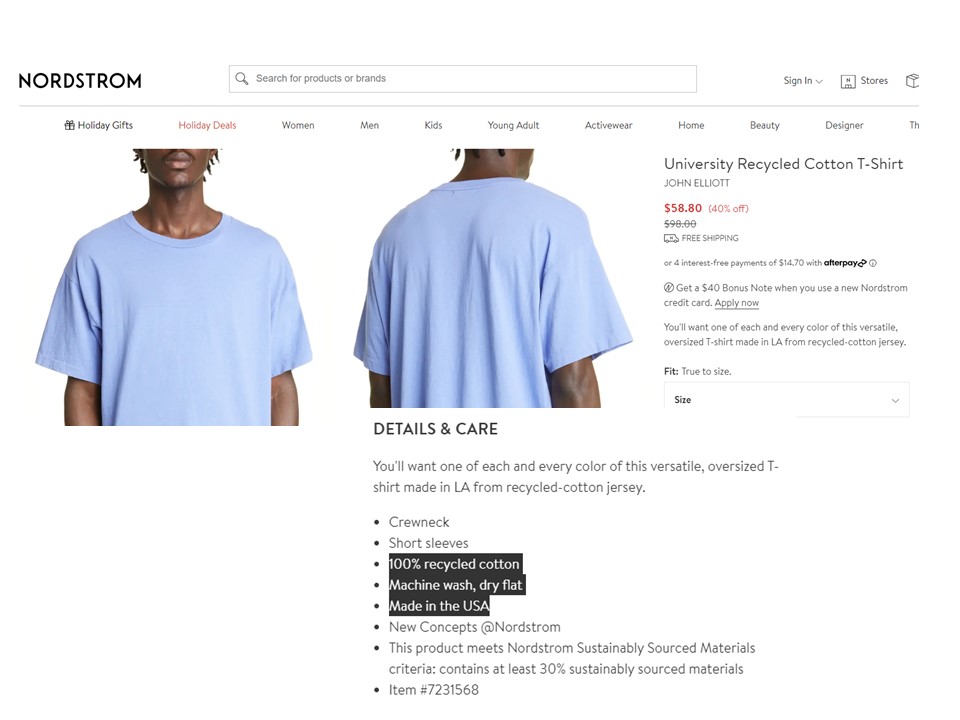
This study was based on a statistical analysis of 3,307 randomly selected clothing items made from recycled textile materials for sale in the U.S. retail market between January 2019 and August 2022 (see the sample picture above). The results show that:
First, U.S. retailers sourced clothing made from recycled textile materials from diverse countries.
Specifically, the sampled clothing items came from as many as 36 countries, including developed and developing economies in Asia, America, the EU, and Africa.
However, reflecting the unique supply chain composition of clothing made from recycled textile materials, U.S. retailers’ sourcing patterns for such products turned out to be quite different from regular new clothing. For example, whereas the vast majority (i.e., over 90%) of U.S. regular new clothing came from developing countries as of 2022 (UNComtrade, 2022), as many as 43% of the sampled clothing items made from recycled textile materials (n=1,408) were sourced from developed countries. Likewise, U.S. retailers seemed to be less dependent on Asia when sourcing clothing made from recycled materials (41.9%, n=1,387) and instead used near-sourcing from America (30.1%, n=994) more often, particularly domestic sourcing from the United States (14.8%, n=490).

Second, U.S. retailers appeared to set differentiated assortments for products imported from developed and developing countries when sourcing clothing made from recycled textile materials.
Among the sampled clothing items made from recycled textile materials, those imported from developing countries, on average, included a broader assortment than developed economies. Likewise, imports from developing countries also concentrated on products relatively more complex to make as opposed to developed countries. Developing countries’ more extensive clothing production capability, including the available production facilities and skilled labor force, than developed economies could have contributed to the pattern.
On the other hand, likely caused by developed countries’ overall higher production costs, the average retail price of sampled clothing items sourced from developed countries was notably higher than those from developing ones. However, NO clear evidence shows that U.S. retailers used developed countries primarily as the sourcing bases for luxury or premium items and used developing countries only for items targeting the mass or value market.
Third, an exporting country’s geographic location was another statistically significant factor affecting U.S. retailers’ sourcing pattern for clothing made from recycled textile materials. Specifically,
- Imports from Asia had the most diverse product assortment (e.g., sizing options) and focused on complex product categories (e.g., outwear) that targeted mass and value markets.
- Imports from America (North, South, and Central America) concentrated on simple product categories (e.g., T-shirts and hosiery) with moderate assortment diversity and mainly targeted the mass and value market.
- Imports from the EU were mainly higher-priced luxury items in medium-sophisticated or sophisticated product categories with diverse assortment.
- Imports from Africa concentrated on relatively higher-priced premium or luxury items in simple product categories (i.e., swim shorts) with a limited assortment diversity.
The study’s findings demystified the country of origin of clothing made from recycled textile materials hidden behind macro trade statistics. The findings also created critical new knowledge that contributed to our understanding of the supply chain of clothing made from recycled textile materials and U.S. retailers’ distinct sourcing patterns and affecting factors for such products. The findings have several other important implications:
First, the study’s findings revealed the broad supply base for clothing made from recycled textile materials and suggested promising sourcing opportunities for such products. Whereas existing studies illustrated consumers’ increasing interest in shopping for clothing made from recycled textile materials, the study’s results indicated that the “enthusiasm” also applied to the supply side, with many countries already engaged in making and exporting such products. Meanwhile, the results showed that U.S. retailers sourced clothing made from recycled textile materials in different product categories with a broad price range targeting various market segments to meet consumers’ varying demands. Moreover, as textile recycling techniques continue to advance, potentially enriching the product offer of clothing made from recycled textile materials, U.S. retailers’ sourcing needs and supply base for such products could expand further.
Second, the study’s findings suggest that sourcing clothing made from recycled textile materials may help U.S. retailers achieve business benefits beyond the positive environmental impacts. For example, given the unique supply chain composition and production requirements, China appeared to play a less dominant role as a supplier of clothing made from recycled textile materials for U.S. retailers. Instead, a substantial portion of such products was “Made in the USA” or came from emerging sourcing destinations in America (e.g., El Salvador, Nicaragua) and Africa (e.g., Tunisia and Morocco). In other words, sourcing clothing made from recycled textile materials could help U.S. retailers with several goals they have been trying to achieve, such as reducing dependence on sourcing from China, expanding near sourcing, and diversifying their sourcing base.
Additionally, the study’s findings call for strengthening U.S. domestic apparel manufacturing capability to better serve retailers’ sourcing needs for clothing made from recycled textile materials. On the one hand, the results demonstrated U.S. retailers’ strong interest in sourcing clothing made from recycled textile materials that were “Made in the USA.” Also, the United States may enjoy certain competitive advantages in making such products, ranging from the abundant supply of recycled textile waste and the affordability of expensive modern recycling machinery to the advanced research and product development capability. On the other hand, the results showed that U.S. retailers primarily sourced simple product categories (e.g., T-shirts and hosiery), targeting the value and mass markets from the U.S. and other American countries. This pattern somewhat mirrored the production and sourcing pattern for regular new clothing, for which apparel “Made in the USA” also lacked product variety and focused on basic fashion items compared with Asian and EU suppliers. Thus, strengthening the U.S. domestic apparel production capacity, especially for those complex product categories (e.g., outwear and suits), could encourage more sourcing of “Made in the USA” apparel using recycled textile materials and support production and job creation in the U.S. apparel manufacturing sector.
by Sheng Lu
Full paper: Lu, S. (2023). Explore U.S. retailers’ sourcing strategies for clothing made from recycled textile materials. Sustainability, 15(1), 38.


 FASH455 Global Apparel & Textile Trade and Sourcing
Recycled textile materials are a leading trend in the fashion industry. From reading this article, I believe that while the fashionable circular design is still in its infancy, the “green” innovation path of investing in the future of new eco-friendly/sustainable fabrics through the use of recycling systems will dominate.
The newest trend of utilizing recycled textiles could be an encouraging step in the right direction in regard to fashion sustainability. However, after reading this article, I have my concerns. First, the article states that the recycled apparel is often sourced from developing nations based on their cheap labor as well as their already substantial apparel labor force. This is a concern because these countries often times have extremely poor working conditions and lackluster environmental safety regulations. By sourcing from these nations, this new sector of fashion may be perpetuating a cycle of abuse. Also, another concern is that textile recycling will become a bandage for unsustainable apparel brands to lean on rather than fix their unjust practices. Fast fashion companies are pumping out huge quantities of apparel everyday. By marketing their fabrics as “recyclable” they can greenwash consumers into thinking they are ethical, when in reality they have not made any true alterations to their business model. While recycling is important, the fashion industry must work towards creating fair working conditions in developing countries through mandated industry wide policy and regulation, as well as focus on creating garments with high longevity in smaller quantities.
Great comment! I am also concerned about poor working conditions of garment workers in developing countries. In relating your comment back to the 2-3 case study about sourcing from Bangladesh, I think it is evident that countries are still benefitting from lower costs, and not putting the garment workers at front of mind. In the article, it stated that the apparel industry in Bangladesh is booming, and the country is the second largest exporter, but I feel like this only goes so far. At the end of the day, the workers are what make this industry succeed and if their needs and wellbeing are not met, then I do not think you are sourcing responsibly or ethically, even if you are making products of recyclable materials.
I found this study of clothing made from recycled textile materials to be informative. Although these days we are aware of clothing made from recycled materials, I didn’t realize that this clothing is already being produced in 36 countries. The different sourcing pattern for clothing made from recycled textile materials imported from developed countries (43%), using near- and domestic-sourcing, as compared to new clothing imported from developed countries (less than 10%) is interesting. I think this pattern could lead to some good opportunities for the US. One benefit of more sourcing in developed countries is less dependence on China with its possible environmental and social concerns. Near- and domestic-sourcing also has added benefits of being able to more easily verify conditions concerning factories, ship more quickly, and take advantage of FTAs. There is an opportunity for an additional way to help restructure both the textile and apparel industries: creating a new ‘niche-like’ market by recycling materials, manufacturing the fabrics made from recycled textile materials, and increasing the manufacturing of recycled clothes made from these materials. US capital could be invested in the required recycling machinery and sewing machinery to do this, in either the US or other CAFTA-DR and USMCA countries. With this new market, the textile and apparel industries in the Western Hemisphere could expand, creating new jobs.
I think it is important to see that both developed and developing countries are both taking part in producing clothing made from recycled textile materials. I think that, with sustainability being such a crucial part of the fashion industry, this is definitely a good step to making progress to become more sustainable. Also, I think it is interesting to note that there is a more broad assortment of clothing using recycled materials when importing from developing countries compared to developed countries. Aside from just the environmental impacts, since the US has a goal to become more self-sufficient, using recycled materials actually are benefiting the US in terms of the US being less dependent on China for products. This shows that using recycled materials has various benefits in so many different areas. From a consumer standpoint, I think that moving forward, more consumers are looking to purchase more sustainable clothing, and this will enable consumers to be more conscious of how their purchases are impacting the environment.
I really enjoyed reading this article and the perspective brought regarding the sourcing of recycled textiles. I thought it was very interesting to learn that as consumers desire for recycled materials increased, the supply side of the industry also increased their emphasis as well. This study supported the trade pattern that reoccurs often which includes more developed countries providing the recycled textiles because they are more advanced, and developing countries takeover the manufacturing of regular new clothing. I found the results of this study to be very intriguing because it showed that regions in Asia, America, EU, and Africa have all been seen to shift their focus to producing these types of garments. This proves that there is a lot of potential growth for this new market and it makes me happy that trends are starting to revolve around being sustainable both by the consumers and suppliers around the world.
I thought this study was really interesting and informative – I especially was intrigued by the part about the assortment of recycled clothing being sourced from less developed countries. This was a shock to me because we learned in the modules about many different supply chains where the less developed countries, for example, those in CAFTA-DR, usually manufacture basic pieces of apparel in bulk. In the case of this article, it explains how less developed countries are manufacturing a bigger assortment of clothing from recycled materials, rather than those basic pieces. I think if CAFTA-DR countries that are more labor-intensive take on this manufacturing practice then their assortment of goods would increase, considering the diversity of their products is currently lacking.
It was interesting to consider in this article that, compared to developed countries, imports from developing countries included a broader and more complex assortment of apparel among the sampled clothing items made from recycled textile materials. We now know that this is because they have more extensive clothing production capabilities and a skilled labor force. It was fascinating to discover how data may enhance our comprehension of the supply chain for garments created from recycled textiles and the distinctive sourcing patterns and influencing factors for such products among U.S. shops. It would be wise for the country to support production and promote job creation in the U.S. garment manufacturing sector by sourcing “Made in the USA” apparel utilizing recycled textile resources. Recycling is crucial, but the fashion industry must also focus on making sustainable clothes and work to require industry-wide policies and regulations that will lead to equitable working conditions in developing nations.
This was an interesting read to relate back to some of the trade and sourcing discussions from class. Most people wouldn’t typically associate sustainable or recyclable products being sourced from Asia and developing countries; however I was a little surprised by the first part of this study. For instance, out of the many U.S. retailers researched, a large percentage of their recyclable goods were sourced from developed countries. Furthermore, our conversations about near-shoring and sourcing diversification could support business opportunities for apparel companies. Likewise, companies can alter their sourcing patterns with more flexibility and efficiency through diversifying their supply chains or sourcing domestically. In the world today, sustainability has become a key driver, not only for consumers but for business partners as well in order to uphold this social responsibility. Moreover, companies must work through sourcing challenges to expand their processes in order to stabilize quality and cost effectiveness, while delivering sustainable and recyclable products.
With second hand shopping being so popular today, I’m not surprised that sourcing recycled materials became more popular within the fashion industry. Consumers become more interested in sustainable fabric and sourcing methods as the years go by, so this trend will probably continue to increase for a long time. However, the issue of sustainable sourcing methods is still prominent, because as this article demonstrates, not all fashion companies are spreading out or diversifying their sourcing and production locations, which increases workers’ risks of poor working conditions. By diversifying, fashion companies can reduce risk and eliminate losses in costs and resources.
As many as 36 countries both developed and developing are making clothing from recycled textile materials. The U.S. producing clothing made from recycled materials is a great push towards sustainability. Also, if the U.S. sources clothing made from recycled textile materials it could be very beneficial. It would reduce their dependence on sourcing clothes from China. Rather than sourcing from China, the U.S. could increase near-shoring and varying their sourcing bases. If the U.S. is able to add diversity in the clothing it creates, similar to Asia and the EU, and promotes apparel “Made in the USA” then it could support production and job creation in the U.S.
I also agree that brands are finally starting to realize a trend in sustainability, and I think a big trend on the rise is Upcycling. A big brand that currently does this is Cotopaxi, who takes fabric scraps and makes bags out of them at the mass production scale. I also see a lot of smaller brands Upcycling, and this is cool to see all the possibilities of Upcycling. The brands that do not look to this are missing a big opportunity because the last thing we need as a society is more clothes being produced. Upcycling is a way to eliminate a ton of potential waste, and the more companies that do this, the better.
Hi Tara, I completely agree with your comment you have made! I am also not surprised that brands are using the sourcing strategy of recycled materials now. This sourcing strategy helps combat the issues of sustainability and environmental compliance that this industry does have issues with. However, there are still concerns of ethical compliance and treatment of workers. Fashion brands and companies need to address these concerns in order to create fair working conditions for their employees.
I found this article interesting because of the diversity of sourcing in recycled material products and how the product assortments vary depending on country of origin. However, there are implications due to the countries being sourced from are developed countries that provide cheap labor which counteracts the sustainability of the recycled materials. I think the article does a great job highlighting what the US could do to strengthen our manufacturing and cater to the market for clothing made with recycled materials.
I found this article very interesting because it discusses innovations in the fashion industry. As fashion is such a circular business, and trends come and go as consumers buy and discard items, it is the perfect industry to start creating recycled clothing.
By creating clothing from recycled materials the fashion industry could become much more sustainable, and reduce their impact on the environment greatly. In addition, companies who implement this will be met with consumers excited to feel good about their purchases.
New innovations in fashion are always exciting, especially this as it has a positive impact on the world.
This article was very informative about how US fashion brands and companies are taking part in sustainable practices by using recycled textile materials in their sourcing strategies. This article highlights how US retailers have sourced recycled materials from 36 countries, with these materials coming from a mix of both developed and developing countries. I find it very imperative to create strategies that are sustainable and environmentally friendly. With the fashion industry having a long track record of being wasteful, now more than ever, it is important for companies to create sustainable practices to combat this issue. This article highlights importance of sustainable practices, with a sourcing strategy of using recycled textile materials being very imperative to the future of this industry. As a consumer, this strategy would make me be a loyal customer to a company; knowing that a fashion brand is environmentally conscious makes me not feel guilty about purchasing from them. I believe that this sourcing strategy is sufficient for the future of this industry.
This article highlights a huge shift in sustainability in the fashion industry, largely driven by consumer demand for sustainable fashion. US retailers source clothing made from recycled textiles from 36 countries. I found it very interesting that it was also stated that 43% of recycled clothing are sourced from developed countries. Due to this there has been a huge shift toward near sourcing as US retailers reduce dependence on asian suppliers.
I thought that this article was well researched on the topic of the emerging sourcing strategies when it comes to clothing made from recycled materials. The fashion industry is being pressured into finding more ways to become sustainable and have ethical production. As mentioned in the article, data is helping U.S. retailers restructure their supply chains in order to meet environmental goals and be more sustainable. However, retailers are struggling to find the balance between cost efficiency, sustainable practices and how they are different from other brands. Consumers are looking towards brands who are transparent. Therefore, companies are focusing more on proving that they are sustainable through providing facts and traceability in their supply chains. One thing I liked about this article is how it raised the question of how brands will continue to expand on their sustainability efforts long term. Brands currently have a small section of recycled materials but will they expand into a larger section within their stores? I’m curious to see how companies continue to enhance their sustainability efforts in the future.
This study fills a real gap in how we talk about recycled textiles. Most debates stay on the demand side, but your product-level data show that supply is already broad and quite active across 36 countries.
I find the contrast with “regular” apparel sourcing especially important. Less China dependence, more “Made in the USA,” and more near sourcing from El Salvador, Nicaragua, Tunisia, and Morocco show that recycled content supports many of the risk goals that retailers claim to have.
The point on product complexity and domestic limits feels very practical. If the U.S. wants more recycled outerwear and tailored items with a “Made in USA” label, it needs investment in capacity, not just marketing about circularity. This paper gives policy makers and brands a concrete map of where recycled-textile sourcing stands today and where new support can have the most impact.
One key takeaway from this for me is how sourcing recycled-material apparel could overall support broader business goals. The main goal it could support is reducing dependence on countries like China and expanding the supply chain.