What Do We Know about Shein’s Sourcing and Supply Chain Strategies from Its IPO Filing?

According to Reuters, Shein has received the necessary approvals to proceed with its Hong Kong IPO, which could take place as early as this fall. As part of the IPO process, Shein has disclosed detailed information about its business operations. The following analysis focuses specifically on the company’s sourcing strategies and supply chain practices.

Overview of Shein’s market and financials

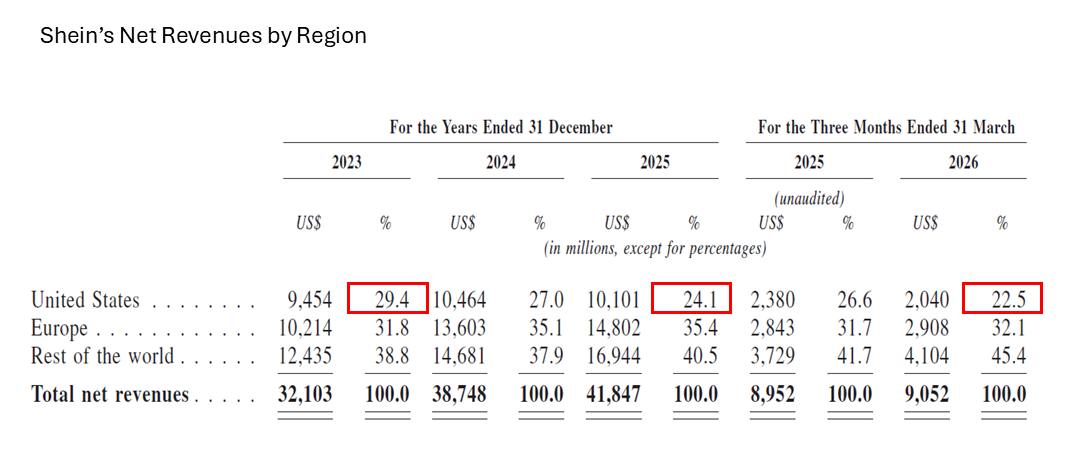
According to the IPO filing document, Shein serves “more than 273 million active consumers in approximately 160 markets across the world.” In the first quarter of 2026, about 22.5% of Shein’s net revenue came from the US, down from 24.1% in 2025, 27.0% in 2024, and 29.4% in 2023. Over the same period, the EU (about 32.1% in Q1 2026) and the rest of the world (about 45.4% in Q1 2026) accounted for a larger share of Shein’s revenue.
Shein’s gross margin increased from 60.6% in 2024 to 67.9% in 2025 and 70.4% in Q1 2026. This increase partly reflects Shein’s growing third-party marketplace business, in which Shein generally records only “service fees” from third-party merchants rather than the full value of merchandise sold, and does not incur merchandise cost of sales on those transactions. Thus, the increase in gross margin reflects, at least in part, a shift in business mix rather than a comparable improvement in the merchandise profit margin.

Meanwhile, Shein’s net profit margin declined from 8.7% in 2024 to 4.9% in 2025 and a negative 1.1% in Q1 2026. The pressure is particularly evident in fulfillment costs, which increased from around 42% of revenue between 2023 and 2024 to 45.6% in 2025 and 47.7% in the first quarter of 2026. Shein subsequently recorded a net loss of US$99 million in the first quarter of 2026.

What is Shein’s LATR Model?

Behind Shein’s “ultra fast fashion” is what it calls the “Large-scale Automated Test and Reorder (LATR) operating model.” Under this approach, new products are initially produced in batches of approximately 100–200 units, and demand is evaluated using real-time customer data. Products that perform well are replenished rapidly, often within five days. Shein believes this system enables it to simultaneously offer an extremely broad assortment, rapid product refreshment, and low inventory levels, the three objectives that traditional apparel retailers often struggle to achieve.

Warehouses play a critical role in Shein’s LATR model and supply chain. According to the company, it has approximately 6 million square meters of warehouse space across Asia, North America, Europe, the Middle East, and South America as of 30 June 2026. Once Shein’s supply chain partners produce a small batch of products, that batch is shipped to one of Shein’s warehouses. Upon receiving customer orders, Shein packages and ships products directly from its warehouses to customers around the world. Shein has also been increasing its efforts to establish new warehouses around the world to be closer to the markets it serves.

Where are Shein’s apparel products mostly made?

As of 2025, Shein works with 7,500 contract manufacturers as well as “large numbers of merchants, independent designers and other suppliers.” Most of Shein’s partners are small and medium-sized enterprises (SMEs). This suggests that instead of relying on a small number of vertically integrated factories, Shein leverages a large, fragmented, and flexible supplier network. The advantage of SMEs is that they can specialize in particular products or production processes and have unused capacity that can be activated when demand suddenly increases.

Shein also admits that its supply network is “built on a distributed footprint of supply chain and fulfillment locations anchored by a central logistics hub in China.” “In 2025, products stored in our central warehouses in the Chinese mainland represented over 90% of our net revenues.”

Furthermore, unlike most Western fashion brands and retailers, which are pursuing a strategy of “reducing China exposure” and “sourcing diversification,” Shein’s IPO filing document does not indicate a large-scale shift of its production away from China.

What are Shein’s key supplier selection criteria?

Shein says its suppliers do not have to be exclusive. Instead, contract manufacturers are permitted to supply other companies. No individual supplier accounted for more than 10% of Shein’s total purchases, and the five largest suppliers together represented only 14.9%–16.4% of Shein’s purchases from 2023 to 2025.

Shein allocates sourcing orders in part based on each supplier’s expertise, not solely on price. According to Shein, “our cloud-based software solutions enable suppliers to be fully digitally integrated with our supply chain from end to end, giving us full-chain visibility. This allows us to automatically allocate orders to suppliers based on expertise, price, capacity and other factors, helping suppliers maximize capacity utilization.” Thus, Shein’s supplier network seems to be differentiated by production capabilities rather than treated as a pool of interchangeable factories.

Shein also expects its suppliers to be flexible and nimble, with the ability to produce small initial batches and rapidly scale up production when demand is demonstrated. According to the company, “because an initial production batch consists of approximately 100 to 200 items, we can quickly launch a large number of new products with minimal upfront commitment, inventory risk, and resource waste. If a product sells well, we can rapidly scale up its production to meet consumer demand. We can rapidly launch small initial batches, and restock products that are in demand in as few as five days.”

Overall, Shein’s business model means it needs a network of specialized factories with flexible capacity. Its technology essentially acts as the coordination mechanism connecting those factories to rapidly changing demand. Shein also says it connects with its suppliers closely and deeply through digital technologies. Shein argues that such integration helps its suppliers “enjoy more predictable order flow, improved asset utilization and higher returns on investment, even with small batch production.”

How have de minimis removal and tariffs affected Shein?

Shein acknowledged that the removal of the U.S. de minimis exemption has already reduced its U.S. sales, slowed company-wide revenue growth, and increased fulfillment expenses. Shein says it is also aware of the EU de minimis rule changes.

In response to the removal of de minimis, Shein says it “for products previously eligible for the de minimis exemption, we have transitioned from a simple customs entry process for de minimis packages to a customs clearance process that requires more extensive documentation and procedures. Amongst other things, we have adopted necessary protocols for the formal entry process to ensure compliance with the more stringent documentation and other procedural requirements”

Regarding tariffs, Shein says “As a result of the recent developments, our China-origin products have become subject to tax rates ranging from 10% to 87.5% (increased from 0-62.5% during the Track Record Period prior to the removal of the de minimis exemption and the Trump Administration’s recent imposition of additional tariffs).

To mitigate the tariff impacts, Shein has been “pursuing a wide range of options, including increasing our prices in the U.S. market to offset a portion of the increased.”

How does Shein see the impacts of environmental regulations? How does sustainability fit its business model?

Shein argues that its demand-driven production system reduces overproduction by producing only small initial batches and replenishing products only after actual consumer demand has been observed. According to the company, this approach minimizes excess inventory, lowers waste, and improves profitability simultaneously. In other words, sustainability is portrayed as aligned with operational efficiency rather than being a cost imposed by regulation.

However, reducing unsold inventory is distinct from addressing the broader environmental impacts associated with the high-volume apparel overconsumption problem.

In the IPO filing document, Shein also introduces the company’s evoluSHEIN sustainability roadmap, which includes responsible design, material sourcing, circularity initiatives, and decarbonization efforts across the value chain. Shein intends to integrate sustainability into product development, manufacturing, and logistics while continuing to emphasize affordability and efficiency.

Supplier auditing

According to Shein, under its Responsible Sourcing (“SRS”) program, suppliers are audited by both in-house teams and internationally renowned third-party auditors, including Bureau Veritas, Intertek, Openview, SGS, TÜV Rheinland, and QIMA, all members of the Association of Professional Social Compliance Auditors. Shein ran roughly 4,200, 4,550, and 5,150 SRS on-site audits in 2023, 2024, and 2025, respectively, covering contract manufacturers representing about 95% of company-branded procurement value each year.  In 2025, over 99% of Shein’s on-site SRS audits were conducted by third-party auditors.

Additionally, Shein discloses that 5, 12, and 5 suppliers were terminated in 2023, 2024, and 2025, respectively, for SRS policy violations. The supplier code of conduct is said to align with the International Labor Organization (ILO) core conventions and the UN Universal Declaration of Human Rights.

However, in the IPO filing document, Shein didn’t mention anything related to forced labor risk, Xinjiang cotton, or UFLPA-related compliance.

What important business issues does Shein see over the next few years?

According to the IPO filing document, Shein sees its future success as depending on the company’s ability to continue expanding internationally while adapting to increasingly complex trade and regulatory environments. Shein regards investments in technology, artificial intelligence, supply chain resilience, fulfillment infrastructure, and marketplace expansion as central strategic priorities.

Importantly, Shein acknowledges that “we have grown rapidly since our inception, and there is no assurance that our growth will continue. In particular, we recorded a net loss of US$99 million for the three months ended 31 March 2026, and there is no assurance that we will achieve or maintain profitability in the future.”

Shein also noted that international tensions are expected to “escalate at an accelerated pace,” potentially creating additional barriers to trade. Its China-based sourcing model therefore represents a strategic vulnerability, even if maintaining production in China remains economically advantageous. As Shein acknowledged, “We sell products to a large number of countries and regions around the world, including the United States and Europe. Currently, the substantial majority of the products sold by us or on our marketplace originate from the Chinese mainland. Tariffs and other trade restrictions imposed by any country where we sell products, particularly on products shipped from China, could significantly hinder our ability to sell products to that country.”

by Sheng Lu

Related reading: Wearing thin: Five things to know about Shein (Udaily, Aug 2026)
Shein Lost Market Share in the U.S. Apparel Retail Market in 2025 Amid Trade Tensions

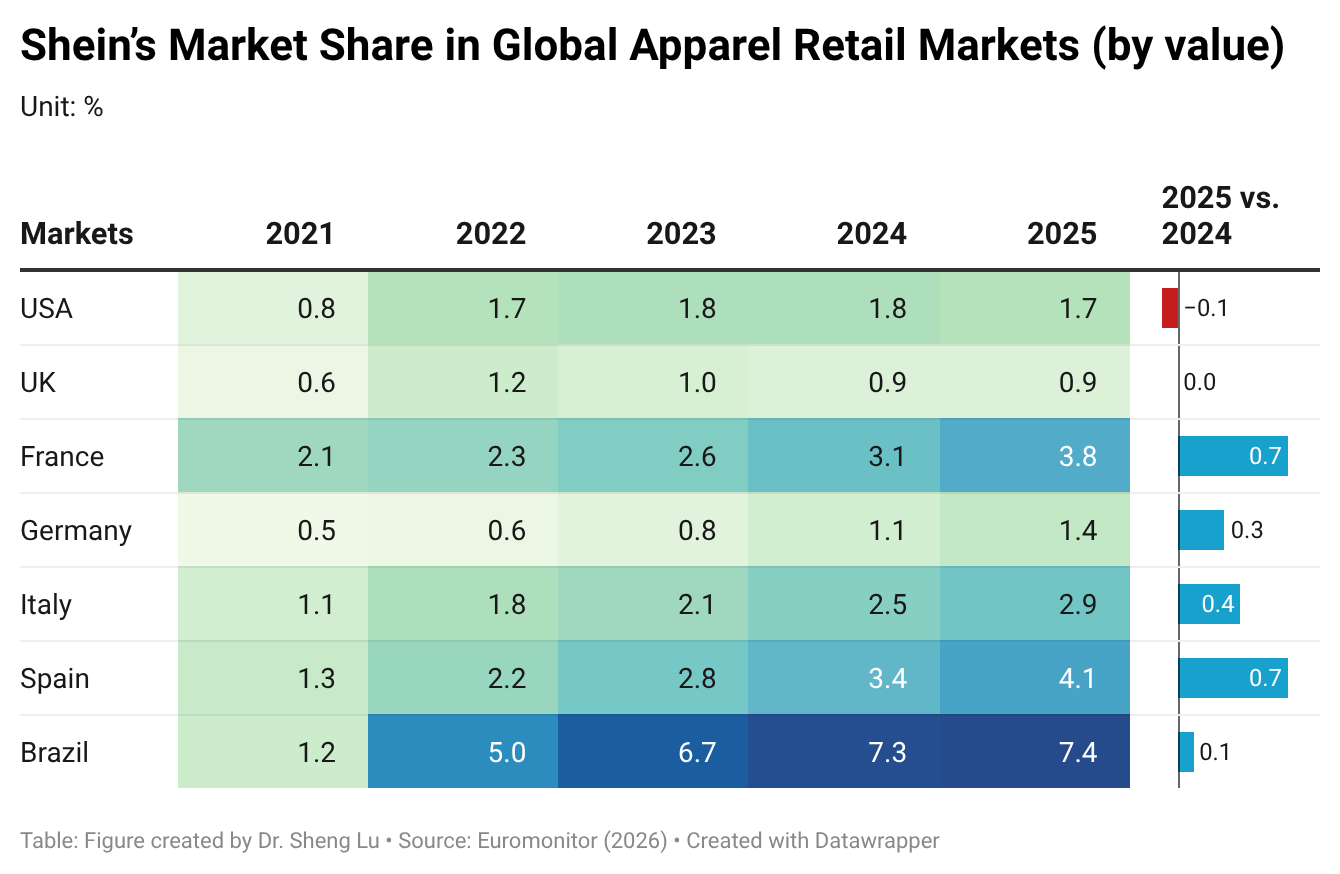
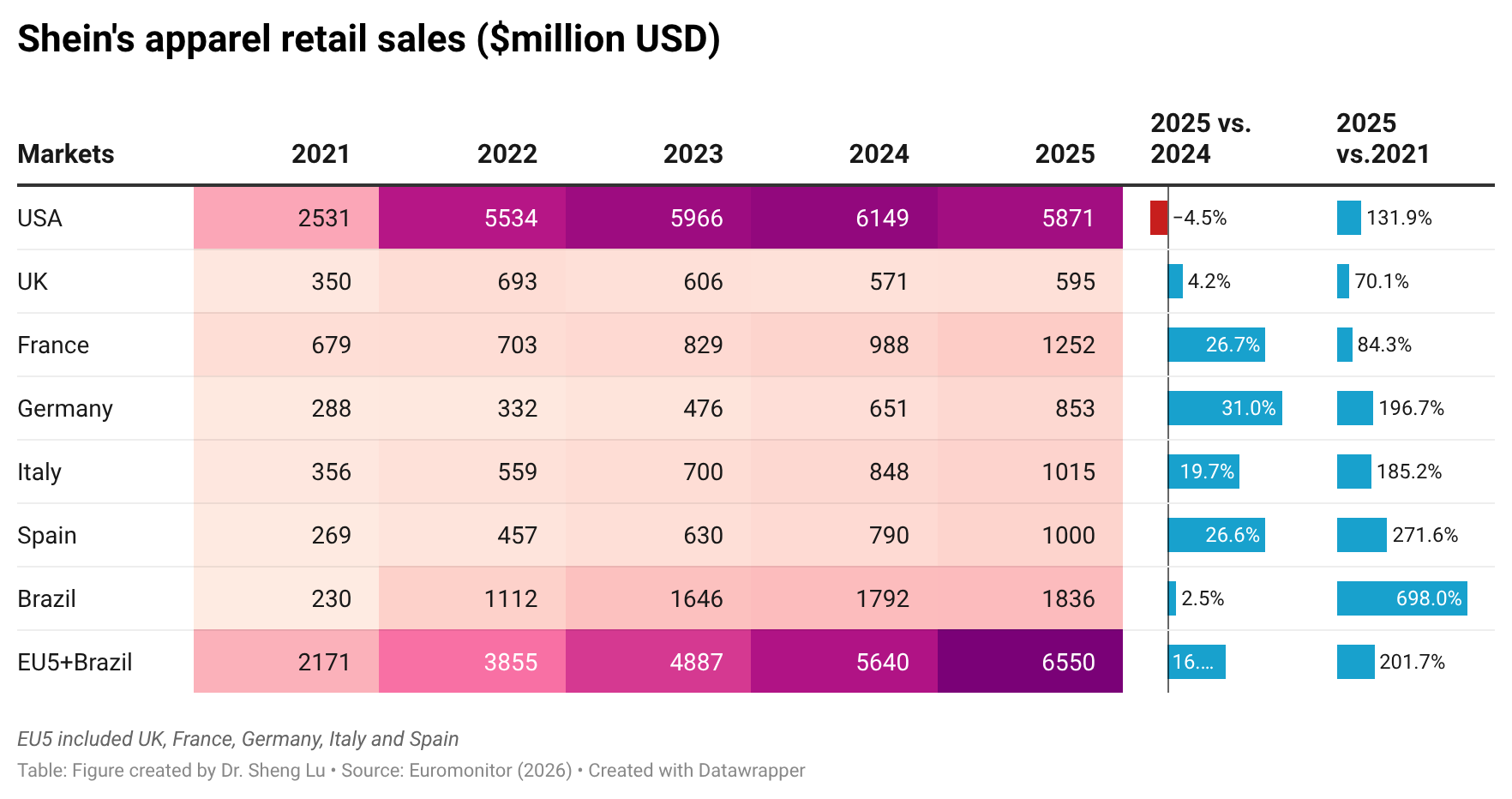
Latest Data from Euromonitor shows that while the United States remained Shein’s largest apparel sales market in 2025, the value of sales declined by 4.5%, affected by factors such as higher tariffs on Chinese products, the elimination of the “de minimis” rules, and young U.S. consumers’ growing concern about sustainability. Based on the value of sales, Shein’s market share in the U.S. also dropped from 1.8% in 2024 to 1.7% in 2025, the first time since 2021.

Shein’s business outlook in the U.S. is expected to remain challenging in 2026 due to ongoing high tariffs affecting imports from China, tighter regulations and enforcement on cross-border e-commerce shipping, and consumers’ increasing demand for sustainable apparel products and supply chain transparency.

Amid headwinds in the US, Shein is diversifying its sales markets in the rest of the world. For example, Shein achieved more apparel retail sales in key EU markets in 2025, including the UK (up 4.2%), France (up 26.7%), Germany (up 31%), Italy (up 19.7%), and Spain (up 26.6%). Likewise, Shein’s sales in Brazil increased by over 698% between 2021 and 2025, much higher than 131% in the US.

As of 2025, Shein’s total apparel sales in the UK, France, Germany, Italy, Spain, and Brazil (around 6.5 billion USD) already surpass the sales in the US (around 5.9 billion). It is likely that emerging markets like Brazil will become increasingly important to Shein’s future global expansion due to the price competitiveness of Shein’s products in local markets, the relatively relaxed regulatory environment, and the attractiveness of Shein’s commitment to investing in production there.

Additional reading: Inside the Chinese factories of fast-fashion giant Shein (by FRANCE 24 English | February 2026)

FASH455 Video Discussion: Textiles, Trade & National Security: A Conversation with Parkdale Mills COO Davis Warlick

For FASH455 class: When writing your blog comment, consider addressing the following aspects:

  • #1 Based on the video, how do CAFTA-DR and USMCA help shape the Western Hemisphere textile and apparel supply chain?
  • #2 Based on the video, what do you see as the main opportunities for textile and apparel nearshoring or reshoring in the Western Hemisphere? How about the key bottlenecks (e.g., cost, infrastructure, labor, sustainability, or trade policy)?
  • #3 The speaker argues for a sectoral trade policy for textiles and apparel rather than broad “free trade.” What is your evaluation?
  • #4 How does the video help deepen your understanding of the complex economic and non-economic factors related to textile and apparel nearshoring and reshoring in the Western Hemisphere?

FASH455 Exclusive Interview with Nicole Bivens Collinson, Managing Principal and Practice Leader of International Trade and Government Relations, Sandler, Travis & Rosenberg, P.A.

About the interview

When learning about apparel sourcing and trade, our students often notice how much they are affected by trade policies and regulations—from tariffs, and something called “de minimis” to UFLPA. These issues are not only critical for fashion companies but can also be quite technical.

We are fortunate to have Nicole Bivens Collinson, Managing Principal and Practice Leader of International Trade and Government Relations of Sandler, Travis & Rosenberg, P.A. (ST&R), a true expert in trade policy and the legal aspects of trade, join us. In the interview, Nicole clarified key U.S. trade rules and provided valuable insights into their apparel sourcing and trade implications, including:

  • What is a tariff, and why is it a big issue for US fashion brands and retailers?
  • Why have the so-called IEEPA “reciprocal tariffs” imposed by the Trump administration so far this year raised so many concerns?
  • What does the term “transshipment” mean in international trade? And why did this issue emerge in the context of higher tariffs this year?
  • What is the “20% US content” rule and its implications for fashion companies?
  • What is “tariff engineering”? Is it legal or illegal? How have fashion companies used it to mitigate the tariff impacts, potentially?
  • What is de minimis? Why was it created, and then became controversial? Since the “de minimis” rule was officially terminated recently, what impacts could we expect now? 
  • What is the Uyghur Forced Labor Prevention Act (UFLPA) and what does it aim to do? How has the implementation of the UFLPA affected U.S. fashion companies’ apparel sourcing?
  • For fashion students interested in working in trade compliance, trade policy, or the legal aspects of the fashion industry, what steps can they take to get started?

About Nicole Bivens Collinson

Nicole Bivens Collinson is the Managing Principal and Practice Leader of International Trade and Government Relations with Sandler, Travis & Rosenberg, P.A. (ST&R). Nicole is a commentator on trade matters on MSNBC, NPR, and BBC the producer of the Two Minutes in Trade podcast.

Nicole has nearly 40 years of experience in government and public affairs and lobbying. She prepares countries, companies, and associations for negotiations with the United States on free trade agreements, trade and investment agreements, labor disputes, and preferential trade programs.

Prior to joining ST&R, Nicole served as assistant chief negotiator for the Office of the U.S. Trade Representative, responsible for the negotiation of bilateral agreements with Latin America, Eastern Europe, Southeast Asia, the Sub-Continent, and Africa. She also served as a country specialist in the International Trade Administration at the Department of Commerce, where she was responsible for the preparation of negotiations on specific topics between the U.S. and Latin America, Eastern Europe, China, and Hong Kong as well as the administration of complex textile agreements.

Nicole holds a master’s degree in international relations from The George Washington University and a triple bachelor’s degree in political science, European studies, and French from Georgetown College. She also studied at the Université de Caen in France.

Nicole is past chair of the Women in International Trade Charitable Trust, past president of Women in International Trade, an advisory board member of America’s TradePolicy.com, treasurer and board member of the Washington International Trade Association, and a member of the Washington International Trade Association Foundation and Women in Government Relations. She serves on the board of trustees for Georgetown College and is the past executive director for the U.S. Hosiery Manufacturers Coalition, the U.S. Apparel Industry Coalition, and the U.S. Sock Distributors Coalition.

About Katie Yasik (moderator)

Katie Yasik is a master’s student & graduate instructor in Fashion and Apparel Studies (FASH) at the University of Delaware (UD). Katie graduated from UD & FASH with a B.S. in Fashion Design and Product Innovation & Sustainable Apparel minor. Driven by her strong passion for sustainability, she interned with the Worldwide Responsible Accredited Production (WRAP) in Spring 2024.

FASH455 Video Discussion: This ‘Loophole’ Lets $54B of Products Into the U.S. Tariff-Free (WSJ)

Discussion questions:

  1. What makes the de minimis rule controversial?
  2. Who might be the winners and losers of the suspension of the de minimis provision for U.S. imports from China? Why?
  3. Imagine you are part of the sourcing department of a U.S.-based fashion company that currently sources from China. How would you respond to the situation in the video, and what recommendations would you make regarding your company’s sourcing strategies?
  4. Do you have any other thoughts or reflections on the video?

Additional reading:

Event Recording: Regulating and Reforming De Minimis (October 2024)

The event was hosted by the Washington International Trade Association on October 9, 2024

Panelists

  • Ralph Carter, Staff Vice President, Regulatory Affairs, FedEx
  • Kim Glas, President & CEO, National Council of Textile Organizations; Commissioner, U.S.-China Economic and Security Review Commission
  • Melissa Irmen, Director of Advocacy, NAFTZ-National Association of Foreign-Trade Zones
  • John Pickel, Senior Director, International Supply Chain Policy, National Foreign Trade Council
  • Felicia Pullam, Executive Director, Office of Trade Relations, U.S. Customs and Border Protection
  • Ana Swanson, Trade and International Economics Reporter, The New York Times (Moderator)

Event summary: Competing views about de minims and its reform

Arguments supporting De Minimis: Proponents like Ralph from FedEx argue that de minimis reduces trade friction, drives international supply chain efficiency, and allows U.S. companies to offer competitive pricing through free returns and streamlined customs processes. Meanwhile, they argue that the de minimis supports low-income U.S. consumers and enables small U.S. businesses to remain competitive.

Criticism of De Minimis: Critics, including Kim Glas from the National Council of Textile Organizations (NCTO), argue that it undercuts U.S. manufacturers, especially in industries like textiles, by allowing cheap imports from countries like China, often bypassing tariffs and safety regulations. They also say that de minimis was unfair to U.S. retailers that pay millions of dollars of tariff duties. Additionally, there are significant concerns about the safety risks posed by counterfeit goods and dangerous products (e.g., fentanyl) entering under de minimis exemptions.

Challenges of dealing with de Minimis: Felicia from the U.S. Customs and Border Protection (CBP) emphasizes the strain on the agency’s resources due to the sheer volume of de minimis shipments—it surged from about 2.8 million shipments per day in fiscal year 2023 to close to 4 million shipments per day in fiscal year 2024. She highlighted challenges such as the often unreliable information the de minimis imports submitted and the outdated authorities that hinder CBP’s enforcement.

Equal treatment for U.S. Foreign Trade Zones: U.S. Foreign Trade Zones (FTZs) are designated areas within the United States that are considered outside U.S. customs territory for import duties. They allow businesses to import, store, assemble, manufacture, or process goods with deferred or reduced customs duties, which are only paid when goods leave the FTZ and enter U.S. commerce. Currently, U.S. FTZs do not benefit from the de minimis exemption, meaning goods imported directly into the U.S. from overseas warehouses can qualify for de minimis, but goods entering through U.S. FTZs do not.

Melissa Irmen from NAFTZ-National Association of Foreign-Trade Zones advocates for U.S. foreign trade zones to be given the same de minimis privileges as foreign warehouses, arguing that this would ensure better oversight and security while maintaining trade efficiency. Critics, however, say that expanding de minimis in this way would exacerbate the problem rather than fix it.

Reforming the De minimis: There is a push for comprehensive reform of the De minimis system, with proposals ranging from raising duties on certain products to eliminating the exemption altogether for specific categories of goods (e.g., textiles, products subject to Section 301 tariffs).

Particularly, in a face sheet released in September 2024, the Biden Administration announced it would address “the significant increased abuse of the de minimis exemption, in particular China-founded e-commerce platforms.” The announcement said the Biden Administration would issue a Notice of Proposed Rulemaking that would exclude from the de minimis exemption all shipments containing products covered by tariffs imposed under Sections 201 or 301 of the Trade Act of 1974, or Section 232 of the Trade Expansion Act of 1962. The announcement also called for Congress to pass new legislation to reform the de minimis rule comprehensively. 

Related readings:

FASH455 Exclusive Interview with the Office of Trade at U.S. Customs and Border Protection (CBP)

Question 1: We know that nearly 98% of clothing consumed in the U.S. is imported. Can you give our students a quick overview of U.S. Customs and Border Protection (CBP)’s role in regulating international trade, particularly textiles and apparel products?

  • CBP’s Office of Trade facilitates legitimate trade, enforces U.S. trade laws, and protects the United States economy to ensure consumer safety and create a level playing field for American businesses.
  • CBP is responsible for regulating clothing and/or textiles products imported into the United States, ensuring that all trade aspects of the importation are correct at the time of entry. These include, but are not limited to the classification, valuation, country of origin markings, and qualification for preferential duty treatment under a free trade agreement and/or program. 
  • Textiles and wearing apparel are recognized as a Priority Trade Issue as codified in the Trade Facilitation and Trade Enforcement Act (TFTEA) of 2015. As such, this issue is one of the primary drivers for risk-informed investment of CBP resources as well as our enforcement and facilitation efforts. This includes the selection of audit candidates, special enforcement operations, outreach, review of free trade agreements and/or trade preference programs claims, and regulatory initiatives.

Question 2: Ensuring no forced labor in the supply chain is a top priority for U.S. fashion companies. Specifically, the Uyghur Forced Labor Prevention Act (UFLPA) officially came into force in June 2022. For our students who may not be familiar with the UFLPA, what essential information should they know about this legislation and the issue of forced labor? Additionally, could you recommend any helpful online resources?

  • CBP is the leading federal agency in the enforcement of forced labor laws and the UFLPA. The agency achieves this through two approaches – the first is through forced labor investigations and issuance of Withhold Release Orders (WROs) and Findings, which require CBP to prevent the release of goods made with forced labor into the U.S. commerce. The second is through the implementation of the UFLPA rebuttable presumption.
  • CBP enforces U.S. law on forced labor within Section 307 of the Tariff Act of 1930, which says any “goods, wares, articles, and merchandise mined, produced, or manufactured wholly or in part in any foreign country” by convict or forced labor is not permitted entry into U.S. commerce. 
  • In 2016, the U.S. Government enacted the Trade Facilitation and Trade Enforcement Act (TFTEA), which removed the “consumptive demand” clause that was in the original statute. This change allowed CBP to set up its own investigative unit, where CBP receives allegations of forced labor, investigates them using the 11 indicators of forced labor, and issues WROs or Findings when applicable. CBP issues a WRO if there is a reasonable suspicion of forced labor conditions by a particular foreign manufacturer, and it issues a Finding if there is probable cause that forced labor conditions exist.
  • The relatively recent UFLPA establishes a rebuttable presumption that any goods made wholly or in part from the Xinjiang Uyghur Autonomous Region (XUAR) are prohibited from entry into U.S. commerce, as they are presumed to be made with forced labor unless the importer can provide clear and convincing evidence the goods are not made from forced labor or sourced from the XUAR.
  • When goods are exported directly from the XUAR, CBP applies the rebuttable presumption and excludes the goods from entry. Importers then must prove by clear and convincing evidence that the goods are not made with forced labor before they can be released into U.S. commerce. For goods not imported directly from the XUAR, CBP evaluates the risk that the producer uses inputs from the XUAR in the production of the final product and will stop any shipments it deems as high risk of containing materials produced from the XUAR.
  • CBP is committed to identifying products made by forced labor and preventing them from entering the United States. CBP’s enforcement of 19 U.S.C. § 1307 supports ethical and humane trade while leveling the playing field for U.S. companies that respect fair labor standards. The UFLPA is a major shift for importers as it requires them to know their entire supply chains from the raw materials all the way to the end product and to ensure no materials made with forced labor are included at any step along the way. Information on all of these topics and many more are available on CBP’s Due Diligence in Supply Chains webpage.
  • Students can visit our Forced Labor webpage for updated information and resources on CBP’s efforts to prevent goods produced with forced labor from entering U.S. commerce. There is also a specific UFLPA webpage, which explains CBP’s roles and responsibilities and links to the UFLPA Entity List; an UFLPA Statistics Dashboard with information on the number of shipments stopped by CBP by fiscal year, industry, or country of origin; due diligence documents and reports; CBP’s Operational Guidance for Importers, frequently asked questions on UFLPA enforcement and the Department of Homeland Security (DHS) Strategy; and additional links to the DHS Forced Labor Enforcement Task Force Agency Related Resources.    

Question 3: Our students are also intrigued by the so-called ‘de minimis rule,’ which has been a topic of heated debate in the news. Why was this rule proposed initially, and how does it relate to the fashion and apparel trade?

  • De minimis shipments, also referred to as Section 321 low-value shipments, are goods that are exempt from duty and tax under 19 U.S.C. § 1321(a)(2)(C) and 19 C.F.R. § 10.151. De minimis eligibility is based on the value of all goods imported by one person, in one day. The de minimis exemption allows CBP to pass, free of duty and tax, merchandise imported by one person on one day that has an aggregate fair retail value in the country of shipments of $800 or less. This provision was first enacted in 1938 to avoid administrative expense to the government from inspecting low-value goods disproportionate to the amount of revenue realized and was subsequently raised multiple times.  
  • The passage of the Trade Facilitation and Trade Enforcement Act (TFTEA) in 2016 raised the de minimis threshold from $200 to $800.
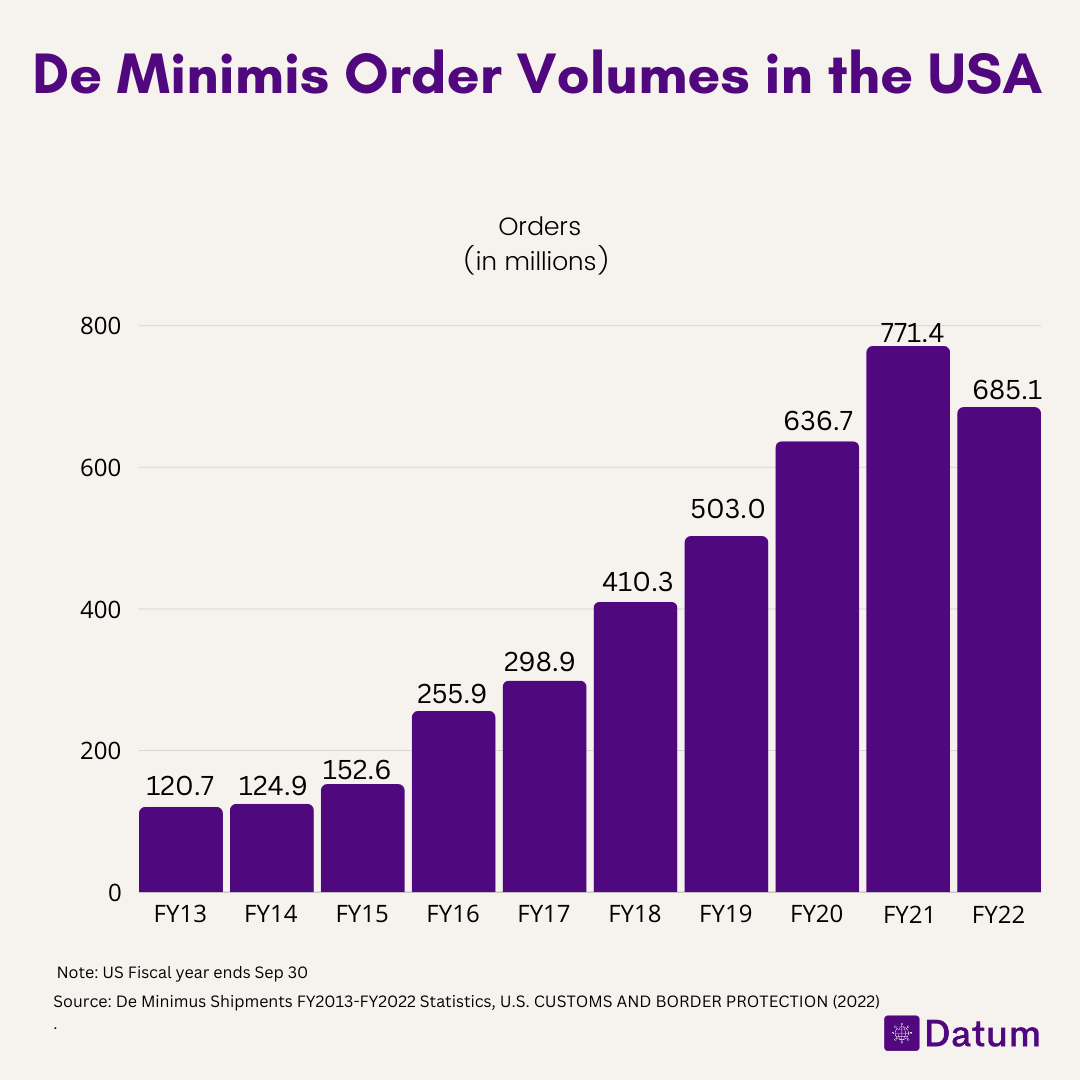
  • In 2015, CBP processed 139 million de minimis transactions. By 2023, this increased to more than 1 billion, representing a 662% growth in eight years. Now, in Fiscal Year 2024, nearly 4 million de minimis shipments arrive at CBP facilities for targeting, review, and potential physical examination each day. Although these packages are low value, they pose the same potential health, safety, and economic security risks as larger and more traditional containerized shipments.  
  • As long as a good is not subject to duties, taxes or fees (such as anti-dumping/ countervailing duties, excise taxes such as those required for alcohol and tobacco products, or any interagency fees that have not been waived for informal entries), it is eligible for de minimis clearance.
  • Significant attention is being placed on the de minimis administrative process for new business models, such as those used by e-commerce and fast fashion companies, which leverage the de minimis process for direct-to-consumer shipments. 

Question 4: Building on the previous question, in April 2024, the Department of Homeland Security (DHS) announced its new textile enforcement actions. How will CBP contribute to the new enforcement strategy?  

  • CBP is responsible for the management, control, and protection of U.S. borders and ports of entry, acting on the frontline of textiles and trade agreements enforcement. The U.S. textile industry is a vital domestic industrial base for U.S. national security, health care, and economic priorities. U.S. textile production is the foundation of the western hemisphere textile and apparel co-production chain, representing over 500,000 U.S. jobs, 1.5 million western hemisphere jobs, and $39 billion in annual shipments. Members of the textile industry have raised concerns with CBP regarding a decline in business momentum affecting their ability to maintain productivity and jobs. 
  • In response to these concerns, CBP is increasing its efforts to detect, interdict and deter illicit textiles trade and promote a level playing field for the domestic textiles industry given the ever-changing threat landscape and recent proliferation of allegations.
  • CBP is conducting coordinated and unified intelligence and data-driven operations to target and interdict textile imports that are not compliant with U.S. trade laws. Efforts include, but are not limited to, running special operations, carrying out Textile Production Verification Team visits at foreign factories and raw material providers, examining cargo, conducting compliance reviews and verifications, completing trade audits, and performing laboratory analysis on imported products with a heighted focus on imports that are subject to the U.S.-Mexico-Canada and Dominican Republic – Central America trade agreements, imported under the de minimis provision, and/or potentially in violation of forced labor laws, including the Uyghur Forced Labor Prevention Act.
  • You can learn more about CBP’s textile enforcement work in a recent CBP Reports video. You can also find information on our website.

Question 5: We know technology is significantly affecting and shifting how international trade is conducted. At CBP, there is an initiative called “21st Century Customs Framework.” Can you provide our students with more information about this program? For example, what is it about, what do you plan to achieve, and why does the program matter for fashion apparel companies?

  • The 21st Century Customs Framework (21CCF) is CBP’s effort to update its Title 19 authorities and underlying statutes, which have not seen comprehensive updates in more than 30 years.
  • Since 1993, trade volumes have increased dramatically, trade practices have changed, and new threats have emerged, which means CBP needs new tools and capabilities to do its job.
  • 21CCF matters for fashion apparel companies in two key ways: (1) the framework identifies updates that would better enable CBP to facilitate lawful trade more efficiently, so that goods can get to consumers, warehouses, stores, and other destinations as quickly as possible; and (2) the framework identifies updates that would enable CBP to bolster detection and enforcement against goods that threaten the well-being of American businesses and consumers—counterfeits, goods produced with forced labor, anti-competitively priced goods, and goods that violate environmental or consumer safety laws.
  • For example, 21CCF includes concepts that would authorize CBP to furnish industry stakeholders with information generated by market platforms regarding compliance with intellectual property rights laws—such as product origin and manufacturer—in importations where intellectual property violations are suspected. 
  • By sharing additional information with the private sector, CBP will be able to utilize its private sector partnerships to more readily identify illicit sellers using online marketplaces to import intellectual property rights-infringing goods into the United States.
  • Additionally, these proposed updates would better position the private sector to make more informed business decisions and eliminate high-risk actors from their supply chains.
  • Overall, in pursuing 21CCF, CBP envisions a trading system where legitimate goods move swiftly and securely; ethical production methods are used throughout the global supply chain; domestic industries compete on a level playing field; and the United States helps lead the world with innovative trade practices.
  • Private sector input has been instrumental throughout the development of the 21CCF statutory concepts, and the framework is now undergoing an interagency review process before eventually being cleared to be formally transmitted to Congress for consideration.

Question 6: As members of Generation Z, our students deeply care about fashion sustainability. Studies also show that fashion companies are increasingly concerned about climate change and its significant business implications. In your view, how can international trade contribute to sustainability and foster a more sustainable fashion industry? How might CBP support and assist in these efforts?

  • Sustainability in fashion concerns more than just addressing textiles or products. It involves the entire product lifecycle process, which includes the way the clothing is produced, consumed, and disposed of in landfills.
  • Sustainability in fashion encompasses a wide range of factors, including cutting carbon dioxide emissions, addressing overproduction, reducing pollution and waste, and supporting biodiversity.
  • CBP has a responsibility, as part of our mission, to keep people safe and protect the economy; that includes supporting the fashion industry. As noted, the fashion, textile, and apparel industries are crucial parts of the U.S. economy. The work CBP does is key in seizing suspect and potentially illegal fashion goods at the border, issuing penalties to bad actors, and protecting the health and safety of the American people.  
  • Due to CBP’s direct influence over trade processes, we see ourselves as a facilitator across the government to start conversations about sustainability and where government can remove barriers or add value to existing environmental efforts in trade.
  • CBP has developed strategies aimed at promoting environmental sustainability within trade. CBP’s Green Trade Strategy, for instance, is designed to champion the reduction of pollution and waste while encouraging the adoption of green technologies and practices. Such initiatives reflect a broader commitment to advancing circularity, recycling, and reuse in the fashion industry that can enable fashion companies to produce and sell their products more sustainably.
  • CBP launched the Green Trade Strategy in 2022 to further enable CBP to fight the negative impacts of climate change and environmental degradation in the context of the trade mission.
  • The strategy focuses on four main pillars:

o Incentivize Green Trade;
o Strengthen Environmental Enforcement Posture;
o Accelerate Green Innovation; and
o Improve Climate Resiliency and Resource Efficiency.

  • Thousands of CBP employees work toward making international trade more sustainable and transparent. The strategy touches every office and every employee at CBP.
  • With these four pillars, the strategy provides a framework for future action. Success requires buy-in and collaboration with all our stakeholders, including the fashion industry, and especially you, the future of fashion. We want your help because we cannot do this alone, and you offer unique perspectives that we need in order to fight and mitigate climate change.
  • Students who are interested in learning more about CBP’s green trade efforts can visit our Green Trade Strategy webpage.

Question 7: Additionally, some of our students are considering a career in international trade. What career opportunities at CBP might be a fit for our undergraduate and graduate students? 

  • There are a number of paths for college students and recent graduates to gain experience and begin to build their careers at CBP, including our recent graduate programs and the Pathways Program.
  • Some positions that recent graduates can pursue include the following:
  • Administrative – CBP has administrative roles in various business functions, such as finance, budget, personnel, logistics, and asset management. Position titles include Staff Assistant and Management and Program Analyst.
  • Law Clerks – This role is for those with recent JDs that expect to pass the Bar Exam within 14 months.
  • Auditors – This is for students pursuing the auditor career (Interns) or those expecting to complete the required unit of Auditor courses (Auditor, GS-11).
  • CBP prioritizes facilitating legitimate trade in textiles and wearing apparel and protecting the intellectual property rights of fashion and apparel brands as a part of its trade mission.
  • CBP employees help protect the wearing and apparel industry from counterfeit merchandise and other unfair or harmful trade practices.
  • Learn more about career opportunities at CBP on our careers page.

–END–

Disclaimer: This interview is intended exclusively for educational purposes in the FASH455 class and shall not be considered an official policy statement of the U.S. Customs and Border Protection (CBP).

The Puzzling US Apparel Import Data…

The latest US apparel import data raises several puzzles that deserve to be investigated further.

Question 1: Why did imports suddenly surge, and is this surge sustainable?

Unexpectedly, US apparel imports experienced a significant surge in February 2024. This surge was marked by a 12.9% increase in quantity and a 2.9% increase in value compared to the previous year. Seasonally adjusted US apparel imports in February 2024 were also nearly 10% higher than in January 2024. The import surge was particularly surprising given that the value of US clothing sales in February 2024 was only 1.3% higher than a year ago and even 0.5% lower than in January 2024 (seasonally adjusted).

That being said, US total merchandise imports also enjoyed a 2.2% increase year over year in February 2024, the best performance since last fall. Meanwhile, the World Trade Organization (WTO)’s latest April 2024 forecast predicted the world merchandise trade volume to grow by 2.6% in 2024 as opposed to a 1.2% decline in 2023.

Therefore, it will be important to watch whether the US apparel trade has indeed reached a turning point and will continue growing in the coming months and throughout the year.

Question 2: Could the volume of US apparel imports in 2023 have been underreported?

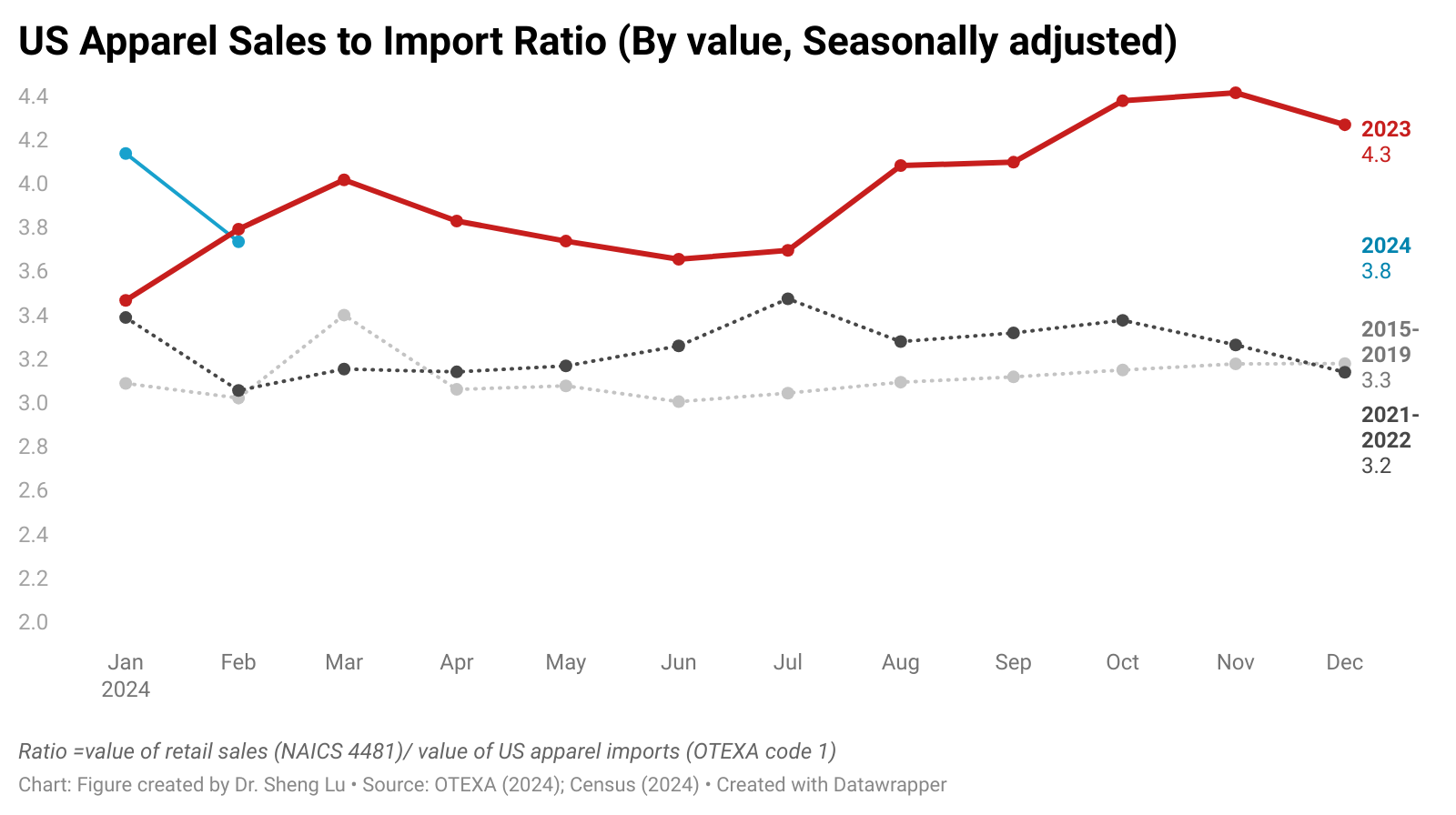
With over 98% of clothing sold in the US retail market being imported today, there exists a strong correlation between US apparel retail sales (NAICS code 4481) and the volume of apparel imports. Between 2015 and 2022, the US clothing sales to clothing import ratio remained consistently around 3.0-3.2 (seasonally adjusted). In other words, the value of retail sales was approximately three times the value of apparel imports. However, in 2023, this ratio increased to 4.0-4.5.

One suspicion is that as more apparel imports came into the US through the de minimis, the official US apparel import data in 2023 was somewhat underreported. Notably, according to Euromonitor, about 40% of US apparel retail sales were achieved through e-commerce in 2023, a substantial increase from 9.4% in 2010. Likewise, with US customs tightening controls on “small package shipments” and enhancing UFLPA enforcement, more imports likely began entering through the standard procedure in recent months, which explains why the US apparel sales to import rato fell back to 3.8 in February 2024.

On the other hand, some say the lowered US apparel import volume in 2023 was due to retailers’ efforts to control inventory levels. Data shows that US clothing stores’ stock-to-sales ratio in the last quarter of 2023 averaged 2.34, slightly lower than 2.43 from 2015 to 2019, but was higher than 2.19 back in 2021. In other words, while there was some effort by retailers to control inventory (as seen by the ratio being lower than pre-pandemic levels), it wasn’t a significant enough change to have a large impact on import demand. Also, considering that apparel is a seasonal product, it doesn’t seem too likely that retailers would risk losing sales opportunities during the most critical selling season of the year (i.e., 4th quarter) by promoting outdated items instead of stocking new ones on the shelf.

Question 3: Why did Asian countries export more apparel to Mexico?

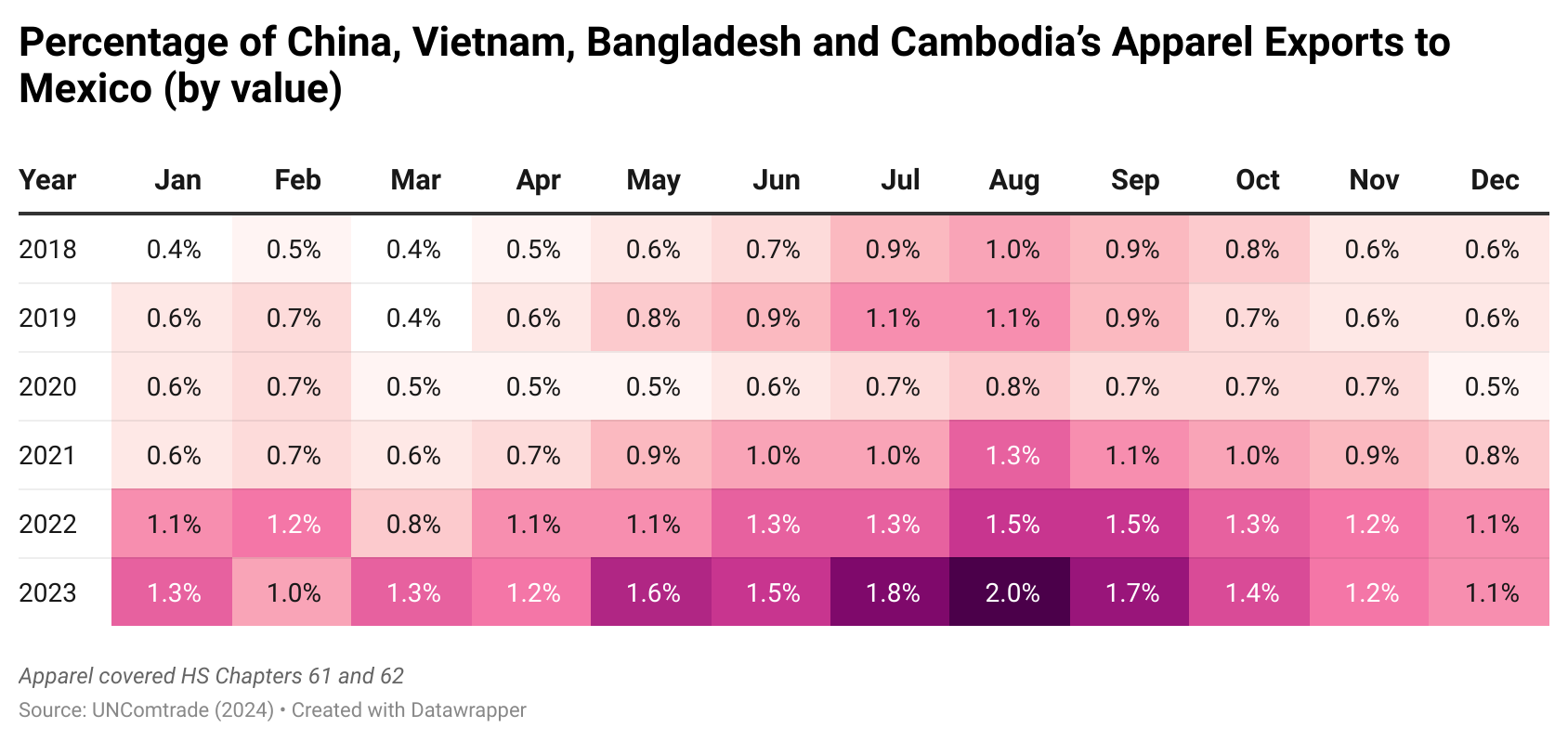
As a developing country, Mexico is not traditionally a leading apparel import market due to consumers’ limited purchasing power and the sufficient local apparel supply. Take China, Vietnam, Bangladesh, and Cambodia, the four top Asian apparel exporting countries (Asia4), for instance. Between 2018 and 2020, Mexico typically accounted for 0.4%-0.7% of Asia4’s total apparel exports. However, since 2022, Asia4 has almost doubled its apparel exports to Mexico (i.e., increased to 1.5%-2.0%). Moreover, during the same period, the percentage of Asia4’s apparel exports to the United States declined from 27% to below 20%, especially in the last quarter of 2023.   

What’s behind the increase in Asian countries’ apparel exports to Mexico needs to be investigated further. As noted earlier, Mexico itself is a leading apparel-producing country. Also, according to Euromonitor, the clothing market in Mexico stayed relatively stable at around 7.6%-7.9% of the size of the US from 2017 to 2023 (in quantity). In other words, Mexico’s increased import demand for Asian clothing doesn’t make much sense.

Others suspect some Asian apparel exports to Mexico eventually entered the US market either by taking advantage of the de minimis rule or the US-Mexico-Canda (USMCA) trade agreement. However, the exact size of this particular trade flow calls for further investigation.

By Sheng Lu

FASH455 Discussion: De Minimis Rule and the US Textile and Apparel Industry

Reading material

How the “de minimis” rule (also referred to as Section 321 imports)* might change will be a critical issue to watch in 2024. Under US customs law, specifically the Trade Facilitation and Trade Enforcement Act of 2015, import duties are generally waived for goods valued at $800 or less per person per day, marking an increase from the previous de minimis threshold of $200.

Generally, the reasons for raising the de minimis threshold include: 1) facilitating the clearance of low-value packages and supporting the e-commerce industry (e.g., small-value shipments from online shopping and e-commerce). 2) allowing customs agencies to focus their limited resources on higher-value and higher-risk shipments; 3) lowering compliance and importing costs for importers, especially small businesses.

However, some stakeholders are increasingly concerned about the “de minimis” as a loophole in practice. For example, US textile industry representatives argued that the rule “providing a backdoor to Chinese goods produced with forced labor. The loophole has not only fueled the rise of imports from foreign e-commerce companies and mass distributors, but it has also put our domestic manufacturers and workers at a competitive disadvantage.”

According to CBP’s statistics, the volume and value of U.S. de minimis imports have been surging in recent years, particularly with the booming of e-commerce.

While reforming the “de minimis” rule is likely, its outlook remains uncertain.

  • The “de minimis” rule can only be changed through actions by US Congress. Several bills (e.g., Import Security and Fairness Act and De Minimis Reciprocity Act of 2023) have been introduced recently, calling for lowering the de minimis thresholds or closing the “loophole” to keep shipping from specific countries like China from taking advantage of the benefits. However, the election-year politics, a divided Congress, and their already packed agenda will make the legislative process challenging. That being said, tactically, Congress might include reform of the “de minimis” rule as part of a broader trade package in the future.
  • Not everyone agrees on how to reform the “de minimis.” For example, while some legislation favors lowering the threshold, others prioritize excluding non-market economies like China to benefit from the rule. Furthermore, US e-commerce businesses and influential logistics companies that benefit from the de minimis rule may oppose attempts to revoke the benefits they currently enjoy.
  • As “de minimis” shipments were exempted from CBP review, it also means that policymakers could lack sufficient data to support potential rule changes and evaluate the impacts. For example, while there is suspicion that companies like Shein and Temu exploited the de minimis rule or even that imports containing forced labor did so, it is challenging to present accurate and reliable data to understand their impacts. Thus, data collection “homework”, such as CBP’s section 321 data pilot program, will be necessary for meaningful discussions on reforming the de minimus rule.
  • *Section 321 refers to a part of U.S. law (19 U.S.C. § 1321) that allows duty-free entry of goods valued at $800 or less per shipment, per day, from foreign suppliers to U.S. customers. This is often called the de minimis exemption. Entry Type 86 is one method for filing Section 321 de minimis entries electronically through U.S. Customs and Border Protection (CBP). Entry Type 86 was initially launched as a pilot test by U.S. Customs and Border Protection (CBP) in September 2019.

Discussion questions:

#1: Please assess the arguments presented in the NY Times article regarding the de minimis rule’s impact on US textile and apparel manufacturers. What evidence or examples support their claims?

#2: Consider the defenders of the de minimis rule who argue that it does not harm the competitiveness of the US textile and apparel industry. What counterarguments and supporting evidence could they present?

#3: What additional information can help us better understand the trade impact of de minimis rules?

#4: Do you support eliminating or lowering the de minimis threshold? Why or why not?

[Instructions: For students in FASH455, please address at least two of the questions above. Additionally, feel free to share any other thoughts on the debates and resources you found relevant and informative.]