New OECD Report: Due Diligence on Recycling Process in the Garment and Footwear Sector (February 2026)

Full report HERE

Key findings:

First, the textile recycling rate remains low in the garment and footwear sector. As the OECD report noted, the market share of recycled fibers remained at approximately 7.6% in 2024 within total textile fiber production.  Meanwhile, “of all recycled fibers, more than 90% was recycled polyester made from open-loop plastic bottles and less than 10% from actual post-consumer textiles.” For apparel sourcing, this means that using recycled input remains limited, fragmented, and often costly, challenging scalability for brands with large-volume sourcing models.

Second, the recycling supply chains are not immune to social responsibility and compliance risks. According to the OECD report, “Child laborin recycling processes is a key area of concern.” Meanwhile, a 2024 International Labor Organization (ILO) study cited in the report found that workers in waste management and recycling typically earn far less than in other sectors. Additionally,  since “textile waste collection, aggregation and sorting are often performed manually, especially in contexts where automated systems are not common,” working conditions could be an issue. Informal workers could also be hired in the recycling supply chain. For example, the ILO estimates that about 80% of jobs in the recycling sector are informal, and in Dhaka alone, around 100,000 women and children work as informal waste pickers. Overall, for fashion brands and retailers that source clothing made with recycled textile materials, this means that due diligence must go beyond traditional Tier 1 or Tier 2 suppliers to include waste and recycling networks. Additionally, recycling activities could occur in regions different from those of garment manufacturing hubs.

Third, the large-scale export of used textiles has implications for recycling outcomes. The OECD report noted that textile waste often crosses borders for sorting or recycling. However, such textile waste trade could undermine domestic recycling capacity (e.g., in the Netherlands, half of the collected textiles are sorted abroad, and the local sorting capacity is used to sort textiles from Germany) and create environmental burdens on textile waste-importing countries. The debate over managing the used clothing trade could continue (e.g., how to avoid shifting environmental burdens from apparel-consuming countries to textile-waste-importing countries, especially those in the developing world).

Fourth, regulatory shifts are reshaping global trade related to textile recycling. The OECD report highlights the EU’s Ecodesign for Sustainable Products Regulation, the revision of the Waste Framework Directive, and the expansion of Extended Producer Responsibility (EPR) schemes. These measures, either already adopted or under development, mandate the separate collection of textiles from mixed household waste, require sorting prior to export to prevent misclassification of waste as reusable goods, and shift the financial responsibility for end-of-life management to producers. For fashion brands and retailers, these changes are likely to raise compliance costs and demand greater traceability throughout supply chains, including post-consumer waste. They also create stronger incentives to redesign products for durability, recyclability, and lower environmental impact, as regulatory fees and trade restrictions become directly tied to “product characteristics.”

Additionally, due diligence for fashion brands and retailers must be adapted to the era of circularity. The OECD report recommends that fashion companies prioritize:

  • scoping new high risk actors (waste pickers, sorters, informal workers),
  • identifying “choke points” in waste flows (e.g., large sorting hubs, major aggregators, or recycling facilities that process high volumes of textile waste and therefore have leverage over upstream practices)
  • evaluating how their own purchasing practices may contribute to downstream impacts (e.g., low pricing pressure or rejection of unsold goods can push waste handling into informal and unsafe channels).
  • meaningful engagement with workers and informal sector representatives, particularly in contexts where recycling activities occur in small workshops, open-air settings, or home-based units with limited regulatory oversight.

Summarized by Sheng Lu

For FASH455 class: When writing your blog comment, you may consider addressing the following aspects. Students are strongly encouraged to read the full report before leaving their comments.

  • Does global textile trade enable circularity or export waste burdens?
  • Should countries restrict used textile imports and exports?
  • Should brands prioritize textile-to-textile recyclability even if it increases costs or limits design flexibility? How might this shift sourcing geography or supplier selection?
  • To what extent should fashion brands and retailers be financially and legally responsible for post-production and post-consumer waste? Should waste costs be integrated into retail pricing?

[discussion for this post is closed]
Shein Lost Market Share in the U.S. Apparel Retail Market in 2025 Amid Trade Tensions

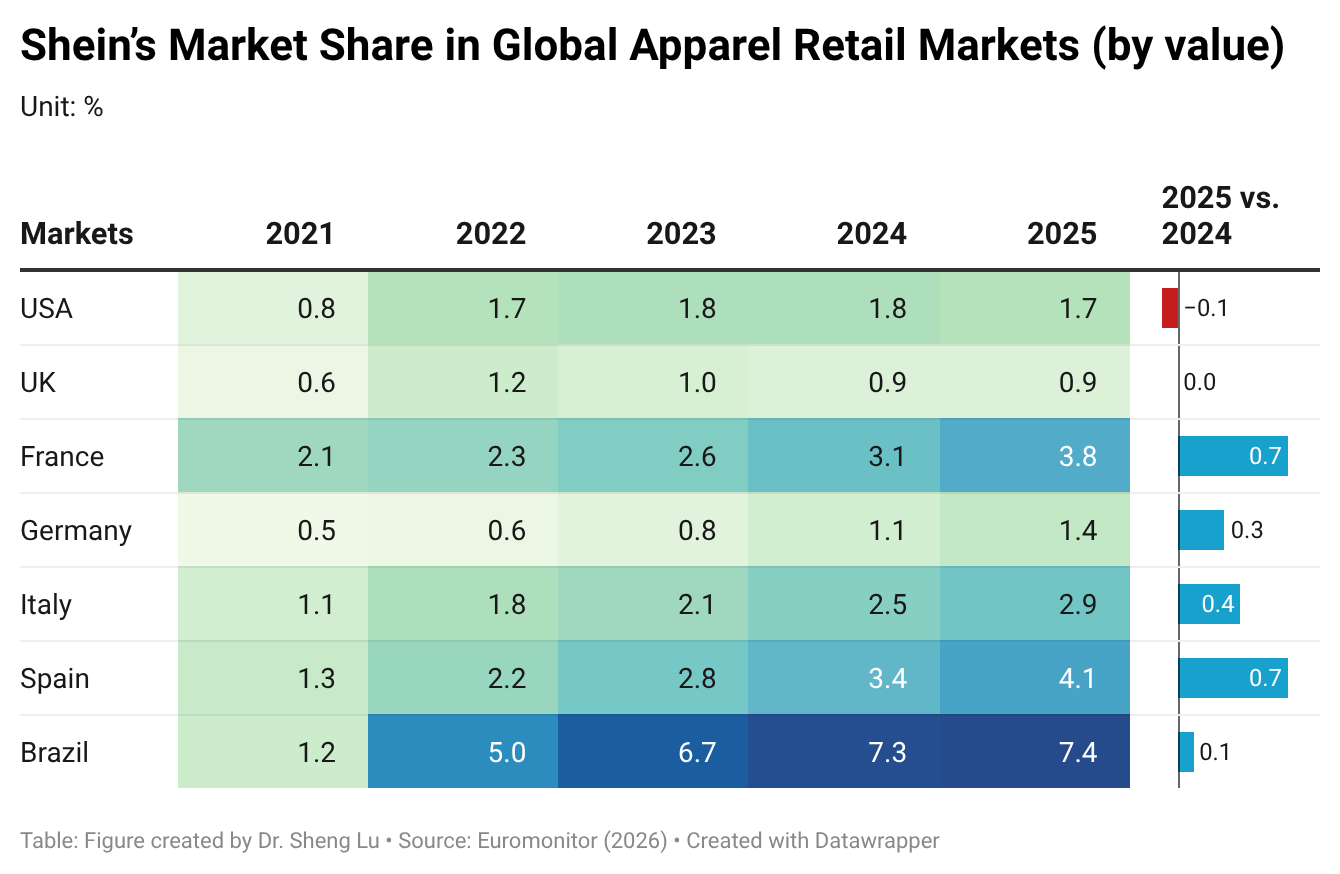
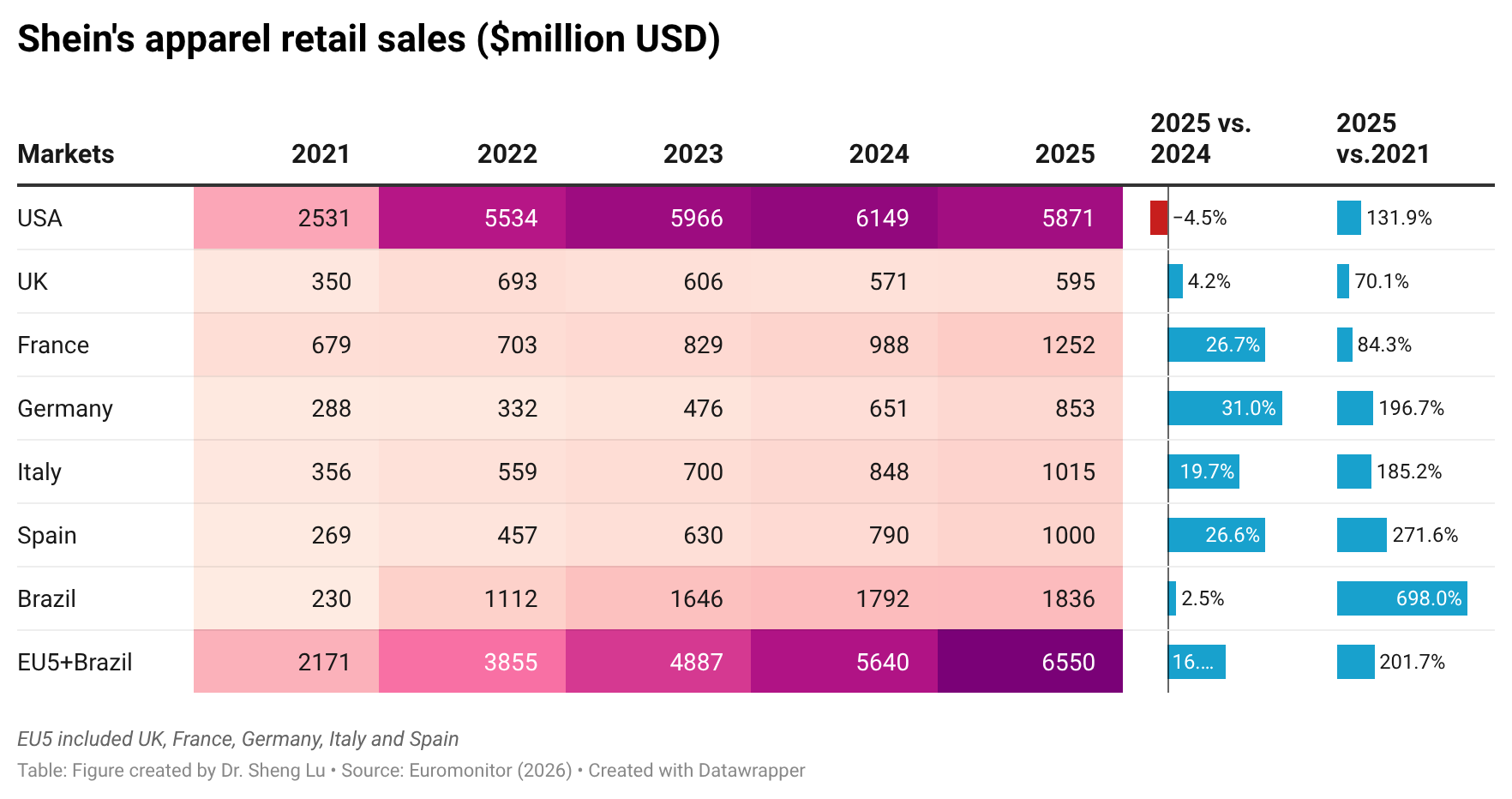
Latest Data from Euromonitor shows that while the United States remained Shein’s largest apparel sales market in 2025, the value of sales declined by 4.5%, affected by factors such as higher tariffs on Chinese products, the elimination of the “de minimis” rules, and young U.S. consumers’ growing concern about sustainability. Based on the value of sales, Shein’s market share in the U.S. also dropped from 1.8% in 2024 to 1.7% in 2025, the first time since 2021.

Shein’s business outlook in the U.S. is expected to remain challenging in 2026 due to ongoing high tariffs affecting imports from China, tighter regulations and enforcement on cross-border e-commerce shipping, and consumers’ increasing demand for sustainable apparel products and supply chain transparency.

Amid headwinds in the US, Shein is diversifying its sales markets in the rest of the world. For example, Shein achieved more apparel retail sales in key EU markets in 2025, including the UK (up 4.2%), France (up 26.7%), Germany (up 31%), Italy (up 19.7%), and Spain (up 26.6%). Likewise, Shein’s sales in Brazil increased by over 698% between 2021 and 2025, much higher than 131% in the US.

As of 2025, Shein’s total apparel sales in the UK, France, Germany, Italy, Spain, and Brazil (around 6.5 billion USD) already surpass the sales in the US (around 5.9 billion). It is likely that emerging markets like Brazil will become increasingly important to Shein’s future global expansion due to the price competitiveness of Shein’s products in local markets, the relatively relaxed regulatory environment, and the attractiveness of Shein’s commitment to investing in production there.

Additional reading: Inside the Chinese factories of fast-fashion giant Shein (by FRANCE 24 English | February 2026)

Fashion Doesn’t Exist in a Vacuum: Reflections on the 2026 World Economic Forum

by Emilie Delaye

Fashion and apparel aren’t just about fabric or seams. It is not just about the clothes that you put on your body. Don’t believe me? Well, I am going to show you just how interconnected the fashion industry is to everything around us. My hope is to show you just how important it is to understand the world around us, especially in the industry we are all about to enter. This deep connection between fashion and the world around us is exactly why global organizations like the World Economic Forum matter.

For those of you who don’t know, the World Economic Forum (WEF) is an independent international organization headquartered in Geneva, Switzerland, dedicated to improving the state of the world through public-private cooperation. Recently, the WEF held the 56th Annual Meeting of the World Economic Forum, which brings together stakeholders from government, business, civil society, and the scientific and cultural domains to have real conversations, solve problems together, and highlight new innovations.

I had the opportunity to watch three sessions from this year’s World Economic Forum. As noted in my summary below, although these sessions did not specifically mention fashion, their insights are highly relevant to the fashion industry in today’s global economy.

“Geopolitical Risks Outlook for 2026 “

  • Summary: The world is changing in ways that feel both risky and promising. While technology, politics, and globalization are creating instability, investments in green energy are driving growth and new opportunities. How countries respond will shape what comes next.
  • Connection to the Fashion Industry: These global changes directly impact the fashion industry by reshaping how clothes are made, sold, and regulated. AI is changing design, production, and supply chains, while political shifts and new global rules affect sourcing, labor, and trade. At the same time, the push for green energy and sustainability is forcing fashion brands to rethink materials, manufacturing, and long-term social responsibility. As a fashion student, it is critical to understand these changes, as they could shift career paths, redefine job roles, and reshape the industry’s future.

“US and China: Where Will They Land?”

  • Summary: The U.S. and China are locked in a long-term competition over power, technology, and security, and while neither side wants war, the rivalry creates instability and misunderstanding. Without clear guidelines, consistent trade policies, and a shared framework, especially around AI and emerging technologies, managing this relationship remains difficult and uncertain.
  • Connection to the Fashion Industry: This relationship affects the fashion industry through tariffs, trade uncertainty, and supply chain disruptions. This is especially true given China’s major role in global apparel manufacturing. This relationship strain makes it more difficult for fashion brands to plan and source their products. As a student of fashion, the relationship between these two countries is an important matter to consider.

An Honest Conversation on AI and Humanity”

  • Summary: AI is changing from a tool into something that can think, decide, and communicate on its own, challenging human control. This creates urgent questions about how society will manage AI before it reshapes jobs, power, and responsibility on its own.
  • Connection to the Fashion Industry: Specifically, the fashion industry will be dramatically impacted by AI by changing how clothes are designed, produced, and sold, and by reshaping the roles people play within the industry. As fashion students, it is important to understand both the benefits and drawbacks of AI, especially since our generation will likely be responsible for making these decisions.

In the end, clothing is a direct reflection of the world around us. Global politics, technology, and ethical responsibility all influence how fashion is created and consumed. For those entering the fashion industry, understanding these forces is essential, as fashion does not exist in a vacuum; it evolves alongside the world that shapes it.

About the author: Emilie Delaye is a graduate instructor in Fashion and Apparel Studies at the University of Delaware. She is also a member of the 2025-2026 Fair Labor Association (FLA) Student Committee.

[Discussion for this post is closed]

FASH455 Video Discussion: Ongoing Impacts of U.S. Import Tariffs on Apparel Exporting Countries (Updated February 2026)

Video 1: Vietnam’s economy pivots to tourism as US tariffs threaten textiles
Video 2: Higher U.S. tariffs threaten Indonesia’s textile industry
Video 3: Tariff and India’s garment industry
Video 4: How Trump’s Tariffs Upended a Hub of Denim Manufacturing in Lesotho

For FASH455 class: When writing your blog comment, consider addressing the following aspects:

  • Based on the videos, what have been the expected and unexpected impacts of tariffs on apparel-exporting countries?
  • Based on the videos, what ethical challenges emerge in apparel sourcing and global trade? How do tariffs complicate or intensify these issues?
  • What does “responsible apparel sourcing” mean when tariffs increase costs and competitive pressure? Is it still feasible? Why or why not?
  • If you were a sourcing manager for a US-based fashion company, how would you redesign your strategy under higher tariffs? Why?
  • Are tariffs an effective tool for improving labor or environmental standards? Why or why not?

Related reading: Evolving Patterns of World Apparel Trade amid Trump’s Hiking Tariffs (January 2026)