
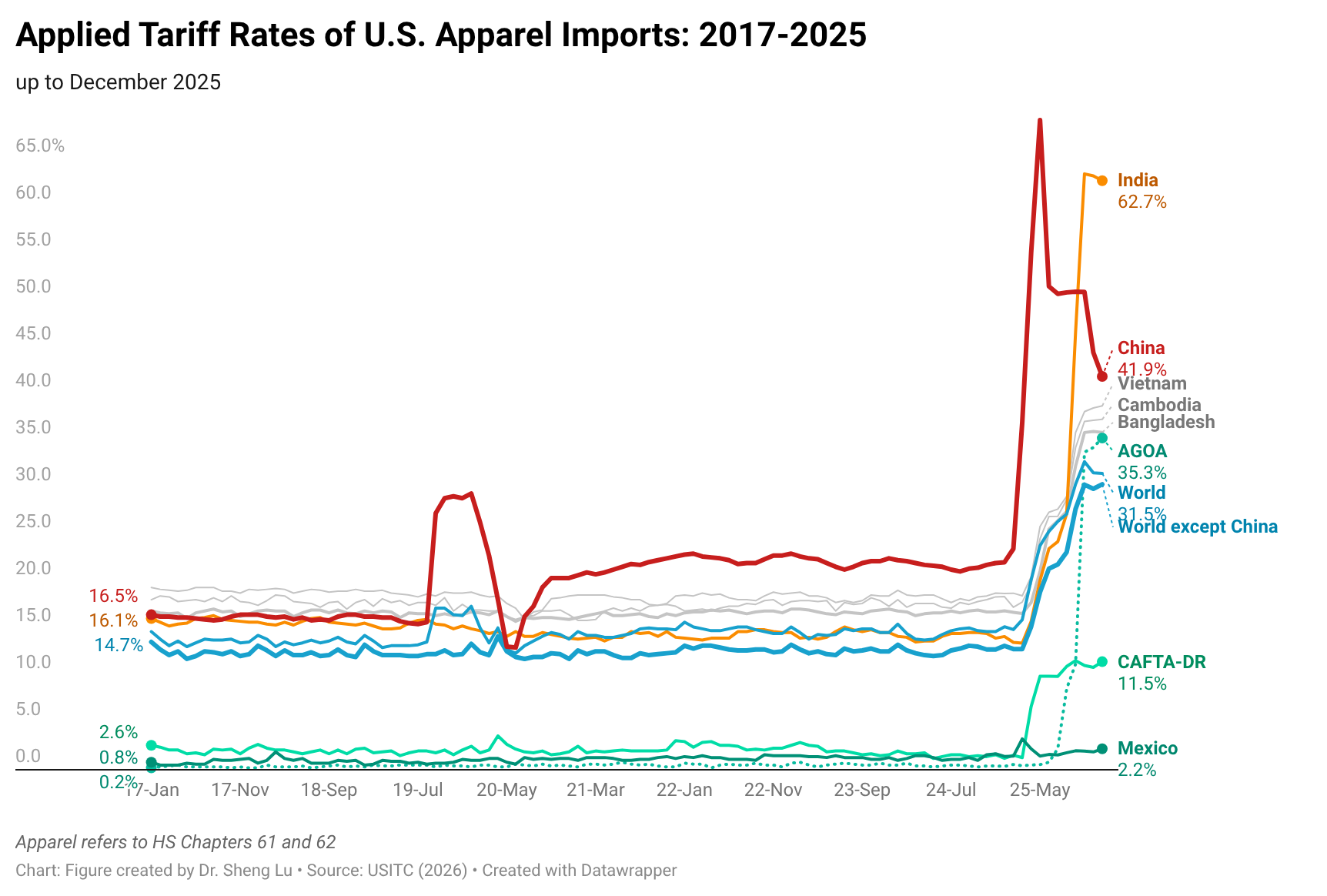
The average tariff rate for U.S. apparel imports (HS Chapters 61 and 62) reached 35.1% in December 2025, hitting a new high in decades and a sharp rise from 14.7% in January 2025, before President Trump’s second term. According to statistics from the Office of Textiles and Apparel (OTEXA), the U.S. International Trade Commission (USITC), and other government agencies, the hiking of tariffs and associated policy uncertainty has affected U.S. apparel sourcing and trade in multiple ways. [click here for detailed tariff data]
Impacts on apparel import price
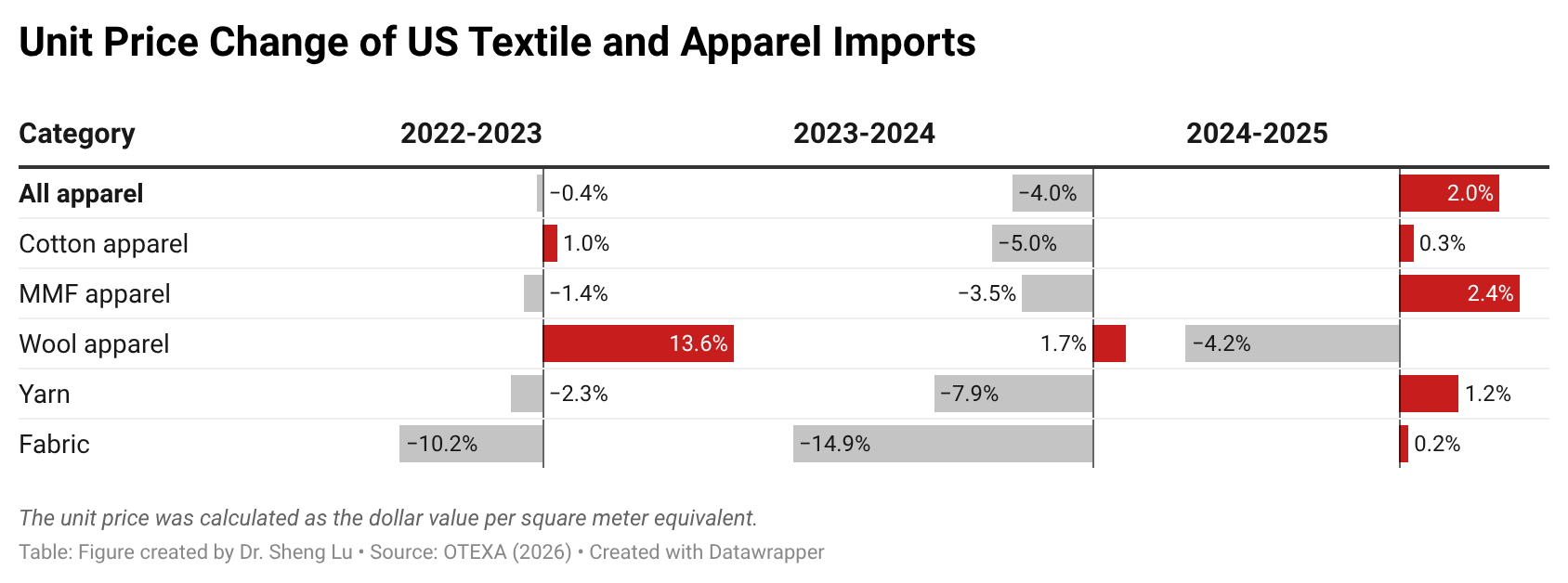
Apparel sourcing cost pressure increased in 2025, although price changes varied by fiber type. Data from OTEXA shows that, measured in dollars per square meter equivalent (SME), the unit price of US apparel imports increased from $3.08/SME in 2024 to $3.14/SME in 2025, a 2% year-over-year increase. Notably, due to an overall downward trend in world cotton prices, the unit price of US cotton apparel imports was almost flat in 2025, after a 5% decline in 2024.
In contrast, amid ongoing geopolitical tensions and rising oil prices, the unit price of US man-made fiber (MMF) apparel imports increased more noticeably by 2.4% in 2025. Still, in absolute terms, the unit price of US MMF apparel at $2.58/SME in 2025 was only about two-thirds of the price of cotton apparel at $3.59/SME.
Additionally, due to weaker demand for relatively more expensive clothing, the unit price of US wool apparel increased from $21.6/SME to only $20.68/SME, or down 4.2%.
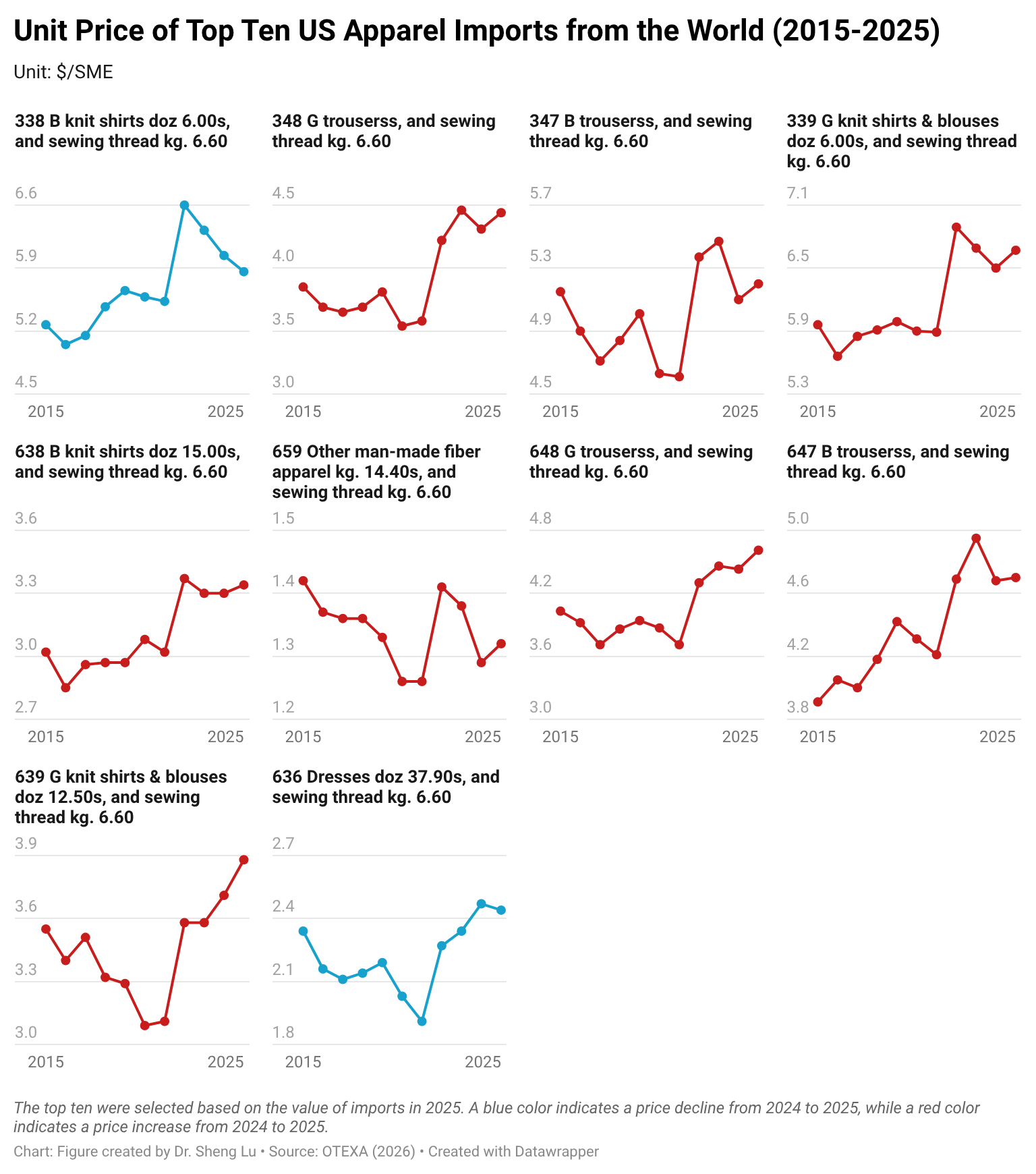
Amid higher tariffs, the unit import price for over half of the apparel import categories increased in 2025. Specifically, of the 106 apparel types categorized by OTEXA, 55 types (or 51.9%) saw a price increase between 2024 and 2025. This includes 22 categories (or 20.8%) with a price increase of more than 10 percent. Likewise, among the top ten largest apparel import categories by value in 2025, eight (80%) experienced price increases between 2024 and 2025, with an average increase of 2.5%. This result suggests that the upward price pressure was embedded in core, high-volume products rather than niche items. Particularly, as fashion companies navigate rising tariffs and policy uncertainty through more frequent adjustments to their original shipping schedules, it could increase their production and logistics costs more than usual. [Click here for detailed top ten U.S. apparel imports price data]
Impact on clothing retail price
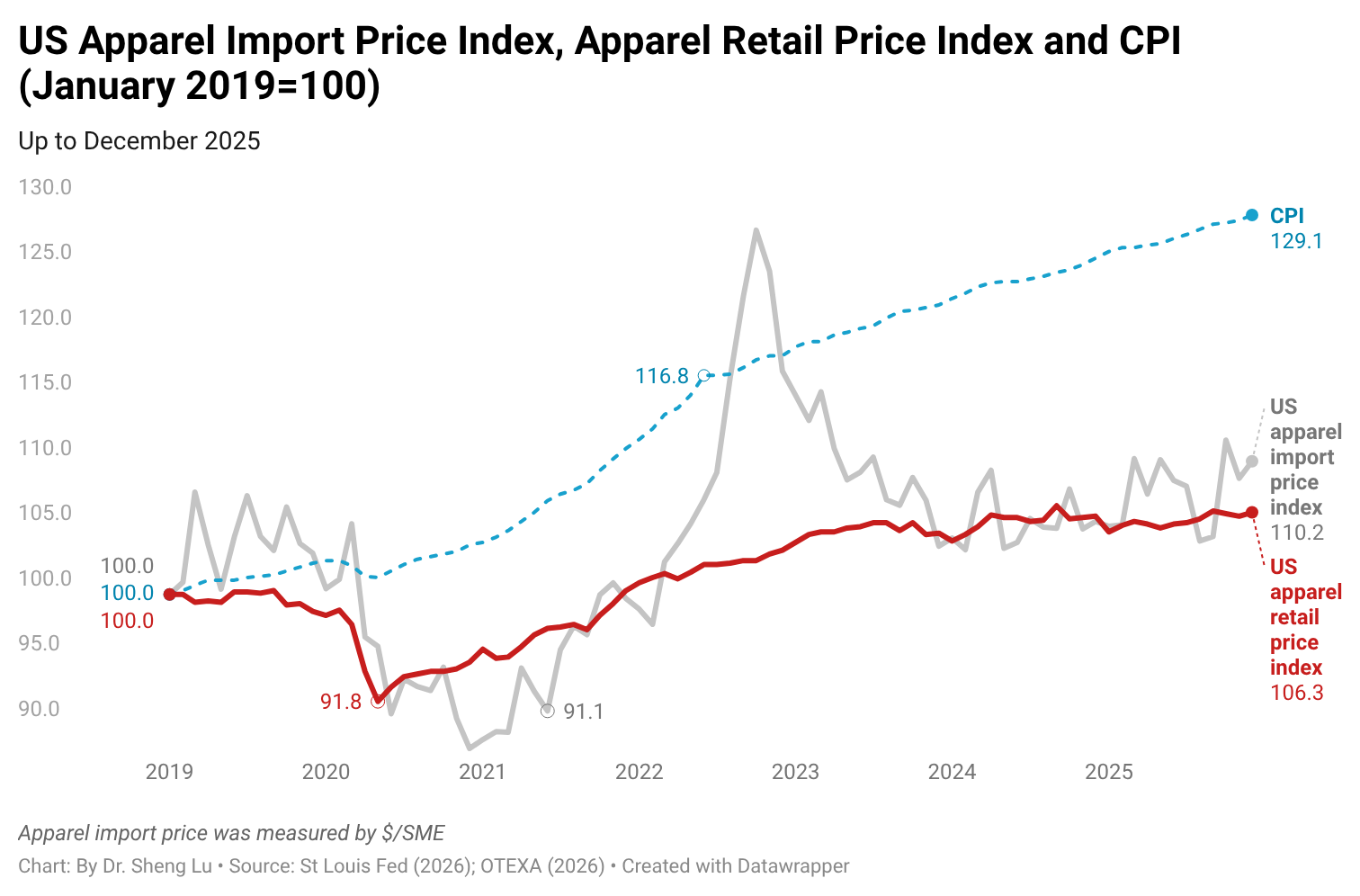
While the average U.S. apparel tariff rate rose from 14.7% in December 2024 to 31.5% in December 2025, the average U.S. clothing retail price increased only slightly by 0.3% during that time. This price rise was also much less than the 2.7% increase in the overall U.S. Consumer Price Index (CPI) during the same period. Since many apparel items are considered discretionary spending, higher inflation may lead consumers to reduce clothing purchases. [Click here for detailed U.S. apparel retail price index and CPI data]
Related, according to the Bureau of Economic Analysis (BEA), apparel accounted for 2.08% of U.S. consumers’ total personal spending in 2025, down from 2.10% in 2023 and 2.23% in 2021. As apparel retailers struggled to increase prices, younger generations, such as Gen Z, have turned to the secondhand clothing market.
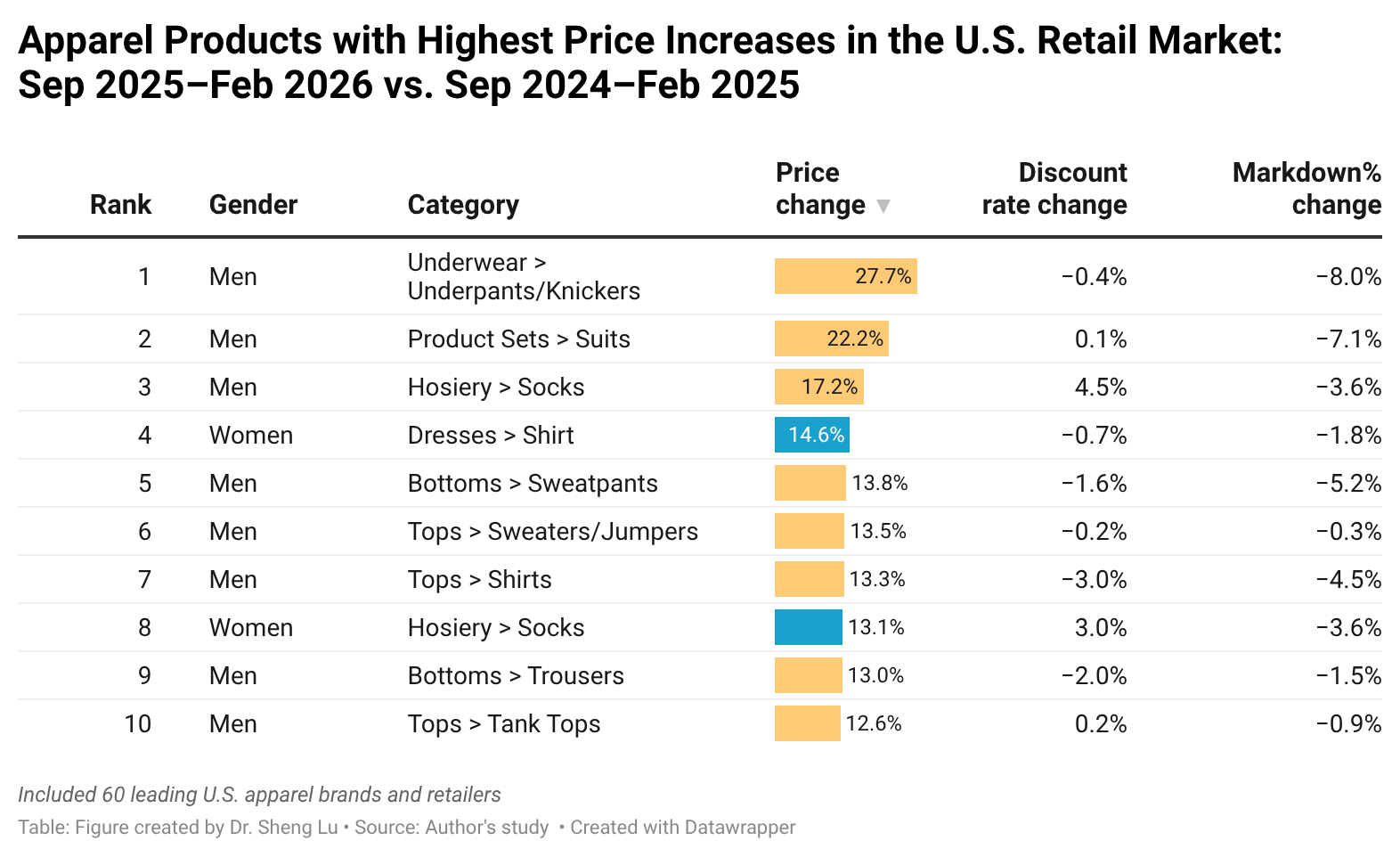
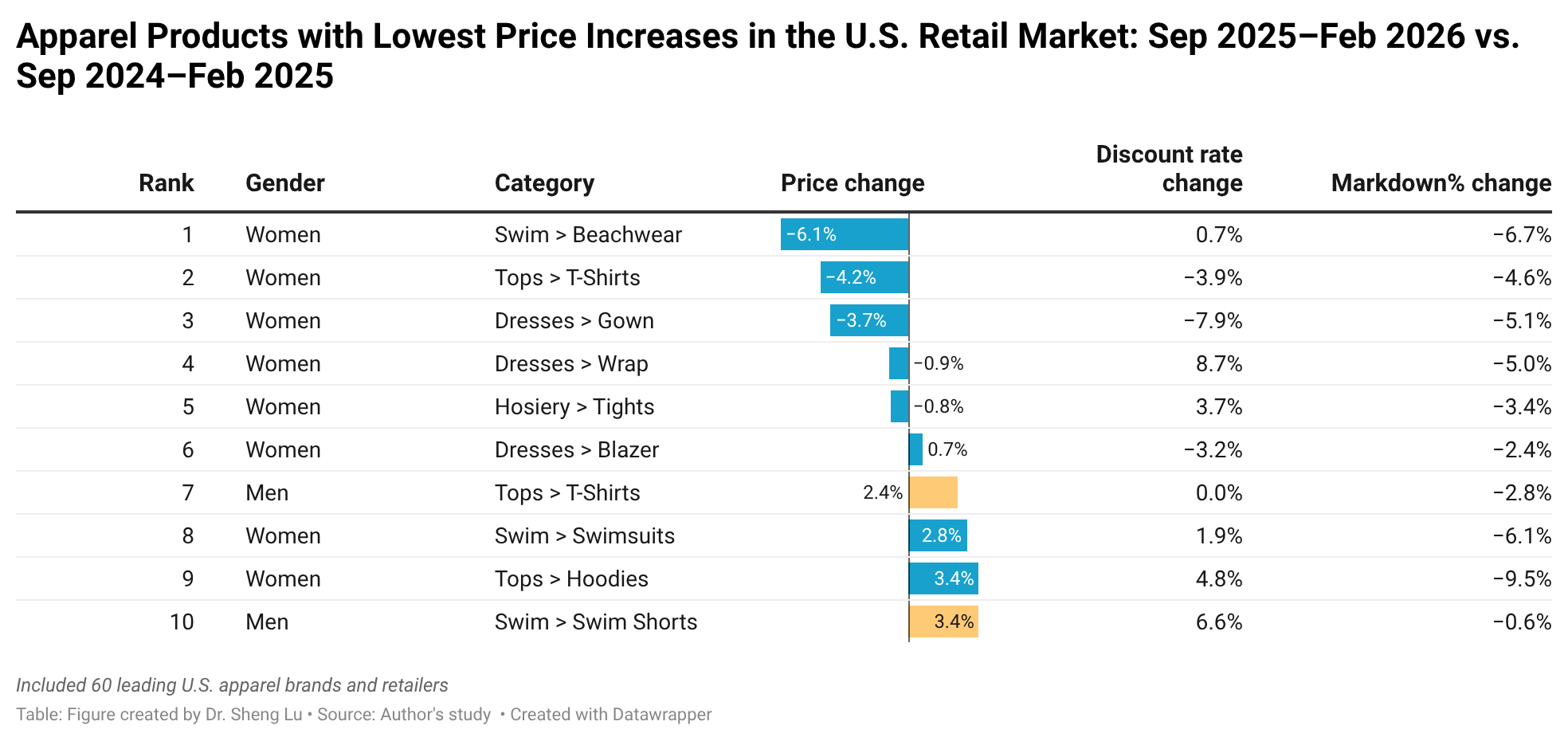
Additionally, data collected from industry sources show that the average retail price for necessities (e.g., men’s underwear) experienced the highest increase during September 2025 and February 2026 compared with the same period a year earlier (i.e., September 2024 and February 2025). In comparison, discretionary spending items such as women’s swimwear and dresses, as well as products with near-shoring opportunity (i.e., T-shirts), experienced the smallest increase over the same period.
Impact on fiber usage and sourcing base
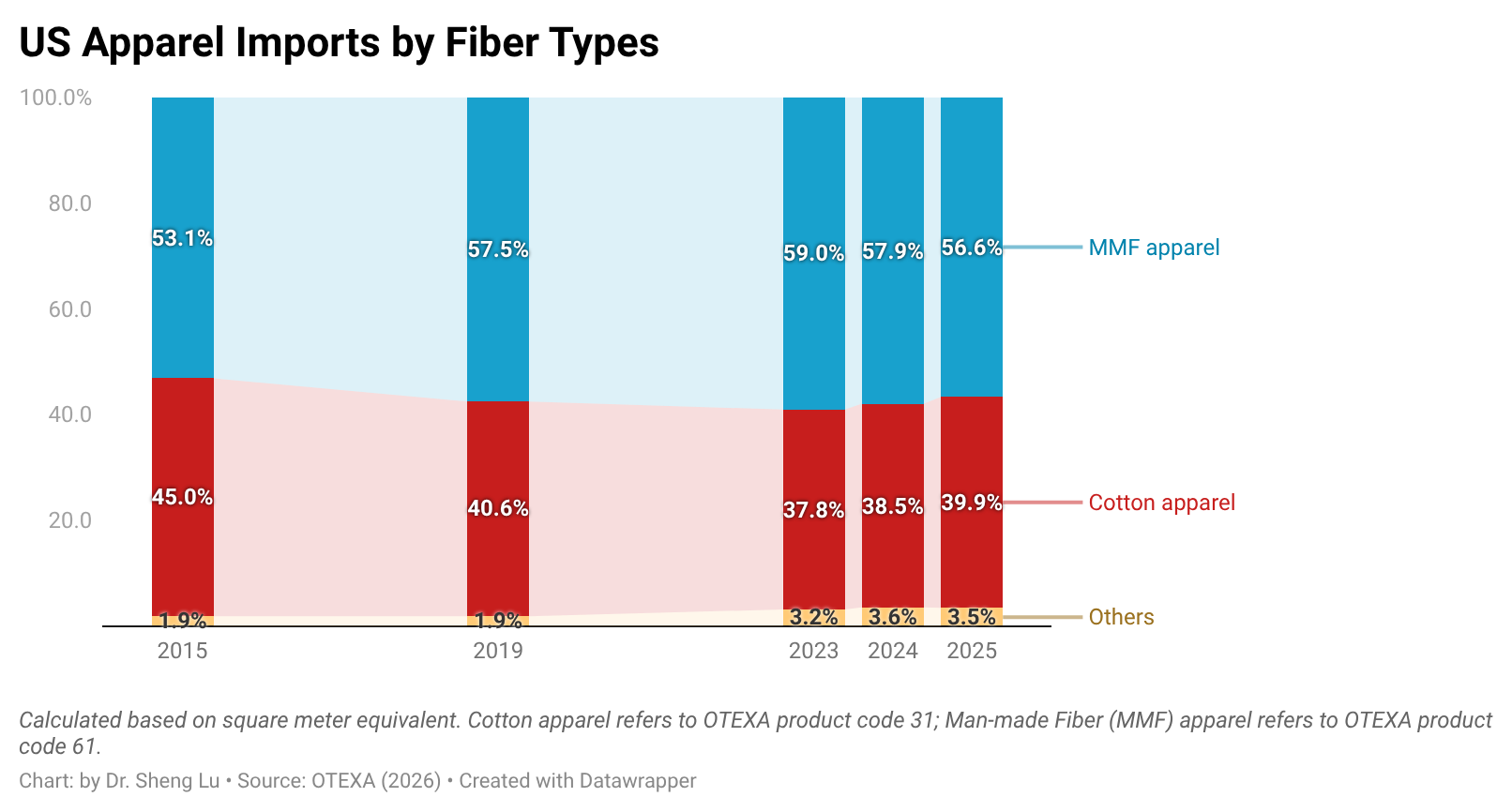
The U.S. tariff rates not only vary by sourcing origin but also by fiber composition. Generally, apparel made with cotton fibers will face a lower tariff rate (i.e., around 8-16% Most-favored-Nation, MFN tariff rates) than apparel made only from man-made fibers (i.e., around 16-32% MFN tariff rates).
As U.S. fashion companies leverage “tariff engineering” to mitigate the import duty increase, U.S. apparel imports in 2025 included more cotton apparel and fewer of those made from man-made fiber (MMF). Specifically, measured by quantity, cotton apparel (OTEXA category 31) accounted for 39.9% of total US apparel imports in 2025, higher than 38.5% in 2024 and 37.8% in 2023. In comparison, man-made fiber (MMF) apparel accounted for 56.6% of total U.S. apparel imports in 2025, a noticeable decline from 57.9% in 2024 and 59% in 2023. [Click here for detailed U.S. apparel imports by fiber content data]
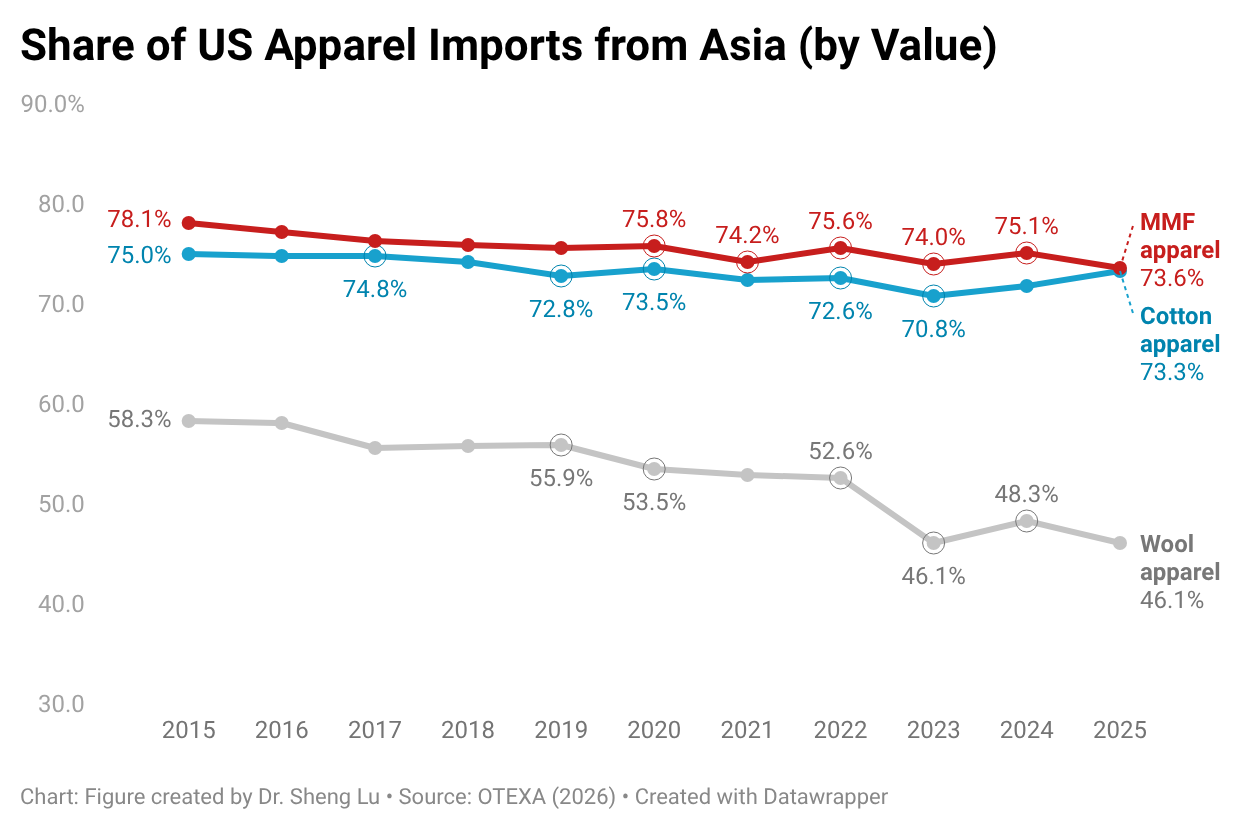
Furthermore, while Asian countries had demonstrated greater competitiveness in man-made fiber (MMF) clothing, higher tariffs on such products in 2025 led U.S. fashion companies to source fewer MMF clothing from Asia. Notably, in value terms, 73.6% of U.S. MMF clothing came from Asia in 2025, a noticeable decline from 75.1% a year earlier. In comparison, 73.1% of U.S. cotton apparel imports came from Asia in 2025, up from 71.8% in 2024. [Click here for Asia market share data]
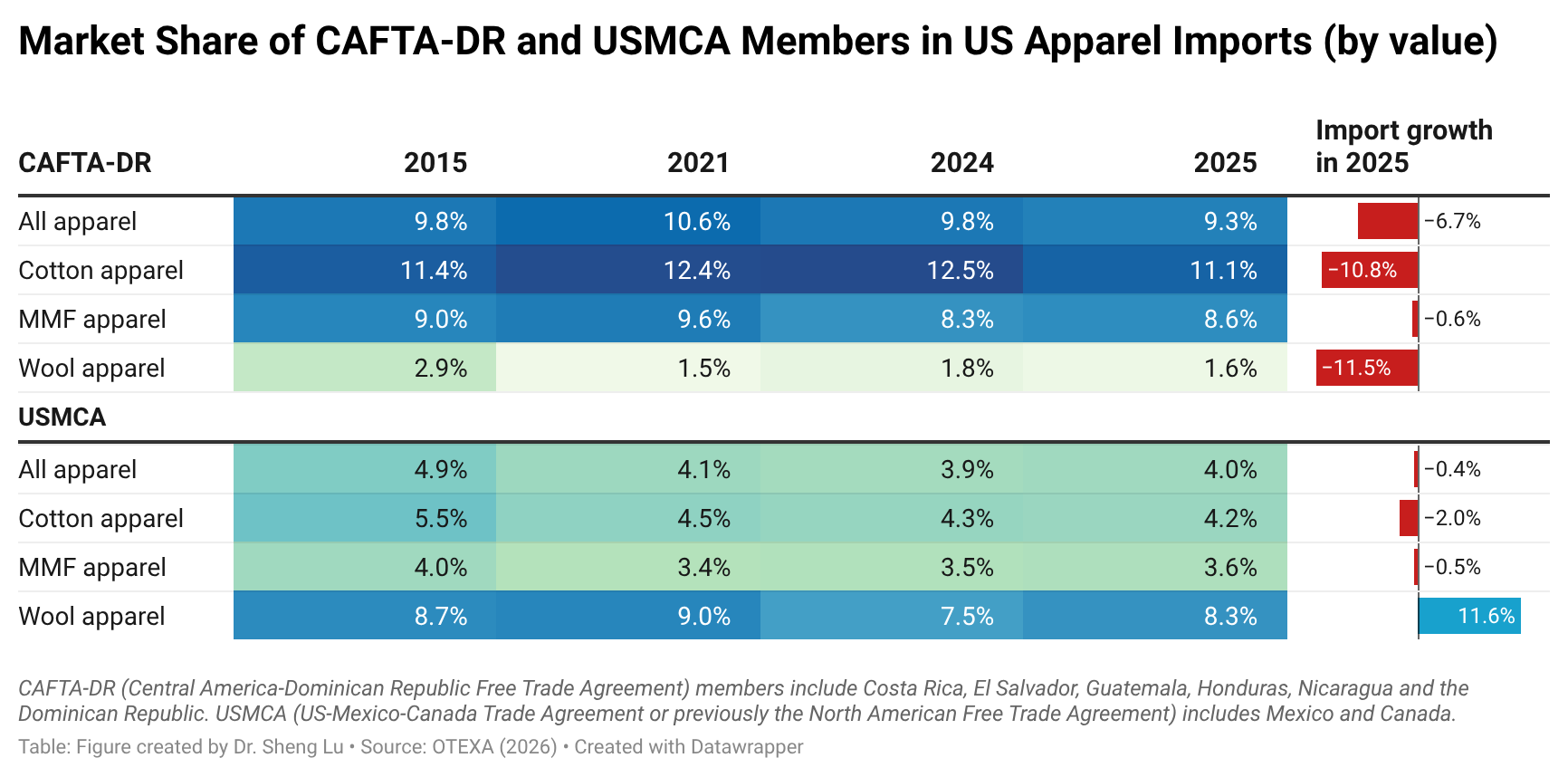
In comparison, it is interesting to note that while CAFTA-DR and USMCA members are perceived as more competitive in making and exporting cotton apparel products, due to tariff advantages, U.S. fashion companies import more man-made fiber (MMF) apparel from the regions in 2025. The same trend applied to wool apparel imports from the USMCA, which grew by 11.6%. These results suggest that if the tariff gap between U.S. apparel imports from CAFTA-DR and USMCA members and those from Asian countries continues in 2026, it may further incentivize U.S. fashion companies to explore additional MMF apparel sourcing opportunities in the Western Hemisphere. This incentive could be reinforced by the fact that, since February 2026, apparel imports from many Asian suppliers have been subject to the new Section 122 tariffs, while qualifying apparel products from CAFTA-DR and USMCA remain exempt. It may also represent a historic opportunity to expand investment in MMF textile manufacturing in CAFTA-DR and USMCA countries, thereby increasing regional production capacity and diversifying product offerings. [Click here for CAFTA-DR and USMCA market share data]
Impact on Free Trade Agreement utilization
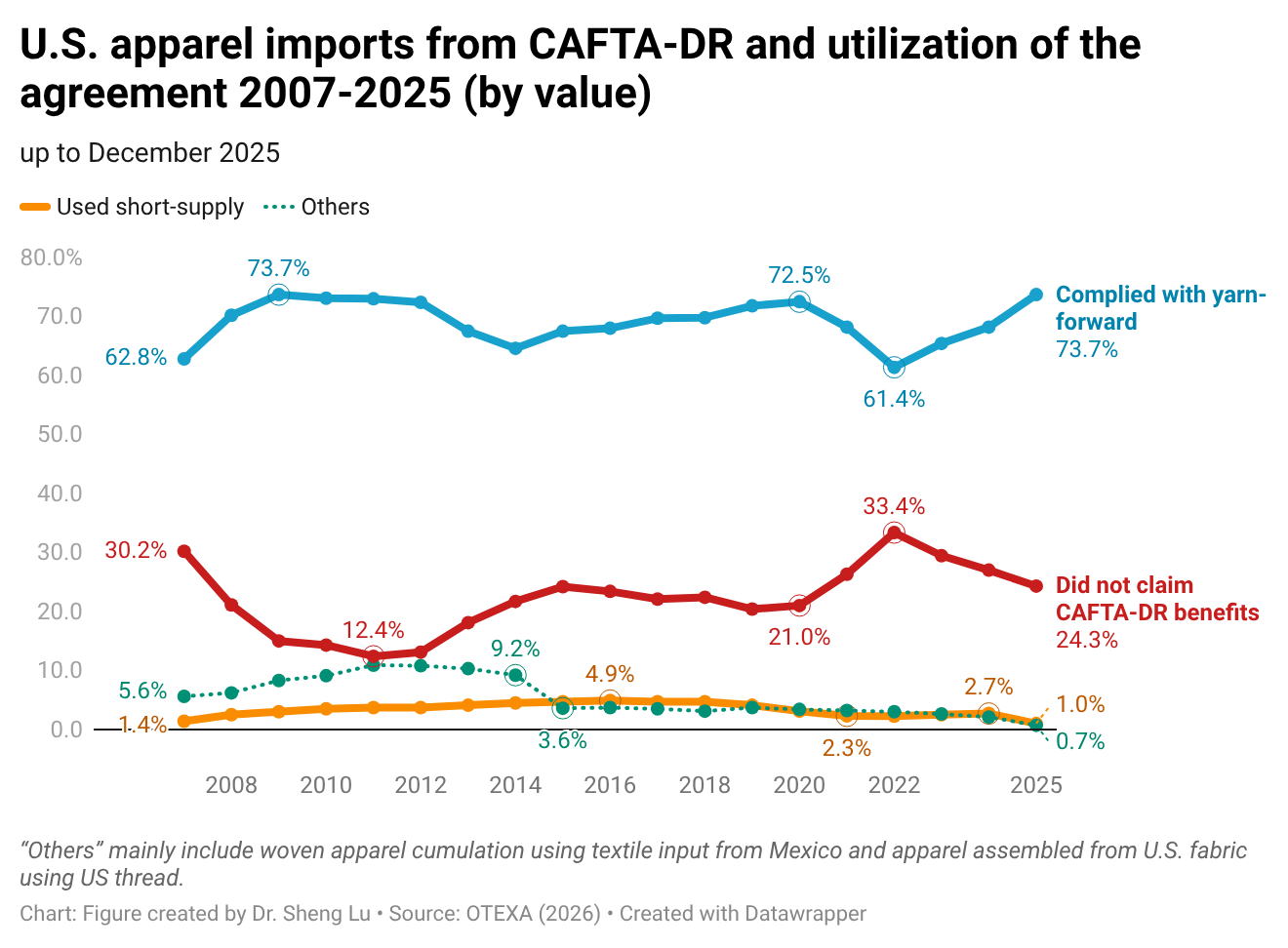
While there is no clear evidence from trade data showing that U.S. fashion companies expanded near-shoring from the Western Hemisphere in 2025, as a silver lining, the utilization of free trade agreements significantly improved. Specifically, measured in value, about 75.7% of U.S. apparel imports from members of the Dominican Republic-Central America Free Trade Agreement (CAFTA-DR) claimed duty-free benefits under the agreement, up from 73.0% in 2024 and 70.5% in 2023. Improved CAFTA-DR utilization in 2025 was driven by a higher volume of imports that met the yarn-forward rules of origin (i.e., up 1.5%). However, the utilization rate of the agreement’s short-supply mechanism decreased from 2.7% to 1.2%, despite more products being added to the list. [Click here for CAFTA-DR utilization data]
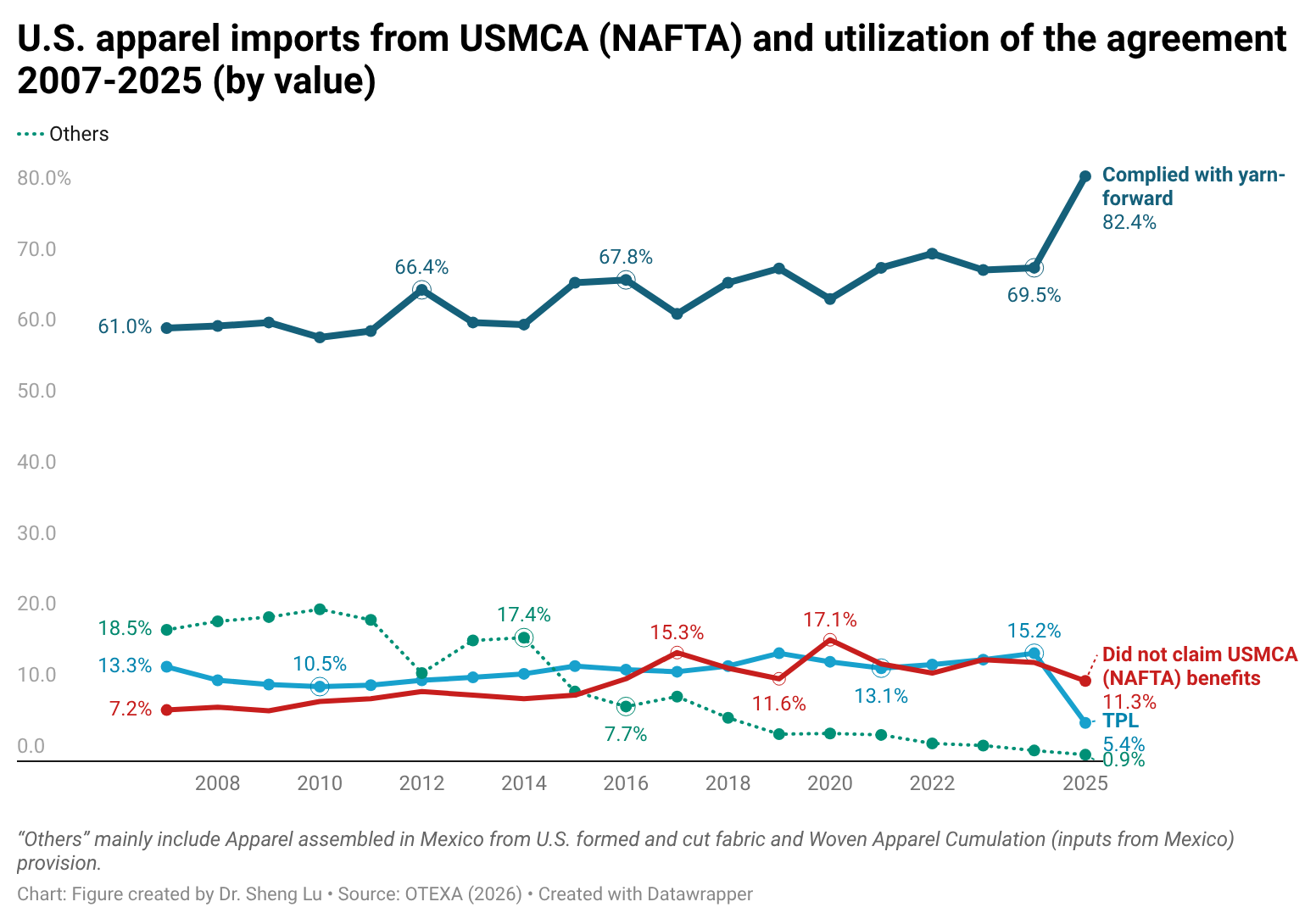
Similarly, in value, about 88.7% of U.S. apparel imports from Mexico and Canada claimed duty-free benefits under the U.S.-Mexico-Canada Agreement (USMCA), up from 86.1% in 2024 and 85.7% in 2023. Notably, in the past, only around 20% of U.S. apparel imports from Canada met the yarn-forward rules of origin; however, this percentage increased dramatically to 69.9% in 2025. Since March 2025, USMCA-qualifying products have been exempt from the “reciprocal tariffs” imposed by the Trump administration, which likely encouraged more U.S. apparel imports from Canada to take advantage of the rules. [Click here for USMCA utilization data]
By Sheng Lu
Read the full paper: Lu, Sheng (2026). US Apparel Import and Sourcing Patterns in 2025. Global Textile Academy, International Trade Centre (ITC). Geneva, Switzerland
[Comment for this post is closed]


An important concept we learned about in class was the lasting effect of tariffs and how they play into the overall global supply chains that apparel companies utilize. Increasing tariffs can negatively impact sourcing decisions, and oftentimes companies must regroup and source from other regions when this occurs. This is what the blog post touches on, as companies have chosen to adjust their sourcing regions rather than their retail prices when high tariffs were implemented. Sourcing in different regions can be beneficial, such as CAFTA-DR and USMCA, because it saves apparel brands money in production and does not require them to increase their retail prices to a point where their consumers are unhappy. This has increased the use of free trade agreements as well. Personally, I think diversifying where companies source is a good strategy. Although it may come with disadvantages such as higher costs and the potential of ethical issues, relying on one area to source from can be quite risky. Companies that were sourcing only from Asia when the high tariffs were imposed were more negatively impacted than others and likely struggled to adjust quickly. This shows that flexibility within supply chains is becoming important in a way similar to cost, as companies need to be able to adapt at a fast turnaround and stay competitive in a rapidly changing market.
A key concept related to this that we discuss frequently in class is how tariffs themselves do not necessarily lead to more localized production. This is due to another concept we learned, factor proportion theory, the idea that countries have different advantages based on their individual situations. For example, the US has advantage in capital but not labor., which is why production stays mainly in lower cost countries that have advantage in labor, like Bangladesh. Tariffs as a means to localize production seems counterintuitive when you understand this theory, as they increase costs but do not change the existing limitations that countries face. Trade is more driven by availability of resources and country advantages rather than changes in policy, which is why tariffs alone cannot shift apparel production back to the US.
One key concept from class that relates to this is factor proportion theory, which explains that countries specialize in production based on their advantages in labor and capital. For example, the U.S. has more of an advantage in capital, while countries like Bangladesh have cheaper labor, which is why a lot of apparel production still happens there. Because of this, even when tariffs increase, production does not simply move back to the U.S. since those underlying advantages do not really change. Another idea from class is how tariffs affect global supply chains. When tariffs increase, companies do not always raise prices, but instead look for other places to source from. This is what we see in the blog, where companies shift sourcing to regions like CAFTA-DR and USMCA to avoid higher costs and take advantage of trade agreements. This allows them to keep prices more stable for consumers instead of passing on all the extra costs. I think this also shows why diversifying sourcing is important. If companies rely too much on one region, like Asia, they are more affected when tariffs or policies change. At the same time, switching sourcing locations can create other issues, like higher costs or ethical concerns. Because of this, companies need to balance cost with flexibility so they can adjust quickly and stay competitive.
Two key concepts related to this article are supply chain management and overseas markets. This article specifically talks about the current high tariffs that the U.S. has put in place and how they are impacting the exports specifically in the fashion industry. This has disrupted the supply chain as there are significant taxes being added to the clothing being brought into the U.S. The article states that the tariff rate has risen from 14.7% to 31.5% in a year, but the average U.S. garment retail price has only increased by 0.3%. I found it interesting that there were higher tariffs on man made fibers in 2025 causing U.S. fashion companies to source less man made fiber clothing from Asia. I’m wondering why there has been less of an increase in retail price when there is such a high tariff increase. In the article it says that there has been less of a demand for higher priced clothing and all clothing is rising in price because of these new policies and the constant changing. Is it because companies know consumers won’t buy these higher priced items? If so, what are companies doing to make their money back with the loss of profit from the tariffs?
One key concept from class that connects to the blog post is the role of the government and how tariffs impact sourcing in the industry. In class we discussed how tariffs directly affect a company when choosing location of production. This is important because additional tariffs and policy changes can increase total cost and cause companies to adapt and potentially relocate their source. This is made clear to us by the blog post since it shows clear examples of increasing sourcing costs. The text states U.S. apparel tariffs grew to 35.1 percent in 2025. Although the cost to import increased greatly, there was only a small increase in retail prices indicating that companies are negatively affected, even more so than the consumer. The text also demonstrates how companies have relocated sourcing to places such as CAFTA-DR and USMCA allowing them to be exempt from these taxes. When looking at the management side of a company, they must monitor these constantly changing trade policies so they can quickly adapt when necessary. Companies can also prepare for this by distributing their sourcing to a variety of locations. Therefore if one of them becomes unmanageable, they still have other suppliers to rely on. Companies that remain prepared for change will have a much easier time managing costs and remaining successful.
One key concept from our class that relates to this blog post is sourcing diversification.
In class, we’ve discussed that sourcing diversification is important because it helps companies reduce risk, especially when facing disruptions such as tariffs, geopolitical tensions, or supply chain delays. By spreading production across multiple countries, brands can remain flexible and avoid over-reliance on a single sourcing region.
In this blog post, we can see that sourcing diversification is fully supported by the data presented on U.S. apparel import patterns in 2025. The shifts in sourcing away from certain countries and toward alternative regions suggest that companies are actively responding to rising costs and policy changes. This pattern helps explain how brands are adapting to external pressures like tariffs by exploring new supplier bases while still trying to maintain cost efficiency and production capacity.
Going forward, we can further explore whether this diversification strategy is sustainable in the long term or if companies will eventually consolidate sourcing again once conditions stabilize. I am curious if newer sourcing destinations will be able to consistently meet quality and scale demands, and fashion companies may want to invest more in building strong relationships and infrastructure in these emerging regions.
One key concept from class that relates to this blog post is factor proportion theory, which explains that different countries specialize in production depending on their resources, like labor and capital. In the apparel industry, many companies continue to produce in countries with lower labor costs because it is more cost efficient. Even though tariffs have increased, production does not automatically move back to the U.S. because the U.S. does not have the same cost advantages as other countries. The blog also shows that tariffs affect sourcing decisions in more ways than just increasing prices. Even though tariffs increased a lot in 2025, retail prices only went up slightly, which shows companies are adjusting their sourcing strategies instead of passing all the costs to consumers. The data also shows that companies are using trade agreements like USMCA and CAFTA-DR to reduce costs and stay competitive. Overall, this shows how important flexibility is in global sourcing. Companies need to be able to adjust where they produce products when trade policies change. Diversifying sourcing locations can help reduce risk and allow companies to adapt more easily to changes in tariffs or the global market.
During class, we learned about the three current patterns within the U.S textile and apparel manufacturing sectors. One being the US T&A has shrunk in size, another being that US T&A is hanging in nature and lastly that US T&A are experiencing different growth trajectories in the US. This relates to the post because it mentions how tariffs are affecting the United States and who they manufacture with. In order to save money for companies and their customers, brands are opting to manufacture either within the United States or other countries that do not require high tariff costs. In my opinion, sourcing with other countries that are able to provide affordable manufacturing for US companies, might not be a bad idea. It will create better relationships between countries and ultimately save brands from having to file for bankruptcy. This post relates most to pattern 3 as the graphs are projecting future growth trajectories that will need to be made for US companies. In order for companies to stay competitive in this market, they need to seek out other sourcing options that balance cost efficiency with quality.
One key concept from our class that relates to this blog post is diversification in terms of the look towards free trade agreements and expansion. This expansion the article states is recently focusing on the Western Hemisphere as Asia becomes a less suitable option with changing tariffs. In class, we’ve discussed that diversification is important because the expansion of sourcing goods such as apparel and increasing of sourcing from countries such as Mexico, Canada, and the Dominican Republic can be used to explain how higher tariffs on products has led companies to shift from sourcing clothes from Asia. The weaker demand for expensive clothing has pushed companies to expand markets where there are less tariffs in order to maintain active consumers. This is seen from the post where duty-free benefits under international agreements such as USMCA and CAFTA-DR have increased imports to the U.S apparel market and the claiming of duty free benefits has risen over 5% since 2023, benefiting the DR and U.S market. Diversification of Americas import market is supported by the data as there was about a 2% decline in Asias importing of MMF and diversification alongside free tade agreements explain this phenomenon. This data along with others suggests that MMF textile manufacturing is said to increase in CAFTA-DR and USMCA countries. Going forward I think it is important to explore how this shift will be maintained. As the U.S continues to diversify production, other regions and countries will become reliant on the U.S. This may pose a problem for a country like the Dominican Republic to be able to have a market the U.S wants and needs will not only booster it economy but allow them to become dependent with their production of this good even as U.S fashion companies continuously change where and how they manufacture alongside the shifts of international laws, and the diversification of markets will continue to shift.
what do you mean “The weaker demand for expensive clothing has pushed companies to expand markets where there are less tariffs in order to maintain active consumers. “?
One of the big ideas we’ve covered is the three patterns of U.S. T&A manufacturing, especially the shift toward a retailer-led sourcing model. Basically, instead of actually sewing clothes in the US, companies instead focus on the high value items (ex: design and marketing). We talked about how this is a huge part of globalization, where brands have to almost act like supply chain managers to stay competitive. This blog post really shows how complicated the supply chain manager role is getting, especially with the 35.1% average tariff rate hitting in late 2025. Since U.S. brands are now “sourcers” rather than “makers,” they’re forced to move production around to avoid costs. For example, the data shows companies are no longer buying man-made fiber from Asia because the tariffs are so high, and they’re moving those orders to USMCA or CAFTA-DR countries just to save money. My main takeaway is that trade policy has become the most important sourcing criterion, even over factory efficiency. Moving forward, I think we’re going to see a massive push for near-shoring in the Western Hemisphere, because free trade agreements are the only way to keep clothing affordable for our us.