Transition Pathway for EU Textiles: For Sustainable and Circular Value Chains (Webinar)

Speakers

  • Antonio de Sousa Maia, Legal Officer, European Commission;
  • Cecilia Nilsson-Bottka, Policy Officer, European Commission;
  • Enrico Venturini, Senior Researcher, NEXT TECHNOLOGY TECNOTESSILE;
  • Dirk Vantyghem, Director General, EURATEX;
  • Clara Mallart, Senior Specialist for Sustainability, MODACC.

Summary of remarks by Dirk Vantyghem (Director General of the European Apparel and Textile Confederation, EURATEX)

  • EU textile and apparel companies are still struggling with an adverse business environment, from high energy bills and hiking inflation to an economic slowdown. Many companies are in trouble. New “green measures” must be careful about their impacts on companies’ business operations.
  • Textile and apparel is one of the most globalized sectors in the EU. Government sustainability policy must consider the global dimension of their implications on EU companies, such as the impact on fair competition and investments across borders.
  • Consumers’ demand for sustainable textile and apparel products, especially their willingness to pay a premium, remains a question mark.
  • If new sustainability regulations are implemented, it is imperative for the government to assist companies going through the transition. Small and medium-sized enterprises (SMEs) form the backbones of the textile and apparel industry. These SMEs must survive as they provide critical products and services to large-scale fashion brands.
  • Many green legislations impacting the EU textile and apparel industry are coming (e.g., new labeling requirements on sustainable materials). Close collaboration and dialogue between the industry and legislators are essential.
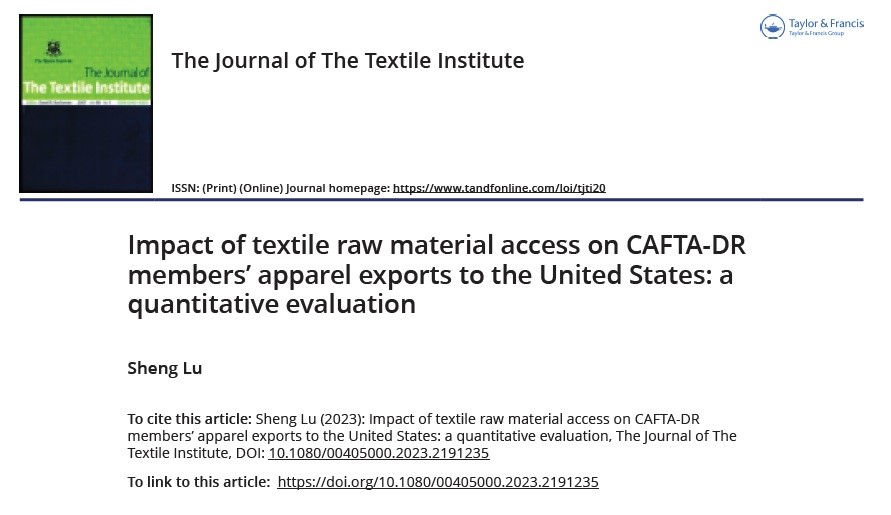
New Study: Impact of Textile Raw Material Access on CAFTA-DR Members’ Apparel Exports to the United States

The full paper is HERE. Below are the key findings:

Over the past decade, U.S. fashion brands and retailers have seen Central America as a critical emerging apparel-sourcing destination. Especially since implementing the Dominican-Republic Central America Free Trade Agreement (CAFTA-DR) in 2006, a trade deal among the United States, El Salvador, Guatemala, Honduras, Nicaragua, the Dominican Republic (joined in 2007), and Costa Rica (joined in 2009), apparel sourcing from the region gained consistent interest among U.S. companies.

Nevertheless, U.S. apparel sourcing from CAFTA-DR members is NOT without significant challenges. For example, CAFTA-DR countries’ market shares in the U.S. apparel import market fell from 11.8% in 2005 before the trade agreement entered into force to only 10.6% in 2022, measured by value. Trade data also indicated that U.S. apparel sourcing from CAFTA-DR members concentrated on simple and low-value items, such as T-shirts, and lacked product diversification with no improvement over the years.

Given the high stakes of improving the status quo, this study quantitatively evaluated the impact of textile raw material access on CAFTA-DR’s apparel exports to the United States. Specifically, this study assumed that CAFTA-DR members cut their textile import tariff rates to improve garment producers’ textile raw material access (i.e., to reduce the cost of sourcing textiles from anywhere in the world and beyond the U.S. supply). The computable general equilibrium (CGE) model estimation based on the GTAP9 database shows mixed results:

On the one hand, cutting CAFTA-DR members’ textile import tariffs to improve their garment producers’ textile raw material access would significantly improve CAFTA-DR members’ price competitiveness of their apparel exports to the United States and increase the export volume.

However, cutting CAFTA-DR members’ textile import tariffs to improve their garment producers’ textile raw material access would significantly expand their textile imports from non-U.S. sources. This means that CAFTA-DR members’ dependence on the U.S. textile raw material supply may decline further.

Overall, the study’s findings remind us that the debate on expanding U.S. apparel sourcing from CAFTA-DR members should go beyond CAFTA-DR members’ garment production. Instead, more efforts could be made to enhance CAFTA-DR garment producers’ textile raw material access as an effective way to expand the region’s apparel exports to the United States.

Meanwhile, several leading CAFTA-DR apparel exporting countries, including Honduras and Nicaragua, have been engaged in negotiations for free trade agreements with China, Taiwan, and other Asian economies. As the study’s findings indicate, these new trade deals could incentivize CAFTA-DR apparel manufacturers to increase their textile sourcing from Asia. In other words, inaction on the U.S. side and maintaining the status quo still could have significant implications for the future stability of the Western Hemisphere textile and apparel supply chain.

by Sheng Lu