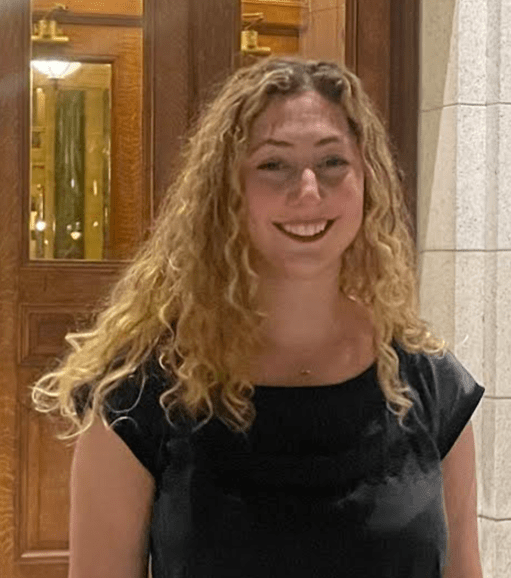
FASH455 Exclusive Interview with Jillian Silverman, Associate Trim Specialist at Lands’​ End, about Textile Raw Materials and Apparel Sourcing

About Jillian Silverman

Jillian Silverman is an Associate Trim Specialist at Lands’ End, based in Madison, Wisconsin. She earned an Honors degree in Fashion Merchandising with a minor in Environmental Humanities from the University of Delaware in 2016. She later completed her Master’s degree in Fashion and Apparel Studies in 2018, focusing on sustainable material development. Her research, which explored the use of mushrooms as a primary material for footwear, gained national media attention. As a graduate instructor, Jillian taught an undergraduate sustainability course at UD. She continues to share her expertise on textile sustainability as an adjunct professor, teaching several courses in the FASH graduate certificate program for sustainable apparel business.

Disclaimer: The views expressed in this interview are those of Jillian Silverman and do not reflect the views or positions of her employer or any affiliated organizations.

Sheng: What are your main responsibilities as a trim specialist? What does a typical day look like? Which aspects of the job do you find particularly interesting or unexpected before taking on the role?

Jillian: I manage the trims for all our apparel categories, which include hard trims like zippers and buttons and soft trims like thread and interlining, just to name a few. I work with our designers to find out their trim needs and any inspiration, our sourcing team to learn where the garments will be manufactured and any cost, quantity, or lead time considerations, and our global trim suppliers (primarily Asia-based) to select existing trim qualities or bring new ones to fruition. I never realized the intricacies of all the different trim types, and I have learned a lot on the job and still learn as I go! I really enjoy sitting between the creative side, particularly with custom trims, and the more logistical side of things. The different teams often have competing priorities, so while that makes it challenging to juggle, the problem-solving aspect keeps things interesting.

Sheng: In general, what factors should be considered when selecting trims and other textile materials in product development and sourcing?

Jillian: One of the big challenges right now is vendor and garment production location and how that relates to material production locations. With the new administration’s push for tariffs, we’ve been trying to quickly pivot away from China, but many of our raw materials still come from China, so it’s not so simple to move production away without having new challenges with transporting materials and the resulting cost and time delays.

In general, our biggest considerations when selecting materials are aesthetics and performance, cost, lead time (how long it takes to get samples and/or bulk production made), and MOQ (minimum order quantity). We also have to consistently reevaluate our supplier base to make sure we have the right partners who offer what we need at the right place, time, and cost. Speed is becoming more important, so the quicker we can have materials made and transported to our factories, the faster we can start selling those products.

Sheng: Based on your observations, how has sustainability influenced the selection and sourcing of textile materials for fashion companies? How is “sustainability” assessed for trims and other textile materials? What emerging trends should we keep an eye on?

Jillian: Sustainability considerations can be more proactive or reactive depending on the company and the issue at hand. For example, we phased out any PFAS from our supply chain to be in compliance with regulations that were coming. Other initiatives may be to reach certain sustainability goals, like ensuring that a specific percentage of polyester is recycled or using organic or BCI (Better Cotton Initiative) vs. conventional cotton, both of which are transitions we’re working to make. For outerwear, we’ve been using a lot more synthetic insulation, which is generally cheaper, more ethical, and offers easier care to our customers compared to down, so that’s a great option across the board, but many swaps are not so simple; switching to materials with a higher recycled content is often more expensive and less readily available. It can also be hard to quantify what is more “sustainable” about an item, so we look for documentation that supports it wherever possible.

Sheng: How do fashion companies today communicate the sustainability attributes of their apparel products? Is specifically mentioning keywords such as “sustainability” and “low impacts” in labels the most common practice?

Jillian: This has been an interesting topic of discussion lately since at a larger company, the people writing product copies for the website may be fairly removed from the product teams who know the ins and outs of their items and materials and what makes them special. Another challenge is that customers may not recognize the industry terms for things like branded fibers or certifications, so while those are more specific and quantifiable than terms like “sustainable,” they may be lost on the end consumer. I think it’s nice to offer both the more simplified language to get the customer to read further and then to try to break out what makes the item fit that label (e.g., water-saving dyeing method, a certain number of recycled bottles in the insulation, etc.).

Sheng: Following up on the previous question, is it true or a myth that sustainable textile materials are typically more expensive and increase production costs? If so, how can companies balance sustainability with cost-effectiveness?

Jillian: I’ve unfortunately found this to be true in many cases, but as the demand increases, many suppliers are beginning to make these switches automatically and often cost-neutral to their customers. The more brands ask for these changes, the more motivated suppliers are to invest in technology, certifications, etc.. We have to weigh whether or not we can use the more sustainable option without negatively impacting the other business needs, as well as gauge what our customer really cares about. It would be great to use more ethical materials and processes across the board, but we often use a phased approach to transition to more recycled content, for example, over time as we deplete existing stocks or focus on certain programs and styles like our more eco-friendly denim.

Sheng: Based on your experience, do you have any advice for our students on preparing for a career in the fashion apparel industry? What can they do at UD to better prepare? Additionally, what benefits do you see in pursuing a Master’s degree in fashion and apparel?

Jillian: My biggest advice is to be open to opportunities that are different from what you envisioned doing or even realized was a specific job that existed, like one centered around trims! I work with people who have moved between different roles in sourcing, design, technical design, and even IT once they get exposed to different teams and what their work was like. It’s ok to pivot if you find something that suits you better, or to find yourself working on something you weren’t expecting. Getting a breadth of experience also helps you to understand the bigger picture of all the moving parts that go into the apparel industry.

–The End–
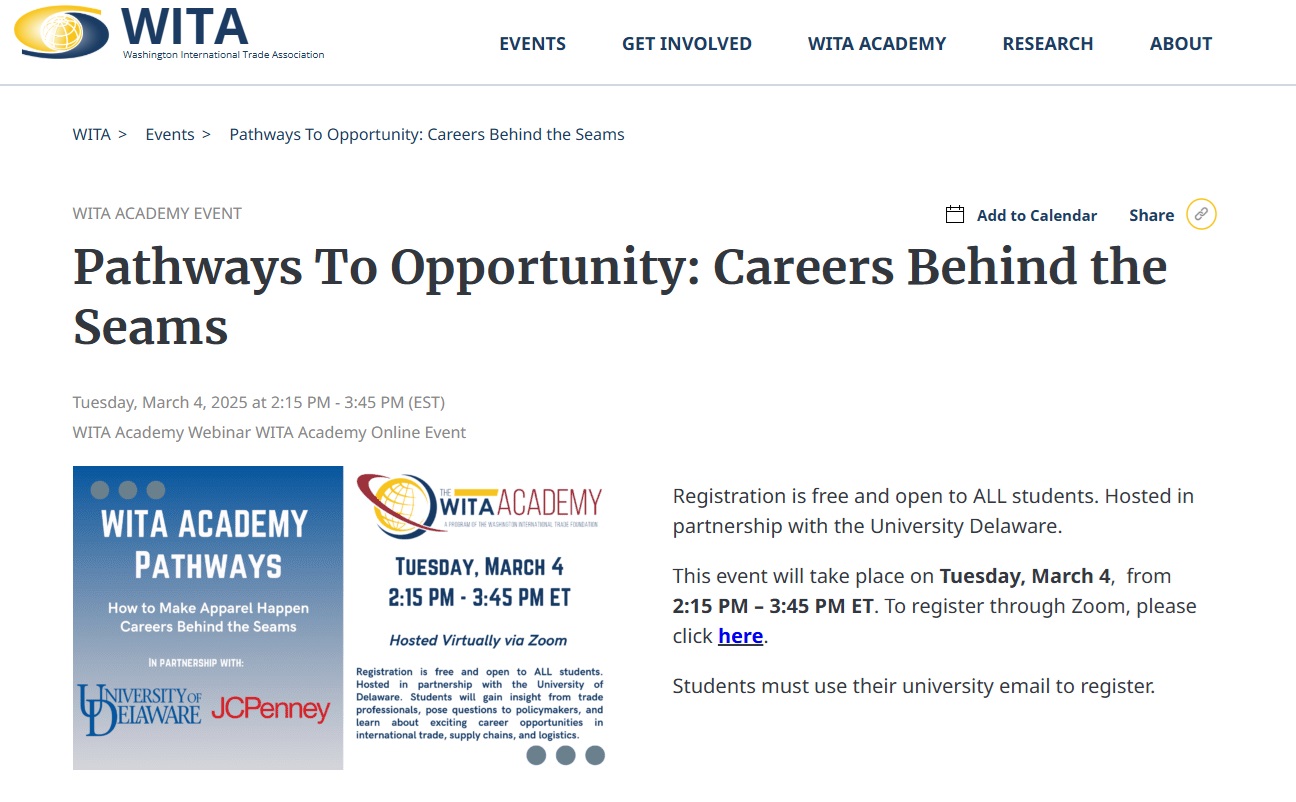
2025 WITA Academy Pathways To Opportunity: Textiles and Apparel-University of Delaware

On March 4, 2025 (Tuesday) from 2:15 pm. to 3:45 pm, the Washington International Trade Association (WITA) Academy, in partnership with UD’s Fashion and Apparel Studies Department and JCPenney, will host a virtual workshop (on Zoom) exploring career opportunities across the fashion apparel supply chain, including design, product development, merchandising, sourcing, sustainability, trade compliance and more.

This event is free and open to ALL UD students (undergraduate and graduate), faculty, and prospective students of the UD FASH program, but registration is required (please use .edu email address): https://www.wita.org/events/pathways-careers-behind-the-seams/

Note: Students in FASH455-010 (Tue and Thu) do not need to register for the event. We will attend the workshop and participate in the live Q&A session in the classroom.

Featured speakers (bios here) from JCPenney include:

  • Amanda Blackman, Director of Planning and Allocation
  • Michelle Erwin, Sourcing Manager
  • Hunter Green, Senior Manager of International Transportation
  • Angela Hofmann, VP, Government Affairs
  • Wayne Milano, SVP, Global Sourcing and Product Development
  • Aqsa Tasleem, Senior Manager of Fabric & Sustainability
  • Katie Thurman, Senior Pre-Production Manager
  • Brandi Wallace, Senior Design Director
  • Brian Wolfrum, Director of Trade Compliance
  • Aaron Worley, Senior Buyer

Recording: Due Diligence Education for Gen Z: Preparing Future Fashion Leaders for Sustainable and Socially Responsible Apparel Sourcing (2025 OECD Forum Side Session)

About the Event

As the fashion industry grapples with increasing demands for sustainability, transparency, and social responsibility, the next generation of industry professionals—Generation Z—will play a crucial role in shaping the future of apparel sourcing and social responsibility practices in the industry.

This session explores how US college fashion programs equip Gen Z with critical knowledge in due diligence, sustainable sourcing, and supply chain transparency. Including voices from educators, Gen Z students (future professionals), and industry partners, the session will share best education practices, identify educational gaps, and present valuable Gen Z’s vision for improving due diligence and social responsibility in the garment industry. Additionally, the session will emphasize the increasing importance of industry-academic partnerships in curriculum development and talent preparation, illustrating the long-term benefits of such collaboration.

This session is highly relevant to industry professionals, educators, students, international organizations, and policymakers interested in supporting the next generation of fashion leaders and fostering a more socially responsible and sustainable fashion industry.

Panelists (Bios here)

  • Matthias Knappe, Head of Fibres, Textiles and Clothing Unit, International Trade Center
  • Laurie Rando, Senior Director of Sustainable Product and Human Rights, Macy’s
  • Julia Hughes, President, United States Fashion Industry Association
  • Megan Dawson-Elli, Manager of Product Sustainability, Tapestry
  • Sheng Lu, Professor & Graduate Director, Fashion and Apparel Studies, University of Delaware
  • Emilie Delaye, Master’s Student, Fashion and Apparel Studies, University of Delaware

This event is an official side session of the 2025 OECD Forum on Due Diligence in the Garment and Footwear Sector.

FASH455 Video Discussion: The Global Journey of a Sneaker

Discussion questions [Please address at least two questions in your comment]

#1: Based on the video and our class discussion, what would be the advantages and disadvantages for Nike to make Converse shoes leveraging a global supply chain?

#2: Assume you are an experienced U.S. shoe worker. What arguments would you present to Nike’s sourcing executives to produce Converse in the United States?

#3: In your opinion, are protective tariffs worth the economic and foreign policy consequences? Why or why not?

#4: The “hidden costs” of global trade (e.g., emissions, labor conditions) are often obscured from consumers. How can brands like Converse address these “hidden costs” while maintaining market competitiveness? What specific policies or regulatory measures should governments implement to promote responsible sourcing and enhance supply chain transparency?

[Discussion is closed]

Is Free Trade Worth the Cost? (Video discussion)

For FASH455 students: Please share your reflections on the video regarding the free trade debate. You can focus on analyzing 1-2 specific debates raised in the video (e.g., comparing the arguments from both sides) and then share your thoughts. Please do not simply state your “opinion,” but use examples, statistics, or trade theories we learned to support your viewpoint.

Further reading: Is Free Trade Worth the Cost?

[discussion is closed]

New OECD Study: The Role of Sustainability Certifications In Due Diligence In The Garment And Footwear Sector (February 2025)

The study was based on a content analysis of major fashion brands and retailers’ sustainability reports and a survey of stakeholders in the garment and footwear sector from August to October 2023, including 32 brands and retailers, 37 suppliers, and a few non-business respondents.  The full report is HERE.

Key findings:

Rise in sustainability certification in the garment and footwear industry

  • Certifications like GOTS (Global Organic Textile Standard) and LWG (Leather Working Group) have seen significant growth (e.g., GOTS-certified facilities increased by 154% from 2018–2023).
  • Certified textile materials still constitute a minority of global production (e.g., 27% for cotton, 39% for leather)

Sustainability certification requirements and motivations

  • Over 80% of surveyed garment and footwear brands/retailers require certifications from suppliers, driven by risk identification (92%), product tracing (81%), and compliance with regulations (72%). In general, larger brands/retailers (91% of those with >€50M turnover) are more likely to mandate certifications than smaller ones (60% of small and medium-sized enterprises, SME).
  • In contrast to brands and retailers, most surveyed garment and footwear suppliers selected market access (84%) as a key motivation for obtaining certifications, followed by reputational reasons (83%) and risk identification (68%)

Types of sustainability certification in the garment and footwear industry

The paper divides sustainability certification in the garment and footwear industry into three major categories:

  • Due diligence certification to attest that a company (e.g. brand, manufacturer) implements the 6-step risk-based due diligence framework as outlined in the OECD Due Diligence Guidance (e.g., Green Button, Oeko-Tex Responsible Business).
  • Targeted risk certifications to verify outcomes on labor, environmental, or animal welfare risks in the supply chain (e.g., Better Cotton Initiative, Cradle to Cradle, Fairtrade Cotton, Fairtrade Textiles, FSC Forest Management, Global Recycled Standard (GRS), GoodWeave, GOTS, LWG, Oekotex SteP, SA8000, Worldwide Responsible Accredited Production)
  • Certificates of origin and chain of custody to trace raw materials (e.g., cotton, wool) to specific regions or facilities (e.g., Better Cotton Traceability, GOTS transaction certificates)

Role of sustainability certification in trade and market access

  • Certifications standardize compliance, enabling suppliers to meet buyer/regulatory demands (e.g., EU due diligence laws).
  • Brands use certifications to exclude high-risk regions (e.g., cotton from areas with forced labor) and validate ethical claims (e.g., recycled content).

Challenges related to sustainability certification in the garment and footwear sector

  • As the report noted, suppliers typically bear certification costs (e.g., audits, improvements), with limited buyer support.
  • SMEs and informal suppliers struggle with eligibility criteria and costs, risking exclusion from global supply chains.
  • The paper argues that certifications are not a “safe harbor.” Instead, apparel and footwear brands and retailers must complement certification with direct assessments, grievance mechanisms, and stakeholder engagement (e.g., worker interviews). Likewise, mandatory due diligence laws (e.g., EU CSDDD) will increase certification demand, but companies must balance compliance with holistic risk management.
  • The paper emphasizes the need for further research to understand how fashion brands and retailers use sustainability certification in practice. Policymakers should also consider new guidelines that clarify how companies should communicate publicly about the elements of due diligence for which they utilize sustainability certifications.

FASH455 Video Discussion: This ‘Loophole’ Lets $54B of Products Into the U.S. Tariff-Free (WSJ)

Discussion questions:

  1. What makes the de minimis rule controversial?
  2. Who might be the winners and losers of the suspension of the de minimis provision for U.S. imports from China? Why?
  3. Imagine you are part of the sourcing department of a U.S.-based fashion company that currently sources from China. How would you respond to the situation in the video, and what recommendations would you make regarding your company’s sourcing strategies?
  4. Do you have any other thoughts or reflections on the video?

Additional reading: