
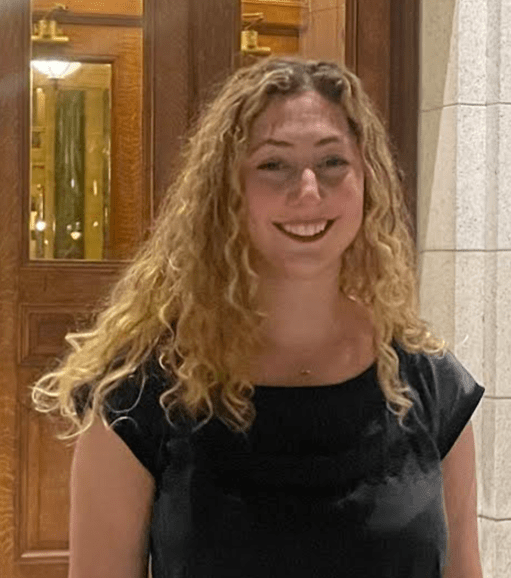
About Jillian Silverman
Jillian Silverman is an Associate Trim Specialist at Lands’ End, based in Madison, Wisconsin. She earned an Honors degree in Fashion Merchandising with a minor in Environmental Humanities from the University of Delaware in 2016. She later completed her Master’s degree in Fashion and Apparel Studies in 2018, focusing on sustainable material development. Her research, which explored the use of mushrooms as a primary material for footwear, gained national media attention. As a graduate instructor, Jillian taught an undergraduate sustainability course at UD. She continues to share her expertise on textile sustainability as an adjunct professor, teaching several courses in the FASH graduate certificate program for sustainable apparel business.
Disclaimer: The views expressed in this interview are those of Jillian Silverman and do not reflect the views or positions of her employer or any affiliated organizations.
Sheng: What are your main responsibilities as a trim specialist? What does a typical day look like? Which aspects of the job do you find particularly interesting or unexpected before taking on the role?
Jillian: I manage the trims for all our apparel categories, which include hard trims like zippers and buttons and soft trims like thread and interlining, just to name a few. I work with our designers to find out their trim needs and any inspiration, our sourcing team to learn where the garments will be manufactured and any cost, quantity, or lead time considerations, and our global trim suppliers (primarily Asia-based) to select existing trim qualities or bring new ones to fruition. I never realized the intricacies of all the different trim types, and I have learned a lot on the job and still learn as I go! I really enjoy sitting between the creative side, particularly with custom trims, and the more logistical side of things. The different teams often have competing priorities, so while that makes it challenging to juggle, the problem-solving aspect keeps things interesting.
Sheng: In general, what factors should be considered when selecting trims and other textile materials in product development and sourcing?
Jillian: One of the big challenges right now is vendor and garment production location and how that relates to material production locations. With the new administration’s push for tariffs, we’ve been trying to quickly pivot away from China, but many of our raw materials still come from China, so it’s not so simple to move production away without having new challenges with transporting materials and the resulting cost and time delays.
In general, our biggest considerations when selecting materials are aesthetics and performance, cost, lead time (how long it takes to get samples and/or bulk production made), and MOQ (minimum order quantity). We also have to consistently reevaluate our supplier base to make sure we have the right partners who offer what we need at the right place, time, and cost. Speed is becoming more important, so the quicker we can have materials made and transported to our factories, the faster we can start selling those products.
Sheng: Based on your observations, how has sustainability influenced the selection and sourcing of textile materials for fashion companies? How is “sustainability” assessed for trims and other textile materials? What emerging trends should we keep an eye on?
Jillian: Sustainability considerations can be more proactive or reactive depending on the company and the issue at hand. For example, we phased out any PFAS from our supply chain to be in compliance with regulations that were coming. Other initiatives may be to reach certain sustainability goals, like ensuring that a specific percentage of polyester is recycled or using organic or BCI (Better Cotton Initiative) vs. conventional cotton, both of which are transitions we’re working to make. For outerwear, we’ve been using a lot more synthetic insulation, which is generally cheaper, more ethical, and offers easier care to our customers compared to down, so that’s a great option across the board, but many swaps are not so simple; switching to materials with a higher recycled content is often more expensive and less readily available. It can also be hard to quantify what is more “sustainable” about an item, so we look for documentation that supports it wherever possible.
Sheng: How do fashion companies today communicate the sustainability attributes of their apparel products? Is specifically mentioning keywords such as “sustainability” and “low impacts” in labels the most common practice?
Jillian: This has been an interesting topic of discussion lately since at a larger company, the people writing product copies for the website may be fairly removed from the product teams who know the ins and outs of their items and materials and what makes them special. Another challenge is that customers may not recognize the industry terms for things like branded fibers or certifications, so while those are more specific and quantifiable than terms like “sustainable,” they may be lost on the end consumer. I think it’s nice to offer both the more simplified language to get the customer to read further and then to try to break out what makes the item fit that label (e.g., water-saving dyeing method, a certain number of recycled bottles in the insulation, etc.).
Sheng: Following up on the previous question, is it true or a myth that sustainable textile materials are typically more expensive and increase production costs? If so, how can companies balance sustainability with cost-effectiveness?
Jillian: I’ve unfortunately found this to be true in many cases, but as the demand increases, many suppliers are beginning to make these switches automatically and often cost-neutral to their customers. The more brands ask for these changes, the more motivated suppliers are to invest in technology, certifications, etc.. We have to weigh whether or not we can use the more sustainable option without negatively impacting the other business needs, as well as gauge what our customer really cares about. It would be great to use more ethical materials and processes across the board, but we often use a phased approach to transition to more recycled content, for example, over time as we deplete existing stocks or focus on certain programs and styles like our more eco-friendly denim.
Sheng: Based on your experience, do you have any advice for our students on preparing for a career in the fashion apparel industry? What can they do at UD to better prepare? Additionally, what benefits do you see in pursuing a Master’s degree in fashion and apparel?
Jillian: My biggest advice is to be open to opportunities that are different from what you envisioned doing or even realized was a specific job that existed, like one centered around trims! I work with people who have moved between different roles in sourcing, design, technical design, and even IT once they get exposed to different teams and what their work was like. It’s ok to pivot if you find something that suits you better, or to find yourself working on something you weren’t expecting. Getting a breadth of experience also helps you to understand the bigger picture of all the moving parts that go into the apparel industry.
–The End–

 FASH455 Global Apparel & Textile Trade and Sourcing
Since the tariffs on China have been increased recently, it is interesting to see how this is affecting brands first hand like Lands’ End. Jillian was explaining that in her role as Associate Trim Specialist, she works closely with both the design team and sourcing team to get the correct trims required for their products. She explained that the tariffs on China have caused Lands’ End to consider moving sourcing away from China, however, this poses many challenges since they source a lot of their materials from China, and other locations may have higher costs and longer manufacturing times. She also mentions aspects like minimum order quantity and transportation issues, which could be a concern when shifting sourcing from China. We talk about issues like these a lot in class, so it puts it into perspective hearing about them affecting real brands and people.
FASH455 Exclusive Interview with Jillian Silverman, Associate Trim Specialist at Lands’ End, about Textile Raw Materials and Apparel Sourcing
It’s such a privilege to learn from the experience of the trim specialist Jillian Silverman. I really enjoyed reading the interview. Her expertise and real-world experience helped me connect my learnings from the class to real-world applications. She mentioned the difficulty of moving away from Chia, even with rising tariffs. We also learned about this from the class and the case study. Since raw materials still largely come from China, and the inadequate infrastructure of other Asian countries, the reliance on China is still strong. Jillian’s comments on sustainability are also down-to-earth. It is so true that sustainable demands must be balanced with business needs. I also like how she points out the necessity of using simplified language to inform customers. This is a big gap between production teams and marketing teams. The customers do not always understand the meanings of certifications and greenwashing risks. I also appreciate Silverman’s career advice. I plan to follow her advice to get a breadth of experience in the fashion industry.
I found this interview with Jillian Silverman super interesting for its behind-the-scenes look into an aspect of the industry we don’t really talk about that much: trims. I had no idea the amount of details that go into making decisions about zippers, buttons, and threads, and how those choices affect everything from the cost to the speed at which something can be sent into production. It was also interesting to learn about the difficulties companies have when they try to move any production out of China because of the tariffs, particularly when many of their raw inputs continue to come from China. I think her thoughts on sustainability were really honest as well. It’s one thing to say you’re going to meet goals, but actually going and doing it is different, and it sounds like actually shifting to recycled materials or eco-friendly materials is not always as quick or as cheap as some people might think. I liked that she said how important it is to have a clear, simple message when talking with customers about sustainable products, since a lot of industry terminology can be pretty meaningless to the average shopper. I also really liked her career advice to keep an open mind for various job paths. It’s a reminder that some of the most interesting jobs in fashion aren’t always the ones you imagine when you are first starting out.
Another great fashion interview featuring Jillian Silverman from lands end. I feel like most of the time in fashion classes we don’t talk about trims. Hearing about her job brought a new aspect to me and opened up new ideas. I do think I would be interested in this job because I like how she works with the sourcing team a lot. I think sourcing is so important and she does a good job balancing talking to sourcing team while choosing what would be the best quality for a trim. I didn’t realize how sustainable materials are more expensive when it comes to trims. I can imagine how hard her job is with the current tariffs and how that is a challenge. Overall I would be intrested in Jillian jobs and didn’t really know it was a job until this interview so I learned a lot.
I found this interview with Jillian to be very insightful. She shares real-world experience about how tariffs on China are truly affecting the industry, connecting with my learnings from class. The tariffs have caused Lands’ End to initiate moving production, but this raises concerns for new challenges. The company has to consider a new sourcing location that doesn’t negatively impact material transportation at an extra cost or delay. Another point Jillian made that I found interesting is how intricate selecting trims is. I was unfamiliar with all that goes into making these decisions and I appreciate the opportunity to learn about her experience in a field we don’t hear about often.
I really enjoyed reading this interview with Jillian, I always love to hear firsthand experiences from someone currently working in the fashion industry to help understand what my future career may look like! I especially enjoyed this interview as Jillian discusses how the tariffs we have discussed in our class are actively impacting her in her role and Land’s End as a whole brand. I found it interesting that Jillian said Land’s End is looking to quickly move sourcing out of China due to the tariffs, this makes me wonder if the brand expects the tariffs to last for a long time rather than be a shorter term challenge they can ride out? Before reading this interview, I honestly did not even know that trim sourcing was a job, though it now makes sense. It is interesting to think about how the sourcing Jillian helps with differs from the sourcing done by an apparel sourcing specialist. For example, are there any specific points of importance that Jillian has to consider when sourcing zippers, as they are made of plastic and metal not thread or fabric, that someone working in apparel sourcing would never have to consider? Overall I really loved reading Jillian’s views and advice about working in the fashion industry and I appreciate the firsthand account!
This interview with Jillian was very interesting and I especially appreciated her thoughts and insights regarding sustainability. Jillian expressed that depending on the company, decisions may be proactive or reactive regarding sustainability. Jillian acknowledged how sustainability within the fashion industry is becoming more and more in demand, and she expressed how the extra cost of sustainable initiatives currently might be not as costly in the future. Jillian said that there is also different sustainability standards that her company follows that consumers might not recognize. Consumers that value sustainability that don’t recognize certain standards might not see the added value that those standards symbolize.
I really appreciated hearing this insight from Jillian. I thought it was interesting read a first hand experience regarding the tariff impacts on the fashion industry. The question ask was in regarding what to consider when selecting textiles for product development and sourcing. Jillian then went on to explain the impact of tariffs in regard to sourcing from China. She mentioned that her company was doing it’s best to quickly pivot from China to avoid the adverse affects of the tariffs, however because so many of the companies raw materials come from China this is difficult. The issues were said to lie in numerous factors including difficulty with transportation, cost, and time delays. This answer helped me to apply the knowledge we have learned in class to a real life scenario.
I really enjoyed reading this interview of Jillian Silverman! I have actually heard about her research using mushrooms as a material in footwear, so it was very interesting to learn more about her! I think being a Trim Specialist is a very interesting role, and trims often times can make or break a garment. It is interesting reading about how the tariffs have been affecting people in the industry, and I am able to get a better picture of what things are really looking like behind the scenes. I think sometimes it can be hard to imagine the effects without real world examples, and reading this interview as well as others from this blog have been really insightful. It is also interesting that she mentioned that speed is becoming a lot more important in the industry. I wonder if this is because of the rise of fast fashion, consumers are used to being able to find different garments from stores like Zara and H&M because they are producing new clothing so often.
I really enjoyed this interview of Jillian Silverman it was very informative. My top takeaways from this interview are how the tariffs is really impacting Land’s End sourcing and they are trying to move away from China’s sourcing but it is really hard due to many raw materials coming from China. Aesthetics and performance, cost, lead time, and MOQ are all areas of importance when selecting materials especially when sustainability is in high demand and with the tariffs it’s really causing more issues as those materials will be tariffed more as they are more expensive. Her role as a trim specialist is fascinating as I have never heard of it before and learning about her experience really opens up my mind of how the apparel and textile industry is really getting affected by these tariffs. I am very appreciative of this interview because it opens the door to many job opportunities and their duties that I have never known before.
This interview made me think about all the tiny details of sourcing. Even trim, a small but key element of design needs to be sourced and produced and is in turn tariffed. I found Jillian’s comments about how sustainability is communicated very eye opening. It’s strange to me that the team writing the product copies are so removed from the production team which is the expert. I wonder how much they consult these teams for input. In addition, the industry terms and jargon are not always easily understood by consumers and therefore it’s easy to greenwash and consumers will not often go and fact check themselves. Also, the availability of recycled and sustainable products at a low price is low, and so many companies use a sort of “rolling” strategy to slowly implement these elements as they become accessible. This provided me with some clarity as to why some brands haven’t made or make very slow changes.
As a senior looking to get a job soon, her advice made me feel more confident that it’s ok to not find the perfect job right away. Many people pivot and move into different roles as opportunities present themselves.
I truly enjoyed listening to this interview because it gave me insights into the fashion industry that many do not talk about and that I did not know. I enjoyed how Jillian explained how important trims are in finished garments and how many teams work in designing clothing. She discussed how important it is to have problem-solving skills and how muhc thought can go into something as simple as a button. Furthermore, the way she discussed sourcing was intriguing. She explained why sourcing challenges do not happen overnight and how raw materials will always be tied to China. Not only this, but her career advice was most compelling to me. She emphasized the importance of having an open mind with unexpected roles, especially ones that are not so well known. This interview gave me a deep understanding on her area of work as well as the reality we live in today.
What a great conversation with Jillian! While a majority of the conversation was centered on sustainability, I was more fascinated by the existence of her position altogether. It’s important for us to learn about all of the job titles and responsibilities that exist in the industry, especially as a soon-to-be graduate like myself. Associate Trim Specialist is a niche role, but it doesn’t sound stagnant or pigeon-holed at all. Quite the contrary, Jillian described her job as technical, creative, collaborative, intuitive, and competitive. These are all job functions that are coveted by many new professionals entering the field, but they may be unaware that the role exists. I’m grateful to read articles like this that expand my worldview.
Another thing that I’ll take away is Jillian’s advice for students: allow yourself to pivot, be open to new experiences, don’t get stuck on one idea of a dream job, and try out new roles to discover what best suits you. I’ll be holding onto that piece of knowledge as I enter this new phase of life next summer.