FASH455 Exclusive Interview with Nicole Bivens Collinson, Managing Principal and Practice Leader of International Trade and Government Relations, Sandler, Travis & Rosenberg, P.A.

About the interview

When learning about apparel sourcing and trade, our students often notice how much they are affected by trade policies and regulations—from tariffs, and something called “de minimis” to UFLPA. These issues are not only critical for fashion companies but can also be quite technical.

We are fortunate to have Nicole Bivens Collinson, Managing Principal and Practice Leader of International Trade and Government Relations of Sandler, Travis & Rosenberg, P.A. (ST&R), a true expert in trade policy and the legal aspects of trade, join us. In the interview, Nicole clarified key U.S. trade rules and provided valuable insights into their apparel sourcing and trade implications, including:

  • What is a tariff, and why is it a big issue for US fashion brands and retailers?
  • Why have the so-called IEEPA “reciprocal tariffs” imposed by the Trump administration so far this year raised so many concerns?
  • What does the term “transshipment” mean in international trade? And why did this issue emerge in the context of higher tariffs this year?
  • What is the “20% US content” rule and its implications for fashion companies?
  • What is “tariff engineering”? Is it legal or illegal? How have fashion companies used it to mitigate the tariff impacts, potentially?
  • What is de minimis? Why was it created, and then became controversial? Since the “de minimis” rule was officially terminated recently, what impacts could we expect now? 
  • What is the Uyghur Forced Labor Prevention Act (UFLPA) and what does it aim to do? How has the implementation of the UFLPA affected U.S. fashion companies’ apparel sourcing?
  • For fashion students interested in working in trade compliance, trade policy, or the legal aspects of the fashion industry, what steps can they take to get started?

About Nicole Bivens Collinson

Nicole Bivens Collinson is the Managing Principal and Practice Leader of International Trade and Government Relations with Sandler, Travis & Rosenberg, P.A. (ST&R). Nicole is a commentator on trade matters on MSNBC, NPR, and BBC the producer of the Two Minutes in Trade podcast.

Nicole has nearly 40 years of experience in government and public affairs and lobbying. She prepares countries, companies, and associations for negotiations with the United States on free trade agreements, trade and investment agreements, labor disputes, and preferential trade programs.

Prior to joining ST&R, Nicole served as assistant chief negotiator for the Office of the U.S. Trade Representative, responsible for the negotiation of bilateral agreements with Latin America, Eastern Europe, Southeast Asia, the Sub-Continent, and Africa. She also served as a country specialist in the International Trade Administration at the Department of Commerce, where she was responsible for the preparation of negotiations on specific topics between the U.S. and Latin America, Eastern Europe, China, and Hong Kong as well as the administration of complex textile agreements.

Nicole holds a master’s degree in international relations from The George Washington University and a triple bachelor’s degree in political science, European studies, and French from Georgetown College. She also studied at the Université de Caen in France.

Nicole is past chair of the Women in International Trade Charitable Trust, past president of Women in International Trade, an advisory board member of America’s TradePolicy.com, treasurer and board member of the Washington International Trade Association, and a member of the Washington International Trade Association Foundation and Women in Government Relations. She serves on the board of trustees for Georgetown College and is the past executive director for the U.S. Hosiery Manufacturers Coalition, the U.S. Apparel Industry Coalition, and the U.S. Sock Distributors Coalition.

About Katie Yasik (moderator)

Katie Yasik is a master’s student & graduate instructor in Fashion and Apparel Studies (FASH) at the University of Delaware (UD). Katie graduated from UD & FASH with a B.S. in Fashion Design and Product Innovation & Sustainable Apparel minor. Driven by her strong passion for sustainability, she interned with the Worldwide Responsible Accredited Production (WRAP) in Spring 2024.
FASH455 Exclusive Interview with Shannon Brady, Import and Product Operations Manager at LoveShackFancy

About the interview

In this exclusive FASH455 interview, we are thrilled to welcome Shannon Brady, Import and Product Operations Manager at LoveShackFancy and a proud UD & FASH alum, to share her experiences navigating global apparel sourcing for fashion students. Shannon offered first-hand insights into the latest sourcing trends in the fashion apparel industry and reflected on her career journey in sourcing and trade. Specific topics covered in the interview include:

  • Apparel sourcing process in general
  • The current U.S. tariff situation and its impacts on apparel sourcing
  • Why do apparel sourcing orders still mostly go to Asia?
  • Outlook for apparel on-shoring and near-shoring
  • Sustainability and sourcing in practice
  • Career opportunities in apparel sourcing and trade

Note: This interview is for informational purposes only and reflects Shannon’s personal perspectives. What was shared in this interview should not be taken as, and does not constitute, official policy, position or guidance from LoveShackFancy.

About Shannon Brady

Shannon Brady is the Import and Product Operations Manager at LoveShackFancy. With over four years of experience in product development and sourcing, she specializes in driving vendor performance, optimizing supply chains, and leading cross-functional initiatives. Before her current role, she worked for the U.S. Fashion Industry Association in Washington, D.C., and then joined Party City as a Sourcing Operations Manager.

Shannon graduated magna cum laude from the University of Delaware with a B.S. in Fashion Merchandising. She was a 2018 UD summer scholar, and her co-authored case study Managing the used clothing trade  was published in the Bloomsbury Fashion Business Cases.

About Emilie Delaye (moderator)

Emilie Delaye is a master’s student & graduate instructor in Fashion and Apparel Studies at the University of Delaware, with a specific interest in supply chain, global sourcing, and sustainability. 

2025 World Trade Report: Making Trade and AI Work Together to the Benefit of All

The World Trade Organization (WTO) recently released its 2025 World Trade Report, which explored the complex and fast-evolving relationship between artificial intelligence (AI) and international trade.

Below are the findings most relevant to the textiles and fashion apparel sector:

First, AI has the potential to boost global trade. However, the impact on different sectors varies. According to the report, AI is expected to significantly boost global trade by 34-37% between 2025 and 2040, with larger increases in digitally deliverable services (around 40% growth), followed by other services (around 30%). In comparison, the AI-driven growth of global trade in the manufacturing sector (22-24%) and the primary input sector (9.5-9.9%) will be much smaller.

Second, AI is helping to reduce trade costs through multiple channels. For example, as the report noted, AI can help reduce trade costs through “optimizing trade logistics, streamlining regulatory compliance and contract enforcement, reducing language barriers, enhancing international communication, and improving search and matching processes between suppliers and buyers.” As another example, the report noted that, “in retail, AI-supported scenario planning has helped firms to diversify suppliers and adjust sourcing calendars to align with changing tariff regimes.” All of these AI applications could be used in apparel sourcing and trade.

In a March 2025 survey conducted by the WTO and the International Chamber of Commerce (ICC) among firms currently using AI, 90 percent reported tangible benefits in trade-related activities, and 56 percent reported that AI enhanced their ability to manage trade risks. The survey also found that “Larger firms primarily use AI for compliance with trade regulations, contract analysis, and trade finance. Smaller firms, in contrast, tend to focus on market intelligence and improving communication.”

Third, AI’s impact on jobs seems to be complicated.  For example, the report suggests that AI will have limited impacts on low-skilled apparel manufacturing jobs, but could replace middle-skilled and high-skilled jobs (such as those in apparel wholesaling and retailing). According to the report, “The task substitution from human labor to AI is more pronounced for medium-skilled and high-skilled occupations than for low-skilled ones.”

Meanwhile, the report categorized textiles and apparel manufacturing (ISIC code 13-15) as a “low” AI-intensity sector, and wholesale and retail (ISIC code 45-47) as “medium” AI-intensive. Nonetheless, the report estimates only a modest share of tasks to be replaced by AI—about 3% for low-skilled and 7–9% for medium- and high-skilled workers.

Fourth, the report calls for “deliberate efforts” by policymakers to broaden AI access and ensure the gains from AI will be evenly distributed globally. In other words, without targeted, proactive policymaking, AI could worsen global inequalities rather than reduce them.

For example, the report suggests that AI could act as an equalizer by increasing the productivity of medium- and low-skilled workers in developing economies. Combined with lower trade costs for cross-border services, these improvements could create more opportunities for companies and professionals in developing economies to engage more actively in global markets.

However, the report also warned thatAI may shift comparative advantages in ways that reinforce inequality.” Notably, “AI adoption is not uniform, as it tends to cluster in large, urban, digitally connected firms in high-income economies… AI technology favors capital- and data-intensive production, which could erode the competitiveness of economies that rely on low-skilled and low-cost labor.”

Additionally, the report noted that trade barriers remain an issue for international trade in the AI era. For example, AI-enabling goods are increasingly affected by technical barriers to trade (TBT). Also, AI-intensive services still face significant restrictions on trade as countries have only made modest commitments under the WTO’s General Agreement on Trade in Services (GATS). Furthermore, regulations on cross-border data flows are still largely fragmented. This explains why the WTO could still play a vital role in supporting AI development, from promoting open markets in AI-related goods and services, to supporting AI innovation and diffusion through intellectual property rights protection, and to encouraging greater regulatory consistency on trade-related aspects of AI.

Summary by Sheng Lu

New USITC Report: HELP/HOPE Program Expiration Would Significantly Hurt Haiti’s Apparel Exports to the U.S.

In a newly released study, the U.S. International Trade Commission (USITC) suggests that if the HOPE (Haitian Hemispheric Opportunity through Partnership Encouragement) Acts and HELP (Haiti Economic Lift Program Act of 2010) are not renewed soon after their expiration on September 30, 2025, it could severely impact Haiti’s apparel exports to the U.S. further. Specifically: 

First, the apparel sector matters significantly for Haiti. Apparel accounted for over 90% of U.S. merchandise imports from Haiti. The apparel sector also provided over 60,000 jobs in Haiti in 2021, though this number declined to nearly 22,000 by 2024 due to political instability and security concerns. Further, according to the USITC report, “Haiti’s apparel production primarily consists of basic apparel items such as T-shirts and cotton goods. Cotton knit T-shirts and manmade fiber knit T-shirts were the top products imported to the United States during 2022–24.”

Second, the HOPE and HELP programs have been critical in supporting Haiti’s apparel exports to the U.S. Data from the Office of Textiles and Apparel (OTEXA) shows that of the total $549 million U.S. apparel imports from Haiti in 2024, about 66% claimed the duty-free benefits under HOPE/HELP.

While Haiti’s apparel exports to the US could also enjoy preferential duty benefits under other U.S. trade preference programs, particularly the Caribbean Basin Economic Recovery Act (CBERA) and its enhanced version–the Caribbean Basin Trade Partnership Act (CBTPA), the apparel rules of origin under HOPE/HELP were far less restrictive. For example, whereas CBTPA requires Haiti to use U.S.-made yarns and fabrics, HOPE/HELP allows Haiti to use textile input from any country, as long as other eligibility criteria (including value-added or quota limits) are met.

Third, related to the previous point, without HOPE/HELP, Haiti’s apparel exports to the U.S. could face significant challenges. The USITC report noted that “The expiration of the HOPE/HELP program at the end of September 2025 would significantly reduce the competitiveness of textile and apparel exports from Haiti to the United States by removing key duty-free access provisions.”

Other studies cited by the USITC report argued that “compliance costs of preferential trade agreements are associated with rules of origin requirements, which can be cumbersome, especially for small firms in developing countries…if rules of origin are not ‘sufficiently simple and transparent,’ their compliance costs (may) exceed their benefits.

Fourth, the expiration of HOPE/HELP could complicate the regional textile and apparel supply chain that involves the U.S. textile input, Haiti, and the Dominican Republic. Specifically, in 2024, about 28.8% of U.S. apparel imports from Haiti were under CBTPA’s “Knit apparel from regional or U.S. fabric from U.S. yarn” or “T-shirts made of regional fabric from U.S. yarn” provisions. This percentage rose to a new high of 32.5% in the first seven months of 2025 (was 23.7% over the same period in 2024). As the USITC report noted that “U.S. yarn is used in downstream fabric production in the Dominican Republic-Central America FTA (CAFTA-DR) countries, which is then used in apparel production in Haiti. Haiti’s preferences further allow for integrated textile and apparel trade with the Dominican Republic, with many inputs imported and finished goods exported through the country.”

However, the report also concluded that “although Haiti would still be able to take advantage of the CBTPA provisions, without the HOPE/HELP program, CBERA exports of textile products are likely to decline sharply, as producers face increased production costs relative to other U.S. trading partners.” In other words, “forcing” Haiti to rely exclusively on U.S. yarns could make its apparel too costly compared with Asia suppliers or CAFTA-DR members, leading U.S. fashion companies to reduce or even withdraw sourcing from Haiti.

(note: due to its technical nature, this post is not open for FASH455 discussion)

Summary by Sheng Lu

Patterns of U.S. Apparel Imports (updated September 2025)

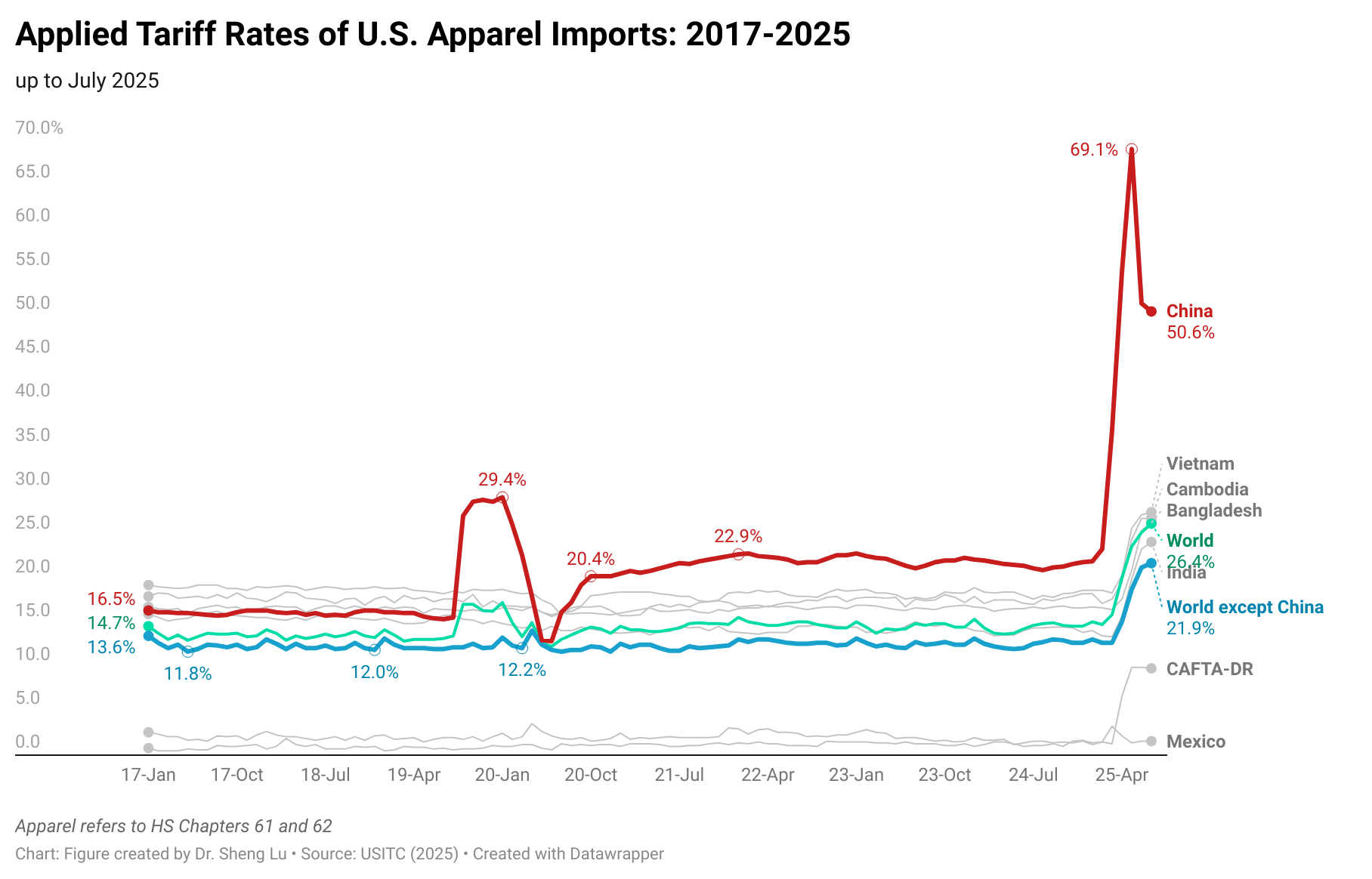
First, as a result of the IEEPA reciprocal tariff, the average tariff rate for U.S. apparel imports (HS Chapters 61 and 62) reached 26.4% in July 2025, marking a new high in decades (note: was 25.4% in June, 23.8% in May and 20.2% in April 2025), and a substantial increase from 14.7% in January 2025, prior to Trump’s second term. Even apparel imports from traditional U.S. free trade agreement partners, such as CAFTA-DR members, now have to be subject to about 10% applied tariffs. And apparel imports from Mexico still enjoyed a relatively low 1.6% tariff rate in July 2025. [Check the applied US apparel import tariff rate here]

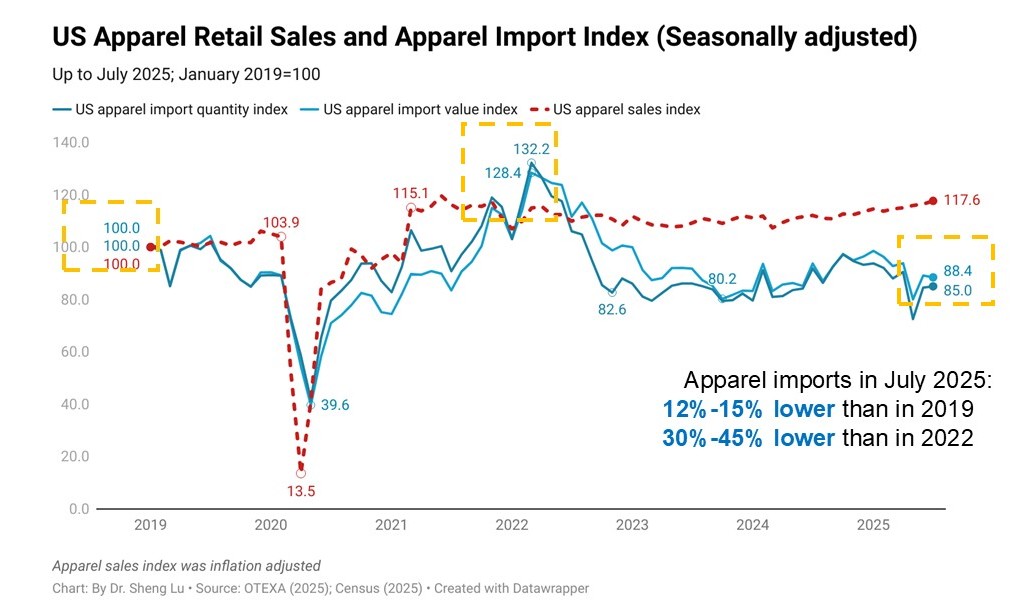
Second, U.S. apparel imports fell in July 2025, negatively impacted by the hiking of tariffs and consumers’ growing hesitancy in clothing spending amid uncertainty about their household financial outlook. Specifically, U.S. apparel imports in July 2025 decreased by 3.0% in value and 5.2% in quantity from a year ago, indicating both an overall shrinking import demand and a more notable import price increase. [Check U.S. apparel import index here]

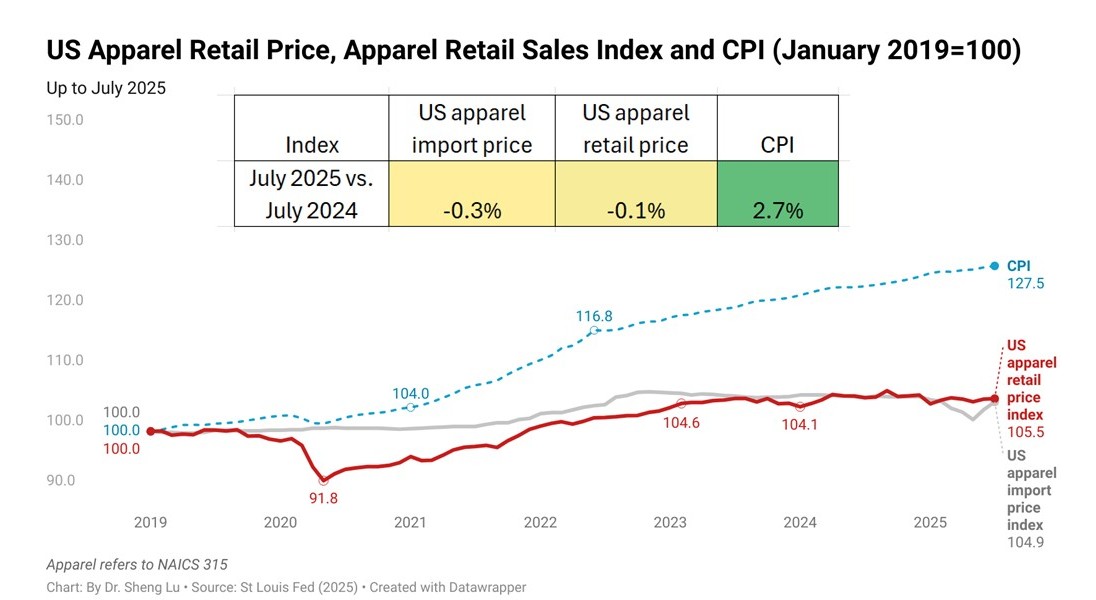
Statistics also show that after removing the seasonal factor, the average U.S. apparel import price went up by nearly 3% from April to July. This trend could become even worse in the coming months as more countries face even higher “reciprocal tariffs” starting from August 2025. However, the average U.S. apparel retail price has not significantly increased, likely because fashion companies fear losing sales at a time when consumers’ clothing spending is already weak. [Check the U.S. clothing retail price index here]

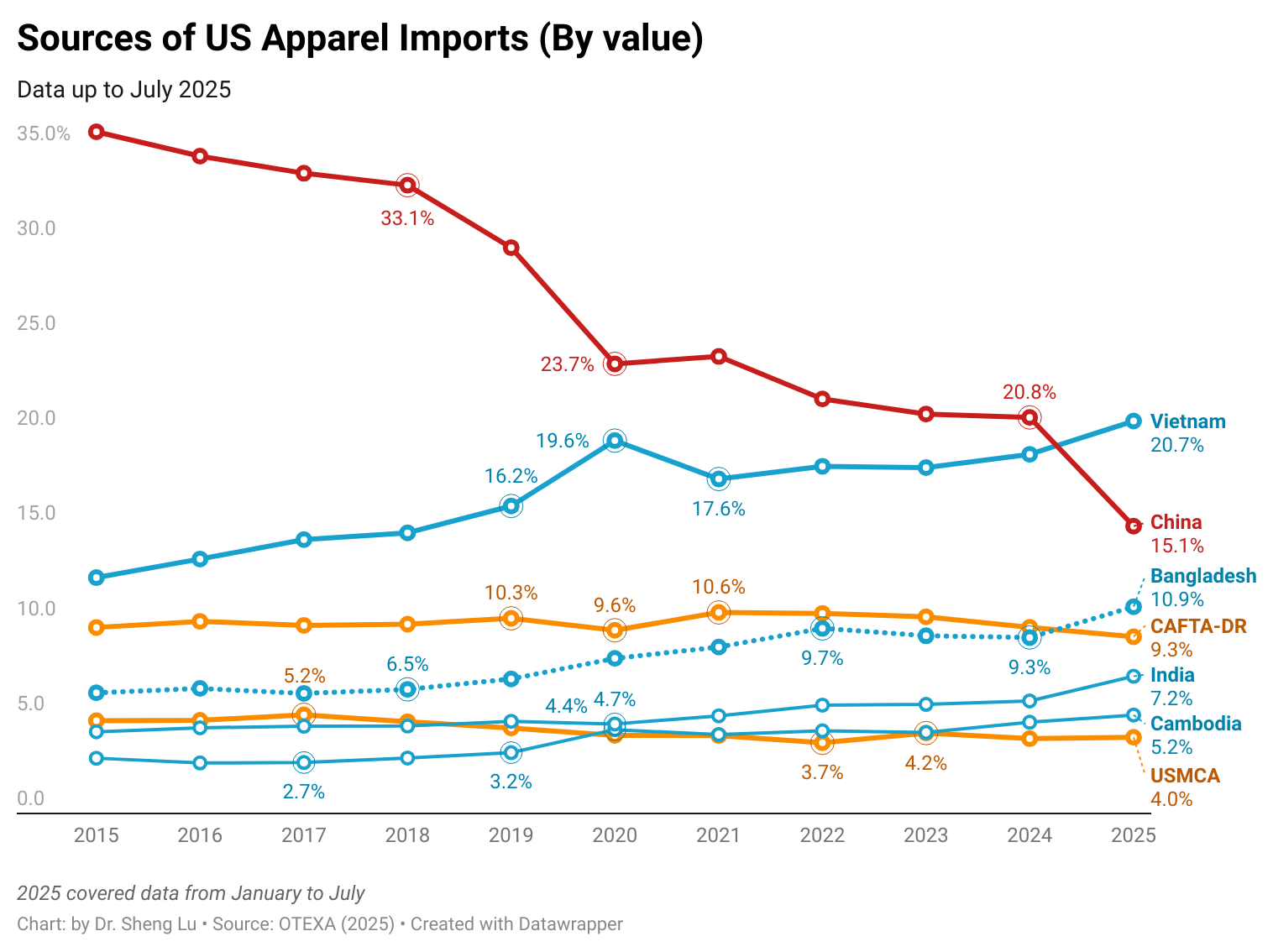
Third, continuing the trends from previous months, U.S. apparel imports from China again fell sharply in July 2025. Facing nearly 50% tariff rates—much higher than those applied to other sourcing countries—U.S. apparel imports from China decreased by 38.4% in value and 27.3% in quantity in July 2025 from a year ago. As a result, in value, China’s market share fell to just 15.6% in July 2025 (was 24.6% in July 2024), significantly lower than Vietnam’s 22.1% (was 19.1% in June 2024). In other words, it may signal a new era where China is no longer the top source of U.S. apparel imports. [Check market shares in U.S. apparel imports here]

Fourth, while Asia as a whole still dominates, trade data suggests more notable trends of sourcing diversification. In July 2025, about 72.9% of U.S. apparel imports came from China, far exceeding the Western Hemisphere (14.8%) and the rest of the world (12.4%). However, Asia’s market share in July 2025 was slightly lower than 74.7% a year ago, suggesting that more imports came from other regions. For example, at the country level, US apparel imports from several emerging Asian suppliers and those in the Middle East and Africa enjoyed fast growth, including Vietnam (up 12.5%), Cambodia (up 25.2%), Pakistan (up 14.7%), Jordan (up 21.6%), and Egypt (up 30.3%).

Meanwhile, U.S. apparel imports from India in July 2025 also increased by over 15%, although the newly imposed higher tariffs on India could alter the trend in the next few months.

Additionally, there is still no evidence that Trump’s tariff policy has meaningfully boosted nearshoring from the Western Hemisphere. On the contrary, in July 2025, U.S. apparel imports from Mexico grew by just 0.5%, despite the significant tariff advantage offered to USMCA-qualifying products. Similarly, imports from CAFTA-DR members decreased by 2.7%. The results revealed the adverse effects of uncertainty in the Trump administration’s tariff policy on encouraging long-term sourcing and investment commitment to the region.

(note: this post is not open for discussion)

By Sheng Lu

FASH455 Video Discussion: The Lesotho Garment Industry in the Shadow of Trump’s Tariffs

Discussion questions: (for students in FASH455, please address at least two questions below in your response. There is no need to repeat the question, but please mention the question #)

  • #1 How do you see the importance of the garment industry to Lesotho—economically, socially, and politically?
  • #2 Why and how could the 15% additional tariff have a significant impact on Lesotho’s garment industry?
  • #3 What responsibilities do U.S. fashion brands and retailers have toward Lesotho in the situation described in the videos?
  • #4 If you were a U.S. garment worker, would you support more favorable trade terms for Lesotho? Why or why not?

Background

  • According to the World Trade Organization (WTO), textiles and apparel accounted for 56.6% of Lesotho’s manufactured goods exports in 2023.
  • UNComtrade data shows that between 2023 and 2024, about half of Lesotho’s apparel exports went to the United States, its largest export market. Other countries in Sub-Saharan Africa (SSA) made up an additional 44% of Lesotho’s apparel exports.
  • Industry sources further indicate that between January 2024 and July 2025, about 60% of apparel labeled “Made in Lesotho” for sale in the U.S. retail market were tops, including 41% of T-shirts. All of these clothes targeted the mass and value market segments, and they were typically priced even lower than those “Made in Bangladesh.”
  • The African Growth and Opportunity Act (AGOA), a trade preference program enacted in 2000, has played a critical role in supporting Lesotho’s apparel export to the U.S. market.
  • Data from the Office of Textiles and Apparel (OTEXA) under the U.S. Department of Commerce shows that U.S. apparel imports from Lesotho totaled $151 million, or 0.19% of total U.S. apparel imports, in 2024. Notably, all of these imports claimed the AGOA duty-free benefits, and 96.8% were entered under the “third-country fabric” provision, which allows least developed countries (LDCs) like Lesotho to use textile raw materials sourced from third countries.

[Discussion is closed for this post]