
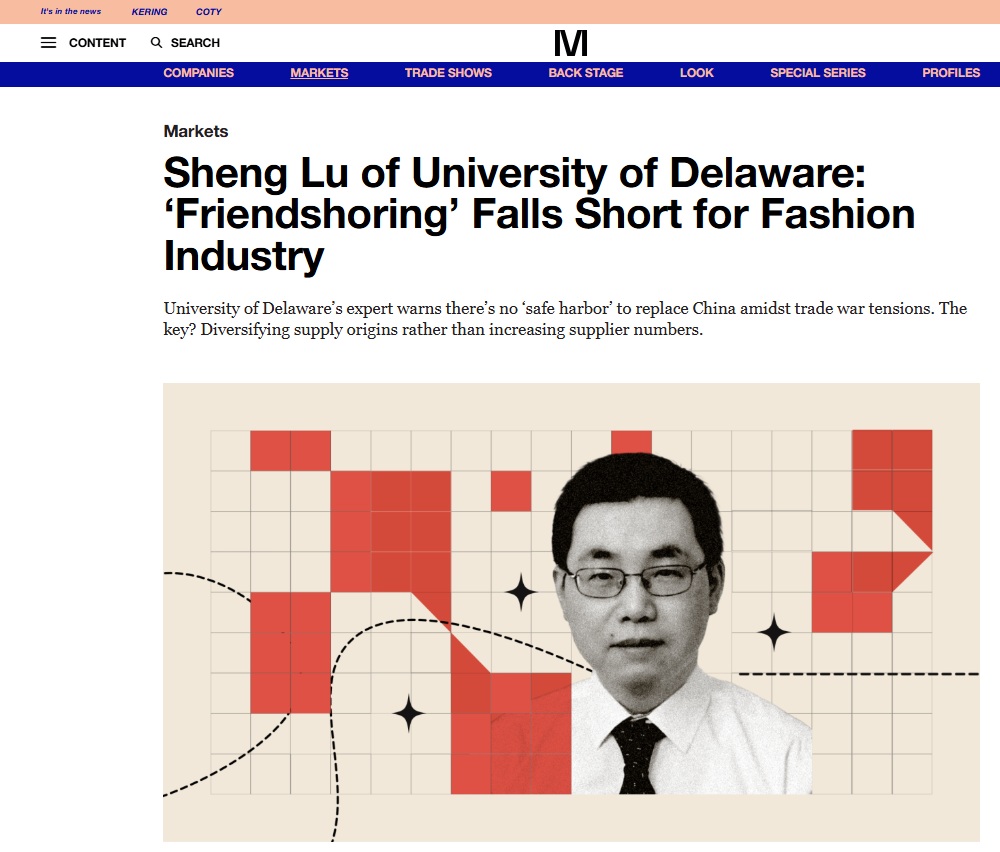
Full interview in English HERE ; Spanish version HERE
Below is the interview summary
Q1. Since the pandemic, has the global fashion supply chain changed?
Key point: The pandemic taught fashion companies the importance of flexibility and agility in sourcing. Heavy reliance on China caused major disruptions during lockdowns, prompting companies to diversify their sourcing base and develop stronger supplier relationships to reduce various sourcing risks.
Q2. Is supply security now more important than price in sourcing decisions?
Key point: Security and sourcing are becoming more closely linked. Leading fashion companies understand that sourcing now requires balancing cost with other important factors such as flexibility, regulatory compliance, and risk management. New regulations related to sustainability demand increasingly detailed supply-chain documentation and transparency. Meanwhile, geopolitical tension between the U.S. and China further adds complexity to fashion companies’ sourcing decisions.
Q3. Are companies continuing to reduce the number of suppliers, and why?
Key point: Recent studies show that many fashion companies are diversifying sourcing beyond China, importing more from emerging supplying countries like Vietnam, Bangladesh, Indonesia, Cambodia, Pakistan, Egypt, and more. However, there are two divergent strategies: some brands expand their supplier base to spread risk and enhance capabilities in sustainable fibers, while others consolidate suppliers to strengthen partnerships with large vendors operating across multiple countries, many of which are still based in China.
Q4. Can the value chain function without China?
Key point: Not realistically. While China’s share of finished garment exports is declining, it still dominates in textiles raw materials. Even when apparel is made in other countries (like Vietnam and Cambodia), much of its fabric, investment, or ownership is Chinese. The newly released OECD data also show that about 30% of Southeast Asian apparel exports include Chinese content.
Q5. Which countries could take advantage of China’s declining role?
Key point: China’s dominance comes not only from its low costs but also from its capacity to produce almost any product category at large scale. To replicate this, companies need to use multiple sourcing locations — a “many-country model” instead of relying on just one. Therefore, diversification, rather than substitution, is the most practical approach. Firms seek to avoid over-dependence on any single country, especially given the volatility of tariffs and supply-chain disruptions.
Q6. Does “friendshoring” apply to fashion?
Key point: Politically appealing but impractical for apparel sourcing. The idea of friendshoring — trading only with “like-minded” nations — doesn’t fit with fashion’s global manufacturing system. Europe and the U.S. share values, but Europe lacks large-scale apparel production. Over 70% of U.S. apparel imports still come from Asia, where most countries are not formal U.S. allies. Therefore, political alignment cannot guide sourcing strategy in fashion; cost, capacity, and speed are more important.
Q7. Will geopolitics and the trade war reshape fashion sourcing in Europe or the U.S.?
Key point: Nearshoring remains a popular concept. European companies explore Eastern Europe and the Mediterranean; U.S. firms consider the Western Hemisphere and limited domestic production. Sustainability has emerged as the new opportunity for near-shoring. Fashion companies now aim to use more sustainable fibers in their clothing products. EU sustainability rules could also attract new investment to expand production in the EU. However, in general, small-sized firms need more resources and support to meet these high environmental standards, both to comply with the law and sustain their businesses.
Q8. Is de-globalizing production possible?
Key point: True de-globalization is unlikely. Instead, globalization is shifting toward greater transparency and accountability. Companies now need to track and report where products are made and how workers are treated, including the sourcing of raw materials. This encourages brands to work closely with their suppliers and promote stronger and strategic collaboration.
Q9. Are there enough incentives for production automation in fashion?
Key point: Yes — Automation provides a way to increase efficiency in high-wage countries like the U.S. With labor costs high and factories shrinking, machines and AI are being adopted to boost productivity and customization. Automation can also help cut down on overproduction — one of fashion’s major waste issues — by supporting made-to-order or small-batch manufacturing.
Q10. Why don’t we see full automation yet?
Key point: Cutting, sewing, and material handling today still require human labor, although factories increasingly use automated tools to boost productivity. Asian suppliers are upgrading equipment to handle smaller, faster orders. Automation is bringing back niche manufacturing (e.g., sock production in the U.S.) and supporting recycling efforts, such as sorting used garments. It helps lower minimum order quantities, matching production to uncertain consumer demand.
Q11. How can Europe maintain relevance amid the U.S.–China trade war?
Key point: Europe continues to be a key player in both textile and apparel manufacturing and consumption. Nearly half of the apparel in the EU is produced locally, often in high-wage countries like Italy, Germany, and France. Asian countries are looking for more market access to the EU because of higher tariffs imposed by the US (e.g., trade diversion). Europe also leads in sustainability and regulatory standards. Complying with EU rules often means meeting the highest global standards. Luxury branding (“Made in Italy/France”) remains highly influential, and the EU’s proactive trade agreements might even enable it to export textiles for processing in Asia, expanding supply chain integration.
Q12. Why hasn’t Africa become a viable textile hub yet?
Key point: Africa’s potential greatly relies on trade preferences like the African Growth and Opportunity Act (AGOA), which recently expired. Without duty-free U.S. access, U.S. companies are less likely to source there. However, the EU could help bridge the gap by forging partnerships for recycled textile materials and sustainable production. Regional collaboration could unlock Africa’s place in circular fashion supply chains.
For students in FASH455: Feel free to share your thoughts on any of the interview questions above. You may also challenge and debate any points raised in the interview and present your arguments.

 FASH455 Global Apparel & Textile Trade and Sourcing
Pertaining to question 3 from the interview with Modaes, a key takeaway identified two different strategies hat companies are using regarding sourcing in today’s economic climate. To start, “some brands expand their supplier base to spread risk and enhance capabilities in sustainable fibers, while others consolidate suppliers to strengthen partnerships with large vendors operating across multiple countries, many of which are still based in China.” I found this question fascinating, given the recent U.S. tariff imposition from the U.S. I am curious about the lifespan of these tariffs, and the long-term effect this will have on U.S. brands, as well as non U.S. brands. Primarily, how long can a small apparel brand survive in regard to moving their pre-existing supply chains out of China, given a possible future long standing tariff? Additionally, I believe that future brands will directly avoid manufacturing and sourcing from China when piecing together their supplies chains, due to the effect of the high tariff today. In all, this is growing into quite the historic event.
I found it interesting how different companies have chosen two separate routes to deal with the tariffs imposed by the Trump administration. As mentioned in the second question, some companies choose to expand their suppliers in order to mitigate risks and assist their sustainability goals. By expanding, they are able to depend on various suppliers, so if one of them encounters a problem, they are not completely dependent on them. The second option some companies are choosing is to reduce their suppliers in order to focus on creating strong bonds with them. The interview mentions how many of these suppliers that they are building these bonds with are still in China. A question that I have about this is which of these strategies has proven to be the most effective?
After reading this interview, I really liked how it broke down what’s actually happening in sourcing right now because it connected perfectly to what we’ve been learning in class about flexibility, risk, and transparency. The point that stood out to me the most was how companies are trying to move away from being so dependent on China, but realistically they still rely on China for textiles and raw materials, which makes the whole “just source somewhere else” idea way more complicated. I also agreed with the idea that supply security is becoming just as important as price, especially with all the new sustainability rules and the U.S. and China tensions. It makes sense that brands are now balancing cost with compliance, speed, and risk, not just chasing the lowest price. The part about automation was also really interesting, especially how it can help reduce overproduction and support smaller, faster orders, but sewing is still too hands-on to automate fully. Overall, this interview made me realize that sourcing today feels way more strategic than ever, and companies really have to think long-term instead of relying on one country or one simple solution.
In the midst of the U.S.-China trade war, what options does Europe have to continue to play a relevant role in the fashion industry?
While I agree with the notion that Asian countries will look for a larger trade partner in Europe as US tariffs continue to rise, I have to wonder whether the EU will be open to the increase in apparel from Asia. As stated in the answer, this increase would lead to greater price competition; however, the low cost of apparel imported from Asia would likely run EU-based companies out of business and create a similar consumer environment to the US. The majority of apparel in the US is imported due to the demise of the domestic apparel manufacturing industry, and because of this, I believe the EU would be more cautious of similar circumstances occurring to their domestic production industry. Additionally, the EU’s progressive stance on sustainability and apparel regulation may make it extremely difficult to re-route low-cost goods destined for the US from Asia. EU standards are much higher than those of the US and would make it difficult for foreign manufacturers to pass compliance protocols if the products were not originally made with EU standards in mind. Furthermore, as stated in the response, EU consumers value labels with origins in Europe and are willing to pay more for these products. While there would be a market for lower-cost goods, consumer perception may make it difficult to gain footing in the market. Europe still has the ability to capitalize on local raw materials and smaller production as consumers worldwide increasingly value sustainability and one-of-a-kind pieces.
I thought the most interesting point in this interview was Professor Lu saying that “friendshoring” basically doesn’t work for fashion. It makes sense since brands can talk about sourcing from “aligned” countries, but the reality is that Asia (and especially China) still has the capacity, materials, and vertical supply chains that no one else can match. I also agree with the idea that there’s no such thing as a “safe harbor” right now. Tariffs can and have changed overnight, and even products made in places like Mexico or Vietnam often still rely on Chinese textile inputs. It makes me wonder if companies are truly diversifying for long-term resilience or just shifting orders around to avoid short-term tariff hits. If China can’t realistically be removed from the equation, maybe the real question is how to make those China-linked supply chains more transparent and compliant instead of pretending total decoupling is possible.
This interview helped me understand how much sourcing strategies have changed and how important flexibility and risk management have become in today’s fashion industry. One point that stood out to me was that sourcing is no longer just about cost but fashion companies also have to consider factors like compliance, sustainability, and supply security. Like talked about in class, sourcing decisions depend on many factors and companies need strong supplier relationships in order to remain competitive while also maintaining transparency. The discussion about China was also interesting. Even though apparel sourcing is shifting to new countries, China still plays a major role in textiles and materials. This shows how much global supply chains are interconnected to one another which can make it difficult to fully move out of one country when it comes to sourcing. When thinking about sustainability, like talked about in the interview, automation will definitely help reduce overproduction and support more sustainable manufacturing methods. I’m curious whether at some point companies will be able to operate without China or if if companies will continue to build strong relationships with China since they still dominate in textiles raw materials.
Interesting read, the argument about the Federal Reserve shift driving equities up is compelling and raises good questions about where markets go next. I appreciate the detailed breakdown of yields, PMIs and global liquidity pressure. Definitely worth considering the implications for emerging markets and bonds if this “cave-in” scenario plays out long-term. Thanks for sharing this analysis.
This article connects so much to what we’ve been learning all semester about how unstable and unpredictable global sourcing has become, especially with Trump’s new tariff waves and the fact that the industry is still feeling the aftershocks of the pandemic. What stood out to me most was Sheng Lu’s point that “friendshoring” just doesn’t work for fashion, which honestly makes sense, there’s no group of allied countries that can match China’s mix of product variety, raw materials, and manufacturing depth. From what I understood is that, friendshoring sounds good politically, but in reality brands would lose too much speed and capability if they tried to force their sourcing footprint into only “friendly” markets. I also thought it was important how you explained that companies today aren’t just worried about cost, they’re dealing with tariff risk, UFLPA rules, EU sustainability regulations, transparency requirements, and pressure to incorporate resale and recycled fibers. That connects directly to what we talk about in class, how sourcing strategies have to be flexible enough to pivot quickly if a country suddenly faces new tariffs or political tension. Your point about the “smaller pie” of consumer demand also felt really accurate, showing how inflation and cautious spending are pushing brands to rethink assortments, invest more in digital, and rely heavily on strong supplier partnerships. The article shows that we’re nowhere near a “post-China” sourcing world, and the future of the industry is all about diversified, tech-forward, regulation-driven supply chains.
This interview highlights how the global fashion supply chain is undergoing a fundamental shift, and it connects to what we have learned in class about companies focusing on flexibility, risk, and transparency. Especially with the pandemic it really it the fashion industry hard due to the previous reliance of China’s sourcing. During the pandemic many disruptions were in place because of lockdowns and after the lift many companies decided it was time to diversify their sourcing methods. I think this is incredibly important due to other recent events such as the tariff war between the U.S. and China which is making sourcing and trading increase which is impacting everyone in the supply chain.
This interview provided such a clear and timely overview of how global apparel sourcing is shifting heading into 2026. I especially liked the explanation of how fashion companies are moving from a cost driven approach to a more balanced strategy that prioritizes risk management, diversification, and supply chain resilience. The comparison between how EU and U.S. brands are responding to these pressures was also really interesting, showing that even though both face similar challenges, their sourcing adjustments and priorities can look quite different. Overall, the insights on trade patterns, regional sourcing shifts, and the long term implications for the industry helped me better understand the complexity of modern apparel sourcing and why companies are rethinking their global footprints.
What stood out to me most in this interview is how clearly it illustrated how the industry isn’t “de-globalizing” but it is actually “re-globalizing” under new priorities. The shift discussed toward diversification over substitution made a lot of sense to me, being that no single country can realistically replace China’s scale or dominance in the market. I thought that the point about Southeast Asia exports containing about 30% of Chinese content was especially important because it challenges the common idea that moving production from China automatically eliminates the dependence on them. I also agreed with the interview’s argument that friendshoring is largely incompatible with fashion. What I found most compelling in this interview was the discussion about nearshoring and sustainability. It is a common theme that sustainability is becoming about more than just ethics, but it is also the economic justification for rebuilding some regional capacity. Overall, this interview highlights how sourcing strategy today requires a balance of resilience, compliance, and transparency.
Reading this interview was very interesting and I felt there were many strong points made. One of the most interesting questions surrounded the speaker explaining they did not think it was possible to replace China in global manufacturing. This is simply because how involved china is in manufacturing specifically in producing raw materials more then any other country. Another question asked was about the possibility of near shoring partnering with closer countries for manufacturing. This idea has been heavily talked about in the industry but it seems rather unrealistic that these countries would be able to meet manufacturing needs to the level that a country such as China is able to fulfill. What I do agree with is that the most realistic option to move away from China as a key contributor is to significantly diversify manufacturing/production rather than having such high stakes in China.
What stood out to me in this interview was how companies still rely on China even when they say they are moving production somewhere else. It made sense when he explained that places like Vietnam or Cambodia still use Chinese fabric, so you can’t really avoid China completely. I also thought the part about flexibility after the pandemic was interesting because we’ve talked about that a lot in class. Brands can’t just focus on price anymore when tariffs and rules change all the time. This interview made me realize how complicated sourcing really is and why companies have to diversify instead of assuming they can replace China.
I really enjoyed this article, as it broke down each issue revolving around the fashion supply chain. It has always been difficult for me to fully grasp this challenge, but the way it was explained was very helpful and effective. What I especially liked was the explanation of how the industry is becoming more strategic and aware of these challenges so that they can bounce back quickly. Furthermore, the pandemic played a major role in prioritzing flexibility and having strong relationships with their suppliers. So, it is interesting to me how there was an emphasis on how fashion companies cannot function without China because of the excessive amount of raw materials and textile capacity attached to them. This article was interesting because it gave me knowledge on sourcing decisions and why they are made and how exactly they are shaped by costs and technology as well as sustainability.
I agree that this article allowed me to better understand the fashion supply chain, and was broken down in a way that was easy to grasp. I think you make a great point that it is interesting that now companies have to rely on China while remaining flexible.
This interview really shows that fashion isn’t becoming less global, it’s just shifting and spreading out. I agree that cutting off China entirely isn’t realistic due to their expertise in garment manufacturing, and scale of their industry. However, brands should still demand more transparency and fair labor practices. I’m also not convinced “friend shoring” will actually change much. While it sounds good politically, Asia still dominates production. In the end, it seems like the real issue isn’t where clothes are made, but how they are made and how the people who make them are treated.
Something that really stood out to me in this article was how big of a role sustainability plays when shifting trade and sourcing patterns. The interview highlighted how new regulations related to sustainability have been put in place to satisfy the demand for supply chain transparency and documentation. One point that stood out to me was how sustainability presented a new opportunity for near-shoring. This is a topic that we have discussed a lot in class, especially regarding regional production and trade. The article stated that sustainability rules can attract new investments to expand production within the EU, and how U.S. firms were considering the western hemisphere and limited domestic production. I think that it will be interesting to see how this affects smaller companies who may not have the resources to keep up with these sustainability rules.
I want to comment on Question 5: “Which countries could take advantage of China’s declining role?”
I want to comment on this interview question because I would’ve answered it in a different way, specifically to address which countries could benefit from fashion companies looking for sourcing opportunities outside of China. From our discussions in class, countries that are major apparel producers such as Bangladesh, Vietnam, and India often don’t present a competitive advantage over China when it comes to offering large product categories or speed to market. However, they can take advantage of the effects of tariffs and companies’ diversification beyond China as a supplier to expand their economies with greater apparel production, as they can offer a price advantage due to lower tariff threat. These countries should invest more in technology, automation, and their labor force in order to increase production capacity, and therefore appeal to be chosen as a sourcing destination over China.
This article explains how complex the global supply chain is. Many companies learned from COVID-19 that depending too much on one country such as China can have negative impacts. They also realized that replacing China is too hard of a task due to their ability in providing materials. However, it allows them to develop stronger relationships with other countries. by sourcing from them. Brands are choosing many-country model and spreading production to places like Vietnam, and Bangladesh. Sourcing from only China can be complicated due to the tensions, affecting brands sourcing decisions. I was surprised to read that “friend-shoring” does not fit with fashion’s global manufacturing system because of cost, capacity, and speed are more important that politics. In class, we have talked about how global supply chains depend on different countries and this article proved that de-globalization is not realistic. Companies need to build relationships with different countries. I am curious to see how companies will deal with these changes.
Supply chain resilience is a topic we have been discussing since the beginning of the semester. It is very unlikely for a brand to be able to escape globalization, since it’s difficult for one country to do it all! The current state of the fashion industry with tariffs is actually helping with globalization, because many brands are moving production around the world and spreading out. While brands can save costs by having production be in China, the U.S wears a lot of textiles sell, and sells them for high prices. De-globalization is very unrealistic especially for a country such as the U.S. Thinking back to some of the other articles, does anyone believe that AI could help to make global sourcing cheaper?
I am going to be focusing on a specific question that I really wanted to learn more about
Is de-globalizing production possible?
Reading through this interview with Modaes once again makes me think about how much really goes on behind the scenes when a brand creates a product. Something that particularly stuck out to me was that even when brands switched over to a different country other than China for production, materials still mostly come from China. So, brands will “not realistically” be able to stray away from China. Because everything is so closely connected, it brings up even more challenges in the supply chain. But, it’s important that brands are taking this into consideration and still improving their sustainability efforts. This interview put a lot of things into perspective and reiterates how many issues there are in the industry regarding sustainability.
I found the discussion on Europe’s growing reliance on near shoring, especially the role of Turkey and North Africa, particularly insightful. The explanation of how fashion companies are balancing cost issues with the need for greater supply chain resilience was very compelling. This is because as explained, transparency has become a huge shift in fashion aligning with our generation. I appreciated the point about China’s continued importance despite diversification trends. It reflects the complexity of shifting global sourcing patterns and recent supply chain relationships. Overall, this provided a clear look at how brands are adapting to the new realities of apparel trade in 2025.
Its always intrigued me the significance of the COVID-19 Pandemic and its continued impact on the fashion industry. In a period of isolation, companies were either encouraged or forced to diversify their supply chain and not rely heavily on one importing country. While this might have been difficult to adjust to so suddenly it has helped in the long run, especially with the newer implementations of tariffs and its associated risks. Companies that did make the change during lockdown have well-established relationships with their suppliers, which is only an added strength to their supply chain strategy. What contradicts this component of flexibility and diversifying the supply chains is China’s dominating presence in the supply chain industry. Without the reliance on China for sourcing materials, companies would struggle. While there has been initiatives to utilize other countries for sourcing and production, it will be nearly impossible for brands to stay away from China completely. I find that severing ties with China is not realistic and the best move for brands right now is to shift from one supplier, and spread their production in an ethical and efficient manner.
I thought this interview was really interesting. It makes a lot of sense that the pandemic showed how important flexibility and strong supplier relationships are, relying so much on China caused huge disruptions. I like the idea of a “many-country model” because it spreads out risk and makes it easier for brands to deal with things like tariffs or shipping delays. The part about automation also stood out to me, it seems like a smart way to make production more efficient, especially for smaller batches or made-to-order items. Europe’s role is really interesting too, with luxury and sustainability giving it an advantage. I’m not sure friendshoring is realistic for most companies, especially smaller ones, but it’s cool to see how brands are trying to balance politics, costs, and supply chain flexibility.
This interview really highlights how the post-pandemic fashion supply chain is becoming more complex. I noticed how companies now view sourcing through a risk-management lens, balancing cost, flexibility, compliance, and geopolitics rather than simply chasing the lowest price. The discussion about China was compelling; even as brands diversify, the industry simply cannot function without China’s raw material capacity, which makes true “de-globalization” unrealistic. I also found the insights on automation and sustainability important, especially the idea that near-shoring may advance not because of politics but because sustainability rules and technological improvements make it more viable. Overall, the interview shows that the future of sourcing will depend on collaboration, transparency, and diversification rather than retreating from globalization.
I think this interview made a really important point about sourcing flexibility. I agree that real “de-globalization” probably isn’t the most realistic, but I was surprised by how much China still matters through textile inputs even when apparel is sewn somewhere else. This emphasizes the FASH455 concept that sourcing is about thinking about risk, capacity, and other factors, not just finding the lowest cost. One question I have is if smaller brands actually have the resources to diversify sourcing, like how large brands do, especially with the increase of sustainability regulations. Additionally, I wonder if supply chains in Latin America or Africa could grow if policy incentives, like AGOA renewal, supported long-term investment in sustainable fibers than short-term sourcing.
Just as the general sentiment of this discourse reveals, I found this interview to be incredibly insightful. Dr. Lu’s answers highlighted the geopolitical tensions that shape the global supply chain’s behavior. Question 6, “Does ‘friendshoring’ apply to fashion?”, reminded me of our conversation in class about nearshoring. Friendshoring refers to the process of trading only with nations that share the same ideologies. In class, we talked about how nearshoring can be sustained to an extent, but Asian exporters like China and India still hold a massive share of the market due to their product diversification and longstanding practices. In the same regard, friendshoring is impractical because some continents lack large-scale production models, like Europe, as mentioned in the interview. Over 70% of US apparel items are imported from Asia. Politics cannot be the only deciding factor when it comes to sourcing. If we’ve learned anything this semester, it’s that sourcing decisions are comprised of a complicated web of factors.
Trade theory, particularly the principle of comparative advantage, suggests that nations should specialize in producing goods where they hold the highest relative efficiency. In the fashion industry, this traditionally meant sourcing from regions with the lowest labor costs, but it has evolved to include factors like specialized infrastructure, raw material access, and technological capacity. This concept helps explain why a many-country model is replacing the total reliance on a single manufacturing hub. The interview highlights that while China remains dominant due to its unrivaled scale and textile raw material production, brands are diversifying into countries like Vietnam and Bangladesh to balance cost with supply security and risk management. Interestingly, the fact that 30% of Southeast Asian apparel exports still contain Chinese content demonstrates that comparative advantage now operates at a component-based level rather than just for finished goods. From a managerial perspective, the primary implication is that true de-globalization is unrealistic; instead, firms must manage increasingly complex, multi-layered dependencies. Managers cannot rely on personal relations because political alignment does not currently align with the global manufacturing capacity needed for fashion. Therefore, the focus must shift toward strategic collaboration and transparency, ensuring that even as the supply chain diversifies, the brand can meet new regulatory demands for sustainability.