
Since Trump’s second term began in early 2025, the world apparel trade has faced significant challenges caused by unprecedented high tariffs and trade policy uncertainty. Both fashion companies and their suppliers have struggled to mitigate the ongoing tariff impacts, from diversifying sourcing bases and diverting export markets to adjusting pricing. These mitigation strategies have also resulted in a noticeable but nuanced shift in the patterns of world apparel trade, creating both winners and losers.
Based on the latest monthly trade data collected from the World Trade Organization (WTO) and other international organizations, this article highlights the evolving patterns of world apparel trade in 2025 amid Trump’s hiking tariffs. The findings offer valuable input for the fashion business community and policymakers to understand the apparel-specific impacts of tariffs from a global perspective and to support the development of related response strategies.
Overall, the findings indicate that Trump’s hiking tariffs have impacted the world apparel trade far beyond the U.S. market. As high tariff rates are expected to remain in 2026, we might see trade diversion and price competition among key suppliers become more evident in the new year. On the other hand, the findings call for greater attention to the tariff’s impacts on small and medium-sized apparel exporting countries, especially those in Asia, South America, and Africa that are less competitive than established, mature suppliers. The ripple effects of the hiking tariffs could increase competition pressures on these small players, resulting in more vulnerability in their export-oriented garment sector and millions of workers.
Key findings:
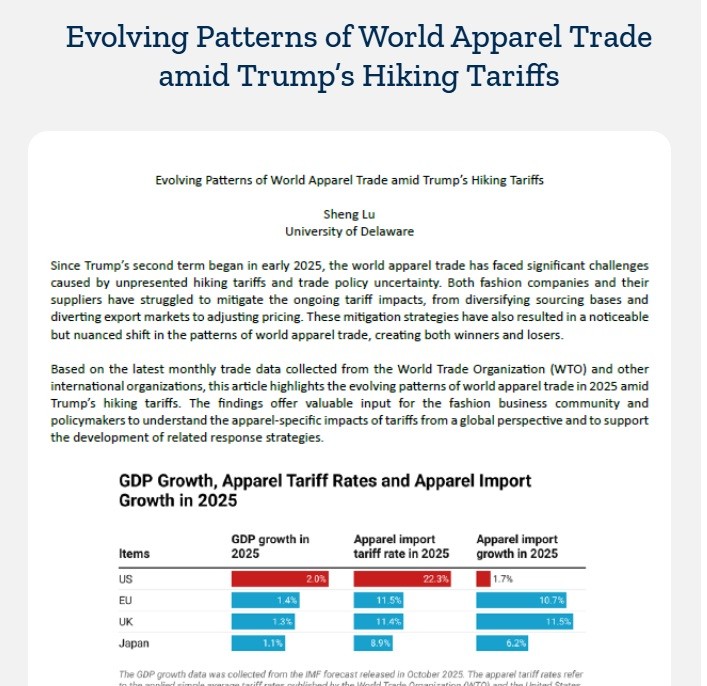
- Pattern 1: Trump’s hiking tariffs appeared to suppress the U.S. import demand for clothing compared with other major import markets.
- Pattern 2: Facing higher tariff barriers in the U.S. market, several leading apparel-supplying countries have been diverting exports to the EU and the UK to mitigate tariff impacts.
- Pattern 3: Except for the case in the U.S., China’s market share remained relatively stable in other key apparel import markets in 2025.
- Pattern 4: Apparel-producing countries in Asia, South America, and Africa faced growing pressure from Chinese products in the domestic market.
- Pattern 5: No evidence suggested that Trump’s hiking tariffs have benefited near-shoring.
Read the full paper HERE (Global Textile Academy, International Trade Centre, Geneva, Switzerland)

 FASH455 Global Apparel & Textile Trade and Sourcing
Thank you for sharing the article. It is nicely articulated.
The trends are along the expected lines due to Trump tariffs. Is the price of garments in US increased by similar amount as increase in import tariffs of 22.3%?
A class concept that could be applied here is quite honestly mercantilism. Mercantilism is the idea that “gold is wealth and wealth is power.” This trade theory essentially revolves around the idea that countries should always prioritize exports and should limit imports by producing everything domestically, thus “keeping the power.” The blog post above shows how current U.S. trade policy under Donald Trump reflects a very mercantilist mindset. Rather than strengthening the U.S. position, though, these excessive tariffs have weakened our country’s global apparel trade and instead intensified competition elsewhere. This directly combats the idea that tariffs automatically benefit domestic industries. From a policy perspective, this shows how damaging an overly nationalistic and mercantilist approach can be in a very globalized industry like fashion. The U.S. seems to ignore that imports can actually be beneficial both economically and politically by creating stronger international relationships.
The blog article above talks about the discourse surrounding Trump’s hiking tariffs and trade policies’ uncertainty, which relates back to the concept of comparative advantage. Comparative advantage surrounds this idea that there will be some countries that will have a bigger absolute advantage or its relatively smaller absolute disadvantage. Throughout the blog article, Trump’s tariffs and policies have been a struggle for companies and suppliers due to their global sourcing bases and export markets. While there have been many who have been affected by this, this goes beyond the US market. More specifically, taking a look at small and medium-sized apparel exporting countries. When we compare established countries like the US to countries less competitive like Haiti, they have always been noted for suffering disadvantages based on the concept of comparative advantage. Although, because the US tends to specialize more in tech, aerospace, and others, a lot of the time smaller countries like Haiti tend to take on the tasks of importing apparel to them. However, now with the increasing tariffs and policies in place, they, an already struggling country, are more vulnerable and have increased competition pressures. Similarly, after doing some research, the apparel industry isn’t the only one being affected by Trump’s tariffs and policies. Industries like automotive and construction are seeing a significant amount of increased costs because of their involvement with imported supplies and materials that are necessary. The struggles within the apparel industry, plus the automotive and construction industries, are visible and hard to ignore.
One key concept from our class that relates to this blog post is trade diversion under protectionist trade policies. In class, we discussed how high tariffs do not necessarily eliminate production, but instead shift trade flows to other markets. Rather than fully protecting domestic industries, tariffs often just redirect exports and create unexpected consequences across global supply chains.In this article, Pattern 2 clearly shows trade diversion happening, as leading apparel suppliers shifted exports away from the United States and toward the EU and UK to avoid higher tariff barriers. At the same time, China’s market share remained relatively stable in other major import markets, which suggests that production did not disappear but simply moved elsewhere. The finding that there is no clear evidence of nearshoring also challenges the assumption that tariffs automatically bring manufacturing back home.From a policy perspective, this raises important questions about whether protectionist strategies truly strengthen the U.S. apparel industry or simply reshuffle global trade patterns. For fashion companies, this highlights the importance of building flexible sourcing networks rather than relying on one major export market.
The concept we have discussed in class that I find relates most to this blog article is globalization and shifting trade patterns. We continue to speak on how globalization connects markets across countries, but it can also change when trade policies are adjusted. Tariffs and other trade barriers can affect where products are produced and where they are sold. We also talked about how companies must adjust their strategies when such global conditions change. In this article, its mentioned that higher U.S. tariffs reduced apparel imports into the U.S., which led many exporting countries to redirect their shipments to markets like the EU and the UK instead. This demonstrates how global trade flows respond to policy changes. When one major market becomes more expensive, exporters begin to look for alternative destinations. It also shows that globalization is not always smooth or stable, especially when trade tensions increase. This being said, fashion brands may need to continuously watch global trade conditions. As policies shift, companies will have to consider shifting both sourcing and sales strategies to stay competitive in the market.
What I found most interesting about this blog post was the use of the World Trade Organization and how it is proving the drastic shift in the trading community. This post ultimately reminded me of the topic we discussed in class about if the president should be concerned about the rising of apparel imports from lower wage countries. In the blog, it is mentioned that since the start of President Donald Trump’s term, the apparel industry has experienced high tariffs, causing a greater issue for globalization. As a class, we talked about the pros and cons of this issue. As long as other export oriented sectors within the United States are doing well, then there should be no worry. On the other hand, this issue could arise and truly harm individuals. However, one critique I would like to make of this blog post is that it focuses on trade data and policy effects, although, it doesn’t go deeply into the long-term impact it’s going to have on employees. Discussing more of this topic and its impact on the world and unemployment rates is something I would be interested in learning more about.
This article relates back to our class concept about comparative advantage. This is the idea that certain countries have more of an advantage when it comes to producing a product vs. selling it or buying it. The US has more tools that allows us to excel in the production of technology, and while we are able to produce simpler things like garments, it ends up usually being cheaper for us to import it from countries at less of an advantage, who may need our trade in our supply areas. This is why the tariffs are having such a big effect on all industries across the world, because the trade system that has been in place for decades is now being dramatically changed and expensed. If we aren’t able to come to some sort of middle ground or lesser extreme when it comes to these tariffs, the future of trade all across the world in all industries will become a huge unknown.
One concept from class that relates to this blog post is mercantilism. In class, we discussed how mercantilism is when “gold is wealth, and wealth is power” and how this can be translated into “export is good and imports are bad” in 2026. This information relates to data in the article as Trump’s raise in tariffs has suppressed the U.S. import demand for clothing, as he believes it should all be produced in the U.S. how it used to be. In the graph showing GDP growth of different countries, we can see the U.S. has had a 22.3% tariff increase in 2025 and only a 1.7% growth in apparel imports in 2025. They have the largest GDP, increase in tariffs, and lowest apparel import growth in comparison to others. A thoughtful question that this information raised for me is whether higher tariffs will actually help the U.S. apparel industry in the long run. While the goal of raising them was to increase domestic production, all it has done is increase prices for consumers as well as brands. This is extremely important because if companies struggle with higher expenses, it could lead to the loss of jobs and less money being put into finding and using new technologies within the industry.
Trump uses a mercantilist perspective as reason for hiking up tariffs and discouraging global apparel trade. The idea that “export is good” and “import is bad” to describe the United States can be an overarching claim to describe a very nuanced and complicated situation.
Rather than apparel manufacturing near shoring themselves back into the United States, suppliers have diverted their businesses to Europe in effort to work around tariffs, and prices drastically increased. Great threats are posed onto small and medium sized businesses in Asia, South America, and Africa that do not have the resources to compete with prices. However, although imposing tariffs can be quite destructive in the short term, it has the potential to be beneficial for the United States in the long run – creating entry-level jobs, upholding labor standards, and keeping clothing to a higher quality standard.
In conclusion, will manufacturing in the apparel industry ever make its way back to the US – or are these tariff policies purely detrimental to American companies? As technology advances, the need for specialized labor within the manufacturing industry increases and will have more opportunity for job growth than those in countries with less technological resources. Machinery like the “Direct Pattern on Loom” (DPOL) and SXD that reduce textile waste are set to become the next wave of the fashion industry and will need a specialized labor force behind it.
Great thought, I didn’t think of the fact that manufacturing in the apparel industry might not make it’s way back the US due to, not just tariffs, but the fact that it’s easier to just import your products from other countries.
This article relates back to the topic of globalization, which we learned about in class. Globalization is the integration of countries’ economies by the sole factor of trading goods, services, and technology. In the article it talked about how Trump’s new tariffs have affected the fashion industry and how there is so much uncertainty at this time. This affects globalization because if companies are forced to pay too much with tariffs, they have to cut costs or cancel orders, which then affects everyone in the supply chain. The article said these tariffs are to stay in place and will be seen throughout 2026, meaning the uncertainty will continue to shape the fashion industry and increase competition pressures. They also mentioned smaller manufacturers not being able to keep up with the low prices being offered by China and Vietnam. I would say that is a future concern because these small manufacturing companies have hundreds, if not thousands, of employees that would be losing out on work and money they heavily rely on. And again, a big thing with globalization is that most of these countries rely on advanced economies to purchase from them to create work and opportunity.
One key concept from class that relates to this posting is the idea of international division of labor. In class we learned that different countries specialize in different stages of producing a product based on many factors like labor, cost, etc. In the textile and apparel sector, developing countries take on more labor intensive manufacturing, which helps in their economic development and also reduces poverty. In this article, Trump’s tariffs disrupted the production patterns mentioned but did not necessarily change them. Even though the U.S. apparel imports. declined, suppliers just redirected the exports to Europe and UK, and China still had stable market shares in countries other than the U.S. However, more smaller export countries (Asia, South America, Africa, etc), had increased competitive pressure. This goes to show that tariffs changed trade flows but did not actually change the overall international division of labor. This does raise concerns that developing countries are now more vulnerable since they rely on garment exports. If trade barriers increase competition without creating new production opportunities, then millions of workers (in export sectors) might face greater economic instability.
One course concept that relates to this blog post is the effects on economies because of tariffs and trade. We learned that trade is a very complex issue that has benefits to both countries, but in less developed countries the apparel industry is how they bring in money and jobs. This blog post explains how high tariffs lead to uncertainty. Companies had to start moving their manufacturing and sourcing into different countries in order to avoid high tariffs placed on imports into the US. This directly hurts countries that depend on the apparel industry; they lose jobs and can take a loss on products and overwork their employees. I think the US should be more careful with tariffs, as it can hurt relationships with other countries. I think there should be policies in place that require there to be a notice period for large tariffs, so the economy won’t be affected as much, and to protect less developed countries. This is important because people’s lives are affected, as this is how factory workers make their living, and tariffs are a cause for uncertainty.
This blog post relates to the concept we learned in class called Mercantilism. Mercantilism says that a country should always maintain a trade surplus (export > import). This basically means that “export is good, import is bad” and all things should be produced domestically. President Trump has been hiking up tariffs since his second term began in early 2025. This likely is because he wants to bring back US manufacturing. If foreign goods become too expensive people won’t buy them and we will have that trade surplus. The high tariff rate is likely going to stay in 2026 and we will likely see trade diversion and price competition with suppliers making small and medium sized exporting countries less competitive compared to mature companies. Since we do not have a lot of control over whether or not the tariffs will continue and at what rate, I think making policy changes to support the potential cost increases will be important. For example, there could be a policy recommendation made that provides financial support to small businesses/companies such as offering low credits lines or tax relief. This would help businesses and brands absorb the short term financial shock of the tariffs.
After reading this blog post, this directly connects to the key concept of globalization which identifies free movement of capital, people, and goods and services. Globalization is such an important part of society in that it boosts trade, international relations, and enables shared resources and products. However, throughout this article it depicts how growing tariffs and increasing regulations have acted as barriers to trade and decreased globalization efforts in turn. The current U.S government administration has dramatically increased tariffs on imports, leaving fashion brands with distress and uncertainty about how to continue production. It has caused fashion companies to struggle in relocating production operations, finding new factories or suppliers, etc. which has made goods in turn increasingly expensive for consumers. Also, the new tariffs have put many other countries at risk in creating increased competition that can land these countries in difficult situations in terms of job stability for the factory workers. This directly questions the validity of tariffs in that, are they actually beneficial? For consumers, it has caused them to pay hidden fees and increased pricing for goods. On the company side, it has made production extensively more expensive as well as introduced challenges and uncertainty within their supply chain. If no one is benefiting from these tariffs, it is causing mass expenses that are much unnecessary. If the goal of these tariffs was to limit imports and promote U.S. manufacture, there has been no movement that supports that, as there is no real nearshoring presence.
Globalization refers to the increasing economic integration and interdependence of national economies through the cross-border movement of goods, services, and capital. In the fashion industry, this manifests as a complex, multi-layered network where sourcing and production are distributed globally to optimize costs, capacity, and market reach. The sources demonstrate that globalization remains resilient despite protectionist shifts, as suppliers adapt to U.S. tariffs by deepening ties with other regions. For example, while China’s U.S. market share dropped to a record low of 14.8%, its exports to the EU and UK rose by 15% and 13.6% respectively, alongside aggressive expansion into emerging markets like Kenya and Argentina. This suggests that the industry is undergoing a nuanced reconfiguration of globalized supply chains to bypass localized trade barriers. A managerial implication is that sourcing agility and production capacity remain more critical than geographic proximity. Data shows that Western Hemisphere near-shoring actually lost market share to mature Asian hubs, which leveraged their established scale and flexibility to navigate policy uncertainty. Therefore, fashion brands should prioritize building resilient, diverse global partnerships rather than assuming that proximity alone guarantees a competitive advantage in a high-tariff environment.
The course concept that relates to this blog is mercantilism. Mercantilism is the idea that a country should prioritize exports over imports for its economy. Tariffs are used to make foreign goods more expensive.
The blog shows mercantilism through the higher tariffs put in place during Trump’s presidency. These tariffs made imported clothing more expensive in the US, which lowered US clothing imports compared to other countries. Because of this many countries that produce apparel sent more products to Europe and the UK instead of the US. The data from the World Trade Organization shows that the tariffs affected the global apparel trade, not just the US.
For fashion companies, this shows that tariffs don’t always push production back to the US like mercantilism is supposed to. Instead the companies are finding other countries to sell to or make products in. For governments, the blog suggests that high tariffs can hurt smaller countries that depend on clothing exports. This can cause more problems in the global supply chain rather than helping it.
One key concept from our class that relates to this blog post is mercantilism theory. In class, we’ve discussed that this theory states that a country should prioritize exporting goods rather than importing goods. Trump’s policies, as he puts it, were imposed to support domestic manufacturing jobs, but as we have learned from our discussion with Mr. Herman as well as in the post that there has been no evidence to suggest these tariffs having positive effects on nearshoring.
According to the blog post, Trump’s hiking tariffs have put added pressure on exporting companies in the apparel industry, especially smaller, less established countries in Africa and South America and Asia.
Going forward, we can further explore how the supreme court’s recent decision, as well as Trump’s “plan B” tariff policies will affect apparel exports and imports.
In the Global Textile and Apparel Activities unit in our course, we observed changes within the industry in regard to employment, value of textile and apparel output, and overall consumption. In realizing that patterns in trade often fluctuate and the idea that even dominating countries can experience declines in productivity and value, it becomes apparent that politics plays a huge role in areas of trade. As stated in this post, we can expect trade diversion and price competition among our suppliers, which will affect efficiency and cost. Despite the impact that tariffs have on US taxpayers, the US won’t exactly be struggling, it is the smaller exporting countries that will be affected. One example being Cambodia, discussed in NPR’s article on the impacts Trump’s tariffs could have on smaller countries, published in July 2025. Bill Reinsch, an international trade expert at the bipartisan Center for Strategic and International Studies states that Cambodia, who sends the US more than $12 billion worth of goods each year, most of it being apparel, could be set back from potential tariffs on exports, affecting the thousands of poor women who make the clothing (Reinsch, 2025). It is easy to overlook and important to not forget about the vulnerable lives that are impacted by our trade patterns involving tariffs.
This post relates to our in class discussion on textile and apparel output and its complexity. We learned that the US focuses on producing products that require more capital and less on things that require more physical labor. This relates back to this blog post because it is talking about trying to switch to producing more products in the US through implementing tariffs. We know that this is a complex issue and that tariffs affect the price of sourcing products and lead times. The US still gains a large amount of value while producing a product overseas through marketing, branding, and design. I think that the question that needs to be asked is if these tariffs are actually going to push companies to change their suppliers and where they produce their products? Producing a shirt in a place such as Bangladesh costs around $1.80. They make large profits and have trusted factories that would also experience an economic crash if we didn’t produce products there. There’s a good chance their tariffs will do nothing but increase the cost of products for US consumers.
One key concept from class that connects to this blog post, is the factor proportion theory. This theory explains that different countries specialize in production based on available resources such as infrastructure, raw materials, labor and capital. We have learned over the course of the semester that some countries are better suited for production because of low labor cost, lower tariffs, and higher production rates. The blog post highlights this theory by showing how the U.S heavily relies on textile and apparel imports from countries like Asia. With the increase in tariffs we can see how imports cost are increasing, and how it is directly affecting the apparel industry. These increases effect sourcing fibers and other materials and increase production cost. Luckily the overall cost of clothing only increased 0.3%. Overall the post connects how production overseas and rising tariffs can directly affect the United States.
The impact of trade and tariffs on economies is one class idea that is relevant to this blog article. We discovered that trade is a complicated matter that benefits both nations, but in less developed nations, the garment industry is the main source of income and employment. This blog post shows how uncertainty is caused by high tariffs. To get around the hefty tariffs imposed on US imports, businesses had to start shifting their sourcing and manufacturing to other nations. Countries that rely on the clothing sector suffer directly from this; they may lose money on goods, lose jobs, and overwork their workers. It will be crucial, in my opinion, to modify policy to accommodate the possible cost rises. For instance, a policy recommendation that offers tax breaks or cheap credit limits to small enterprises or companies could be presented. This would lessen the immediate financial impact of the tariffs on companies and brands.
One key concept from our class that relates to this blog post is mercantilism. Mercantilism is a trade theory that emphasizes government intervention, such as tariffs, to protect domestic industries and reduce reliance on imports. In this case, Trump is implementing tariffs with partial intent to generate more U.S. Jobs. In class, we discussed how mercantilist policies aim to improve national trade balances but often distort global trade flows.
In this blog post Trump’s high tariffs reflect a mercantilist approach intended to reduce U.S. apparel imports and support domestic production. However, the data shows unintended consequences. U.S. import demand declined, but suppliers diverted exports to the EU and UK instead and there was no clear benefit to near-shoring. This suggests that rather than strengthening U.S. manufacturing, tariffs are proving to reshape global trade patterns and intensified competition in other markets, indirectly causing inflation and an economic divide.
From a policy perspective, this raises concerns about the effectiveness of tariffs in reviving domestic industries. Fashion companies may need to further diversify sourcing and markets, while policymakers should consider whether protectionist strategies truly achieve long-term competitiveness.
One key concept from our class that relates to this blog post is trade diversion. In class, we discussed how trade diversion occurs when tariffs or other trade barriers cause companies to shift sourcing or exports to more cost-effective markets. This concept is important because it shows how policy decisions can reshape global supply chains without reducing overall trade. In this blog post, trade diversion is clearly shown by the shift of apparel exports away from the U.S. and toward Europe and the UK. As tariffs increased under Donald Trump’s second term, suppliers adjusted by shifting exports to markets with fewer barriers. It is also noted that U.S. import demand declined compared to other regions, showing how tariffs can reduce trade in one market while boosting it in others. I am curious to see how fashion companies will continue to diversify their sourcing and sales markets with tariff uncertainty. Additionally, I wonder whether smaller exporting countries will be able to remain competitive as global competition continues.
One concept from our class that relates to this post is comparative advantage. In class, we discussed how different countries specialize in producing different goods based on their own efficiency specific to the good. Learning about comparative advantages helps to explain global trade patterns in the fashion industry. This idea is closely connected to globalization, where production is spread across countries to reduce costs and increase efficiency.
To connect to the blog post, this concept helps explain the blog’s discussion of how suppliers are responding to higher U.S. tariffs, implemented by Trump. Instead of exporting to the U.S., many countries are shifting trade to other markets within Europe. It is apparent that even when trade policies change, countries still try to maintain their comparative advantage and keep their own best interest in mind. In order to do this, they seek out alternative markets rather than shifting production entirely. The fact that China’s market share remains stable in other regions also supports this idea.
From a policy perspective, I think that these findings suggest that tariffs may not significantly change global production patterns. It will most likely result in redirecting trade flow. This could create more pressure on smaller, developing countries who are exporting goods. These countries are typically less competitive, therefor more vulnerable in the global market. I also think the discussion in this blog post raises questions of whether tariffs are an effective long-term strategy for protecting domestic industries. More importantly, will the U.S. positively benefit from increased tariffs as President Trump promised, or will it hurt the U.S. in the long run?
This article focuses on Trumps trade policies and how they have reshaped trade. In terms of class concepts I would closely relate this to mercantilism because this theory emphasizes government intervention to maximize exports and minimize imports, often through tools like tariffs. The goal is to protect domestic industries and improve a country’s trade balance.
Connecting this to the blog post, the U.S. government increased tariffs on apparel imports to over 22% as a way to reduce dependence on foreign goods and support domestic production, which reflects a mercantilist approach. Which instead of strengthening U.S. manufacturing, the policy led to unplanned effects. Exports were redirected to other markets like the EU and UK. This shows that in today’s globalized fashion industry, supply chains are so interconnected that tariffs don’t necessarily bring production back to the U.S. but instead divert trade.
A key question I can think of when looking at this post is :Are mercantilist-style policies still effective in a highly globalized economy? This matters because modern supply chains are deeply interconnected, making it harder for one country to control the way trade comes in. If tariffs mainly cause trade diversion their long-term effectiveness is questionable. This raises important implications for policymakers trying to balance a steady world while working with the true realitys of the economy.
One concept from class that connects to this post is factor proportions theory. This theory says that countries tend to produce and export goods that use their abundant resources most efficiently. For apparel countries with lots of low-cost labor, like Bangladesh or Vietnam, focus on making clothing because it gives them an advantage. This theory helps explain why global trade hasn’t completely shifted even with U.S. tariffs. China and other major exporters are still competitive in big markets like the EU and UK because they have the resources and experience to produce large volumes efficiently. The blog shows that countries are redirecting exports rather than stopping production, which fits with the idea that countries stick to what they can produce best. This shows that tariffs alone don’t change global production patterns quickly. Managers should keep sourcing from countries that have strong production advantages instead of just chasing low tariffs. At the same time, smaller countries may need help or support to stay competitive in the global apparel market.
One key concept from our class that relates to this blog post is the idea that the US is exploring overseas markets because domestic demand for US-produced textiles is very limited. With the tariff increases, the import demand for textiles has decreased, as reported by the key findings. The US is also looking to grow its demand for textiles, and this may be a way to create domestic demand for textiles by bringing production back to the United States. This, of course, is dependent on how long tariffs last and if it would be worth the cost to bring production back. Looking at how China is putting pressure on smaller countries, however, this could be possible if there are no alternatives to China in the future. This is definitely an interesting topic and one to continue watching to see how it develops.
Trump’s tariffs have extremely disrupted global apparel trade. This relates to mercantilism as Trump’s policies are targeted to protect domestic industries and is reducing imports. One solution we discussed in class was diversifying sourcing and shifting markets. US apparel companies refer to themselves as “marketers” as they focus on business tactics such as design, marketing and supply chain management. Thus, they typically outsource production. As discussed in class, US production typically focuses on niche markets and industrial textiles such as medical gear. However, given the current tariffs, expanding domestic production for basic apparel textiles may prove beneficial for US companies in the long run. With continuously shifting trade policies and disruptions, will trade diversification or focusing on domestic production help the US more long term? Although it is cheaper to outsource to less developed countries, this poses an ethical concern with labor practices and undercompensation for workers. With shifting policies, there is no one solution to address this imbalance.
I strongly feel as though Trump’s thought process behind the tariffs he imposed is mercantilism. The thought that exporting is good and importing is bad. This reflects greatly from his tariffs as imports decreased majorly in the fashion and apparel sector as consumers had a hard time affording clothes from their beloved fast-fashion brands. Another trend noted from his tariffs is that there was no recognizable increase in near-shoring meaning imports weren’t even shifted elsewhere, but decreased overall.
One concept from our class that relates to this blog post is Factor Proportions Theory, which explains how countries typically export goods that use their abundant factors of production and import goods that use relatively scarce factors. In class, we discussed that this theory helps explain why labor intensive goods like apparel are often produced in countries with abundant low cost labor.
This blog post reflects this idea: countries with large labor pools in Asia, South America, and Africa remain key apparel exporters, even as tariffs reduce import demand within the United States. Larger companies can shift exports to the EU and UK, while smaller exporters face increased pressure from more competitive producers like China. These shifts illustrate how underlying factors influence trade patterns, even through policy shocks like high tariffs. On a broader scale, this shows that global trade policies can create effects beyond the target market. Companies and policymakers must consider the distribution of resources, production, and global supply chain dynamics when responding to tariffs and trade disruptions.