Is Textile and Apparel Manufacturing Coming back to the U.S.?

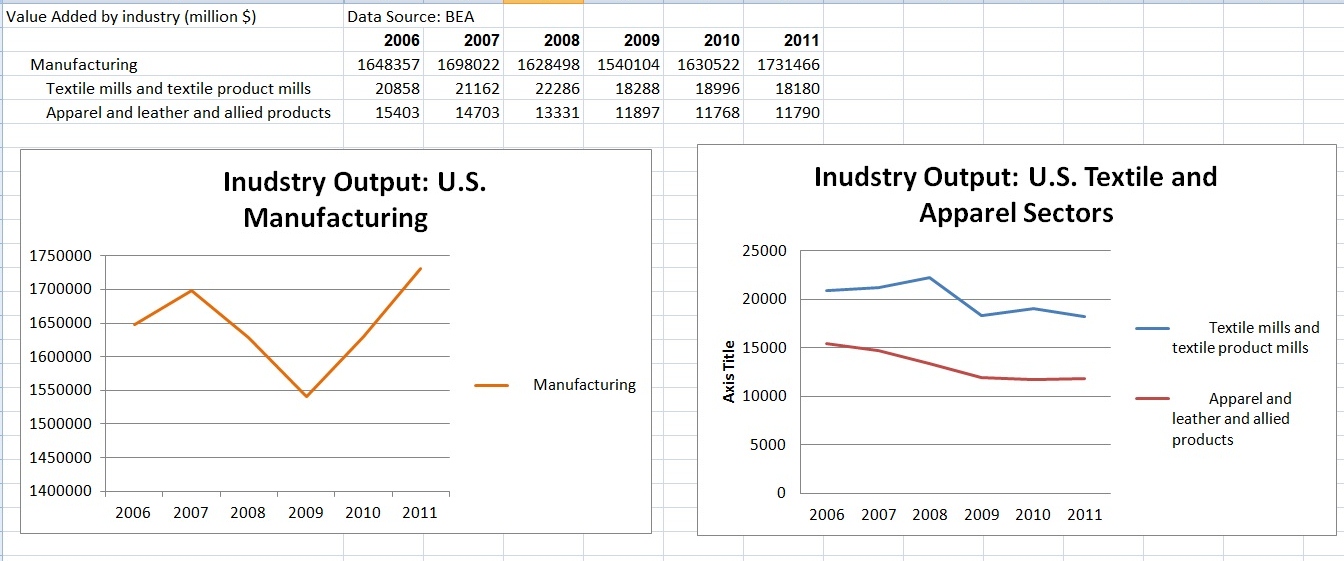
output

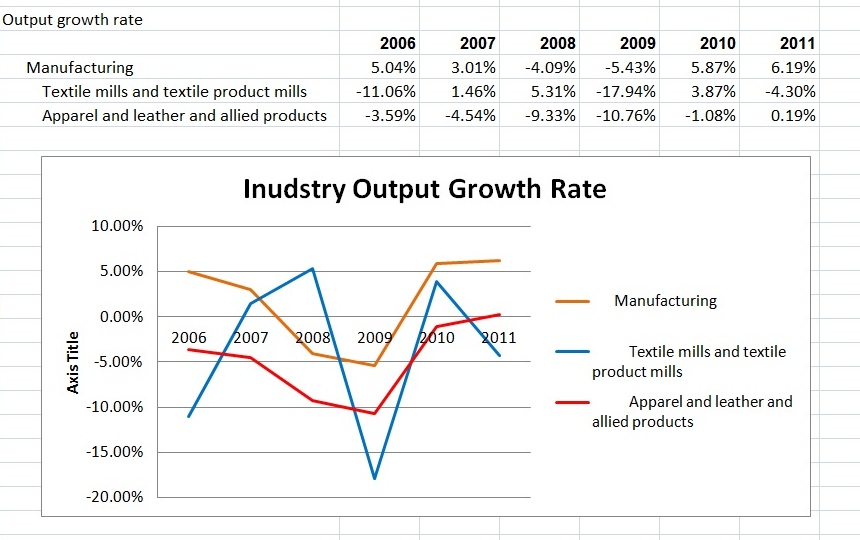
output growth rate

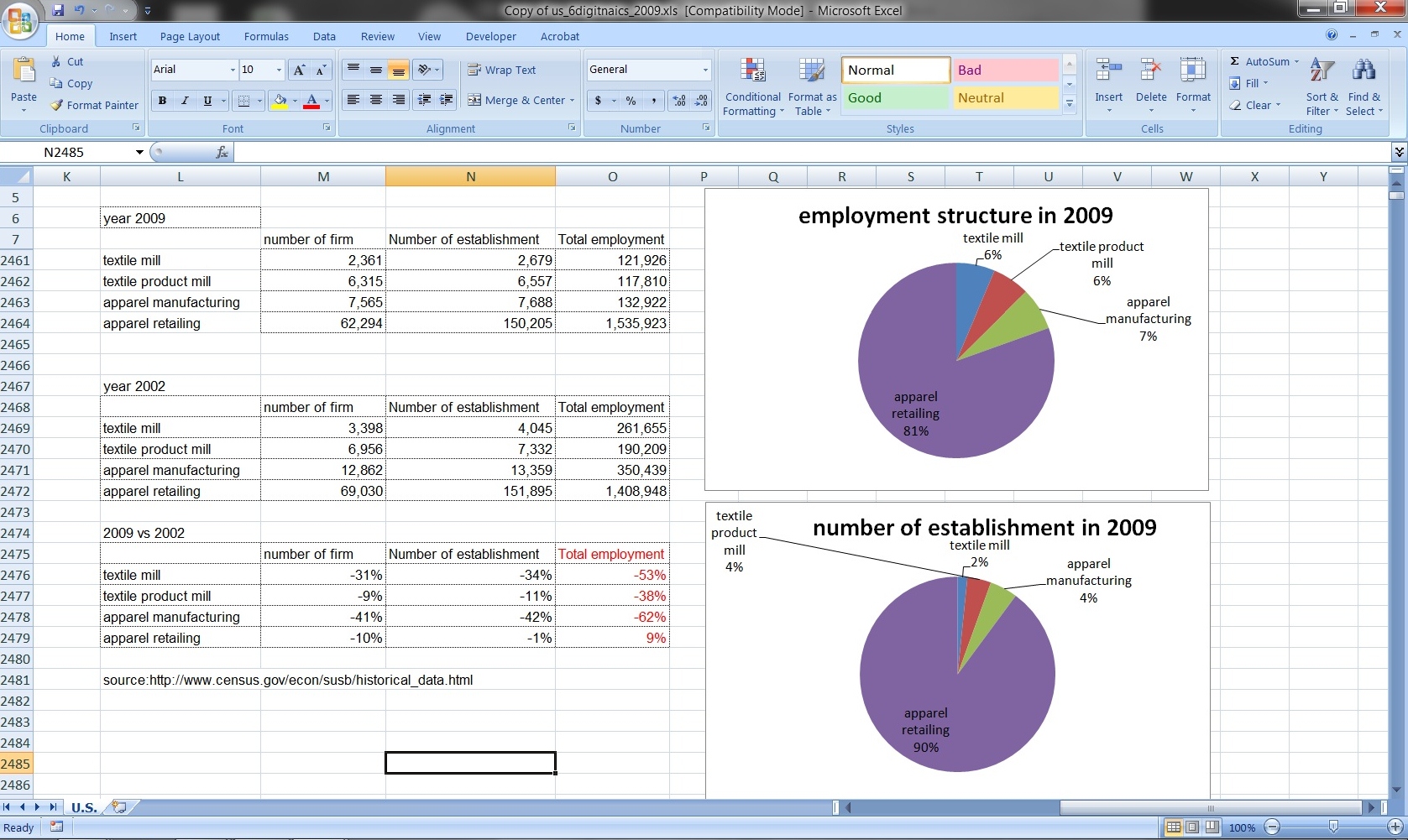
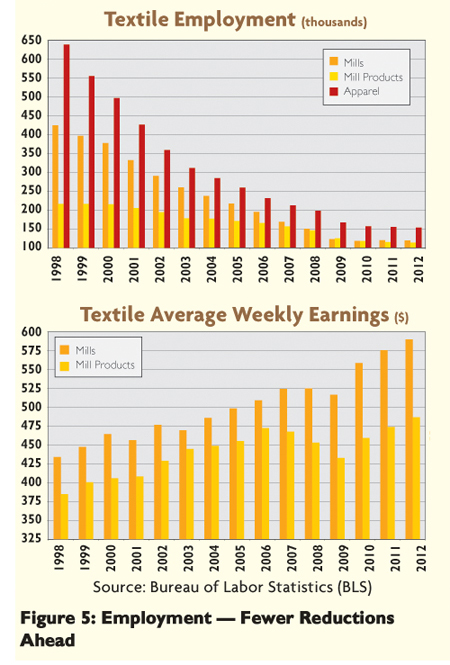
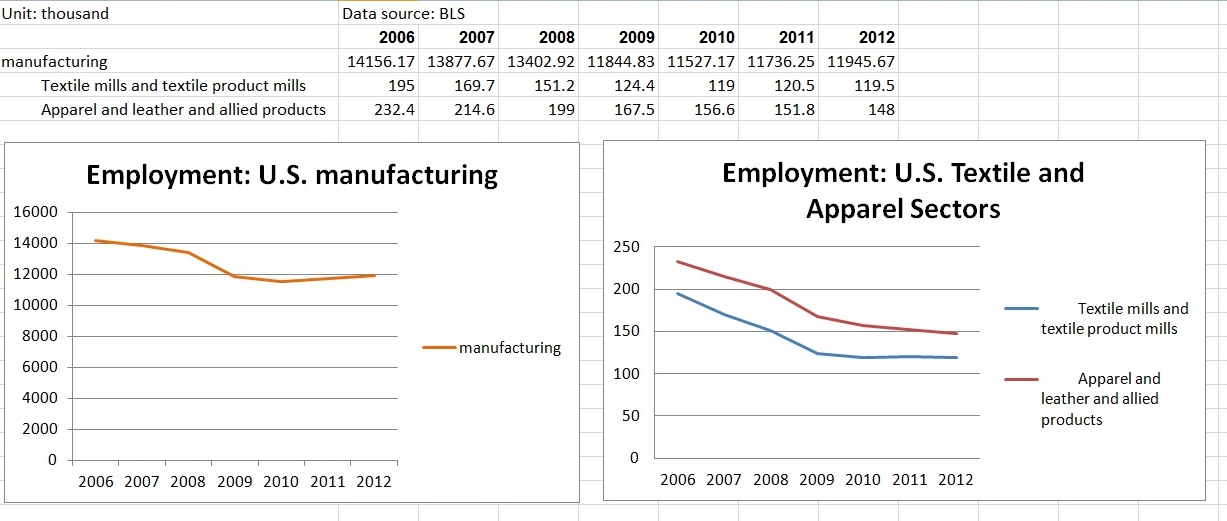
employment

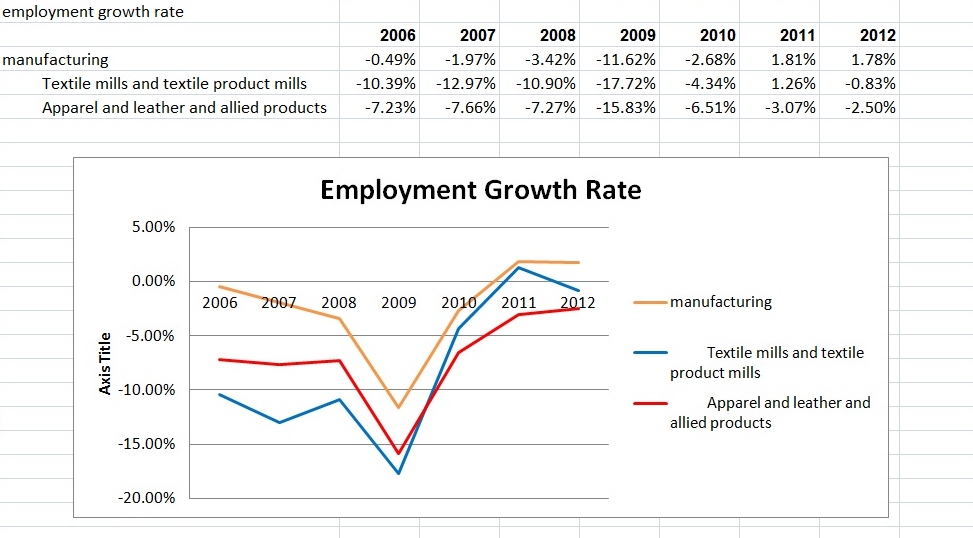
employment growth rate

Preliminary Findings:

1. As suggested by numerous studies, the U.S. manufacturing sector as a whole demonstrated a robust V-shaped recovery from the 2008 financial crisis in terms of industry output.   Growth rate of the industry output from 2010-2011 was also among the highest in the past 10 years.

2. There is no sign yet that textile and apparel (T&A) manufacturing is coming back to the U.S, despite suggested popularity of “insourcing” as result of rising labor cost in China. However, the decline rate of apparel manufacturing in the U.S. seemed to be slowing down.

3. Jobless recovery happened both in the U.S. manufacturing sector as a whole and in the T&A manufacturing sectors. Particularly, the U.S. T&A industry respectively lost 21.0% and 25.6% of its manufacturing jobs from 2008-2012 compared with only 10.8% decline of employment in the manufacturing sector over the same period.  Based on the current data, it can be concluded that a sizable return of manufacturing jobs in the U.S. T&A industry would hardly occur at least in the near future.

Sheng Lu

How many U.S. consumers are willing to spend $1,300 for a blazer, $170 for a dress shirt, $80 for a tie and $390 for a pair of jeans?

Recently, WSJ wrote a story about apparel “made in USA”. Although apparel manufacturing will never disappear in the U.S. (as the case elsewhere in the world), neither is it likely that those lost labor-intensive manufacturing jobs in the apparel sector will come back in the future. Why? Just ask yourself: Am I willing to spend $1,300 for a blazer, $170 for a dress shirt, $80 for a tie and $390 for a pair of jeans? These are the price tags associated with “Made in USA” for apparel.

Apparel is not a single case. If you’d like to enjoy your iPhone “Made in USA”, please add two “00” to the current price tag. Like it or not?

Similar questions can also be raised to the Europeans, Chinese, Koreans and everyone else in the world. For example, what will happen if China does not import U.S. cotton but totally relies on its domestic supply? What will happen if each country tries to produce their own air plane instead of using Boeing’s aircraft? How about European retailers only accept credit card issued by an European financial service provider and reject Visa or America Express? And how long will it take to deliver a package to Asia if FedEx and UPS are not allowed to operate in these regions? Will these “changes” improve or worsen people’s daily life? The answer is obvious.

Globalization does not mean “Made in China”nor “Made in USA”. Rather, it means “Made in the World” based on each country’s comparative advantage, it means getting access to the world resources and using them more wisely and more efficiently. Why not everyone engages in doing something they are good at doing and then exchange? This is why we go grocery instead of growing vegetables nor raising cows by ourselves today. 

Globalization also means a product now can reach the world market beyond the limited domestic market. But a country can only successfully export when another country is willing to import. This is why we need to support trade liberalization so that every country can export more of those products they are competitive in making. And definitely more jobs will be created domestically. I mean every country that engages in such global “exchange”.

We no longer live in the 15th century when the Mercantilism was born. In the 21st century, export is good and import is equally good for the economy. Embrace globalization and enjoy better life~  

Sheng Lu 

Data source: American  Apparel and Footwear Association (2012)

Data source: U.S.-China Business Council

TPP and the U.S. Textile Manufacturing Industry

The Congressional Research Service just released its most recent study on the U.S. textile manufacturing industry and the Trans-Pacific Partnership (TPP) Negotiation. This is also one of the limited reference available so far that specifically addresses the sectoral impacts of TPP.

Overall, this report did a good job of compiling latest statistics showing the operation of the regional trade & production network between the United States and those developing countries in central and south America. It also discusses why the U.S. textile industry appears to be very nervous about Vietnam.

However, the study wasn’t able to quantify the impact of TPP, which leaves potential for future studies. On the other hand, although debates over TPP centers upon the rules of origin, we shall not forget about foreign investment–especially when geographically Vietnam is very close to China, Japan and South Korea. Even yarn-forward is adopted, why cannot Chinese factories move their factories to Vietnam? It shall be noted that China’s economy is undergoing structural change and it’s the time for some Chinese factories to “go offshore”. 

Full text of the report can be found here.


OTEXA identifies top export markets for U.S. textile and apparel

The Office of Textiles and Apparel (OTEXA) recently released its 2012 Going Global Report, which identifies 15 top export markets for U.S. made textiles and apparel. The report also includes statistical profile of these 15 countries, including their GDP per capita, GDP growth and bilateral trade with the United States in recent years.

It is interesting to note that the top export markets for textile and for apparel are very different. Wonder why? Please think about the “stages of development theory” we discussed in class.

HS code refers to the “Harmonized tariff schedule” (HS), a classification system for commodities. Textile and apparel are covered by HS code chapter 50-63. Detailed list can be found at http://www.usitc.gov/tata/hts/bychapter/index.htm

The report can be downloaded from here

US: Yarn-forward rule row flares up again

polyester-yarn-import-175429_189210

A row has flared up again over the yarn-forward rule of origin in US free trade agreements after The Hosiery Association (THA) called for a knit-to-shape, assembly-only exception for socks and hosiery in the Trans-Pacific Partnership (TPP).

Three textile trade associations have now written to US Trade Representative Ron Kirk expressing their “strong opposition” to the proposal.

The American Manufacturing Trade Action Coalition (AMTAC), National Council of Textile (NCTO) Organizations, and American Fiber Manufacturers Association (AFMA) say any such move “conflicts with the US textile industry’s longstanding support” of a yarn-forward rule of origin for textiles and apparel.

The yarn-forward rule requires all stages of production – from yarn spinning to fabric formation and final garment assembly – to be done either in the United States or in an FTA partner country to qualify for duty-free treatment.

US textile groups say the rule is “long-established” and “logical” because the value of a finished item comes from its components, rather than from its final assembly.

But American retailers, apparel brands, manufacturers and importers argue it is too restrictive, hinders new trade and investment in the sector, and renders most existing trade ineligible for preferential tariff treatment.

The Hosiery Association wants the TPP pact – currently being negotiated by the US, Vietnam, Brunei, Chile, New Zealand, Singapore, Australia, Malaysia and Peru – to allow hosiery producers to source yarns for man-made fibre socks and hosiery outside the TPP region in all instances except in the case of 100% cotton and polyester products.

But “this proposal would be a massive blow to US and other TPP producers who manufacture acrylic, nylon and various other types of man-made fibre yarns,” the textile groups say.

“In short, the THA proposal allows yarns currently made in large quantities in the United States to be sourced from third parties, notably China,” the letter says.

Apparel Market: Landscape of Change

An article from the Textile World Highlights:

  • The global apparel retail industry grew by 3.4% in 2011 to reach a value of $1,175,353.1 million. In 2016, the global apparel retail industry is forecast to have a value of $1,348,098.8 million, an increase of 14.7% since 2011.  Americas accounts for 36% of the global apparel retail industry value.
  • Technlogy is changing consumers’ shopping behavior as well as preferences (such as redefining value of products). The internet, smartphones and social networking are driving the apparel industry to a greater extent than ever before.
  • “Made in USA” is attracting consumers, however, to be more accurate, it means “source in the Western Hemisphere” rather than moving manufacturing totally back in the U.S.. However, in order to have “near sourcing” happen, addtional trade liberalization is required to remove the so much constraints.  
  • Supply chain transparancy and cooridnation is with growing significance to the success of business in the apparel companies.
  • The only constant in the apparel industry is change (enviorment, business model, product innovation, technology…).

Re-shoring US apparel making tough but not impossible

This recent comment from Just-style argues that re-shoring U.S. apparel manufacturing may become likely given China’s quickly rising labor cost. However, another two points mentioned by the article deserve more attention: one is that in order to make “made-in-USA” apparel competitive, industry leaders believe that tariffs and trade barriers on imported yarns and fabrics need to be much lowered. The question is, how realistic this “goodwill” can become true, considering the attitude of the US textile sector on the matter and their political influences. Second, although there might be some demands for sewing jobs in the U.S., these occupations are very low paid. The article admits that except immigrant, propably few Americans today (even those unemployeed) would like to take them (and have the qualified skills).  Then, does re-shoring really matter for college graduates in the fashion apparel program?  

To read the full article, click here

Megatrend in the US textile and apparel sector

(click the picture to enlarge)

Opinion: Apparel imports boost U.S. jobs

Key points:

“These four million U.S. workers – seen and unseen – help you get dressed every day. They design shoes and clothes, perform research and development, cut and sew, supervise production, handle customs and logistics, ensure product safety compliance, market and merchandise product, outfit our troops and work on the sales floor. In addition to these four million workers, there are countless U.S. transportation, distribution, warehousing, and logistics workers who depend on our industry for their jobs.”

“about 75 percent of the retail value of most clothing and footwear comes from non-manufacturing activities that happen entirely inside the United States.”
“Supply chain jobs and manufacturing jobs are equally valuable to the overall health of the U.S. economy. It is wrong to foster a public policy agenda that forces these two groups to compete against each other. ”

Written by Kevin Burke. president and chief executive officer of the American Apparel & Footwear Association.

Read more: http://www.politico.com/news/stories/0712/78779.html#ixzz21PNrJzHK

The Relationship Between Import Penetration and Operation of the U.S. Textile and Apparel Industries From 2002 to 2008

Published in Clothing and Textile Research Journal, Vol 30, No. 2, p119-133

The Relationship Between Import Penetration and Operation of the U.S. Textile and Apparel Industries From 2002 to 2008

Sheng Lu and Kitty Dickerson

Abstract

The U.S. textile and apparel (T&A) industries have respectively adopted various restructuring strategies in recent years which fundamentally changed the way the two industries operate and the shifting relationship of each sector with imports. This study empirically tests the relationship between import penetration and the operation of the U.S. T&A industries based on data at 4-digit North American Industry Classification System (NAICS) code level from 2002-2008. Results from the panel data model show that overall the U.S. textile industry formed a weak cooperative relationship with import penetration level in the U.S. market and a neutral relationship was suggested for the U.S. apparel industry with imports. These findings contribute to understanding the global nature of today’s U.S. T&A industries and suggest useful perspectives for the U.S. textile trade policies.

To read the full paper, click here

Outlook for the US Textile Inudstry in 2012

An annual report prepared by the Textile World on the outlook of the U.S. textile industry in the year ahead. The report covers topics ranging from the industry output, market evaluation, price, international trade, job market and policy enviorment.

As noted by the report “Despite declines in employment, job prospects for skilled workers, engineers and merchandisers should be tolerably good as the industry evolves into one that primarily requires people with good communication skills, creativity, and who are skilled enough to operate today’s high-technology, computer-operated machines.”

To read the fulltext of the report, click here

Textile Makers Fight to Be Heard on South Korea Trade Pact

Read the full article from the New York Times:

My comment:

It is important to realize that the U.S. textile industry and the U.S. apparel industry today are no longer close parnters. Why? Because they choose different restructuring strategies in response to globalization and rising imports.