FASH455 Exclusive Interview with Avedis Seferian, President & CEO of Worldwide Responsible Accredited Production (WRAP)

About the interview

Social responsibility is a critical topic in apparel sourcing and trade. Gen Z, both as consumers and future professionals in the fashion industry, care deeply about this issue. At the same time, the conversation around social responsibility has become more technical and complex, such as compliance with new regulations like the Uyghur Forced Labor Prevention Act (UFLPA).

In the interview, Avedis Seferian, President & CEO of Worldwide Responsible Accredited Production (WRAP), shared his insights and extensive practical experience about the current landscape and emerging trends in social responsibility related to apparel sourcing, including:

  • What does “social responsibility” truly mean in the context of today’s global apparel industry, and how has that meaning evolved over the past decade?
  • What are the key expectations for fashion companies if they need to achieve socially responsible sourcing?
  • Is social responsibility more of a legal issue or an ethical issue for fashion companies? Where does the line lie between what is required by law and what is expected ethically from apparel brands and factories?
  • How does a typical social compliance audit work on the ground, and why does it involve much more than simply “completing a checklist,” as some people may misunderstand?
  • Does greater supply chain transparency help promote social responsibility? How can fashion companies be encouraged to become more transparent, and what challenges remain?
  • What is the impact on garment factories and their workers when fashion companies suddenly cancel sourcing orders? As fashion companies increasingly expect suppliers to be “flexible,” such as accommodating last-minute changes to sourcing orders, could this expectation further complicate social responsibility efforts?
  • Can AI and technology have some potential applications in promoting social responsibility in the fashion industry?
  • Advice for students and young professionals entering the apparel industry who want to make a meaningful impact in social responsibility and ethical sourcing.

About Avedis Seferian

Avedis Seferian joined WRAP in 2004 and became its President and CEO in 2012. Avedis has extensive knowledge of social responsibility issues within the highly complex worldwide supply chains of the apparel, textile and footwear sectors. A recognized expert in the area of social compliance and responsible sourcing, Avedis was named by Assent Compliance as one of the top 100 corporate social responsibility influence leaders for 2020.

Additionally, Avedis speaks five languages, has lived in four countries and holds three degrees from three continents—a Bachelor’s in Economics from St. Stephen’s College, Delhi University in India; a Master of Business Administration from the American University of Armenia; and a Juris Doctor from the Georgetown University Law Center in the United States.

About Emilie Delaye (moderator)

Emilie Delaye is a master’s student & graduate instructor in Fashion and Apparel Studies at the University of Delaware, with a specific interest in supply chain, global sourcing, and sustainability. Emilie is also a member of the Fair Labor Association (FLA) 2025-2026 Student Committee and the University of Delaware President’s Student Advisory Council.  

2025 WITA Academy Pathways To Opportunity: Textiles and Apparel-University of Delaware

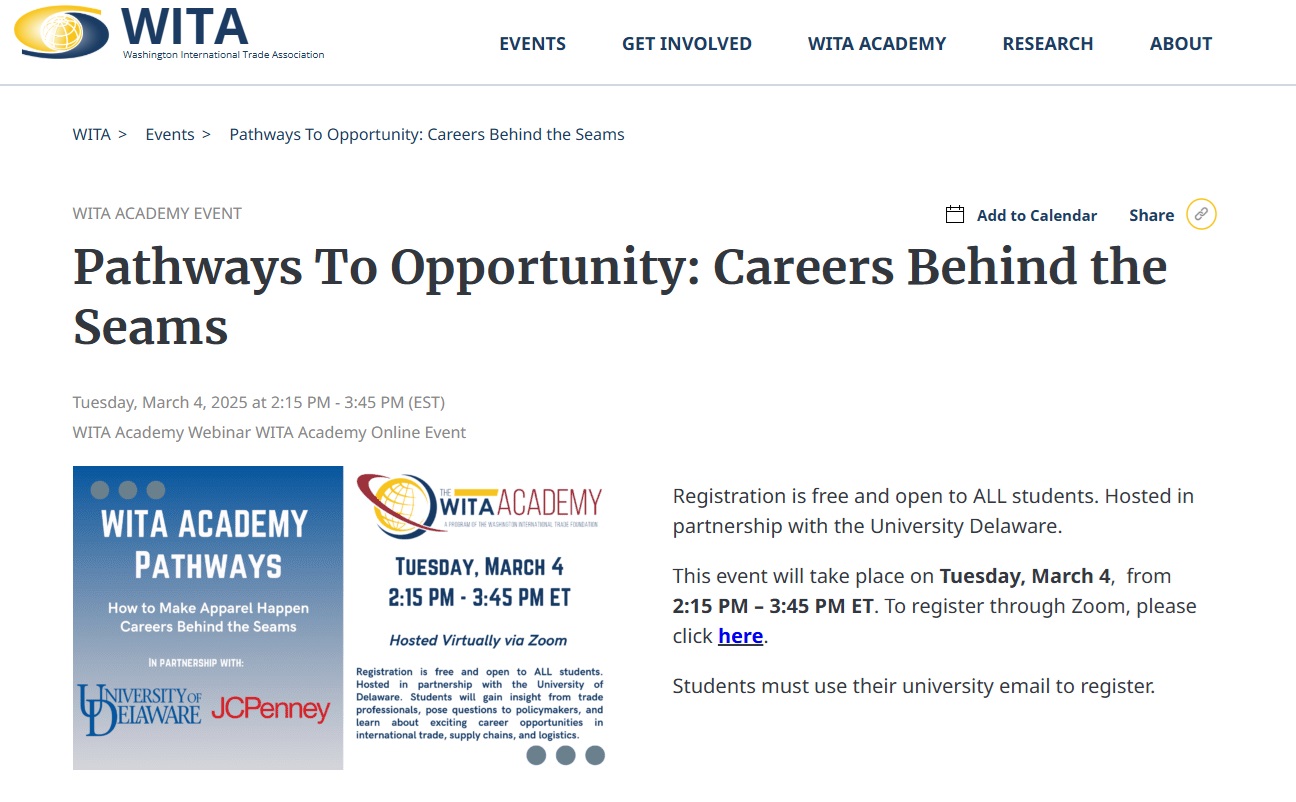
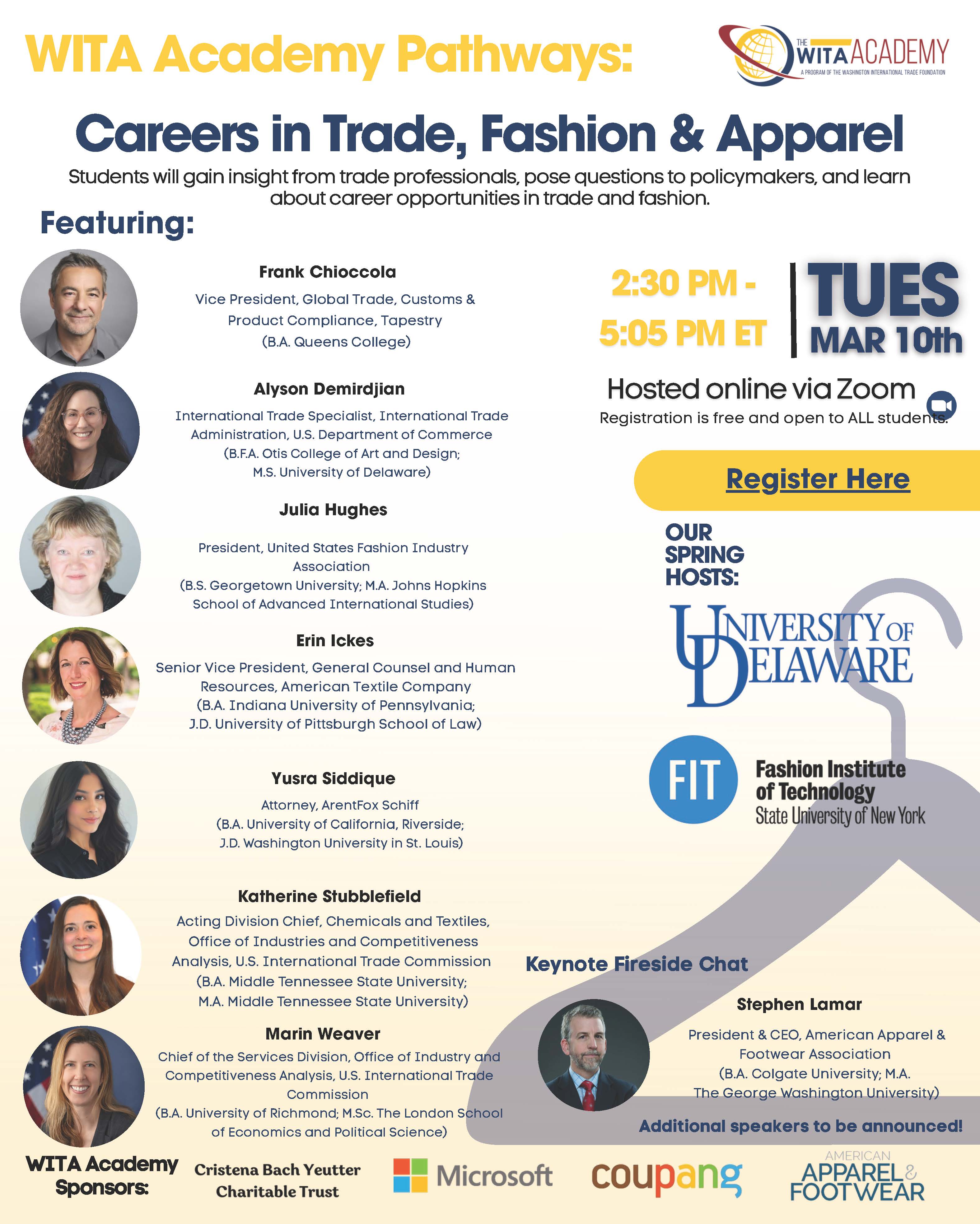
On March 4, 2025 (Tuesday) from 2:15 pm. to 3:45 pm, the Washington International Trade Association (WITA) Academy, in partnership with UD’s Fashion and Apparel Studies Department and JCPenney, will host a virtual workshop (on Zoom) exploring career opportunities across the fashion apparel supply chain, including design, product development, merchandising, sourcing, sustainability, trade compliance and more.

This event is free and open to ALL UD students (undergraduate and graduate), faculty, and prospective students of the UD FASH program, but registration is required (please use .edu email address): https://www.wita.org/events/pathways-careers-behind-the-seams/

Note: Students in FASH455-010 (Tue and Thu) do not need to register for the event. We will attend the workshop and participate in the live Q&A session in the classroom.

Featured speakers (bios here) from JCPenney include:

  • Amanda Blackman, Director of Planning and Allocation
  • Michelle Erwin, Sourcing Manager
  • Hunter Green, Senior Manager of International Transportation
  • Angela Hofmann, VP, Government Affairs
  • Wayne Milano, SVP, Global Sourcing and Product Development
  • Aqsa Tasleem, Senior Manager of Fabric & Sustainability
  • Katie Thurman, Senior Pre-Production Manager
  • Brandi Wallace, Senior Design Director
  • Brian Wolfrum, Director of Trade Compliance
  • Aaron Worley, Senior Buyer

New USITC Report: Apparel: Export Competitiveness of Certain Foreign Suppliers to the United States

The United States International Trade Commission (USITC) released its new fact-finding report examining the competitiveness of Bangladesh, Cambodia, India, Indonesia, and Pakistan as apparel suppliers to the United States. The study was conducted in 2024 based on input from secondary sources (e.g., trade statistics, public hearings, and desk studies) and fieldwork. Below are summaries of the key findings regarding apparel export competitiveness.

Factors that affect export competitiveness in the global apparel sector

One key issue the study explored is what factors affect a country’s apparel export competitiveness and how to become a preferred apparel sourcing base for U.S. fashion companies.

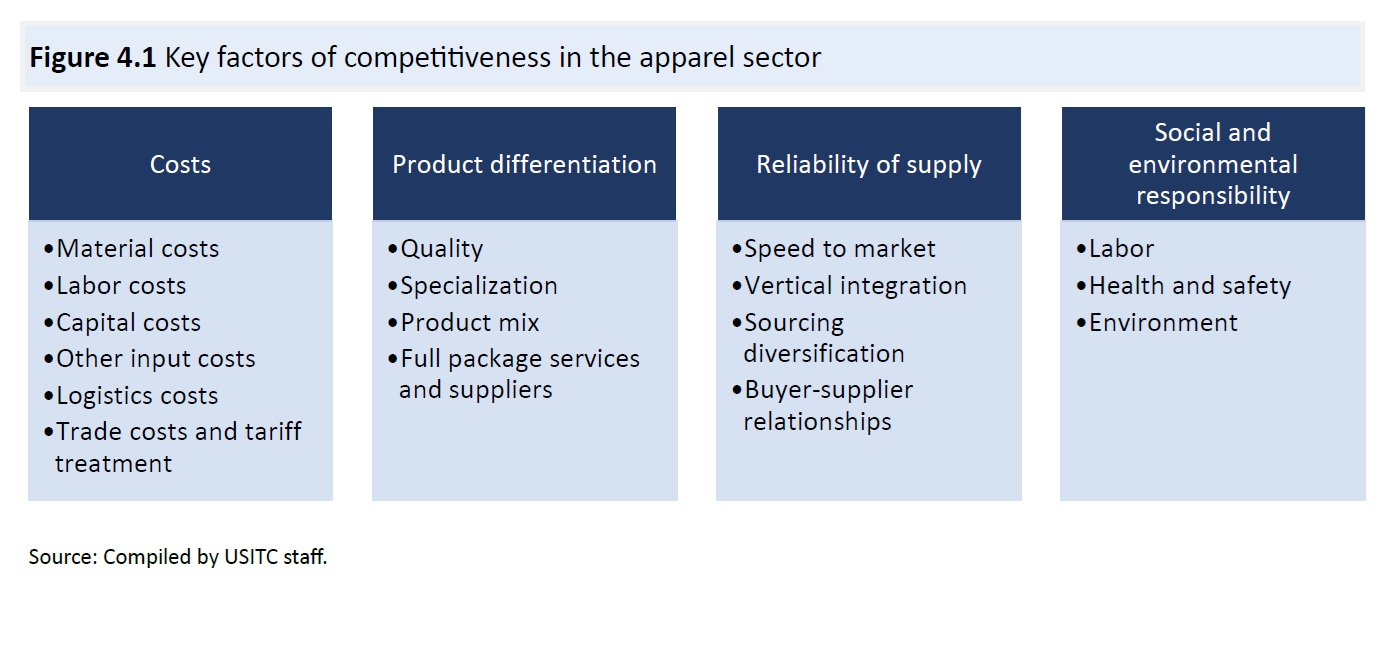
The studies suggest that four types of factors are most important (see the figure above). However, consistent with existing literature, the USITC report could not determine which factor is decisive in fashion companies’ apparel sourcing decisions. For example, the report found that:

  • cost—the price buyers pay their suppliers—plays a key role in sourcing decisions, although opinions vary regarding the importance of cost relative to other factors.
  • Depending on the product, target consumer, and identity of a brand or buyer, apparel buyers will place varying degrees of importance on product differentiation factors such as quality, specialization, product mix, and full package offerings, which include design services, finishing, packaging, and logistics.”
  • The emphasis on reliability has particularly grown in response to various recent disruptions to global apparel supply chains such as a global pandemic, geopolitical conflicts, and trade policy.”
  • Although emerging research suggests that compliance programs concerning wages, social inclusion, and climate change mitigation may increase competitiveness, buyers and brands remain divided on the topicthe relative importance, or “weight,” of such compliance in sourcing decisions remains a topic of active study and discussion within the industry.

Cost and export competitiveness

The USITC report highlighted the complex and nuanced relationship between “costs” and a country’s apparel export competitiveness. Several patterns are noteworthy:

  • Apparel is a buyer-driven industry, meaning “the global apparel supply chain gives buyers the power to negotiate based on price, which can push down prices and transfer greater costs to the supplier.”
  • The ability to produce textile raw materials locally can provide cost advantages in garment production—“Material inputs are widely recognized as the largest component in the cost of a final apparel product, and these prices are largely determined by the presence of a domestic textile industry or costs of importing textiles.”
  • It is difficult to compare wages across countries to measure labor competitiveness. In particular, low labor costs “do not reflect the true cost of doing business (e.g., via wage suppression)” in a country and “they can harm a country’s reputation for social compliance and negatively affect labor productivity.”

Buyer-supplier relationships in apparel sourcing

The USITC report revealed some positive developments in the buyer-supplier relationships involving U.S. fashion companies.

  • Fashion companies increasingly recognize the value of building long-term relationships with their vendors. Buyers emphasize that maintaining these relationships is a key factor in sourcing decisions, largely due to the cost and time involved in finding and establishing relationships with new suppliers.
  • Fashion companies’ efforts to improve supply chain transparency and traceability also need  “suppliers who will act in line with their brand’s values.”
  • Suppliers benefit from the long-term relationship, too. As the USITC report noted, some fashion companies guarantee suppliers a particular profit margin to ensure their continued operation. Additionally, some buyers gain a deep understanding of their suppliers’ cost structures, enabling them to calculate the costs of compliance with various standards and assist suppliers in reducing costs where possible.
  • Subcontracting is still regarded as necessary for the garment industry. As noted in the USITC report, apparel orders fluctuate seasonally, making it impractical for suppliers to hire additional permanent workers or invest in machinery for peak demand. To meet buyer expectations during busy periods, manufacturers often subcontract parts of orders and increase overtime or rely on temporary contract workers. This practice is seen as essential for ensuring a reliable supply of apparel.

Social and environmental responsibility and apparel sourcing

The USITC report acknowledged the growing importance of social and environmental compliance to a country’s apparel export competitiveness. However, the relationship remains complex.

  • The extent to which voluntary social and environmental responsibility programs and their associated auditing practices have influenced outcomes, especially regarding worker rights, remains unclear.
  • Suppliers report that the increased frequency of flooding and high temperatures due to climate change negatively affect their ability to meet labor and environmental standards.
  • Increased compliance with social and environmental standards raises supplier costs, negatively impacting their cost competitiveness. Many stakeholders note that while brands and consumers demand greater responsibility, this often does not come with a “price premium” for suppliers, who ultimately absorb these increased costs.

Note: The USITC report also evaluated the export competitiveness of each apparel-exporting country it examined, including their respective competitive advantages and issues to address.

Training Next Gen Sourcing Talents for a More Sustainable Future 

Interview script

FASH455 Interview Series—Coach Global Trade Compliance Internship (Guest: Victoria Langro)

About Victoria Langro

Victoria Langro is an Honors Marketing & Operations Management Majors and Fashion Management Minor (class of 2022). She is also a 2020 UD Summer Scholar. In summer 2021, Victoria worked with Tapestry, which owns Coach, as a global trade compliance intern.

Victoria is the author of several publications on apparel trade and sourcing, including US-UK Free Trade Agreement: What Does it Mean for the Apparel Industry? and How Has COVID-19 Affected Apparel Exports from China, Vietnam, and Bangladesh?

Which Apparel Sourcing Factors Matter?

Key findings:

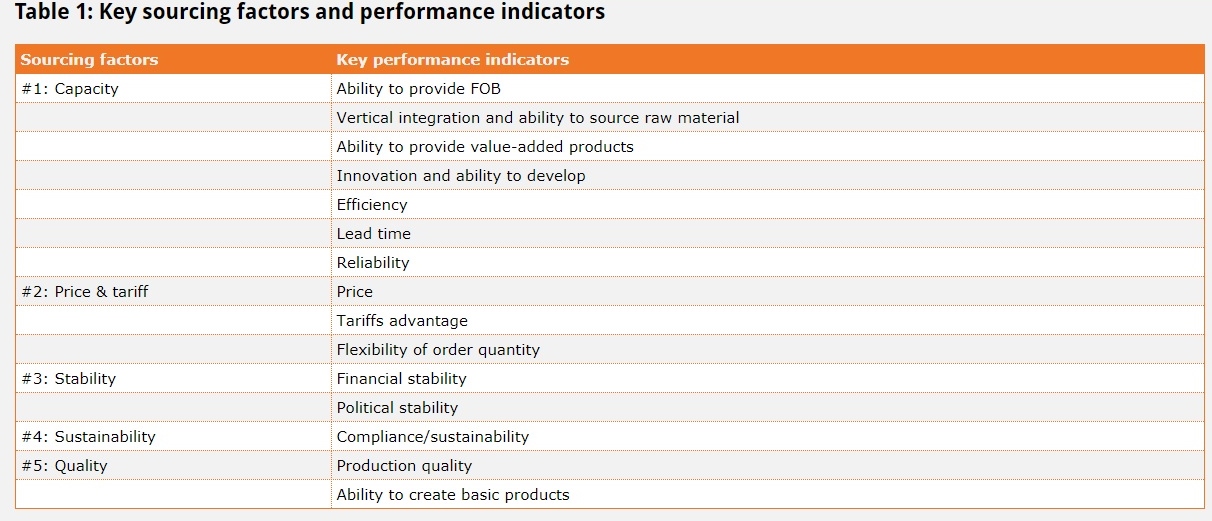
The apparel sourcing formula is getting ever more sophisticated today. US fashion brands and retailers consider a wide range of factors when deciding where to source their products. The long list of sourcing factors includes #1 Capacity, #2 Price & tariff, #3 Stability, #4 Sustainability, and #5 Quality (see the table below).

When evaluating the world’s top 27 largest apparel supplying countries’ performance,  no souring destination appears to be perfect. In general, fashion brands and retailers have many choices for sourcing destinations that can meet their demand for production capacity, price point, and quality. However, fashion companies face much more limited options when seeking an apparel sourcing destination with a stable financial and political environment and a strong sustainability record.

When we compare the trade volume and the performance against the five primary sourcing factors:

  • Apparel sourcing today is no longer a “winner takes all” game. Notably, the factor “Capacity” is suggested to have limited impacts on the value of apparel imports from a particular sourcing destination.
  • Apparel sourcing is not merely about “competing on price” either--the impact of the factor “Price & tariff” on the pattern of apparel imports statistically is not significant.
  • Improving financial and political stability as well as product quality can help a country enhance its attractiveness as an apparel sourcing base. In particular, American and Asia-based fashion companies seem to give substantial weight to the factors of “Stability” and “Product quality” in their sourcing decisions.
  • Fashion companies’ current sourcing model does not always provide strong financial rewards for sustainability. Interestingly, the result indicates that a higher score for the factor “sustainability” does NOT result in more sourcing orders at the country level. Behind the result, fashion companies today likely consider sustainability and compliance at the vendor level rather than at the country level in their sourcing decisions. It is also likely that sustainability and compliance are treated more as pre-requisite or “bottom-line” criteria instead of a factor to determine the volume of the sourcing orders. 

In conclusion, fashion companies’ sourcing decisions seem to be more complicated and subtle than what is often described in public.

By Emma Davis and Sheng Lu

Further reading: Emma Davis & Sheng Lu (2021). Which apparel sourcing factors matter the most?. Just-Style.