FASH455 Video Discussion: Vietnam Garment Factory Tour (updated: October 2025)

About the factory

  • The factory is a foreign direct investment (FDI) operation in central Vietnam specializing in ODM (Original Design Manufacturing) — producing ready-made designs that can be customized for private labels. Specific products include sportswear, casual wear, workwear, and uniforms.
  • The factory hires about 500 workers, and it aims to increase the size to 700-1000 workers, which was the pre-COVID level. The monthly pay averaged about $400.
  • The garment factory mainly exports to the U.S., Europe, and Brazil. The factory can do both full package sourcing (i.e., manages the entire production process, from procuring materials to manufacturing, quality control, and packaging—delivering finished goods ready for export) and CMT sourcing (i.e., cut make and trim–buyer provides the materials and designs, while the supplier only performs garment assembly, sewing, and finishing).
  • The factory mostly uses woven fabrics, and they are mainly sourced from China and Europe. Other sources include Taiwan, Thailand, and Malaysia. Some fabrics are Oeko-Tex certified, given the growing importance of using sustainable materials.
  • To meet the rules of origin requirements under free trade agreements (FTAs), such as the EU-Vietnam FTA, Vietnam is making efforts to enhance its local textile manufacturing capability.
  • To meet the clients’ needs, the factory has received several certifications related to social compliance and sustainability, including WRAP, BSCI, and ISO 9000.
  • Textile waste is partly sold or donated (e.g., blankets and jackets for local communities).

Discussion questions (for FASH455, please answer all of them):

  • How does the video help you understand the complexity of apparel sourcing?
  • Based on the video, what is your evaluation of the strengths of the factory as an apparel sourcing base for US fashion companies? Any specific area in which the factory can be improved?
  • If you have the chance to visit a garment factory, what would you focus on evaluating and why?

Additional reading: Vietnam overtakes China as US’s top apparel supplier (FDi intelligence, Financial Times, October 8, 2025)

New OECD Study: The Role of Sustainability Certifications In Due Diligence In The Garment And Footwear Sector (February 2025)

The study was based on a content analysis of major fashion brands and retailers’ sustainability reports and a survey of stakeholders in the garment and footwear sector from August to October 2023, including 32 brands and retailers, 37 suppliers, and a few non-business respondents.  The full report is HERE.

Key findings:

Rise in sustainability certification in the garment and footwear industry

  • Certifications like GOTS (Global Organic Textile Standard) and LWG (Leather Working Group) have seen significant growth (e.g., GOTS-certified facilities increased by 154% from 2018–2023).
  • Certified textile materials still constitute a minority of global production (e.g., 27% for cotton, 39% for leather)

Sustainability certification requirements and motivations

  • Over 80% of surveyed garment and footwear brands/retailers require certifications from suppliers, driven by risk identification (92%), product tracing (81%), and compliance with regulations (72%). In general, larger brands/retailers (91% of those with >€50M turnover) are more likely to mandate certifications than smaller ones (60% of small and medium-sized enterprises, SME).
  • In contrast to brands and retailers, most surveyed garment and footwear suppliers selected market access (84%) as a key motivation for obtaining certifications, followed by reputational reasons (83%) and risk identification (68%)

Types of sustainability certification in the garment and footwear industry

The paper divides sustainability certification in the garment and footwear industry into three major categories:

  • Due diligence certification to attest that a company (e.g. brand, manufacturer) implements the 6-step risk-based due diligence framework as outlined in the OECD Due Diligence Guidance (e.g., Green Button, Oeko-Tex Responsible Business).
  • Targeted risk certifications to verify outcomes on labor, environmental, or animal welfare risks in the supply chain (e.g., Better Cotton Initiative, Cradle to Cradle, Fairtrade Cotton, Fairtrade Textiles, FSC Forest Management, Global Recycled Standard (GRS), GoodWeave, GOTS, LWG, Oekotex SteP, SA8000, Worldwide Responsible Accredited Production)
  • Certificates of origin and chain of custody to trace raw materials (e.g., cotton, wool) to specific regions or facilities (e.g., Better Cotton Traceability, GOTS transaction certificates)

Role of sustainability certification in trade and market access

  • Certifications standardize compliance, enabling suppliers to meet buyer/regulatory demands (e.g., EU due diligence laws).
  • Brands use certifications to exclude high-risk regions (e.g., cotton from areas with forced labor) and validate ethical claims (e.g., recycled content).

Challenges related to sustainability certification in the garment and footwear sector

  • As the report noted, suppliers typically bear certification costs (e.g., audits, improvements), with limited buyer support.
  • SMEs and informal suppliers struggle with eligibility criteria and costs, risking exclusion from global supply chains.
  • The paper argues that certifications are not a “safe harbor.” Instead, apparel and footwear brands and retailers must complement certification with direct assessments, grievance mechanisms, and stakeholder engagement (e.g., worker interviews). Likewise, mandatory due diligence laws (e.g., EU CSDDD) will increase certification demand, but companies must balance compliance with holistic risk management.
  • The paper emphasizes the need for further research to understand how fashion brands and retailers use sustainability certification in practice. Policymakers should also consider new guidelines that clarify how companies should communicate publicly about the elements of due diligence for which they utilize sustainability certifications.

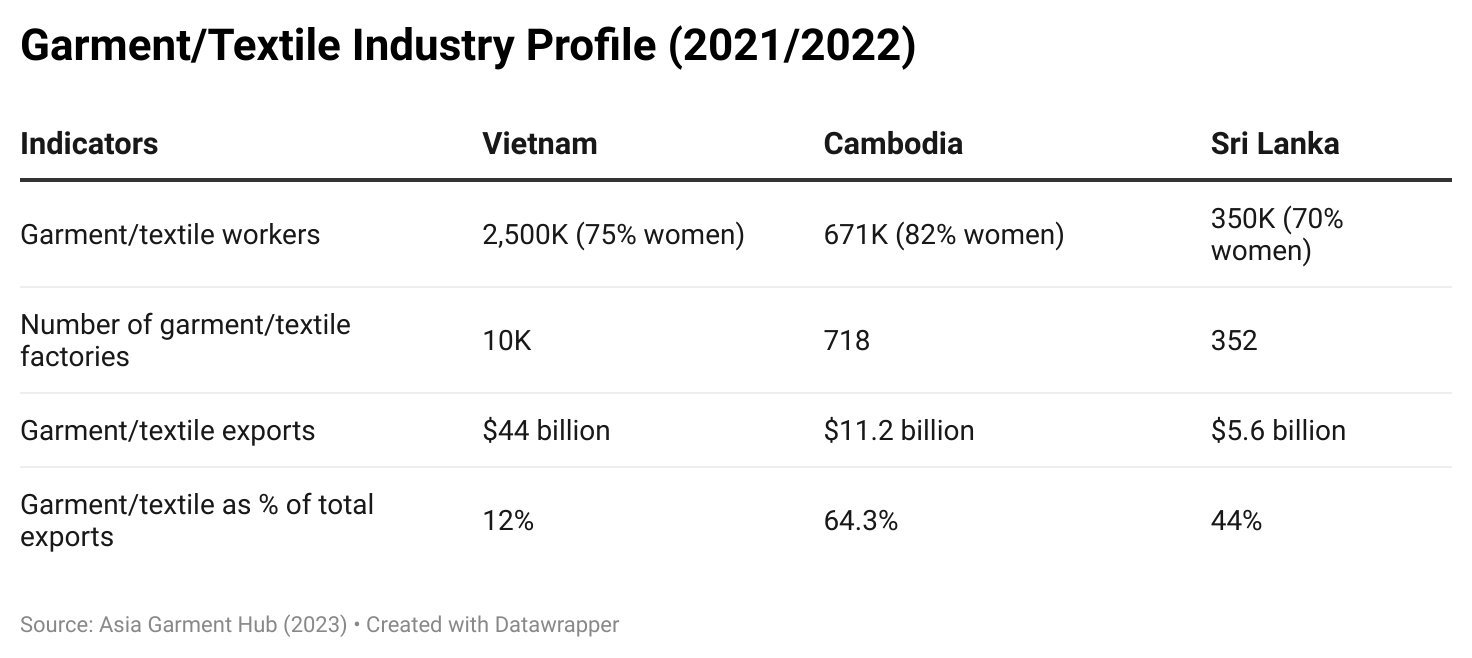
Inside Garment Factories in Vietnam, Cambodia, and Sri Lanka (updated April 2023)

Garment factories in Vietnam
Garment factories in Cambodia
Garment factories in Sri Lanka

Discussion questions (proposed by students in FASH455, spring 2023)

  • Based on the videos, does the flying geese concept still work today? Why?
  • Do you think Western fashion brands and retailers’ increasing emphasis on sustainability and social responsibility in apparel sourcing reduces Asian suppliers’ competitive disadvantage? Why or why not?
  • With Asian countries increasingly leveraging their labor advantages alongside advanced technologies, is the prospect of expanding nearshoring even less likely? What is your assessment?
  • What is your vision for the recycled clothing supply chain? Why or why not do you think Asian countries will continue to dominate?