FASH455 Exclusive Interview with Jillian Silverman, Associate Trim Specialist at Lands’​ End, about Textile Raw Materials and Apparel Sourcing

About Jillian Silverman

Jillian Silverman is an Associate Trim Specialist at Lands’ End, based in Madison, Wisconsin. She earned an Honors degree in Fashion Merchandising with a minor in Environmental Humanities from the University of Delaware in 2016. She later completed her Master’s degree in Fashion and Apparel Studies in 2018, focusing on sustainable material development. Her research, which explored the use of mushrooms as a primary material for footwear, gained national media attention. As a graduate instructor, Jillian taught an undergraduate sustainability course at UD. She continues to share her expertise on textile sustainability as an adjunct professor, teaching several courses in the FASH graduate certificate program for sustainable apparel business.

Disclaimer: The views expressed in this interview are those of Jillian Silverman and do not reflect the views or positions of her employer or any affiliated organizations.

Sheng: What are your main responsibilities as a trim specialist? What does a typical day look like? Which aspects of the job do you find particularly interesting or unexpected before taking on the role?

Jillian: I manage the trims for all our apparel categories, which include hard trims like zippers and buttons and soft trims like thread and interlining, just to name a few. I work with our designers to find out their trim needs and any inspiration, our sourcing team to learn where the garments will be manufactured and any cost, quantity, or lead time considerations, and our global trim suppliers (primarily Asia-based) to select existing trim qualities or bring new ones to fruition. I never realized the intricacies of all the different trim types, and I have learned a lot on the job and still learn as I go! I really enjoy sitting between the creative side, particularly with custom trims, and the more logistical side of things. The different teams often have competing priorities, so while that makes it challenging to juggle, the problem-solving aspect keeps things interesting.

Sheng: In general, what factors should be considered when selecting trims and other textile materials in product development and sourcing?

Jillian: One of the big challenges right now is vendor and garment production location and how that relates to material production locations. With the new administration’s push for tariffs, we’ve been trying to quickly pivot away from China, but many of our raw materials still come from China, so it’s not so simple to move production away without having new challenges with transporting materials and the resulting cost and time delays.

In general, our biggest considerations when selecting materials are aesthetics and performance, cost, lead time (how long it takes to get samples and/or bulk production made), and MOQ (minimum order quantity). We also have to consistently reevaluate our supplier base to make sure we have the right partners who offer what we need at the right place, time, and cost. Speed is becoming more important, so the quicker we can have materials made and transported to our factories, the faster we can start selling those products.

Sheng: Based on your observations, how has sustainability influenced the selection and sourcing of textile materials for fashion companies? How is “sustainability” assessed for trims and other textile materials? What emerging trends should we keep an eye on?

Jillian: Sustainability considerations can be more proactive or reactive depending on the company and the issue at hand. For example, we phased out any PFAS from our supply chain to be in compliance with regulations that were coming. Other initiatives may be to reach certain sustainability goals, like ensuring that a specific percentage of polyester is recycled or using organic or BCI (Better Cotton Initiative) vs. conventional cotton, both of which are transitions we’re working to make. For outerwear, we’ve been using a lot more synthetic insulation, which is generally cheaper, more ethical, and offers easier care to our customers compared to down, so that’s a great option across the board, but many swaps are not so simple; switching to materials with a higher recycled content is often more expensive and less readily available. It can also be hard to quantify what is more “sustainable” about an item, so we look for documentation that supports it wherever possible.

Sheng: How do fashion companies today communicate the sustainability attributes of their apparel products? Is specifically mentioning keywords such as “sustainability” and “low impacts” in labels the most common practice?

Jillian: This has been an interesting topic of discussion lately since at a larger company, the people writing product copies for the website may be fairly removed from the product teams who know the ins and outs of their items and materials and what makes them special. Another challenge is that customers may not recognize the industry terms for things like branded fibers or certifications, so while those are more specific and quantifiable than terms like “sustainable,” they may be lost on the end consumer. I think it’s nice to offer both the more simplified language to get the customer to read further and then to try to break out what makes the item fit that label (e.g., water-saving dyeing method, a certain number of recycled bottles in the insulation, etc.).

Sheng: Following up on the previous question, is it true or a myth that sustainable textile materials are typically more expensive and increase production costs? If so, how can companies balance sustainability with cost-effectiveness?

Jillian: I’ve unfortunately found this to be true in many cases, but as the demand increases, many suppliers are beginning to make these switches automatically and often cost-neutral to their customers. The more brands ask for these changes, the more motivated suppliers are to invest in technology, certifications, etc.. We have to weigh whether or not we can use the more sustainable option without negatively impacting the other business needs, as well as gauge what our customer really cares about. It would be great to use more ethical materials and processes across the board, but we often use a phased approach to transition to more recycled content, for example, over time as we deplete existing stocks or focus on certain programs and styles like our more eco-friendly denim.

Sheng: Based on your experience, do you have any advice for our students on preparing for a career in the fashion apparel industry? What can they do at UD to better prepare? Additionally, what benefits do you see in pursuing a Master’s degree in fashion and apparel?

Jillian: My biggest advice is to be open to opportunities that are different from what you envisioned doing or even realized was a specific job that existed, like one centered around trims! I work with people who have moved between different roles in sourcing, design, technical design, and even IT once they get exposed to different teams and what their work was like. It’s ok to pivot if you find something that suits you better, or to find yourself working on something you weren’t expecting. Getting a breadth of experience also helps you to understand the bigger picture of all the moving parts that go into the apparel industry.

–The End–

New Study: Importing Clothing Made from Recycled Textile Materials? A Study of Retailers’ Sourcing Strategies in Five European Countries

Full paper: Leah Marsh and Sheng Lu (2024). Importing clothing made from recycled textile materials? A study of retailers’ sourcing strategies in five European countries. Sustainability, 16(2), 825.

Summary & Key Findings:

With consumers’ growing awareness of the environmental impacts of clothing production and consumption, retailers in Europe (EU) have expressed a heightened interest in selling clothing using recycled textile materials (referred to as “recycled clothing” in this study). For example, fast fashion giants like H&M and Zara and luxury brands such as Hugo Boss have started carrying recycled clothing, aiming to integrate circularity into their product designs and business models.

In the study, we examined retailers’ sourcing strategies for clothing made from recycled textile materials in five European countries, including the United Kingdom (UK), Italy, France, Germany, and Spain. These five countries represent the EU’s largest clothing retail markets, consistently accounting for over 60% of the region’s total apparel sales.

Through an industry source using web crawling techniques and manual verification, 5,000 Stock Keeping Units (SKUs) of clothing items made from recycled textile materials were randomly selected and analyzed. These items were sold by retailers in the UK, Germany, Italy, France, and Spain between January 2021 and May 2023.

The results show that Firist, EU retailers sourced clothing using recycled textile materials from diverse sources, including over 40 developing and developed countries across Asia, America, Europe, and Africa. Second, other than assortment diversity (i.e., the number of color or sizing options for a clothing item), no statistical evidence shows that developing countries had advantages over developed ones regarding product sophistication, replenishment frequency, and pricing for recycled clothing in the five EU markets. Third, a supplying country’s geographic location statistically affects the type of recycled clothing EU retailers import. For example, retailers in the five EU countries typically adopt the following sourcing portfolio by region:

  • Asia: relatively sophisticated clothing items (e.g., dresses and outerwear) targeting the mass and value market.
  • America (North, South, and Central): relatively simple clothing categories (e.g., T-shirts and socks) targeting the mass and value market.
  • Europe: sophisticated clothing categories primarily for the luxury or premium market
  • Africa: relatively simple clothing categories targeting the premium market

The findings offered new insights into the business aspects of recycled clothing, particularly regarding its intricate supply chains and leading suppliers. The study’s results have several additional important implications.

First, while existing studies often suggest “local for local” textile recycling, the study’s findings revealed promising global sourcing opportunities for clothing using recycled textile materials. Particularly, leveraging a diverse sourcing base would allow EU retailers to take advantage of each supplying country’s unique production strength regarding product categories and assortment features and more efficiently balance various sourcing factors ranging from costs and flexibility to speed to market. Meanwhile, the study’s findings indicate that many countries worldwide have begun producing and exporting clothing using recycled textile materials, and the sourcing options and capacities will hopefully continue to grow.

Second, according to the study’s findings, unlike the patterns of making regular garments using virgin fiber, low-wage developing countries demonstrated no noticeable competitive edges over developed economies regarding producing and exporting clothing using recycled textile materials. Instead, developed economies, including many high-wage Western EU countries, emerged as top suppliers and leading sourcing destinations for recycled clothing. Thus, expanding clothing production using recycled textile materials presents an exciting economic opportunity with a promising future in developed countries, where many have plans to revitalize the domestic manufacturing sector and establish a sustainable circular economy.

Third, building on the previous point, the sustained commitment of fashion brands and retailers to carry more clothing made from recycled textile materials in their product assortment could hold significant implications for the future landscape of global apparel trade and sourcing patterns. For example, whereas apparel products are predominantly exported from developing to developed countries today, more trade flows could occur between developed economies in the future, attributed to their increasing production capacity and growing demand for clothing using recycled textile materials. Similarly, major apparel exporters in Asia, such as China and Bangladesh, might assume a less dominant role as a sourcing base for recycled clothing due to their insufficient infrastructure for efficiently sorting used clothing and generating high-quality recycled textile materials.

By Leah Marsh and Sheng Lu

Discussion questions proposed by FASH455:

#1 How might EU fashion companies’ sourcing strategies change as they increase carrying clothing made from recycled textile materials?

#2 Could the US emerge as a leading sourcing destination for clothing made from recycled textile materials? What are the potential advantages and disadvantages?

#3 Is expanding clothing made from recycled textile materials the right approach to achieve fashion sustainability? What is your thought?

New Study: Explore U.S. Retailers’ Sourcing Strategies for Clothing Made from Recycled Textile Materials

Key findings:

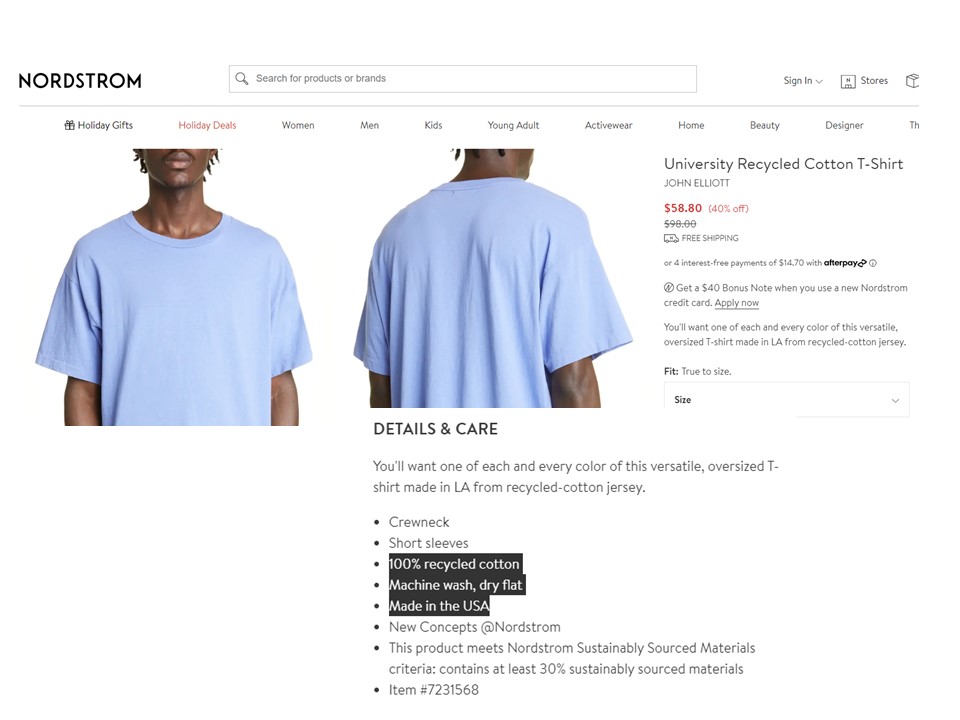
This study was based on a statistical analysis of 3,307 randomly selected clothing items made from recycled textile materials for sale in the U.S. retail market between January 2019 and August 2022 (see the sample picture above). The results show that:

First, U.S. retailers sourced clothing made from recycled textile materials from diverse countries.

Specifically, the sampled clothing items came from as many as 36 countries, including developed and developing economies in Asia, America, the EU, and Africa.

However, reflecting the unique supply chain composition of clothing made from recycled textile materials, U.S. retailers’ sourcing patterns for such products turned out to be quite different from regular new clothing. For example, whereas the vast majority (i.e., over 90%) of U.S. regular new clothing came from developing countries as of 2022 (UNComtrade, 2022), as many as 43% of the sampled clothing items made from recycled textile materials (n=1,408) were sourced from developed countries. Likewise, U.S. retailers seemed to be less dependent on Asia when sourcing clothing made from recycled materials (41.9%, n=1,387) and instead used near-sourcing from America (30.1%, n=994) more often, particularly domestic sourcing from the United States (14.8%, n=490).

Second, U.S. retailers appeared to set differentiated assortments for products imported from developed and developing countries when sourcing clothing made from recycled textile materials.

Among the sampled clothing items made from recycled textile materials, those imported from developing countries, on average, included a broader assortment than developed economies. Likewise, imports from developing countries also concentrated on products relatively more complex to make as opposed to developed countries. Developing countries’ more extensive clothing production capability, including the available production facilities and skilled labor force, than developed economies could have contributed to the pattern.

On the other hand, likely caused by developed countries’ overall higher production costs, the average retail price of sampled clothing items sourced from developed countries was notably higher than those from developing ones. However, NO clear evidence shows that U.S. retailers used developed countries primarily as the sourcing bases for luxury or premium items and used developing countries only for items targeting the mass or value market. 

Third, an exporting country’s geographic location was another statistically significant factor affecting U.S. retailers’ sourcing pattern for clothing made from recycled textile materials. Specifically,

  • Imports from Asia had the most diverse product assortment (e.g., sizing options) and focused on complex product categories (e.g., outwear) that targeted mass and value markets.
  • Imports from America (North, South, and Central America) concentrated on simple product categories (e.g., T-shirts and hosiery) with moderate assortment diversity and mainly targeted the mass and value market.
  • Imports from the EU were mainly higher-priced luxury items in medium-sophisticated or sophisticated product categories with diverse assortment.
  • Imports from Africa concentrated on relatively higher-priced premium or luxury items in simple product categories (i.e., swim shorts) with a limited assortment diversity. 

The study’s findings demystified the country of origin of clothing made from recycled textile materials hidden behind macro trade statistics. The findings also created critical new knowledge that contributed to our understanding of the supply chain of clothing made from recycled textile materials and U.S. retailers’ distinct sourcing patterns and affecting factors for such products. The findings have several other important implications:

First, the study’s findings revealed the broad supply base for clothing made from recycled textile materials and suggested promising sourcing opportunities for such products. Whereas existing studies illustrated consumers’ increasing interest in shopping for clothing made from recycled textile materials, the study’s results indicated that the “enthusiasm” also applied to the supply side, with many countries already engaged in making and exporting such products. Meanwhile, the results showed that U.S. retailers sourced clothing made from recycled textile materials in different product categories with a broad price range targeting various market segments to meet consumers’ varying demands. Moreover, as textile recycling techniques continue to advance, potentially enriching the product offer of clothing made from recycled textile materials, U.S. retailers’ sourcing needs and supply base for such products could expand further.

Second, the study’s findings suggest that sourcing clothing made from recycled textile materials may help U.S. retailers achieve business benefits beyond the positive environmental impacts. For example, given the unique supply chain composition and production requirements, China appeared to play a less dominant role as a supplier of clothing made from recycled textile materials for U.S. retailers. Instead, a substantial portion of such products was “Made in the USA” or came from emerging sourcing destinations in America (e.g., El Salvador, Nicaragua) and Africa (e.g., Tunisia and Morocco). In other words, sourcing clothing made from recycled textile materials could help U.S. retailers with several goals they have been trying to achieve, such as reducing dependence on sourcing from China, expanding near sourcing, and diversifying their sourcing base.

Additionally, the study’s findings call for strengthening U.S. domestic apparel manufacturing capability to better serve retailers’ sourcing needs for clothing made from recycled textile materials. On the one hand, the results demonstrated U.S. retailers’ strong interest in sourcing clothing made from recycled textile materials that were “Made in the USA.” Also, the United States may enjoy certain competitive advantages in making such products, ranging from the abundant supply of recycled textile waste and the affordability of expensive modern recycling machinery to the advanced research and product development capability. On the other hand, the results showed that U.S. retailers primarily sourced simple product categories (e.g., T-shirts and hosiery), targeting the value and mass markets from the U.S. and other American countries. This pattern somewhat mirrored the production and sourcing pattern for regular new clothing, for which apparel “Made in the USA” also lacked product variety and focused on basic fashion items compared with Asian and EU suppliers. Thus, strengthening the U.S. domestic apparel production capacity, especially for those complex product categories (e.g., outwear and suits), could encourage more sourcing of “Made in the USA” apparel using recycled textile materials and support production and job creation in the U.S. apparel manufacturing sector.

by Sheng Lu

Full paper: Lu, S. (2023). Explore U.S. retailers’ sourcing strategies for clothing made from recycled textile materials. Sustainability, 15(1), 38.

Explore the Recycled Clothing Market in Five European (EU) Countries

Abstract

By leveraging industry sources and a content analysis of companies’ websites, this study explores how retailers carry and sell clothing made from recycled textile materials in the five largest European economies, namely the United Kingdom (UK), Italy, Germany, France, and Spain.

The results show that:

  • The recycled clothing market in the five EU countries has enjoyed fast growth over the past three years. However, recycled clothing remains a niche product. Ultimately, recycled clothing only accounted for 1.5% of clothing launched in the five EU markets as of 2022.
  • EU retailers adopt distinct merchandising strategies for clothing made from recycled textile materials. For example, clothing made from recycled materials concentrates on specific product categories, including outwear, swimwear, and bottoms, but is less likely to be available for categories including tops and dresses.
  • Affected by the recycling technologies and the raw material supply, recycled clothing sold in the five EU countries mainly uses recycled polyester or a combination of two or more recycled fibers. In comparison, it is still rare to see clothing made from 100% recycled cotton (less than 1% of the market total), given the technical difficulty of making recycled cotton strong and durable enough. The unbalanced supply of recycled textile raw materials by fiber types also contributes to the phenomenon that recycled clothing concentrates on specific categories.
  • Recycled clothing looks more “boring” or “dull” than regular new clothing overall–as much as 80% of recycled clothing available in the five EU countries adopted the plain pattern (i.e., the apparel item does not contain any graphics, spots, florals, or other designs) compared to only 60% of regular new clothing.
  • Retailers in the five EU countries generally tend to price recycled clothing lower than regular new clothing in the luxury & premium segment but often higher in the mass & value market. The results reflect the dilemma of pricing recycled clothing: whereas the production costs could be higher, consumers do not often see the value of such product (i.e., unwilling to pay a price premium).

The findings enhance our understanding of the business aspect of recycled clothing, especially from retailers’ perspectives. The results suggest that advancing recycling technologies will be critical to overcoming the physical shortcomings of recycled clothing and diversifying the product offers in the market. Meanwhile, in collaboration with other stakeholders, retailers can do more to help consumers better understand the benefits of shopping for recycled clothing and change their perceptions about its low value and inferior quality.

Short bio: Leah Marsh is a Fashion Merchandising and Management major at the University of Delaware (UD) & 2022 UD summer scholar. She is also a World Scholar, a competitive UD program aiming to offer students with unique global learning experiences and networking. Leah is recently admitted to the 4+1 fashion and apparel studies graduate program at the University of Delaware. Additionally, Leah is a UD BlueHen Social Media Ambassador.

Further reading: Leah Marsh & Sheng Lu (2022). Unleashing the potential of Europe’s recycled clothing market. Just-Style Magazine