Patterns of U.S. Apparel Imports (updated January 2026)

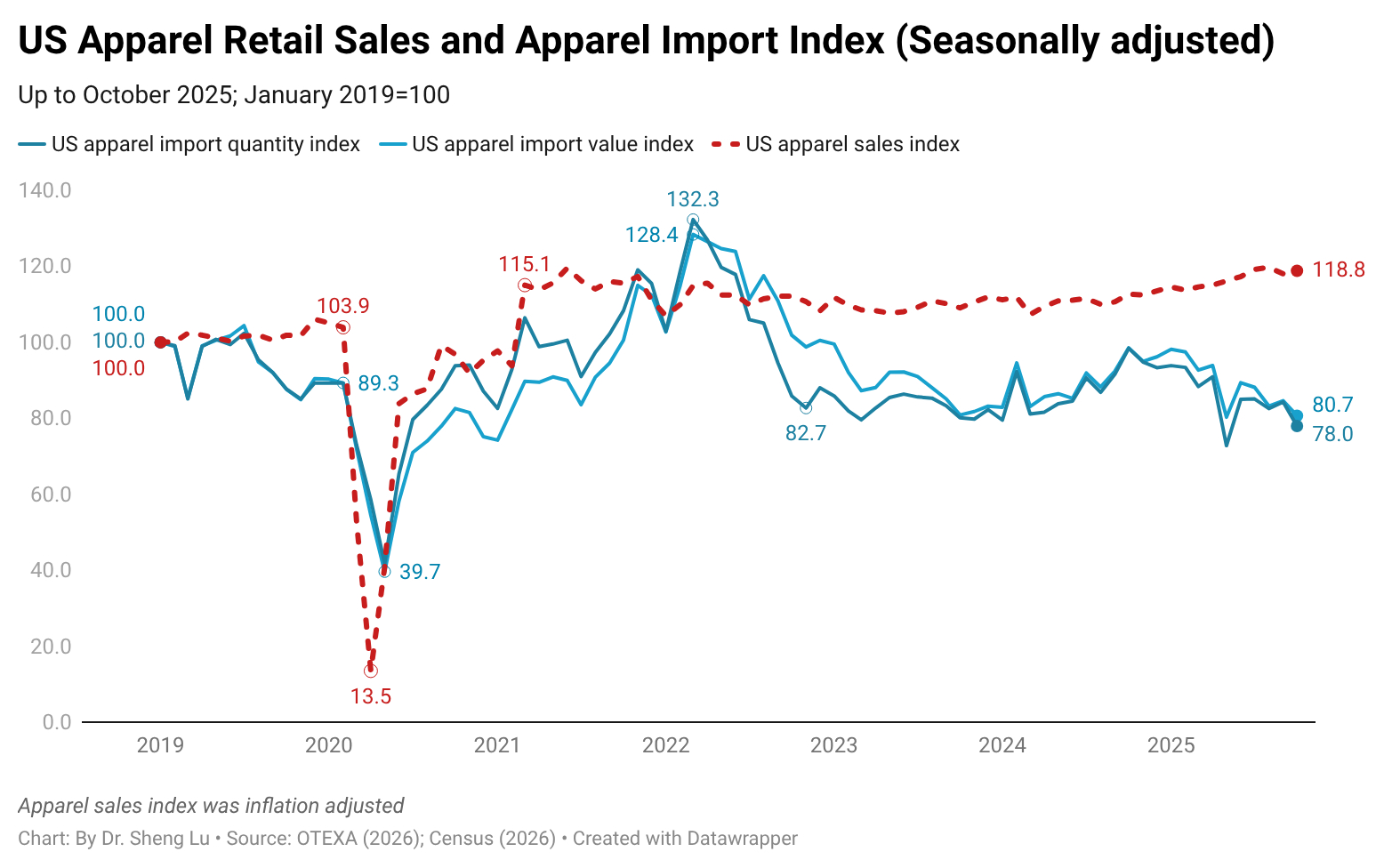
Jointly affected by weak import demand and rising tariffs, US apparel imports in October 2025 sharply declined by 18.5% in value and 21.1% in volume compared to a year earlier. This was the worst performance so far in 2025 and marked a third consecutive month of decline in US apparel imports. Notably, the volume of US apparel imports has become more volatile in 2025 than in previous years, as fashion companies rushed to adjust their original shipping schedules and bring products in early to offset tariff impacts. It is likely that US apparel imports will stay at lower levels in the coming months, especially from December to January, the usual slow import season. (see detailed import data here)

US apparel imports from China experienced another significant decline in October 2025, reflecting US fashion companies’ ongoing strategy of “reducing China exposure.” Specifically, in October 2025, US apparel imports from China dropped by 53.3% in value and 43.1% in quantity year over year, performing much worse than the world average. As a result, in October 2025, China accounted for only 11.3% of US apparel imports in value (down from 19.8% in October 2024) and 25.3% in quantity (down from 35.1% in October 2024), one of the lowest levels in decades. (see detailed market share data here)
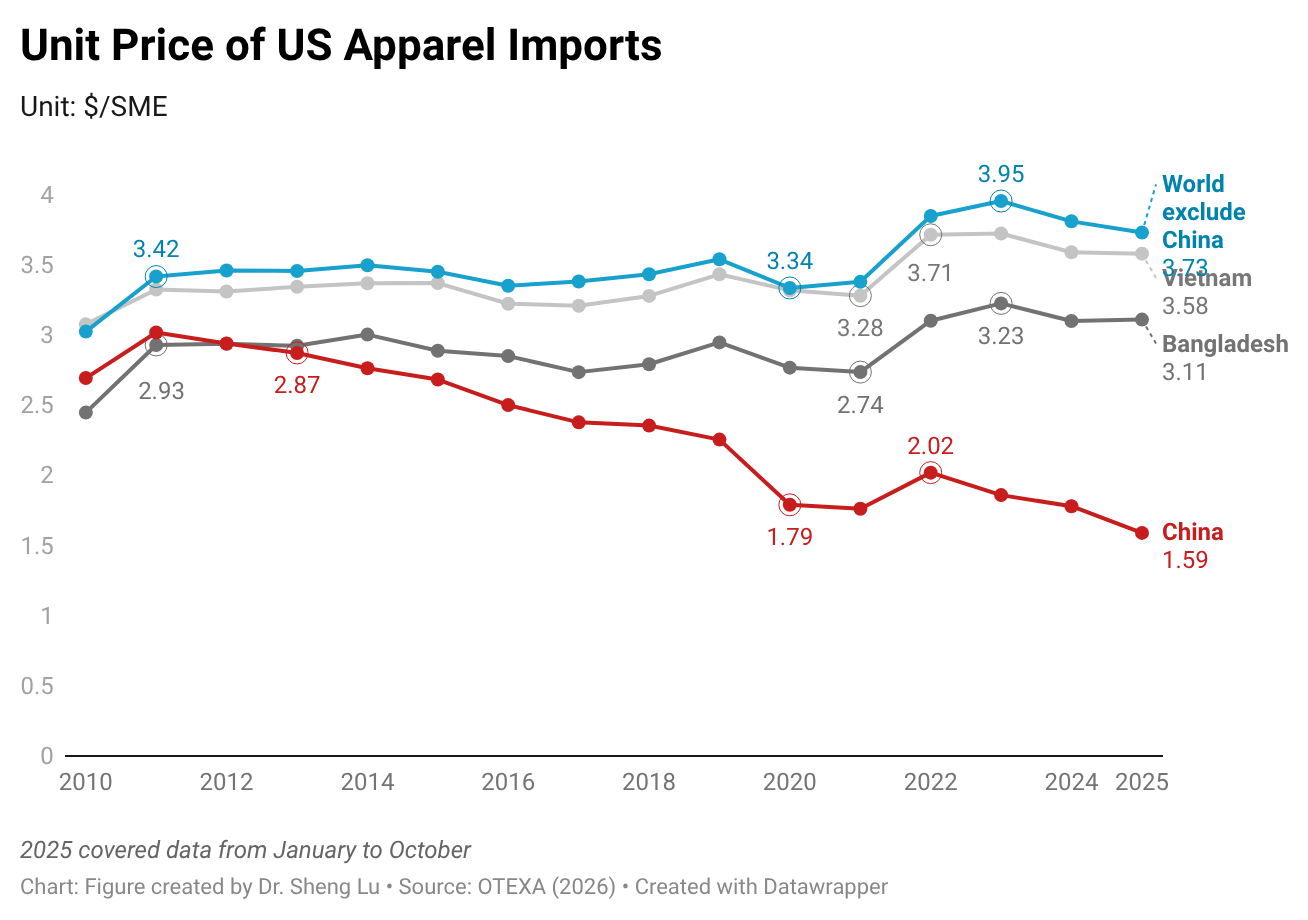
It should also be noted that, measured in dollars per square meter equivalent (SME), the unit price of US apparel imports from China decreased by 10.6% so far in 2025 (January to October), whereas the unit price of total US apparel imports increased by 1.6%. (see detailed unit price data here) These apparently “contradictory” results suggest that the decline in US apparel imports from China may not be driven solely by pricing or even tariffs. Instead, they might also be influenced by US fashion companies’ assessment of sourcing risks and geopolitical issues involving China. 

US apparel imports from Asia continued to demonstrate resiliency overall. So far in 2025 (January to October), in value, Asian countries together accounted for 73.0% of US apparel imports, higher than 71.6% in 2024 over the same period. (see detailed Asia market share data here) In October 2025, the value of US apparel imports from top Asian suppliers, excluding China and India, remained relatively stable and even increased. Countries including Vietnam, Bangladesh, Cambodia, Indonesia, and Pakistan also gained additional market share in October 2025 compared to a year ago. These results revealed US fashion companies’ sourcing diversification strategy amid hiking tariffs and policy uncertainty, as well as the competitiveness of these Asian countries in meeting importers’ demand.
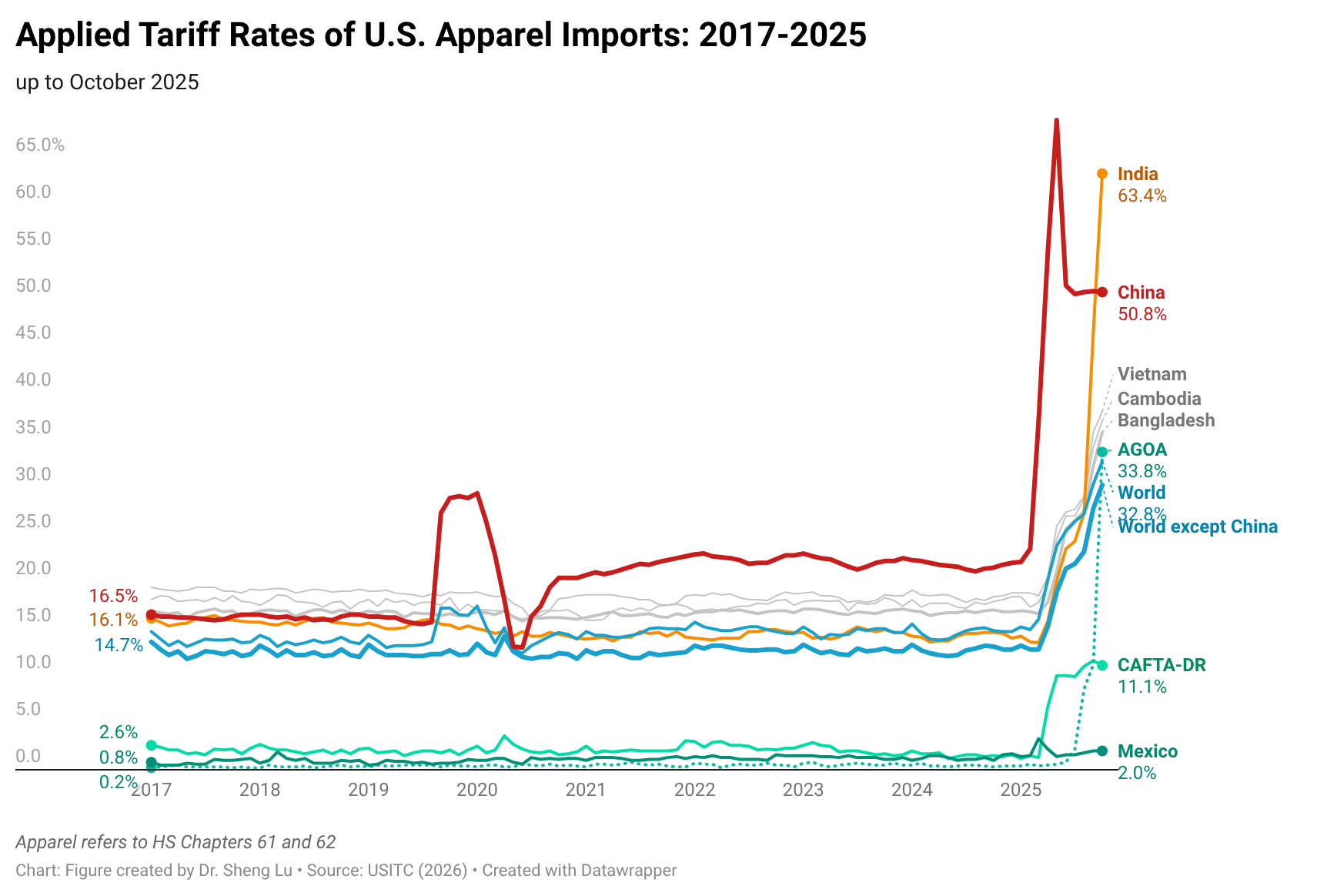
US apparel imports from India declined by nearly 30% in October 2025, highlighting the negative impact of high tariffs on the country’s appeal as a sourcing destination for U.S. fashion companies. Considering President Trump’s recent comments on sanctioning countries that buy Russia’s oil, the prospects for reducing the punitive tariffs on U.S. apparel imports from India remain uncertain.

In relative terms, Western Hemisphere suppliers gained a small share in US apparel imports in October 2025, including Mexico (rising from 3.1% to 3.5%) and CAFTA-DR members (up from 9.1% to 9.5%). However, in absolute terms, US apparel imports from Mexico and CAFTA-DR still dropped by 8.5% and 15.3% in October 2025, respectively. It also remains uncertain how the recent turmoil related to Venezuela might impact US fashion companies’ assessment of trading and geopolitical risks in the region and their willingness to expand sourcing from the Western Hemisphere in the coming year. 
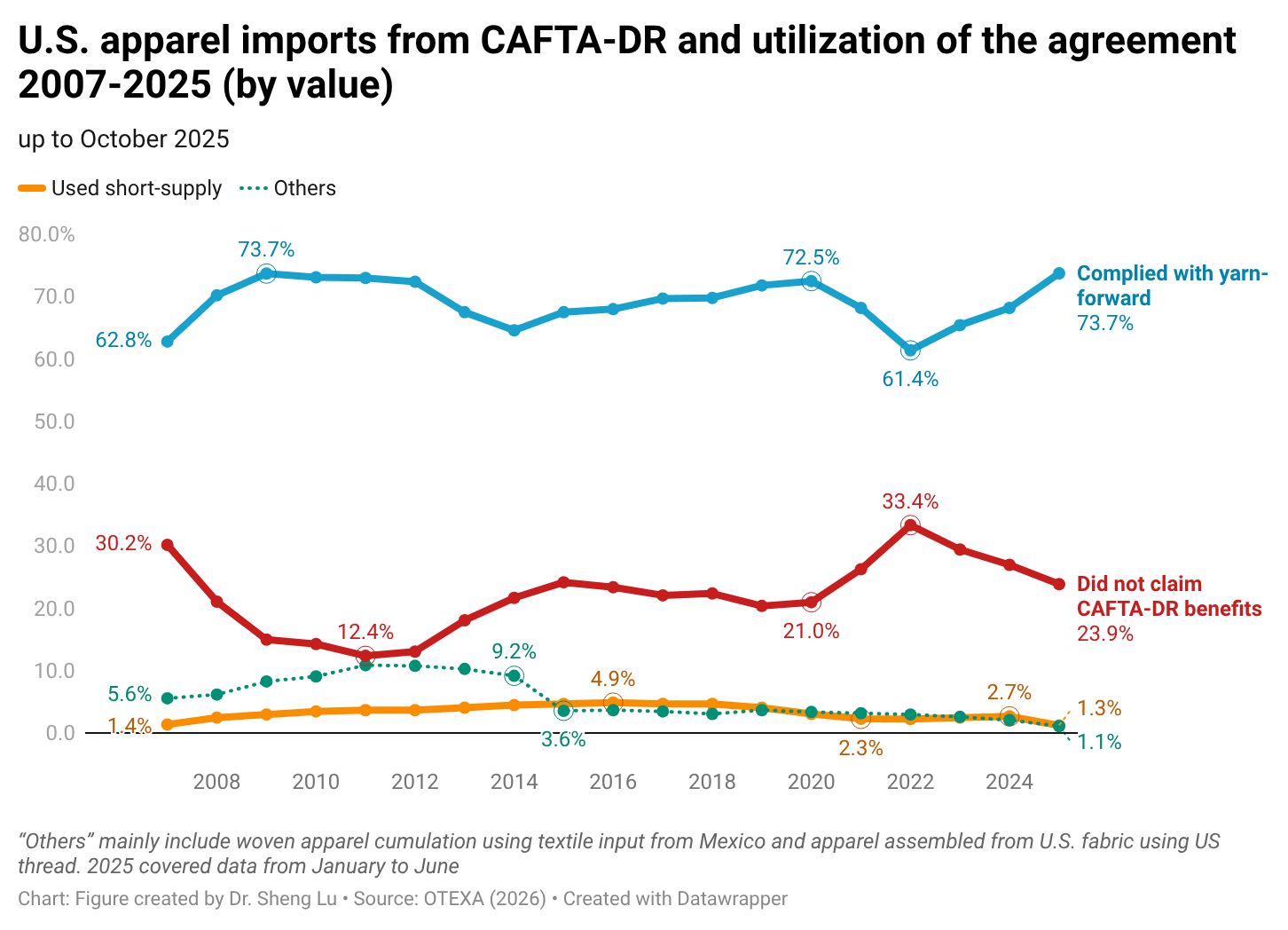
As a silver lining regarding near-shoring from the Western Hemisphere,so far in 2025 (January to October), about 76.1% of US apparel imports from the CAFTA-DR claimed duty-free benefits under the agreement, up from 72.9% in 2024 over the same period. The improved CAFTA-DR utilization so far in 2025 was driven by a higher volume of imports that complied with the yarn-forward rules of origin. However, the utilization rate of the agreement’s short supply mechanism decreased from 2.8% to 1.2% despite more products being added to the list. (See detailed CAFTA-DR utilization data here).
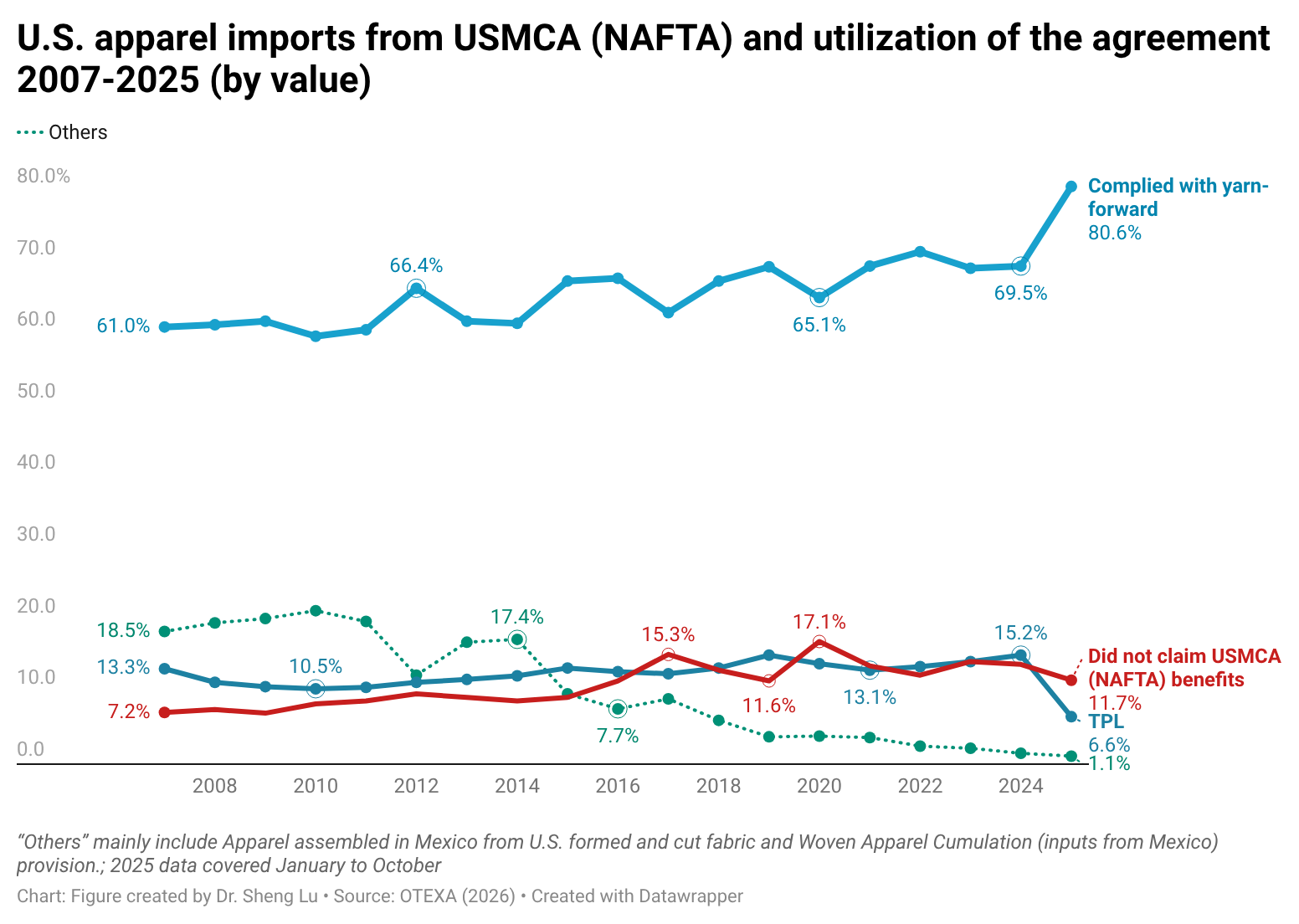
Likewise, in the first ten months of 2025, about 88.3% of US apparel imports from the USMCA claimed duty-free benefits under the agreement, up from 86.4% over the same period in 2024. Notably, in the past, only about 20% of US apparel imports from Canada met the yarn-forward rules of origin; however, this rate increased significantly to 63% in 2025. (See detailed USMCA utilization data here)

by Sheng Lu

Additional reading: Geopolitics Will Shake Up Sourcing—Again—In 2026 (Sourcing Journal)

Outlook 2023– Key Issues to Shape Apparel Sourcing and Trade

In December 2022, Just-Style consulted a panel of industry experts and scholars in its Outlook 2023–what’s next for apparel sourcing briefing. Below is my contribution to the report. All comments and suggestions are more than welcome!

2023 is likely another year full of challenges and opportunities for the global apparel industry.

First, the apparel industry may face a slowed world economy and weakened consumer demand in 2023. Apparel is a buyer-driven industry, meaning the sector’s volume of trade and production is highly sensitive to the macroeconomic environment. Amid hiking inflation, high energy costs, and retrenchment of global supply chains, leading international economic agencies, from the World Bank to the International Monetary Fund (IMF), unanimously predict a slowing economy worldwide in the new year. Likewise, the World Trade Organization (WTO) forecasts that the world merchandise trade will grow at around 1% in 2023, much lower than 3.5% in 2022. As estimated, the world apparel trade may marginally increase between 0.8% and 1.5% in the new year, the lowest since 2021. On the other hand, the falling demand may somewhat help reduce the rising sourcing cost pressure facing fashion companies in the new year.

Second, fashion brands and retailers will likely continue leveraging sourcing diversification and strengthening relationships with key vendors in response to the turbulent market environment. According to the 2022 fashion industry benchmarking study I conducted in collaboration with the US Fashion Industry Association (USFIA), nearly 40 percent of surveyed US fashion companies plan to “source from more countries and work with more suppliers” through 2024. Notably, “improving flexibility and reducing resourcing risks,” “reducing sourcing from China,” and “exploring near-sourcing opportunities” were among the top driving forces of fashion companies’ sourcing diversification strategies. Meanwhile, it is not common to see fashion companies optimize their supplier base and work with “fewer vendors.” For example, fashion companies increasingly prefer working with the so-called “super-vendors,” i.e., those suppliers with multiple-country manufacturing capability or can make textiles and apparel vertically, to achieve sourcing flexibility and agility. Hopefully, we could also see a more balanced supplier-importer relationship in the new year as more fashion companies recognize the value of “putting suppliers at the core.”

Third, improving sourcing sustainability and sourcing apparel products using sustainable textile materials will gain momentum in the new year. On the one hand, with growing expectations from stakeholders and pushed by new regulations, fashion companies will make additional efforts to develop a more sustainable, socially responsible, and transparent apparel supply chain. For example, more and more fashion brands and retailers have voluntarily begun releasing their supplier information to the public, such as factory names, locations, production functions, and compliance records. Also, new traceability technologies and closer collaboration with vendors enable fashion companies to understand their raw material suppliers much better than in the past. Notably, the rich supplier data will be new opportunities for fashion companies to optimize their existing supply chains and improve operational efficiency.

On the other hand, with consumers’ increasing interest in fashion sustainability and reducing the environmental impact of textile waste, fashion companies increasingly carry clothing made from recycled textile materials. My latest studies show that sourcing clothing made from recycled textile materials may help fashion companies achieve business benefits beyond the positive environmental impacts. For example, given the unique supply chain composition and production requirements, China appeared to play a less dominant role as a supplier of clothing made from recycled textile materials. Instead, in the US retail market, a substantial portion of such products was “Made in the USA” or came from emerging sourcing destinations in America (e.g., El Salvador, Nicaragua) and Africa (e.g., Tunisia and Morocco). In other words, sourcing clothing made from recycled textile materials could help fashion companies with several goals they have been trying to achieve, such as reducing dependence on sourcing from China, expanding near sourcing, and diversifying their sourcing base. Related, we are likely to see more public dialogue regarding how trade policy tools, such as preferential tariffs, may support fashion companies’ efforts to source more clothing using recycled or other eco-friendly textile materials.

Additionally, the debates on fashion companies’ China sourcing strategy and how to meaningfully expand near-sourcing could intensify in 2023. Regarding China, fashion companies’ top concerns and related public policy debates next year may include:

  • How to fully comply with the Uyghur Forced Labor Prevention Act (UFLPA) and reduce the forced labor risks in the supply chain?
  • What to do with Section 301 tariff actions against imports from China, including the tariff exclusion process?
  • How to reduce “China exposure” further in sourcing, especially regarding textile raw materials?
  • How should fashion companies respond and mitigate the business impacts of China’s shifting COVID policy and a new wave of COVID surge?
  • What contingency plan will be should the geopolitical tensions in the Asia-Pacific region directly affect shipping from the region?

Meanwhile, driven by various economic and non-economic factors, fashion companies will likely further explore ways to “bring the supply chain closer to home” in 2023. However, the near-shoring discussion will become ever more technical and detailed. For example, to expand near-shoring from the Western Hemisphere, more attention will be given to the impact of existing free trade agreements and their specific mechanisms (e.g., short supply in CAFTA-DR) on fashion companies’ sourcing practices. Even though we may not see many conventional free trade agreements newly launched, 2023 will be another busy year for textile and apparel trade policy deliberation, especially behind the scene and on exciting new topics.

By Sheng Lu

Discussion question: As we approach the middle of the year, why do you agree or disagree with any predictions in the outlook? Please share your thoughts.