EU Commission: Skills for Jobs in the EU Textile and Clothing Industry to Evolve

In a recent analysis report, the EU Commission foresees that skills needed by jobs in the EU textile and clothing industry will continue to evolve from 2013 to 2025. Specifically, the report argues that:

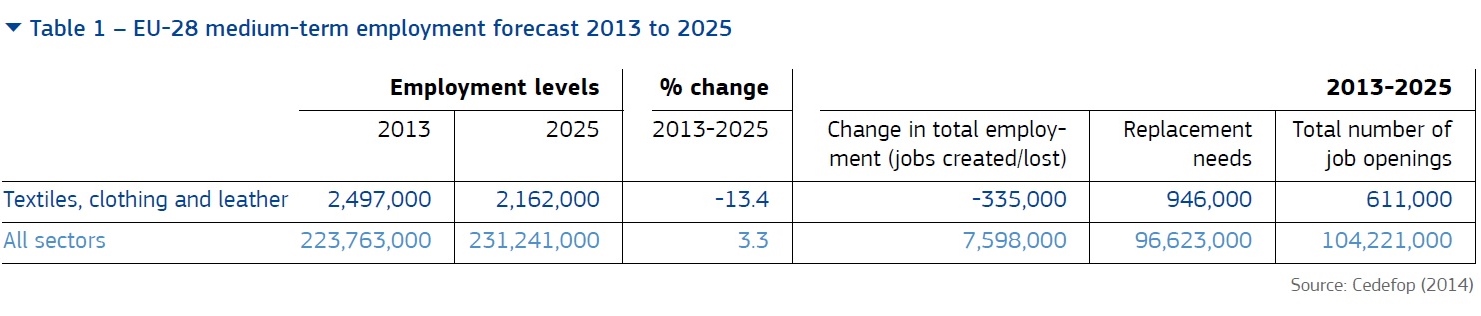
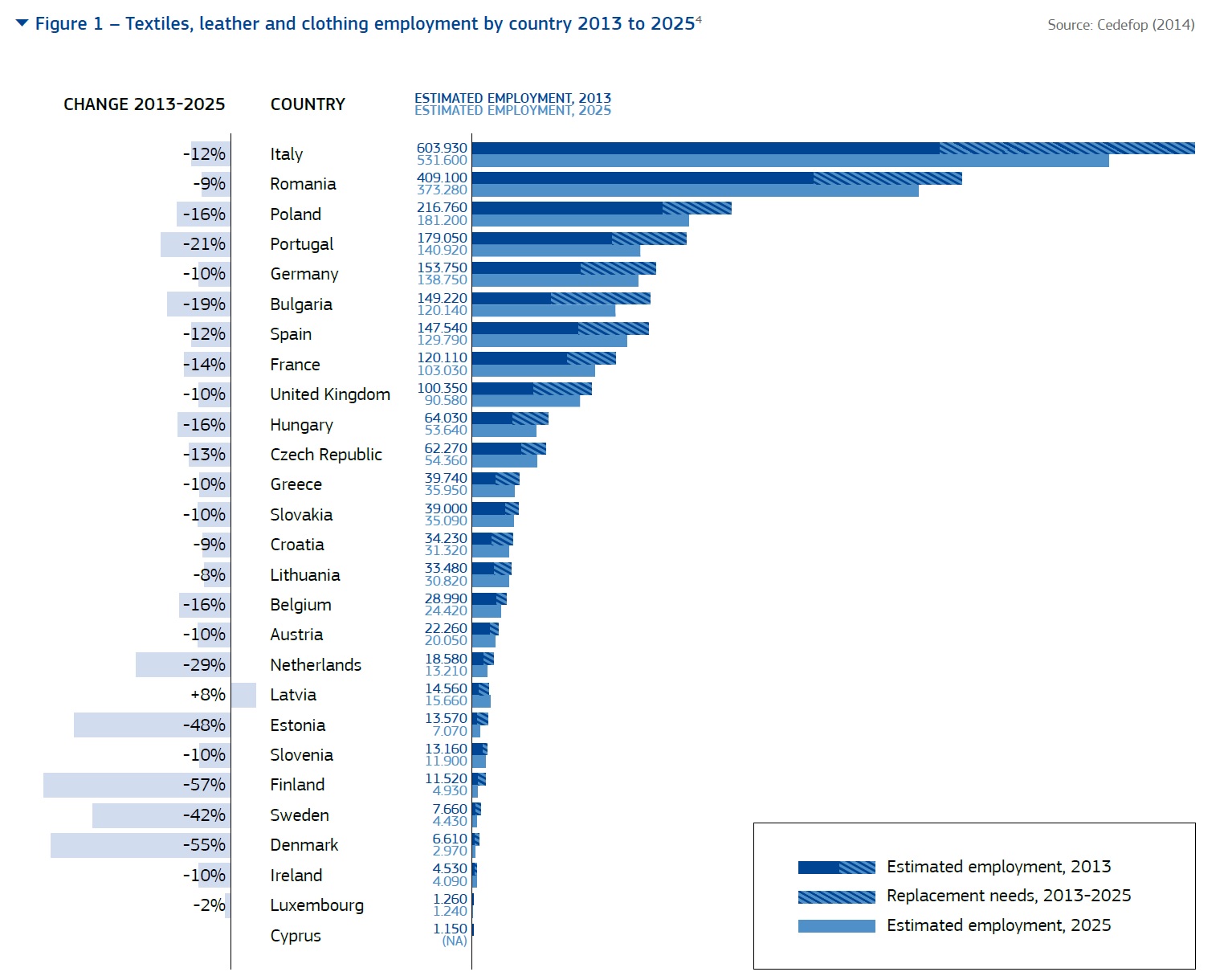
First, employment in the EU textile and clothing sector is forecast to decline by 13.4% from 2.5 million in 2013 to 2.1million in 2025. Even with shrinking employment levels, because of the need to replace nearly 1 million workers forecast to retire or leave the sector, about 611,000 job openings are anticipated from 2013 to 2025.

Second, employment in the EU textile and clothing sector is no just declined, but also evolved. From 2013 to 2025, demand for “crafted and related occupations” as well as “plant and machine operators and assemblers” will decline 34% and 13% respectively, whereas job openings for “technician and associated professional occupations” are estimated to grow at a modest rate. Among the estimated 611,000 job openings, 93% will require high or medium level qualifications.

Third, in terms of specific skills needed by the EU textile and clothing sector based on where the sector might progress towards 2020:

1) Technical production competencies will remain central to recruitment with increased focus on the demand for versatile staffs that can operate across different workstations.

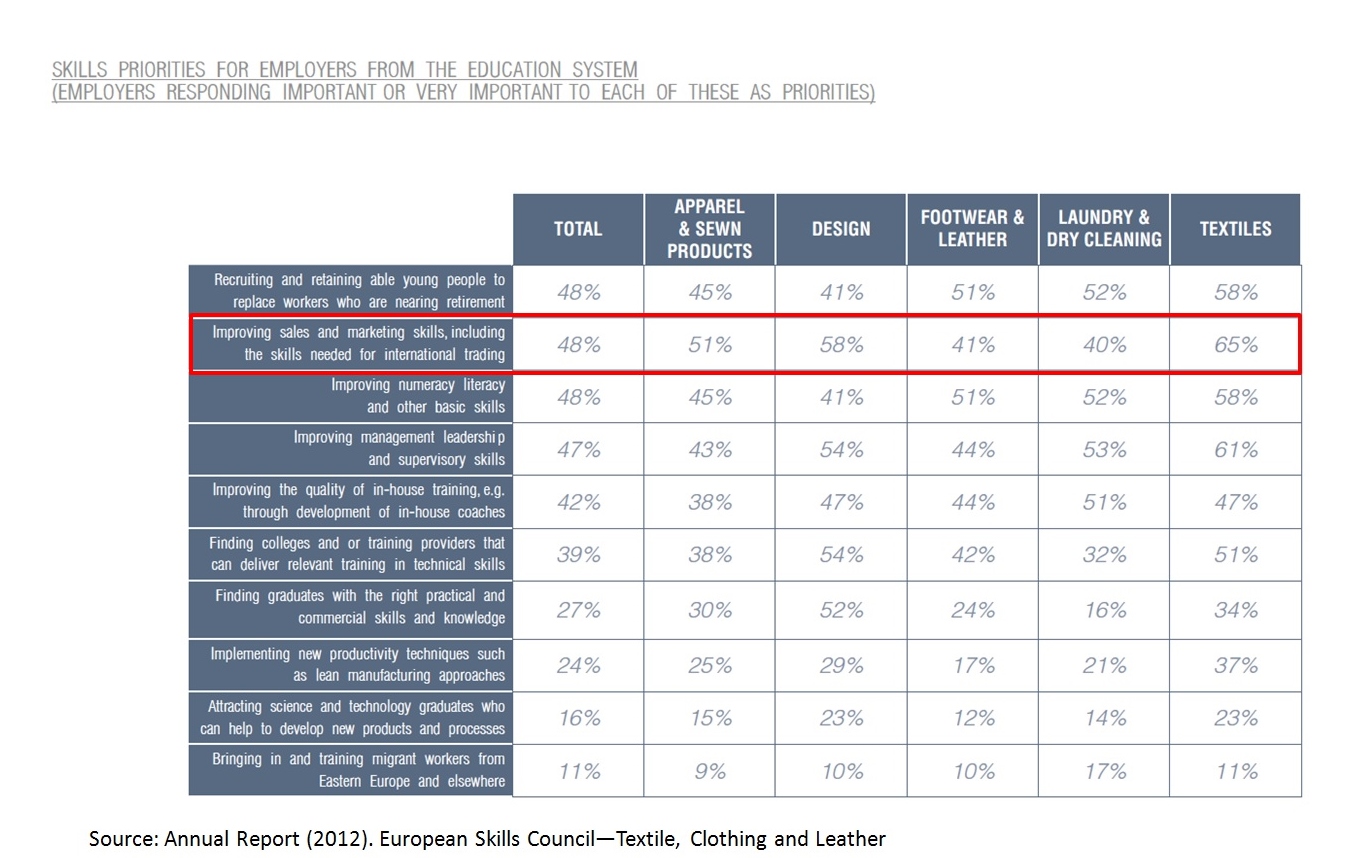
2) Supply chain management, business, sales and marketing skills (including the skills in international trade) are growing in importance. For many EU textile and clothing companies, “trade has taken place of production”.

3) The EU textile and clothing industry is further expecting skills on technology, innovation and sustainability. Leading technology-led areas include mass customization, 3D body measurement, advanced CAD and eCommerce technologies, internet infrastructures for custom-tailored clothing and business-to-consumer eCommerce among retailers.
2

3

1

Outlook of the U.S. Textile Industry in 2013

The latest industry outlook proposed by the Textile World argues that in 2013 the U.S. textile industry will improve industry strategy and planning in the following areas:

  • increased management emphasis in such areas as sourcing, inventory control
  • use of more flexible and efficient machinery and equipment
  • new and upgraded consumer products,
  • more ecologically friendly offerings
  • more Made-in-USA labels

 Don’t misunderstand/misinterpret these terms. The proposed strategies actually tell us:

1. the U.S. textile industry will become even more capitalized in production (as the result of “using more flexible and efficient machinery and equipment”).

2. the success of the U.S. textile industry relies on import (that’s why “management of sourcing” is suggested to be emphasized), despite the intension to promote “made in USA” label which has more to do with the current “rules of origin” defining the nationality of the products.

3. the softgoods industry (textile, apparel and related retailing) is a highly buyer-driven industry. Even textile mills have realized the importance of understanding and directly reaching the consumers.

4. sustainability is a major factor driving technical reform and upgrading in the textile industry. Other than the environmental concerns, there is another strategy behind the efforts: when the U.S. textile industry is fully ready to “be able to produce in a sustainable way”, it will ask for legislation support to require “everybody”(including imported products) to meet the same environmental standards(professionally, we call it “technical barriers of trade”). Developing countries can compete on price, but definitely cannot compete on technology and capital which are the basis of achieving “sustainability”.  Bu then, you will see sustainability becomes a real game changer.     

 Another relevant forecast made by the article “But holding these costs down through efficiency gains can also have a negative impact —namely, a smaller industry workforce. In the textile sector, for instance, squeezed by productivity gains, overall employment should drop from 232,000 in 2012 to near 209,000 by 2015.” As we menioned in the class, technology kills jobs too, although new types of jobs will be created at the same time–but with totally different skill requirements.