
Summary
In the context of the significant tariff hikes during President Trump’s second term, there has been heated debate about who ultimately bears the cost of higher U.S. import tariffs. Do U.S. apparel retailers pass these additional costs on to consumers through higher retail prices, or do they absorb a substantial share of the costs themselves?
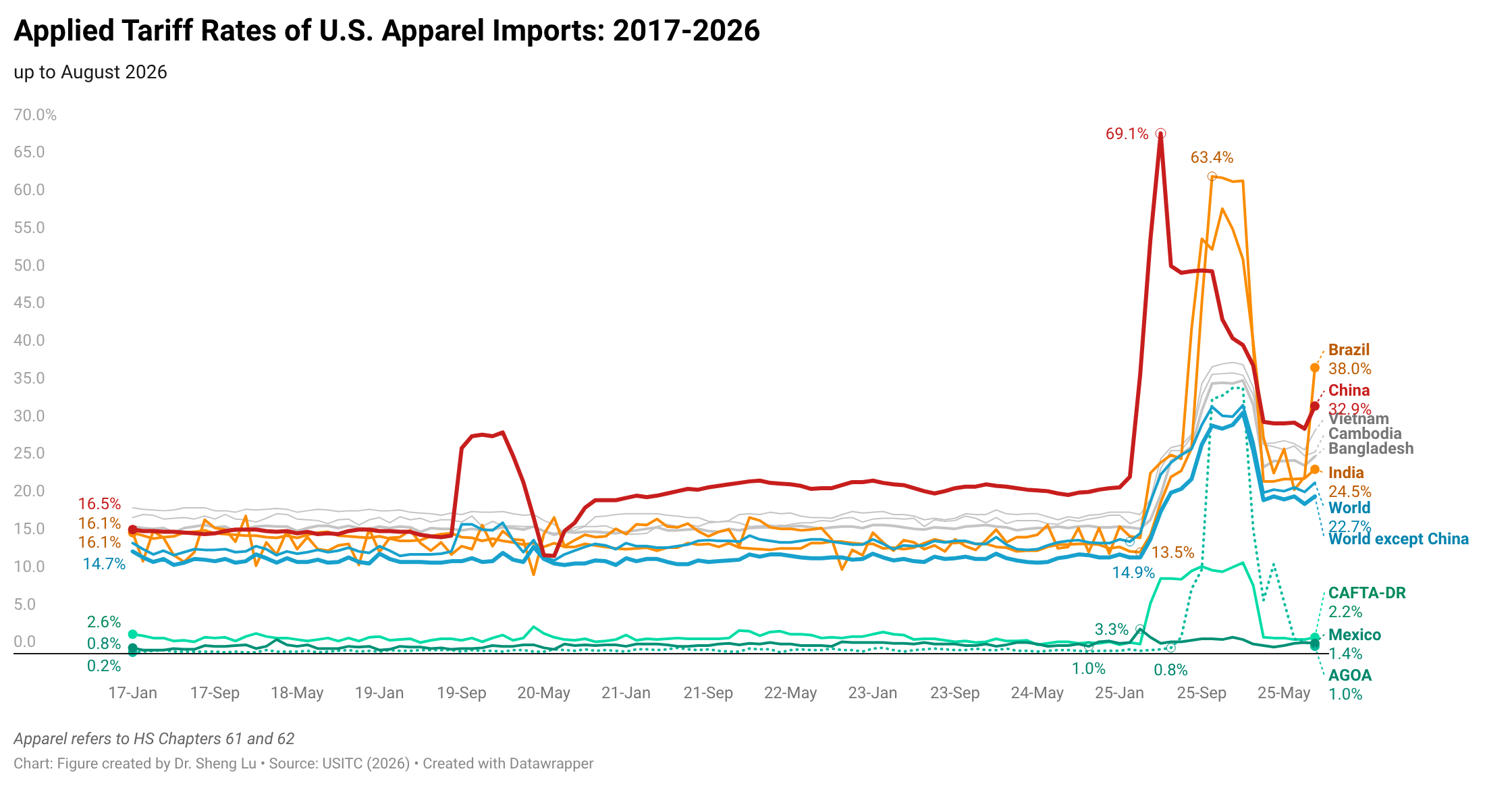
Using monthly U.S. government data from January 2015 through December 2025, the study examines how apparel tariff changes are transmitted through the import-to-retail pricing chain. Rather than looking only at consumer prices, the study considered three interconnected factors: U.S. apparel import tariff rates, U.S. apparel import prices, and U.S. apparel retail prices. The analysis also included U.S. apparel retail sales to reflect shifting consumer demand.
Challenging the common perception that higher tariffs inevitably lead to higher clothing price tags in the retail market, the findings suggest that tariff increases do not necessarily translate into proportionally higher retail prices. Instead, a substantial share of the tariff burden appears to be absorbed by U.S. fashion companies and their suppliers, rather than being fully passed on to consumers, at least in the short to medium term. Specifically:
First, higher tariffs do not automatically translate into higher apparel import prices. One particularly interesting finding is that U.S. apparel import prices showed relatively little response to tariff increases. In the statistical analysis, tariff shocks explained only approximately 1.2% of the variation in U.S. apparel import prices over a ten-month forecast horizon. More than 95% of the variation was explained by import prices’ own historical dynamics. In other words, changes in tariffs alone did not explain much of the month-to-month movement in U.S. apparel import prices.
Several factors could contribute to this intriguing pattern. One is that apparel sourcing operates on relatively long planning and purchasing cycles. Brands and retailers often negotiate prices and place orders with overseas suppliers several months before products arrive in the United States. Consequently, import prices may not adjust immediately when trade policies change.
In addition, importers and suppliers may renegotiate prices and share some of the additional tariff burden, at least initially. However, this arrangement can put additional financial pressure on overseas manufacturers, many of which already operate with relatively thin profit margins.
Second, U.S. apparel retail prices respond to tariffs, but the increase could be delayed. According to the study, while U.S. apparel retail prices do respond positively to tariff increases, the response is relatively small and temporary. The statistical analysis finds that apparel retail prices initially show no statistically significant increase following a tariff shock. A measurable positive response emerges approximately three months later. However, this effect weakens quickly and becomes statistically insignificant afterward. In other words, U.S. apparel retailers do not immediately pass the full impact of higher import costs on to consumers. Instead, they appear to absorb a substantial share of additional costs, at least in the short to medium term.
Several factors could help explain this behavior. The U.S. apparel retail market is highly competitive, and consumers have many alternatives when shopping for clothing. Retailers may therefore be reluctant to increase prices substantially because doing so could cause customers to switch to competitors. Retailers may also have opportunities to renegotiate supplier prices, adjust sourcing arrangements, or modify product assortments to manage additional costs.
It should be noted that the findings do not suggest that tariffs have no impact on apparel prices. Rather, they show that tariff costs are transmitted to consumers neither immediately nor proportionally. Over a ten-month forecast horizon, tariff changes explain only about 5% of the variation in U.S. apparel retail prices. By comparison, retailers’ historical pricing patterns explain the largest share, over 70%, of price fluctuations, while consumer demand accounts for approximately 16%–22%.
The study’s findings have important implications for U.S. fashion companies, their suppliers, and policymakers. Most importantly, limited increases in consumer prices do not necessarily mean limited economic consequences for the apparel industry. When U.S. apparel retailers cannot fully pass higher tariff costs on to consumers, these costs must be absorbed or managed elsewhere in the supply chain. U.S. retailers may face pressure on profit margins, while overseas suppliers may face greater pressure to lower prices or share the additional costs. Thus, the key issue for the apparel industry is not simply whether tariffs lead to higher retail prices, but how the resulting financial burden is distributed and managed across the global supply chain.
For policymakers, the findings underscore the importance of looking beyond changes in consumer or retail prices when evaluating the economic impact of tariffs. Limited increases in retail prices do not necessarily mean that tariffs impose limited costs. Rather, policymakers should also examine how tariff costs are absorbed and distributed across the global apparel value chain, including their effects on retailers, overseas suppliers, and other industry stakeholders.
By Sheng Lu
Full paper: Lu, S. (2026). Do U.S. Apparel Retailers Absorb or Pass Through Tariff Costs? Evidence from U.S. Apparel Import and Retail Prices, 2015–2025. Research Journal of Textile and Apparel, ahead of print


