FASH455 Exclusive Interview with Avedis Seferian, President & CEO of Worldwide Responsible Accredited Production (WRAP)

About the interview

Social responsibility is a critical topic in apparel sourcing and trade. Gen Z, both as consumers and future professionals in the fashion industry, care deeply about this issue. At the same time, the conversation around social responsibility has become more technical and complex, such as compliance with new regulations like the Uyghur Forced Labor Prevention Act (UFLPA).

In the interview, Avedis Seferian, President & CEO of Worldwide Responsible Accredited Production (WRAP), shared his insights and extensive practical experience about the current landscape and emerging trends in social responsibility related to apparel sourcing, including:

  • What does “social responsibility” truly mean in the context of today’s global apparel industry, and how has that meaning evolved over the past decade?
  • What are the key expectations for fashion companies if they need to achieve socially responsible sourcing?
  • Is social responsibility more of a legal issue or an ethical issue for fashion companies? Where does the line lie between what is required by law and what is expected ethically from apparel brands and factories?
  • How does a typical social compliance audit work on the ground, and why does it involve much more than simply “completing a checklist,” as some people may misunderstand?
  • Does greater supply chain transparency help promote social responsibility? How can fashion companies be encouraged to become more transparent, and what challenges remain?
  • What is the impact on garment factories and their workers when fashion companies suddenly cancel sourcing orders? As fashion companies increasingly expect suppliers to be “flexible,” such as accommodating last-minute changes to sourcing orders, could this expectation further complicate social responsibility efforts?
  • Can AI and technology have some potential applications in promoting social responsibility in the fashion industry?
  • Advice for students and young professionals entering the apparel industry who want to make a meaningful impact in social responsibility and ethical sourcing.

About Avedis Seferian

Avedis Seferian joined WRAP in 2004 and became its President and CEO in 2012. Avedis has extensive knowledge of social responsibility issues within the highly complex worldwide supply chains of the apparel, textile and footwear sectors. A recognized expert in the area of social compliance and responsible sourcing, Avedis was named by Assent Compliance as one of the top 100 corporate social responsibility influence leaders for 2020.

Additionally, Avedis speaks five languages, has lived in four countries and holds three degrees from three continents—a Bachelor’s in Economics from St. Stephen’s College, Delhi University in India; a Master of Business Administration from the American University of Armenia; and a Juris Doctor from the Georgetown University Law Center in the United States.

About Emilie Delaye (moderator)

Emilie Delaye is a master’s student & graduate instructor in Fashion and Apparel Studies at the University of Delaware, with a specific interest in supply chain, global sourcing, and sustainability. Emilie is also a member of the Fair Labor Association (FLA) 2025-2026 Student Committee and the University of Delaware President’s Student Advisory Council.  

Progress and Challenges in Apparel Supply Chain Traceability: A Case Study on ASKET

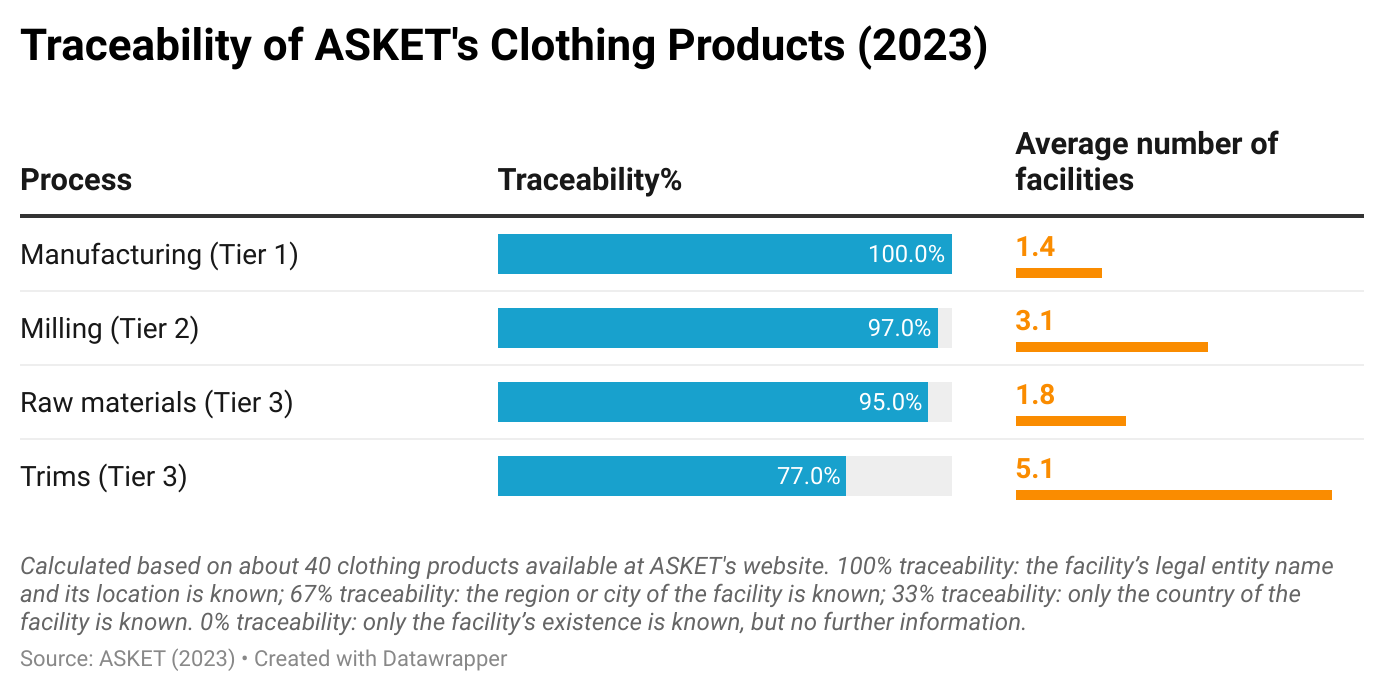
ASKET is a prominent online retailer based in Sweden that commits to complete supply chain transparency. Based on analyzing nearly 40 unique products and their detailed supply chain information posted on ASKET’s website as of May 2023, the article aims to shed light on the company’s supply chain traceability progress and the remaining challenges it faces.

First, while ASKET achieved full traceability for Tier 1 suppliers, tracking Tier 2 and Tier 3 suppliers was more difficult. For example, compared with its perfect traceability score for Tier 1 suppliers (i.e., garment factories), ASKET’s average traceability for Tier 2 Milling factories (i.e., yarn and fabric producers) was at around 97%, and the score fell to only 77% for trims suppliers in Tier 3.

As one critical contributing factor to the phenomenon, Tier 2 and Tier 3 suppliers had far more players than Tier 1, which presented a more significant challenge in obtaining detailed information about all the factories involved. For example, ASKET’s garment cutting and sewing operations predominantly occurred within a single facility. In contrast, making yarns, fabrics, and trims EACH usually involve multiple facilities in different parts of the world.

Second, a comprehensive understanding of the sub-supply chains associated with apparel components is pivotal in enhancing a fashion company’s overall traceability. Notably, the apparel supply chain is far more complicated than the commonly known four stages—fiber, yarn, fabric, and garment manufacturing. Rather, apparel components like yarns, fabrics, sewing threads, buttons, and zippers have complex and intricate sub-supply chains. For instance, for ASKET’s shirts or polo shirts:

  • Cotton was “farmed in New Mexico, Arizona, California and Texas, USA, ginned in Anqing, China.”
  • Yarn was “spun and twisted in Hyderabad, India,” and “dyed in Varese, Italy.”
  • Fabric was “woven in Letohrad, Czech Republic, dyed and finished in Prato, Italy.
  • Sewing thread was “produced in Breisgau, Germany, wound and packed in St. Maria de Palautordera, Spain
  • Button was produced in Saccolongon, Italy, with corozo farmed in Manabi, Ecuador.

Third, using recycled textile materials in apparel products could make it trickier to map the supply chain.

  • ASKET reported no problem tracking recycled textile materials derived from natural fibers, especially recycled wool products.
  • ASKET’s capability of tracing recycled man-made fiber textiles yielded mixed results. For example, ASKET was still investigating the Tier 3 raw material suppliers for one fabric made with “100% pre-consumer recycled nylon.” Likewise, for one body fabric derived from “plastic waste collected from Spanish Mediterranean and French Atlantic oceans and coastlines,” pinpointing the precise origin of the raw fiber posed a challenge.

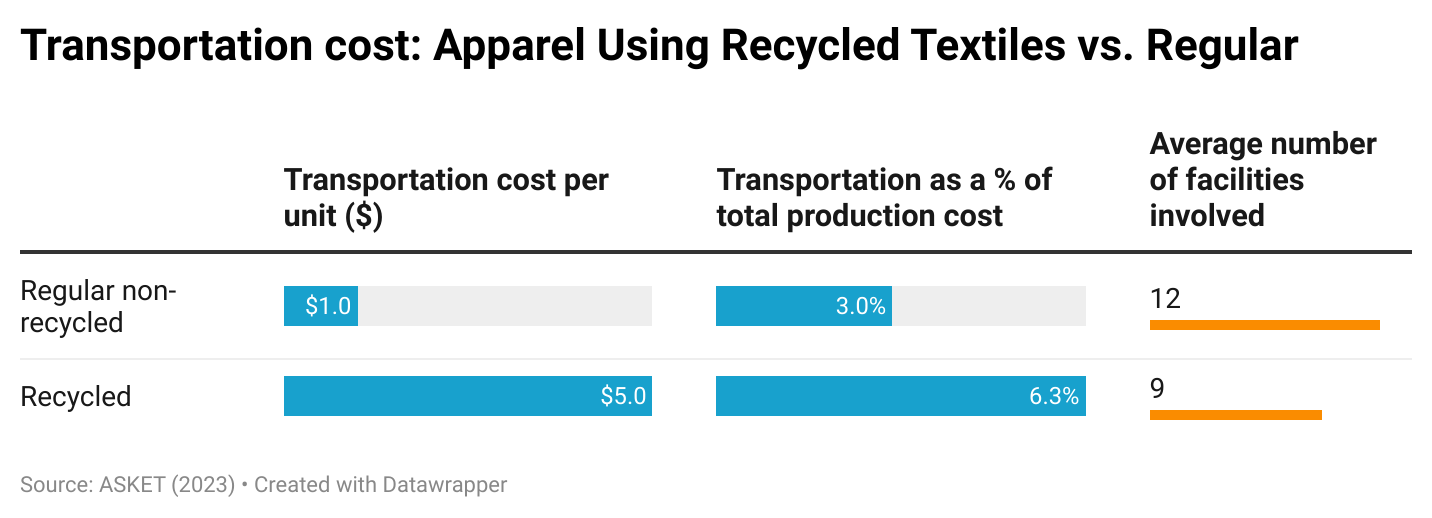
Fourth, ASKET’s data shows that using recycled textiles in apparel products could incur higher transportation costs. For example, the average transportation cost for an ASKET garment using recycled textiles would reach $5 per unit (or 6.3% of the total production costs), much higher than regular clothing using non-recycled materials ($1 per unit or 3% of the total production). However, on average, making a garment using recycled textile materials could involve fewer facilities(e.g., 9 vs. 12). This result suggests that the higher transportation cost associated with clothing made from recycled textiles may not be attributed to a longer supply chain but rather to a more tedious and expensive recycled fiber collection process.

Additionally, ASKET’s data indicates a strong correlation between its retail price and sourcing costs. Specifically, ASKET’s applied a gross margin% ranging from 71%–81%. This implies that a $2 increase in sourcing costs could potentially lead to a retail price increase of $10-$20. Thus, controlling and managing sourcing costs will always be a priority for a fashion company.

By Sheng Lu

Further reading: Lu, Sheng (2023). How Asket is achieving apparel supply chain traceability. Just-Style.

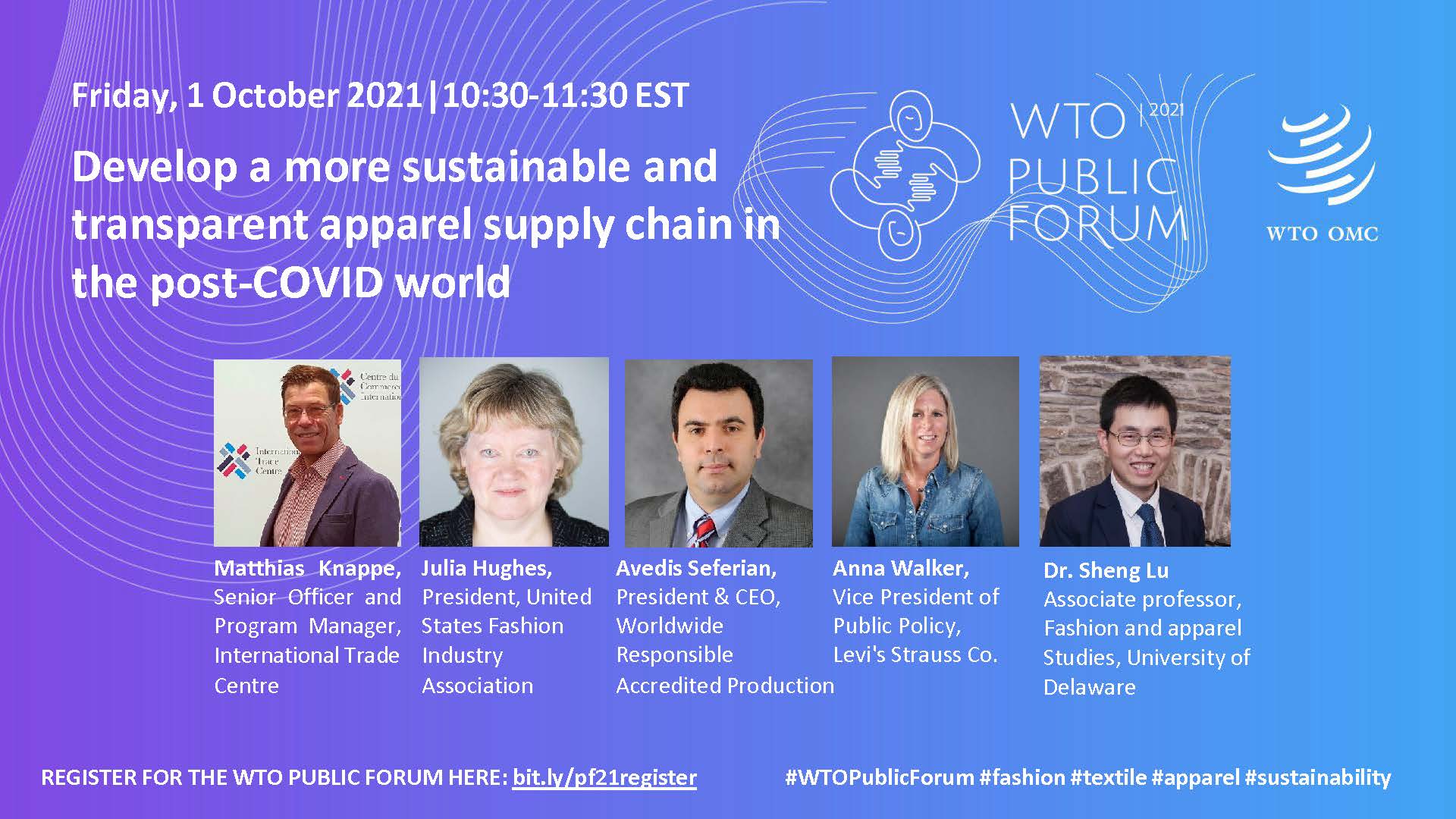
2021 WTO Public Forum Session 105: Develop a more sustainable and transparent apparel supply chain in the Post-COVID world

Panelists:

  • Julia Hughes, President, United States Fashion Industry Association
  • Matthias Knappe, Senior Officer and Program Manager for Cotton, Fibers and Textiles, International Trade Centre
  • Avedis Seferian, President & CEO, Worldwide Responsible Accredited Production (WRAP).
  • Anna Walker, Vice President of Public Policy, Levi’s Strauss Co.
  • Dr. Sheng Lu, Associate Professor, Department of Fashion & Apparel Studies, University of Delaware

Event summary:

Apparel is a $2.5 trillion global business, involving over 120 million workers worldwide and playing a uniquely critical role in the post-COVID economic recovery. The session intends to facilitate constructive dialogue regarding the progress, challenges, and opportunities of building a more sustainable and transparent apparel supply chain in the Post-COVID world, which matters significantly to ALL stakeholders, from fashion brands, garment workers, policymakers to ordinary consumers.

The panel shared their valuable insights about the impacts of COVID on the world apparel trade patterns and how to make the apparel supply chain more sustainable and transparent in the post-COVID world. Specifically:

First, panelists agree that COVID-19 has resulted in unpresented challenges for apparel sourcing and trade, from supply chain disruptions, cost increases to market uncertainties.

Second, despite the mounting challenges and financial pressures caused by COVID-19, the apparel industry as a whole is NOT ignoring sustainability and social responsibility. Some leading fashion brands and retailers allocate more resources to strengthen their relationships with key vendors during the pandemic. The shifting business environment and the adoption of digital technologies also allow apparel companies to explore new business models and achieve more sustainable and socially responsible apparel production and trade.

Third, the apparel industry is attaching greater importance to supply chain transparency. Today, fashion brands and retailers typically track their tier 1 and tier 2 suppliers. A growing number of companies also start to understand who is making the textile raw materials (i.e., fibers and yarns). To improve supply chain transparency further, panelists suggest more traceability technologies, building trust between importers and suppliers and creating a clearer regulatory framework. Trade policy can also have a crucial role to play in the process.

Other 2021 WTO Public Forum sessions: https://www.wto.org/english/forums_e/public_forum21_e/pf21_programme_e.htm