Textile and Apparel Sector in the TPP Negotiation: An Update

TPP_map

USTR objectives
Officially, USTR has announced the following objectives in the TPP for textile and apparel:

  • Elimination of tariffs on textile and apparel exports to TPP countries;
  • A “yarn forward” rule of origin, which requires that textile and apparel products be made using U.S. or other TPP country yarns and fabrics to qualify for the benefits of the agreement, so as to ensure that non-qualifying textiles and apparel from non-TPP countries do not enjoy the benefits reserved for TPP countries;
  • A carefully crafted “short supply” list, which would allow fabrics, yarns, and fibers that are not commercially available in the United States or other TPP countries to be sourced from non-TPP countries and used in the production of apparel in the TPP region without losing duty preference;
  • Strict enforcement provisions and customs cooperation commitments that will provide for verification of claims of origin or preferential treatment, and denial of preferential treatment or entry for suspect goods if claims cannot be verified; and
  • A textile specific safeguard mechanism that will allow the United States and other TPP countries to re-impose tariffs on certain goods if a surge in imports causes or threatens to cause serious damage to domestic producers.

X-basket
According to the National Council of Textile Organizations, with regard to the market access offer to Vietnam, textile and apparel products are categories into different groups based on their “sensitivity” to the domestic industry producing the like products. Among the three major categories, the so called “X-basket” will include textile and apparel items that are deemed most sensitive to the United States. Specific items to be included in the X-basket however are unclear and details of the phrase-out formula are still under discussion. It is said that items in the “X-basket” may be subject to an initial tariff cut ranging from 35 to 50 percent.

Vietnam’s top apparel exports to the United States are basic apparel items like shirts, sweaters and pants.  Many of them are the same types of items that were subject to the U.S. safeguard measures against China back in 2005. The U.S. textile industry hopes that the longer phrase-out period for items in the “X-basket” would provide needed time for the industry to adjust. However, for the Vietnam side, if duties on most of its apparel exports to the United States stay in place after the implementation of the TPP, the value of participating in the agreement would substantially be compromised.

Short-supply list
The short-supply list is a roster of fabrics and other textile inputs that are determined to not be readily available in the TPP region in commercial quantities on a timely basis and can therefore be imported from third countries. Items on the short-supply list would be exempt from the general “yarn-forward” rule of origin that the U.S. has proposed in the textiles and apparel talks. USTR is pushing for a short-supply list that would have permanent items as well as temporary items that will be removed after three years. Previous U.S. free trade agreements, including CAFTA, have included a short supply process to add additional products to the list once the agreement enters into force. But the U.S. has rejected the notion that the short-supply list could be modified after the TPP enters into force.

Mexico has consistently sought to limit the scope of the short-supply list, arguing that it actually makes some of the products that the U.S. had originally proposed for inclusion in the short-supply list. Mexico was also pushing for roughly 70 items proposed for the short supply to be included only on a temporary basis, rather than a permanent one.

Other TPP members’ positions
According to the Inside US Trade, Malaysia’s textile and apparel industry is supporting U.S. calls for a “yarn-forward” rule of origin in TPP, but is also pushing for a range of exceptions such as cut-and-sew allowances and a short supply list that would be periodically reviewed. Among the items the Malaysian industry would like to see on the short supply list are shirting fabrics such as woven cotton fabric that weighs not more than 250 grams because this type of fabric is said not made in the U.S. nor Malaysia.

Related reading
Lu, S. (2014). Does Japan’s accession to the Trans-Pacific Partnership an opportunity or a threat to the U.S. textile industry: A quantitative analysis. Journal of the Textile Institute. (ahead of print version) 


2014 USFIA Benchmarking Study Released

UntitledKey Findings

  • China will remain the dominant supplier, though Vietnam and Asia as a whole are seen as having more growth potential.
  • Companies aren’t leaving Bangladesh, and are committed to compliance.
  • Companies continue to look for opportunities closer to home, including the United States, as they diversify their sourcing.
  • Companies are diversifying their sourcing and expect to continue to do so. However, current FTAs and preference programs remain under-utilized or don’t represent a major component of respondents’ sourcing.
  • Respondents welcome the passage or renewal of all future trade agreements that intend to remove trade barriers and facilitate international trade in the industry.

About the Benchmarking Study
The 2014 USFIA benchmarking study is conducted based on a survey of 29 executives at 29 leading U.S. fashion companies from March to April 2014. The study incorporates a balanced mix of respondents representing various business types in the U.S. fashion industry, including retailers, importers, wholesalers, and manufacturers. The survey asked respondents about the business outlook, sourcing practices, utilization of Free Trade Agreements and preference programs, and views on trade policy.

The full study can be downloaded from HERE.

Vietnam Announces Ambitious Plan to Develop its Textile Industry

Reported by the Sourcing Journal, Vietnam’s Ministry of Industry and Trade recently approved its textile and garment sector development plan up to year 2030. Under the new plan, Vietnam sets an ambitious goal to achieve a 55% local content ratio for exported apparel by 2015 and will further increase the ratio to around 70% by 2030. As estimated, the plan will bring about an annual textile production growth rate of 12 to 13 percent between 2013 and 2030 in Vietnam.

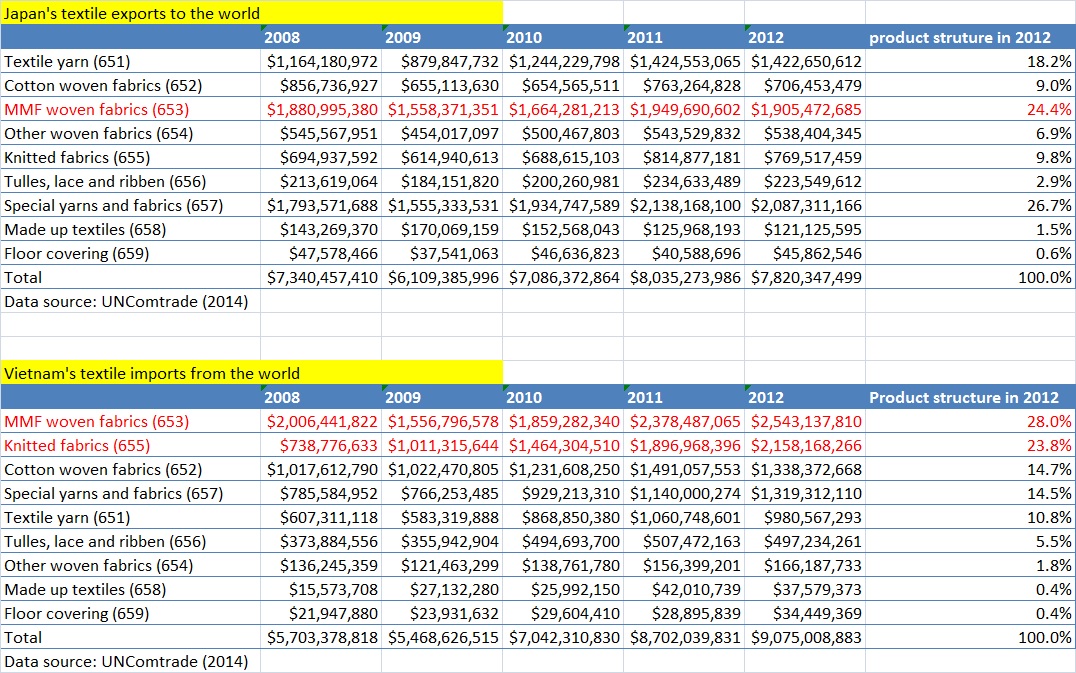
Numerous studies have suggested that Vietnam could substantially expand its apparel exports to the world after the implementation of the Trans-Pacific Partnership (TPP), a free trade agreement under negotiation by twelve countries in the Asia-Pacific region, including the United States and Vietnam. However, restrained by its stage of development, about 70—80% of Vietnam’s demand for textile inputs currently is imported (Lopez-Acevedo & Robertson, 2012). Based on 23 interviews, Goto (2007) further finds that apparel suppliers in Vietnam on average produced 67% CMT and 33% FOB based on value and 95% CMT and 5% FOB based on quantity.

But with the help of foreign investment from South Korea, Taiwan and Japan, Vietnam is quickly building up its textile manufacturing capacity (note: this is very different from the case in Mexico). According to the General Statistics Office of Vietnam, the number of textile firms in Vietnam had quickly increased from 408 in 2000 to 1,577 in 2008. Lopez-Acevdeo & Robertson (2012) further suggest that Vietnam’s annual production of cotton fiber has reached 10,000 tons; 50,000 tons of man-made fiber; 260,000 tons of short-staple fiber and yarn; 15,000 tons of knitted fabric; and 680 million meters of woven fabric. Around 38% of Vietnam’s textile output came from foreign invested companies in 2009.

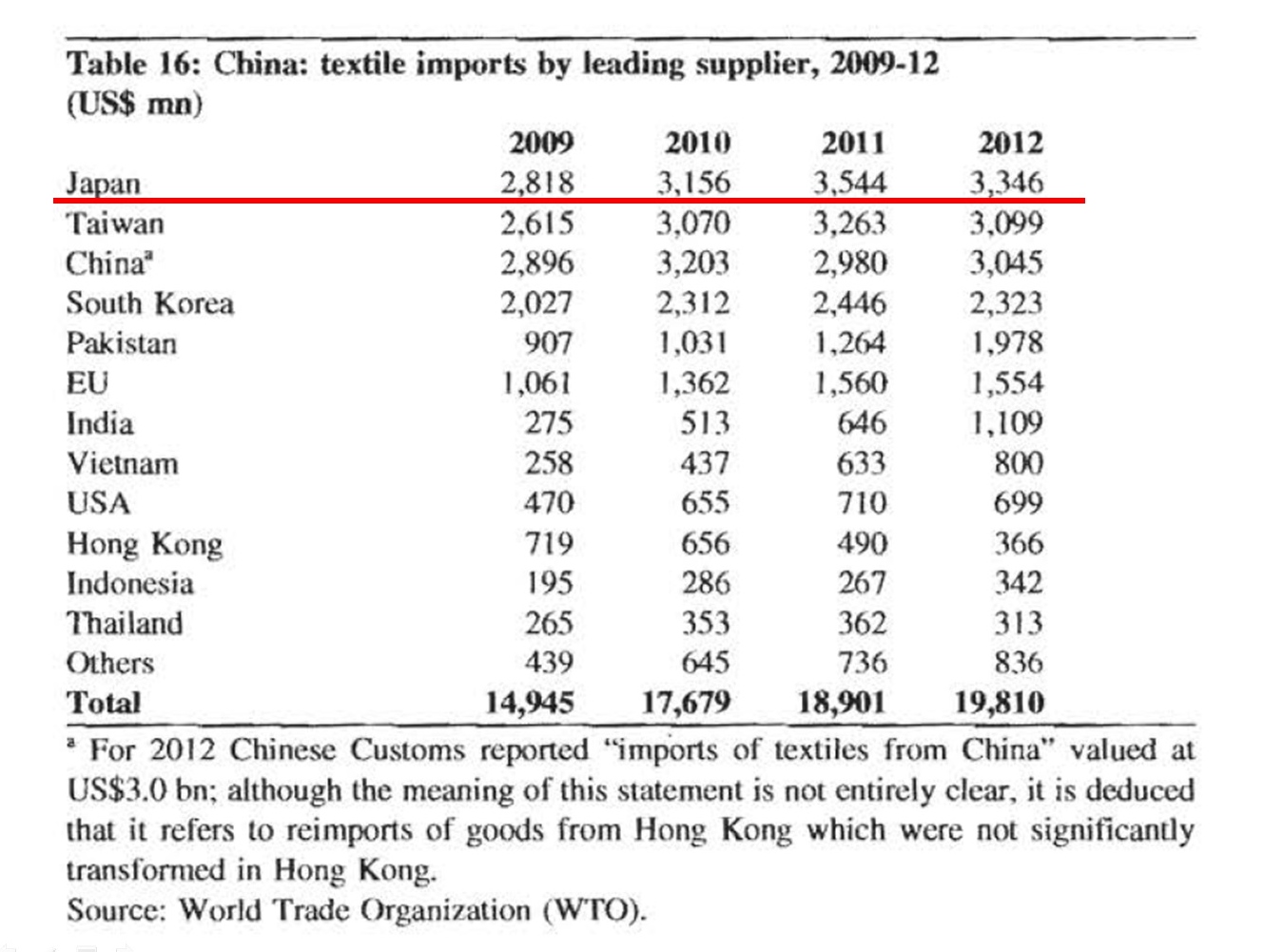
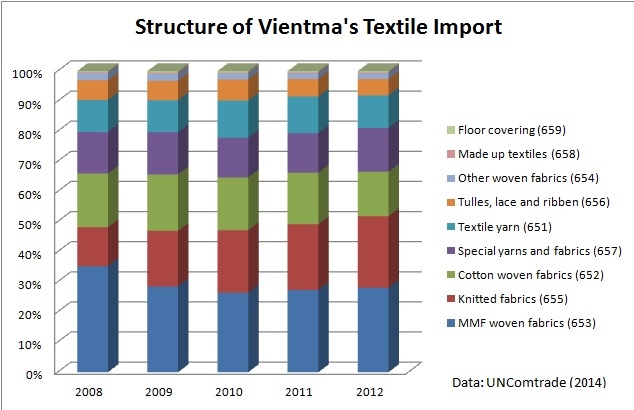
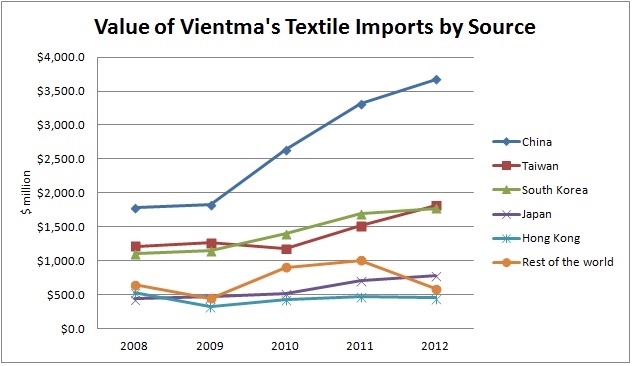
Vietnam’s ambition to expand its domestic textile manufacturing capacity will have huge implications for the US-based textile industry. Although Vietnam seldom uses US-made textile inputs, Vietnam’s apparel exports to the United States directly compete with those exported from Mexico and countries in the Caribbean Basin regions which is the largest export market for U.S. made textiles (Lu & Dickerson, 2012).  An expanded local textile manufacturing capacity will not only reduce Vietnam’s demand for imported textile inputs, but also will help improve the price competitiveness of Vietnam’s apparel exports in the global marketplace. If China increasingly moves its textile factories to Vietnam (unless the conflict between Vietnam and China over the South China Sea complicates the situation), Vietnam may further becomes a net textile exporter in the long run.

1

2


Untitled


3

4

The Ways and Means Hearing Shows Divided Views on US Trade Policy for Textiles and Apparel

ways&means

US Trade Representative Michael Froman testified on Obama’s 2014 trade policy agenda before the House Ways and Means Committee on April 3. Issues concerning the textile, apparel and the footwear industry were raised three times during the 3-hour hearing. However, it seems the Congress is much divided on how to deal with the T&A sector deemed as “sensitive” in the FTA talks.

(1h:42’)Mike Thompson (D-CA) asked Froman to reevaluate the value of including the “yarn-forward” rules of origin (RoO) in the TPP. Thompson suggested that this rule only affects a small proportion of the US apparel imports nowadays (Note: according to Froman, it was $13 billion annually or 17% of the total US apparel imports) and no longer meets the needs of the US outdoor apparel industry which demands more flexible RoO in supporting of their business model. In response, Forman said that “the USTR’s approach to T&A is always being to ensure to strike a balance that helps the domestic producers continue to produce while allowing importers to import products that serve customers…”

(2h:06’) Earl Blumenauer (D-OR) asked Froman to reduce the trade barriers (tariff and NTB) on footwear imports, arguing that less than 1% of the footwear consumed in the US nowadays is domestically produced. He said that the high tariff rates both retard the ability of the US footwear industry to concentrate on those parts of the value chain that it enjoys competitive advantages and hurt the interests of the US consumers. In response, Forman said that footwear has been a sensitive and key issue to the US and among other TPP members. According to Forman, USTR has been working both with the domestic producers and the importers to develop an approach hoping to achieve the right balance that the domestic producers can continue to compete and also the importers can bring in high quality products (from overseas) for the US consumers. Additionally, Forman referred to the footwear industry an “outstanding area” in the TPP negotiation and said that discussion among all partners will continue.

Last but not least, (2h:30’) Bill Pascrell(D-NJ), also the chair of the house textile caucus, reiterated the importance of the yarn-forward RoO to the US textile industry and asked Froman to ensure that the USTR will “seek the longest possible duty phrase out for the most sensitive textile items” in the TPP negotiation. In his reply to Pascrell, Forman said that his team will work with all stakeholders of the US T&A industry to fully understand what these “sensitive textile items” are and will use tools like the “phrase out period” and “short supply list” to strike a right balance. Pascrell also expressed the concerns of the US textile industry about Vietnam’s wanting of immediate access to the US apparel market after the implementation of the TPP. However, Forman declined to give any concrete promise, just saying the USTR commits to create the “maximum number of jobs in the US” through the trade talks[Note: textile industry jobs? Apparel retail jobs?].

In addition to the T&A, other issues mentioned in the hearing include TPA, GSP, TAA, IPR, SPS & TBT, TTIP, SOE, TiSA, ITA and WTO.

Full hearing can be viewed here

Sheng Lu

The TPP would actually benefit whom?: The local Vietnamese companies or rather the global capitals which invest in Vietnam ?

tpp

Outcomes of many studies suggest that Vietnam would become one of the largest beneficiaries of the Trans-Pacific Partnership (TPP) by substantially expanding its apparel exports to the United States. However, the news report below raises another interesting question to consider: who actually would benefit from the TPP: The local Vietnamese companies or rather the global capitals which invest in Vietnam because of the agreement? This question is important because the answer reflects many debates nowadays about the impact of globalization; particularly, the impact is suggested to be unequally felt by different stakeholders.

From thanhniennews

The US-led TPP trade pact that will include Vietnam among its signatories is expected to be wrapped up this year, but Vietnamese firms are unsure if they will benefit.

Many are anxious since foreign investors with deep pockets are planning to set up operations in the country to take advantage of the lowering of import taxes by many large economies that will sign up for the trade deal.

For instance, import tariffs in the US, the biggest customer for Vietnam’s leading export, textiles, will be cut from 17-32 percent now to zero.

Many textile and garment companies in the region have already begun to move to Vietnam.

Texhong Corporation of Hong Kong, which set up a dyeing factory in the southern province of Dong Nai in 2006, recently opened another one in the northern province of Quang Ninh with an investment of US$300 million.

One of Hong Kong’s leading textile companies, TAL Apparel, has plans to set up a second textile-dyeing -apparel factory worth hundreds of millions of dollars. It has eight factories worldwide, including one in Vietnam’s northern province of Thai Binh since 2004.

Unisoll Vina, owned by South Korean Hansoll Textile Ltd, has also got a license to build a $50-million factory to make fur and leather clothing and accessories.

According to the Ho Chi Minh City Association of Garment, Textile, Embroidery and Knitting, Japanese companies Toray International and Mitsui, Austria’s Lenzing, and China’s Sunrise are also exploring investment opportunities in the country.

Vietnamese companies are meanwhile trying to enlarge their limited feedstock production capacity to comply with TPP’s regulations on origins – for instance apparel has to be made using yarn and other materials produced in member countries.

The Vietnam National Textile and Garment Group (Vinatex) has opened three yarn factories this year in Hanoi and the central provinces of Ha Tinh and Thua Thien-Hue with an annual capacity of 1,270 tons.

It started work on 11 others in the first half of the year.

Figures from the Vietnam Textile and Apparel Association (Vitas) showed that 70 percent of more than 3,700 textile factories in the country make apparel; only 6 percent produce yarn and 17 percent make cloth while 4 percent dye.

Local producers depend largely on fabric imported from China.

Insiders said a yarn factory costs tens of millions of dollars, a sum most Vietnamese businesses cannot afford.

Pham Xuan Hong, deputy chairman of Vitas, said unless the government helps by making cheap loans available for yarn projects, the industry would not benefit from the TPP at all.

The government also needs to zone certain areas for dyeing plants since they are shunned everywhere due to pollution concerns, Hong said.