
A new study by the Changing Markets Foundation suggests severe negative environmental and social, economic impacts of used clothing exports to Kenya. However, the Textile Recycling Association, based in the UK, argues strongly in favor of the benefits of the used clothing trade.
Concerns about the used clothing exports to Kenya (viewpoints from the Changing Markets Foundation)
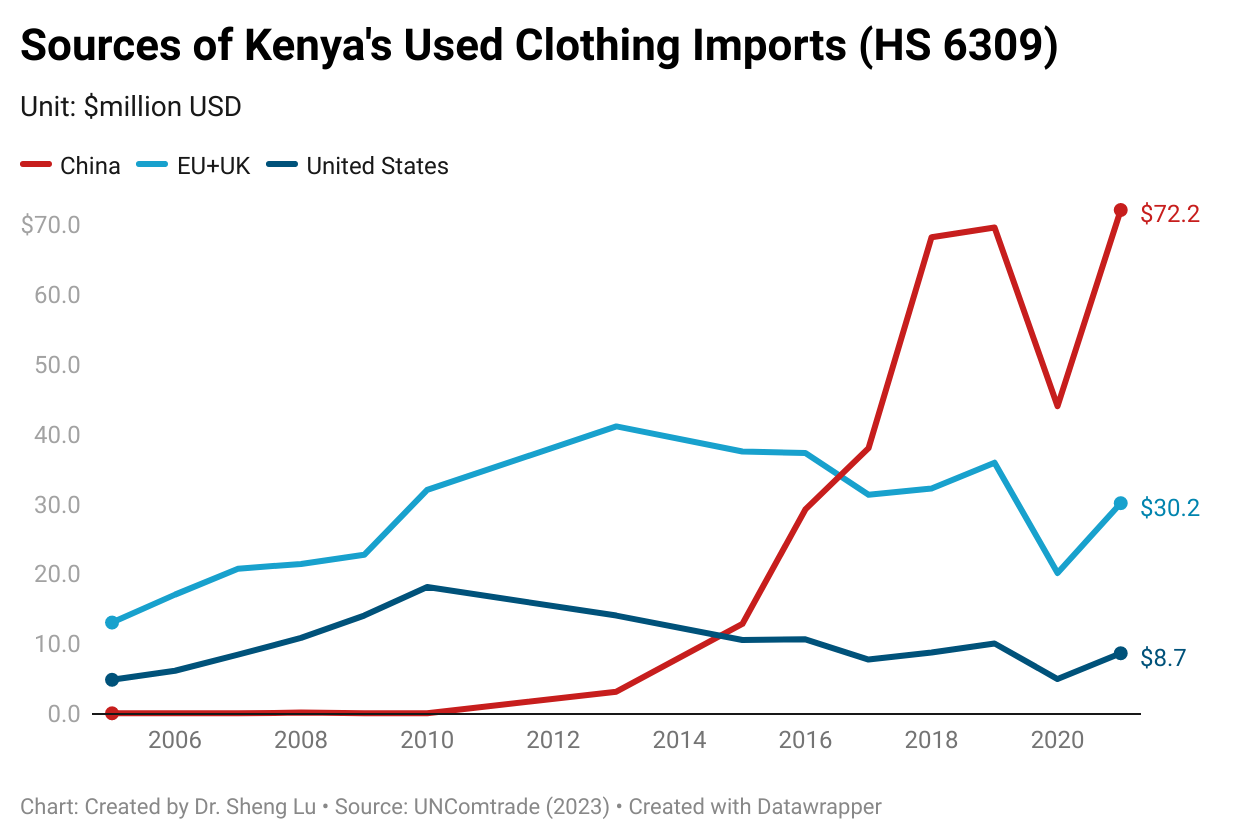
- Data from the United Nations (UNComtrade) shows that Kenya’s used clothing imports surged by over 500% from 2005 ($27 million) to 2021 ($172 million).
- An overwhelming volume of used clothing shipped to Kenya is waste synthetic clothing, a toxic influx creating devastating consequences for the environment and communities. It is estimated that over 300 million items of damaged or unsellable clothing made of synthetic or plastic fibers are exported to Kenya each year, where they end up dumped, landfilled, or burned, exacerbating the plastic pollution crisis.
- Interviews with used clothing traders in Kenya show that 20–50% of the used clothing in bales they purchased was unsellable due to being damaged, too small, unfit for the climate or local styles, and sometimes even with clothing that is covered in vomit, stains or otherwise damaged beyond repair.
- European sorting companies often skimmed off high-quality used clothing for resale in the local EU market. They exported the lower-quality and lower-graded ones to developing countries like Kenya.
- It remains challenging to recycle synthetic clothing as it often contains harmful additives or other materials that make the recycling process difficult or impossible. Additionally, the quality of the recycled synthetic fibers is typically lower than that of the original fabric (i.e., using virgin fiber).
Defend the used clothing exports to Kenya (viewpoints from the Textile Recycling Association, TRA)
- Sorting, trading and selling used clothing “directly employs two million people in Kenya alone , with tens of millions employed globally and supporting many more employment positions in ancillary sectors.”
- “Used clothing and textiles collected in the UK, should go through a detailed sorting process and can be sorted typically into 130 plus re-use and recycling grades and sometimes this can be more than 200 grades. In the sorting process each garment is picked up and individually assessed by highly trained experts*. The good quality re-useable products are segregated from the recycling grades.” [*According to Changing Markets Foundation’s report, about 36 million pieces of used clothing were exported from the UK to Kenya in 2021; All EU countries exported about 112 million pieces to Kenya]
- “It is the buyers in these countries (note: countries like Kenya) that dictate the flows of (used clothing) textiles and which import the goods into their countries.”
- “TRA members are required to ensure that only good quality re-usable clothing products are sold onto countries in Africa and other non-OECD countries. Recycling grades and other non-textile/clothing items have to be removed… However, the majority of countries are not subject to the same tight restrictions on trading as the UK.. This is to the extent that some countries allow unsorted used textiles containing a complete mix of re-usable items, recycling grades, and waste to be sold into African countries as a product.” “The qualities of (used clothing) items originating from different countries is likely to vary significantly.”
- “Kenyan’s buy more than 10 times as much used clothing from China than they do from the UK.”
For FASH455: the blog comment assignment can address the following questions:
- What is your stance on the used clothing trade? Should the government impose more export or import trade restrictions on used clothing?
- As we learned in class, developing countries like Kenya are supposed to rely on making and exporting labor-intensive garments to develop their economies. Can importing used clothing lead to similar economic growth? Any evidence that can support the argument?
- What are the ethical issues involved in the used clothing trade? Should government policies play a role in regulating these ethical concerns?
- Could restricting the used clothing trade discourage fast fashion and reduce textile waste generation? Why or why not?
- Should developed countries like the U.S. voluntarily restrict used clothing exports to lessen the economic and environmental pressures on developing countries like Kenya? What are the potential benefits and drawbacks of such a policy?
- Based on the reading, what critical questions remain unanswered, and what further studies could be conducted to gather valuable information for informed decision-making on regulating the used clothing trade?
Additional reading:
- What Affects the Patterns of Used Clothing Exports?
- Why is the used clothing trade such a hot-button issue?

 FASH455 Global Apparel & Textile Trade and Sourcing
Indeed, used clothing trade is not black and white either. It involves complex social, economic, political and ethical issues.
What is your stance on the used clothing trade? Should the government impose more export or import trade restrictions on used clothing?
It is difficult to make a definite statement either way. Used clothing does employ many of Kenya’s citizens, so one must take this in to account when discussing what the next steps are to begin to solve the issue. Completely banning imports on used clothing might cause a backlash initially for Kenya. What will the individuals who rely on these clothing to make profit, as well as the consumers who purchase these clothes, do if we eliminate all imports? Banning imports, or making restrictions, in my opinion is just a bandaid solution. We need to first tackled our consumption problem and begin to place restrictions on the materials that are allowed in our clothing, and the materials that are not. If we begin to ban these chemicals/materials, and put further emphasis on natural fibers, we can begin to simply decrease the amount of things textiles that exist causing these issues. Then we need to tackle the problem from a solution-focused perspective. How can we solve these issues of poor quality? What can we do to help sustainably recycle these synthetic textiles? This is where we might look at organizations looking to invest in infrastructure that will allow for Africa to take these textiles and sustainably recycle them. Overall, I think the true solutions will bring us to a more circular system, rather than simply banning imports that will eventually end up in another part of the world.
This is a really insightful perspective! I appreciate how you consider both the economic impact on Kenya and the larger issue of overconsumption. Your point about focusing on material regulation rather than just banning imports is important. Addressing the root causes and investing in sustainable recycling solutions seems like a more effective long-term approach.
#1 The used clothing trade has some benefits, but the negatives are hard to ignore. While it creates jobs in Kenya, the fact that so much of what’s sent there is basically trash is a huge problem. European companies keeping the best pieces and dumping the worst ones on developing countries just makes it worse. There should definitely be stricter regulations on both exports and imports to make sure only wearable clothes are sent instead of just offloading waste. Otherwise, it feels less like trade and more like a way for wealthier countries to avoid dealing with their own textile waste.
#2 Knowing how much of the donated clothing actually ends up in landfills or being burned makes me rethink where I donate. I’d rather give clothes to places that make sure they actually get reused, like local shelters or resale shops, instead of risking them becoming waste in another country. Selling, swapping, or donating directly to people in need feels like a better option. The biggest thing influencing my decision is how unregulated the whole process seems. If almost half of what’s sent to Kenya is unsellable, then it’s not really “helping” the way people think it is.
Good thought. France proposed to the European Union to ban used clothing exports in 2024 (https://www.reuters.com/business/environment/france-proposes-eu-ban-exports-used-clothes-2024-03-14/). However, some industry stakeholders argue that secondhand clothing imports and locally produced garments serve different market segments and do not directly compete. One “supporting evidence” is that imported used clothing is often significantly cheaper than locally made new garments, catering to lower-income consumers who might not otherwise afford new clothing.
Is the argument convincing enough?
Hi Rachel! I agree that there needs to be stricter regulations on exports and imports to and from Kenya because of the ongoing issue of waste being dumped there. Although I agree with this, I feel as if these wealthier countries are not willing to help make this change and are avoiding making a difference in these poorer countries. So, this is why I think regulations are important and will add pressure for them to help.
#1 After the video and reading, I believe that the used clothing trade brings up some complex ideas. On one side, the used clothing trade provides individuals with affordable clothing options to many who may need cheaper options. It allows those who may struggle financially to get clothing for themselves in addition to family and loved ones. It also provides job opportunities to many throughout Kenya, allowing them to make money to provide for themselves and others. On the other hand, however, others argue that this type of trade may hold back the growth of local textile industries. If much of the clothing is bought, used or donated, less people will be purchasing full priced items at clothing stores. This takes away from the local economy and local apparel companies. In terms of the government, I feel that imposing more export or import restrictions on used clothing will not entirely solve all problems. Stricter import laws may grow local production and job creation, however, it also could harm those who need secondhand clothing.
#2 After considering the debate, I feel that I would still choose to donate used clothing but educate myself on where or how to properly donate them. I feel it greatly benefits those consumers who are in need or cheaper clothing options. I currently, and would continue, to focus on donating clothing to local organizations or communities I know are in need. Other than helping those in need, another factor that helped to make my decision is the idea of sustainability. Donating clothes keeps clothing out of landfills and also helps to reduce waste.
The used clothing trade is extremely complex and raises several issues regarding environmental, social, and economic concerns. The government should impose stricter regulations regarding the used clothing trade. Over 300 million damaged pieces of clothing made of synthetic and plastic fibers are exported to Kenya annually, it has become a dumping ground for exporting countries such as the EU and UK. Trade regulations such as limiting the volume of exports. In addition, I believe that donating used clothes is extremely important to those who are struggling however the process of donating clothes needs to be more mindful instead of wasteful. I believe a huge problem that needs to be addressed is the quality control of the clothes being sent to Kenya.
#1: Used trade has always presented both positives and negatives in my opinion. On one hand, used trade, similar to what was mentioned in the article, can be dangerous, as an influx of used clothing being shipped to a country like Kenya still adds to our worldwide “textile waste” issue; the shipments of used clothing affects countries economically and environmentally, sine the waste is often dumped into landfills, and contributing to plastic pollution (due to the synthetic fibers used in the synthetic clothing). However, there are positives also. According to the article, used clothing helps employ over 200 million people, which is great for underdeveloped countries like Kenya; the citizens have an opportunity to enter and work for major corporations, which helps their economy. In addition to this, I also see the benefits of used clothing trade as a whole; used clothing trade allows us to focus more on sustainably recycling and reusing clothing to serve as different purposes for different people, instead of mass-producing products to cater to a growing market; used clothing trade is good for the environment (if done properly), and allows room for circular fashion to increase. Even though I do see both sides, I do think in order for this to be done on a larger scale, there has to be many regulations in place to ensure that used clothing is being traded in a safe and effective way – a way where disease is mitigated and it doesn’t influence things like textile waste.
#2: In knowing both sides, I personally am all for the idea of used trade, and think it would be a great way for us to not only mitigate baseless yet fast-paced production (which is dependent on consumer demands and on-going trends), and turn to giving back to the community, and those in needs; I also think this would present cool opportunities for people to receive cultural garments through this exchange, because many countries specialize in specific clothing. I think it just needs to be done in a safe way, to ensure easy processes for everyone. I think for me, I am most drawn to the idea that this would not only help other people (who may not have the resources to buy new garments every season like others), but would also be a more influential in allowing people to grow to become more sustainable with the way they shop/purchase goods (specifically garments).
2. After considering both sides of the debate, I think that donating clothes is still very important and I personally will donate the clothes that I no longer need but I will do this in a better way. When I donate my clothing I should make sure they are still in good condition and wearable for other consumers. I should also consider donating my clothes to places where I know to sort and separate the clothes before trading them. This video made me realize that we all need to be more cautious, especially with clothes made out of polyester, because it is harming so many other countries and it is like we are just dumping garbage on their lands.
5. Some of the ethical issues involved in the used clothes trade include environmental issues, dumping “trash” into pooper countries where there is nothing to do with the clothes other than let them pile up into mountains, health issues getting worse due to fires in the clothing letting out chemicals into the air supply, seeing clothes go into water streams causing water to contain more and more microplastics, and bad labor and protection for these workers who separate clothes everyday. Government policies should 100% play a role in regulating these ethical concerns. People should not have to work like this and they should not have the burden of all these wasted clothes on their hands. This is something that can only change for the better if the government gets involved. People in poorer countries do not have the power to change all of these conditions but the government does.
#1
I believe the used clothing trade, while offering certain economic benefits, should be more regulated. The system allows for a large volume of low-quality or even unusable garments to be put in countries like Kenya. This harms the environment and strains public health systems. Governments should implement stricter restrictions to ensure that only clean, wearable, and high quality garments are traded. There should also be greater accountability from exporters to prevent the misuse of the trade as a way to stop textile waste. Regulation doesn’t mean shutting down the trade entirely it means setting standards that protect the environment and all the people involved.
#2
After reading both viewpoints, I’ve become more educated about how I donate clothes. I believe it’s important to only donate gently used, clean, and wearable items and to do so through organizations that ensure proper distribution or responsible recycling. Knowing that a large percentage of donations end up being wasted in other countries made me rethink. I want my donations to help and to definitely not harm. Factors that influenced my decision include the environmental consequences of synthetic textile waste, the ethical issues surrounding dignity and respect for recipient communities, and the potential to support local economies more directly by reducing wasteful exports.
I think that the used clothes trade can be seen as a negative and a positive. For example the article says, “It is estimated that over 300 million items of damaged or unsellable clothing made of synthetic or plastic fibers are exported to Kenya each year, where they end up dumped, landfilled, or burned, exacerbating the plastic pollution crisis”. This is proving that by trying to do good by sending used clothes to Kenya for people, it actually ends up backfiring and causing more issues since they are damaged, unwearable, or don’t work for the climate there. So yes, the government should impose more export and import restrictions on used clothes. I think that there should be laws to allow exports on clothes that will be used and benefit the countries they are sent to, but there should also be laws to push against exports that will cause more problems in countries they are sent to. This question poses an important and tricky point since we see donating and recycling used clothes as a stereotypical good thing, but can see from this article that this is not always the case.
Question #1
The used clothing is a tricky situation, on one hand it is giving the people of Kenya a business and profit, but also destroying and crowding their lives and the environmental surroundings. I think that there should definitely be a restriction on the amount of clothing being sent to Kenya, but not removing all of it. The video shows bales and bales of more “unsellable” clothing that is just piling up in landfills and being burned. You can really see how the amount of used clothing they are receiving is very excessive. The hard question is to what to do with the rest of the used clothing that wouldn’t be sent to Kenya, and thats why there needs to be research on how we can safely dispose of these clothing items without harming the environment. I believe there should also be more inspection on the clothing that does get sent to Kenya, because it seems that alot of it is in terrible condition, so there should be some sort of process to ensure the clothing is in sellable or usable condition.
Question #6
Restricting the used clothing trade would not get rid of fast fashion, but it may discourage consumers who are educated not to consume as much fast fashion. I feel a lot of people are not aware of the used clothing agreement as well as fast fashion. Our generation is always having ads shoved in our faces, and we have learned to crave the lowest prices possible, but it has become unhealthy. Especially Gen Z, who are the target market for a lot of these big fast fashion companies like Shein. The video shows interviews with people from Kenya who are noticing that a lot of the clothing being sent to them is of terrible quality and is being labeled as “fast fashion”, but there needs to be larger movements in throughout the world to put a stop to fast fashion, it wont be as easy as restricting the used clothing trade.
I think that the environmental consequences concerning used clothing are terrible. I was shocked to learn how much used clothing is sent to Kenya that is unsellable, resulting in it ending up in landfills and dumps. As there is an increasing level of concern for environmental sustainability when it comes to apparel, this process seems to be the opposite. With synthetic clothing releasing harmful chemicals into soil and water, this is truly a horrific impact on the environment. This really shows the true affect of donating clothes. Although the belief is that donating your clothes can help both society and the environment, it is not known how much waste accumulates from doing this. It is especially disappointing that much of this occurs in lower income areas. I am not sure quite how to fix such a massive issue, but I do believe that this should be a high level of concern that should be brought to attention much more.
#1: My stance on the used clothing trade is that I think that the government should impose more export trade restrictions on used clothing coming from other countries. This is due to the fact that many clothing items that Kenya imports from other countries are unable to be salvaged and do not meet the criteria for them to be used. Since the clothing trade is Kenya’s main source of income, it is important that they get the most out of the garments that they import. So I think it is important for the government to maximize the amount of profit they can make from importing clothing. A way that could also maximize efficiency of the used clothing trade would be to include both import and export trade restrictions. If they include more import restrictions they can reduce the amount of unprofitable imports from other countries by not allowing the garments to be taken.
#3: I think it is hard to fully decide whether or not to donate clothes without more restrictions implemented in order to stop clothing waste. Without more laws and government regulations with the used clothing trade, I don’t think it is healthy for companies and brands to throw their waste at Kenya or other countries experiencing the same effects. However, if we do not continue to try to repurpose clothing, it feels like we are doing the same thing. It still seems like we are giving waste to another country or just throwing those clothes into landfills. I think we need another company or country to create a system where you can give used clothes that are not in the condition to be reworn. So that they can be turned into something else or repurposed in a different way (such as new yarn/thread) that does not turn it into waste for other countries.
2. After considering both sides of the argument, I will be more conscious about where I donate my used clothes. Before learning about post-consumer waste and sustainability issues surrounding secondhand clothing, I believed donating clothing was a positive way to get rid of old clothing. The fact that 20%-50% of used clothing bales shipped to Kenya are unwearable shows that this method of unloading harms the environment and the economy. In the future, I will to be more mindful and donate only gently used items to organizations with transparent end-use policies or use resale platforms.
4. Importing used clothing doesn’t appear to offer the same kind of economic growth potential as developing a local garment manufacturing industry. Countries like Kenya are expected to grow their economies by producing and exporting labor-intensive garments, which creates jobs and builds infrastructure. In contrast, a heavy reliance on used clothing imports may undercut local textile and fashion industries, making it harder for domestic brands and producers to compete. While the used clothing trade may provide some jobs, such as in sorting and resale, these roles don’t build the same long-term industrial capacity or economic independence. For Kenya to achieve sustainable development, a focus on building its own fashion manufacturing sector, instead of being a recipient of secondhand clothing, may be a more effective path.
#1
I believe the used clothing trade should be more strategically regulated rather than restricted. While the economic benefits, like the employment of two million people in Kenya, are significant, the environmental damage and ethical concerns can’t be ignored. The issue isn’t necessarily the concept of used clothing exports but the quality control and lack of accountability. Governments should step in to set and enforce higher export standards, especially for non-OECD countries, and require transparency from exporters. Dumping low grade or nonreusable textiles framed as “donations” is misleading at best and exploitative at worst.
#5
The ethical issues at play are super layered. At the heart of it is the question: are we genuinely helping developing countries, or are we offloading our textile waste under the idea of generosity? Sending clothes covered in stains or synthetic materials that can’t be recycled feels more like outsourcing our landfill problem than promoting sustainable development. There’s also the cultural implication, are we unintentionally (or intentionally) undermining Kenya’s domestic apparel industry? I think governments, particularly in exporting countries, have a moral responsibility to ensure their textile waste isn’t contributing to environmental injustice abroad. That means enacting policy that distinguishes between ethical reuse and exploitative dumping.