
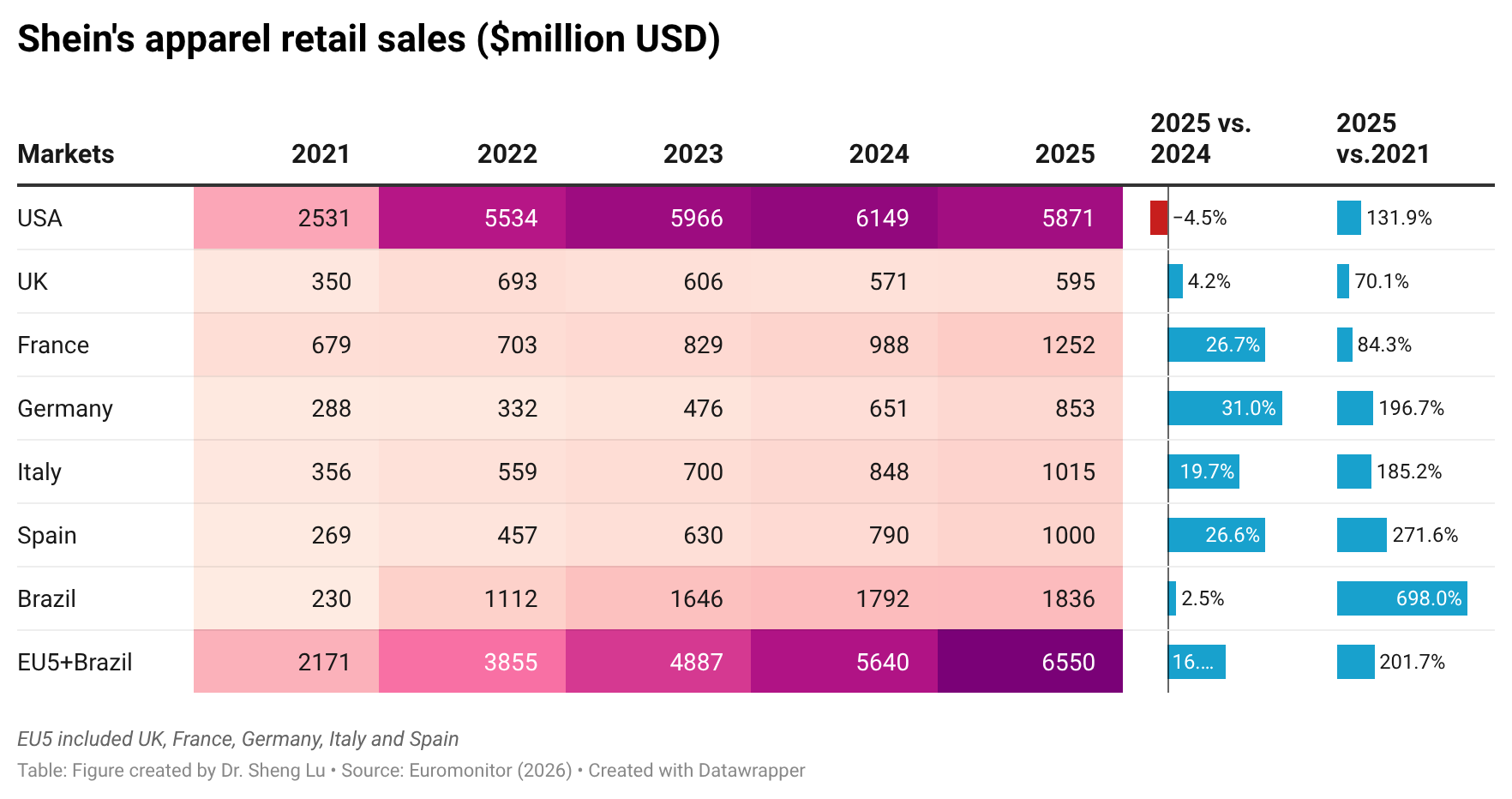
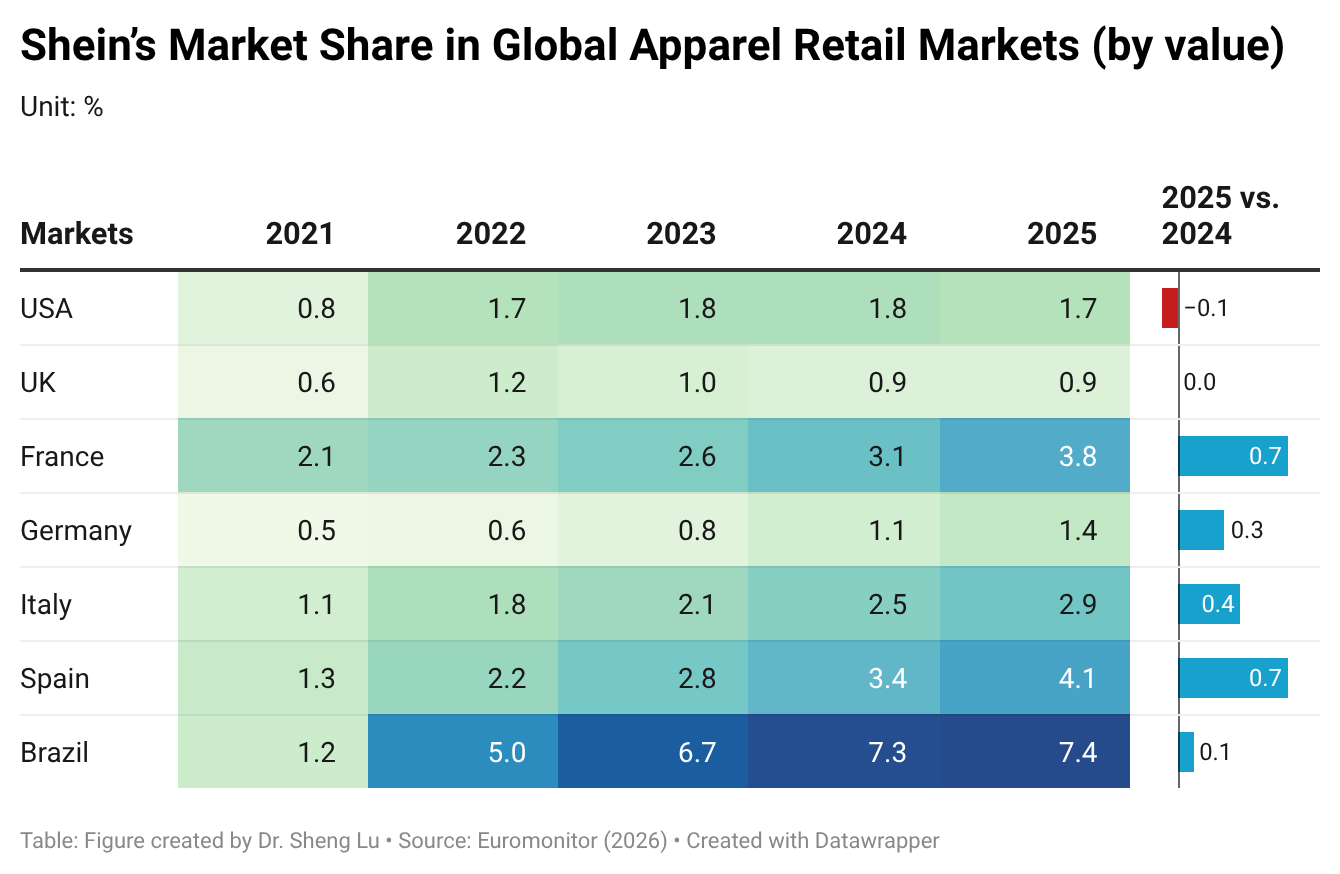
Latest Data from Euromonitor shows that while the United States remained Shein’s largest apparel sales market in 2025, the value of sales declined by 4.5%, affected by factors such as higher tariffs on Chinese products, the elimination of the “de minimis” rules, and young U.S. consumers’ growing concern about sustainability. Based on the value of sales, Shein’s market share in the U.S. also dropped from 1.8% in 2024 to 1.7% in 2025, the first time since 2021.
Shein’s business outlook in the U.S. is expected to remain challenging in 2026 due to ongoing high tariffs affecting imports from China, tighter regulations and enforcement on cross-border e-commerce shipping, and consumers’ increasing demand for sustainable apparel products and supply chain transparency.
Amid headwinds in the US, Shein is diversifying its sales markets in the rest of the world. For example, Shein achieved more apparel retail sales in key EU markets in 2025, including the UK (up 4.2%), France (up 26.7%), Germany (up 31%), Italy (up 19.7%), and Spain (up 26.6%). Likewise, Shein’s sales in Brazil increased by over 698% between 2021 and 2025, much higher than 131% in the US.
As of 2025, Shein’s total apparel sales in the UK, France, Germany, Italy, Spain, and Brazil (around 6.5 billion USD) already surpass the sales in the US (around 5.9 billion). It is likely that emerging markets like Brazil will become increasingly important to Shein’s future global expansion due to the price competitiveness of Shein’s products in local markets, the relatively relaxed regulatory environment, and the attractiveness of Shein’s commitment to investing in production there.
Additional reading: Inside the Chinese factories of fast-fashion giant Shein (by FRANCE 24 English | February 2026)

 FASH455 Global Apparel & Textile Trade and Sourcing
Shein is convenient to consumers because of the low prices and as harmful Shein is to the environment sustainable options are not worth as much as low prices are to most consumers.
While its certainly true Shein is ‘convenient’ especially to college students looking for a budget friendly retailer, that doesn’t entirely justify the environmental costs that Shein manufacturers produce. Clothing is a basic human necessity and its important for everyone to have access to clothes that is comfortable and provides protection.
However, being ‘in-trend’ is an inherent luxury that not everyone needs access to. ‘clothing hauls’ and swift micro trends have desensitized us to overconsumption and much of the blame for clothing waste can fall on the consumer.
Its hard to justify using Shein and it’s cheap labor, when sites like ebay and depop provide budget friendly and ‘in-trend’ clothing still in circulation, along with local second-hand stores.
After reading and watching the video attracted to this blog, this article can relate back to some concepts that we’ve already discussed during class. One of the biggest concepts that surrounds a lot of bases of this class is globalization. The whole concept of globalization is how we use products imported from other countries in our daily lives and how they traveled across borders to get here. Globalization is especially prevalent in the fashion industry, as there is a network of place(s) that make and assemble apparel pieces.
With Shein being one of the biggest global e-commerce companies, their globalization influence can be seen with the popularity of their imported products being successful in other countries. One of these countries includes the US. So much so that during lecture it was mentioned how Shein’s expansion within the US has begun with a distribution center in Indiana. With that prior information I knew beforehand, it was definitely a little shocking to see how Shein is seeing a loss in market share within the US. According to the blog post, Shein’s market share in the U.S. dropped from 1.8% in 2024 to 1.7% in 2025, the first time since 2021. Additionally, while still the highest country in sales, the value of sales declined by 4.5%. The blog mentions a lot of different factors that affected this, including higher tariffs, tighter regulations on cross-border e-commerce shipping, and consumer demand for sustainable products. It doesn’t help that within the video, it did mention how their products are not made to last long, which in turn contributes to the company being one of the biggest polluters. It looks like US consumers are starting to become more aware of these instances revealed in the data.
On the contrary, it doesn’t seem to be affecting other countries like France, Germany, and Brazil, as they’ve seen an increase in sales up to 31% and are beating the US sales combined. With all that being said, their globalization influence is still holding strong in those countries. All things considered, I do wonder if those countries will eventually see a decrease in market share and sales just like how we are beginning to see slowly in the US. While some regulations and restrictions the US has on Shein could be a major factor for the decline, I know from other articles I’ve read and class discussions in previous courses how customers are being more sustainably conscious, so it makes me wonder why they haven’t seen a decrease already. Also, just researching it for a bit, the EU does have stronger and more comprehensive sustainability standards than the US for apparel imports, which also makes me ask the question why we have only seen it just in the US and not some European countries.
Very thoughtful read and watch. The short video documentary was extremely well made and provides a very neutral stance on Shein’s business and work model; showing the concerns with sustainability, giving Shein’s response to these concerns, and showing the market for jobs along with the work being offered to locals in search of work opportunities. This is why China, more specifically Guangjo, has absolute advantage when it comes to the garment production and export. Areas like Guangjo have more residents in search for work than actual job opportunities. This means when a worker happens to succumb to unsafe work conditions or happens to quit, there’s someone who can take their place within that day.
This creates a dilemma for many consumers who aim for sustainability. While it’s important we only buy what we need and purchase garments made from sustainable materials to avoid pollution, what happens to these workers if the market for garments dwindles? How many of these workers, who are already pushing their limits in order to afford living, will survive if brands like Shein makes budget cuts and lets these workers go?
It’s important for us as consumers to ask these questions, we want to be sustainable, but we have to consider who is being affected with these efforts. While I personally don’t shop at Shein and I do believe it’s immoral to shop there, I understand the appeal with low prices and ‘in-trend’ garments, and sympathize with the workers.
One key concept from our class that relates to this blog post is trade theory and specifically the impacts of trade. Trade theory aims to explain if trade is good or bad from a rational perspective, however it also outlines the impacts of trade on different people. The segment that benefits from trade is the consumer, but the segment that suffers from trade are smaller competitors in the clothing industry.
The concept of the impacts of trade directly relates to this blog post because it explains how such a global retailer impacts countries that are large consumer. For example, the article states that “Shein’s sales in Brazil increased by over 698% between 2021 and 2025,” which is a huge growth in sales in this market specifically. Although Shein is greatly benefitting from this increase in sales, the local market in Brazil is likely to be suffering from this growth of Shein. The artilcle highlights that the reason for this huge growth in Brazil is because of Shein’s price competitiveness in local markets and a “relaxed regulatory environment,” meaning that Shein’s products are chosen of local products which hurts the local economy and impacts Brazilian businesses.
A managerial implication of fashion companies primarily present in Brazil is the presence of intense pressure on reducing pricing. Managers have to find ways to either reduce their prices or market their products to compete with Shein’s products. This rise in very fast fashion cause local fashion companies to suffer and they will have to find creative ways to appeal to the consumers they have lost with the use of promotion or with stressing the importance of shopping local. I’m curious how Shein’s competitors will continue their growth in countries like Brazil.
An overarching topic from our class that relates to this blog post is trade theory, especially comparative advantage and the role of recent U.S. tariffs. In class, we learned that countries often focus on producing goods they can make at a lower cost, such as apparel in countries with cheaper labor. We also talked about how tariffs raise the cost of imports and can influence where companies choose to sell their products. These concepts help explain why it has become more expensive for Shein to sell in the U.S., as tariffs placed on Chinese imports have directly contributed to the company’s decline in U.S. sales. Because of these recent trade barriers, Shein has shifted more of its focus to markets like Brazil and parts of Europe due to trade regulations there being more relaxed. Personally, I believe the tariffs are damaging as a whole because they raise prices for consumers while pushing companies to move sales to less regulated markets. This process does not encourage real improvement but instead ultimately just shifts the problem to other countries.
One key concept from our class that relates to the blog post is trade theory and comparative advantage. We learned about comparative advantage and how certain countries specialize in making products at a lower cost than other countries. China has a lower comparative advantage in clothes because of its low labor costs, which has made exporting them globally a lot cheaper. The post discusses how Shein used to have a lot of success in the US but the value of sales has declined by 4.5%. Recently, with the US tariffs, the cost of Chinese goods has increased. Shein sales in countries like Brazil have increased, as well as in the EU. Getting rid of the de minims rule also adds to this. Going forward, I am curious to see if Shein shifts their market to be more attractive and tends to their European and Brazilian market. I am also curious to see if sales continue to decline in the US due to the tariffs.