
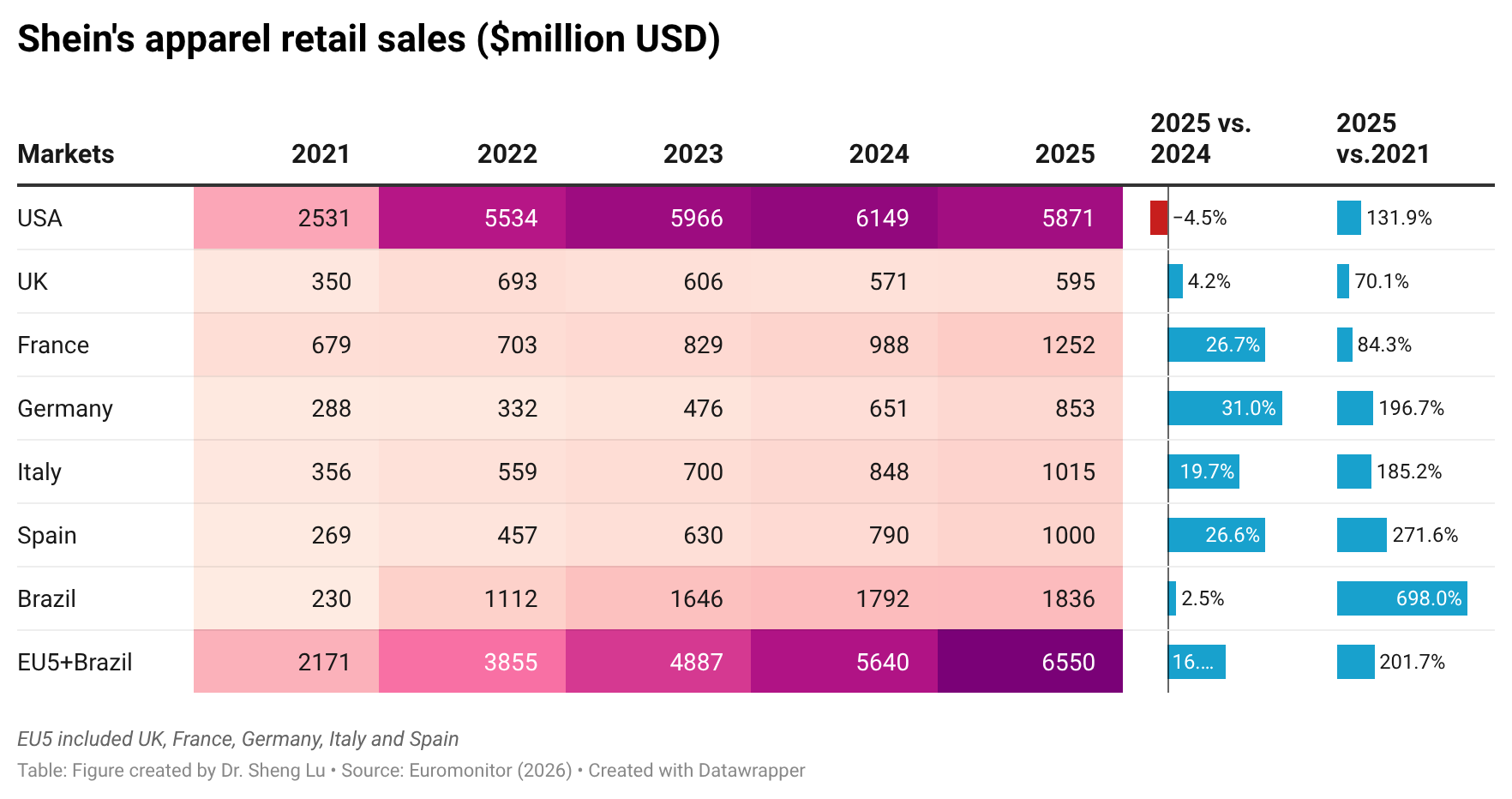
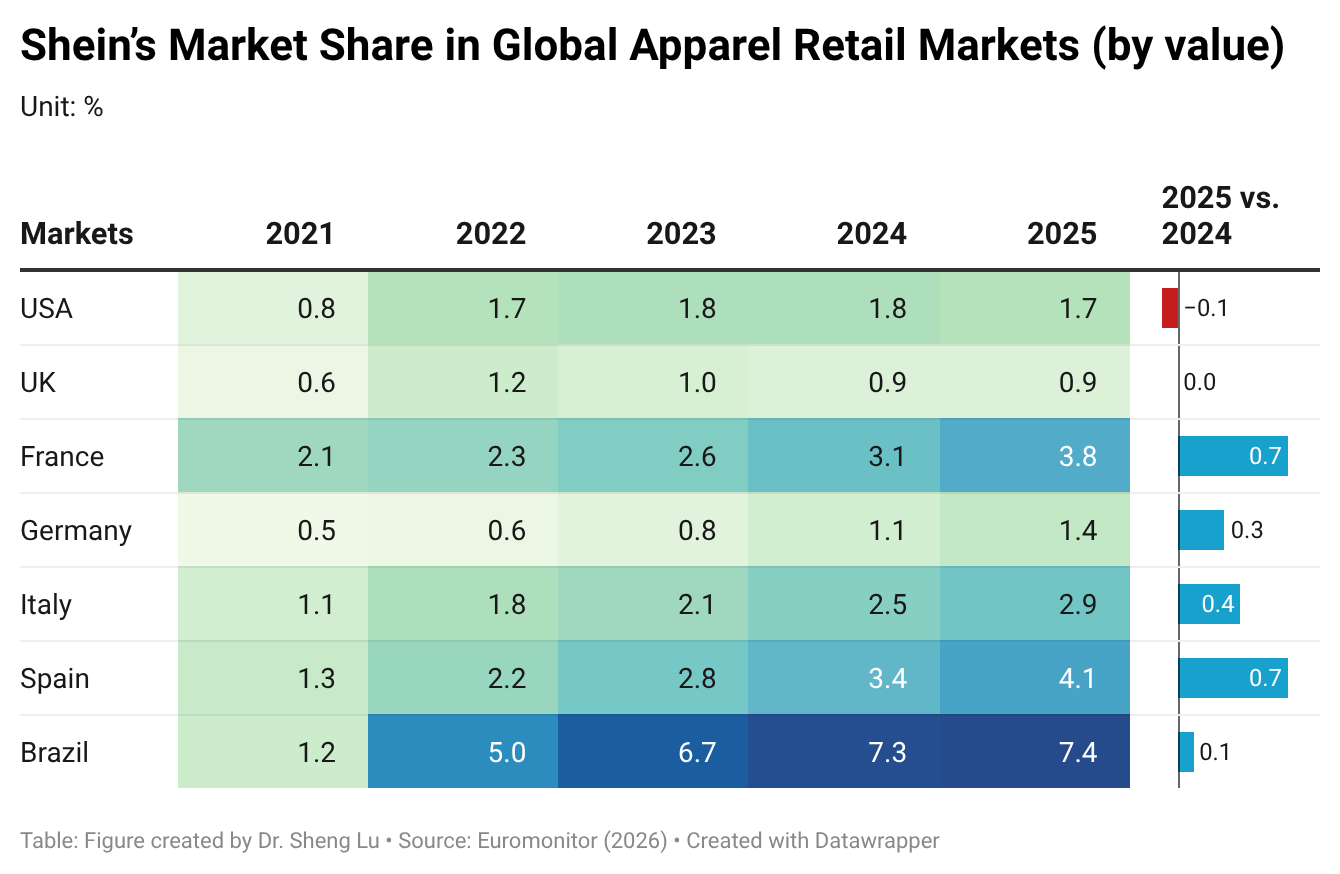
Latest Data from Euromonitor shows that while the United States remained Shein’s largest apparel sales market in 2025, the value of sales declined by 4.5%, affected by factors such as higher tariffs on Chinese products, the elimination of the “de minimis” rules, and young U.S. consumers’ growing concern about sustainability. Based on the value of sales, Shein’s market share in the U.S. also dropped from 1.8% in 2024 to 1.7% in 2025, the first time since 2021.
Shein’s business outlook in the U.S. is expected to remain challenging in 2026 due to ongoing high tariffs affecting imports from China, tighter regulations and enforcement on cross-border e-commerce shipping, and consumers’ increasing demand for sustainable apparel products and supply chain transparency.
Amid headwinds in the US, Shein is diversifying its sales markets in the rest of the world. For example, Shein achieved more apparel retail sales in key EU markets in 2025, including the UK (up 4.2%), France (up 26.7%), Germany (up 31%), Italy (up 19.7%), and Spain (up 26.6%). Likewise, Shein’s sales in Brazil increased by over 698% between 2021 and 2025, much higher than 131% in the US.
As of 2025, Shein’s total apparel sales in the UK, France, Germany, Italy, Spain, and Brazil (around 6.5 billion USD) already surpass the sales in the US (around 5.9 billion). It is likely that emerging markets like Brazil will become increasingly important to Shein’s future global expansion due to the price competitiveness of Shein’s products in local markets, the relatively relaxed regulatory environment, and the attractiveness of Shein’s commitment to investing in production there.
Additional reading: Inside the Chinese factories of fast-fashion giant Shein (by FRANCE 24 English | February 2026)

 FASH455 Global Apparel & Textile Trade and Sourcing
Shein is convenient to consumers because of the low prices and as harmful Shein is to the environment sustainable options are not worth as much as low prices are to most consumers.
While its certainly true Shein is ‘convenient’ especially to college students looking for a budget friendly retailer, that doesn’t entirely justify the environmental costs that Shein manufacturers produce. Clothing is a basic human necessity and its important for everyone to have access to clothes that is comfortable and provides protection.
However, being ‘in-trend’ is an inherent luxury that not everyone needs access to. ‘clothing hauls’ and swift micro trends have desensitized us to overconsumption and much of the blame for clothing waste can fall on the consumer.
Its hard to justify using Shein and it’s cheap labor, when sites like ebay and depop provide budget friendly and ‘in-trend’ clothing still in circulation, along with local second-hand stores.
After reading and watching the video attracted to this blog, this article can relate back to some concepts that we’ve already discussed during class. One of the biggest concepts that surrounds a lot of bases of this class is globalization. The whole concept of globalization is how we use products imported from other countries in our daily lives and how they traveled across borders to get here. Globalization is especially prevalent in the fashion industry, as there is a network of place(s) that make and assemble apparel pieces.
With Shein being one of the biggest global e-commerce companies, their globalization influence can be seen with the popularity of their imported products being successful in other countries. One of these countries includes the US. So much so that during lecture it was mentioned how Shein’s expansion within the US has begun with a distribution center in Indiana. With that prior information I knew beforehand, it was definitely a little shocking to see how Shein is seeing a loss in market share within the US. According to the blog post, Shein’s market share in the U.S. dropped from 1.8% in 2024 to 1.7% in 2025, the first time since 2021. Additionally, while still the highest country in sales, the value of sales declined by 4.5%. The blog mentions a lot of different factors that affected this, including higher tariffs, tighter regulations on cross-border e-commerce shipping, and consumer demand for sustainable products. It doesn’t help that within the video, it did mention how their products are not made to last long, which in turn contributes to the company being one of the biggest polluters. It looks like US consumers are starting to become more aware of these instances revealed in the data.
On the contrary, it doesn’t seem to be affecting other countries like France, Germany, and Brazil, as they’ve seen an increase in sales up to 31% and are beating the US sales combined. With all that being said, their globalization influence is still holding strong in those countries. All things considered, I do wonder if those countries will eventually see a decrease in market share and sales just like how we are beginning to see slowly in the US. While some regulations and restrictions the US has on Shein could be a major factor for the decline, I know from other articles I’ve read and class discussions in previous courses how customers are being more sustainably conscious, so it makes me wonder why they haven’t seen a decrease already. Also, just researching it for a bit, the EU does have stronger and more comprehensive sustainability standards than the US for apparel imports, which also makes me ask the question why we have only seen it just in the US and not some European countries.
Very thoughtful read and watch. The short video documentary was extremely well made and provides a very neutral stance on Shein’s business and work model; showing the concerns with sustainability, giving Shein’s response to these concerns, and showing the market for jobs along with the work being offered to locals in search of work opportunities. This is why China, more specifically Guangjo, has absolute advantage when it comes to the garment production and export. Areas like Guangjo have more residents in search for work than actual job opportunities. This means when a worker happens to succumb to unsafe work conditions or happens to quit, there’s someone who can take their place within that day.
This creates a dilemma for many consumers who aim for sustainability. While it’s important we only buy what we need and purchase garments made from sustainable materials to avoid pollution, what happens to these workers if the market for garments dwindles? How many of these workers, who are already pushing their limits in order to afford living, will survive if brands like Shein makes budget cuts and lets these workers go?
It’s important for us as consumers to ask these questions, we want to be sustainable, but we have to consider who is being affected with these efforts. While I personally don’t shop at Shein and I do believe it’s immoral to shop there, I understand the appeal with low prices and ‘in-trend’ garments, and sympathize with the workers.
One key concept from our class that relates to this blog post is trade theory and specifically the impacts of trade. Trade theory aims to explain if trade is good or bad from a rational perspective, however it also outlines the impacts of trade on different people. The segment that benefits from trade is the consumer, but the segment that suffers from trade are smaller competitors in the clothing industry.
The concept of the impacts of trade directly relates to this blog post because it explains how such a global retailer impacts countries that are large consumer. For example, the article states that “Shein’s sales in Brazil increased by over 698% between 2021 and 2025,” which is a huge growth in sales in this market specifically. Although Shein is greatly benefitting from this increase in sales, the local market in Brazil is likely to be suffering from this growth of Shein. The artilcle highlights that the reason for this huge growth in Brazil is because of Shein’s price competitiveness in local markets and a “relaxed regulatory environment,” meaning that Shein’s products are chosen of local products which hurts the local economy and impacts Brazilian businesses.
A managerial implication of fashion companies primarily present in Brazil is the presence of intense pressure on reducing pricing. Managers have to find ways to either reduce their prices or market their products to compete with Shein’s products. This rise in very fast fashion cause local fashion companies to suffer and they will have to find creative ways to appeal to the consumers they have lost with the use of promotion or with stressing the importance of shopping local. I’m curious how Shein’s competitors will continue their growth in countries like Brazil.
An overarching topic from our class that relates to this blog post is trade theory, especially comparative advantage and the role of recent U.S. tariffs. In class, we learned that countries often focus on producing goods they can make at a lower cost, such as apparel in countries with cheaper labor. We also talked about how tariffs raise the cost of imports and can influence where companies choose to sell their products. These concepts help explain why it has become more expensive for Shein to sell in the U.S., as tariffs placed on Chinese imports have directly contributed to the company’s decline in U.S. sales. Because of these recent trade barriers, Shein has shifted more of its focus to markets like Brazil and parts of Europe due to trade regulations there being more relaxed. Personally, I believe the tariffs are damaging as a whole because they raise prices for consumers while pushing companies to move sales to less regulated markets. This process does not encourage real improvement but instead ultimately just shifts the problem to other countries.
One key concept from our class that relates to the blog post is trade theory and comparative advantage. We learned about comparative advantage and how certain countries specialize in making products at a lower cost than other countries. China has a lower comparative advantage in clothes because of its low labor costs, which has made exporting them globally a lot cheaper. The post discusses how Shein used to have a lot of success in the US but the value of sales has declined by 4.5%. Recently, with the US tariffs, the cost of Chinese goods has increased. Shein sales in countries like Brazil have increased, as well as in the EU. Getting rid of the de minims rule also adds to this. Going forward, I am curious to see if Shein shifts their market to be more attractive and tends to their European and Brazilian market. I am also curious to see if sales continue to decline in the US due to the tariffs.
Yes I’m also wondering if now they will start appealing to other countries trends! It’s crazy how during Covid, Shein was one of biggest online stores almost everyone shopped at.
One important concept from class that connects to this blog post is globalization and how trade policies affect markets. In class, we learned that globalization gives companies opportunities to expand into different countries, but it also creates risks. While globalization can help companies grow, changes in tariffs and trade policies can negatively impact businesses.
In the blog post, Shein clearly reflects this idea. The article states that the latest data from Euromonitor shows U.S. sales declined by 4.5%, largely due to rising tariffs on Chinese goods. At the same time, Shein’s sales in Brazil grew by more than 698% between 2021 and 2025, showing how globalization affects markets differently.
Shein faced challenges in the U.S. largely because it depends on imports from China, meaning tariff increases can quickly affect prices. Brazil, however, seems to offer conditions that better support Shein’s growth. This difference shows how trade policies can reshape competitive advantages across markets. Going forward, Shein may need to consider adjustments to its sourcing or market strategies to reduce these risks. Overall, this blog post highlights how fashion companies may need to rethink their import and export decisions as global trade conditions continue to change.
One concept seen in this blog post regarding Shein is trade theory. As seen in the video and article, China has a comparative advantage for labor compared to other countries. This means that other countries can have better means and be more efficient in producing things like clothing (absolute advantage), but China specializes in producing clothing making them only slightly behind the US and other countries who produce clothing. According to the video, small factories in China that have cheap labor expenses are able to handle the high demand of clothing from other countries. That is why sourcing clothing from China can be cheap for other countries. When a country specializes in a different area of production, that country has more resources to produce said product.
Thinking about the future of Shein, I wonder how long it will still be popular in the US. As seen in the article, Shein’s market share has dropped in the past year in the US due to tariff’s and the need for more sustainable fashion. By personal experience, I have ordered from Shein and know a lot of friends that have as well due to the cheap prices. However, I think our ordering habits will change once we graduate and get jobs earning higher income.
A key concept that this relates to is Globalization. Globalization is the idea that the world is becoming increasingly interconnected. For example, Shein has the capability to sell across the globe, in several different continents. They are integrated into the fashion vocabulary wherever you go. This blog discusses how Shein sales have gone up in many countries despite market share losses in the United States. Interestingly, sales have gone up in many European countries like the UK, France, Germany, Italy, and Spain despite the EU ramping up anti-fast fashion policies. The EU and UK have recently instated policies that will hinder the operation and business structures of many fast fashion brands. One thing mentioned in this article is that Brazil is becoming an increasingly larger market for Shein. I think this speaks more towards Brazil becoming a larger market for fashion across the board.
After reading Apparel Retail Market in 2025 Amid Trade Tensions, a key concept from our class that relates is the Factor Proportions Theory. The Factor Proportion Theory explains that countries produce and export goods in which they have a comparative advantage, meaning they specialize in goods that use the abundant resources specific to that country. When thinking about this specific article, China has an abundance of cheap labor, making it have a comparative advantage in making labor-intensive products such as apparel. Due to this reason, Shein can manufacture apparel at a very low cost.
Shein’s ability to build an entire business around China’s labor abundance directly correlates with the Factor Proportions Theory and has allowed the brand to flourish and be very successful. However, the recent high tariffs placed on Chinese products and the push young U.S consumers have for sustainably made products have led to 4.5% decrease in Shein’s sales. This is the first decline in sales since 2021. To combat this, Shein shifted its marketing focus to Europe and Brazil, which is, in my opinion, a short term fix. This decrease in sales demonstrates that while Factor Proportion Theory explains Shein’s success, trade policy and social views can rapidly affect a business model that relies heavily on a singular country’s labor advantage.
After reading this blog, I am left wondering how sustainable Shein’s business model is long-term. If one policy can cause a brand’s market to decline significantly, it implies that fashion brands should be diversifying their manufacturing across multiple countries, rather than being dependent on a single one. I believe that if brands spread production to multiple countries, they are better protected when trade policies are changed.
One key concept from our class that relates to this blog post is Globalization. In class, we’ve discussed that globalization is important for driving global economic growth, reducing poverty by increasing jobs, and even lowering consumer prices. It also has great affects on fostering cross-cultural understanding.
In this blog post, we can see that globalization is fully supported by the data because even though Shein’s value of sales in the U.S has decreased, sales are soaring around the world. “As of 2025, Shein’s total apparel sales in the UK, France, Germany, Italy, Spain, and Brazil (around 6.5 billion USD) already surpass the sales in the US (around 5.9 billion).” Sales went up in all of these countries by at least 31%, which is keeping Shein alive.
Going forward, I am curious if this pattern will continue and if Shein sales in the U.S continue to decline. And if so, will the fast fashion company be able to sustain its numbers with the EUK countries? I am sure the tariffs had to have had an affect on costs in the U.S, though I wonder if it was extreme enough to cause this drop in sales. That, along with the low quality clothing and consumers growing interest in sustainable clothing.
A concept from class that relates to this blog article is understanding the criteria needed for sourcing. We discussed that companies choose sourcing locations based on several factors, including cost, trade policy, and market access. We also talked about how sourcing decisions are not permanent and must be adjusted when conditions change.
In this post, Shein’s decline in U.S. market share shows how trade policy can affect a company’s sourcing decisions. Since most of Shein’s products are made in China, higher U.S. tariffs and the removal of the de minimis rule increased costs and made selling these goods in the U.S. more difficult. While this was happening, Shein’s sales grew significantly in Brazil and parts of Europe, where trade conditions have been more favorable. This can reflect how companies respond to changes in sourcing criteria, not just labor costs.
Going forward, fashion brands may need to constantly reevaluate where they produce and sell products. Trade policy can and has shifted quickly, so sourcing decisions have to stay flexible.
Within this blog post, you are able to tell the decline in SHEIN’s sales within the United States in 2025 compared to 2024. According to the Euromonitor, SHEIN faced a 4.5% decline in their normal sales activity. The reasoning for this decrease is due to higher tariff costs for products that are being imported. However, I am questioning if this is the only reason for this decline. During class, we learned that consumers are actively seeking sustainable companies to shop at. Fast fashion brands like SHEIN are not in that category, leading me to wonder if their sales have dropped because of this. As sustainability becomes a larger focus for consumers, companies that lack transparency on this topic will be unable to uphold their target customers. To conclude, the rise in tariffs may not be the only issue with SHEIN’s decrease in sales, but also to changing consumers values on how the company manufactures their garments.
In class, we talked about how sourcing is a big part of the inner struggles in brands. Especially when it came to tariffs being put into place, many brands were forced to look elsewhere to find cheaper but still higher quality countries to produce their products. However, switching production areas can also be risky due to how quickly these tariff policies are being changed, and are sometimes leaving brands in an even worse situation than before when choosing new locations for production.
This video talks about the sourcing issue that SHEIN is currently facing when it comes to selling its products in the US. While they are still able to produce their products for cheap in China, they are having to up the prices they are selling them for when it comes to shipping/selling to US consumers, due to tariffs.
After the discussion today with out guest speaker and the new tariffs just put into place last week, I’m interested to find out what will happen in July when the time for these tariffs is up, and how the president will move forward.
This article was interesting to me to understand as someone that is focused on sustainability in the fashion industry and seeing how Shein’s popularity is decreasing in the U.S. from the issue of sustainability becoming more important to young consumers. One course concept this article connects to is comparative advantage. The idea helps to explain how countries specialize in producing goods when they have lower opportunity costs. For Shein, China’s low labor costs gives them a comparative advantage in manufacturing apparel, which allows Shein to supply global markets with low-priced products. However, this concept also helps explain Shein’s recent sales decline in the U.S. Despite its past success, higher tariffs on Chinese imports and stricter cross-border e-commerce regulations have increased the cost of sourcing apparel from China. According to the article, these trade tensions contributed to a 4.5% decline in Shein’s U.S. sales value in 2025. A managerial implication is that fashion companies that are reliant on low-cost imports need to reconsider their sourcing strategies. They could diversify production into countries with more favorable trade relationships to help reduce tariff related cost increases. Lastly, Shein can consider to focus on Brazil’s market and while sales are growing substantially the last few years.
One concept from class that relates to this blog post is globalization. In class, we learned how globalization is the free movement of goods, services, capital, and people, and how regardless of whether or not we like it, it will always be around. This information relates to facts given in the article as Shein is a global company that produces clothing in China and sells to many different countries. With the change in tariffs in the U.S., we have seen sales slowing down and how government trade policies can affect global businesses. This has forced Shein to expand more into Europe and Brazil (Increased by 698% between 2021 and 2025) and shows how fashion brands operate in a global economy and must adjust to global trade changes. A thoughtful question that this information raised for me is whether or not brands like Shein will permanently shift their focus to new markets, or try to rebuild their U.S. presence. This matters because it could change the balance of power in the fashion industry. If brands focus more on countries such as Brazil and Europe which have fewer regulations and lower costs, it may affect labor standards and competition worldwide.
A key concept we learned in class that applies to this blog post would be globalization which is when the supply chain becomes global and products are imported from all over the world. The benefits of using globalization in supply chains are that it helps economic growth, it lowers prices of products for consumers, and it helps to increase interactions between countries. Specifically in this article, globalization is used when products and fast fashion garments from Shein are being manufactured and shipped from the factories in China to countries all over the world. Examples of countries who receive these shipments from this blog post are the USA, UK, France, Germany, Italy, Spain, and Brazil. Although the value of sales to the US has gone down 4.5% due to the increase on tariffs to Chinese products. A question that I have about this blog post and globalization would be, how is the Trump administration going to continue to affect the tariffs on Shein products and will this help to stop the US from continuing to ordering fast fashion products from Shein?
When thinking of a topic that related to the article the idea of winners and losers of trade matched perfectly. In class, we discussed how trade liberalization benefits consumers through lower prices, but it can also harm domestic producers and workers who cannot compete with imports.
Trade policy changes can shift who benefits and who bears the cost. This blog shows how Shein previously benefited from low tariffs and the de minimis rule, allowing inexpensive Chinese imports to enter the U.S. market.
However, with higher tariffs and tighter cross-border enforcement, Shein’s U.S. sales declined by 4.5%, and its market share dropped from 1.8% to 1.7%. These policy changes may reduce Shein’s advantage in the U.S. market, potentially benefiting domestic retailers or competitors.
At the same time, consumers who relied on ultra-low prices may face higher costs. This situation raises the question of whether trade restrictions strengthen domestic industry or shift sourcing and sales to other global markets, such as Brazil and Europe. If companies can easily redirect trade flows, the long-term effectiveness of protectionist policies remains uncertain.
One key concept from class that relates to this blog post is globalization. In class, we defined globalization as the freer movement of goods, services, capital, and people across borders, supported by lower trade barriers and technological advancement. In the apparel industry, globalization has created highly integrated supply chains where products are often “made in the world” rather than in a single country. In the blog post discussing Shein losing U.S. market share in 2025, we can see how globalization both enabled and constrained the company’s growth. Shein’s rapid expansion was built on cross-border e-commerce and global sourcing efficiencies. However, rising U.S.–China trade tensions and new tariff measures disrupted these flows, contributing to a decline in its U.S. sales and market share. This demonstrates that globalization increases interdependence, but it also makes companies vulnerable to political and policy shifts. A thoughtful question moving forward is whether globalization in fashion is entering a more regionalized phase rather than continuing full global integration. If trade barriers persist, will companies like Shein rely more heavily on nearshoring or diversified regional hubs? This matters because it could reshape the structure of the global apparel market.
The main idea that ties this post with in-class discussion is the concept of globalization, and its creation of “winners and losers”. This idea is exacerbated by manufacturing companies in countries like China, where ethical labor laws and concerns for sustainability are few and far between.
Americans have a growing concern and are becoming more environmentally conscious about the goods – particularly apparel, they’re consuming. In addition to other factors like tariff costs, Shein sales have declined by 4.5% in 2025. Although Shein is still a large fast fashion powerhouse in the US, their brand strategy and lack of transparency no longer aligns with the moral concerns of many American citizens.
A large issue with globalization is the impossibility of true transparency within the manufacturing sector. Shein, a company worth $66 Billion dollars repeatedly takes advantage of small companies that pay their workers pennies for their garments. In terms of policy, I believe developed countries like China should have to abide by federal US worker laws in order to sell within the United States.
One key concept from our class that relates to this blog post is comparative advantage. Comparative advantage focuses on opportunity cost, explaining how countries or companies specialize in producing goods at a relatively lower cost. This allowed Shein to offer very low-priced apparel and compete strongly in global markets.
In this blog post, Shein’s declining U.S. market share shows how tariffs can weaken comparative advantage. Higher U.S. tariffs and stricter import regulations increased Shein’s costs, contributing to a 4.5% decline in U.S. sales and reduced market share in 2025. This connects to our class discussions that tariffs raise import prices and reduce competitiveness, even for companies with lower production costs. As a result, Shein’s business outlook in the U.S. remains challenging.
Going forward, Shein may focus more on countries with fewer tariffs and lower trade barriers. I am curious if Shein will continue growing faster in markets like Brazil and Europe instead of the U.S. This shows how fashion companies may shift their strategy to maintain their low-price competitiveness and stay competitive.
One key concept from our class that relates to this blog post is Globalization, which is the idea that the world in very interconnected. Different countries trading goods and services with each other to create trade all over the world.
Shein has the ability to sell in many different countries and continents around the globe, The US being one of them. In the bllog post we can see how Shein sales are going up in many different countries (the UK, France, Germany, Italy, and Spain) but that their sales are going down in US. This is happening despite heighted anti- fast fashion policies in many of the countries with a spike in sales.
Going forward I would be curious to see if it was possible to find out just why Shein sales are dropping so hard in the US. Personally I would like to think that people who were shopping there have been educated on the harms that Shein has on the people and the planet, while that may not be the case and the raising tarrifs could also be part of it, it would still be interesting to learn more about.
One concept from class that relates to the blog post “Shein Lost Market Share in the U.S. Apparel Retail Market in 2025 Amid Trade Tensions” is globalization. Globalization refers to the freer movement of goods, services, capital, and people. This allows companies to source and produce products internationally. Shein is highlighted as a brand that relies on globalization for its success. The brand heavily relies on selling its products to U.S. consumers. In 2025, the U.S. was Shein’s largest apparel sales market. Now in 2026, we can see a shift in their sales. Due to increased tariffs and trade restrictions Shein’s sales have decreased in the United States, negativity impacting their market share. The brand that was once the number one brand, has now fallen. The blog post states that “the value of sales declined by 4.5%. Based on the value of sales, Shein’s market share in the U.S. also dropped from 1.8% in 2024 to 1.7% in 2025, the first time since 2021” (Lu, 2026). While globalization is beneficial for a brand’s growth and sales, there can be major downsides when policies change. Shein is a prime example of the negative impact that globalization can have on brand growth.
Reading this article, it really related to rules of origin, which we learned about in class. Rules of origin are the legal criteria, laws, and regulations used in international trade and basically a guideline for trade. This relates to the article because of the rules of origin. Shein’s goods are Chinese-based, meaning when tariffs come into place, Shein takes a toll because they are a Chinese-based company. And now with the De Minimis rule being eliminated, they no longer have a loophole for the tariffs and will be subjected to paying them. Another thing rules of origin do is enforce environmental standards, and if Shein does not have proper documentation, their products will not be accepted into the US. Overall I think that Shein is a company we should move on from, as it’s fast fashion and has an unethical chain from labor to sourcing. And it seems that people’s minds are changing in the US and are stopping themselves from shopping at Shein, but that is sadly not the same for some other leading countries. I think if Shein wanted to continue and fight for their spot, sustainability would be their top priority.
One key concept from our class that relates to “Shein Lost Market Share in the U.S. Apparel Retail Market in 2025 Amid Trade Tensions” post is globalization. Globalization is the Freer movement of goods, services, capital, and people. In class, we learned that globalization would not happen without economic growth, lower trade and investment barriers, and technological advancement. In this blog post, examining Shein’s loss of U.S. market share in 2025, we see how globalization both fueled and limited the company’s growth. Looking at Shein’s rapid expansion, we can see how it relied heavily on cross-border e-commerce and global sourcing. We saw how tariffs and trade tensions have disrupted these channels for the U.S. and China. Ultimately, this is leading to the decline in Shein’s U.S. sales and market share. I am curious if Shein will continue to market to the U.S. despite the tariffs and trade tensions. Additionally, I am curious what other countries they will begin to market to that have less tariffs and lower trade barriers.
I think this article brings multiple interesting points to light in regards to U.S. consumer’s perception of fast fashion giant Shein. I think that a combination of U.S. Tariffs and a shift in consumer values on sustainability are at fault for Shein losing their market in the U.S. The tariffs will most likely continue to affect lots of international trade in the U.S from now on. I’m sure that at first, losing the US market felt detrimental to Shein’s success, but now they have shifted their focus to market to other countries and have had quick success. It brings up an interesting idea that because of the tariffs, many businesses in other countries that once relied on the US market, will now have to shift their resources elsewhere which could affect the significance of the U.S in the global supply chain. In class, we’ve focused on globalization and how one of its driving factors is relationships between countries. Globalization by trading overseas is important to the U.S. because it creates so many jobs and diversifies our culture. Without globalization and international relationships, many U.S. businesses could be hurt economically.
From reading this blog post and watching the video, the concepts discussed relate back to trade theory, specifically the Factor Proportions Theory. The Factor Proportions Theory strengthens countries’ positioning on which products to produce depending on their resources being more capital intensive leaning or labor intensive leaning. In relation to the blog, this theory further demonstrates the reasoning behind Shein’s production within China as it is a prime exemplar of the factor proportions theory. This is because China is abundant in labor in which it has the comparative advantage in producing labor intensive products, like apparel or garments in this case. The blog goes on to show how Shein has dominated the fast fashion market by having numerous “independent workshops” or factories in China that produce more than 6,000 apparel pieces or products each day to then be shipped out to consumers shortly after. In choosing an industry that aligns with China’s strengths it has allowed Shein to be successful globally in countries such as Brazil, The U.K, France, Germany, etc and formally the U.S. Countries like the U.S. are lowering their spending on fast fashion companies, such as Shein, due to the rising concern of sustainability and the increased tariffs. This does pose questions of the future of fast fashion companies, being that U.S. consumers are such a large consumer group, fast fashion companies will lose a lot of their previous consumer demand, innately lowering their sales. As mentioned in the article, if Shein targets consumers in emerging countries, will consumers still maintain high purchasing power for Shein to sustain their rapid success? Because consumerism is so prevalent in the U.S., will the demand be as high to drive profits in other countries? Questions like these are important as they directly address the longevity of fast fashion companies. As sustainability efforts are becoming highly significant, consumers are shopping more consciously with increased awareness of fast fashion and its harmful effects. Consumers are shifting away from fast fashion brands and looking at ways to promote circular fashion with shopping second hand or environmentally friendly brands. This fundamentally challenges the fast fashion business model itself and whether it will continue on.
In class, we talked about how tariffs and trade barriers affect global businesses by increasing the cost of imported goods and forcing companies to adjust their sourcing and market strategies. Tariffs act as taxes on imports, which can reduce a company’s price competitiveness and change where places choose to sell or produce their products. This concept helps explain the trends described in the blog post about SHEIN. The company’s U.S. apparel sales declined by 4.5% in 2025 and its market share dropped from 1.8% to 1.7%, largely due to higher tariffs on Chinese imports and stricter cross-border shipping regulations. Since SHEIN relies heavily on manufacturing in China, these policies directly weaken its low-price advantage in the U.S., while markets with fewer restrictions, such as Brazil and several European countries, experienced strong growth. A key managerial implication is that global fashion companies must diversify supply chains and production locations to reduce risk from changing trade policies. If tariffs remain uncertain, companies like SHEIN may need to invest more in regional production or different sourcing strategies in order to maintain competitiveness and long-term growth. It is really interesting to look at how these tariffs can significantly impact small businesses, but also companies as big as SHEIN as well. I am curious as to see what the future holds for SHEIN in the US market because the future of tariffs is uncertain.
After reading this post two concepts I saw throughout were globalization and trade theory. In class we talked about how globalization is the company’s opportunity to expand. We are seeing this as Shein is connected to every country and seems to be continuously growing. While the sales in the U.S. have decreased because of the tariffs the rest of the world has an increasing amount of sales from this company.
The blog post states that the U.S. sales are decreasing because of the tariffs we currently have, but the rest of the world is increasing in sales. It said that in 2021-2025 Brazil’s sales went up 698%. This shows that each market is in a different place and while a brand can be advertising and marketing toward each country the same there might be factors out of their control that can bring down their sales.
This blog post has made me think about Shein’s business model and the longevity of it. The added tariffs from the U.S. have seemed to impact them greatly and caused them to start declining in sales. If this one policy has such an impact on their sales, is their business model stable? If another country added tariffs similar to ours could it destroy their company in the long run?
One key concept from class we discussed that I think closely relates to this blog post are tariffs and globalization. The recent rise and slowdown of Temu and Shein shows how globalization and tariffs interact in today’s economy. These companies grew quickly in the U.S. taking advantage of global supply chains. Gravitating towards the cheaper labor in China, and direct shipping to consumers is what lets them offer extremely low prices. Disregarding the fact that this offers poor unhealthy working conditions for the people producing products. But U.S. tariffs on Chinese goods have made purchasing more expensive, weakening their competitive edge. In this blog post, we can see that by the data Temu’s daily active users in the U.S. declined by around 48–58%. As a result, shoppers are returning to Amazon, which can combine international sourcing with domestic warehouses, fast delivery, and easy returns. This example demonstrates that while globalization allows companies to reach global markets cheaply. Trade policies like tariffs can shift the balance back toward businesses that have both global and local capabilities. Going forward, we can further explore how trade and globalization continue to shape the strategies of e commerce platforms like Amazon, Temu, and Shein.
One concept from class that really connects to this post is market diversification in response to global trade uncertainty. In class we talked about how fashion companies can’t rely too heavily on one market because trade policy, tariffs, or even consumer sentiment can shift quickly. Expanding into multiple regions helps brands manage risk and stabilize long-term growth.
Looking at Shein’s sales data, this idea is very clear. Even though U.S. sales declined by 4.5% in 2025, the company saw strong growth in markets like Germany +31% and France 26.7% and continued expansion in Brazil. The EU5 + Brazil total actually reached $6.55 billion, which is higher than the U.S. market. This shows that Shein is not dependent on just one country and is spreading its risk across regions.
From a managerial perspective, this strategy seems smart in today’s unpredictable trade environment. However, I wonder if increasing regulatory pressure in Europe could eventually challenge this growth model.
A key concept we learned in class that directly relates to this article and video is the trade theories. Especially comparative advantage reinforced by factory proprtions theory, meaning countries export their products that use factors they have relatively more of. The video shows why Chinas garment making capital, Guangzhou, fits this theory by thousands of workers arriving daily, factories everywhere, and Shein relies on a flexible network of small workshops producing tiny orders (50-100 pieces) and rapidly scaling what sells. This labor-intensive, speed-driven system supports Shein’s low processes. On the other hand, it also creates vulnerability, piece-rate pay, and reported 75+ hour weeks suggest intense cost pressure.
The blog post shows how trade policy can distup that advantage in the U.S.. Even if China has a production cost advantage, tariffs and tighter cross-border rules raise the “effective price”, helping explain why Sheins U.S. sales fell 4.5%, and market shares dropped in 2025. Though growth in Europe and Brazil suggests that Shein is reallocating trade flows toward markets where its cost advantage has fewer barriers.
Global textile trade can enable circularity, but it can also export waste burdens if used-clothing flows overwhelm importing countries. Policy should require sorting/traceability before export rather than complete bans. Brands should prioritize textile recyclability and accept EPR responsibility, integrating end-of-life costs into pricing to reduce overproduction.
One key concept from our class that relates to this blog post is comparative advantage theory. In class, we discussed that comparative advantage explains how firms and countries gain from trade by specializing in areas where they face lower opportunity costs. These advantages can come from cheaper labor, favorable trade policies or efficient logistics.
In the blog post, comparative advantage helps explain why Shein is losing market share in the United States while expanding in places like the United Kingdom and Brazil. Higher U.S. tariffs on Chinese goods and stricter cross-border e-commerce rules increase Shein’s costs as well as weakening its lower-price advantages. This adds to the idea that comparative advantage is not fixed, it constantly shifts based on policy or regulation changes.
A question I pose is if more countries begin tightening trade rules and increasing sustainability regulations, will fast fashion companies like Shein and Temu be able to maintain a global comparative advantage?
One key concept from our class that relates to this blog post is comparative advantage theory. This theory suggests that countries should specialize in producing goods they can make at a more efficient speed and at lower opportunity cost and then trade for other goods. In the apparel industry, this explains why production is concentrated in countries like China, where large scale manufacturing, established supply chains and lower labor costs create efficiency advantages.
In the blog, Shein’s loss of U.S. market share in 2025 during trade tensions reflects how disruptions to comparative advantage can reshape competition. As tariffs increased and US and China trade tensions rose, Shein’s cost advantage from China based production became worse. The post shows that policy changes and stricter enforcement around shipments across the border increased costs and delivery times, reducing Shein’s price competitiveness. This explains why competitors with stronger US distribution channels were better positioned to maintain market share.
In my opinion, fashion companies should reduce overreliance on a single sourcing country. Allowing for production across regions can lessen the risk of fallout. Brands that switch up production before problems occur will most likely be more successful and stay ahead when trade rules change.
One key concept from our class that relates to this blog post is comparative and absolute advantage in global trade. In lecture, we discussed that a country has an absolute advantage when it can produce goods more efficiently than another country, (china with labor, US with capital). Comparative advantage further explains how countries specialize in industries where they have lower opportunity costs, reinforcing global sourcing patterns.
In the blog post and documentary about Shein, this concept is illustrated through Guangzhou’s garment sector. The region’s large labor pool and constant supply of workers allow factories to operate at extremely low costs and high speed, strengthening China’s dominance in apparel exports. However, this labor surplus also weakens workers’ safety and union. The post notes that replacements are readily available when workers quit or face unsafe conditions. This dynamic helps explain how Shein sustains ultra-low prices, while being able to respond defensively to sustainability concerns.
From a managerial perspective, fashion companies should recognize that relying solely on labor cost advantages is risky in the long term. Brands may need to balance cost efficiency with investments in labor standards and transparency to avoid reputational damage. A more sustainable competitive advantage could come from innovation and responsible sourcing rather than dependence on vulnerable labor markets.
Trump’s tariffs have caused Shein to lose market share in the US. Is this a solution to sustainability? In class, we have discussed how sustainability is a global issue in the textile and apparel industry. Fast fashion is an unhealthy apparel business, and Trump’s tariffs have indirectly led to a dip in Shein’s, a fast-fashion company, market share in the US. We know that the tariffs have caused this because Shein’s market share in other countries has grown. Tariffs can be used as a policy lever to force economic change, and although the tariffs imposed by President Trump were not intended for this, they do show a way in which policies can be used to help drive sustainability in the textile and apparel industry.
One key concept from our class that relates to this blog post is consumer and company responsibility
In class, specifically while attending the interview with Nate Herman, we discussed the role of the consumer as well as retail companies in following responsible business decisions.
In this blog post, we can see that SHEIN has lost market share in the US for the first time since 2021, while the post noted that this is partially due to increased tariffs and general supply chain disruption, US consumers growing ethical and sustainability concerns also left a dent in the company’s US success. This relates to our discussion with Nate Herman, who brought up the responsibility of brands to foster healthy relationships with their production partners. He highlighted how a failure to support factory relationships can lead to a brand’s downfall, with Sears as a notable example. I believe this same concept can be applied to the brand-consumer relationship, meaning that, if a brand like SHEIN fails to meet the growing expectations of sustainability conscious consumers in the US, they will continue to lose market share.
Tariffs are something we have talked about in class that have an effect in the US. In this blog it talks about how Shein’s market share in the US has dropped from 1.8% in 2024 to 1.7% in 2025 for the first time since 2021. Since tariffs have hit the US more, people are purchasing less from Shein since it mostly comes from China.
This blog helps to show how much tariffs are affecting the US. Shein used to be one of the most popular places to purchase your clothes because of how cheap it is, but now with tariffs making it higher that has decreased. We can see by the stats in the blog that Shein is now bigger in our countries which ties in with the concept of globalization. The way we need to trade with other countries to expand our market, which is what Shein is doing.
In the video it shows how the Shein factories work, how fast fashion is working. They speak about how the factory workers get paid up to $0.06 for each piece of clothing they make and how some people work long hours to get more money. This might seem like a bad thing but since China has one of the biggest populations in the world, not everyone has got the opportunity to work better jobs then these.