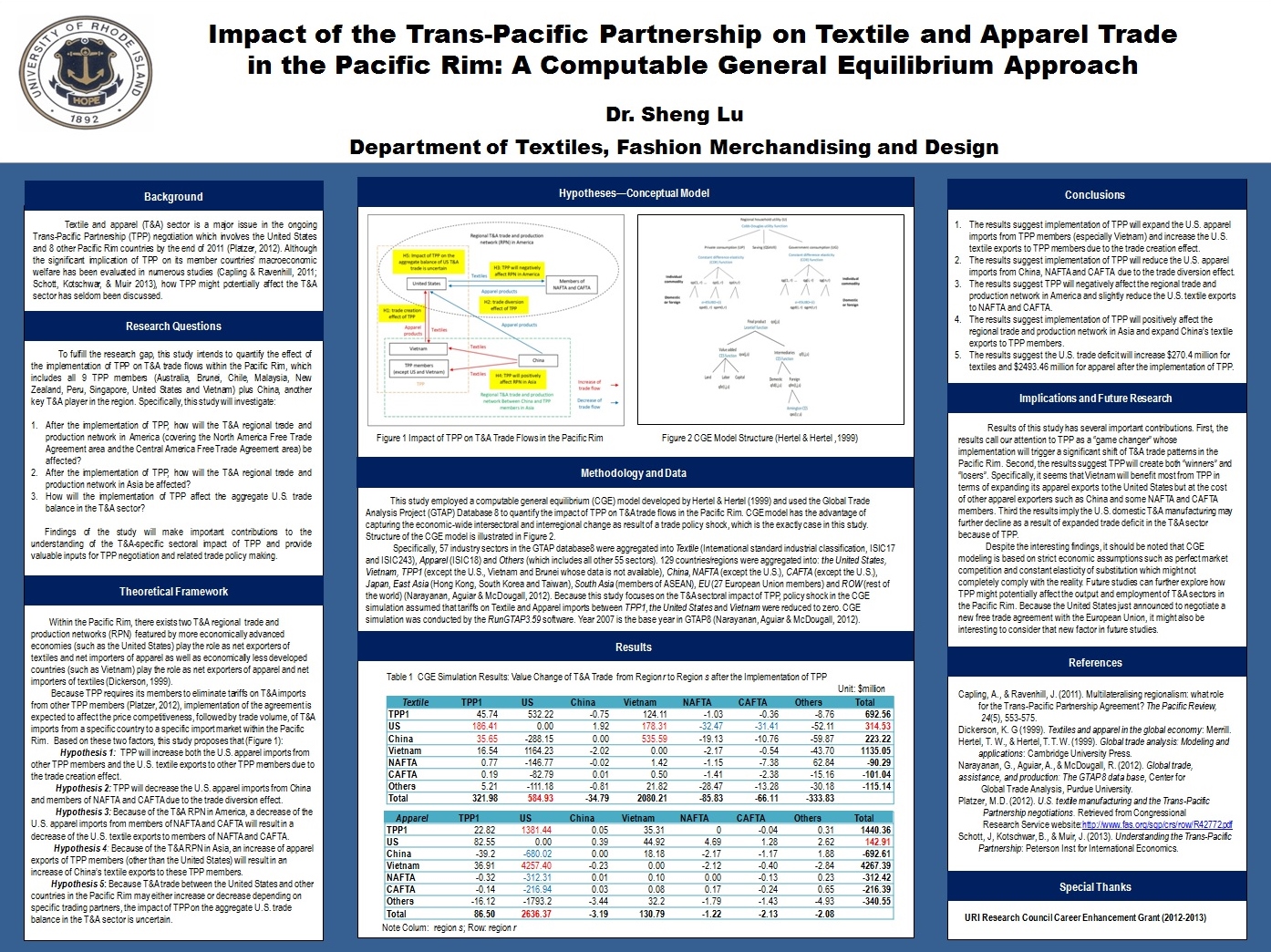
Citation: Lu, S. (2013). Impact of the Trans-Pacific Partnership on textile and apparel trade in the Pacific Rim. World Trade Organization Focus, 20(5), 67-77.
For questions, please contact the author: shenglu@mail.uri.edu
FASH455 Global Apparel & Textile Trade and Sourcing
Copyright© 2012-2026 Dr. Sheng Lu, Professor, Department of Fashion & Apparel Studies, University of Delaware

Citation: Lu, S. (2013). Impact of the Trans-Pacific Partnership on textile and apparel trade in the Pacific Rim. World Trade Organization Focus, 20(5), 67-77.
For questions, please contact the author: shenglu@mail.uri.edu
Yesterday in class, some of you asked why did the U.S. decide to join the TPP negotiation at the very beginning? The following report from the Financial Times (UK) may provide some insightful views. To put it simply, it is a big game involving national interests. You can also rethink about those points I mentioned in the class regarding the “strategic importance of Asia to the US”.
From Financial Times April 2, 2013
With the rise of China in its sights, the Obama administration has posted marines in Darwin, Australia, and increased the number of warships visiting Subic Bay in the Philippines. The “pivot” to Asia now has a new stopover: Brussels.
After years of discussing the idea, the US and the EU are finally starting to negotiate a free-trade agreement which would form an economic zone covering 40 per cent of the world’s gross domestic product.
At the same time, momentum is building on another important trade initiative, the Trans-Pacific Partnership, which brings together the US with several of the Asia-Pacific region’s most dynamic economies: Singapore, Australia, Vietnam and – since two weeks ago – Japan. It will come as a surprise to anyone who spent a lot of time on the campaign trail last year, but free-trade agreements have emerged as one of the biggest priorities of Barack Obama’s second term as US president.
The striking feature of this burst of free trading is who is absent. The agreements are one of the fresh ways Washington is developing to deal with China, the world’s biggest exporter of manufactured goods. After urging China to behave as “a responsible stakeholder” and after the brief flirtation with a G2 arrangement in Mr Obama’s first year, the latest trade approach might be characterised as ABC – Anyone But China.
Supporters of the US-EU trade pact complain that it is about more than China. They point to the boost to growth that could flow from a deal between two partners which already have a two-way annual trade in goods and services of $1tn.
However, much of the substance of the EU talks and of TPP points to China. The agenda includes state subsidies for business and protecting intellectual property – the sorts of issues that are huge bones of contention with Beijing.
If the US can get enough important countries to sign up, it hopes to establish global trading standards that China would feel obliged to respect.
On Capitol Hill, where free trade is not an easy sell in an era of unemployment of more than 7.5 per cent, the China angle helps to rally support.
“This is very much part of our China strategy,” an aide to a leading Republican senator puts it, talking of the discussions with the EU.
More broadly, the two negotiations reflect a different approach to global governance. Prolonged deadlock over the Doha trade round, with similar stalemates about climate change, small arms and other issues, has led to deep scepticism about the idea of achieving global agreements on important issues.
TPP and the US-EU trade talks represent an alternative strategy, an attempt to forge fresh rules by appealing to smaller groups of like-minded nations, in this case working around China rather than with Beijing. Supporters say this is not an abandonment of global institutions like the World Trade Organisation, but simply a realistic assessment of how to get things done.
The big question, of course, is how China will react. Ever since it joined the WTO more than a decade ago, China has had one foot inside the global trading system and one outside it.
On most of the occasions that China has lost legal challenges at the WTO, it has implemented the rulings and made its trade laws compliant. But Beijing has yet to open up government procurement, an important factor in an economy like China’s. At the same time, allegations of Chinese hacking of trade secrets from other countries are seen by many as an affront to the very idea of free trade.
Beijing has strong views about what is really going on.
“The US is trying to rewrite global trade rules behind our backs,” says a senior Chinese official.
The risk of the US approach is that it could encourage China to turn its back even further on the global trading system, diminishing the incentive to comply rather than intensifying it.
If that were to happen, the US-EU trade talks would not herald a new era of economic integration but rather another nail in the coffin of globalisation.
By Sheng Lu
The Congressional Research Service just released its most recent study on the U.S. textile manufacturing industry and the Trans-Pacific Partnership (TPP) Negotiation. This is also one of the limited reference available so far that specifically addresses the sectoral impacts of TPP.
Overall, this report did a good job of compiling latest statistics showing the operation of the regional trade & production network between the United States and those developing countries in central and south America. It also discusses why the U.S. textile industry appears to be very nervous about Vietnam.
However, the study wasn’t able to quantify the impact of TPP, which leaves potential for future studies. On the other hand, although debates over TPP centers upon the rules of origin, we shall not forget about foreign investment–especially when geographically Vietnam is very close to China, Japan and South Korea. Even yarn-forward is adopted, why cannot Chinese factories move their factories to Vietnam? It shall be noted that China’s economy is undergoing structural change and it’s the time for some Chinese factories to “go offshore”.
Full text of the report can be found here.

A row has flared up again over the yarn-forward rule of origin in US free trade agreements after The Hosiery Association (THA) called for a knit-to-shape, assembly-only exception for socks and hosiery in the Trans-Pacific Partnership (TPP).
Three textile trade associations have now written to US Trade Representative Ron Kirk expressing their “strong opposition” to the proposal.
The American Manufacturing Trade Action Coalition (AMTAC), National Council of Textile (NCTO) Organizations, and American Fiber Manufacturers Association (AFMA) say any such move “conflicts with the US textile industry’s longstanding support” of a yarn-forward rule of origin for textiles and apparel.
The yarn-forward rule requires all stages of production – from yarn spinning to fabric formation and final garment assembly – to be done either in the United States or in an FTA partner country to qualify for duty-free treatment.
US textile groups say the rule is “long-established” and “logical” because the value of a finished item comes from its components, rather than from its final assembly.
But American retailers, apparel brands, manufacturers and importers argue it is too restrictive, hinders new trade and investment in the sector, and renders most existing trade ineligible for preferential tariff treatment.
The Hosiery Association wants the TPP pact – currently being negotiated by the US, Vietnam, Brunei, Chile, New Zealand, Singapore, Australia, Malaysia and Peru – to allow hosiery producers to source yarns for man-made fibre socks and hosiery outside the TPP region in all instances except in the case of 100% cotton and polyester products.
But “this proposal would be a massive blow to US and other TPP producers who manufacture acrylic, nylon and various other types of man-made fibre yarns,” the textile groups say.
“In short, the THA proposal allows yarns currently made in large quantities in the United States to be sourced from third parties, notably China,” the letter says.

A recent study of the United States International Trade Commission reaffirms the special roles played by free trade agreements in supporting the regional trade-production network (RTN) for textile and apparel products in America and promoting the export of U.S.-made textile to developing countries in the region in particular. However, also as mentioned in the report, the influence of such RTN has sustantially declined since the full elimination of quota system in 2005. The implementation of the new FTAs established between US and countries in Asia-Pacific pose new uncertanties to the RTN in America, given the trade diversion effect commonly seen in FTAs.

A great commentary article on a recent study on trade protectionist measures by Chad Bown, a former professor from Brandeis university and a guru on trade remedy measures. It is interesting to note that the using of trade protectionist measures is much less frequent today than in the past. I agree with the reasons proposed by the article, such as the establishment of the WTO as a monitoring body, global production and emerging markets instead of developed countries becoming leading importers. On the other hand, trade protectionist measures are taking more diversified forms today and the scope has gone far beyond the traditional AD, CVD and safeguard measures. In particuar, measures that intend to promote export potentially could raise new trade disputes among leading exporters.
The full report can be downloaded from here
The Sixth Anniversary of Post-quota Era:
New Patterns of World Textile and Clothing Trade and Critical Trade Policy Issues
By Sheng Lu
Keywords: Post-quota era, world textile and clothing trade, trade policy
Impact of the elimination of the 40-year textile and clothing (T&C) quota system on January 1, 2005 has always been a research interest to scholars in the field. Shifting from a highly-distorted trading environment to a much more market-based competition, reshuffle of the world T&C trade in the post-quota era is widely believed to be unavoidable and will have ripple effects on the future landscape of the global T&C industry (Dickerson, 1999; Nordas, 2004).
After six years of transition, medium and long-term effects of quota elimination have begun to display, attributed to adjustment of business practices of T&A firms in response to the new “rules of the game” (UNIDO, 2009). By taking advantage of such great timing, this study scrutinizes patterns of world T&C trade that have been newly emerged so far in the post-quota era. Capturing these new trends of development at the macro-industry level can both deepen understanding about the 40-year quota system itself and raise awareness of emerging research agendas for world T&C trade.
Three specific post-quota patterns of world T&C trade are discussed in the study:
First, non-dominant position of China in world T&C export. At first glance, China increased its market share in world T&C export by roughly 10 percentage points from 2005 to 2008, suggesting China was one of the biggest winners of quota elimination (WTO, 2010). However, a closer look will find: (1) China gained its market share at a decelerating rate over that period, implying China’s export surge at the very beginning of quota elimination was mainly due to the temporary transition effect; (2) At the disaggregated 6-digit HS code level, China’s export performance varied greatly from product to product, implying other exporters was still able to compete with China in the post-quota era by focusing on certain T&C product categories; (3) A number of Asian and European countries other than China also enjoyed robust growth in T&C export since 2005, suggesting China was one of the beneficiaries rather than the only winner of the post-quota era. Last but not least, the emergence of the “China+1” sourcing strategy indicated that T&C importers already started selecting other possible substitution sourcing destination as China’s back-up. In particular, importers were cautions about China’s rising manufacturing cost and the business risks associated with placing “too many eggs in one basket”.
Second, geographic concentration of T&C trade and increasing dependence on textile manufacturing capacity for clothing export. This new pattern is closely associated with changes of buyers’ sourcing practices. Specifically: (1) Market concentration rate (Herfindahl index) in major T&C importing countries, such as the United States, Europe and Japan, quickly went up since 2005 because of buyers’ consolidation of their sourcing channels. Traditional trade patterns such as “triangle manufacturing” and “outward processing trade” which were artificially created by the quota system can no longer justify their rationality of existence when quota restriction were removed. (2) The traditional “Cut, Make and Trim” (CMT) sourcing practice was gradually replaced by full-package sourcing. This shift was largely caused by the upgrading of global T&C value chain, including the transition of branded manufacturers into marketers and retailers’ more active involvement in direct sourcing; (3) Compared to CMT, qualified destination for full package sourcing needs to have the capacity of locally manufacturing textiles. This requirement poses big challenges to many developing countries which haven’t established a sound textile industry yet due to their overall lagged behind economic development. Impacts of full package sourcing on many aspects of the global T&C industry can be further studied.
Third, widening gap of intra-region trade patterns between America and Europe. As one format of vertical division of labor formed by countries in the same region but at different development stages, intra-region trade was a special feature of the world T&C trade, especially in America and Europe (Dickerson, 1999). However, statistics showed that intra-region trade in America quickly dropped from 69% to 55.7% for textiles and 48.5% to 26.9% for clothing from 2004 to 2008 (WTO, 2010). The decline occurred despite the new passage of several free-trade agreements which deliberately include clauses encouraging the using of U.S.-made textile products by neighboring developing countries. Accompanied with lowering share of intra-region T&C trade, imports from Asia keep constant rising in America over the same period. In contrast, share of intra-region trade in Europe remained stable, stood at around 75% for textiles and 82% for clothing. More studies can be done to explore the causes of such widening gap between America and Europe in terms of intra-region trade patterns.
This study also calls for awareness of “unexpected” negative effects of some trade policies on developing countries’ T&C export in the post-quota era. These trade policies include although not limited to: (1) WTO Doha Development Agenda (DDA). The DDA negotiation set the goal to cut import tariff for T&C product worldwide. However, reduced tariff rate will also wear down the real benefits of preferential duty-free treatment enjoyed by some least developed countries when competing with T&C export giants such as China and India; (2) Rule of origin (ROO) provisions in free-trade agreements. ROO originally was developed to ensure preferential treatments be enjoyed only by eligible FTA members. However, as ROO is specific to each FTA, the complexity and inconsistency made many preferential treatments seldom be taken advantage of. ROO further reduces the incentives for developing countries to develop their own textile industry. This put developing countries at a special disadvantage position when buyers are shifting to full package sourcing as discussed above. (3) Generalized System of Preferences (GSP). Aimed at promoting economic growth in the developing world, developed countries allow preferential duty-free entry of imports from eligible developing countries through the GSP program. Ironically, although T&C account for 50%-90% of total exports for many developing countries (WTO, 2010), most T&C importers including the United States and the European Union still reject including T&C in their GSP programs due to opposition from political forceful domestic industries with concerns about import competition. It is a challenge for policy makers in the post-quota era to design a set of fair and rational trading rules under which developing countries can enjoy the benefits of quota elimination and have more opportunities participating in world T&C trade. Academia has its key role to play in this endeavor.
References
Dickerson, K. G. (1999). Textiles and apparel in the global economy. N.J.: Merrill
Nordas, H. K. (2004). The global textile and clothing industry post the agreement on textiles and clothing. WTO discussion papers, 5. Geneva: WTO Publications
United Nations Industrial Development Organization, UNIDO (2009). The Impact of Institutions on Structural Change in Manufacturing: the Case of International Trade Regime in Textiles and Clothing. Vienna: Austria
World Trade Organization, WTO. (2010). World Trade Statistics, Geneva: Switzerland
Read the full article from the New York Times:
My comment:
It is important to realize that the U.S. textile industry and the U.S. apparel industry today are no longer close parnters. Why? Because they choose different restructuring strategies in response to globalization and rising imports.

 FASH455 Global Apparel & Textile Trade and Sourcing