Is clothing “made in USA” more ethical? How “ethical” should be defined?

It has become a commonly held view that apparel workers in many developing countries are unfairly treated because they are much lower paid compared with their counterparts in the developed countries.  For example, American Apparel, a company that insists all of its products made in USA, claims itself to be sweatshop-free on the basis that it pays workers an hourly wage of $12.  However, does an hourly wage of $12 in the USA necessarily mean more “ethical” than an hourly wage of several cents in a poor developing country like Bangladesh?  

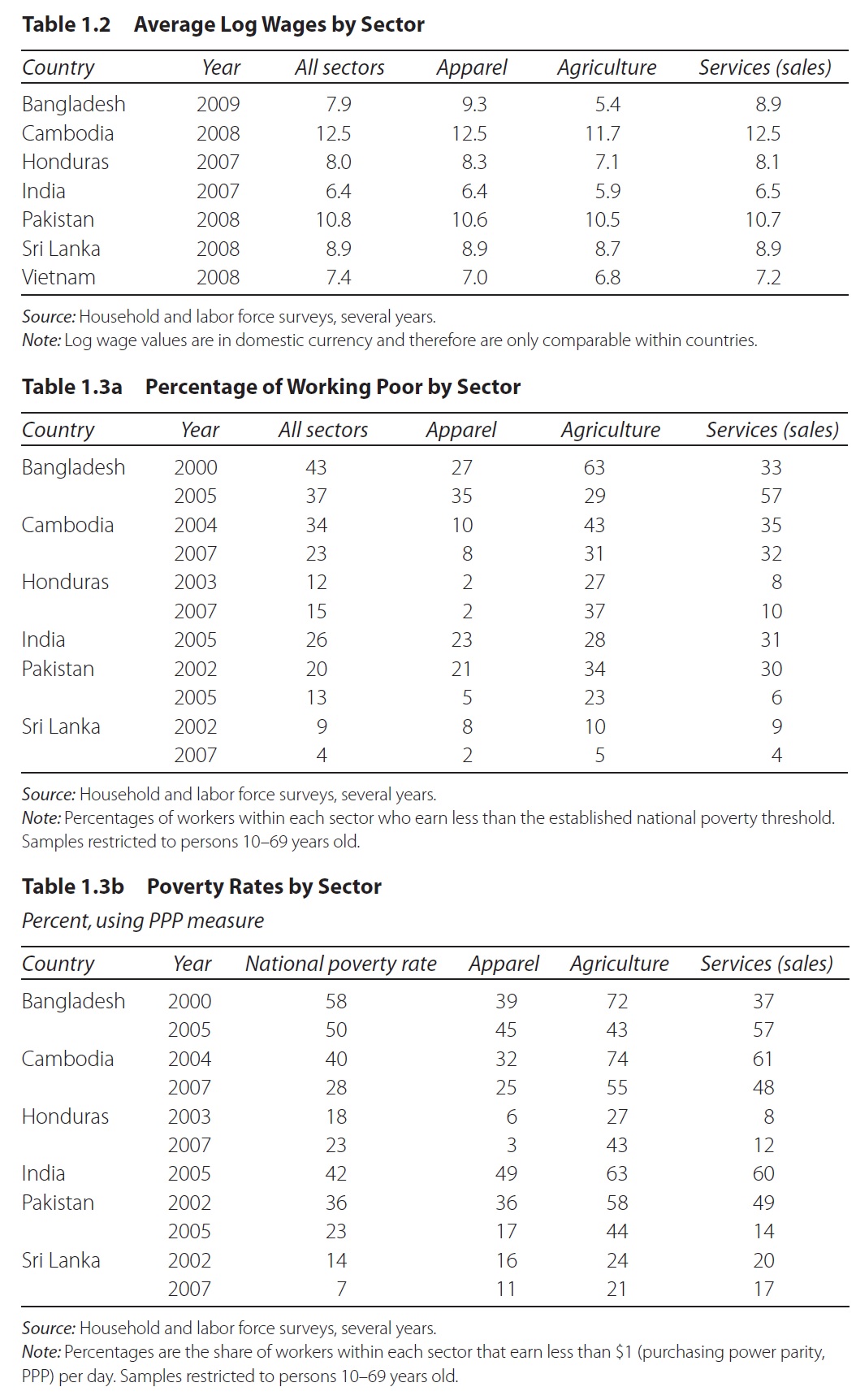
An often ignored fact is that in many developing countries, jobs in the apparel sector are better paid than positions in other sectors. For example, according to a recent study conducted by the World Bank, in Bangladesh, wage level in its apparel sector is 17.7% higher than the average level of all sectors, 72.2% higher than the wage level in the agriculture sector and 4.5% higher than the wage level in the service sector. This is not surprising, because in many developing countries, “moving from agriculture and low-end services into apparel jobs is a channel for social upgrading” (Lopez-Acevedo & Robertson, 2012).

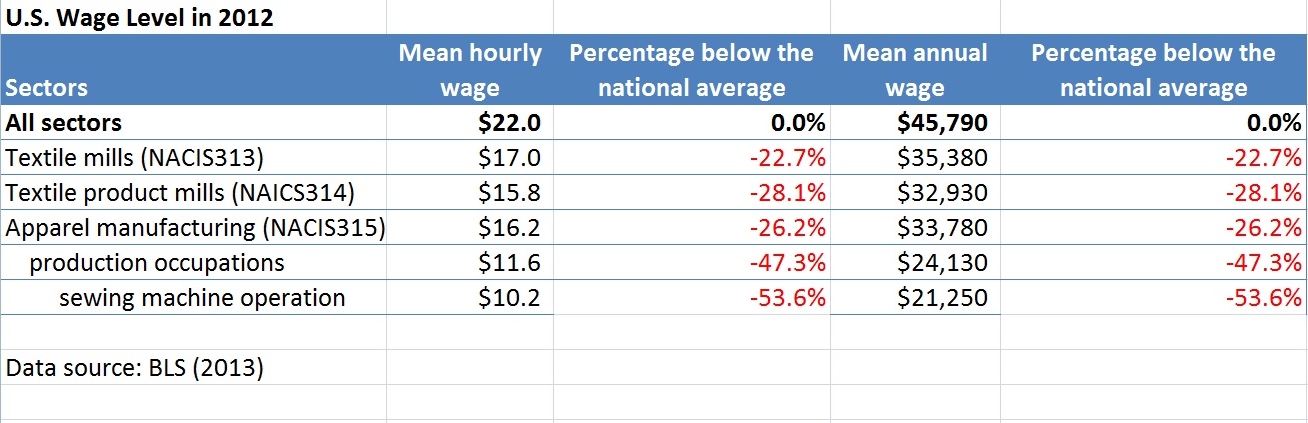
Then, what does an hourly wage of $12 mean in a developed country like the United States? Data from the Bureau of Labor Statistics show that, in 2012, average wage level in the U.S. apparel manufacturing sector (NAICS 315) is 26.2% below the average wage level of all sectors. More specifically, the average wage level for the production occupations is 47.3% below the national average level and 53.6% below the national average level for sewing machine operators, the exact type of job that the hourly wage of $12 refers to. 

The point to make here after the comparison is that it is misleading to define “ethical” or comment on “corporate social responsibility” without putting the matter in the context of the stage of development and the nature of the economy.  Wage level is not determined by good will, but by the principle of economics 101.

By Sheng Lu

apparel payment

Untitled

TPP updates: Hong Kong and South Korean textile firms increase FDI in Vietnam

The American Chamber of Commerce in Vietnam recently updates the textile & apparel sectoral negotiation under the TPP. At this point, different stake holders in the negotiation still hold divided views on a number of key issues, such as the rules of origin and short supply list. It is not a country line, but a line between different business types. What is also interesting to watch is that textile firms from Hong Kong and South Korea have taken actions to seize the “strategic opportunity” of investing in Vietnam. In the long run, it is not positive news for the U.S. textile mills to see Vietnam become more self-dependent on textile supply. However, few people believe TPP would conclude by the end of this year…

Full text of the article:

In Vietnam in preparation for the Trans-Pacific Partnership duty-free exports of apparel from Vietnam to the USA in accordance with the Textiles and Apparel Chapter rules of origin.

Senator Richard Burr (R-NC) asked USTR Michael Froman at the Jun 6, 2013 Senate Finance Committee hearing on the nomination, ” … a poorly negotiated TPP agreement could result in the loss of hundreds of thousands of U.S. jobs in the textile sector … If confirmed as the U.S. Trade Representative, will you support the yarn-forward rule of origin?”

Ambassador Froman replied, “The short answer is yes. We have made clear that we need clear rules of origin with yarn-forward at the center, we need rules against trans-shipments … the yarn-forward fule is a central part of our approach to textiles.” Click this link to see a C-SPAN video of the Senate Finance Committee hearing (0:27:41).

The “yarn forward” rule of origin means that all products in a garment from the yarn stage forward must be made in one of the countries that is party to the TPP agreement. In simple terms, the “yarn forward” rule means that the benefits of the agreement accrue to producers in TPP member countries rather than producers in non-TPP countries.

Perhaps in response, Mr. Nguyen Vu Tung, Deputy Chief of Mission at Vietnam’s Embassy to the USA in Washington, said at a conference on Jun 19, 2013, that the latest U.S. offer “is really, really difficult for us to accept.” Unless the two sides can reach a breakthrough, “I’m really concerned about the prospect of Vietnam to conclude the successful negotiation of TPP,” he said. According to the report, ”U.S. textile producers sell billions of dollars of yarn and fabric each year to U.S. free trade partners in Latin America, where it is turned into clothing and sent back to the United States. They fear without the yarn forward rule, Vietnam will be able to shut down that trade by importing yarn and fabric from China to make clothing to ship duty-free to the United States.”

Deputy Chief of Mission Nguyen Vu Tung made the comment at a conference organized by the Woodrow Wilson Center in Washington on The Trans-Pacific Partnership: New Rules for a New Era, Jun 19, 2013 (3 hours), with opening remarks by Robert Zoellick, former U.S. Trade Representative, former U.S. Deputy Secretary of State, and former World Bank President. Click the link to see a video of the webinar.

While political leaders and diplomats discuss the Trans-Pacific Partnership rules of origin, Hong Kong, South Korean, and Australian firms are developing and planning major textiles FDI in Vietnam to produce yarn and fabric, the supporting textiles industry for apparel production.

Korea’s Kyungbang inaugurates new $40 million yarn facility in Binh Duong; plan to develop the largest yarn-spinning in Asia. When the plant is extended in its second and third phase (with registered investment of $160 million), it will be the largest mill in Asia.

Hong Kong’s Texhong to invest $300 million, Pacific Textiles $180 million in new textile facilities in Vietnam, in preparation for TPP

Texhong has has already invested $200 million in a plant in Dong Nai Province, and committed in Jul 2012 $300 million to a factory in Quang Ninh, which should be operational in the 2nd half of 2013.

Last year [2012] Texhong said it would invest $300 million to build a new yarn factory in Quang Ninh.. When the second-phase investment is completed next year [2014] its annual capacity will more than double to 110,000 tonnes of yarn.

Australia’s Woolmark® helps develop yarn-forward wool products in Vietnam. Today there are close to 50 companies in Vietnam using Australian wool. “When we started the project, none of the manufacturing partners knew anything about wool, and some of them had never even felt it,” said AWI project manager Jimmy Jackson. Initially we ran training courses to explain wool’s properties, benefits and features for manufacturing and producing garments. The next step was to introduce the manufacturers to suppliers of Australian wool yarns. We also had to explain the Woolmark standards and requirement in terms of both wear and laundering performance. Now that the Vietnamese manufacturers are confident in producing quality wool garments, AWI will introduce them to global retail and brand buyers.

A Global View in Mind Means More Job and Career Oppertunities in the Fashion Apparel Industry

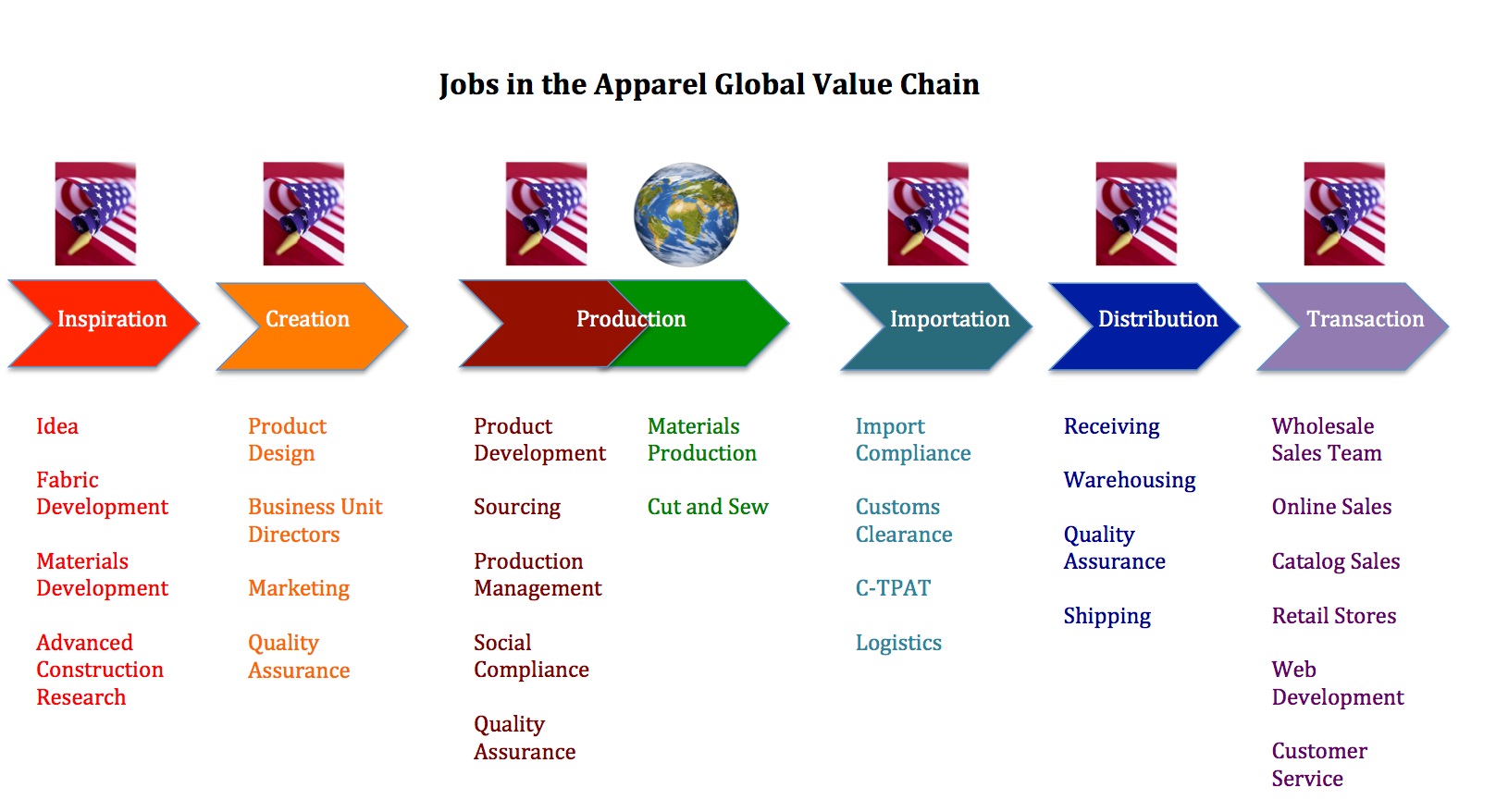
(Note: the functions & jobs below the U.S. flag mean they are based in the United States;  Remember, apparel are “made in the world”–just like iphone and ipad. Even imports contain U.S. added value.)

021313_Moongate_Assoc_Global_Value_Chain_Report

Source: Moongate Association (2012). Analyzing the Value Chain for Apparel Designed in the United States and Manufactured Overseas

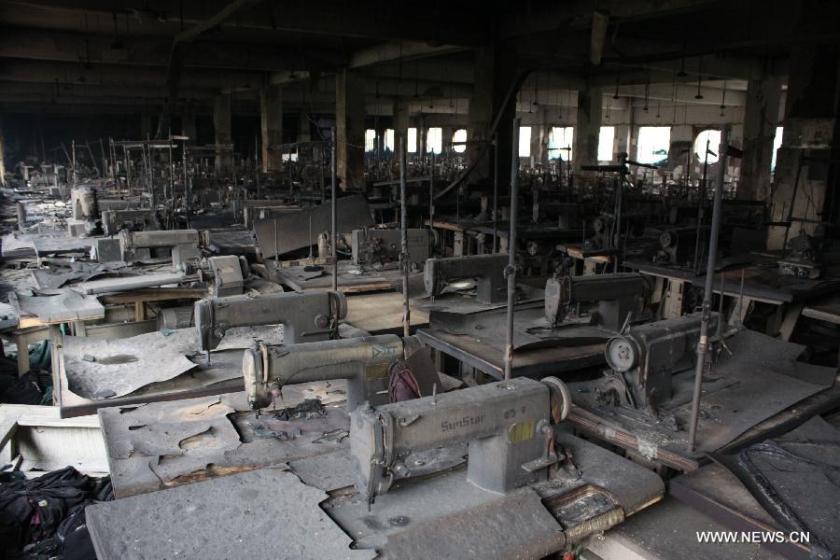
Building Collapse Kills 200 Bangladeshi Garment Workers

jp-bangladesh1-articleLarge

When can tragedy as such come to an end!?

NewYork Times reports today (April 25, 2013)

“A building housing several factories making clothing for European and American consumers collapsed into a deadly heap on Wednesday, only five months after a horrific fire at a similar facility prompted leading multinational brands to pledge to work to improve safety in the country’s booming but poorly regulated garment industry.

The Bangladeshi news media reported that inspection teams had discovered cracks in the structure of Rana Plaza on Tuesday. Shops and a bank branch on the lower floors immediately closed. But the owners of the garment factories on the upper floors ordered employees to work on Wednesday, despite the safety risks.

International attention was focused on labor conditions in Bangladesh five months ago, with the fatal fire at Tazreen Fashions, a garment factory near Dhaka. That fire brought pledges from government officials and many global companies to tighten safety standards.

Bangladesh is the world’s second-leading garment exporter, trailing only China, but the industry has been plagued by concerns over safety and angry protests over rock-bottom wages. The industry has grown rapidly in the past decade, particularly as rising wages in China have pushed many global clothing companies to look for lower costs elsewhere. Bangladesh has the lowest labor costs in the world, with the minimum wage for garment workers set at roughly $37 a month.

Such low labor costs have attracted not just Walmart but almost every major global clothing company, including Sears, Gap, Tommy Hilfiger and many others. Bangladesh now has more than 5,000 garment factories, employing more than 3.2 million workers, many of them women, and advocates credit the industry for lifting people out of poverty, even with such low wages. Exports also provide a critical source of foreign exchange that helps the government offset the high costs of imported oil.

But critics have argued that the outsize importance of the industry has made the government reluctant to take steps that could increase costs or alienate foreign brands. Labor unions are almost nonexistent, and a labor organizer, Aminul Islam, was tortured and murdered last year. The case remains unsolved. Meanwhile, some factory owners say they cannot raise wages or invest in upgrading facilities because of the low prices paid by Western brands.

The news was also covered by CNN:

http://www.cnn.com/2013/04/25/world/asia/bangladesh-building-collapse/index.html

NPR News Discussion

http://www.npr.org/2013/05/02/180557959/ethical-fashion-is-the-tragedy-in-bangladesh-a-final-straw

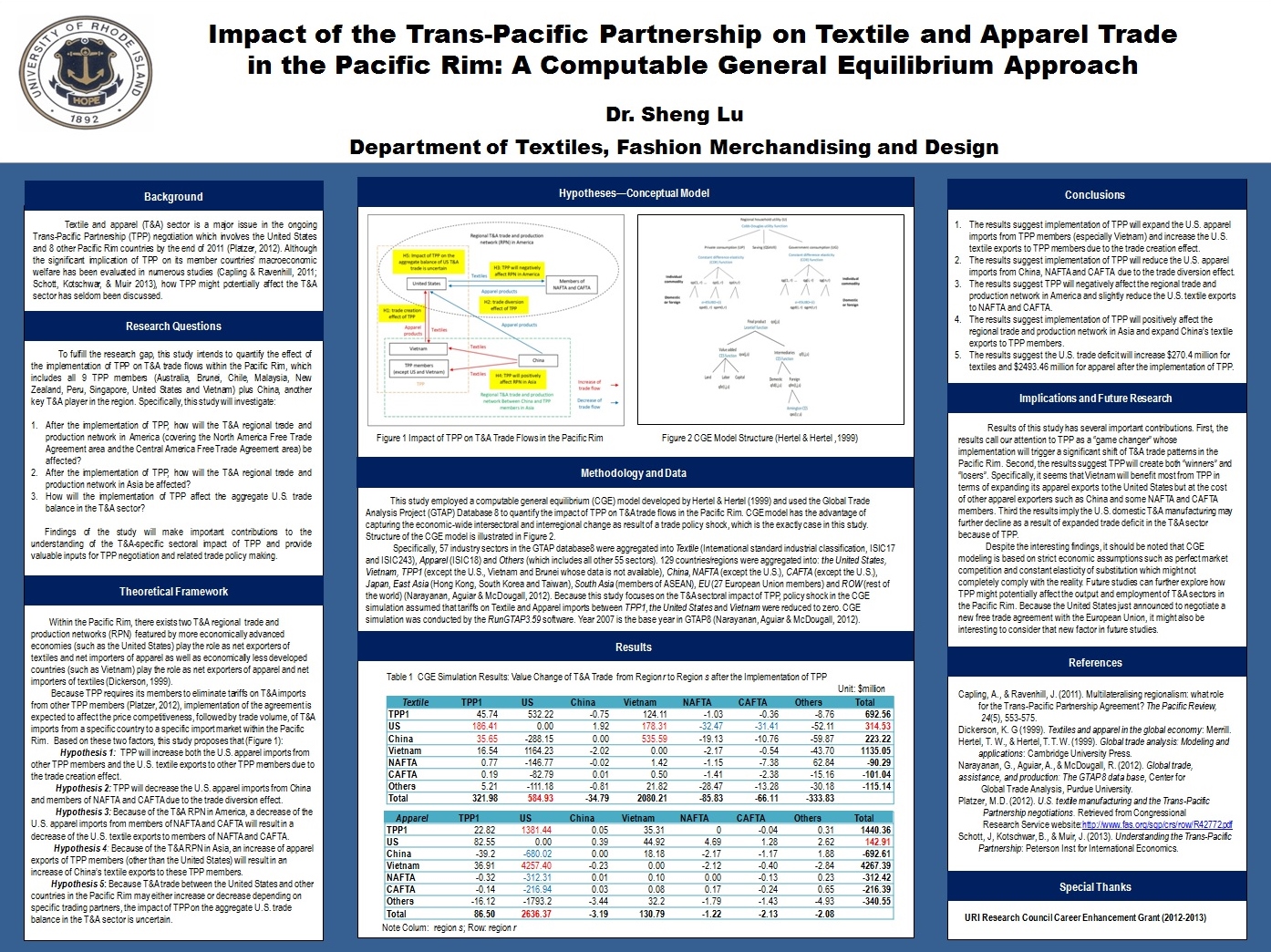
Impact of the Trans-Pacific Partnership on Textile and Apparel Trade in the Pacific Rim

TPP on T&A trade in the pacific rim

Citation: Lu, S. (2013). Impact of the Trans-Pacific Partnership on textile and apparel trade in the Pacific Rim. World Trade Organization Focus, 20(5), 67-77.

For questions, please contact the author: shenglu@mail.uri.edu

Global Apparel Sales Push Ahead in 2012

untitled

Is Textile and Apparel Manufacturing Coming back to the U.S.?

output

output growth rate

employment

employment growth rate

Preliminary Findings:

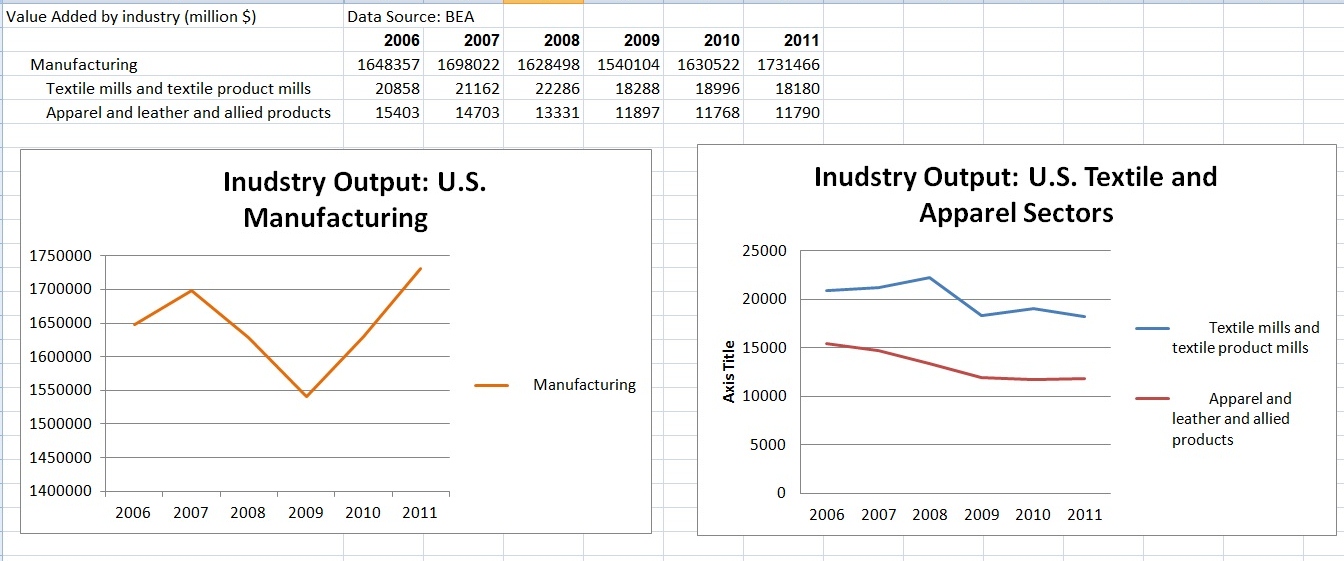
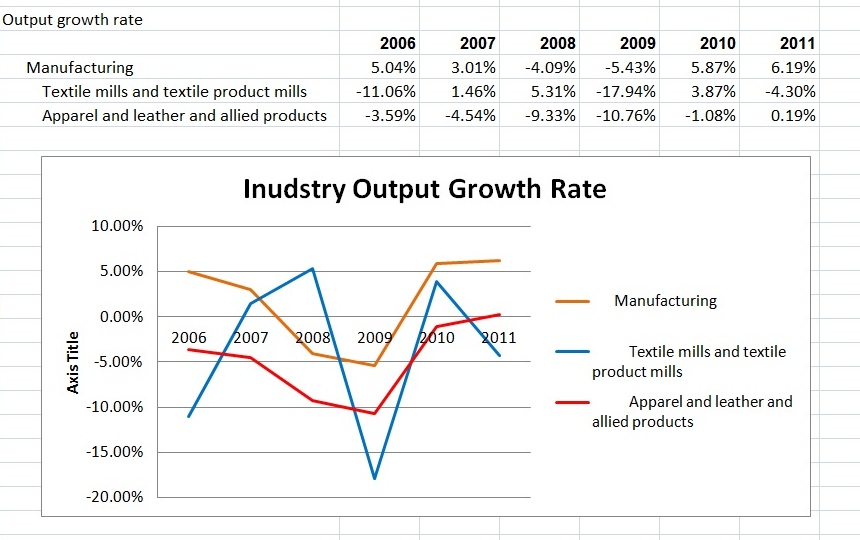
1. As suggested by numerous studies, the U.S. manufacturing sector as a whole demonstrated a robust V-shaped recovery from the 2008 financial crisis in terms of industry output.   Growth rate of the industry output from 2010-2011 was also among the highest in the past 10 years.

2. There is no sign yet that textile and apparel (T&A) manufacturing is coming back to the U.S, despite suggested popularity of “insourcing” as result of rising labor cost in China. However, the decline rate of apparel manufacturing in the U.S. seemed to be slowing down.

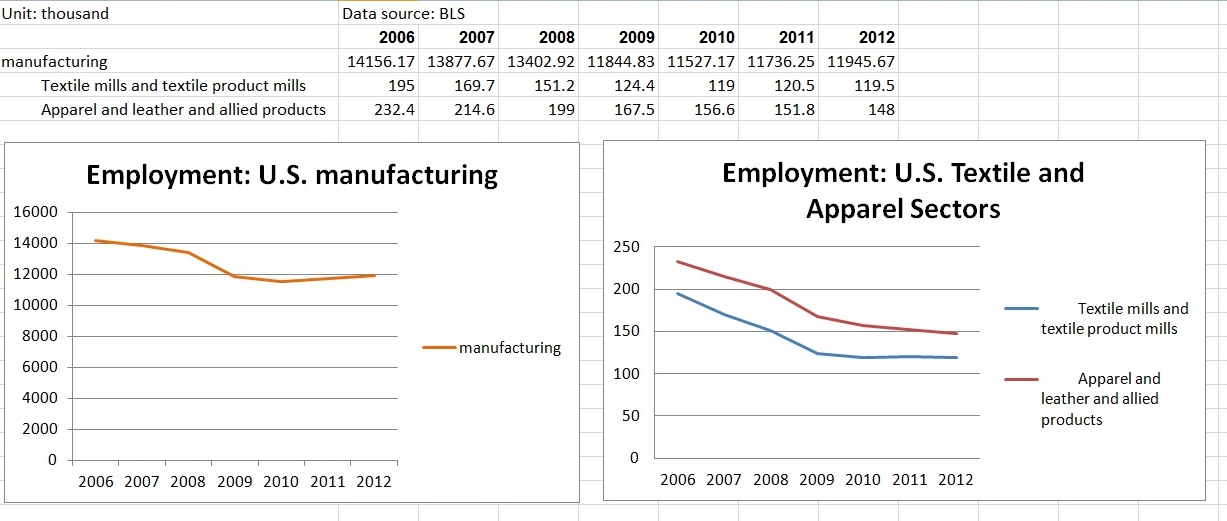
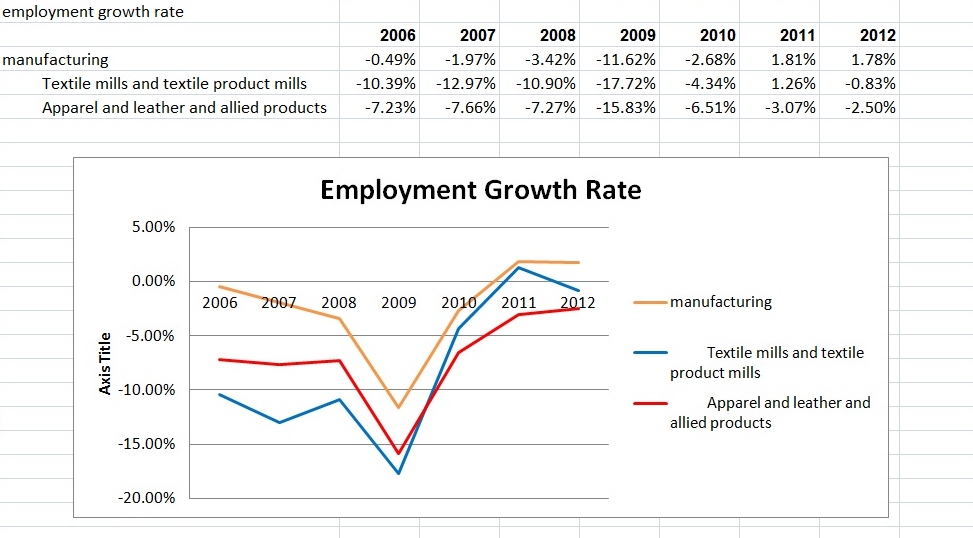
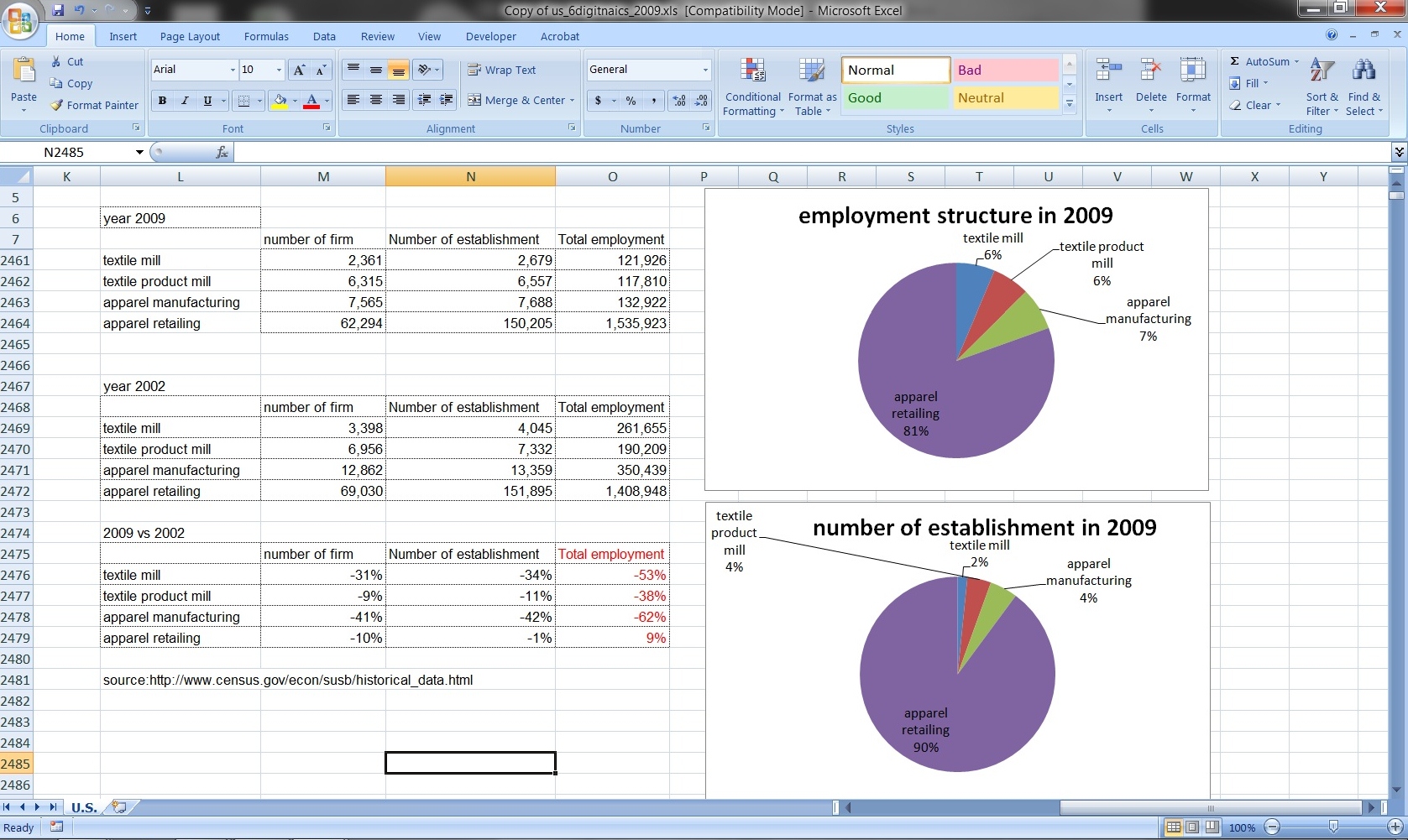
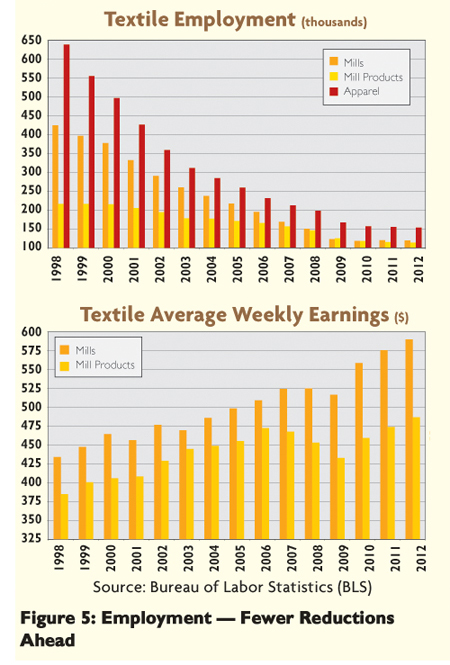
3. Jobless recovery happened both in the U.S. manufacturing sector as a whole and in the T&A manufacturing sectors. Particularly, the U.S. T&A industry respectively lost 21.0% and 25.6% of its manufacturing jobs from 2008-2012 compared with only 10.8% decline of employment in the manufacturing sector over the same period.  Based on the current data, it can be concluded that a sizable return of manufacturing jobs in the U.S. T&A industry would hardly occur at least in the near future.

Sheng Lu

What we shall learn from the Bangladesh fire accident?

131998035_51n

1. Is corporate social responsibility a problem ONLY in developing countries?

How ethical is  clothing “made in UK” or “made in USA”? Suggested reading:

ANALYSIS – How ethical is UK manufacturing? (Textile Month International, 2012)

Sweatshops Are Fashion’s Dirty Little Secret. But They Don’t Exist in L.A. — Do They? (2012)

2. As a consumer, shall we be responsible for something too?

Isn’t that we always want better quality products at lower price and delivered at faster speed? Because clothing retail is such a highly competitive buyer-driven business, in order to meet our “demand”, isn’t companies have to find a way to increase product quality, shorten production time, frequently change design patterns but stick to the old delivery schedule and lower sourcing cost? Can we say the “race to the bottom” CRS practice in clothing factories has nothing to do with us as consumers?

3. Some people suggest: since there are so many ethical problems in developing countries, why not we just move apparel manufacturing back to the US or EU?

 If you ask these garment workers in Bangladesh, they would tell you that despite the horrible working conditions, they still feel “happy” to work there. Before working for the garment factory, their life was even worse—because of poverty and limited opportunity available to them. For example, for many young females in the least developing countries, if they do not work for garment factories, the other place for them to go is prostitution. We need to think about this question: if the Bangladesh factory was forced to close (Western brands no longer give them the order), what would happen to its workers?

4. Why internationally we still have no official labor standard, despite we have international organizations such as ILO, WTO, World Bank and United Nations out there as well as many international rules in other areas?

The nature of the problem is very similar as the ongoing global climate change negotiation. Countries are at different stages of development and what seems “ethical” may not necessarily fit for another country’s national conditions.

But still, everyone has a role to play to improve the status quo and create a better world, no matter as a consumer, professional working in the T&A industry, scholar or policy maker.

Sheng Lu

How many U.S. consumers are willing to spend $1,300 for a blazer, $170 for a dress shirt, $80 for a tie and $390 for a pair of jeans?

Recently, WSJ wrote a story about apparel “made in USA”. Although apparel manufacturing will never disappear in the U.S. (as the case elsewhere in the world), neither is it likely that those lost labor-intensive manufacturing jobs in the apparel sector will come back in the future. Why? Just ask yourself: Am I willing to spend $1,300 for a blazer, $170 for a dress shirt, $80 for a tie and $390 for a pair of jeans? These are the price tags associated with “Made in USA” for apparel.

Apparel is not a single case. If you’d like to enjoy your iPhone “Made in USA”, please add two “00” to the current price tag. Like it or not?

Similar questions can also be raised to the Europeans, Chinese, Koreans and everyone else in the world. For example, what will happen if China does not import U.S. cotton but totally relies on its domestic supply? What will happen if each country tries to produce their own air plane instead of using Boeing’s aircraft? How about European retailers only accept credit card issued by an European financial service provider and reject Visa or America Express? And how long will it take to deliver a package to Asia if FedEx and UPS are not allowed to operate in these regions? Will these “changes” improve or worsen people’s daily life? The answer is obvious.

Globalization does not mean “Made in China”nor “Made in USA”. Rather, it means “Made in the World” based on each country’s comparative advantage, it means getting access to the world resources and using them more wisely and more efficiently. Why not everyone engages in doing something they are good at doing and then exchange? This is why we go grocery instead of growing vegetables nor raising cows by ourselves today. 

Globalization also means a product now can reach the world market beyond the limited domestic market. But a country can only successfully export when another country is willing to import. This is why we need to support trade liberalization so that every country can export more of those products they are competitive in making. And definitely more jobs will be created domestically. I mean every country that engages in such global “exchange”.

We no longer live in the 15th century when the Mercantilism was born. In the 21st century, export is good and import is equally good for the economy. Embrace globalization and enjoy better life~  

Sheng Lu 

Data source: American  Apparel and Footwear Association (2012)

Data source: U.S.-China Business Council

OTEXA identifies top export markets for U.S. textile and apparel

The Office of Textiles and Apparel (OTEXA) recently released its 2012 Going Global Report, which identifies 15 top export markets for U.S. made textiles and apparel. The report also includes statistical profile of these 15 countries, including their GDP per capita, GDP growth and bilateral trade with the United States in recent years.

It is interesting to note that the top export markets for textile and for apparel are very different. Wonder why? Please think about the “stages of development theory” we discussed in class.

HS code refers to the “Harmonized tariff schedule” (HS), a classification system for commodities. Textile and apparel are covered by HS code chapter 50-63. Detailed list can be found at http://www.usitc.gov/tata/hts/bychapter/index.htm

The report can be downloaded from here

US: Yarn-forward rule row flares up again

polyester-yarn-import-175429_189210

A row has flared up again over the yarn-forward rule of origin in US free trade agreements after The Hosiery Association (THA) called for a knit-to-shape, assembly-only exception for socks and hosiery in the Trans-Pacific Partnership (TPP).

Three textile trade associations have now written to US Trade Representative Ron Kirk expressing their “strong opposition” to the proposal.

The American Manufacturing Trade Action Coalition (AMTAC), National Council of Textile (NCTO) Organizations, and American Fiber Manufacturers Association (AFMA) say any such move “conflicts with the US textile industry’s longstanding support” of a yarn-forward rule of origin for textiles and apparel.

The yarn-forward rule requires all stages of production – from yarn spinning to fabric formation and final garment assembly – to be done either in the United States or in an FTA partner country to qualify for duty-free treatment.

US textile groups say the rule is “long-established” and “logical” because the value of a finished item comes from its components, rather than from its final assembly.

But American retailers, apparel brands, manufacturers and importers argue it is too restrictive, hinders new trade and investment in the sector, and renders most existing trade ineligible for preferential tariff treatment.

The Hosiery Association wants the TPP pact – currently being negotiated by the US, Vietnam, Brunei, Chile, New Zealand, Singapore, Australia, Malaysia and Peru – to allow hosiery producers to source yarns for man-made fibre socks and hosiery outside the TPP region in all instances except in the case of 100% cotton and polyester products.

But “this proposal would be a massive blow to US and other TPP producers who manufacture acrylic, nylon and various other types of man-made fibre yarns,” the textile groups say.

“In short, the THA proposal allows yarns currently made in large quantities in the United States to be sourced from third parties, notably China,” the letter says.

Apparel Market: Landscape of Change

An article from the Textile World Highlights:

  • The global apparel retail industry grew by 3.4% in 2011 to reach a value of $1,175,353.1 million. In 2016, the global apparel retail industry is forecast to have a value of $1,348,098.8 million, an increase of 14.7% since 2011.  Americas accounts for 36% of the global apparel retail industry value.
  • Technlogy is changing consumers’ shopping behavior as well as preferences (such as redefining value of products). The internet, smartphones and social networking are driving the apparel industry to a greater extent than ever before.
  • “Made in USA” is attracting consumers, however, to be more accurate, it means “source in the Western Hemisphere” rather than moving manufacturing totally back in the U.S.. However, in order to have “near sourcing” happen, addtional trade liberalization is required to remove the so much constraints.  
  • Supply chain transparancy and cooridnation is with growing significance to the success of business in the apparel companies.
  • The only constant in the apparel industry is change (enviorment, business model, product innovation, technology…).

Re-shoring US apparel making tough but not impossible

This recent comment from Just-style argues that re-shoring U.S. apparel manufacturing may become likely given China’s quickly rising labor cost. However, another two points mentioned by the article deserve more attention: one is that in order to make “made-in-USA” apparel competitive, industry leaders believe that tariffs and trade barriers on imported yarns and fabrics need to be much lowered. The question is, how realistic this “goodwill” can become true, considering the attitude of the US textile sector on the matter and their political influences. Second, although there might be some demands for sewing jobs in the U.S., these occupations are very low paid. The article admits that except immigrant, propably few Americans today (even those unemployeed) would like to take them (and have the qualified skills).  Then, does re-shoring really matter for college graduates in the fashion apparel program?  

To read the full article, click here

Megatrend in the US textile and apparel sector

(click the picture to enlarge)

Opinion: Apparel imports boost U.S. jobs

Key points:

“These four million U.S. workers – seen and unseen – help you get dressed every day. They design shoes and clothes, perform research and development, cut and sew, supervise production, handle customs and logistics, ensure product safety compliance, market and merchandise product, outfit our troops and work on the sales floor. In addition to these four million workers, there are countless U.S. transportation, distribution, warehousing, and logistics workers who depend on our industry for their jobs.”

“about 75 percent of the retail value of most clothing and footwear comes from non-manufacturing activities that happen entirely inside the United States.”
“Supply chain jobs and manufacturing jobs are equally valuable to the overall health of the U.S. economy. It is wrong to foster a public policy agenda that forces these two groups to compete against each other. ”

Written by Kevin Burke. president and chief executive officer of the American Apparel & Footwear Association.

Read more: http://www.politico.com/news/stories/0712/78779.html#ixzz21PNrJzHK

China’s Apparel Market, 2011

Image

The report is prepared by Li & Fung and includes the following parts:

  1. Market overview
  2. Competitive landscape
  3. Latest developments
  4. Snapshots of sub-sector performance

To read the full report, click here

Fashion Forward: Zara is trying to go global

Can fast fashion go global? Does the business model which heavily rely on local supply fit for global operation? As mentioned in the article, 70% of Zara’s sale in 2001 came from the EU, although it has opened 179 new stores in Asia in 2011, 156 of them in China.

To do business in emerging markets may incur many unique barriers and challenges. For example, the article reported that China’s consumer watchdog attacked Zara for poor quality in 2011. Often time we see much heavier invovlement of government in economic activities. And many emerging markets are very segmented (due to regional economic development gap) than in the US/west. Europe.

To read the fulltext, click here

Outlook for the US Textile Inudstry in 2012

An annual report prepared by the Textile World on the outlook of the U.S. textile industry in the year ahead. The report covers topics ranging from the industry output, market evaluation, price, international trade, job market and policy enviorment.

As noted by the report “Despite declines in employment, job prospects for skilled workers, engineers and merchandisers should be tolerably good as the industry evolves into one that primarily requires people with good communication skills, creativity, and who are skilled enough to operate today’s high-technology, computer-operated machines.”

To read the fulltext of the report, click here

Global Apparel Value Chain Trade and Crisis

Gereffi, G. & Frederick, S. (2010). The Global Apparel Value Chain, Trade and the Crisis: Challenges and Opportunities for Developing Countries. The World Bank.: Washington DC

One recent work of Dr. Gary Gereffi, a well-known expert on value chain studies, on the impacts of the financial crisis on the global apparel industry. It is suggested that the developing countries will gradually move up in the value chain and undertake more value-added functions such as design and product development. This is a two-edge sword to T&A industries in the developed countries. It could mean more resources to take advantage of and more intensified compeitition at the same time. Although Dr. Gary uses the concepts of OEM, ODM and OBM to describe evolution of the apparel chain, the major conlusions are compatable with the famous stages of development theory suggested by Toney (1986).

To read the fulltext, click here

The Sixth Anniversary of Post-quota Era

The Sixth Anniversary of Post-quota Era:

New Patterns of World Textile and Clothing Trade and Critical Trade Policy Issues

By Sheng Lu

Keywords: Post-quota era, world textile and clothing trade, trade policy

       Impact of the elimination of the 40-year textile and clothing (T&C) quota system on January 1, 2005 has always been a research interest to scholars in the field. Shifting from a highly-distorted trading environment to a much more market-based competition, reshuffle of the world T&C trade in the post-quota era is widely believed to be unavoidable and will have ripple effects on the future landscape of the global T&C industry (Dickerson, 1999; Nordas, 2004).

After six years of transition, medium and long-term effects of quota elimination have begun to display, attributed to adjustment of business practices of T&A firms in response to the new “rules of the game” (UNIDO, 2009). By taking advantage of such great timing, this study scrutinizes patterns of world T&C trade that have been newly emerged so far in the post-quota era.  Capturing these new trends of development at the macro-industry level can both deepen understanding about the 40-year quota system itself and raise awareness of emerging research agendas for world T&C trade.

Three specific post-quota patterns of world T&C trade are discussed in the study:

First, non-dominant position of China in world T&C export. At first glance, China increased its market share in world T&C export by roughly 10 percentage points from 2005 to 2008, suggesting China was one of the biggest winners of quota elimination (WTO, 2010). However, a closer look will find: (1) China gained its market share at a decelerating rate over that period, implying China’s export surge at the very beginning of quota elimination was mainly due to the temporary transition effect; (2) At the disaggregated 6-digit HS code level, China’s export performance varied greatly from product to product, implying other exporters was still able to compete with China in the post-quota era by focusing on certain T&C product categories; (3) A number of Asian and European countries other than China also enjoyed robust growth in T&C export since 2005, suggesting China was one of the beneficiaries  rather than the only winner of the post-quota era. Last but not least, the emergence of the “China+1” sourcing strategy indicated that T&C importers already started selecting other possible substitution sourcing destination as China’s back-up. In particular, importers were cautions about China’s rising manufacturing cost and the business risks associated with placing “too many eggs in one basket”.

Second, geographic concentration of T&C trade and increasing dependence on textile manufacturing capacity for clothing export. This new pattern is closely associated with changes of buyers’ sourcing practices. Specifically: (1) Market concentration rate (Herfindahl index) in major T&C importing countries, such as the United States, Europe and Japan, quickly went up since 2005 because of buyers’ consolidation of their sourcing channels. Traditional trade patterns such as “triangle manufacturing” and “outward processing trade” which were artificially created by the quota system can no longer justify their rationality of existence when quota restriction were removed. (2) The traditional “Cut, Make and Trim” (CMT) sourcing practice was gradually replaced by full-package sourcing. This shift was largely caused by the upgrading of global T&C value chain, including the transition of branded manufacturers into marketers and retailers’ more active involvement in direct sourcing; (3) Compared to CMT, qualified destination for full package sourcing needs to have the capacity of locally manufacturing textiles. This requirement poses big challenges to many developing countries which haven’t established a sound textile industry yet due to their overall lagged behind economic development.  Impacts of full package sourcing on many aspects of the global T&C industry can be further studied.

Third, widening gap of intra-region trade patterns between America and Europe. As one format of vertical division of labor formed by countries in the same region but at different development stages, intra-region trade was a special feature of the world T&C trade, especially in America and Europe (Dickerson, 1999). However, statistics showed that intra-region trade in America quickly dropped from 69% to 55.7% for textiles and 48.5% to 26.9% for clothing from 2004 to 2008 (WTO, 2010). The decline occurred despite the new passage of several free-trade agreements which deliberately include clauses encouraging the using of U.S.-made textile products by neighboring developing countries. Accompanied with lowering share of intra-region T&C trade, imports from Asia keep constant rising in America over the same period. In contrast, share of intra-region trade in Europe remained stable, stood at around 75% for textiles and 82% for clothing. More studies can be done to explore the causes of such widening gap between America and Europe in terms of intra-region trade patterns.

This study also calls for awareness of “unexpected” negative effects of some trade policies on developing countries’ T&C export in the post-quota era. These trade policies include although not limited to: (1) WTO Doha Development Agenda (DDA). The DDA negotiation set the goal to cut import tariff for T&C product worldwide. However, reduced tariff rate will also wear down the real benefits of preferential duty-free treatment enjoyed by some least developed countries when competing with T&C export giants such as China and India; (2) Rule of origin (ROO) provisions in free-trade agreements. ROO originally was developed to ensure preferential treatments be enjoyed only by eligible FTA members. However, as ROO is specific to each FTA, the complexity and inconsistency made many preferential treatments seldom be taken advantage of. ROO further reduces the incentives for developing countries to develop their own textile industry. This put developing countries at a special disadvantage position when buyers are shifting to full package sourcing as discussed above. (3) Generalized System of Preferences (GSP). Aimed at promoting economic growth in the developing world, developed countries allow preferential duty-free entry of imports from eligible developing countries through the GSP program. Ironically, although T&C account for 50%-90% of total exports for many developing countries (WTO, 2010), most T&C importers including the United States and the European Union still reject including T&C in their GSP programs due to opposition from political forceful domestic industries with concerns about import competition. It is a challenge for policy makers in the post-quota era to design a set of fair and rational trading rules under which developing countries can enjoy the benefits of quota elimination and have more opportunities participating in world T&C trade. Academia has its key role to play in this endeavor.

 References

Dickerson, K. G. (1999). Textiles and apparel in the global economy. N.J.: Merrill

Nordas, H. K. (2004). The global textile and clothing industry post the agreement on textiles and clothing. WTO discussion papers, 5. Geneva: WTO Publications

United Nations Industrial Development Organization, UNIDO (2009). The Impact of Institutions on Structural Change in Manufacturing: the Case of International Trade Regime in Textiles and Clothing. Vienna: Austria

World Trade Organization, WTO. (2010). World Trade Statistics, Geneva: Switzerland

World Bank Released New Report on the Impacts of Quota Elimination on the World Labor Market

Sewing Success?: Employment, Wages, and Poverty following the End of the Multi-Fibre Arrangement

Edited by Gladys Lopez-Acevedo, Raymond Robertson

Directions in Development : DID – Poverty English; Paperback; 532 pages; 6×9 Published March 14, 2012 by World Bank ISBN: 978-0-8213-8778-8; SKU: 18778

Full report can be downloaded from here

Textile Makers Fight to Be Heard on South Korea Trade Pact

Read the full article from the New York Times:

My comment:

It is important to realize that the U.S. textile industry and the U.S. apparel industry today are no longer close parnters. Why? Because they choose different restructuring strategies in response to globalization and rising imports.