Note for FASH455: In our class, we cover the basics of apparel rules of origin in U.S. free trade agreements, which is a crucial topic for apparel sourcing. Although not required for our class, if you want more details about the technical aspects of determining apparel rules of origin, the implications for applied tariff rates, and related U.S. Customs regulations, this webinar recording is recommended. For example, the video explains why a blazer labeled “Made in Cambodia” could use fabrics from China, and even have the fabric cut into component parts in China.
The event was hosted by the Washington International Trade Association on October 9, 2024
Panelists
Ralph Carter, Staff Vice President, Regulatory Affairs, FedEx
Kim Glas, President & CEO, National Council of Textile Organizations; Commissioner, U.S.-China Economic and Security Review Commission
Melissa Irmen, Director of Advocacy, NAFTZ-National Association of Foreign-Trade Zones
John Pickel, Senior Director, International Supply Chain Policy, National Foreign Trade Council
Felicia Pullam, Executive Director, Office of Trade Relations, U.S. Customs and Border Protection
Ana Swanson, Trade and International Economics Reporter, The New York Times (Moderator)
Event summary: Competing views about de minims and its reform
Arguments supporting De Minimis: Proponents like Ralph from FedEx argue that de minimis reduces trade friction, drives international supply chain efficiency, and allows U.S. companies to offer competitive pricing through free returns and streamlined customs processes. Meanwhile, they argue that the de minimis supports low-income U.S. consumers and enables small U.S. businesses to remain competitive.
Criticism of De Minimis: Critics, including Kim Glas from the National Council of Textile Organizations (NCTO), argue that it undercuts U.S. manufacturers, especially in industries like textiles, by allowing cheap imports from countries like China, often bypassing tariffs and safety regulations. They also say that de minimis was unfair to U.S. retailers that pay millions of dollars of tariff duties. Additionally, there are significant concerns about the safety risks posed by counterfeit goods and dangerous products (e.g., fentanyl) entering under de minimis exemptions.
Challenges of dealing with de Minimis: Felicia from the U.S. Customs and Border Protection (CBP) emphasizes the strain on the agency’s resources due to the sheer volume of de minimis shipments—it surged from about 2.8 million shipments per day in fiscal year 2023 to close to 4 million shipments per day in fiscal year 2024. She highlighted challenges such as the often unreliable information the de minimis imports submitted and the outdated authorities that hinder CBP’s enforcement.
Equal treatment for U.S. Foreign Trade Zones: U.S. Foreign Trade Zones (FTZs) are designated areas within the United States that are considered outside U.S. customs territory for import duties. They allow businesses to import, store, assemble, manufacture, or process goods with deferred or reduced customs duties, which are only paid when goods leave the FTZ and enter U.S. commerce. Currently, U.S. FTZs do not benefit from the de minimis exemption, meaning goods imported directly into the U.S. from overseas warehouses can qualify for de minimis, but goods entering through U.S. FTZs do not.
Melissa Irmen from NAFTZ-National Association of Foreign-Trade Zones advocates for U.S. foreign trade zones to be given the same de minimis privileges as foreign warehouses, arguing that this would ensure better oversight and security while maintaining trade efficiency. Critics, however, say that expanding de minimis in this way would exacerbate the problem rather than fix it.
Reforming the De minimis: There is a push for comprehensive reform of the De minimis system, with proposals ranging from raising duties on certain products to eliminating the exemption altogether for specific categories of goods (e.g., textiles, products subject to Section 301 tariffs).
Particularly, in a face sheet released in September 2024, the Biden Administration announced it would address “the significant increased abuse of the de minimis exemption, in particular China-founded e-commerce platforms.” The announcement said the Biden Administration would issue a Notice of Proposed Rulemaking that would exclude from the de minimis exemption all shipments containing products covered by tariffs imposed under Sections 201 or 301 of the Trade Act of 1974, or Section 232 of the Trade Expansion Act of 1962. The announcement also called for Congress to pass new legislation to reform the de minimis rule comprehensively.
Question 1: We know that nearly 98% of clothing consumed in the U.S. is imported. Can you give our students a quick overview of U.S. Customs and Border Protection (CBP)’s role in regulating international trade, particularly textiles and apparel products?
CBP’s Office of Trade facilitates legitimate trade, enforces U.S. trade laws, and protects the United States economy to ensure consumer safety and create a level playing field for American businesses.
CBP is responsible for regulating clothing and/or textiles products imported into the United States, ensuring that all trade aspects of the importation are correct at the time of entry. These include, but are not limited to the classification, valuation, country of origin markings, and qualification for preferential duty treatment under a free trade agreement and/or program.
Textiles and wearing apparel are recognized as a Priority Trade Issue as codified in the Trade Facilitation and Trade Enforcement Act (TFTEA) of 2015. As such, this issue is one of the primary drivers for risk-informed investment of CBP resources as well as our enforcement and facilitation efforts. This includes the selection of audit candidates, special enforcement operations, outreach, review of free trade agreements and/or trade preference programs claims, and regulatory initiatives.
Question 2: Ensuring no forced labor in the supply chain is a top priority for U.S. fashion companies. Specifically, the Uyghur Forced Labor Prevention Act (UFLPA) officially came into force in June 2022. For our students who may not be familiar with the UFLPA, what essential information should they know about this legislation and the issue of forced labor? Additionally, could you recommend any helpful online resources?
CBP is the leading federal agency in the enforcement of forced labor laws and the UFLPA. The agency achieves this through two approaches – the first is through forced labor investigations and issuance of Withhold Release Orders (WROs) and Findings, which require CBP to prevent the release of goods made with forced labor into the U.S. commerce. The second is through the implementation of the UFLPA rebuttable presumption.
CBP enforces U.S. law on forced labor within Section 307 of the Tariff Act of 1930, which says any “goods, wares, articles, and merchandise mined, produced, or manufactured wholly or in part in any foreign country” by convict or forced labor is not permitted entry into U.S. commerce.
In 2016, the U.S. Government enacted the Trade Facilitation and Trade Enforcement Act (TFTEA), which removed the “consumptive demand” clause that was in the original statute. This change allowed CBP to set up its own investigative unit, where CBP receives allegations of forced labor, investigates them using the 11 indicators of forced labor, and issues WROs or Findings when applicable. CBP issues a WRO if there is a reasonable suspicion of forced labor conditions by a particular foreign manufacturer, and it issues a Finding if there is probable cause that forced labor conditions exist.
The relatively recent UFLPA establishes a rebuttable presumption that any goods made wholly or in part from the Xinjiang Uyghur Autonomous Region (XUAR) are prohibited from entry into U.S. commerce, as they are presumed to be made with forced labor unless the importer can provide clear and convincing evidence the goods are not made from forced labor or sourced from the XUAR.
When goods are exported directly from the XUAR, CBP applies the rebuttable presumption and excludes the goods from entry. Importers then must prove by clear and convincing evidence that the goods are not made with forced labor before they can be released into U.S. commerce. For goods not imported directly from the XUAR, CBP evaluates the risk that the producer uses inputs from the XUAR in the production of the final product and will stop any shipments it deems as high risk of containing materials produced from the XUAR.
CBP is committed to identifying products made by forced labor and preventing them from entering the United States. CBP’s enforcement of 19 U.S.C. § 1307 supports ethical and humane trade while leveling the playing field for U.S. companies that respect fair labor standards. The UFLPA is a major shift for importers as it requires them to know their entire supply chains from the raw materials all the way to the end product and to ensure no materials made with forced labor are included at any step along the way. Information on all of these topics and many more are available on CBP’s Due Diligence in Supply Chains webpage.
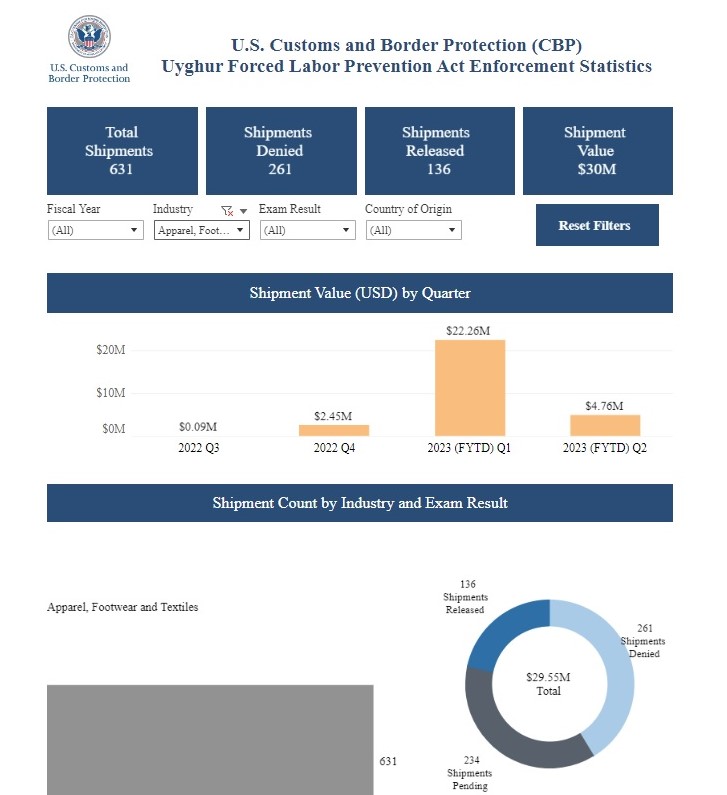
Students can visit our Forced Labor webpage for updated information and resources on CBP’s efforts to prevent goods produced with forced labor from entering U.S. commerce. There is also a specific UFLPA webpage, which explains CBP’s roles and responsibilities and links to the UFLPA Entity List; an UFLPA Statistics Dashboard with information on the number of shipments stopped by CBP by fiscal year, industry, or country of origin; due diligence documents and reports; CBP’s Operational Guidance for Importers, frequently asked questions on UFLPA enforcement and the Department of Homeland Security (DHS) Strategy; and additional links to the DHS Forced Labor Enforcement Task Force Agency Related Resources.
Question 3: Our students are also intrigued by the so-called ‘de minimis rule,’ which has been a topic of heated debate in the news. Why was this rule proposed initially, and how does it relate to the fashion and apparel trade?
De minimis shipments, also referred to as Section 321 low-value shipments, are goods that are exempt from duty and tax under 19 U.S.C. § 1321(a)(2)(C) and 19 C.F.R. § 10.151. De minimis eligibility is based on the value of all goods imported by one person, in one day. The de minimis exemption allows CBP to pass, free of duty and tax, merchandise imported by one person on one day that has an aggregate fair retail value in the country of shipments of $800 or less. This provision was first enacted in 1938 to avoid administrative expense to the government from inspecting low-value goods disproportionate to the amount of revenue realized and was subsequently raised multiple times.
In 2015, CBP processed 139 million de minimis transactions. By 2023, this increased to more than 1 billion, representing a 662% growth in eight years. Now, in Fiscal Year 2024, nearly 4 million de minimis shipments arrive at CBP facilities for targeting, review, and potential physical examination each day. Although these packages are low value, they pose the same potential health, safety, and economic security risks as larger and more traditional containerized shipments.
As long as a good is not subject to duties, taxes or fees (such as anti-dumping/ countervailing duties, excise taxes such as those required for alcohol and tobacco products, or any interagency fees that have not been waived for informal entries), it is eligible for de minimis clearance.
Significant attention is being placed on the de minimis administrative process for new business models, such as those used by e-commerce and fast fashion companies, which leverage the de minimis process for direct-to-consumer shipments.
Question 4: Building on the previous question, in April 2024, the Department of Homeland Security (DHS) announced its new textile enforcement actions. How will CBP contribute to the new enforcement strategy?
CBP is responsible for the management, control, and protection of U.S. borders and ports of entry, acting on the frontline of textiles and trade agreements enforcement. The U.S. textile industry is a vital domestic industrial base for U.S. national security, health care, and economic priorities. U.S. textile production is the foundation of the western hemisphere textile and apparel co-production chain, representing over 500,000 U.S. jobs, 1.5 million western hemisphere jobs, and $39 billion in annual shipments. Members of the textile industry have raised concerns with CBP regarding a decline in business momentum affecting their ability to maintain productivity and jobs.
In response to these concerns, CBP is increasing its efforts to detect, interdict and deter illicit textiles trade and promote a level playing field for the domestic textiles industry given the ever-changing threat landscape and recent proliferation of allegations.
CBP is conducting coordinated and unified intelligence and data-driven operations to target and interdict textile imports that are not compliant with U.S. trade laws. Efforts include, but are not limited to, running special operations, carrying out Textile Production Verification Team visits at foreign factories and raw material providers, examining cargo, conducting compliance reviews and verifications, completing trade audits, and performing laboratory analysis on imported products with a heighted focus on imports that are subject to the U.S.-Mexico-Canada and Dominican Republic – Central America trade agreements, imported under the de minimis provision, and/or potentially in violation of forced labor laws, including the Uyghur Forced Labor Prevention Act.
You can learn more about CBP’s textile enforcement work in a recent CBP Reports video. You can also find information on our website.
Question 5: We know technology is significantly affecting and shifting how international trade is conducted. At CBP, there is an initiative called “21st Century Customs Framework.” Can you provide our students with more information about this program? For example, what is it about, what do you plan to achieve, and why does the program matter for fashion apparel companies?
The 21st Century Customs Framework (21CCF) is CBP’s effort to update its Title 19 authorities and underlying statutes, which have not seen comprehensive updates in more than 30 years.
Since 1993, trade volumes have increased dramatically, trade practices have changed, and new threats have emerged, which means CBP needs new tools and capabilities to do its job.
21CCF matters for fashion apparel companies in two key ways: (1) the framework identifies updates that would better enable CBP to facilitate lawful trade more efficiently, so that goods can get to consumers, warehouses, stores, and other destinations as quickly as possible; and (2) the framework identifies updates that would enable CBP to bolster detection and enforcement against goods that threaten the well-being of American businesses and consumers—counterfeits, goods produced with forced labor, anti-competitively priced goods, and goods that violate environmental or consumer safety laws.
For example, 21CCF includes concepts that would authorize CBP to furnish industry stakeholders with information generated by market platforms regarding compliance with intellectual property rights laws—such as product origin and manufacturer—in importations where intellectual property violations are suspected.
By sharing additional information with the private sector, CBP will be able to utilize its private sector partnerships to more readily identify illicit sellers using online marketplaces to import intellectual property rights-infringing goods into the United States.
Additionally, these proposed updates would better position the private sector to make more informed business decisions and eliminate high-risk actors from their supply chains.
Overall, in pursuing 21CCF, CBP envisions a trading system where legitimate goods move swiftly and securely; ethical production methods are used throughout the global supply chain; domestic industries compete on a level playing field; and the United States helps lead the world with innovative trade practices.
Private sector input has been instrumental throughout the development of the 21CCF statutory concepts, and the framework is now undergoing an interagency review process before eventually being cleared to be formally transmitted to Congress for consideration.
Question 6: As members of Generation Z, our students deeply care about fashion sustainability. Studies also show that fashion companies are increasingly concerned about climate change and its significant business implications. In your view, how can international trade contribute to sustainability and foster a more sustainable fashion industry? How might CBP support and assist in these efforts?
Sustainability in fashion concerns more than just addressing textiles or products. It involves the entire product lifecycle process, which includes the way the clothing is produced, consumed, and disposed of in landfills.
Sustainability in fashion encompasses a wide range of factors, including cutting carbon dioxide emissions, addressing overproduction, reducing pollution and waste, and supporting biodiversity.
CBP has a responsibility, as part of our mission, to keep people safe and protect the economy; that includes supporting the fashion industry. As noted, the fashion, textile, and apparel industries are crucial parts of the U.S. economy. The work CBP does is key in seizing suspect and potentially illegal fashion goods at the border, issuing penalties to bad actors, and protecting the health and safety of the American people.
Due to CBP’s direct influence over trade processes, we see ourselves as a facilitator across the government to start conversations about sustainability and where government can remove barriers or add value to existing environmental efforts in trade.
CBP has developed strategies aimed at promoting environmental sustainability within trade. CBP’s Green Trade Strategy, for instance, is designed to champion the reduction of pollution and waste while encouraging the adoption of green technologies and practices. Such initiatives reflect a broader commitment to advancing circularity, recycling, and reuse in the fashion industry that can enable fashion companies to produce and sell their products more sustainably.
CBP launched the Green Trade Strategy in 2022 to further enable CBP to fight the negative impacts of climate change and environmental degradation in the context of the trade mission.
The strategy focuses on four main pillars:
o Incentivize Green Trade; o Strengthen Environmental Enforcement Posture; o Accelerate Green Innovation; and o Improve Climate Resiliency and Resource Efficiency.
Thousands of CBP employees work toward making international trade more sustainable and transparent. The strategy touches every office and every employee at CBP.
With these four pillars, the strategy provides a framework for future action. Success requires buy-in and collaboration with all our stakeholders, including the fashion industry, and especially you, the future of fashion. We want your help because we cannot do this alone, and you offer unique perspectives that we need in order to fight and mitigate climate change.
Students who are interested in learning more about CBP’s green trade efforts can visit our Green Trade Strategy webpage.
Question 7: Additionally, some of our students are considering a career in international trade. What career opportunities at CBP might be a fit for our undergraduate and graduate students?
There are a number of paths for college students and recent graduates to gain experience and begin to build their careers at CBP, including our recent graduate programs and the Pathways Program.
Some positions that recent graduates can pursue include the following:
Administrative – CBP has administrative roles in various business functions, such as finance, budget, personnel, logistics, and asset management. Position titles include Staff Assistant and Management and Program Analyst.
Law Clerks – This role is for those with recent JDs that expect to pass the Bar Exam within 14 months.
Auditors – This is for students pursuing the auditor career (Interns) or those expecting to complete the required unit of Auditor courses (Auditor, GS-11).
CBP prioritizes facilitating legitimate trade in textiles and wearing apparel and protecting the intellectual property rights of fashion and apparel brands as a part of its trade mission.
CBP employees help protect the wearing and apparel industry from counterfeit merchandise and other unfair or harmful trade practices.
Learn more about career opportunities at CBP on our careers page.
–END–
Disclaimer: This interview is intended exclusively for educational purposes in the FASH455 class and shall not be considered an official policy statement of the U.S. Customs and Border Protection (CBP).
#1: On April 5, 2024, the US Department of Homeland Security (DHS) released its new enhanced strategy to combat illicit trade and level the playing field for the American textile industry and the estimated over 500,000 US textile jobs*. *note: according to the Bureau of Labor Statistics, as of December 2023, the US textile and apparel manufacturing sector employed about 272,400 workers (seasonally adjusted), including 89.3K in NACIS313 textile mills, 95.6K in NAICS314 textile product mills and 87.5K in NAICS315 apparel manufacturing. As of December 2023, NAICS 4482 apparel retail stores employed about 850,000 workers (seasonally adjusted).
According to DHS, the new enforcement plan will focus on the following areas:
Cracking down on small package shipments to prohibit illicit goods from U.S. markets by improving screening of packages claiming the Section 321 de minimis exemption for textile, Uyghur Forced Labor Prevention Act (UFLPA), and other violations, including expanded targeting, laboratory and isotopic testing, and focused enforcement operations.
Conducting joint Customs and Border Protection (CBP)-Homeland Security Investigation (HIS)HSI trade special operations to ensure cargo compliance. This includes physical inspections; country-of-origin, isotopic, and composition testing; and in-depth reviews of documentation. CBP will issue civil penalties for violations of U.S. laws and coordinate with HSI to develop and conduct criminal investigations when warranted.
Better assessing risk by expanding customs audits and increasing foreign verifications. DHS personnel will conduct comprehensive audits and textile production verification team visits to high-risk foreign facilities to ensure that textiles qualify under the U.S.-Mexico-Canada Agreement (USMCA) or the Central America-Dominican Republic Free Trade Agreement (CAFTA-DR). (note: As CBP noted, most US free trade agreements and trade preference programs have complex textiles and apparel-specific rules of origin requirements. CBP is “responsible for ensuring that the trade community complies with all statutory, regulatory, policy, and procedural requirements that pertain to importations under free trade agreements and other trade preference programs.”)
Building stakeholder awareness by engaging in an education campaign to ensure that importers and suppliers in the CAFTA-DR and USMCA region understand compliance requirements and are aware of CBP’s enforcement efforts.
Leveraging U.S. and Central American industry partnerships to improve facilitation for legitimate trade. (note: The Biden Administration aims to leverage textile and apparel trade as part of the solution to address “root causes of migration in Central America. According to the White House Fact Sheet released in March 2024, the Office of the U.S. Trade Representative and Central American Trade Agencies and textiles and apparel industry stakeholders will work together to build a directory with detailed profiles of manufacturing and sourcing companies in the region, including information on business practices and production capabilities, to facilitate transparent sourcing, and bolster the region’s supply chain.)
Expanding the Uyghur Forced Labor Prevention Act (UFLPA) Entity List to identify malign suppliers for the trade community through review of additional entities in the high-priority textile sector for inclusion in the UFLPA Entity List. (note: Once an entity is on this list, in general, it is prohibited from exporting its goods to the United States. Importers are required to ensure the supply chains of their imported products are free from entities on the Entity List).
#2: Several US textile and apparel industry stakeholders have publicly responded to DHS’s new strategy.:
“We strongly commend DHS for the release of a robust textile and apparel enforcement plan today. We also greatly appreciate Secretary Mayorkas’ personal engagement in this urgent effort and believe it’s a strong step forward to addressing pervasive customs fraud that is harming the U.S. textile industry.”
“The essential and vital domestic textile supply chain has lost 14 plants in recent months. The industry is facing severe economic harm due to a combination of factors, exacerbated by customs fraud and predatory trade practices by China and other countries, which has resulted in these devastating layoffs and plant closures. DHS immediately understood the economic harms facing the industry and deployed the development of a critical action plan.”
“The industry requests include
Ramped up textile and apparel enforcement with regard to Western Hemisphere trade partner countries, including onsite visits and other targeted verification measures to enforce rules of origin as well as to address any backdoor Uyghur Forced Labor Prevention Act (UFLPA) violations.
Increased UFLPA enforcement to prevent textile and apparel goods made with forced labor from entering our market, including in the de minimis environment.
Immediate expansion of the UFLPA Entity List, isotopic testing, and other targeting tools. Intensified scrutiny of Section 321 de minimis imports and a review of all existing Executive Branch authorities under current law to institute basic reforms to this outdated tariff waiver mechanism. “
“We appreciate the Department of Homeland Security (DHS)’s announcement today outlining enhanced enforcement activities to prevent illicit trade in textiles. Our members support 55 million (more than one in four) American jobs and invest considerable time and resources in their customs compliance programs. Many of our members are Tier 3 participants in Customs-Trade Partnership Against Terrorism (C-TPAT). They are trusted traders and meet the high standards required to receive that designation by U.S. Customs and Border Protection and DHS. Our members are on the front lines for ensuring that they have safe and secure supply chains.
“While DHS launches this enforcement plan, we urge it to partner with our associations and our associations’ members. A successful enforcement plan must include input from all stakeholders, clear communication with the trade, and coordinated activities with importers, especially if DHS finds illicit activity happening in the supply chain. The results of any illicit activities must be shared so that our members and other importers can act quickly to address the issue. As our members look to diversify their supply chains, especially back to the Western Hemisphere, we must make sure efforts are included to incentivize and not deter new investments.”
#3 Comments: Overall, the new DHS textile enforcement plan suggests several key US textile and apparel trade policy directions: 1) revisit the current de minimis rules that are used by many e-commerce businesses; 2) further strengthen the UFLPA and forced labor enforcement; 3) expand the Western hemisphere textile and apparel supply chain and encourage more US apparel sourcing from CAFTA-DR members; 4) scrutinize US apparel imports from China and imports from other Asian countries that heavily use textile raw material from China.
Discussion questions for FASH455 (please answer them all):
How do the perspectives of the US textile industry and US fashion brands and retailers diverge concerning CBP’s new strategy? What are the areas in which they share common ground?
Building on the previous question, how can the difference between the US textile industry and US fashion brands and retailers be explained regarding their response to DHS’s new enforcement strategy?
As a sourcing manager for a major US apparel brand with global operations, how do you plan to adjust your company’s sourcing practices in light of DHS’s new strategy? You can list 1-2 detailed action plans and provide your analysis.
Background
The U.S. Customs and Border Protection (CBP) is an agency within the Department of Homeland Security (DHS), responsible for “regulating and facilitating international trade, collecting import duties, enforcing U.S. trade laws, and protecting the nation’s borders.”
Homeland Security Investigations (HSI) is also a division within the Department of Homeland Security (DHS), responsible for “investigating transnational crime and threats, specifically those criminal organizations that exploit the global infrastructure through which international trade, travel and finance move.”
A new study released by the Hinrich Foundation in July 2023 evaluated the impact of the implementation of the Uyghur Forced Labor Prevention Act (UFLPA) on Vietnam’s textile and apparel industry.
The study’s findings were based on interviews with “senior leaders and owners of Vietnam’s garment and textile small and medium-sized enterprises (SMEs).” (Note: However, the study didn’t specify when and how many interviews were conducted.) Below are the summarized key findings:
#1: Vietnam’s textile and apparel industry heavily uses cotton imported from China. As noted in the study, in 2021, China accounted for nearly 30% of Vietnam’s cotton imports (ranked #1, $1.48 billion out of total $4.99 billion imports), surpassing the US ($1.05 billion).
#2: Vietnam’s garment exports may contain Xinjiang cotton. According to the study, “Once the cotton arrives in Vietnam, international intermediary manufacturers create finished garments from semi-finished products to export globally, often using the same materials from banned Chinese suppliers. This results in the ‘laundering’ of Xinjiang cotton.”
#3: Vietnam textile and apparel SMEs report challenges in proving the origin of cotton in fabrics. For example, one respondent says, “Differentiating between cotton products coming from different sources is challenging as they might have been blended while being transported by sea. Suppliers from China, Vietnam, Bangladesh, India, and Pakistan may engage in this practice to falsely label Xinjiang cotton as coming from other locations to circumvent this act.”
#4: Vietnam’s textile and apparel SMEs say the UFLPA implementation has negatively affected their exports to the United States.
CBP’s statistics show that (current as of July 1, 2023), since UFLPA’s implementation in June 2022, a more significant amount of Vietnam’s textiles, apparel, and footwear were affected by law enforcement than those from China (e.g., $20 million vs.$16.2 million investigated and $3.53 million vs.$1.04 million denied access).
US fashion companies are sourcing LESS from Vietnam due to forced labor concerns. According to one respondent, “My company is producing apparel products for several US-based fashion brands and uses materials from China and exports to the US. Since UFLPA was in place in June 2022, they have ordered less from us. It seems that our partners feel pressure from the regulators, so they are looking for alternative risk-free suppliers.”
The surveyed SMEs also expect MORE of Vietnam’s textile and apparel exports to be investigated under the UFLPA enforcement down the road. Some SMEs commented that “it would be hard for US firms to rapidly find alternative suppliers in a short time, therefore more checks on Vietnamese cargoes are to be expected.”
The study acknowledges that “In the worst-case scenario, Vietnamese SMEs may lose market access if their American importers are unable to verify that the supply chain is free from inputs produced via forced labor.”
#5: UFLPA also increased the trade compliance costs of “Made in Vietnam,” a significant challenge to many SMEs. One respondent commented, “Compliance with the UFLPA may pose a challenge for SMEs due to the higher costs associated with providing the necessary documentation of their supply chains. This could be due to the need to conduct additional audits, hire external consultants, or implement new tracking systems.”
Additionally, the report called for Vietnam’s textile and apparel SMEs to 1) diversify the supply chain, especially using more cotton imports from the US, India, Australia, and Brazil. 2) enhance supply chain traceability (note: how to make it happen remains a big question mark); 3) engage in dialogue with US authorities.
UFLPA establishes a rebuttable presumption that “any goods, wares, articles, and merchandise mined, produced, or manufactured whollyor in part in the Xinjiang Uyghur Autonomous Region (XUAR) of the People’s Republic of China, or produced by certain entities,” are not allowed to enter the United States based on Section 307 of the Tariff Act of 1930. In other words, generally, importers have to provide evidence demonstrating that the factories or entities involved in the production of their imported products have no connection to XUAR or are not involved in any forced labor practices in XUAR.
UFLPA affects not only US imports directly from China but also products from other countries. Notably, China is a critical textile raw material supplier for many leading apparel exporting countries in Asia, and over 90% of cotton “made in China” comes from XUAR.
According to the US Customs and Border Protection (CBP), from June 2022 to April 2023, about 345 “textiles, apparel and footwear” shipments from mainland China ($13.45 million), 263 shipments from Vietnam ($13.3 million), 4 shipments from Sri Lanka ($1.64 million) and 46 shipments from other countries ($1.16 million) were affected by UFLPA enforcement.

 FASH455 Global Apparel & Textile Trade and Sourcing