FASH455 Exclusive Interview with Matthias Knappe, Head of Fibres, Textiles and Clothing Unit, International Trade Centre

About the interview

Textile and apparel trade matters. Even today in the 21st century, apparel could still account for 80—90% of a developing country’s total merchandise export and play a critical role in promoting economic growth, poverty reduction, and gender equality. The interview explored several key topics:

  • Why textile & apparel trade matters for development in the 21st century
  • How ITC provides capacity building support and enhances the export competitiveness of garment exporters in developing countries
  • Sustainability movement’s impact on apparel sourcing and export competitiveness of developing countries
  • The promise and complexity of circularity in tackling used clothing challenges
  • Empowering women entrepreneurs through SheTrades
  • Skills and education needed to thrive in the global fashion apparel trade

About Matthias Knappe (speaker)

Matthias Knappe is the Head of Fibres, Textiles and Clothing Unit at the International Trade Centre (ITC), which is co-run by the World Trade Organization (WTO) and the United Nations (UN). Matthias has over 30 years of diversified professional experience in international trade and development. He has worked at the enterprise, institutional, and governmental levels. Matthias is leading ITC’s textile and apparel and light manufacturing unit. Over the last 20 years, he has been working with the T&C sector around the world to increase its export competitiveness. He designed and currently manages ITC’s Global Textiles and Clothing (GTEX) programme and various other fibre, apparel and light manufacturing projects. The Unit’s present portfolio includes projects in 15 countries.

About Emilie Delaye (moderator)

Emilie Delaye is a master’s student in Fashion and Apparel Studies at the University of Delaware, with a specific interest in supply chain, global sourcing, and sustainability. With a background in Entrepreneurship and Fashion Management, Emilie’s passion lies in improving the fashion industry through innovative problem-solving and collaboration. She has worked on projects exploring sourcing destinations and emerging sourcing trends, as well as collaborated with Macy’s on an initiative centered around Extended Producer Responsibility (EPR) regulations. Emilie’s work is driven by a commitment to fostering innovation and ethical practices in fashion, positioning her as a future leader in driving the industry toward greater sustainability and responsibility.

FASH455 Exclusive Interview with Tricia Carey, Chief Commercial Officer of Renewcell, about Textile Recycling and Implications for Apparel Sourcing and Supply Chain

About Tricia Carey

Throughout her career, Tricia believes in ‘progress over perfection’.  As an advocate for innovation and circularity in the textile and apparel industry, she recently joined Renewcell to accelerate the commercial development of CIRCULOSE®, making fashion circular. With a vast global network, as well as experience in brand building, storytelling, and business development, she is an invaluable partner to close the loop and optimize the benefits of CIRCULOSE®.

For more than twenty years, Tricia held various commercial management positions at Lenzing Fibers to establish the TENCEL™ brand, build mill partners, and set retailer specifications.  Her roles comprised marketing, Americas business development, and global denim segment expansion, including the creation of the Carved in Blue platform and numerous collaborative collections with mills and brands.

Tricia holds a bachelor’s degree in Fashion Merchandising from The Fashion Institute of Technology, as well as certificates in Digital Marketing and Strategy from Cornell University and MIT.

Tricia serves on the board of Accelerating Circularity, as well as the Transformers Foundation and the Fashion Impact Fund.  She was Vice Chair at Textile Exchange from 2014-2018.  In 2020 she was nominated as B2B Content Marketer of the Year by Content Marketing Institute, as well as top 100 Denim Legends by WeAr Magazine.  In 2019 Tricia was awarded the RIVET 50 for influential denim industry leaders.  She has been a speaker at various industry events, including the Conscious Fashion and Lifestyle Network at the United Nations, Transformers, Kingpins Show, Southern Textile Association, Texworld, Premiere Vision, Wear Conference, and more.

Tracia lives in New York City and can be seen dashing on the Peloton leaderboard.  The best way to connect with Tricia is through LinkedIn.

The interview was moderated by Emilie Delaye, UD’s entrepreneurship major and fashion management minor. Emilie has been involved in several research projects on the textile and apparel trade, sourcing, and sustainability issues, including authoring a paper on US fashion companies’ evolving sourcing strateiges published in Just-Style. Emilie is also the recipient of the 2024 Warner and Taylor Awards for Outstanding Seniors, the highest recognition for UD’s graduating seniors.

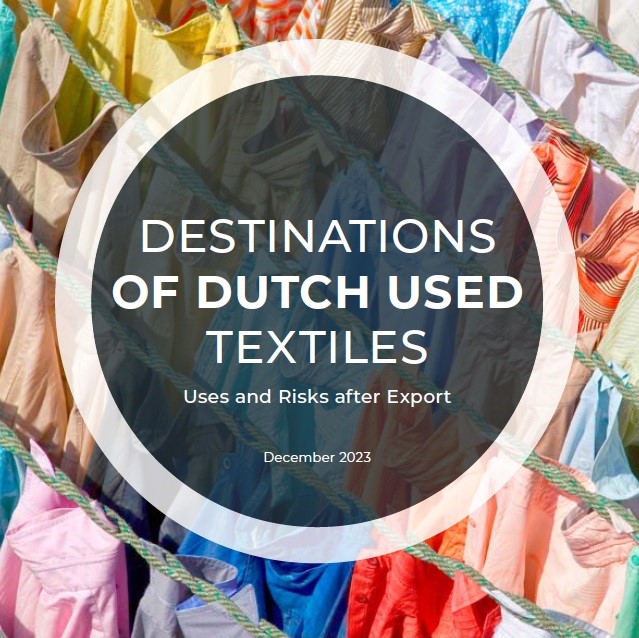
Study: Destinations of Dutch used textiles (February 2024)

The study is available HERE (published by the Government of the Netherlands). Key findings:

Size of used textiles trade:

  • In 2022, the Netherlands exported 248,000 tons of used textiles (or over €193 million), the highest in the past five years. This trend aligned with the EU’s broader used clothing exports, which reached 1.7 million tons in 2019. The average European price for used textiles was around €0.76 per kg in 2019.
  • In 2018, 84% of used textiles collected in the Netherlands were exported, with 53% being suitable for re-wearing, 33% recycled, and 14% being nonrecyclable and non-renewable.

Destinations of the used textile exports

Trade data analysis (HS6309 and HS6310 from 2017 to 2022) and interviews revealed several key export destinations for used clothing exports from the Netherlands:

  • Poland and Pakistan as Import-export hubs. The high volumes of HS 6309 (used textiles) exports from the Netherlands to Poland likely reflect the lower labor costs for labor-intensive manual sorting in Poland. For the last five years, Pakistan has also been a top-five destination for Dutch used textile exports (under HS6309). Four of the six Dutch collector-sorters interviewed confirmed that Pakistan is a primary export destination, noting that the lowest quality textiles were usually sent there. However, Pakistan is also the world’s sixth largest used clothing exporter, suggesting Pakistan is unlikely to be the final destination for the Dutch used textile exports but an import-export hub.
  • India is positioned as a significant recycling hub, particularly for HS 6310 (sorted and unsorted used rags and textile scraps) imported from the Netherlands. India also receives a substantial volume of HS 6310 textiles originating from the Netherlands via France. Notably, India enforces trade restrictions requiring textiles under HS 6309 (used textiles) to be imported only through the Kandla Special Economic Zone (KASEZ), with a mandate for at least 50% to be re-exported. Panipat in India is home to numerous spinning companies, ranging from large to small. These companies specialize in cleaning and sorting textile waste to produce recycled yarn, which is then supplied to weaving and manufacturing units in Panipat and beyond. Most of India’s used textiles re-exports went to African countries.
  • Ghana and Kenya were significant recipients of used textiles from the Netherlands, yet their export volumes for HS6309 (used textiles) and HS 6310 (sorted and unsorted used rags and textile scraps) were comparatively low. The high import-to-export ratios underscore these two countries’ role as the reuse and disposal destinations of used textiles from the Netherlands.

Characteristics of the used textile exports

  • The report highlights divergent perspectives on the quality and rewearability of textile exports to African countries. Dutch collectors and sorters assert that all exports from the Netherlands to Africa consist of good-quality rewearables. They distance themselves from the problem of textile waste exported to Africa, attributing it to the unregulated practices of certain parts of the used textiles trade that involve illegal contractors and exports.
  • According to the study, textiles deemed suitable for currently viable closed-loop recycling technologies include those made of pure cotton, pure wool, pure acrylic, and cotton-rich and wool-rich blends exceeding 80%. However, the study noted a concerning decline in the proportion of collected textiles suitable for rewear, coupled with a rise in textiles containing synthetic fibers. Most interviewees explicitly attribute the degradation in the quality of used textiles over time to the influence of “ultra-fast fashion.”

Environmental and social impacts of used textile exports

  • Interviews revealed a significant variation in the perceived environmental impacts of the used clothing trade. For example, participants from import-export hubs like Pakistan and recycling hubs like India emphasized minimal environmental harm, focusing on the positive contributions of used textile imports. In contrast, interviewees from reuse and disposal countries, such as Kenya and Ghana, discussed environmental harms and their localized impacts. Interviewees also expressed concerns that “certain sustainability solutions may be developed in such a way that generates additional problems further away” and benefit actors in Europe and the West only.
  • The study also found that 99% of fashion brands “do not disclose a commitment to ultimately reduce the number of new items they produce,” and only 12% of fashion companies have even disclosed the quantity of products produced annually in 2023, down from 15% in 2022.
  • The involved parties acknowledge the considerable difficulty in completely disassociating any participant in the reverse supply chain from the adverse impacts of textile exports. Despite efforts, achieving complete transparency beyond EU borders is deemed nearly impossible, as highlighted by one used textiles collector.

Job creation

  • The used textiles value chain unambiguously generates a huge amount of employment, particularly for women, in the sorting, recycling, selling, cleaning, repairing, re-styling, and distributing processes.
  • A 2023 International Labour Organization (ILO) study showed that new recycling and reprocessing activities could create over 10 million jobs in Latin America and the Caribbean and around 0.5 million jobs in Europe.
  • However, concerns related to job quality and social risks were also raised in interviews, particularly concerning reuse and disposal countries. Even where waste management systems for used textiles are formalized and managed, they often rely on the “labors of informal actors” for various functions such as distribution, resale, and disposal processes. Gender-based disadvantage may also be a concern. For example, the study found that whereas recycling and sorting enterprises are overwhelmingly owned and operated by men, women perform the majority of lower-wage, non-technical, and manual labor-intensive tasks.

Regulations

  • The Dutch government’s Circular Textiles Policy Programme for 2020–2025 outlines a commitment to enhance the proportion of recycled materials in textiles and apparel products available in the Dutch market, including achieving a 10% reuse and 30% recycling rate of sold textiles and apparel by 2025.
  • The Dutch Extended Producer Responsibility (EPR) for textiles was officially implemented on July 1, 2023. Onwards, producers are responsible for “recycling and reusing of textiles…including an appropriate collection system, recycling and reusing of clothing and household textiles and financing this entire system.”
  • The policy landscape for managing and exporting used textiles in Europe has evolved to align with environmental goals, with key milestones such as the EU Strategy for Sustainable and Circular Textiles in March 2022. While this strategy aims to create a greener and more resilient textiles sector, the report suggests a need for a bolder vision and more international orientation, emphasizing responsibility for socioenvironmental impacts beyond Europe.
  • The EU Waste Framework Directive (WFD) is another crucial instrument to tackle the environmental challenges of high textile consumption. The WFD regulates all aspects of textile waste management, including the specific obligations to ensure separate collection, treatment, and reporting requirements. The directive calls for all EU Member States to establish separate collection systems for used textiles by the beginning of 2025.
Supplementary video: Used clothing from Europe: Trash or treasure for Africa?

New Study: Importing Clothing Made from Recycled Textile Materials? A Study of Retailers’ Sourcing Strategies in Five European Countries

Full paper: Leah Marsh and Sheng Lu (2024). Importing clothing made from recycled textile materials? A study of retailers’ sourcing strategies in five European countries. Sustainability, 16(2), 825.

Summary & Key Findings:

With consumers’ growing awareness of the environmental impacts of clothing production and consumption, retailers in Europe (EU) have expressed a heightened interest in selling clothing using recycled textile materials (referred to as “recycled clothing” in this study). For example, fast fashion giants like H&M and Zara and luxury brands such as Hugo Boss have started carrying recycled clothing, aiming to integrate circularity into their product designs and business models.

In the study, we examined retailers’ sourcing strategies for clothing made from recycled textile materials in five European countries, including the United Kingdom (UK), Italy, France, Germany, and Spain. These five countries represent the EU’s largest clothing retail markets, consistently accounting for over 60% of the region’s total apparel sales.

Through an industry source using web crawling techniques and manual verification, 5,000 Stock Keeping Units (SKUs) of clothing items made from recycled textile materials were randomly selected and analyzed. These items were sold by retailers in the UK, Germany, Italy, France, and Spain between January 2021 and May 2023.

The results show that Firist, EU retailers sourced clothing using recycled textile materials from diverse sources, including over 40 developing and developed countries across Asia, America, Europe, and Africa. Second, other than assortment diversity (i.e., the number of color or sizing options for a clothing item), no statistical evidence shows that developing countries had advantages over developed ones regarding product sophistication, replenishment frequency, and pricing for recycled clothing in the five EU markets. Third, a supplying country’s geographic location statistically affects the type of recycled clothing EU retailers import. For example, retailers in the five EU countries typically adopt the following sourcing portfolio by region:

  • Asia: relatively sophisticated clothing items (e.g., dresses and outerwear) targeting the mass and value market.
  • America (North, South, and Central): relatively simple clothing categories (e.g., T-shirts and socks) targeting the mass and value market.
  • Europe: sophisticated clothing categories primarily for the luxury or premium market
  • Africa: relatively simple clothing categories targeting the premium market

The findings offered new insights into the business aspects of recycled clothing, particularly regarding its intricate supply chains and leading suppliers. The study’s results have several additional important implications.

First, while existing studies often suggest “local for local” textile recycling, the study’s findings revealed promising global sourcing opportunities for clothing using recycled textile materials. Particularly, leveraging a diverse sourcing base would allow EU retailers to take advantage of each supplying country’s unique production strength regarding product categories and assortment features and more efficiently balance various sourcing factors ranging from costs and flexibility to speed to market. Meanwhile, the study’s findings indicate that many countries worldwide have begun producing and exporting clothing using recycled textile materials, and the sourcing options and capacities will hopefully continue to grow.

Second, according to the study’s findings, unlike the patterns of making regular garments using virgin fiber, low-wage developing countries demonstrated no noticeable competitive edges over developed economies regarding producing and exporting clothing using recycled textile materials. Instead, developed economies, including many high-wage Western EU countries, emerged as top suppliers and leading sourcing destinations for recycled clothing. Thus, expanding clothing production using recycled textile materials presents an exciting economic opportunity with a promising future in developed countries, where many have plans to revitalize the domestic manufacturing sector and establish a sustainable circular economy.

Third, building on the previous point, the sustained commitment of fashion brands and retailers to carry more clothing made from recycled textile materials in their product assortment could hold significant implications for the future landscape of global apparel trade and sourcing patterns. For example, whereas apparel products are predominantly exported from developing to developed countries today, more trade flows could occur between developed economies in the future, attributed to their increasing production capacity and growing demand for clothing using recycled textile materials. Similarly, major apparel exporters in Asia, such as China and Bangladesh, might assume a less dominant role as a sourcing base for recycled clothing due to their insufficient infrastructure for efficiently sorting used clothing and generating high-quality recycled textile materials.

By Leah Marsh and Sheng Lu

Discussion questions proposed by FASH455:

#1 How might EU fashion companies’ sourcing strategies change as they increase carrying clothing made from recycled textile materials?

#2 Could the US emerge as a leading sourcing destination for clothing made from recycled textile materials? What are the potential advantages and disadvantages?

#3 Is expanding clothing made from recycled textile materials the right approach to achieve fashion sustainability? What is your thought?

Explore the Recycled Clothing Market in Five European (EU) Countries

Abstract

By leveraging industry sources and a content analysis of companies’ websites, this study explores how retailers carry and sell clothing made from recycled textile materials in the five largest European economies, namely the United Kingdom (UK), Italy, Germany, France, and Spain.

The results show that:

  • The recycled clothing market in the five EU countries has enjoyed fast growth over the past three years. However, recycled clothing remains a niche product. Ultimately, recycled clothing only accounted for 1.5% of clothing launched in the five EU markets as of 2022.
  • EU retailers adopt distinct merchandising strategies for clothing made from recycled textile materials. For example, clothing made from recycled materials concentrates on specific product categories, including outwear, swimwear, and bottoms, but is less likely to be available for categories including tops and dresses.
  • Affected by the recycling technologies and the raw material supply, recycled clothing sold in the five EU countries mainly uses recycled polyester or a combination of two or more recycled fibers. In comparison, it is still rare to see clothing made from 100% recycled cotton (less than 1% of the market total), given the technical difficulty of making recycled cotton strong and durable enough. The unbalanced supply of recycled textile raw materials by fiber types also contributes to the phenomenon that recycled clothing concentrates on specific categories.
  • Recycled clothing looks more “boring” or “dull” than regular new clothing overall–as much as 80% of recycled clothing available in the five EU countries adopted the plain pattern (i.e., the apparel item does not contain any graphics, spots, florals, or other designs) compared to only 60% of regular new clothing.
  • Retailers in the five EU countries generally tend to price recycled clothing lower than regular new clothing in the luxury & premium segment but often higher in the mass & value market. The results reflect the dilemma of pricing recycled clothing: whereas the production costs could be higher, consumers do not often see the value of such product (i.e., unwilling to pay a price premium).

The findings enhance our understanding of the business aspect of recycled clothing, especially from retailers’ perspectives. The results suggest that advancing recycling technologies will be critical to overcoming the physical shortcomings of recycled clothing and diversifying the product offers in the market. Meanwhile, in collaboration with other stakeholders, retailers can do more to help consumers better understand the benefits of shopping for recycled clothing and change their perceptions about its low value and inferior quality.

Short bio: Leah Marsh is a Fashion Merchandising and Management major at the University of Delaware (UD) & 2022 UD summer scholar. She is also a World Scholar, a competitive UD program aiming to offer students with unique global learning experiences and networking. Leah is recently admitted to the 4+1 fashion and apparel studies graduate program at the University of Delaware. Additionally, Leah is a UD BlueHen Social Media Ambassador.

Further reading: Leah Marsh & Sheng Lu (2022). Unleashing the potential of Europe’s recycled clothing market. Just-Style Magazine