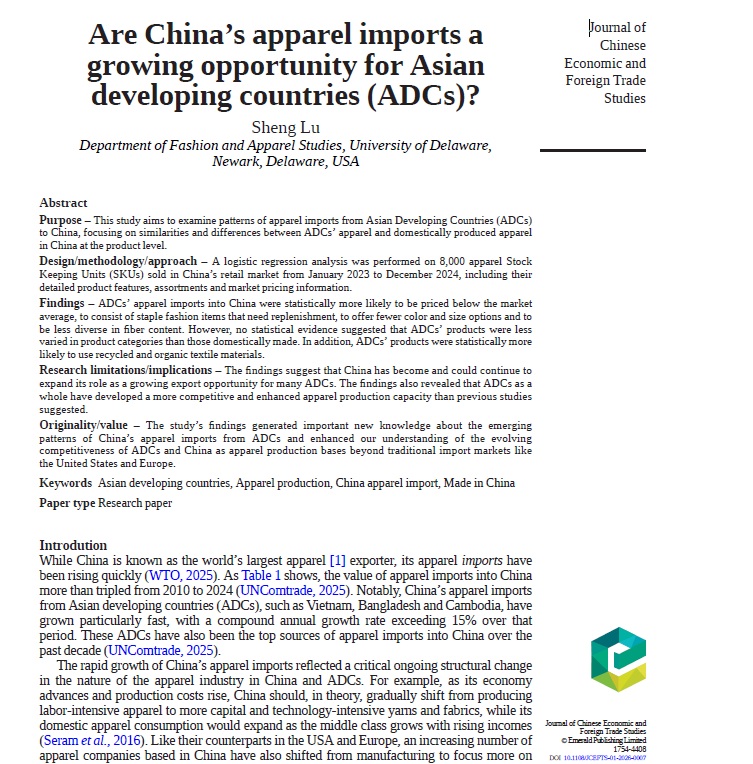
New Study: Are China’s apparel imports a growing opportunity for Asian developing countries (ADCs)?

The study, newly published in the Journal of Chinese Economic and Foreign Trade Studies (peer-reviewed), examines the rapid growth of China’s apparel imports from Asian developing countries (ADCs), including Vietnam, Bangladesh, Cambodia, Indonesia, India, Sri Lanka, and Pakistan.

Using product-level analysis of 8,000 apparel Stock keeping units (SKUs) sold in China’s retail market between 2023 and 2024, the research finds that:

  • China is becoming an increasingly important apparel export market for Asian suppliers, not just a competing manufacturing base. Trade statistics also showed that the value of apparel imports into China more than tripled from $2.1 billion in 2010 to more than $10 billion in 2024.
  • China’s apparel imports from ADCs are no longer limited to basic low-end products today. Suppliers from these countries now offer a wide range of apparel categories comparable to domestically made Chinese products.
  • China’s apparel imports from ADC countries are especially competitive in lower-priced staple items and replenishment-driven categories.
  • China’s apparel imports from ADCs were found more likely to feature recycled and organic textile materials than domestically produced apparel in China, suggesting growing competitiveness in sustainable apparel manufacturing.

The findings have several important implications:

First, the findings confirmed that ADCs have become a critical source of apparel for the Chinese retail market. This means that even though China may remain the world’s largest apparel producer and exporter in the foreseeable future, it is no longer the case that apparel sold in China is necessarily made domestically, as this study and trade statistics illustrate. Instead, China has become and could continue to expand its role as a growing export opportunity for many ADCs and support trade-led economic growth there. This is especially important and strategic in the medium to long term for hundreds of thousands of apparel producers from ADCs, as their exports to traditional markets, including the United States, face increasing tariff barriers and policy uncertainties since Trump’s second term began in early 2025.

Second, the study’s findings revealed that ADCs as a whole have developed a more competitive and enhanced apparel production capacity than previous studies suggested. Challenging the popular perception that ADCs were limited to producing cheap basic apparel items like T-shirts and bottoms, these countries can now manufacture a wide range of apparel products, almost comparable to those of Chinese companies, as this study found. This progress can be attributed to ongoing foreign investment and capacity-building support in ADCs, including from Chinese companies eager to expand their multi-country production capabilities, which has significantly boosted the scale and scope of apparel manufacturing in ADCs. Because of ADCs’ demonstrated ability to offer a wide range of apparel products, they can also be seen as preferred “alternatives” to sourcing from China, as Western fashion companies aim to build a more diversified apparel sourcing base and depend less on China.

Furthermore, the study’s findings suggested that expanding textile manufacturing capacity in ADCs could be a strategic move to further improve their apparel export competitiveness. It is important, though not surprising, that China’s apparel imports from ADCs were less diverse in fiber content than domestically produced apparel. This result echoed previous studies, which found that many ADCs still rely heavily on textile raw materials imported from China due to a lack of local manufacturing. Expanding textile production in ADCs would enable these countries to develop stronger vertical apparel manufacturing capabilities, broaden their apparel product offerings, and reduce vulnerability to supply chain disruptions in today’s turbulent trading environment. ADCs may particularly consider attracting more investment in strategic areas, such as products made with sustainable textile fibers, where their products appear even more prominent in the market than those made in China. 

By Sheng Lu

FASH455 Exclusive Interview with Matthias Knappe, Head of Fibres, Textiles and Clothing Unit, International Trade Centre

About the interview

Textile and apparel trade matters. Even today in the 21st century, apparel could still account for 80—90% of a developing country’s total merchandise export and play a critical role in promoting economic growth, poverty reduction, and gender equality. The interview explored several key topics:

  • Why textile & apparel trade matters for development in the 21st century
  • How ITC provides capacity building support and enhances the export competitiveness of garment exporters in developing countries
  • Sustainability movement’s impact on apparel sourcing and export competitiveness of developing countries
  • The promise and complexity of circularity in tackling used clothing challenges
  • Empowering women entrepreneurs through SheTrades
  • Skills and education needed to thrive in the global fashion apparel trade

About Matthias Knappe (speaker)

Matthias Knappe is the Head of Fibres, Textiles and Clothing Unit at the International Trade Centre (ITC), which is co-run by the World Trade Organization (WTO) and the United Nations (UN). Matthias has over 30 years of diversified professional experience in international trade and development. He has worked at the enterprise, institutional, and governmental levels. Matthias is leading ITC’s textile and apparel and light manufacturing unit. Over the last 20 years, he has been working with the T&C sector around the world to increase its export competitiveness. He designed and currently manages ITC’s Global Textiles and Clothing (GTEX) programme and various other fibre, apparel and light manufacturing projects. The Unit’s present portfolio includes projects in 15 countries.

About Emilie Delaye (moderator)

Emilie Delaye is a master’s student in Fashion and Apparel Studies at the University of Delaware, with a specific interest in supply chain, global sourcing, and sustainability. With a background in Entrepreneurship and Fashion Management, Emilie’s passion lies in improving the fashion industry through innovative problem-solving and collaboration. She has worked on projects exploring sourcing destinations and emerging sourcing trends, as well as collaborated with Macy’s on an initiative centered around Extended Producer Responsibility (EPR) regulations. Emilie’s work is driven by a commitment to fostering innovation and ethical practices in fashion, positioning her as a future leader in driving the industry toward greater sustainability and responsibility.

Utilization of US Trade Preference Programs–Why Fashion Companies Make the Sourcing Decisions They Do? (Video recording)

2022 WTO Aid for Trade Conference

Part 1 – Exporting countries and utilization of US Trade Preference Programs: An Overview

Part 2. Case Studies: Why companies make the sourcing decisions they do?

  • Patrick Fox, Senior Director, Customs and Trade Strategy, VF Corporation
  • Cen Williams, Hub Leader for Africa and Middle East region, PVH
  • Greg Poole, Chief Sourcing Officer, The Children’s Place

Background:

Trade preference programs provide duty-free US market access to selected exports of eligible developing countries. Unlike free trade agreements, all preference programs are unilateral, meaning they do not require reciprocal trade concessions.

There are five major trade preference programs enacted in the United States, including:

  • Generalized System of Preferences (GSP), which applies to developing countries as a whole. However, the US GSP program excludes most textile and apparel products due to import competition concerns.  GSP expired on December 31, 2020 and Congress is working with stakeholders to renew the program.
  • Four trade preference programs that target specific regions, including the Andean Trade Preference Act (APTA), the Caribbean Basin Economic Recovery Act (CBERA), the Caribbean Basin Trade Partnership Act (CBTPA), the African Growth and Opportunity Act (AGOA), and the Haitian Opportunity through Partnership Encouragement (HOPE) Act. In 2021, about 2% of US apparel imports came from trade preference partners.
  • US trade preferences reflect both economic development and foreign policy goals. In addition to the economic benefits, eligibility criteria create incentives for beneficiary countries to support objectives such as adopting and enforcing internationally recognized worker rights, reducing barriers to investment, and enforcing intellectual property rights.
  • However, the trade preference program is not without controversies. For example, it is debatable whether the trade preference program effectively enhances the genuine export competitiveness of developing countries. Also, despite preferential duty benefits, US fashion companies often hesitate to source more from trade preference partners due to concerns about a lack of critical infrastructure, limited production capacity, and political instability.