Note for FASH455: In our class, we cover the basics of apparel rules of origin in U.S. free trade agreements, which is a crucial topic for apparel sourcing. Although not required for our class, if you want more details about the technical aspects of determining apparel rules of origin, the implications for applied tariff rates, and related U.S. Customs regulations, this webinar recording is recommended. For example, the video explains why a blazer labeled “Made in Cambodia” could use fabrics from China, and even have the fabric cut into component parts in China.
Question 1: We know that nearly 98% of clothing consumed in the U.S. is imported. Can you give our students a quick overview of U.S. Customs and Border Protection (CBP)’s role in regulating international trade, particularly textiles and apparel products?
CBP’s Office of Trade facilitates legitimate trade, enforces U.S. trade laws, and protects the United States economy to ensure consumer safety and create a level playing field for American businesses.
CBP is responsible for regulating clothing and/or textiles products imported into the United States, ensuring that all trade aspects of the importation are correct at the time of entry. These include, but are not limited to the classification, valuation, country of origin markings, and qualification for preferential duty treatment under a free trade agreement and/or program.
Textiles and wearing apparel are recognized as a Priority Trade Issue as codified in the Trade Facilitation and Trade Enforcement Act (TFTEA) of 2015. As such, this issue is one of the primary drivers for risk-informed investment of CBP resources as well as our enforcement and facilitation efforts. This includes the selection of audit candidates, special enforcement operations, outreach, review of free trade agreements and/or trade preference programs claims, and regulatory initiatives.
Question 2: Ensuring no forced labor in the supply chain is a top priority for U.S. fashion companies. Specifically, the Uyghur Forced Labor Prevention Act (UFLPA) officially came into force in June 2022. For our students who may not be familiar with the UFLPA, what essential information should they know about this legislation and the issue of forced labor? Additionally, could you recommend any helpful online resources?
CBP is the leading federal agency in the enforcement of forced labor laws and the UFLPA. The agency achieves this through two approaches – the first is through forced labor investigations and issuance of Withhold Release Orders (WROs) and Findings, which require CBP to prevent the release of goods made with forced labor into the U.S. commerce. The second is through the implementation of the UFLPA rebuttable presumption.
CBP enforces U.S. law on forced labor within Section 307 of the Tariff Act of 1930, which says any “goods, wares, articles, and merchandise mined, produced, or manufactured wholly or in part in any foreign country” by convict or forced labor is not permitted entry into U.S. commerce.
In 2016, the U.S. Government enacted the Trade Facilitation and Trade Enforcement Act (TFTEA), which removed the “consumptive demand” clause that was in the original statute. This change allowed CBP to set up its own investigative unit, where CBP receives allegations of forced labor, investigates them using the 11 indicators of forced labor, and issues WROs or Findings when applicable. CBP issues a WRO if there is a reasonable suspicion of forced labor conditions by a particular foreign manufacturer, and it issues a Finding if there is probable cause that forced labor conditions exist.
The relatively recent UFLPA establishes a rebuttable presumption that any goods made wholly or in part from the Xinjiang Uyghur Autonomous Region (XUAR) are prohibited from entry into U.S. commerce, as they are presumed to be made with forced labor unless the importer can provide clear and convincing evidence the goods are not made from forced labor or sourced from the XUAR.
When goods are exported directly from the XUAR, CBP applies the rebuttable presumption and excludes the goods from entry. Importers then must prove by clear and convincing evidence that the goods are not made with forced labor before they can be released into U.S. commerce. For goods not imported directly from the XUAR, CBP evaluates the risk that the producer uses inputs from the XUAR in the production of the final product and will stop any shipments it deems as high risk of containing materials produced from the XUAR.
CBP is committed to identifying products made by forced labor and preventing them from entering the United States. CBP’s enforcement of 19 U.S.C. § 1307 supports ethical and humane trade while leveling the playing field for U.S. companies that respect fair labor standards. The UFLPA is a major shift for importers as it requires them to know their entire supply chains from the raw materials all the way to the end product and to ensure no materials made with forced labor are included at any step along the way. Information on all of these topics and many more are available on CBP’s Due Diligence in Supply Chains webpage.
Students can visit our Forced Labor webpage for updated information and resources on CBP’s efforts to prevent goods produced with forced labor from entering U.S. commerce. There is also a specific UFLPA webpage, which explains CBP’s roles and responsibilities and links to the UFLPA Entity List; an UFLPA Statistics Dashboard with information on the number of shipments stopped by CBP by fiscal year, industry, or country of origin; due diligence documents and reports; CBP’s Operational Guidance for Importers, frequently asked questions on UFLPA enforcement and the Department of Homeland Security (DHS) Strategy; and additional links to the DHS Forced Labor Enforcement Task Force Agency Related Resources.
Question 3: Our students are also intrigued by the so-called ‘de minimis rule,’ which has been a topic of heated debate in the news. Why was this rule proposed initially, and how does it relate to the fashion and apparel trade?
De minimis shipments, also referred to as Section 321 low-value shipments, are goods that are exempt from duty and tax under 19 U.S.C. § 1321(a)(2)(C) and 19 C.F.R. § 10.151. De minimis eligibility is based on the value of all goods imported by one person, in one day. The de minimis exemption allows CBP to pass, free of duty and tax, merchandise imported by one person on one day that has an aggregate fair retail value in the country of shipments of $800 or less. This provision was first enacted in 1938 to avoid administrative expense to the government from inspecting low-value goods disproportionate to the amount of revenue realized and was subsequently raised multiple times.
In 2015, CBP processed 139 million de minimis transactions. By 2023, this increased to more than 1 billion, representing a 662% growth in eight years. Now, in Fiscal Year 2024, nearly 4 million de minimis shipments arrive at CBP facilities for targeting, review, and potential physical examination each day. Although these packages are low value, they pose the same potential health, safety, and economic security risks as larger and more traditional containerized shipments.
As long as a good is not subject to duties, taxes or fees (such as anti-dumping/ countervailing duties, excise taxes such as those required for alcohol and tobacco products, or any interagency fees that have not been waived for informal entries), it is eligible for de minimis clearance.
Significant attention is being placed on the de minimis administrative process for new business models, such as those used by e-commerce and fast fashion companies, which leverage the de minimis process for direct-to-consumer shipments.
Question 4: Building on the previous question, in April 2024, the Department of Homeland Security (DHS) announced its new textile enforcement actions. How will CBP contribute to the new enforcement strategy?
CBP is responsible for the management, control, and protection of U.S. borders and ports of entry, acting on the frontline of textiles and trade agreements enforcement. The U.S. textile industry is a vital domestic industrial base for U.S. national security, health care, and economic priorities. U.S. textile production is the foundation of the western hemisphere textile and apparel co-production chain, representing over 500,000 U.S. jobs, 1.5 million western hemisphere jobs, and $39 billion in annual shipments. Members of the textile industry have raised concerns with CBP regarding a decline in business momentum affecting their ability to maintain productivity and jobs.
In response to these concerns, CBP is increasing its efforts to detect, interdict and deter illicit textiles trade and promote a level playing field for the domestic textiles industry given the ever-changing threat landscape and recent proliferation of allegations.
CBP is conducting coordinated and unified intelligence and data-driven operations to target and interdict textile imports that are not compliant with U.S. trade laws. Efforts include, but are not limited to, running special operations, carrying out Textile Production Verification Team visits at foreign factories and raw material providers, examining cargo, conducting compliance reviews and verifications, completing trade audits, and performing laboratory analysis on imported products with a heighted focus on imports that are subject to the U.S.-Mexico-Canada and Dominican Republic – Central America trade agreements, imported under the de minimis provision, and/or potentially in violation of forced labor laws, including the Uyghur Forced Labor Prevention Act.
You can learn more about CBP’s textile enforcement work in a recent CBP Reports video. You can also find information on our website.
Question 5: We know technology is significantly affecting and shifting how international trade is conducted. At CBP, there is an initiative called “21st Century Customs Framework.” Can you provide our students with more information about this program? For example, what is it about, what do you plan to achieve, and why does the program matter for fashion apparel companies?
The 21st Century Customs Framework (21CCF) is CBP’s effort to update its Title 19 authorities and underlying statutes, which have not seen comprehensive updates in more than 30 years.
Since 1993, trade volumes have increased dramatically, trade practices have changed, and new threats have emerged, which means CBP needs new tools and capabilities to do its job.
21CCF matters for fashion apparel companies in two key ways: (1) the framework identifies updates that would better enable CBP to facilitate lawful trade more efficiently, so that goods can get to consumers, warehouses, stores, and other destinations as quickly as possible; and (2) the framework identifies updates that would enable CBP to bolster detection and enforcement against goods that threaten the well-being of American businesses and consumers—counterfeits, goods produced with forced labor, anti-competitively priced goods, and goods that violate environmental or consumer safety laws.
For example, 21CCF includes concepts that would authorize CBP to furnish industry stakeholders with information generated by market platforms regarding compliance with intellectual property rights laws—such as product origin and manufacturer—in importations where intellectual property violations are suspected.
By sharing additional information with the private sector, CBP will be able to utilize its private sector partnerships to more readily identify illicit sellers using online marketplaces to import intellectual property rights-infringing goods into the United States.
Additionally, these proposed updates would better position the private sector to make more informed business decisions and eliminate high-risk actors from their supply chains.
Overall, in pursuing 21CCF, CBP envisions a trading system where legitimate goods move swiftly and securely; ethical production methods are used throughout the global supply chain; domestic industries compete on a level playing field; and the United States helps lead the world with innovative trade practices.
Private sector input has been instrumental throughout the development of the 21CCF statutory concepts, and the framework is now undergoing an interagency review process before eventually being cleared to be formally transmitted to Congress for consideration.
Question 6: As members of Generation Z, our students deeply care about fashion sustainability. Studies also show that fashion companies are increasingly concerned about climate change and its significant business implications. In your view, how can international trade contribute to sustainability and foster a more sustainable fashion industry? How might CBP support and assist in these efforts?
Sustainability in fashion concerns more than just addressing textiles or products. It involves the entire product lifecycle process, which includes the way the clothing is produced, consumed, and disposed of in landfills.
Sustainability in fashion encompasses a wide range of factors, including cutting carbon dioxide emissions, addressing overproduction, reducing pollution and waste, and supporting biodiversity.
CBP has a responsibility, as part of our mission, to keep people safe and protect the economy; that includes supporting the fashion industry. As noted, the fashion, textile, and apparel industries are crucial parts of the U.S. economy. The work CBP does is key in seizing suspect and potentially illegal fashion goods at the border, issuing penalties to bad actors, and protecting the health and safety of the American people.
Due to CBP’s direct influence over trade processes, we see ourselves as a facilitator across the government to start conversations about sustainability and where government can remove barriers or add value to existing environmental efforts in trade.
CBP has developed strategies aimed at promoting environmental sustainability within trade. CBP’s Green Trade Strategy, for instance, is designed to champion the reduction of pollution and waste while encouraging the adoption of green technologies and practices. Such initiatives reflect a broader commitment to advancing circularity, recycling, and reuse in the fashion industry that can enable fashion companies to produce and sell their products more sustainably.
CBP launched the Green Trade Strategy in 2022 to further enable CBP to fight the negative impacts of climate change and environmental degradation in the context of the trade mission.
The strategy focuses on four main pillars:
o Incentivize Green Trade; o Strengthen Environmental Enforcement Posture; o Accelerate Green Innovation; and o Improve Climate Resiliency and Resource Efficiency.
Thousands of CBP employees work toward making international trade more sustainable and transparent. The strategy touches every office and every employee at CBP.
With these four pillars, the strategy provides a framework for future action. Success requires buy-in and collaboration with all our stakeholders, including the fashion industry, and especially you, the future of fashion. We want your help because we cannot do this alone, and you offer unique perspectives that we need in order to fight and mitigate climate change.
Students who are interested in learning more about CBP’s green trade efforts can visit our Green Trade Strategy webpage.
Question 7: Additionally, some of our students are considering a career in international trade. What career opportunities at CBP might be a fit for our undergraduate and graduate students?
There are a number of paths for college students and recent graduates to gain experience and begin to build their careers at CBP, including our recent graduate programs and the Pathways Program.
Some positions that recent graduates can pursue include the following:
Administrative – CBP has administrative roles in various business functions, such as finance, budget, personnel, logistics, and asset management. Position titles include Staff Assistant and Management and Program Analyst.
Law Clerks – This role is for those with recent JDs that expect to pass the Bar Exam within 14 months.
Auditors – This is for students pursuing the auditor career (Interns) or those expecting to complete the required unit of Auditor courses (Auditor, GS-11).
CBP prioritizes facilitating legitimate trade in textiles and wearing apparel and protecting the intellectual property rights of fashion and apparel brands as a part of its trade mission.
CBP employees help protect the wearing and apparel industry from counterfeit merchandise and other unfair or harmful trade practices.
Learn more about career opportunities at CBP on our careers page.
–END–
Disclaimer: This interview is intended exclusively for educational purposes in the FASH455 class and shall not be considered an official policy statement of the U.S. Customs and Border Protection (CBP).
How the “de minimis” rule (also referred to as Section 321 imports)* might change will be a critical issue to watch in 2024. Under US customs law, specifically the Trade Facilitation and Trade Enforcement Act of 2015, import duties are generally waived for goods valued at $800 or less per person per day, marking an increase from the previous de minimis threshold of $200.
Generally, the reasons for raising the de minimis threshold include: 1) facilitating the clearance of low-value packages and supporting the e-commerce industry (e.g., small-value shipments from online shopping and e-commerce). 2) allowing customs agencies to focus their limited resources on higher-value and higher-risk shipments; 3) lowering compliance and importing costs for importers, especially small businesses.
However, some stakeholders are increasingly concerned about the “de minimis” as a loophole in practice. For example, US textile industry representatives argued that the rule “providing a backdoor to Chinese goods produced with forced labor. The loophole has not only fueled the rise of imports from foreign e-commerce companies and mass distributors, but it has also put our domestic manufacturers and workers at a competitive disadvantage.”
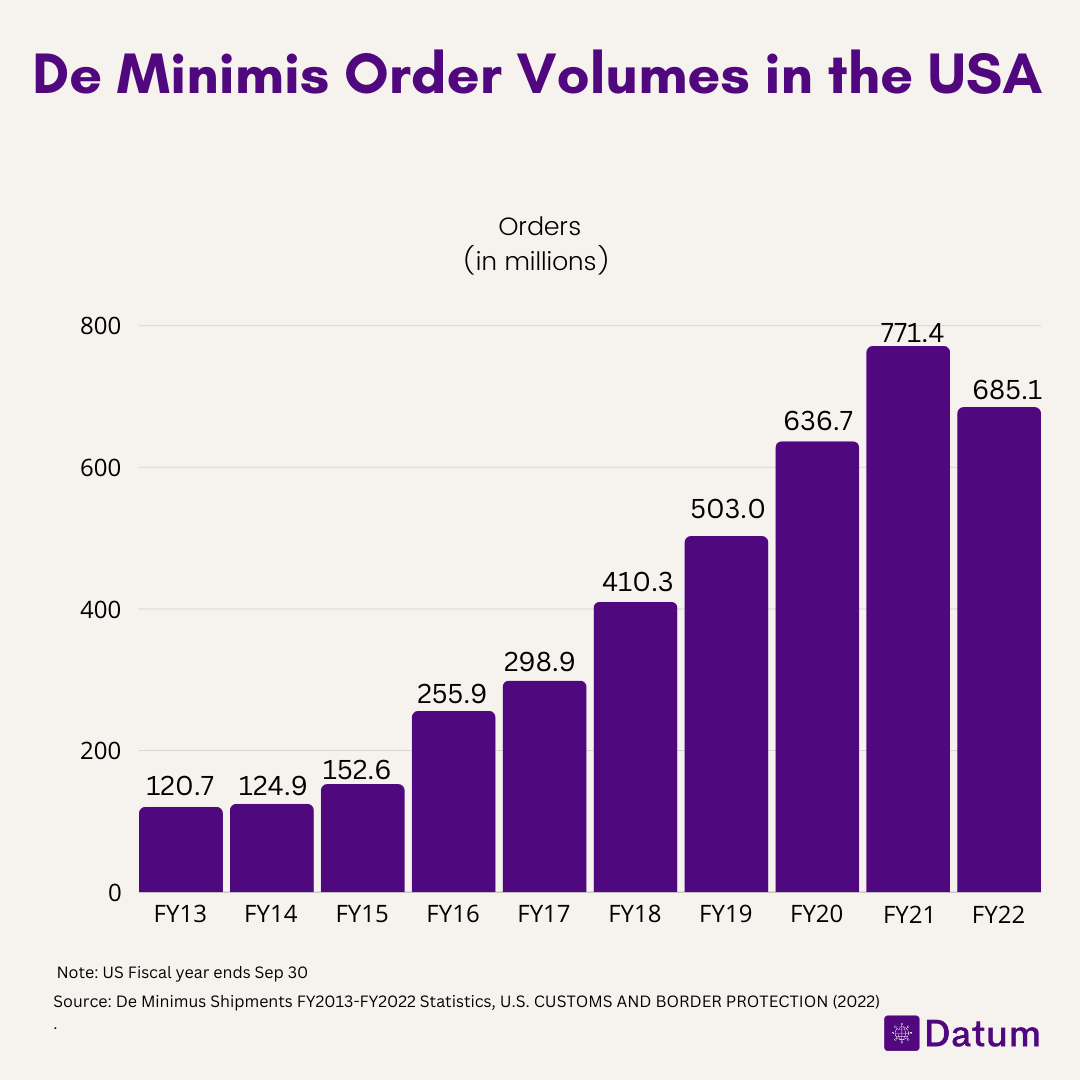
According to CBP’s statistics, the volume and value of U.S. de minimis imports have been surging in recent years, particularly with the booming of e-commerce.
While reforming the “de minimis” rule is likely, its outlook remains uncertain.
The “de minimis” rule can only be changed through actions by US Congress. Several bills (e.g., Import Security and Fairness Act and De Minimis Reciprocity Act of 2023) have been introduced recently, calling for lowering the de minimis thresholds or closing the “loophole” to keep shipping from specific countries like China from taking advantage of the benefits. However, the election-year politics, a divided Congress, and their already packed agenda will make the legislative process challenging. That being said, tactically, Congress might include reform of the “de minimis” rule as part of a broader trade package in the future.
Not everyone agrees on how to reform the “de minimis.” For example, while some legislation favors lowering the threshold, others prioritize excluding non-market economies like China to benefit from the rule. Furthermore, US e-commerce businesses and influential logistics companies that benefit from the de minimis rule may oppose attempts to revoke the benefits they currently enjoy.
As “de minimis” shipments were exempted from CBP review, it also means that policymakers could lack sufficient data to support potential rule changes and evaluate the impacts. For example, while there is suspicion that companies like Shein and Temu exploited the de minimis rule or even that imports containing forced labor did so, it is challenging to present accurate and reliable data to understand their impacts. Thus, data collection “homework”, such as CBP’s section 321 data pilot program, will be necessary for meaningful discussions on reforming the de minimus rule.
*Section 321 refers to a part of U.S. law (19 U.S.C. § 1321) that allows duty-free entry of goods valued at $800 or less per shipment, per day, from foreign suppliers to U.S. customers. This is often called the de minimis exemption. Entry Type 86is one method for filing Section 321 de minimis entries electronically through U.S. Customs and Border Protection (CBP). Entry Type 86 was initially launched as a pilot test by U.S. Customs and Border Protection (CBP) in September 2019.
Discussion questions:
#1: Please assess the arguments presented in the NY Times article regarding the de minimis rule’s impact on US textile and apparel manufacturers. What evidence or examples support their claims?
#2: Consider the defenders of the de minimis rule who argue that it does not harm the competitiveness of the US textile and apparel industry. What counterarguments and supporting evidence could they present?
#3: What additional information can help us better understand the trade impact of de minimis rules?
#4: Do you support eliminating or lowering the de minimis threshold? Why or why not?
[Instructions: For students in FASH455, please address at least two of the questions above. Additionally, feel free to share any other thoughts on the debates and resources you found relevant and informative.]
As described in the video, transshipment is one form of illegal import activities and occurs when false country-of-origin information is provided for imported goods in order to evade U.S. customs duties. Transshipment was a major issue in textile and apparel trade back in days when the quota system was still in place.
According to the media, because of the escalating U.S.-China tariff war, customs fraud such as transshipment is thriving again. Some fashion companies are also using tariff engineering to avoid paying the punitive tariffs in a legal way. Indeed, how to label “Made in ___” can be much more complicated, technical and subtle than we realize.

 FASH455 Global Apparel & Textile Trade and Sourcing