
In September 2026, the World Trade Organization (WTO) released the 2026 World Trade Report, which examines how the more open and integrated world economy that the WTO helped create has posed challenges for the multilateral trading system. Below is a summary of the report’s key findings and themes most relevant to the global textile and apparel industry.
Unbalanced trade impacts
According to the report, by early 2026, around 72% of global merchandise trade still takes place under the most-favored-nation (MFN) tariff terms, thanks to the market-opening benefits and predictability of the multilateral trading system created by the WTO.
While trade has benefited the world economy as a whole, not all economies have shared the gains equally. For example, according to the report, least developed countries (LDCs) still accounted for less than 1% of world trade. Countries with low participation in global trade have seen limited economic improvement or fallen further behind. As another example, according to the WTO Trade Cost Index, trade costs for LDCs in manufacturing and services exceed those of high-income countries by 50%. In particular, “effectiveness of preference schemes for LDCs is limited by complex eligibility criteria and uncertainty around renewal.”
Meanwhile, even within developed countries, import competition and technological change could disproportionately affect certain communities. As the report noted, “Export opportunities have created new jobs, but often not for the same people or in the same places that were negatively affected.”
Shifting global trade patterns relevant to textiles & apparel
Although the report does not specifically discuss textiles and apparel, several shifting global trade patterns are highly relevant to the sector.
One is the increasing global value chain (GVC) trade. International trade today is becoming less about a country exporting a finished product to another country. Instead, production is organized through cross-border networks of firms, suppliers, intermediate inputs, investment, and services. The report notes that GVC trade increased from 35.2% of global trade in 1995 to 48.7% in 2022. However, the report also warned that “the rise of GVCs has been linked to hyper-specialization, and this may make meaningful trade-led development harder to achieve.” Meanwhile, the same specialization and interdependence that make global supply chains efficient can also increase their exposure to external shocks, such as tariffs, geopolitical tensions, war, export restrictions, or regulatory changes.
Furthermore, because GVCs involve multiple stages, a tariff on a final product or input can generate indirect effects through upstream and downstream suppliers. The report specifically introduces the concept of an “effective rate of protection“, which can differ substantially from the statutory tariff because of GVC linkages.
Second, geopolitics is changing the logic of globalization. According to the report, there is a major shift from an efficiency-oriented model of interdependence toward one increasingly shaped by security, resilience, and geopolitical alignment. For example, since 2018, US–China trade growth has consistently lagged behind each country’s trade with other partners, suggesting a decoupling of trade flows.
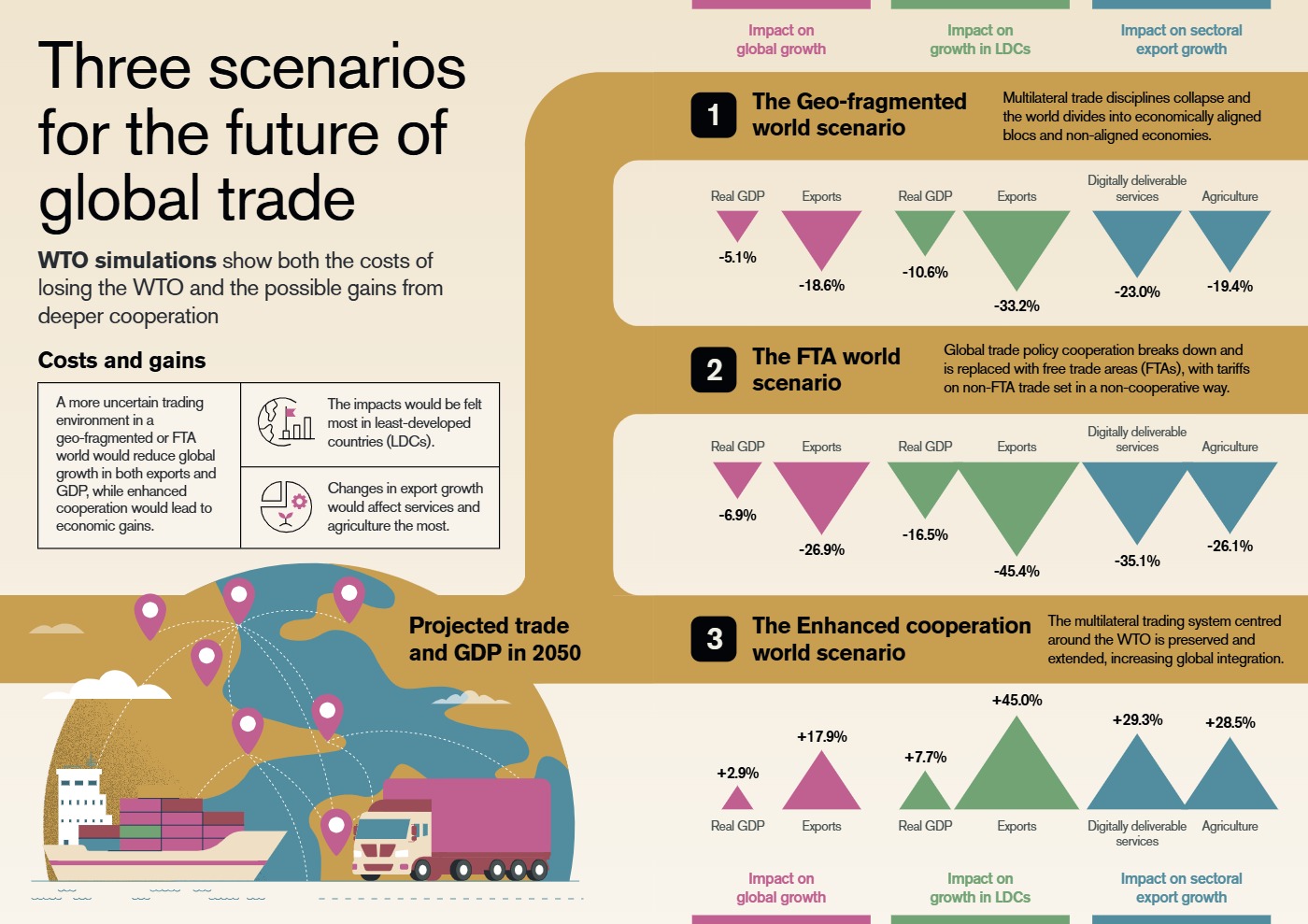
However, the report warned that “decoupling” and so-called “friend-shoring” can become costly when they reinforce geopolitical fragmentation because they disrupt the international production networks underlying the global economy. According to the WTO’s quantitative study, in a “geo-fragmented world,” where trade cooperation is organized around geopolitical blocs, world GDP and global trade could decrease by 5.1% and 18.6%, respectively, from the baseline. World GDP (down 6.9%) and trade (down 26.9%) could shrink even more sharply if WTO cooperation is replaced by a network of free trade agreements, or an “FTA world” scenario. (see the infographic above)
Third, environmental policy is changing the determinants of comparative advantage. The report introduces the idea of a “green comparative advantage,” whereby trade specialization increasingly reflects the carbon intensity of production. In other words, economies with lower-emission production methods could expand their exports as environmental policies gain importance, eventually influencing production and sourcing decisions alongside traditional factors such as labor costs, tariffs, infrastructure, and supplier capabilities.
Meanwhile, the report presents the increasing environmental regulation as a “dual challenge” for international trade. Environmental policies are necessary to support the green transition, but differences in their design and implementation can generate new trade costs and cross-border spillovers. The policy challenge is not simply whether to regulate, but how to design environmental regulations to achieve environmental objectives while minimizing unnecessary trade frictions.
Key questions raised by the report
Based on the report, a few questions are worth considering further:
- Can we still maintain an open, integrated, and rules-based world economy as a pillar of the multilateral trading system that the WTO was built to create?
- How can multilateral rules reconcile differing national economic models without triggering retaliatory trade wars as governments increasingly rely on industrial policies, including subsidies, green transition mandates, and state interventions?
- Given the shift toward nearshoring, friendshoring, and security-driven trade restrictions, will regional/plurilateral agreements serve as building blocks for global commerce or degenerate into discriminatory, competing trade blocs?
- While artificial intelligence and digital services drive a surge in global trade, how can developing nations build digital infrastructure and skills fast enough to participate in AI-driven global value chains rather than being left behind?
Summary by Sheng Lu

