In this special episode of the FASH455 exclusive interview series, Emilie Delaye, FASH graduate instructor and founder of Nova Medical Wearables, shared her first-hand experiences sourcing for her startup. Nova was created for individuals living with PICC lines, chronic conditions, and invisible illnesses, with the hope of transforming everyday medical necessities into elevated wearables that restore confidence and individuality.
In a podcast-style conversation, Emilie discussed real-world cases involving supplier selection, vendor partnerships for innovative solutions that accommodate small minimum order quantities, and “Made in the USA” sourcing options. She also reflected on what sourcing entails in practice, especially from a small-business perspective.
This episode is especially relevant for students interested in starting their own businesses, suppliers working with small and medium-sized enterprises (SMEs), and professionals working in sourcing and supply chain management.
Beyond her work with Nova Medical Wearables, Emilie’s academic and professional interests focus on global supply chains, sourcing strategy, sustainability, and social responsibility in the fashion and apparel industry. Through her research, teaching, and industry engagement, she explores how businesses can build more transparent, ethical, and resilient supply chains while creating positive environmental and social impact. Emilie served as the lead moderator of the FASH455 exclusive interview series and co-authored the 2026 Fashion Industry Benchmarking Study released by the U.S. Fashion Industry Association. Most recently, Emilie was selected to receive the 2026 Sara Douglas Fellowship for Professional Promise from the International Textile and Apparel Association (ITAA) and will receive the award in November at the ITAA annual conference.
The global apparel sourcing landscape is undergoing unprecedented transformation. Rising tariffs, evolving U.S. trade policies, geopolitical uncertainty, and new sustainability and compliance requirements are reshaping how U.S. fashion companies source their products and manage global supply chains. For suppliers, manufacturers, and sourcing partners, understanding these changing priorities has never been more important.
This webinar highlights key trade policy issues facing U.S. fashion companies as of mid-September 2026 and fashion companies’ latest sourcing trends, based on findings from the 2026 Fashion Industry Benchmarking Study, the annual survey conducted by the United States Fashion Industry Association (USFIA) and the University of Delaware. Leveraging official U.S. trade statistics and additional product-level analysis, speakers also compared the competitiveness of mature apparel suppliers (e.g., China and Vietnam) with emerging sourcing destinations (e.g., Guatemala, Sri Lanka, Egypt, and Jordan) and discussed the implications of the current business environment for apparel exporters serving the U.S. market.
Speakers
Matthias Knappe, Head of Fibres, Textiles and Clothing Unit at the International Trade Centre
Julia Hughes, President, United States Fashion Industry Association
Sheng Lu, Professor and Graduate Director, Fashion and Apparel Studies, University of Delaware
Emilie Delaye, Graduate Instructor, Fashion and Apparel Studies, University of Delaware
Explore additional resources from the Global Textile Academy, run by the International Trade Centre.
On August 22, 2026, the United States began imposing an additional 50% tariff on specified imports from Canada under Section 338 of the Tariff Act of 1930. The tariffs apply to approximately $27.6 billion of Canadian goods, including certain textile and apparel products. Notably, coverage is determined by the specific HTSUS tariff lines in the Annexes, not by the broad product category. The scope of Canadian products subject to the additional tariffs was subsequently modified effective September 15, 2026. Furthermore, for products subject to the 50% Section 338 tariffs, the rate would apply regardless of whether the products qualify for preferential treatment under the US-Mexico-Canada Agreement (USMCA).
Meanwhile, as part of its retaliation, Canada imposed additional tariffs on selected U.S. products beginning September 8, 2026, including HS codes associated with textile and apparel products. The Canadian counter-tariffs include rates of 15%, 25%, and 50%, depending on the product.
Sourcing patterns
#1 Data from the Office of Textiles and Apparel (OTEXA) indicate that Canada is a relatively minor sourcing base for U.S. fashion companies, accounting for only 0.6% of imports by value and 0.2% by quantity in the first seven months of 2026.
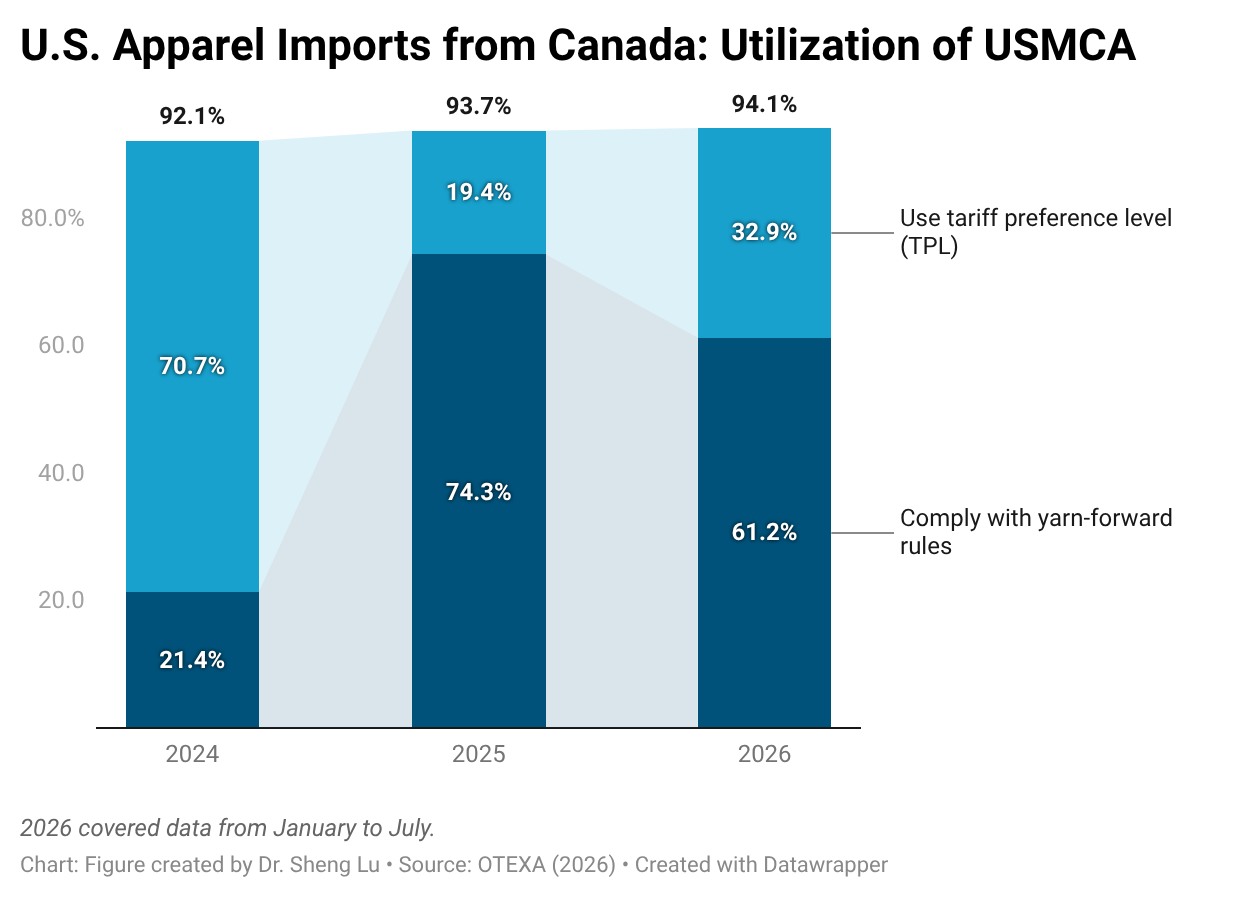
#2 Meanwhile, in the first seven months of 2026, about 94.1% of U.S. apparel imports from Canada claimed the duty-free benefits under USMCA, higher than 92.1% in 2024 and 93.7% in 2025. Also, according to OTEXA’s data, since 2025, a much higher percentage of U.S. apparel from Canada has complied with the yarn-forward rules of origin, and far fewer have used the tariff preference level (TPL) mechanism, particularly those using cotton and Man-made fiber (MMF). [See detailed data HERE]
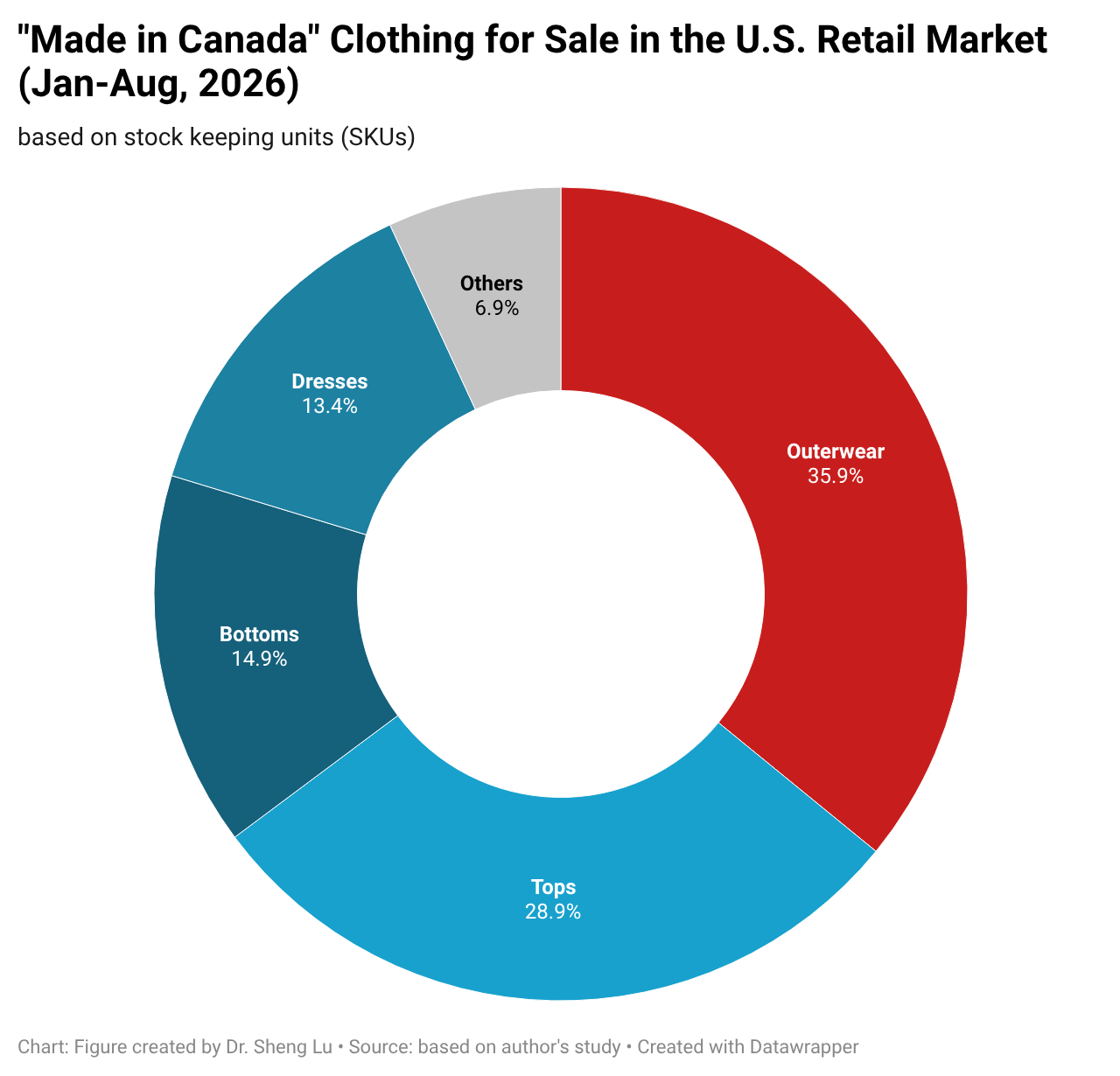
#3 Tracking apparel products for sale in the U.S. retail market from January 1 to September 1, 2026 identified approximately 5,990 stock-keeping units (SKUs) of clothing items labeled “Made in Canada.” Of these products, outerwear was the largest category, accounting for 35.9%. Most outerwear was jackets (16.5%) and coats (15.5%).
For these outerwear products, the most used fibers included polyester (73.6%), nylon (33.5%), cotton (30%), and wool (13.2%). This relatively diverse fiber mix and Canada’s limited local fabric manufacturing capacity help explain why TPL has been important for U.S. apparel imports from Canada. Because Canadian apparel manufacturers may rely on imported textile materials, without TPL, it could be challenging for these products to meet the restrictive yarn-forward rules of origin under USMCA.
Furthermore, 71% of “Made in Canada” outerwear for sale in the U.S. market was in the luxury and premium segments, with an average unit selling price of $1,050 for coats and $695 for jackets from January 1 to September 1, 2026. The relatively high value of these products also suggests that tariff increases could have a more significant impact on their sourcing costs and, potentially, retail prices. This is because tariffs are generally calculated as a percentage of customs value, meaning that a tariff increase would translate into a larger dollar cost for higher-value garments, which could, in turn, increase the pressure on retailers to raise prices or absorb higher costs.
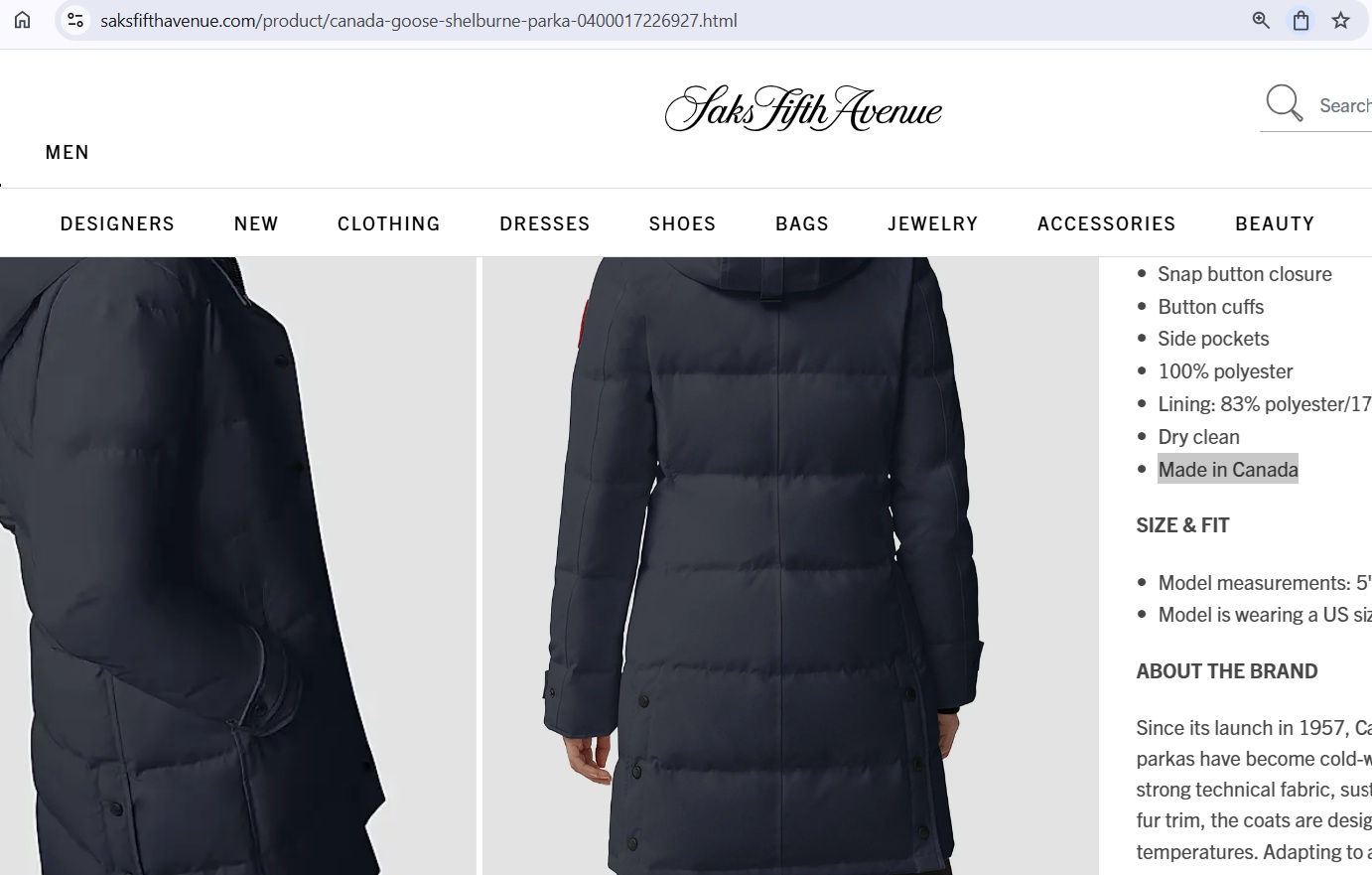
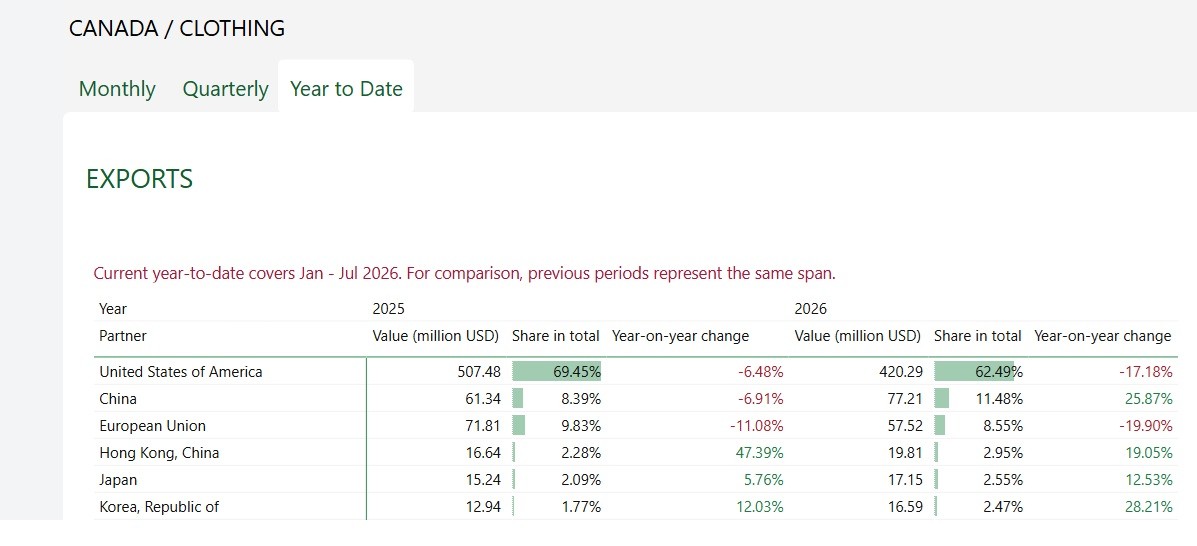
#4 Additionally, the United States is the single largest export market for Canadian-made clothing. For example, data from the World Trade Organization shows that so far in 2026 (January to July), about 62.5% of Canada’s apparel exports were destined for the United States. As a result, Canadian clothing producers and exporters would find it challenging to identify alternative export markets in the short to medium term. For well-known brands like Canada Goose, because its unique competitive advantage is “Made in Canada,” common tariff-mitigation strategies, such as shifting production to lower-tariff countries, may be even harder without compromising an important element of its brand identity.
In September 2026, the World Trade Organization (WTO) released the 2026 World Trade Report, which examines how the more open and integrated world economy that the WTO helped create has posed challenges for the multilateral trading system. Below is a summary of the report’s key findings and themes most relevant to the global textile and apparel industry.
Unbalanced trade impacts
According to the report, by early 2026, around 72% of global merchandise trade still takes place under the most-favored-nation (MFN) tariff terms, thanks to the market-opening benefits and predictability of the multilateral trading system created by the WTO.
While trade has benefited the world economy as a whole, not all economies have shared the gains equally. For example, according to the report, least developed countries (LDCs) still accounted for less than 1% of world trade. Countries with low participation in global trade have seen limited economic improvement or fallen further behind. As another example, according to the WTO Trade Cost Index, trade costs for LDCs in manufacturing and services exceed those of high-income countries by 50%. In particular, “effectiveness of preference schemes for LDCs is limited by complex eligibility criteria and uncertainty around renewal.”
Meanwhile, even within developed countries, import competition and technological change could disproportionately affect certain communities. As the report noted, “Export opportunities have created new jobs, but often not for the same people or in the same places that were negatively affected.”
Shifting global trade patterns relevant to textiles & apparel
Although the report does not specifically discuss textiles and apparel, several shifting global trade patterns are highly relevant to the sector.
One is the increasing global value chain (GVC) trade. International trade today is becoming less about a country exporting a finished product to another country. Instead, production is organized through cross-border networks of firms, suppliers, intermediate inputs, investment, and services. The report notes that GVC trade increased from 35.2% of global trade in 1995 to 48.7% in 2022. However, the report also warned that “the rise of GVCs has been linked to hyper-specialization, and this may make meaningful trade-led development harder to achieve.” Meanwhile, the same specialization and interdependence that make global supply chains efficient can also increase their exposure to external shocks, such as tariffs, geopolitical tensions, war, export restrictions, or regulatory changes.
Furthermore, because GVCs involve multiple stages, a tariff on a final product or input can generate indirect effects through upstream and downstream suppliers. The report specifically introduces the concept of an “effective rate of protection“, which can differ substantially from the statutory tariff because of GVC linkages.
Second, geopolitics is changing the logic of globalization. According to the report, there is a major shift from an efficiency-oriented model of interdependence toward one increasingly shaped by security, resilience, and geopolitical alignment. For example, since 2018, US–China trade growth has consistently lagged behind each country’s trade with other partners, suggesting a decoupling of trade flows.
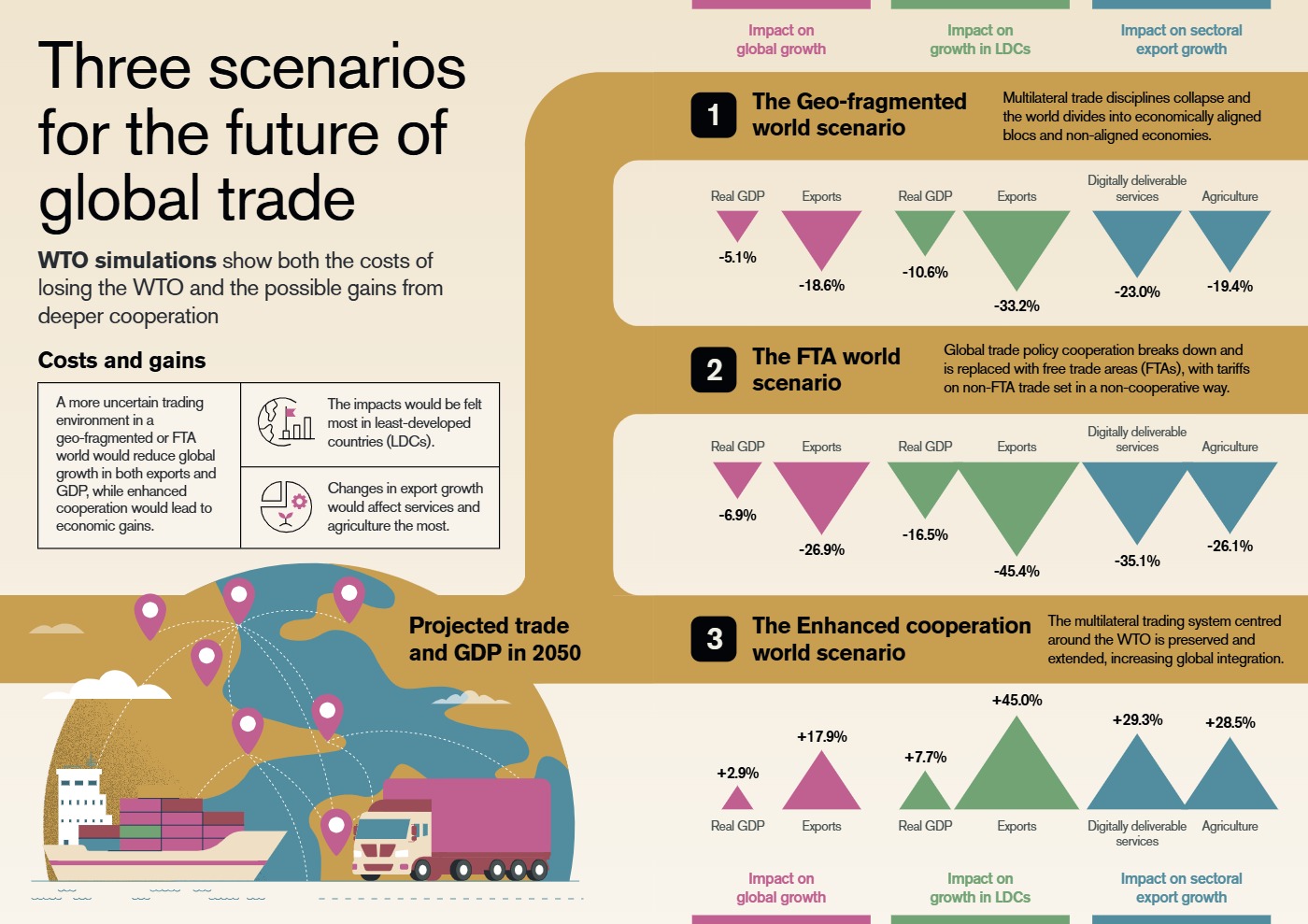
However, the report warned that “decoupling” and so-called “friend-shoring” can become costly when they reinforce geopolitical fragmentation because they disrupt the international production networks underlying the global economy. According to the WTO’s quantitative study, in a “geo-fragmented world,” where trade cooperation is organized around geopolitical blocs, world GDP and global trade could decrease by 5.1% and 18.6%, respectively, from the baseline. World GDP (down 6.9%) and trade (down 26.9%) could shrink even more sharply if WTO cooperation is replaced by a network of free trade agreements, or an “FTA world” scenario. (see the infographic above)
Third, environmental policy is changing the determinants of comparative advantage. The report introduces the idea of a “green comparative advantage,” whereby trade specialization increasingly reflects the carbon intensity of production. In other words, economies with lower-emission production methods could expand their exports as environmental policies gain importance, eventually influencing production and sourcing decisions alongside traditional factors such as labor costs, tariffs, infrastructure, and supplier capabilities.
Meanwhile, the report presents the increasing environmental regulation as a “dual challenge” for international trade. Environmental policies are necessary to support the green transition, but differences in their design and implementation can generate new trade costs and cross-border spillovers. The policy challenge is not simply whether to regulate, but how to design environmental regulations to achieve environmental objectives while minimizing unnecessary trade frictions.
Key questions raised by the report
Based on the report, a few questions are worth considering further:
Can we still maintain an open, integrated, and rules-based world economy as a pillar of the multilateral trading system that the WTO was built to create?
How can multilateral rules reconcile differing national economic models without triggering retaliatory trade wars as governments increasingly rely on industrial policies, including subsidies, green transition mandates, and state interventions?
Given the shift toward nearshoring, friendshoring, and security-driven trade restrictions, will regional/plurilateral agreements serve as building blocks for global commerce or degenerate into discriminatory, competing trade blocs?
While artificial intelligence and digital services drive a surge in global trade, how can developing nations build digital infrastructure and skills fast enough to participate in AI-driven global value chains rather than being left behind?
I am an Associate Materials Manager at Kohl’s, overseeing Active and Kids Knits. My interest in fashion business began with a desire to build a career that engaged both my analytical and creative sides. I began college as a Chemistry major, but after my first semester, I realized I wanted to pursue a field that would let me combine my analytical strengths with my passion for creativity and product. I earned a BS in Fashion Merchandising & Management from the University of Delaware, with minors in Sustainable Apparel & Textile Innovation and Business Management. Today, I execute global materials sourcing strategies for Kohl’s Private and Exclusive brands, delivering optimal supply chain value across quality, cost, speed, and on-time delivery. I am detail-oriented and technically proficient, with particular strengths in cost analysis, Excel, and process optimization.
My prior experience as a Sourcing Coordinator helped sharpen my skills in negotiation, data accuracy, and resourcefulness in fast-paced environments. Together, my work across Sourcing and Materials has given me a global perspective on sourcing strategy, from fabric to finished garment, while keeping me closely connected to both the product and the analytical side of the business. I apply this perspective to collaborate cross-functionally, make data-informed decisions, and ultimately deliver the best possible product for the Kohl’s consumer.
Disclaimer: The views expressed in this interview are those of Mariel Abano and do not reflect the views or positions of her employer or any affiliated organizations.
Sheng: Can you briefly share your career path since graduating from UD? What was your first job after graduation, what different roles did you take on before your current position as a Material Manager, and what were some of the most important career transitions or experiences along the way?
Mariel: My career began as a Sourcing Coordinator, and the role provided a strong foundation in adaptability and working effectively in a fast-paced environment. Within my first year, I worked under three different managers and experienced several scope changes, beginning with woven bottoms and jackets, expanding into outerwear, and eventually growing further through a reorganization that placed me over all our NY brands for all wovens. This period was instrumental in building my technical skill set, particularly in negotiation, cost analysis, Excel, and process optimization. At the same time, I learned how to navigate change quickly while maintaining attention to detail and staying focused on execution.
As my scope expanded, I also gained valuable experience working with cross-functional teams that were not physically located in the same office, including teams in New York. Without being able to walk over to a colleague’s desk to discuss an issue or gather context, I needed to be more intentional about how I communicated and built relationships. I learned to over-communicate rather than under-communicate, ask clarifying questions early, and create strong virtual partnerships that still felt personal and collaborative. This experience reinforced the importance of investing in cross-functional relationships, particularly when working across distance and different functions. After a year and a half of navigating significant changes and developing these skills, I was promoted to Associate Materials Manager. This transition brought another opportunity to grow, as I moved into the materials team and shifted my focus from wovens to knits, expanding my expertise and allowing me to take on a new set of responsibilities within the sourcing organization.
Sheng: What are your main responsibilities as a Materials Manager for Active and Kids’ Knits at Kohl’s? Could you walk us through what a typical day or week looks like? What aspects of your role do you find most interesting or rewarding?
Mariel:As an Associate Materials Manager at Kohl’s, I serve as the primary point of contact for our mill partners, overseeing seasonal fabric costing and leading fabric development from concept through execution. I work closely with Design and Production to develop materials that support our fabric strategy, consolidation initiatives, and product newness, while also maintaining both physical and digital fabric libraries that help our cross-functional teams leverage existing qualities and stay ahead of trends and innovation. A key part of my role is building strong mill partnerships and ensuring materials meet our expectations for cost, quality, agility, and sustainability. I also bring market intelligence and mill capabilities back to the team to help inform partner selection and ensure we are positioned to execute our product strategies effectively.
Beyond fabric development, I help execute materials sourcing strategies that balance cost, quality, speed, and lead-time objectives while supporting the broader garment sourcing strategy. This includes contributing to seasonal and long-range mill strategies, as well as managing service-level terms, consumption charts, and inventory risk. I also work closely with our mills to ensure we meet cost, quality, and delivery standards, and I serve as a key liaison between Sourcing, Design, Production, QAPI (Quality Assurance and Performance Improvement), and external partners to keep programs moving forward. In addition, I support Kohl’s sustainability initiatives, maintain systems and reporting tools, and contribute to training and process improvements that strengthen how our team documents information, communicates across functions, and uses data to make informed decisions.
What I find most rewarding about my role is the balance between the product and analytical sides of the business. Being involved in fabric development keeps me closely connected to the product and lets me see how materials evolve from an initial concept into the finished garment, while costing lets me leverage my analytical skills and evaluate the numbers behind those materials. I really enjoy being able to use both sides of my skill set and seeing how they come together to support strong product and business decisions.
Sheng: How is your role as a Material Manager different from other functions such as sourcing, buying/merchandising, production, and product development? How do you collaborate with these different teams in your work? In what situations or stages of the product development process is close collaboration particularly important? Could you share an example of a project or situation where effective collaboration among these teams was critical to achieving the desired product, cost, quality, or production outcome?
Mariel:The Associate Materials Manager role is closely aligned with Sourcing, with the key distinction being the level at which we operate. Materials focus on the fabric level and work directly with (textile) mills, while Sourcing focuses on the garment level and partners with vendors. The two teams work closely together to execute Materials and Sourcing strategies and achieve our shared goals. Materials also has an additional research and development (R&D) component that Sourcing does not, which allows us to work especially closely with Design and Production. When developing or re-sourcing a fabric, we need to ensure that the Design intent is maintained while also meeting the cost and lead-time expectations established by Production. While Materials does not work directly with Merchandising, merchants ultimately make the final decisions on what gets purchased, so understanding their timelines is also important. When planning fabric commitment timing, we need to ensure merchants have enough time to make those decisions, particularly when mills require unit projections or longer-range fabric commitments. Materials works closely with Sourcing, Design, and Production to identify opportunities to manage costs while balancing quality, product, and customer expectations.
Sheng: What are some of the most important or unique challenges you face when working with materials for activewear and kids’ knit products? What technical knowledge or skills are particularly important for succeeding in your role?
Mariel:For active products, the primary challenge is ensuring the fabric delivers the performance the product is intended to provide. This requires a strong understanding of technical finishes such as moisture wicking, quick-dry, and chlorine resistance, as well as fabric characteristics such as stretch and recovery, breathability, and pilling resistance. It is not enough for a fabric to simply look or feel right. We also need to understand how it will perform in its intended use. Because of this, one of the most important technical skills in my role is interpreting fabric testing reports, understanding how different fabric constructions and finishes impact performance, and identifying what adjustments may be needed to achieve the desired result.
For Kids products, print execution is a critical part of the fabric development process, so having a strong understanding of different print techniques and how they perform across various fabric constructions is essential. Fabric performance is equally important, particularly hand feel, durability, and pilling, and achieving the right performance requires understanding how fabric finishes, material content, and fabric construction work together. Children value comfort and are more active, which makes these considerations especially important for Kids. Ultimately, succeeding in my role requires a combination of technical fabric knowledge, analytical skills, and a strong understanding of our mill capabilities. Being able to evaluate a fabric not only by how it looks and performs, but also by how efficiently and competitively it can be produced, allows us to make the right sourcing decisions for each category.
Sheng: Looking back on your time at UD and in FASH, what courses or experiences have been most useful in preparing you for your career? For students who are interested in careers in apparel materials, product development, or sourcing, what technical and professional skills would you recommend they develop? What advice would you give students about preparing for their first job and standing out during the recruiting process?
Mariel:Looking back on my time at UD, several courses played an important role in preparing me for my career. FASH 210 (Seminar on Fashion and Sustainability) sparked my interest in sustainability and ultimately led me toward Materials, since so much of sustainability starts with understanding what a fabric is made from. FASH 215 (Fundamentals of Textiles I) and FASH 220 (Fundamentals of Textiles II) helped build my foundation in textile knowledge, which remains highly relevant to my Materials work today. FASH 218 (Introduction to Fashion Business), FASH 330 (Merchandise planning), and FASH 490 (Strategic Fashion Management) helped me understand a brand or company’s purpose, the importance of identifying white space, and the need to understand your target customer. FASH 455 (Global apparel sourcing and trade) was particularly valuable in solidifying my interest in Sourcing while also giving me a broader global perspective. Each of these courses helped build a different part of my foundation and gave me knowledge that I continue to apply in my career today.
For students interested in Materials, Production, or Sourcing, I would recommend developing a strong combination of hard and soft skills. Textile knowledge is important for Materials, but having a basic understanding of textiles is also valuable in Production and Sourcing. Excel is another essential skill for Sourcing and Materials. I use pivot tables every day, and Excel is a critical tool for cost analysis, organization, and negotiation. Strong collaboration and prioritization skills are also key in this industry.
Apparel is fast-paced, and adapting quickly requires strong relationships with cross-functional partners and the ability to manage multiple priorities at once. I would also encourage students to develop strong problem-solving skills. Many technical skills can be taught on the job, but being able to approach a challenge, ask the right questions, identify potential solutions, and follow through is extremely valuable. When preparing for my first job, I would focus on demonstrating curiosity, a willingness to learn, and the ability to take initiative. During the recruiting process, students should focus on showing not only what they know, but how they think, solve problems, and approach unfamiliar situations. Those qualities show that you are someone others can rely on and that you are prepared to contribute from day one.