
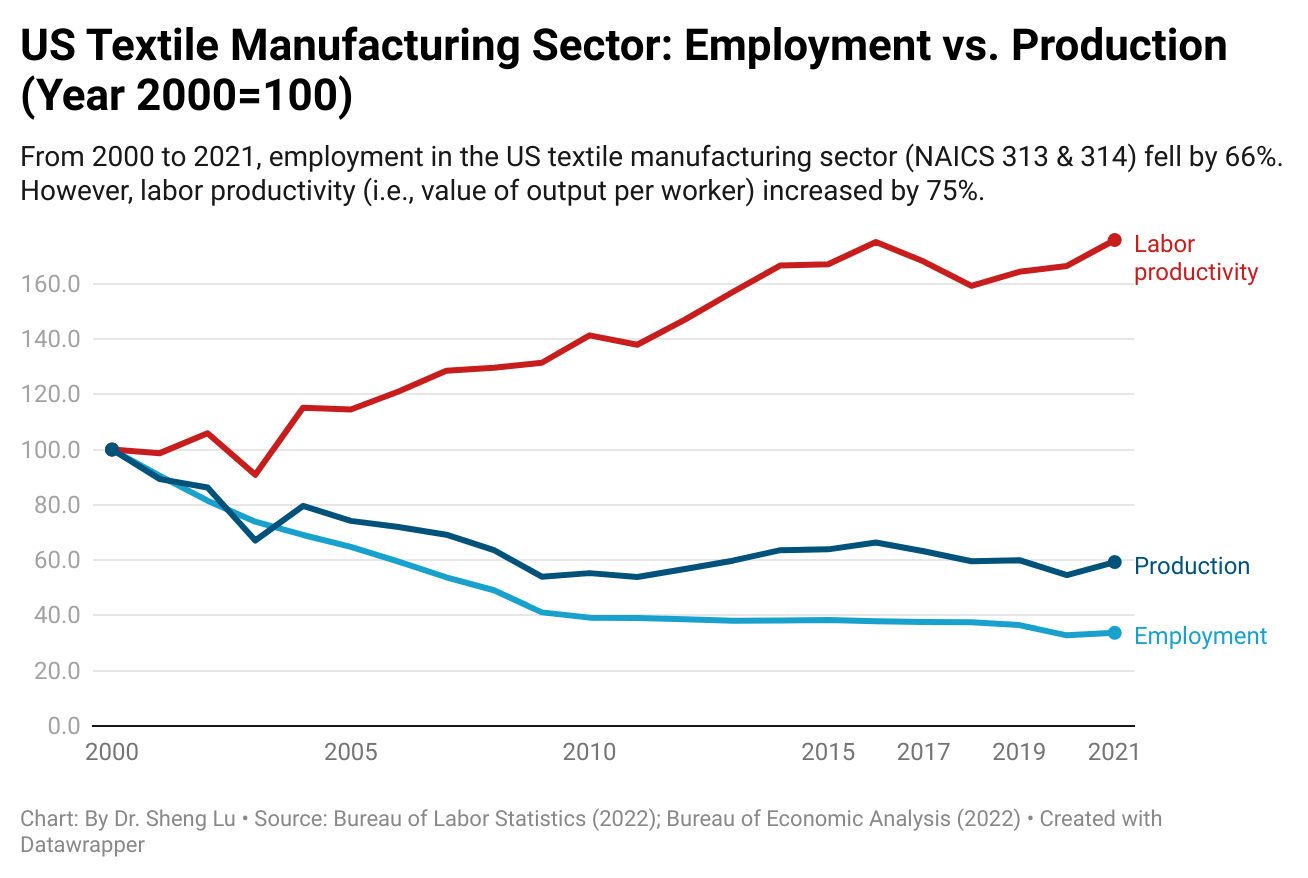
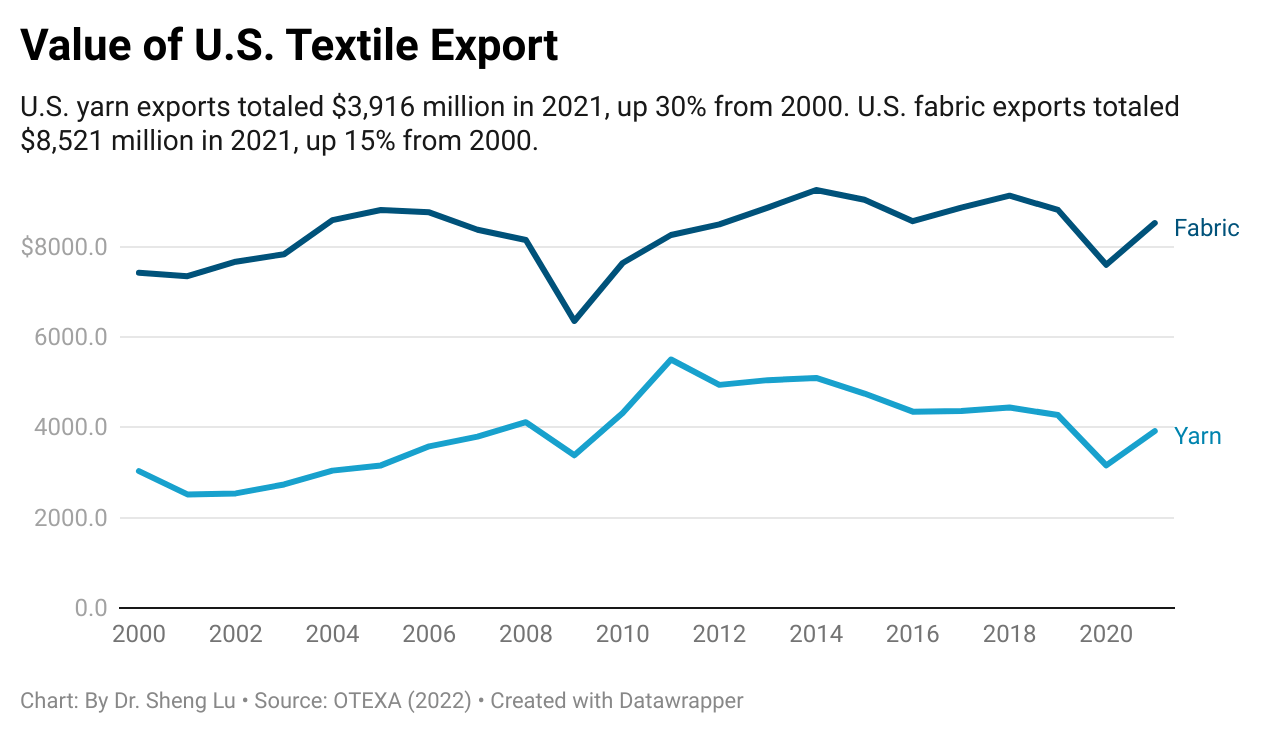
Discussion questions:
#1. Are classic trade theories (e.g., comparative advantage) still relevant or outdated in the 21st century? Why? Please share your thoughts based on the video and the figures.
#2. Based on the video and the figures above, is the US textile manufacturing sector a winner or loser of globalization and international trade? Why?
#3. Take the following poll (anonymous) and share your reflections.
#4. Should the government’s trade policy consider non-economic factors such as national security and geopolitics? What should be the line between promoting “fair trade” and “trade protectionism”? What’s your view?
#5. Is there anything else you find interesting/intriguing/thought-provoking in the video? Why?
(Welcome to our online discussion. For students in FASH455, please address at least two questions and mention the question number (#) in your reply)

 FASH455 Global Apparel & Textile Trade and Sourcing
#3) The U.S. textile manufacturing industry sector is a loser of globalization and international trade because in the process of wanting to make products as cheap as possible, the factories as well as jobs went overseas to places like China or Switzerland where their dyeing machinery is more advanced. Also many businesses that have started in the US have moved off-shore because of this reasoning. Due to this, jobs in the US were lost and factories closed, which had a negative effect on those workers. It is now very crucial for the US to bring that idea of everything having to be made cheaply and at a fast rate back to the wages/income of employees and job growth/opportunity being most important. The US must keep innovating and find ways in which making the supply chains more local won’t increase prices.
#7) I found it to be very interesting when they were talking about the cotton farm and how if just one storm came, it would be completely wiped out. With this being a smaller cotton gin, it hurt the profits, the crop, as there is no way of really protecting it. This was thought-provoking to me because people put so much work into this and then it can all be taken away and and I wondered how with all the new technology there is not a way to prevent or minimize the effects.
#3) It’s really hard to say as the U.S textile market itself has been a loser in it, but everyday American consumers overall have been definite winners in it. The textile market has been a loser because due to globalization and textile jobs moving out of the US over the last several decades, the US textile market had become extremely small and had mostly moved out of the country. However, international trade for the country as a whole has been very beneficial for US companies as well as consumers. In many circumstances, workers in other countries have been mistreated and worked in unethical conditions in order for brands to make more money, and to be able to offer their products at a lower price to American consumers.
5.) The U.S. textile manufacturing sector is a loser of globalization and international trade. Many companies are using free trade to their advantage. Other countries have lower labor costs, along with lower supply costs. Utilizing these resources will ultimately result in a cheaper product and higher profits. The U.S. factories are losing because of this. They are paying their workers an adequate amount, and sourcing from nearby. This puts them behind the companies that are choosing to use trade.
7.) I found it very interesting to see how the weather was one of the biggest risks within the cotton industry. I originally viewed a horizontal integration production process to come with many benefits but did not think about the negatives. Being a small company, they rely on themselves for sourcing and the weather can ruin everything overnight. This makes me wonder how a bigger cotton company prevents this, and what they do when it affects multiple people that are sourcing from them.
1) One thing that makes globalization and trade debatable is the global vs local effect. The video mentioned how the global poverty rate decreased to a third of what is was since 1990.Globalization has improved global standards, but has also disrupted the American economy. The textile workers in American Giant stated after the creation of NAFTA in 2000, textile factories shut down and jobs became limited. It was stated that “you can quit one job and go right across the street and get another one.” By pushing manufacturing to China, we took jobs from Americans and also decreased the influence of vocational schools in students, making us more dependent on other countries.
7) The video caught my attention when it started discussing trade schools and the U.S. education system. My mom is a high school teacher and I hear her talk about how college and a four year degree is pushed so much on students when for some, it is simply not the right choice for one reason or another. When the video mentioned this same fact, I never connected it to the trade policies before. Since manufacturing is given to other countries to do, the need for workers in that category has decreased. This means special skills and trades are being lost. This is scary to think about because we are starting to rely so much on other countries.
#3. Based on the video and the figures above, is the US textile manufacturing sector a winner or loser of globalization and international trade? Why?
From the video, it seems as if the United States textile manufacturing sector is a loser of globalization and international trade. It is interesting to see this industry’s perspective of globalization especially from individuals in the industry. One of the biggest arguments for globalization is lowers prices & affordability for the consumer. From this perspective, it seemed that as a whole the United States was a winner of globalization. However, when beginning to look at the consequences of moving production overseas, we not only see the textile manufacturing sector being affected, but we also see this impact disperse to the communities in America as well. When brands offshore and outsource production overseas for lower prices & labor, our very own US textile manufacturing industry is losing out on this business. It also forces this industry into a highly competitive environment, that does not have equal “playing fields”, and does not have insurance/protection in case environmental factors ruin crops. The US has clear labor laws and human rights policies (as well as increasing environmental policies), whereas their competitors for cotton growning for instance do not have to follow the same rules. This allows for labor exploitation to decrease costs, and makes our US companies seem unappealing or less competitive.
I think that in some ways, however, the US textile manufacturing industry is a winner of globalization. Due to increased competition, this industry has been pushed to adapt & innovate, allowing for the creation of new technologies. This also allows for higher-paying jobs, but education for these skilled positions will need to improve for these jobs to be attainable to the community.
#4. Related to question #3, does the future prosperity of the US textile manufacturing sector need globalization or de-globalization? What’s your vision?
I don’t necessarily think that globalization or deglobalization is the answer. I think that eliminating globalization and completely deglobalizing is near impossible, and if we did achieve it the results would be more detrimental to society than good. I do think, however, we need to continue to improve our trade policies and rules set in place, to ensure that we are not putting the United States in a competitive environment they will never be able to compete with, due to factors out of their control (i.e. ethical reasons). Not only do we need to improve the policies set in place, but we need to ensure that there is a way to enforce these policies. For instance, the Uyghur Forced Labor Prevention Act is a step in the right direction, however, provisions such as De Minimis make it harder to actually track where cotton is coming from and enforcing this policy.
#5 Anything you found interesting from the video
The ethical concerns surrounding Xinjiang’s cotton production and the U.S. import ban demonstrate the growing importance of transparency and ethical sourcing in supply chains, especially as consumers demand more accountability. This also opens opportunities for U.S. manufacturers to position themselves as ethical and sustainable alternatives by utilizing domestic cotton and localized supply chains.
The agility of smaller, regionalized supply chains is a critical takeaway. These supply chains not only enhance productivity through lead manufacturing but also reduce vulnerabilities associated with global disruptions. The $1.9 trillion in foreign direct investment and the significant contribution of manufacturing to the U.S. GDP further underscore the sector’s potential for innovation and growth, especially in textiles.