
Founded in Sweden in 1947, H&M is widely regarded as a leading fast-fashion retailer, known for offering a high volume of trend-driven products at competitive prices. To better understand H&M’s fast fashion business model and its implications for the company’s sourcing practices, this study analyzed H&M’s detailed factory list published in February 2026, which includes 1,455 entries.
The factories on the list were classified using information from the “Product Type” and “Factory Type” columns. Specifically, Apparel suppliers are factories that produce finished garments (e.g., denim, knitwear, woven apparel) and are listed as “Manufacturing unit”. Factories that did not provide product information were excluded from the analysis.
Key findings:
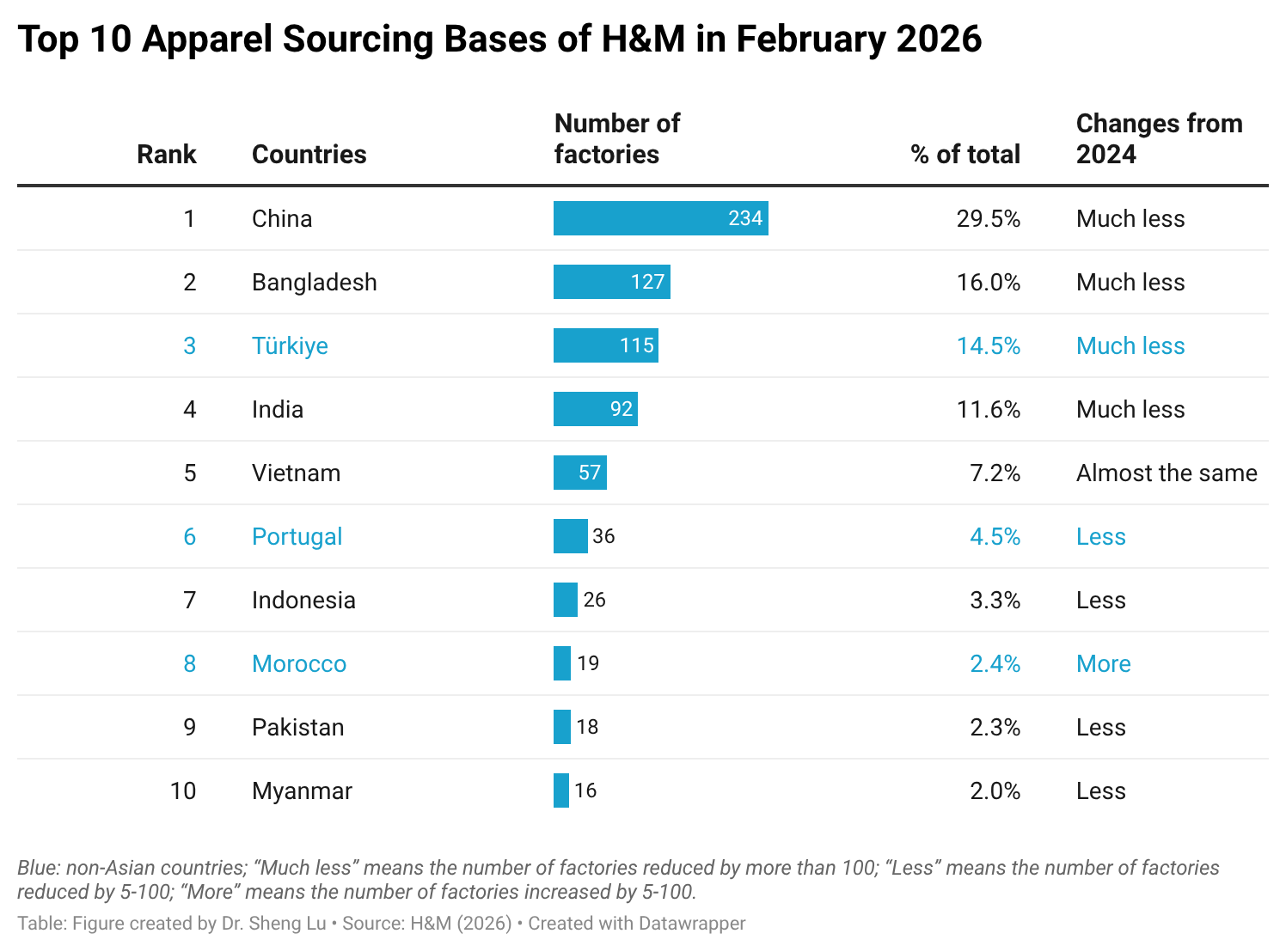
First, like most other leading apparel brands and retailers, H&M utilized a geographically diverse sourcing base. Specifically, as of February 2026, H&M sourced apparel from nearly 800 factories across 23 countries and about 550 factories producing textile raw materials in 15 countries.
However, compared to its 2024 sourcing base, H&M seemed to have consolidated the number of factories it sourced from.
Notably, H&M appears to maintain long-term relationships with its suppliers. Among the nearly 800 contracted apparel factories, 314 (nearly 40%) have worked with H&M for more than 10 years, and another 126 for 6–10 years. Only 261 factories (about 33%) have fewer than 3 years of relationship. According to H&M’s website, it “onboard new suppliers or factories and, occasionally, phase them out according to our business needs.”
Second, while Asia remains H&M’s largest apparel sourcing base, other regions, particularly Europe and Africa, also play a critical role. As of February 2026, seven of the top ten countries with the most contracted factories for H&M were located in Asia. However, Türkiye, Portugal, and Morocco also ranked among the top ten. Compared to U.S. fashion companies, which tend to rely more heavily on Asian sourcing, these countries generally play a more limited role in their sourcing portfolios, highlighting H&M’s relatively greater emphasis on regional diversification and proximity sourcing. In particular, sourcing from Europe and Africa can provide H&M with shorter lead times and greater responsiveness to EU market demand, which aligns well with the speed-to-market requirements of its fast fashion business model.
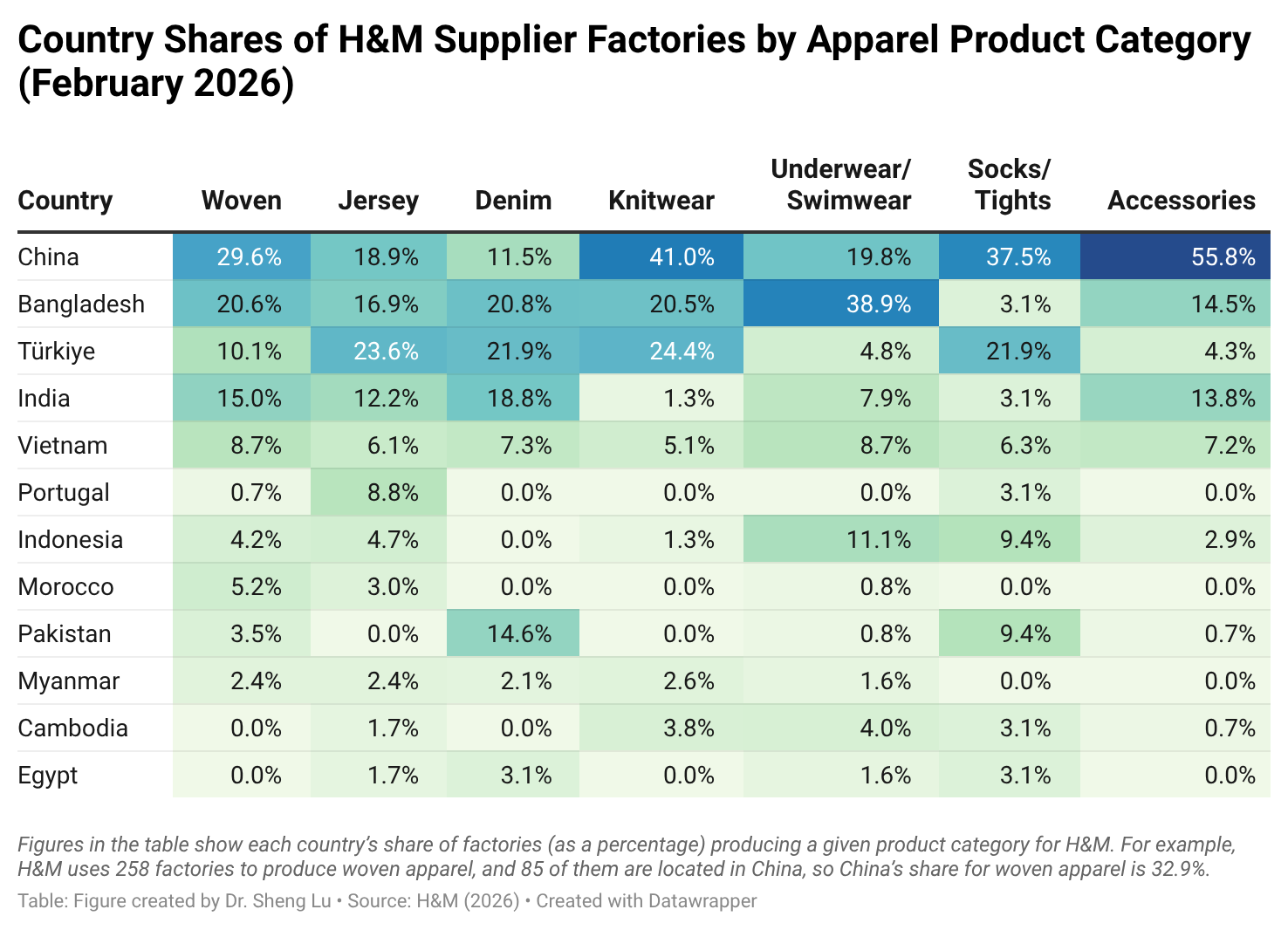
Third, at the country level, in terms of the number of contracted factories, China remains H&M’s single largest apparel sourcing destination (over 230 factories, or 29.5%) as of February 2026. H&M also sourced the widest range of apparel product categories from its China-based factories, covering woven apparel (85 factories), jersey (56 factories), knitwear (32 factories), and denim (11 factories). In other words, China is one of the few countries that can make almost all types of products for H&M. In comparison, H&M was inclined to source more narrow product categories from other top-supplying countries, such as Türkiye for jersey, denim and knitwear; India for denim, Indonesia for underwear/swimwear; and Pakistan for denim and socks. This finding aligns with recent studies indicating that Western fashion companies commonly regard China as highly competitive for its product variety, which is difficult for other countries to match.
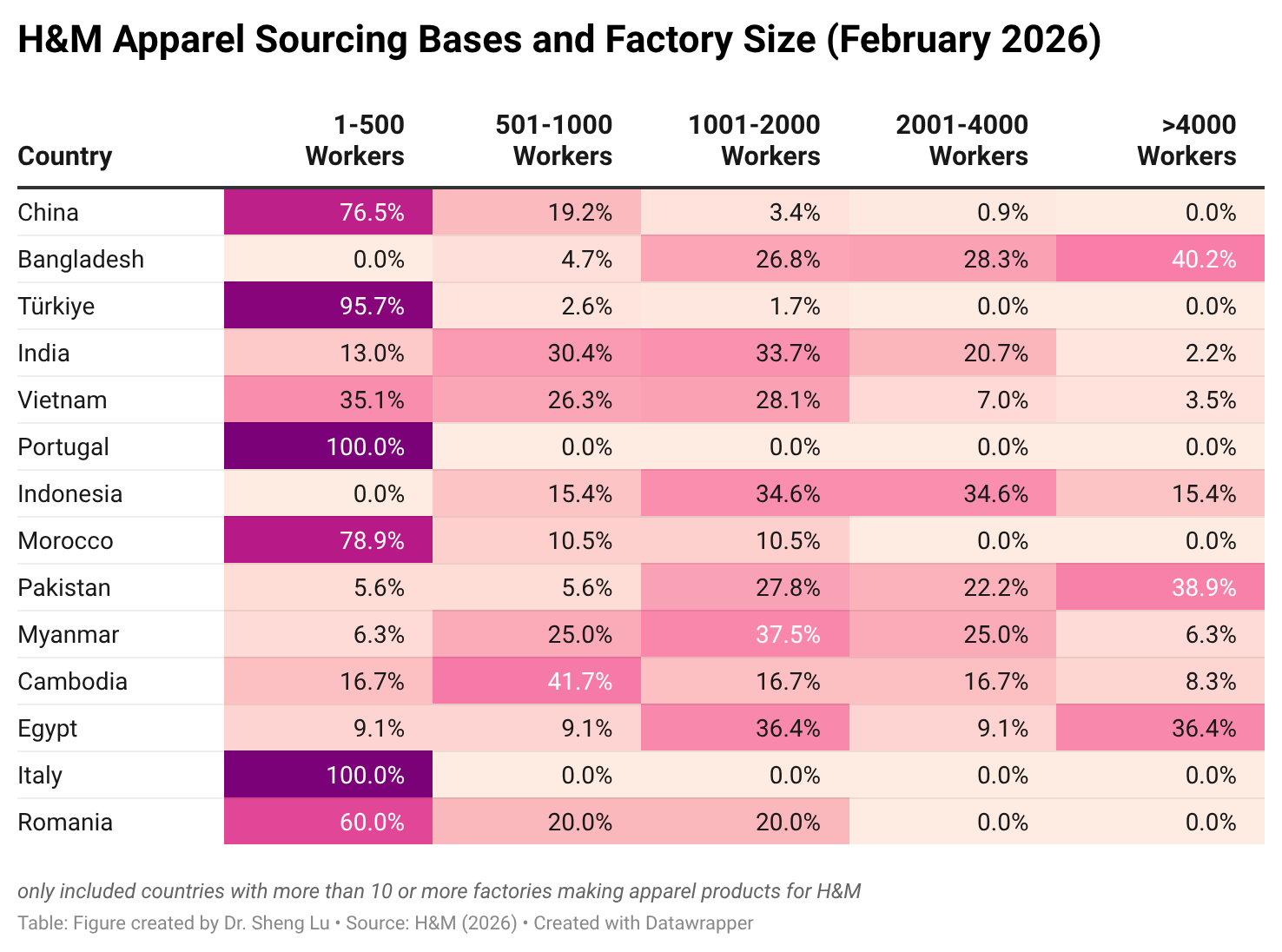
It is also noteworthy that most of H&M’s contracted factories in China are relatively small, with over 76% employing fewer than 500 workers. This pattern is consistent with China’s role in supplying more variety-driven orders with small- to medium-sized minimum order quantities (MOQs). In contrast, H&M’s contracted factories in other major Asian sourcing countries, such as Bangladesh, Pakistan, and Indonesia, are more concentrated in large-scale production, typically employing over 1,000 workers. Notably, 41% of H&M’s contracted factories in Bangladesh and nearly 40% in Pakistan have more than 4,000 workers, indicating their role in producing high-volume orders for the company.
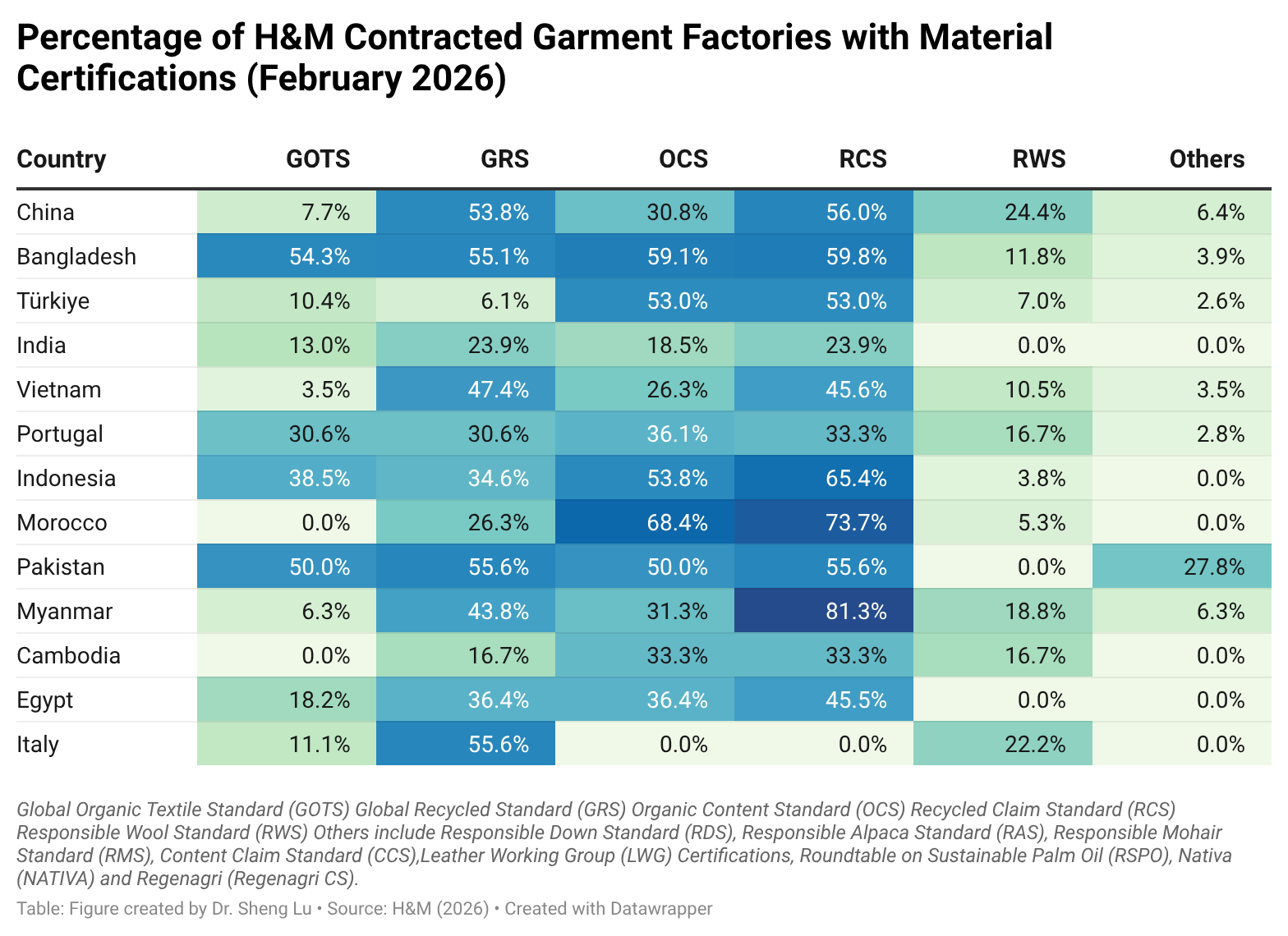
Additionally, H&M contracted garment factories have commonly received material certification, led by those related to organic and recycled content. For example, as of February 2026, among H&M’s contracted apparel factories, 49.6% held the Recycled Claim Standard (RCS), followed by Global Recycled Standard, GRS (39%) and Organic Content Standard, OCS (38.5%). The results align with H&M’s stated material goals of increasing the use of recycled or sustainably sourced materials in commercial products to 100% by 2030, including reaching 50% recycled materials. Most of H&M’s top apparel-supplying countries already have 50–70% of factories holding at least one type of material-related certification. The ability to obtain such certifications is increasingly becoming a baseline expectation for H&M suppliers.
by Sheng Lu
Additional reading: H&M’s Evolving Sourcing Map Speaks to Global Supply Chain Shifts (Sourcing Journal, April 2026)

 FASH455 Global Apparel & Textile Trade and Sourcing
One key concept from class that relates to this blog is the Flying Geese model. This model demonstrates how in Asia, the division of labor in the textile and apparel industry is very present and shows the hierarchy in economic development.
The Flying Geese model relates to this blog post because it shows why H&M sources apparel mainly from China and Bangladesh. According to the model, China is a tier 3 country, meaning that it mostly manufactures textiles. This makes sense because H&M primarily sources woven products, knitwear, and accessories from China which require more advanced factories. According to the model, Bangladesh is a tier 4 country, meaning that it mostly manufactures apparel. This makes sense because H&M sources a lot of apparel, denim, and underwear/swimwear from Bangladesh.
I find it interesting that most of the countries H&M sources from have smaller factories, but Bangladesh, Pakistan, and Egypt are characterized by much bigger factories. I wonder, why is there such a huge difference in factory size in the different countries? Wouldn’t a larger factory allow for reduction of overall costs (economies of scale)?
In class, we recently discussed how production in the apparel industry shifts between countries based on their level of development. One concept that relates to this blog post is the flying geese model, which pretty much explains how more developed countries move away from basic production, while less developed countries take over those roles. Over time, this creates a system where countries at different stages focus on different parts of the supply chain.In the blog post, you can see this in how H&M sources from different countries depending on what they need. China still plays a big role because it can handle a wide range of product types, while countries like Bangladesh and Pakistan are more focused on large-scale production. This kind of shows how countries at different stages of development contribute differently to H&M’s sourcing strategy. It also stood out to me that factories in Bangladesh are much larger, which makes sense since they focus more on high-volume production.I think this is proof that H&M is not just reliant on one country but sort of utilizing several countries based on what they require. It also made me realize how interconnected the global supply chain is, and how it’s not so straightforward to just move production to the cheapest spot. At the same time I wonder if countries that are more focused on basic production now will move up the chain and start taking on more complex roles over time.
One concept from class that connects to this post is supply chain diversification. We talked about how brands spread production across multiple countries to reduce risk and stay flexible, especially with changing demand and global uncertainty. This is really important in apparel since it’s such a fast moving, buyer driven industry. In the blog, you can clearly see this with H&M’s sourcing strategy. As of 2026, they source from nearly 800 factories across 23 countries, showing how global and diversified their supply chain is. At the same time, they’ve actually reduced the number of factories compared to before and built long term relationships with many suppliers, which shows they’re balancing efficiency with stability. Asia is still dominant, but countries like Turkey and Morocco are also becoming important. From a managerial perspective, this makes me think brands are shifting toward fewer but stronger supplier relationships instead of just chasing the lowest cost. It also makes me think of whether this strategy helps with sustainability and reliability long term, or if it could limit flexibility in the future if demand suddenly changes.
“supply chain diversification” is not a concept we ever covered in class
This blog post relates directly to a concept learned in class on the Flying Geese model. The Flying Geese model is described as a dynamic regional division of labor in manufacturing based on hierarchy of economic development in the region. In the post, Professor Lu discusses H&M’s supply chain and how the brand is planning to improve upon it. A discussion question that we were asked during class was if cheap labor in Asia is the primary driving factor behind the flying geese model, however, this blog confirms that having dominant relationships with companies that you manufacture with is much more important. Nearly 40% of suppliers have worked with H&M for the past 10 years, showing a strong emphasis on consistency and trust. In addition to prioritizing relationships, the Flying Geese model also describes the tiered structure amongst H&M’s sourcing. For example, their manufacturing in China is more advanced, flexible and of higher quality. Then there’s Bangladesh and Pakistan which contains a lower cost production rate. Lastly, there’s Europe and North America, consisting of faster and proximity based production. This ultimately puts together a structure, resembling the flying geese model. Overall, I found this blog post to be insightful as it correlates to topics we have discussed in class and has given me a better understanding of why fashion brands source in multiple countries, rather than just one.
One key concept from our lectures is the idea of proximity sourcing. This involves locating production in countries close to the company’s main consumers in order to reduce lead times and increase responsiveness to fashion trends. In this blog post about H&M, proximity sourcing is shown by the inclusion of Türkiye, Portugal, and Morocco in the brand’s top ten sourcing destinations. These locations allow H&M to bypass the longer shipping times that come with Asian ports, which provided them speedyness, which is essential for their fast-fashion model. This diversification acts as to balance their high-volume and longer-lead production in countries like Bangladesh. A significant managerial implication of this data is the “China Plus One” strategy. However, I am curious if the increasing the requirements for sustainability certifications will eventually favor EU suppliers over Asian ones due to stricter environmental regulations within the European Green Deal.
A course concept this Blog post relates to is the Flying Geese Model. The Flying Geese Model is a model that explains a region’s division of labor based on the development level of each region. Essentially stating that the early industrializer will pass more labor intensive jobs to less developed countries to get a lower cost. This connects to H&M and their sourcing shifts because they are changing where they source from, in order to get a cheaper cost. They are moving away from China to Bangladesh and Vietnam which highlights how much fast fashion needs a low cost in order to generate revenue to keep their company growing. My biggest critique is that the Flying Geese Model is meant to have a smooth transition and progression. In the article, however, they show a few disruptions regarding tensions in trade and sustainability issues. Will these sustainability issues interrupt the traditional Flying Geese Model pattern by restricting the transition to countries that produce at a lower cost?
One key concept from our class that relates to this blog post is The Flying Geese Model. In class we have discussed what the Flying Geese Model is, a dynamic regional division of labor in manufacturing based on the hierarchy of economic development in the region which is important when looking at this posts discussion of H&Ms sourcing. This model can be used to explain why H&M has many different sourcing regions and how the labor in one area and the apparel or textiles they are making varies greatly. In this blog post, we can see that H&M sources apparel from 23 countries and textiles from 15, mainly focusing in China and this is supported by the data in the apparel graph. This information helps explain this phenomenon because specific regions have specializations in certain production, and a hierarchy as to who can produce it most efficiently, so the products manufacturing is split up into many regions. The production is not just in Asia but has also been shifting to Africa and Europe. Sourcing everything from China is challenged as H and M has found that other regions have a more effective speed-to-market system. Going forward we can further explore what the specific hierarchy is for H&M in the future and how the division of labor is going to shift. I am curious if the pattern can continue as it is, because large companies like H&M are always looking for ways to garner more profit and they may do this within the Flying Geese Model as well.
One key concept from class that relates to this blog post is sourcing diversification and proximity sourcing. In class, we discussed how fashion companies use geographically diverse supplier networks to reduce risk, improve flexibility, and respond more quickly to consumer demand. Proximity sourcing, or sourcing closer to key consumer markets, is especially important for fast fashion companies because shorter lead times allow brands to react faster to trends. In this blog post, H&M’s sourcing strategy strongly reflects these concepts. Although Asia remains H&M’s largest sourcing region, the company also heavily relies on countries like Türkiye, Portugal, and Morocco. These locations are strategically important because they are closer to H&M’s European customer base, helping reduce shipping times and improve speed-to-market. The post also shows that H&M balances sourcing by product category, using China for a wide variety of apparel while relying on countries like Bangladesh and Pakistan for high-volume production. This demonstrates how sourcing decisions are often based on both efficiency and specialization.Going forward, I think H&M’s regional diversification strategy could become even more important as companies continue facing supply chain disruptions, rising transportation costs, and pressure for sustainability. Fast fashion companies may increasingly prioritize suppliers that can offer both flexibility and certified sustainable materials. However, I also wonder whether maintaining such a large and diverse sourcing network could become more costly and difficult to manage over time.
One key concept from our class that relates to this blog post is rules of origin. We talked about how these rules decide if a product gets lower tariffs under trade agreements, based on where it’s made and how much value is added in each country. This is important because it affects sourcing choices, especially when companies want to cut tariffs while keeping costs down. In the blog post, rules of origin explain why sourcing is moving to countries with good trade deals with big markets like the U.S., not just to places with low costs. For instance, nearshoring to Mexico is popular because of speed and closeness, but also because of trade agreements like the USMCA. These agreements offer tariff benefits if origin rules are followed. This means trade compliance is becoming more important in sourcing decisions, not just labor costs. For fashion companies, it’s important to plan supply chains with rules of origin in mind right from the start, not as an extra thought. Companies that carefully match their sourcing and production to meet these rules can save a lot of money. One question is whether smaller brands have what it takes to really use these complicated trade rules.
One course concept that relates to this article is the Flying Geese Model. This model explains how production shifts from more advanced economies to developing countries as labor costs rise and industries move to lower-cost locations. In the apparel industry, this model is visible when sourcing moves from countries like China to emerging manufacturers such as Bangladesh and Vietnam. I think this article clearly reflects the Flying Geese Model because H&M is diversifying production across different countries based on each country’s competitive advantage. China still remains H&M’s largest sourcing destination because of its ability to produce a wide range of apparel products and handle smaller, flexible orders. However, countries like Bangladesh and Pakistan are increasingly important for large-scale, low-cost production. This demonstrates how apparel production moves through stages of development, with different countries specializing in different roles within global supply chains. A key managerial implication for fashion companies is that sourcing strategies should balance cost efficiency with flexibility and risk diversification. The article shows that relying too heavily on one country is risky because of tariffs, geopolitical tensions, and high labor costs, which can disrupt supply chains.
One key concept from our class that relates to this blog post is sourcing criteria. In class, we discussed that companies select suppliers based on factors like cost, speed, flexibility and compliance, depending on their business model and target market. In this blog post, sourcing criteria helps explain why H&M maintains a geographically diverse supplier base while still relying heavily on countries like China. China’s ability to produce a wide range of product categories supports H&M’s need for variety, while countries like Bangladesh and Pakistan focus on large-volume production. The post also shows how regions like Türkiye and Morocco help H&M achieve faster lead times, which is critical for fast fashion. This suggests that balancing cost efficiency with speed and flexibility is key to staying competitive. H&M’s long-term supplier relationships also show the importance of stability in sourcing. I think it will be interesting to see if sustainability certifications become a deciding factor over cost in the future as brands push toward future goals.
A key concept from class is the Flying Geese Model, which explains how production shifts from higher-cost countries to lower-cost countries over time. As costs rise in leading economies, production moves to more cost-efficient locations, and countries specialize based on their development level.
H&M’s February 2026 factory data shows this pattern. China is important because it can produce many different types of clothing, while other countries focus on specific products. For example, Türkiye, India, Indonesia, and Pakistan specialize in items like denim, knitwear, and swimwear. Bangladesh and Pakistan also play a major role in large-scale production, with many large factories supporting high-volume manufacturing.
A managerial implication is that fashion companies like H&M need to carefully balance cost, speed, and flexibility when choosing suppliers. The data shows that different countries serve different roles, so companies cannot rely on just one sourcing strategy.
One key concept from our class that relates to this blog post is the diversity of sourcing and supplier risk management. In class, we discussed how fashion companies reduce sourcing risks by spreading production across multiple countries instead of relying too heavily on one sourcing base. This strategy has become increasingly important because of tariffs, political tensions, rising labor costs, and supply chain disruptions affecting the global apparel industry. In this blog post about H&M’s evolving sourcing base, we can clearly see sourcing diversification in action. The article explains that H&M sourced apparel from nearly 800 factories across 23 countries as of February 2026, while also relying on hundreds of textile material suppliers. Although Asia remains H&M’s largest sourcing region, the company continues adjusting production across countries such as China, Bangladesh, India, and Vietnam to balance cost, speed, and supply chain efficiency. The post also shows that even when brands reduce apparel sourcing from China, textile raw material sourcing still heavily depends on China because of its advanced infrastructure and vertically integrated supply chain. For the future I think that fashion companies may need to think beyond simply shifting garment assembly to lower cost countries. Building resilient supply chains will also require investing in alternative textile mills and raw material suppliers outside of China, which is much more difficult and capital intensive. I also think this raises an important question about whether nearshoring alone can realistically replace Asia’s production dominance in the near future. Even if companies want to diversify politically or geographically, the scale and efficiency of Asia’s textile network still provide major competitive advantages.
A useful concept from class that relates to the blog post is the Flying Geese Model, which basically explains how textile and apparel production changes throughout Asia as nations become more economically advanced. Additionally, it shows a regional division of labor, where different countries specialize in different phases of the supply chain, spanning from labor-intensive garment manufacturing to capital-intensive textile inputs. This concept does a great job of explaining H&M’s sourcing strategy. According to the blog, H&M sources from about 800 apparel factories across 23 countries, with Asia continuing to dominate, especially China, Bangladesh, and Pakistan. Bangladesh and Pakistan specialize in more large-scale garment production, while China’s ability to produce a wide range of goods fits the model’s idea that more developed economies handle more difficult tasks. My takeaway from this is that while H&M’s sourcing strategy showcases efficiency and flexibility, it also promotes dependence on a multi-layered regional structure. For fashion companies, diversification should not just involve adding countries but also carefully considering which countries are best in terms of speed, scale, and product variety. An interesting question that I was thinking about throughout the blog was whether H&M’s strong dependence on Asia can withstand trade crises or rising labor costs that change regions’ manufacturing hierarchy.
One key concept from our class that relates to this blog post is the thought process companies use when deciding their sourcing location. They must account for factors such as cost, speed, and sustainability. They also must think about how potential changes in the industry such as tariffs could affect them. This leads companies to diversify their sourcing regions. This concept connects to the article because H&M sources from a variety of countries for many different reasons. Bangladesh focuses on large quantities while China is important for producing different types of clothing. By sourcing at multiple locations, H&M creates a more efficient production process. The article also shows how even a big company like H&M cares for sustainability and has certifications to prove it. Other companies in the industry should learn from H&M in terms of sourcing from a variety of countries. Not only does it minimize risks with potential tariffs being put in place, but it also allows companies to source specific items in areas that specialize in it.
This is relevant to our current coursework from the month since Free Trade Agreements are effecting EU companies now more than ever. As we learned in class, around 45 FTAs were enacted as of January 2025. This is a substantial increase from 28 in the year 2000. Overall H&M’s sourcing decisions show the necessity for flexibility when discussing global trade strategies especially in the EU.
A topic relating to this blog that we learned in class is the Flying Geese Model. The Flying Geese Model explains how textile and apparel production shifts from advanced to developing countries as labor costs rise. Representing the economic hierarchy throughout each region. The movement of production helps developing countries become more industrialized while allowing fashion companies to lower sourcing and manufacturing costs.
In the blog post, “China remains H&M’s single largest apparel sourcing destination (over 230 factories, or 29.5%) as of February 2026″ (Lu, 2026). H&M still relies heavily on China because of its advanced production, while also producing in other countries. The brand uses factories in Bangladesh and Vietnam for lower-cost apparel production and cheaper labor costs. H&M not only wants cheaper production costs but also wants to create long-term relationships with suppliers. The spread of production across multiple countries, depending on skills, advancement, and cost, directly connects to the Flying Geese Model.
A major idea from class that connects to this blog post is how global apparel manufacturing changes as countries become more developed economically. We talked about the flying geese model, which explains that as nations become more advanced, they often transition away from basic manufacturing and move toward higher-value industries and more advanced technology. As that occuurs, countries with lower labor costs begin taking over large-scale apparel production with less advanced technology and lower wages, creating a layered global supply chain. H&M’s sourcing strategy reflects the concept of the flying geese model very well. The company relies on multiple countries for different manufacturing purposes instead of depending on one single location. China continues to be important because of its advanced production capabilities and ability to handle a variety of products, while countries such as Bangladesh and Pakistan specialize more heavily in mass production and lower cost for manufacturing. The article also mentioned that factories in Bangladesh are much larger and have more workers, which supports the idea that these countries are structured around producing high volumes efficiently. What stood out to me is how complex and interconnected the apparel supply chain really is. Production decisions are not based only on finding the cheapest labor market, but brands also consider things like factory size, manufacturing skills, and production capacity when looking for manufacturing warehouses.
One key concept from our class that relates to this blog post is sourcing diversification and proximity sourcing. In class, we discussed how fashion companies reduce supply chain risk and improve speed-to-market by sourcing from multiple regions rather than relying on one country. Proximity sourcing is especially important for fast fashion brands because shorter lead times allow companies to respond more quickly to changing consumer demand and trends. In this blog post, H&M’s sourcing strategy clearly reflects these ideas. Although Asia remains the company’s largest sourcing base, H&M also relies heavily on countries such as Türkiye, Portugal, and Morocco. This regional diversification supports the fast fashion model by allowing H&M to supply European markets faster while reducing dependence on a single sourcing region. The data also shows that H&M maintains long-term supplier relationships, with nearly 40% of factories working with the company for more than 10 years, which helps create stability and consistency in production quality. A managerial implication from this post is that fashion companies should balance cost efficiency with flexibility and resilience when building sourcing networks. H&M’s strategy shows that relying only on low-cost sourcing is no longer enough in today’s market. Companies also need suppliers that can provide speed, product variety, and sustainability certifications to stay competitive and meet consumer expectations.
In class we talked a lot about the flying geese model and we can see here a real life example of that. As a country develops it moves from garment production to textile production, and lesser developed areas take on the garment production.
H&M mostly sources from China and Bangladesh. China is a more developed country and mostly produces textiles. H& sources a lot of textiles from China, not so much garments. The textiles are then exported to Bangladesh for production, because Bangladesh is less developed and therefore is more suit for higher labour processes vs higher capital processes.
One key concept from our class that relates to this article is the Flying Geese Model. In class, we learned how the model explains how production shifts from more advanced economies to developing industries search for lower labor costs and different production capabilities. It also shows how countries can specialize in different stages or product types within global supply chains. In the blog post, the Flying Geese Model helps explain H&M’s sourcing strategy across multiple countries. China remains H&M’s largest sourcing destination because it can produce a wide variety of apparel products and handle smaller orders. In countries such as Bangladesh and Pakistan, they focus on large scale and high volume production with many workers. This shows how production responsibilities are distributed based on each country’s strengths. A managerial implication is that fashion companies should continue diversifying sourcing networks instead of relying on one country. H&M’s use of suppliers in Europe ad Africa for proximity sourcing also shows the important of shorter lead times in fast fashion. Going forward, it will be interesting to see whether rising labor costs in China will push even more production toward countries such as Bangladesh or India.
The article shares H&M’s sourcing strategy, which directly correlates with the flying geese model, a model that we learned in class. The model suggests a tiered system with low-tier labor-abundant nations completing the beginning segments of the apparel value chain, and the higher the tier of country, the more capital-abundant pieces of the chain the country partakes in. When we look at the contracts H&M conducts with countries in Asia, we see this model in action. 76% of factories in China employ under 500 people, roughly 40% of factories in Bangladesh and Pakistan have more than 4000 workers. This means that the labor-abundant work is being done in Bangladesh and Pakistan. H&M is also diversifying its sourcing supply chain across the world. H&M is a global brand, and that means staying in one region for the supply chain can lead to disruptions when shipping to different parts of the world. Although countries in Asia typically provide a more competitive price, H&M has found that utilizing countries like Portugal or Morocco has been possible by using those countries for specific products or niches. The utilization of Portugal and Morocco has reportedly shortened lead times to the EU and allowed for quicker response to the demands of the EU market.
One key concept discussed in class recently from the case study is sourcing criteria and what defining factors play a role in which countries a retailer selects to source from. Sourcing factors and criteria guide retail brands to decide which country best fits their sourcing needs for the company. Furthermore, H&M utilizes a newfound sustainability as initiative in being a major sourcing factor.
The sourcing factor of sustainability is supported in this blog post in depicting the emergence in significance of obtaining material certifications for usage of recycled fabrics and fabrics. H&M has implemented goals of using responsibly sourced material at 100% by 2030, which has directly impacted factory production. Furthermore, the blog also states “The ability to obtain such certifications is increasingly becoming a baseline expectation for H&M suppliers.” This further demonstrates how sustainability has become highly integrated into H&M’s sourcing strategy.
Although data from the blog displays over half of H&M’s suppliers have achieved some degree of sustainable material certifications, H&M has been known for unsustainable practices such as greenwashing and having a lack of transparency. It’s interesting that H&M holds sustainability to such a high standard internally in business operations, yet is known for being one of the most unsustainable retailers. This leads me to question the validity of their sustainability initiatives. Furthermore, how valuable in terms of sustainability are these material certifications? Are they truly indicative or a true measure of sustainability?
Similar to many popular apparel retailers, H&M utilizes a geographically diverse sourcing base with about 800 factories across 23 countries sourcing apparel for the brand, and nearly 550 factories producing textile raw materials in 15 countries. This connects to the flying geese model that we learned about during class lectures. This model is a dynamic regional division of labor in manufacturing that is based on the level of economic development in the nation, which leads to a consistent pattern where more advanced economies implement more capital and technology intensive production processes. Essentially, this means that more labor intensive jobs will occur in less developed countries. H&M is shifting its sourcing from China to Vietnam and Bangladesh amidst rising tariffs caused by the Trump Administration. I am interested moving forward how this will impact major retailers sourcing decisions, and it shows that no retailer is able to consistently rely on any singular sourcing location since tariffs are consistently changing.
In class, we learned about the Flying Geese Model, which explains how manufacturing moves from more developed countries to lower-cost developing countries as wages and production costs increase. In the apparel industry, this means brands shift sourcing to different countries over time to stay competitive and reduce costs. H&M’s sourcing strategy connects closely to the Flying Geese Model because the company uses factories across many countries, especially in Asia. China remains H&M’s largest sourcing country because it can produce a wide variety of products quickly, but H&M also relies heavily on countries like Bangladesh, Pakistan, and Indonesia for large-volume, lower-cost production. This reflects the shift of manufacturing from higher-cost countries to developing economies with cheaper labor and strong production capacity. One important takeaway is that fashion companies need flexible global sourcing networks to stay competitive in fast fashion. H&M’s sourcing strategy shows how brands combine different countries’ strengths for cost, speed, and product variety.
One key concept from our class that relates to the article is global sourcing. In class, we discussed how fashion companies rely on suppliers from different countries to balance costs, speed, product variety, and efficiency. This article shows how H&M leverages a highly diversified sourcing network to support its fast-fashion business model. I found it interesting that countries such as Türkiye, Portugal, and Morocco play an important role because they allow H&M to respond more quickly to customer demand in Europe through shorter lead times. The article also highlighted that China remains H&M’s largest sourcing destination because it can produce a wide range of product categories, unlike other countries that tend to specialize in only a few types of apparel. This shows how China remains competitive in global apparel production despite shifts in sourcing strategies. I also found the sustainability certifications interesting because they show how environmental responsibility is becoming more important in sourcing decisions. Overall, this article helped me better understand how fast fashion companies balance speed, cost, product variety, and sustainability within global supply chains. I am curious whether H&M will continue expanding sourcing outside of Asia in the future to reduce risks and improve flexibility in its supply chain.
In class recently we learned about sourcing criteria, and that is what companies use when trying to find a new vendor, manufacturer or supplier. It’s used to compare, evaluate and find out more about the outcome of using that new vendor. As there are many risks when adding someone new to the supply chain. This relates back to the article as H&M are increasing their sourcing from Türkiye, Portugal, and Morocco. This is near-shoring for H&M and for fast fashion brands timing and quickness is everything so they bring sourcing closer to them is what sourcing criteria did for them as they had to weigh all the outcomes and see what works best for their brand and this is the idea they came up with. Plus with H&M using China so much they did their research as China is very technically capable and this is a souring criteria leading them to be in high relations with them. I think it’s great they have good relationships with their manufacturers in China even if they are smaller but I would not fully rely on them especially in uncertain times with tariffs and global issues as of right now. At any moment we could have tariffs raised or taxes implemented and that’s a risk H&M has to deal with and take.
After reading this article, a key concept from recent lectures that stuck out to me was regional supply chain structuring within global apparel trade. In class, we discussed that although apparel is a globalized industry, production is increasingly organized on a regional basis, especially in the EU where textiles and apparel manufacturing, retail, and consumption are closely integrated across Western, Central, and Eastern Europe. The regional supply chain structure improves responsiveness and increases efficiency in production with nearby consumer markets. In this blog post, H&M’s sourcing strategy reflects this structure by employing nearshore suppliers from Türkiye, Portugal, and Morocco. The data presented in this post shows how H&M balances regional sourcing on a large-scale production in countries like Bangladesh and China which simulates a hybrid global-regional model. Something to consider is how rising tariffs may affect H&M’s future regional sourcing decisions and potentially even push other fast fashion companies towards regionalized supply chains. Nearshoring may be a more viable option for future consideration increase speed and efficiency without significantly affected the costs.
One key concept from our class that relates to this H&M sourcing study is the ‘Stages of Development in the Textile Complex.’ In class, we’ve discussed that a country’s industry evolves through six stages based on its output structure, typically shifting from labor-intensive apparel assembly to capital-intensive textile production, depending on the country’s level of development. In this blog post, these stages are clearly supported by H&M’s supplier data. China has progressed to an advanced stage, where it is now prioritized for its product variety and ability to manufacture complex items that other nations can’t easily match. However, countries like Bangladesh and Pakistan remain in the early stage of apparel export, focusing on labor-intensive, mass production, with factories often employing over 4,000 workers. H&M utilizes Türkiye for proximity sourcing to ensure speed and efficiency, which aligns with more mature and responsive regional industry patterns. Going forward, I am curious if this pattern will shift as H&M mandates 100% sustainable materials by 2030. The use of recycled materials requires advanced technology, which may force suppliers in earlier developmental stages to modernize their textile capabilities much faster than traditional models predict, to remain globally competitive
One key concept from our class that relates to this H&M sourcing study is the ‘Stages of Development in the Textile Complex.’ In class, we’ve discussed that a country’s industry evolves through six stages based on its output structure, typically shifting from labor-intensive apparel assembly to capital-intensive textile production, depending on the country’s level of development. In this blog post, these stages are clearly supported by H&M’s supplier data. China has progressed to an advanced stage, where it is now prioritized for its product variety and ability to manufacture complex items that other nations can’t easily match. However, countries like Bangladesh and Pakistan remain in the early stage of apparel export, focusing on labor-intensive, mass production, with factories often employing over 4,000 workers. H&M utilizes Türkiye for proximity sourcing to ensure speed and efficiency, which aligns with more mature and responsive regional industry patterns. Going forward, I am curious if this pattern will shift as H&M mandates 100% sustainable materials by 2030. The use of recycled materials requires advanced technology, which may force suppliers in earlier developmental stages to modernize their textile capabilities much faster than traditional models predict, to remain globally competitive
This blog post relates very closely to the Flying Geese Model we discussed in class, which explains how manufacturing shifts between countries based on their level of economic development. I do think H&M’s strategy of sourcing is a example of this model because the company relies on different countries for different production needs. China is used for more advanced and flexible manufacturing because they are one of the more advanced “leading geese”, while countries like Bangladesh and Pakistan focus on lower cost production because they are less developed and are very labor abundant. Although they are not asian countries, Europe and North America are also important for faster, proximity based production. This is how we end up with a tiered global supply chain The post also showed that low labor costs are not the only reason companies choose certain sourcing locations. H&M placed a major focus on maintaining strong relationships with suppliers, with many suppliers working with the company for over 10 years. This highlights how trust and consistency are just as important as finding cheaper labor. The article also mentioned trade tensions and sustainability concerns, which could potentially disrupt the progression of the Flying Geese Model. Overall, this specific blog post did give me a better understanding of why fashion brands source products from multiple countries instead of depending on only one region, because it is using a brand I actually know and have bought from before.
One course concept that relates to this blog post is the Flying Geese Model and the idea that Asia is a growing sourcing and production market. The Flying Geese Model explains how apparel production shifts across Asian countries as economies develop, labor costs rise, and countries specialize in different stages of production. More advanced economies tend to focus on higher-value or more specialized production, while lower-cost countries handle large-scale manufacturing. This concept helps explain H&M’s sourcing strategy, as shown in the article. Although China remains H&M’s largest sourcing destination with over 230 factories, the company also relies heavily on countries such as Bangladesh, Pakistan, and Indonesia for large-scale production. Meanwhile, China supplies a wider variety of apparel categories and smaller order quantities, showing its move toward more specialized and flexible manufacturing. H&M’s sourcing network across Asia reflects how production shifts regionally rather than remaining stagnant in one country. A key implication is that fashion companies increasingly need diversified sourcing networks to balance cost, speed, and product variety. H&M’s use of both Asia and nearby regions, such as Türkiye and Morocco, shows how fast-fashion brands combine the Flying Geese Model with proximity sourcing to improve responsiveness to consumer demand.
I find one key concept this blog relates to, to be sourcing criteria. This is very prominent in paragraph 6 where the type of finished garments produced within their factories in different regions is listed. The fact that the factories H&M has in China are able to produce the widest range of products with the top 4 being woven apparel, jersey, knitwear, and denim. Many of their other factories in other countries are more limited in what they can make yet have larger factories hosting over 1000 employees, while China’s factories for H&M commonly host 500 employees or less, making it easier to produce smaller orders or produce nicher products. They fit the sourcing criteria for the majority of H&M’s apparel products yet they expand to sourcing from other countries for whatever other needs are not being met or need extra support. This is a great real-world example of how some countries have the technologies or resources to create some apparel products more than others, like how Indonesia covers their sourcing for underwear and swimwear. I’ve tried to post this at least 10 times so hopefully it goes through this time.