FASH455 Video Discussion: What ‘Made In America’ Jeans Actually Look Like (June 2026)

#1: Why did denim production shift from the United States to Asia? Was lower labor cost the primary driver, or were other structural factors equally or more important? Explain your reasoning.

#2: The video argues that U.S. denim mills are not competing against Pakistani fabric mills, but against “Pakistan’s entire vertically integrated apparel supply chain.” Do you agree? Why or why not? Should the United States rebuild a vertically integrated apparel supply chain, or should it focus on capital-intensive textile manufacturing while continuing to outsource labor-intensive apparel production? What are the benefits and challenges of each approach? Explain your thoughts.

#3: If you were the sourcing manager for Levi’s or American Eagle, under what circumstances would you choose to source denim apparel from the U.S. instead of Pakistan or Mexico? You may consider factors such as cost, lead time, product quality, sustainability, trade policy, and consumer demand.

#4: Would higher U.S. tariffs on imported apparel alone be enough to bring apparel manufacturing back to the United States? Use evidence from the video to support your argument.

Additional reading:

Trade at the Border: Customs, Enforcement, and Emerging Challenges (WITA Webinar, June 2026)

Panelists:

  • Joshua Aikens, Head of Government Affairs, Zonos
  • Blake Harden, Managing Director, Washington Council Ernst & Young; former Trade Counsel on the House Ways & Means Committee; and former Senior Attorney in the Office of the Chief Counsel at US Customs and Border Protection
  • Sydney Mintzer, Partner, Customs, International Trade, Supply Chain & Distribution, Mayer Brown LLP
  • Felicia Pullam, Senior Director, Geo-Commerce, APCO Worldwide; former Executive Director, Office of Trade Relations, U.S. Customs and Border Protection

The panel provided a timely update and a detailed analysis of the Trump Administration’s Executive Order (EO 14411) on Strengthening Customs Enforcement, released on June 3, 2026. Key points raised by the panel:

Firstly, in addition to tariffs, customs enforcement is becoming another major trade issue facing the importing community, including U.S. fashion brands and retailers. According to several panelists, the Trump administration, through the EO, aims to ensure that every tariff owed is collected, companies cannot evade tariffs through customs “loopholes,” and that importers and their brokers are fully accountable for compliance. In other words, customs compliance is increasingly becoming a strategic issue rather than simply an operational one.

Secondly, importers of Record (IOR) face much stricter requirements. Specifically, the EO now requires that an IOR have “minimum U.S. tangible domestic assets, bonding, or both.” One panelist explained that, “I think what will surprise a lot of companies is the definition of US importer of record versus foreign importer of record. The status quo doesn’t draw that distinction…A foreign importer that is a trading company—if a foreign company owns a US trading company, they don’t have a lot of employees, they don’t hold a lot of assets, that company is likely to face significant restrictions that don’t exist today…I think that’s going to surprise a lot of companies who think because they’re an LLC or incorporated in the US that they currently think of themselves as a US company and as a US importer.”

Thirdly, using Delivery Duty Paid (DDP) sourcing may no longer shield U.S. buyers from customs enforcement risks. Historically, many fashion brands and retailers simply purchased products DDP and allowed overseas suppliers to handle importing. However, panelists warned that this approach is becoming much riskier in the context of the new EO. Instead, fashion brands and retailers may need to conduct much greater due diligence over suppliers’ import compliance than in the past. As one panelist noted, “A lot of companies that think they’re doing the right thing. So, for example, a U.S. company that says, ‘I don’t want to import it. I don’t want to be responsible for importing anymore. I’m going to let you, the foreign supplier, figure out how it’s going to get into the United States. I just want to receive it DDP… I just want to get the product.’ Historically, that consignee wasn’t really going to be touched by the customs laws. And I think that’s changing today..in particular because the justice department is able to use US criminal and civil statutes to go after what under the law is essentially conspiracy statute.” Another added that, “…a U.S. consignee who knows it’s paying X dollars for a good… may think they’re getting a good deal but they’re not really looking beyond why is that price so low… historically that was okay and I think it’s less okay now.”

Fourthly, AI could reshape customs compliance. According to the panel, AI could help the government identify fraud, analyze the supply chain, and detect anomalies more effectively and smartly. Meanwhile, for fashion companies, AI could potentially improve compliance, automate product classification, and better collect supply chain information. Relatedly, panelists noted that Customs increasingly expects importers to have comprehensive visibility into their supply chains, including knowing who they are doing business with and maintaining information that can trace products back through the supply chain. One panelist commented that, “I think AI is going to accelerate it. (It) is an expectation that you have more information at your fingertips about your supply chain that you know who is in whether that’s true or not right but the expectation is that you have that information that you share that information that you know who you’re doing business with that you can go all the way back.”  

Additionally, some panelists noted that the Trump Administration may intentionally use higher customs compliance costs as a “strategy” to encourage reshoring and “friend-shoring”. According to one panelist, “I think you have to think about the administration’s longer-term goal, right? So the administration’s longer-term goal is to reshore. They want more U.S. production.” Another added, “I think part of that is enforcement, ensuring the revenue in the short run, but part of that is also trying to encourage U.S. sourcing. And so… even if you’re doing everything right and you’re importing, I think the cost of importing, the burden of importing is increasing. And I think that’s simply because there’s a goal to either source from the U.S. or source from the partners that the administration prefers.”

Know about the First Sale Rule in Apparel Sourcing

Related background

First Sale rule legally allows importers, such as U.S. fashion brands and retailers, to “use the price paid in the ‘first or earlier sale’ as the basis for the customs value of the goods rather than the price the importer ultimately paid for the goods, in certain circumstances.”

According to a 2009 study by the U.S. International Trade Commission (USITC), based on data input from the Customs and Border Protection (CBP), from September 1, 2008, to August 31, 2009, about 6.07% of imported woven apparel (HS Chapter 62) and 5.48% of imported knitted apparel (HS Chapter 61) used the “first-sale” rule, compared with the average of 2.4% for all U.S. goods imports over the same period. The report also noted that “Only the textiles, apparel, and footwear sector had both above-average First Sale use and an above-average tariff rate.”

While there have been no official updated statistics, media reports indicate that fashion companies, including EU luxury brands, were interested in leveraging the “First sale” rule as part of their strategies to legally mitigate the impacts of tariff hikes during President Trump’s second term.

However, in February 2026, Bill Cassidy (R-LA) and Sheldon Whitehouse (D-RI) introduced a bill called the Last Sale Valuation Act of 2026. The proposal would require customs duties to be calculated based on the last sale before export to the United States, effectively eliminating the current First Sale rule.

The bill also heats up the debate on the First Sale Rule. On the one hand, organizations like the National Council of Textile Organizations (NCTO), representing U.S. textile and apparel manufacturers, support eliminating the First Sale rule, arguing that most countries require last-sale valuation. Critics of the First Sale Rule also contend that it enables some importers to reduce their duty liability by declaring a lower transaction value.

In contrast, many fashion brands, retailers, and importers support retaining the First Sale Rule, arguing that it is a long-established and legally recognized customs valuation method that reflects the realities of global supply chains.

Summarized by Sheng Lu

Patterns of U.S. Apparel Imports (updated June 2026)

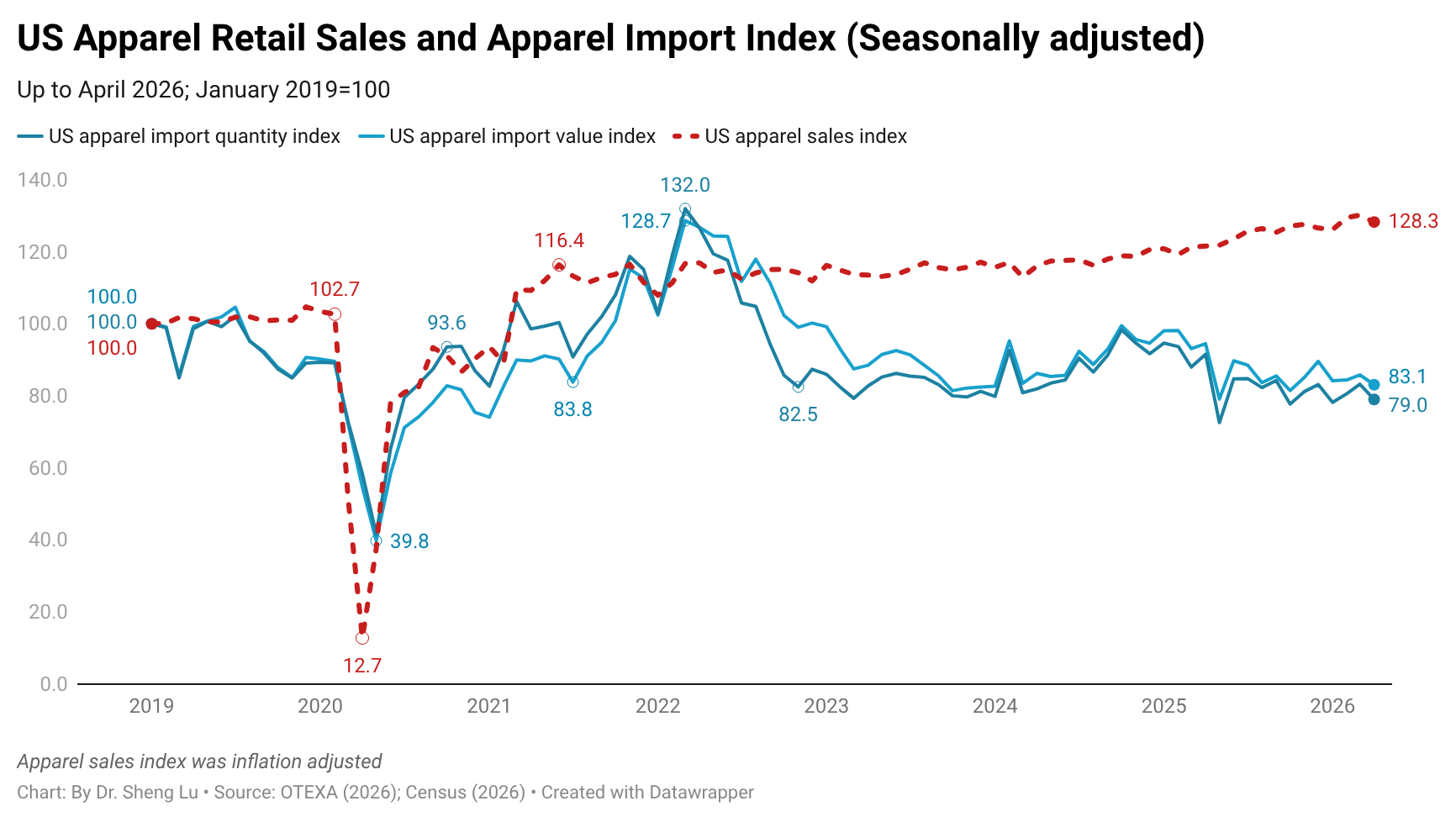
First, U.S. apparel imports continued to shrink in April 2026, reflecting consumers’ hesitation to spend on clothing amid worsening inflation and ongoing economic uncertainty. Specifically, U.S. apparel imports declined by 12.0% in value and 13.8% in April 2026 compared to the previous year, marking the fourth consecutive month of negative growth. Even after adjusting for seasonal factors, U.S. apparel imports in April 2026 were still 3.2% lower in value and 5.1% lower in quantity than in March 2026. As U.S. inflation rose to 4.2% in May 2026, U.S. apparel imports may not reverse the downward trend anytime soon. [see detailed monthly U.S. apparel import data here]

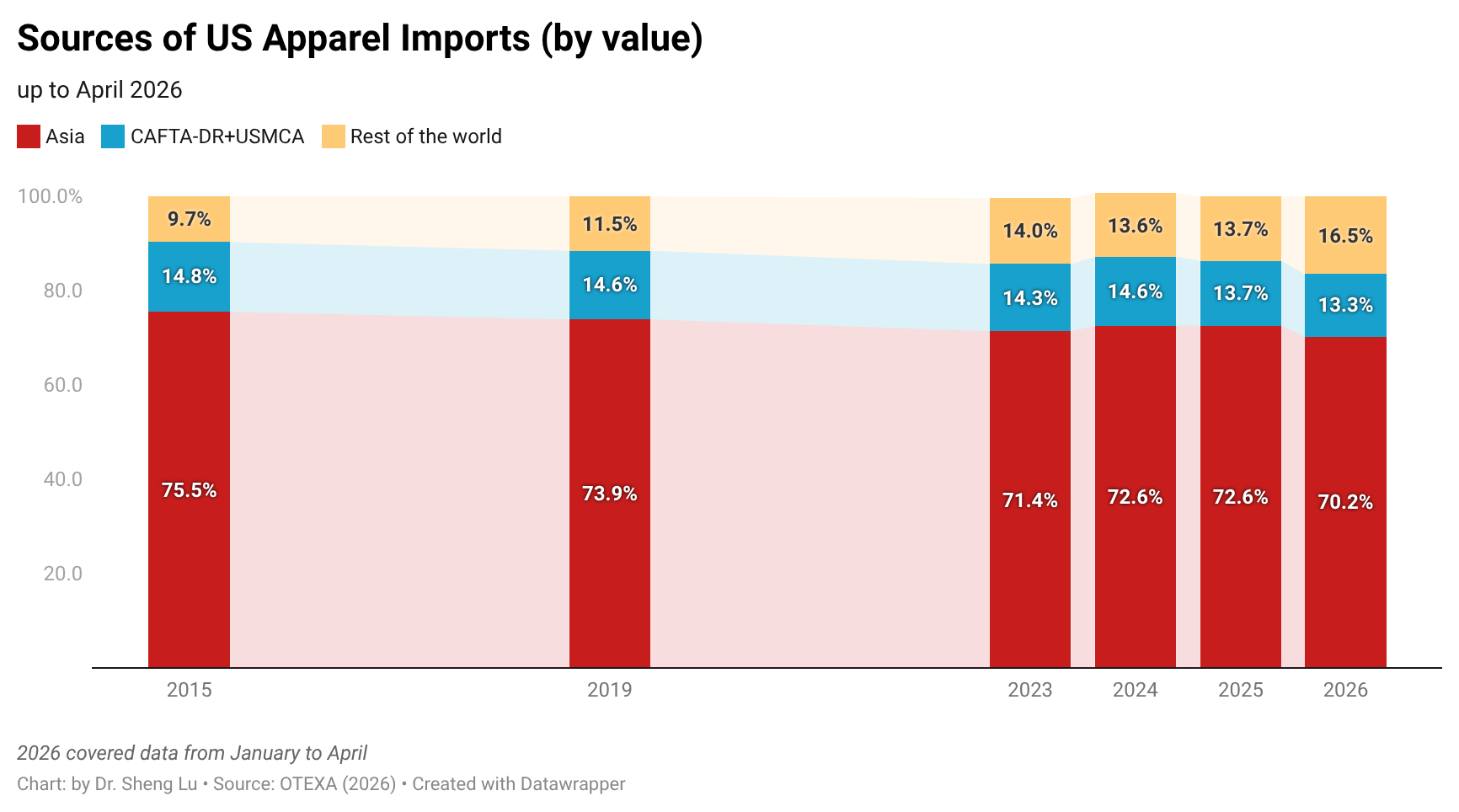
Second, although Asia still dominates, the U.S. apparel sourcing base is becoming increasingly diverse. By value, about 70.2% of U.S. apparel imports came from Asian countries in April 2026, down from 72.0% a year earlier. Notably, Asia’s declining market share was NOT captured by Western Hemisphere countries, whose share remained at 15.7% in April 2026 (including 13.7% for CAFTA-DR and USMCA members), even slightly lower than the 15.8% recorded in April 2025. Instead, U.S. apparel imports from countries outside Asia and the Western Hemisphere reached a new high of 14.1% in April 2026, up from 12.3% in April 2025 and well above the 7.4% recorded in 2015. This shift reflects U.S. fashion companies’ efforts in recent years to explore emerging sourcing destinations in regions such as Africa, the Middle East, and the EU to mitigate growing sourcing risks and other concerns.

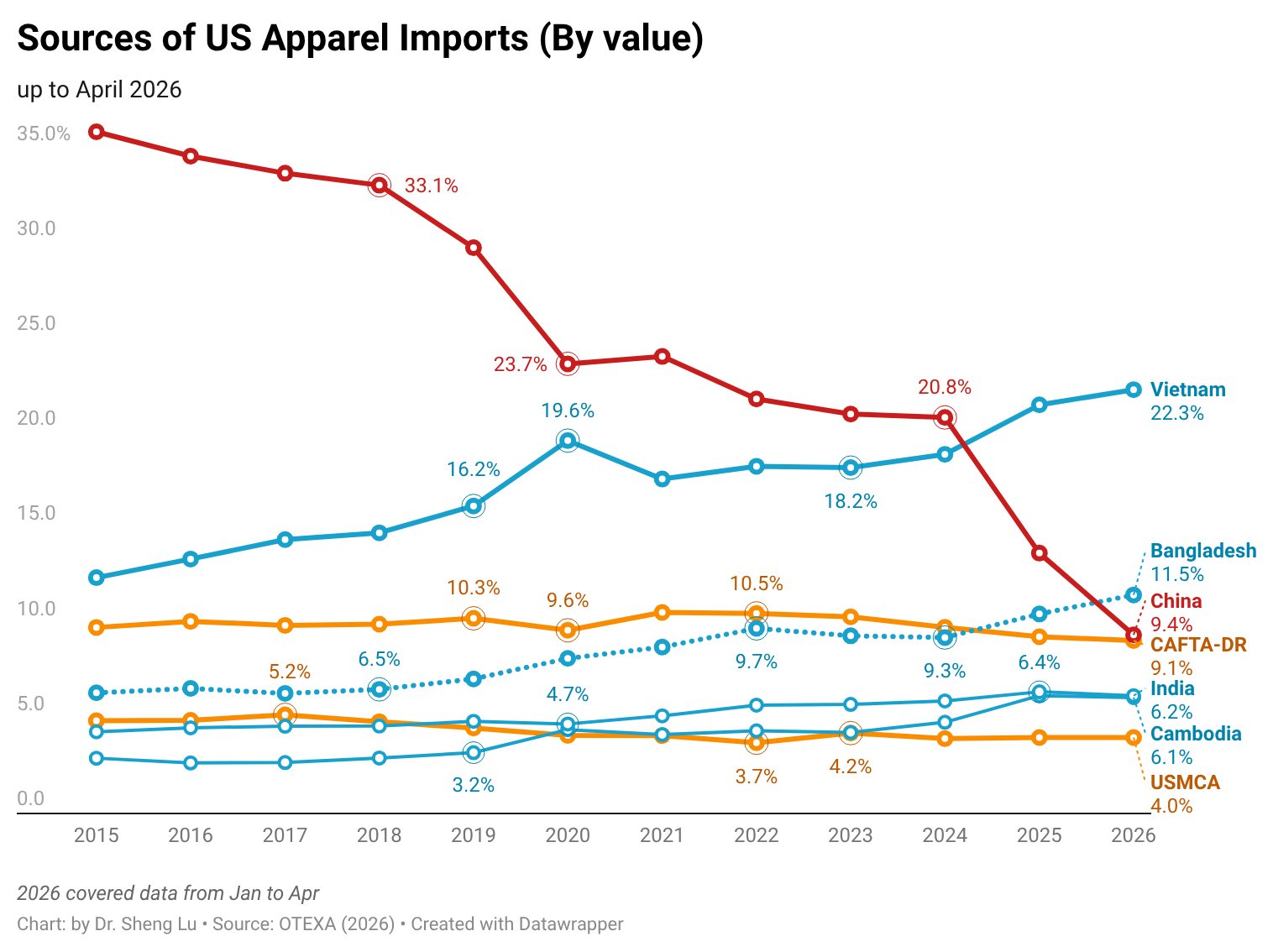
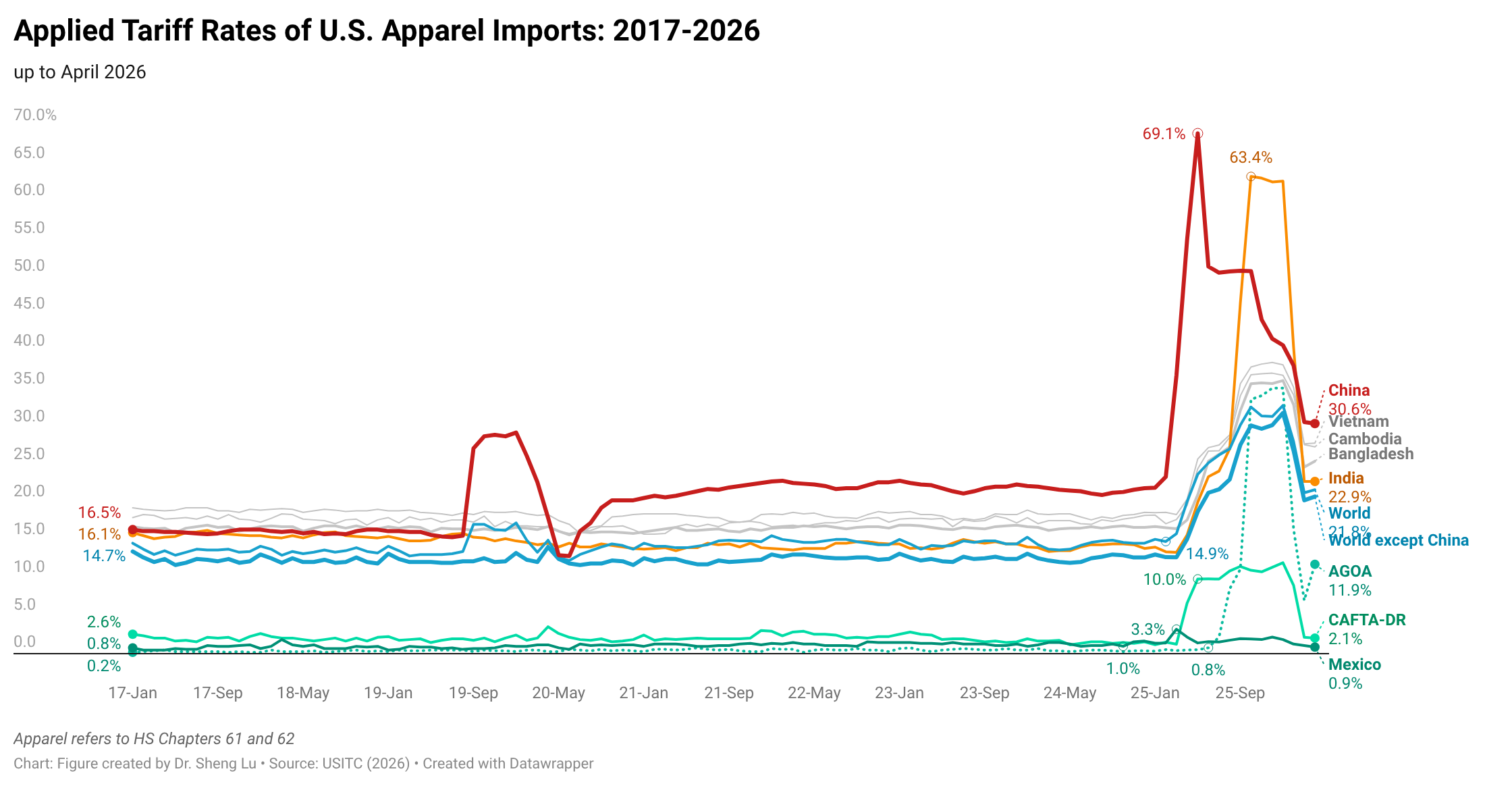
Third, at the country level, U.S. fashion companies have increased sourcing from several key Asian apparel-supplying countries beyond China, as well as from a few emerging sourcing destinations in other regions. Specifically, in the first four months of 2026, while the value of U.S. apparel imports decreased by 12%, imports from Vietnam (up 1.3%), Indonesia (up 2.3%), and Cambodia (up 14.2%) increased. Egypt (up 14.7%) and Turkey (up 6.4%) also became more popular sourcing destinations. In comparison, over the same period, U.S. apparel imports from China (down 50.2%), India (down 28.0%), and Bangladesh (down 11.2%) decreased substantially. Particularly for China and India, the much higher tariff rates imposed on their products were among the critical factors behind their loss of sourcing orders. Regarding Bangladesh, since it primarily produces low-volume items for U.S. fashion companies, it could be disproportionately affected as ordinary U.S. consumers purchase fewer clothing items amid economic stress. [See detailed country market share data here]

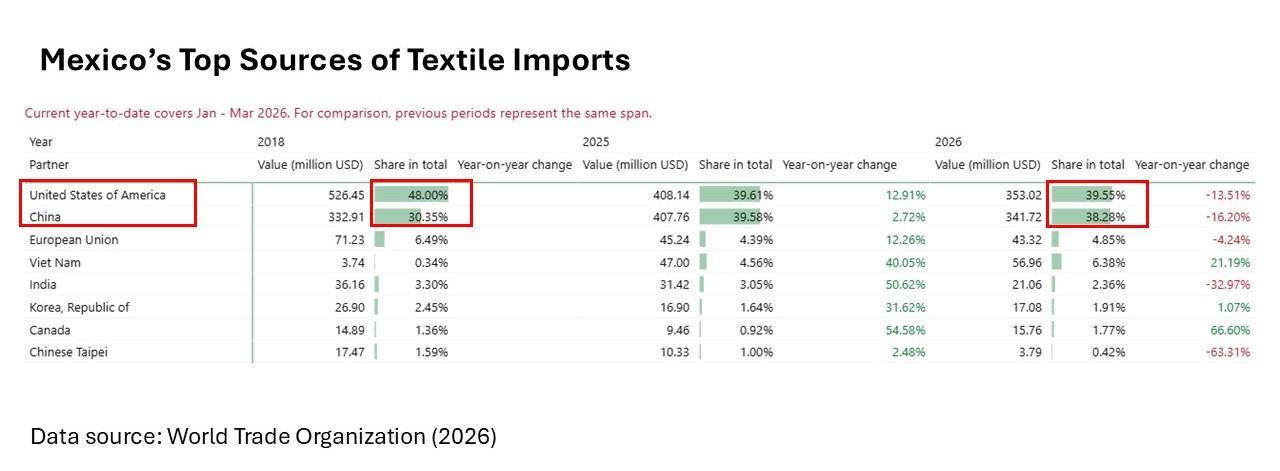
Fourth, with the upcoming US-Mexico-Canada Agreement (USMCA) joint review later this summer, the state of U.S. textile and apparel trade with Mexico and Canada has drawn increased attention. On the one hand, the OTEXA data show that the USMCA remained the single largest export market for U.S.-made yarns and fabrics as of 2026. In the first four months of 2026, about 48.4% of U.S. yarn and fabric exports went to USMCA members, including 33.9% destined for Mexico. This share has been highly consistent over the past decades, including when the USMCA replaced NAFTA in 2020. Meanwhile, according to the latest data from the World Trade Organization (WTO), in the first three months of 2026, the U.S. accounted for about 39.3% of Mexico’s textile imports. However, this percentage was noticeably lower than 48% in 2018. Over the same period, China has become an increasingly important textile supplier for Mexico, with its market share rising from 30.3% in 2018 to 38.3%.

On the other hand, in value terms, USMCA accounted for 3.4% of U.S. apparel imports in the first four months of 2026 (including 2.8% from Mexico), slightly up from 3.2% over the same period in 2025. Despite the relatively low market share compared to Asian suppliers, it should be noted that in the first three months of 2026, nearly 98% of Mexico’s apparel exports went to the United States. Data from the U.S. International Trade Commission further show that almost 94% of those exports claimed duty-free benefits under the USMCA in the first three months of 2026, a significant jump from around 80%-83% in the past. USMCA-qualifying apparel has been among the very few products exempt from the tariff hikes since Trump’s second term.

Furthermore, in the first four months of 2026, about 55.3% of U.S. apparel imports from Mexico were cotton apparel, the lowest share since 2021 (around 57%). While the available data did not establish a direct causal relationship, the growing availability of textile inputs from Asia may have contributed to a broader diversification of Mexico’s apparel exports to the U.S. market beyond traditional products such as men’s and boys’ cotton trousers. This trend also underscores the high stakes of USMCA’s review. The agreement’s duty-free preferences and yarn-forward rules have long encouraged the use of U.S.-made textile inputs, especially those cotton-centered, in Mexican apparel production. Without these incentives, Mexican manufacturers could have greater flexibility in sourcing textile inputs from Asia, given the benefits of diversifying their export offerings. Such a shift could reduce demand for U.S. yarn and fabric exports and further weaken traditional Western Hemisphere textile and apparel supply chains.

Additionally, U.S. apparel imports from Sub-Saharan African (SSA) countries declined sharply, down 30.9% in value and 22.3% in quantity in April 2026. So far in the first four months of 2026, SSA countries together accounted for 1.9% of U.S. apparel imports, the same as in 2025. With the African Growth and Opportunity Act (AGOA) renewed for only one year and set to expire at the end of 2026, these results reinforce concerns that U.S. fashion companies are unwilling to expand apparel sourcing from AGOA without a clear long-term policy outlook.

by Sheng Lu