New Study: Strengthening Textile to Textile Recycling Capacity in the U.S.-Dominican Republic-Central America Free Trade Agreement (CAFTA-DR) Region

Read the Full Study HERE

In collaboration with the American Apparel and Footwear Association (AAFA), this study draws on 12 in-depth stakeholder interviews conducted between February and April 2026. Interviewees included U.S. fashion brands and retailers, textile manufacturers and recyclers, policymakers and other industry stakeholders involved in the CAFTA-DR region.

Some of the key findings include:

  • The CAFTA-DR region possesses important advantages for developing an integrated Textile to Textile (T2T) recycling ecosystem. Existing textile and apparel manufacturing capacity, geographic proximity to the U.S. market, preferential market access under CAFTA-DR, and growing interest in nearshoring provide a foundation for future growth.
  • Early movers are establishing a regional recycling footprint, particularly in El Salvador and Guatemala. Stakeholders reported ongoing efforts involving textile waste collection, sorting, recycling, yarn production, and garment manufacturing using recycled inputs. However, regional T2T supply chains remain fragmented, and integration across countries is incomplete.
  • Post-industrial textile waste offers a strong, proven starting point for scaling T2T recycling. Compared with post-consumer textile waste, post-industrial cutting scraps are generally cleaner, more homogeneous, and already partially sorted by fiber type and color. They can help companies build operational experience, infrastructure, and market confidence before expanding into more complex post-consumer recycling systems.
  • Insufficient and uncertain market demand, rather than technological feasibility alone, is becoming a major barrier to expanding T2T recycling. Although relevant recycling technologies, production know-how, and some physical capacity already exist, recyclers and manufacturers remain hesitant to invest in additional capacity without stronger assurances of sustained demand for recycled textile materials.
  • Cost parity between recycled and conventional textile materials is becoming increasingly achievable, but operational complexity remains. Sorting costs, labor intensity, contamination, production scale, and quality consistency continue to affect the commercial viability of T2T recycling.

One particularly interesting takeaway is that building a circular fashion industry requires more than recycling technology and corporate sustainability commitments. Trade policy could become an important tool for advancing textile circularity. By creating stronger market incentives for recycled materials, clarifying rules of origin, and facilitating cross-border trade in recycled textile inputs, trade agreements like CAFTA-DR could help encourage investment and build more integrated regional circular textile and apparel supply chains.

In other words, trade policy can help facilitate the movement of conventional textile and apparel products and shape the future of more sustainable, circular fashion supply chains.

By Emilie Delaye and Sheng Lu

Also read: AAFA press release about the study
Mature vs. Emerging Apparel Sourcing Destinations: Implications for US Fashion Companies

Presentation Summary

As U.S. fashion companies continue to expand into emerging markets, including many non-Asian countries (e.g., Jordan, Egypt), this presentation discusses the strengths and limitations of these emerging sourcing destinations compared with mature supplying countries (e.g., China and Vietnam).

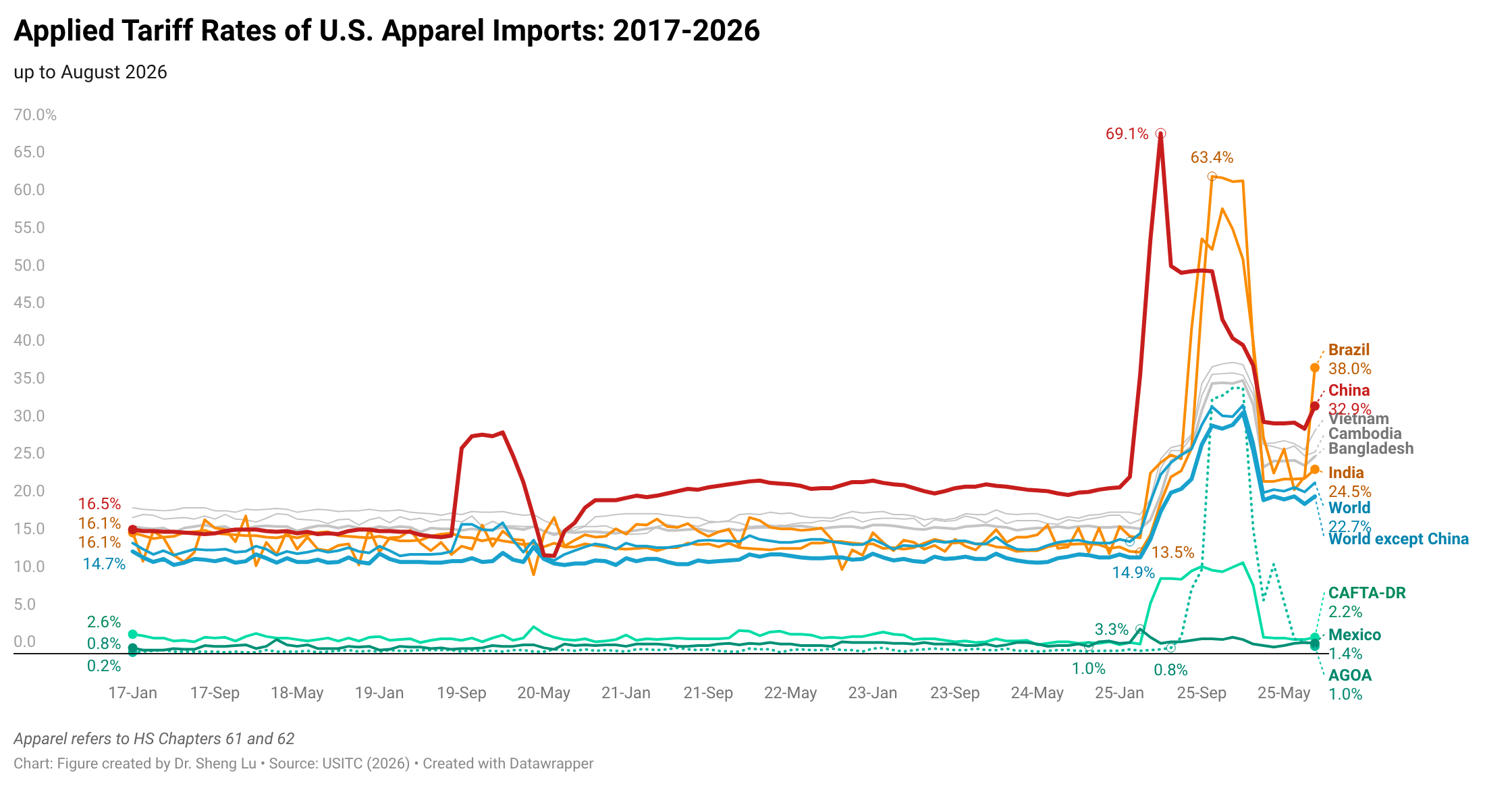
Leveraging the latest macro-U.S. trade statistics and product-level data running from Jan to Oct, 2026,  several interesting patterns were found:

First, despite declining market share and fashion companies’ ongoing sourcing diversification, mature sourcing destinations, especially China, continue to demonstrate notable strengths in supplying a much wider variety of apparel products, as measured by the number of Stock Keeping Units (SKUs).

Second, emerging sourcing destinations mostly supply the mass and value market segments, likely because U.S. fashion companies face growing sourcing cost pressure amid tariff hikes. In comparison, a substantial share of US apparel imports from China and Vietnam already target luxury and premium market segments.

Third, U.S. fashion companies commonly source certain product categories from emerging sourcing destinations, such as Cambodia for tops, Jordan for T-shirts, tops, and bottoms, Egypt for tops and bottoms, and Sri Lanka for swimwear and underwear. In comparison, mature sourcing destinations like China and Vietnam can supply all major product categories.  In particular, emerging sourcing destinations still have limited capacity to supply relatively more complex product types, including dresses and outerwear.

Similarly, US apparel imports from mature sourcing destinations demonstrate more diversity in fiber content. In comparison, US apparel imports from most emerging sourcing destinations often have gaps in the use of specific fibers, especially beyond cotton and basic polyester. This may reflect more advanced local textile manufacturing capacity in mature sourcing destinations.

Additionally, according to the 2026 USFIA benchmarking study, surveyed fashion companies mostly view emerging sourcing destinations as cost-competitive. Meanwhile, these countries still lag in speed to market, flexibility, agility, and minimum order quantity.

Overall, the findings raise some interesting trends to watch.

One is that mature sourcing destinations will remain highly relevant and could be used more strategically by leveraging their advantages in supplying a wider range of products and adjusting orders more easily. In other words, mature suppliers may no longer dominate sourcing volume, but they remain indispensable strategic partners.

Second, U.S. fashion companies could consider where to invest in emerging sourcing destinations further. Beyond expanding existing production capacity, there may be growing opportunities to diversify product offerings, strengthen local textile manufacturing, and develop capabilities to serve higher-value market segments.

Third, the next phase of sourcing diversification may be driven by a broader set of competitiveness factors. As emerging sourcing destinations gain importance and the global business landscape continues to evolve, it will be interesting to see how U.S. fashion companies balance conventional sourcing factors, such as cost and speed to market, with emerging priorities, such as trade compliance capabilities and regional balancing in sourcing.

By Sheng Lu

Note: The presentation was delivered at the 2026 Apparel Importers Trade and Transportation Conference co-hosted by the United States Fashion Industry Association and the Fashion Institute of Technology (FIT) in New York City.

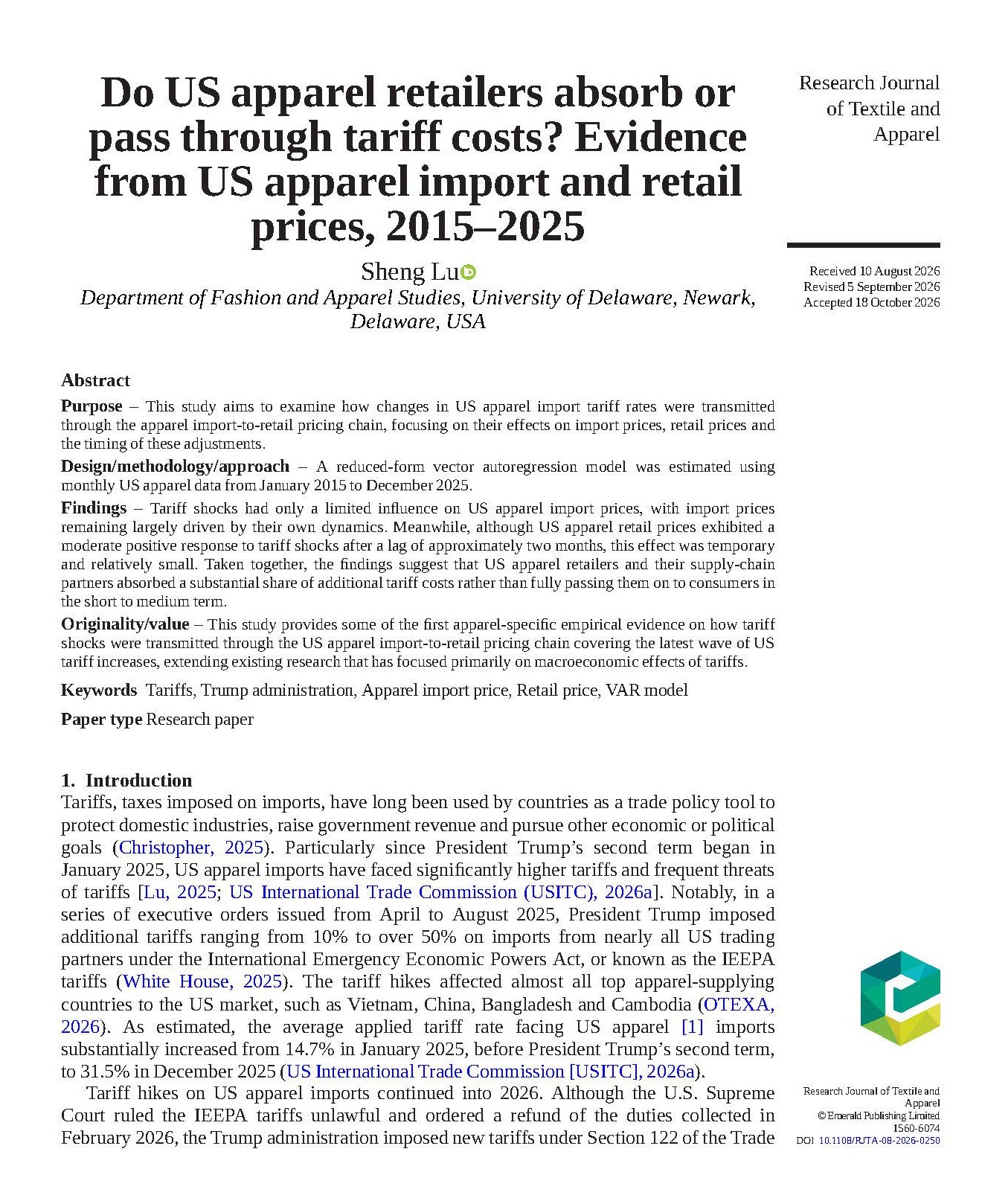
New Study: Do US apparel retailers absorb or pass through tariff costs? Evidence from US apparel import and retail prices, 2015–2025

Summary

Background

In the context of the significant tariff hikes during President Trump’s second term, there has been heated debate about who ultimately bears the cost of higher U.S. import tariffs. Do U.S. apparel retailers pass these additional costs on to consumers through higher retail prices, or do they absorb a substantial share of the costs themselves?

Research question

Using monthly U.S. government data from January 2015 through December 2025, the study examines how apparel tariff changes are transmitted through the import-to-retail pricing chain. Rather than looking only at consumer prices, the study considered three interconnected factors: U.S. apparel import tariff rates, U.S. apparel import prices, and U.S. apparel retail prices. The analysis also included U.S. apparel retail sales to reflect shifting consumer demand.

Findings

Challenging the common perception that higher tariffs inevitably lead to higher clothing price tags in the retail market, the findings suggest that tariff increases do not necessarily translate into proportionally higher retail prices. Instead, a substantial share of the tariff burden appears to be absorbed by U.S. fashion companies and their suppliers, rather than being fully passed on to consumers, at least in the short to medium term. Specifically:

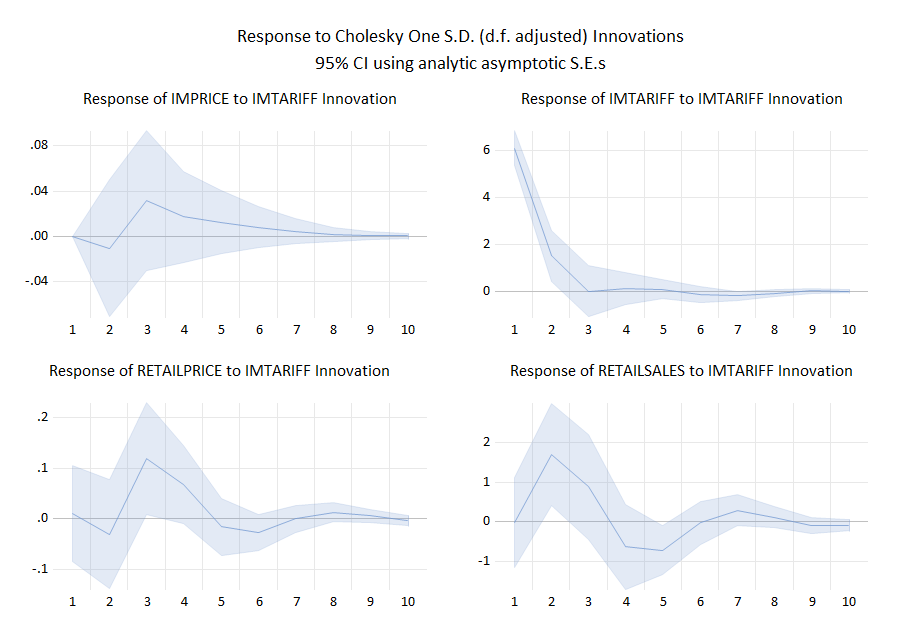
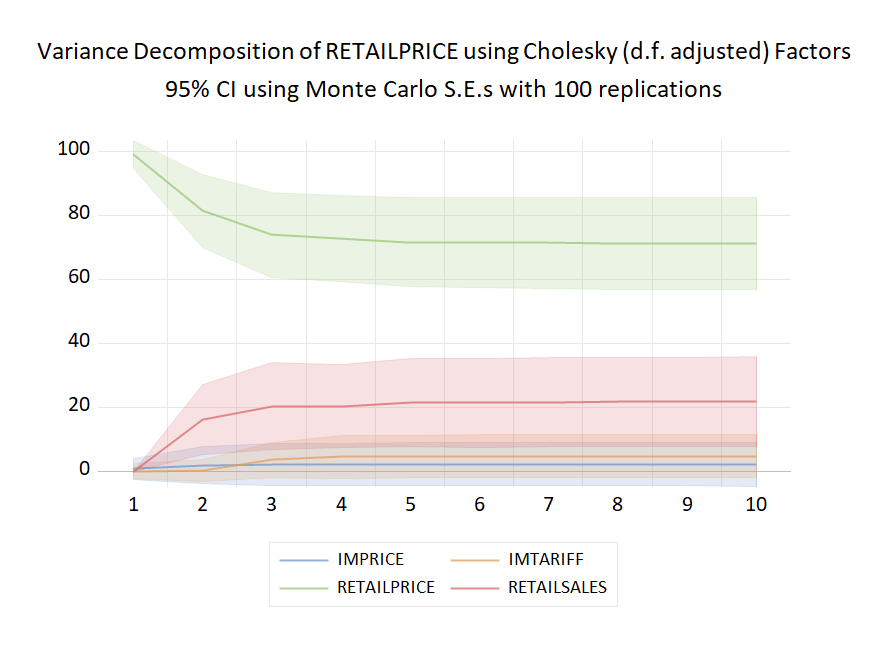
First, higher tariffs do not automatically translate into higher apparel import prices. One particularly interesting finding is that U.S. apparel import prices showed relatively little response to tariff increases. In the statistical analysis, tariff shocks explained only approximately 1.2% of the variation in U.S. apparel import prices over a ten-month forecast horizon. More than 95% of the variation was explained by import prices’ own historical dynamics. In other words, changes in tariffs alone did not explain much of the month-to-month movement in U.S. apparel import prices.

Several factors could contribute to this intriguing pattern. One is that apparel sourcing operates on relatively long planning and purchasing cycles. Brands and retailers often negotiate prices and place orders with overseas suppliers several months before products arrive in the United States. Consequently, import prices may not adjust immediately when trade policies change.

In addition, importers and suppliers may renegotiate prices and share some of the additional tariff burden, at least initially. However, this arrangement can put additional financial pressure on overseas manufacturers, many of which already operate with relatively thin profit margins.

Second, U.S. apparel retail prices respond to tariffs, but the increase could be delayed. According to the study, while U.S. apparel retail prices do respond positively to tariff increases, the response is relatively small and temporary. The statistical analysis finds that apparel retail prices initially show no statistically significant increase following a tariff shock. A measurable positive response emerges approximately three months later. However, this effect weakens quickly and becomes statistically insignificant afterward. In other words, U.S. apparel retailers do not immediately pass the full impact of higher import costs on to consumers. Instead, they appear to absorb a substantial share of additional costs, at least in the short to medium term.

Several factors could help explain this behavior. The U.S. apparel retail market is highly competitive, and consumers have many alternatives when shopping for clothing. Retailers may therefore be reluctant to increase prices substantially because doing so could cause customers to switch to competitors. Retailers may also have opportunities to renegotiate supplier prices, adjust sourcing arrangements, or modify product assortments to manage additional costs.

It should be noted that the findings do not suggest that tariffs have no impact on apparel prices. Rather, they show that tariff costs are transmitted to consumers neither immediately nor proportionally. Over a ten-month forecast horizon, tariff changes explain only about 5% of the variation in U.S. apparel retail prices. By comparison, retailers’ historical pricing patterns explain the largest share, over 70%, of price fluctuations, while consumer demand accounts for approximately 16%–22%.

Implications

As the findings suggest, the key question facing the U.S. apparel industry amid tariff hikes is not simply whether tariffs will make clothing more expensive, but how companies across the global supply chain will absorb, share, and manage the resulting costs. In the context of continued trade policy uncertainty, understanding these dynamics will be increasingly important for fashion companies as they make sourcing, pricing, and supplier-management decisions.

For overseas apparel manufacturers, the findings also raise an important question: as U.S. importers face higher tariff costs, will suppliers be increasingly asked to share the burden by lowering export prices? Such pressure could further strain manufacturers’ profitability and influence their relationships with U.S. buyers.

For policymakers, the findings underscore the importance of looking beyond changes in consumer or retail prices when evaluating the economic impact of tariffs. Limited increases in retail prices do not necessarily mean that tariffs impose limited costs. Rather, policymakers should also examine how tariff costs are absorbed and distributed across the global apparel value chain, including their effects on retailers, overseas suppliers, and other industry stakeholders.

By Sheng Lu

Full paper: Lu, S. (2026). Do U.S. Apparel Retailers Absorb or Pass Through Tariff Costs? Evidence from U.S. Apparel Import and Retail Prices, 2015–2025. Research Journal of Textile and Apparel, ahead of print