
Global Textile and Apparel Exports by Income Groups (2000-2015)

textile-2

textile-1

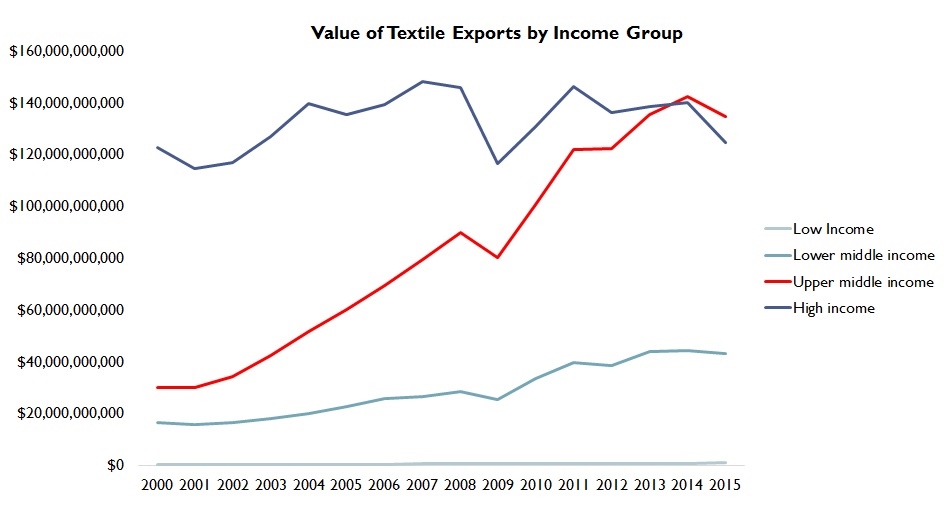
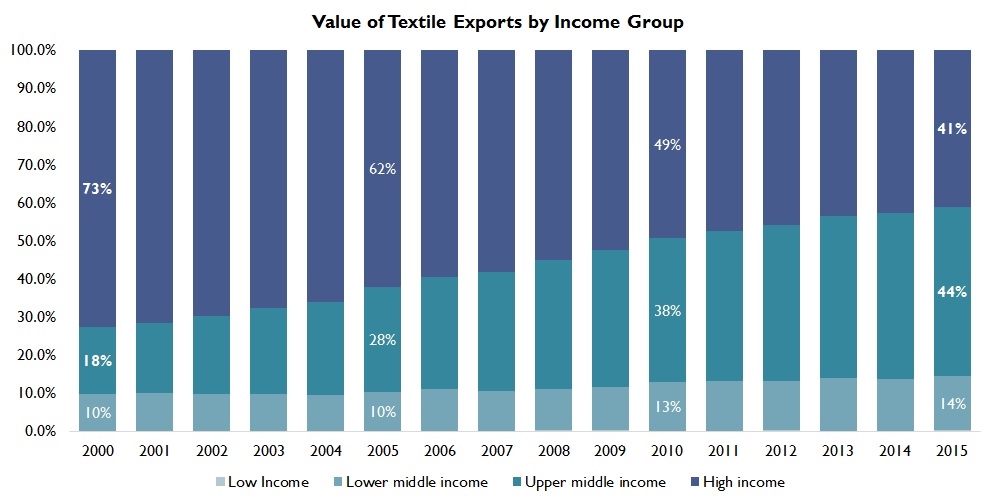
As of 2015, over 40% of textile exports still come from high income countries. Meanwhile, upper middle income countries are quickly expanding exports and gaining more market shares from 2000 to 2015. However, textile exports from low income countries remain minimal.

apparel-2

apparel-1

From 2000 to 2015, shares of apparel exports from high income countries dropped from 50% to 31%. Meanwhile, market shares of upper middle income countries increased from 32% to 46%. However, low income countries are becoming even more marginalized in apparel exports: their market shares slipped from 0.3% in 2000 to only 0.1% in 2015.

share-1  share-2

Additionally, textile and apparel exports in general are economically more important for lower income countries than higher income countries. However, the percentage of textile and apparel in a country’s total merchandise exports seem to be declining across all income groups except for low-income countries.  Meanwhile, for a good number of low-income and lower-middle income countries such as Bangladesh, Gambia, Pakistan and Cambodia, textile and apparel remain one of their very few exporting opportunities.

Data source: World Trade Organization (2017), World Bank (2017); Country list (by income groups) can be found HERE

Acknowledgement: Thanks to Sheiron Crawford for assisting the data collection.

Outlook 2017: Apparel Industry Issues in the Year Ahead

outlook

In January 2017, Just-Style consulted a panel of industry leaders and scholars in its Outlook 2017–Apparel Industry Issues in the Year Ahead management briefing. Below is my contribution to the report. Welcome for any suggestions and comments.

1: What do you see as the biggest challenges – and opportunities – facing the apparel industry in 2017, and why?

I see the uncertainty in the global economy will pose one of the biggest challenges facing the apparel industry in 2017. Apparel business is buyer-driven. A great number of studies have suggested that economic growth is by far the most effective and reliable predictive factor for apparel consumption. Unfortunately, it seems apparel companies have to deal with another year of economic volatility and weak demand in 2017. For example, according to the latest International Monetary Fund (IMF) forecast released in October 2016, global economic growth in 2017 is projected to only recover to 3.4 percent from 3.1 percent in 2016. There is no particular excitement among major apparel consumption markets either: outlook of the U.S. economy in 2017 is complicated by the strong U.S dollar, the Federal Reserve’s monetary policy as well as the uncertain trade and tax policy to be adopted by the new Trump administration; Economic growth in the EU region next year will continue to be hindered by the unknown fallout from UK’s referendum on leaving the EU, pervasive geopolitical uncertainties, high unemployment rates and the rising protectionist tendencies; Japan’s economic growth is projected to be as low as 1.0 percent in 2017 according to the Organization for Economic Co-operation and Development (OECD); And China’s economic growth in 2017 could slow again to 6.5 percent, which would be the slowest pace in more than 25 years. Reflecting the trend, we might see a stagnant growth or even a decline of global textile and apparel trade in 2017 as well.

Nevertheless, companies’ continuous investments on technology and innovation will create exciting new opportunities for the apparel industry. Particularly, growing areas in the apparel industry such as 3D printing, wearable technology, digital prototyping and e-commerce have made many “non-traditional” players now interested in fashion, including technology giants like Google and Apple. I think we can expect the apparel industry to become even more modern and high-tech driven in the years to come. The changing nature of the apparel industry will also increase demand for talents from an ever more diversified educational background, such as engineering, physical therapy and business analytics.

2: What’s happening with sourcing? How is the sourcing landscape likely to shift in 2017, and what strategies can help apparel firms and their suppliers to stay ahead?

One observation from me is that textile and apparel (T&A) supply chain is becoming more regional-based. For example, data from the World Trade Organization (WTO) shows that 91.4 percent of textiles imported by Asian countries in 2015 came from other Asian countries, up from 86.6 percent in 2008. This suggests that Asian countries togetherare building a more integrated T&A supply chain. Likewise, in 2015 close to 90 percent of apparel exported by North, South and Central American countries went to the United States and Canada and 81 percent of apparel exported by EU countries went to other EU countries too. To be noted, all of these three major T&A supply chains are facilitated by respective free trade agreements in the region such as the North American Free Trade Agreement (NAFTA), ASEAN–China Free Trade Area (ACFTA) and of course the common market enjoyed by the EU members. On the other hand, fashion brands and apparel retailers often use the Western-Hemisphere supply chain and EU-based supply chain as a supplement to the Asia-based supply chain for more fashion-oriented or time-sensitive items. I think such a dual-track sourcing strategy will continue in 2017.

Related, I think supply chain management will play a growing important role helping apparel companies control sourcing cost, improve speed to market and better meet consumers’ demand in 2017. An interesting phenomenon revealed by the 2016 U.S. Fashion Industry Benchmarking Study released by the U.S. Fashion Industry Association is that around 30 percent of respondents say they plan to consolidate rather than diversify their sourcing base in the next 2 years. As one respondent commented, “(Our) focus right now is really finding efficiencies and maximizing productivity in the supply chain. While we won’t necessarily move out of any countries, we are consolidating the base within regions.”

Last but not least, I think in 2017 apparel companies will continue to give more weight to sustainability and social responsibility in their sourcing decisions. Building a more transparent and sustainable supply chain is an irreversible trend in the apparel industry. 

3: What should apparel firms be doing now if they want to remain competitive into the future? What will separate the winners from the losers?

To remain competitive into the future, apparel companies need to be prepared to change and be willing to try something new. Indeed, revolution is coming for the apparel industry, including the way products are made and sourced (example: 3D printing and various digital manufacturing tools), how consumers shop (example: the see-now-buy-now trend) and where and how to sell (example: the booming e-commerce and omni-channel retailing). In the past, small and medium sized companies (SME) were regarded more vulnerable than big players in the apparel industry for business survival.  However, nowadays, without embracing the spirit of innovation and entrepreneurship, even large companies can quickly become “dinosaurs” and find their business struggling. 

4: What keeps you awake at night? Is there anything else you think the apparel industry should be keeping a close eye on in the year ahead? Do you expect 2017 to be better than 2016, and why?

One thing that keeps me awake at night as a professor is what needs to be changed or updated in our curriculum to better prepare our students for the needs of the apparel industry. Fashion programs like us directly prepare future professionals for the fashion apparel industry. This also means we are not immune to the big shift in the industry either. For example, our course offerings currently include textile science, product development, merchandising, branding and sourcing and trade. But in addition to these conventional topics, what else should be added to the curriculum? What new skill setsor knowledge points will be highly expected by the apparel industry for our students in the future? Personally I think talent training is a critical area that the apparel industry and our fashion educational programs can and should form closer partnership. And the outcomes will be mutual beneficial too.

Trade policy is another area that keeps me awake at night. Trade policy matters for the apparel industry because it affects the quantity, price and availability of products in the market. Specifically, in 2017 I will be watching closely about the following trade agendas: 1) the WTO Trade Facilitation Agreement (TFA), which is nearing entering into force. TFA aims to make customs and border procedures easier, speed up the passage of goods between countries and lower cost of trade.

2) negotiation of the Regional Comprehensive Economic Partnership (RCEP). In 2015, the sixteen RCEP members altogether exported $369 billion worth of textile and apparel (50% of world share) and imported $124 billion (34% of world share). Since the Trans-Pacific Partnership (TPP) won’t be implemented anytime soon, RCEP has the potential to influence and reshape the T&A supply chain in the Asia-Pacific region.

3) a possible revision of the North American Free Trade Agreement (NAFTA). NAFTA is a critical factor facilitating and maintaining the Western-Hemisphere textile and apparel supply chain. A recent study of mine shows that ending the NAFTA would significantly hurt apparel manufacturing in Mexico and textile manufacturing in the United States, largely because apparel “Made in Mexico” today often contains yarns and fabrics “Made in USA”.

4) Trans-Pacific Partnership (TPP) and Trans-Atlantic Trade and Investment Partnership (T-TIP). Although many people think these two agreements are dead, I disagree. TPP and T-TIP are NOT conventional free trade agreements (FTAs) that deal with tariffs and non-tariff barriers only. Just like why we need traffic rules, TPP and T-TIP address our needs to update international trade regulations on 21st century trade agendas such as digital trade, state-owned enterprises, labor and environmental standards, small and medium sized enterprises and trade related investment. On the other hand, both TPP and T-TIP still have a solid and broad supporting base, which includes the fashion apparel industry. If trade politics is why TPP and T-TIP are in trouble, for the same reason, we should expect a reversal of the fate of these two agreements when time arrives. Plus, we should never underestimate the creativity and wisdom of trade policymakers.

Sheng Lu

New USCBC Study Suggests Overall Positive Impacts of China on the US economy

oe-cover_0

Although the trade relationship with China is often blamed for causing job losses in the United States, a new study prepared for the U.S.-China Business Council (USCBC) by Oxford Economics suggests overall positive impacts of China on the US economy. According to the study:

  • China has grown to become the third-largest destination for American goods and services, only after Mexico and Canada. China purchased $165 billion in goods and services from the United States in 2015, representing 7.3 percent of all US exports and about 1 percent of total US economic output. By 2030, US exports to China are projected to rise to more than $520 billion annually.
  • The US-China trade relationship supports roughly 2.6 million jobs in the United States. Specifically, US exports to China directly and indirectly supported 8 million new jobs in 2015.
  • The reported gross US trade deficit with China is overstated and somehow misleading. As China has become an integral part of the global manufacturing supply chain, much of its exports are comprised of foreign-produced components delivered for final assembly in China. If the value of these imported components is subtracted from China’s exports, the US trade deficit with China is reduced by half, to about 1 percent of GDP—about the same as the US trade deficit with the European Union.
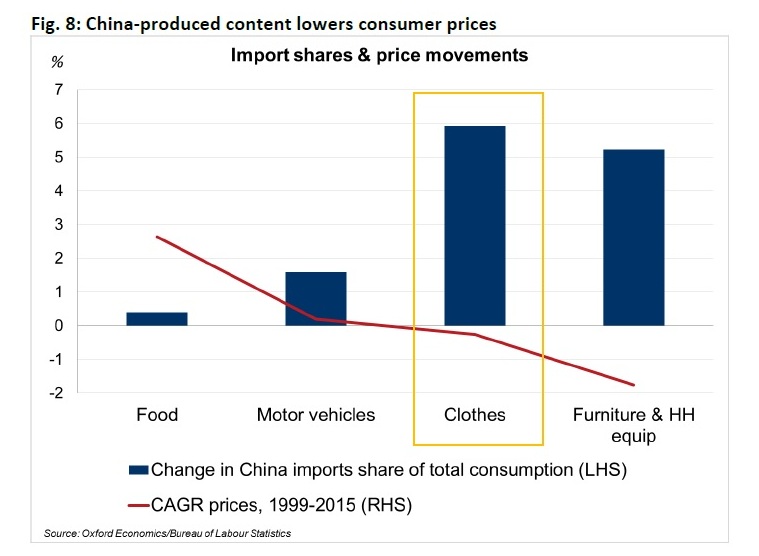
  • Additionally, “Made in China” lowered prices in the United States for consumer goods. As estimated, US consumer prices are 1 percent – 1.5 percent lower because of Chinese imports–trade with China saved each American household up to $850 in 2015. Given the fact that hourly labor costs in the textile industry were $2.65 in China in 2014 compared with $17.71 in the United States, the report argues that replacing Chinese imports of textiles and clothing with US manufactured products would significantly raise US consumer prices.

uscbcjob2017.jpg

uscbcjob20172

In terms of the textile and apparel (T&A) sector, the report suggests that:

  • The rising U.S. import from China mostly represents China’s displacement of imports from other countries and regions: China has been squeezing out traditional apparel manufacturers such as Mexico, Hong Kong, and Taiwan.
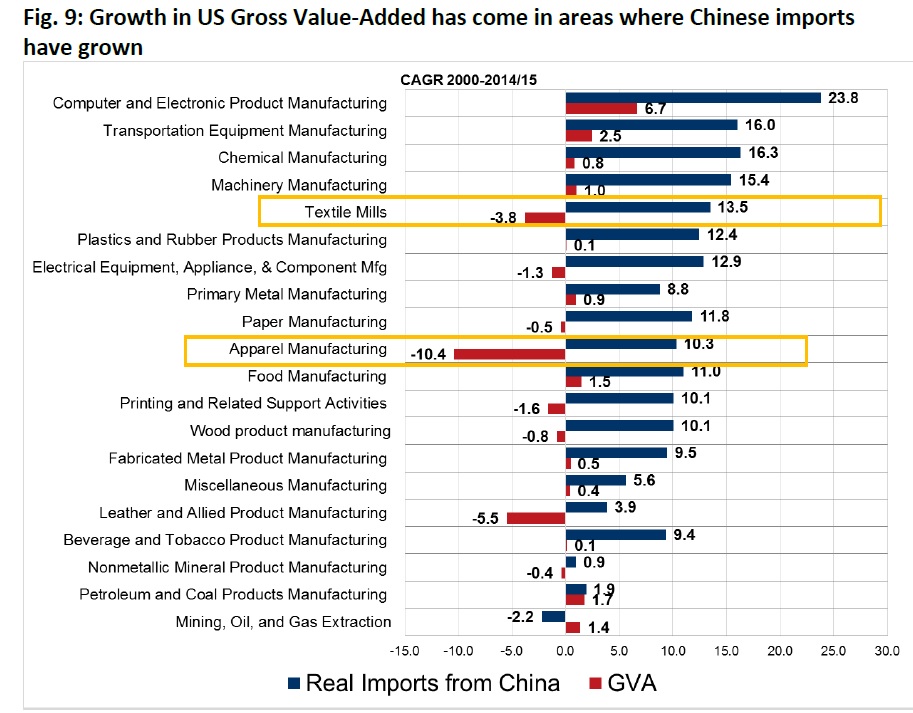
  • Meanwhile, textile and apparel manufacturing is one of the very few sectors that observe a paralleled pattern of rising imports from China and declining gross value added in the United States since 2000. In comparison, over the same period other sectors that experienced the most rapid growth in Chinese imports are also the sectors where US businesses have seen the strongest growth.

The report can be downloaded from HERE.

Made in the USA Textiles and Apparel:Facts and Future

The presentation is the outcome of Jillian Luetje‘s honor project in FASH455 (Fall 2016). In the project, Jillian explored the facts and future of “Made in USA” textile and apparel based on her research of existing literature and interviews with U.S. trade officials. The presentation intends to help the audience (especially those new to the area of textile and apparel trade and trade policy) have a basic understanding of the topic.  

Key findings:

  • Textile and apparel manufacturing in the USA is NOT totally gone.
  • The U.S. textile industry in particular relies on the Western Hemisphere supply chain and related free trade agreements
  • Made in the USA apparel is not going to increase any time soon.

Welcome for any comments and suggestions!

Outlook for Trade Policy in the Trump Administration and Impact on the Textile and Apparel Industry: A Summary of Views from Experts

bn-qb709_1001tr_m_20161002000431

TPP is in trouble, but NOT dead

David Spooner, Partner at Barnes & Thornburg LLP, Former Chief Textile & Apparel Negotiator at the Office of the U.S. Trade Representative, and Former Assistant Secretary of Commerce for Import Administration: “it will be a tough road to pass it (the Trans-Pacific Partnership, TPP) during the Trump Administration…However, there may be opportunities for the (fashion) industry if Trump brings new faces to the Office of the U.S. Trade Representative (USTR) and takes a fresh look at trade agreements.” Source: https://www.usfashionindustry.com/news/off-the-cuff-newsletter/2803-recap-28th-apparel-importers-trade-transportation-conference

Jeffrey J. Schott, Senior Fellow of the Peterson Institute for International Economics: “What’s the future for TPP? Most likely, Trump will simply not implement it. Without US participation, the pact cannot definitively enter into force. It’s death by malign neglect.” “But the 11 other TPP countries may not sit idly on the sidelines waiting for US ratification. Instead, they could agree among themselves to extend the TPP benefits to each other on a provisional basis, leaving the door open for US participation in the future. If the United States subsequently ratifies the TPP, the pact would then enter into force on a permanent basis.” Source: https://piie.com/blogs/trade-investment-policy-watch/tpp-could-go-forward-without-united-states

Steve Warner, President/CEO BeaverLake6 Group LLC, former President and CEO of the Industrial Fabrics Association International (IFAI): “TPP was dead going forward. TPP isn’t actually bad for the technical textiles industry except in a few instances. The real bad culprit, though, is the passage of the Trade Promotion Authority (TPA), which I opposed when it was being hotly debated in 2015. TPA gave no wiggle room for lawmakers to make even slight changes in the TPP when it was presented by the Obama administration that could at least mollify a representative’s constituents. You couldn’t just like parts of the agreement; you had to like all of it. Thus, you were either with it entirely or have to go against it. It proved to be safer to go against it. As for T-TIP, it was going to be a tough deal to conclude when the European Union insisted a primary objective for them was the elimination of the Berry Amendment protection for US domestic manufacturers” Source: http://www.beaverlake6.com/in-my-opinion/

Face uncertainties but with hope

Michael Singer, vice president of customs compliance at Macy’s and chairman of the U.S. Fashion Industry Association (USFIA): “I do see some opportunities believe it or not, and I had to struggle really hard to come up with something positive. From the regulatory basis, there may be an opportunity for some easing of government laws and mandates.” “One of the key issues we now face is how the administration and Congress will handle trade issues in 2017… We all know how important trade and the access to world markets is in our ability to provide our customers the choices and products they expected, and yet there is no doubt the protectionist sentiment in our country is at historic levels. USFIA will be doing our best to make sure that this remains a top priority and we clearly communicate the importance and benefit of trade to U.S. consumers and the U.S. economy.” Source: http://wwd.com/business-news/government-trade/donald-trump-on-trade-taxes-and-regulations-10702130/

 Julia Hughes, President of the U.S. Fashion Industry Association (USFIA): “A lot of folks were surprised by the (election) outcome… We can see we have our work cut out for us…We’re going to be dealing with a lot of unknowns even with the continuation of a Republican Congress.” Source: http://www.just-style.com/analysis/tpp-is-not-going-to-happen-in-a-trump-administration_id129272.aspx

Daniel J. Ikenson, director of Cato’s Herbert A. Stiefel Center for Trade Policy Studies: “If he (Trump) is able to expand and diversify the pool of people advising him, there is a reasonable chance that President Trump’s actions will be less bellicose than his rhetoric has been. After all, as someone who wants to make America “great again,” President-elect Trump will want the policies implemented by his administration to help grow the economy. Trade agreements have succeeded in that regard and, in addition to the TPP, there are plenty of countries and regions willing to partner, including the European Union and the United Kingdom (separately), and plenty of alternative negotiating platforms for accomplishing trade and investment liberalization. ” Source: https://www.cato.org/blog/shifting-gears-contemplate-trumps-trade-policies

David Spooner, Partner at Barnes & Thornburg LLP, Former Chief Textile & Apparel Negotiator at the Office of the U.S. Trade Representative, and Former Assistant Secretary of Commerce for Import Administration: “I think there’s some opportunity in a Trump administration…Assuming chaos provides opportunities, and if Trump brings in new faces to USTR, it might give us an opportunity to do new things in trade. We’ve been screwed by the yarn-forward rule for decades. Maybe there’s an opportunity to do things, even if it’s around the margins.” Source: https://sourcingjournalonline.com/tpp-ttip-wont-happen-trump-administration/

Robert Antoshak, managing director at Olah Inc.: “First, (Trump) he’ll let TPP, the Trans-Pacific Partnership) just wither on the vine. It’s pretty easy to kill TPP by doing nothing; Congress hasn’t voted on it yet. Next, he may activate the escape clause in NAFTA (the North American Free Trade Agreement with Canada and Mexico), which gives signatories a six-month window to exit the agreement. During that time, he could use an exit for political gain in the media – imagine the headlines about the US pulling out of NAFTA – but in reality, he could use the time to renegotiate portions of the agreement. And then there’s T-TIP, the Transatlantic Trade and Investment Partnership free trade deal with the EU. Personally, I’m going to keep a close eye on relations between the White House and 10 Downing Street. The commonalities between the forces supporting Brexit and Trump are all too similar. Why negotiate with all of the EU, when it may be more politically expedient for Trump to negotiate a separate economic-trade deal with Theresa May?” “I am confident that he (Trump) will attempt to alter the global hierarchy. One way of changing the system will be to focus on trade. He can make tactical adjustments to trade policy that will not only give him the front-page news he craves, but will enact the kind of systemic change upon which he ran for president.” Source: http://www.just-style.com/comment/trump-trade-policy-who-knows-what-hell-do_id129295.aspx

US-China Trade War? Keep a close watch

Augustine Tantillo, president and chief executive officer of the National Council of Textile Organizations (NCTO): “(I) would be surprised if Trump does not take some steps to crack down on currency devaluation, particularly as it relates to China.” Source: http://wwd.com/business-news/government-trade/donald-trump-on-trade-taxes-and-regulations-10702130/

 Chad Bown, Senior Fellow of the Peterson Institute for International Economics: “What he (Trump) has said is that they (China) manipulate their currency and he has threatened to impose tariffs upwards of 45%. The concerns with doing that is that we (USA) do have a trade agreement with 163 other economies of the world, the WTO. China is a part of that and by doing that (imposing tariffs upwards of 45%) unilaterally, would be violating our commitments, legal commitments to our trading partners under that deal and China would be authorized and probably would retaliate and strike back and probably do the same thing against the United States which would mean U.S. companies and exporters that make goods and agricultural products, and send those to China would suffer as a retaliatory response.” Source: https://www.c-span.org/video/?417891-3/washington-journal-chad-bown-trade-policy-trump-administration

Textile and apparel industry needs NAFTA 

Steve Lamar, executive vice president for the American Apparel & Footwear Association(AAFA): “It is well established that CAFTA and NAFTA are critical for the U.S. textile and apparel industry. The things we have continued to argue is how to find ways to make it better… NAFTA was negotiated when there were no other free-trade agreements and the world was surrounded by quotas and rules of origin that catered to the United States. But the industry has evolved.” “Trump will renegotiate NAFTA and is only threatening to abrogate the free-trade accord… Trump likes to build up leverage to get the best possible deal, and he can view trade with that same lens.” Source: https://www.apparelnews.net/news/2016/nov/17/how-would-end-nafta-affect-la-apparel-industry/

Augustine Tantillo, president and chief executive officer of the National Council of Textile Organizations (NCTO): “there will be a ‘level of caution,’ when it comes to renegotiating NAFTA. This agreement has been in place for a while and it would be clearly disruptive to simply walk away from it at this point.” Source: http://wwd.com/business-news/government-trade/donald-trump-on-trade-taxes-and-regulations-10702130/

Leonie Barrie, Managing editor of Just-Style: “Will a Trump administration revisit NAFTA? Such a prospect is a concerning one because NAFTA’s free trade framework with Mexico has been at the heart of many sourcing strategies in North America. The US exported $6.5bn of apparel and textiles to Mexico last year and, in turn, Mexico shipped $4.2bn to the US. Earlier this year executives told just-style that if Trump went ahead with threats to build a 3,200-kilometre fence on the Mexican-American border to stem immigration, it could cut $2.2bn or 20% of the $11bn in US-Mexican textiles and apparel trade in its first year.” Source: http://www.just-style.com/comment/what-might-a-trump-presidency-mean-for-apparel_id129260.aspx

Please feel free to respond to any comments above or leave your thoughts.

The Future of the Asia-Pacific Region as a Textile and Apparel Sourcing Destination: Discussion Questions Proposed by FASH455

asia-pacific-economy-v7

#1 How have US importers/retailers/fashion brands which source from China reacted to China’s rising labor cost in recent years? Any specific examples of companies’ practices and strategies?

#2 It is widely reported that China’s labor cost has been rising quickly in recent years (around 14% annually between 2010 and 2014). But trade data didn’t show a significant drop of China’s textile and apparel exports to the US. Why is that?

#3 Why do you think people have a conception of China being a “highly reliable” sourcing destination for textile and apparel? What is China’s unique competitiveness?

#4 Many domestic and foreign firms have started investing in textile/fiber factories in Vietnam because of the yarn forward rules of origin in TPP. Would it be in the United States’ best interest to become one of these investors? Why or why not?

#5 In the class we discussed the “flying geese model” and the phenomenon of “Factory Asia”. Particularly, Asian countries are forming an ever more integrated textile and apparel supply chain—for example, apparel manufacturers in Asia are gradually using more textile inputs made in Asia rather than made outside the region. Does it mean that the United States has no role to play in Asia-based textile and apparel supply chain? Will the TPP make a difference?

#6 Should US allow China to join the TPP? Why or why not? If China joins the TPP, what will be the implications for the pattern of textile and apparel trade in the Asia-Pacific region?

 #7 What is the relationship between the Regional Comprehensive Economic Partnership (RCEP) and the Trans-Pacific Partnership (TPP)? Alternatives? Competitors? Friends? Foes? Why are there so many different free trade agreements (FTA) in the same region?

Please feel free to share your thoughts and recommend any additional articles/readings/resources relevant to the discussion. Please mention the question # in your reply.


Chinese Manufacturer to Open $20 Million Garment Factory in the US

mou-signing-between-arkansas-and-suzhou-tianyuan_203804

We all know that China is the single largest supplier of textile and apparel to the U.S. market. But on Oct 20, 2016, Arkansas Gov. Asa Hutchinson announced Tianyuan Garments Company, a Chinese sport apparel manufacturer based in Suzhou, China will invest $20 million to build a new garment factory in the Little Rock area of Arkansas.

Tianyuan, founded in 1998, is a garment maker specializing in the production of casual and sport apparel, including garment for Adidas, Reebok and Armani. With five facilities in China, Tianyuan was named one of the top 100 garment companies in China in 2015. Tianyuan’s annual production rate is nearly 10 million articles and clothing. The company currently supplies 90% of the garments marketed by Adidas, which is the second-largest global sports and apparel maker behind Nike. Tianyuan was also one of several suppliers for the 2014 World Cup and for the Italian Olympic Team in 2016.  

According to the Memorandum of understanding (MOU) signed by Hutchinson and Tianyuan executives, the Chinese apparel giant will hire 400 full-time workers primarily from Arkansas within four years of starting operations in central Arkansas. It is said that these workers will be paid around $14/hour.

As part of the deal, Arkansas offers an incentive package that will include five-year, 3.9% annual tax rebate worth nearly $1.6 million annually. Other incentives include a $1 million infrastructure assistance grant for building improvements and equipment purchases, as well as a $500,000 stipend for worker training.

Arkansas will also help provide assistance in helping Tianyuan get 20 work visas for company executives who will live in Arkansas or travel between the U.S. and China on business related to the Little Rock manufacturing plant. Furthermore, the Chinese garment maker will receive abatement of up to 65% of property taxes from the city of Little Rock and Pulaski County.

Tianyuan is not the only Chinese textile and apparel company that invests in the US in recent years. Back in 2013, Keer Group, a Chinese textile company founded in 1995 and based in Zhejiang, China opened a new facility in Lancaster County, South Carolina as the base of operations for Keer Group’s expansion into the North American market. With $218 million total investment in 5 years, Keer America plans to open one plant with manufacturing capacity of 30,000 metric tons of yarn per year and another plant with 75,000 spindles to make 50 metric tons of yarns daily.

Please feel free to share your thoughts on the following discussion questions:

  1. Why do you think Tianyuan and Keer group decide to open factories in the US? Based on your research, do you think Tianyuan and Keer’s investments reflect a growing trend in the industry or are they just two individual cases?
  2. In your view, are investments made by Tianyuan and Keer group good or bad for the US economy? Why?
  3. What is the business outlook for Tianyuan’s garment factory in the US and Keer America? What are their opportunities and challenges?
  4. Any other thoughts or questions for the case?

[Discussion for this post is closed]

CRS Releases Updated Study on the U.S. Textile Industry and the Trans-Pacific Partnership (TPP)

crs-reportOn September 1, the Congressional Research Service (CRS) released its updated study on the U.S. textile industry and the Trans-Pacific Partnership (TPP). According to the report:

First, TPP is suggested to have a limited impact on U.S. domestic textile and apparel manufacturing, because:

1) Automation rather than imports is found to be the top factor causing job losses in the U.S. textile industry in the past decade;

2) U.S. is one of the very few TPP members whose textile output mostly went into home textiles, floor coverings and other technical textile products rather than apparel.

3) More than 90% of apparel sold in the United States is already imported. Some companies maintain U.S. manufacturing of high-value products or products requiring quick delivery, which are not likely to be supplied by other TPP members.

4) A quantitative assessment conducted by the U.S. International Trade Commission (USITC) in May also suggests that U.S. imports of textiles will only climb 1.6% by 2032 if TPP enters into force in 2017. Over the same 15-year period, both output and employment in the U.S. textile industry could slightly shrink by 0.4% as a result of the implementation of TPP.

Second, TPP could challenge the Western-Hemisphere supply chain and negatively affect U.S. textile exports to the region:

1) TPP will make apparel manufacturers located in Mexico and Central America lose one important advantage—duty free access to the U.S. market, when competing with Asian TPP members such as Vietnam and Malaysia.  The Central American-Dominican Republic Apparel and Textile Council also estimates the CAFTA-DR region could see a contraction of 15%-18% in industrial employment resulting from lost production orders in the first year after the TPP agreement is implemented.

2) The major products sourced by U.S. apparel companies from the Western Hemisphere region include basic, low-value knitwear garments such as shirts, pants, underwear, and nightwear, with a focus on men’s and boys’ wear. However, these products are with low time sensitivity but high price sensitivity, meaning Asian TPP members can easily offer a more competitive price and take away sourcing orders after the implementation of TPP.  

3) Because of physical distance and abundance of local supply, leading Asian TPP apparel exporters such as Vietnam seldom use US-made yarns and fabrics. Supported by foreign investments, Vietnam is also quickly building up its own textile manufacturing capacity, which is expected to reach 2 million metric tons for fabrics and 650,000 metric tons for fibers by 2020. This implies that TPP may help little creating new export markets for US textile products, despite the restrictive yarn forward rules of origin.

Additionally, TPP could result in intensified competition in the technical textile area, which is of strategic importance to the future of the U.S. textile industry:

1) If the proposed agreement is implemented, those segments of the U.S. textile industry that supply industrial textiles are likely to face greater competition from rising imports from Japan.

2) TPP will allow Japanese industrial textiles to newly get duty free access to Mexico and Canada, which are the largest export markets for U.S. industrial fabrics in 2015. However, TPP won’t help US companies get more favorable access to China, which is the top export market for Japanese industrial fabrics.

2016 August Sourcing at Magic Debriefing

FullSizeRender.jpg

New landscape of sourcing

  • Sourcing is turning from regional to global. In the past, U.S. apparel companies/fashion brands set up regional offices to handle sourcing. Nowadays, companies are building a global infrastructure to develop, source and market their products around world. Global rather than regional sourcing also allows companies to improve sourcing efficiency and reduce total product and distribution cost while maintaining quality of their product and services.
  • U.S. apparel companies/fashion brands are going with fewer but more capable vendors (“super vendors”). For example, executive from a leading U.S. apparel brand said their company has shrunk their sourcing base by 40% in the past few years. At the same time, they now expect their vendors to be able to supply on a global scale, including having multiple manufacturing facilities around the world and being able to provide value added services such as design and product development.
  • Related, sourcing is shifting from cut-make-and trim (CMT) to full package. This is consistent with our findings in the latest USFIA benchmarking study which suggests that vendors are highly expected to have the capacity of supplying raw material.
  • U.S. apparel companies/fashion brands are also investing to build a more partnership-based relationship with vendors— help vendors reduce cost, become more innovative and have the same vision looking at the whole picture of the supply chain. At the same time, U.S. apparel companies/fashion brands see vendors as their “ambassadors” and want to know more about them—what they believe, what they can bring to the table and how they treat their workers.
  • Companies are redefining the role of sourcing in their businesses. Sourcing is no longer treated as a technical function, but an integral part of a company’s overall business strategy.  

 IMG_2041

Made in USA

  • There is a noticeable interest in sourcing textiles and apparel “Made in USA” at Magic. A dozen U.S.-based apparel companies attended the Magic show and their booths attracted a heavy traffic. According to representatives from these companies, U.S. consumers’ increased demand for apparel “Made in USA” has been a strong support for their business growth in recent years.
  • Nevertheless, apparel “Made in USA” often contain imported inputs today. I specifically asked a few vendors where their fabrics come from. All but one company said fabrics were imported because it was so hard to find domestic suppliers, especially for woven fabrics. Interesting enough, some companies feel OK to label their apparel “Made in USA” even though they use imported fabrics. According to them, apparel can be labeled “Made in USA” as long as “domestic content exceeds 60% of the value of the finished product.”
  • At a seminar, some entrepreneurs which make and sell “Made in USA” apparel and accessories said price and production cost remain one of their top business challenges. I asked the panel whether going high-end is the only option for the future of apparel “Made in USA” given the high labor cost in the country. They disagreed—saying technology advancement and design innovation could help reduce production cost. However, all panelists admit they carry some luxury product lines. Additionally, some companies choose to emphasize concepts other than “Made in USA”, such as “hand-made” and “Pride in Seattle”, in order to make their products look more personal to consumers and allow more flexibility in sourcing raw material.

12751249_584173535074689_533837109_n

Updates of sourcing destinations

  • Ethiopia: as I observe, Ethiopia is THE star at this year’s Sourcing at Magic. The country was repeatedly mentioned by panelists at various seminars as a promising and emerging sourcing destination. Several events at the show were also exclusively dedicated to promoting apparel and footwear “Made in Ethiopia”. A couple of reasons why Ethiopia is so “hot”: 1) the ten year extension of AGOA creates a stable market environment encouraging sourcing from Africa and investing in the region (and for sure the duty free access both to the US and EU market).  2) Located in the middle of Africa, Ethiopia is regarded as a hub that has the potential to take a leadership role in integrating the apparel supply chain in the region. 3) It is said that Ethiopian government is very supportive to the development of the local textile industry.  4) Many U.S. fashion companies feel sourcing from Ethiopia involves less risks of trade compliance than sourcing from some Asian countries such as Bangladesh.  
  • China: China unarguably remains the No.1 textile and apparel supplier to the U.S. market—in terms of numbers, around 60% vendors at the Magic show came from China. But I notice that booths of Chinese vendors didn’t have much traffic this time, an interesting signal for sourcing trend in the upcoming season. Nevertheless, while U.S. apparel companies/fashion brands are placing more emphasis on supply chain efficiency, quality of products, speed to market and added value in sourcing, “Made in China” will continue to enjoy many unique advantages over other suppliers. Plus, Chinse factories are actively investing overseas, from Southeast Asian countries to Africa. This makes Chinese factories likely to grow into “super vendors” that western fashion brands/retailers are looking for. To certain extent, macro trade statistics alone may not be able to fully reveal what is going on in apparel sourcing and trade.   
  • Vietnam: Regarding the future of Vietnam as a sourcing destination for U.S. apparel companies/fashion brands, somehow I hear more concerns than excitements at Magic. The uncertainty surrounding the ratification of TPP by the U.S. Congress definitely has made some companies hold back their investment and sourcing plan in Vietnam. Another big concern is Vietnam’s labor shortage and limited manufacturing capacity: apparel factories in Vietnam are already competing with electronic industry for young skilled workers. US companies also have to compete with their EU counterparts for orders in Vietnam. The newly reached EU-Vietnam Free Trade Agreement (EVFTA), which is very likely to be implemented earlier than TPP, provides Vietnam duty free access also to the EU market. And EVFTA adopts a much more flexible rule of origin than TPP, making it easier for Vietnam factories to actually use the agreement.

Sustainability

The awareness of social responsibility and sustainability has much improved: everyone in the industry is talking about them and have a view on them. On a voluntary basis, some companies are making efforts to improve traceability of their products, i.e. to help consumers know exactly where their clothing comes from and what is happening at the upstream of the supply chain. Yet, how to encourage factories to share their information and control tier 2 and tier 3 suppliers remain a challenge. 

by Sheng Lu

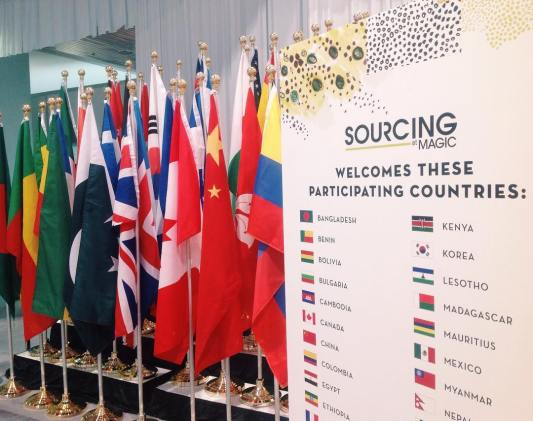
Note: Sourcing at Magic is one of the largest and most influential annual textile and apparel sourcing events hosted in the United States. Special thanks to the Center for Global and Areas Studies at the University of Delaware for funding the trip.

WTO Reports World Textile and Apparel Trade in 2015

The World Textile and Apparel Trade in 2016 is now available

textile

clothing

According to the newly released World Trade Statistical Review 2016 by the World Trade Organization (WTO), the current dollar value of world textiles (SITC 65) and apparel (SITC 84) exports totaled $291 billion and $445 billion respectively in 2015, but decreased by 7.2 percent and 8.0 percent from a year earlier. This is the first time since the 2009 financial crisis that the value of world textiles and apparel exports grew negatively.

However, textiles and apparel are not alone. The current dollar value of world merchandise exports also declined by 13 percent in 2015,to $16.0 trillion, as export prices fell by 15 percent. In comparison, the volume of world trade grew slowly at a rate of 2.7 percent, which was roughly in line with world GDP growth of 2.4 percent. WTO says that falling prices for oil and other primary commodities, economic slowdown in China, a severe recession in Brazil, strong fluctuations in exchange rates, and financial volatility driven by divergent monetary policies in developed countries are among the major factors that contributed to the weak performance in world trade.

Textile and apparel exports

China, the European Union and India remained the top three exporters of textiles in 2015. Altogether, they accounted for 66.4 percent of world exports. The United States remained the fourth top textile exporter in 2015. The top ten exporters all experienced a decline in the value of their exports in 2015, with the highest declines seen in the European Union (-14 percent) and Turkey (-13 percent). The smallest decline was recorded in China (-2 percent).

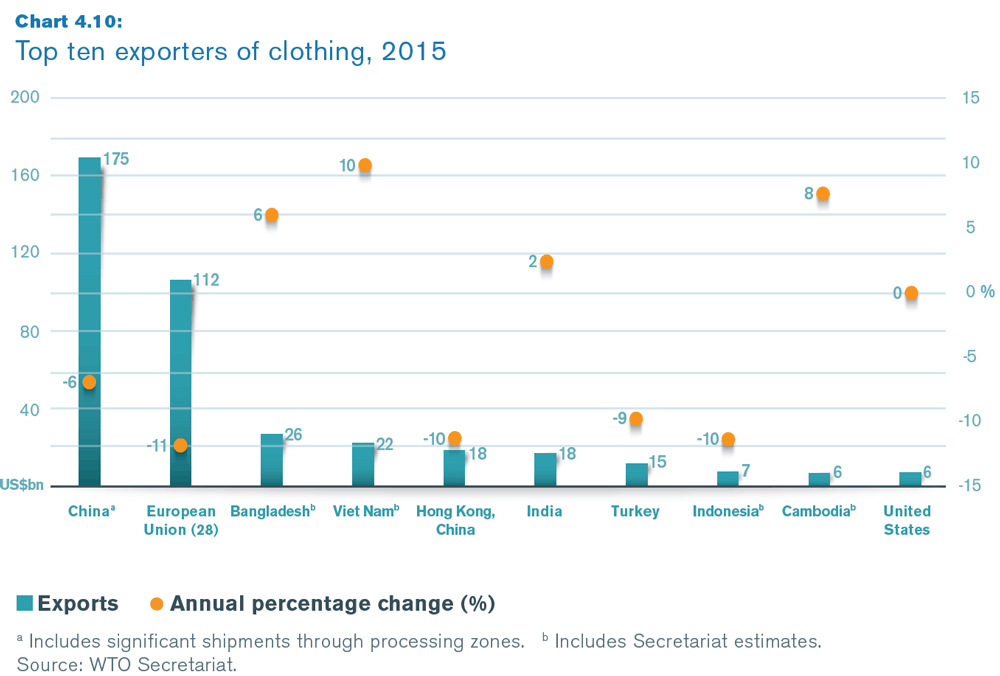
Top three exporters of apparel include China, the European Union and Bangladesh. Altogether, they accounted for 70.3 percent of world exports. Among the top ten exporters of apparel, increases in export values were recorded by Vietnam (+10 percent), Cambodia(+8 percent), Bangladesh (+6 percent) and India (+2 percent). The other major exporters saw stagnation in their export values (United States) or recorded a decline (all other top ten economies).

china's market share

Additionally, despite reported rising production cost, China’s market shares in world textile and apparel exports continued to rise in 2015 (see the figure above).

Textile and apparel imports

The European Union, China and the United States were the top three importers of textiles in 2015. However, altogether they accounted for only 37 percent of world imports, down from 52.8 percent in 2000. Because a good proportion of textiles made by developed countries (such as the United States) are exported to developing countries for apparel manufacturing purposes, the pattern reflects the changing dynamics of world apparel manufacturing and exports in recent years.

Because of consumers’ purchasing power (often measured by GDP per capita) and size of the population, the European Union, the United States and Japan remained the top three importers of apparel in 2015. Altogether, they accounted for 59 percent of world imports, but down from 78 percent in 2000. This indicates that import demand from other economies, especially some emerging markets, have been growing faster over the past decade.

world trade 2016

Turning Africa into a Global Textile and Apparel Hub

Before the 2016 Source Africa Trade event in June 2016, CNBC interviewed Tim Armstrong, Investment Promotion Director for the Textile Development Unit at the Ministry of Industry and Trade in Tanzania. Three questions were discussed during the interview:

  • Are free trade agreements/trade preference programs such as the African Growth and Opportunity Act (AGOA) translating into tangible results we can see that help African clothing exporters?
  • What has AGOA extension done to the textile and apparel industry in Africa, particularly in the context of Tanzania? What are the impacts of rules of origin on investment in the region?
  • Can apparel “Made in Africa” compete in the global marketplace when raw material such as yarns and fabrics has to be sourced from elsewhere?

What is your view on these issues?

USITC Studies the Impact of Trade on Manufacturing Jobs in the U.S. Textile and Apparel Industry

job impact of trade

employment in the US T&A industry

In its newly released Economic Impact of Trade Agreement Implemented under Trade Authorities Procedures, 2016 Report, the U.S. International Trade Commission (USITC) provides a quantitative assessment on the impact of trade on manufacturing jobs in the U.S. textile and apparel industry. According to the report:

  • Manufacturing jobs in the U.S. textile and apparel industry have been declining steadily over the past two decades. Between 1998 and 2014, employment in the NAICS 313 (textile mills), NAICS314 (textile product mills) and NAICS 315 (apparel manufacturing) sectors on average decreased annually by 7.6 percent, 4.3 percent and 11.2 percent, respectively.
  • Rising import is found NOT a major factor leading to the decline in employment in the U.S. textile industry (NAICS 313)–as estimated, imports only contributed 0.4 percent of the total 7.6 percent annual employment decline in the U.S. textile industry. Instead, more job losses in the sector are found caused by improved productivity as a result of capitalization & automation (around 4.6 percent annually) and the shrinkage of domestic demand for U.S. made textiles (around 3.5 percent annually) between 1998 and 2014.
  • Rising imports is the top factor contributing to job losses in apparel manufacturing (NAICS 315), however. As estimated by USITC, of the total 11.2 percent annual employment decline in apparel manufacturing, almost all of them is affected by imports (10.8 percent). On the other hand, increased domestic demand for apparel (such as from U.S. consumers) is found positively adding manufacturing jobs by 2 percent annually in the United States from 1998 to 2014.
  • To be noted, USITC did not estimate the impact of trade on employment changes in the retail aspect of the industry. According to the U.S. Bureau of Labor Statistics, approximately 80 percent of jobs in the U.S. textile and apparel industry came from retailers in 2015. These retail-related jobs are typically “non-manufacturing” in nature, such as: fashion designers, merchandisers, buyers, sourcing specialists, supply chain management specialists and marketing analysts.

China’s Position as the No.1 Textile and Apparel Sourcing Destination Remains Unshakable

china

China as the top textile and apparel sourcing destination for U.S. companies remains “unshakable”, according to product level data from the Office of Textiles and Apparel (OTEXA) under the U.S. Department of Commerce.  Specifically, based on the import value in 2015:

  • Of the total 11 categories of yarns, China was the top supplier for 3 categories (27.3%)
  • Of the total 34 categories of fabrics, China was the top supplier for 23 categories (67.6%)
  • Of the total 106 categories of apparel, China was the top supplier for 95 categories (89.6%)
  • Of the total 16 categories of made-up textiles, China was the top supplier for 12 categories (75.0%)

In comparison, Vietnam, the second largest textile and apparel supplier to the United States, was the top supplier for only four categories of apparel (3.8% of the total 106 categories).

china market share

For many textile and apparel products, China not only is the largest supplier, but also holds a lion’s market share. Specifically, for those textile and apparel product categories that China was the top supplier in 2015 (by value):

  • China’s average market share reached 20.7% for yarns, 2.3 percentage points higher than the 2nd top supplier
  • China’s average market share reached 42.0% for fabrics, 25 percentage points higher than the 2nd top supplier
  • China’s average market share reached 52.7% for apparel, 37.2 percentage points higher than the 2nd top supplier
  • China’s average market share reached 56.8% for made-up textiles, 42.7 percentage points higher than the 2nd top supplier

by Sheng Lu

International Trade Supports Textile and Apparel “Made in USA”

International trade plays a critical role supporting textile and apparel (T&A) “Made in USA”, according to latest firm-level data from the Office of Textiles and Apparel (OTEXA) under the U.S. Department of Commerce.

imported input

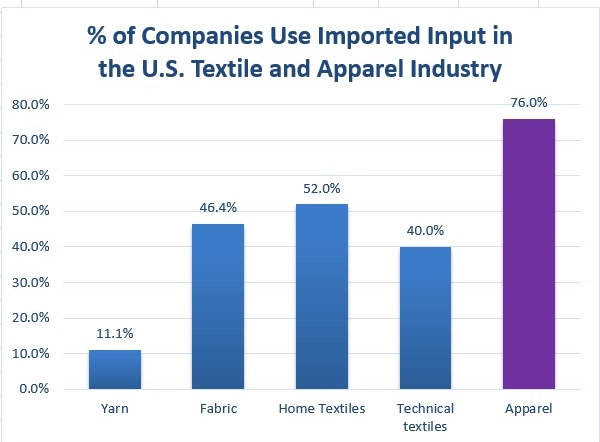
First and formost, textile and apparel “Made in USA” today contain imported components. Data collected from the OTEXA “Made in USA” Sourcing database shows that using imported inputs such as cut parts, fabrics, accessories and trims is a very common practice among the total 122 companies which claim making either yarn, fabric, home textiles, technical textiles or apparel in the United States. Particularly, more than 76% of companies which make apparel in the United States say they use imported inputs, followed by companies which make technical textiles (52%) and fabrics (46%). Moreover, the lack of sufficient supply of locally made fabrics is the top reason why U.S. T&A companies use imports as alternatives.

The supportive role played by imports to T&A “Made in USA” also explains why the U.S. T&A industry is in favor of the passage of the American Manufacturing Competitiveness Act 2016 (Miscellaneous Tariff Bill, MTB). The Bill, which passed by the U.S. Congress in May, will eliminate or reduce hundreds of import duties on textile raw materials and intermediate products that are not produced or available domestically in the United States.

us companies export

On the other hand, export promotes “Made in USA” textiles and apparel as well. Data from the OTEXA “Made in USA” sourcing database shows that as many as 88.9% of U.S.-based yarn manufacturers, 82.9% of technical textile manufacturers, 75% of fabrics manufacturers and 76% of home textile manufacturers currently export and sell their products overseas.

For more detailed data and analysis, please stay tuned…

Sheng Lu

FASH455 Exclusive Interview with Julia K. Hughes, President of the United States Fashion Industry Association

logo-1138967853headshot_USFIA-hughes_300x300px

Julia K. Hughes is President of the United States Fashion Industry Association (USFIA), which represents textile and apparel brands, retailers, importers, and wholesalers based in the United States and doing business globally. Founded in 1989 as the United States Association of Importers of Textiles & Apparel with the goal of eliminating the global apparel quota system, USFIA now works to eliminate tariff and non-tariff barriers that impede the industry’s ability to trade freely and create economic opportunities in the United States and abroad. Ms. Hughes represents the fashion industry in front of the U.S. government and international governments and stakeholders.

Ms. Hughes has testified before Congress and the Executive Branch on textile trade issues. She is recognized as an expert in textile and apparel issues and frequently speaks at international conferences including the Apparel Sourcing Show, MAGIC, Foreign Service Institute, National Association of Manufacturers, Cotton Sourcing Summit, International Textiles and Clothing Bureau, Young Presidents’ Organization, World Trade Organization Beijing International Forum, and others.

Ms. Hughes served as the first President of the Organization of Women in International Trade (OWIT) and is one of the founders of the Washington Chapter of Women in International Trade (WIIT) and WIIT Charitable Trust. In 1992, she received the Outstanding Woman in International Trade award and in 2008, the WIIT Lifetime Achievement Award.

Ms. Hughes has an M.A. in International Studies from the Johns Hopkins School of Advanced International Studies and a B.S. in Foreign Service from Georgetown University.

Special thanks to Samantha Sault, Vice President of Communication for the U.S. Fashion Industry Association for facilitating and supporting this exclusive interview. Ms. Sault is responsible for the development and execution of the association’s communications strategy, including public relations, policy research and messaging, and social media. Prior to joining the association, Ms. Sault honed her communications expertise at DCI Group, a global public affairs communications firm headquartered in Washington, D.C. Previously, she worked in media as a web editor and fact checker at The Weekly Standard and an editorial assistant at Policy Review, the journal of the Hoover Institution. She began her career in the apparel industry at 17 at abercrombie kids in Bethesda, Maryland.

Interview Part

Sheng Lu: Our students are interested in knowing who the members of the U.S. Fashion Industry Association (USFIA) are. Can you name a few of your member companies?

Julia Hughes: Our members range from major global brands and fast-fashion retailers, to small importers and wholesalers. While all of our members must be doing business in the United States, our membership roster also includes some international companies with a retail presence in the United States. Some of our most actively engaged members include iconic brands and retailers like Ralph Lauren, Macy’s, Levi Strauss & Co., JCPenney, Urban Outfitters, PVH Corp., and American Eagle Outfitters. We also represent small and medium-size importers, wholesalers, and manufacturers that you might not know by name, but supply to many of your favorite brands and retailers—companies like Michar, MGF Sourcing, and Golden Touch Imports, to name a few.

Sheng Lu: The USFIA is an advocate for trade liberalization and removal of trade barriers. Can you talk with us about the benefits of free trade, especially for the fashion industry both in the United States and globally?

Julia Hughes: As you know, USFIA was originally founded in 1989 (then known as the United States Association of Importers of Textiles and Apparel) with the mission to eliminate the global quota system. We were successful! But of course, as you also know, that work is not over. The quotas may have gone away, but there still are import barriers that are unique to the apparel industry. USFIA member companies continue to face some of the United States’ highest tariffs. Textiles and apparel, combined with footwear, still account for some of the highest peaks in the U.S. tariff schedule, with many double-digit tariffs and a high of 32 percent.

Not only are these tariffs higher than on other products, but these tariffs also are a regressive tax. We believe it is simply wrong for a single mom to pay a 32 percent import tax for her baby’s onesies and a 16 percent tariff for her baby’s booties, while the wealthy pay a 1.2 percent tariff for their silk scarves. In total, apparel tariffs take more than $10 billion out of the pockets of hard-working Americans annually. So eliminating these tariffs would be an immediate benefit to American consumers and to American families.

But even removing these tariffs would not mean that there is “free trade.” For example, the fact that the United States maintains these peak textile and apparel tariffs creates problems for new policy initiatives to expand export markets for U.S. products. Market access for American brands and exports is hindered by prohibitively high tariffs in attractive third country markets such as India and Brazil. Our own peak tariffs only encourage other governments to maintain their own high apparel and textile tariffs to “protect” their domestic industries. American brands such as Levi’s and Polo are among the most recognized brands in the world. American yarn spinners and fabric makers operate highly efficient operations that make them among the world’s most competitive producers. For all of these companies, we need every opportunity to remove barriers to trade.

There is a great opportunity to create high-paying jobs here in the United States, too. Fashion brands and retailers offer quality design, product development, logistics, sourcing, and service jobs in the United States, along with manufacturing jobs. These jobs are supported by global value chains, and will be on track to grow IF free trade agreements contain rules of origin and market access provisions that will decrease the cost of those fashion products. This would not only help the brands and retailers grow and create more jobs, but also help consumers by providing access to affordable, high quality apparel.

Finally, free trade isn’t just about tariffs – but also non-tariff barriers like regulations, certifications, and testing requirements all represent non-tariff barriers to trade. And since today’s global brands are selling everywhere from the United States to the UK to Japan to Dubai, we are working to eliminate these barriers, too.

Sheng Lu: The Trans-Pacific Partnership (TPP) is a buzzword for the fashion industry, with Vietnam and China at the core of the discussion. Many people see Vietnam as an alternative sourcing destination to China for labor-intensive apparel and footwear products. You’ve visited both Vietnam and China recently. What’s your first-hand observation? How competitive is “Made in Vietnam” compared with “Made in China”?

Julia Hughes: The TPP is a top priority for USFIA and for our member companies. But unlike some, we do not see the TPP as creating an either/or scenario for sourcing apparel and footwear. China remains the top supplier to the U.S. market, and we do not see that changing any time soon. The breadth of manufacturing operations in China, combined with the state-of-the-art infrastructure and logistics operations, mean that sourcing executives are comfortable with placing orders and knowing that they will get the quality product that they want delivered on time.

However, you are correct that Vietnam is seen as an alternative sourcing destination.—not just by U.S. sourcing executives, but also for Chinese companies. Both the TPP and the EU-Vietnam Free Trade Agreement make Vietnam an especially attractive destination for making apparel and for investments in manufacturing yarns and fabrics. But Vietnam is not necessarily the destination for companies searching for lower prices.

Sheng Lu: In the 2015 USFIA Benchmarking Study, around one-third of respondents report sourcing from 6-10 different countries and another one-third report sourcing from 11-20 different countries. What are some of the reasons that U.S. fashion companies today would choose to have such a diversified sourcing base?

Julia Hughes: There are a couple reasons why companies have such diversified sourcing bases. First, it is a holdover from the quota era, because companies were pretty much forced to diversify their sourcing since they couldn’t import everything from China. Following the elimination of the quotas in 2005, companies had cultivated trusted suppliers all over the world in countries as diverse as Vietnam, Sri Lanka, Mexico, and Colombia, so there was no reason to leave these good suppliers after they had spent the time and resources developing their supply chain. Second, diversification is a method of risk management. There are lots of risks that could impact your supply chain—from natural disasters to labor strife to terrorist attacks. The last thing a company wants is to have all of their production in one place—because when disaster strikes, you won’t be able to get your product to your customers. By keeping a diverse supply chain, you can ensure that you’ll always have products moving to the shelves. Finally, different countries have different specialties—and truthfully, no one country can do it all. Companies don’t necessarily prefer to source fabric, yarn, zippers, and buttons from four different countries and ship to a fifth for cutting and sewing, but sometimes, that’s the way it must be done in order to produce the best product at the best price for your target customer.

Sheng Lu: We know that the African Growth and Opportunity Act (AGOA) has been extended for another 10 years. How has the U.S. fashion industry reacted to the AGOA extension? Are U.S. consumers going to see more “Made in Africa” apparel in the retail stores?

Julia Hughes: USFIA member companies are definitely looking at sourcing opportunities in Africa after the extension of AGOA. Today a little more than 1 percent of U.S. apparel imports come from Sub-Saharan Africa—and there are only a few countries that ship apparel to the U.S. market. Kenya, Lesotho, Mauritius, and Madagascar are the major producers of apparel today – representing 87% of the U.S. imports. The ten-year extension of AGOA is allowing companies to take a fresh look at what is available to source in Africa today, as well as to plan to long-term growth. Both PVH and VF, for example, have been very public about their commitment to develop a vertically integrated industry in Ethiopia.

What is exciting is that new sourcing supply chains are opening up in Africa. While the level of U.S. imports remains low there are some growing suppliers. For example, during March 2016–a month when the overall U.S. apparel imports plunged by -21 percent compared to March 2015—there were a few Sub-Saharan African suppliers that bucked the trend. U.S. imports from Madagascar jumped by 160 percent, from Ethiopia by 83 percent, and from Ghana by 371 percent!

Sheng Lu: Textile and apparel trade policy is always one of the most challenging topics for students in FASH455. Many students wonder why the rules governing the global textile and apparel trade are always far more complicated than most other sectors. For example, in the past, students had to learn about the quota system, from the Short-term Arrangement (STA) to the Multi-Fiber Arrangement (MFA). The quota system is gone, but it seems students now have to know even more “terms”: the yarn-forward rules of origin, short supply list, third country fabric provision, trade preference level (TPL) and earned import allowance… What makes the textile and apparel trade so unique in terms of trade regulations?

Julia Hughes: This is a great question–and one that does not have an easy answer. Absolutely, when I first started working with the industry, it was a revelation to understand about quotas and labeling requirements classification issues. Today, the industry is even more complicated. I think that a lot of the complexity today is due to protectionism. Negotiators looked for ways to limit the market opening impact of trade agreements, and to try to protect their domestic industry. This isn’t just an issue for the United States.  Starting with NAFTA in the 1990’s, the rules are more complicated in every free trade agreement—and none of the free trade agreements exactly matches the others. But the complexity isn’t just for FTAs, of course. Today, we also face more regulations, different labeling requirements for different countries (and unfortunately sometimes even different labels are required in different states!), and more testing and certification requirements.

Sheng Lu: Looking ahead in 2016, what important sourcing trends and trade patterns shall we expect in the U.S. fashion industry? What are the policy priorities for the USFIA this year?

Julia Hughes: The implementation of the Trans-Pacific Partnership (TPP) remains at the top of our list of policy priorities. But implementation is still a long way off, especially since the U.S. Congress is unlikely to vote on the agreement before the November elections. We don’t expect to see a huge shift to sourcing in Vietnam, Malaysia, and the other TPP partners in 2016-2017, since duty-free treatment is a long way off, but we do expect to see companies taking a closer look at opportunities there—and it helps that Vietnam is already the #2 supplier to the United States, so many companies are already sourcing there. We’re also prioritizing completion of the Transatlantic Trade & Investment Partnership (T-TIP) between the United States and European Union. The EU is a great source for luxury brands and companies manufacturing leather goods, but this agreement has an even greater potential in terms of regulatory harmonization, making it easier for many of our members to break into the retail markets in Europe. We’re also focused on enhancing the African Growth & Opportunity Act (AGOA), cumulation of free trade agreements, and customs and ethical sourcing issues, too. As far as future trends, we’re looking forward to seeing the results of our third-annual Fashion Industry Benchmarking Study, which will give us a lot of insight into what brands are thinking about sourcing and expansion!

Sheng Lu: Last but not least, our students wonder what makes you and your staff personally interested in the fashion industry. Particularly, through your daily work, how do you see the impact of the fashion industry in the 21st century global economy?

Julia Hughes: My path to the world of fashion is from the policy side. I was always interested in international policy and after graduating from Georgetown University and SAIS, I was fortunate to hear about an opportunity to be the Washington Representative for Associated Merchandising Corporation (AMC). It was a terrific opportunity to be engaged in policy discussions, but also to spend time with the buyers, with the sourcing teams, and also with the overseas offices and vendors to understand the impact on trade policy on the clothes we wear. Let’s face it, it is a shock to realize the way that Congressional actions, and negotiations, can determine whether a jacket is made with down, or synthetic fibers, or cotton–or maybe it is manufactured to qualify as a shirt instead of a jacket. It also is inspiring to work with industry executives who are committed to fashion as well as doing good for the global economy. Textiles and apparel has always been an industry that can be a gateway for economic development–and I have seen the positive impact by creating jobs where there were none before–as well as expanding U.S. jobs in design, product development and compliance.

Samantha Sault: I have always loved fashion—in fact, my very first job in high school was folding clothes and working the register at abercrombie kids at the mall in my hometown!—but I never thought about fashion as a career until I had been working for a few years after college. I started my career in political media in D.C., and eventually started covering the intersection of fashion and politics for various publications, including exciting events like New York Fashion Week and President Obama’s first inauguration (and the First Lady’s fabulous dresses). After five years in media and public affairs, I found my way to USFIA and the business and policy side of the fashion industry. The most inspiring part about working in fashion has been getting to know our contacts at our member companies, and seeing how committed they are not only to their brands, but also to ethical sourcing and compliance. These are not just buzzwords—I’ve learned firsthand that many of the individuals at our member companies are deeply committed to ensuring that they are doing the right thing in their supply chains from the factory floor (especially for women) to the retail store, and it has made me appreciate these brands even more than I already did.

–The End–

EU Textile and Apparel Industry Sees Commercial Opportunities in Trans-Atlantic Trade and Investment Partnership (T-TIP)

RTEmagicC_Web_block-01_01_png

(picture source: Euratex)

According to the European Apparel and Textile Federation (Euratex), Trans-Atlantic Trade and Investment Partnership (T-TIP), if reached and implemented, will bring substantial commercial benefits to the EU textile and apparel (T&A) industry. Euratex sees T-TIP has the great potential to help EU T&A expand exports to the U.S. market, particularly in two areas:

One is high-end apparel. The United States is EU’s third largest apparel export market only after Switzerland and Russia. In 2014, apparel exports from EU(28) to the United States exceed €2.5 billion and most products were much higher priced than those exported from elsewhere in the world. Euratex expects that when the high tariff facing EU apparel products in the U.S. market is removed—such as 28% tariff rate for women’s jacket, and customs red tape is cut, many small and medium (SME) sized EU T&A companies will be able to gain more access to the 300 million people U.S. apparel market.

The other is technical textiles: Euratex highlighted that “technical textiles, like high functionality fabrics used for firefighters’ uniforms or airbags, represent half of our textiles exports to the US. European home textiles are of great success in the US: more than €92million of bedlinen were sold in 2014. Nonwoven textile products for hygiene and medical purposes (cleansing tissues, surgical bedsheets, gauze, bandages, etc.) are a growing part of our exports to the U.S.. High-tech textiles products cover a wide range of applications – transport, construction, agriculture, defense, personal protection and much more.”

Moreover, it seems that the EU technical textile industry is very interested in getting access to the U.S. market currently protected by the Berry Amendment. Euratex sees “Opening business opportunities in public sector for technical textiles is a must in T-TIP. “Europe is a recognized leader in production of smart technical textiles due to advanced manufacturing technologies and constant innovation of materials and their application. The production of technical textiles in Europe significantly increased over the past ten years. With TTIP, the US public services will be able to benefit from the innovative products manufactured in Europe.” Euratex says.

Background: the state of EU-US textile and apparel trade

EU-US T&A trade

The True Meaning of FASH455 (Global Apparel and Textile Trade and Sourcing)


I encourage everyone to watch these two short videos, which provide a great summary of FASH455 and remind us the true meaning of our course.

First and foremost, FASH455 is not designed to be a course which just technically talks about textile and apparel (T&A) trade and how to source T&A products. Yes, from various trade theories, evolution pattern of the global T&A industry, T&A regional production and trade network to the flying geese model, we do cover a lot of factual knowledge and theories in FASH455, because this is a highly professional area. But please keep in mind that the vision and perspective set for FASH455 are much higher and critical, that is:

  1. What role can the textile and apparel industry play in building a better world—how to reduce poverty, achieve economic growth, promote human development, enhance sustainability and contribute to world peace and security?
  2. What does it mean as a FASH major (as well as a college graduate)? What can we positively contribute to the world we are living today?

By the same token, I hope students realize that the most meaningful thing you can take away from the course is a fresh new way (perspective) of looking at the world and recognizing the critical 21st century global agendas that are closely connected with our T&A industry. For example:

  • How to more equally distribute the benefits & cost of globalization among different countries and groups of people?
  • How to make sure that tragedies like the Rana Plaza building collapse will never happen again?
  • How to make international trade work better and more effectively lead to economic growth and human development? 
  • How to achieve sustainability while develop the economy? To which extent shall we renovate the conventional growth model?
  • How to use trade policy as a tool to solve some tough global issues such as labor practices and environmental standard? 

For many of these questions, there is no good answer yet. But they are waiting for you, the young professional and new generation of leaders, to find an answer and write the history, based on your knowledge, wisdom, responsibility, courage and creativity!

What do you take away from FASH455? Please feel free to share your thoughts and comments.

Why NCTO and Euratex Disagree on the Textile and Apparel Rules of Origin in T-TIP?

eu-and-us-ta-rules-of-origin1

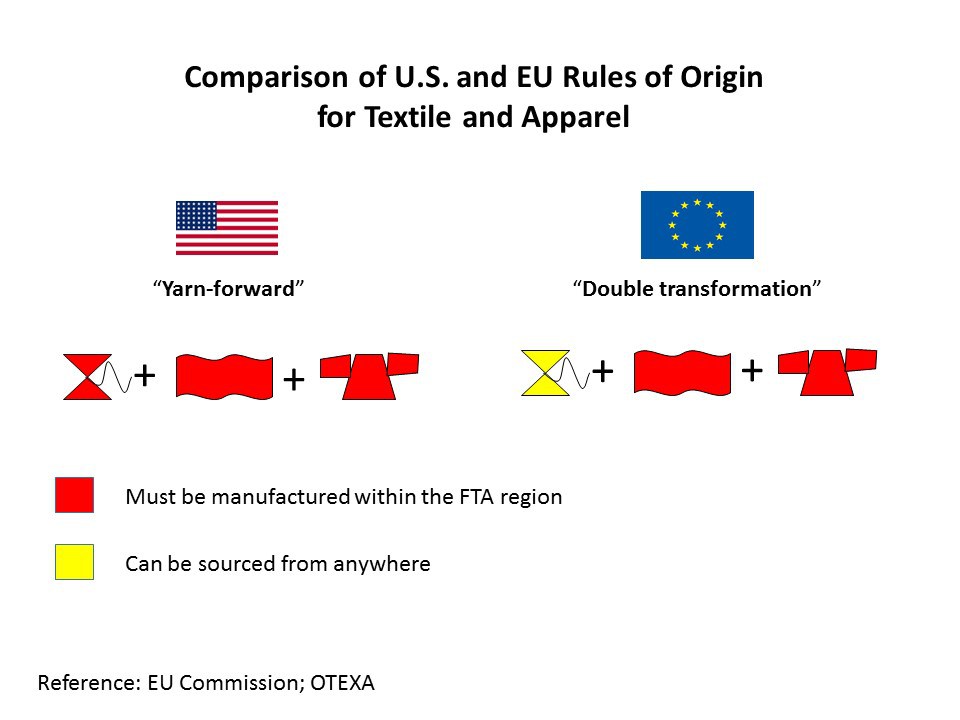
In an April 13 press briefing, the National Council of Textile Organizations (NCTO) which represents the U.S. textile industry, insists the Trans-Atlantic Trade and Investment Partnership (T-TIP) shall adopt the so called “yarn-forward” Rules of origin (RoO). Yarn-forward (or “triple transformation”) in T-TIP means, in order to receive preferential duty treatment provided under the trade agreement, yarns used in textile production in general need to be sourced either from the US or EU.  All 14 existing free trade agreements (FTA) in the United States adopt the yarn-forward RoO.

In comparison, in its position paper released in June 2015, the European Apparel and Textile Confederation (Euratex), which represents the EU textile and apparel industry, favors a so called “fabric forward” RoO in T-TIP instead of “yarn-forward”. Fabric-forward (or “double transformation”) in T-TIP means in order to receive preferential duty treatment provided under the trade agreement, fabrics used in apparel production in general need to be sourced either from the US or EU, but yarns used in textile production can be sourced from anywhere in the world.

US

Exploring data at the 4-digit NAICS code level can find that the United States remains a leading yarn producer. Value of U.S. yarn production (NAICS 3131) even exceeded fabric production (NAICS 3132) in 2014. This means: 1) U.S. has sufficient capacity of yarn production; 2) it will be in the financial interests of the U.S. textile industry to encourage more use of U.S.-made yarns in textile production in the T-TIP region (i.e. pushing the “yarn-forward” RoO).

eu textile production
EU yarn import

However, data at the 4-digit NACE R.2 code level suggests that EU(28) was short of €5,643 million local supply of yarns (NACE C1310) for its manufacturing of fabrics (NACE C1320) in 2013 (latest statistics available). This figure well matched with the value of €4,514 million yarns that EU (28) imported from outside the region that year. Among these yarn imports (SITC 651), over half came from China (22%), Turkey (19%) and India (13%), whereas only 5% came from the United States. Should the “yarn-forward” RoO is adopted in T-TIP, EU textile and apparel manufacturers may face a shortage of yarn supply or see an increase of their sourcing & production cost at least in the short run.

Sheng Lu

TPP and the U.S. Textile and Apparel Industry: Questions from FASH455

tpp textileThe following discussion questions are proposed by students enrolled in FASH455 (Spring 2016). Please feel free to join our online discussion.

#1 Is TPP successful in terms of “creating new market access opportunities” for the U.S. textile and apparel industry? Why or why not?

#2 Should the U.S. textile industry be worried that Vietnam is quickly building its own textile industry because of TPP?

#3 Compared with the case of Vietnam in TPP, why was there little discussion on Mexico and Central American countries developing their local textile industry and becoming less reliant on textile imports from the United States in the context of NAFTA and CAFTA-DR?  

#4 If China joins the TPP, do you think they would support a “yarn-forward” rules of origin or a less restrictive one? Why?

#5 Given the grave concerns about the potential impact of TPP on the U.S. textile industry, what is the point of negotiating such a trade deal?

[Discussion is closed for this post]

Reference: TPP Chapter Summary: Textiles and Apparel

Extra-EU Trade for Textile & Apparel Went Up in 2015

EU export (2015)

EU import (2015)

According to statistics released by the European Apparel and Textile Confederation (Euratex), extra-EU trade for textile and apparel (T&A) achieved record high in 2015, suggesting a positive economic state of the industry.

Specifically, extra-EU T&A exports went up by 3.6 percent in 2015. Among the key export markets: thanks to the appreciation of U.S. dollar against Euro last year, EU’s textile and apparel exports to the United States respectively increased by 16 percent and 21 percent. Despite China’s slowed economic growth, EU’s export to China was also robust: 6 percent growth for textile and 19 percent growth for apparel. However, EU’s T&A exports to Russia (down 27 percent for textile and down 29 percent for apparel) and Ukraine (down 26 percent for apparel) sharped dropped, reflecting the substantial impact of political instability on trade.  

In terms of the import side, extra-EU T&A imports rose 9.6% in 2015. China remained the top external T&A supplier to the EU, however, other Asian countries with lower-production cost are quickly catching up. This is particularly the case for apparel: while EU’s apparel imports from China went up 6 percent in 2015, imports from Bangladesh (up 24 percent), Cambodia (up 33 percent), Vietnam (up 26 percent), Pakistan (up 25 percent) and Myanmar (up 79 percent) grew much faster, suggesting a relative decline of China’s market share in the EU market.

Outsoucing and “Made in USA” An Ongoing Debate

Slide1

The following questions are proposed by students enrolled in FASH455 Spring 2016. Please feel free to leave your comment and engage in our online discussion.

L.L Bean: A Business Model for “Made in USA”?

L.L. Bean has been a strong business for hundreds of years, yet recently their sales of Bean Boots have skyrocketed because they are now seen as trendy. Even though L.L. Bean’s orders and demand has gone up, they still somehow manage to have their products being handmade, sourced locally, and all in the US.

#1: Can L.L. Bean become a model for other businesses looking to manufacture in the US? How has L.L. Bean managed to keep this business model up for so many years and why have they not changed or decided to outsource? 

#2: Why doesn’t L.L Bean look into other American cities for manufacturing options so they do not lose productivity by being exclusively made in Maine?

#3: Do you think it would be beneficial for L.L. Bean to outsource to foreign companies for their manufacturing? Would there still be as high of a demand if these boots were manufactured abroad?

Outsourcing v.s. “Made in USA”

#4: It is said that one reason why American brands choose to offshore their manufacturing is because there isn’t as many cutting edge machines readily available in the States as in other countries. Is it realistic for the American manufacturing market to invest in these machines for domestic manufacturing? If so, how can America make sure to stay relevant with these technologies and not fall behind as we have currently?

#5: One aspect commonly mentioned throughout these readings was the lack of skilled labor in the US in the fashion industry. Is the decrease in skilled areas, such as shoemaking and needle trade, due to the increase in skilled labor overseas? Are these professions considered outdated for young Americans to be learning? How can we jumpstart a desire for young people to take up these skills once again?

#6: One major problem the US has been facing regarding keeping production domestic has been the lack of skilled workers to work in factories. Is the cost of providing training to interested workers too high? Should it be required that all fashion majors should take a sewing class? Where does the decision to train apparel workers begin?

#7: Many American manufacturers refrain from manufacturing in the United States because it is too expensive because more people are formally educated and are not willing to work for a low wage, but only 15% of respondents actually are working towards that. Is it realistic to reach out to homeless communities looking to get back onto their feet to see if they would work in factories? Would this help promote American manufacturing and decrease importing?

#8: In today’s fast paced fashion world, trends come and go rather quickly. The striking disadvantage of manufacturing overseas is the slow turnaround time which could be up to 3-5 months. By manufacturing domestically, turnaround can be as quick as 2 weeks. Why do the majority of fashion companies still choose to manufacture overseas when there is a possibility the trend could be over by time they reach store shelves (Thus, a lack in profit)? When will trend pressures become too much for overseas production?

#9: Is it even worth it to bring manufacturing back to America if it is not benefitting the workers and creating jobs? If manufacturing in the US is simply machine based, what is the point of doing so when it could be cheaper elsewhere and benefit countries that need the jobs?

[Discussion is closed for this post].

Textile and Apparel Sector in the 2016 U.S. Trade Policy Agenda

2

In the recently released 2016 President’s Trade Agenda, the textile and apparel (T&A) sector was mentioned four times (up from only once in 2015*):

1.Trade enforcement

“THE OBAMA ADMINISTRATION has a record of trade enforcement victories that have helped to level the playing field for American workers, businesses, farmers, and ranchers. In 2016, we will continue to aggressively pursue a robust trade enforcement agenda, including by using new and stronger tools under the bipartisan Trade Enforcement Act of 2015 to hold our trading partners accountable.

Ongoing disputes include challenges to:

  • China’s far-reaching export subsidy program extending across sectors and dozens of sub-sectors, including textiles, industrial and agricultural products.”

2.Trade preference programs

“Haitian Hemispheric Opportunity through Partnership Encouragement Act (HOPE) pro­gram, which supports nearly $900 million in garment imports from Haiti, is an essen­tial support for Haiti’s long-term economic growth and industrial development. HOPE supports thousands of jobs in Haiti’s textile and gar­ment sectors, while providing important pro­tections to workers. Early extension of this program will provide the necessary stability and continuity for companies to continue in­vesting in Haiti’s future.”

3.Benefits of trade to the American people

“More recent trends are similar, with families steadily gaining purchasing power as the price of traded goods, such as smart phones, apparel, and toys, falls. While all households benefit, the gains from trade have predominantly benefited lower-income Americans, who spend a greater portion of their incomes on highly-traded staples like food, shoes, and clothing.”

4.Trade and labor

Our engagement has produced an Imple­mentation Plan Related to Working and Liv­ing Conditions of Workers that is helping to address concerns about workers’ rights and working conditions in Jordan’s garment sec­tor, particularly with respect to foreign work­ers. Jordan has issued new standards for dormitory inspections, submitted new labor legislation to its parliament and hired new labor inspectors. USTR and Department of Labor continue to work with Jordan on the issues under the Plan.

Overall, it seems:1) Reflecting the global nature of the sector, T&A is a topic that involves multiple trading parties for the United States; 2) Economic development and foreign aid are important elements in the U.S. trade policy for T&A. 3) Social responsibility and labor practices in the T&A sector remain a grave concern and need further improvement through international collaborations. 4) The T&A sector is involved in some topics with divisive public opinions, such as the impact of imports.

* Textile and apparel mentioned in the 2015 U.S. Trade Policy Agenda:

Our engagement has produced an Implementation Plan Related to Working and Living Conditions of Workers that is helping to address concerns about workers’ rights and working conditions in Jordan’s garment sector, particularly with respect to foreign workers. Jordan has issued new standards for dormitory inspections, submitted new labor legislation to its parliament and hired new labor inspectors.

[Discussion is closed for this post]

State of China’s Textile and Apparel (T&A) Industry (Updated in January 2016)

Textile-factory-in-China-007

How to deal with China as a sourcing destination remains a tough and controversial issue facing U.S. apparel retailers and fashion brands in 2016. Although companies are of grave concerns about China’s continuous rising production cost (especially labor cost), few other lower-wage countries can beat China in terms of industry integration, supply chain efficiency, and reliability.This blog post intends to add to the discussion by taking a look at the supply side, i.e. what is happening in the China textile and apparel (T&A) industry.

First, China’s production capacity remains unparalleled in the world. In 2014, the latest statistics available, textile fiber production in China exceeded 50 million tons, accounting for 54.36 percent of world share. By 2013, as much as 64.2 percent of the world’s chemical fibers, 64.1 percent of synthetic fibers and 26.2 percent of cotton were produced in China (see the table blew). On the other hand, apparel production in China reached 29.9 billion units in 2014, up 10.4 percent from 2013. Given China’s vast production capacity, very likely it will remain the top apparel sourcing destination for most EU and US fashion apparel companies for many years to come. For example, Vietnam’s apparel production in 2015 totaled 2.85 billion units, which was only around 10 percentage of China’s production scale in 2014.

1

Second, China’s T&A industry is growing slower. Specifically, output of China’s T&A industry (measured by value added) grew only 7.0 percent between 2013-2014, a significant drop from 10.3 percent between 2009-2010. Other major economic indicators in the industry, from sales revenue, net profit to investment, followed a similar pattern (see the figure below). Additionally, for the first time since the 2008 financial crisis, China’s T&A exports suffered a 3.9 percent decline in 2015 (-1.3% for textiles and -5.4% for apparel). Given the downward pressure on China’s economy and uncertainties in the world marketplace, such a slow-growth pattern is likely to continue in the years ahead.

2

investment

Third, China’s T&A industry is undergoing important structural adjustment. Within the total industry output, the ratio of apparel, home textiles and industrial textiles has turned from 51:29:20 in 2010 to 46.8: 28.6: 24.6 in 2014, reflecting China’s efforts to move towards making more value-added and technology-intensive textile products. This ratio is expected to become 40:27:33 by the end of 2020 (i.e. the end of China’s 13th five-year plan). In order to overcome the pressure of rising labor and production cost, China’s T&A manufacturing base is gradually moving from the east coast to the western and central part of the country (accounting for 22.5 percent of China’s T&A production in 2014, up from 16.8 percent in 2010; this share may further increase to 28 percent by 2020). Additionally, T&A companies in China are encouraged to increase spending on research and development (R&D), which on average had accounted for 0.47 percent of T&A companies’ sales revenue in 2013, up from 0.43 percent in 2011.

Fourth, T&A companies in China are actively seeking business opportunities in the domestic retail market. Apparel retail sales in China reached 893.6 billion yuan in 2014 (around $137.5 billion), among which 30.77 percent were sold online (up from 14.54 percent in 2011). Apparel retail price on average rose 2.6 percent between 2013-2014, compared with 2.0 percent increase of China’s overall CPI over that period. However, it shall be noted that apparel retail sales in China’s tier 1 and tier 2 cities achieved almost zero growth in 2014, partially reflecting the negative impact of retail price increase on consumers’ demand. In comparison, apparel retail sales in China’s tier 3 & 4 cities as well as rural areas remain robust and strong. Additionally, financial performance of T&A companies in China is becoming more polarized. Companies that follow the traditional business model of manufacturing and exporting are facing their most difficult time since the 2008 financial crisis. However, there are also many success stories of apparel companies that focus on function upgrading, i.e. moving from simply “manufacturing” products to “serving” the market needs.

Sheng Lu

Recommended reading: China’s 13th five-year plan for its textile and apparel industry: Key numbers

Top 10 Most Read FASH455 Blog Posts in 2015

top 10


1. Potential Impact of TPP on the Textile and Apparel Sector: A Summary of Recent Studies

2. 2014 World Textile Industry Labor Cost Comparison

3. Global Trade of Used Clothing (Updated: October 2015)

4. Market Size of the Global Textile and Apparel Industry: 2014 to 2018

5. When Will TPP Take Effect? Let’s look at the History

6. China to Become the World’s Largest Apparel Market in 2019

7. Are US Textile and Apparel Imports Using Free Trade Agreements?

8. 2015 US Fashion Industry Benchmarking Study Released

9. Exclusive Interview with Erin Ennis, Vice President, US-China Business Council

10. US Tariff Phaseout Schedule for Textile and Apparel in TPP by OTEXA Code

Textile and Apparel (T&A)-Specific Rules of Origin in TPP—Apparel Products

Textile and apparel (T&A)-specific rules of origin (RoO) for most apparel articles under TPP are known as the nickname “yarn forward”. “Yarn-forward “means preferential treatment under TPP will be allowed if the component determining classification meet BOTH the following two criteria:

  • knit or woven in TPP countries FROM yarn spun or extruded in TPP countries;
  • apparel is cut or knit to shape or both + sewn or otherwise assembled in TPP countries

In other words, “yarn forward” RoO not only requires the activity of apparel manufacturing must happen in one or more TPP countries, but also requires certain textile material used to make the apparel products must come from the TPP region.

The following is an example of how TPP describes “yarn-forward” rules of origin:

“A good is an originating good if it is produced entirely in one or more TPP countries by one or more producers using non-originating materials and each of the non-originating materials used in the production of the good satisfies any production process requirement, any applicable change in tariff classification requirement or any other requirement specified.”

yarn forward

The followings are details of T&A-specific RoO for apparel products in TPP compiled based on released TPP text. “Regular yarn-forward” means all textile material listed in the table must be TPP originating. Overall, TPP allows much fewer exceptions to “yarn-forward” rules than most existing free trade agreements in the United States (such as NAFTA, CAFTA-DR, and Columbia Free Trade Agreement).

61 rule.jpg

61

62 rule.jpg

62

U.S. Department of Commerce Releases Factsheet on TPP and the U.S. Textile and Apparel Industry

textile_Page_1

According to the factsheet released by the U.S. Department of Commerce, the Trans-Pacific Partnership (TPP) will create exciting new export opportunities for the U.S. textile and apparel (T&A) industry. The report highlights Vietnam and Japan as two promising markets in TPP for certain T&A products “Made in USA”, including:

Vietnam:

  • Cotton fiber, yarn, and Cotton woven Fabric (U.S. exported $394 million in 2014 with 16% market share only after China; tariff will be cut from 12% to zero on day one)
  • Non-woven fabrics (U.S. exported $23million in 2014, up 951% from 2009; tariff will be cut from 12% to zero on day one)

Japan

  • Synthetic fiber, yarn, and fabric (U.S. exported $61 million in 2014, up 61% from 2009; tariff will be cut from 2.7%-10% to zero on day one)
  • Industrial and advanced textile fabrics (U.S. exported $91 million in 2014, the fourth largest supplier after China, Taiwan, South Korea; tariff will be cut from 8.2% to zero on day one)
  • Men’s and boy’s apparel (U.S. exported $32.6milion in 2014, up 30.9% from 2009; tariff will be cut from 9.8% to zero on day one)

The factsheet also argues that TPP is a “balanced” deal for the U.S. T&A industry: long U.S. tariff phaseout schedule, strict “yarn-forward” rules of origin and textile safeguard mechanism in TPP will serve the interests of those stakeholders that seek protection of U.S. domestic T&A manufacturing, whereas duty savings from import tariff cut and the short supply list will create greater market access opportunities for U.S. fashion brands and retailers.

According to the report, the United States is the fourth largest textile exporter in the world. 54% of total U.S. T&A exports went to TPP markets in 2014. The United States is also the single largest importer of T&A in the world. 372,300 T&A manufacturing jobs remained in the United States in 2014.

US Tariff Phaseout Schedule for Textile and Apparel in TPP by OTEXA Code

[This post is updated on July 1, 2016]

Please also read:TPP tariff phase-out can steer Vietnam sourcing plans

The United States includes as many as 38 different types of phaseout schedule in TPP and 8 of them apply to the textile and apparel (T&A) sector.

phaseout category

In general, T&A products with lower base tariff rate seem to be given more generous phaseout treatment than T&A that are subject to higher base tariff rate. For example, although T&A products under category EIF can immediately enjoy duty-free treatment once TPP takes into force, their base tariff rate is also the lowest (7.9% on average). In comparison, whereas T&A products under category US6, US7, US8 and US9 are subject to the highest base tariff rate, they are given the least generous tariff cut (i.e. 35%) once TPP takes into effect. This will makes average tariff rate applied to these products remain the highest almost throughout the whole phaseout period. It should be noted that even though US11 apparently seems to be the most restrictive phaseout category (i.e. 50% cut on day 1 and the resulting rate will remain unchanged until the end of year 12), its average tariff rate actually will be lower than phaseout category US6, US7, US8 and US9.

tariff

In the following table, the U.S. phaseout schedule for T&A in the released TPP text based on the 8-digit Harmonized System (HS) code is matched with the Office of Textiles and Apparel (OTEXA) product category. Results show that products equivalent to around 37.5% of the value of U.S. textile and apparel imports from Vietnam in 2015 will enjoy immediate duty-free treatment once TPP takes into force (i.e. EIF), approximately 4% will be subject to medium-level protection (i.e. EIF+B5) and 58.6% are under high (i.e. EIF+ any of the followings: US6, US7, US8, US9, US10, US11) or very high level of protection (i.e. any of the followings: US6, US7, US8, US9, US10, US11).

phaseout by OTEXA code

phaseout by trade data

Note: “Level of protection” in the above table is defined as the following: 1) Low level of protection: EIF only; 2) Medium level of protection: EIF+B5; 3) High level of protection: EIF+any of the followings: US6, US7, US8, US9, US10, US11; 4) Very high level of protection: any of the followings: US6, US7, US8, US9, US10, US11 only.

Sheng Lu


Tariff Remains a Critical Trade Barrier Worldwide for the Textile and Apparel Sector

1

tariff rate

According to data from the World Trade Organization:

  1. In 2013, average applied tariff rate remained at 10.73% for textiles and 18.25% for apparel worldwide. Compared with the average tariff rate for all sectors, the rate for textiles on average is 1.4 percentage points higher and the rate for apparel is 8.9 percentage points higher. This implies that although tariff may not be a critical trade barrier for some sectors anymore, it still significantly matters for the textile and apparel sector.
  2. Least developed countries (LDC) overall set a higher tariff rate for textiles and apparel than the world average level. Ironically, many LDCs heavily rely on imports for textile supply. Should these LDCs lower their tariff rate for textiles, it may help apparel manufacturers there save sourcing cost for yarns and fabrics and improve the price competitiveness of finished apparel products.
  3. At the country level, countries with the highest tariff rate for textiles include Ethiopia (27.8%), Sudan (27.4%), Argentina (23.3%, Brazil (23.3%), Gabon (19.8%), Cameroon (19.6%), Chad (19.6%) and Congo (19.6%). And countries with the highest tariff rate for apparel include Zimbabwe (72.26%), South Africa (41.02%), Namibia (41.02%), Swaziland (41.02%), Botswana (41.02%), Lesotho (41.02%), Bolivia (40.0%), Sudan (40.0%), Argentina (35.0%), Ethiopia (35.0%) and Brazil (35.0%). Interesting enough, many of these countries are members of the African Growth and Opportunity Act (AGOA) which are eligible for the third country fabric provision.

Sheng Lu

The Future of Asia-Pacific and Implications for the U.S. Textile and Apparel Industry

Asia Pacific

The following discussion questions are proposed by students enrolled in FASH455 (Global Apparel & Textile Trade and Sourcing) Fall 2015 after learning the unit on textile and apparel industry & market in the Asia-Pacific region. Please feel free to leave your comment and engage in our online discussion.

  1. We’ve heard so much about China’s superior involvement in the textile & apparel sectors globally, but how are these industries contributing to the local economy?
  2. As rules on working conditions and minimum wage have been enforced in Mainland China many business people have moved their operations to Southeast Asia, do you think the Southeast Asia will eventually become like mainland China forcing businessmen to seek low wages elsewhere?
  3. Will Vietnam shift its sourcing of yarns and fabrics from China to US after TPP? What are some setbacks associated with this? What are some potential opportunities?
  4. While Vietnam is currently one of the primary exporters of apparel to the United States, what should be the actions taken by the United States if they continue to “refuse” to cut out Chinese Textiles? Or, should the United States continue their trading patterns with Vietnam despite their reliance on Chinese Textiles?
  5. The Asia pacific region is made up of a variety of countries with different strengths and political infrastructure. How does the variety of policies and governments affect how we do business abroad, and is there a way to set standards that are not individualized to each country?
  6. China and the US can be seen as a threat to one another. However the president of China said the “Pacific Ocean has enough space for the two large countries”. Do you think they are threats to each other, or are they ultimately helping each other’s economies grow?
  7. What will happen as more and more countries that used to produce apparel move into producing more capital intensive production?
  8. What are the advantages or disadvantages of excluding China from international trade agreements such as TPP?
  9. If the T&A industry in China is envisioned by policymakers as beginning to focus more on technical textiles, how will the textile industry in China compete with the industry in the United States?
  10. Why has East Asia become one of the most economically interconnected regions in the world?
  11. What are some of the reasons that China still remains one of most price competitive export markets in the World? Also, does China face challenges in losing their top spot as leader in price competitiveness? If so, what are some of the reasons they are in danger of competition?
  12. How is the discussion about yarn forward rules of origin different in regards to TPP countries than the same discussion between the NAFTA/CAFTA-DR countries?

 [Discussion for this post is closed].

USTR Michael Froman Comments on the Textile and Apparel Chapter under TPP

Trans-Pacific-Partnership-1

In an event hosted by the Council on Foreign Relations on October 15, 2015, U.S. Trade Reprehensive Michael Froman left a comment on the textile and apparel chapter (T&A) under TPP. He said that:”

“You know, we worked very hard to find solutions that could address the broad range of stakeholder interests here, even when we had conflicting interests here in the U.S. I’ll take textile as an example. You know, we have a domestic textiles industry that’s been investing in more production in the U.S., growing their employment in the U.S. And obviously we have a strong sector of our economy that brings in apparel from other countries, apparel importers and retailers. We worked very closely with both groups of stakeholders to come up with a solution, to come up with an outcome that we think both will be comfortable with and both will be supportive of. And that’s been very important to us to try and address the broad range of U.S. stakeholder interests, whether it’s labor, environment, importers, exporters, to make sure we’re covering everybody’s interests well.”

In the remarks, Forman also ruled out the possibility that TPP would be renegotiated. He said that:

“So this isn’t one of those agreements where, you know, you can, you know, reopen an issue or renegotiate a provision. This is one where, you know, every issue is tied to every other issue and every country’s outcome is balanced against every other country’s outcome. And so that’s the agreement that we’ll be putting forward under TPA for a vote by Congress.”

According to Inside U.S. Trade (October 9, 2015), the final TPP reflects some of the key priorities of the U.S. textile industry by allowing limited exceptions from the prevailing yarn-forward rules of origin and by including tariff phaseouts for “sensitive apparel items” of 10 to 12 years.

Besides the basket of goods that will become duty-free upon entry into force (which include cotton shirts and cotton sweaters), TPP sets up three other categories for tariff reductions on apparel:

TPP apparel

Major exceptions other than the “short supply list” mechanism under TPP include:

  • An “earned import allowance program for cotton pants made in Vietnam from third-country fabric by importing a specified amount of U.S. cotton pants fabric. This would allow cotton pants from Vietnam would enter the U.S. duty-free as soon as the agreement is implemented. It is said the ratio for the program is “close” to 1:1. However, for men’s cotton pants, there could be a 15 million square meter equivalents (SMEs) annual cap until year 10, after which it will increase to 20 million. There is no quantitative limit for the other types of cotton pants that can be shipped under the program, such as women’s, girls’ and boys’ pants.
  • A limited list of cut-and-sew items that Vietnam and other TPP countries can ship to the U.S. under the preferential TPP duty rate. These include synthetic baby clothes, travel goods including handbags, and bras.