FASH455 Exclusive Interview with Mariel Abano, Associate Materials Manager at Kohl’s, about Materials Sourcing and Management

About Mariel Abano

I am an Associate Materials Manager at Kohl’s, overseeing Active and Kids Knits. My interest in fashion business began with a desire to build a career that engaged both my analytical and creative sides. I began college as a Chemistry major, but after my first semester, I realized I wanted to pursue a field that would let me combine my analytical strengths with my passion for creativity and product. I earned a BS in Fashion Merchandising & Management from the University of Delaware, with minors in Sustainable Apparel & Textile Innovation and Business Management. Today, I execute global materials sourcing strategies for Kohl’s Private and Exclusive brands, delivering optimal supply chain value across quality, cost, speed, and on-time delivery. I am detail-oriented and technically proficient, with particular strengths in cost analysis, Excel, and process optimization.

My prior experience as a Sourcing Coordinator helped sharpen my skills in negotiation, data accuracy, and resourcefulness in fast-paced environments. Together, my work across Sourcing and Materials has given me a global perspective on sourcing strategy, from fabric to finished garment, while keeping me closely connected to both the product and the analytical side of the business. I apply this perspective to collaborate cross-functionally, make data-informed decisions, and ultimately deliver the best possible product for the Kohl’s consumer.

Disclaimer: The views expressed in this interview are those of Mariel Abano and do not reflect the views or positions of her employer or any affiliated organizations.

Sheng: Can you briefly share your career path since graduating from UD? What was your first job after graduation, what different roles did you take on before your current position as a Material Manager, and what were some of the most important career transitions or experiences along the way?

Mariel: My career began as a Sourcing Coordinator, and the role provided a strong foundation in adaptability and working effectively in a fast-paced environment. Within my first year, I worked under three different managers and experienced several scope changes, beginning with woven bottoms and jackets, expanding into outerwear, and eventually growing further through a reorganization that placed me over all our NY brands for all wovens. This period was instrumental in building my technical skill set, particularly in negotiation, cost analysis, Excel, and process optimization. At the same time, I learned how to navigate change quickly while maintaining attention to detail and staying focused on execution.

As my scope expanded, I also gained valuable experience working with cross-functional teams that were not physically located in the same office, including teams in New York. Without being able to walk over to a colleague’s desk to discuss an issue or gather context, I needed to be more intentional about how I communicated and built relationships. I learned to over-communicate rather than under-communicate, ask clarifying questions early, and create strong virtual partnerships that still felt personal and collaborative. This experience reinforced the importance of investing in cross-functional relationships, particularly when working across distance and different functions. After a year and a half of navigating significant changes and developing these skills, I was promoted to Associate Materials Manager. This transition brought another opportunity to grow, as I moved into the materials team and shifted my focus from wovens to knits, expanding my expertise and allowing me to take on a new set of responsibilities within the sourcing organization.

Sheng: What are your main responsibilities as a Materials Manager for Active and Kids’ Knits at Kohl’s? Could you walk us through what a typical day or week looks like? What aspects of your role do you find most interesting or rewarding?

Mariel:As an Associate Materials Manager at Kohl’s, I serve as the primary point of contact for our mill partners, overseeing seasonal fabric costing and leading fabric development from concept through execution. I work closely with Design and Production to develop materials that support our fabric strategy, consolidation initiatives, and product newness, while also maintaining both physical and digital fabric libraries that help our cross-functional teams leverage existing qualities and stay ahead of trends and innovation. A key part of my role is building strong mill partnerships and ensuring materials meet our expectations for cost, quality, agility, and sustainability. I also bring market intelligence and mill capabilities back to the team to help inform partner selection and ensure we are positioned to execute our product strategies effectively.

Beyond fabric development, I help execute materials sourcing strategies that balance cost, quality, speed, and lead-time objectives while supporting the broader garment sourcing strategy. This includes contributing to seasonal and long-range mill strategies, as well as managing service-level terms, consumption charts, and inventory risk. I also work closely with our mills to ensure we meet cost, quality, and delivery standards, and I serve as a key liaison between Sourcing, Design, Production, QAPI (Quality Assurance and Performance Improvement), and external partners to keep programs moving forward. In addition, I support Kohl’s sustainability initiatives, maintain systems and reporting tools, and contribute to training and process improvements that strengthen how our team documents information, communicates across functions, and uses data to make informed decisions.

What I find most rewarding about my role is the balance between the product and analytical sides of the business. Being involved in fabric development keeps me closely connected to the product and lets me see how materials evolve from an initial concept into the finished garment, while costing lets me leverage my analytical skills and evaluate the numbers behind those materials. I really enjoy being able to use both sides of my skill set and seeing how they come together to support strong product and business decisions.

Sheng: How is your role as a Material Manager different from other functions such as sourcing, buying/merchandising, production, and product development? How do you collaborate with these different teams in your work? In what situations or stages of the product development process is close collaboration particularly important? Could you share an example of a project or situation where effective collaboration among these teams was critical to achieving the desired product, cost, quality, or production outcome?

Mariel:The Associate Materials Manager role is closely aligned with Sourcing, with the key distinction being the level at which we operate. Materials focus on the fabric level and work directly with (textile) mills, while Sourcing focuses on the garment level and partners with vendors. The two teams work closely together to execute Materials and Sourcing strategies and achieve our shared goals. Materials also has an additional research and development (R&D) component that Sourcing does not, which allows us to work especially closely with Design and Production. When developing or re-sourcing a fabric, we need to ensure that the Design intent is maintained while also meeting the cost and lead-time expectations established by Production. While Materials does not work directly with Merchandising, merchants ultimately make the final decisions on what gets purchased, so understanding their timelines is also important. When planning fabric commitment timing, we need to ensure merchants have enough time to make those decisions, particularly when mills require unit projections or longer-range fabric commitments. Materials works closely with Sourcing, Design, and Production to identify opportunities to manage costs while balancing quality, product, and customer expectations.

Sheng: What are some of the most important or unique challenges you face when working with materials for activewear and kids’ knit products? What technical knowledge or skills are particularly important for succeeding in your role?

Mariel:For active products, the primary challenge is ensuring the fabric delivers the performance the product is intended to provide. This requires a strong understanding of technical finishes such as moisture wicking, quick-dry, and chlorine resistance, as well as fabric characteristics such as stretch and recovery, breathability, and pilling resistance. It is not enough for a fabric to simply look or feel right. We also need to understand how it will perform in its intended use. Because of this, one of the most important technical skills in my role is interpreting fabric testing reports, understanding how different fabric constructions and finishes impact performance, and identifying what adjustments may be needed to achieve the desired result.

For Kids products, print execution is a critical part of the fabric development process, so having a strong understanding of different print techniques and how they perform across various fabric constructions is essential. Fabric performance is equally important, particularly hand feel, durability, and pilling, and achieving the right performance requires understanding how fabric finishes, material content, and fabric construction work together. Children value comfort and are more active, which makes these considerations especially important for Kids. Ultimately, succeeding in my role requires a combination of technical fabric knowledge, analytical skills, and a strong understanding of our mill capabilities. Being able to evaluate a fabric not only by how it looks and performs, but also by how efficiently and competitively it can be produced, allows us to make the right sourcing decisions for each category.

Sheng: Looking back on your time at UD and in FASH, what courses or experiences have been most useful in preparing you for your career? For students who are interested in careers in apparel materials, product development, or sourcing, what technical and professional skills would you recommend they develop? What advice would you give students about preparing for their first job and standing out during the recruiting process?

Mariel:Looking back on my time at UD, several courses played an important role in preparing me for my career. FASH 210 (Seminar on Fashion and Sustainability) sparked my interest in sustainability and ultimately led me toward Materials, since so much of sustainability starts with understanding what a fabric is made from. FASH 215 (Fundamentals of Textiles I) and FASH 220 (Fundamentals of Textiles II) helped build my foundation in textile knowledge, which remains highly relevant to my Materials work today. FASH 218 (Introduction to Fashion Business), FASH 330 (Merchandise planning), and FASH 490 (Strategic Fashion Management) helped me understand a brand or company’s purpose, the importance of identifying white space, and the need to understand your target customer. FASH 455 (Global apparel sourcing and trade) was particularly valuable in solidifying my interest in Sourcing while also giving me a broader global perspective. Each of these courses helped build a different part of my foundation and gave me knowledge that I continue to apply in my career today.

For students interested in Materials, Production, or Sourcing, I would recommend developing a strong combination of hard and soft skills. Textile knowledge is important for Materials, but having a basic understanding of textiles is also valuable in Production and Sourcing. Excel is another essential skill for Sourcing and Materials. I use pivot tables every day, and Excel is a critical tool for cost analysis, organization, and negotiation. Strong collaboration and prioritization skills are also key in this industry.

Apparel is fast-paced, and adapting quickly requires strong relationships with cross-functional partners and the ability to manage multiple priorities at once. I would also encourage students to develop strong problem-solving skills. Many technical skills can be taught on the job, but being able to approach a challenge, ask the right questions, identify potential solutions, and follow through is extremely valuable. When preparing for my first job, I would focus on demonstrating curiosity, a willingness to learn, and the ability to take initiative. During the recruiting process, students should focus on showing not only what they know, but how they think, solve problems, and approach unfamiliar situations. Those qualities show that you are someone others can rely on and that you are prepared to contribute from day one.

–The End–

Merchandising and Sourcing: FASH455 Exclusive Interview with Natalie Kaucic, Global Merchant for Dockers at Levi Strauss & Co.

About Natalie Kaucic

Natalie Kaucic is a Merchandising professional currently in the role of Global Merchant for Dockers Men’s Tops at Levi Strauss & Co. She graduated from the University of Delaware in 2019 with a Fashion Merchandising Degree and Business Admin minor. During her studies, she was awarded the Fashion Scholarship Fund scholarship, studied at John Cabot in Rome, participated in the Disney College Program, and was a leader for the Delaware Diplomats. Natalie’s research on the global market for sustainable apparel was published in Just-style, a leading fashion industry trade publication. Post university, Natalie started as an assistant at Minted as a Merchandiser, where she worked in the Wedding category and faced the adverse challenges of the wedding industry during COVID-19. Levi’s was her next endeavor where she started as an assistant, and has since been promoted to run the Dockers Men’s Tops Category for the Globe.

Disclaimer: The comments and opinions expressed below are solely my own and do not reflect the views or opinions of any company.

Sheng: What are your primary job responsibilities as a global merchant? What does a typical day or week look like for you? Which part of the job do you find most exciting? Were there any aspects of the position that surprised you after you started?

Natalie: My primary responsibility is to create a brand-right and consumer-focused product assortment. Under the covers, this looks like a vast variety of tasks that I do on a seasonal basis. I regularly listen and work with regional merchandising to understand their regional specific needs, collaborate with design on new product ideas and fabrics, and meet with product development to work on new fabric innovations and product costing. Every week looks dramatically different for me in my work. Sometimes, I’m heads down in assortment strategy; other weeks, I work on creating templates and calendars for process improvement.

What I find most exciting is seeing the product in person. Most Dockers Tops are not sold domestically, so it’s really fun to see a product you worked on in the wild! I am also grateful to be able to manage an assistant. Seeing things click for her and watching her succeed is incredibly motivating.

What surprised me the most was the number of different teams I work with, including planning, regional merchants, product development, marketing, styling, design, garment/fit development, copy, IT, analytics, sales, business operations, and e-commerce. Learning what everyone does and who to go to was the most significant learning curve and the biggest shock coming into my role.

Sheng: Based on your observation and experience, how do the merchandising, product development, and sourcing teams collaborate in a fashion apparel company? Could you explain their respective responsibilities and how they support one another?

Natalie: In my role, I have more direct contact with our product development team than the sourcing team. I work very closely with product development as they are the team that helps produce our product. They manage fabric & garment development, costing negotiations, and innovation development/testing. They also work through some more micro-sourcing strategies, for example, moving the production from one factory to another to get better duty rates. As a hypothetical example, we sell a poplin shirt primarily in Europe. Pretend we produce the shirt in India at a cost of $10/each. However, shipping it to Europe incurs a 40% import duty, bringing the cost of goods sold (COGS) to $14. If we could produce the shirt in Mexico, where the duty rate to Europe is only 5%, even if the production cost is higher—say $12—the overall cost to Europe would still be lower. There are endless complexities to this that I’m sure you will learn more from FASH455—topics like free trade agreements, yarn forward rules of origin, etc.

Sheng: Fashion companies need to balance various factors such as cost, quality, speed to market, and compliance risks when deciding where to source their apparel products. Could you share your experiences and reflections on managing these challenges in the real world?

Natalie: Below is an example of natural fibers and the cost challenge with cotton-forward apparel products.

Currently, linen is in high demand, but there isn’t enough crop to meet industry needs—it’s a classic case of supply and demand. Not only does this drive up costs (COGS), but it also complicates the process of securing raw materials. It’s easy to overlook that the apparel industry is fundamentally tied to agriculture, making it vulnerable to factors like bad weather, natural disasters, and inaccurate demand forecasting. These challenges force us to make critical decisions. With rising garment costs, should the company absorb the expense to keep prices steady for consumers? Our product development team might ask if we need to pre-book fibers to lock in pricing—when is the right time to do that, and how much should we purchase?

This isn’t a new challenge. For example, cotton, our primary raw material for clothing, fluctuates in price like oil, making agility in sourcing essential!

Sheng: Studies show that consumers want to see more “sustainable apparel products” in stores. How are fashion companies responding to this demand? What opportunities and challenges does this trend present for fashion companies’ business operations, especially in merchandising, supply chain, and sourcing?

Natalie: This is such a complicated question. I think about this often as I am personally really passionate about this topic!

In my day-to-day work, I focus on sustainable fibers, as the fabric content of a garment is something I can directly influence. Working on a global scale, I collaborate with regions worldwide, each of which—along with their retailers—has different values regarding sustainable products. Europe, for instance, is relatively ahead of the US in sustainability and often requires a certain percentage of sustainable fibers (e.g., organic cotton, recycled cotton) in our products. In Europe, items using 100% organic cotton hold significant value and can command a higher price in stores such as Galeries Lafayette or Zalando. However, not all retailers and consumers globally share the same commitment to sustainability. In some cases, we may need to use synthetics for functional purposes, such as in activewear. In those instances, we prioritize using recycled polyester or nylon to meet our sustainability goals. Regardless of the consumer or price point, our goal is to integrate sustainability at every level and for every product.

One challenge I find particularly interesting is working with “recycled cotton.” As you may know, recycling cotton typically involves breaking down the fibers, which shortens and weakens them. Because of this, there’s usually a limit to how much recycled cotton can be used before fabric quality is affected. That’s why you often see recycled cotton blended with virgin cotton in the same garment. However, newer recycling methods that aim to preserve the staple length are emerging, offering hope for improvements as the technology becomes more mature and accessible.

Ultimately, heavy consumption, regardless of the fabric being recycled or organic, isn’t truly sustainable. The focus should be on choosing pieces you love and investing in items that are made to last.

Sheng: Are there any other major trends in the fashion industry that we should closely monitor in the next 1-3 years?

Natalie: In the next 1-3 years, I’m eager to see what AI-driven tools will be introduced to assist merchants in making smarter, data-backed decisions. In merchandising, we are constantly trying to predict the future. A lot of research and data analysis go into decision making,  but also a big handful of going with your gut. Will AI be able to help us find trends in the past that can better help us make decisions for the future?

It’s not exactly a trend, but I’m really curious about the future of fast fashion giants over the next decade. With growing interest in sustainability and new regulations emerging from Europe, will we eventually see a decline in these dominant players, or will demand for fast, cheap apparel always persist?

Sheng: Last but not least, is there anything you learned from FASH455 or other FASH courses that you find particularly relevant and helpful in your career? What advice would you offer current students preparing for a career in the fashion apparel industry?

Natalie: I felt really prepared coming out of the FASH program for my corporate job. I picked this degree, as I’m sure many have because it combined the necessary key concepts of a business degree with the skills and knowledge to build a career in apparel. I think the classes I reference the most in my day-to-day life are product development classes, textile classes, and apparel buying. As a merchant, I need to be able to talk about fabric types with designers, cost engineering with product developers, and financial metrics with planners. FASH455 was one of my favorite classes because sourcing, trade, geopolitics, and policy constantly pull the strings behind the scenes in the apparel sector. FASH455 gives you insight into how these factors create ripples in the apparel sector.

When it comes to advice, it’s tried and true: network! Talk to teachers, reach out to alumni, sign up for the UD Job Shadow Program, and talk to the career center. There are so many services to take advantage of while at UD. Other than networking, I would highly recommend steering the subjects of your papers to companies and topics you are interested in. I worked on a few reports about Levi Strauss & Co., which confirmed it as a target company for me and helped me succeed in the interview process.

Lastly, be flexible! You might come in, as I did, thinking you want to be a buyer, only to realize it’s not the best fit. Or, you could start with greeting cards and stationery merchandising and pivot to apparel. Or even move out of apparel entirely! Nothing is set in stone, and that’s both the most stressful yet reassuring lesson I’ve learned since graduating.

–The End–

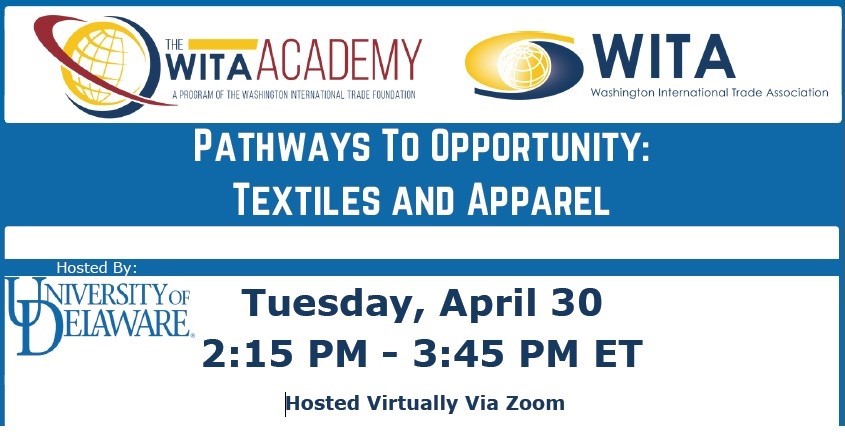
2024 WITA Academy Pathways To Opportunity: Textiles and Apparel-University of Delaware

On April 30, 2024 (Tuesday) from 2:15 pm. to 3:45 p.m, the Washington International Trade Association (WITA) Academy, in partnership with UD’s Fashion and Apparel Studies Department, will host a virtual workshop (on Zoom) exploring career opportunities in textiles and apparel trade, sourcing, supply chain, and sustainability.

This event is free and open to ALL UD students (undergraduate and graduate) and faculty, but registration is required (please use UD email address): https://www.wita.org/events/pathways-april30-2024/

Note: Students in FASH455 do not need to register for the event. We will attend the workshop and participate in the live Q&A session in the classroom.

Confirmed speakers include:

  • Katherine White, Chief Textiles and Apparel Negotiator, Office of the U.S. Trade Representative (USTR)
  • Nate Herman, Senior Vice President, Policy, American Apparel & Footwear Association (AAFA)
  • Felicia Pullam, Executive Director, Office of Trade Relations, U.S. Customs and Border Protection (CBP); former Deputy Assistant Secretary of Commerce for Textiles, U.S. Department of Commerce
  • Stephanie Lester, Vice President, Head of Government Affairs, Gap Inc.
  • Maristella Iacobello, VP of Global Customs and Trade, PVH Corporation
  • Sarah Thorn, Senior Director, Global Government Affairs, Walmart

Product Development and Apparel Sourcing: FASH455 Exclusive Interview with Abby Edge, Product Development Associate at Eileen Fisher

About Abby Edge

Abby Edge is the Product Development associate at Eileen Fisher, where she supports key initiatives in sourcing and sustainability. She graduated from the University of Delaware (UD) in 2020 with a degree in Fashion Merchandising. During her time at UD, she developed a passion for sustainable sourcing and social responsibility, which led her to pursue a career with a company that aligns with these values. Abby also served as a teaching assistant for FASH455 in Spring 2020 and was the co-author of How will EU Trade Curb Affect Cambodia’s Apparel Industry published in Just-Style.

Disclaimer: The views expressed in this interview are those of Abby Edge and do not reflect the views or positions of her employer or any affiliated organizations.

Sheng: What does a Product Development Associate do? Can you walk us through your typical day at Eileen Fisher? Also, what makes you love your job?

Abby: Product development can mean different things at different companies, but at Eileen Fisher (EF) it means costing and development prior to product development (PO). All samples, fabrics, and costs need to be approved during the Product Development period before the business teams place their buys. Every day, I communicate with our vendors to cost styles and create time & action plans so that delivery will be met. We work with our vendors and fabric mills to align and finalize pricing to achieve our margin goals. We also must think strategically about material and vendor allocation to improve lead times and mitigate carbon footprint.

I work hybrid, and our beautiful office is on the Hudson River in Irvington, New York. I enjoy going into the office to spend time with my team and review the product in person. I love my job because I am exposed to so many new and exciting sustainability initiatives every day. I admire everything that EF stands for and that we can promote a “less is more” wardrobe.

Sheng: What are the key steps involved in product development, and how do you collaborate with your sourcing team throughout this process?

Abby: At Eileen Fisher, there are two main stages of the product development process before “commitment”: “development” and “dupe.” At the development stage, we focus on any new materials that are being added to the line. We make sure the costing, testing, and lead times are workable. Then, at the dupe stage, we cost and sample the entire product line so that the merchandising and buying teams have all the information they need to place their buys. After commitment, we pass the baton to the Production team to finalize quantities, issue purchase orders, and track orders. Together, the Product Development

Sheng: Sustainability is a key focus in the fashion apparel industry today. From the product development perspective, what notable improvements have been made in recent years, and where do opportunities lie for further progress?

Abby: Eileen Fisher is leading the way in sustainability within the fashion industry, and it has been incredibly rewarding to be a part of a team where this principle is integrated into every aspect. For example, materials are at the core of EF. We focus on natural, organic, and regenerative materials and steer away from synthetics. Regenerative organic cotton is a new material that I’m really excited about. It all starts with the health of the farm and the people growing our cotton. The regenerative organic certification means that the cotton is grown holistically and healthily, contributing to the soil’s health and mitigating the impacts of climate change.

Additionally, the certification has strict social responsibility guidelines, requiring a living wage and safe working conditions for all farmers. This is just one example of innovative improvements that are being made in the material sector. Others include Lenzing Tencel lyocell, regenerative responsible wool, and organic linen.

Another key initiative at Eileen Fisher is our take-back program called “Renew,” where customers bring back their old EF garments in exchange for a $5 store credit. Since the program started in 2009, 2 million garments have been collected. Of the 2 million, 660,885 have been re-sold in stores, and the rest have been donated, repurposed, or downcycled. Some of my favorite EF pieces have actually been purchased from the store’s renewal section! It is also great to see other brands following suit and creating take-back and recycling programs. Clothing waste is an industry-wide problem; we need all hands on deck to make a difference.

Sheng: From your observation, how has the adoption of digital technologies transformed the practices of product development and apparel sourcing?

Abby: Our Product lifecycle management (PLM) system— Centric— has helped streamline the design and product development process tremendously. All teams have access to the PLM system, which allows everyone to be on the same page and easily access any information they might need. For example, designers use the system to set up styles and tech packs, whereas the merchandising team uses the system to line plan and set retails. In my role, I use PLM to enter and land costs and analyze margins. It is dynamic and provides everyone the key tools to succeed while working on multiple seasons at once.

Sheng: Are there any other major trends in the fashion industry that we should closely monitor in the next 1-2 years, particularly in product development and sourcing?

Abby: Traceability and transparency have become increasingly important in the industry. Technology platforms are emerging that can ensure transparency throughout all supply chain tiers using a digital “fiber coin.” The specific platform we use— Textile Genesis—maps the supply chain from fiber to retail to verify any sustainable fibers so that all claims we make are valid. In other words, they ensure the “transactions” between each supply chain step (fiber to yarn to fabric to garment) are authentic. It has been very exciting to see this project come to life, and I feel that platforms like this will become increasingly more prominent in the coming years.

Sheng: What reflections can you share from your experiences at UD and FASH? what advice would you offer to current students preparing for a career in product development and apparel sourcing?

Abby: I am so grateful for my time at UD in the FASH program. I made so many connections with my peers, professors, and alums that have helped me get to where I am now. My advice to current students is to get involved as much as possible, whether through study abroad programs, internships, or clubs. Don’t limit yourself or close yourself off to areas of the industry and embrace any opportunity you get, as you never know where it could lead. My internship with Under Armour in Hong Kong through the FASH study abroad program really helped me grow personally and professionally and I would not be where I am without that experience.

–End–