FASH455 Exclusive Interview with Mikayla DuBreuil about Technical Apparel Design and Sourcing

About Mikayla DuBreuil

Hello, my name is Mikayla DuBreuil, and my passion is to bring designers’ creative visions to life. I have a diverse background in apparel design, from intimates and compression wear to dresses and jeans, and everything in between! My resume consists of technical design positions at Under Armour, Marena, Anthropologie (URBN), Lee & Wrangler, and, most recently, SPIRIT HALLOWEEN.

Above all, my joy in apparel design lies in pattern-making. Designers are the artists, and pattern makers are the engineers who bring their designs to life. I love problem-solving to create fantastical designs and reduce physical sampling. Most of my work is in CAD 3D software, specifically CLO 3D. I am also a certified super user in the 3D CAD software, Vstitcher, and experienced in the 2D CAD patterning software, Accumark and Optitex.

Note: Mikayla Dubreuil graduated from the University of Delaware (UD) with a Master of Science in Fashion and Apparel Studies. She also graduated from UD with a Bachelor’s Science in Apparel Design in 2018. She received the International Textiles and Apparel (ITAA) Sara Douglas Fellowship for Professional Promise-Masters in 2019. Mikayla’s master’s thesis Traditional vs. big-data fashion trend forecasting: An examination using WGSN and EDITED was published in the International Journal of Fashion Design, Technology and Education and have been cited by more than 100 other scholarly papers.  

Sheng: What are your main responsibilities as a technical designer? Can you walk us through your typical day? Also, what makes you love your job?

Mikayla: A technical designer’s job is to ensure the proper execution of fit and construction of a garment to meet the designer’s & buyers’ expectations whilst keeping cost in mind.

This involves creating detailed tech packs with key measurements, i.e., specs like waist, front neck drop, across shoulder, sweep, and front length from high point shoulder, measuring garments, conducting fittings on a live fit model, and submitting fit comments. A common technical design goal is to approve a design with as few physical samples as possible.

Some technical designers’ responsibilities are more rooted in construction and creating tech packs, whilst others focus on fit.

However, in my opinion, the best technical designers have a strong pattern-making and construction background. By having a strong pattern-making and construction background, technical designers (TDs) can communicate to designers what silhouettes and constructions are feasible. In this manner, TDs can find creative solutions to execute the designer’s vision and improve fit.

As an Associate 3D Technical designer, my typical day consists of taking design set-ups/hand-offs, pattern making the designs in CLO 3D, and attending buyer review meetings.

I love my job at Spirit Halloween because I can build garments in 3D, both bringing the designer’s vision to life and improving sustainability by reducing sampling. I also have an incredible manager, which is very important.

Sheng: How does a technical designer collaborate with the sourcing department, and in what ways does your work influence sourcing decisions?

Mikayla: To preface, the sourcing department is responsible for deciding what fabrics and trims will go into the garment.

Technical designers collaborate with the sourcing department or buyers by recommending ideal fabrics to achieve the desired look of a garment. For example, for a bodysuit, technical design would recommend a stretch knit fabrication. TDs affect sourcing decisions by providing knowledge on how the garment will execute in the desired fabric.

Ultimately, it is often sourcing/design/buying’s decision—the call varies from company to company—to choose the fabric. Ultimately, technical design commonly doesn’t make the call on what fabric is used.

This impacts our work because technical designers will base their specs and patterns on the fabric and desired silhouette. For example, a stretch denim pant would have smaller specs than a non-stretch denim pant since the stretch denim has more ease.

Further, the sourcing department affects our TDs’ work because it determines which vendor is making the garment. As a result, this affects our decision on whether to make the pattern internally or externally, based on the vendor’s expertise & capabilities.

Sheng: Our students are particularly interested in fabric sourcing. From your experience, what factors do fashion companies weigh most heavily when selecting fabrics, and how do these influence design and production decisions?

Mikayla: Cost. Cost and fabric drape.

However, designers and technical designers can push back if a lower-cost option is executing poorly. Buyers can make the decision to increase the retail price to meet initial markup goals to accommodate higher fabric costs.

Alternatively, the team may choose to use the low-cost fabric option in a less high-profile area of the garment and spend more on a high-quality fabric in a statement area of the garment.

On a separate note, if there is liability fabric, i.e., extra fabric that is not being used, buyers often reallocate the fabric to a different or new silhouette.

Sustainability is also at the forefront of mind, especially at denim brands. There is a shift to move towards recycled cotton.

Sheng: Many fashion companies are incorporating “preferred sustainable fibers” such as recycled, organic, or regenerative materials. From your perspective, what are the opportunities and challenges in integrating these fibers into apparel?

Mikayla:Cost and fit are both challenges in integrating these fibers into apparel. For example, many consumers want stretch in denim jeans, but it can be difficult to achieve that effect when switching to certain “preferred sustainable fibers”.

Additionally, it’s difficult to source a “sustainable” faux fur for a teddy bear costume. The plush material is so specific, resulting in a lack of sustainable choices.

One opportunity is using fabrics that are composed of a single fiber. Fabrics with fiber blends are much more difficult to recycle. A lot of opportunities are available to the consumer! Buy fewer and higher-quality items. Wear clothes more than once before washing.

Sheng: Looking ahead, what industry trends will you be keeping a close eye on in the next 1-2 years, and why?

Mikayla: Tariffs!! Tariffs impact our ability to source and distribute our garments. Also, pop culture matters, since many want to dress up as the latest phenoms!

Sheng: Reflecting on your time at UD and in FASH, what experiences helped prepare you for your career? What advice would you give to current students as they plan their career paths?

Mikayla:Think about what you want and your goals. I am so glad that I attended the FASH Grad program, which gave me exposure to CLO 3D and ultimately led to my current role. While I was at UD, I was proactive by working with professors on projects that gave me industry visibility. For example, I worked on an Optitex project that allowed me to attend a training at the Under Armour HQ, which helped me earn a spot as a technical design intern and catapult my career.

–The End–

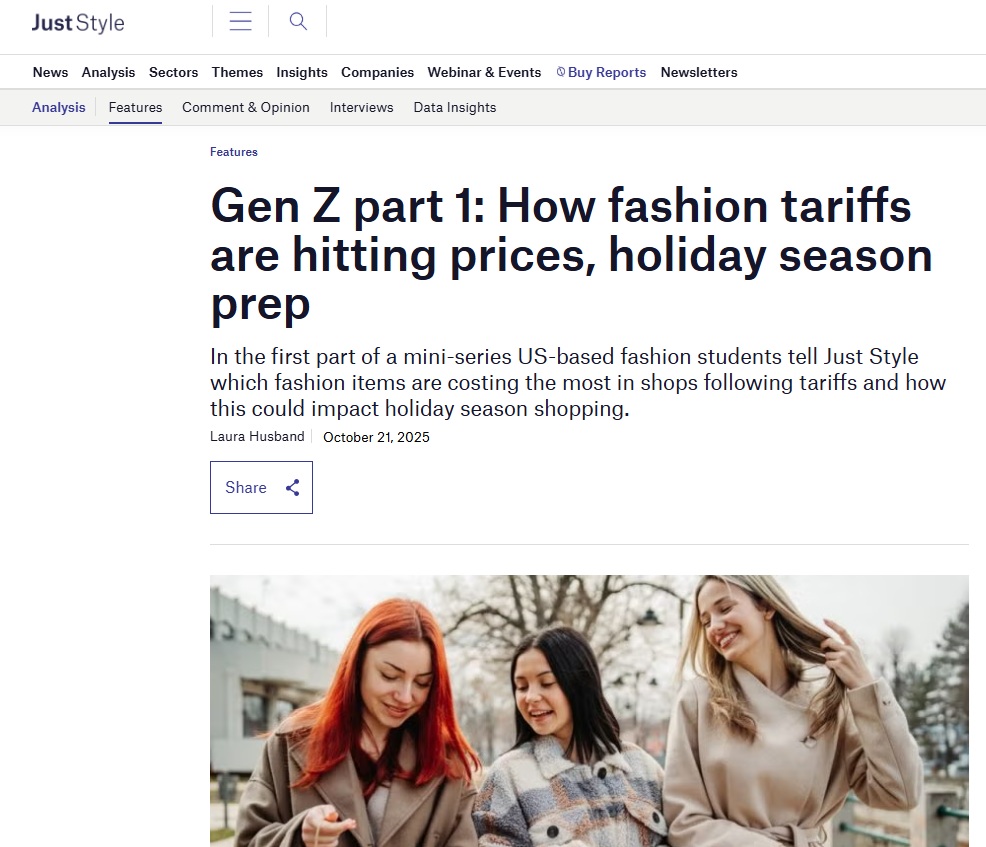
Hot Button Apparel Trade and Sourcing Issues: Gen Z’s Perspective (October 2025)

As the fashion industry faces an unprecedented business and trade policy environment, hearing directly from Gen Z fashion majors—the next generation of both consumers and young professionals—has never been more critical.

In a new Just-Style mini series, students from FASH455 and the FASH department at the University of Delaware shared their valuable Gen Z perspectives on several hot-button apparel trade and sourcing issues as well as their vision for the future of the fashion apparel industry. Several findings are noteworthy:

First, like other consumer groups, Gen Z has felt the increasingly noticeable retail price hike driven by higher tariffs, and they are responding by reducing clothing purchases.  Compared to a survey conducted in April, nearly all Gen Z consumers now see higher price tags across a broad range of products, including necessities, outerwear, and footwear in the U.S. retail market. Notably, Gen Z consumers feel most strongly about the price hikes at fast fashion retailers—including Shein. Due to the perceived low quality and use of inexpensive textile materials, it is even more challenging for fast fashion brands to justify price increases. Our students who frequently thrift clothing also noted a price increase in the secondhand clothing market. As a warning sign to fashion companies, many surveyed Gen Z students say they plan to spend less this holiday season, or keep shopping “to a minimum” because of price increases.  For example,

  • Gabriella Krug, Fashion Merchandising and Management senior: As a shopper, I’ve adjusted by buying fewer items overall, checking sales racks more often, and using platforms like Depop and Poshmark to sell and buy trendy pieces. For the holidays, I think these price increases will push me, and most shoppers like me, to focus more on quality rather than quantity. I’ll definitely be taking advantage of Black Friday and Cyber Monday deals this year. Ultimately, tariffs could cause people to make more intentional and selective purchases this holiday season.
  • Cheyenne Weiss, Fashion Design & Product Innovation senior: While the higher tariffs have widespread effects on the fashion industry, I have personally noticed raised prices for outerwear and footwear. I noticed these two categories specifically as they are what I was shopping for going back to school and it is telling of how directly trade policy impacts consumers. The effects of the tariffs are hitting close to home, and I would feel most frustrated to see loungewear and athleisure categories rise in price. While these areas seem to already be feeling the effects of raised tariffs, it would be hard as a consumer to continue purchasing these items if tariffs keep rising, considering these are the fashion categories I buy from the most often. As a shopper, the higher prices discourage me from going out and purchasing new clothing.
  • Skye Johnson, Fashion Merchandising and Management senior: I have noticed that prices are rising among all types of clothing. In particular, I have heard that Fast Fashion retailers like H&M or even Shein have increased their prices significantly. While I personally do not shop at fast fashion retailers like Shein, I’ve seen the impact through school research projects and conversations with friends. This is frustrating because these fast fashion items are made with very cheap materials like polyester and nylon.
  • Julia Brady, Graduate Student studying Fashion and Apparel with a focus on Sustainability: I mainly shop using online resale sites, such as Depop, and just enjoy browsing higher-end online consignment stores, like Vestaire and theRealReal, for secondhand designer deals. I have seen fewer deals on the site and more high-priced secondhand designer items… Even on Depop, international listings are higher than normal. The category I would be most frustrated to see prices rise in would be footwear… I also expect to buy holiday gifts from local artisans and local stores, due to higher quality and (hopefully) decreased tariff impact.
  • Nadia Grosso, Fashion Merchandising and Management senior: I’ve noticed myself becoming even more price-sensitive when shopping because of the rising prices, so I’m always looking to find the best deal to stretch my budget as much as I can. Overall, I think shoppers are trying to limit their spending as much as possible, and being more cognizant of prices when choosing what to purchase and who to purchase from. As a result, come holiday shopping time, I might be more inclined to shop at discount retailers or even decrease how much I purchase compared to previous years.

Second, Gen Z fashion majors view globalization and international trade as generally beneficial for the fashion industry. At the same time, they emphasize the need to enhance sustainability and social responsibility in the global apparel trade. For example, while most survey respondents supported leveraging apparel trade to promote economic development in developing countries, they also stressed that trade volume alone should not define success. Instead, many highlighted the importance of ensuring that garment workers in developing countries directly benefit from trade and Western fashion brands and retailers have a responsibility to help make this happen. For example,

  • Emilie Delaye, Master’s student in fashion and apparel studies: I believe that it is almost virtually impossible to move manufacturing fully back into the US. Nearshoring could really help sustainability (as fewer emissions would be released), but nearshoring would require investment and savvy trade deals to ensure that many different kinds of products can be produced there. I don’t really think it is that important that the US maintains a “strong” textile and apparel sector. As we know from the innovation or economic development timeline, the textile and apparel sector is an entry point for less developed economies. It could actually be perceived as a positive that we aren’t largely in this market. I think that there are other more critical sectors to focus on for the US. Plus, we simply do not have the skilled labor or machinery needed to do this. I support the leveraging of the clothing trade to support economic development in the countries that need it. I believe that if done sustainably and socially responsibly, the apparel sector could help millions of individuals in these countries.
  • Abigail Loth, Fashion Merchandising and Management senior: As a consistent consumer in the US fashion industry, I believe that globalization and international trade is vital for our success. Not only does it keep trends fresh, globalization and international trade encourage styles to remain diverse and costs to be cheap… Maintaining a strong domestic textiles and apparel sector in the US is also extremely important. This is because it provides an abundance of jobs/opportunities, innovation and sustainability practices. So, in order to leverage the clothing trade and support workers in developing countries as ethical sourcing and fair labor practices help ensure that globalization benefits more than just corporations.
  • Ekaterina Forakis, Fashion and apparel studies 4+1 graduate student: Globalization and international trade are crucial aspects of the U.S. fashion industry. It is these that keep the U.S. fashion industry running. Trade theory explains why globalization benefits countries like the U.S. and allows them to focus on textile manufacturing, one of the country’s strong suits. Higher tariffs and import restrictions are not necessary to maintain U.S. manufacturing because the U.S. is already a top textile exporting country and does not specialize in apparel production. The country’s capacity for automation is what makes it reliable in the textile sector. Automation allows for more standardized production of textiles which are necessary for developing countries to produce apparel.
  • Emma Lombardi, Fashion Design and Product Innovation senior: I view globalization and international trade as a double edged sword for the U.S. fashion industry, because on the one hand, while it doesn’t benefit the creation of jobs in rural areas that many covet, it also shifts the emphasis towards more sophisticated industries in technology development and innovation both in mechanical and textile sectors.
  • Julia Brady, Graduate Student studying Fashion and Apparel with a focus on Sustainability: I think tariffs and import restrictions are necessary, but not just to protect U.S. domestic manufacturing. Tariffs could help regulate the amount of toxic chemicals along the textile manufacturing value chain. An alternative route for the U.S. to take would be to scale up flax for fibers to be used in domestic textile manufacturing. Perhaps tariffs will force companies and the federal government to invest in agricultural advances in this field…I would never want to advocate taking away work in developing countries; however, for the sake of our environment, we may need to shift the way the fashion supply chain currently operates. It is important to me that the U.S. maintains a strong textiles and apparel sector because we are a big part of the problem. We must take control over the way we consume and dispose of textiles. There could be so many opportunities for economic growth if we shift toward domestic manufacturing, prioritizing the use of materials we already have.

Third, associated with the debate on the future of textiles and apparel “Made in the USA,” most Gen Z fashion majors show little interest in factory jobs. On the one hand, unlike most developing countries, today’s U.S. fashion industry provides Gen Z fashion majors with many exciting and promising non-manufacturing job opportunities, ranging from apparel design, product development, sourcing, trade compliance, and merchandising to marketing. By contrast, factory jobs are often perceived as “low paid,” “repetitive,” and “poor working conditions.”  Our Gen Z fashion majors particularly emphasized that their preferred employers should provide both financial and career progress opportunities, and they want to see keywords such as “innovation,” “sustainability,” “room to grow,” and “inclusiveness” associated with their future jobs. In other words, to attract more Gen Z workers to factory jobs, companies need to do more than just offer competitive pay. For example,

  • Gabriella Krug, Fashion Merchandising and Management senior: At this point in my career, I have not pursued an interest in textile or apparel manufacturing or factory-related jobs. My internships have exposed me to different sides of the industry…That said, I think my generation could see these roles as more appealing if companies focused on innovation, sustainability, and clear opportunities for growth. For example, if factories showcased their role in a circular fashion and created a more modern, flexible work environment, I think more Gen Z talent would be drawn in since we’re motivated by making a positive impact. Personally, I’m most interested in jobs that mix creativity with business—like sales, buying, or trend forecasting. When it comes to an employer, I value opportunities to learn and grow, strong mentorship, and a culture built on collaboration and inclusivity.
  • Cheyenne Weiss, Fashion Design & Product Innovation senior: I am not personally interested in pursuing a career in textile or apparel manufacturing as I see myself in a more creativity-based position. I feel as though my skills in fashion would be better suited for a role where I’m working directly with design and developing the fit and aesthetics of garments. Factory-related jobs in fashion could become more appealing to my generation if more rising fashion professionals knew about the opportunities that are available… When considering the qualities of an employer that I would want to work for, an important factor for me is a growth mindset. I value being able to learn and adapt as the industry evolves and I would want my employer to share my same persistence to always be learning and bettering the quality of work I can produce.
  • Skye Johnson, Fashion Merchandising and Management senior: I am not interested in pursuing careers in textile and apparel manufacturing or factory related jobs. However, I completely respect the importance of these roles in our fashion industry. I feel that my skills or career goals do not align with these jobs, but there could definitely be ways to make it more appealing to Gen Z. For example, offering safer working conditions, competitive pay, clear paths for professional growth, etc… When considering an employer, I value a workplace that aligns with my values, offers an inclusive environment, open communication, creative freedom, and room to grow in the company. I want to feel like I belong and am making an actual impact where I work.
  • Abigail Loth, Fashion Merchandising and Management senior: I personally do not have any interest in pursuing a career in textile or apparel manufacturing and factory-related jobs. These jobs consist of heavy hands on labor, limited creativity and repetitive daily tasks. The job is very cookie-cutter and has limitations for growth and opportunity. In order to make these types of factory jobs more appealing to our generation, the employers should provide safer working conditions, more money, and a sense of change/development in the everyday job. If factory jobs allowed more flexibility for creative thinking and alterations, they would appeal more to Gen Z.
  • Julia Brady, Graduate Student studying Fashion and Apparel with a focus on Sustainability: I am interested in pursuing a career related to textile and apparel manufacturing. Specifically, I would love to work towards a more socially responsible fashion industry. I could see myself working for a textile recycling plant in the U.S.; I expect more to be popping up over the next decade. If the factories were focused on green engineering and diverting textile waste, this might be another attractive core value of a potential future employer. I would be more inclined to work a factory job if the conditions in the factory were regulated and protective of the workers’ health. Additionally, if the employer was prioritizing the use of natural materials combined with textile recycling outputs, this would be very appealing to me as a prospective employee.

Fourth, Gen Z fashion majors show a high awareness of AI and are open to increasing its use in the fashion industry. Specifically, our Gen Z students believe that AI can be a powerful tool widely adopted by fashion companies, such as supporting apparel sourcing decisions, generating designs, and conducting data analysis and forecasting. Many also envision bold, creative applications of AI, such as optimizing secondhand clothing use or dynamically altering garments’ colors and textures based on weather conditions or consumers’ moods. These findings underscore the growing importance of deliberately integrating AI into fashion education and strengthening collaborations between industry and academia. For example,

  • Emilie Delaye, Master’s student in fashion and apparel studies: I think that AI could help understand and simplify the complex supply chains we have. Perhaps by incorporating AI into sourcing decisions, it could help determine the most efficient and eco-friendly path for the garment.
  • Gabriella Krug, Fashion Merchandising and Management senior: If there were no limits in terms of technology or resources, I would love to see AI used to create a truly circular fashion system. Garments would be designed with little to no waste from the very beginning with AI predicting the most sustainable production methods. Also, I think AI should account for each garment’s end-of-life by tracking how items can be reused, recycled, or repurposed.
  • Skye Johnson, Fashion Merchandising and Management senior: I still feel that AI will not be able to completely take over in the fashion industry, we still need that human touch. That human aspect is what makes the industry go round, especially when it comes to designers…If I could pick a bold AI-driven innovation to see in the fashion industry, I would love to see garments that change color or texture based on your mood or the weather. The AI technology could read your personal style and predict what looks best on you. That would definitely take years to make, but it would further blur the lines between fashion, technology and art.
  • Abigail Loth, Fashion Merchandising and Management senior: I would love to see AI-driven innovation that would be able to make custom designs depending on preferred colors, style, size, or shape and deliver it based on preferences of style and sustainability.
  • Nadia Grosso, Fashion Merchandising and Management senior: AI can be a helpful tool to analyze data and make recommendations on how to apply its findings to real-world situations. Especially with the uncertainty surrounding changing prices and geopolitics, AI could be implemented to help fashion companies navigate difficult sourcing decisions and manage their complex supply chains. I would also love to see AI be implemented more to drive sustainability initiatives such as reducing waste within production or even assisting with the discovery and development of more sustainable materials. However, I don’t think AI can fully replace human intelligence and creativity, so it’s important for it to be used as a tool and not as a replacement.

Additionally, the results show that Gen Z fashion majors overwhelmingly support the increased use of recycled textile materials in clothing and view it as an important opportunity to address the textile waste problem. However, as consumers, they still expect such products to remain financially affordable, match the quality of non-sustainable options, and look stylish. Additionally, with greater knowledge and awareness of sustainability, Gen Z consumers expect fashion companies to provide more transparency regarding their recycling practices and price structures (i.e., what they are actually paying for). This requires fashion companies to continue to improve their supply chain mapping and traceability in the era of textile recycling. For example,

  • Emilie Delaye, Master’s student in fashion and apparel studies: The (recycled) garments currently on the market are very expensive and do not appeal to my personal style…And it is very important for fashion companies to provide clear sustainability information. I think providing information on the cost breakdown would be valuable to see and ensure that the money is distributed more evenly.
  • Gabriella Krug, Fashion Merchandising and Management senior: Yes, I do care about clothing made from recycled textile materials because it feels like a step in the right direction and it makes me feel like I am making a more thoughtful choice as a consumer…What makes these products most appealing to me is the mix of style and transparency. Especially with Gen Z, the culture is shifting more and more toward eco-conscious consumers, now with the help of Depop, ThredUp, and Poshmark. These platforms give people an easy way to step into the world of sustainable fashion. For me, I want to know that the clothing looks and feels just as high-quality as non-sustainable options, but I also don’t want to feel like I’m overpaying just because it’s labeled as eco-friendly…I want brands to be upfront about what percentage of a garment is actually recycled and how it was made
  •  Skye Johnson, Fashion Merchandising and Management senior: For me, the appeal of recycled or sustainable fashion products comes from a combination of style, price, and brand transparency. I believe it is very important that fashion companies provide clear sustainability information and have the efforts and data to back it up… Obviously, no brand is perfect, but when I see a brand putting in the work to do better, I respect them a ton more.
  • Nadia Grosso, Fashion Merchandising and Management senior: Fashion brands need to do more to educate their consumers and highlight the importance of sustainability, while also incorporating it as a value into all of their business practices. I think that we can make sustainable and recycled products more appealing to consumers by being transparent and educating them on their importance. Fashion brands are becoming increasingly aware that providing clear sustainability and sourcing information to their consumers is necessary to gain their trust and loyalty, especially as a growing number of consumers are considering these practices as influencing factors to make purchases.

FASH students who contributed to the series include:

  • Gabriella Krug, Fashion Merchandising and Management senior
  • Emilie Delaye, Master’s student in fashion and apparel studies
  • Cheyenne Weiss, Fashion Design & Product Innovation senior & 4+1 graduate student
  • Skye Johnson, Fashion Merchandising and Management senior
  • Julia Brady, Master’s student in fashion and apparel studies
  • Abigail Loth, Fashion Merchandising and Management senior
  • Nadia Grosso, Fashion Merchandising and Management senior
  • Ekaterina Forakis, Fashion and apparel studies & 4+1 graduate student
  • Emma Lombardi, Fashion Design and Product Innovation senior

Explore more:

FASH455 Exclusive Interview with Karin De León, Investment and Promotion Director, Apparel and Textiles Association of Guatemala (VESTEX)

About Karin De León

Karin De León has been working in the textile and apparel sector in Guatemala for more than 25 years, promoting the development of the industrial cluster, participating in the creation of strategies, supporting the strengthening of the supply chain, and attracting investment.

As part of her role at the Apparel and Textile Association of Guatemala (VESTEX), for 10 years she held the position of Executive Director of CECATEC-RD (Central American and Dominican Council of Clothing and Textiles), the entity that integrates textile & apparel industry associations of Central America and the Dominican Republic and which is responsible for coordinating the inter-institutional relationship with public and private entities of the United States of America, Mexico and Colombia mainly.

From 2020 to the beginning of 2022, she served as Chief of Staff of the Ministry of Economy of Guatemala and later became General Coordinator of the National Competitiveness Program (PRONACOM), a government entity responsible for promoting the country and attracting investment.

Karin is currently VESTEX’s investment and promotion director, and representative of Guatemala in CECATEC-RD. She coordinates the inter-institutional relationship with government entities of the United States (such as the United States Trade Representative and the Department of Commerce) as well as private institutions mainly related to the United States, Mexico, and Colombia.

Sheng: Can you provide a brief introduction to VESTEX and a general overview of your member companies?

Karin: VESTEX is the Apparel and Textile Association of Guatemala, a private association representing the Guatemalan textile and apparel export sector. It focuses on promoting the industry’s exports through strategic alliances with public and private institutions at the national and international levels.  Its strategic axes are Sectoral Resilience, which seeks to position the industry as a generator of investment and formal employment in the country; Sectoral Sustainability, through the promotion of sustainability as a long-term strategy for industry continuity and compliance, providing companies in the sector with tools that facilitate compliance with the obligations established in the laws and regulations.

VESTEX partners comprise companies that integrate the entire supply chain of the apparel and textile sector, encompassing yarn and fabric manufacturers, apparel producers, as well as firms providing specialized services and accessories to the industry.

Sheng: Studies show that there is consistent interest among U.S. fashion companies in expanding nearshoring from the Western Hemisphere, including Guatemala. What is your observation? What makes Guatemala an attractive destination for apparel sourcing today? What are the unique advantages of sourcing from the country?

Karin:Guatemala has become an increasingly attractive destination for apparel sourcing due to its unique combination of industrial integration, geographic advantages, and strong compliance standards. The country offers a highly integrated apparel cluster that encompasses every stage of the supply chain—from spinning yarn and weaving fabrics to apparel manufacturing, printing, finishing, and packaging. This full-package model not only streamlines operations and enhances traceability but also allows for greater flexibility and product diversity, raising the added value of garments and positioning Guatemala as a competitive supplier for niche and complex products requiring skilled labor and high-quality materials.

Another key differentiator is Guatemala’s strategic location. With access to ports on both the Atlantic and Pacific coasts—separated by only 249 miles—the country can efficiently serve both the East and West coasts of the United States. Guatemala manages the second-largest maritime cargo operation in Central America (after Panama), which is critical for companies seeking to balance and mitigate geopolitical and logistical risks. In addition, proximity to the U.S. substantially reduces environmental impact: sourcing from Guatemala lowers CO₂ emissions from maritime transport by approximately 84% compared to sourcing from Asia. Transit times are also highly competitive, with shipments reaching Miami in as little as three days, enabling U.S. buyers to manage inventories more effectively and respond to market demands with agility.

Equally important, Guatemalan apparel companies operate under a strong framework of labor and environmental compliance. Companies demonstrate a full-spectrum commitment to input traceability, adherence to strict rules of origin, and continuous process improvement to reduce resource consumption. Investments in monitoring and ESG systems underscore their transparency and alignment with global sustainability standards.

Taken together, this integration of cluster capabilities, geographic proximity, and compliance with international norms positions Guatemala as a reliable, sustainable, and strategically advantageous sourcing partner for U.S. fashion companies.

Sheng: How important is the Dominican Republic-Central America Free Trade Agreement (CAFTA-DR) in supporting Guatemala’s apparel exports to the U.S. market? What impact do CAFTA-DR’s apparel-specific rules of origin have on garment exporters’ supply chains and export strategies in Guatemala?

Karin:CAFTA-DR has provided certainty by encouraging long-term investments in textile infrastructure and capabilities. CAFTA-DR has been the basis for the development of Guatemala’s apparel industry.  The yarn-forward rule established under the agreement has not only fostered integration with the U.S. supply chain but also promoted stronger collaboration among Central American countries. By allowing the accumulation of inputs and processes within the region, CAFTA-DR has significantly strengthened intraregional trade.

This integration has facilitated the specialization of each Central American country. In Guatemala’s case, it has enabled the use of specific yarns and fabrics produced in other countries and manufactured locally, fostering a greater diversification of production.

According to OTEXA figures, in the year ending June 2025, 89.17% of Guatemala’s total apparel exports to the U.S. entered under the Free Trade Agreement preferences. Of this total, 79.69% qualified under the yarn-forward rule—that is, garments made with yarn from the U.S. or yarn produced within one of the Central American countries. CAFTA-DR, and particularly its rules of origin, have been the basis of Guatemala’s strategy in recent years, not only to attract foreign direct investment but also to encourage significant reinvestments.

Sheng: Data shows that an increasing share of yarns and fabrics used by Guatemala garment factories are now locally made in Guatemala and other Central American countries. Could you discuss the recent trends in textile manufacturing capacity building in Guatemala, as well as the industry’s current priorities in building a more vertically integrated regional supply chain?

Karin:Guatemala offers a series of competitive advantages that are reinforcing its role as a regional hub for textile and apparel manufacturing. At the country level, it benefits from a stable macroeconomy, a solid exchange rate, competitive electricity prices within the region, and a reliable energy supply. At the industry level, Guatemala stands out for its robust apparel and textile cluster and highly skilled workforce.

Since the pandemic in 2020, when many global companies accelerated nearshoring strategies, Guatemala has successfully attracted new foreign investment and supported the expansion of companies already established in the country, particularly in the spinning industry. Installed capacity is primarily focused on cotton, although blends are also produced. By the end of 2024, apparel exported to the U.S. consisted of 62.8% cotton, 36.4% synthetics, and 0.8% wool, reflecting the central role of cotton in the country’s production while also showing diversification into other fibers.

Driven by shifting market demand, textile production in Guatemala has been expanding beyond knits, with a modest increase in woven fabrics as well. Investments in innovation and technology have enabled the industry to offer specialized processes, including antimicrobial treatments, absorption, UPF protection, enzymatic washing, softening, and plush finishing, among others. A particularly important advancement has been the investment in elastic knit fabrics, which has opened the door to the production of categories such as sportswear, intimate apparel (seamless), shapewear (technical lingerie and compression fabrics), and medical textiles.

We recognize, however, that there remain challenges and opportunities to broaden the regional textile offering—particularly in the production of yarns and fabrics made from fibers not yet manufactured locally. Expanding capacity in these areas would further strengthen vertical integration and supply chain resilience.

In this context, VESTEX has taken a leading role in supporting and guiding companies interested in exploring these opportunities. In coordination with Guatemala’s foreign direct investment promotion agency, efforts are underway to identify high-demand inputs that are currently unavailable in the region but represent strategic opportunities for local production.

Sheng: Since April 2025, U.S. apparel imports from CAFTA-DR countries, including Guatemala, are subject to a new 10% “reciprocal tariff.” How has this tariff increase and the Trump administration’s trade policy so far impacted Guatemala’s garment industry and exports? 

Karin:The main challenge for Guatemala’s apparel industry under the current U.S. trade policy has been the high degree of uncertainty. Markets and buyers demand stability, yet in recent months orders have slowed significantly as companies await clarity on the tariffs that will ultimately apply to each country. This hesitation has already resulted in lost opportunities: seasonal orders cannot be recovered once the selling window has passed.

Traditionally, Guatemala’s apparel sector grows between 3% and 5% annually; however, 2025 projections have been revised downward, and current expectations suggest growth closer to 1–2%. According to the Central Bank of Guatemala, as of June 2025, exports registered a modest 1.36% increase—well below what was anticipated under normal conditions.

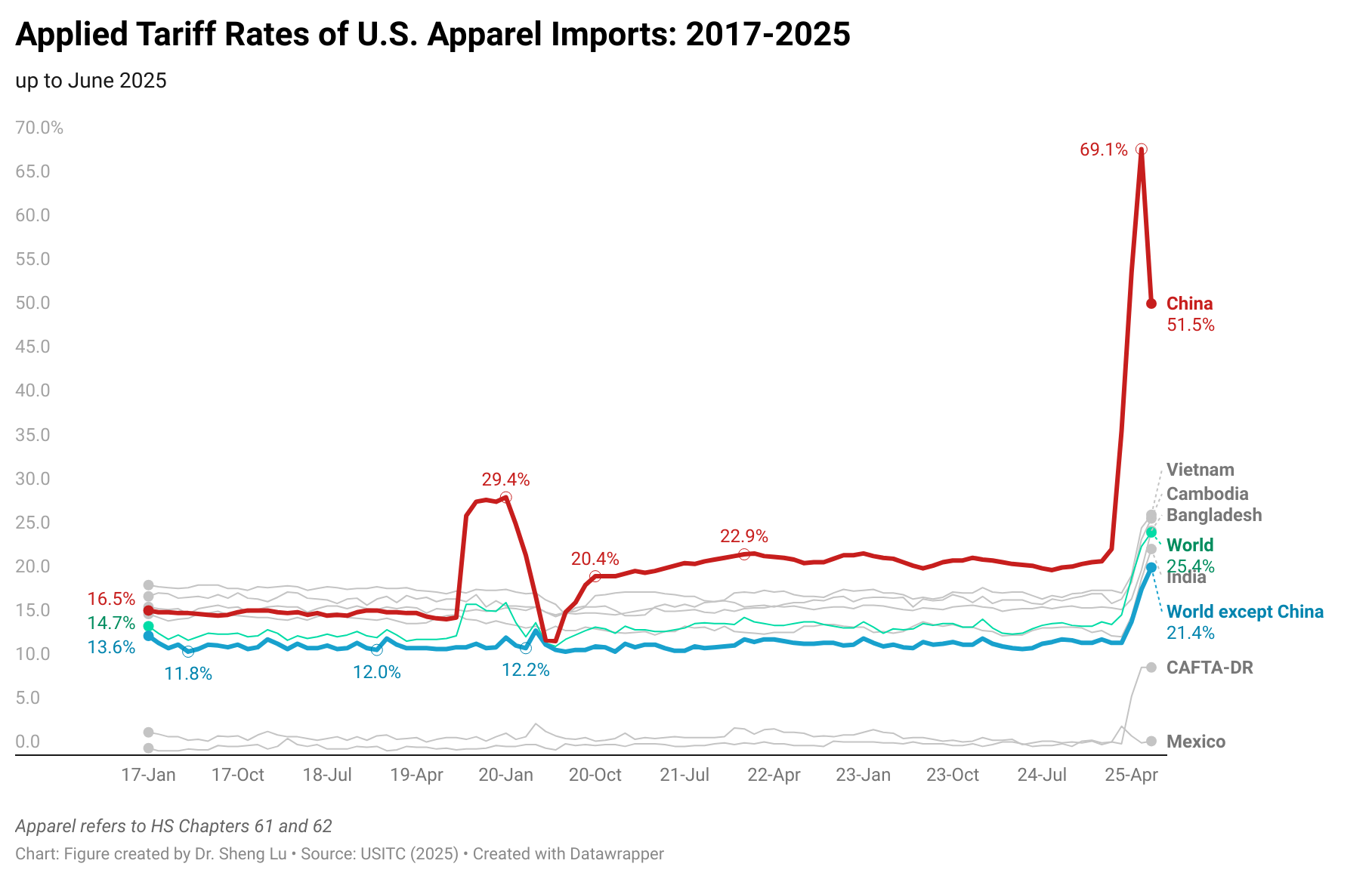
Another major impact has been the need for companies to absorb additional costs to maintain contracts with international brands. This has reduced profit margins, limited reinvestment capacity, and increased pressure on already tight production cycles. Buyers face uncertainty as well: they do not know how much a garment ordered today will cost by the time it is delivered six to nine months later, since tariff rates are subject to abrupt changes. The volatility recalls past episodes in China, where tariffs under former President Trump rose as high as 145% before being reduced to 30%, creating unpredictable supply conditions.

That said, Guatemala continues to hold a relative tariff advantage compared with Asian competitors, where rates now reach 15%, 18%, 25%, or even higher. This gap may ultimately favor Guatemala if U.S. buyers reconfigure sourcing strategies to prioritize suppliers who are both geographically closer and more reliable. Indeed, global sourcing is shifting away from a purely low-cost model toward one that values resilience, speed to market, and compliance.

Sheng: The 2025 US Fashion Industry Association Benchmarking Study indicates that U.S. fashion companies are increasingly seeking sourcing destinations that can provide sustainable apparel products, including those made with preferred fibers such as organic, recycled, regenerative, and biodegradable materials. What strategies or recent initiatives has the Guatemalan textile and apparel industry undertaken to meet this demand for sustainability?

Karin: Guatemalan mills already source recycled polyester yarns, organic or regenerative cotton, and biodegradable materials. Brands are actively demanding these products. In fact, mills have obtained various certifications and adhere to practices focused on circular economy, science-based target initiatives, and other sustainability standards.

Traceability is key for the textile and apparel industry, and Guatemala has managed to implement measures such as data management and continuous improvement as a way to demonstrate this.

  • Adoption of Sustainable Certifications and Standards: Guatemalan manufacturers are obtaining certifications like GOTS (Global Organic Textile Standard), OEKO-TEX, Global Recycled Standard, Recycled Claim Standard, Blue Sign, Higg FEM, among others, ensuring their products meet international sustainability standards.
  • Investment in Technologies: Many mills are upgrading to water and energy-efficient machinery, as well as more sustainable dyeing and finishing processes.
  • Training and Capacity Building: Initiatives to train and certify workers and management on sustainable practices and standards are increasing, promoting a culture of sustainability throughout the industry.
  • Integration of Circular Economy Principles: Some mills are exploring design for recyclability techniques to align with circular economy goals.

These initiatives collectively position the Guatemalan textile and apparel sector as a viable sourcing destination for sustainable fashion, aligning with global market trends and buyer preferences for more sustainable products.

Sheng: In addition to the questions discussed earlier, what are the top business and policy issues facing Guatemala’s textile and apparel industry over the next 1–2 years?

Karin:Over the next 1–2 years, Guatemala’s textile and apparel industry will face several pressing business and policy issues that will shape its competitiveness.

1. Infrastructure and logistics.
A key issue remains the need to strengthen national infrastructure, particularly ports, customs processes, and internal transport routes.

2. Limited availability of regional inputs.
The industry continues to face constraints in the local production of certain yarns, fabrics, and specialized fibers. Inputs such as viscose, spandex, and rayon are not yet manufactured in the region at scale, which limits vertical integration and forces reliance on imports from outside the hemisphere. Expanding textile capacity in these areas is a central issue to ensure resilience and broaden the exportable supply.

3. Market visibility and buyer perception.
Despite its high level of integration, many international buyers remain unaware of Guatemala’s strengths in complex products, compliance, and sustainability. A persistent challenge is to raise global awareness of the country’s capabilities in order to capture greater sourcing opportunities.

4. Policy uncertainty and trade volatility.
The recent 10% reciprocal tariff applied to CAFTA-DR countries has introduced significant uncertainty. Buyers hesitate to place long-term orders when tariff levels are unclear, and this volatility affects sourcing decisions. Stability and predictability in trade policy remain critical issues for the sector.

5. Differentiation and specialization under nearshoring.
Another key challenge is sustaining competitiveness through higher-value products. Today, 54.11% of Guatemala’s apparel exports already include advanced finishing processes, and the industry is investing in spinning, woven fabrics, and technical textiles. However, scaling these capabilities requires reinvestment and foreign capital inflows—both of which are being constrained by global uncertainty. Given that Guatemala currently supplies only about 2% of U.S. apparel imports, a major issue ahead is how to convert this untapped potential into tangible growth.

In short, while the country is positioning itself strategically with competitive tariffs, geographic proximity, and an increasingly sophisticated textile base, the top issues over the next two years will be overcoming infrastructure and logistics bottlenecks, reducing dependence on imported inputs, strengthening promotion to buyers, and navigating trade policy volatility. Addressing these challenges will be crucial for Guatemala to capitalize on long-term opportunities in the ongoing global supply chain reconfiguration.

-The End-

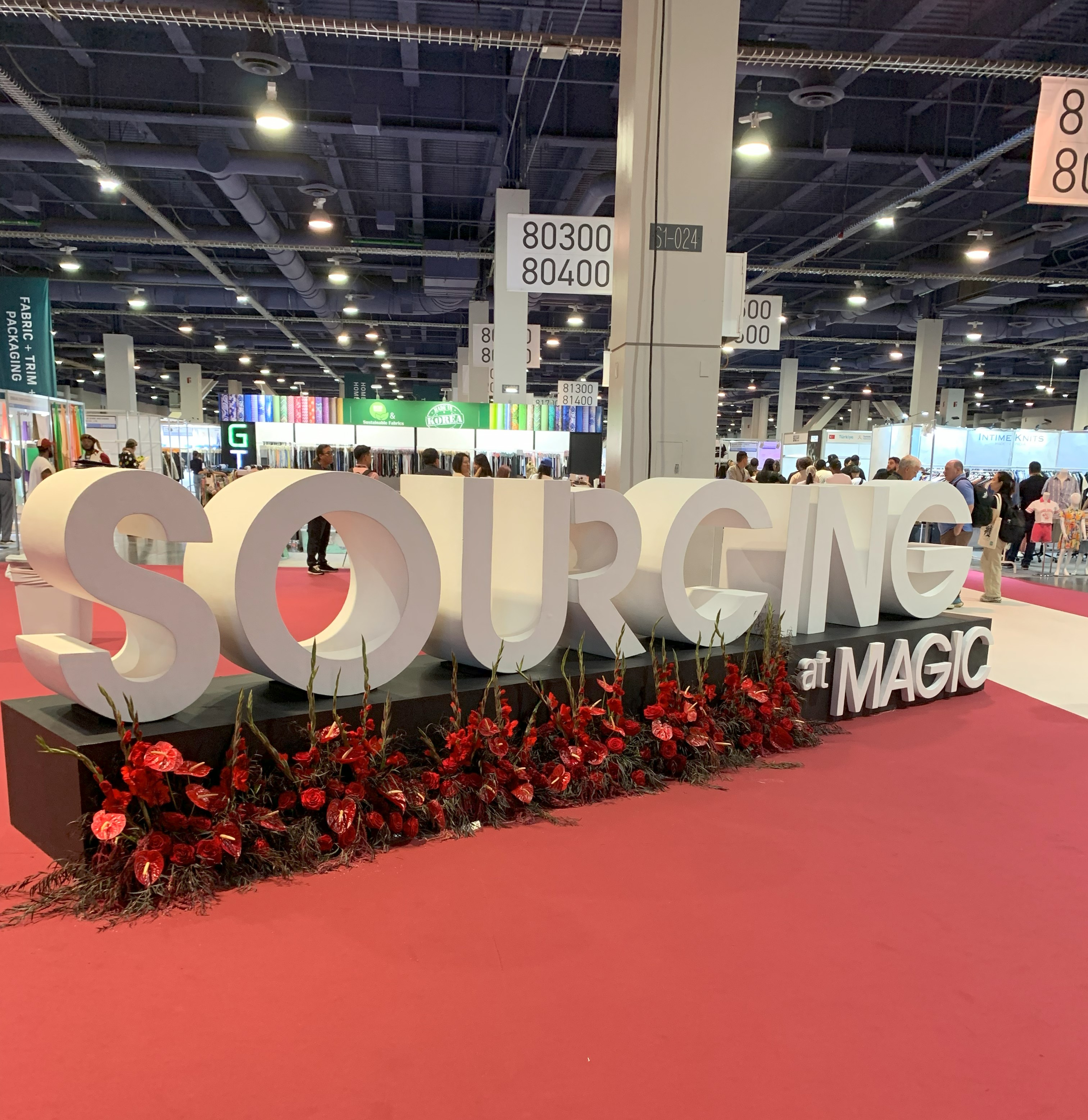
2025 August Sourcing at MAGIC Recap

The latest Sourcing at MAGIC, one of the largest and most influential fashion apparel trade shows in North America, was held from August 18 to 20, 2025 in Las Vegas. Drawing thousands of apparel manufacturers, textile raw material suppliers, brands, and retail buyers from over 30 countries around the globe, the event provides a unique opportunity to observe the latest U.S. apparel sourcing trends and market sentiment.

Aligned with the results of the 2025 Fashion Industry Benchmarking Study released by the United States Fashion Industry Association (USFIA), the hiking tariffs imposed by the Trump administration and ongoing policy uncertainty were among the top concerns for MAGIC attendees. One major tariff impact often heard at the MAGIC show was the growing inflationary pressure. It was a prevailing view among vendors, brands, and retailers that a price increase had begun and would become even more noticeable to U.S. consumers in the upcoming months. Some also argue that “tariff is no longer a sourcing problem,” but how brands and retailers should handle their “profit margin, product assortment, and pricing.”

Meanwhile, apparel suppliers care significantly about the additional reciprocal tariff” rates they face compared to their key competitors. For instance, a jeans supplier from Pakistan said they were relieved to see more order inquiries come in, as their Indian competitors faced significantly higher tariff rates threatened by the Trump administration.

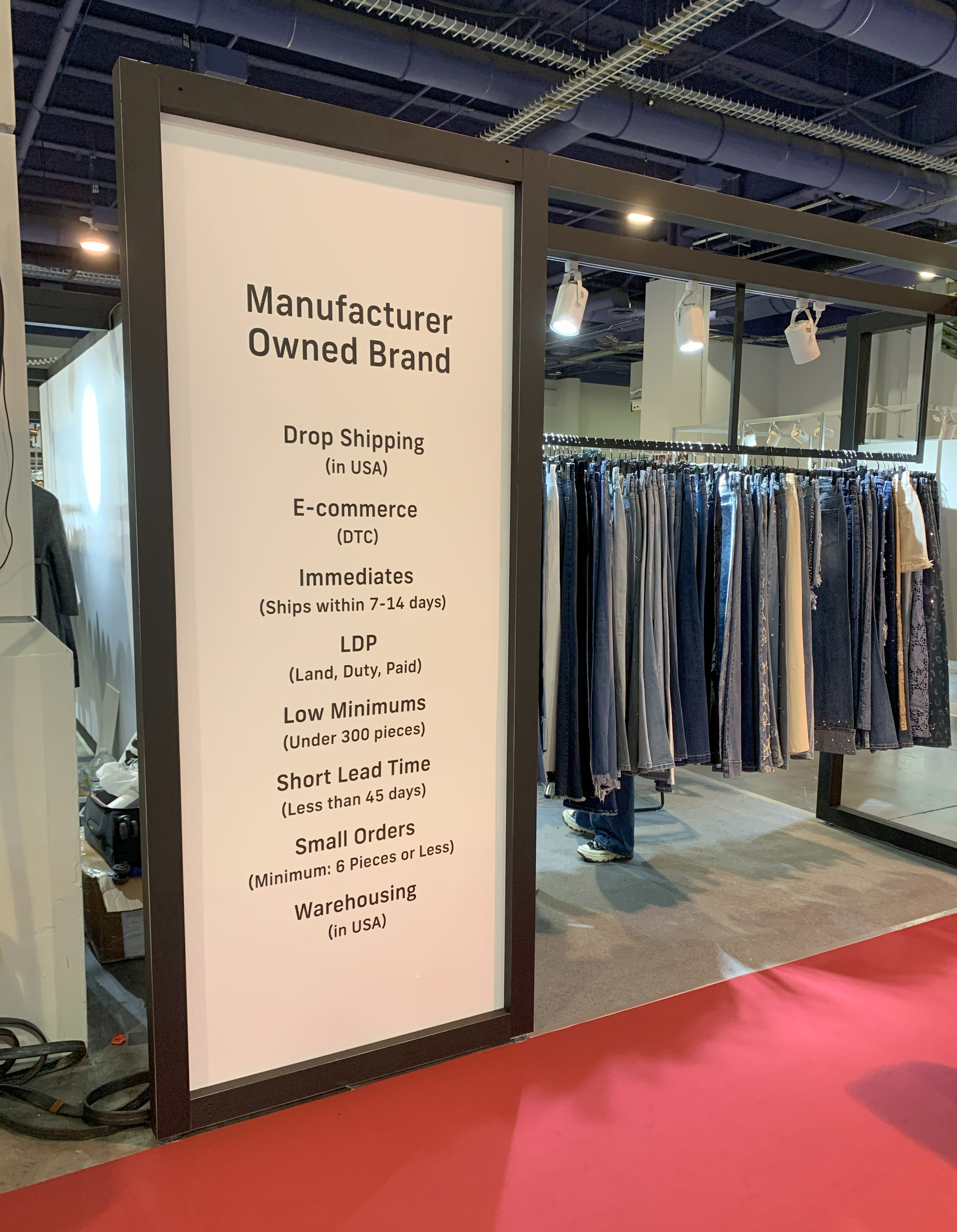
Still, nearly 600 exhibitors from China attended MAGIC, making it the largest delegation from any country. Two interesting phenomena revealed how Chinese suppliers try to stay competitive in today’s challenging business environment. One is to offer various value-added sourcing services beyond physical products.  For example, there was a dedicated session at this year’s MAGIC show that featured Chinese manufacturers that provide services such as drop shipping (i.e., when a customer places an order, the retail store never physically handles the product. Instead, the manufacturer is responsible for inventory, packing, and shipping), director to consumer (DTC) e-commerce and warehousing. Meanwhile, some Chinese vendors accept small orders (i.e., 6 pieces or less) or low minimum orders (i.e., 300 pieces) and promise a short lead time of 45 days. In comparison, the minimum order quantity (MOQ) required by suppliers in other Asian and Western Hemisphere countries typically exceeds thousands of pieces.

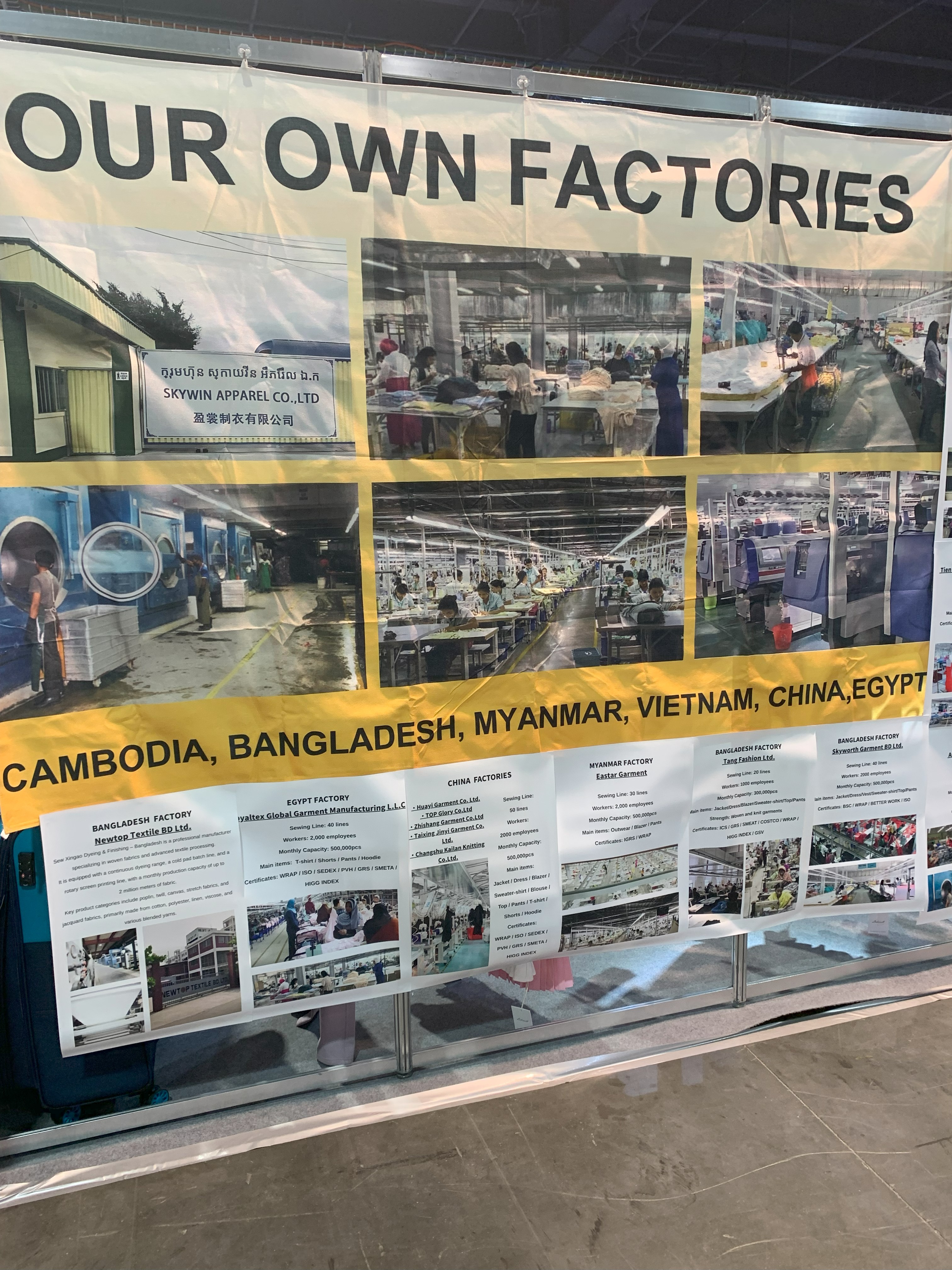
On the other hand, it is not uncommon to see that vendors from Bangladesh, Vietnam, Cambodia, or even Egypt and Ghana were actually owned by Chinese investors. Several Chinese factories purposefully highlight that they own factories across the world, from China and Southeast Asia to Africa. According to the USFIA benchmarking study, some U.S. fashion companies also prefer vendors with production capabilities in multiple countries to reduce sourcing risks.

As U.S. fashion companies continue to diversify their sourcing beyond the traditional top three—China, Vietnam, and Bangladesh—emerging destinations are increasingly optimistic about their U.S. export prospects. For instance, a supplier from Jordan noted that recent U.S. tariff hikes have boosted Jordan’s competitiveness, given the zero most-favored-nation (MFN) tariff under the U.S.-Jordan Free Trade Agreement and a 15% reciprocal tariff rate, which was lower than many Asian suppliers face.Jordanian suppliers speak highly of the capacity-building support from international organizations such as the International Trade Centre (ITC), particularly in areas like skills training and market intelligence.

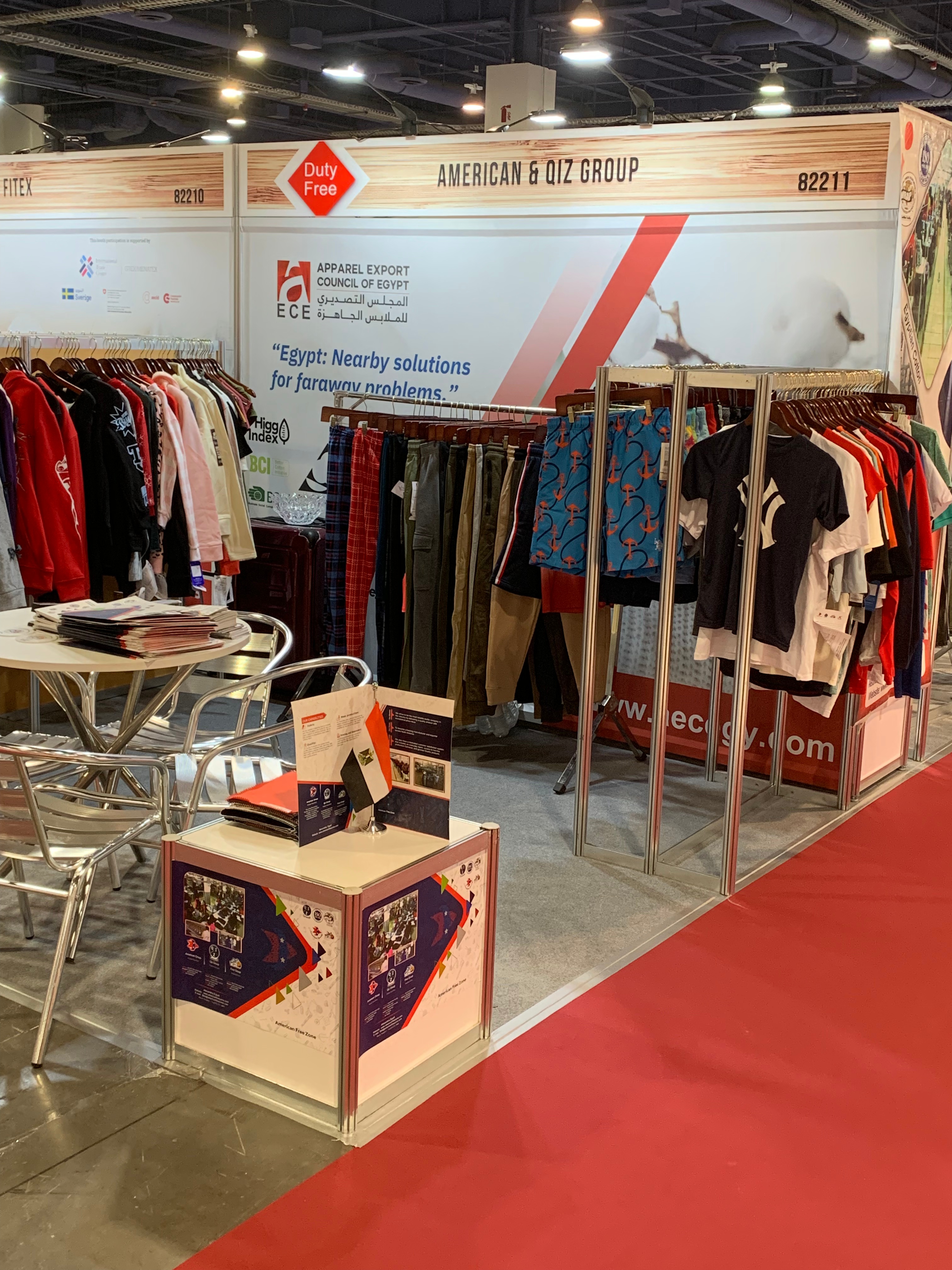
Similar to Jordan, Egypt’s apparel exports can benefit from a zero most-favored-nation (MFN) tariff, provided they meet the rules of origin under the Qualifying Industrial Zones (QIZ) initiative. However, unlike Jordan, suppliers from Egypt tend to specialize in cotton and other natural-fiber–intensive apparel, leveraging their advantages in producing locally made, high-quality natural textile fibers.

Clothing made from preferred sustainable fibers, particularly those incorporating recycled textiles, has grown increasingly popular. Nearly every country represented at MAGIC, including developing nations in Asia and Africa, showcased such products.

It should be noted, however, that producing clothing with sustainable textile fibers requires suppliers to obtain certifications such as GOTS (Global Organic Textile Standard), Global Recycled Standard (GRS), and Better Cotton Initiative (BCI). Although these certifications add costs, most vendors view sustainability as an opportunity to enhance export competitiveness rather than a threat in the long term. Some also mentioned that buyers were often willing to pay a premium for products made with sustainable materials, providing a significant financial incentive.

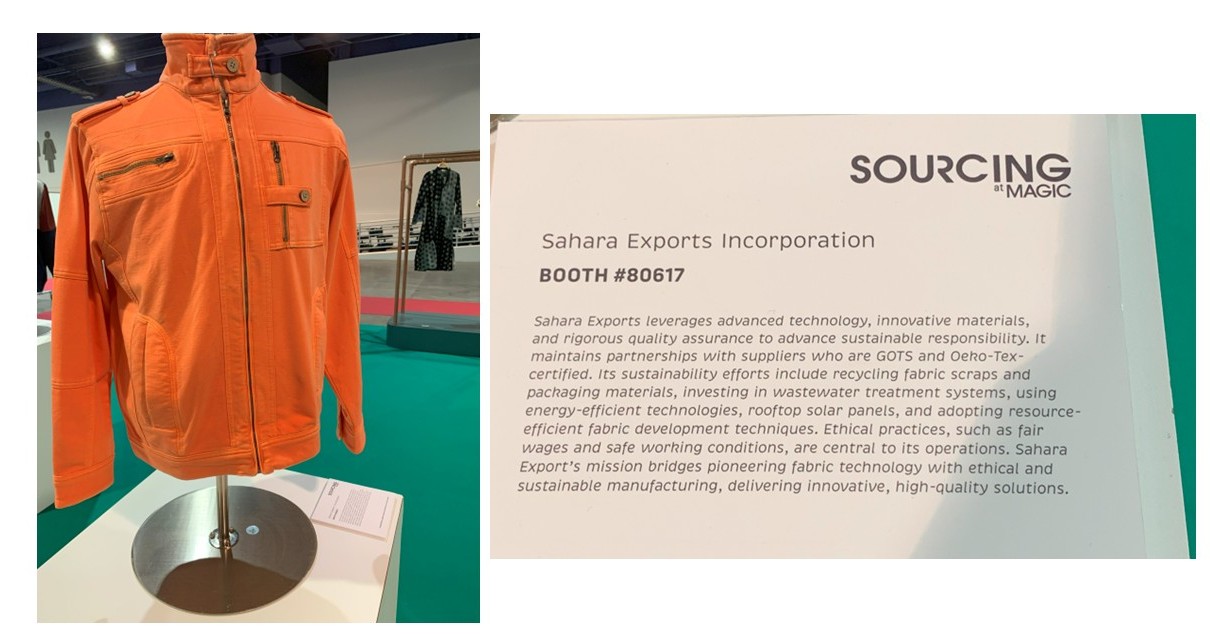
On the other hand, achieving sustainable sourcing and production is becoming increasingly comprehensive, requiring continuous innovation in both technology and business models. For example, at the show, some vendors showcased apparel products that integrated multiple sustainability concepts, ranging from material development and eco-design to social responsibility and post-consumption solutions.

by Sheng Lu

FASH455 Exclusive Interview with Matthias Knappe, Head of Fibres, Textiles and Clothing Unit, International Trade Centre

About the interview

Textile and apparel trade matters. Even today in the 21st century, apparel could still account for 80—90% of a developing country’s total merchandise export and play a critical role in promoting economic growth, poverty reduction, and gender equality. The interview explored several key topics:

  • Why textile & apparel trade matters for development in the 21st century
  • How ITC provides capacity building support and enhances the export competitiveness of garment exporters in developing countries
  • Sustainability movement’s impact on apparel sourcing and export competitiveness of developing countries
  • The promise and complexity of circularity in tackling used clothing challenges
  • Empowering women entrepreneurs through SheTrades
  • Skills and education needed to thrive in the global fashion apparel trade

About Matthias Knappe (speaker)

Matthias Knappe is the Head of Fibres, Textiles and Clothing Unit at the International Trade Centre (ITC), which is co-run by the World Trade Organization (WTO) and the United Nations (UN). Matthias has over 30 years of diversified professional experience in international trade and development. He has worked at the enterprise, institutional, and governmental levels. Matthias is leading ITC’s textile and apparel and light manufacturing unit. Over the last 20 years, he has been working with the T&C sector around the world to increase its export competitiveness. He designed and currently manages ITC’s Global Textiles and Clothing (GTEX) programme and various other fibre, apparel and light manufacturing projects. The Unit’s present portfolio includes projects in 15 countries.

About Emilie Delaye (moderator)

Emilie Delaye is a master’s student in Fashion and Apparel Studies at the University of Delaware, with a specific interest in supply chain, global sourcing, and sustainability. With a background in Entrepreneurship and Fashion Management, Emilie’s passion lies in improving the fashion industry through innovative problem-solving and collaboration. She has worked on projects exploring sourcing destinations and emerging sourcing trends, as well as collaborated with Macy’s on an initiative centered around Extended Producer Responsibility (EPR) regulations. Emilie’s work is driven by a commitment to fostering innovation and ethical practices in fashion, positioning her as a future leader in driving the industry toward greater sustainability and responsibility.

Impacts of Tariffs: Gen Z’s Perspective

In a new Just-Style mini series, students from FASH455 and the FASH department at the University of Delaware shared their valuable Gen Z perspectives on the impact of the recent tariff increases.

Students’ responses reveal that the impacts of the tariff increase on ordinary U.S. consumers are real, direct, and significant. Like other consumer groups, our Gen Z students express deep concern about the adverse effects of tariffs on the U.S. economy, market uncertainties, and the fashion industry’s growth prospects this year. While shopping for clothing, many students have noticed price increases and reduced product availability due to tariff hikes and related disruptions.

On the other hand, as Gen Z consumers, students send a strong message to fashion brands and retailers—sustainability still matters. In fact, in this environment, students have become ever more conscious of sustainability, asking critical questions such as: Do I really need to buy more clothing? Where was the clothing made? Was the clothing produced ethically? In other words, we may see a growing shift toward “slow fashion” among Gen Z consumers, who expect apparel brands and retailers to make even stronger commitments toward sustainability and social responsibility, instead of compromising these values for “cost mitigation.”

Likewise, students expect higher-quality products or items that can last longer to justify the higher price they pay. Regularly shopping for secondhand clothing, driven by its affordability, environmental benefits, and unique styles, could also become increasingly popular. This leaves an interesting question about the future of cheap but low-quality fast fashion and its attractiveness among Gen Z consumers.

The mini series is available through Just-style. Below are selected comments from students:

Gen Z consumers care about tariffs in the news

Rachel Zemel (Fashion Merchandising and Management major): As a Fashion Merchandising and Management major, I’ve definitely been paying closer attention to how tariffs impact what we see on the sales floor. Learning about global sourcing and trade agreements in class has made me more curious about where products are coming from and how political or economic shifts can directly affect the retail industry. I’ve caught myself checking clothing labels more often to see where things are made and understand why certain brands are shifting their production away from countries like China. I think what used to feel like a distant conversation now feels very connected to the way I shop and think about product availability.

Annabelle Gensler (Fashion Merchandising & Management and Fashion Design & Product Innovation double majors): The tariff discussion has been far more impactful on my shopping habits than I would have imagined…I’d like to consider myself a thoughtful consumer in that I rarely make impulse purchases, and I do what I can to avoid feeling any sense of buyer’s remorse. This has become exceptionally true in today’s evolving state of trade policy and manifests itself in a few ways…As a fashion student, I have a good understanding of what constitutes a fair price for fashion and apparel goods. I try to use these strengths of mine by paying close attention to fiber content, care instructions, origin of materials, and manufacturing location. Overall, I’d say the tariff discussion makes me think twice, three times, ten times before making a purchase.

Alexandra Untu (Fashion Merchandising and Management and Philosophy double majors): As a fashion student and fashion lover, I closely follow tariff updates and actively try to educate myself to gain a more objective and informed perspective on the changes introduced by the current administration. Although I started shopping more consciously a while ago, I’m now more intentional than ever with my purchases…I pay attention to where clothes are made and take the time to research their country of origin and production practices. I’ve also been focusing on buying pieces made from high-quality materials, with timeless styles that are versatile enough to be worn in different outfits and settings.

Lola Kulis (Fashion merchandising and management major and 4+1 graduate student): As a Fashion Merchandising student, I’ve been especially invested in the ongoing discussion around tariffs and their impact on retail pricing. From an industry perspective, it’s scary; as someone preparing to enter the field, I feel uncertain about what the future holds. And as a consumer, I feel frustrated. We’re facing the direct impact of global trade decisions influencing the pricing and accessibility of apparel. The worst part is the uncertainty. The constant policy changes and back and forth are only putting more stress on business owners, consumers, the working class, etc.. The media coverage surrounding these trade policies has made me realize how interconnected global sourcing and retail pricing really are. I’ve started paying closer attention to where garments are manufactured and how those origins might impact cost, availability, and even quality. I’ve shifted my perspective, not only as a student but also as a consumer. 

Madison Toth (Fashion Merchandising and Management major): The tariff discussion in the media has definitely increased my interest in where exactly my clothing is being made. As I shop, I have started to check labels on where these apparel items are being manufactured. It is fascinating to me that the most popular and successful U.S retailers are globally sourcing apparel, yet the increase in tariffs is being thrown into policy. Admittedly, I struggle to keep up with the news, but I’m very intrigued by the current tariff discussion. I follow closely because it will affect my job in the future as I enter my career in the fashion industry, but also as a consumer.

Price hikes and reduced product availability due to tariffs concern Gen Z consumers

Rachel Zemel (Fashion Merchandising and Management major): Since April, I’ve definitely noticed price increases…I’ve also noticed a shift in product availability, especially when I shop online. Certain sizes and styles are gone faster than usual and don’t seem to get restocked. In stores, the selection feels limited too. It seems like brands are being more careful with how much they’re producing, maybe to avoid excess inventory or reduce risk. As someone who shops a lot and also studies this industry, it’s interesting to see how these challenges are playing out in real-time. It makes me think differently about what goes into every piece I buy.

Annabelle Gensler (Fashion Merchandising & Management and Fashion Design & Product Innovation double majors): The majority of the shopping I’ve done since April has occurred online, and the biggest difference I’ve noticed since the tariff discourse has started, is the stock of goods available. It’s rare that I stumble upon a product offering that has all sizes and colors in-stock. Now, when I filter my search for a graduation dress in the size and color I prefer, fewer and fewer items populate. In the past, retailers might have been able to bulk order goods to maintain stock domestically, or ship from international locations directly to the consumer; tariffs have halted these practices. Items I’m considering purchasing no longer feel safe in my cart because of how quickly stockouts are occurring. This, paired with an expectation of drastic increases in price, has created an internal sense of urgency when I have items in my cart. I know it’s unlikely that the item will be available at a certain price point, or at all, and so the conscious consumerism I try to practice is really being put to the test.

Alexandra Untu (Fashion Merchandising and Management and Philosophy double majors): Based on my own and my friends’ experience, the changes have been subtle so far, but noticeable. Prices have been going up gradually across all types of products, including clothing, but the availability of products hasn’t yet turned into a cause for concern. While the current situation is not dramatic as of now, there is undoubtedly a change that is happening, and we are expecting more striking changes in the near future that could affect our shopping behavior quite significantly.

Madeline Osbourn (Fashion Merchandising and Management major): The tariff increase has affected merchandise orders for my sorority. The tariffs have made the prices rise on orders that we planned on making. This creates an issue with prepaid and future orders, keeping in mind the members’ willingness to transition and conform to the higher-priced merchandise that is designed.

Lola Kulis (Fashion merchandising and management major and 4+1 graduate student): Because inflation has been on the rise for some time now, it’s hard to differentiate the cause of these price changes. Prices for basics, like denim, cotton tops, and even activewear, are outrageously high. Over the past year, I’ve observed a significant decline in promotional activity. Retailers are offering fewer discounts, and even Black Friday, once known for major deals, felt noticeably underwhelming. Considering the current global trade and policy changes, I only see this worsening. On the availability side, popular sizes and color options tend to sell out much more quickly, leading to a more competitive shopping experience.

Madison Toth (Fashion Merchandising and Management major): To be honest, I have been reluctant to shop with popular fashion retailers because of the current tariff discussions. I have strayed away from shopping online and in-store due to the uncertainty of the economic climate. While apparel prices are increasing, as well as other products, it is vital for me to take all of that into consideration. Tariffs affect more than apparel, and as a college student, some purchases take priority over clothing. Because of this, I am unable to comment on price and product availability since the tariff discussion began. I have simply decided that, for me personally, in the current economic climate, apparel shopping should be placed on the back burner.

Sustainability matters even more

Rachel Zemel (Fashion Merchandising and Management major): Sustainability matters even more to me now. When prices go up, it forces me to think about the long-term value of what I’m buying. I want to spend my money on items that are made with quality materials and with people and the planet in mind. It’s hard to justify spending more on something that was cheaply made or won’t last beyond a few wears. I think price increases actually help push the conversation toward more conscious consumption. Even with a student budget, I try to prioritize brands that are transparent about their production or at least make some effort toward ethical practices. It’s not always possible to buy 100% sustainably, but I try to balance things. thrifting, supporting small designers, and not overconsuming are just a couple of changes that can have a big impact. Sustainability isn’t just about buying the “right” thing, it’s about shifting the way we shop. That mindset doesn’t go away just because prices are rising.

Alexandra Untu (Fashion Merchandising and Management and Philosophy double majors): Sustainability has always been a core value for me, and that won’t change, even if prices rise. Sustainability isn’t just a trend; it goes far beyond money – it’s a life-or-death issue. It’s a moral responsibility we have to future generations, and we shouldn’t treat it lightly or abandon it. Shopping with sustainability in mind isn’t always the easiest or the cheapest route, but it’s the right one. Now, more than ever, we should be doing -or learning to do – the right thing. Every purchase sends a message about the change we want to see. Every purchase is a small step toward a better, more responsible future for us and for our children.

Lola Kulis (Fashion merchandising and management major and 4+1 graduate student): Sustainability matters even more to me in the face of rising prices. As clothing becomes more expensive, we become more hesitant in purchasing. I think more about what I’m investing in, starting with being intentional about supporting brands that are transparent, responsible, and committed to reducing their environmental impact. I’d rather buy less and choose more wisely than spend more on items that contribute to overproduction and waste. I’ve realized more than ever that sustainability is not a trend, it’s our future. As I prepare to enter the fashion industry, it’s important that I practice what I preach and support the long-term goals.

Madison Toth (Fashion Merchandising and Management major): Sustainability is something that I do genuinely care about. When shopping, I tend to lean more towards brands that practice ethical sourcing and are more transparent about where their items come from. From my time as a student, I have learned many of the horrible outcomes of the fashion industry related to sustainability. From seeing videos of workers begging for higher wages, seeing dyes dumped into bodies of water, and looking at the incredibly tall piles of textile waste, it sticks with me both as a student and a consumer…If a price increase meant that apparel manufacturers were getting paid fair wages, I would purchase those items. However, now, due to tariffs, I am more likely to dodge popular retailers. Sustainability is very important to my generation, and I value the efforts that brands have made to become more sustainable. But it raises the question, when is a price so high that sustainability no longer matters? To that, it’s hard to say. I think it depends on the economic status of each consumer. From sustainable companies with higher prices, there are purchases that I just cannot justify paying. I do care about sustainability, but there does come a point where it becomes financially unattainable.

Katie Yasik (Fashion Design and Product Innovation major): Yes, sustainability still matters to me, even with rising prices. It’s not always easy to prioritize, especially on a student budget, but I try to make more conscious choices like buying fewer, longer-lasting pieces or shopping secondhand. I think it’s important to consider the environmental and social impact of fast fashion, and if prices are going up anyway, I’d rather invest in something that aligns with my values.

Isabella DiGiulio (Fashion merchandising and management major and 4+1 graduate student): I think that the tariffs may bring a new wave of interest in sustainability, specifically for donation-based, second-hand clothing stores. These stores will likely be able to maintain their low pricing because they do not need to account for operational expenses in apparel production. Even if there is to be a price increase, their prices may still remain relatively lower and more affordable compared to first-hand clothing brands…Furthermore, sustainable shopping doesn’t solely refer to purchasing second-hand goods or buying from brands with biodegradable fabrics or ethical labor practices. Sustainable shopping can also refer to the abstinence from shopping. With influences such as social media and fast fashion, overconsumption has become an extremely normalized practice through which many people, especially Gen Z, feel compelled to consistently refresh their wardrobes to follow trends and keep up with the ever-changing standards of style and identity.

Explore more:

FASH455 Exclusive Interview with Ally Botwinick, Textile Assistant at The Kasper Group, about Textile Raw material Sourcing and Management

About Ally Botwinick

Hi! My name is Ally Botwinick, and I am a University of Delaware alum who studied Fashion Merchandising and completed the 4+1 master’s program in Fashion and Apparel Studies. I am currently working as a Textile Assistant at The Kasper Group in NYC. The Kasper Group is a portfolio of global fashion brands such as Nine West, Anne Klein, Kasper, Le Suit, and Jones New York. I work on fabric sourcing and production for the Jones New York brand as well as denim fabrics for all brands within the Kasper Group.

Note: During her studies in the FASH 4+1 program, Ally participated in several research and experiential learning projects. She co-authored Explore PVH Corporation’s Evolving Apparel Sourcing Strategies, published in Just-style, a leading industry publication focusing on apparel trade and sourcing. Her master’s thesis, which examined US retailers’ merchandising strategies for clothing made from recycled textile materials, was published in the International Journal of Fashion Design, Technology, and Education. Ally was also a UD summer scholar and a key member of the FASH students team that helped Macy’s develop a vision of its sustainable apparel sourcing strategy (see featured UDaily story and Yahoo).  Additionally,  Ally was a policy intern for the American Apparel and Footwear Association (AAFA) in Washington, D.C. in the summer of 2022.

Disclaimer: The views expressed in this interview are those of Ally Botwinick and do not reflect the views or positions of her employer or any affiliated organizations.

Sheng: What are your main responsibilities as a textile assistant? What does a typical day look like? What aspects of the job do you find particularly interesting or unexpected before taking on the role?

Ally: My main responsibility as a Textile Assistant is to help buy and keep track of all fabric orders for Jones New York as well as denim for multiple brands within the Kasper Group. Jones New York has both a mainline division, which is sold at retailers such as Macy’s and Dillard’s, as well as an off-price division called Jones New York Signature which is sold at off-price retailers such as TJ Maxx, Marshall’s, Burlington, Ross, etc..

During a typical day, I communicate with textile mills/factories overseas about fabric approvals or rejections based on fabric color, quality, and hand feel. For each fabric order that we place, we have the mills submit fabric references to our New York office for review. Each morning, I process these submissions and work with my team to release comments to the mills. The color must match the color standard we send them at the beginning of production. The fabric quality must match the fabric standard that we approved upon booking the fabric.

We keep track of all these approvals and rejections in what is called a fabric WIP (work in progress) chart, where we keep track of each order for each season and division. This WIP chart includes key fabric information, price, production timelines, and fabric submit status, among other order details. Creating and updating these fabric WIPs is something I do continuously throughout the day as I receive updates from mills and factories.

I frequently work with cross-functional partners, like members of the design, production, costing, and color teams, and touch base about any changes to design boards, production schedules, costing, or color issues that may arise.

One of the most interesting aspects of the job is the number of teams that collaborate on a daily basis, especially when there are updates made to the fashion collection, such as changes to color names, production units, production schedules, fabric details, and costs.

Sheng: In general, what factors should be considered when selecting textile raw materials, such as fabrics, in product development and sourcing?

Ally:Some important factors to consider when selecting fabrics are hand feel (whether the fabric feels soft, dry, smooth, rough, etc…) and price.  We want to ensure the fabric provides comfort to the consumer and that it will drape well according to the garment design. We work very closely with the design and costing teams when sourcing fabrics as we must ensure fabrics are functional, stylish, on-brand, and meet margin goals.

We highly consider the fiber content as well. Fiber costs can be influenced by a multitude of factors, even including the weather or occurrence of natural disasters which can affect supply and demand. We also closely monitor cotton traceability as there are forced labor concerns with cotton grown in parts of China. We require each mill supplying fabrics made with cotton to submit a cotton traceability certificate for us to track the cotton’s origins. This way, we can ensure no cotton is being produced in association with forced labor.

Sheng: What are the main processes involved in selecting and sourcing textile raw materials like fabrics?

Ally:At my company, the Fabric Research & Development team is more involved in finding new fabrics, whereas my team is more involved in fabric buying and production. The design and R&D team usually hand off the desired fabrics to us after sourcing, and we go ahead and buy the fabric. We buy fabric yardage according to the number of units (garments) in the collection, accounting for the different sizes and colorways.

However, we do occasionally get involved in the sourcing aspect as well. When we source fabrics, we consider the factors I mentioned such as cost, quality, and fiber content. We also think about how we may want to elevate and bring newness to the brand.

When adding certain washes or finishes to fabrics, the appearance can change, so this is something we consider as well. When purchasing a new novelty fabric such as a new jacquard, velour, or cross-dye, we expect the mill to tell us if there is a certain inherent characteristic we should know about prior to booking. For example, a mill might tell us the fabric is known to flare a bit, and this is hard to control, or it tends to shrink a little when washing. This way, we can decide whether the fabric is acceptable based on our needs. If we decide to purchase, we then collaborate with internal cross-functional partners about creating a level of tolerance accounting for these inherent characteristics.

Upon booking any fabric, we always require mills to fill out a fabric detail sheet with information such as cuttable width, weight, price, MOQ (minimum order quantity), lead time, etc… and we have them send us a fabric header which becomes our fabric standard. The design team will also request a sample garment to ensure the fabric is suitable for the garment. All these processes are essential for booking fabric.

Sheng: Where do textile raw materials typically come from, or which countries or regions mostly supply textile raw materials for US fashion companies today?

Ally:Some of the top countries supplying fabric for U.S. fashion companies include China, Vietnam, South Korea, and India. Also, from my observation, Asia plays a significant role as a leading textile raw material supplier for many leading U.S. apparel brands and retailers.

Sheng: From your observation, how has sustainability influenced the selection and sourcing of textile materials for fashion companies? What emerging trends are worth watching?

Ally:From my observation, sustainability is becoming more and more important to brands and consumers alike. Recycled polyester is on the rise as more consumers are paying attention to the materials in their clothing and trying to lessen their environmental impact. Recycled polyester seems easier to incorporate rather than, say, recycled cotton, which is harder to trace back to the source and has quality concerns. I see recycled materials on the rise in my company, and as someone who wrote my master’s thesis on this topic, it is very exciting and encouraging to see.

Sheng: Based on your experience, can you offer any advice to our students regarding preparing for a career in the fashion apparel industry? What could they do at UD?

Ally:Some advice I would give to students preparing for a career in the fashion industry is to think about what classes at UD most intrigued and inspired them. There are so many different career paths within the fashion industry, whether it be design, product development, sales, merchandise planning, costing, garment sourcing, fabric sourcing, merchandise buying, etc… Whatever you are most passionate about, go after it. Also, keep an open mind. You may find a great opportunity that you hadn’t previously considered, and you may end up loving it. There is so much to be learned in any given role, especially when starting out. Throughout my role, I have learned not only the ins and outs of the fabric production cycle, but also the entire garment life cycle. I can see how all the teams within my organization work together to achieve a common goal.

UD has so many amazing resources to utilize for planning your future career. First, take advantage of the career center by meeting with a career counselor and updating your resume and LinkedIn. Next, consider doing a research project with a professor on a topic you are passionate about. There are so many professors in the fashion department who would be happy to chat about research opportunities, and having this experience can really help you stand out during the job search and interview process. Internships and retail experience are also great ways to gain work experience while in school. Lastly, lean on your network. If an alum you know has a career that sounds interesting to you, reach out to them and ask them for a quick phone call to learn more about it. It is great to build your network and learn more about different potential career paths. Overall, my greatest advice is to truly enjoy your college years- they go by so fast. Make the most of your time at UD, pursue your passions, and remember that exciting opportunities lie ahead!

–The End–

Used Clothing Trade Debate Continues in Kenya (updated March 2025)

A new study by the Changing Markets Foundation suggests severe negative environmental and social, economic impacts of used clothing exports to Kenya. However, the Textile Recycling Association, based in the UK, argues strongly in favor of the benefits of the used clothing trade.

Concerns about the used clothing exports to Kenya (viewpoints from the Changing Markets Foundation)

  • Data from the United Nations (UNComtrade) shows that Kenya’s used clothing imports surged by over 500% from 2005 ($27 million) to 2021 ($172 million).
  • An overwhelming volume of used clothing shipped to Kenya is waste synthetic clothing, a toxic influx creating devastating consequences for the environment and communities. It is estimated that over 300 million items of damaged or unsellable clothing made of synthetic or plastic fibers are exported to Kenya each year, where they end up dumped, landfilled, or burned, exacerbating the plastic pollution crisis.
  • Interviews with used clothing traders in Kenya show that 20–50% of the used clothing in bales they purchased was unsellable due to being damaged, too small, unfit for the climate or local styles, and sometimes even with clothing that is covered in vomit, stains or otherwise damaged beyond repair.
  • European sorting companies often skimmed off high-quality used clothing for resale in the local EU market. They exported the lower-quality and lower-graded ones to developing countries like Kenya.
  • It remains challenging to recycle synthetic clothing as it often contains harmful additives or other materials that make the recycling process difficult or impossible. Additionally, the quality of the recycled synthetic fibers is typically lower than that of the original fabric (i.e., using virgin fiber).

Defend the used clothing exports to Kenya (viewpoints from the Textile Recycling Association, TRA)

  • Sorting, trading and selling used clothing “directly employs two million people in Kenya alone , with tens of millions employed globally and supporting many more employment positions in ancillary sectors.”
  • “Used clothing and textiles collected in the UK, should go through a detailed sorting process and can be sorted typically into 130 plus re-use and recycling grades and sometimes this can be more than 200 grades. In the sorting process each garment is picked up and individually assessed by highly trained experts*.  The good quality re-useable products are segregated from the recycling grades.” [*According to Changing Markets Foundation’s report, about 36 million pieces of used clothing were exported from the UK to Kenya in 2021; All EU countries exported about 112 million pieces to Kenya]
  • “It is the buyers in these countries (note: countries like Kenya) that dictate the flows of (used clothing) textiles and which import the goods into their countries.”
  • “TRA members are required to ensure that only good quality re-usable clothing products are sold onto countries in Africa and other non-OECD countries.   Recycling grades and other non-textile/clothing items have to be removed… However, the majority of countries are not subject to the same tight restrictions on trading as the UK..  This is to the extent that some countries allow unsorted used textiles containing a complete mix of re-usable items, recycling grades, and waste to be sold into African countries as a product.” “The qualities of (used clothing) items originating from different countries is likely to vary significantly.”
  • “Kenyan’s buy more than 10 times as much used clothing from China than they do from the UK.”

Discussion questions proposed by FASH455 class:

  • #1 What is your stance on the used clothing trade? Should the government impose more export or import trade restrictions on used clothing?
  • #2 After considering both sides of the debate, what is your decision regarding donating used clothing? What factors influenced your choice?
  • #3 Any other thoughts or comments on the used clothing trade debate?
  • #4 As we learned in class, developing countries like Kenya are supposed to rely on making and exporting labor-intensive garments to develop their economies. Can importing used clothing lead to similar economic growth? Any evidence that can support the argument?
  • #5 What are the ethical issues involved in the used clothing trade? Should government policies play a role in regulating these ethical concerns?
  • #6 Could restricting the used clothing trade discourage fast fashion and reduce textile waste generation? Why or why not?
  • #7 Should developed countries like the U.S. voluntarily restrict used clothing exports to lessen the economic and environmental pressures on developing countries like Kenya? What are the potential benefits and drawbacks of such a policy?
  • #8 Based on the reading, what critical questions remain unanswered, and what further studies could be conducted to gather valuable information for informed decision-making on regulating the used clothing trade?

(Note: For students in FASH455, please answer at least two of the questions above. Be sure to mention the question number in your response, but there is no need to repeat the question.)

Additional reading:

FASH455 Exclusive Interview with Hannah Laurits, Fabric Lab Textile Coordinator at Swim USA, about Fabrics and Apparel Sourcing

About Hannah Laurits

Hello! My name is Hannah Laurits, and I am currently working as a Textile Lab Fabric Coordinator at Swim USA. I graduated from the Master of Science program in Fashion and Apparel Studies at the University of Delaware in 2024. Through the program, I had the opportunity to work on various research projects, ranging from adaptive apparel to sustainable textiles. During my time at UD, I also had the privilege of teaching Fash133 Foundations for Fashion Innovation, which was an incredibly rewarding experience.

In addition to my master’s degree, I hold a Bachelor of Science in Apparel Design and Fashion Merchandising from the University of Delaware. Throughout my academic journey, I completed internships related to textiles and sourcing, which played a significant role in shaping my career and led me to my current position at Swim USA. I am passionate about the intersection of textile innovation, sustainability, and sourcing, and I’m excited to share insights from my experiences in the industry.

Disclaimer: The views expressed in this interview are those of Hannah Laurits and do not reflect the views or positions of her employer or any affiliated organizations.

Sheng: What are your main responsibilities as a fabric lab textile coordinator? What does a typical day look like? Which aspects of the job do you find particularly interesting or unexpected before taking on the role?

Hannah: As a Fabric Lab Textile Coordinator, I work to ensure that the fabrics that go into our products meet both our internal quality standards as well as the standards of our customers and the global textile industry. In the lab, we mainly focus on quality control, which includes ensuring that the fabrics we use in production meet specific quality standards.

In my role, a typical day may include visually and/or digitally reviewing colors to ensure that they align with our established standards. Additionally, each day consists of a variety of testing and analysis of results to ensure that they meet brand requirements. I also assist with raw materials development, particularly in the areas of color and fabric testing for various brands. One key aspect of my work is analyzing testing data to identify risks, areas for improvement, and potential delays in production. The best part of my role is the variety of tasks I’m involved in, the opportunity to work on multiple brands, and the extensive cross-functional collaboration I get to participate in. From color matching and testing to analyzing data and working directly with various teams, no two days are ever the same. The level of collaboration across departments has been extremely helpful, allowing me to learn from different areas of the business and broaden my skill set.

Sheng: In general, what factors should be considered when selecting fabrics in product development and apparel sourcing?

Hannah: When selecting fabrics for product development and sourcing, there are many factors to consider, including but not limited to cost, quality, durability, color and dyeing process, fiber content, intended use, sustainability, lead times, availability, and compliance with regulations. In my role, understanding the fabric composition, color, and dyeing process, as well as the intended final use is essential. Different fibers and dyestuffs have inherent properties that can affect the fabric’s appearance and colorfastness, so it’s crucial to understand how they will perform in the final product. This knowledge helps determine whether achieving a specific color while maintaining the desired quality is feasible. By carefully considering these factors, we ensure that the product meets both aesthetic and performance standards.

Sheng: Part of your job involves testing fabrics. What needs to be tested, and what are the main issues involved in the quality control of fabrics?

Hannah:A large part of my role involves testing fabrics to ensure they meet the required standards. There are a variety of tests that need to be completed, and they generally fall into two main categories: color fastness and physical properties. Color fastness testing is conducted to ensure that the fabric retains its color and/or does not run when exposed to various factors, such as washing, sunlight, or exposure to chlorine. Physical property testing helps ensure that the fabric will meet the required performance standards. This includes testing for qualities like weight, stretch, and dimensional stability. These tests are essential to make sure the final product fits well and performs as expected for the consumer.

Sheng: From your observation, how has sustainability impacted the selection and sourcing of textile materials for fashion companies? How is “sustainability” assessed for fabrics? What emerging trends are worth watching?

Hannah: Sustainability is a major focus in the textile and apparel industry, continuously evolving and shaping how fashion companies approach textile research, development, and sourcing. There is a noticeable shift towards prioritizing eco-friendly materials and minimizing environmental footprint. Sustainability can be assessed in many ways in fabrics throughout a fabric’s entire lifecycle – from raw material sourcing to end-of-life disposal. It is important to consider not only the environmental impact but also the social and ethical aspects of fiber cultivation and fabric production, ensuring that workers’ rights are also prioritized. From what I have observed in the market, the most accessible and widely adopted sustainable fabrics tend to be recycled, organic, or plant-based materials. However, there are many other emerging trends worth watching. These include waterless or low-water dyeing technologies, eco-friendly finishes and treatments, regenerative agriculture, and innovative fiber development

Sheng: Following up on the previous question, is it true or a myth that sustainable fabrics are typically more expensive and increase production costs? If so, how can companies balance sustainability with cost-effectiveness?

Hannah:While sustainable fabrics can sometimes be more expensive, it’s not always the case. Factors such as higher initial investments in sustainable technologies, costs of production, the smaller scale of production, and the costs associated with certifications can make sustainable fabrics more costly. However, it is still possible for companies to balance sustainability with cost-effectiveness. Sustainable practices often bring long-term benefits, such as risk reduction, improved durability, and increased brand value. Further, as more brands shift towards and invest in sustainable material innovation, we can expect these fabrics to become more affordable and available over time.

Sheng: Based on your experience, can you offer any advice to our students regarding preparing for a career in the fashion apparel industry? What could they do at UD? What is the benefit of getting a master’s degree in fashion and apparel?

Hannah: My advice to students is to get involved as much as possible. Internships are a great way to gain hands-on experience. If internships aren’t available, networking and learning from professionals in the industry are invaluable. At UD, there are numerous opportunities to take advantage of, like research projects, clubs, and career fairs to build connections and expand your knowledge. I have found that a master’s degree in Fashion and Apparel has provided me with a strong foundation which has helped me secure a career and be successful in the industry. I often find myself referring to course topics and key skills I learned in graduate school such as data analysis.

Additionally, if any students soon graduating are interested in Swim USA, below is information from our HR department on how they search for talent. “For entry-level roles, we typically use Handshake as a great way to reach upcoming graduates or recent alumni. I would advise them to register and look at opportunities there. If they haven’t already, they should also ensure their LinkedIn profile is up to date and has a nice professional picture. Start following companies that you might be interested in, like SWIM USA, to see new or open roles first. They are also welcome to follow our Swim USA careers page for more information.”

–The End–

FASH455 Exclusive Interview with Jillian Silverman, Associate Trim Specialist at Lands’​ End, about Textile Raw Materials and Apparel Sourcing

About Jillian Silverman

Jillian Silverman is an Associate Trim Specialist at Lands’ End, based in Madison, Wisconsin. She earned an Honors degree in Fashion Merchandising with a minor in Environmental Humanities from the University of Delaware in 2016. She later completed her Master’s degree in Fashion and Apparel Studies in 2018, focusing on sustainable material development. Her research, which explored the use of mushrooms as a primary material for footwear, gained national media attention. As a graduate instructor, Jillian taught an undergraduate sustainability course at UD. She continues to share her expertise on textile sustainability as an adjunct professor, teaching several courses in the FASH graduate certificate program for sustainable apparel business.

Disclaimer: The views expressed in this interview are those of Jillian Silverman and do not reflect the views or positions of her employer or any affiliated organizations.

Sheng: What are your main responsibilities as a trim specialist? What does a typical day look like? Which aspects of the job do you find particularly interesting or unexpected before taking on the role?

Jillian: I manage the trims for all our apparel categories, which include hard trims like zippers and buttons and soft trims like thread and interlining, just to name a few. I work with our designers to find out their trim needs and any inspiration, our sourcing team to learn where the garments will be manufactured and any cost, quantity, or lead time considerations, and our global trim suppliers (primarily Asia-based) to select existing trim qualities or bring new ones to fruition. I never realized the intricacies of all the different trim types, and I have learned a lot on the job and still learn as I go! I really enjoy sitting between the creative side, particularly with custom trims, and the more logistical side of things. The different teams often have competing priorities, so while that makes it challenging to juggle, the problem-solving aspect keeps things interesting.

Sheng: In general, what factors should be considered when selecting trims and other textile materials in product development and sourcing?

Jillian: One of the big challenges right now is vendor and garment production location and how that relates to material production locations. With the new administration’s push for tariffs, we’ve been trying to quickly pivot away from China, but many of our raw materials still come from China, so it’s not so simple to move production away without having new challenges with transporting materials and the resulting cost and time delays.

In general, our biggest considerations when selecting materials are aesthetics and performance, cost, lead time (how long it takes to get samples and/or bulk production made), and MOQ (minimum order quantity). We also have to consistently reevaluate our supplier base to make sure we have the right partners who offer what we need at the right place, time, and cost. Speed is becoming more important, so the quicker we can have materials made and transported to our factories, the faster we can start selling those products.

Sheng: Based on your observations, how has sustainability influenced the selection and sourcing of textile materials for fashion companies? How is “sustainability” assessed for trims and other textile materials? What emerging trends should we keep an eye on?

Jillian: Sustainability considerations can be more proactive or reactive depending on the company and the issue at hand. For example, we phased out any PFAS from our supply chain to be in compliance with regulations that were coming. Other initiatives may be to reach certain sustainability goals, like ensuring that a specific percentage of polyester is recycled or using organic or BCI (Better Cotton Initiative) vs. conventional cotton, both of which are transitions we’re working to make. For outerwear, we’ve been using a lot more synthetic insulation, which is generally cheaper, more ethical, and offers easier care to our customers compared to down, so that’s a great option across the board, but many swaps are not so simple; switching to materials with a higher recycled content is often more expensive and less readily available. It can also be hard to quantify what is more “sustainable” about an item, so we look for documentation that supports it wherever possible.

Sheng: How do fashion companies today communicate the sustainability attributes of their apparel products? Is specifically mentioning keywords such as “sustainability” and “low impacts” in labels the most common practice?

Jillian: This has been an interesting topic of discussion lately since at a larger company, the people writing product copies for the website may be fairly removed from the product teams who know the ins and outs of their items and materials and what makes them special. Another challenge is that customers may not recognize the industry terms for things like branded fibers or certifications, so while those are more specific and quantifiable than terms like “sustainable,” they may be lost on the end consumer. I think it’s nice to offer both the more simplified language to get the customer to read further and then to try to break out what makes the item fit that label (e.g., water-saving dyeing method, a certain number of recycled bottles in the insulation, etc.).

Sheng: Following up on the previous question, is it true or a myth that sustainable textile materials are typically more expensive and increase production costs? If so, how can companies balance sustainability with cost-effectiveness?

Jillian: I’ve unfortunately found this to be true in many cases, but as the demand increases, many suppliers are beginning to make these switches automatically and often cost-neutral to their customers. The more brands ask for these changes, the more motivated suppliers are to invest in technology, certifications, etc.. We have to weigh whether or not we can use the more sustainable option without negatively impacting the other business needs, as well as gauge what our customer really cares about. It would be great to use more ethical materials and processes across the board, but we often use a phased approach to transition to more recycled content, for example, over time as we deplete existing stocks or focus on certain programs and styles like our more eco-friendly denim.

Sheng: Based on your experience, do you have any advice for our students on preparing for a career in the fashion apparel industry? What can they do at UD to better prepare? Additionally, what benefits do you see in pursuing a Master’s degree in fashion and apparel?

Jillian: My biggest advice is to be open to opportunities that are different from what you envisioned doing or even realized was a specific job that existed, like one centered around trims! I work with people who have moved between different roles in sourcing, design, technical design, and even IT once they get exposed to different teams and what their work was like. It’s ok to pivot if you find something that suits you better, or to find yourself working on something you weren’t expecting. Getting a breadth of experience also helps you to understand the bigger picture of all the moving parts that go into the apparel industry.

–The End–

2025 WITA Academy Pathways To Opportunity: Textiles and Apparel-University of Delaware

On March 4, 2025 (Tuesday) from 2:15 pm. to 3:45 pm, the Washington International Trade Association (WITA) Academy, in partnership with UD’s Fashion and Apparel Studies Department and JCPenney, will host a virtual workshop (on Zoom) exploring career opportunities across the fashion apparel supply chain, including design, product development, merchandising, sourcing, sustainability, trade compliance and more.

This event is free and open to ALL UD students (undergraduate and graduate), faculty, and prospective students of the UD FASH program, but registration is required (please use .edu email address): https://www.wita.org/events/pathways-careers-behind-the-seams/

Note: Students in FASH455-010 (Tue and Thu) do not need to register for the event. We will attend the workshop and participate in the live Q&A session in the classroom.

Featured speakers (bios here) from JCPenney include:

  • Amanda Blackman, Director of Planning and Allocation
  • Michelle Erwin, Sourcing Manager
  • Hunter Green, Senior Manager of International Transportation
  • Angela Hofmann, VP, Government Affairs
  • Wayne Milano, SVP, Global Sourcing and Product Development
  • Aqsa Tasleem, Senior Manager of Fabric & Sustainability
  • Katie Thurman, Senior Pre-Production Manager
  • Brandi Wallace, Senior Design Director
  • Brian Wolfrum, Director of Trade Compliance
  • Aaron Worley, Senior Buyer

New OECD Study: The Role of Sustainability Certifications In Due Diligence In The Garment And Footwear Sector (February 2025)

The study was based on a content analysis of major fashion brands and retailers’ sustainability reports and a survey of stakeholders in the garment and footwear sector from August to October 2023, including 32 brands and retailers, 37 suppliers, and a few non-business respondents.  The full report is HERE.

Key findings:

Rise in sustainability certification in the garment and footwear industry

  • Certifications like GOTS (Global Organic Textile Standard) and LWG (Leather Working Group) have seen significant growth (e.g., GOTS-certified facilities increased by 154% from 2018–2023).
  • Certified textile materials still constitute a minority of global production (e.g., 27% for cotton, 39% for leather)

Sustainability certification requirements and motivations

  • Over 80% of surveyed garment and footwear brands/retailers require certifications from suppliers, driven by risk identification (92%), product tracing (81%), and compliance with regulations (72%). In general, larger brands/retailers (91% of those with >€50M turnover) are more likely to mandate certifications than smaller ones (60% of small and medium-sized enterprises, SME).
  • In contrast to brands and retailers, most surveyed garment and footwear suppliers selected market access (84%) as a key motivation for obtaining certifications, followed by reputational reasons (83%) and risk identification (68%)

Types of sustainability certification in the garment and footwear industry

The paper divides sustainability certification in the garment and footwear industry into three major categories:

  • Due diligence certification to attest that a company (e.g. brand, manufacturer) implements the 6-step risk-based due diligence framework as outlined in the OECD Due Diligence Guidance (e.g., Green Button, Oeko-Tex Responsible Business).
  • Targeted risk certifications to verify outcomes on labor, environmental, or animal welfare risks in the supply chain (e.g., Better Cotton Initiative, Cradle to Cradle, Fairtrade Cotton, Fairtrade Textiles, FSC Forest Management, Global Recycled Standard (GRS), GoodWeave, GOTS, LWG, Oekotex SteP, SA8000, Worldwide Responsible Accredited Production)
  • Certificates of origin and chain of custody to trace raw materials (e.g., cotton, wool) to specific regions or facilities (e.g., Better Cotton Traceability, GOTS transaction certificates)

Role of sustainability certification in trade and market access

  • Certifications standardize compliance, enabling suppliers to meet buyer/regulatory demands (e.g., EU due diligence laws).
  • Brands use certifications to exclude high-risk regions (e.g., cotton from areas with forced labor) and validate ethical claims (e.g., recycled content).

Challenges related to sustainability certification in the garment and footwear sector

  • As the report noted, suppliers typically bear certification costs (e.g., audits, improvements), with limited buyer support.
  • SMEs and informal suppliers struggle with eligibility criteria and costs, risking exclusion from global supply chains.
  • The paper argues that certifications are not a “safe harbor.” Instead, apparel and footwear brands and retailers must complement certification with direct assessments, grievance mechanisms, and stakeholder engagement (e.g., worker interviews). Likewise, mandatory due diligence laws (e.g., EU CSDDD) will increase certification demand, but companies must balance compliance with holistic risk management.
  • The paper emphasizes the need for further research to understand how fashion brands and retailers use sustainability certification in practice. Policymakers should also consider new guidelines that clarify how companies should communicate publicly about the elements of due diligence for which they utilize sustainability certifications.

New Study: Exploring the US as a Sourcing Base for Clothing Using Recycled Cotton

The full article is published in Just-Style and below is the summary:

Market Size

Reflecting fashion companies’ interest in carrying more sustainable apparel products to meet consumers’ demand, there has been a notable increase in clothing using recycled cotton in the U.S. retail market since 2022. For example, based on information collected from US apparel retailers’ websites, only about 100 Stock Keeping Units (SKUs) of “Made in the USA” clothing explicitly indicated that they contained recycled cotton in 2022 and 2023, respectively. However, in the first nine months of 2024, this number had already doubled to around 200.

Despite the impressive growth, clothing containing recycled cotton remains a “niche” in the U.S. retail market. As of 2024, the total SKUs of “Made in the USA” clothing containing recycled cotton accounted for only about 0.1% of those made with regular virgin cotton.

Meanwhile, measured by SKU count, 70% of “Made in the USA” clothing containing recycled cotton was sold in the mass and value segments in the U.S. retail market from 2022 to 2024.  In comparison, over the same period, “Made in the USA” clothing made with regular cotton catered to a more diverse consumer base, with a relatively balanced distribution across the mass and value segment (57%) and the luxury and premium segment (43%).

Product Features

There appears to be a notable distinction between the product categories of “Made in the USA” clothing using recycled cotton and those made with regular cotton. Specifically, from 2022 to 2024, by SKU count, “Made in the USA” clothing containing recycled cotton mainly focused on basics such as T-shirts (35.6%), jeans (20.1%), other bottoms (20.7%) and other tops (18.4%). Particularly, jeans appear more likely to contain recycled cotton than any other apparel category.

Using recycled cotton also appears to affect clothing’s design patterns. For example, from 2022 to 2024, nearly 85% of “Made in the USA” clothing containing recycled cotton chose plain design patterns compared to only 65% of those exclusively using regular cotton. These results echo findings from previous studies, suggesting that the shorter fiber length and lower quality of recycled cotton may limit the use of more intricate and complex design details.

Fiber Content

Reflecting the significant limitations of the quality and properties of the fiber, clothing labeled as using “100% recycled cotton” was rarely available in the U.S. retail market from 2022 to 2024, regardless of where the item was made. In most cases, recycled cotton accounted for no more than 30% of the total fiber content in a garment, with typical labels read like “49% cotton, 21% recycled cotton, 17% recycled polyester” (jeans), “Made from 70% cotton and 30% recycled cotton” (T-shirt), and “Made from 70% cotton, 29% recycled cotton, and 1% elastane” (skirt).

Results show that over 95% of “Made in the USA” clothing containing recycled cotton was blended with regular virgin cotton, and 92% of imported clothing did the same. According to textile scientists, this blend helps overcome the physical limitations of recycled cotton and enhances the fabric’s durability and softness. Approximately 14% of “Made in the USA clothing” containing recycled cotton was blended with polyester. This blend was commonly used for jeans and T-shirts to improve durability and flexibility and may also reduce production costs. However, compared with “Made in the USA” clothing made from regular cotton, it was uncommon to see recycled cotton blended with specific fiber types such as nylon, spandex, rayon, and linen. This result again revealed the physical limitations of recycled cotton and explained the narrow range of apparel products currently suited for its use.

Sustainability Claims

In practice, the sustainability claims of “Made in the USA” clothing containing recycled cotton in the U.S. retail market appear to be a “mixed bag.” On the one hand, as anticipated, “Made in the USA” clothing containing recycled cotton seems to be more likely to highlight its sustainability attributes than those using regular cotton only. From 2022 to 2024, by SKU count, more than 23.1% of “Made in the USA” items containing recycled cotton mentioned the word “sustainable” in the product description or label, and another 16.2% mentioned “eco-friendly.” In comparison, less than 2% of “Made in the USA” clothing made from regular cotton included these two terms.  Similarly, a higher percentage of “Made in the USA” clothing using recycled cotton also featured other sustainability-related terms such as “impacts,” “waste,” and “certified,” compared to those made from regular cotton.

On the other hand, however, the sustainability claims of “Made in the USA” clothing containing recycled cotton are not without concerns. For example, in many cases, the product descriptions or labels provide no detailed and verifiable information about the actual “sustainability benefits” of producing and consuming clothing made from recycled cotton aside from vaguely saying the product was “sustainable,” “eco-friendly,” or “certified.”

To complicate the issue further, as clothing made from regular cotton increasingly emphasizes its sustainability benefits as a natural fiber, it somehow diminishes the exclusivity of recycled cotton as a sustainable option. For example, there is no clear evidence indicating that consumers generally perceive clothing using “recycled cotton” as more or less sustainable than those using “organic cotton” or cotton certified by reputable programs such as the “Better Cotton Initiative, BCI” and the “U.S. Cotton Trust Protocol.” In other words, “recycled cotton” faces intense competition as the preferred sustainable fiber among many choices available to fashion companies, including regular cotton. 

Pricing Practices

Results show that “Made in the USA” clothing containing recycled cotton is not always “cheap” for U.S. consumers. For instance, for those targeting the mass market segment, between 2022 and 2024, adding recycled cotton increased the selling price of “Made in the USA” clothing by more than 10% compared to items made with virgin cotton, with jeans being the only exception (i.e., 12% lower).

Price data also show that “Made in the USA” recycled cotton items generally have higher price tags than comparable non-U.S.-made items across both mass and premium markets, particularly in popular categories like T-shirts and bottoms. This trend suggests that higher U.S. domestic production costs, particularly the higher wage level than Asian countries, could contribute to these elevated prices.

Reflections

As the findings highlighted, while visibility is increasing, promoting recycled cotton in clothing still encounters significant challenges. For instance, technical advancements in the quality of recycled cotton fiber are critical to enhancing its competitiveness among other “preferred sustainable fibers,” raising its perceived market value and enabling its use across a broader range of clothing categories beyond T-shirts and jeans.

Notably, due to slow progress in improving the physical properties of recycled cotton, some have seemingly “given up” on using it for clothing and suggest focusing more on repurposing recycled cotton for other categories, such as non-wovens, carpets, packaging, and home textiles. However, as sustainability legislation, such as the Extended Producer Responsibility (EPR) law, increasingly mandates fashion companies to recycle textile waste, not promoting recycled cotton could lead to greater reliance on recycled polyester or other man-made fibers in clothing, which may not serve the long-term business interests of the cotton industry.

by Katherine Yasik (Fashion Design and Product Innovation major & Sustainable apparel minor, Fashion and Apparel Studies, University of Delaware) and Sheng Lu

Costume Buying and Sourcing: FASH455 Exclusive Interview with Kara Hamalainen, Associate Costume Buyer at Disney Live Entertainment

About Kara Hamalainen

My name is Kara Hamalainen, and I am a May 2023 graduate of the University of Delaware. I earned my Bachelor of Science double majoring in Fashion Design and Product Innovation & Fashion Merchandising and Management. While studying at UD, I was very involved with the Impact Dance Company and Synergy Fashion Group. I have a strong passion for the costume industry because I grew up as a dancer, and it is the perfect way to link my two most prominent interests of fashion and the entertainment world together.

After graduating from UD, I was accepted into the Disney Professional Internship program and began my role as a Disney Live Entertainment Costuming Buyer Intern. I had the most incredible experience as a Professional Intern for the Walt Disney Company, and luckily, my time with my dream company did not end after my internship. I was offered a full-time Associate Costume Buyer role, and I get to continue making magic for thousands of people every single day! I currently live in Orlando, Florida and have been in my full-time ACB role for about six months.

Sheng: As a costume buyer for Disney, what are your primary job responsibilities? What does a typical day or week look like for you? Which part of the job do you find most exciting? Were there any aspects of the position that surprised you after you started?

Kara: The primary responsibility of a costume buyer under Disney Live Entertainment is to have the right costumes at the right place, in the right quantity, and at the right time. Buyers are responsible for placing orders for costume pieces, garments, and accessories and ensuring that delivery dates for products ordered are closely monitored. By achieving this, we can create and enrich the experiences of our guests and cast members worldwide. Our work can be seen at the Disney theme parks, resort hotels, cruise ships, and numerous other locations around the globe, which is truly a special and unique opportunity.

I am an Associate Costume Buyer under our Character Programs & Development (CP&D) replenishment team. In this role, I mainly replenish existing products but may assist with new developments as needed. My main responsibility is facilitating the purchase of various hard and soft goods for our character costumes. I assist a few buyers on my team with their orders while managing my own orders and vendor relationships. I also facilitate conversations with domestic vendors across the U.S. to get high-quality products on time and within budget. Additionally, I issue fabric and notions requests from our warehouse to get materials stored in-house and sent to our outside vendors for production.

The most exciting part of my job is witnessing how my work behind the scenes impacts people every single day. Whenever I go to the Walt Disney World theme parks, I watch guests interact with their favorite Disney characters through meet & greets and parades. It is heartwarming to know that I get to contribute to something so special to somebody and allow them to have that memory for the rest of their life.

An aspect of my role that surprised me the most was how complex and detail-oriented every single element of a character’s costume is. It may be as small as an earring or a buckle on a belt, but each costume component is treated equally. Attention to detail is an extremely crucial element to Disney Live Entertainment Costuming to ensure the power of storytelling comes across to all guests.

Sheng: What does the buying and sourcing process look like for costumes? What factors do you typically consider in your buying and sourcing decisions? What are the unique issues or challenges involved in costume buying and sourcing?

Kara: The buying process for character costumes begins with our CP&D inventory planning team, which monitors the inventory of our costumes in terms of sizing, assortment, and quantity. The inventory planning team determines optimal inventory levels and all costume issue locations in the warehouse. They are also the team that will receive specific requests from costuming leaders and sites regarding inventory status and demand for a certain character costume. Once the inventory planning team has decided what character costume piece will need to be ordered and the ideal quantity, they will notify the buyer to place an order.

Once the buyer has been notified of the new purchase request, they will email their vendors to notify them of the new order. It is essential to inform the vendor of the item, quantity, and due date to confirm that the order can fit into their current production schedule. The buyer will also confirm pricing with the vendor. As soon as the vendor confirms that the new order will fit into their production schedule, the buyer writes the official purchase order. For all soft goods, this is the point in time where the buyer will notify our patternmaking team to send the tech pack and samples to the vendor for production. If necessary, the buyer will also ensure that fabric and notions requests are made for the order. Once the buyer takes these steps, the outside vendor will successfully produce the order.

When production is completed, and the order is delivered to our warehouse, a detailed quality check process will be performed. Every item goes through inspection, is counted for quantity accuracy, and is measured to ensure that sizing is to spec based on the tech pack. If there are any discrepancies, there are multiple ways in which the issue can be resolved so the items can ultimately pass the quality inspection. Most importantly, the buyer will be notified and communicate the issue to the vendor so it can be prevented for future orders. If there are no noted issues with the order, then the order will be received in the system and marked for completion.

A challenge frequently arises involves orders with a “hard due date,” meaning the costume piece is needed for a specific project, show, or cruise ship. These hard due date orders do not have flexibility with their due dates as a regular replenishment order would, so it is crucial to make the vendor aware of shifting order priority if necessary. Sometimes, these hard-due-date order requests come in with very little notice, so the buyer will confirm with the vendor that they can turn in the items quickly and successfully meet the due date. If a hard due date order becomes impossible to meet, the buyer will communicate with the inventory planning team, which will work on finding a viable solution.

Sheng: As a costume buyer, how do you collaborate with other departments and teams at Disney, such as designers, product development, and sourcing? How about external stakeholders, such as your vendors?

Kara: For the CP&D Procurement Buying team, one of our main focuses is our communication and relationships with outside vendors. It is extremely vital that we build and maintain strong relationships with our outside vendors so our business can continue to run successfully. The buyers are in constant contact with their assigned vendors, communicating daily via email and phone about both current and new costume orders. It is also important that we get our work onto their production schedule in a timely manner to avoid scheduling conflicts with other customers they may have.

Regarding other teams at Disney, my buying team often collaborates with the project development buying team. This team is responsible for buying and sourcing materials for new character costumes that the designers are currently developing. Once the development process has been completed, we hold transition meetings where the development team goes over everything the replenishment buying team will need to know about the new character costume for future orders. This includes elements such as raw materials, fiber content, vendor information, and price per costume piece.

Sheng: Do you see any innovations changing the future of costume buying or production, particularly due to factors like technology, AI, and sustainability?

Kara: The Walt Disney Company commits to environmental sustainability, implementing several goals to achieve by 2030 related to emissions, water, waste, materials, and sustainable design. Specifically for Disney Live Entertainment Costuming, we focus on sustainable materials, manufacturing, and zero waste management. Fabrics and raw materials will be resourced to contain at least 25% certified sustainable content or lower-impact alternatives. Plastics will also need to contain at least 30% recycled content or a lower-impact alternative material. Manufacturers of raw materials and garments must provide one or more approved sustainable certifications and confirm participation in the Higg Index.

As a buyer, it will be our responsibility to work with our outside vendors and ensure they are closely following our company’s sustainability efforts. As some vendors source their own materials rather than use Disney-supplied materials, they must shift toward using recycled, sustainably sourced, or lower-impact alternative textiles and raw materials. Additionally, any vendors specializing in plastics and other hard goods will have to figure out ways to make their materials more sustainable without affecting the quality of the costume piece. Our current outside vendors must also maintain a sustainable manufacturing certification and provide proof of their sustainability practices. Suppose this is not possible for some of our current vendors. In that case, I imagine we would have to identify new vendors who can maintain production on a sustainable level that is ideal for our business model.

Sheng: What advice would you give to students interested in pursuing a career in costume buying and sourcing? What skill sets are most valued in this role? Are there any specific experiences or opportunities at UD and in the FASH program that you would highly recommend for our students exploring their career paths?

Kara: I would highly recommend taking advantage of internship opportunities during your time at UD. Internships are a great way to gain hands-on experience in the day-to-day responsibilities of a particular role while allowing you to strengthen your understanding of the textile and apparel industry from a real-world perspective. It is also an extremely effective way to network and make valuable connections in the industry. Don’t be afraid to start conversations with your FASH professors about your goals and interests, as they are always willing to help and will likely have strong connections to the industry as well.

Additionally, having an open mind is extremely important going into the industry. Your first job out of college may not be your dream role, but know that you are gaining valuable industry skills that can be applied to a number of different positions. For example, I know that I eventually want to work my way into a more creative and design-driven role. While my current position as a costume buyer may not be focused on design and creativity, the communication and organization skills I am gaining can still translate to various positions in the industry.

Lastly, follow your dreams! It might sound cliché, but you never know what will happen if you put yourself out there and give something a shot. I faced multiple rejections from Disney before getting accepted into the internship program. If I had not decided to persevere and keep trying, I would not be where I am today. I also owe so much of my successes to the UD FASH program, as I am so grateful for the opportunities it provided. Good luck to all of you!

–The End–

Explore Egypt, Morocco, and Tunisia as a Sourcing Base for Clothing Made from Recycled Cotton

The full article is available HERE and below is the summary:

With consumers’ growing demand for sustainable apparel products, fashion companies increasingly carry clothing made from recycled textile materials and seek additional supply bases. Recycled cotton has great potential for use in garments because of the wide availability of cotton-made secondhand clothing and the perceived positive environmental impacts of effectively recycling post-consumption cotton waste.

This study explores Egypt, Morocco, and Tunisia’s potential as sourcing bases for clothing made from recycled cotton. North African countries, including Egypt, Morocco, and Tunisia, have a long history of making and exporting cotton and cotton-made finished garments. The “developing country” status and membership in trade agreements or trade preference programs, such as the African Growth and Opportunity Act (AGOA) and the EU-Mediterranean Association Agreement, allow apparel products from these three countries to enjoy preferential duty benefits in the world’s top import markets. Therefore, there is great potential to capitalize on recycled cotton apparel and “green exports” to further promote economic development in the region.

About 13,000 Stock Keeping Units (SKUs) of clothing items made by these three countries newly launched to the world retail market between January 2022 and April 2024 were randomly captured from fashion brands and retailers’ websites. About half of the items were made of regular cotton, and the other half explicitly mentioned using “recycled cotton” in the product label or description. The results show that:

#1: Egypt, Morocco, and Tunisia have gradually expanded their clothing exports made from recycled cotton since 2022. For example, as estimated, about 1,300 SKUs of clothing using recycled cotton from these three countries were newly launched to the US and EU retail markets in 2023, a substantial increase from only 150 SKUs back in 2022 (or a sevenfold increase). Similarly, in the first four months of 2024, clothing using recycled cotton accounted for 10.2% of total cotton apparel from the three countries in the US and EU markets, a substantial increase from only 1.1% in 2022.

#2: Of the collected samples, apparel using recycled cotton from Egypt, Morocco, and Tunisia was destined for as many as 49 countries, reflecting the global demand for such products. However, possibly restrained by the limited supply, the export market for clothing using recycled cotton remained less diverse than that for clothing made of regular cotton, which spanned 72 countries.

#3: Geographically, the European Union (EU) was the top clothing export market for Egypt, Morocco, and Tunisia, accounting for over 75% of these countries’ export value in 2022, according to UN trade statistics (UNComtrade). This was also the case for recycled cotton products. Specifically, the EU accounted for 65% of these three countries’ total recycled cotton clothing exports measured in SKUs in the collected samples, higher than 59.4% of regular cotton clothing products.

#4: Egypt, Morocco, and Tunisia focused on different product categories for clothing using recycled cotton than those made from regular cotton. Specifically, of the sampled items, clothing using recycled cotton had a notable concentration on bottoms (52.9%), followed by tops other than T-shirts (23.8%). Recycled cotton clothing also was more commonly used for outerwear (7.5%) than those using regular cotton (3.8%). In comparison, only about 7.9% of clothing using recycled cotton were T-shirts, much fewer than nearly 30% of those using regular cotton. Similarly, specific product categories, such as underwear and hosiery, rarely use recycled cotton. Likely, the concerns for quality and durability and the difficulty of absorbing higher production costs make using recycled cotton for these relatively simple categories more challenging.

#5: Even though cotton apparel made in Egypt, Morocco, and Tunisia already commonly mentioned their sustainability attributes (86%), phrases such as “sustainability” and “sustainable” appeared even more frequently in clothing using recycled cotton (94.6%). For example, some producers highlighted that they “worked with suppliers, workers, unions and international organizations” to ensure their recycled cotton clothing contributed to “the United Nations Sustainable Development Goals.” Likewise, some labels intentionally remind consumers about the positive environmental impact of using recycled cotton, “The use of recycled cotton helps to limit the consumption of raw materials.” Another added, “The production of recycled cotton recovered cotton, mainly from the production of other garments, thus reducing the production of virgin spring and water consumption, energy and natural resources.”  

Meanwhile, compared to clothing using regular cotton, those made with recycled cotton in Egypt, Morocco, and Tunisia reported much higher participation in certification programs, such as the Recycled Claim Standard (RCS), which verifies the recycled content and tracks it from source to final product.

#6: Reflecting the technical limitations of the fiber property, it remains rare to have clothing that is 100% made from recycled cotton. According to industry experts, longer cotton fibers generally indicate higher quality. Since the recycling process shortens cotton fibers, regular virgin cotton or other fibers like polyester are typically used alongside recycled cotton to make fabrics smoother, stronger, and more durable. For example, common labels include descriptions such as “80% virgin cotton, 20% RCS certified recycled cotton” and “55% RCS certified recycled polyester, 45% RCS certified recycled cotton.”

#7: Except for T-shirts, in most cases, clothing made from recycled cotton in Egypt, Morocco, and Tunisia was priced lower than their equivalent using virgin fiber in the market. This is particularly the case for the premium and luxury market segments, where clothing using recycled fiber typically was 20-30% lower priced than regular clothing. The results echo the findings of numerous studies indicating that consumers are generally unwilling to pay higher prices for recycled fiber clothing as they perceive such products as lower quality and less “valuable.” Also, more needs to be done to create more financial incentives for producers in Egypt, Morocco, and Tunisia to expand the production scale and increase the use of recycled cotton in their products.

By Emilie Delaye and Sheng Lu

New Report: Reimagining the Apparel Value Chain amid Volatility

The new study released by Mckinsey & Co. was based on a survey of chief procurement officers (CPOs) from “apparel companies that collectively spend about $110 billion annually on sourcing” and follow-up in-depth interviews with 25 CPOs conducted in late 2023. Key findings:

#1 Fashion companies face increasingly challenging sourcing scenarios complicated by “ongoing supply disruptions caused by shifting demand, material price volatility, geopolitics, global trade issues, rising competition, and regulatory changes.” Compared to many other sectors, the apparel supply chain is particularly volatile, and disruptions can have amplified ripple effects throughout the supply chain. For example, an 11% decline in yarn exports could lead to a 30% drop in the production utilization rate of fabric mills.

#2 Fashion companies further prioritized “end-to-end” process efficiency in response to the shifting sourcing environment. For example, nearly 70 percent of respondents expect to “improve sourcing cost in the near term,” they plan to “improve efficiency across all facets of sourcing, including lower product costs, reduced sourcing expenses, and accelerated go-to-market processes.” Other practices to control sourcing costs include “using analytics to examine product cost breakdowns and identifying opportunities to improve fabric unit costs and material consumption,” “using digital platforms and data-driven insights to inform sourcing decisions and collaborating with suppliers to pinpoint cost savings opportunities.”

#3 Strengthening relationships with key suppliers remains critical. About 71 percent of surveyed brands consider “consolidating the supplier base” a medium to high priority for their strategy in the next five years. Surveyed fashion companies also indicate that deeper relationships, including “long-term volume commitments, shared strategic three- to five-year plans, and collaboration partnerships,” accounted for 43 percent of their total apparel supplier base in 2023, up from 26 percent in 2019. In comparison, suppliers based on “transactional relationships” only accounted for 3% of the total in 2023, a substantial decrease from 22% in 2019.

As the report noted, building strategic partnerships with core suppliers and “innovative niche suppliers” based on trust and transparency “resulted in a more robust, resilient, and agile supplier base” for fashion companies. More importantly, deeper importer-supplier partnerships extend beyond cost-saving measures but increasingly emphasize “sustained value creation.”

#4 Fashion companies continue to diversify their sourcing base geographically and pursue nearshoring to “improve speed, cost, and agility.” Specifically, between 2019 and 2023, respondents reduced their sourcing value from China (down from 30% to 22%) and sourced more from South Asia (up from 23% to 34%). At the country level, more than 40 percent of respondents plan to further increase sourcing from Bangladesh, India, and Vietnam. That being said, the report found that nearshoring remains “flat” in sourcing value in the US (about 17%) and in the EU (about 25%) from 2019 to 2023.

#5 To expand apparel nearshoring, several bottlenecks remain to be solved: 1) lower labor productivity in the region resulting in higher “total landed costs,” 2) challenges with yarn and fabric availability, and 3) the supplier bases in nearshoring countries can manufacture a more limited array of products.

The report also noted that “both local suppliers and Asian companies with a presence in Central America and Mexico have invested in improving their productivity and building local capacity for making yarns and fabrics,” which is helpful in addressing the challenges.

#6 Sustainability will continue to affect fashion companies’ sourcing decisions. For example, 80 percent of respondents said that “environmental, social, and governance certifications; transparency and traceability; and sustainable material usage have become prerequisites in supplier selection.” Fashion companies commonly used scorecards (92 percent) and third-party audits (78 percent) to ensure suppliers’ compliance with sustainability requirements. There is also an increasing need for data transparency on sustainability. However, “data is important, but organizations must understand how to use it to create value.”

Further, 86 percent and 70 percent of respondents said they would use recycled polyester and recycled cotton in their apparel products over the next five years.

#7 Digital innovation will deepen further in the sourcing and product development area. Popular tools include 3D modeling and digital sampling, Fabric libraries, and Product Lifecycle Management (PLM) system. However, prioritizing process redesign, data quality enhancement, and the integration of systems are essential to enable efficient operations. For example, one company developed a single material ID library with more than 30,000 materials from approximately 300 suppliers, allowing the company to aggregate more than 6,000 cost sheets in less than a minute.

FASH455 Exclusive Interview with Tricia Carey, Chief Commercial Officer of Renewcell, about Textile Recycling and Implications for Apparel Sourcing and Supply Chain

About Tricia Carey

Throughout her career, Tricia believes in ‘progress over perfection’.  As an advocate for innovation and circularity in the textile and apparel industry, she recently joined Renewcell to accelerate the commercial development of CIRCULOSE®, making fashion circular. With a vast global network, as well as experience in brand building, storytelling, and business development, she is an invaluable partner to close the loop and optimize the benefits of CIRCULOSE®.

For more than twenty years, Tricia held various commercial management positions at Lenzing Fibers to establish the TENCEL™ brand, build mill partners, and set retailer specifications.  Her roles comprised marketing, Americas business development, and global denim segment expansion, including the creation of the Carved in Blue platform and numerous collaborative collections with mills and brands.

Tricia holds a bachelor’s degree in Fashion Merchandising from The Fashion Institute of Technology, as well as certificates in Digital Marketing and Strategy from Cornell University and MIT.

Tricia serves on the board of Accelerating Circularity, as well as the Transformers Foundation and the Fashion Impact Fund.  She was Vice Chair at Textile Exchange from 2014-2018.  In 2020 she was nominated as B2B Content Marketer of the Year by Content Marketing Institute, as well as top 100 Denim Legends by WeAr Magazine.  In 2019 Tricia was awarded the RIVET 50 for influential denim industry leaders.  She has been a speaker at various industry events, including the Conscious Fashion and Lifestyle Network at the United Nations, Transformers, Kingpins Show, Southern Textile Association, Texworld, Premiere Vision, Wear Conference, and more.

Tracia lives in New York City and can be seen dashing on the Peloton leaderboard.  The best way to connect with Tricia is through LinkedIn.

The interview was moderated by Emilie Delaye, UD’s entrepreneurship major and fashion management minor. Emilie has been involved in several research projects on the textile and apparel trade, sourcing, and sustainability issues, including authoring a paper on US fashion companies’ evolving sourcing strateiges published in Just-Style. Emilie is also the recipient of the 2024 Warner and Taylor Awards for Outstanding Seniors, the highest recognition for UD’s graduating seniors.

Product Development and Apparel Sourcing: FASH455 Exclusive Interview with Abby Edge, Product Development Associate at Eileen Fisher

About Abby Edge

Abby Edge is the Product Development associate at Eileen Fisher, where she supports key initiatives in sourcing and sustainability. She graduated from the University of Delaware (UD) in 2020 with a degree in Fashion Merchandising. During her time at UD, she developed a passion for sustainable sourcing and social responsibility, which led her to pursue a career with a company that aligns with these values. Abby also served as a teaching assistant for FASH455 in Spring 2020 and was the co-author of How will EU Trade Curb Affect Cambodia’s Apparel Industry published in Just-Style.

Disclaimer: The views expressed in this interview are those of Abby Edge and do not reflect the views or positions of her employer or any affiliated organizations.

Sheng: What does a Product Development Associate do? Can you walk us through your typical day at Eileen Fisher? Also, what makes you love your job?

Abby: Product development can mean different things at different companies, but at Eileen Fisher (EF) it means costing and development prior to product development (PO). All samples, fabrics, and costs need to be approved during the Product Development period before the business teams place their buys. Every day, I communicate with our vendors to cost styles and create time & action plans so that delivery will be met. We work with our vendors and fabric mills to align and finalize pricing to achieve our margin goals. We also must think strategically about material and vendor allocation to improve lead times and mitigate carbon footprint.

I work hybrid, and our beautiful office is on the Hudson River in Irvington, New York. I enjoy going into the office to spend time with my team and review the product in person. I love my job because I am exposed to so many new and exciting sustainability initiatives every day. I admire everything that EF stands for and that we can promote a “less is more” wardrobe.

Sheng: What are the key steps involved in product development, and how do you collaborate with your sourcing team throughout this process?

Abby: At Eileen Fisher, there are two main stages of the product development process before “commitment”: “development” and “dupe.” At the development stage, we focus on any new materials that are being added to the line. We make sure the costing, testing, and lead times are workable. Then, at the dupe stage, we cost and sample the entire product line so that the merchandising and buying teams have all the information they need to place their buys. After commitment, we pass the baton to the Production team to finalize quantities, issue purchase orders, and track orders. Together, the Product Development

Sheng: Sustainability is a key focus in the fashion apparel industry today. From the product development perspective, what notable improvements have been made in recent years, and where do opportunities lie for further progress?

Abby: Eileen Fisher is leading the way in sustainability within the fashion industry, and it has been incredibly rewarding to be a part of a team where this principle is integrated into every aspect. For example, materials are at the core of EF. We focus on natural, organic, and regenerative materials and steer away from synthetics. Regenerative organic cotton is a new material that I’m really excited about. It all starts with the health of the farm and the people growing our cotton. The regenerative organic certification means that the cotton is grown holistically and healthily, contributing to the soil’s health and mitigating the impacts of climate change.

Additionally, the certification has strict social responsibility guidelines, requiring a living wage and safe working conditions for all farmers. This is just one example of innovative improvements that are being made in the material sector. Others include Lenzing Tencel lyocell, regenerative responsible wool, and organic linen.

Another key initiative at Eileen Fisher is our take-back program called “Renew,” where customers bring back their old EF garments in exchange for a $5 store credit. Since the program started in 2009, 2 million garments have been collected. Of the 2 million, 660,885 have been re-sold in stores, and the rest have been donated, repurposed, or downcycled. Some of my favorite EF pieces have actually been purchased from the store’s renewal section! It is also great to see other brands following suit and creating take-back and recycling programs. Clothing waste is an industry-wide problem; we need all hands on deck to make a difference.

Sheng: From your observation, how has the adoption of digital technologies transformed the practices of product development and apparel sourcing?

Abby: Our Product lifecycle management (PLM) system— Centric— has helped streamline the design and product development process tremendously. All teams have access to the PLM system, which allows everyone to be on the same page and easily access any information they might need. For example, designers use the system to set up styles and tech packs, whereas the merchandising team uses the system to line plan and set retails. In my role, I use PLM to enter and land costs and analyze margins. It is dynamic and provides everyone the key tools to succeed while working on multiple seasons at once.

Sheng: Are there any other major trends in the fashion industry that we should closely monitor in the next 1-2 years, particularly in product development and sourcing?

Abby: Traceability and transparency have become increasingly important in the industry. Technology platforms are emerging that can ensure transparency throughout all supply chain tiers using a digital “fiber coin.” The specific platform we use— Textile Genesis—maps the supply chain from fiber to retail to verify any sustainable fibers so that all claims we make are valid. In other words, they ensure the “transactions” between each supply chain step (fiber to yarn to fabric to garment) are authentic. It has been very exciting to see this project come to life, and I feel that platforms like this will become increasingly more prominent in the coming years.

Sheng: What reflections can you share from your experiences at UD and FASH? what advice would you offer to current students preparing for a career in product development and apparel sourcing?

Abby: I am so grateful for my time at UD in the FASH program. I made so many connections with my peers, professors, and alums that have helped me get to where I am now. My advice to current students is to get involved as much as possible, whether through study abroad programs, internships, or clubs. Don’t limit yourself or close yourself off to areas of the industry and embrace any opportunity you get, as you never know where it could lead. My internship with Under Armour in Hong Kong through the FASH study abroad program really helped me grow personally and professionally and I would not be where I am without that experience.

–End–

Sourcing Sustainable Fashion Products (II): FASH455 Exclusive Interview with Megan Dawson-Elli, Product Sustainability Manager at Tapestry (UD & FASH BS16)

About Megan Dawson-Elli

Megan Dawson-Elli graduated from the University of Delaware (UD) in 2016 with a degree in Fashion Merchandising. During her time at UD, she was the winner of the Fashion Scholarship Fund case study, a highly competitive national competition. Early in her academic career, she identified her interest in environmental sustainability within the fashion industry. This inspired Megan to study abroad in Hong Kong in 2014, where she was a Sourcing & Sustainability intern for Under Armour. After graduation, Megan worked in merchandising and sourcing before starting her career in environmental sustainability at PVH in 2018. Presently, Megan holds the position of Product Sustainability Manager at Tapestry, where she leads their work on product impact, environmentally preferred materials, and circularity.

In her free time, Megan enjoys reading, running, and traveling. She lives in NYC with her fiancé, also a UD graduate, and likes spending her weekends in Central Park.

Disclaimer: The views expressed in this interview are those of Megan Dawson-Elli and do not reflect the views or positions of her employer or any affiliated organizations.

Sheng: What does a Product Sustainability Manager do? Can you walk us through your typical day at Tapestry? Also, what makes you love your job?

Megan: As a Product Sustainability Manager, I work as an internal consultant to our brands to support their progress towards our Environmental, Social and Governance (ESG) goals and their desire to market and evaluate the environmentally preferred attributes of our products. Many initiatives fall under Product Sustainability, but I would bucket most of the work into several categories: marketing claims substantiation, environmentally preferred materials, product impact, circularity, and packaging. Every day can look different in this role, which keeps it exciting! One day I will be working with teams to craft a marketing claim about a product and the next I will be collecting data from suppliers for a life cycle assessment. My work is very dynamic, with some projects lasting days versus months. I love my job because I get to work with teams across the company that are passionate about sustainability, and even though I no longer work to create products, it’s still the focus of my work.

Sheng: Consumers today, especially our Gen Z students, want to see more “sustainable” fashion products in the market. What does “sustainable product” mean in practice? Can “sustainability” be objectively measured?

Megan: The term “sustainable” has become difficult to define as many initiatives can fit under it, like environmentally preferred materials, responsible sourcing, circularity, etc. It can also be seen as a yes/no question, while sustainability is a journey where progress should grow as new innovations become available. At a product level, the most visible sustainability initiatives that can be seen are environmentally preferred materials or social impact claims being made about the item. There are plenty of initiatives that companies are doing across their supply chain and their operations. Checking out a company’s annual Corporate Responsibility report will show a greater picture of its efforts, commitments, and progress.

Sheng: How can sourcing contribute to a fashion company’s sustainability efforts and make more sustainable products available to consumers?

Megan: At Tapestry, we follow an internal framework known as “Style, Performance and Impact.” This ensures all products meet our high standards of craftsmanship. The framework also guides our decision-making around environmentally preferred materials and material innovation investments.

  • Style: Does it meet design needs or the intended design function of the product?
  • Performance: Does it meet expectations of quality and cost?
  • Impact: Does the material or decision have a measurable reduction in environmental impact?

Additionally, suppliers play a critical role in helping companies realize their environmental and social ambitions. We consistently partner with stakeholders across our value chain to work toward more responsible practices that their businesses can incorporate, especially through increased implementation of environmentally preferred manufacturing practices and using preferred materials.

Sheng: Related to sustainability are the buzzwords “supply chain transparency” and “traceability.” What progress has been made, and what are the key steps for fashion companies in achieving greater transparency and traceability in their supply chains and sourcing?

Megan: To ensure a more responsible and transparent supply chain, it is critical to map supply chains and the relationships between suppliers. At Tapestry, we have begun the process of onboarding suppliers to join TrusTrace, a cloud-based web platform for sustainability, where we intend to conduct more upstream supply chain mapping and the collection of documentation to establish material and product traceability. We envision the platform will help us meet enterprise-wide sustainability commitments and goals, and help us align with upcoming regulatory requirements and industry best practices.

We have also improved downstream traceability by launching a digital product passport program, most notably through Coachtopia products. Customers can hold their smartphones against the cloud emblem on their Coachtopia product until the pop-up appears and then learn the total environmental impact of the product, along with all the potential avenues to extend its useful life under the sub-brand’s circular principles.

Sheng: As legislation related to fashion companies’ sustainability practices continues to be newly implemented or is on the horizon, are there any specific regulations you would recommend our students closely monitor?

Megan: There are many emerging ESG regulations, especially in Europe. Below are some that would be interesting to review.

Europe:

USA:

Sheng: Any reflections on your experiences at UD and FASH? What advice would you offer to current students preparing for a career in fashion sustainability after graduation?

Megan: My “lightbulb moment” for wanting to pursue a career in sustainability happened while I was at UD, specifically from taking the ethics and sustainability in the fashion industry class. After identifying environmental sustainability as my focus and passion, I found ways to include it in every project, case study, and internship during school. The great thing about sustainability is that every department in a company can be part of the collective efforts, so even if you aren’t on an ESG (Environmental, Social, Governance) team, you can make an impact. If you are specifically interested in pursuing a role on an ESG team, I recommend networking with people in the industry that have those roles to learn more about what the job looks like and staying up to date on the latest news, innovations and regulations in the space. Also, there are plenty of college courses and industry certifications in sustainability that can be a great learning resource.

–END–

Sourcing Sustainable Fashion Products (I): FASH455 Exclusive Interview with Julianna Alfieri, Senior Global Sourcing Specialist at Amscan (UD & FASH BS22)

About Julianna Alfieri

Julianna Alfieri is the Senior Global Sourcing Specialist for Amscan, which serves over 40,000 retail outlets across the globe and owns Party City Holdings Inc. Born and raised in Long Island, Julianna has always had a passion for all things fashion. This passion led her to pursue a Bachelor’s degree in Fashion Merchandising and Management, with a minor in Sustainable Apparel & Textile Innovation, from the University of Delaware. Julianna furthered her expertise with a Graduate Degree from Parsons School of Design in Fashion Sustainability. Her diverse background includes experience in fashion styling, retail, marketing, and indexing, all of which have shaped her approach to global sourcing. With these educational and professional experiences, Julianna has built a solid foundation and acquired the necessary tools to excel in the industry.

Disclaimer: The views expressed in this interview are those of Julianna Alfieri and do not reflect the views or positions of her employer or any affiliated organizations.

Sheng: What does a Senior Global Sourcing Specialist do? What does your typical day look like? Also, what makes you love your job, or what is the most exciting part of it?

Julianna: As a Senior Global Sourcing Specialist, my role revolves around fostering cross-functional collaboration and maintaining strong relationships with vendors and suppliers. I oversee specific categories of the company’s business, ensuring effective communication and negotiation to maximize the quality of goods while meeting financial objectives. This involves working closely with my sourcing team, global offices, and utilizing various systems to streamline sourcing processes.

On a typical day, I work closely with my sourcing team and global partners to analyze costs, manage vendor relationships, and collaborate on major projects within my designated categories. Additionally, I assist in updating data in relevant systems and ensuring smooth transitions for new suppliers while also contributing to major projects aimed at enhancing redundancy categories and diversifying our supplier base.

The dynamic nature of the role keeps me engaged and continuously learning, allowing me to apply my education to real-world scenarios and witness the tangible outcomes of our efforts, such as seeing products I’ve contributed to in stores. What I find most exciting is the opportunity for constant growth and the collaborative aspect of working with our global partners!

Sheng: Can you walk us through the sourcing process—for example, the main procedures, who will be involved, and the general timeline?

Julianna: The overall sourcing process is an extremely collaborative effort involving multiple teams and stakeholders. It begins with identifying the need for specific products, which could stem from various reasons such as new product development, transitioning from existing suppliers, or finding vendors offering better cost or quality.

Once the product to be sourced is determined, we engage with suppliers from our matrix. Communication is managed internally for domestic vendors, while for international vendors, our global partners are involved. We evaluate potential suppliers based on their capability to produce the desired product and then proceed to cost negotiations.

Sample gathering is a crucial step where we collect samples from all potential vendors to assess quality and cost-effectiveness. This decision often involves input from both sourcing and product development teams. Using Product Lifecycle Management (PLM) systems, we then generate artwork for the product, collaborating closely with the art team.

Once artwork is finalized, it is shared with the chosen vendor to facilitate production specifications. Lead times for sample creation and production are negotiated with the vendor. Once we receive a pre-production sample, either our global partners or product development teams evaluate its quality and suitability.

Upon pre-production sample approval, the sourcing team updates our systems to indicate the selected vendor for the product. Throughout this process, sourcing manages communication between cross-functional teams and partners.

The timeline for this process typically spans 3 to 6 months, varying on factors such as the country of sourcing, vendor payment terms, lead times, and sample production quality.

Sheng: We know retailers today need to “balance” many sourcing factors today, from costs and speed to market to compliance risks. In practice, how do these factors actually affect companies’ sourcing decisions? For example, are there any specific factors that hold particular importance or are given significant weight in the decision-making process?

Julianna: Sourcing decisions within companies are deeply influenced by a number of factors. Among these factors, cost stands out as a primary consideration, directly impacting the financial health and competitiveness of the company. Balancing cost-effectiveness with other factors is essential to ensure optimal value for the organization.

Quality is another factor that holds significant weight in sourcing decisions. Maintaining specific standards of quality is essential to uphold the brand reputation, customer satisfaction, and overall product integrity. Innovation also drives sourcing decisions, as companies look for suppliers with advanced products, technologies, or processes to stay competitive and meet changing consumer needs.

Other critical factors include supplier reliability and supplier diversity. Dependable suppliers ensure consistent delivery schedules, minimize disruptions, and foster trust, while diversification enhances resilience and flexibility. Building strong relationships with suppliers encourages working together, coming up with new ideas, and achieving long-term success!

Finally, sustainability is now a crucial factor in sourcing decisions, driven by increasing consumer and regulatory demands for environmentally and socially responsible practices. Companies favor suppliers committed to sustainability, such as reducing waste and upholding fair labor standards. Embracing sustainability not only reflects a company’s corporate values, but also ensures long-term business success and resilience in a market that values conscious practices.

Sheng: From your observation, what are the critical sourcing trends and key issues to watch in 2024?

Julianna: In today’s climate, it is evident that there are several critical sourcing trends and key issues to keep a close eye on in 2024. Among these, prioritizing resilience, sustainability, and diversification stands out as essential for companies aiming to navigate the evolving sourcing landscape successfully!

The COVID-19 pandemic has led to a renewed emphasis on strengthening supply chain resilience. Companies are actively diversifying their suppliers and improving risk management to ensure operational continuity. Based on my personal experience in this industry, I’ve recognized the essential role adaptability plays in keeping operations running smoothly without interruption.

Additionally, there is growing attention on sustainability and ethical sourcing. Companies are under pressure to be transparent and accountable due to increased consumer awareness about environmental and social issues. In our organization, we maintain standards through the use of supplier audits to ensure sustainability compliance. Initiatives such as sustainable packaging and collaborations with suppliers certified by reputable organizations like the Forest Stewardship Council (FSC) reflect our efforts to advance sustainability goals.

One of the key challenges I’ve encountered in my sourcing career is the reliance on a limited supplier base. This became evident during our paper bag project when antidumping duties significantly impacted our sourcing strategy. The imposition of antidumping duties on paper bags from certain regions prompted us to explore alternative suppliers globally. This highlighted the importance of diversifying our supplier matrix to reduce dependence on specific regions and mitigate risks associated with geopolitical tensions or trade regulations.

Lastly, uncertain economic climates have significantly influenced what warrants close attention. Our company’s experience with Chapter 11 bankruptcy served as a pivotal moment, illuminating the crucial paths forward. As repeatedly emphasized, maintaining a diverse and resilient supplier base is essential for mitigating risks linked to potential disruptions in the supply chain. Additionally, closely monitoring costs and implementing cost-saving measures becomes imperative for navigating through uncertain economic times. Lastly, fostering robust supplier relationships and enhancing communication and collaboration with suppliers emerge as essential strategies for navigating challenges and ensuring continuity in the sourcing process, especially amidst economic uncertainty.

Sheng: Many retailers have adopted PLM (product life cycle management) and other digital tools to manage sourcing and the supply chain. From your observations, what changes have these tools brought to sourcing?

Julianna: Digital tools are vital for global sourcing as they streamline processes, enhance communication, and provide real-time insights, enabling companies to make informed decisions. Some important tools I work with closely include PLM (Product Lifecycle Management), BPCS (Business Planning and Control System), and Datamyne, as they help to optimize efficiency and mitigate risks in the complex global marketplace.

PLM helps to centralize information and documents, which ensures that all stakeholders have access to real-time data, updates, and feedback, leading to improved alignment. This helps for history purposes and checking previous decision making done by other team members. PLM also assists with processes such as supplier onboarding, product specifications management, and artwork/sample tracking.

BPCS provides a wide range of tools for managing inventory, procurement, and production planning. It helps ensure that inventory levels are optimized, procurement processes are efficient, and production activities are scheduled according to demand forecasts and inventory data. This visibility into inventory levels also allows sourcing partners to access crucial information, such as the amount of inventory on hand, helping us prioritize sourcing efforts based on urgency.

Lastly, Datamyne provides valuable insights into global trade data, including import and export information, tariffs, and compliance requirements. Datamyne also allows users to search for potential suppliers, thus mitigating risks associated with geopolitical factors and trade regulations. In response to the antidumping tariffs affecting our paper bags (previously mentioned), I utilized Datamyne to identify alternative vendors exempt from these tariffs. I thoroughly researched and explored these potential vendors to determine if they could serve as viable alternatives for sourcing paper bags, thereby circumventing the tariffs.

Sheng: Any reflections on your experiences at UD and FASH? What advice would you offer current students preparing for a career in sourcing after graduation?

Julianna: Reflecting on my experiences through the UD fashion program, I am grateful for the comprehensive education and real-world projects that have shaped my understanding of the fashion industry and the global sourcing world. UD provided me with valuable insights into various aspects of the industry and encouraged me to explore my interests deeply. Through specialized courses for my focus on sustainable apparel and textile innovation, I gained practical knowledge that is directly applicable to the sourcing realm. The exposure to relevant case studies and global issues was instrumental in honing my skills and preparing me for my career in global sourcing, and UD has paved the way for the inevitable challenges and opportunities ahead.

For current students preparing for a career in sourcing after graduation, my first piece of advice would be to prioritize networking and building relationships with peers and faculty members. Business is personal, and these connections can open doors to opportunities in the industry! Additionally, dedicating oneself to school projects and seeking any type of industry experience can provide clarity on career paths and offer invaluable insights into different work environments, and help in understanding one’s preferences within the industry.

Developing strong presentation skills and the confidence to speak up in team settings are essential for standing out as a leader and effectively communicating with vendors, global partners, and cross-functional teams.

Finally, staying informed about current events, especially in the sourcing landscape, is crucial for making informed decisions and staying ahead in the industry.

Feel free to reach out anytime if you’d like to connect, chat, or discuss industry insights – I am always here and eager to engage!

–The END–

Exploring US Apparel Brands and Retailers’ Evolving Sourcing Strategies (December 2023)

The full article is here (Just-Style access required). Below are the key findings:

Based on a content analysis of the annual reports of about 30 largest US fashion brands and retailers from 2018 to 2023, this study aims to identify these companies’ most critical evolving sourcing practices, including their sourcing destination adjustment, primary sourcing factors, and emerging sourcing-related “hot topics.” The findings provide critical market intelligence, informing US fashion companies about their peers’ emerging sourcing trends and popular practices. The results show that:

First, maintaining a relatively diverse sourcing base remains common among US fashion companies. Results show that large-size companies today typically source from more than 20 countries. One critical factor behind fashion companies’ sourcing diversification strategies is that no single supplying country is “perfect,” given the increasingly complex sourcing factors. Sourcing diversification allows fashion companies to balance various sourcing factors. For example, according to company #19, “the (sourcing diversification) approach provides us with the greatest flexibility in identifying the appropriate manufacturers while considering quality, cost, timing of product delivery and other criteria.” On the other hand, sourcing diversification enables companies to adapt quickly to market uncertainties and enjoy supply chain flexibility and resilience.

Second, while US fashion companies are not necessarily leaving any particular countries they source from, many have substantially reduced the number of vendors they work with over the past few years. Specifically, out of the 30 fashion companies the study examined, over 60% explicitly mentioned they consolidated their sourcing base at the vendor level from 2017/2018 to 2022/2023, although the degree varied. For example:

  • Company #4, a leading sportswear brand, cut its contracted factories from 363 to 291 (or down 19.8%)
  • Company #6, which owns several jeans and sportswear brands, reduced its contracted factories from 1,000 to around 340 (or down 66%)
  • Company #9, a well-known specialty clothing store, cut its vendors from 800 to 250 (or down 68.8%)
  • Company #26, a specialty clothing store targeting the youth, cut its vendors from 150 to around 119 (or down 20.7%)
  • Company #28, a discount department store, cut its vendors from 3,100 to around 2,800 (or down 9.7%)

Associated with the trend of “country diversification and vendor consolidation,” US fashion companies are increasingly interested in working with “super vendors,” e.g., those with multiple country presence or vertical manufacturing capability. The use of “super vendor” can also be observed in fashion companies’ willingness to give more sourcing orders to their top suppliers. For example, Company #18, a casual and outdoor wear retailer, reduced its vendors from 200 in 2017/2018 to 110 in 2022/2023, but increased the cap of sourcing orders for its top 10 vendors from 40% to 47% over the same period.

Third, regarding the sourcing base, many US fashion companies have intentionally reduced their apparel sourcing from China, given the US-China tariff war, deteriorating bilateral relations, and the forced labor concerns with China’s Xinjiang region (XUAR). Specifically, more than one-third of the examined companies explicitly mentioned their strategy to reduce finished garments sourcing from China. Furthermore, several US fashion companies indicated their “reducing China exposure” strategy would continue, implying China’s market share in the US apparel import market could decrease further.

Nevertheless, even though fewer finished garments are coming from China, US fashion companies admit that China will continue to play a critical role as a textile raw material supplier as no immediate practical alternative is available. For example, Company #20, a specialty clothing chain focusing on trendy and fashionable items, says, “During fiscal 2022, we sourced most of our finished products with partners and suppliers outside the US and we continued to design and purchase fabrics globally, with most coming from China.”

Fourth, in line with trade statistics, US fashion companies consider other Asian suppliers, such as Vietnam, Bangladesh, Cambodia, and Indonesia, as their top choices as China’s alternatives. In comparison, few fashion companies explicitly mentioned moving their sourcing orders from China to Western Hemisphere countries or other regions.

Additionally, regarding emerging “hot topics” related to sourcing:

  • Geopolitics: the deteriorating US-China relations, escalated trade tensions expanded from tariffs to forced labor, and the potential trade disruptions have concerned US fashion companies significantly. Notably, US fashion companies regard sourcing from China as increasingly risky, with the implementation of the Uyghur Forced Labor Prevention Act (UFLPA) in June 2022. For example, according to Company 2, “The Uyghur Forced Labor Prevention Act and other similar legislation may lead to greater supply chain compliance costs and delays to us and to our vendors.”
  • Near-shoring: due to the decoupling and de-risking from the China movement, US fashion companies have begun actively exploring near-shoring sourcing opportunities in the Western Hemisphere, particularly from members of the Dominican Republic-Central America Free Trade Agreement (CAFTA-DR). For example, Company #1, the North American manufacturer, disclosed that “(our) Company relies on a number of preferential trade programs (…) including the Dominican Republic – Central America – United States Free Trade Agreement (CAFTA-DR (…) Collectively, these agreements strengthen US economic relations and expand trade with Central America, the Dominican Republic, and Haiti.
  • Sustainability and social responsibility: It is noteworthy that aside from climate change and forced labor, which are typically addressed as risk factors, US fashion companies generally hold an optimistic and forward-looking perspective for sustainability, such as new technologies and endeavors toward more sustainable production and sourcing. Terms such as using preferred or recycled materials, supply chain transparency and traceability, and emerging sustainability technologies have been more frequently mentioned in companies’ annual or ESG reports. For example, Company #17 says, “Increase the usage of environmentally preferred materials to comprise 32.6% of the brand’s global materials footprint.” Company #2 adds, “Our goal is to use preferred materials in 100 percent of our products by 2030.” Company #9 states, “We collaborate with suppliers to increase the supply of preferred raw materials.”
  • Supply chain transparency: US fashion companies attach great importance to improving supply chain transparency and traceability. Compared to the past, fashion companies are more willing to invest in new technologies and digital tools, allowing them to map supply chains and achieve sustainability goals more effectively. Related to this, US fashion companies have actively engaged with industry associations and other industry communities outside the company to stay informed about sustainability trends and learn best practices.

By Emily Delaye and Sheng Lu

Note: Welcome to the webinar hosted by the US Fashion Industry Association (USFIA) on Friday, December 15, 2023 at 2:00pm EST, to hear Emily Delaye discuss the study in detail.

FASH455 Exclusive Interview with Jennifer Pisula, Fabric Sourcing Manager at QVC, about Why Fabric Sourcing Matters

About Jennifer Pisula

Jennifer Pisula is a Fabric Sourcing Manager at QVC. Jennifer is also a member of the Cotton Board, appointed by the U.S. Secretary of Agriculture.

Jennifer has over ten years of experience in the corporate retail industry, where she first started her career as a Buyer at Qurate for QVC, buying for brands such as Isaac Mizrahi, Liz Claiborne, and C. Wonder. Given her love for Product Development and Production, Jennifer shifted her career to Sourcing at QVC where she traveled to China, Hong Kong, and Vietnam for factory and mill visits. Jennifer left QVC to be the Sourcing lead for URBN’s Anthropologie Plus line and the lead for Free People Movement Pre-Production and Production. In 2020, Jennifer returned to Qurate to lead the Fabric Sourcing team for QVC, where she manages sourcing & R&D for over 20 brands, working on both celebrity and core private label brands. Jennifer also works part-time as an Adjunct Professor at Immaculata University, where she teaches Textiles and Fashion Portfolio Development. In addition to her professional positions,

Jennifer Pisula graduated from the Textiles, Fashion Merchandising and Design M.S. program from the University of Rhode Island & earned a B.S. in Fashion Merchandising from Mercyhurst University.

The interview was conducted by Leah Marsh, a graduate student in the Department of Fashion and Apparel Studies at the University of Delaware. Leah’s research focused on​​ exploring EU retailers’ sourcing strategies for clothing made from recycled textile materials and fashion companies’ supply chain and sourcing strategies.

The interview is part of the 2023 Cotton in the Curriculum program, supported by Cotton Incorporated, to develop open educational resources (OER) for global apparel sourcing classes.

FASH455 Exclusive Interview with Julia Hughes, President of the United States Fashion Industry Association about the Latest US Apparel Sourcing Trends

About Julia K. Hughes

Julia K. Hughes is President of the United States Fashion Industry Association (USFIA), which represents brands, retailers, importers, and wholesalers based in the United States and doing business globally. She represents the industry in front of the U.S. government as well as international governments and stakeholders, explaining how fashion companies create high quality jobs in the United States and economic opportunities around the world.

An expert on textile and apparel trade issues, Julie has testified before Congress and the Executive Branch. She frequently speaks at international conferences including the China & Asia Textile Forum, Fashion Institute of Technology (FIT), Harvard University’s Bangladesh Development Conference, MAGIC, Prime Source Forum, Vietnam Textile Summit, and others.

Julie served as the first President and is one of the founders of the Washington Chapter of Women in International Trade (WIIT) and is one of the founders of the WIIT Charitable Trust. She also was the first President of the Organization of Women in International Trade (OWIT).  In 1992, she received the Outstanding Woman in International Trade award and in 2008, the WIIT Lifetime Achievement Award. She also is a member of the International Women’s Forum.

Julia has an M.A. in International Studies from the Johns Hopkins School of Advanced International Studies and a B.S. in Foreign Service from Georgetown University.

The interview was conducted by Leah Marsh, a graduate student in the Department of Fashion and Apparel Studies at the University of Delaware. Leah’s research focused on​​ exploring EU retailers’ sourcing strategies for clothing made from recycled textile materials and fashion companies’ supply chain and sourcing strategies.

The interview is part of the 2023 Cotton in the Curriculum program, supported by Cotton Incorporated, to develop open educational resources (OER) for global apparel sourcing classes.

Technical Design and Apparel Sourcing: FASH455 Exclusive Interview with Emma Zuckerman (UD & FASH BS16), Technical Designer at Nike

About Emma Zuckerman

Emma Zuckerman, a New Jersey native, graduated from the University of Delaware in 2016 with a degree in Apparel Design. During her time at UD, she actively participated in the FASH program and engaged in extracurricular activities related to her major. Emma conducted research on functional fashion with Dr. Martha Hall and held positions on the executive board, eventually becoming the President of Synergy Fashion Group in her senior year. She also founded a club dedicated to creating adaptive garments for children with disabilities. After graduation, Emma commenced her career in technical design with Under Armour (UA), accumulating six years of experience across various apparel categories and fabrications. She began in youth basketball, then transitioned through a range of products, from underwear to seamless leggings, woven jackets, and pants. In her later years at Under Armour, she played a significant role in the launch of Curry Brand and the introduction of UA’s first inline women’s basketball apparel line (non-uniform). Presently, Emma holds the position of Senior Technical Designer at Nike, where she contributes to the development of ACG and Nike SB product lines.

In her free time, Emma loves working on personal sewing, patterning, and draping projects. She also loves hiking, skateboarding, baking, swimming, and painting!

Disclaimer: The views expressed in this interview are those of Emma Zuckerman and do not reflect the views or positions of her employer or any affiliated organizations.

Sheng: What does a technical designer do? Can you walk us through your typical day as a technical designer? Also, what makes you love your job?

Emma: Technical designers work on developing clothing – we work with factory partners to take a style from a conceptual sketch to bulk production. For each style, we start by working with our design partners to understand their vision. We create detailed construction sketches, measurement charts, and sometimes original patterns, then compile those into a tech pack along with our designer’s garment sketch and a Bill of Materials outlining all garment components. A factory partner uses the information in that tech pack to make a sample to send back to us. We fit that sample with our team, cutting and pinning until we achieve the desired fit and aesthetic. The factory uses our feedback to create a second sample, and this process repeats until the style is finalized and approved for production. Throughout the process, we keep the tech pack up-to-date and ensure it accurately reflects the style we’re developing.

There are so many things I love about my job! The subjects of fitting and patterning are fascinating to me, and there will always be so much to learn about them. I love that throughout my career, there will be no limit to how much I can learn and how much my skills can grow. I exercise my creativity while also exercising the mathematical side of my brain, so my job is constantly challenging me in really interesting ways. I get to work with people around the world, learn about other cultures, backgrounds, and communication styles, and collaborate with amazingly talented teammates.

Sheng: How does a technical designer get involved in a fashion company’s sourcing process?

Emma: A technical designer’s level of involvement in the sourcing process varies from company to company, but it is always extremely helpful to work closely with our sourcing team. Since both technical designers and the sourcing team communicate with factories, we often check in with each other to make sure the information we’re sending is consistent. We (technical designers) can help provide feedback on factory capabilities and sample quality. Understanding the sourcing process helps us gain insight into why our sourcing partners allocate certain styles to specific factories (for example, a factory might have expertise with woven fabrics, outerwear, or embroidery; a style might qualify for a lower duty rate if sourced from a specific region; some factories may reach their maximum capacity for new styles more quickly than others).

Technical designers work most closely with our sourcing partners during costing conversations. Factories send cost sheets for every style at several key points during development. These cost sheets break down every element that contributes to the final cost of making the garment, from materials to trims, to time spent.  One major role of a sourcing partner (or, at some companies, a product developer) is to process these cost sheets and advise the rest of the team on how much cost needs to be saved, and/or what steps can be taken to save cost, to ensure the style is profitable. Technical designers can use our garment construction and patterning expertise to effectively contribute to these conversations (which leads nicely into the next question)!

Sheng: We know production cost is a critical sourcing factor for fashion brands and retailers. From a technical designer’s perspective, what factors affect garment production and its sourcing costs? What strategies can be employed to manage these costs, beyond labor wages?

Emma: So many factors affect production cost – at the top of my mind are material cost (for fabric yardage and individual trims like zippers) and cut/make time (which includes labor cost and factory overhead). Material usage and cut/make time are both factors that technical designers can heavily influence during costing conversations with our design and sourcing teams. 

Material usage: Marker efficiency refers to the amount of fabric used per garment compared to the amount wasted. The more closely pattern pieces can fit together, the less space for fabric scraps between them and the more efficient a marker will be. A technical designer can use their patterning experience to advise pattern shapes that will contribute to marker efficiency. For example, adding or removing a seam may allow pattern pieces to fit more closely together. Choosing where and when to engineer print placements – for example, matching stripes across a seam – will also impact the way pattern pieces can be arranged and, therefore, how efficient a marker can be. An efficient marker will both save cost and minimize fabric waste.

More on material usage, and cut/make time: Each construction choice contributes to the final cost of making the garment. For example, when it comes to finishing seam allowances, binding a seam allowance will take longer and use more material than an overlock stitch. For that reason, binding a seam allowance will also be more expensive. As garment construction experts, we lead conversations about style details, the time it will take to construct them, and other options that could potentially save time and material. This helps our team make informed choices that consider both cost and aesthetics.

Sheng: What are your thoughts on the trend of fashion companies using more sustainable materials like recycled cotton in their products?

Emma: I support fashion companies making an effort toward more sustainable & ethical production, and using recycled materials is an important step. Fabric with recycled fiber content can be more expensive and more difficult to source than traditional fabric, which may discourage some companies from moving in that direction. I’m hopeful that this trend will continue and that as it gains popularity, fabric with recycled fiber content will become easier to source over time.

Speaking of ethical production, I also would like to see fashion industry brands take additional steps toward a more earth-positive and people-positive existence, including:

  • Considering local labor laws, worker wages, and working conditions when selecting factories
  • Implementing garment repair programs to extend the lifecycle of their styles
  • Improving accuracy of demand planning to reduce excess inventory and/or considering donation or upcycling of excess inventory
  • Expanding size ranges and accurately grading sizes to fit well on plus-sized consumers
  • Moving away from gendering clothing as “men’s” or “women’s;” during sample development, checking that samples fit well on lots of body types (including individuals who have had gender-affirming care, individuals who haven’t, individuals who may be wearing gender affirming garments like binders)
  • Diversifying the company workforce at every level, from entry-level to leadership to c-suite
  • Expanding representation in advertising campaigns to reflect the diversity of global consumers
  • Supporting nonprofit agencies whose work aligns with company values

Some companies are doing a great job of fulfilling some, most, or all of the items on my above wish list, but we know that the fashion industry has a long way to go when it comes to impacting our earth and our societies positively. I think it’s our job as newer fashion industry professionals to speak up about all of this and start to push our industry in a better direction.

Sheng: What other key industry trends will you closely monitor in 2023?

Emma: I am so interested in the increased use of 2D and 3D patterning software. Programs such as Gerber, Optitex, Clo, and Browzwear are already changing the design and development process in fascinating ways. Experience in any of these programs has already become a very valuable asset for job applicants. I’m curious whether garments will ever be sold to consumers based only on 3D renderings, and if body scanning will become a more mainstream part of the shopping process.

I’m also curious how the increased use of 2D and 3D patterning software will impact more traditional design processes, like paper patterns and draping. Will these arts be preserved? Are there types of apparel that will always need to be draped or patterned physically? Will students 20 years from now still learn to pattern and drape the way we did, or will these skills be fully computer-based?

Sheng: Any reflections on your experiences at UD and FASH? what advice would you offer current students preparing for a career in fashion after graduation?

Emma: I feel so lucky to have had the experience that I did at UD and within the FASH program. I learned so much in my patterning, draping, collections, textiles, and sourcing classes (big shoutout to Dr. Lu!) that has stayed with me and helped me find success in my current job.

I have so much advice! If you’re looking for a career in technical design, practice any patterning software you can access as much as you can. As you begin applying to jobs, try to reach out to contacts at the companies you’re applying to (even if it means sending a random LinkedIn message to a fellow UD grad, or asking a professor/another student to help connect you with someone). Start your career with curiosity and an open mind – you will learn so much on the job that isn’t covered in school. Try to find a mentor, or several mentors, who’ve had work experiences similar to yours. A mentor who you can trust and rely on for advice makes a huge difference when work gets challenging. Speaking of which – work does get challenging, and that’s okay! Work on learning to identify situations that you can work through and learn from (which are hugely beneficial to your personal growth and career development), compared to work environments that are more consistently unhealthy or not providing what you need (which are an indication that it’s time to make a change). If you have coworkers you trust, sharing salary information openly is a great way to make sure everyone’s skills and contributions are being valued appropriately.

Enjoy your time in college and in the FASH program. I miss it!

–The END–

FASH455 Industry/Internship Stories—Hannah Laurits, Haddad Brands

Hannah Laurits (second from the right) worked as a sourcing intern for Haddad Brands in New York City in the summer of 2023. In the picture, Hannah was visiting the company’s world class distribution center in New Jersey.

About Hannah Laurits

Hannah Laurits is a master’s student in the Department of Fashion and Apparel Studies (FASH) at the University of Delaware (UD). She also received her B.S. from UD & FASH with a double major in apparel design and fashion merchandising and management.

Hannah is passionate about adaptive clothing and making the fashion industry more inclusive and sustainable. She has participated in several related research projects, including working at UD’s Health and Innovation Lab and designing adaptive clothing for children with Down syndrome. Hannah’s master’s thesis explores U.S. retailers’ merchandising and business strategies for adaptive clothing. As a graduate instructor, Hannah teaches FASH133 (Foundations for Fashion Innovation), an important foundational course for FASH freshmen. Hannah is the recipient of the 2023 International Textiles and Apparel Association (ITAA) Sara Douglas Fellowship in recognition of her academic excellence and accomplishments.

During the summer of 2023, Hannah had the exceptional opportunity to work as a sourcing intern for Haddad Brands in New York City. Below, she shared her reflections on this incredible internship experience.

Question: What does a typical day look like during your sourcing internship with Haddad?

Hannah: Each day, I would enter Haddad’s beautiful Manhattan office and make my way up to my desk on the 10th floor, which was home to the design and sourcing departments. I had the opportunity to sit next to my mentor and assist her in her day-to-day tasks as a Fabric and Trim Research &Development (R&D) Manager. This often consisted of maintaining fabric/trim development digital and physical libraries, creating new fabric swatch headers, entering fabric/trim data in PLM, partnering with Product Development to establish fabric and trim codes for PLM, and analyzing new fabric developments. I also assisted in collaborating and developing fabrications, finishes, and trims with our supply chain by communicating feedback via internal emails.

One thing that  I really enjoyed was that each day consisted of working cross-functionally with the different teams. I helped prepare for and sit in on weekly fabric/trim development status meetings with the various Design teams where fabric/trim developments for the upcoming seasons were discussed and designers would make new fabric requests for their added styles. I also sat in on bi-weekly fabric/trim development status meetings with the Product Approval team to ensure the fabric samples from mills were up to standard for development. Here, I was able to help weigh in on fabrics and compare them to our standards to determine if they met our requirements or if they needed to be changed and how. Additionally, some days included meetings with various suppliers to discuss innovations in fiber, fabric, finish, and trim.

Being part of an internship that enabled me to perform meaningful work from day one, provided countless opportunities for personal growth, and exposed me to working with some of the most iconic global brands (e.g., Levi’s) was a truly fulfilling experience.

Question: Any major projects did you work on during your internship? What did you learn from the experiences?

Hannah:Each Haddad Legacy Intern was assigned and worked on a project for their department based upon a real business need. Based on my educational background and my passion for sustainability, my team outlined a project that would best fit. This involved researching innovative sustainable solutions and sourcing practices to further their sustainability efforts.

My research was not only conducted from outside sources but from internal ones as well. I felt an immense amount of support from all of the individuals who helped me accomplish this project and was excited to learn that they also are just as excited about sustainable practices as I am. At the end of the internship, each intern had the chance to present to senior management our individual projects. This experience taught me how to create a visually compelling presentation and relay large amounts of data concisely and effectively.

Question: What insights did you learn about the fashion apparel industry from the internship? For example, the key issues the industry cares about or the challenges it faces.

Hannah:From my internship experience, I was able to see firsthand key topics important to the fashion/apparel industry; specifically, two areas caught my attention.

First, sustainability and social responsibility. Consumers and investors are seeking more sustainable products and better practices from the brands they love. Considering this, sustainability-forward brands are focused on maintaining their high values regarding these areas and keeping their practices aligned with them.

Second, the fashion industry is constantly seeking innovative technology solutions, including in the sourcing and supply chain areas. Technology is evolving faster than ever, helping create efficient solutions to drive the fashion industry forward. Technologies such as 3D printing, AI, laser cutting, and more are being used to improve the industry in various ways such as trend forecasting, supply chain, and consumer experience, just to name a few. Even regarding sustainability, many fashion brands are investing in or actively exploring new technology solutions to help them develop a more sustainable and ethical supply chain and improve sourcing transparency, traceability, and accountability.

Question: How do your learning experiences at FASH help with your internship? Any specific knowledge or skill sets do you find most critical?

Hannah:FASH had a great influence on my decision to pursue a sourcing internship with Haddad Brands. It was through the UD & FASH department’s Fashion Career Meetup that I was able to connect with the amazing HR team at Haddad Brands and learn more about the company.

Specifically, it was FASH455 (Global Apparel Trade and Sourcing) that piqued my interest in the world of sourcing and provided foundational knowledge for my internship. Working in fabric research and development, on a daily basis, I referred back to key concepts from FASH215 (Fundamentals of Textiles I) and FASH220 (Fundamentals of Textiles II) on fiber, yarn, fabric, structures, color, and finish. Additionally, the FASH Social Responsibility and Sustainability certificate courses played a unique role in my experience, helping me bring a sustainability forward perspective into my internship and providing a solid background to further build upon for my internship project.

Furthermore, the FASH department at UD excels at providing students with extensive foundational fashion industry knowledge. Not only is the course curriculum excellent, but so is the faculty who goes above and beyond to help foster student’s education and build critical professional skills.

Question: What’s your plan after graduation?

Hannah:I am currently working on wrapping up my master’s program and am on track to graduate in May 2024. I am seeking a full-time role that allows me to have a hand in developing products that have a positive impact on people and the planet. Potential roles include sustainability, social compliance, sourcing, product development, and product line management related to fashion apparel products. While I am originally from Delaware, I am hoping to relocate to a city on the East Coast such as NYC, Philadelphia, or Baltimore. However, I am open to considering job opportunities and locations beyond this scope. As my graduation approaches, I am eager to begin my career in the fashion apparel industry.

Meanwhile, I am actively seeking winter and spring internship opportunities in the greater Philadelphia area or remote positions to enhance my professional development.

–END—

EU Extended Producer Responsibility for Textiles: Potential Impacts (Updated July 2023)

On July 6, 2023, the European Commission proposed a new rule, which aims to reduce textile waste and bolster used textile markets across the European Union (EU). EU says the new initiative will “accelerate the development of the separate collection, sorting, reuse and recycling sector for textiles in the EU, in line with the EU Strategy for Sustainable and Circular Textiles (released in March 2022).

Just-Style consulted a panel of industry experts and scholars to assess the potential ramifications of the new EU rule. Below are my contributions to the discussion, for consideration only.

What are your thoughts on the latest update on the new proposed rules?

The new EU rule goes far beyond existing regulations on sustainable textile and apparel production. For example:

  • While circular fashion is mostly voluntary efforts by companies, the new rule will impose a mandatory eco-modulation fee” that is used to collect, sort, and recycle used textiles.
  • The proposal also aims to address “the issue of illegal exports of textile waste to countries ill-equipped to manage.”  Notably, despite the controversies surrounding the negative impacts of the used clothing trade on the developing world, few countries impose export restrictions on used clothing.
  • Additionally, there are few specific rules or regulations that explicitly mention stopping “fast fashion.” The new EU rule will be the first of its kind. It will be interesting to see how EU-based fast fashion giants like Zara and H&M respond to the proposal.

How do you think it will affect global apparel production, sourcing and trade?

While we are still waiting for the proposal’s details, the new rule is expected to substantially promote more use of recycled textile fibers in clothing with profound implications for the future of global apparel production, sourcing, and trade patterns.

For example, one of my recent studies found that given the many ways of recycling textile waste (e.g., mechanical and chemical), the supply chain of clothing made from recycled materials is versatile, potentially allowing countries of all kinds to get involved. Also, sourcing clothing made from recycled textile materials may offer many exciting business benefits beyond sustainability, such as reducing “China exposure,” expanding near-shoring, and diversifying the sourcing base.

What are the opportunities for the global apparel industry given these new proposed rules?

One opportunity is on the supply side–the new proposed rule could drive significant new investments in textile recycling, from exploring new textile recycling methods and improving the efficiency of collecting and sorting used clothing to expanding the production capacity in making garments using recycled textiles. In the future, clothing made from recycled textile materials may no longer be a “niche product” but a mainstream offering.

The new rule may also raise public awareness of the environmental and social aspects of clothing. For example, consumers may continue to push brands and retailers to make the apparel supply chain more transparent and inform them about the product’s detailed environmental, climate, and social impact.

What are the challenges for the global apparel industry given these new proposed rules?

It is unsure whether the “eco-modulation fee” will apply to EU-based textile and apparel producers only or will affect any producers that sell products in the EU markets. Given the long and fragmented nature of the textile and apparel supply chain, who will be subject to the “eco-modulation fee” needs clarification.

Fashion brands and retailers may also face higher sourcing costs and more limited product choices when sourcing clothing using recycled textiles. Like it or not, achieving “cost neutral” remains a critical principle for most fashion companies.

On the other hand, reflecting the unique supply chain of clothing made from recycled textiles, fashion companies must strengthen the monitoring efforts beyond the garment factories (i.e., tier 1 suppliers) to include tier 2 and 3 suppliers that handle the initial stages of recycled textile production.

by Sheng Lu

Related reading:

Transition Pathway for EU Textiles: For Sustainable and Circular Value Chains (Webinar)

Speakers

  • Antonio de Sousa Maia, Legal Officer, European Commission;
  • Cecilia Nilsson-Bottka, Policy Officer, European Commission;
  • Enrico Venturini, Senior Researcher, NEXT TECHNOLOGY TECNOTESSILE;
  • Dirk Vantyghem, Director General, EURATEX;
  • Clara Mallart, Senior Specialist for Sustainability, MODACC.

Summary of remarks by Dirk Vantyghem (Director General of the European Apparel and Textile Confederation, EURATEX)

  • EU textile and apparel companies are still struggling with an adverse business environment, from high energy bills and hiking inflation to an economic slowdown. Many companies are in trouble. New “green measures” must be careful about their impacts on companies’ business operations.
  • Textile and apparel is one of the most globalized sectors in the EU. Government sustainability policy must consider the global dimension of their implications on EU companies, such as the impact on fair competition and investments across borders.
  • Consumers’ demand for sustainable textile and apparel products, especially their willingness to pay a premium, remains a question mark.
  • If new sustainability regulations are implemented, it is imperative for the government to assist companies going through the transition. Small and medium-sized enterprises (SMEs) form the backbones of the textile and apparel industry. These SMEs must survive as they provide critical products and services to large-scale fashion brands.
  • Many green legislations impacting the EU textile and apparel industry are coming (e.g., new labeling requirements on sustainable materials). Close collaboration and dialogue between the industry and legislators are essential.

Online event: Achieve More Sustainable and Socially Responsible Apparel Sourcing in the Post-Covid World: Fashion Companies’ Perspectives

Registration (Free)

February 14, 2023 (Tuesday), 12:00pm—1:00pm EST

Panelists:

  • Julia Hughes, President, United States Fashion Industry Association (USFIA)
  • Laurie Rando, Senior Director of Sustainable Products & Human Rights, Macy’s Inc.
  • Dr. Sheng Lu, Associate Professor of Fashion and Apparel Studies, University of Delaware

About the session:

This event, hosted by the United States Fashion Industry Association, is an official side session of the 2023 OECD Forum on Due Diligence in the Garment and Footwear Sector.

The session intends to facilitate constructive dialogue regarding the latest progress, challenges, and opportunities for achieving more sustainable and socially responsible apparel sourcing in the Post-COVID world. The session will offer a unique opportunity to hear directly from leading fashion brands and retailers regarding 1) fashion companies’ latest sourcing practices against the evolving business environment and their impacts on due diligence; 2) fashion companies’ new efforts and innovative projects to achieve more sustainable and socially responsible apparel sourcing; 3) opportunities and challenges to further improve sustainability and social responsibility in apparel sourcing in the post-COVID world. In addition, the session will be highly relevant and informative to all stakeholders in the fashion apparel business community, civil society, international organizations, academia, and policymakers.

New Study: Explore U.S. Retailers’ Sourcing Strategies for Clothing Made from Recycled Textile Materials

Key findings:

This study was based on a statistical analysis of 3,307 randomly selected clothing items made from recycled textile materials for sale in the U.S. retail market between January 2019 and August 2022 (see the sample picture above). The results show that:

First, U.S. retailers sourced clothing made from recycled textile materials from diverse countries.

Specifically, the sampled clothing items came from as many as 36 countries, including developed and developing economies in Asia, America, the EU, and Africa.

However, reflecting the unique supply chain composition of clothing made from recycled textile materials, U.S. retailers’ sourcing patterns for such products turned out to be quite different from regular new clothing. For example, whereas the vast majority (i.e., over 90%) of U.S. regular new clothing came from developing countries as of 2022 (UNComtrade, 2022), as many as 43% of the sampled clothing items made from recycled textile materials (n=1,408) were sourced from developed countries. Likewise, U.S. retailers seemed to be less dependent on Asia when sourcing clothing made from recycled materials (41.9%, n=1,387) and instead used near-sourcing from America (30.1%, n=994) more often, particularly domestic sourcing from the United States (14.8%, n=490).

Second, U.S. retailers appeared to set differentiated assortments for products imported from developed and developing countries when sourcing clothing made from recycled textile materials.

Among the sampled clothing items made from recycled textile materials, those imported from developing countries, on average, included a broader assortment than developed economies. Likewise, imports from developing countries also concentrated on products relatively more complex to make as opposed to developed countries. Developing countries’ more extensive clothing production capability, including the available production facilities and skilled labor force, than developed economies could have contributed to the pattern.

On the other hand, likely caused by developed countries’ overall higher production costs, the average retail price of sampled clothing items sourced from developed countries was notably higher than those from developing ones. However, NO clear evidence shows that U.S. retailers used developed countries primarily as the sourcing bases for luxury or premium items and used developing countries only for items targeting the mass or value market. 

Third, an exporting country’s geographic location was another statistically significant factor affecting U.S. retailers’ sourcing pattern for clothing made from recycled textile materials. Specifically,

  • Imports from Asia had the most diverse product assortment (e.g., sizing options) and focused on complex product categories (e.g., outwear) that targeted mass and value markets.
  • Imports from America (North, South, and Central America) concentrated on simple product categories (e.g., T-shirts and hosiery) with moderate assortment diversity and mainly targeted the mass and value market.
  • Imports from the EU were mainly higher-priced luxury items in medium-sophisticated or sophisticated product categories with diverse assortment.
  • Imports from Africa concentrated on relatively higher-priced premium or luxury items in simple product categories (i.e., swim shorts) with a limited assortment diversity. 

The study’s findings demystified the country of origin of clothing made from recycled textile materials hidden behind macro trade statistics. The findings also created critical new knowledge that contributed to our understanding of the supply chain of clothing made from recycled textile materials and U.S. retailers’ distinct sourcing patterns and affecting factors for such products. The findings have several other important implications:

First, the study’s findings revealed the broad supply base for clothing made from recycled textile materials and suggested promising sourcing opportunities for such products. Whereas existing studies illustrated consumers’ increasing interest in shopping for clothing made from recycled textile materials, the study’s results indicated that the “enthusiasm” also applied to the supply side, with many countries already engaged in making and exporting such products. Meanwhile, the results showed that U.S. retailers sourced clothing made from recycled textile materials in different product categories with a broad price range targeting various market segments to meet consumers’ varying demands. Moreover, as textile recycling techniques continue to advance, potentially enriching the product offer of clothing made from recycled textile materials, U.S. retailers’ sourcing needs and supply base for such products could expand further.

Second, the study’s findings suggest that sourcing clothing made from recycled textile materials may help U.S. retailers achieve business benefits beyond the positive environmental impacts. For example, given the unique supply chain composition and production requirements, China appeared to play a less dominant role as a supplier of clothing made from recycled textile materials for U.S. retailers. Instead, a substantial portion of such products was “Made in the USA” or came from emerging sourcing destinations in America (e.g., El Salvador, Nicaragua) and Africa (e.g., Tunisia and Morocco). In other words, sourcing clothing made from recycled textile materials could help U.S. retailers with several goals they have been trying to achieve, such as reducing dependence on sourcing from China, expanding near sourcing, and diversifying their sourcing base.

Additionally, the study’s findings call for strengthening U.S. domestic apparel manufacturing capability to better serve retailers’ sourcing needs for clothing made from recycled textile materials. On the one hand, the results demonstrated U.S. retailers’ strong interest in sourcing clothing made from recycled textile materials that were “Made in the USA.” Also, the United States may enjoy certain competitive advantages in making such products, ranging from the abundant supply of recycled textile waste and the affordability of expensive modern recycling machinery to the advanced research and product development capability. On the other hand, the results showed that U.S. retailers primarily sourced simple product categories (e.g., T-shirts and hosiery), targeting the value and mass markets from the U.S. and other American countries. This pattern somewhat mirrored the production and sourcing pattern for regular new clothing, for which apparel “Made in the USA” also lacked product variety and focused on basic fashion items compared with Asian and EU suppliers. Thus, strengthening the U.S. domestic apparel production capacity, especially for those complex product categories (e.g., outwear and suits), could encourage more sourcing of “Made in the USA” apparel using recycled textile materials and support production and job creation in the U.S. apparel manufacturing sector.

by Sheng Lu

Full paper: Lu, S. (2023). Explore U.S. retailers’ sourcing strategies for clothing made from recycled textile materials. Sustainability, 15(1), 38.

Video Discussion: The Changing Face of Textiles and Apparel “Made in Asia” (Updated December 2022)

Video 1: China’s textile industry going global

Video 2: Smart tech at E China clothing factory

Video 3: Vietnam’s textile and apparel industry amid the pandemic

Video 4: How H&M’s Recycling Machines Make New Clothes From Used Apparel in Hong Kong

Discussion questions:

  1. How are textiles and apparel “Made in Asia” changing their face? What are the driving forces of these changes?
  2. Based on the video, why or why not do you think the “flying geese model” is still valid today?
  3. How to understand COVID-19’s impact on Asia’s textile and apparel industry? What strategies have been adopted by garment factories in Asia to survive the pandemic? What challenges do they still face?
  4. What is your evaluation of Asia’s competitiveness as a textile and apparel production and sourcing hub over the next five years? Why? What factors could be relevant?  
  5. Anything else you find interesting/intriguing/thought-provoking/debatable in the video? Why?

Note: Everyone is welcome to join our online discussion. For students in FASH455, please address at least two questions. Please mention the question number # (no need to repeat the question) in your comment.