
TPP: A Conversation with U.S. Trade Representative Michael Froman

The following summary of the event is written by Natalie Smith, a student in FASH455 Fall 2016.

  • Michael Forman continually talked about the benefits of passing the TPP during the end of Obama’s term and during the lame duck period. If the TPP is not passed during this time, the bill could sit in congress for years since the two presidential candidates are against free trade.
  • Michael Forman also mentions some outstanding issues that have surrounded the TPP. One main problem is the dairy industry, which is export and import sensitive and the need for a balance to set their needs. Additionally, the pork industry has problems with implementation, especially with Japan. There are also concerns with the financial services and data flows.
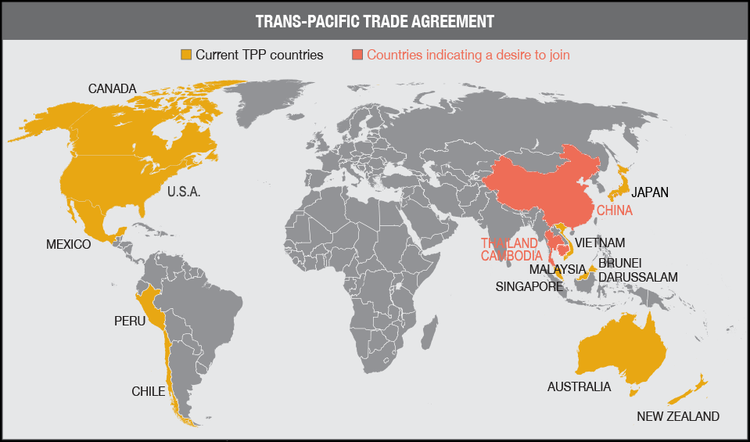
  • However, Michael Forman stated the urgency of implementing the TPP as quick as possible. If it is not implemented rapidly China has the ability to set the rules of trade. China, similar to the U.S. wants to move into the Asian Pacific market, however the TPP has different objectives then other Chinese trade agreements. The TPP has a focus on labor and environmental standards and IP standards. Although, it seems the goal is to eventually get China to join the TPP. Forman mentioned if China does not end up joining the TPP, we want them to be forced to live in a TPP world, which includes high standards.
  • Michael Forman further discusses the Trans-Atlantic Trade and Investment Partnership (T-TIP), which they hope to soon reach an agreement on with the European Union. They recently finished their thirteenth round of negotiations, the main outstanding problems with the TTIP are the uneven growth, Greek crisis, and euro skepticism. Nevertheless, the TTIP is a positive agenda item to help promote job growth in Europe.

A few things that stuck out to me from this dialogue included Forman’s belief of California being the state to benefit the most from the TPP. Currently, California exports $170 billions of goods and are strong in manufacturing, agricultural, entertainment, IP industries, etc. I also found it interesting that he continually reiterated that we have not lost jobs in the U.S. solely because of globalization but mainly because of automation.

Trade Adjustment Assistance (TAA) Program: An Overview

In the class, we briefly introduced the Trade Adjustment Assistance (TAA) program, which has played a critical role in the past decades both financially helping trade-displaced workers and tactically facilitating trade liberalization agendas in U.S. trade policy.

Rationale and purpose of TAA

It is widely acknowledged that trade liberalization can benefit consumers and create new market-access opportunities for export-oriented firms. However, expanded trade may also exert negative and often concentrated effects on domestic industries and workers that face increased import competition. Freer trade is not entirely free, but bears the cost of economic adjustment. TAA program therefore is designed to provide readjustment assistance to firms and workers that suffer dislocation (job loss) due to foreign competition or offshoring. To be noted, TAA has been a significant tool to assist workers in the U.S. textile and apparel industry.

taa3

According to official statistics, since 1974, 2.2 million American workers have benefited from the TAA program, which provides workers with opportunities to obtain the skills, credentials, resources, and support they need to obtain good jobs in an in-demand occupation — and keep them. TAA was last authorized in June 2015 to continue through June 30, 2021.

Eligibility for TAA

To be eligible for TAA, petitioning workers must establish that foreign trade contributed importantly to their loss of employment. The role of foreign trade can be established in one of several ways:

  •  An increase in competitive imports: The sales or production of the petitioning firm have decreased absolutely and imports of articles or services like or directly competitive with those produced by the petitioning firm have increased.
  • A shift in production to a foreign country: The workers’ firm has moved production of the articles or services that the petitioning workers produced to a foreign country or the firm has acquired, from a foreign provider, articles or services that are directly competitive with those produced by the workers.
  • Adversely affected secondary workers: The petitioning firm is a supplier or a downstream producer to a TAA-certified firm and either (1) the sales or production for the TAA-certified firm accounted for at least 20% of the sales or production of the petitioning firm or (2) a loss of business with a TAA-certified firm contributed importantly to the workers’ job losses.

Additionally, workers who lost jobs from firms that have been publicly identified by the United States International Trade Commission (USITC) as injured by a market disruption (for example, in anti-dumping, countervailing duty or safeguard cases) or other qualified action can also submit TAA petition.

Workers’ Benefits under TAA

TAA benefits for individual workers include:

  • Training and reemployment services and income support for workers who have exhausted their unemployment compensation benefits and are enrolled in training.
  • Workers age 50 and over may participate in the Reemployment Trade Adjustment Assistance (RTAA) wage insurance program.
  • Certified workers may also be eligible for a tax credit for a portion of the premium costs for qualified health insurance.

Financial Cost of TAA

TAA is financially covered by the federal government (i.e. taxpayers’ money) through annual appropriations. Appropriations for the program in FY2016 were $861 million, of which $450 million was for training and reemployment services and the remaining $411 million was for income support and other activities.

Role of TAA in U.S. trade policy

TAA is “presented as an alternative to policies that would restrict imports, and so provides assistance while bolstering freer trade and diminishing prospects for potentially costly tension (retaliation) among trade partners.”(Hornbeck, 2013)

Back in 1992, newly elected President Clinton oversaw the implementation of the North America Free Trade Agreement (NAFTA), but did so only after a number of conditions were attached, including TAA. In 2002, President Bush and the Republicans pushed hard to renew the long-expired trade promotion authority (TPA), but Democrats were unwilling to provide it unless TAA was reauthorized. TAA was also directly linked to the passage of three free trade agreements (FTAs) by US Congress in 2011, including US-Korea, US-Columbia and US-Panama FTAs.

 taa

taa2

Concerns about TAA

Critics strongly debate the merits of TAA on equity, efficiency, and budgetary grounds:

  • Economic efficiency: some critics argue that economic efficiency was far from guaranteed given that subsidies can operate to reduce worker and firm incentives to relocate, take lower-paying jobs and in other ways to carryout necessary reform.
  • Equity: some critics argue that because many economic groups hurt by changing economic circumstances caused by other than trade policies were not afforded similar economic assistance (for example, domestic competition and technology advancement). For the sake of fairness, if society has a responsibility to help all those dislocated by economic change, then policies should not be narrowly restricted to trade-related harm only.
  • Administrative cost: it is argued by some economists that defining and measuring injury from tariff reduction would be inexact, if not arbitrary. Some studies also suggest that many firms, even smaller ones, could adjust on their own, and that workers could just as well rely on more broadly available unemployment and retraining programs. In addition, the high costs of TAA would dilute political support for the program.

Reference:

Collins, B. (2016). Trade Adjustment Assistance for Workers and the TAA Reauthorization Act of 2015, Congressional Research Service, R44153

Hornbeck, J.F. (2013).Trade Adjustment Assistance (TAA) and Its Role in U.S. Trade Policy, Congressional Research Service, R41922

CRS Releases Updated Study on the U.S. Textile Industry and the Trans-Pacific Partnership (TPP)

crs-reportOn September 1, the Congressional Research Service (CRS) released its updated study on the U.S. textile industry and the Trans-Pacific Partnership (TPP). According to the report:

First, TPP is suggested to have a limited impact on U.S. domestic textile and apparel manufacturing, because:

1) Automation rather than imports is found to be the top factor causing job losses in the U.S. textile industry in the past decade;

2) U.S. is one of the very few TPP members whose textile output mostly went into home textiles, floor coverings and other technical textile products rather than apparel.

3) More than 90% of apparel sold in the United States is already imported. Some companies maintain U.S. manufacturing of high-value products or products requiring quick delivery, which are not likely to be supplied by other TPP members.

4) A quantitative assessment conducted by the U.S. International Trade Commission (USITC) in May also suggests that U.S. imports of textiles will only climb 1.6% by 2032 if TPP enters into force in 2017. Over the same 15-year period, both output and employment in the U.S. textile industry could slightly shrink by 0.4% as a result of the implementation of TPP.

Second, TPP could challenge the Western-Hemisphere supply chain and negatively affect U.S. textile exports to the region:

1) TPP will make apparel manufacturers located in Mexico and Central America lose one important advantage—duty free access to the U.S. market, when competing with Asian TPP members such as Vietnam and Malaysia.  The Central American-Dominican Republic Apparel and Textile Council also estimates the CAFTA-DR region could see a contraction of 15%-18% in industrial employment resulting from lost production orders in the first year after the TPP agreement is implemented.

2) The major products sourced by U.S. apparel companies from the Western Hemisphere region include basic, low-value knitwear garments such as shirts, pants, underwear, and nightwear, with a focus on men’s and boys’ wear. However, these products are with low time sensitivity but high price sensitivity, meaning Asian TPP members can easily offer a more competitive price and take away sourcing orders after the implementation of TPP.  

3) Because of physical distance and abundance of local supply, leading Asian TPP apparel exporters such as Vietnam seldom use US-made yarns and fabrics. Supported by foreign investments, Vietnam is also quickly building up its own textile manufacturing capacity, which is expected to reach 2 million metric tons for fabrics and 650,000 metric tons for fibers by 2020. This implies that TPP may help little creating new export markets for US textile products, despite the restrictive yarn forward rules of origin.

Additionally, TPP could result in intensified competition in the technical textile area, which is of strategic importance to the future of the U.S. textile industry:

1) If the proposed agreement is implemented, those segments of the U.S. textile industry that supply industrial textiles are likely to face greater competition from rising imports from Japan.

2) TPP will allow Japanese industrial textiles to newly get duty free access to Mexico and Canada, which are the largest export markets for U.S. industrial fabrics in 2015. However, TPP won’t help US companies get more favorable access to China, which is the top export market for Japanese industrial fabrics.

ILO Evaluates Trade Impact of Labor Provisions in Free Trade Agreements

labor provision

The International Labor Organization (ILO) releases a new study, which looks at how the increasing number of labor provisions in free trade agreements are impacting the world of work. According to the study:

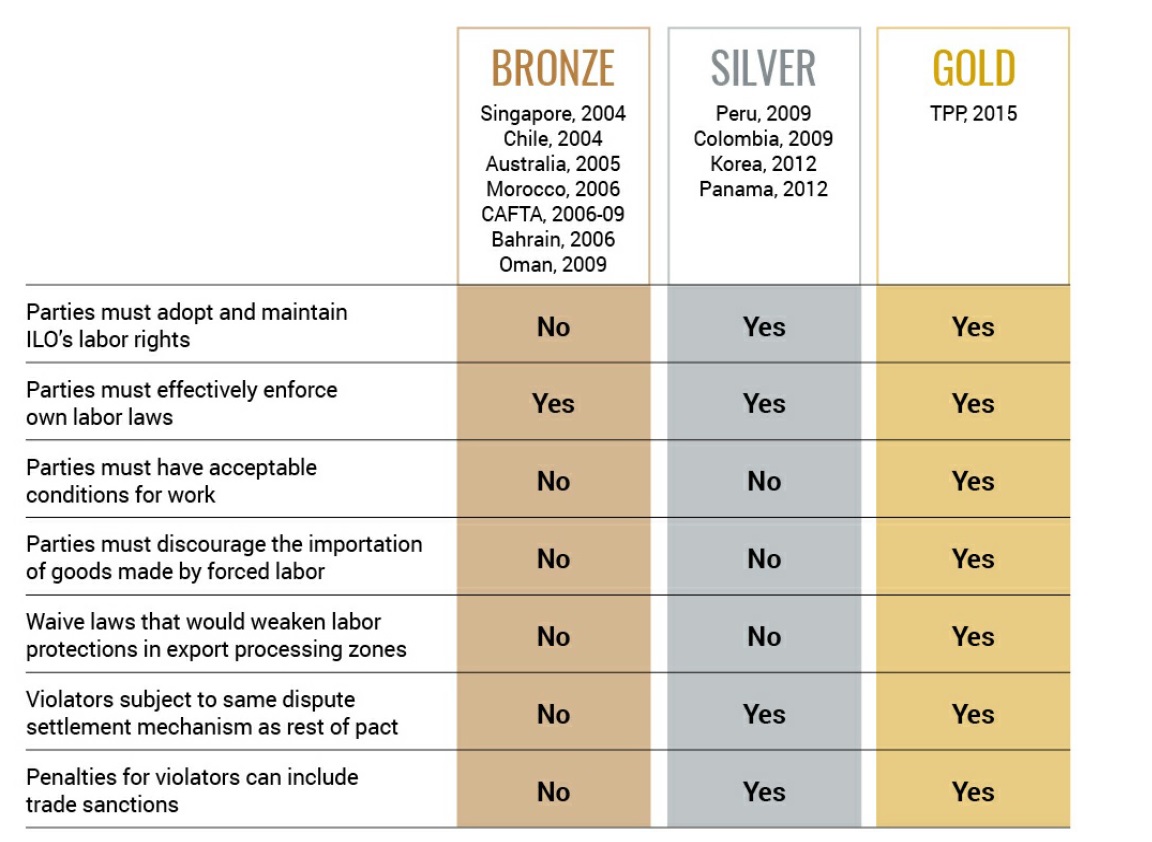
Labor provisions in free trade agreements take into consideration any standard which addresses labor relations or minimum working terms or conditions, mechanisms for monitoring or promoting compliance, and/or a framework for cooperation.  (See appendix: evolution of labor provisions in US free trade agreements).

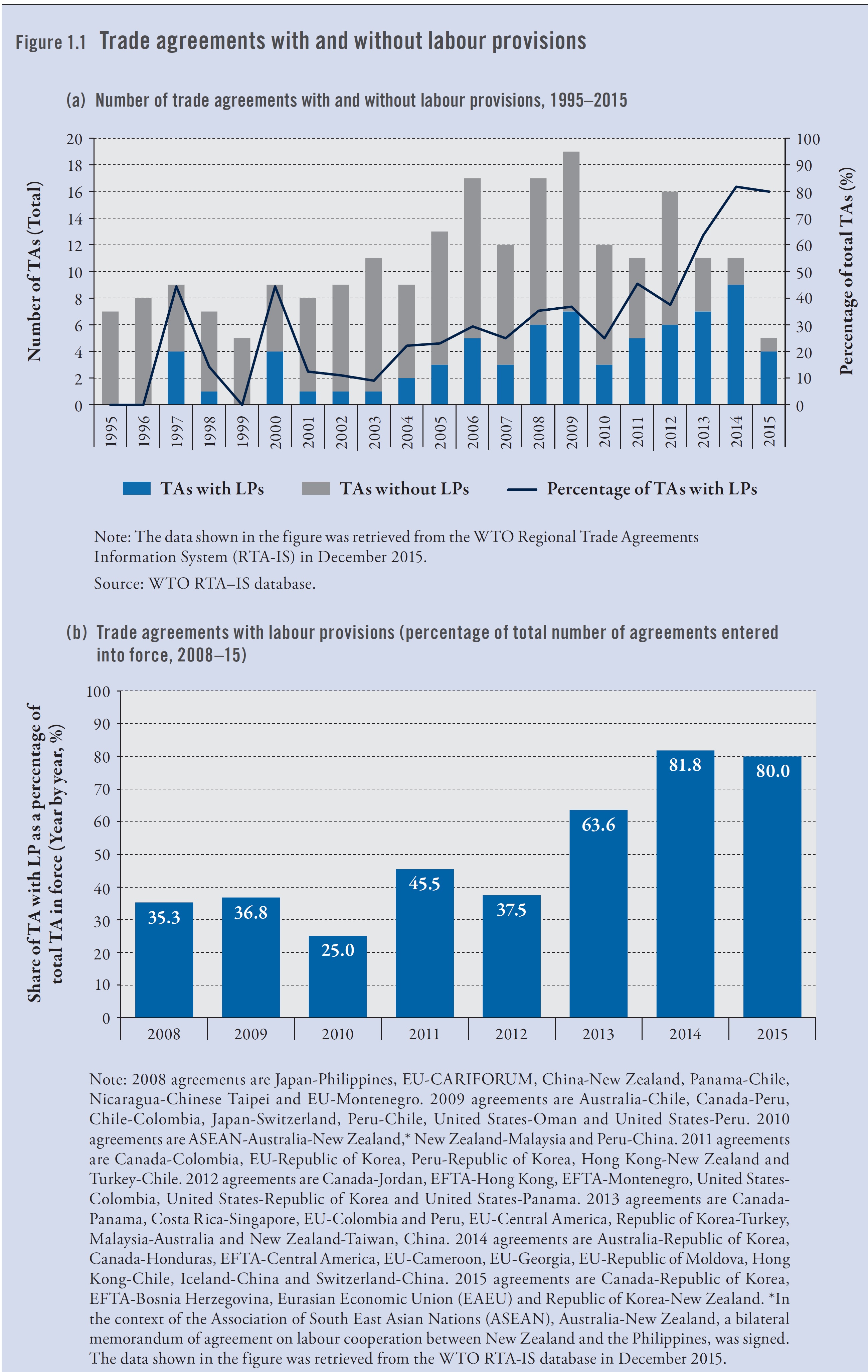
As of December 2015, there were 76 trade agreements in place (covering 135 economies) that include labor provisions, nearly half of which came into existence after 2008. This represents more than one-quarter (28 percent) of the trade agreements which the World Trade Organization (WTO) has been notified of, and which are currently in force. Over 80 percent of agreements that came into force since 2013 contain such provisions. Countries most active in promoting labor provisions in free trade agreements include: Canada, the European Union, the United States, Chile, New Zealand and Switzerland. Some South-South free trade agreements also include labor provisions.

The study finds that there is NO evidence to support the claim that implementation and enforcement of labor standards leads to reduced trade. The findings show that trade agreements, with or without labor provisions, boost trade between members of the agreement to a similar extent. For country-partner pairs that have a trade agreement with labor provisions in force, bilateral trade is estimated to be on average 28 percent greater than what would be expected without such an agreement.

Results further show that, on average, trade agreements that contain labor provisions impact positively on labor force participation rates, bringing larger proportions of male and female working-age populations into the labor force and, particularly, increasing the female labor force. The study assumes that labor provisions in trade agreements can raise people’s expectations of better working conditions, which in turn increases their willingness to enter the labor force.

However, the study found NO statistically significant relationship between labor provisions and labor market outcomes such as wages, share of vulnerable employment or gender gaps at the aggregate level (i.e. consider all countries). On the one hand, this implies that labor provisions at least do not lead to the deterioration of other labor standards in a country. On the other hand, it indicates that labor provisions in free trade agreements have limited impact on the outcomes of the labor market.

Additionally, the study stresses that interaction among stakeholders, capacity-building and monitoring mechanisms – with the support of social dialogue are critical to achieve positive outcomes in the labor market. In a case study on the Cambodia–US Textile Agreement specifically, the report finds strong firm-level intervention, such as monitoring and compliance, improved wages at the firm level, including a notable reduction of the gender wage gap. In another case study, it is found that capacity-building measures brought to Bangladesh after the Rana Plaza tragedy have resulted in some visible improvements with respect to the number of trade unions, building safety and amendments in labor law in the country.

Appendix: Evolution of labor provisions in US free trade agreements

labor provisions

Source: http://www.thirdway.org/memo/tpp-in-brief-labor-standards

USITC Studies the Impact of Trade on Manufacturing Jobs in the U.S. Textile and Apparel Industry

job impact of trade

employment in the US T&A industry

In its newly released Economic Impact of Trade Agreement Implemented under Trade Authorities Procedures, 2016 Report, the U.S. International Trade Commission (USITC) provides a quantitative assessment on the impact of trade on manufacturing jobs in the U.S. textile and apparel industry. According to the report:

  • Manufacturing jobs in the U.S. textile and apparel industry have been declining steadily over the past two decades. Between 1998 and 2014, employment in the NAICS 313 (textile mills), NAICS314 (textile product mills) and NAICS 315 (apparel manufacturing) sectors on average decreased annually by 7.6 percent, 4.3 percent and 11.2 percent, respectively.
  • Rising import is found NOT a major factor leading to the decline in employment in the U.S. textile industry (NAICS 313)–as estimated, imports only contributed 0.4 percent of the total 7.6 percent annual employment decline in the U.S. textile industry. Instead, more job losses in the sector are found caused by improved productivity as a result of capitalization & automation (around 4.6 percent annually) and the shrinkage of domestic demand for U.S. made textiles (around 3.5 percent annually) between 1998 and 2014.
  • Rising imports is the top factor contributing to job losses in apparel manufacturing (NAICS 315), however. As estimated by USITC, of the total 11.2 percent annual employment decline in apparel manufacturing, almost all of them is affected by imports (10.8 percent). On the other hand, increased domestic demand for apparel (such as from U.S. consumers) is found positively adding manufacturing jobs by 2 percent annually in the United States from 1998 to 2014.
  • To be noted, USITC did not estimate the impact of trade on employment changes in the retail aspect of the industry. According to the U.S. Bureau of Labor Statistics, approximately 80 percent of jobs in the U.S. textile and apparel industry came from retailers in 2015. These retail-related jobs are typically “non-manufacturing” in nature, such as: fashion designers, merchandisers, buyers, sourcing specialists, supply chain management specialists and marketing analysts.

2016 U.S. Fashion Industry Benchmarking Study Released

The 2018 U.S. Fashion Industry Benchmarking Study is now available
usfia 2016 cover_Page_1

The report can be downloaded from HERE

Key Findings of the study:

I. Business environment and outlook in the U.S. Fashion Industry

  • Overall, respondents remain optimistic about the five-year outlook for the U.S. fashion industry. “Market competition in the United States” is ranked the top business challenge this year, which, for the first time since 2014, exceeds the concerns about “increasing production or sourcing cost.”

II. Sourcing practices in the U.S. fashion industry

  • U.S. fashion companies are more actively seeking alternatives to “Made in China” in 2016, but China’s position as the No.1 sourcing destination seems unlikely to change anytime soon. Meanwhile, sourcing from Vietnam and Bangladesh may continue to grow over the next two years, but at a slower pace.
  • U.S. fashion companies continue to expand their global reach and maintain truly global supply chains. Respondents’ sourcing bases continue to expand, and more countries are considered potential sourcing destinations. However, some companies plan to consolidate their sourcing bases in the next two years to strengthen key supplier relationships and improve efficiency.
  • Today, ethical sourcing and sustainability are given more weight in U.S. fashion companies’ sourcing decisions. Respondents also see unmet compliance (factory, social and/or environmental) standards as the top supply chain risk.

III. Trade policy and the U.S. fashion industry

  • Overall, U.S. fashion companies are very excited about the conclusion of the Trans-Pacific Partnership (TPP) negotiations and they look forward to exploring the benefits after TPP’s implementation.
  • Thanks to the 10-year extension of the African Growth and Opportunity Act (AGOA), U.S. fashion companies have shown more interest in sourcing from the region. In particular, most respondents see the “third-country fabric” provision a critical necessity for their company to source in the AGOA region.
  • Free trade agreements (FTAs) and trade preference programs remain underutilized in 2016 and several FTAs, including NAFTA and CAFTA-DR, are utilized even less than in previous years. U.S. fashion companies also call for further removal of trade barriers, including restrictive rules of origin and remaining high tariffs.

The benchmarking study was conducted between March 2016 and April 2016 based on a survey of 30 executives from leading U.S. fashion and apparel brands, retailers, importers, and wholesalers. In terms of business size, 92 percent of respondents report having more than 500 employees in their companies, while 84 percent of respondents report having more than 1,000 employees, suggesting that the findings well reflect the views of the most influential players in the U.S. fashion industry.

For the benchmarking studies in 2014 and 2015, please visit: https://www.usfashionindustry.com/resources/industry-benchmarking-study

International Trade Supports Textile and Apparel “Made in USA”

International trade plays a critical role supporting textile and apparel (T&A) “Made in USA”, according to latest firm-level data from the Office of Textiles and Apparel (OTEXA) under the U.S. Department of Commerce.

imported input

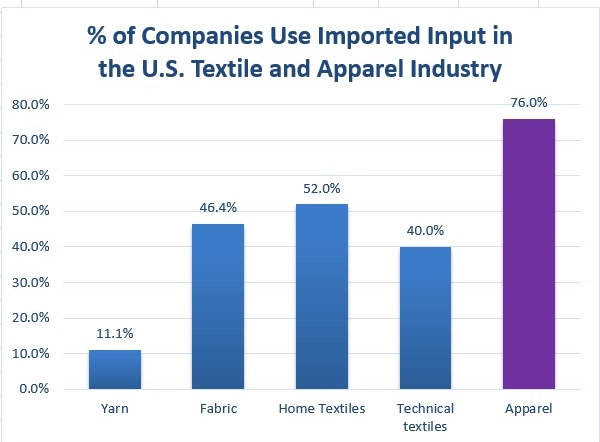
First and formost, textile and apparel “Made in USA” today contain imported components. Data collected from the OTEXA “Made in USA” Sourcing database shows that using imported inputs such as cut parts, fabrics, accessories and trims is a very common practice among the total 122 companies which claim making either yarn, fabric, home textiles, technical textiles or apparel in the United States. Particularly, more than 76% of companies which make apparel in the United States say they use imported inputs, followed by companies which make technical textiles (52%) and fabrics (46%). Moreover, the lack of sufficient supply of locally made fabrics is the top reason why U.S. T&A companies use imports as alternatives.

The supportive role played by imports to T&A “Made in USA” also explains why the U.S. T&A industry is in favor of the passage of the American Manufacturing Competitiveness Act 2016 (Miscellaneous Tariff Bill, MTB). The Bill, which passed by the U.S. Congress in May, will eliminate or reduce hundreds of import duties on textile raw materials and intermediate products that are not produced or available domestically in the United States.

us companies export

On the other hand, export promotes “Made in USA” textiles and apparel as well. Data from the OTEXA “Made in USA” sourcing database shows that as many as 88.9% of U.S.-based yarn manufacturers, 82.9% of technical textile manufacturers, 75% of fabrics manufacturers and 76% of home textile manufacturers currently export and sell their products overseas.

For more detailed data and analysis, please stay tuned…

Sheng Lu

FASH455 Exclusive Interview with Julia K. Hughes, President of the United States Fashion Industry Association

logo-1138967853headshot_USFIA-hughes_300x300px

Julia K. Hughes is President of the United States Fashion Industry Association (USFIA), which represents textile and apparel brands, retailers, importers, and wholesalers based in the United States and doing business globally. Founded in 1989 as the United States Association of Importers of Textiles & Apparel with the goal of eliminating the global apparel quota system, USFIA now works to eliminate tariff and non-tariff barriers that impede the industry’s ability to trade freely and create economic opportunities in the United States and abroad. Ms. Hughes represents the fashion industry in front of the U.S. government and international governments and stakeholders.

Ms. Hughes has testified before Congress and the Executive Branch on textile trade issues. She is recognized as an expert in textile and apparel issues and frequently speaks at international conferences including the Apparel Sourcing Show, MAGIC, Foreign Service Institute, National Association of Manufacturers, Cotton Sourcing Summit, International Textiles and Clothing Bureau, Young Presidents’ Organization, World Trade Organization Beijing International Forum, and others.

Ms. Hughes served as the first President of the Organization of Women in International Trade (OWIT) and is one of the founders of the Washington Chapter of Women in International Trade (WIIT) and WIIT Charitable Trust. In 1992, she received the Outstanding Woman in International Trade award and in 2008, the WIIT Lifetime Achievement Award.

Ms. Hughes has an M.A. in International Studies from the Johns Hopkins School of Advanced International Studies and a B.S. in Foreign Service from Georgetown University.

Special thanks to Samantha Sault, Vice President of Communication for the U.S. Fashion Industry Association for facilitating and supporting this exclusive interview. Ms. Sault is responsible for the development and execution of the association’s communications strategy, including public relations, policy research and messaging, and social media. Prior to joining the association, Ms. Sault honed her communications expertise at DCI Group, a global public affairs communications firm headquartered in Washington, D.C. Previously, she worked in media as a web editor and fact checker at The Weekly Standard and an editorial assistant at Policy Review, the journal of the Hoover Institution. She began her career in the apparel industry at 17 at abercrombie kids in Bethesda, Maryland.

Interview Part

Sheng Lu: Our students are interested in knowing who the members of the U.S. Fashion Industry Association (USFIA) are. Can you name a few of your member companies?

Julia Hughes: Our members range from major global brands and fast-fashion retailers, to small importers and wholesalers. While all of our members must be doing business in the United States, our membership roster also includes some international companies with a retail presence in the United States. Some of our most actively engaged members include iconic brands and retailers like Ralph Lauren, Macy’s, Levi Strauss & Co., JCPenney, Urban Outfitters, PVH Corp., and American Eagle Outfitters. We also represent small and medium-size importers, wholesalers, and manufacturers that you might not know by name, but supply to many of your favorite brands and retailers—companies like Michar, MGF Sourcing, and Golden Touch Imports, to name a few.

Sheng Lu: The USFIA is an advocate for trade liberalization and removal of trade barriers. Can you talk with us about the benefits of free trade, especially for the fashion industry both in the United States and globally?

Julia Hughes: As you know, USFIA was originally founded in 1989 (then known as the United States Association of Importers of Textiles and Apparel) with the mission to eliminate the global quota system. We were successful! But of course, as you also know, that work is not over. The quotas may have gone away, but there still are import barriers that are unique to the apparel industry. USFIA member companies continue to face some of the United States’ highest tariffs. Textiles and apparel, combined with footwear, still account for some of the highest peaks in the U.S. tariff schedule, with many double-digit tariffs and a high of 32 percent.

Not only are these tariffs higher than on other products, but these tariffs also are a regressive tax. We believe it is simply wrong for a single mom to pay a 32 percent import tax for her baby’s onesies and a 16 percent tariff for her baby’s booties, while the wealthy pay a 1.2 percent tariff for their silk scarves. In total, apparel tariffs take more than $10 billion out of the pockets of hard-working Americans annually. So eliminating these tariffs would be an immediate benefit to American consumers and to American families.

But even removing these tariffs would not mean that there is “free trade.” For example, the fact that the United States maintains these peak textile and apparel tariffs creates problems for new policy initiatives to expand export markets for U.S. products. Market access for American brands and exports is hindered by prohibitively high tariffs in attractive third country markets such as India and Brazil. Our own peak tariffs only encourage other governments to maintain their own high apparel and textile tariffs to “protect” their domestic industries. American brands such as Levi’s and Polo are among the most recognized brands in the world. American yarn spinners and fabric makers operate highly efficient operations that make them among the world’s most competitive producers. For all of these companies, we need every opportunity to remove barriers to trade.

There is a great opportunity to create high-paying jobs here in the United States, too. Fashion brands and retailers offer quality design, product development, logistics, sourcing, and service jobs in the United States, along with manufacturing jobs. These jobs are supported by global value chains, and will be on track to grow IF free trade agreements contain rules of origin and market access provisions that will decrease the cost of those fashion products. This would not only help the brands and retailers grow and create more jobs, but also help consumers by providing access to affordable, high quality apparel.

Finally, free trade isn’t just about tariffs – but also non-tariff barriers like regulations, certifications, and testing requirements all represent non-tariff barriers to trade. And since today’s global brands are selling everywhere from the United States to the UK to Japan to Dubai, we are working to eliminate these barriers, too.

Sheng Lu: The Trans-Pacific Partnership (TPP) is a buzzword for the fashion industry, with Vietnam and China at the core of the discussion. Many people see Vietnam as an alternative sourcing destination to China for labor-intensive apparel and footwear products. You’ve visited both Vietnam and China recently. What’s your first-hand observation? How competitive is “Made in Vietnam” compared with “Made in China”?

Julia Hughes: The TPP is a top priority for USFIA and for our member companies. But unlike some, we do not see the TPP as creating an either/or scenario for sourcing apparel and footwear. China remains the top supplier to the U.S. market, and we do not see that changing any time soon. The breadth of manufacturing operations in China, combined with the state-of-the-art infrastructure and logistics operations, mean that sourcing executives are comfortable with placing orders and knowing that they will get the quality product that they want delivered on time.

However, you are correct that Vietnam is seen as an alternative sourcing destination.—not just by U.S. sourcing executives, but also for Chinese companies. Both the TPP and the EU-Vietnam Free Trade Agreement make Vietnam an especially attractive destination for making apparel and for investments in manufacturing yarns and fabrics. But Vietnam is not necessarily the destination for companies searching for lower prices.

Sheng Lu: In the 2015 USFIA Benchmarking Study, around one-third of respondents report sourcing from 6-10 different countries and another one-third report sourcing from 11-20 different countries. What are some of the reasons that U.S. fashion companies today would choose to have such a diversified sourcing base?

Julia Hughes: There are a couple reasons why companies have such diversified sourcing bases. First, it is a holdover from the quota era, because companies were pretty much forced to diversify their sourcing since they couldn’t import everything from China. Following the elimination of the quotas in 2005, companies had cultivated trusted suppliers all over the world in countries as diverse as Vietnam, Sri Lanka, Mexico, and Colombia, so there was no reason to leave these good suppliers after they had spent the time and resources developing their supply chain. Second, diversification is a method of risk management. There are lots of risks that could impact your supply chain—from natural disasters to labor strife to terrorist attacks. The last thing a company wants is to have all of their production in one place—because when disaster strikes, you won’t be able to get your product to your customers. By keeping a diverse supply chain, you can ensure that you’ll always have products moving to the shelves. Finally, different countries have different specialties—and truthfully, no one country can do it all. Companies don’t necessarily prefer to source fabric, yarn, zippers, and buttons from four different countries and ship to a fifth for cutting and sewing, but sometimes, that’s the way it must be done in order to produce the best product at the best price for your target customer.

Sheng Lu: We know that the African Growth and Opportunity Act (AGOA) has been extended for another 10 years. How has the U.S. fashion industry reacted to the AGOA extension? Are U.S. consumers going to see more “Made in Africa” apparel in the retail stores?

Julia Hughes: USFIA member companies are definitely looking at sourcing opportunities in Africa after the extension of AGOA. Today a little more than 1 percent of U.S. apparel imports come from Sub-Saharan Africa—and there are only a few countries that ship apparel to the U.S. market. Kenya, Lesotho, Mauritius, and Madagascar are the major producers of apparel today – representing 87% of the U.S. imports. The ten-year extension of AGOA is allowing companies to take a fresh look at what is available to source in Africa today, as well as to plan to long-term growth. Both PVH and VF, for example, have been very public about their commitment to develop a vertically integrated industry in Ethiopia.

What is exciting is that new sourcing supply chains are opening up in Africa. While the level of U.S. imports remains low there are some growing suppliers. For example, during March 2016–a month when the overall U.S. apparel imports plunged by -21 percent compared to March 2015—there were a few Sub-Saharan African suppliers that bucked the trend. U.S. imports from Madagascar jumped by 160 percent, from Ethiopia by 83 percent, and from Ghana by 371 percent!

Sheng Lu: Textile and apparel trade policy is always one of the most challenging topics for students in FASH455. Many students wonder why the rules governing the global textile and apparel trade are always far more complicated than most other sectors. For example, in the past, students had to learn about the quota system, from the Short-term Arrangement (STA) to the Multi-Fiber Arrangement (MFA). The quota system is gone, but it seems students now have to know even more “terms”: the yarn-forward rules of origin, short supply list, third country fabric provision, trade preference level (TPL) and earned import allowance… What makes the textile and apparel trade so unique in terms of trade regulations?

Julia Hughes: This is a great question–and one that does not have an easy answer. Absolutely, when I first started working with the industry, it was a revelation to understand about quotas and labeling requirements classification issues. Today, the industry is even more complicated. I think that a lot of the complexity today is due to protectionism. Negotiators looked for ways to limit the market opening impact of trade agreements, and to try to protect their domestic industry. This isn’t just an issue for the United States.  Starting with NAFTA in the 1990’s, the rules are more complicated in every free trade agreement—and none of the free trade agreements exactly matches the others. But the complexity isn’t just for FTAs, of course. Today, we also face more regulations, different labeling requirements for different countries (and unfortunately sometimes even different labels are required in different states!), and more testing and certification requirements.

Sheng Lu: Looking ahead in 2016, what important sourcing trends and trade patterns shall we expect in the U.S. fashion industry? What are the policy priorities for the USFIA this year?

Julia Hughes: The implementation of the Trans-Pacific Partnership (TPP) remains at the top of our list of policy priorities. But implementation is still a long way off, especially since the U.S. Congress is unlikely to vote on the agreement before the November elections. We don’t expect to see a huge shift to sourcing in Vietnam, Malaysia, and the other TPP partners in 2016-2017, since duty-free treatment is a long way off, but we do expect to see companies taking a closer look at opportunities there—and it helps that Vietnam is already the #2 supplier to the United States, so many companies are already sourcing there. We’re also prioritizing completion of the Transatlantic Trade & Investment Partnership (T-TIP) between the United States and European Union. The EU is a great source for luxury brands and companies manufacturing leather goods, but this agreement has an even greater potential in terms of regulatory harmonization, making it easier for many of our members to break into the retail markets in Europe. We’re also focused on enhancing the African Growth & Opportunity Act (AGOA), cumulation of free trade agreements, and customs and ethical sourcing issues, too. As far as future trends, we’re looking forward to seeing the results of our third-annual Fashion Industry Benchmarking Study, which will give us a lot of insight into what brands are thinking about sourcing and expansion!

Sheng Lu: Last but not least, our students wonder what makes you and your staff personally interested in the fashion industry. Particularly, through your daily work, how do you see the impact of the fashion industry in the 21st century global economy?

Julia Hughes: My path to the world of fashion is from the policy side. I was always interested in international policy and after graduating from Georgetown University and SAIS, I was fortunate to hear about an opportunity to be the Washington Representative for Associated Merchandising Corporation (AMC). It was a terrific opportunity to be engaged in policy discussions, but also to spend time with the buyers, with the sourcing teams, and also with the overseas offices and vendors to understand the impact on trade policy on the clothes we wear. Let’s face it, it is a shock to realize the way that Congressional actions, and negotiations, can determine whether a jacket is made with down, or synthetic fibers, or cotton–or maybe it is manufactured to qualify as a shirt instead of a jacket. It also is inspiring to work with industry executives who are committed to fashion as well as doing good for the global economy. Textiles and apparel has always been an industry that can be a gateway for economic development–and I have seen the positive impact by creating jobs where there were none before–as well as expanding U.S. jobs in design, product development and compliance.

Samantha Sault: I have always loved fashion—in fact, my very first job in high school was folding clothes and working the register at abercrombie kids at the mall in my hometown!—but I never thought about fashion as a career until I had been working for a few years after college. I started my career in political media in D.C., and eventually started covering the intersection of fashion and politics for various publications, including exciting events like New York Fashion Week and President Obama’s first inauguration (and the First Lady’s fabulous dresses). After five years in media and public affairs, I found my way to USFIA and the business and policy side of the fashion industry. The most inspiring part about working in fashion has been getting to know our contacts at our member companies, and seeing how committed they are not only to their brands, but also to ethical sourcing and compliance. These are not just buzzwords—I’ve learned firsthand that many of the individuals at our member companies are deeply committed to ensuring that they are doing the right thing in their supply chains from the factory floor (especially for women) to the retail store, and it has made me appreciate these brands even more than I already did.

–The End–

African Growth and Opportunity Act and Textile & Apparel

(In the video: Gail Strickler, former Assistant US Trade Representative for Textiles, highlights the immense opportunities created by the renewal of AGOA for duty-free access to the massive US market for African textile and apparel producers.)

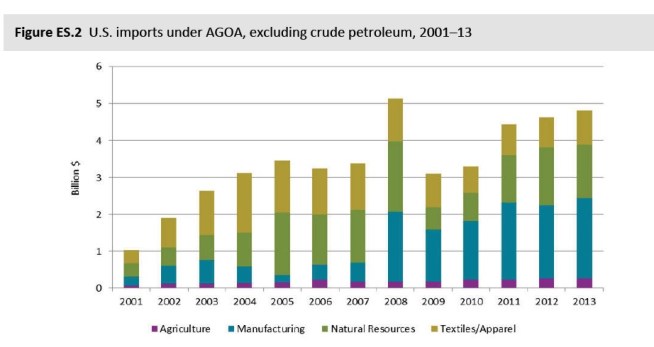
The African Growth and Opportunity Act (AGOA) is a non-reciprocal trade agreement enacted in 2000 that provides duty-free treatment to U.S. imports of certain products from eligible sub-Saharan African (SSA) countries. AGOA intends to promote market-led economic growth and development in SSA and deepen U.S. trade and investment ties with the region. (note: non-reciprocal means SSA countries do not need to offer equivalent benefits to imports from the United States.)

Because apparel production plays a dominant role in many SSA countries’ economic development, apparel has become one of the top exports for many SSA countries under AGOA.  Like many trade agreements and trade preference programs, AGOA also set unique rules of origin for textile and apparel (T&A):

First, to enjoy the duty-free and quota-free treatment in the US market, eligible T&A products made in qualifying AGOA countries need to be one of the following categories:

  • Apparel made with US yarns and fabrics;
  • Apparel made with Sub-Saharan African (SSA) regional yarns and fabrics, subject to a cap;
  • Apparel made with yarns and fabrics not produced in commercial quantities in the United States;
  • Certain cashmere and merino wool sweaters; and
  • Eligible hand-loomed, handmade or folklore articles and ethnic printed fabrics.

Second, under a special rule called “third-country fabric” provision, AGOA countries with lesser-developed countries (LDBC) status can further enjoy duty-free access in the US market for apparel made from yarns and fabric originating anywhere in the world (such as China, South Korea, and Taiwan). This special rule is deemed as critical because most SSA countries still have no capacity in producing capital and technology-intensive textile products. [Note: Although the US imports of apparel made with third-country fabric are subject to a cap, the cap has never been reached].

According to a 2014 comprehensive study conducted by the USITC, the “third-country fabric” provision has three major benefits to the AGOA members:

1) Increase exports of apparel. This can be evidenced by the fact that most US apparel imports under AGOA came from those countries that are eligible for the “third-country fabric” provision, such as Lesotho, Kenya, Mauritius, and Swaziland. In comparison, because South Africa is not eligible for the “third-country fabric” provision, its apparel exports to the United States had significantly dropped since 2003 and only accounted for 0.6% among AGOA countries in 2013.

2) Encourage foreign investment. From 2003 to 2013, a total 21 T&A FDI projects were made in SSA, among which 18 projects (or 85.7%) were greenfield FDI. The third-country fabric provision is the main driver for these FDI projects. For example, many Chinese and Taiwanese investors had opened apparel factories in Ghana, Kenya, Lesotho, Madagascar, Malawi, Mauritius, Namibia, Nigeria and Tanzania as a source of exports to the United States and the EU.

3) Enhance trade diversification. Theoretically, relaxing rules of origin (RoO) such as the third-fabric provision can free up companies’ resources and allow them to expand export product lines. As observed by a few empirical studies, AGOA’s third-country fabric provision helped related countries increase the varieties of apparel exports between 39 and 61 percent.

AGOA receives new authorization in 2015, which will last for 10 years until 2025 (including the 3rd country fabric provision). This ten-year renewal of AGOA is regarded as critical and necessary to encourage more long-term investment in the region. As put by Florizelle Liser, Assistant US Trade Representative for Africa “What we know is that African producers of apparel, like producers of apparel all around the world, need to have the flexibility to source their input from wherever of those can be produced most effectively, cost effectively for the products that they are sewing. So we want through the “third country fabric” provision to give the African producers of apparel that flexibility. We do know in terms of establishing textiles business on the ground producing those inputs right there in Africa and that more of that indeed is going to happen. The reason is that as U.S. buyers of apparel and this is an enormous market for apparel… as U.S. buyers of apparel source more of their apparel from Africa, then investors in textile mills, which are very expensive, will be incentivized and are being incentivized to actually establish those fabric mills right there in Africa, and then be able to save time, in terms of getting those inputs that are needed for the clothing that is being produced. So we see that happening already: it’s happening in Kenya, it’s happening in Ethiopia and around the continent. And that is what we need to have more of as we go forward in this ten-year extension of AGOA.”

AGOA 1

AGOA 2

AGOA 3

Why NCTO and Euratex Disagree on the Textile and Apparel Rules of Origin in T-TIP?

eu-and-us-ta-rules-of-origin1

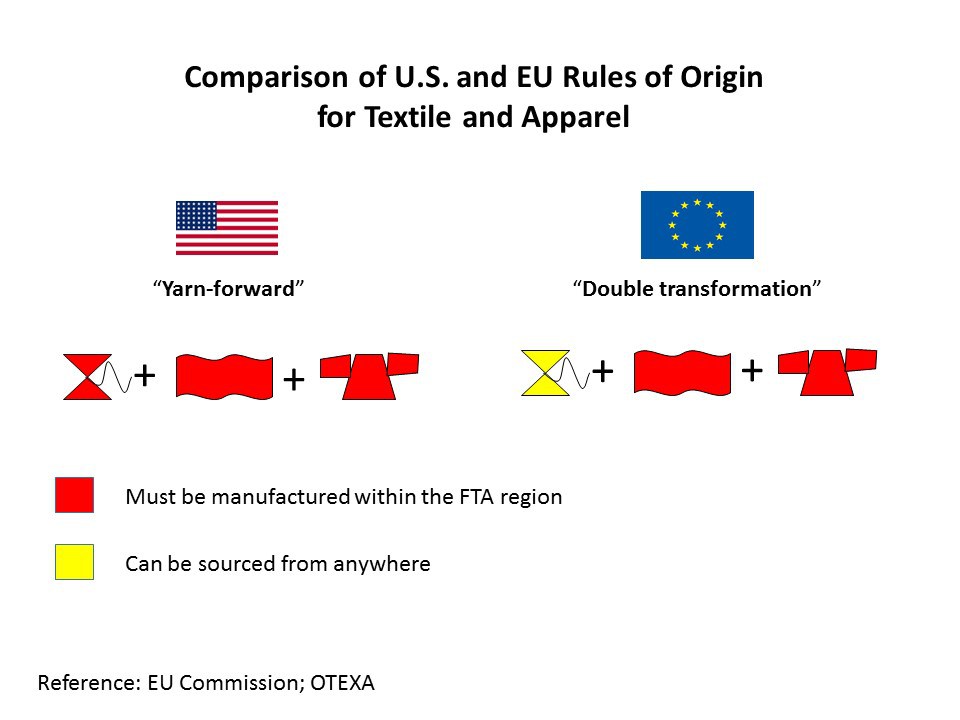
In an April 13 press briefing, the National Council of Textile Organizations (NCTO) which represents the U.S. textile industry, insists the Trans-Atlantic Trade and Investment Partnership (T-TIP) shall adopt the so called “yarn-forward” Rules of origin (RoO). Yarn-forward (or “triple transformation”) in T-TIP means, in order to receive preferential duty treatment provided under the trade agreement, yarns used in textile production in general need to be sourced either from the US or EU.  All 14 existing free trade agreements (FTA) in the United States adopt the yarn-forward RoO.

In comparison, in its position paper released in June 2015, the European Apparel and Textile Confederation (Euratex), which represents the EU textile and apparel industry, favors a so called “fabric forward” RoO in T-TIP instead of “yarn-forward”. Fabric-forward (or “double transformation”) in T-TIP means in order to receive preferential duty treatment provided under the trade agreement, fabrics used in apparel production in general need to be sourced either from the US or EU, but yarns used in textile production can be sourced from anywhere in the world.

US

Exploring data at the 4-digit NAICS code level can find that the United States remains a leading yarn producer. Value of U.S. yarn production (NAICS 3131) even exceeded fabric production (NAICS 3132) in 2014. This means: 1) U.S. has sufficient capacity of yarn production; 2) it will be in the financial interests of the U.S. textile industry to encourage more use of U.S.-made yarns in textile production in the T-TIP region (i.e. pushing the “yarn-forward” RoO).

eu textile production
EU yarn import

However, data at the 4-digit NACE R.2 code level suggests that EU(28) was short of €5,643 million local supply of yarns (NACE C1310) for its manufacturing of fabrics (NACE C1320) in 2013 (latest statistics available). This figure well matched with the value of €4,514 million yarns that EU (28) imported from outside the region that year. Among these yarn imports (SITC 651), over half came from China (22%), Turkey (19%) and India (13%), whereas only 5% came from the United States. Should the “yarn-forward” RoO is adopted in T-TIP, EU textile and apparel manufacturers may face a shortage of yarn supply or see an increase of their sourcing & production cost at least in the short run.

Sheng Lu

TPP and the U.S. Textile and Apparel Industry: Questions from FASH455

tpp textileThe following discussion questions are proposed by students enrolled in FASH455 (Spring 2016). Please feel free to join our online discussion.

#1 Is TPP successful in terms of “creating new market access opportunities” for the U.S. textile and apparel industry? Why or why not?

#2 Should the U.S. textile industry be worried that Vietnam is quickly building its own textile industry because of TPP?

#3 Compared with the case of Vietnam in TPP, why was there little discussion on Mexico and Central American countries developing their local textile industry and becoming less reliant on textile imports from the United States in the context of NAFTA and CAFTA-DR?  

#4 If China joins the TPP, do you think they would support a “yarn-forward” rules of origin or a less restrictive one? Why?

#5 Given the grave concerns about the potential impact of TPP on the U.S. textile industry, what is the point of negotiating such a trade deal?

[Discussion is closed for this post]

Reference: TPP Chapter Summary: Textiles and Apparel

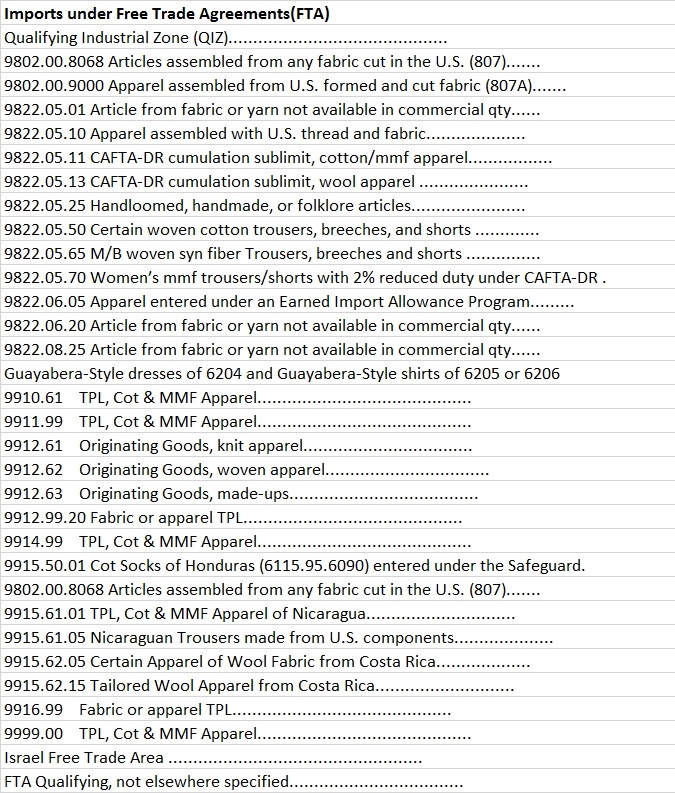
The Percent of U.S. Apparel Imports Entering under Free Trade Agreements Fell to a Record Low Level in 2015

FTA use 2015 1

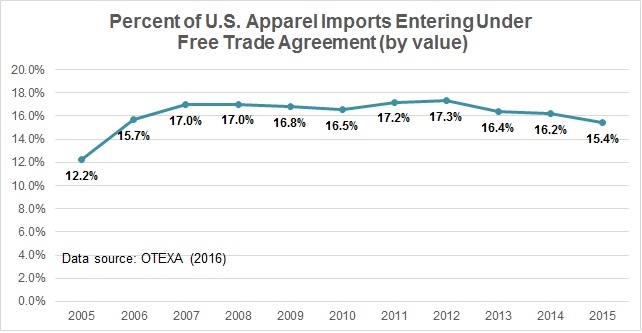
Latest statistics from the Office of Textiles and Apparel (OTEXA) show that the share of U.S. apparel imports entering under free trade agreements (FTAs) fell to a record low level of only 15.4 percent in 2015. This figure was not only lower than 16.2 percent in 2014, but also was THE lowest one since 2006, despite the implementation of a few new FTAs during that period.  

FTA use 2015 2

Among the major FTAs reached by the United States, the U.S.-Bahrain has the highest utilization rate of 99.7 percent in 2015 (note: utilization rate =value of imports entering under FTA from a particular country/value of imports from a particular country), whereas a couple of FTAs whose utilization rate is below 80 percent, such as CAFTA-DR (75.8 percent), U.S.-Korea FTA (75.2 percent), U.S.-Israel FTA (65.5 percent), U.S.-Australia FTA (53.7 percent) and U.S.-Morocco FTA (34.6 percent). A low utilization rate implies that U.S. companies did not claim the preferential duty benefits while importing apparel from these FTA regions.

FTA use 2015 3   

On the other hand, CAFTA-DR and NAFTA altogether account for around 76 percent of U.S. apparel imports entering under FTAs in 2015. This result is consistent with the findings in the 2015 U.S. Fashion Industry Benchmarking Study which also finds that CAFTA-DR and NAFTA were the two most frequently utilized FTAs reported by the survey respondents.

As a result of the lower share of apparel imports entering under FTAs, the American Apparel and Footwear Association Apparelstat 2015 released this week found that the effective average U.S. apparel import duty reached 13.54 percent in 2014, which is even higher than 11.97 percent in 2001. In comparison, over the same period, the average U.S. import duty on ALL products dropped from 1.64 percent in 2001 to 1.40 percent in 2014.

by Sheng Lu

Textile and Apparel Sector in the 2016 U.S. Trade Policy Agenda

2

In the recently released 2016 President’s Trade Agenda, the textile and apparel (T&A) sector was mentioned four times (up from only once in 2015*):

1.Trade enforcement

“THE OBAMA ADMINISTRATION has a record of trade enforcement victories that have helped to level the playing field for American workers, businesses, farmers, and ranchers. In 2016, we will continue to aggressively pursue a robust trade enforcement agenda, including by using new and stronger tools under the bipartisan Trade Enforcement Act of 2015 to hold our trading partners accountable.

Ongoing disputes include challenges to:

  • China’s far-reaching export subsidy program extending across sectors and dozens of sub-sectors, including textiles, industrial and agricultural products.”

2.Trade preference programs

“Haitian Hemispheric Opportunity through Partnership Encouragement Act (HOPE) pro­gram, which supports nearly $900 million in garment imports from Haiti, is an essen­tial support for Haiti’s long-term economic growth and industrial development. HOPE supports thousands of jobs in Haiti’s textile and gar­ment sectors, while providing important pro­tections to workers. Early extension of this program will provide the necessary stability and continuity for companies to continue in­vesting in Haiti’s future.”

3.Benefits of trade to the American people

“More recent trends are similar, with families steadily gaining purchasing power as the price of traded goods, such as smart phones, apparel, and toys, falls. While all households benefit, the gains from trade have predominantly benefited lower-income Americans, who spend a greater portion of their incomes on highly-traded staples like food, shoes, and clothing.”

4.Trade and labor

Our engagement has produced an Imple­mentation Plan Related to Working and Liv­ing Conditions of Workers that is helping to address concerns about workers’ rights and working conditions in Jordan’s garment sec­tor, particularly with respect to foreign work­ers. Jordan has issued new standards for dormitory inspections, submitted new labor legislation to its parliament and hired new labor inspectors. USTR and Department of Labor continue to work with Jordan on the issues under the Plan.

Overall, it seems:1) Reflecting the global nature of the sector, T&A is a topic that involves multiple trading parties for the United States; 2) Economic development and foreign aid are important elements in the U.S. trade policy for T&A. 3) Social responsibility and labor practices in the T&A sector remain a grave concern and need further improvement through international collaborations. 4) The T&A sector is involved in some topics with divisive public opinions, such as the impact of imports.

* Textile and apparel mentioned in the 2015 U.S. Trade Policy Agenda:

Our engagement has produced an Implementation Plan Related to Working and Living Conditions of Workers that is helping to address concerns about workers’ rights and working conditions in Jordan’s garment sector, particularly with respect to foreign workers. Jordan has issued new standards for dormitory inspections, submitted new labor legislation to its parliament and hired new labor inspectors.

[Discussion is closed for this post]

Top 10 Most Read FASH455 Blog Posts in 2015

top 10


1. Potential Impact of TPP on the Textile and Apparel Sector: A Summary of Recent Studies

2. 2014 World Textile Industry Labor Cost Comparison

3. Global Trade of Used Clothing (Updated: October 2015)

4. Market Size of the Global Textile and Apparel Industry: 2014 to 2018

5. When Will TPP Take Effect? Let’s look at the History

6. China to Become the World’s Largest Apparel Market in 2019

7. Are US Textile and Apparel Imports Using Free Trade Agreements?

8. 2015 US Fashion Industry Benchmarking Study Released

9. Exclusive Interview with Erin Ennis, Vice President, US-China Business Council

10. US Tariff Phaseout Schedule for Textile and Apparel in TPP by OTEXA Code

Textile and Apparel (T&A)-Specific Rules of Origin in TPP—Apparel Products

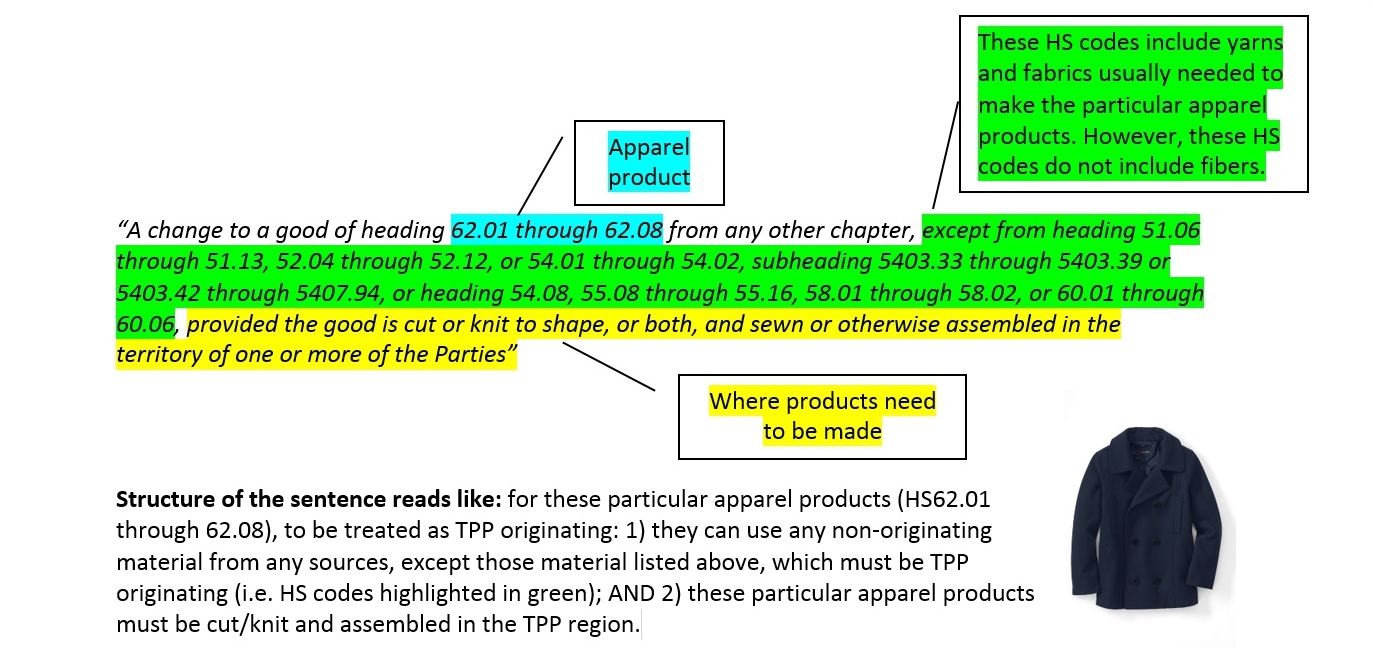
Textile and apparel (T&A)-specific rules of origin (RoO) for most apparel articles under TPP are known as the nickname “yarn forward”. “Yarn-forward “means preferential treatment under TPP will be allowed if the component determining classification meet BOTH the following two criteria:

  • knit or woven in TPP countries FROM yarn spun or extruded in TPP countries;
  • apparel is cut or knit to shape or both + sewn or otherwise assembled in TPP countries

In other words, “yarn forward” RoO not only requires the activity of apparel manufacturing must happen in one or more TPP countries, but also requires certain textile material used to make the apparel products must come from the TPP region.

The following is an example of how TPP describes “yarn-forward” rules of origin:

“A good is an originating good if it is produced entirely in one or more TPP countries by one or more producers using non-originating materials and each of the non-originating materials used in the production of the good satisfies any production process requirement, any applicable change in tariff classification requirement or any other requirement specified.”

yarn forward

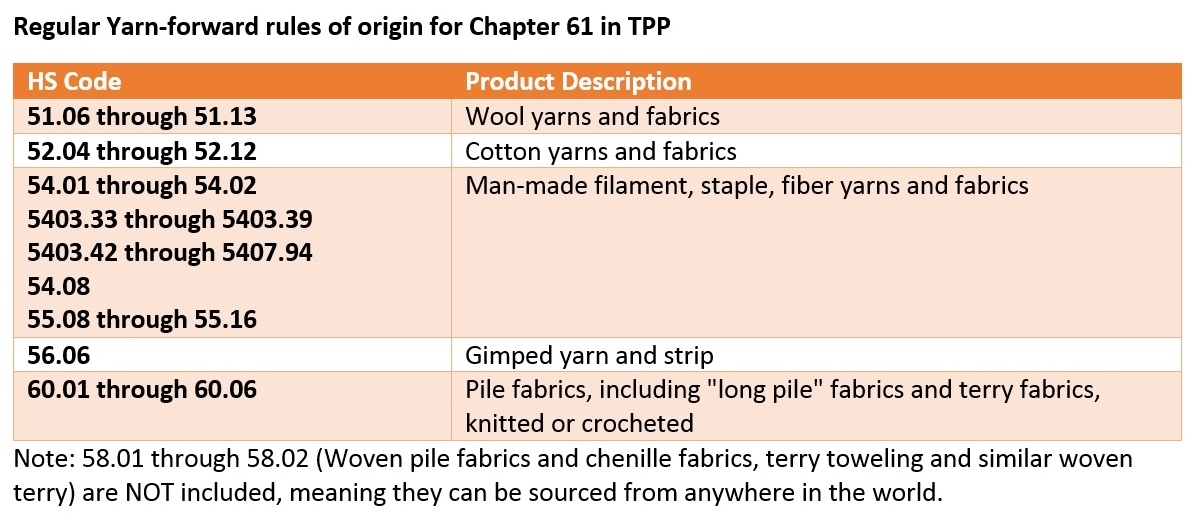
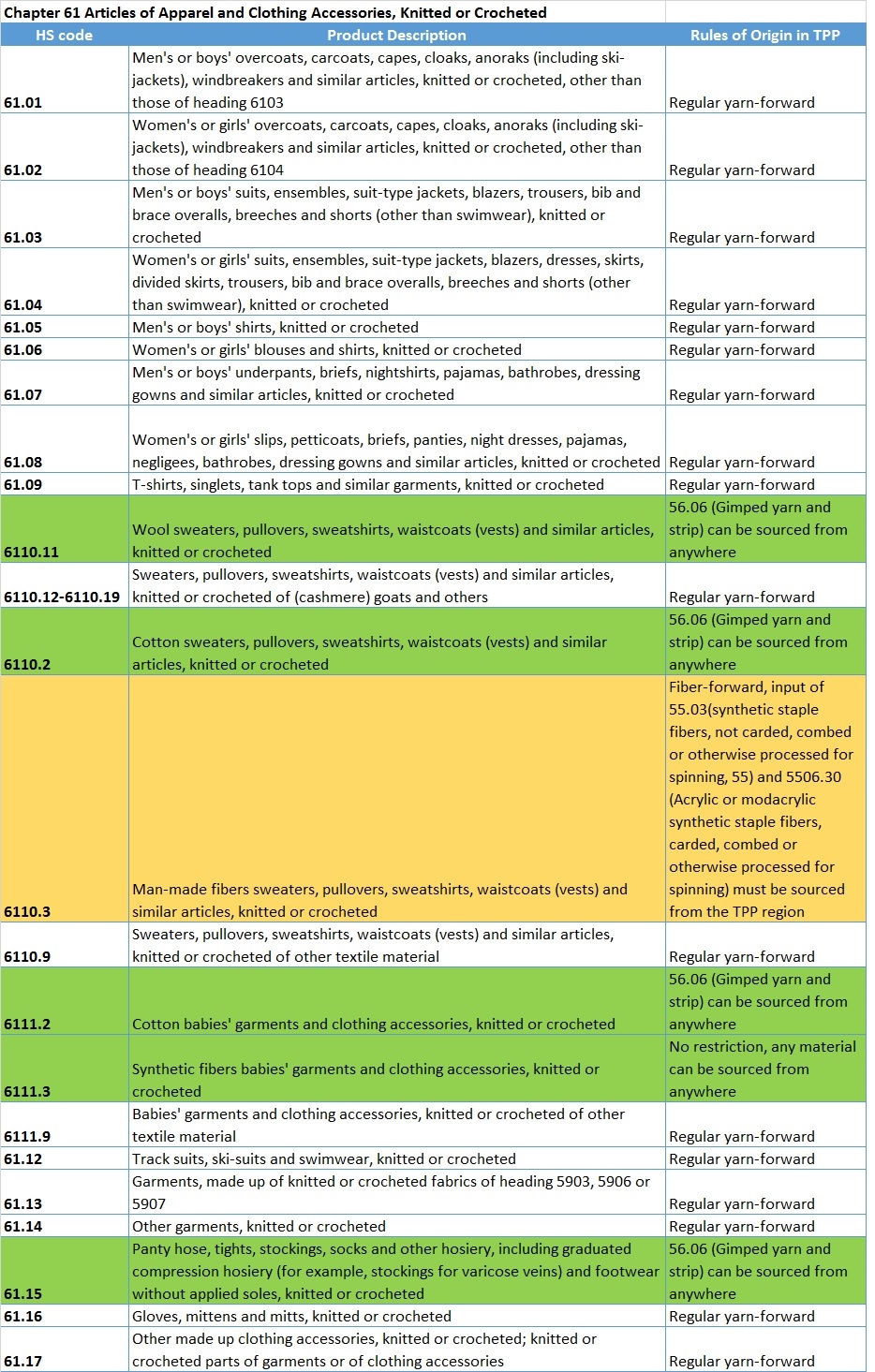
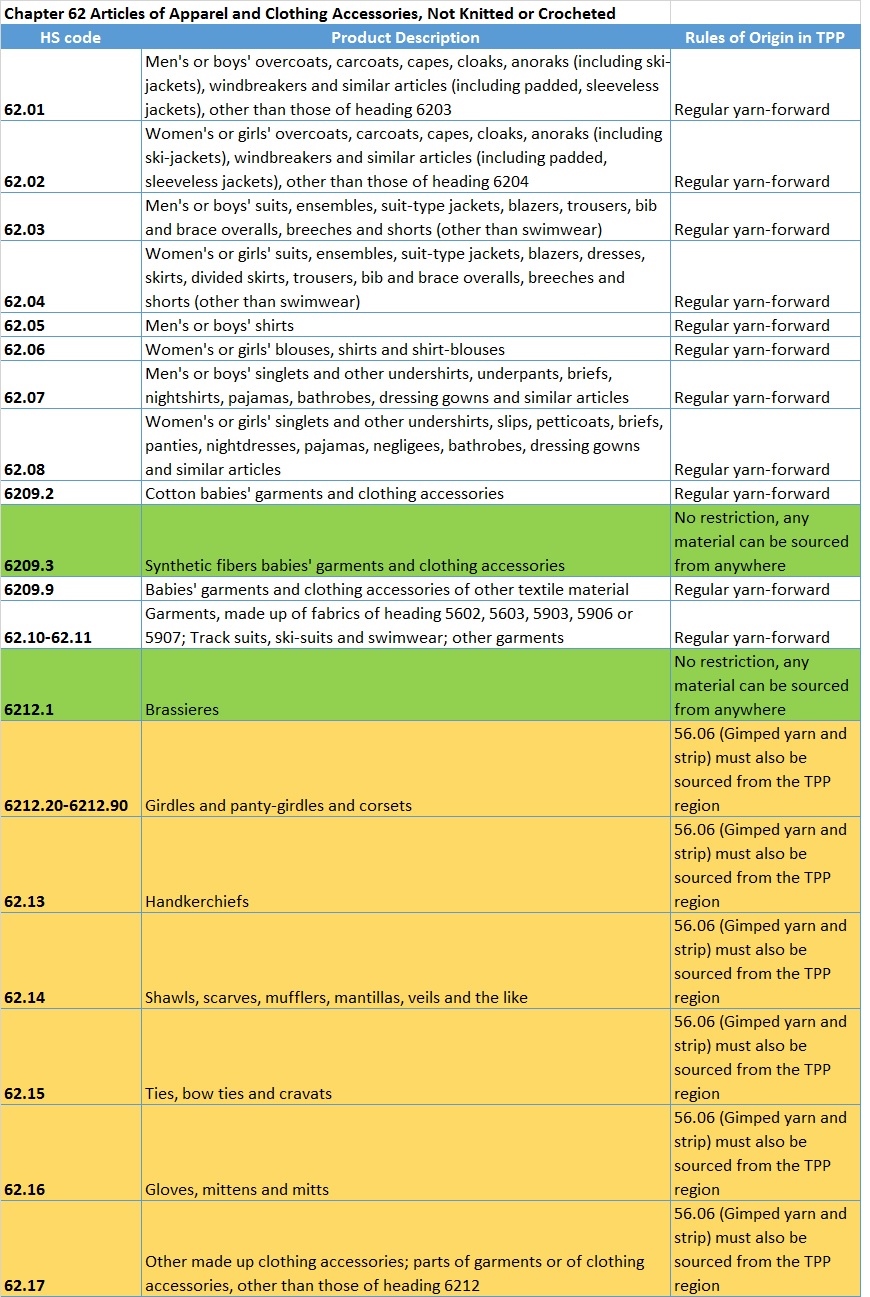
The followings are details of T&A-specific RoO for apparel products in TPP compiled based on released TPP text. “Regular yarn-forward” means all textile material listed in the table must be TPP originating. Overall, TPP allows much fewer exceptions to “yarn-forward” rules than most existing free trade agreements in the United States (such as NAFTA, CAFTA-DR, and Columbia Free Trade Agreement).

61 rule.jpg

61

62 rule.jpg

62

U.S. Department of Commerce Releases Factsheet on TPP and the U.S. Textile and Apparel Industry

textile_Page_1

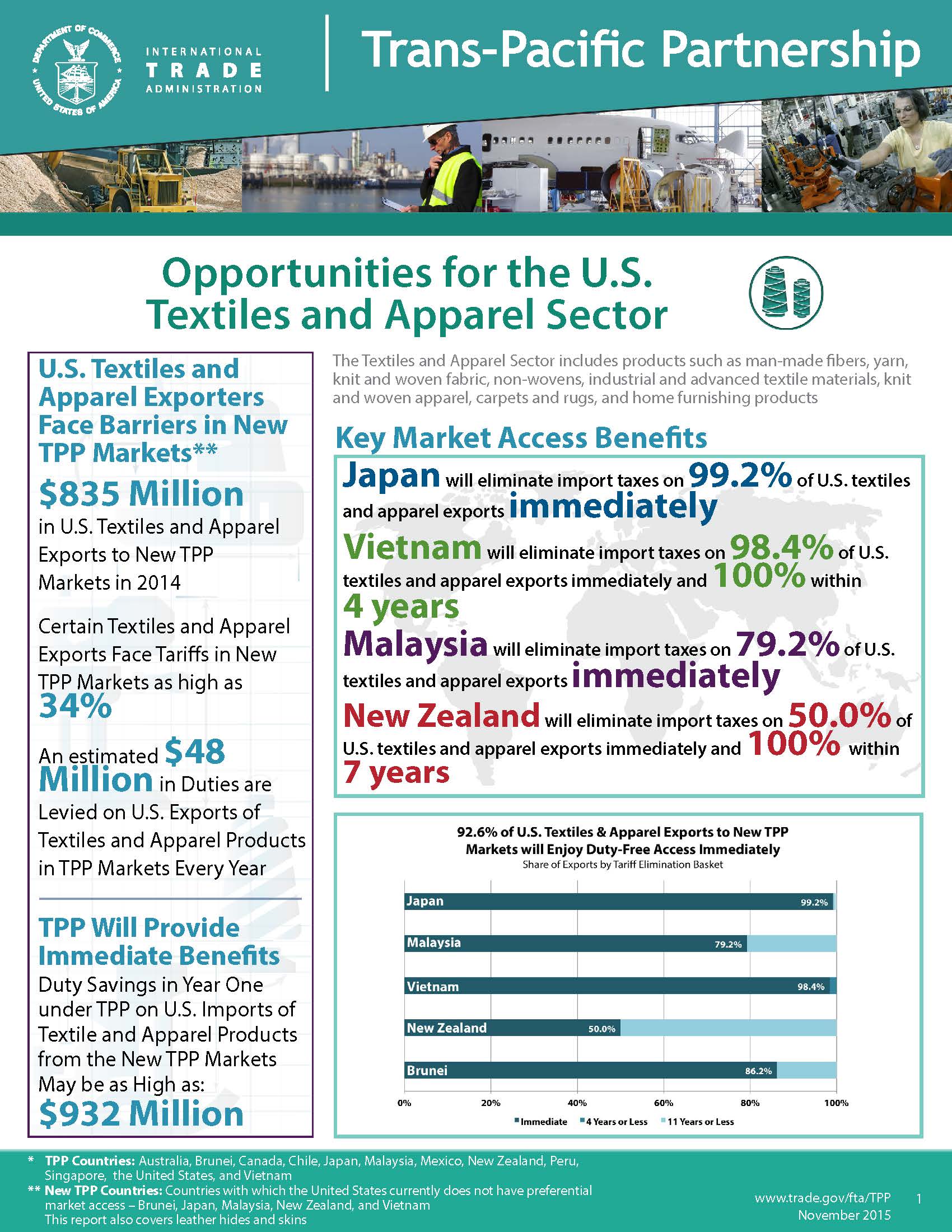
According to the factsheet released by the U.S. Department of Commerce, the Trans-Pacific Partnership (TPP) will create exciting new export opportunities for the U.S. textile and apparel (T&A) industry. The report highlights Vietnam and Japan as two promising markets in TPP for certain T&A products “Made in USA”, including:

Vietnam:

  • Cotton fiber, yarn, and Cotton woven Fabric (U.S. exported $394 million in 2014 with 16% market share only after China; tariff will be cut from 12% to zero on day one)
  • Non-woven fabrics (U.S. exported $23million in 2014, up 951% from 2009; tariff will be cut from 12% to zero on day one)

Japan

  • Synthetic fiber, yarn, and fabric (U.S. exported $61 million in 2014, up 61% from 2009; tariff will be cut from 2.7%-10% to zero on day one)
  • Industrial and advanced textile fabrics (U.S. exported $91 million in 2014, the fourth largest supplier after China, Taiwan, South Korea; tariff will be cut from 8.2% to zero on day one)
  • Men’s and boy’s apparel (U.S. exported $32.6milion in 2014, up 30.9% from 2009; tariff will be cut from 9.8% to zero on day one)

The factsheet also argues that TPP is a “balanced” deal for the U.S. T&A industry: long U.S. tariff phaseout schedule, strict “yarn-forward” rules of origin and textile safeguard mechanism in TPP will serve the interests of those stakeholders that seek protection of U.S. domestic T&A manufacturing, whereas duty savings from import tariff cut and the short supply list will create greater market access opportunities for U.S. fashion brands and retailers.

According to the report, the United States is the fourth largest textile exporter in the world. 54% of total U.S. T&A exports went to TPP markets in 2014. The United States is also the single largest importer of T&A in the world. 372,300 T&A manufacturing jobs remained in the United States in 2014.

Potential Impact of the Trans-Atlantic Trade and Investment Partnership (T-TIP) on Related Textile and Apparel Trade Flows

The presentation was delivered at the 2015 International Textile and Apparel Association (ITAA) Conference in Santa Fe, New Mexico on November 13, 2015. Welcome for any suggestions and feedback.

USTR Michael Froman Comments on the Textile and Apparel Chapter under TPP

Trans-Pacific-Partnership-1

In an event hosted by the Council on Foreign Relations on October 15, 2015, U.S. Trade Reprehensive Michael Froman left a comment on the textile and apparel chapter (T&A) under TPP. He said that:”

“You know, we worked very hard to find solutions that could address the broad range of stakeholder interests here, even when we had conflicting interests here in the U.S. I’ll take textile as an example. You know, we have a domestic textiles industry that’s been investing in more production in the U.S., growing their employment in the U.S. And obviously we have a strong sector of our economy that brings in apparel from other countries, apparel importers and retailers. We worked very closely with both groups of stakeholders to come up with a solution, to come up with an outcome that we think both will be comfortable with and both will be supportive of. And that’s been very important to us to try and address the broad range of U.S. stakeholder interests, whether it’s labor, environment, importers, exporters, to make sure we’re covering everybody’s interests well.”

In the remarks, Forman also ruled out the possibility that TPP would be renegotiated. He said that:

“So this isn’t one of those agreements where, you know, you can, you know, reopen an issue or renegotiate a provision. This is one where, you know, every issue is tied to every other issue and every country’s outcome is balanced against every other country’s outcome. And so that’s the agreement that we’ll be putting forward under TPA for a vote by Congress.”

According to Inside U.S. Trade (October 9, 2015), the final TPP reflects some of the key priorities of the U.S. textile industry by allowing limited exceptions from the prevailing yarn-forward rules of origin and by including tariff phaseouts for “sensitive apparel items” of 10 to 12 years.

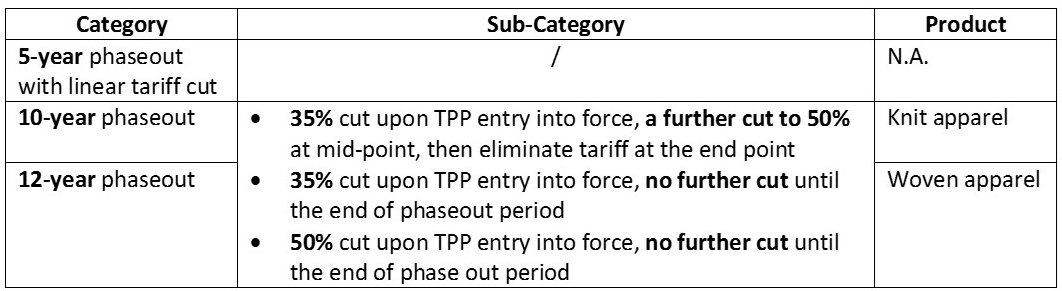
Besides the basket of goods that will become duty-free upon entry into force (which include cotton shirts and cotton sweaters), TPP sets up three other categories for tariff reductions on apparel:

TPP apparel

Major exceptions other than the “short supply list” mechanism under TPP include:

  • An “earned import allowance program for cotton pants made in Vietnam from third-country fabric by importing a specified amount of U.S. cotton pants fabric. This would allow cotton pants from Vietnam would enter the U.S. duty-free as soon as the agreement is implemented. It is said the ratio for the program is “close” to 1:1. However, for men’s cotton pants, there could be a 15 million square meter equivalents (SMEs) annual cap until year 10, after which it will increase to 20 million. There is no quantitative limit for the other types of cotton pants that can be shipped under the program, such as women’s, girls’ and boys’ pants.
  • A limited list of cut-and-sew items that Vietnam and other TPP countries can ship to the U.S. under the preferential TPP duty rate. These include synthetic baby clothes, travel goods including handbags, and bras.

When Will TPP Take Effect? Let’s look at the History

Untitled

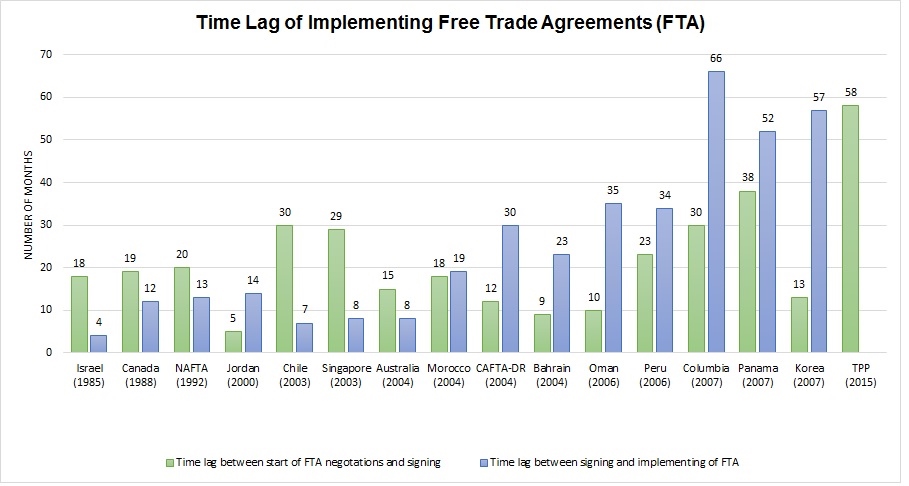
With the conclusion of the Trans-Pacific Partnership (TPP) negation on Oct 5, people now wonder: when will the agreement eventually take effect?

As shown in the chart above, since the 1985 US-Israel Free Trade Agreement, the average time lag between signing and implementing a free trade agreement (FTA) in the United States is 25.5 months (over 2 years). However, since 2006 the average time lag increased to 48.8 months (around 4 years).

So looks like it will take a while…

Potential Impact of TPP on the Textile and Apparel Sector: A Summary of Recent Studies

Screenshot 2015-10-06 08.13.16

(Picture credit: Lu, S. (2015) Does Japan’s accession to the Trans-Pacific Partnership mean an opportunity or a threat to the U.S. textile industry? A quantitative evaluation, Journal of the Textile Institute, 106(5), 536-549.)

With the conclusion of the Trans-Pacific Partnership (TPP) negotiation on Oct 5, 2015, it is time to think about its potential impact. Specifically for the textile and apparel (T&A) industry, the followings studies may offer some hints (to read more, you can click each title):

Trade Statistics

Statistics show the 12 TPP partners altogether imported $65 billion worth of textiles and $154 billion worth of apparel in 2013, which accounted for a world import share of 20 percent and 32 percent, respectively (WTO, 2015). In 2014, around 55 percent of U.S. textile and apparel exports (or $13.3 billion) went to the other 11 TPP partners, and 17 percent of U.S. textile and apparel imports (or $17.8 billion) came from the TPP region (OTEXA, 2015).

Impact of TPP on U.S. Textile and Apparel Manufacturing: A Preliminary Estimation

TPP overall will have a negative impact on U.S. domestic textile and apparel manufacturing. In all simulated scenarios, the annual manufacturing output in the United States will decline by $846 million–$3,780 million for textile and $1,154 million–$1,828 million for apparel than otherwise.

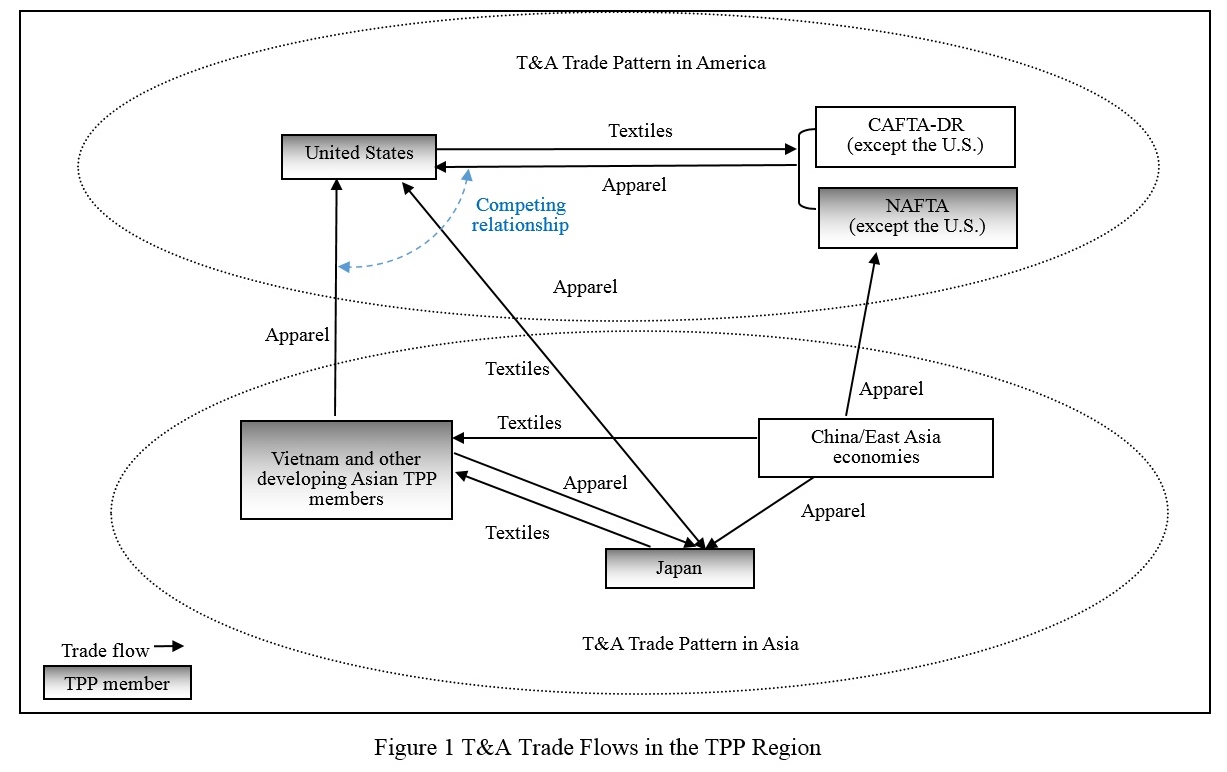
2.The “yarn-forward” rule may not substantially benefit U.S. domestic textile and apparel manufacturing as some people had suggested, for two reasons: 1) results show that Vietnam is more likely to use Japanese textiles than U.S. textiles when yarn-forward rule is in place. 2) U.S. apparel imports from Vietnam directly compete with those imported from NAFTA and CAFTA regions, the largest export market for U.S.-made yarns and fabrics. When NAFTA and CAFTA’s market share in the U.S. apparel import market is taken away by Vietnam, U.S. textile exports to NAFTA and CAFTA will decline anyway, regardless of whether Vietnam uses U.S.-made textiles.

3.Results suggest that compared with the “yarn-forward” rule, development of Vietnam’s local textile industry will have an even larger impact on the future of U.S. domestic textile and apparel manufacturing. Particularly, when Vietnam becomes more capable of making textile inputs by its own, not only Vietnam’s overall demand for imported textiles will decline, but also Vietnam’s apparel exports will become even more price-competitive in the U.S. as well as the world marketplace.

“Import Sensitive” Clothing and the TPP X-basket : What might include

1

Based on examining three recent trade programs, including: U.S. International Trade Commission (USITC) monitoring program on T&A imports from China based on the U.S.-China Textile Memorandum of Understanding (MOU) (2008—present), Office of Textiles and Apparel (OTEXA) monitoring program on U.S. T&A imports from Vietnam (2007-2008) and U.S. textile safeguard measures against China (2003-2005), it seems “import sensitive” T&A in the United States mostly refer to cotton and man-made fiber apparel and fabrics. OTEXA product Code 338, 339, 340, 345, 347, 348, 352, 447, 638, 639, 640, 645, 646, 647, 648 and 652 are most likely to be included in the TPP X-basket.

Because Vietnam’s T&A exports to the United States heavily concentrate on these “import sensitive” T&A categories, the X-basket has the potential to substantially affect the actual trade liberalization that can be enjoyed by the T&A sector under TPP:

  • By the most conservative estimation, i.e. the X-basket only covers Category A “import sensitive” apparel products, it will affect about 41.6 percent of U.S. apparel imports from Vietnam (or 38.7 percent of total U.S. T&A imports from Vietnam) if trade pattern remains the same as in 2014.
  • In the worst case, i.e. the X-basket covers all “import sensitive” T&A products identified by this study, it will affect about 70.0 percent of total U.S. T&A imports from Vietnam, if trade patterns remains the same as in 2014.

2015 US Fashion Industry Benchmarking Study

3

The survey results show that TPP matters for the U.S. fashion industry, with as many as 79 percent of respondents saying implementation of the agreement will impact their business practices. Specifically:

  • 72 percent expect to source more textiles and apparel from TPP partners, suggesting the imminent impact of TPP for the U.S. fashion industry could be trade creation.
  • Fewer than 10 percent expect to source less from non-TPP members after the implementation of the agreement, suggesting the trade diversion effect of TPP could be limited.
  • 48 percent expect to strategically adjust or redesign their supply chain based on TPP, implying TPP could be a game changer and has the potential to shape new patterns of textile and apparel trade in the Asia-Pacific region in the long term.
  • However, as few as 7 percent expect to export more products to TPP partners, while only 10 percent expect to invest more in TPP partners (building factories, operating retail stores and e-commerce operations) after implementation of the agreement. It seems the U.S. fashion industry hasn’t focused much on TPP’s potential to promote exports and achieve greater market access.
  • Additionally, 45 percent say the TPP Short-Supply List should be expanded, and comments indicate the proposed “yarn-forward” Rule of Origin is a major hurdle to the industry realizing real benefits from the agreement. In fact, as many as 83 percent support or strongly support abandoning the strict “yarn-forward” Rule of Origin and adopting a more flexible one in future FTAs (Figure 21). This suggests that the benefit of TPP for the U.S. fashion industry and the utilization of the agreement will largely depend on the Rule of Origin. In particular, there is a strong call among U.S. fashion companies to make the textile and apparel Rule of Origin less restrictive and more flexible in TPP.

Why does the US Textile Industry Want Yan-forward Rule of Origin (RoO) in TPP?

The US textile industry insists yarn-forward RoO in TPP is not because they expect a substantial increase of textile exports to Vietnam as the case of NAFTA and CAFTA which help capture the export markets in Mexico and Central America. But rather it is because:

1) Without yarn-forward, situation will get even worse. Particularly, a less restrictive RoO will make Vietnam’s apparel exports which contain textiles made in China, Taiwan or South Korea qualified for duty free access to the US market. Definitely this will be a more imminent and bigger threat to the US textile industry than simply facing competition from Vietnam’s apparel which contains Japanese made textiles. And still many US textile companies don’t treat the Japanese textile industry very seriously, although I think they should. Remember, Japan currently is the fourth largest textile supplier to Vietnam and the NO.1 textile supplier to China.

2) With yarn-forward RoO in place, at least US textile companies can invest in Vietnam (remember, globalization is about movement of capital as well. Many apparel companies in Mexico and Central America actually are invested by US companies). Without yarn-forward RoO however, Vietnam can simply rely on imported textiles as the case mentioned in (1) and there will be no incentive for US textile companies to move factories to Vietnam (meaning, capital holders will lose).

So overall yarn-forward RoO may win a few more years for the US textile industry. But in the long run, it is my view that the US textile production and its exports to the Western Hemisphere countries may still inevitably decline (especially those output to be used for apparel assembly purposes) after the implementation of TPP. In the 21st century, the nature of competition is supply chain v.s. supply chain.

USTR Adjusts Language of TPP Negotiation Objectives for Textile and Apparel

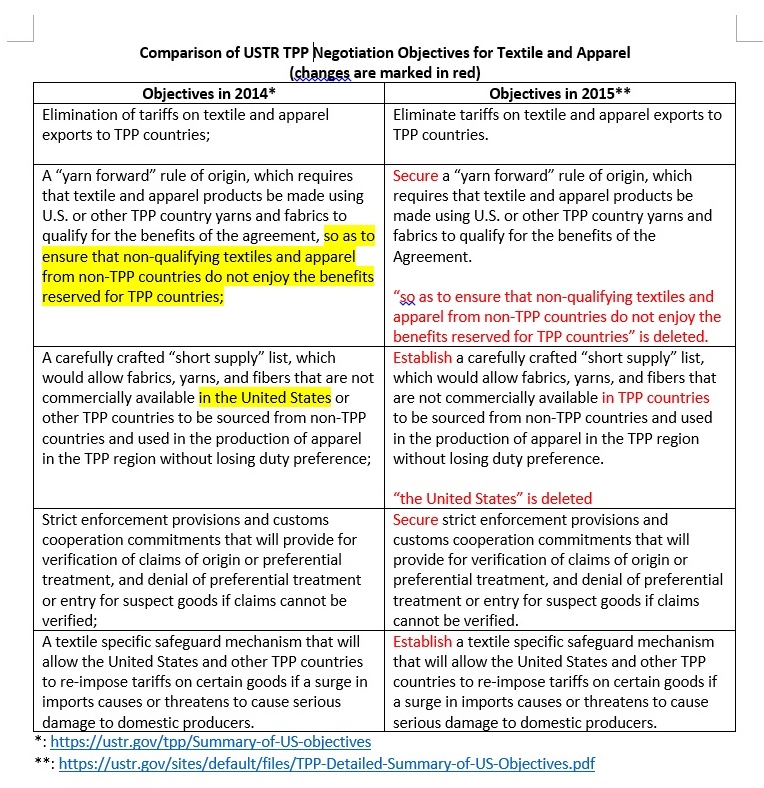
On September 22, the U.S. Trade Representative Office (USTR) releases a detailed summary of its latest TPP negotiation objectives. Specifically for the textile and apparel chapter, compared with the negotiation objectives released in 2014, some wording changes are made this time:

UntitledDoes the change imply that the U.S. side has agreed to allow more exceptions to the “yarn-forward” rules of origin in TPP, but in the format other than “short supply list”? For example, will it be “earned import allowance” or tariff preference level (TPL)?

On the other hand, does the change imply that the “short supply list” under TPP will be stricter than previously expected? (in the 2014 version of the negotiation objectives, it read like the “short supply list” may include those products that are not commercially available in the US but are commercially available in other TPP members. However, in the 2015 version, only those products that are absolutely not commercially available in the whole TPP region are eligible for the “short supply list”.)

Sheng Lu

2015 US Fashion Industry Benchmarking Study Released

[Note: The 2016 U.S. Fashion Industry Benchmarking Study has been released]

UntitledThe U.S. Fashion Industry Association (USFIA) released its 2015 benchmarking study today. The report examines the industry’s business environment and outlook, sourcing practices as well as U.S. fashion companies’ viewpoints on critical trade policy agendas. Among the key findings:

  • Overall, respondents remain optimistic about the five-year outlook for the U.S. fashion industry. Like last year, they are most concerned about increasing production or sourcing costs, but they expect increases to be more modest this year.
  • Consistent with our 2014 findings, U.S. fashion companies are NOT moving away from China, and Bangladesh remains a popular sourcing destination with high growth potential, though not quite as high as last year.
  • Companies continue to diversify their sourcing, though free trade agreements (FTAs) and preference programs remain underutilized.
  • The U.S. fashion industry is a critical Trans-Pacific Partnership (TPP) stakeholder, as close to 80 percent of respondents expect implementation will impact their business practices. However, the restrictive rules in the agreement limit the potential.
  • U.S. fashion companies continue to express interest in expanding sourcing in the United States in the next two years as they further diversify their sourcing. However, there is no evidence that companies are shifting their business models back to manufacturing.

This benchmarking study was based on a survey of 30 executives at the leading U.S. fashion companies from March 2015 to April 2015. The findings well reflect the views of the most influential players in the U.S. fashion industry, with 90 percent of respondents having more than 100 employees (including 60 percent with more than 1,000 employees).

The full report can be downloaded from HERE.

TPP Textile Negotiation Updates (March 2015)

trans-pacific-trade-agreement_issuebanner

According to Inside US Trade, negotiators continued their work on the technical details of the textile chapter under the Trans-Pacific Partnership (TPP) during the latest round of negotiation in Hawaii. Although progress has been achieved, key issues remain unsolved.   Exceptions to Yarn-Forward Rule of Origin Since the 807A program under the Caribbean Basin Imitative (CBI) enacted in 1998, the so called “yarn-forward” rule of origin has been adopted in almost all free trade agreement (FTA) and trade preference program (TPA) reached between the United States and its trading partners. “Yarn forward” rule requires that each step of apparel production from spinning of the yarn must take place in one of the FTA countries. At the same time, FTA/TPA often adopt exceptions in addition to “yarn-forward” rule so as to provide flexibility to importers, especially in the case when certain textile and apparel products are not available in commercial quantities from the FTA/TPA region. It is almost certain at this point that TPP will continue to adopt the “yarn forward” rules of origin. However, what kind of exceptions to the yarn forward rule will be allowed in TPP remain unclear: 1) How long will be the “short supply” list in TPP? Short supply list is a mechanism which allows fibers, yarns, and fabrics determined not to be available in commercial quantities in a timely manner from within the FTA partner countries to be sourced from outside the countries for use in qualifying textile and apparel products. According to Inside US Trade, some TPP countries want to declare the short-supply list complete as soon as possible so that they can shift the discussion to other possible exceptions to the yarn-forward rule. However, others doubt that the U.S. would be willing to contemplate additional exceptions and therefore believe that the best approach is to keep the short-supply list open and try to add as many products as possible. 2) Whether there will be other exception mechanisms in TPP in addition to the “short supply” list? According to Inside US Trade, there were some discussions on creating a separate mechanism such as the tariff-preference levels (TPL) in TPP. TPL allows for a certain quantity of textile and apparel goods (usually yarns, fabrics and cut pieces) from a third-country (a country who is not a party to the agreement) to qualify for the FTA benefits. Additionally, it is more than just Vietnam that is seeking more exceptions to the “yarn forward” rule in TPP. For example, Australia and New Zealand are also doing so, which may be in large part for tactical reasons — essentially holding up the textile talks as leverage to secure acceptable outcomes in other areas that are more important to them, for instance, agricultural market access or intellectual property. Tariff Phrase-out Mechanism Inside US Trade says that U.S. is sticking to the framework that it laid out in its initial tariff offer, which put products into three categories subject to different phrase-out schedule:

  • X-basket, which covers the most sensitive products that would be subject to an initial cut upon entry into force, but then remain in place until they are eliminated in the tenth year for knit apparel and fifteenth year for woven apparel
  • B-basket, which consists of slightly more sensitive apparel items that would be subject to a linear tariff phase-out over five years
  • A-basket, which consists of least sensitive items whose tariff rate would go to zero immediately upon TPP entries into force

Key questions remain as to which items the United States will place into what basket. Other issues in the textile chapter The TPP textile chapter may also include languages on the following two issues: 1) a special safeguard mechanism under which the importing country can raise tariffs up to the most-favored nation (MFN) level in the case of an import surge; 2) customs language on the inspection mechanism.

Mexican New Import Rules on Textiles and Apparel Raise Concerns

mexicanclothes

In January 2015, Mexico announced a set of new measures aimed at combating “unfair” trade practices in T&A imports and enhancing the competitiveness of domestic T&A sector in the face of increasing foreign competition.

The proposed measures will particularly target those imports considered to be “undervalued” by the Mexican government. According to Inside US Trade and Sourcing Journal Online, one of these measures is to establish a minimum reference price for imported T&A products. If shipments enter at below that price, they would be subject to an investigation by the Mexican government that could lead to the imposition of additional duties and taxes. To be noted, the proposed new measures will be taken separately from traditional trade remedy measures such as anti-dumping, countervailing duty and safeguard.

Other proposed measures intend to strengthen custom enforcement, including:

  • Mexico will required a mandatory registry for T&A imports. A similar registry system has been required for footwear;
  • Mexico will postpone the import duty reduction that was expected to be implemented at the beginning of 2016 on 73 apparel items and seven textile made-ups. Originally slated to enter into force on January. 1, 2013, the duty reduction from 25 percent to 20 percent has been twice postponed for one-year periods and will now be delayed until 2018;
  • Importers will be required to provide advance notice of shipments to the Mexican Economy Secretariat in the future;
  • Mexico will break down the current eight-digit tariff lines for textile and apparel products into 10 digits, which an industry source said would allow tariff rates to be more specific in light of the fact that apparel products have evolved to be more specialized;

Moreover, Mexico will implement a new financing mechanism with total available credit of 450 million pesos (around $30 million USD) over the next 12 months to help the domestic T&A industry (especially small- and medium-sized enterprises) upgrade their machinery and equipment, pursue innovative strategies and develop new products. The Mexican Service Agency for the Commercialization and Development of Agricultural Markets (Aserca) will further support the purchase of cotton from domestic growers by textile manufacturers.

According to WWD, the US T&A industry has three major concerns about Mexican’s proposed measures: one is the potential delay in custom clearance and more complicated documentation requirements; second is the additional tariff rate and increased cost of exporting from the United States or anywhere else in the world to Mexico; third is the lack of policy transparency adding to the potent business risks.

Industry Background

T&A industry accounted for 3.7 percent of Mexico’s GDP in 2013 (1.3 percent for textiles and 2.5 percent for apparel). About 415,000 workers directly employed in the sector in 2013, among which 74 percent worked for the apparel sector.

1

One important feature of Mexico’s T&A industry is the so called “Maquiladora” operation: simple sewing of garments made from imported fabrics and using cheap labor. The “Maquiladora” operation is largely coordinated by US-based apparel brands and retailers. Most of “Maquiladora” factories are located in the free trade zones, in which equipment and imported materials (such as fabrics) can be duty-free. Output of “Maquiladora” are exported, mostly to the United States.

3

Mexico imported $8.6 billion T&A in 2013, among which $2.4 billion were fabrics, followed by made-up textiles ($0.55 billion) and yarns ($0.39 billion). This pattern reveals Mexico’s heavy reliance on imported textiles due to limited domestic textile manufacturing capacity.

At the same time, Mexico’s apparel imports increased from $2.4 billion in 2008 to $2.9 billion in 2013. Particularly, Mexico’s apparel imports from China surged by 558.8 percent between 2008 and 2013. In 2013 alone, apparel imports from China went up by 42.1% to $0.97 billion. It is said that China is the main target of Mexico’s proposed new import measures.

4

 [Comment for the post is closed]

Tariff or Not

B711fJvCcAAELet

Tariff is a tax levied on imports only. Tariff will make imports more expensive in the market. For example, if the original price of a “Made in China” T-shirt is $5, with a 20% tariff, it becomes $5*(1+20%)=$6 when sold in the U.S. market.

Tariff has multiple impacts. On one hand, tariff may protect the domestic industry from foreign competition and help government of the importing country gain some tax revenues. On the other hand, consumers will have to pay more (or consume less) because of increased market price as result of tariff. Tariff also hurts exporters and those sectors operating on a global basis. For example, a high tariff rate on imported fabrics may raise the production cost of a clothing manufacturer which sells its finished products to the world market. According to the World Trade Organization, nearly 60 percent of world trade today are inputs and components. 

Questions for discussion:

  • How to explain the phenomenon that tariff rates are so different across different types of product in the picture? Should they be so different?
  • Should tariffs on flats, sneakers, boots and moccasins be lowered or eliminated in the U.S. or even world wide? What issues need to be considered?

Why does the US Textile Industry Want Yarn-forward Rule of Origin (RoO) in TPP?

textile

My personal understanding: the US textile industry insists yarn-forward RoO in TPP is not because they expect a substantial increase of textile exports to Vietnam as the case of NAFTA and CAFTA which help capture the export markets in Mexico and Central America. But rather it is because:

1) Without yarn-forward, situation will get even worse. Particularly, a less restrictive RoO will make Vietnam’s apparel exports which contain textiles made in China, Taiwan or South Korea qualified for duty free access to the US market. Definitely this will be a more imminent and bigger threat to the US textile industry than simply facing competition from Vietnam’s apparel which contains Japanese made textiles. And still many US textile companies don’t treat the Japanese textile industry very seriously, although I think they should. Remember, Japan currently is the fourth largest textile supplier to Vietnam and the NO.1 textile supplier to China.

1

2

2) With yarn-forward RoO in place, at least US textile companies can invest in Vietnam (remember, globalization is about movement of capital as well. Many apparel companies in Mexico and Central America actually are invested by US companies). Without yarn-forward RoO however, Vietnam can simply rely on imported textiles as the case mentioned in (1) and there will be no incentive for US textile companies to move factories to Vietnam (meaning, capital holders will lose).  

So overall yarn-forward RoO may win a few more years for the US textile industry. But in the long run, it is my view that the US textile production and its exports to the Western Hemisphere countries may still inevitably decline (especially those output to be used for apparel assembly purposes) after the implementation of TPP. In the 21st century, the nature of competition is supply chain v.s. supply chain. 

The future of the US textile industry is those high-end markets, particularly technical & industrial textiles.  

Sheng Lu 

Additional Reading: The potential impact of TPP on the US textile industry

Textile and Apparel Sector in the TPP Negotiation: An Update

TPP_map

USTR objectives
Officially, USTR has announced the following objectives in the TPP for textile and apparel:

  • Elimination of tariffs on textile and apparel exports to TPP countries;
  • A “yarn forward” rule of origin, which requires that textile and apparel products be made using U.S. or other TPP country yarns and fabrics to qualify for the benefits of the agreement, so as to ensure that non-qualifying textiles and apparel from non-TPP countries do not enjoy the benefits reserved for TPP countries;
  • A carefully crafted “short supply” list, which would allow fabrics, yarns, and fibers that are not commercially available in the United States or other TPP countries to be sourced from non-TPP countries and used in the production of apparel in the TPP region without losing duty preference;
  • Strict enforcement provisions and customs cooperation commitments that will provide for verification of claims of origin or preferential treatment, and denial of preferential treatment or entry for suspect goods if claims cannot be verified; and
  • A textile specific safeguard mechanism that will allow the United States and other TPP countries to re-impose tariffs on certain goods if a surge in imports causes or threatens to cause serious damage to domestic producers.

X-basket
According to the National Council of Textile Organizations, with regard to the market access offer to Vietnam, textile and apparel products are categories into different groups based on their “sensitivity” to the domestic industry producing the like products. Among the three major categories, the so called “X-basket” will include textile and apparel items that are deemed most sensitive to the United States. Specific items to be included in the X-basket however are unclear and details of the phrase-out formula are still under discussion. It is said that items in the “X-basket” may be subject to an initial tariff cut ranging from 35 to 50 percent.

Vietnam’s top apparel exports to the United States are basic apparel items like shirts, sweaters and pants.  Many of them are the same types of items that were subject to the U.S. safeguard measures against China back in 2005. The U.S. textile industry hopes that the longer phrase-out period for items in the “X-basket” would provide needed time for the industry to adjust. However, for the Vietnam side, if duties on most of its apparel exports to the United States stay in place after the implementation of the TPP, the value of participating in the agreement would substantially be compromised.

Short-supply list
The short-supply list is a roster of fabrics and other textile inputs that are determined to not be readily available in the TPP region in commercial quantities on a timely basis and can therefore be imported from third countries. Items on the short-supply list would be exempt from the general “yarn-forward” rule of origin that the U.S. has proposed in the textiles and apparel talks. USTR is pushing for a short-supply list that would have permanent items as well as temporary items that will be removed after three years. Previous U.S. free trade agreements, including CAFTA, have included a short supply process to add additional products to the list once the agreement enters into force. But the U.S. has rejected the notion that the short-supply list could be modified after the TPP enters into force.

Mexico has consistently sought to limit the scope of the short-supply list, arguing that it actually makes some of the products that the U.S. had originally proposed for inclusion in the short-supply list. Mexico was also pushing for roughly 70 items proposed for the short supply to be included only on a temporary basis, rather than a permanent one.

Other TPP members’ positions
According to the Inside US Trade, Malaysia’s textile and apparel industry is supporting U.S. calls for a “yarn-forward” rule of origin in TPP, but is also pushing for a range of exceptions such as cut-and-sew allowances and a short supply list that would be periodically reviewed. Among the items the Malaysian industry would like to see on the short supply list are shirting fabrics such as woven cotton fabric that weighs not more than 250 grams because this type of fabric is said not made in the U.S. nor Malaysia.

Related reading
Lu, S. (2014). Does Japan’s accession to the Trans-Pacific Partnership an opportunity or a threat to the U.S. textile industry: A quantitative analysis. Journal of the Textile Institute. (ahead of print version) 


2014 USFIA Benchmarking Study Released

UntitledKey Findings

  • China will remain the dominant supplier, though Vietnam and Asia as a whole are seen as having more growth potential.
  • Companies aren’t leaving Bangladesh, and are committed to compliance.
  • Companies continue to look for opportunities closer to home, including the United States, as they diversify their sourcing.
  • Companies are diversifying their sourcing and expect to continue to do so. However, current FTAs and preference programs remain under-utilized or don’t represent a major component of respondents’ sourcing.
  • Respondents welcome the passage or renewal of all future trade agreements that intend to remove trade barriers and facilitate international trade in the industry.

About the Benchmarking Study
The 2014 USFIA benchmarking study is conducted based on a survey of 29 executives at 29 leading U.S. fashion companies from March to April 2014. The study incorporates a balanced mix of respondents representing various business types in the U.S. fashion industry, including retailers, importers, wholesalers, and manufacturers. The survey asked respondents about the business outlook, sourcing practices, utilization of Free Trade Agreements and preference programs, and views on trade policy.

The full study can be downloaded from HERE.

Why Textile and Apparel Majors Need to Know about Trade Policy

Untitled

This past week, our class moved to the topic of trade policy, which as usual turned out to be one of the most challenging and “least exciting” chapters for our students. A common question in students’ mind is (and probably for some professors in the textile and apparel field as well): as a fashion major, why do I need to care about trade policy?

The answer is straightforward: textile market is shaped by rules—trade policy. Trade policy affects the availability of T&A products in the market in terms of quantity, price and speed. Trade policy also affects T&A companies’ access to the market, both domestic and foreign. Simply look at the clothing and shoes we wear daily: if they are imported, very likely the price we pay includes 10-30% additional tax (tariff). Even the clothing is “made in USA”, we should realize that the survival of US domestic apparel manufacturing could be the result of protection by the exact same trade policy which makes imported competing products 10—30% more expensive than otherwise in the US market.

Yet, trade policy does not happen naturally. Trade policies are deliberately made by policymakers and strongly influenced by industry players. Two things I hope our students can realize: first, the T&A industry cannot afford ignoring trade policy. Think about this case: if the US yarn manufacturers did not actively advocate “yarn-forward” rules of origin to be adopted in NAFTA and CAFTA, what will happen to their fate right now? Vice versa, how will the commercial interests of apparel retailers/importers be affected if they stop voicing themselves and simply leave the trade protectionism forces to influence trade policymakers? As the saying goes: if you are not at the table, you are on the menu. To certain extent, there is no good or bad trade policy, but winners and losers.

Second, understanding trade policy making is about understanding the real world. Trade policymaking is a painful balancing process like trying to “breathe and suck at the same time”.Not only different interests groups may have conflicting views on a specific trade policy, but also different policymakers may have their respective philosophies and priorities. As we mentioned in the class, agencies in the executive branch such as the US Trade Representative Office and the Commerce Department put national interests and international obligations of the United States at its heart whereas the Congress often times gives preferences to regional, sectoral and party interests.  A full understanding of T&A trade policy thus requires familiarity with what’s going on in this unique industry sector, knowledge about its key players as well as having a big picture vision in mind. For example, without recognizing the value of becoming a WTO member for China, it will be difficult to appreciate why it was willing to allow US to restrict its apparel exports from 2003 to 2008 on a discriminatory basis (T-shirt book, part III).

Our FASH students shall be encouraged to jump out of the narrowly-defined fashion world, because no industry operates as an island. Instead, the T&A industry is part of the world economy and shaped by the “rest” of the world economy.

 Sheng Lu

The Ways and Means Hearing Shows Divided Views on US Trade Policy for Textiles and Apparel

ways&means

US Trade Representative Michael Froman testified on Obama’s 2014 trade policy agenda before the House Ways and Means Committee on April 3. Issues concerning the textile, apparel and the footwear industry were raised three times during the 3-hour hearing. However, it seems the Congress is much divided on how to deal with the T&A sector deemed as “sensitive” in the FTA talks.

(1h:42’)Mike Thompson (D-CA) asked Froman to reevaluate the value of including the “yarn-forward” rules of origin (RoO) in the TPP. Thompson suggested that this rule only affects a small proportion of the US apparel imports nowadays (Note: according to Froman, it was $13 billion annually or 17% of the total US apparel imports) and no longer meets the needs of the US outdoor apparel industry which demands more flexible RoO in supporting of their business model. In response, Forman said that “the USTR’s approach to T&A is always being to ensure to strike a balance that helps the domestic producers continue to produce while allowing importers to import products that serve customers…”

(2h:06’) Earl Blumenauer (D-OR) asked Froman to reduce the trade barriers (tariff and NTB) on footwear imports, arguing that less than 1% of the footwear consumed in the US nowadays is domestically produced. He said that the high tariff rates both retard the ability of the US footwear industry to concentrate on those parts of the value chain that it enjoys competitive advantages and hurt the interests of the US consumers. In response, Forman said that footwear has been a sensitive and key issue to the US and among other TPP members. According to Forman, USTR has been working both with the domestic producers and the importers to develop an approach hoping to achieve the right balance that the domestic producers can continue to compete and also the importers can bring in high quality products (from overseas) for the US consumers. Additionally, Forman referred to the footwear industry an “outstanding area” in the TPP negotiation and said that discussion among all partners will continue.

Last but not least, (2h:30’) Bill Pascrell(D-NJ), also the chair of the house textile caucus, reiterated the importance of the yarn-forward RoO to the US textile industry and asked Froman to ensure that the USTR will “seek the longest possible duty phrase out for the most sensitive textile items” in the TPP negotiation. In his reply to Pascrell, Forman said that his team will work with all stakeholders of the US T&A industry to fully understand what these “sensitive textile items” are and will use tools like the “phrase out period” and “short supply list” to strike a right balance. Pascrell also expressed the concerns of the US textile industry about Vietnam’s wanting of immediate access to the US apparel market after the implementation of the TPP. However, Forman declined to give any concrete promise, just saying the USTR commits to create the “maximum number of jobs in the US” through the trade talks[Note: textile industry jobs? Apparel retail jobs?].

In addition to the T&A, other issues mentioned in the hearing include TPA, GSP, TAA, IPR, SPS & TBT, TTIP, SOE, TiSA, ITA and WTO.

Full hearing can be viewed here

Sheng Lu