What Affects the Patterns of Used Clothing Exports?

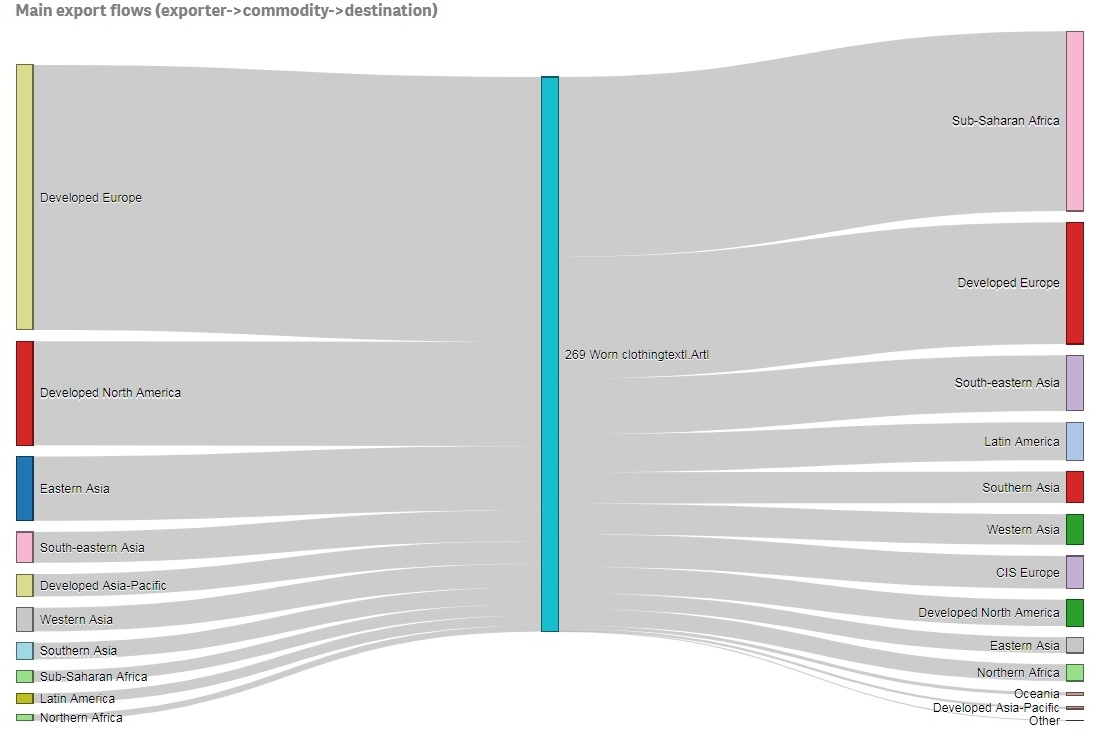
Used clothing trade patterns (data source: UNComtrade (2021)

This study intends to explore the key factors that affect the volume of a country’s used clothing exports. Notably, the world’s used clothing exports (defined as the Harmonized System code 6309) substantially increased from only $2.5 billion in 2009 to over $4.2 billion in 2019, or up 63.4% (UNComtrade, 2021). While numerous studies have explored the patterns of used clothing imports and their social-economic impacts on the importing countries, what drives a country’s used clothing exports remains largely unknown.

In the study, we conducted a regression analysis of 37 countries’ used clothing exports in 2019 (or over 90% of the value of the world’s used clothing exports that year) (UNComtrade, 2021). The explanatory factors we considered include new clothing sales (2018-2019), new clothing retail price (2018-2019), population (2019), and country classification (developed or developing in 2019). The results show that:

  • First, there is a strong positive relationship between a country’s new clothing sales and its used clothing exports. On average, a 1% increase in new clothing sales would result in a 0.85% increase in used clothing exports when holding other factors constant.
  • Second, as new clothing gets cheaper in the retail market, a country would export more used clothing and vice versa. Specifically, when the retail price for new clothing decreases by 1%, the value of used clothing export could increase by 1.2% on average when holding other factors constant.
  • Third, when holding other factors constant, used clothing exports from developed countries were 56% higher than in developing economies. Lower-income levels and various other social-economic factors (such as the awareness of sustainability and used clothing collection mechanism) could be the factors behind the phenomenon.
  • Fourth, the size of the population has NO significant impact on a country’s used clothing exports. This explains why a developed economy with a relatively small population (such as the Netherlands and Canada) exported far more used clothing than a populous developing one (such as India and Indonesia) in 2019 (Uncomtrade, 2021).

The study’s findings create new knowledge about the primary factors affecting the patterns of used clothing exports and have several important implications. First, the results suggest that we can do more on the supply side to curb the surge of used clothing exports, given the rising concerns about its controversial impacts on the developing world and the environment. Particularly, encouraging consumers to purchase fewer new clothing and shop more “slowly” can be among the most effective ways to reduce the supply of used clothing. Second, echoing the finding of existing studies, the results confirm the significant price impact on the generation of used clothing exports. Notably, the result reminds us about the enormous social-economic and environmental “cost” of selling new clothing too cheaply. Additionally, the findings suggest that developed countries have a crucial role in addressing the used clothing export problem, even those with a relatively small population.

By Aline Gomes Siqueira and Dr. Sheng Lu

Note: The study will be presented at the 2021 International Textile and Apparel Association (ITAA) Annual Conference in November.
Supply Chain Resiliency and the Role of Small Manufacturers—U.S. Textile Industry’s Perspective

Witness: National Council of Textile Organizations (NCTO) President and CEO Kim Glas; The full testimony is available HERE

Note:

Berry Amendment: Under a provision of 1941 legislation known as the “Berry Amendment” , the Department of Defense (DOD) must buy clothing, fabrics, fibers, yarns, other made-up textiles, boots, and certain other items that are 100% US-made.  Notably, the Berry Amendment mandates a much higher level of domestic content than the Buy American Act of 1933, which, in general, only requires 50% of the costs of a product to be manufactured in the United States. DOD spent around $1.6 billion on clothing, textiles, and footwear in FY2020 under the Berry Amendment. The items covered by the Berry Amendment have varied over the years. In the FY2017 NDAA (P.L. 114-328), Congress extended the Berry Amendment by requiring DOD to provide 100% U.S.-made running shoes for recruits entering basic training.

Biden’s “Buy America” policy:

  • On January 25, 2021, President Biden issued an Executive Order on Ensuring the Future Is Made in All of America by All of America’s Workers, as part of his “Build Back Better” economic recovery plan. The order created the role of a “director of Made-in-America” within the Office of Management and Budget and increased the threshold and price preferences for domestic goods.
  • Related, on February 24, 2021, President Biden released an executive order (EO) and announced to conduct a 100-day supply chains review on several key US industries, including semiconductors, batteries, strategic minerals, and pharmaceuticals. The review will also cover certain critical business sectors, such as national defense, public health, information and communication technology, energy, transportation, and agriculture. Further, the EO explicitly asks the Secretary of Health and Human Services, in consultation with the heads of appropriate agencies, to submit a report identifying risks in the supply chain of personal protective equipment (PPE). PPE includes textile products like facial masks, gowns and gloves. More comprehensive reform and supply chain strategies are likely to follow after the supply chain review requested by the EO.

Is the Western Hemisphere Textile and Apparel Supply Chain in Trouble?

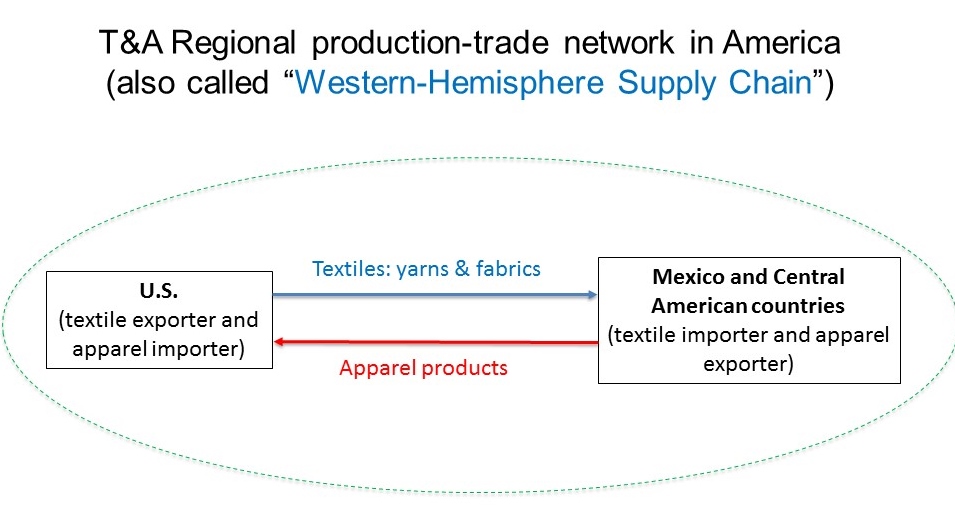
Within the Western-Hemisphere (WH) textile and apparel supply chain, the United States serves as the leading textile supplier, whereas developing countries in North, Central, and South America (such as Mexico and countries in the Caribbean region) assemble imported textiles from the United States or elsewhere into apparel. The majority of clothing produced in the area is eventually exported to the United States or Canada.

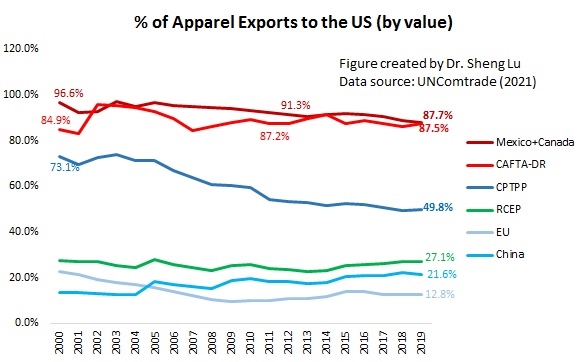
WH countries still form a close supply chain partnership in textile and apparel production. For example, close to 70% of US textile exports went to WH members in 2020, a pattern that has stayed stable over the past decades (OTEXA, 2021). Meanwhile, the United States serves as the single largest export market for most apparel exporting countries in the WH For example, in 2019, close to 89% of apparel exports from CAFTA-DR and USMCA (NAFTA) members went to the US.

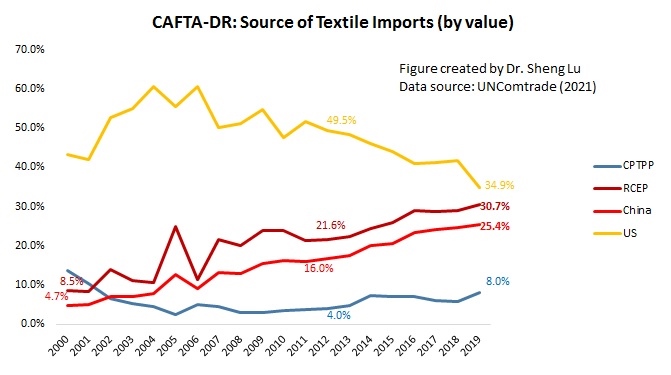
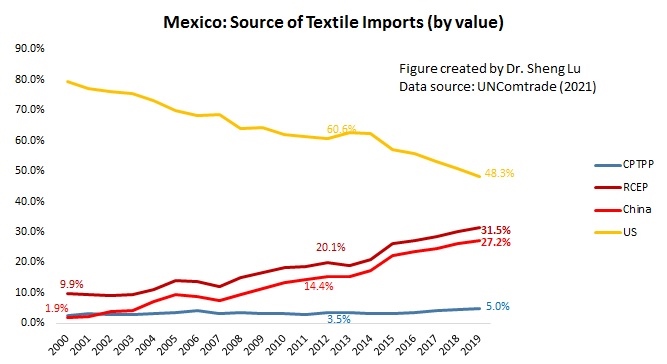
However, the WH textile and apparel supply chain is not without significant challenges. For example, CAFTA-DR and Mexico are increasingly using textiles inputs from outside the WH region, which weakens the US role as a dominant textile supplier. Notably, most of the market shares lost by US textile suppliers are fulfilled by Asian countries, including China and other members of the RCEP (Regional Comprehensive Economic Partnership). Theoretically, using cheaper textile inputs from Asia may help apparel producing countries in the WH improve the price competitiveness of their finished garments and diversify their export markets beyond the US.

Meanwhile, despite the apparent popularity of “near-sourcing”, no evidence suggests that US fashion brands and retailers are sourcing more from WH countries, including CAFTA-DR and USMCA (NAFTA) members. Neither the US-China trade war nor COVID-19 seems to have shifted the trends. Instead, close to 75%-80% of US apparel imports still come from Asian countries (OTEXA, 2021). Studies further show that a vast majority of US apparel imports from WH concentrate on a limited category of products, such as tops and bottoms, which is far from sufficient to meet retailers’ sourcing needs.

On the other hand, technical textiles and industrial textiles account for a growing share in the total US textile exports, and Asia is a particularly fast-growing market. However, there is few US free trade agreement with Asian countries, making it a disadvantage to promote “Made in the USA” products in these markets. It is debatable what should be the priority for the US textile and apparel trade policy: to continue to protect the exports of yarn and fabrics to the WH or open new export markets for technical and industrial textiles outside the WH region?

by Sheng Lu

Relate readings: