
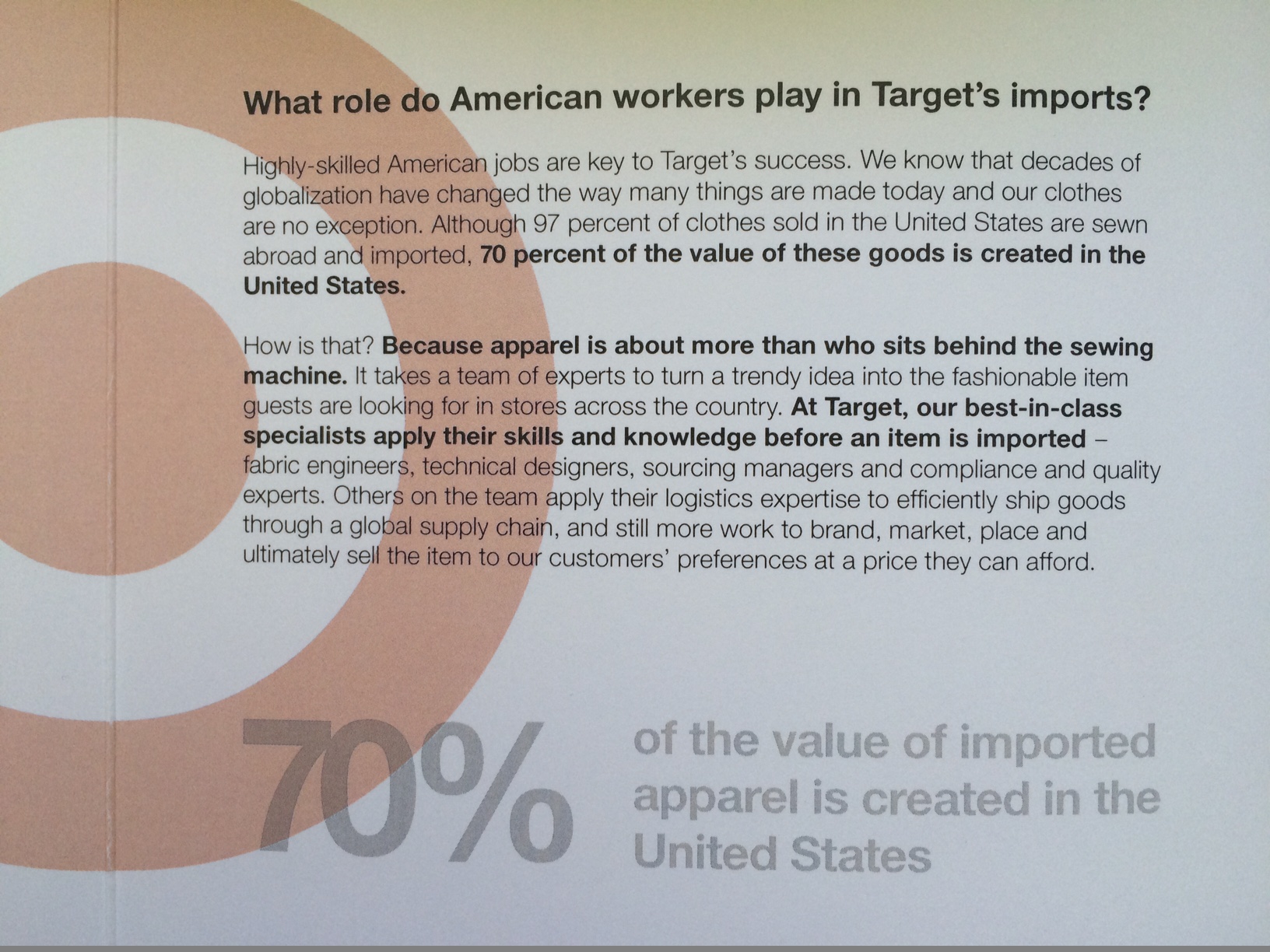
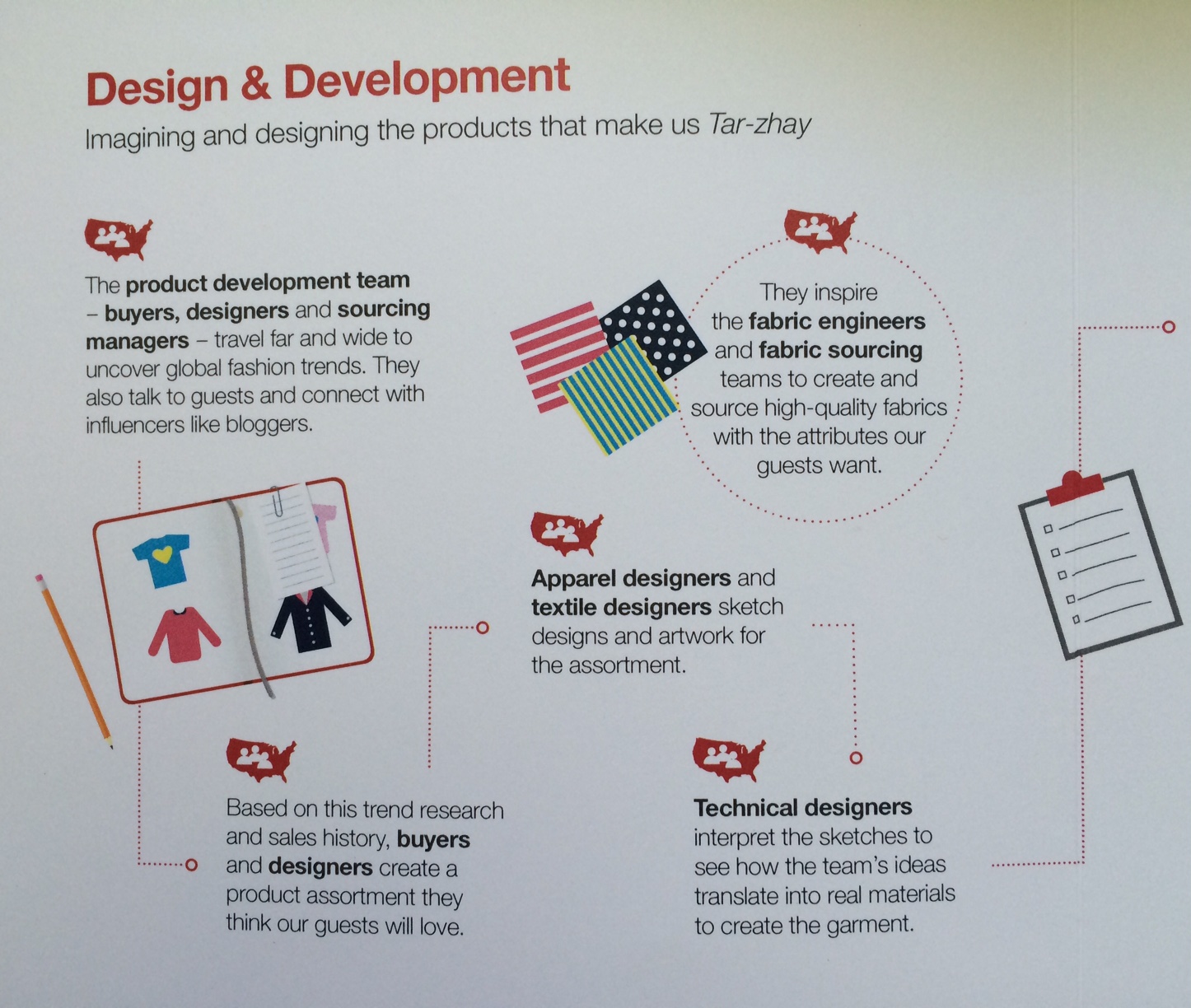
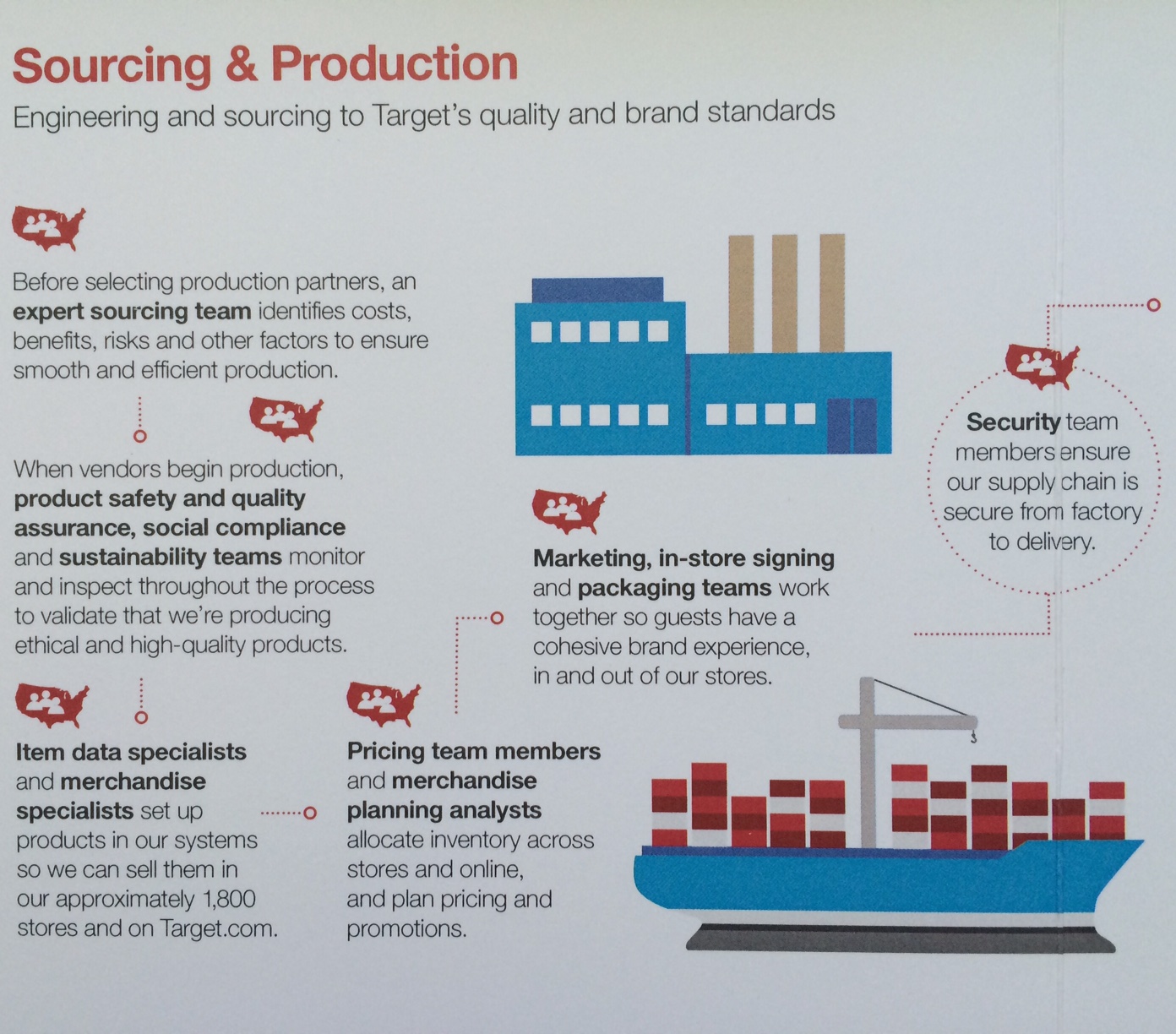


A global view in mind means more career opportunities: except material production and cut and sew, other well-paid jobs in the apparel value chain stay in the United States.
Source: Moongate Association (2017). Analyzing the Value Chain for Apparel Designed in the United States and Manufactured Overseas

 FASH455 Global Apparel & Textile Trade and Sourcing
It’s really interesting how when someone reads the label on their clothing, they more than likely assume that the item was entirely made wherever the label says. The full global value chain for apparel and all the jobs, people, and responsibilities it takes to bring a garment from an idea on the drawing board to a purchase by a consumer is not understood well enough. Like Target mentions, “apparel is about more than who sits behind the sewing machine.” There’s an entire chain of people who are needed to produce an apparel item, and it’s more than just the designer and the manufacturer. There are countless steps from the inspiration to the creation and production , then to the importation and the distribution, and finally to the transaction and into the consumers’ hands. Most consumers are highly uneducated about the path their apparel takes in order to get into their closets and homes, and it is something that companies, like Target, should start to do. This is the premise behind transparency, in that consumers should know exactly where their products came from, where they began, and all the ins and outs of the global value chain. I love how Target broke this down in not only a well-detailed manner, but also in a way that could be understood by their consumers.
very well said! As I know, Target creates these graph for members of US Congress–to help them understand the nature of today’s global apparel value chain and ask them not to favor “manufacturing jobs” over “service jobs.”
I am very aligned with what you have shared! I think that consumers underestimate not only the processes and supply chains behind how their clothing is made, but they also underestimate just how globalized our lives have become. Transparency is definitely a “ping word” but going off of that, I think that Traceability is another term that is becoming increasingly popular. Transparency is about, like you said, supply chains being accessible and visible to consumers. Traceability, I believe, is the additional “prove it” layer, meaning that it is really forcing brands to trace where resources are being sourced, and where they are going throughout the chain. A brand like Target, might pride themselves on being “transparent” with their supply chain, but might be sourcing products that originally came from Uyghur cotton (this is just an example – not saying they do).
I looked up what Target is doing in an effort to achieve transparency & traceability, and here is what I found: https://corporate.target.com/sustainability-ESG/governance-and-reporting/responsible-sourcing-sustainability/Supply-Chain-Traceability-Transparency
Indeed, traceability and supply chain transparency are very hot topics these days among fashion brands and retailers. More and more companies have started to voluntarily release their supplier list (such as Target). You may also find this article interesting and relevant: https://shenglufashion.com/2023/06/05/progress-and-challenges-in-apparel-supply-chain-traceability-a-case-study-on-asket/
On the other hand, this blog post is closely connected to the “smiling curve” concept we discussed in class. While much attention was given to the “made in” label, the graph reminds us that the apparel supply chain supports many well-paid non-manufacturing jobs in the US. In other words, the value chain concept further challenges the viewpoint that “import is bad.”
The whole global supply chain is so complex and has many different parts to it. When making a single product, there is so much more that goes into it than people necessarily think. For me personally, I never fully thought about how much effort and steps go into each garment, but this class has taught me to open my eyes and really think about where the garments I buy come from. I really like how open Target is about their products. Many brands keep it very private, which can make it difficult for consumers to really get to know the brand they are purchasing from. This is the first time I’ve seen a company who is really transparent with sourcing and production. They give detailed descriptions of before production, during, and after which is very important for consumers to understand because it could make or break their decision to buy from that specific company. I think companies need to be more open about specific details like where they source their products, how many employees work to create these products, and overall just more information about how merchandise arrives at their stores.
After doing some research, I found some information on other companies’ supply chains and how transparent they are. Amazon is another company that is very open about production and the behind the scenes of how you receive their products. An article I found, https://tinuiti.com/blog/amazon/amazon-supply-chain/, discusses the process behind sourcing and production for Amazon. It gives details of the process starting with sending products, receiving and storing, customer orders, shipping, customer service, and customer returns. It’s very important for companies to show consumers exactly how their process works to bring them the products they buy.
It is really interesting that all the materials and processes that go into a product can be found and made in another country but when it comes into the US, we give it 70% of its value. The branding, marketing, advertisements, and more are what give a products its worth, not only the materials.
In Target’s marketing, they heavily promote the value-added smiley graph curve in explaining the importance of how the corporate team based in the US gives the products 70% of their value. While I think it is amazing for Target to indicate the positions surrounding their apparel outside of manufacturing, it also takes away a lot of the credit from those parts of production. Displaying what the production of apparel looks like and what people do throughout the supply chain is wonderful for consumer awareness, but it does not highlight the work done offshore. I love seeing US-based positions in Target’s production receiving recognition, however, I ultimately believe it contributes to the minimal support and continued poor working conditions in developing countries if their importance in the supply chain is taken for granted.
I found the marketing techniques used by Target are super interesting. A lot of brands these days are highlighting their use of suitable materials or use of fair labor laws, but Target has approached it in a. completely new way. When they are stating 70% of the product is made in USA, I assumed they were talking about textile and fiber production, but then I kept reading. At first I thought of this information by target to be wrong or not true, in a sense “brain washing” the consumer. But, then I read some of my classmates responses and I have a new understanding of targets message, even if it’s an advertising tactic. I think it is important to highlight that there are so many other jobs that are in the US that rely on Target. Policy makers focus on the manufacturing jobs because they hold the most ethics issues, but most of the jobs are in the US and are not manufacturing.
I think it’s important for consumers to understand that even when a product is produced in another country, much of the process still involves the US, whether through design, distribution, or retail, which creates jobs domestically. Additionally, outsourcing production can foster mutual benefits—providing economic opportunities abroad while allowing businesses to offer affordable products at home. This approach highlights the global nature of trade, where helping other countries develop their industries and economies also strengthens international relationships and benefits consumers worldwide. It’s a reminder that global trade is often a mutual collaboration and support.
It is important for people to realize that even when a product is made in another country, much of the work that adds value happens in the U.S., such as design, distribution, and retail, which supports jobs here at home. Producing goods overseas can also bring benefits on both sides, offering economic growth abroad while enabling companies to deliver affordable products to consumers domestically. This showcases the collaborative nature of global trade, where helping other nations grow their industries can strengthen international ties and create shared benefits. Something that stood out to me is how much value a product gains once it has entered the U.S., due to activities such as marketing and branding which often contribute more to its worth than the materials or production itself.
I think that it’s very important for customers to truly understand where their products are coming from, and that almost all of the time, the clothing they are wearing isn’t just coming from one place. It takes a lot of different labor from different places to create just one article of clothing. Target highlighted that well as they describe the process that their clothing goes to before it actually hits the shelves. Additionally, it’s important for consumers to understand that producing goods overseas is what keeps our and other economies going, as it creates positive relationships between the US and other countries.
The breakdown of Target’s global value chain clearly illustrates how the “Made in” label captures only a small portion of where value is actually created. It is crazy when we look at labels we simply disregard where the garments truly come from. Manufacturing may take place overseas, a substantial part of the higher-value functions such as design, product development, logistics, and retail remain in the United States. At the same time, this raises an important acknowledgment, recognizing the value retained in the U.S. should not overshadow the contributions and working conditions of labor in sourcing countries. There has been increased transparency in companies and it is a meaningful step forward. But it must be paired with more efforts to ensure that value and responsibility are taken into consideration to prove to consumers their loyalty.
The Smiling Curve, a key idea from our class, relates to this blog post. It suggests that the most valuable parts of a global supply chain are at the beginning and end of the process. Design and branding are on one end, while retail and marketing are on the other. The manufacturing stages in the middle add the least value. This concept goes against the usual idea that production creates most of the economic value. The Target value chain supports the Smiling Curve well. Even though 97% of garments are made overseas, 70% of the apparel’s value is created in the U.S. This happens through design, sourcing, logistics, and retail. These activities represent the high-value endpoints of the Smiling Curve. Which raised the question of if policymakers should change their focus? Instead of only protecting manufacturing jobs, they might invest more in service roles like compliance, supply chain data analysis, and product creation. These roles could keep well-paying jobs in the United States.
The entire global supply chain is extremely complex and contains many moving parts. During the production of a product, making a single product, so much goes into ensuring it is created with the correct criteria. Personally, I never thought of the production process and how much goes into it, but this class has really given me a perspective and taught me about the manufacturing process. I respect how open Target is about the production of their products. Most brands are not as transparent when it comes to their manufacturing process. One key concept we have discussed in class that relates to this blog post is the stages of development in the textile complex. We have discussed the stages of development in the textile complex because it goes into depth on where companies are sourcing and manufacturing their garments or textiles from. In this blog post, we can see that the stages of development are fully explained on the brand Target. The article goes into depth about their manufacturing process and where they source their textiles from. This challenges the stages of textile development because Target mentions how American workers are involved directly in their production process, whereas not many brands can say the same. Going forward, we can further explore Targets product development and how The United States is directly involved in the process. I am curious know if they are going to maintain their U.S production, given it is more expensive in comparison to other countries.