BIS Released Assessment Report of the U.S. Textile and Apparel Manufacturing Sector

bis

The Bureau of Industry and Security (BIS) under the U.S. Department of Commerce recently released its assessment report of the U.S. textile and apparel (T&A) manufacturing sector. The report was based on a survey of 571 U.S. T&A manufacturers in summer 2017. These respondents include 230 textile mills (NAICS 313), 128 textile product mills (NAICS 314), and 213 apparel manufacturers (NAICS 315).

Below are the key findings of the study:

The state of the U.S. textile and apparel (T&A) manufacturing sector

  • U.S. T&A manufacturing has shrunk significantly: the value of T&A shipments (seasonally adjusted) in 2016 ($68 billion) was almost 56% decrease in real terms since 1995 ($153 billion).
  • U.S. T&A manufacturing has undergone substantial structural change: textiles and textile products accounted for 82% of the total shipments of the U.S. T&A industry as of 2016, compared to 57% in 1995. Notably, only 18% of shipments came from apparel manufacturing in 2016, compared to 43% in 1995.
  • U.S. T&A manufacturing sector is hiring less: Between 1990 and 2016, total employment decreased by 79%, from 1.7 million to 352,000 workers; over the same period, over 86% of apparel manufacturing jobs disappeared.
  • U.S. T&A manufacturers are making more capital investments: The overall total Capital Expenditures (CAPEX) of the 571 respondents increased 90 percent from 2012 to 2016 (from $1.6 billion to $3.1 billion). Particularly, the CAPEX of textile mills grew by 80 percent over that period—mostly on “Machinery, Equipment, and Vehicles.”
  • North Carolina hosted the largest number of U.S. T&A facilities (22 percent of the respondents), followed by Georgia (10 percent), and South Carolina (9 percent).
  • China, Mexico, and Canada are the most popular destinations for foreign investments by U.S. T&A manufacturers.

Competition landscape and factors

  • Respondents listed a total of 1,309 U.S. competitors and 552 non-U.S. competitors. Chinese companies were cited as the number one source of foreign competition.
  • “Quality,” “Lead Time,” and “Innovation” were the top three competitive advantages of U.S. T&A manufacturers as they related to foreign competition. “Labor Costs” was regarded as the top disadvantage of U.S. T&A manufacturing.
  • 43 percent of respondents believed that reshoring was occurring in U.S. T&A manufacturing. Almost all of these respondents believed that “Shorter Lead Times” and the “Marketability of the ‘Made in USA’ Label” were the factors driving the trend.
  • The Affordable Care Act (ACA), Minimum Wage regulations (Federal, State, and Local), and U.S. Trade Policy were the top governmental regulations and provisions cited as negatively impacting the competitiveness of U.S. T&A manufacturers.
  • 61 percent of respondents reported that they had difficulties hiring and/or retaining employees for their T&A operations, specifically production line workers such as operators and machine technicians. The skill gaps in the labor market for those positions were by far the biggest ones identified for the industry.
  • 43 percent of respondents believed that reshoring was occurring in T&A manufacturing (i.e., the practice of transferring a business operation that was moved to a non-U.S. location back to the United States.) Textile manufacturers were more likely to be aware of reshoring.

Trade and U.S. textile and apparel manufacturing

  • On average, respondents say 48 percent of their textile and textile products are “100 percent made in the U.S.”, while for apparel it was around 54 percent.
  • U.S. T&A exports dropped 10 percent between 2012 and 2016, from $2.2 billion to $1.98 billion. On average, exports accounted for only 12 percent of respondents’ total sales.
  • 33 percent of respondents considered themselves to be dependent on foreign sources for supplies, which was highest among textile mills.
  • 37 percent of respondents reported that they considered themselves to be dependent on non-U.S. sourcing for their machinery or equipment.

Berry Amendment and U.S. textile and apparel manufacturing

  • For textile mills, an average of 12 percent of U.S. output was Berry Amendment-related; for textile product mills the average was 21 percent, and for apparel production, it averaged 26 percent. 67 percent of respondents believed that the Berry Amendment had a positive impact on their organization’s business.

U.S. and Mexico Reached a Deal to Replace NAFTA

us-mexico-trade-agreement

The Office of U.S. Trade Representative (USTR) announced that the United States and Mexico have “reached a preliminary agreement in principle” to update the 24-year old North American Free Trade Agreement (NAFTA). According to USTR, compared with the existing NAFTA, the new deal will

  • strengthen the labor and environmental protection provisions
  • provide stronger and more effective protection and enforcement of intellectual property right protection
  • reduce various non-tariff barriers facing U.S. agriculture exports
  • include new rules of origin and origin procedures for autos (including requiring 75 percent of auto content be made in the United States and Mexico AND 40-45 percent of auto content be made by workers earning at least $16 per hour.)
  • include new chapters dealing with digital trade and textiles
  • include a 16-year “sunset period” with a review every six years, at which time the parties can renew the deal for another 16 years.

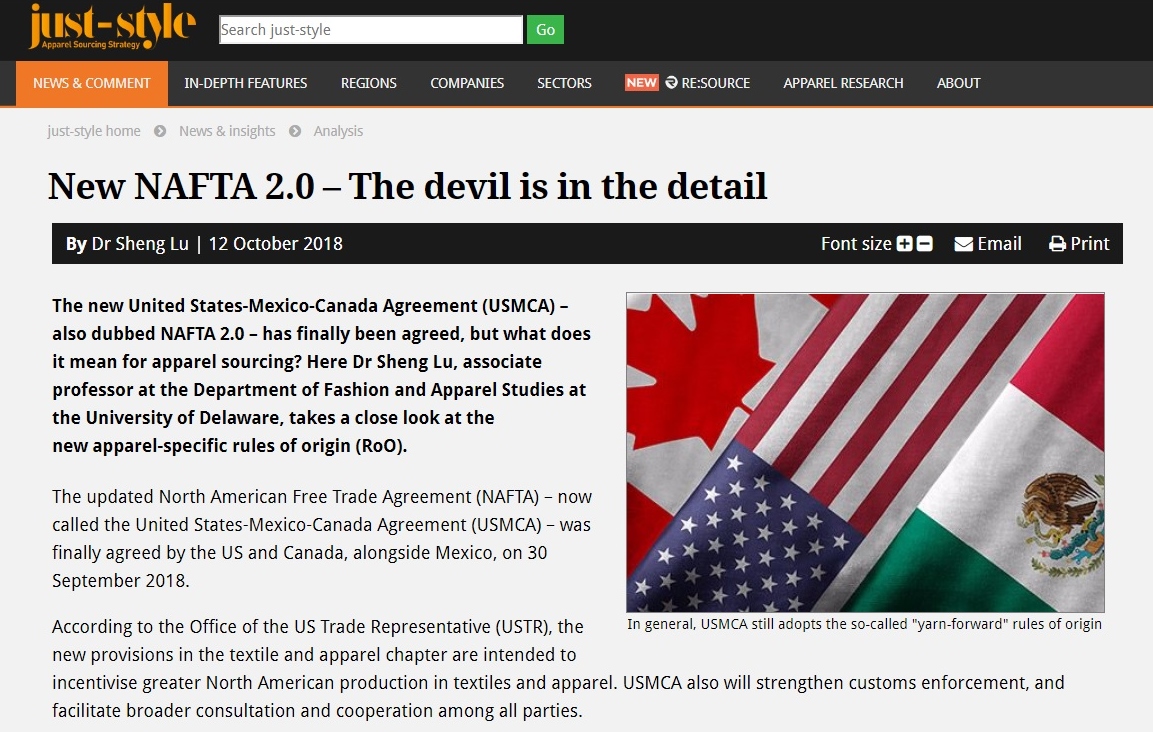
Specifically for the textile and apparel sector, USTR said that “The new provisions on textiles incentivize greater United States and Mexican production in textiles and apparel trade, strengthen customs enforcement, and facilitate broader consultation and cooperation among the Parties on issues related to textiles and apparel trade.” More specifically, the new textile chapter in renegotiated NAFTA will:

1) Promote greater use of Made-in-the-USA fibers, yarns, and fabrics by limiting rules that allow for some use of non-NAFTA inputs in textile and apparel trade; and requiring that sewing thread, pocketing fabric, narrow elastic bands, and coated fabric, when incorporated in apparel and other finished products, be made in the region for those finished products to qualify for trade benefits. “

2) Include textile-specific verification and customs cooperation provisions that provide new tools for strengthening customs enforcement and preventing fraud and circumvention.

Based on USTR’s statement, it is likely, although not confirmed, that the US-Mexico deal will allow more limited tariff preference level (TPL) than the existing NAFTA.

USTR’s statement also said that the new deal would be subject to “finalization and implementation,” and its relationship with NAFTA remain unclear. The statement did not mention anything about Canada, another NAFTA member, either. Interesting enough, when announcing the US-Mexico deal in front of the press, President Trump said I will terminate the existing deal (NAFTA).  When that happens, I can’t quite tell you; it depends on what the timetable is with Congress.  But I’ll be terminating the existing deal and going into this deal.  We’ll start negotiating with Canada relatively soon.”

In a statement released on the same day, the American Apparel and Footwear Association (AAFA) said it welcomed the conclusion of bilateral talks with Mexico on NAFTA and emphasized the need for Canada to be a part of any final agreement: “The conclusion of talks between the U.S. and Mexico is a positive step in the NAFTA negotiations, however, it is essential that the updated agreement remain trilateral. At the same time, we encourage the administration to share the details of the agreement so the business community can inspect the impact on North American supply chains and share feedback with the administration and Congress…Any update to the agreement must continue to support these American jobs, promote trade linkages, and be seamlessly implemented to be considered a success. It is with this in mind that we are deeply concerned to hear any mention of withdrawal or termination of the existing agreement at this late stage.”

According to Inside U.S. Trade, the National Council of Textile Organizations (NCTO) which represents the U.S. textile industry says it is “encouraged by the information released by USTR with respect to strengthening the rules of origin for textiles and apparel in the announced agreement with Mexico. U.S. talks with Canada are still ongoing, however, and NCTO will wait to review the text of any final agreement before issuing a more detailed statement on the negotiation outcome.”

2018 U.S. Fashion Industry Benchmarking Study Released

The 2019 U.S. Fashion Industry Benchmarking Study is now availablecover

The report can be downloaded from HERE

Key findings of this year’s study:

Business challenges facing U.S. fashion companies: Protectionism is the top challenge for the U.S. fashion industry in 2018. More companies worry about increases in production or sourcing cost, too. For the second year in a row, “protectionist trade policy agenda in the United States” ranks the top challenge for U.S. fashion companies in 2018.

Industry outlook: Despite concerns about trade policy and cost, executives are more confident about the five-year outlook for the U.S. fashion industry in 2018 than they were a year ago, although confidence has not fully recovered to the level seen in 2015 and 2016. In addition, 100 percent of respondents say they plan to hire more employees in the next five years, compared with 80-85 percent in previous studies; market analysts, data scientists, sustainability/compliance related specialists or managers, and supply chain specialists are expected to be the most in-demand.

U.S. fashion companies’ sourcing strategy: When it comes to sourcing, diversification is key for many companies.

  • Most respondents continue to maintain a diverse sourcing base, with 60.7 percent currently sourcing from 10+ different countries or regions, up from 57.6 percent in 2017.
  • Larger companies, in general, continue to be more diversified than smaller companies.
  • Reflecting the U.S. fashion industry’s growing global reach, respondents report sourcing from as many as 51 countries or regions in 2018, the same as in 2017. Asia as a whole continues to take the lead as the dominant sourcing region. Meanwhile, with the growing importance of speed-to-market and flexibility, the Western Hemisphere is becoming an indispensable sourcing base.
  • Keeping a relatively diverse sourcing base will remain a key element of U.S. fashion companies’ sourcing strategy. Nearly 80 percent of respondents plan to source from the same number of countries, or more countries, in the next two years. However, respondents are equally divided on whether to increase or decrease the number of suppliers they will work with.
  • China plus Vietnam plus Many” has become an ever more popular sourcing model among respondents. And this model is evolving as companies further diversify their China production. In particular, China now typically accounts for only 11-30 percent of companies’ total sourcing value or volume, compared with 30-50 percent in the past.
  • Although China’s position as the top sourcing destination is unshakable, companies are actively seeking alternatives to “Made in China.” This does not seem to be due to concerns about cost, but rather the worries about the escalating U.S.-China trade tensions.
  • Benefiting from the diversification away from China, Vietnam and Bangladesh are expected to play a bigger role as apparel suppliers for the U.S. market in the near future.

Rules of origin and the utilization of trade agreements for sourcing: Rules of origin, and exceptions to the rules of origin, significantly impact whether companies use free trade agreements (FTAs) and trade preference programs for sourcing.

  • While FTAs and trade preference programs remain largely underutilized by U.S. fashion companies, more companies are using NAFTA (65 percent), CAFTA-DR (58 percent) and AGOA (50 percent) than in the past two years.
  • Still, it’s concerning that companies often do not claim the duty-free benefits when sourcing from countries with FTAs or preference programs. Companies say this is primarily due to the strict rules of origin.
  • Exceptions to the “yarn-forward” rules of origin, including tariff preference levels (TPLs), commercial availability/short supply lists, and cumulation, are priorities for respondents; 48 percent say they currently use these mechanisms for sourcing. These exceptions provide critical flexibilities that make companies more likely to use FTAs and source from FTA regions.

NAFTA: U.S. fashion companies call for a further reduction of trade barriers and urge trade negotiators to “do no harm” to NAFTA, the most-utilized free trade agreement by respondents.

  • Respondents predominantly support initiatives to eliminate trade barriers of all kinds, from high tariffs to overcomplicated documentation requirements, to restrictive rules of origin in NAFTA and future free trade agreements.
  • More than half of respondents explicitly say NAFTA is important to their business—and they have grave concerns about the uncertain future of the agreement.

Sourcing in sustainable and socially compliant ways: Overall, U.S. fashion companies are making more commitments to sustainability and social responsibility.

  • 85 percent of respondents plan to allocate more resources for sustainability and social compliance in the next two years, in areas including providing training to suppliers and internal employees, adding more employees, and working more closely with third-party certification programs on sustainability and social compliance. However, the availability of operational budget remains the primary hurdle for companies that want to do more.
  • 100 percent of respondents map their supply chains (i.e., keep records of name, location, and function of suppliers), up from 90 percent in 2017. Over 80 percent of respondents track not only Tier 1 suppliers (i.e., factory where the final product is assembled), but also Tier 2 suppliers (i.e., subcontractors or major component suppliers, such as fabrics). However, it’s less common for companies to map Tier 3 (i.e., yarn spinners, finding and trimming suppliers) and Tier 4 suppliers (i.e., raw materials suppliers, such as cattle/pig hides, rubber, cotton, wool, goose down, minerals/metals and chemicals).
  • 100 percent of respondents audit their suppliers for issues including building safety, fire safety, and treatment of workers. The vast majority of respondents (96 percent) currently use third-party certification programs to audit, with both announced and unannounced audits.

The US Fashion Industry Benchmarking Study from 2014 to 2017 can be downloaded from HERE

U.S. Textile and Apparel Industry Responds to Trump’s Tariff Announcement against China

FOREIGN201708211521000183597989940

On June 15, 2018, the Trump Administration announced to impose a 25% punitive tariff on a list of Chinese goods based on the results of its Section 301 investigation, which targeted against China’s unfair trade practices related to the forced transfer of American technology and intellectual property. The additional duty will first apply to 818 lines of products on July 6, 2018, which cover approximately $34 billion worth of imports from China. Office of the U.S. Trade Representative (USTR) said it would issue a final determination on the second set of 284 proposed tariff lines, which cover approximately $16 billion worth of imports from China shortly. The total 1,102 tariff lines targeted by USTR generally focuses on products from industrial sectors that contribute to or benefit from the “Made in China 2025” industrial policy, which include industries such as aerospace, information and communications technology, robotics, industrial machinery, new materials, and automobiles.

In response to the U.S. action, China’s Ministry of Commerce (MOFCOM) quickly announced its proposed countermeasures, including a 25% punitive tariff on approximately $34 billion worth of U.S. soybean, autos, and fruits effective July 6, 2018. China is also ready to impose the punitive tariff on another list of products, which cover approximately $16 billion worth of medical device, chemicals and energy imports from the United States.

The U.S. textile and apparel industry keeps a close watch on the U.S.-China trade dispute since as much as 36% of U.S. textile and apparel imports come from China. In an announcement released on June 16, 2018, the American Apparel and Footwear Association (AAFA) called a victory that no textile and apparel products are subject to the punitive tariff proposed by USTR. The June 15 USTR list also removes the majority of the textile machinery initially on the retaliation product list back in April 2018. However, U.S. fashion brands and apparel retailers remain deeply concerned about Trump’s tariff action and its potential negative economic impacts on the apparel sector.

In contrast, the U.S. textile industry, represented by the National Council of Textile Organizations (NCTO) praised the Trump administration’s tariff announcement. NCTO also called on the Trump administration to include finished textile and apparel products on any future lists of imports from China to be made subject to Section 301 tariffs.  Not surprisingly, NCTO’s proposal is opposed strongly by AAFA and the U.S. Fashion Industry Association, representing U.S. fashion brands and apparel retailers. As argued by USFIA, the U.S. tariff rates on apparel and fashion products are already the highest among manufactured goods, reaching 32 percent for man-made fiber apparel and 67 percent for footwear. Any additional tariff would constitute a huge, regressive tax increase and have a negative impact on the American jobs.

Appendix: Timeline of U.S. Section 301 Investigation against China

June 15, 2018: The Trump Administration announced to impose a 25% punitive tariff on a list of Chinese goods based on the results of its section 301 investigation

June 4, 2018: Secretary of Commerce Wilbur Ross concluded his two-day trade negotiation with China in Beijing. A White House statement said “the meetings focused on reducing the United States’ trade deficit by facilitating the supply of agricultural and energy products to meet China’s growing consumption needs, which will help support growth and employment in the United States. The United States officials conveyed President Donald J. Trump’s clear goal for achieving a fair trading relationship with China.” While the announcement didn’t mention the next round, it says that the delegation will “receive guidance on the path forward.”

May 29, 2018: President Trump suddenly announced that the United States will impose a 25 percent tariff on $50 billion of goods imported from China containing industrially significant technology, including those related to the “Made in China 2025” program.  The final list of covered imports will be announced by June 15, 2018. The announcement also said that the U.S. Trade Representative Office (USTR) will continue WTO dispute settlement against China originally initiated in March to address China’s discriminatory technology licensing requirements. Additionally, the United States will implement specific investment restrictions and enhanced export controls for Chinese persons and entities related to the acquisition of industrially significant technology. The list of restrictions and controls will be announced by June 30, 2018.

May 19, 2018: A joint statement released by the White House said that the United States and China had led to an agreement for China to buy more goods and services, including “meaningful increases in U.S. agriculture and energy exports.” The statement also said that both sides attach importance to intellectual property protections, agreed to encourage two-way investment and to strive to create a fair, level playing field for competition, and agreed to engage at high levels on trade and investment issues. Additionally, the statement said that the United States would send a team to China to work out the details of the agreement. However, the statement did not contain a specific target for reducing the $375 billion trade deficits.

April 5, 2018: President Trump announced that he has instructed the Office of the U.S. Trade Representative (USTR) to consider $100 billion additional retaliatory tariffs on China, in response to China’s own retaliation against the Section 301 tariffs announced in late March. In a statement released the next day, USTR confirms the proposed new measures. USTR also says that any additional tariffs proposed will be subject to a similar public comment process as the proposed tariffs announced on April 3, 2018. No tariffs will go into effect until the respective process is complete. 

April 3, 2018: USTR released the proposed list of Chinese products to be subject to the retaliatory tariff under the Section 301 action. The proposed list covers approximately 1,300 separate tariff lines and will undergo further review in a public notice and comment process, including a hearing (scheduled at around May 15, 2018). The USTR statement says it will make a final decision on whether to implement the proposed tariff action after the whole process. 

March 26, 2018: USTR filed a WTO case against China’s discriminatory technology licensing requirements (DS542). The US claimed that China’s measures appear to be inconsistent with Articles 3, 28.1(a) and (b) and 28.2 of the Trade-Related Intellectual Property Rights Agreement (TRIPS). As of April 8, 2018, the European Union, Japan, Ukraine and Saudi Arabia have requested to join the dispute as third parties. According to the WTO rule, China shall enter into consultation with the US no later than April 26, 2018. If the dispute is not resolved by May 25, 2018 (i.e., 60 days after the request for consultation), the United States may request a WTO panel. As of June 17, 2018, the case is still in consultations.

March 22, 2018: President Trump announced his decisions on the actions the Administration will take in response to China’s unfair trade practices covered in the USTR Section 301 investigation of China’s Acts, Policies, and Practices Related to Technology Transfer, Intellectual Property, and Innovation. U.S. Trade Representative Robert Lighthizer initiated the investigation in August 2017 at the direction of President Trump. In the Memorandum he signed, President Trump directed the US Trade Representative to level tariffs on about $50 billion worth of Chinese imports. 

January 2018: the U.S. Trade Representative Office submitted its annual report on China’s WTO Compliance to U.S. Congress. The report says that “It seems clear that the United States erred in supporting China’s entry into the WTO on terms that have proven to be ineffective in securing China’s embrace of an open, market-orientated trade regime.”

August 14, 2017: President Trump issued a memorandum directing the USTR to determine if China’s policies regarding IPR theft and forced technology requirements “may be harming American intellectual property rights, innovation, or technology development,” and thus warrant USTR action under Section 301of the 1974 Trade Act.

Related reading: The Section 301 Investigation against China Divides the U.S. Textile Industry and U.S. Fashion Brands and Retailers

The Section 301 Investigation against China Divides the U.S. Textile Industry and U.S. Fashion Brands and Retailers
FOREIGN201708211603000328832175771

On April 3, 2018, the U.S. Trade Representative Office (USTR) released the proposed list of Chinese products to be subject to the retaliatory tariff under the Section 301 action. The proposed list covers approximately 1,300 separate tariff lines, including textile machinery. However, textile and apparel (HS chapters 50 to 63) were not on the list.

USTR says it will make a final decision on whether to implement the proposed tariff action after a public hearing process scheduled at around May 15, 2018. Most U.S.-based textile and apparel industry associated have submitted their public comments regarding the section 301 investigation. Because of their respective commercial interests, not surprisingly, the U.S. textile industry favors the retaliatory tariffs on imports from China whereas U.S. fashion brands and retailers oppose the action strongly. Specifically:

National Council of Textile Organizations (NCTO)

  • NCTO applauds the Trump Administration’s formal initiation of a Section 301 case designed to address China’s persistent and highly damaging actions in the area of intellectual property theft. NCTO argues that illegal activity on the part of the government of China has gone on for far too long, at the direct expense of U.S. manufacturers and the loss of millions of U.S. manufacturing jobs.
  • The U.S. textile industry is severely disappointed that the retaliation list published by USTR on April 3 does not contain a single textile or apparel product.
  • NCTO argues that China’s illegal IPR activities have damaged the U.S. textile industry and recommend that textile and apparel products be added to the retaliation list.

The United States Fashion Industry Association (USFIA)

  • USFIA opposes adding apparel (items classifiable under chapters 61 and 62 of the HTSUS) and other fashion products (such as footwear, handbags, and luggage) to the retaliation list against China.
  • USFIA argues that tariffs are NOT the appropriate mechanism to redress the activities outlined in USTR’s report to the White House. Imposing tariffs on imports of fashion products would do nothing to solve the concerns about China’s IP policies and practices outlined in USTR’s Section 301 report.
  • USFIA believes that the best way to address concerns about China’s IPR practices is action at the multilateral level that includes other US trading partners.

American Apparel and Footwear Association (AAFA)

  • AAFA strongly opposes the proposed imposition of tariffs on textile, apparel, and footwear equipment and machinery as this will result in increased costs for AAFA members who are making yarns, fabrics, clothes, and shoes in the United States.
  • AAFA believes that a tariff on textile and apparel products would be a hidden tax on U.S. consumers, particularly since China represents such a large source of U.S. imports of these products.
  • AAFA strongly supports the Trump Administration’s efforts to improve the protection of intellectual property rights in China.

Regional Textile and Apparel Supply Chains–Questions from FASH455

References and tables_Page_1

NAFTA and Textile and Apparel Rules of Origin

#1 How do rules of origin (RoO) and free trade agreement (FTA) regulations affect speed to market in apparel sourcing? Do countries who are part of an FTA find it to be easier to get to market in a shorter amount of time if they are working with other FTA members? Or could RoO slow down the production process because producers have to be more careful about compliance with the complicated RoO?

#2 Why or why not the “yarn forward” rules of origin remains an effective way to promote textile and apparel production in the Western-Hemisphere?  What other options are available to improve the competitiveness of the Western-Hemisphere textile and apparel supply chain?

#3 What would happen to the Western-Hemisphere textile and apparel supply chain should NAFTA no longer exist?

#4 Should NAFTA be responsible for the loss of US apparel manufacturing jobs? Any hard evidence?

#5 If you were U.S. trade negotiators, what would you do with TPL in NAFTA given the competing views from the U.S. textile industry and U.S. fashion brands and retailers?

The Outlook of “Factory-Asia”

#6 From the perspective of the U.S. textile and apparel industry, is it a good idea for the United States to reach free trade agreement (FTA) with Asian countries? If so, what countries should be included in the new FTA? If not, why?

#7 How can U.S. companies get involved in the Asia-based textile and apparel supply chain?

#8 Why or why not is the “Flying geese model” unique to Asia? Can the model be replicated in America too?

(Welcome to join our online discussion. Please mention the question number in your reply)

CPTPP Tariff Phaseout Schedule for Textiles and Apparel

The Comprehensive and Progressive Agreement for Trans-Pacific Partnership (CPTPP),  signed on March 8, 2018, is a new free trade agreement between Australia, Brunei, Canada, Chile, Japan, Malaysia, Mexico, New Zealand, Peru, Singapore, and Vietnam. Once the CPTPP enters into force, it will be one of the largest free trade agreements in the world and will provide enhanced market access to key Asian markets. Below is the detailed tariff phaseout schedule for textile and apparel products by CPTPP members:

CPTPP

This slideshow requires JavaScript.

by Sheng Lu

Is It Necessary to Cut Trade Deficit and Achieve Trade Balance?

2

1.jpg

While the Trump Administration is seeking to reduce the U.S. trade deficit and achieve a more “balanced trade” with its trading partners, a newly-released World Economic Forum (WEC) paper questions the necessity and economic rationale of doing so. As argued by the paper:

First, a country’s trade balance is NOT a measurement of its international commercial success. Neither is the case that “imports are bad and exports are good. “Instead, the paper says that “it is more accurate to think of imports as the benefits of trade, and exports as the cost that needs to be paid to obtain these benefits.”

Second, it is a misconception that “trade deficits cause a reduction in employment and production and trade surplus increase them.” Rather, imports could  increase because of an increase in domestic income thereby increasing the aggregate demand. Empirical studies also overwhelmingly find that rapid economic growth and larger trade deficit are associated with faster employment growth in the United States in history (see the graphs above).

Third, as the supply chain goes global, a tax on imported inputs can reduce rather than promote a country’s exports, particularly manufacturing goods (for example high tariffs on imported fabrics will reduce the price competitiveness of clothing exports). Likewise, trade barriers could disrupt production and reduce domestic employment in both the “protected” industries and those downstream sectors that use their outputs.  

Fourth, primarily trade balance is a function of a country’s national saving and investments, not of trade policies. In other words, trade policies, such as higher tariffs and quantitative restrictions, will have no impact on a country’s trade balance. Interesting enough, countries like Singapore which maintain fairly low trade barriers, run a trade surplus equal to as high as 20% of its GDP. In comparison, India was one of the most highly protected economies in the early 1990s when it experienced unsustainable large trade deficits. Further, there is a dynamic balance between a country’s trade balance and exchange rate: in an open economy, reducing a country’s imports could lead to an appreciation of its currency and eventually hurt its exports as well.     

What is your view on the trade deficit and trade balance? Why do you agree or disagree with the arguments of the WEC paper? Do you find any evidence that challenges the findings of the paper? Please feel free to leave your comments.

Outlook 2018: Apparel Industry Issues in the Year Ahead

Outlook 2019: Apparel Industry Issues in the Year Ahead is available 

th.jpg

In January 2018, Just-Style consulted a panel of industry leaders and scholars in its Outlook 2018–Apparel Industry Issues in the Year Ahead management briefing. Below is my contribution to the report. All suggestions and comments are most welcome!

1. What do you see as the biggest challenges – and opportunities – facing the apparel industry in 2018, and why?

One of the biggest opportunities facing the apparel industry in 2018 could be the faster growth of the world economy. According to the International Monetary Fund (IMF), the global growth forecast for 2018 is expected to reach 3.7 percent, about 0.1 percent points higher than 2017 and 0.6 percent points higher than 2016. Notably, the upward economic growth will be broad-based, including the United States, the Euro area, Japan, China, emerging Europe and Russia. Hopefully, the improved growth of the world economy will translate into increased consumer demand for clothing in 2018.

Nevertheless, from the macroeconomic perspective, oversupply will remain a significant challenge facing the apparel industry in 2018. Data from the World Bank and the World Trade Organization (WTO) shows that, while the world population increased by 21.6 percent between 2000 and 2016, the value of clothing exports (inflation-adjusted) surged by 123.5 percent over the same period. Similarly, between 2000 and 2016, the total U.S. population increased by 14.5 percent and the GDP per capita increased by 22.2 percent, but the supply of apparel to the U.S. retail market surged by over 67.8 percent during the same time frame. The problem of oversupply is the root of many challenges faced by apparel companies today, from the intense market competition, pressure of controlling production and sourcing cost, struggling with excessive inventory and deep discounts to balancing sustainability and business growth.

2: What’s happening with sourcing? How is the sourcing landscape likely to shift in 2018, and what can apparel firms and their suppliers do to stay ahead?

The 2017 US Fashion Industry Benchmarking Study, which I conducted in collaboration with the US Fashion Industry Association (USFIA) earlier this year, provides some interesting insights into companies’ latest sourcing strategies and trends. Based on a survey of 34 executives at the leading U.S. fashion companies, we find that:

First, most surveyed companies continue to maintain a relatively diversified sourcing base, with 57.6 percent currently sourcing from 10+ different countries or regions, up from 51.8 percent last year. Larger companies, in general, continue to have a more diversified sourcing base than smaller companies. Further, around 54 percent of respondents expect their sourcing base will become more diversified in the next two years, up from 44 percent in 2016; over 60 percent of those expecting to diversify currently source from more than 10 different countries or regions already. Given the uncertainties in the market and the regulatory environment (such as the Trump Administration’s trade policy agenda), companies may use diversification to mitigate potential market risks and supply chain disruptions due to protectionism.

Second, although U.S. fashion companies continue to seek alternatives to “Made in China” actively, China’s position as top sourcing destination remains unshakable. Many respondents attribute China’s competitiveness to its enormous manufacturing capacity and overall supply chain efficiency. Meanwhile, it is interesting to note that the most common sourcing model is shifting from “China Plus Many” to “China Plus Vietnam Plus Many” (i.e. China typically accounts for 30-50 percent of total sourcing value or volume, 11-30 percent for Vietnam and less than 10 percent for other sourcing destinations). I think this sourcing model will likely to continue in 2018.

Third, social responsibility and sustainability continue to grow in importance in sourcing decisions. In the study, we find that nearly 90 percent of respondents give more weight to sustainability when choosing where to source now than in the past. Around 90 percent of respondents also say they map their supply chains, i.e., keeping records of name, location, and function of suppliers. Notably, more than half of respondents track not only Tier 1 suppliers, suppliers they contract with directly, but also Tier 2 suppliers, i.e., supplier’s suppliers. However, the result also suggests that a more diversified sourcing base makes it more difficult to monitor supply chains closely. Making the apparel supply chain more socially responsible, sustainable and transparent will continue to be a hot topic in 2018.

3: What should apparel firms and their suppliers be doing now if they want to remain competitive further into the future? What will separate the winners from the losers?

I assume many experts will suggest what apparel firms should change to stay competitive into the future. However, the question in my mind is what should companies keep doing regardless of the external business environment? First, I think companies should always strive to understand and impress consumers and control their supply chains. Despite the growing popularity of e-commerce and the adoption of transformative new technologies, the fundamental nature of apparel as a buyer-driven business will remain the same. Second, companies should always leverage their resources and stay “unique,” no matter it means offering differentiated products or value-added services, maintaining exclusive distribution channels or keeping the leadership position in a particular niche market. Third, apparel firms should always follow the principle of “comparative advantage” and smartly define the scope of their core business functions instead of trying to do everything. Additionally, winners will always be those companies that can take advantage of the mega-development trends of the industry and be willing to make long-term and visionary investments, both physical and intangible (such as human talents).

4: What keeps you awake at night? Is there anything else you think the apparel industry should be keeping a close eye on in the year ahead? Do you expect 2018 to be better than 2017, and why?

I think the apparel industry should keep a close eye on the following issues in 2018:

  • The destiny of the North American Free Trade Agreement (NAFTA): The potential policy change to NAFTA means so much to the U.S. textile and apparel industry as well as suppliers in other parts of the world. Notably, through a regional textile and apparel supply chain facilitated by the agreement over the past 23 years, the NAFTA region has grown into the single largest export market for U.S. textile and apparel products as well as a major apparel sourcing base for U.S. fashion brands and retailers. In 2016, as much as half of U.S. textile and apparel exports went to the NAFTA region, totaling US$11billion, and U.S. apparel imports from Mexico and Canada exceeded US$3.9billion. Understandably, if NAFTA no longer exists, sweeping changes in the trade rules, such as import duties, could significantly affect the sourcing and manufacturing behaviors of U.S. textile and apparel companies and consequentially alter the current textile and apparel trade patterns in the NAFTA region. For example, Mexico’s focus on basic apparel items suggests that U.S. importers could quickly source from elsewhere if duty savings under NAFTA are eliminated.
  • The possible reaching of the Regional Comprehensive Economic Partnership (RCEP): Even though RCEP is less well-known than the Trans-Pacific Partnership (TPP), we should not ignore the potential impact of the agreement on the future landscape of textile and apparel supply chain in the Asia-Pacific region. One recent study of mine shows that the RCEP will lead to a more integrated textile and apparel supply chain among its members but make it even harder for non-RCEP members to get involved in the regional T&A supply chain in the Asia-Pacific. This conclusion is backed by the latest data from the World Trade Organization (WTO): In 2016, around 91 percent of Asian countries’ textile imports came from other Asian countries, up from 86 percent in 2006. The more efficient regional supply chain as a result of RCEP will further help improve the price competitiveness of apparel made by “factory Asia” in the world marketplace. Particularly in the past few years, textile and apparel exports from Asia have already posted substantial pressures on the operation of the textile and apparel regional supply chain in the Western Hemisphere.
  • Automation of apparel manufacturing and its impact on the job market: Recall my observations at the MAGIC this August, several vendors showcased their latest technologies which have the potential to automate the cut and sew process entirely or substantially reduce the labor inputs in garment making. The impact of automation on the future of jobs is not a new topic, but the apparel industry presents a unique situation. Globally, over 120 million people remain directly employed in the textile and apparel industries today, a good proportion of whom are females living in poor rural areas. According to the World Trade Organization (WTO), for quite a few low-income and lower-middle income countries such as Bangladesh, Gambia, Pakistan, Madagascar, Sri Lanka, and Cambodia, as much as over 70 percent of their total merchandise exports were textile and apparel products in 2016. Should these labor-intensive garment sewing jobs in the developing countries were replaced by machines, the social and economic impacts will be consequential. I think it is the time to start thinking about the possible scenarios and the appropriate policy responses.

Tariff Remains a Critical Trade Barrier for the Textile and Apparel Sector (Updated December 2017)

textile

clothing

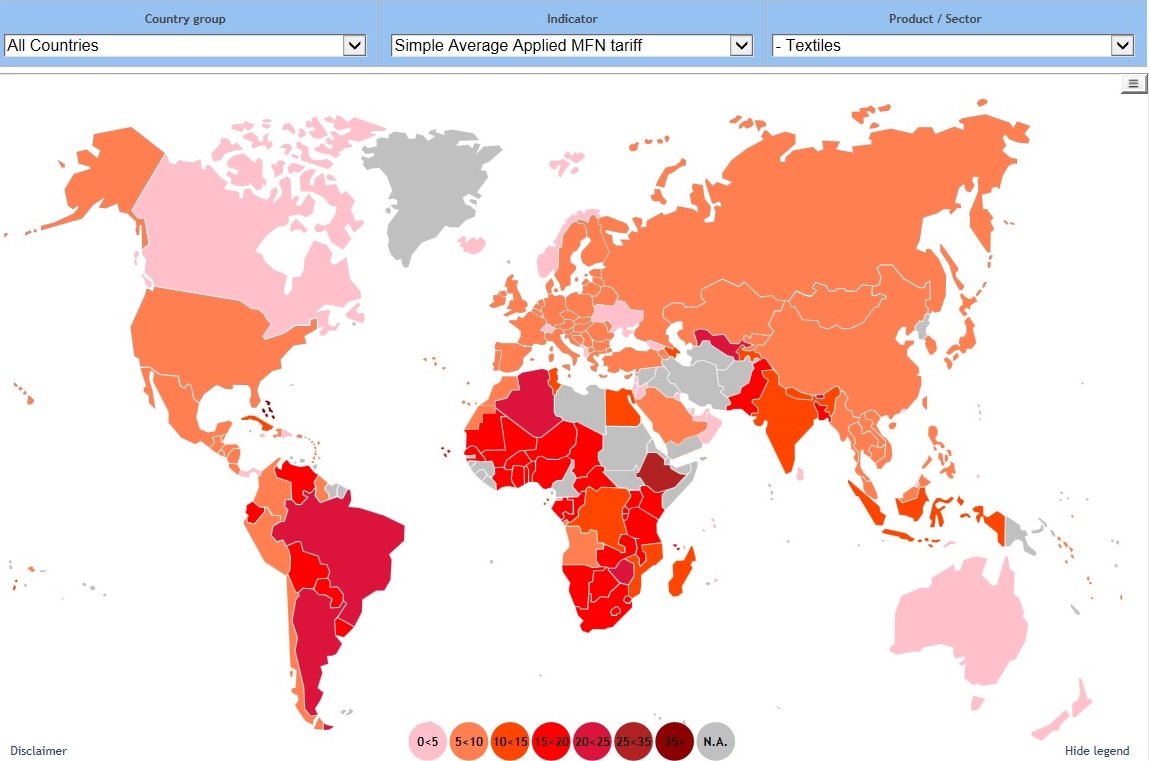
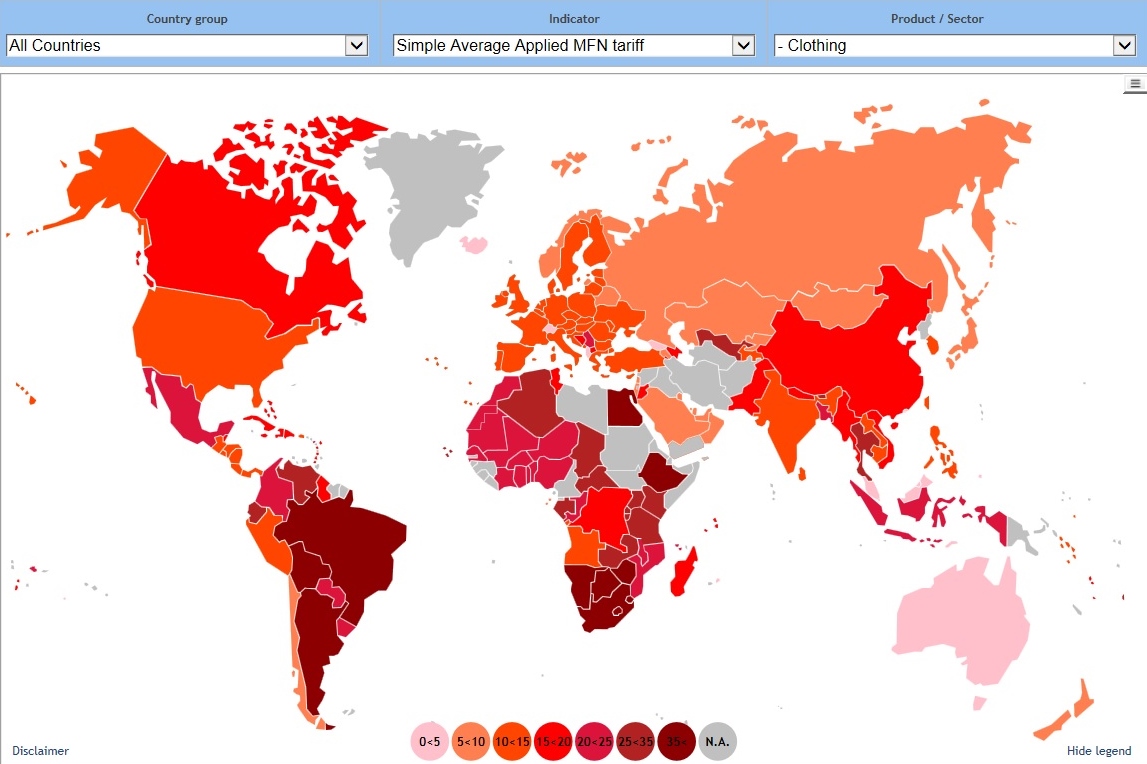
According to latest statistics from the World Trade Organization (WTO), in 2016, the average applied tariff rate remained at 10.5% for textiles and 17.5% for apparel worldwide. Compared with the average tariff rate for all sectors, the tariff rate for textile and apparel is 1.4 percentage points and 8.4 percentage points higher respectively. The result suggests that while tariff may no longer be a critical trade barrier for some sectors, it still significantly matters for the textile and apparel industry.

Least developed countries (LDC) overall set a higher tariff rate for textiles and apparel than other more advanced economies. For many poorest countries in the world, tariff remains the single largest source of tax revenue for the local government. However, it is also true that should these LDCs lower their tariff rate for textile inputs such as yarns and fabrics, it may help apparel manufacturers in these countries lower production cost and improve the price competitiveness of their finished apparel products in the world marketplace.

At the country level, countries with the highest tariff rate for textiles include Bahamas (37.1%), Ethiopia (28.0%), Uzbekistan (24.5%), Algeria (24.0%), Argentina (23.3%), and Brazil (23.3%). Whereas countries with the highest tariff rate for apparel include South Africa (41.0%), Namibia (41.0%), Swaziland (41.0%), Botswana (41.0%), Lesotho (41.0%), Bolivia (40.0%), Egypt (38.4%), Argentina (35.0%), Ethiopia (35.0%) and Brazil (35.0%).

tariff rate

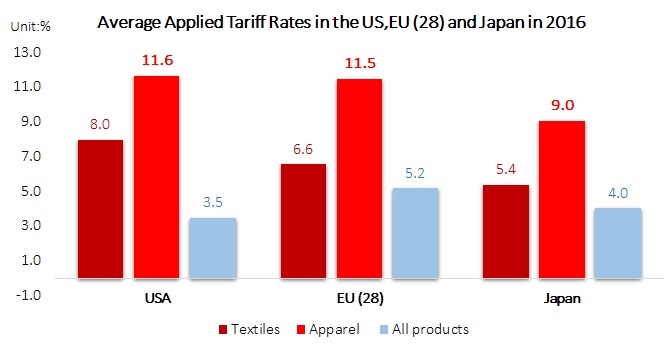
Data also shows that the import tariff rates of the US, EU(28) and Japan, the top three largest textile and apparel importers in the world, stay unchanged over the past three years.

Map_630900_I_

TIC

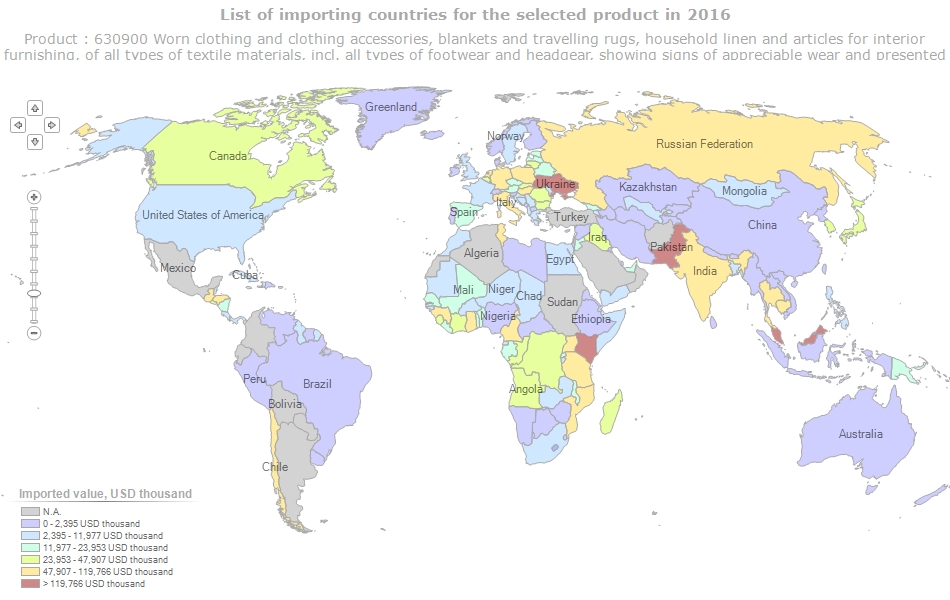
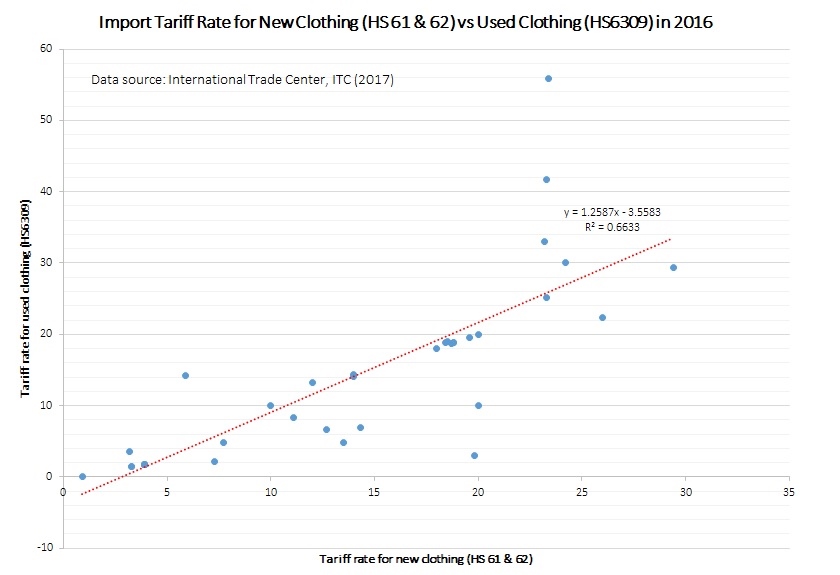
Additionally, there seems to be a positive relationship between a country’s import tariff rate for new clothing (HS 61 & 62) and used clothing (HS 6309). Of the total 180 countries covered by the International Trade Center (ITC) database, about 62.7% set an equal or higher tariff rate for new clothing than used clothing. Some African nations place a particularly high tariff rate for used clothing, including Zimbabwe (167%), South Africa (149%), Rwanda (117%), Namibia (80%), Tanzania (56%), and Uganda (41%).

Detailed tariff rates in Excel can be downloaded from HERE

Apparel Sourcing in U.S. Trade Preference Program Countries

Speakers:

  • Tarek Kabil – Egyptian Ministry of Trade & Industry
  • Ashraf Rabiey – QIZ Minister of Egypt
  • Gabi Bar – QIZ Minister of Israel
  • Mark D’Sa – Special Project Director for Haiti
  • Moderator: Gail Strickler – former Assistant US Trade Representative for Textiles

Discussion questions:

  1. What are the financial incentives for US brands and retailers to source apparel in preference program countries? Why do U.S. apparel imports from members of AGOA, QIZs and HELP overall remain at a fairly low level despite the trade preference programs? How to improve the situation?
  2. Overall, why or why not should the US keep the trade preference programs or any critical reforms are needed?
  3. Any other interesting points you learned from the video or questions you may have?

CRS Releases Report on NAFTA Renegotiation and US Textile Manufacturing

23120124_10155817882672812_4644791366056415981_oKey findings:

U.S. textile and apparel trade with NAFTA members

  • The United States maintains a bilateral trade surplus in yarns and fabrics ($4.1 billion in 2016) as well as made-up textiles ($720 million in 2016) with NAFTA members.
  • Regarding apparel, the United States had a trade surplus with Canada of $1.4 billion and a trade deficit with Mexico of $2.7 billion in 2016.

Impact of NAFTA on employment and production in the U.S. textile and apparel industry

  • The effects of NAFTA are NOT straightforward, and the drop in U.S. domestic textile and apparel production and jobs cannot be blamed solely on NAFTA.
  • The U.S. International Trade Commission (USITC) concluded that imports of textiles had a tiny effect on U.S. textile industry employment (a 0.4% decline) from 1998 to 2014, which covers most of the period since NAFTA’s enactment. However, the collapse of the U.S. domestic apparel industry and changing clothing tastes may have had a more significant impact on domestic textile production.
  • There is little evidence that NAFTA was the decisive factor for the loss of jobs in the U.S. apparel manufacturing sector, given that the major growth in apparel manufacturing for the U.S. market has occurred in Asian countries that receive no preferences under NAFTA.

Impact of the Tariff Preference Level (TPL) in NAFTA

  • In nearly every year since 2010, Mexico has come close to exporting the maximum allowable amount of cotton and man-made fiber apparel with duty-free foreign content. Canada’s TPL fill rates are typically highest for cotton and man-made fiber fabric and made-up products but are not usually fully filled.
  • It is not clear that eliminating the TPL program would result in a substantial return of textile production or jobs to the United States; if it were to raise the cost of Mexican apparel production, it could instead result in imports from other countries displacing imports from Mexico.
  • Other than U.S. fashion brands and retailers, Mexico and Canada reportedly oppose the elimination of the NAFTA TPL program too.

 Possible Effects of Potential NAFTA Modification

  • Mexico’s focus on basic apparel items suggests that S. importers could quickly source from elsewhere if duty savings under NAFTA are eliminated. However, even now, some U.S. fashion companies say the duty savings are not worth the time and resources required to comply with the NAFTA rules of origin and documentation requirements. In 2016, roughly 16% of qualifying textile and apparel imports from NAFTA failed to take advantage of the duty-free benefits and instead paid applicable tariffs.
  • Whatever the outcome of the NAFTA renegotiation, in the medium and long run, the profitability of the North American textile and apparel industry will likely depend less on NAFTA preferences such as yarn forward and more on the capacity of producers in the region to innovate to remain globally competitive.
  • One change in NAFTA proposed by the United States would require motor vehicles to have 85% North American content and 50% U.S. content to qualify for tariff-free treatment. If auto manufacturers were to import more passenger cars from outside the NAFTA region and pay the 2.5% U.S. import duty rather than complying with stricter domestic content requirements, automotive demand for U.S.-made technical textiles could be adversely affected.
  • If the TPP-11 countries strike a trade deal, one possible effect is that Canada and Mexico may import more textile and apparel products from other TPP countries, including Vietnam. This could ultimately be a disadvantage for U.S.-based producers. How the inclusion of Canada and Mexico in a fresh TPP-11 arrangement would affect their participation in NAFTA is unknown.

The full report can be downloaded from HERE

Trade Issues Facing the U.S. Apparel and Retail Industry

Panel:

  • Steve Lamar, Executive VP at the American and Apparel Footwear Association (AAFA)
  • Jon Gold, VP of Supply Chain and Customs Policy at the National Retail Federation (NRF)
  • Robert Antoshak (Host), Managing Director at Olah Inc.

Topic discussed

  • Renegotiation of the North American Free Trade Agreement (NAFTA)
  • Trump’s trade policy agenda
  • What’s going on in the retail market?
  • Technology and the future of apparel supply chain
  • US labeling requirements and a return of Made-in-USA

USTR Lighthizer Discusses Philosophies behind Trump Administration’s Trade Policy

At an event hosted by the Center for Strategic and International Studies (CSIS) on September 18, U.S. Trade Representative Robert Lighthizer addressed the U.S. trade policy in the Trump Administration, particularly Trump’s beliefs on trade:

Philosophy 1: The reason why some Americans oppose free trade is NOT that they were “ill-informed.” Rather, it is because the U.S. trade policy for decades has failed to create a “level playing field.” The Trump Administration will proactively use all instruments to “make it expensive” for U.S. trading partners to engage in the non-economic behavior, convince U.S. trading partners to treat U.S. workers, farmers, and ranchers fairly and demand “reciprocity” both in the home and international markets.

Philosophy2: Trade deficits matter. Although trade policy is not the only cause for the trade deficit, it can be a major contributor, such as high tariffs that deny the market access for U.S. products, not imposing the border adjustment tax and currency manipulation.

Philosophy 3: China is the top challenge. According to Lighthizer, “the sheer scale of China’s coordinated efforts to develop their economy, to subsidize, to create national champions, to force technology transfer, and to distort markets in China and throughout the world is a threat to the world trading system that is unprecedented.”

Philosophy 4: The Trump Administrations will exam all existing trade agreements to make sure they provide “roughly equivalent” measured by trade deficits. “Where there the numbers and other factors indicate a disequilibrium, one should renegotiate.”

During the Q&A session, Lighthizer further shared his views on some cutting-edge trade issues:

  1. Regarding the NAFTA renegotiation, Lightlizher said that the negotiation is “moving at warp speed, but we don’t know whether we’re going to get to a conclusion, that’s the problem.” The consultation process with U.S. Congress is complicated and time-consuming, but it is unavoidable.
  2. The Trump Administration prefers bilateral trade deal over regional and multilateral ones. Given the size of the U.S. economy, Lighthizer believes that bilateral trade agreement will provide more negotiation leverages and ensure better enforcement.
  3. The Trump Administration will still stay very much engaged in Asia.
  4. The WTO Dispute-Settlement mechanism doesn’t work well—it has both imposed new obligations for the U.S. and reduced a lot of U.S. benefits.
  5. Regarding the outlook for the Trans-Atlantic Trade and Investment Partnership (T-TIP) negotiation, Lighthizer stressed the importance of the US-EU trade relations. He said that the series of elections in EU is a reason why the negotiation of the agreement hasn’t moved forward.
  6. Regarding TISA (Trade in services agreement), the U.S. objective is to open markets and eliminate market access barriers for U.S. companies.

2017 U.S. Fashion Industry Benchmarking Study Released

The 2018 U.S. Fashion Industry Benchmarking Study is now availablecover

The report can be downloaded from HERE

Key findings of the study:

While the majority of respondents remain confident about the five-year outlook for the U.S. fashion industry, the percentage of those who are “optimistic” or “somewhat optimistic” dropped to a record low since we began conducting this study in 2014. This change could be due to concerns about the “protectionist trade policy agenda in the United States” and “market competition in the United States from e-commerce,” the top two concerns this year.

  • The percentage of those who are “optimistic” or “somewhat optimistic” fell from 92.3 percent in 2016 to 71.0 percent in 2017, a record low since we began conducting this study in 2014. As many as 12.9 percent of respondents are “somewhat pessimistic” about the next five years, mostly large-scale retailers with more than 3,000 employees.
  • Despite the challenges, demand for human talent in the industry overall remains robust. This year, around 80 percent of respondents plan to hire more employees in the next five years, especially supply chain specialists, data scientists, sourcing specialists, and marketing analysts.
  • Cost is no longer one of the top concerns; respondents are less stressed about “increasing production or sourcing cost,” which slipped from #2 challenge in 2016 to #7 challenge in 2017. Only 34 percent rate the issue among their top five challenges this year, significantly lower than 50 percent in 2016 and 76 percent in 2015. Labor cost remains the top factor driving up sourcing cost in 2017.

Although U.S. fashion companies continue to seek alternatives to “Made in China,” China’s position as the top sourcing destination remains unshakable. Meanwhile, sourcing from Vietnam and Bangladesh may continue to grow over the next two years, but at a relatively slow pace.

  • 91 percent of respondents source from China; while 100 percent sourced from China in our past three studies, China is still the top-ranked sourcing destination this year, and the percentage of those expecting to decrease sourcing from the country fell from 60 percent in 2016 to 46 percent this year—and many more expect to maintain their current sourcing value or volume from the country in the next two years.
  • Likely reflecting the United States’ withdrawal from the Trans-Pacific Partnership (TPP) and the expectation of increasing labor costs, only 36 percent of respondents expect to increase sourcing from Vietnam in the next two years, much lower than 53 percent who said the same in 2016.
  • Respondents are cautious about expanding sourcing from Bangladesh in the next two years, with only 32 percent expecting to somewhat increase sourcing While “Made in Bangladesh” enjoys a prominent price advantage over many other Asian suppliers, respondents view Bangladesh as the having the highest risk for compliance.

U.S. fashion companies continue to maintain truly global supply chains.

  • Respondents source from 51 countries or regions in 2017, close to the 56 in last year’s study.
  • 57.6 percent source from 10+ different countries or regions in 2017, up from 51.8 percent in last year’s survey. In general, larger companies have a more diversified sourcing base than smaller companies. Additionally, retailers maintain a more diversified sourcing base than brands, importers/wholesalers, and manufacturers.
  • Around 54 percent expect their sourcing base will become more diversified in the next two years, up from 44 percent in 2016; among these respondents, over 60 percent currently source from more than 10 different countries or regions.
  • The most common sourcing model is shifting from “China Plus Many” to “China Plus Vietnam Plus Many.” The typical sourcing portfolio today is 30-50 percent from China, 11-30 percent from Vietnam, and the rest from other countries.
  • While Asia as a whole remains the dominant sourcing region for U.S. fashion companies, the Western Hemisphere is growing in popularity. This year, we see a noticeable increase in sourcing from the United States (70 percent, up from 52 percent in 2016) and countries in North, South, and Central Americas, which offer a shorter lead time and relatively lower risk of compliance.

Today, ethical sourcing and sustainability are given more weight in U.S. fashion companies’ sourcing decisions. Respondents also see unmet compliance (factory, social and/or environmental) standards as the top supply chain risk.

  • 5 percent of respondents say ethical sourcing and sustainability have become more important in their company’s sourcing decisions in 2017 compared to five years ago.
  • 100 percent of respondents currently audit their suppliers, including how suppliers treat their workers, suppliers’ fire safety, and suppliers’ building safety. The majority (93 percent) use third-party certification programs to audit, with a mix of announced and unannounced audits.
  • As many as 90 percent of respondents map their supply chains, i.e., keep records of name, location, and function of suppliers. More than half track not only Tier 1 suppliers, suppliers they contract with directly, but also Tier 2 suppliers, i.e. supplier’s suppliers. It is less common for U.S. fashion companies to map Tier 3 and Tier 4 suppliers though, which could be because of the difficulty of getting access to related information with such a globalized and highly fragmented supply chain.

Free trade agreements (FTAs) and trade preference programs remain underutilized, and several FTAs, including CAFTA-DR, are utilized even less this year than in previous years.

  •  Of the 19 FTAs/preference programs we examined this year, only NAFTA is used by more than 50 percent of respondents for import purposes.
  • Even more concerning, some U.S. fashion companies source from countries/regions with FTAs/preference programs but, for whatever reason, do not claim the benefits. For example, as many as 38 percent and 6 percent of respondents, respectively, do not use CAFTA-DR and NAFTA when they source from these two regions.

Respondents unanimously oppose the U.S. border adjustment tax (BAT) proposal and call for the further removal of trade barriers, including restrictive rules of origin and high tariffs.

  • 100 percent of respondents oppose a border adjustment tax; 84 percent “strongly oppose” it.
  • Respondents support initiatives to eliminate trade barriers of all kinds, from high tariffs to overcomplicated documentation requirements, to the restrictive yarn-forward rules of origin in NAFTA and future free trade agreements.
  • Respondents say the “complex standards on labeling and testing”, “complex rules for the valuation of goods at customs” and “administrative and bureaucratic delays at the border” are the top non-tariff barriers they face when sourcing today.

The benchmarking studies from 2014 to 2016 can be downloaded from https://www.usfashionindustry.com/resources/industry-benchmarking-study 

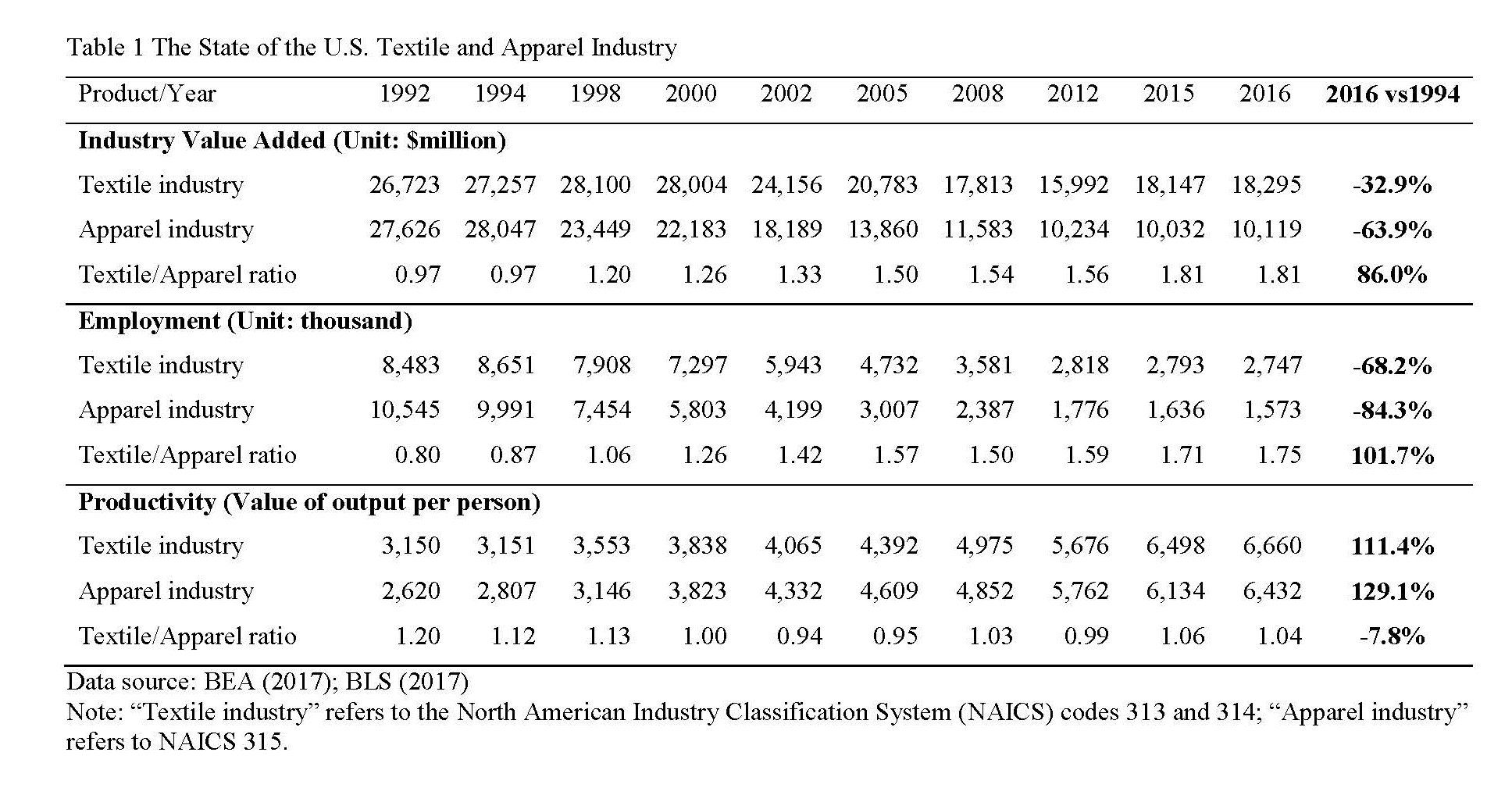
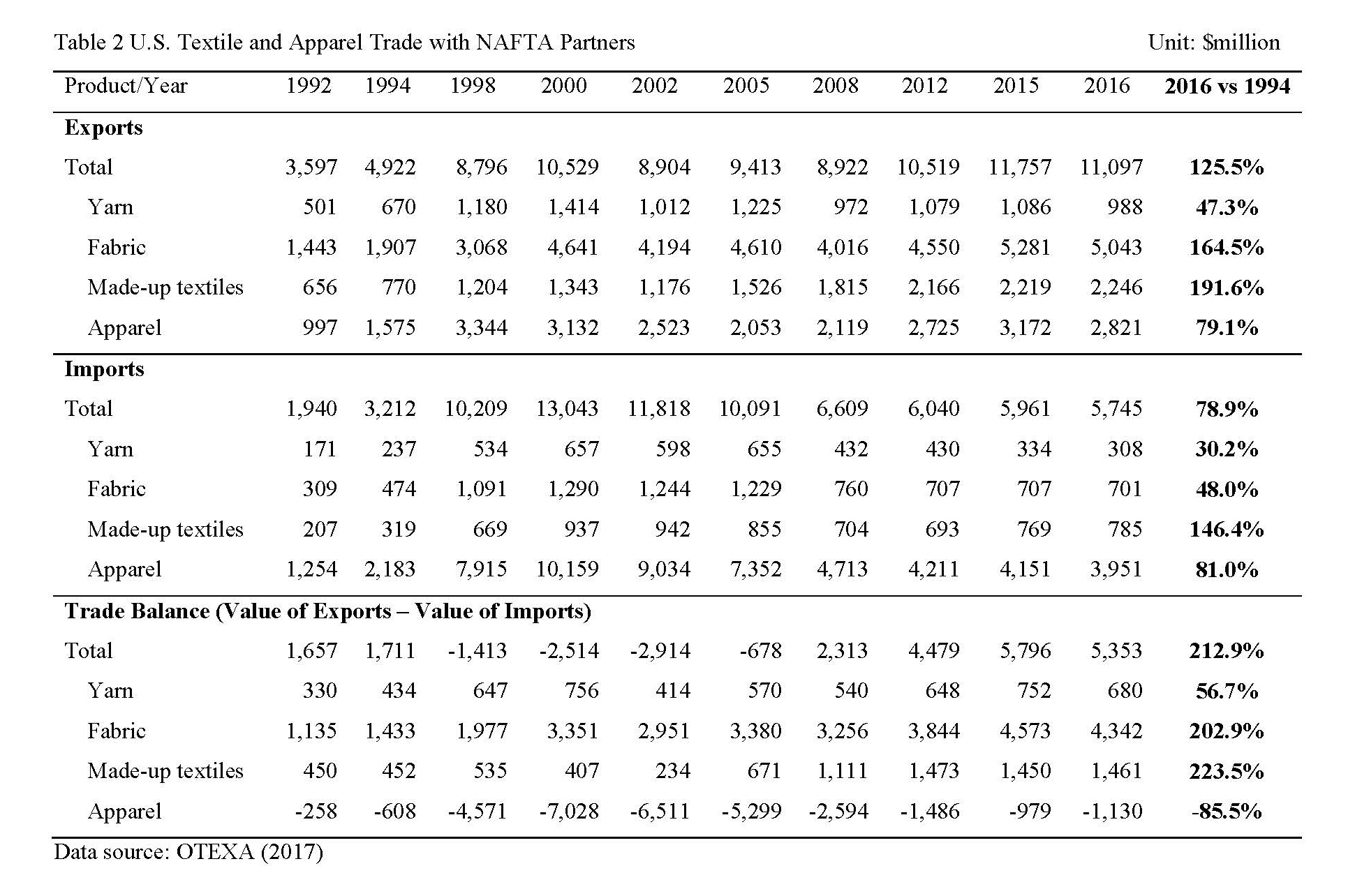
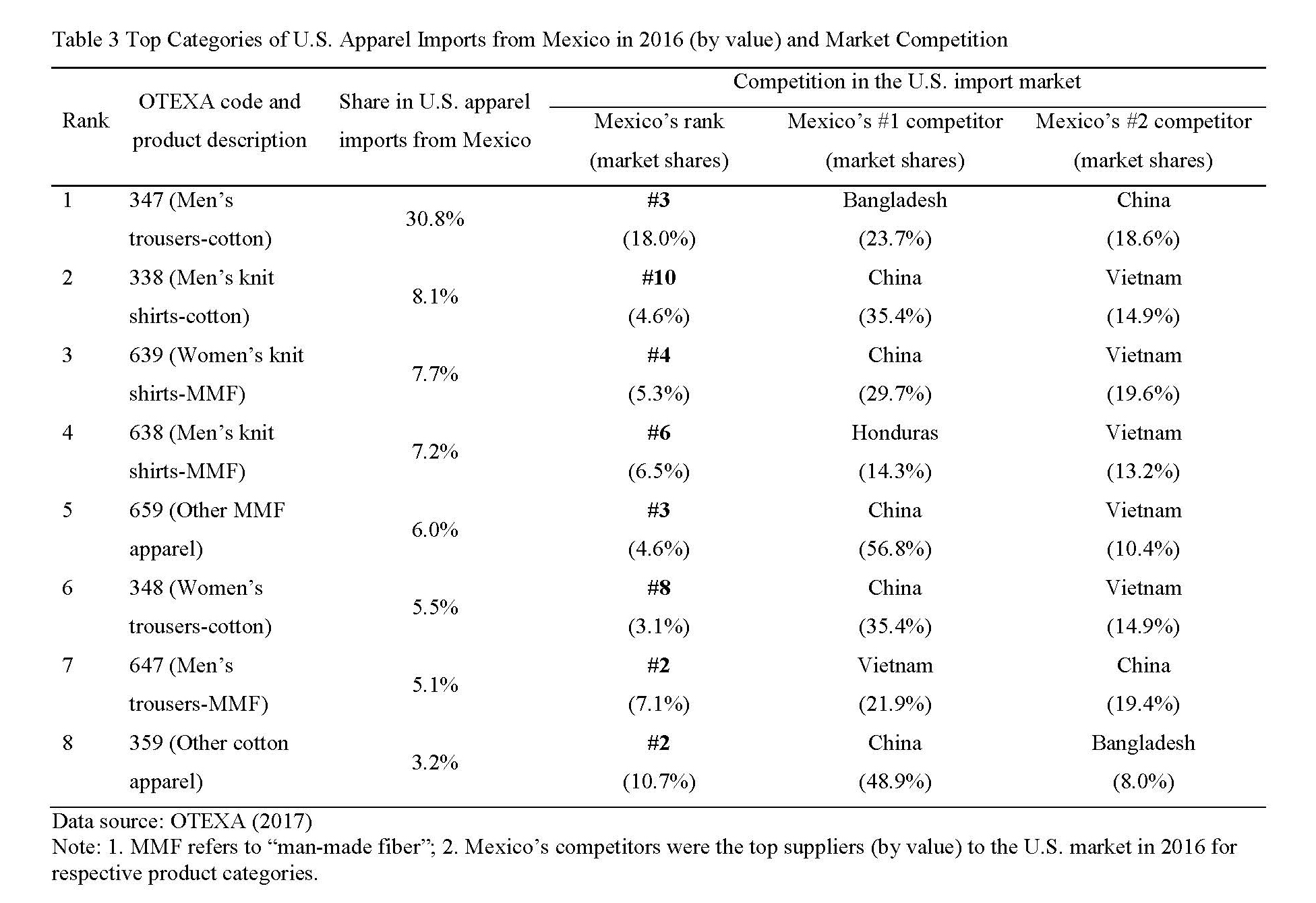
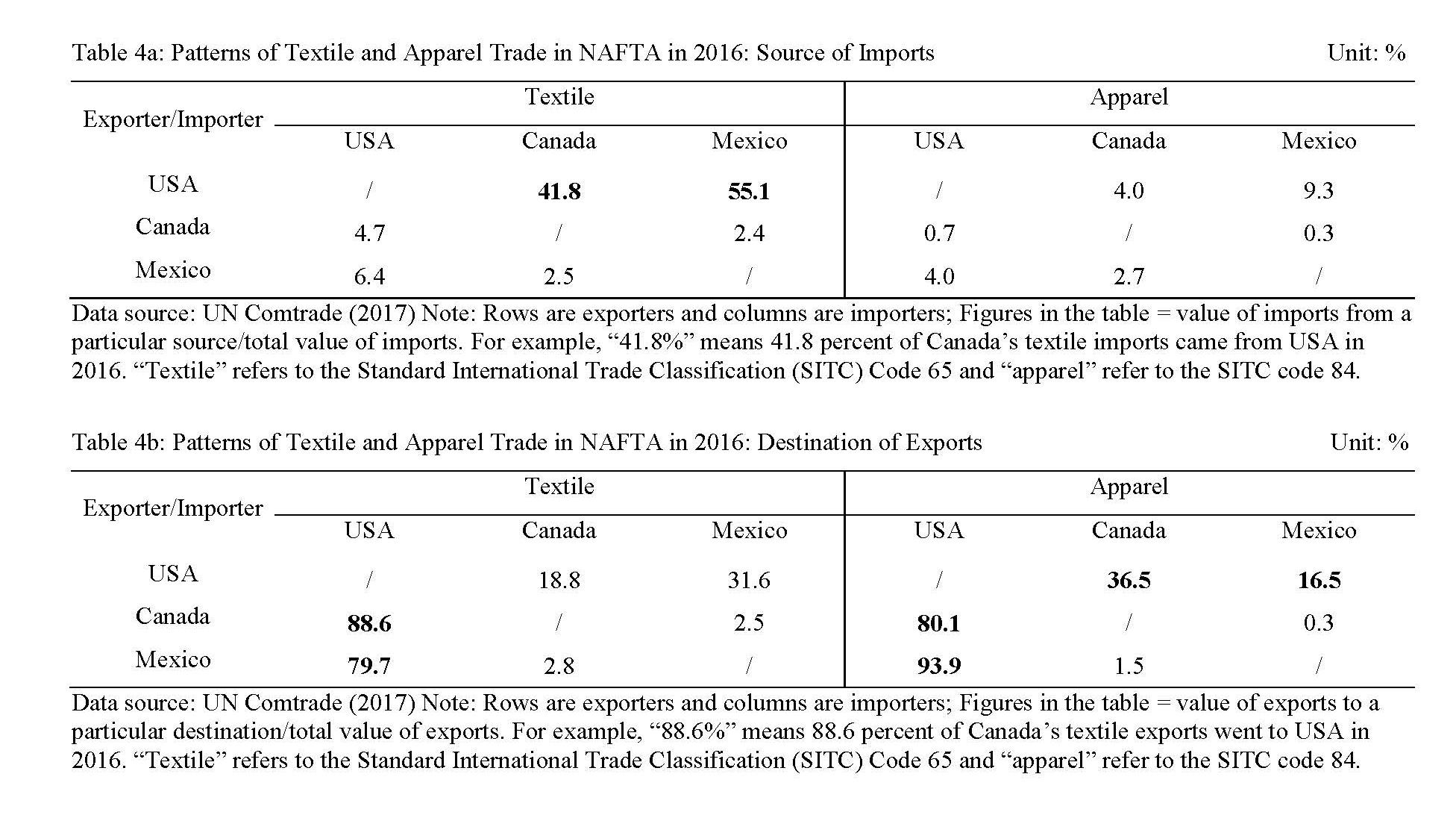
US Textile and Apparel Industry and NAFTA: Key Statistics (updated July 2017)

References and tables_Page_1References and tables_Page_2References and tables_Page_3

References and tables_Page_4

USTR Hearings on the Renegotiation of NAFTA: Textile and Apparel Industry

Panel:

  • Augustine Tantillo, President, and CEO, National Council of Textile Organizations
  • David Spooner, Counsel representing the U.S. Fashion Industry Association
  • Stephen Lamar, Executive Vice President, American Apparel and Footwear Association
  • Randy Price, VP, Managing Director Product Supply—Americas, VF Corporation
  • Marc Fleischaker, Trade Counsel, Rubber and Plastic Footwear Manufacturers Association
  • Reece Langley, VP of Washington Operations, National Cotton Council
  • Richard Gottuso, Vice President and General Counsel, Bracewell, LLP-Hunter Douglas

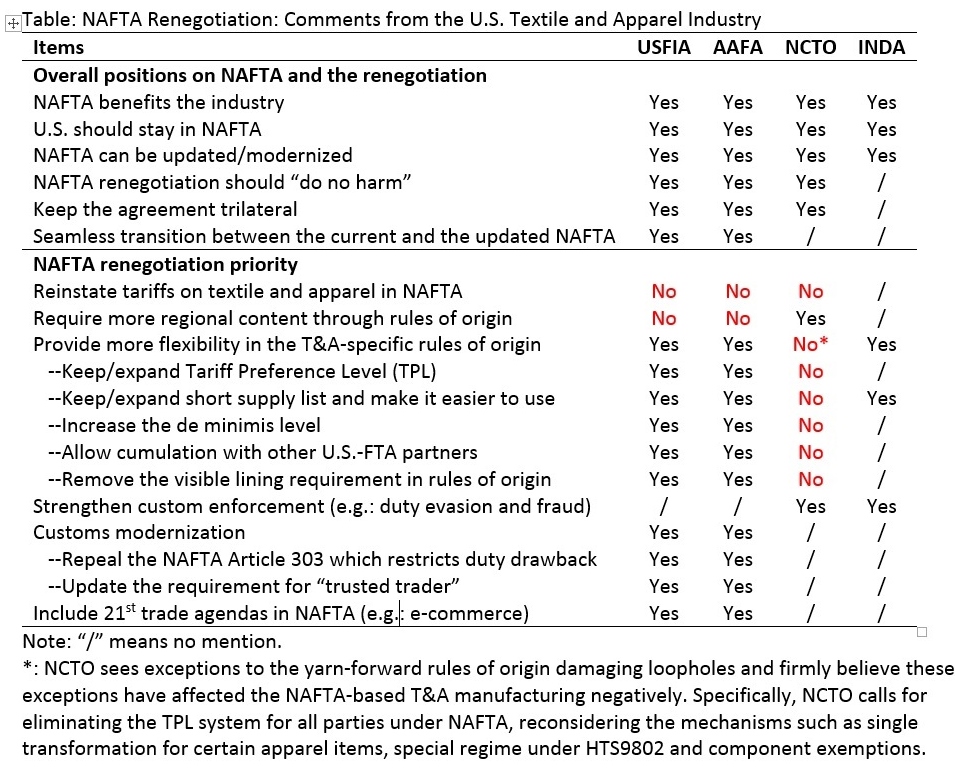
US Textile and Apparel Industry Associations Comment on NAFTA Renegotiation

This week, several leading U.S. textile and apparel industry associations submitted their comments to the Office of the United States Trade Representative (USTR) regarding the renegotiation objectives of the North American Free Trade Agreement (NAFTA). Below is a summary of these organizations’ viewpoints based on their submissions:

NAFTA renegotiation

Appendix: Submitted written comments

Trade Policy and the Textile and Apparel Industry: Discussion Questions

Global Partners

#1 Why or why not the textile and apparel industry should get involved in policy advocacy?

#2 Do you think the current U.S. trade policy reflects the interests of the U.S. textile and apparel industry? Please provide detailed examples.

#3 It is said that “trade is a way for countries to strengthen partnerships and alliances, promote peace and trust between the cooperating nations, and help other countries in need.” Do you think this principle still holds today?

#4 President Trump proposes an “America First Trade Policy,” which intends to encourage more “buy America” and reduce the U.S. trade deficit. How should President Trump respond if other countries adopt a similar approach by proposing initiatives such as “EU first trade policy,” “China first trade policy” and “Mexico first trade policy”?

#5 What do you take away from Case Study 2 regarding the making of U.S. trade policy?

Please mention the question # in your comment.

What Will Happen to the U.S. Textile and Apparel Industry if NAFTA Is Gone?

References and tables_Page_1.jpg

References and tables_Page_2

Since its taking effect in 1995, NAFTA, a trade deal between the United States, Mexico, and Canada, has raised heated debate regarding its impact on the U.S. economy. President Trump has repeatedly derided NAFTA, describing it as “very, very bad” for U.S. companies and workers, and he promised during his campaign that he would remove the United States from the trade agreement if he could not negotiate improvements.

The U.S. textile and apparel (T&A) industry is a critical stakeholder of the potential policy change, because of its deep involvement in the regional T&A supply chain established by the NAFTA. Particularly, over the past decades, trade creation effect of the NAFTA has significantly facilitated the formation of a regional T&A supply chain among its members. Within this supply chain, the United States typically exports textiles to Mexico, which turns imported yarns and fabrics into apparel and then exports finished apparel back to the United and Canada for consumption.

So what will happen to the U.S. T&A industry if NAFTA no longer exists? Here is what I find*:

figure 1

First, results show that ending the NAFTA will significantly hurt U.S. textile exports. Specifically, the annual U.S. textile exports to Mexico and Canada will sharply decline by $2,081 million (down 47.7%) and $351 million (down 14%) respectively compared to the base year level in 2015.Although U.S. textile exports to other members of the Central America Free Trade Agreement (CAFTA-DR), will slightly increase by $42 million (up 1.5%), the potential gains will be far less than the loss of exports to the NAFTA region.

2

Second, results show that ending the NAFTA will significantly reduce U.S. apparel imports from the NAFTA region. Specifically, annual U.S. apparel imports from Mexico and Canada will sharply decrease by $1,610 million (down 45.3%) and $916 million (down 154.2%) respectively compared to the base year level in 2015 (H2 is supported). However, ending the NAFTA would do little to curb the total U.S. apparel imports, largely because U.S. companies will simply switch to importing more apparel from other suppliers such as China and Vietnam.

3

Third, ending NAFTA will further undercut textile and apparel manufacturing in the United States rather than bring back “Made in the USA.” Specifically, annual U.S. textile and apparel manufacturing will decline by $1,923 million (down 12.8%) and $308 million (down 3.0%) respectively compared to the base year level in 2015 (H3 is supported). Weaker demand from the NAFTA region is the primary reason why U.S. T&A manufacturing will suffer a decline.

These findings have several important implications. On the one hand, the results suggest that the U.S. T&A will be a big loser if the NAFTA no longer exists. Particularly, ending the agreement will put the regional T&A supply chain in jeopardy and make the U.S. textile industry lose its single largest export market—Mexico. On the other hand, findings of the study confirm that in an almost perfectly competitive market like apparel, raising tariff rate is bound to result in trade diversion. With so many alternative suppliers out there, understandably, ending the NAFTA will NOT increase demand for T&A “Made in the USA,” nor create more manufacturing jobs in the sector. Rather, Asian textile and apparel suppliers will take away market shares from Mexico and ironically benefit most from NAFTA’s dismantlement.

*Note: The study is based on the computable general equilibrium (CGE) model developed by the Global Trade Analysis Project (GTAP). Data of the analysis came from the latest GTAP9 database, which includes trade and production data of 57 sectors in 140 countries in 2015 as the base year. For the purpose of the study, we assume that if NAFTA no longer exists, the tariff rate applied for T&A traded between NAFTA members will increase from zero to the normal duty rate (i.e. the Most-Favored-Nation duty rate) in respective countries.

by Sheng Lu

Gail Strickler, Former Assistant US Trade Representative for Textiles, on Trump’s Trade Policy

DSCF4755 (2)

Gail Strickler, Assistant U.S. Trade Representative for Textiles (2009-2015), who negotiated the textile chapter under the Trans-Pacific Partnership (TPP), visited UD on April 13 and delivered a public lecture on The Global Apparel Industry – Style and Substance. The event is part of the Fashion and Diplomacy Lecture Series sponsored by the Institute for Global Studies and the Department of Fashion and Apparel Studies.

During the talk, Gail made a few comments regarding trade policy in the Trump administration:

First, Gail believes that the existing U.S. free trade agreements (FTAs), trade preference programs (PTAs) and the U.S. commitments at the World Trade Organization (WTO) are unlikely to be undone by President Trump because retaliatory actions from other trading partners would be inevitable.

Second, regarding the North American Free Trade Agreement (NAFTA), Gail doesn’t think the proposed renegotiation would threaten the benefits presently enjoyed by the U.S. textile and apparel industry. Gail also thinks the Central America Free Trade Agreement (CAFTA-DR) is a lifeline for the U.S. domestic textile manufacturing sector. Notably, NAFTA and CAFTA-DR together account for almost 70% of U.S. yarn and fabric exports.

Third, as observed by Gail, Wilbur Ross, the Commerce Secretary, has been given an expanded role in trade in the Trump Administration. Gail believes Ross’s appointment is likely to bode well for NAFTA and CAFTA-DR on textiles because Ross until recently owned the International Textile Group (ITG), which has significant investments in Mexico and relies heavily on CAFTA-DR for its textile sales.

However, Gail doesn’t think concentrating on trade deficits to define trade policy is a very “good method” of navigating the trade world. Interesting enough, last time when the U.S. trade deficit significantly shrank was during the 2008 financial crisis.  

Gail is also a strong advocator of sustainability in the textile and apparel sector. She believes that trade programs can play a vital role in encouraging sustainable development, improving labor practices and facilitating sustainable regional supply chains. According to Gail, powerful the labor provisions in trade programs can be if strong incentives are coupled with a credible threat of rapid enforcement – little evidence of effectiveness if only one (or fewer) of these conditions is met. However, comparing with enforcing labor provisions, Gail finds promoting and enforcing environmental sustainability standards through trade agreements is much more complex in the textile and apparel sector and will require creativity and strong participation from private sectors and consumers.

Before the public lecture, Gail visited FASH455 and had a special discussion session with students on topics ranging from the textile and apparel rules of origin in TPP, NAFTA renegotiation, AGOA renewal and state of the U.S. textile and apparel industry.

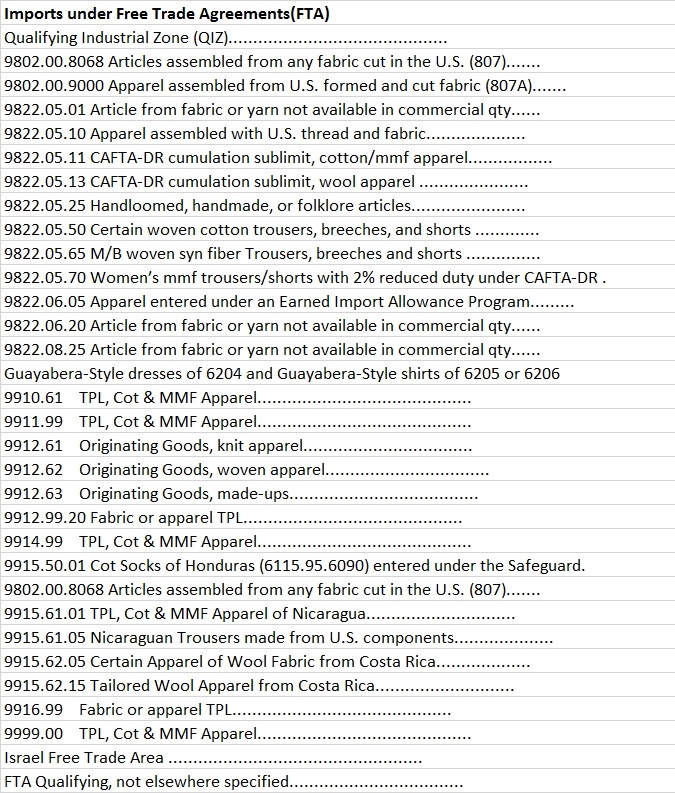
Are US Textile and Apparel Imports Using Free Trade Agreements? (Updated February 2017)

Free trade agreements (FTAs) are arrangement among two or more countries under which they agree to eliminate tariffs and non-tariff (NTB) barriers on trade among themselves (Cooper, 2014). Theoretically, companies shall be interested in increasing imports from FTA regions because of the duty-free treatment (i.e., the trade creation effect). Particularly, not paying import tariff duty can be a great cost advantage for textile and apparel (T&A) companies given the fact that the average US import tariff rate was still as high as 8% for textiles and 11.6% for apparel in 2016 (WTO, 2017).

fta-2017

Despite the potential benefit of using FTAs, data from the Office of Textiles and Apparel show that 85.7% of US T&A imports came from non-FTA regions in 2016. Interesting enough, although more FTAs have taken effect in the United States, T&A imported under FTA as a percent of total T&A imports dropped from 15.1% in 2008 to 14.3% in 2016.

Among the FTAs in force, the North American Free Trade Agreement (NAFTA) and the Dominican-Republic-Central America Free Trade Agreement (CAFTA-DR) altogether accounted for 75.9% of the value of total U.S. T&A imports under FTAs in 2016.

us-fta-utlization-2016

Statistics further reveal that sometimes companies did not claim duty free benefits of FTAs even though they imported T&A from the FTA region. For example, in 2016 about 29.9% of U.S. T&A imports from South Korea, 24.3% from CAFTA-DR and 16.3% from NAFTA and 12.9% from Columbia did not enjoy the duty free treatment granted by the respective FTAs.

fta-rule-3

Some industry experts say the complex T&A rules of origin is a major factor why US T&A companies are not using FTAs enough. According to the Office of Textiles and Apparel (OTEXA), there are more than 20 different tariff lines dealing with various T&A rule of origin situations under respective FTAs.

short-supply-2016

Additionally, U.S. T&A importers seem to use the “short supply list” mechanism–an exception to the yarn forward rules of origin under FTAs, more actively. For example, in 2016 around 2.4% of US T&A imports under FTAs took advantage of the “short supply list” mechanism, increased from only 1.2% in 2008. Similarly, a record high of 6.2% of U.S. T&A imports under the CAFTA-DR used the short supply list in 2016.

Sheng Lu

Positions on Key Trade Issues: US Fashion Industry Association (USFIA) V.S. National Council of Textile Organizations (NCTO)


From left to right: Julia Hughes (president of USFIA), Auggie Tantillo (president & CEO of NCTO) and Robert Antoshak (Managing Director of Olah Inc., moderator)

In a panel discussion hosted by Kingpins on February 9, 2017, Julia K. Hughes, President of the United States Fashion Industry Association (USFIA), and Augustine Tantillo, President and Chief Executive of the National Council of Textile Organizations (NCTO) shared their respective perspectives on key trade issues facing the U.S. textile and apparel industry in 2017.

Trade and job creation in the United States

Julia Hughes: Discussion on the relationship of trade and jobs in the public is often misguided. We support U.S. manufacturing. But along the supply chain, from product development, sourcing, marketing to retailing, fashion brands and retailers have also created many well-paid non-manufacturing jobs in the United States. Study further shows that 70%-80% of the retail value of an imported clothing actually stays in the United States.

Auggie Tantillo: Pleased and excited to see the discussion on the possibility of bringing back/expanding manufacturing in the United States. Still the United States produces $65—70 billion worth of textiles annually, which support many manufacturing jobs in the sector.  The U.S. textile industry also makes around $2 billion investment annually (updating machines and equipment). We need to acknowledge the baseline value of manufacturing in the United States.  

Border Adjustment Tax(BAT)

Julia Hughes: BAT is a complicated issue. However, if the current BAT proposal is adopted, it will raise the retail price (meaning ordinary US consumers will have to pay more) and appreciate the U.S. dollar (meaning U.S. exports will get hurt). This is why USFIA along with 100+ companies and industry associations opposes any BAT.
Auggie Tantillo: NCTO strongly believes that updating the tax structure in the United States is long overdue. NCTO welcomes a serious look at the BAT proposal, since the United States is the only major economy in the world that does not adopt BAT. The United States doesn’t need to run such a high trade deficit. Instead, we need to make the tax structure supporting the U.S. manufacturing base.

North American Free Trade Agreement (NAFTA)

Julia Hughes: NAFTA is 20 years’ old and it can be improved. However, raising import tax (tariff) is NOT a good idea. NAFTA supports the Western-Hemisphere supply chain, which is critical for the U.S. textile and apparel industry. We need to defend this supply chain.  

Auggie Tantillo: NAFTA works and benefits its members on all sides of the border, including the United States. NCTO supports the continuation of NAFTA as well as to update and modernize the agreement as necessary.

Yarn-forward Rules of Origin (RoO)

Julia Hughes: Apparel is a global industry and apparel supply chain needs to be nimble. The yarn-forward RoO prevents apparel companies and retailers from fully enjoying the duty-free benefits under a free trade agreement (FTA) since not always the FTA region makes the needed products or their textile components. Exceptions to the yarn-forward rules such as the tariff preference level (TPL), provide necessary flexibility.  

Auggie Tantillo: The yarn-forward RoO has been a great success and we need to keep it (in existing and future trade agreements). The only things that need to be improved is the exception to the yarn-forward RoO (such as short supply list and trade preference level). RoO is supposed to keep benefits of a free trade agreement to its members only, yet these exceptions create loopholes and cause damages (to the U.S. textile industry).

On China

Julia Hughes: We need China, which still provides 40% of textiles and apparel consumed in the United States. It will be a disaster to trigger a trade war between the two countries.

Auggie Tantillo: We need to better help the Western-Hemisphere producers (in competing with textile and apparel made in China). China’s  40%+ market shares in the U.S. textile and apparel import market are not all based on its genuine competitiveness. Rather, China’s unfair trade practices such as IPR violation, government subsidy and unacceptable factory working conditions & environmental practices are of grave concerns.

Trans-Pacific Partnership (TPP)

Julia Hughes: TPP is not dead. On the other hand, countries around the world are actively negotiating new bilateral/regional free trade agreements. The United States doesn’t want to be left behind.

Auggie Tantillo: TPP is “in deep hibernation”, but trade agreement will never be really dead. It is still hopeful that TPP will come back later—but very likely to be in a different form, such as bilateral trade agreements. To be noted, many TPP members have already established bilateral/regional trade agreements with the United States.  

Discussion questions: 1) Why do you think Julia Hughes and Auggie Tantillo disagree on many trade issues? On which topics they actually agree with each other and why? 2) What’s your response to Julia Hughes and Auggie Tantillo’s comments on trade issues above? 3) Based on the panel discussion, why do you think textile and apparel companies need to care about trade policy? Please feel free to share your views.

Outlook 2017: Apparel Industry Issues in the Year Ahead

outlook

In January 2017, Just-Style consulted a panel of industry leaders and scholars in its Outlook 2017–Apparel Industry Issues in the Year Ahead management briefing. Below is my contribution to the report. Welcome for any suggestions and comments.

1: What do you see as the biggest challenges – and opportunities – facing the apparel industry in 2017, and why?

I see the uncertainty in the global economy will pose one of the biggest challenges facing the apparel industry in 2017. Apparel business is buyer-driven. A great number of studies have suggested that economic growth is by far the most effective and reliable predictive factor for apparel consumption. Unfortunately, it seems apparel companies have to deal with another year of economic volatility and weak demand in 2017. For example, according to the latest International Monetary Fund (IMF) forecast released in October 2016, global economic growth in 2017 is projected to only recover to 3.4 percent from 3.1 percent in 2016. There is no particular excitement among major apparel consumption markets either: outlook of the U.S. economy in 2017 is complicated by the strong U.S dollar, the Federal Reserve’s monetary policy as well as the uncertain trade and tax policy to be adopted by the new Trump administration; Economic growth in the EU region next year will continue to be hindered by the unknown fallout from UK’s referendum on leaving the EU, pervasive geopolitical uncertainties, high unemployment rates and the rising protectionist tendencies; Japan’s economic growth is projected to be as low as 1.0 percent in 2017 according to the Organization for Economic Co-operation and Development (OECD); And China’s economic growth in 2017 could slow again to 6.5 percent, which would be the slowest pace in more than 25 years. Reflecting the trend, we might see a stagnant growth or even a decline of global textile and apparel trade in 2017 as well.

Nevertheless, companies’ continuous investments on technology and innovation will create exciting new opportunities for the apparel industry. Particularly, growing areas in the apparel industry such as 3D printing, wearable technology, digital prototyping and e-commerce have made many “non-traditional” players now interested in fashion, including technology giants like Google and Apple. I think we can expect the apparel industry to become even more modern and high-tech driven in the years to come. The changing nature of the apparel industry will also increase demand for talents from an ever more diversified educational background, such as engineering, physical therapy and business analytics.

2: What’s happening with sourcing? How is the sourcing landscape likely to shift in 2017, and what strategies can help apparel firms and their suppliers to stay ahead?

One observation from me is that textile and apparel (T&A) supply chain is becoming more regional-based. For example, data from the World Trade Organization (WTO) shows that 91.4 percent of textiles imported by Asian countries in 2015 came from other Asian countries, up from 86.6 percent in 2008. This suggests that Asian countries togetherare building a more integrated T&A supply chain. Likewise, in 2015 close to 90 percent of apparel exported by North, South and Central American countries went to the United States and Canada and 81 percent of apparel exported by EU countries went to other EU countries too. To be noted, all of these three major T&A supply chains are facilitated by respective free trade agreements in the region such as the North American Free Trade Agreement (NAFTA), ASEAN–China Free Trade Area (ACFTA) and of course the common market enjoyed by the EU members. On the other hand, fashion brands and apparel retailers often use the Western-Hemisphere supply chain and EU-based supply chain as a supplement to the Asia-based supply chain for more fashion-oriented or time-sensitive items. I think such a dual-track sourcing strategy will continue in 2017.

Related, I think supply chain management will play a growing important role helping apparel companies control sourcing cost, improve speed to market and better meet consumers’ demand in 2017. An interesting phenomenon revealed by the 2016 U.S. Fashion Industry Benchmarking Study released by the U.S. Fashion Industry Association is that around 30 percent of respondents say they plan to consolidate rather than diversify their sourcing base in the next 2 years. As one respondent commented, “(Our) focus right now is really finding efficiencies and maximizing productivity in the supply chain. While we won’t necessarily move out of any countries, we are consolidating the base within regions.”

Last but not least, I think in 2017 apparel companies will continue to give more weight to sustainability and social responsibility in their sourcing decisions. Building a more transparent and sustainable supply chain is an irreversible trend in the apparel industry. 

3: What should apparel firms be doing now if they want to remain competitive into the future? What will separate the winners from the losers?

To remain competitive into the future, apparel companies need to be prepared to change and be willing to try something new. Indeed, revolution is coming for the apparel industry, including the way products are made and sourced (example: 3D printing and various digital manufacturing tools), how consumers shop (example: the see-now-buy-now trend) and where and how to sell (example: the booming e-commerce and omni-channel retailing). In the past, small and medium sized companies (SME) were regarded more vulnerable than big players in the apparel industry for business survival.  However, nowadays, without embracing the spirit of innovation and entrepreneurship, even large companies can quickly become “dinosaurs” and find their business struggling. 

4: What keeps you awake at night? Is there anything else you think the apparel industry should be keeping a close eye on in the year ahead? Do you expect 2017 to be better than 2016, and why?

One thing that keeps me awake at night as a professor is what needs to be changed or updated in our curriculum to better prepare our students for the needs of the apparel industry. Fashion programs like us directly prepare future professionals for the fashion apparel industry. This also means we are not immune to the big shift in the industry either. For example, our course offerings currently include textile science, product development, merchandising, branding and sourcing and trade. But in addition to these conventional topics, what else should be added to the curriculum? What new skill setsor knowledge points will be highly expected by the apparel industry for our students in the future? Personally I think talent training is a critical area that the apparel industry and our fashion educational programs can and should form closer partnership. And the outcomes will be mutual beneficial too.

Trade policy is another area that keeps me awake at night. Trade policy matters for the apparel industry because it affects the quantity, price and availability of products in the market. Specifically, in 2017 I will be watching closely about the following trade agendas: 1) the WTO Trade Facilitation Agreement (TFA), which is nearing entering into force. TFA aims to make customs and border procedures easier, speed up the passage of goods between countries and lower cost of trade.

2) negotiation of the Regional Comprehensive Economic Partnership (RCEP). In 2015, the sixteen RCEP members altogether exported $369 billion worth of textile and apparel (50% of world share) and imported $124 billion (34% of world share). Since the Trans-Pacific Partnership (TPP) won’t be implemented anytime soon, RCEP has the potential to influence and reshape the T&A supply chain in the Asia-Pacific region.

3) a possible revision of the North American Free Trade Agreement (NAFTA). NAFTA is a critical factor facilitating and maintaining the Western-Hemisphere textile and apparel supply chain. A recent study of mine shows that ending the NAFTA would significantly hurt apparel manufacturing in Mexico and textile manufacturing in the United States, largely because apparel “Made in Mexico” today often contains yarns and fabrics “Made in USA”.

4) Trans-Pacific Partnership (TPP) and Trans-Atlantic Trade and Investment Partnership (T-TIP). Although many people think these two agreements are dead, I disagree. TPP and T-TIP are NOT conventional free trade agreements (FTAs) that deal with tariffs and non-tariff barriers only. Just like why we need traffic rules, TPP and T-TIP address our needs to update international trade regulations on 21st century trade agendas such as digital trade, state-owned enterprises, labor and environmental standards, small and medium sized enterprises and trade related investment. On the other hand, both TPP and T-TIP still have a solid and broad supporting base, which includes the fashion apparel industry. If trade politics is why TPP and T-TIP are in trouble, for the same reason, we should expect a reversal of the fate of these two agreements when time arrives. Plus, we should never underestimate the creativity and wisdom of trade policymakers.

Sheng Lu

New USCBC Study Suggests Overall Positive Impacts of China on the US economy

oe-cover_0

Although the trade relationship with China is often blamed for causing job losses in the United States, a new study prepared for the U.S.-China Business Council (USCBC) by Oxford Economics suggests overall positive impacts of China on the US economy. According to the study:

  • China has grown to become the third-largest destination for American goods and services, only after Mexico and Canada. China purchased $165 billion in goods and services from the United States in 2015, representing 7.3 percent of all US exports and about 1 percent of total US economic output. By 2030, US exports to China are projected to rise to more than $520 billion annually.
  • The US-China trade relationship supports roughly 2.6 million jobs in the United States. Specifically, US exports to China directly and indirectly supported 8 million new jobs in 2015.
  • The reported gross US trade deficit with China is overstated and somehow misleading. As China has become an integral part of the global manufacturing supply chain, much of its exports are comprised of foreign-produced components delivered for final assembly in China. If the value of these imported components is subtracted from China’s exports, the US trade deficit with China is reduced by half, to about 1 percent of GDP—about the same as the US trade deficit with the European Union.
  • Additionally, “Made in China” lowered prices in the United States for consumer goods. As estimated, US consumer prices are 1 percent – 1.5 percent lower because of Chinese imports–trade with China saved each American household up to $850 in 2015. Given the fact that hourly labor costs in the textile industry were $2.65 in China in 2014 compared with $17.71 in the United States, the report argues that replacing Chinese imports of textiles and clothing with US manufactured products would significantly raise US consumer prices.

uscbcjob2017.jpg

uscbcjob20172

In terms of the textile and apparel (T&A) sector, the report suggests that:

  • The rising U.S. import from China mostly represents China’s displacement of imports from other countries and regions: China has been squeezing out traditional apparel manufacturers such as Mexico, Hong Kong, and Taiwan.
  • Meanwhile, textile and apparel manufacturing is one of the very few sectors that observe a paralleled pattern of rising imports from China and declining gross value added in the United States since 2000. In comparison, over the same period other sectors that experienced the most rapid growth in Chinese imports are also the sectors where US businesses have seen the strongest growth.

The report can be downloaded from HERE.

Apparel Sourcing in 2017: Results from the Just-Style State of Sourcing Survey

sourcing-560x400

The latest Just-Style State of Sourcing Survey conducted in December 2016 suggests a few trends of apparel sourcing in 2017:

  • Exchange rate volatility and rising raw material and labor costs are among the top concerns for apparel sourcing in 2017. Around 69% of survey respondents expect overall sourcing costs to rise in 2017, compared with 54.5% in last year’s survey. The fluctuating exchange rate, buyer’s expectation for higher quality of products and complex compliance requirements are among the major factors driving up the sourcing cost.
  • Apparel companies expect more uncertainties regarding the political and policy environment in 2017. Specific concerns for apparel companies include trade policy under Trump’s Administration, possible renegotiation of trade agreements such as the North American Free Trade Agreement (NAFTA) and Trump’s threats to impose a 45% punitive tariff on US textile and apparel imports from China. Respondents say the uncertainties make it challenging for companies to do strategic planning in advance
  • Sourcing will play an increasingly important role helping companies achieve strategic goals. It is highly expected that sourcing can contribute to meeting the fast-evolving demands of omni-channel retailing, consumers’ expectations for a more convenient shopping experience, as well as greater product innovation across all sales channels. A few respondents say they will use process and productivity improvement and closer collaboration with key suppliers to try to achieve these goals and mitigate any sourcing cost increases.   
  • Sourcing destinations may continue to slightly adjust in 2017. Specifically, 72.1% of respondents say they are looking for alternative source of supply in 2017 compared with 69.2% last year. Popular emerging sourcing destinations include Central America and the United States, EU, UK, Vietnam, Bangladesh, Indonesia and Kenya. However, the survey also confirms that China‘s dominance as the top apparel supplier is unlikely to change anytime soon – with a rise in the number of respondents looking to increase orders from the country in the upcoming year.

Respondents of the survey include manufacturers (29%), importers, agents or sourcing office executives (23%), retailers (12%), fiber, yarn, or fabric suppliers (11%), consulting, research, government, trade institute, NGO and university fields (14%) and software suppliers (2.6%).

Full report of the survey is available HERE.

Made in the USA Textiles and Apparel:Facts and Future

The presentation is the outcome of Jillian Luetje‘s honor project in FASH455 (Fall 2016). In the project, Jillian explored the facts and future of “Made in USA” textile and apparel based on her research of existing literature and interviews with U.S. trade officials. The presentation intends to help the audience (especially those new to the area of textile and apparel trade and trade policy) have a basic understanding of the topic.  

Key findings:

  • Textile and apparel manufacturing in the USA is NOT totally gone.
  • The U.S. textile industry in particular relies on the Western Hemisphere supply chain and related free trade agreements
  • Made in the USA apparel is not going to increase any time soon.

Welcome for any comments and suggestions!

Outlook for Trade Policy in the Trump Administration and Impact on the Textile and Apparel Industry: A Summary of Views from Experts

bn-qb709_1001tr_m_20161002000431

TPP is in trouble, but NOT dead

David Spooner, Partner at Barnes & Thornburg LLP, Former Chief Textile & Apparel Negotiator at the Office of the U.S. Trade Representative, and Former Assistant Secretary of Commerce for Import Administration: “it will be a tough road to pass it (the Trans-Pacific Partnership, TPP) during the Trump Administration…However, there may be opportunities for the (fashion) industry if Trump brings new faces to the Office of the U.S. Trade Representative (USTR) and takes a fresh look at trade agreements.” Source: https://www.usfashionindustry.com/news/off-the-cuff-newsletter/2803-recap-28th-apparel-importers-trade-transportation-conference

Jeffrey J. Schott, Senior Fellow of the Peterson Institute for International Economics: “What’s the future for TPP? Most likely, Trump will simply not implement it. Without US participation, the pact cannot definitively enter into force. It’s death by malign neglect.” “But the 11 other TPP countries may not sit idly on the sidelines waiting for US ratification. Instead, they could agree among themselves to extend the TPP benefits to each other on a provisional basis, leaving the door open for US participation in the future. If the United States subsequently ratifies the TPP, the pact would then enter into force on a permanent basis.” Source: https://piie.com/blogs/trade-investment-policy-watch/tpp-could-go-forward-without-united-states

Steve Warner, President/CEO BeaverLake6 Group LLC, former President and CEO of the Industrial Fabrics Association International (IFAI): “TPP was dead going forward. TPP isn’t actually bad for the technical textiles industry except in a few instances. The real bad culprit, though, is the passage of the Trade Promotion Authority (TPA), which I opposed when it was being hotly debated in 2015. TPA gave no wiggle room for lawmakers to make even slight changes in the TPP when it was presented by the Obama administration that could at least mollify a representative’s constituents. You couldn’t just like parts of the agreement; you had to like all of it. Thus, you were either with it entirely or have to go against it. It proved to be safer to go against it. As for T-TIP, it was going to be a tough deal to conclude when the European Union insisted a primary objective for them was the elimination of the Berry Amendment protection for US domestic manufacturers” Source: http://www.beaverlake6.com/in-my-opinion/

Face uncertainties but with hope

Michael Singer, vice president of customs compliance at Macy’s and chairman of the U.S. Fashion Industry Association (USFIA): “I do see some opportunities believe it or not, and I had to struggle really hard to come up with something positive. From the regulatory basis, there may be an opportunity for some easing of government laws and mandates.” “One of the key issues we now face is how the administration and Congress will handle trade issues in 2017… We all know how important trade and the access to world markets is in our ability to provide our customers the choices and products they expected, and yet there is no doubt the protectionist sentiment in our country is at historic levels. USFIA will be doing our best to make sure that this remains a top priority and we clearly communicate the importance and benefit of trade to U.S. consumers and the U.S. economy.” Source: http://wwd.com/business-news/government-trade/donald-trump-on-trade-taxes-and-regulations-10702130/

 Julia Hughes, President of the U.S. Fashion Industry Association (USFIA): “A lot of folks were surprised by the (election) outcome… We can see we have our work cut out for us…We’re going to be dealing with a lot of unknowns even with the continuation of a Republican Congress.” Source: http://www.just-style.com/analysis/tpp-is-not-going-to-happen-in-a-trump-administration_id129272.aspx

Daniel J. Ikenson, director of Cato’s Herbert A. Stiefel Center for Trade Policy Studies: “If he (Trump) is able to expand and diversify the pool of people advising him, there is a reasonable chance that President Trump’s actions will be less bellicose than his rhetoric has been. After all, as someone who wants to make America “great again,” President-elect Trump will want the policies implemented by his administration to help grow the economy. Trade agreements have succeeded in that regard and, in addition to the TPP, there are plenty of countries and regions willing to partner, including the European Union and the United Kingdom (separately), and plenty of alternative negotiating platforms for accomplishing trade and investment liberalization. ” Source: https://www.cato.org/blog/shifting-gears-contemplate-trumps-trade-policies

David Spooner, Partner at Barnes & Thornburg LLP, Former Chief Textile & Apparel Negotiator at the Office of the U.S. Trade Representative, and Former Assistant Secretary of Commerce for Import Administration: “I think there’s some opportunity in a Trump administration…Assuming chaos provides opportunities, and if Trump brings in new faces to USTR, it might give us an opportunity to do new things in trade. We’ve been screwed by the yarn-forward rule for decades. Maybe there’s an opportunity to do things, even if it’s around the margins.” Source: https://sourcingjournalonline.com/tpp-ttip-wont-happen-trump-administration/

Robert Antoshak, managing director at Olah Inc.: “First, (Trump) he’ll let TPP, the Trans-Pacific Partnership) just wither on the vine. It’s pretty easy to kill TPP by doing nothing; Congress hasn’t voted on it yet. Next, he may activate the escape clause in NAFTA (the North American Free Trade Agreement with Canada and Mexico), which gives signatories a six-month window to exit the agreement. During that time, he could use an exit for political gain in the media – imagine the headlines about the US pulling out of NAFTA – but in reality, he could use the time to renegotiate portions of the agreement. And then there’s T-TIP, the Transatlantic Trade and Investment Partnership free trade deal with the EU. Personally, I’m going to keep a close eye on relations between the White House and 10 Downing Street. The commonalities between the forces supporting Brexit and Trump are all too similar. Why negotiate with all of the EU, when it may be more politically expedient for Trump to negotiate a separate economic-trade deal with Theresa May?” “I am confident that he (Trump) will attempt to alter the global hierarchy. One way of changing the system will be to focus on trade. He can make tactical adjustments to trade policy that will not only give him the front-page news he craves, but will enact the kind of systemic change upon which he ran for president.” Source: http://www.just-style.com/comment/trump-trade-policy-who-knows-what-hell-do_id129295.aspx

US-China Trade War? Keep a close watch

Augustine Tantillo, president and chief executive officer of the National Council of Textile Organizations (NCTO): “(I) would be surprised if Trump does not take some steps to crack down on currency devaluation, particularly as it relates to China.” Source: http://wwd.com/business-news/government-trade/donald-trump-on-trade-taxes-and-regulations-10702130/

 Chad Bown, Senior Fellow of the Peterson Institute for International Economics: “What he (Trump) has said is that they (China) manipulate their currency and he has threatened to impose tariffs upwards of 45%. The concerns with doing that is that we (USA) do have a trade agreement with 163 other economies of the world, the WTO. China is a part of that and by doing that (imposing tariffs upwards of 45%) unilaterally, would be violating our commitments, legal commitments to our trading partners under that deal and China would be authorized and probably would retaliate and strike back and probably do the same thing against the United States which would mean U.S. companies and exporters that make goods and agricultural products, and send those to China would suffer as a retaliatory response.” Source: https://www.c-span.org/video/?417891-3/washington-journal-chad-bown-trade-policy-trump-administration

Textile and apparel industry needs NAFTA 

Steve Lamar, executive vice president for the American Apparel & Footwear Association(AAFA): “It is well established that CAFTA and NAFTA are critical for the U.S. textile and apparel industry. The things we have continued to argue is how to find ways to make it better… NAFTA was negotiated when there were no other free-trade agreements and the world was surrounded by quotas and rules of origin that catered to the United States. But the industry has evolved.” “Trump will renegotiate NAFTA and is only threatening to abrogate the free-trade accord… Trump likes to build up leverage to get the best possible deal, and he can view trade with that same lens.” Source: https://www.apparelnews.net/news/2016/nov/17/how-would-end-nafta-affect-la-apparel-industry/

Augustine Tantillo, president and chief executive officer of the National Council of Textile Organizations (NCTO): “there will be a ‘level of caution,’ when it comes to renegotiating NAFTA. This agreement has been in place for a while and it would be clearly disruptive to simply walk away from it at this point.” Source: http://wwd.com/business-news/government-trade/donald-trump-on-trade-taxes-and-regulations-10702130/

Leonie Barrie, Managing editor of Just-Style: “Will a Trump administration revisit NAFTA? Such a prospect is a concerning one because NAFTA’s free trade framework with Mexico has been at the heart of many sourcing strategies in North America. The US exported $6.5bn of apparel and textiles to Mexico last year and, in turn, Mexico shipped $4.2bn to the US. Earlier this year executives told just-style that if Trump went ahead with threats to build a 3,200-kilometre fence on the Mexican-American border to stem immigration, it could cut $2.2bn or 20% of the $11bn in US-Mexican textiles and apparel trade in its first year.” Source: http://www.just-style.com/comment/what-might-a-trump-presidency-mean-for-apparel_id129260.aspx

Please feel free to respond to any comments above or leave your thoughts.

The US Elections Explained: Trade Policy

This video is a great supplement to our discussion on the U.S. trade policy this week. To be noted, the next president’s trade policy will affect millions of Americans, as well as the health and competitiveness of the country’s economy. Done right, trade policy can also advance strategic interests like strengthening the economies of allies, deepening diplomatic ties, and promoting global cooperation that acts as a bulwark against conflict.

Please feel free to share your thoughts on the video, including any points you agree, disagree or find interesting. Additional resources that can facilitate the discussion are also welcome.

The Future of the Asia-Pacific Region as a Textile and Apparel Sourcing Destination: Discussion Questions Proposed by FASH455

asia-pacific-economy-v7

#1 How have US importers/retailers/fashion brands which source from China reacted to China’s rising labor cost in recent years? Any specific examples of companies’ practices and strategies?

#2 It is widely reported that China’s labor cost has been rising quickly in recent years (around 14% annually between 2010 and 2014). But trade data didn’t show a significant drop of China’s textile and apparel exports to the US. Why is that?

#3 Why do you think people have a conception of China being a “highly reliable” sourcing destination for textile and apparel? What is China’s unique competitiveness?

#4 Many domestic and foreign firms have started investing in textile/fiber factories in Vietnam because of the yarn forward rules of origin in TPP. Would it be in the United States’ best interest to become one of these investors? Why or why not?

#5 In the class we discussed the “flying geese model” and the phenomenon of “Factory Asia”. Particularly, Asian countries are forming an ever more integrated textile and apparel supply chain—for example, apparel manufacturers in Asia are gradually using more textile inputs made in Asia rather than made outside the region. Does it mean that the United States has no role to play in Asia-based textile and apparel supply chain? Will the TPP make a difference?

#6 Should US allow China to join the TPP? Why or why not? If China joins the TPP, what will be the implications for the pattern of textile and apparel trade in the Asia-Pacific region?

 #7 What is the relationship between the Regional Comprehensive Economic Partnership (RCEP) and the Trans-Pacific Partnership (TPP)? Alternatives? Competitors? Friends? Foes? Why are there so many different free trade agreements (FTA) in the same region?

Please feel free to share your thoughts and recommend any additional articles/readings/resources relevant to the discussion. Please mention the question # in your reply.