The Apparel Industry on Both Sides of the Atlantic Push for Regulatory Coherence in the TTIP negotiation

TTIP

The European Apparel and Textile Confederation (EURATEX) and the American Apparel and Footwear Association (AAFA), the two leading trade associations representing the apparel industry in the EU and US respectively, released their joint comment on the Trans-Atlantic Trade and Investment Partnership (TTIP) on December 13, pushing negotiators of the agreement to address the regulatory challenges that affect the apparel business across the Atlantic.  Specifically, the diverse labeling and product safety requirements between EU and US are identified as the two leading regulatory hurdles for the apparel business. Other issues of concern to the EURATEX and AAFA include conflict minerals reporting requirements, customs procedures and chemical management regimes.

TTIP, launched in June 2013, is one of the most important and economically influential free trade agreements currently under negotiation. If implemented, the agreement is expected to create additional $65 billion and $86 billion GDP to the US and the EU respectively.

It is argued that because the implementing tariff rate in the EU and US on average is already quite low, harmonizing regulatory differences rather than eliminating tariffs will be the key to the TTIP negotiation.* However, the very different and rigid legislative procedures in the EU and US may complicate the negotiation on regulatory coherence. Particularly, both the EU and US may want to convince the other side that their current regulations/standards are the better ones. And the political implication will be bad if trade negotiators of either side leave the impression domestically that the TTIP would lower down their current standards for sensitive topics such as “product safety” and “environmental protection” .  

Note*: as one of the few exceptions, the tariff rates for T&A are still relatively high: 6.6% for textiles and 11.5% for apparel in the EU as well as 7.9% for textiles and 11.6% for apparel in the US according to the World Trade Organization.

import

export

b2

by Sheng Lu

International Trade and Global Supply Chain

Questions to think about:

Why supply chain matters in the 21st century global economy?

What benefits a global supply chain can bring to us?

 What unique risks are involved in a global supply chain?

What role the government and policies can play in facilitating the global supply chain?

Are you prepared to embrace the concept of “made in the world”?

Exclusive Interview with Julia K. Hughes, President of the United States Fashion Industry Association

Julia

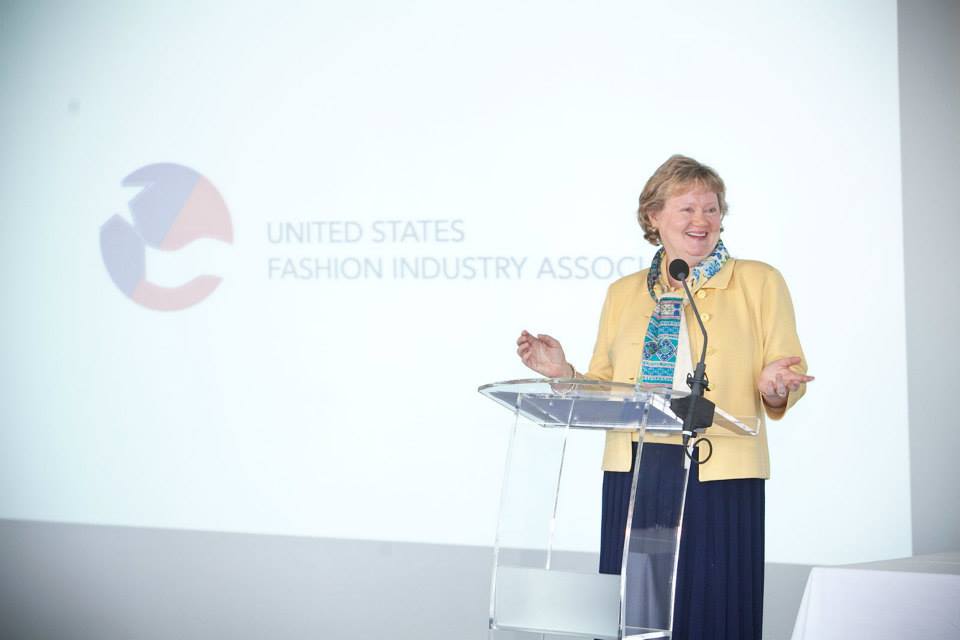
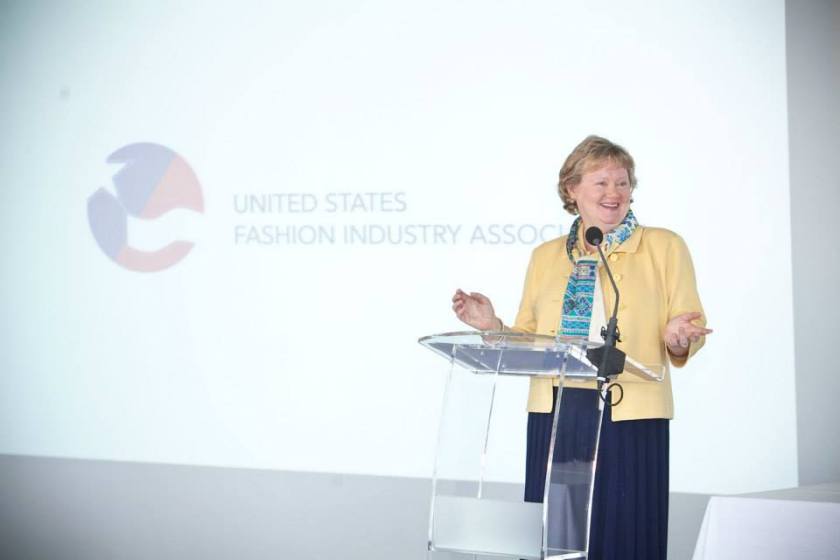
(Photo above: Julia Hughes presented at the 25th Annual Textile and Apparel Importer Conference. Courtesy of the United States Fashion Industry Association)

Julia K. Hughes is the President of the United States Fashion Industry Association (USFIA). USFIA represents all segments of the fashion industry, from apparel brands to retailers to service companies.  Ms. Hughes represents the interests of textile and apparel importers on trade policy issues to government officials, both in the United States and overseas. She has testified before Congress and the Executive Branch on textile trade issues. Ms. Hughes is also recognized as an expert in textile and apparel issues and is a frequent speaker at international conferences including the Apparel Sourcing Show, MAGIC, Foreign Service Institute, National Association of Manufacturers, Cotton Sourcing Summit, USIA’s Worldnet, the International Textiles and Clothing Bureau, Young Presidents’ Organization, World Trade Organization Beijing International Forum and others.

Julia Hughes is also well known to students enrolled in TMD433. She is featured in the book Travels of a T-shirt in the Global Economy, which highlights the global nature of the textile and apparel industry in the 21st century and those complicated economic, social and political factors associated with this important sector.

Interview Part

Sheng Lu: Would you please briefly introduce the current status of the U.S. fashion industry which your organization represents? For example, how large is the industry, how important is it to the US and the global economy, and what types of companies are involved as well as their business functions?

Julia Hughes: The phrase “the fashion industry” may call to mind images of Fashion Week and photo shoots. In this era of global trade, however, the high-fashion runways are just one part of the broader textile and apparel industry that ranges from high-end luxury brands to fast-fashion retailers—and the thousands of companies in between that produce and sell clothing, shoes, and other textile products.

United States Fashion Industry Association members and affiliates include companies across the value chain, which support our mission to remove barriers to textile and apparel trade. These companies include:

  • Brands, retailers, importers, and wholesalers of textiles and apparel.
  • Service providers, including consultants, customs brokers, freight forwarders, law firms, logistics providers, steamship lines, and testing and certification companies that help those brands, retailers, importers, and wholesalers.
  • Manufacturers and suppliers of finished products and inputs for finished products, as well as supplier associations, business councils, and promotional groups.
  • Agencies that promote the industry from a specific region, country, city, or other geographic entity.
  • Academic institutions.

This industry includes companies and professionals across the value chain, working in roles ranging from design and development, to sourcing and logistics, to trade policy and compliance, to retail and marketing. USFIA members include all of these types of companies and individuals…

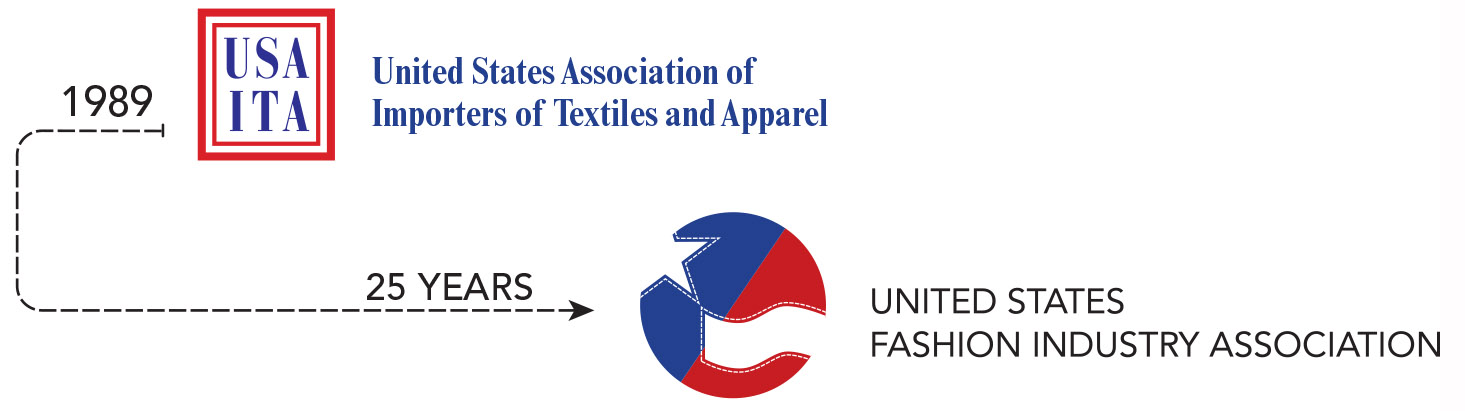
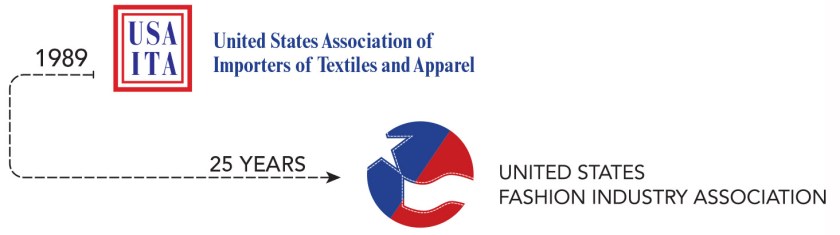
Sheng Lu: The United States Association of Importers of Textiles & Apparel (USA-ITA) has been a big name in the industry for 25 years. What leads your organization to change the name and rebrand yourself? Particularly, how will the USFIA distinguish itself with the American Apparel and Footwear Association (AAFA), whose members also include many US-based apparel companies and retailers?

Julia Hughes: The United States Association of Importers of Textiles & Apparel (USA-ITA), founded in January 1989 by nine U.S. importers, was instrumental in eliminating the global apparel quota system. At that time, it seemed like an almost insurmountable task to change the political dynamic enough so that the special protection for textiles and apparel would finally end.

On January 1, 2005, the quotas were officially eliminated, and since then, the industry has increasingly globalized. As a result, new challenges arise every day for apparel brands, retailers, and importers, ranging from challenges with compliance at the factories to challenges with transportation at the ports of entry. Over the years, the association has evolved with our members to address these new challenges—but our brand, including our name, logo, and official mission statement, had not changed in over two decades.

Accordingly, our major project in 2013 was rebranding the association to more clearly communicate our purpose and our direction for the future. It’s important to note that this project was not about changing our purpose or direction, but about ensuring that our brand accurately reflects the reality of the industry and the work we had already been doing for our members. The new brand—the United States Fashion Industry Association—was developed over 10 months with input from members and our trusted network across the value chain who participated in comprehensive overviews.

Why did we choose this name? First, our members are no longer just “importers.” While importing will be a critical aspect of our members’ sourcing plans for the foreseeable future, many of our members are truly global brands—for instance, designing product in the United States, producing that product in Asia, and then selling that product in Europe or Australia. Additionally, many of our members are also making product in the United States from U.S. and/or imported inputs. As we told WWD, “We are very supportive of Made in USA, and we sponsored some of the very first programs about Made in USA at MAGIC. It is a very important element, but it is one part of sourcing decision making.” Considering these realities, the phrase “Importers of Textiles and Apparel” no longer accurately described the industry or our members, so we needed to update it. (It was also a mouthful!) We settled on this exact name because “the fashion industry” is the phrase that companies, government, and the media uses most commonly to describe the wide variety of companies and professionals across the value chain—it best describes our association in 2013 and moving forward.

We spoke to our members and some trusted partners in our network about who we are and what sets us apart. From those conversations, we developed five values that we keep in mind with every decision we make. They are:

1.      Integrity: Our members tell us that we listen to them, support them, and defend them—while our government partners tell us that we work with them to find creative solutions.

2.      Substance: We maintain and articulate a deep understanding of the industry and challenges most important to our members—the sourcing and compliance executives who make tough decisions every day on how to address these challenges.

3.      Focus: We keep a laser focus on our mission, which allows us to be agile and quickly seize upon opportunities to move the needle.

4.      Collaboration: Our members collaborate to share best practices and amplify the industry’s voice on the critical issues, putting aside marketplace competition to work together toward common goals.

5.      Foresight: We keep our members informed not only about the regulatory challenges today, but also the regulatory challenges of tomorrow—and as our industry globalizes, we likewise expand our reach.

Sheng Lu: As mentioned in your mission statement, the USFIA is dedicated to the removal of barriers that impede the free movement of textile and apparel products to the United States and international markets. What are the top trade policy and market access concerns for the USFIA right now?

Julia Hughes: For 25 years, the United States Fashion Industry Association (USFIA)–formerly the United States Association of Importers of Textiles & Apparel (USA-ITA)–worked to eliminate barriers that impede the free movement of textile and apparel products to the United States and international markets. We participate in advocacy activities on a number of issues related to our mission in order to eliminate the tariff and non-tariff barriers that impede the industry’s ability to trade freely and create economic opportunities in the United States and abroad. Our top issues include:

Sheng Lu: You are featured in the well-known book Travels of T-shirt in the Global Economy. Interestingly enough, your counterpart in the book—Mr. Auggie Tantillo, now taps to lead the National Council of Textile Organizations (NCTO) which represents the US textile industry.  In the T-shirt book, you two held very different views on whether the U.S. should restrict apparel imports from China. Now almost 8 years later, do you (and the USFIA) still debate often with Auggie (and the NCTO) on textile and apparel trade policy issues? If so, what are you mainly debating about?

Julia Hughes: Today, Auggie and I still disagree on some of the basic trade policy issues–especially the negotiations for new free trade agreements. NCTO is trying to hold onto the same textile rules of origin that were negotiated in the 1990s, the yarn-forward rule of origin. USFIA and our members continue to encourage the U.S. textile industry to take a fresh look at the global industry.  But, so far, we remain far apart.

Nonetheless, we also have some areas where we can work together. Both our organizations support efforts to promote Made in the USA activities, as well as manufacturing in the Western Hemisphere. And, just this week I asked Auggie to help us with information about U.S.-based fabric mills. We also have collaborated on some proposals with Customs and Border Protection that build on the “trusted trader” concept and would focus enforcement measures on the companies who are not already proven to be compliant. And if I had to make a prediction, I would predict that in the next few years, we will find other areas where we can worth together productively.

Sheng Lu: Most of our students in the Textiles, Fashion Merchandising and Design (TMD) department will become professionals working for the US fashion industry after graduation. Does the USFIA have any resources available to our college students or have any future plans to expand the collaboration with the textile and apparel educational programs/academic institutions?

Julia Hughes: Yes! We welcome participation from universities, educators, and students in the fashion industry.

First, our website is a wonderful resource for information about the industry and our key issues. In addition to our issue pages, you’ll also find resources including recaps of past seminars, recordings of past webinars, our member publications, and more. (Some of this information is locked to USFIA members, but in the spirit of helping to grow our industry and future members, we’re always happy to help you access specific information you need! Just ask us!) We continue to build on the website, and in 2014, we will be launching a Value Chain Directory, which will provide comprehensive information on service providers and sourcing opportunities around the world.

Additionally, we host a number of events throughout the year, including our annual conference. We’re happy to work with educators and students to make attendance affordable, and we even have opportunities for universities to exhibit and students to volunteer.

We also encourage current and former students to visit our Career Center, which contains job opportunities at USFIA member companies. Even if you’re not looking for a job at the moment, it may be helpful to see what types of candidates these companies are seeking.

We’re always happy to work with universities, educators, and students to ensure that we educate the next generation of fashion industry leaders and professionals—future USFIA members!
USAITA to USFIA

EURATEX Raises Concerns about Pakistan’s Membership in the EU GSP+ Program

In a statement released on November 4, 2013, the European Apparel and Textile Confederation (EURATEX) openly expressed their opposition to the proposed “unique delegated act” for the EU Generalized Scheme of Preferences plus (GSP+) program. Specifically, the EURATEX strongly questioned Pakistan’s qualification as a beneficiary of the GSP+ , saying that “Pakistan has a poor record in matters related to Human rights and in particular to the protection of religious minorities, women and children .”

As put by Mr. Alberto Paccanelli, president of the EURATEX: “During the recent GSP revision it was repeatedly stated by the EU Commission that one of the main objectives of the new regime was to ensure that preferences were given to the countries that need them and in the case of GSP+ to countries that are promoting high Human, Social and Environmental standards.”

The GSP system is an EU trade policy tool specifically designed to help developing countries expand exports to the European Union markets. Beneficiaries of the GSP program can enjoy special favorable market access conditions such as tariff reduction and quota elimination.  For example, the EU charges an average 6.2% and 11.2% tariff rate for textile and apparel imports respectively from most sources, but the rates are lowered to 5.0% and 9% respectively for imports from GSP beneficiaries.

As part of the GSP system, the GSP+ program provides additional market access preferences to those economically and socially vulnerable countries under the condition that these countries will “implement core human rights, labor rights and other sustainable development conventions.” For example, textile and apparel imports from beneficiaries of the GSP+ program will be waived for import tariffs in the EU market. This will substantially improve the price competitiveness of products from the GSP+ beneficiary countries when competing with Asian suppliers such as China and India.

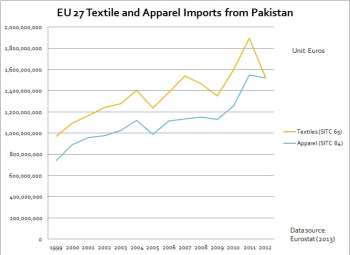
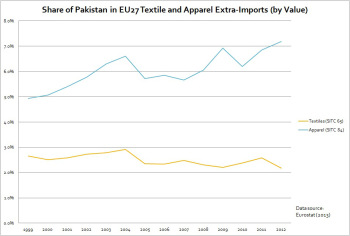
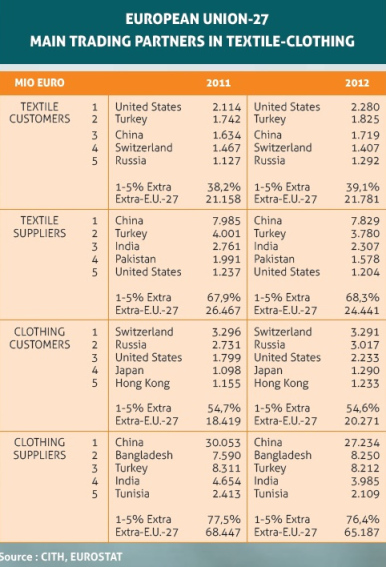
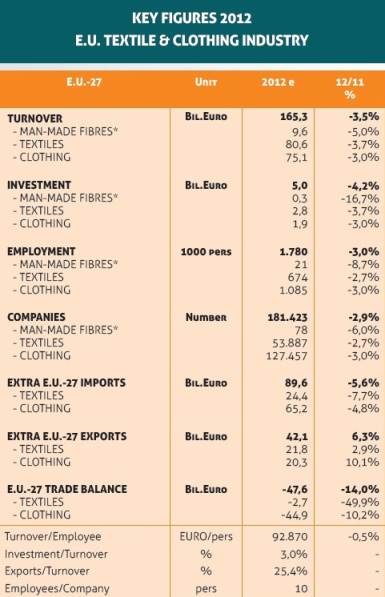
Despite the emphasis on Pakistan’s human right practices, the real factor driving EURATEX’s opposition to Pakistan’s membership in the GSP+ program could be market competition.  Pakistan is one of the most competitive textile and apparel exporters among the GSP beneficiaries. Data show that Pakistan’s textile and apparel exports to the EU market enjoyed robust growth over the past decade, causing the EU domestic textile & apparel manufacturers to become nervous about import competition.  The EURATEX, which represents the commercial interests of the EU local textile & apparel industry, has consistently opposed EU’s duty free access to Pakistan’s textile and apparel products.

Moreover, under the EU GSP system, there is a mechanism called “graduation of competitive sector”, under which imports of particular groups of products originating in a given GSP beneficiary country will lose GSP preferences once the average imports of this particular sector exceed 15% of GSP imports of the same products from all GSP beneficiary countries (12.5% for textile and clothing). However, the “graduation of competitive sector” mechanism will not be applied to GSP+ members. This means that if Pakistan becomes a GSP+ member, the EU domestic textile and apparel manufacturers may have to face increasing import competition from Pakistan but can do little about it.  

The most critical yet controversial part of the debate is, to which extent, the GSP system can be built into an effective and balanced development tool. According to a 2012 World Bank study, “the textile and apparel sector is THE most important manufacturing sector of Pakistan, which generated one-fourth of the country’s industrial value-added, recruited more than 40% of industrial labor force, contributed 8% of the country’s overall GDP and accounted for about 60% of Pakistan’s total merchandise exports.”  That being said, allowing Pakistan to export more textiles and apparel to the EU market is one of the very few ways to make the GSP system work and bring actual benefits to the country. Yet, the EU domestic textile and apparel industry can also cite statistics, arguing the necessity of protecting the domestic textile mills and saving the jobs there by resisting as many textile and apparel imports as possible.

On the other hand, the GSP system needs to take into consideration the benefits of all beneficiaries, especially to avoid creating “losers” and “winners” within the group. This is the philosophy behind the introduction of the “graduation of competitive sector” mechanism so that the interests of those “small countries” can be particularly taken care of. For example, when Pakistan is gaining additional market shares in the EU textile and apparel import market because of the GSP+ status, other less competitive developing countries may see decline of their exports. The textile and apparel industry is as important to these “losers” as it is to Pakistan.

Overall, the GSP debate reflects the significance and the complexity of the textile and apparel sector in the 21st century global economy.  Particularly, trade policy will continue playing a key role in improving the situation, yet it calls for courage and wisdom of policymakers.

by Sheng Lu

1

2

Why the General Public Needs to Care About Textiles and Apparel

International Trade Administration Reorganized

ita

From Just Style:

As part of its first major reorganization in more than 30 years, the US Department of Commerce’s International Trade Administration (ITA) has consolidated its four business divisions into three units.

The new units are Global Markets, Industry and Analysis, and Enforcement and Compliance.

Global Markets combines ITA’s country and regional experts, overseas and domestic field staff, and specific trade promotion programmes.

The Industry and Analysis (I&A) unit brings together ITA’s industry, trade, and economic experts to help US industries develop and execute international trade and investment policies to increase exports.

And the Enforcement and Compliance unit helps enforce US trade laws and ensure compliance with trade agreements.

The Office of Textiles & Apparel (OTEXA), which oversees apparel and textile trade, supervises the implementation of all textile trade agreements, formulates trade policy, performs research and analysis, compiles industry data, and promotes US trade events, is now part of the new Industry & Analysis division. Key staffs at the OTEXA and their responsibilities can be found HERE.

“Just as companies must change and adapt to ensure they provide cost-effective, high-quality products and services that meet the demands of their clients, so too must government agencies adapt to continuously improve their performance and make the best use of scarce public funds,” explained Francisco Sánchez, undersecretary for international trade.”

The TPP would actually benefit whom?: The local Vietnamese companies or rather the global capitals which invest in Vietnam ?

tpp

Outcomes of many studies suggest that Vietnam would become one of the largest beneficiaries of the Trans-Pacific Partnership (TPP) by substantially expanding its apparel exports to the United States. However, the news report below raises another interesting question to consider: who actually would benefit from the TPP: The local Vietnamese companies or rather the global capitals which invest in Vietnam because of the agreement? This question is important because the answer reflects many debates nowadays about the impact of globalization; particularly, the impact is suggested to be unequally felt by different stakeholders.

From thanhniennews

The US-led TPP trade pact that will include Vietnam among its signatories is expected to be wrapped up this year, but Vietnamese firms are unsure if they will benefit.

Many are anxious since foreign investors with deep pockets are planning to set up operations in the country to take advantage of the lowering of import taxes by many large economies that will sign up for the trade deal.

For instance, import tariffs in the US, the biggest customer for Vietnam’s leading export, textiles, will be cut from 17-32 percent now to zero.

Many textile and garment companies in the region have already begun to move to Vietnam.

Texhong Corporation of Hong Kong, which set up a dyeing factory in the southern province of Dong Nai in 2006, recently opened another one in the northern province of Quang Ninh with an investment of US$300 million.

One of Hong Kong’s leading textile companies, TAL Apparel, has plans to set up a second textile-dyeing -apparel factory worth hundreds of millions of dollars. It has eight factories worldwide, including one in Vietnam’s northern province of Thai Binh since 2004.

Unisoll Vina, owned by South Korean Hansoll Textile Ltd, has also got a license to build a $50-million factory to make fur and leather clothing and accessories.

According to the Ho Chi Minh City Association of Garment, Textile, Embroidery and Knitting, Japanese companies Toray International and Mitsui, Austria’s Lenzing, and China’s Sunrise are also exploring investment opportunities in the country.

Vietnamese companies are meanwhile trying to enlarge their limited feedstock production capacity to comply with TPP’s regulations on origins – for instance apparel has to be made using yarn and other materials produced in member countries.

The Vietnam National Textile and Garment Group (Vinatex) has opened three yarn factories this year in Hanoi and the central provinces of Ha Tinh and Thua Thien-Hue with an annual capacity of 1,270 tons.

It started work on 11 others in the first half of the year.

Figures from the Vietnam Textile and Apparel Association (Vitas) showed that 70 percent of more than 3,700 textile factories in the country make apparel; only 6 percent produce yarn and 17 percent make cloth while 4 percent dye.

Local producers depend largely on fabric imported from China.

Insiders said a yarn factory costs tens of millions of dollars, a sum most Vietnamese businesses cannot afford.

Pham Xuan Hong, deputy chairman of Vitas, said unless the government helps by making cheap loans available for yarn projects, the industry would not benefit from the TPP at all.

The government also needs to zone certain areas for dyeing plants since they are shunned everywhere due to pollution concerns, Hong said.

EU Textile and Apparel Industry Sees Positive Impact of the TTIP

The European Apparel and Textile Federation (EURATEX) on September 26, 2013 hosted a luncheon event on the current US-EU negotiation on the Trans-Atlantic Trade and Investment Partnership (TTIP), particularly the impact of the agreement on the EU textile and apparel sector. According to Mr. Alberto Paccanelli, president of the EURATEX, the United States currently is the EU 2nd largest export market for T&A (over $4.5 billion Euros) and the largest when counting textiles alone. Alberto said that the US market is highly price sensitive and this is one of the reasons why tariffs remain an effective barrier to EU exports. For example, the US still charges a tariff rate as high as 28.2% for imported man-made fiber overcoat and 32% tariff rate for man-made fiber T-shirt. Alberto further added that:

“The EU-US negotiations are the key priority for the EU Textile and Clothing Industry. EURATEX has made a rough assessment on the benefits of the Agreement: it is estimated that exports would register possible annual increases between 2.5% and 3.5% on top of the normal growth rate in Exports due to the Agreement. The EU should strive for duty free access from day one without exceptions and in what concerns Non-Tariff Barriers we should aim at harmonization and mutual recognition. It is also critical to improve access to the Public Procurement Markets and ensure a high level of intellectual property right (IPR) protection and enforcement. The TTIP Agreement should improve business conditions for small and medium-sized enterprises (SMEs), simplifying customs procedures and the costs associated. For the EU Textile and Clothing Industry Rules of Origin are also critical and double transformation should be ensured.”

eu1

eu2

Expanding Global Trade through Innovation and the Digital Economy


This is the introductory video of this year’s World Trade Organization (WTO) Public Forum hosted from Oct 1 to Oct 3. The WTO Public Forum is an annual event that provides a platform for public debate across a wide range of WTO issues and trade topics. The Public Forum is also an opportunity for us in the WTO to listen and exchange views with non-government organizations (NGOs), academia, the private sector, with those of you who are increasingly participating in shaping the world’s economic and political environment. This year’s Public Forum looks at the future of trade in an era of innovation and digitalization.

As put it by Michael Froman, the U.S. Trade Representative :” The global marketplace has experienced a sea change. Combining globalization with new technology and with new business models has dramatically accelerated the pace of change and innovation. The flow of data is as important as the movement of goods. Services are an increasing share of value-added manufacturing. And the market is determining standards at an increasingly rapid pace.”

Travels of a T-shirt with Pietra Rivoli (2013)

TPP updates: Hong Kong and South Korean textile firms increase FDI in Vietnam

The American Chamber of Commerce in Vietnam recently updates the textile & apparel sectoral negotiation under the TPP. At this point, different stake holders in the negotiation still hold divided views on a number of key issues, such as the rules of origin and short supply list. It is not a country line, but a line between different business types. What is also interesting to watch is that textile firms from Hong Kong and South Korea have taken actions to seize the “strategic opportunity” of investing in Vietnam. In the long run, it is not positive news for the U.S. textile mills to see Vietnam become more self-dependent on textile supply. However, few people believe TPP would conclude by the end of this year…

Full text of the article:

In Vietnam in preparation for the Trans-Pacific Partnership duty-free exports of apparel from Vietnam to the USA in accordance with the Textiles and Apparel Chapter rules of origin.

Senator Richard Burr (R-NC) asked USTR Michael Froman at the Jun 6, 2013 Senate Finance Committee hearing on the nomination, ” … a poorly negotiated TPP agreement could result in the loss of hundreds of thousands of U.S. jobs in the textile sector … If confirmed as the U.S. Trade Representative, will you support the yarn-forward rule of origin?”

Ambassador Froman replied, “The short answer is yes. We have made clear that we need clear rules of origin with yarn-forward at the center, we need rules against trans-shipments … the yarn-forward fule is a central part of our approach to textiles.” Click this link to see a C-SPAN video of the Senate Finance Committee hearing (0:27:41).

The “yarn forward” rule of origin means that all products in a garment from the yarn stage forward must be made in one of the countries that is party to the TPP agreement. In simple terms, the “yarn forward” rule means that the benefits of the agreement accrue to producers in TPP member countries rather than producers in non-TPP countries.

Perhaps in response, Mr. Nguyen Vu Tung, Deputy Chief of Mission at Vietnam’s Embassy to the USA in Washington, said at a conference on Jun 19, 2013, that the latest U.S. offer “is really, really difficult for us to accept.” Unless the two sides can reach a breakthrough, “I’m really concerned about the prospect of Vietnam to conclude the successful negotiation of TPP,” he said. According to the report, ”U.S. textile producers sell billions of dollars of yarn and fabric each year to U.S. free trade partners in Latin America, where it is turned into clothing and sent back to the United States. They fear without the yarn forward rule, Vietnam will be able to shut down that trade by importing yarn and fabric from China to make clothing to ship duty-free to the United States.”

Deputy Chief of Mission Nguyen Vu Tung made the comment at a conference organized by the Woodrow Wilson Center in Washington on The Trans-Pacific Partnership: New Rules for a New Era, Jun 19, 2013 (3 hours), with opening remarks by Robert Zoellick, former U.S. Trade Representative, former U.S. Deputy Secretary of State, and former World Bank President. Click the link to see a video of the webinar.

While political leaders and diplomats discuss the Trans-Pacific Partnership rules of origin, Hong Kong, South Korean, and Australian firms are developing and planning major textiles FDI in Vietnam to produce yarn and fabric, the supporting textiles industry for apparel production.

Korea’s Kyungbang inaugurates new $40 million yarn facility in Binh Duong; plan to develop the largest yarn-spinning in Asia. When the plant is extended in its second and third phase (with registered investment of $160 million), it will be the largest mill in Asia.

Hong Kong’s Texhong to invest $300 million, Pacific Textiles $180 million in new textile facilities in Vietnam, in preparation for TPP

Texhong has has already invested $200 million in a plant in Dong Nai Province, and committed in Jul 2012 $300 million to a factory in Quang Ninh, which should be operational in the 2nd half of 2013.

Last year [2012] Texhong said it would invest $300 million to build a new yarn factory in Quang Ninh.. When the second-phase investment is completed next year [2014] its annual capacity will more than double to 110,000 tonnes of yarn.

Australia’s Woolmark® helps develop yarn-forward wool products in Vietnam. Today there are close to 50 companies in Vietnam using Australian wool. “When we started the project, none of the manufacturing partners knew anything about wool, and some of them had never even felt it,” said AWI project manager Jimmy Jackson. Initially we ran training courses to explain wool’s properties, benefits and features for manufacturing and producing garments. The next step was to introduce the manufacturers to suppliers of Australian wool yarns. We also had to explain the Woolmark standards and requirement in terms of both wear and laundering performance. Now that the Vietnamese manufacturers are confident in producing quality wool garments, AWI will introduce them to global retail and brand buyers.

Can the U.S. Negotiate a High-standard TPP

From 30′–38′ was the remark made by Steve Lamar, Executive Vice President of the American Apparel and Footwear Association (AAFA). From the view of the U.S. apparel industry, TPP will help diversify the import sources, promote export (note: AAFA members “produce everywhere and sell everywhere in the world”) and facilitate regulatory coherence of trade regulations. Steve hoped that the TPP outcome will be: 1) useable and relevant to the business community, not only for today, but also for the next 20 years; 2) can provide flexibility for AAFA members in implementing their supply chain strategy in today’s global economy.  Steve also believes that complication is the largest obstacle for the TPP negotiation, given the increasing number of countries getting involved and so many agendas included.

Other distinguished speaker in the event include Barbara Weisel, Assistant U.S. Trade Representative for Southeast Asia and the Pacific. Barbara summarized the TPP history, the perspectives from the USTR and latest negotiation updates, very informative.

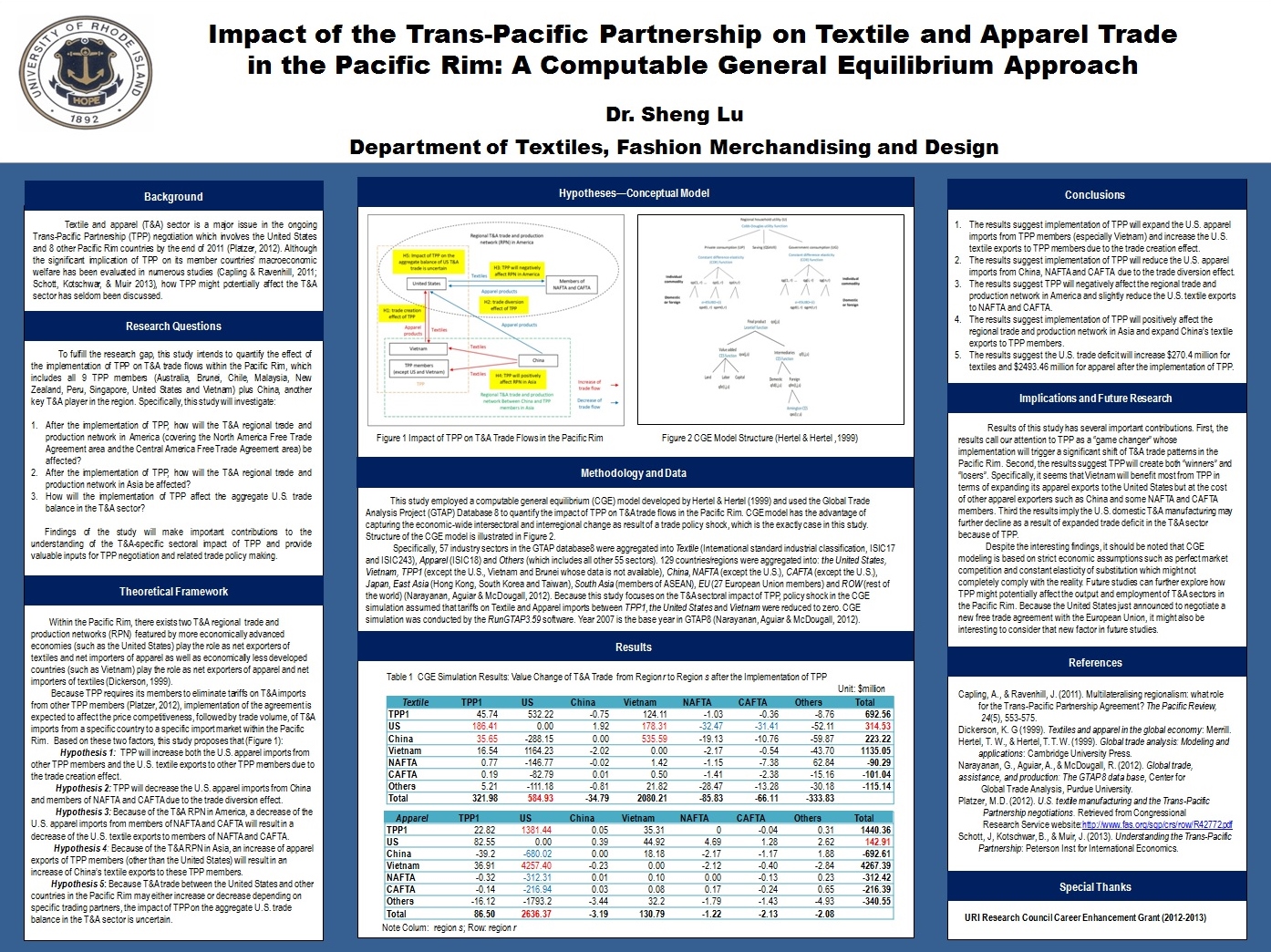
Impact of the Trans-Pacific Partnership on Textile and Apparel Trade in the Pacific Rim

TPP on T&A trade in the pacific rim

Citation: Lu, S. (2013). Impact of the Trans-Pacific Partnership on textile and apparel trade in the Pacific Rim. World Trade Organization Focus, 20(5), 67-77.

For questions, please contact the author: shenglu@mail.uri.edu

China’s chair left unoccupied at Obama’s free trade party

Yesterday in class, some of you asked why did the U.S. decide to join the TPP negotiation at the very beginning? The following report from the Financial Times (UK) may provide some insightful views. To put it simply, it is a big game involving national interests. You can also rethink about those points I mentioned in the class regarding the “strategic importance of Asia to the US”.

From Financial Times April 2, 2013

With the rise of China in its sights, the Obama administration has posted marines in Darwin, Australia, and increased the number of warships visiting Subic Bay in the Philippines. The “pivot” to Asia now has a new stopover: Brussels.

After years of discussing the idea, the US and the EU are finally starting to negotiate a free-trade agreement which would form an economic zone covering 40 per cent of the world’s gross domestic product.

At the same time, momentum is building on another important trade initiative, the Trans-Pacific Partnership, which brings together the US with several of the Asia-Pacific region’s most dynamic economies: Singapore, Australia, Vietnam and – since two weeks ago – Japan. It will come as a surprise to anyone who spent a lot of time on the campaign trail last year, but free-trade agreements have emerged as one of the biggest priorities of Barack Obama’s second term as US president.

The striking feature of this burst of free trading is who is absent. The agreements are one of the fresh ways Washington is developing to deal with China, the world’s biggest exporter of manufactured goods. After urging China to behave as “a responsible stakeholder” and after the brief flirtation with a G2 arrangement in Mr Obama’s first year, the latest trade approach might be characterised as ABC – Anyone But China.

Supporters of the US-EU trade pact complain that it is about more than China. They point to the boost to growth that could flow from a deal between two partners which already have a two-way annual trade in goods and services of $1tn.

However, much of the substance of the EU talks and of TPP points to China. The agenda includes state subsidies for business and protecting intellectual property – the sorts of issues that are huge bones of contention with Beijing.

If the US can get enough important countries to sign up, it hopes to establish global trading standards that China would feel obliged to respect.

On Capitol Hill, where free trade is not an easy sell in an era of unemployment of more than 7.5 per cent, the China angle helps to rally support.

“This is very much part of our China strategy,” an aide to a leading Republican senator puts it, talking of the discussions with the EU.

More broadly, the two negotiations reflect a different approach to global governance. Prolonged deadlock over the Doha trade round, with similar stalemates about climate change, small arms and other issues, has led to deep scepticism about the idea of achieving global agreements on important issues.

TPP and the US-EU trade talks represent an alternative strategy, an attempt to forge fresh rules by appealing to smaller groups of like-minded nations, in this case working around China rather than with Beijing. Supporters say this is not an abandonment of global institutions like the World Trade Organisation, but simply a realistic assessment of how to get things done.

The big question, of course, is how China will react. Ever since it joined the WTO more than a decade ago, China has had one foot inside the global trading system and one outside it.

On most of the occasions that China has lost legal challenges at the WTO, it has implemented the rulings and made its trade laws compliant. But Beijing has yet to open up government procurement, an important factor in an economy like China’s. At the same time, allegations of Chinese hacking of trade secrets from other countries are seen by many as an affront to the very idea of free trade.

Beijing has strong views about what is really going on.

“The US is trying to rewrite global trade rules behind our backs,” says a senior Chinese official.

The risk of the US approach is that it could encourage China to turn its back even further on the global trading system, diminishing the incentive to comply rather than intensifying it.

If that were to happen, the US-EU trade talks would not herald a new era of economic integration but rather another nail in the coffin of globalisation.


2013 U.S. Trade Policy Agenda Hearing

This year’s USTR trade agenda hearing at the senate finance committee is quite interesting. Ron Kirk just stepped down and Demetrios took the testimony as the acting USTR. Demetrios looks both young and smart. I am not sure whether he is among the top candidates to be considered for the USTR position but his congressional working experiences and legal background make him at least a qualified candidate in my view. Nevertheless, USTR usually is a political appointee. More interesting to watch is Sherrod Brown and Rob Portman now serve in the same committee. Sherrod obviously holds a very suspicious view about trade liberalization. As I remember he was the only senator who raised question focusing on import restrictions. Demetrios looked like a student before Rob Portman understandably.  Attending such a hearing should make Portman feel quite special too. “Unfortunately”, now he has to speak more for Ohio than for globalization.  TPA (Trade Promotion Act) turned out to be the No.1 hot topic in today’s hearing.  Japan & TPP raised grave concerns as well. I am not sure whether it is the best timing to accept Japan into the TPP. This unavoidably will make the agriculture & auto related negotiations much more challenging than otherwise.    Something a little surprising to me is China was not targeted very often today.

By Sheng Lu

TPP and the U.S. Textile Manufacturing Industry

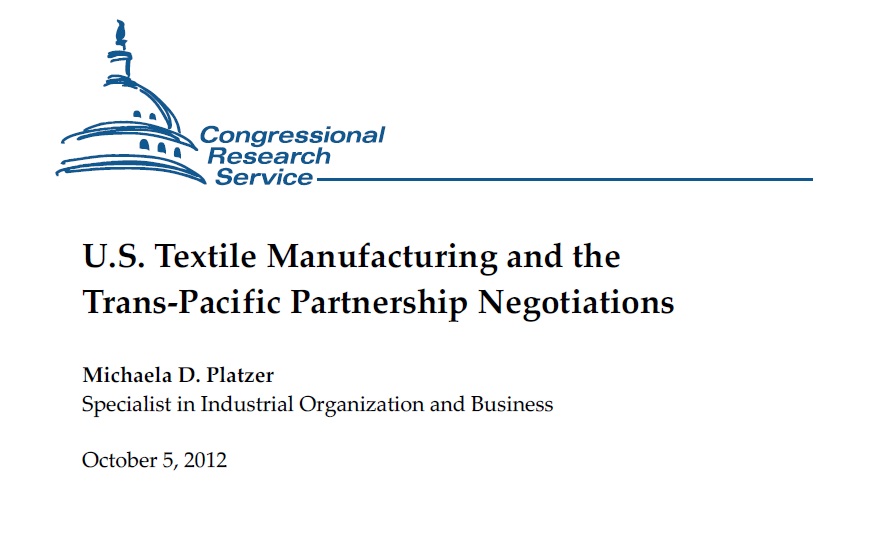
The Congressional Research Service just released its most recent study on the U.S. textile manufacturing industry and the Trans-Pacific Partnership (TPP) Negotiation. This is also one of the limited reference available so far that specifically addresses the sectoral impacts of TPP.

Overall, this report did a good job of compiling latest statistics showing the operation of the regional trade & production network between the United States and those developing countries in central and south America. It also discusses why the U.S. textile industry appears to be very nervous about Vietnam.

However, the study wasn’t able to quantify the impact of TPP, which leaves potential for future studies. On the other hand, although debates over TPP centers upon the rules of origin, we shall not forget about foreign investment–especially when geographically Vietnam is very close to China, Japan and South Korea. Even yarn-forward is adopted, why cannot Chinese factories move their factories to Vietnam? It shall be noted that China’s economy is undergoing structural change and it’s the time for some Chinese factories to “go offshore”. 

Full text of the report can be found here.


US: Yarn-forward rule row flares up again

polyester-yarn-import-175429_189210

A row has flared up again over the yarn-forward rule of origin in US free trade agreements after The Hosiery Association (THA) called for a knit-to-shape, assembly-only exception for socks and hosiery in the Trans-Pacific Partnership (TPP).

Three textile trade associations have now written to US Trade Representative Ron Kirk expressing their “strong opposition” to the proposal.

The American Manufacturing Trade Action Coalition (AMTAC), National Council of Textile (NCTO) Organizations, and American Fiber Manufacturers Association (AFMA) say any such move “conflicts with the US textile industry’s longstanding support” of a yarn-forward rule of origin for textiles and apparel.

The yarn-forward rule requires all stages of production – from yarn spinning to fabric formation and final garment assembly – to be done either in the United States or in an FTA partner country to qualify for duty-free treatment.

US textile groups say the rule is “long-established” and “logical” because the value of a finished item comes from its components, rather than from its final assembly.

But American retailers, apparel brands, manufacturers and importers argue it is too restrictive, hinders new trade and investment in the sector, and renders most existing trade ineligible for preferential tariff treatment.

The Hosiery Association wants the TPP pact – currently being negotiated by the US, Vietnam, Brunei, Chile, New Zealand, Singapore, Australia, Malaysia and Peru – to allow hosiery producers to source yarns for man-made fibre socks and hosiery outside the TPP region in all instances except in the case of 100% cotton and polyester products.

But “this proposal would be a massive blow to US and other TPP producers who manufacture acrylic, nylon and various other types of man-made fibre yarns,” the textile groups say.

“In short, the THA proposal allows yarns currently made in large quantities in the United States to be sourced from third parties, notably China,” the letter says.

The Importance of CAFTA-DR and NAFTA to the U.S. Textile Industry

A recent study of the United States International Trade Commission reaffirms the special roles played by free trade agreements in supporting the regional trade-production network (RTN) for textile and apparel products in America and promoting the export of U.S.-made textile to developing countries in the region in particular. However, also as mentioned in the report, the influence of such RTN has sustantially declined since the full elimination of quota system in 2005. The implementation of the new FTAs established between US and countries in Asia-Pacific pose new uncertanties to the RTN in America, given the trade diversion effect commonly seen in FTAs.

The Great Recession and Trade Protectionism: What Went Right?

A great commentary article on a recent study on trade protectionist measures by Chad Bown, a former professor from Brandeis university and a guru on trade remedy measures. It is interesting to note that the using of trade protectionist measures is much less frequent today than in the past. I agree with the reasons proposed by the article, such as the establishment of the WTO as a monitoring body, global production and emerging markets instead of developed countries becoming leading importers. On the other hand, trade protectionist measures are taking more diversified forms today and the scope has gone far beyond the traditional AD, CVD and safeguard measures. In particuar, measures that intend to promote export potentially could raise new trade disputes among leading exporters.

The full report can be downloaded from here

The Sixth Anniversary of Post-quota Era

The Sixth Anniversary of Post-quota Era:

New Patterns of World Textile and Clothing Trade and Critical Trade Policy Issues

By Sheng Lu

Keywords: Post-quota era, world textile and clothing trade, trade policy

       Impact of the elimination of the 40-year textile and clothing (T&C) quota system on January 1, 2005 has always been a research interest to scholars in the field. Shifting from a highly-distorted trading environment to a much more market-based competition, reshuffle of the world T&C trade in the post-quota era is widely believed to be unavoidable and will have ripple effects on the future landscape of the global T&C industry (Dickerson, 1999; Nordas, 2004).

After six years of transition, medium and long-term effects of quota elimination have begun to display, attributed to adjustment of business practices of T&A firms in response to the new “rules of the game” (UNIDO, 2009). By taking advantage of such great timing, this study scrutinizes patterns of world T&C trade that have been newly emerged so far in the post-quota era.  Capturing these new trends of development at the macro-industry level can both deepen understanding about the 40-year quota system itself and raise awareness of emerging research agendas for world T&C trade.

Three specific post-quota patterns of world T&C trade are discussed in the study:

First, non-dominant position of China in world T&C export. At first glance, China increased its market share in world T&C export by roughly 10 percentage points from 2005 to 2008, suggesting China was one of the biggest winners of quota elimination (WTO, 2010). However, a closer look will find: (1) China gained its market share at a decelerating rate over that period, implying China’s export surge at the very beginning of quota elimination was mainly due to the temporary transition effect; (2) At the disaggregated 6-digit HS code level, China’s export performance varied greatly from product to product, implying other exporters was still able to compete with China in the post-quota era by focusing on certain T&C product categories; (3) A number of Asian and European countries other than China also enjoyed robust growth in T&C export since 2005, suggesting China was one of the beneficiaries  rather than the only winner of the post-quota era. Last but not least, the emergence of the “China+1” sourcing strategy indicated that T&C importers already started selecting other possible substitution sourcing destination as China’s back-up. In particular, importers were cautions about China’s rising manufacturing cost and the business risks associated with placing “too many eggs in one basket”.

Second, geographic concentration of T&C trade and increasing dependence on textile manufacturing capacity for clothing export. This new pattern is closely associated with changes of buyers’ sourcing practices. Specifically: (1) Market concentration rate (Herfindahl index) in major T&C importing countries, such as the United States, Europe and Japan, quickly went up since 2005 because of buyers’ consolidation of their sourcing channels. Traditional trade patterns such as “triangle manufacturing” and “outward processing trade” which were artificially created by the quota system can no longer justify their rationality of existence when quota restriction were removed. (2) The traditional “Cut, Make and Trim” (CMT) sourcing practice was gradually replaced by full-package sourcing. This shift was largely caused by the upgrading of global T&C value chain, including the transition of branded manufacturers into marketers and retailers’ more active involvement in direct sourcing; (3) Compared to CMT, qualified destination for full package sourcing needs to have the capacity of locally manufacturing textiles. This requirement poses big challenges to many developing countries which haven’t established a sound textile industry yet due to their overall lagged behind economic development.  Impacts of full package sourcing on many aspects of the global T&C industry can be further studied.

Third, widening gap of intra-region trade patterns between America and Europe. As one format of vertical division of labor formed by countries in the same region but at different development stages, intra-region trade was a special feature of the world T&C trade, especially in America and Europe (Dickerson, 1999). However, statistics showed that intra-region trade in America quickly dropped from 69% to 55.7% for textiles and 48.5% to 26.9% for clothing from 2004 to 2008 (WTO, 2010). The decline occurred despite the new passage of several free-trade agreements which deliberately include clauses encouraging the using of U.S.-made textile products by neighboring developing countries. Accompanied with lowering share of intra-region T&C trade, imports from Asia keep constant rising in America over the same period. In contrast, share of intra-region trade in Europe remained stable, stood at around 75% for textiles and 82% for clothing. More studies can be done to explore the causes of such widening gap between America and Europe in terms of intra-region trade patterns.

This study also calls for awareness of “unexpected” negative effects of some trade policies on developing countries’ T&C export in the post-quota era. These trade policies include although not limited to: (1) WTO Doha Development Agenda (DDA). The DDA negotiation set the goal to cut import tariff for T&C product worldwide. However, reduced tariff rate will also wear down the real benefits of preferential duty-free treatment enjoyed by some least developed countries when competing with T&C export giants such as China and India; (2) Rule of origin (ROO) provisions in free-trade agreements. ROO originally was developed to ensure preferential treatments be enjoyed only by eligible FTA members. However, as ROO is specific to each FTA, the complexity and inconsistency made many preferential treatments seldom be taken advantage of. ROO further reduces the incentives for developing countries to develop their own textile industry. This put developing countries at a special disadvantage position when buyers are shifting to full package sourcing as discussed above. (3) Generalized System of Preferences (GSP). Aimed at promoting economic growth in the developing world, developed countries allow preferential duty-free entry of imports from eligible developing countries through the GSP program. Ironically, although T&C account for 50%-90% of total exports for many developing countries (WTO, 2010), most T&C importers including the United States and the European Union still reject including T&C in their GSP programs due to opposition from political forceful domestic industries with concerns about import competition. It is a challenge for policy makers in the post-quota era to design a set of fair and rational trading rules under which developing countries can enjoy the benefits of quota elimination and have more opportunities participating in world T&C trade. Academia has its key role to play in this endeavor.

 References

Dickerson, K. G. (1999). Textiles and apparel in the global economy. N.J.: Merrill

Nordas, H. K. (2004). The global textile and clothing industry post the agreement on textiles and clothing. WTO discussion papers, 5. Geneva: WTO Publications

United Nations Industrial Development Organization, UNIDO (2009). The Impact of Institutions on Structural Change in Manufacturing: the Case of International Trade Regime in Textiles and Clothing. Vienna: Austria

World Trade Organization, WTO. (2010). World Trade Statistics, Geneva: Switzerland

Textile Makers Fight to Be Heard on South Korea Trade Pact

Read the full article from the New York Times:

My comment:

It is important to realize that the U.S. textile industry and the U.S. apparel industry today are no longer close parnters. Why? Because they choose different restructuring strategies in response to globalization and rising imports.