Exclusive Interview with Julia K. Hughes, President of the United States Fashion Industry Association

Julia

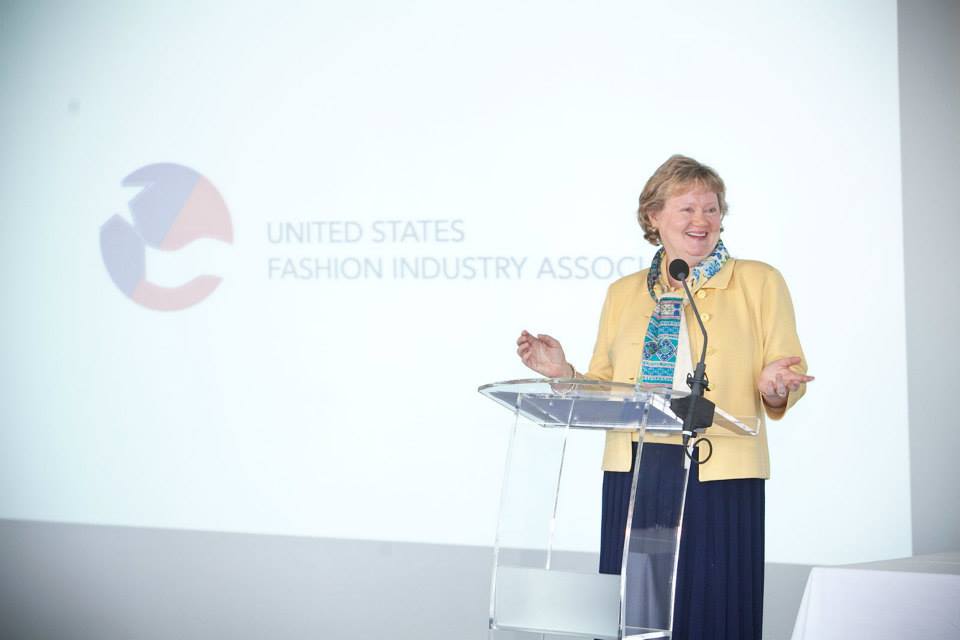
(Photo above: Julia Hughes presented at the 25th Annual Textile and Apparel Importer Conference. Courtesy of the United States Fashion Industry Association)

Julia K. Hughes is the President of the United States Fashion Industry Association (USFIA). USFIA represents all segments of the fashion industry, from apparel brands to retailers to service companies.  Ms. Hughes represents the interests of textile and apparel importers on trade policy issues to government officials, both in the United States and overseas. She has testified before Congress and the Executive Branch on textile trade issues. Ms. Hughes is also recognized as an expert in textile and apparel issues and is a frequent speaker at international conferences including the Apparel Sourcing Show, MAGIC, Foreign Service Institute, National Association of Manufacturers, Cotton Sourcing Summit, USIA’s Worldnet, the International Textiles and Clothing Bureau, Young Presidents’ Organization, World Trade Organization Beijing International Forum and others.

Julia Hughes is also well known to students enrolled in TMD433. She is featured in the book Travels of a T-shirt in the Global Economy, which highlights the global nature of the textile and apparel industry in the 21st century and those complicated economic, social and political factors associated with this important sector.

Interview Part

Sheng Lu: Would you please briefly introduce the current status of the U.S. fashion industry which your organization represents? For example, how large is the industry, how important is it to the US and the global economy, and what types of companies are involved as well as their business functions?

Julia Hughes: The phrase “the fashion industry” may call to mind images of Fashion Week and photo shoots. In this era of global trade, however, the high-fashion runways are just one part of the broader textile and apparel industry that ranges from high-end luxury brands to fast-fashion retailers—and the thousands of companies in between that produce and sell clothing, shoes, and other textile products.

United States Fashion Industry Association members and affiliates include companies across the value chain, which support our mission to remove barriers to textile and apparel trade. These companies include:

  • Brands, retailers, importers, and wholesalers of textiles and apparel.
  • Service providers, including consultants, customs brokers, freight forwarders, law firms, logistics providers, steamship lines, and testing and certification companies that help those brands, retailers, importers, and wholesalers.
  • Manufacturers and suppliers of finished products and inputs for finished products, as well as supplier associations, business councils, and promotional groups.
  • Agencies that promote the industry from a specific region, country, city, or other geographic entity.
  • Academic institutions.

This industry includes companies and professionals across the value chain, working in roles ranging from design and development, to sourcing and logistics, to trade policy and compliance, to retail and marketing. USFIA members include all of these types of companies and individuals…

Sheng Lu: The United States Association of Importers of Textiles & Apparel (USA-ITA) has been a big name in the industry for 25 years. What leads your organization to change the name and rebrand yourself? Particularly, how will the USFIA distinguish itself with the American Apparel and Footwear Association (AAFA), whose members also include many US-based apparel companies and retailers?

Julia Hughes: The United States Association of Importers of Textiles & Apparel (USA-ITA), founded in January 1989 by nine U.S. importers, was instrumental in eliminating the global apparel quota system. At that time, it seemed like an almost insurmountable task to change the political dynamic enough so that the special protection for textiles and apparel would finally end.

On January 1, 2005, the quotas were officially eliminated, and since then, the industry has increasingly globalized. As a result, new challenges arise every day for apparel brands, retailers, and importers, ranging from challenges with compliance at the factories to challenges with transportation at the ports of entry. Over the years, the association has evolved with our members to address these new challenges—but our brand, including our name, logo, and official mission statement, had not changed in over two decades.

Accordingly, our major project in 2013 was rebranding the association to more clearly communicate our purpose and our direction for the future. It’s important to note that this project was not about changing our purpose or direction, but about ensuring that our brand accurately reflects the reality of the industry and the work we had already been doing for our members. The new brand—the United States Fashion Industry Association—was developed over 10 months with input from members and our trusted network across the value chain who participated in comprehensive overviews.

Why did we choose this name? First, our members are no longer just “importers.” While importing will be a critical aspect of our members’ sourcing plans for the foreseeable future, many of our members are truly global brands—for instance, designing product in the United States, producing that product in Asia, and then selling that product in Europe or Australia. Additionally, many of our members are also making product in the United States from U.S. and/or imported inputs. As we told WWD, “We are very supportive of Made in USA, and we sponsored some of the very first programs about Made in USA at MAGIC. It is a very important element, but it is one part of sourcing decision making.” Considering these realities, the phrase “Importers of Textiles and Apparel” no longer accurately described the industry or our members, so we needed to update it. (It was also a mouthful!) We settled on this exact name because “the fashion industry” is the phrase that companies, government, and the media uses most commonly to describe the wide variety of companies and professionals across the value chain—it best describes our association in 2013 and moving forward.

We spoke to our members and some trusted partners in our network about who we are and what sets us apart. From those conversations, we developed five values that we keep in mind with every decision we make. They are:

1.      Integrity: Our members tell us that we listen to them, support them, and defend them—while our government partners tell us that we work with them to find creative solutions.

2.      Substance: We maintain and articulate a deep understanding of the industry and challenges most important to our members—the sourcing and compliance executives who make tough decisions every day on how to address these challenges.

3.      Focus: We keep a laser focus on our mission, which allows us to be agile and quickly seize upon opportunities to move the needle.

4.      Collaboration: Our members collaborate to share best practices and amplify the industry’s voice on the critical issues, putting aside marketplace competition to work together toward common goals.

5.      Foresight: We keep our members informed not only about the regulatory challenges today, but also the regulatory challenges of tomorrow—and as our industry globalizes, we likewise expand our reach.

Sheng Lu: As mentioned in your mission statement, the USFIA is dedicated to the removal of barriers that impede the free movement of textile and apparel products to the United States and international markets. What are the top trade policy and market access concerns for the USFIA right now?

Julia Hughes: For 25 years, the United States Fashion Industry Association (USFIA)–formerly the United States Association of Importers of Textiles & Apparel (USA-ITA)–worked to eliminate barriers that impede the free movement of textile and apparel products to the United States and international markets. We participate in advocacy activities on a number of issues related to our mission in order to eliminate the tariff and non-tariff barriers that impede the industry’s ability to trade freely and create economic opportunities in the United States and abroad. Our top issues include:

Sheng Lu: You are featured in the well-known book Travels of T-shirt in the Global Economy. Interestingly enough, your counterpart in the book—Mr. Auggie Tantillo, now taps to lead the National Council of Textile Organizations (NCTO) which represents the US textile industry.  In the T-shirt book, you two held very different views on whether the U.S. should restrict apparel imports from China. Now almost 8 years later, do you (and the USFIA) still debate often with Auggie (and the NCTO) on textile and apparel trade policy issues? If so, what are you mainly debating about?

Julia Hughes: Today, Auggie and I still disagree on some of the basic trade policy issues–especially the negotiations for new free trade agreements. NCTO is trying to hold onto the same textile rules of origin that were negotiated in the 1990s, the yarn-forward rule of origin. USFIA and our members continue to encourage the U.S. textile industry to take a fresh look at the global industry.  But, so far, we remain far apart.

Nonetheless, we also have some areas where we can work together. Both our organizations support efforts to promote Made in the USA activities, as well as manufacturing in the Western Hemisphere. And, just this week I asked Auggie to help us with information about U.S.-based fabric mills. We also have collaborated on some proposals with Customs and Border Protection that build on the “trusted trader” concept and would focus enforcement measures on the companies who are not already proven to be compliant. And if I had to make a prediction, I would predict that in the next few years, we will find other areas where we can worth together productively.

Sheng Lu: Most of our students in the Textiles, Fashion Merchandising and Design (TMD) department will become professionals working for the US fashion industry after graduation. Does the USFIA have any resources available to our college students or have any future plans to expand the collaboration with the textile and apparel educational programs/academic institutions?

Julia Hughes: Yes! We welcome participation from universities, educators, and students in the fashion industry.

First, our website is a wonderful resource for information about the industry and our key issues. In addition to our issue pages, you’ll also find resources including recaps of past seminars, recordings of past webinars, our member publications, and more. (Some of this information is locked to USFIA members, but in the spirit of helping to grow our industry and future members, we’re always happy to help you access specific information you need! Just ask us!) We continue to build on the website, and in 2014, we will be launching a Value Chain Directory, which will provide comprehensive information on service providers and sourcing opportunities around the world.

Additionally, we host a number of events throughout the year, including our annual conference. We’re happy to work with educators and students to make attendance affordable, and we even have opportunities for universities to exhibit and students to volunteer.

We also encourage current and former students to visit our Career Center, which contains job opportunities at USFIA member companies. Even if you’re not looking for a job at the moment, it may be helpful to see what types of candidates these companies are seeking.

We’re always happy to work with universities, educators, and students to ensure that we educate the next generation of fashion industry leaders and professionals—future USFIA members!

USAITA to USFIA

Why the General Public Needs to Care About Textiles and Apparel

International Trade Administration Reorganized

ita

From Just Style:

As part of its first major reorganization in more than 30 years, the US Department of Commerce’s International Trade Administration (ITA) has consolidated its four business divisions into three units.

The new units are Global Markets, Industry and Analysis, and Enforcement and Compliance.

Global Markets combines ITA’s country and regional experts, overseas and domestic field staff, and specific trade promotion programmes.

The Industry and Analysis (I&A) unit brings together ITA’s industry, trade, and economic experts to help US industries develop and execute international trade and investment policies to increase exports.

And the Enforcement and Compliance unit helps enforce US trade laws and ensure compliance with trade agreements.

The Office of Textiles & Apparel (OTEXA), which oversees apparel and textile trade, supervises the implementation of all textile trade agreements, formulates trade policy, performs research and analysis, compiles industry data, and promotes US trade events, is now part of the new Industry & Analysis division. Key staffs at the OTEXA and their responsibilities can be found HERE.

“Just as companies must change and adapt to ensure they provide cost-effective, high-quality products and services that meet the demands of their clients, so too must government agencies adapt to continuously improve their performance and make the best use of scarce public funds,” explained Francisco Sánchez, undersecretary for international trade.”

U.S. Textile Plants Return, With Floors Largely Empty of People

This is a strongly recommended New York Times article which focuses on the current status of the U.S. textile industry.The article reflects many things we’ve discussed in the class.

First, we still live in a world of “specialization”, in which each country produces something but not everything based on their respective comparative advantage. It is important to realize that the reason why textile manufacturing is coming back to the United States is because the manufacturing process has become more “capital and technology intensive” in nature.  Therefore, it makes senses for the United States as a capital and technology abundant country to focus on producing “capital and technology” intensive products. At the same time, with the fast rising labor cost in recent years, some developing countries are gradually losing “comparative advantage” in making labor intensive apparel products. This factor further affects T&A companies’ decision making on where to produce.

Second, textile and apparel industry is NOT disappearing in the U.S., but it evolves constantly in response to globalization and technology advancement.  “Made in America” is starting to mean something again, but not the same as what it used to mean. As the business function of the textile and apparel industry in the US becomes more capital, knowledge and technology intensive, it provides even more promising career options and opportunities for our TMD/TM graduates than in the past.  That’s also why in the classroom, we emphasize creativity, critical thinking, analysis skills, playing with technology, leadership skills and having a big landscape of the industry in mind.

Third, as we discussed in the class, the “made in ___” label can no longer reflect the whole supply chain of finished textile/apparel products in the 21st century.   Instead, we live in a “made in the world” era in which different countries share responsibilities in T&A product development, manufacturing and distribution. Neither is it the case that the U.S. textile and apparel industry is all about “manufacturing” today. Those non-manufacturing functions such as retailing, merchandising, branding and marketing actually contribute much higher added values and result in a U-shape global apparel value chain called “smiling curve”.

Travels of a T-shirt with Pietra Rivoli (2013)

Bureau of Labor Statistics: Manufacturing-related Fashion Jobs Continue to Drop in the U.S.

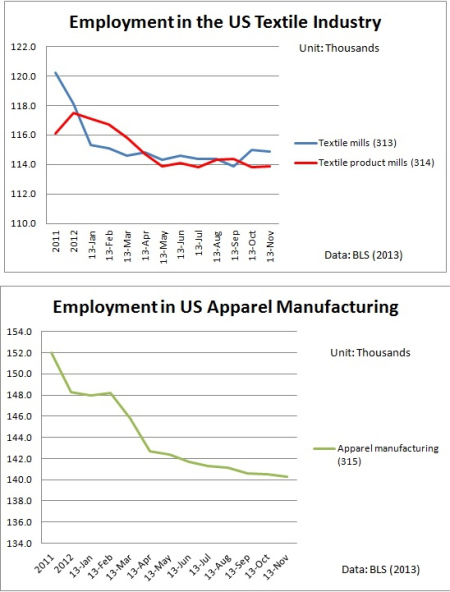
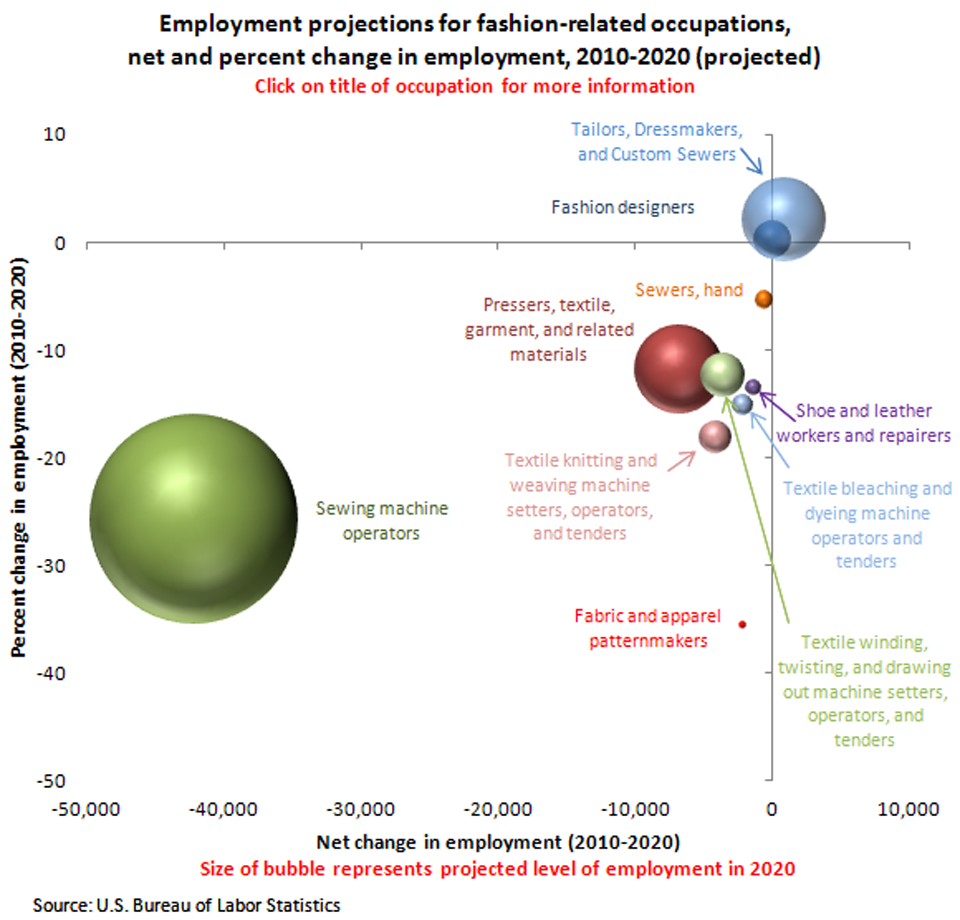
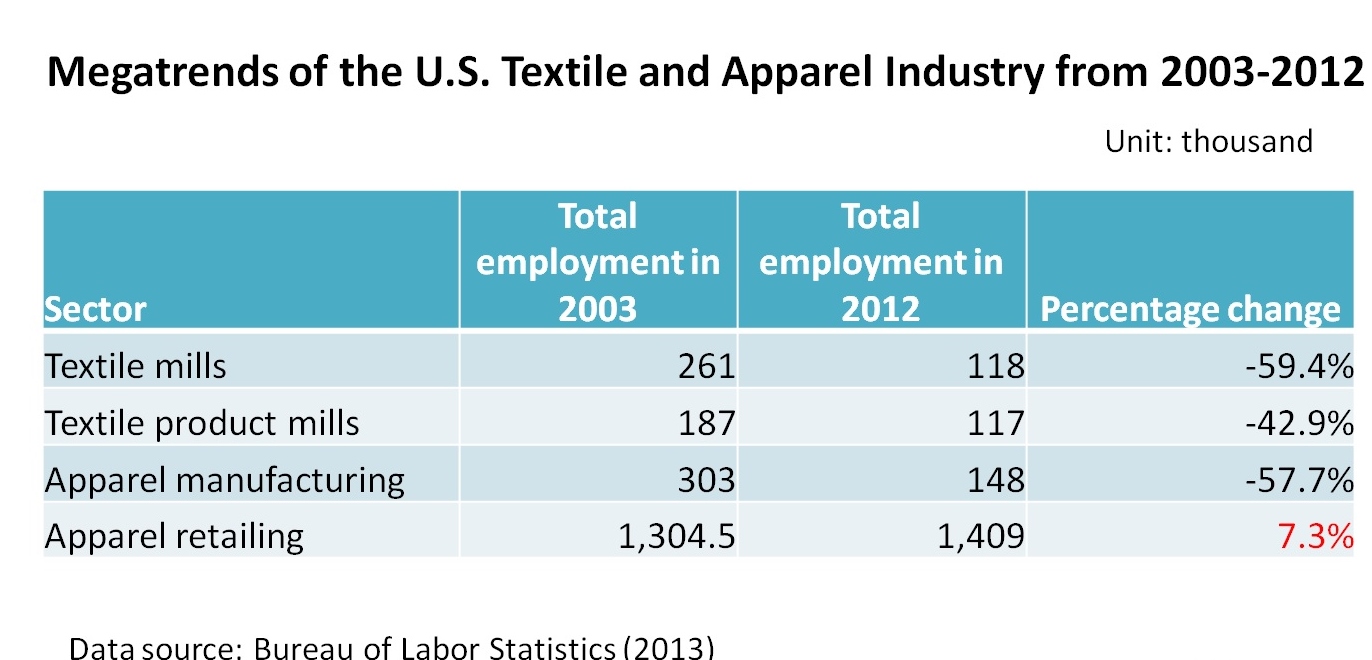
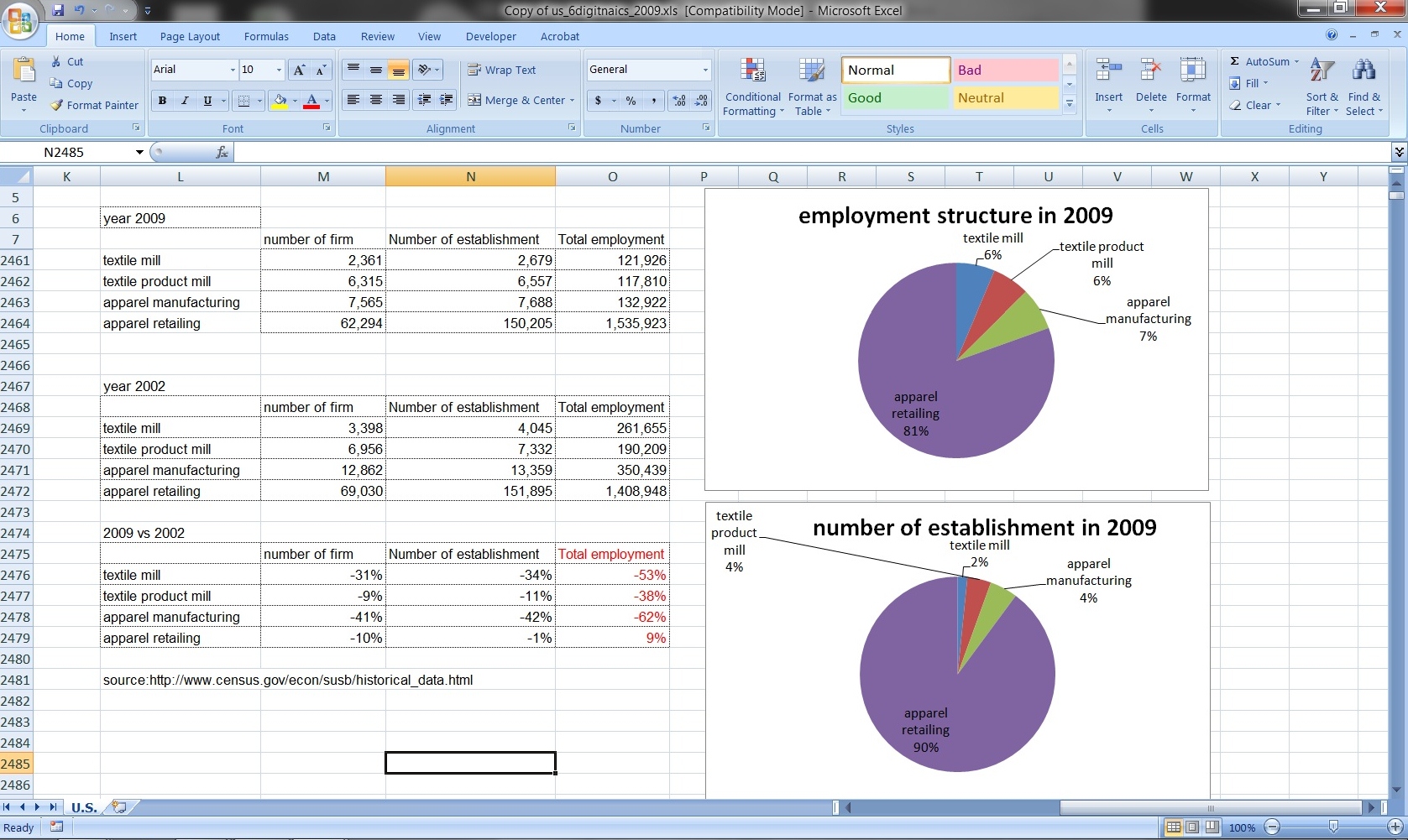
A recent study released by the U.S. Bureau of Labor Statistics (BLS) showed that manufacturing-related fashion jobs in the United States will continue to drop through 2020. Although the occupation of sewing machine operator is projected to face the most significant shrinkage in employment, the job decline is suggested to be an industry-wide phenomenon. According to the BLS, from 2003 to 2012, the U.S. apparel manufacturing industry (NAICS 315) had lost 57.7% of its jobs.

The question open for discussion, yet critical for textile& apparel major college graduates, is that how might the decline in manufacturing affect the destiny of other aspects of the U.S. fashion industry in the long run, such as the design and product development functions. No industry sector can survive as an island. As argued by the world’s leading scholar on the subject Michael Porter in his numerous studies addressing the industry competitiveness, the availability and strength of the local supporting industries have a key role to play in shaping the competitiveness of an industry in a nation. For example, the reason why the United States remains the world leading man-made fiber producer today is largely because the U.S. chemistry industry is able to provide needed inputs (such as raw material, technology and knowhow). By the same token, if fabrics are no longer locally made, compared with their overseas competitors such as Italy and China, the U.S. fashion designers might also be put at a big disadvantage in sourcing the needed material and developing the sample products in a timely manner, with flexible choices and at a reasonable cost.

Technology is another critical  factor contributing to job decline in the U.S. fashion industry. As the 2008 study Forecasting the US fashion industry with industry professionals—Part I material and design concluded that “design and production processes would rely heavily on computer and digital technology…the apparel package in the U.S., including creative design, will possibly migrate offshore with the exceptions of heavily technology-involved design and product development tasks.”   

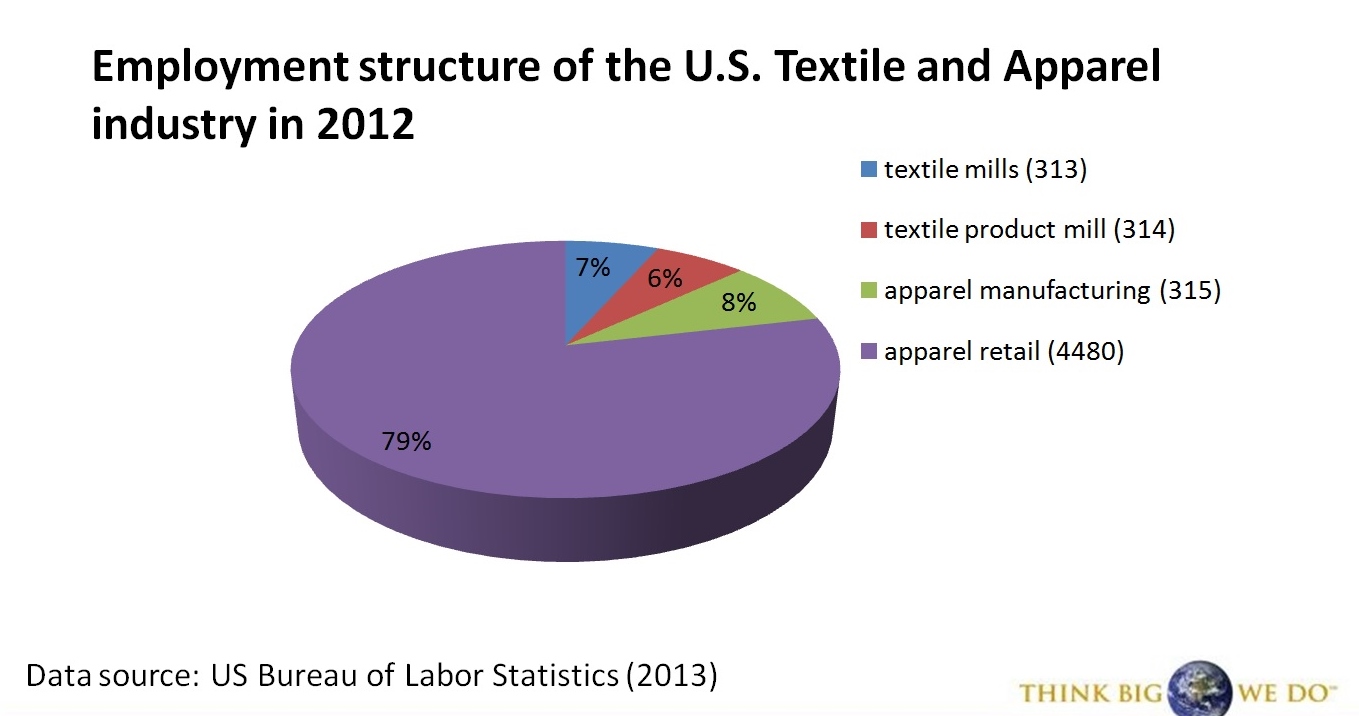
In the meanwhile, the retail sector remains a robust job creator for textile & apparel major college graduates. From 2003 to 2012, total employment in the U.S. apparel retail industry (NAICS 4482) increased 5.7%. By 2012, almost 80% of the occupations in the U.S. textile and apparel industry were offered by retailers. 

by Sheng Lu

fashion_12_lrg

2

1

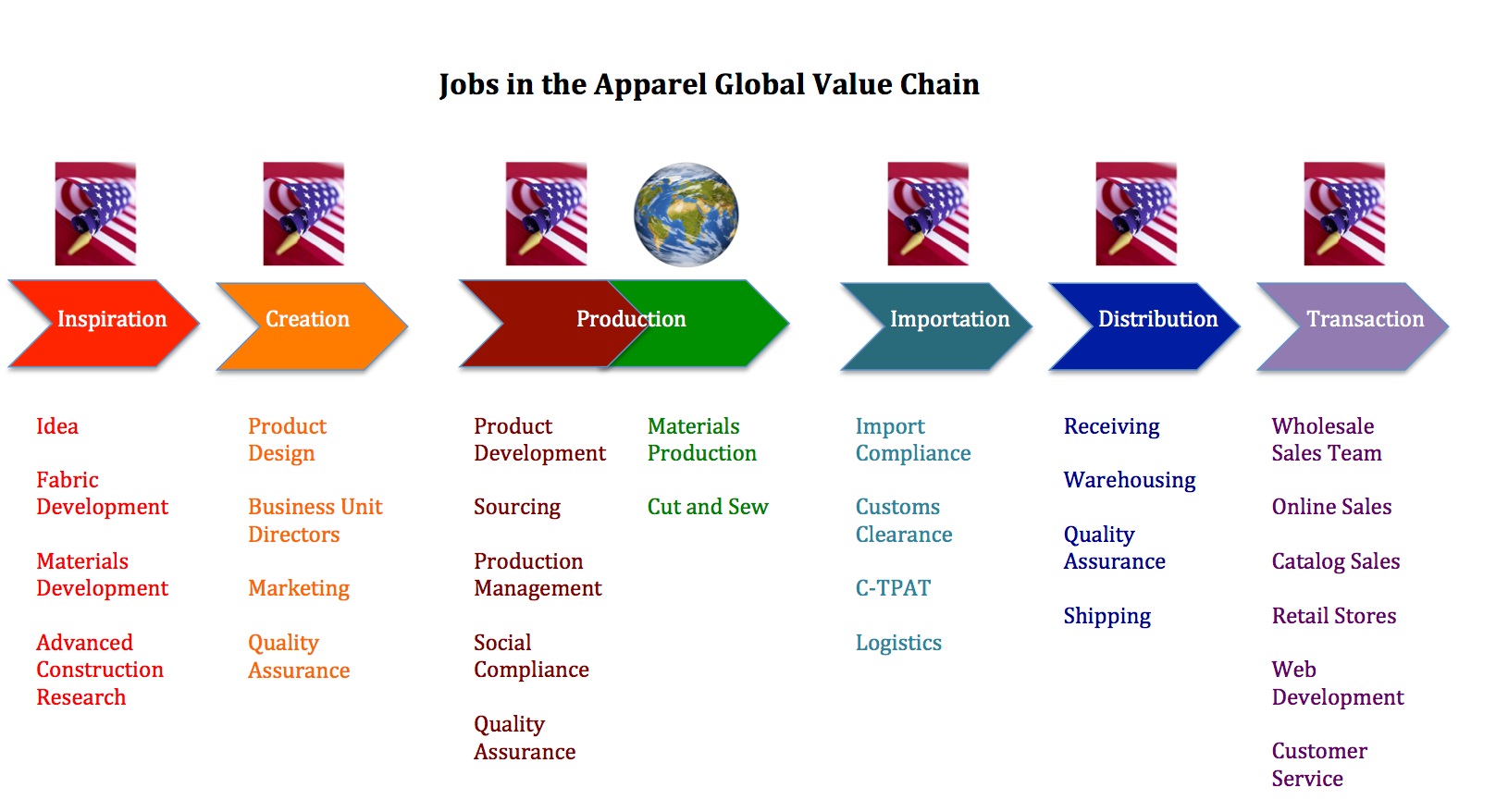
A Global View in Mind Means More Job and Career Oppertunities in the Fashion Apparel Industry

(Note: the functions & jobs below the U.S. flag mean they are based in the United States;  Remember, apparel are “made in the world”–just like iphone and ipad. Even imports contain U.S. added value.)

021313_Moongate_Assoc_Global_Value_Chain_Report

Source: Moongate Association (2012). Analyzing the Value Chain for Apparel Designed in the United States and Manufactured Overseas

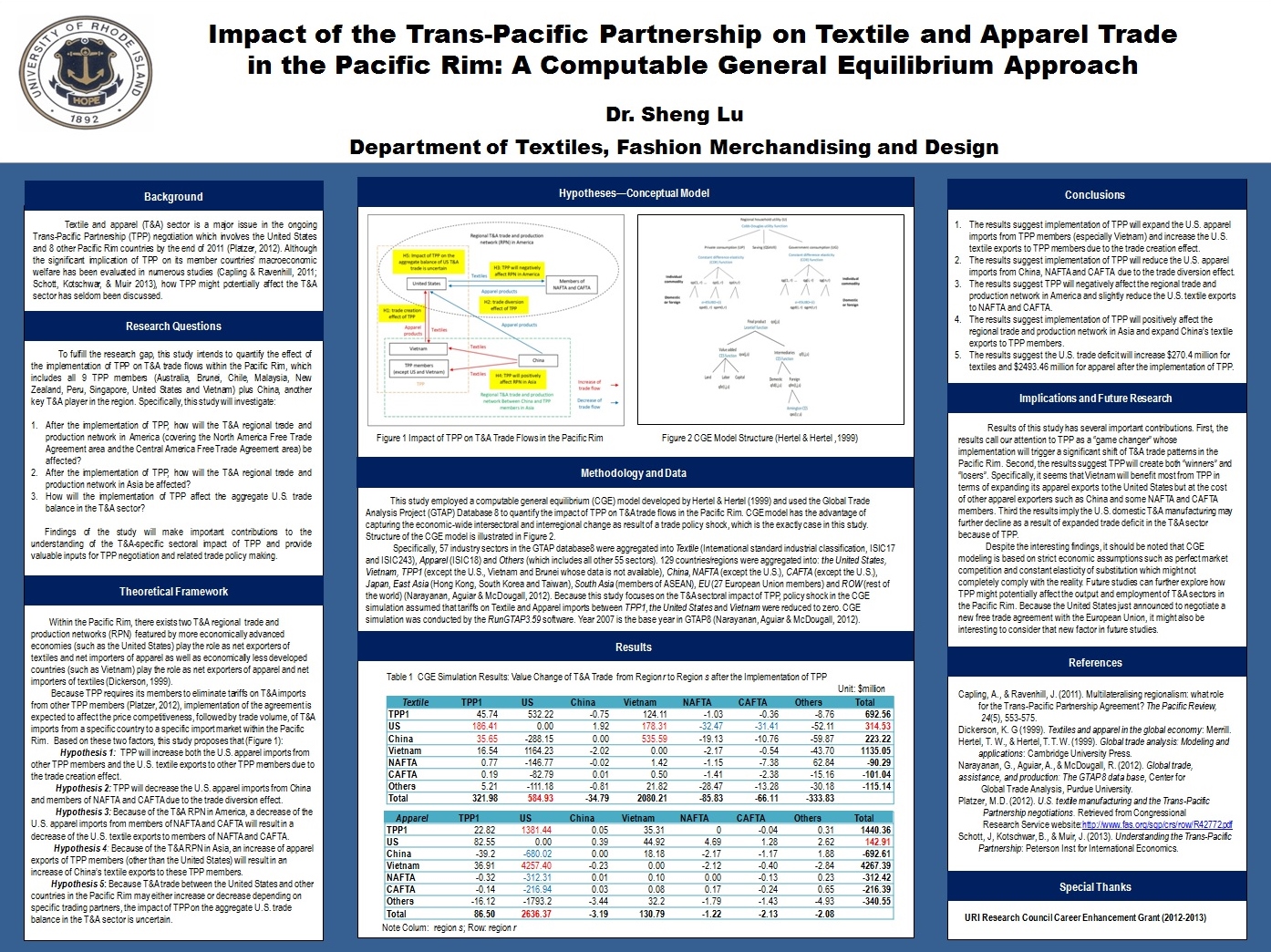
Impact of the Trans-Pacific Partnership on Textile and Apparel Trade in the Pacific Rim

TPP on T&A trade in the pacific rim

Citation: Lu, S. (2013). Impact of the Trans-Pacific Partnership on textile and apparel trade in the Pacific Rim. World Trade Organization Focus, 20(5), 67-77.

For questions, please contact the author: shenglu@mail.uri.edu

Three U.S. Textile Organizations Merge

NCTO-logo

If you’ve finished the third part of the T-shirt book, you should remember Auggie Tantillo and the American Manufacturing Trade Action Coalition (AMTAC) under his leadership. On March 28, 2013,  AMTAC together with the National Textile Association (NTA) joined the National Council of Textile Organization (NCTO), which will become the flagship organization representing the interests of the U.S. textile industry (textile mills and texile product mills which produce fibers, yarns, fabrics, home textiles and industrial textiles). This new movement could strengthen the voice of the U.S. textile industry in Washington DC, but at the same time can also be read as a sign of the declining industry base of AMTAC and NCTO.

The press release of the merger can be downloaded from here

Trans-Atlantic Trade and Investment Partnership

20130213ustr460x210

From Just Style, March 2013

Textile and clothing industry groups on both sides of the Atlantic have welcomed the news that the EU and the US are to commence talks on the biggest bilateral trade deal ever negotiated.

European Union (EU) clothing and textile industry association Euratex has hailed the launch of talks between the United States and the EU to forge what the European Commission calls the “biggest bilateral trade deal ever,” saying EU exporters will benefit.

A deal, once sealed, could eliminate American duties as high as 19%, says Euratex.

The EU’s textile and clothing industry already has a positive trade balance with the US. “Tariffs are still high in the US” for textile and clothing, Euratex president Alberto Paccanelli has stressed.

And it is worse when it comes to exporting products containing wool where the “duties are generally higher, sometimes above 19%,” Luisa Santos, head of international trade at Euratex, told just-style.

So “we expect to have duty-free access from the entry into force of the agreement and we are willing to give the same benefit to the US,” Ms Santos noted. With exports being highly price-sensitive, an elimination of the duties could “help substantially our competitiveness in the market.”

The EU’s textile and clothing exports to the US have been steadily increasing and are already substantial. In 2009, these exports stood at EUR2.8bn (US$3.7bn) and in 2010, they rose to EUR3.3bn, while they reached EUR3.7bn in 2011.

In negotiations, the EU would have a “forward looking approach” in terms of tariff and duty-free access from day one, according to Santos.

US sees opportunity

There was also optimism from American importers and retailers. Julie Hughes, president of the United States Association of Importers of Textiles & Apparel (USA-ITA), said a free trade agreement “presents a terrific opportunity” to remove duties and resolve regulatory issues that hold back trade between the US and the EU.

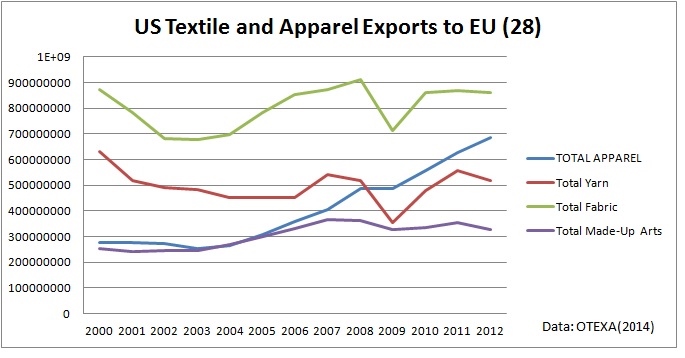
“We are especially enthusiastic about the launch of the US-EU trade negotiations,” Hughes told just-style adding: “Many people don’t realise that the EU is actually one of the top destinations for US exports of yarns, fabrics, and apparel” or that US brands import yarns and fabrics from the EU to manufacture ‘Made in the USA’ garments.

However some US groups are concerned because of different tax and regulatory regimes between the two regions.

“We are eagerly watching how the US government is going to engage with the EU,” said David Trumbull, vice president of the USA’s National Textile Association.

He is concerned about the fact that the US does not have the comprehensive sales tax systems in place in Europe, which do not apply for exports. Meanwhile, American producers can pay more through income tax or corporate tax: so US exporters could be placed at a comparative tax disadvantage, also having to pay VAT in Europe.

He said: “We do not want to get subjected to double taxation when exporting to the EU while EU producers get away with paying import duties to the US.”

Other issues to discuss

Meanwhile, back in Europe, the European Commission is compiling an impact study on “which sector benefits how”, said Helene Banner, EU trade spokesperson. The study will be released in two months.

An earlier report from the EU-US High-Level Working Group on Jobs and Growth (HLWG) had, noted Banner, recommended “eliminating all duties on bilateral trade, with a substantial elimination of tariffs upon entry into force, and a phasing out of all but the most sensitive tariffs in a short time frame.”

But there are host of other issues to discuss, notably, labelling, safety and consumer protection, during clothing and textile talks.

One issue is that “the information that has to be included on the label is more extensive in the US than in the EU,” Ms Santos stressed. For instance, the US has mandatory origin labelling – which is currently only a (recent) proposal in the EU.

And when it comes to safety and consumer protection, the US has its own legislation that varies from the EU. – for example requirements in terms of testing.

Santos said it is important to focus on “harmonisation to reduce costs for companies, especially small-and-medium enterprises in both sides of the Atlantic”.

Brussels and Washington aim to conclude the talks “ideally in about two years from now,” said EU trade Commissioner Karel De Gucht: “But more paramount than speed is achieving an ambitious deal.”

The European Commission will present draft negotiating directives to the EU Council of Ministers for approval in March and similar proposals are being sent to the US Congress. “Both sides aim to advance fast once negotiations are started,” added Banner.

Outlook of the U.S. Textile Industry in 2013

The latest industry outlook proposed by the Textile World argues that in 2013 the U.S. textile industry will improve industry strategy and planning in the following areas:

  • increased management emphasis in such areas as sourcing, inventory control
  • use of more flexible and efficient machinery and equipment
  • new and upgraded consumer products,
  • more ecologically friendly offerings
  • more Made-in-USA labels

 Don’t misunderstand/misinterpret these terms. The proposed strategies actually tell us:

1. the U.S. textile industry will become even more capitalized in production (as the result of “using more flexible and efficient machinery and equipment”).

2. the success of the U.S. textile industry relies on import (that’s why “management of sourcing” is suggested to be emphasized), despite the intension to promote “made in USA” label which has more to do with the current “rules of origin” defining the nationality of the products.

3. the softgoods industry (textile, apparel and related retailing) is a highly buyer-driven industry. Even textile mills have realized the importance of understanding and directly reaching the consumers.

4. sustainability is a major factor driving technical reform and upgrading in the textile industry. Other than the environmental concerns, there is another strategy behind the efforts: when the U.S. textile industry is fully ready to “be able to produce in a sustainable way”, it will ask for legislation support to require “everybody”(including imported products) to meet the same environmental standards(professionally, we call it “technical barriers of trade”). Developing countries can compete on price, but definitely cannot compete on technology and capital which are the basis of achieving “sustainability”.  Bu then, you will see sustainability becomes a real game changer.     

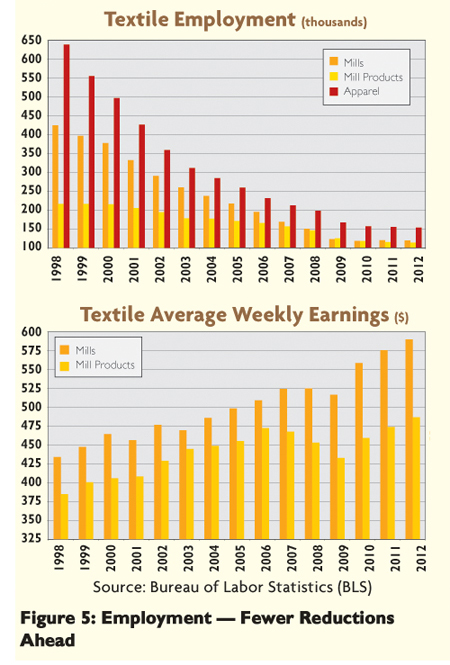
 Another relevant forecast made by the article “But holding these costs down through efficiency gains can also have a negative impact —namely, a smaller industry workforce. In the textile sector, for instance, squeezed by productivity gains, overall employment should drop from 232,000 in 2012 to near 209,000 by 2015.” As we menioned in the class, technology kills jobs too, although new types of jobs will be created at the same time–but with totally different skill requirements.

Is Textile and Apparel Manufacturing Coming back to the U.S.?

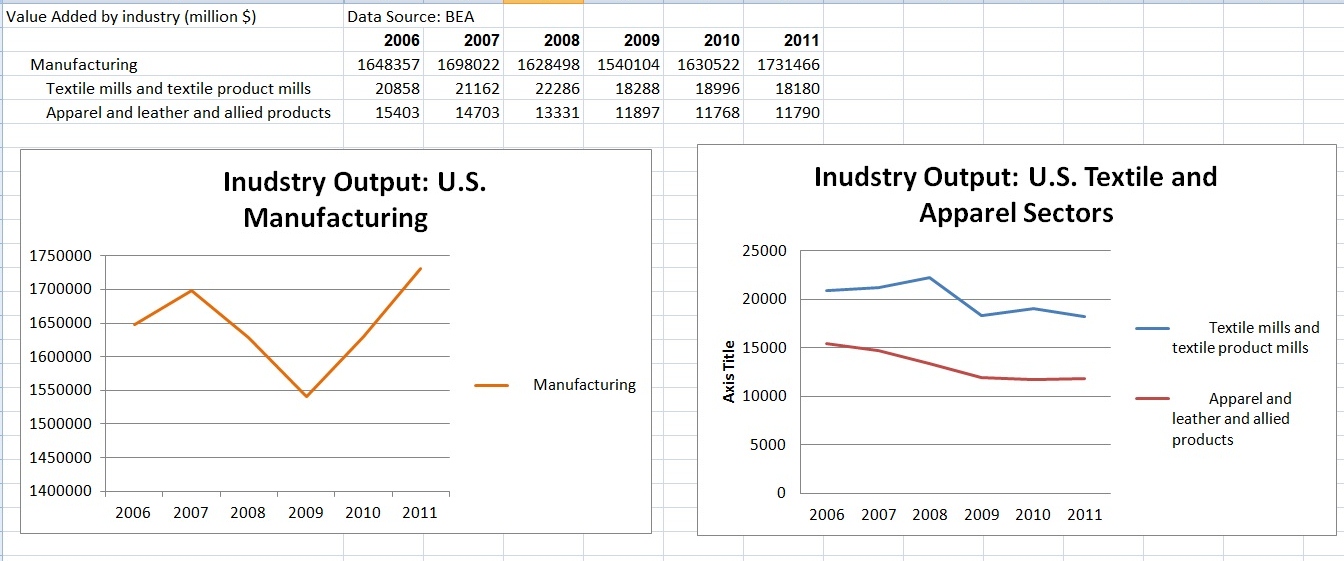
output

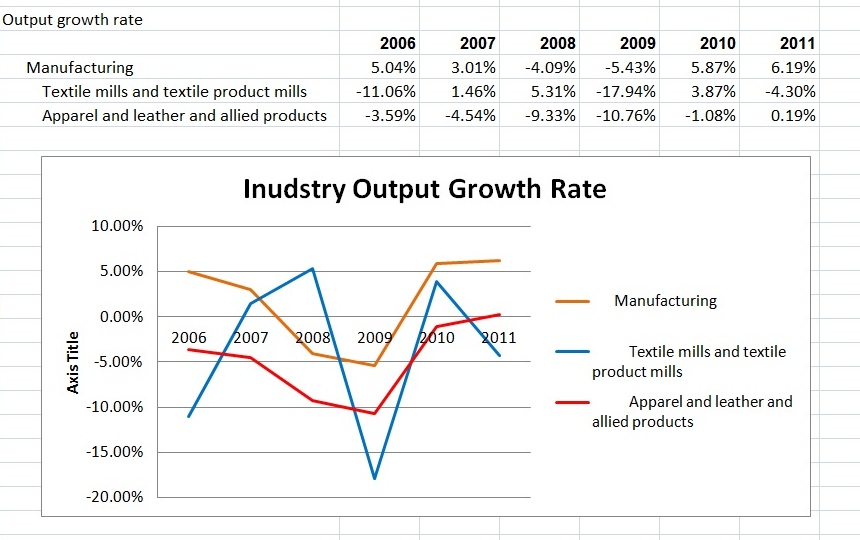
output growth rate

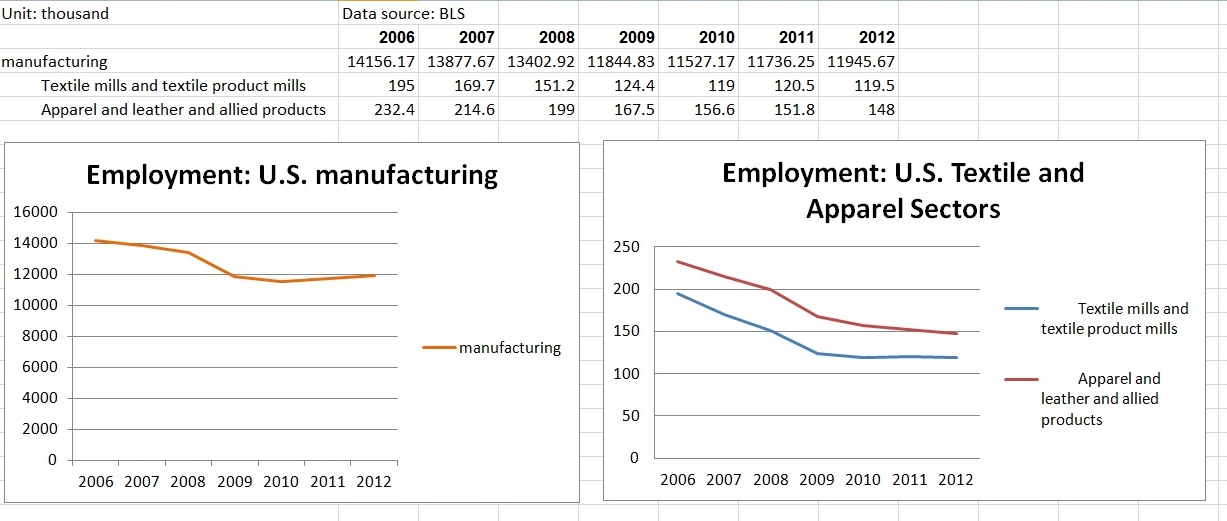
employment

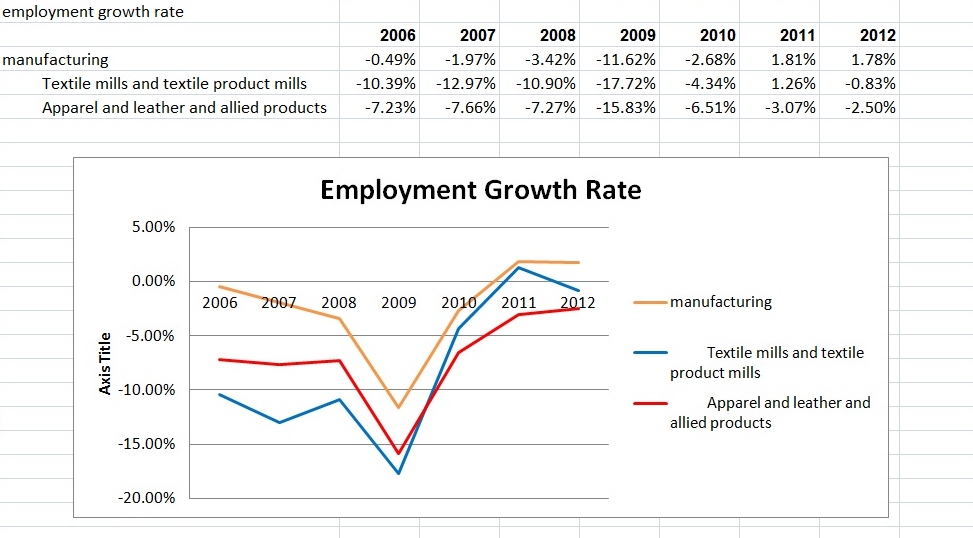
employment growth rate

Preliminary Findings:

1. As suggested by numerous studies, the U.S. manufacturing sector as a whole demonstrated a robust V-shaped recovery from the 2008 financial crisis in terms of industry output.   Growth rate of the industry output from 2010-2011 was also among the highest in the past 10 years.

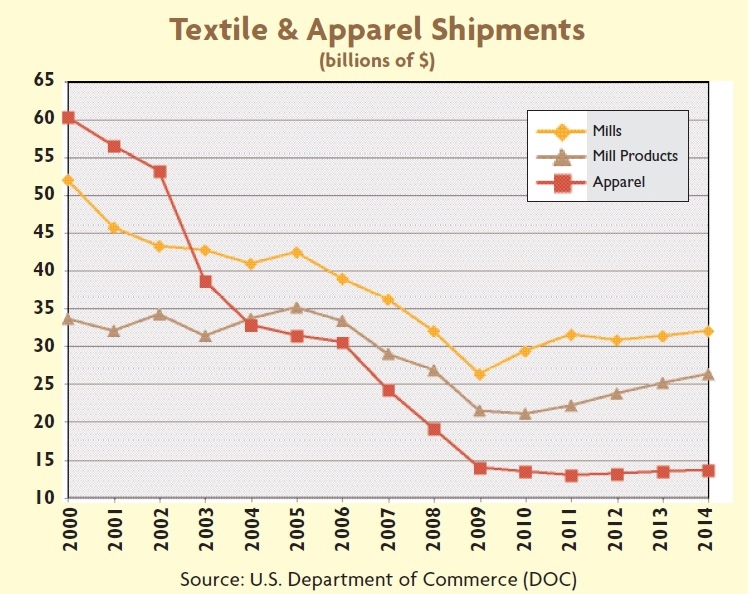
2. There is no sign yet that textile and apparel (T&A) manufacturing is coming back to the U.S, despite suggested popularity of “insourcing” as result of rising labor cost in China. However, the decline rate of apparel manufacturing in the U.S. seemed to be slowing down.

3. Jobless recovery happened both in the U.S. manufacturing sector as a whole and in the T&A manufacturing sectors. Particularly, the U.S. T&A industry respectively lost 21.0% and 25.6% of its manufacturing jobs from 2008-2012 compared with only 10.8% decline of employment in the manufacturing sector over the same period.  Based on the current data, it can be concluded that a sizable return of manufacturing jobs in the U.S. T&A industry would hardly occur at least in the near future.

Sheng Lu

How many U.S. consumers are willing to spend $1,300 for a blazer, $170 for a dress shirt, $80 for a tie and $390 for a pair of jeans?

Recently, WSJ wrote a story about apparel “made in USA”. Although apparel manufacturing will never disappear in the U.S. (as the case elsewhere in the world), neither is it likely that those lost labor-intensive manufacturing jobs in the apparel sector will come back in the future. Why? Just ask yourself: Am I willing to spend $1,300 for a blazer, $170 for a dress shirt, $80 for a tie and $390 for a pair of jeans? These are the price tags associated with “Made in USA” for apparel.

Apparel is not a single case. If you’d like to enjoy your iPhone “Made in USA”, please add two “00” to the current price tag. Like it or not?

Similar questions can also be raised to the Europeans, Chinese, Koreans and everyone else in the world. For example, what will happen if China does not import U.S. cotton but totally relies on its domestic supply? What will happen if each country tries to produce their own air plane instead of using Boeing’s aircraft? How about European retailers only accept credit card issued by an European financial service provider and reject Visa or America Express? And how long will it take to deliver a package to Asia if FedEx and UPS are not allowed to operate in these regions? Will these “changes” improve or worsen people’s daily life? The answer is obvious.

Globalization does not mean “Made in China”nor “Made in USA”. Rather, it means “Made in the World” based on each country’s comparative advantage, it means getting access to the world resources and using them more wisely and more efficiently. Why not everyone engages in doing something they are good at doing and then exchange? This is why we go grocery instead of growing vegetables nor raising cows by ourselves today. 

Globalization also means a product now can reach the world market beyond the limited domestic market. But a country can only successfully export when another country is willing to import. This is why we need to support trade liberalization so that every country can export more of those products they are competitive in making. And definitely more jobs will be created domestically. I mean every country that engages in such global “exchange”.
We no longer live in the 15th century when the Mercantilism was born. In the 21st century, export is good and import is equally good for the economy. Embrace globalization and enjoy better life~  

Sheng Lu 

Data source: American  Apparel and Footwear Association (2012)

Data source: U.S.-China Business Council

TPP and the U.S. Textile Manufacturing Industry

The Congressional Research Service just released its most recent study on the U.S. textile manufacturing industry and the Trans-Pacific Partnership (TPP) Negotiation. This is also one of the limited reference available so far that specifically addresses the sectoral impacts of TPP.

Overall, this report did a good job of compiling latest statistics showing the operation of the regional trade & production network between the United States and those developing countries in central and south America. It also discusses why the U.S. textile industry appears to be very nervous about Vietnam.

However, the study wasn’t able to quantify the impact of TPP, which leaves potential for future studies. On the other hand, although debates over TPP centers upon the rules of origin, we shall not forget about foreign investment–especially when geographically Vietnam is very close to China, Japan and South Korea. Even yarn-forward is adopted, why cannot Chinese factories move their factories to Vietnam? It shall be noted that China’s economy is undergoing structural change and it’s the time for some Chinese factories to “go offshore”. 

Full text of the report can be found here.


OTEXA identifies top export markets for U.S. textile and apparel

The Office of Textiles and Apparel (OTEXA) recently released its 2012 Going Global Report, which identifies 15 top export markets for U.S. made textiles and apparel. The report also includes statistical profile of these 15 countries, including their GDP per capita, GDP growth and bilateral trade with the United States in recent years.

It is interesting to note that the top export markets for textile and for apparel are very different. Wonder why? Please think about the “stages of development theory” we discussed in class.

HS code refers to the “Harmonized tariff schedule” (HS), a classification system for commodities. Textile and apparel are covered by HS code chapter 50-63. Detailed list can be found at http://www.usitc.gov/tata/hts/bychapter/index.htm

The report can be downloaded from here

US: Yarn-forward rule row flares up again

polyester-yarn-import-175429_189210

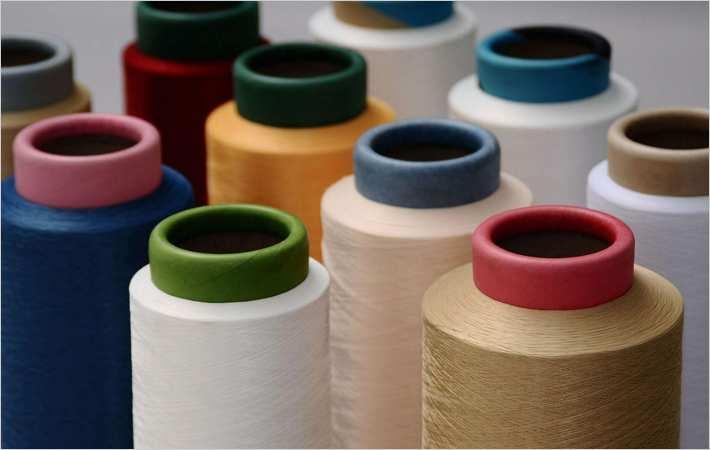
A row has flared up again over the yarn-forward rule of origin in US free trade agreements after The Hosiery Association (THA) called for a knit-to-shape, assembly-only exception for socks and hosiery in the Trans-Pacific Partnership (TPP).

Three textile trade associations have now written to US Trade Representative Ron Kirk expressing their “strong opposition” to the proposal.

The American Manufacturing Trade Action Coalition (AMTAC), National Council of Textile (NCTO) Organizations, and American Fiber Manufacturers Association (AFMA) say any such move “conflicts with the US textile industry’s longstanding support” of a yarn-forward rule of origin for textiles and apparel.

The yarn-forward rule requires all stages of production – from yarn spinning to fabric formation and final garment assembly – to be done either in the United States or in an FTA partner country to qualify for duty-free treatment.

US textile groups say the rule is “long-established” and “logical” because the value of a finished item comes from its components, rather than from its final assembly.

But American retailers, apparel brands, manufacturers and importers argue it is too restrictive, hinders new trade and investment in the sector, and renders most existing trade ineligible for preferential tariff treatment.

The Hosiery Association wants the TPP pact – currently being negotiated by the US, Vietnam, Brunei, Chile, New Zealand, Singapore, Australia, Malaysia and Peru – to allow hosiery producers to source yarns for man-made fibre socks and hosiery outside the TPP region in all instances except in the case of 100% cotton and polyester products.

But “this proposal would be a massive blow to US and other TPP producers who manufacture acrylic, nylon and various other types of man-made fibre yarns,” the textile groups say.

“In short, the THA proposal allows yarns currently made in large quantities in the United States to be sourced from third parties, notably China,” the letter says.

Apparel Market: Landscape of Change

An article from the Textile World Highlights:

  • The global apparel retail industry grew by 3.4% in 2011 to reach a value of $1,175,353.1 million. In 2016, the global apparel retail industry is forecast to have a value of $1,348,098.8 million, an increase of 14.7% since 2011.  Americas accounts for 36% of the global apparel retail industry value.
  • Technlogy is changing consumers’ shopping behavior as well as preferences (such as redefining value of products). The internet, smartphones and social networking are driving the apparel industry to a greater extent than ever before.
  • “Made in USA” is attracting consumers, however, to be more accurate, it means “source in the Western Hemisphere” rather than moving manufacturing totally back in the U.S.. However, in order to have “near sourcing” happen, addtional trade liberalization is required to remove the so much constraints.  
  • Supply chain transparancy and cooridnation is with growing significance to the success of business in the apparel companies.
  • The only constant in the apparel industry is change (enviorment, business model, product innovation, technology…).

Re-shoring US apparel making tough but not impossible

This recent comment from Just-style argues that re-shoring U.S. apparel manufacturing may become likely given China’s quickly rising labor cost. However, another two points mentioned by the article deserve more attention: one is that in order to make “made-in-USA” apparel competitive, industry leaders believe that tariffs and trade barriers on imported yarns and fabrics need to be much lowered. The question is, how realistic this “goodwill” can become true, considering the attitude of the US textile sector on the matter and their political influences. Second, although there might be some demands for sewing jobs in the U.S., these occupations are very low paid. The article admits that except immigrant, propably few Americans today (even those unemployeed) would like to take them (and have the qualified skills).  Then, does re-shoring really matter for college graduates in the fashion apparel program?  

To read the full article, click here

Megatrend in the US textile and apparel sector

(click the picture to enlarge)

Opinion: Apparel imports boost U.S. jobs

Key points:

“These four million U.S. workers – seen and unseen – help you get dressed every day. They design shoes and clothes, perform research and development, cut and sew, supervise production, handle customs and logistics, ensure product safety compliance, market and merchandise product, outfit our troops and work on the sales floor. In addition to these four million workers, there are countless U.S. transportation, distribution, warehousing, and logistics workers who depend on our industry for their jobs.”

“about 75 percent of the retail value of most clothing and footwear comes from non-manufacturing activities that happen entirely inside the United States.”
“Supply chain jobs and manufacturing jobs are equally valuable to the overall health of the U.S. economy. It is wrong to foster a public policy agenda that forces these two groups to compete against each other. ”

Written by Kevin Burke. president and chief executive officer of the American Apparel & Footwear Association.

Read more: http://www.politico.com/news/stories/0712/78779.html#ixzz21PNrJzHK

The Relationship Between Import Penetration and Operation of the U.S. Textile and Apparel Industries From 2002 to 2008

Published in Clothing and Textile Research Journal, Vol 30, No. 2, p119-133

The Relationship Between Import Penetration and Operation of the U.S. Textile and Apparel Industries From 2002 to 2008

Sheng Lu and Kitty Dickerson

Abstract

The U.S. textile and apparel (T&A) industries have respectively adopted various restructuring strategies in recent years which fundamentally changed the way the two industries operate and the shifting relationship of each sector with imports. This study empirically tests the relationship between import penetration and the operation of the U.S. T&A industries based on data at 4-digit North American Industry Classification System (NAICS) code level from 2002-2008. Results from the panel data model show that overall the U.S. textile industry formed a weak cooperative relationship with import penetration level in the U.S. market and a neutral relationship was suggested for the U.S. apparel industry with imports. These findings contribute to understanding the global nature of today’s U.S. T&A industries and suggest useful perspectives for the U.S. textile trade policies.

To read the full paper, click here

Outlook for the US Textile Inudstry in 2012

An annual report prepared by the Textile World on the outlook of the U.S. textile industry in the year ahead. The report covers topics ranging from the industry output, market evaluation, price, international trade, job market and policy enviorment.

As noted by the report “Despite declines in employment, job prospects for skilled workers, engineers and merchandisers should be tolerably good as the industry evolves into one that primarily requires people with good communication skills, creativity, and who are skilled enough to operate today’s high-technology, computer-operated machines.”

To read the fulltext of the report, click here

Textile Makers Fight to Be Heard on South Korea Trade Pact

Read the full article from the New York Times:

My comment:

It is important to realize that the U.S. textile industry and the U.S. apparel industry today are no longer close parnters. Why? Because they choose different restructuring strategies in response to globalization and rising imports.