Is Wal-Mart’s $250 billion “Made in the USA” Program Another “Crafted with Pride Campaign”? (II)

walmart-is-committed-to-american-renewal-infographic-s-manufacting-infographic-400pxwide-01

In early 2014, Wal-Mart Store Inc. announced its commitment to buy $250 billion “Made in the USA” products (including textiles and apparel) over the next 10 years ($50 billion annually) with the hope to “help spark a revitalization of U.S.-based manufacturing” and “create jobs in America”.

So how is the program going so far, especially in the textile and apparel (T&A) area?

made-in-usa

21

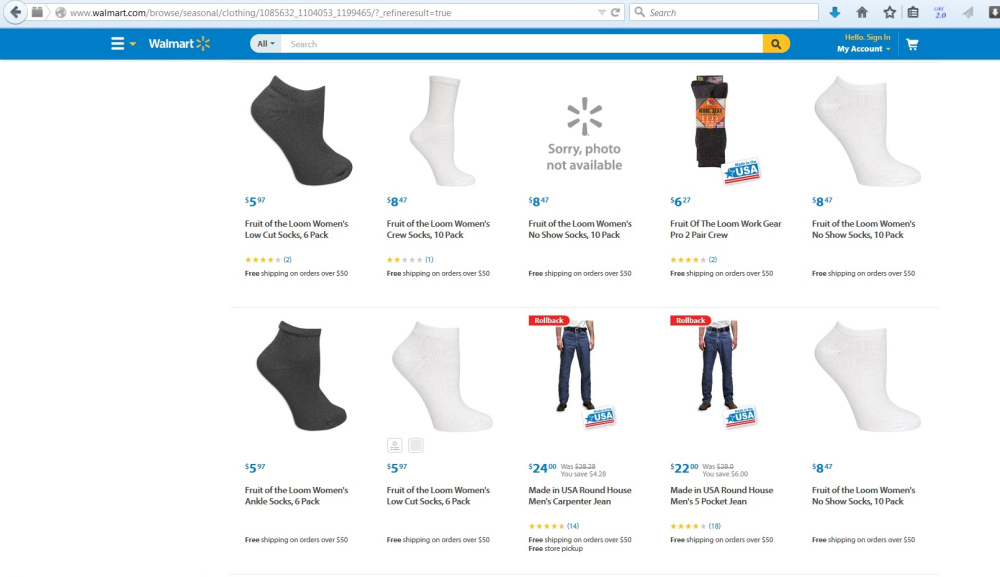
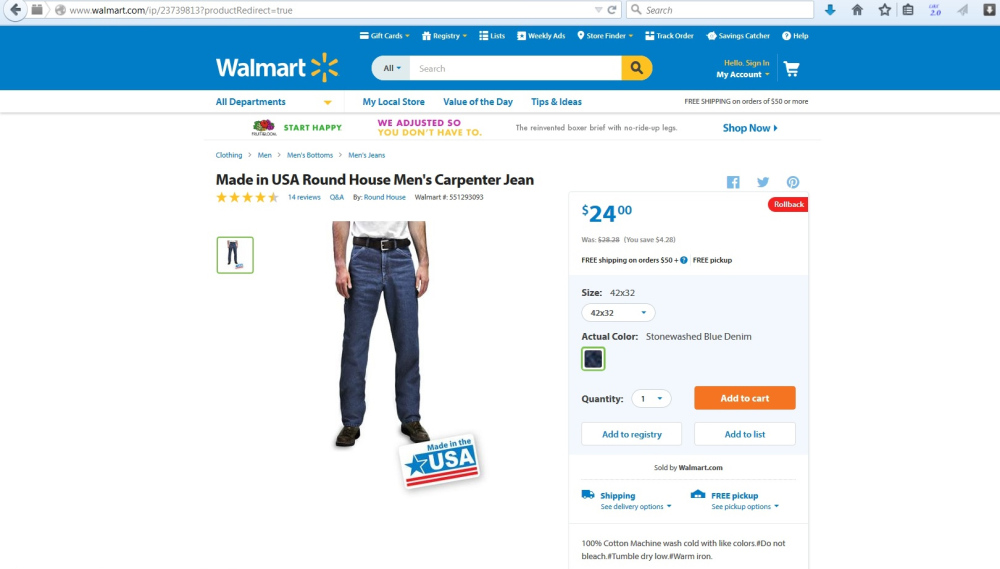
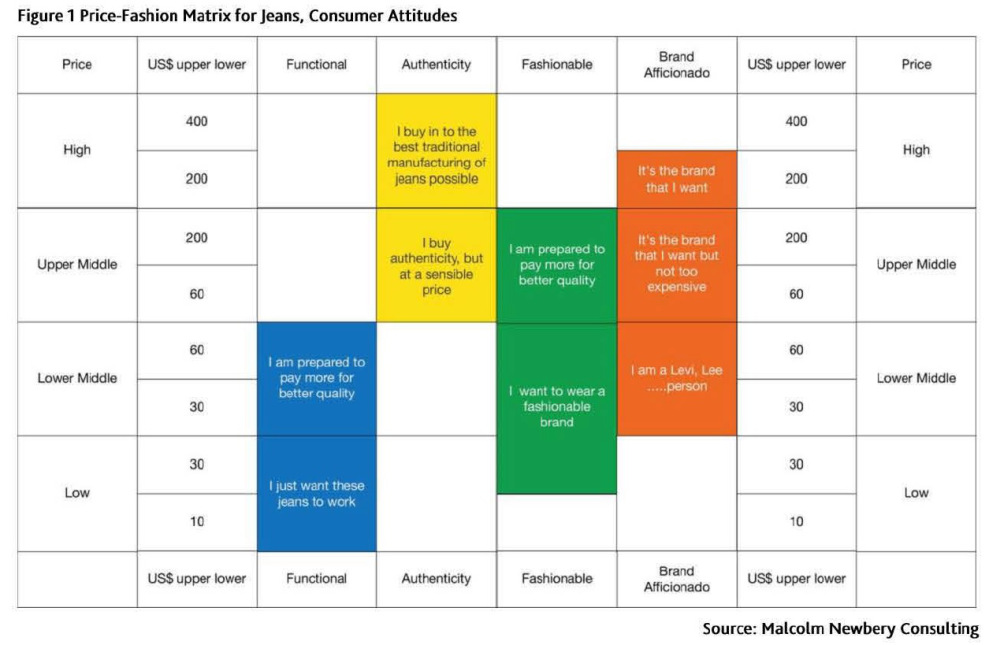
From exploring the company’s website, it is interesting to find that around 30 kinds of “Made in USA” T&A currently are being sold at Wal-Mart. However, majority of these T&A products are basic socks priced less than $10/unit. Wal-Mart also sells two types of men’s jeans, priced at $24/pair and $22/pair respectively. Although such a price level is higher than most jeans sold at Wal-Mart (which range from $8 to $20 per unit on average), it is still at the low-end of the market (see the chart below adopted from a Just Style report on the global jeans market).

41

On the other hand, as part of the “Made in USA” program, Wal-Mart sponsors a U.S. Manufacturing Innovation Fund with the purpose of “making it both easier and more competitive to make household goods in the U.S.”. T&A is one area this fund is willing to support as long as the research projects could “reduce the cost of producing textiles and apparel in the U.S., including weaving, fabric dyeing, cut & sew.

So what’s your view on Wal-Mart’s “Made in USA” initiative in the 21st century? How is it different from the “Crafted with Pride Campaign”? Will it bring back manufacturing jobs in the US as its objective stated? Will Wal-Mart repeat its record in history again? Please feel free to share your view.

[Please do not leave comment until after our case study 4]

Additional reading: Is Wal-Mart’s $250 billion “Made in the USA” Program Another “Crafted with Pride Campaign”? (I)


Pattern of Production and Trade in the U.S. Textile and Apparel Industry from 2000 to 2013

Impact of TPP on U

Outlook for the U.S. Textile Industry in 2015

In its annual industry analysis report, the Textile World (TW) presents another optimistic outlook for the U.S. textile industry in year 2015.

First, the U.S. textile industry is predicted to be in a good shape economically this year. For example, according to TW, shipment of textile mills (NAICS 313 &314) is expected to increase 3-4 percent in 2015 from last year. Value of apparel manufacturing (NAICS 315) may also increase 5 percent. Additionally, market demand for basic mill products (fibers and fabrics), nonwoven fabrics and fabrics designed for activewear could be particularly strong this year.

Second, the U.S. textile industry will continue to bring back “made in USA” through capitalization. As observed by TW, new plant and equipment spending is widespread in the U.S. textile industry in recent years, covering activities ranging from fibers, spinning, nonwovens, composites, technical fibers to textile chemical. TW further estimates that some 2.2 percent of mill shipment dollars will be spent on new investment in 2015, a level much higher than a few years ago.

Third, trade deficit in the U.S. textile industry is gradually shrinking. On one hand, TW estimates that due to China’s decreasing market share, imports of T&A to the United States will down 1 percent in 2015. This trend may continue in the years ahead. On the other hand, TW estimates that the U.S. textile exports will continue to grow for the straight 5th year in 2015. However, TW doesn’t believe textile and apparel manufacturing will have any big near-term shift back to the U.S, nor the total employment in the industry (because increased production is to be made by machines).

Fourth, sustainability and supply chain management will attract even more attention by the industry in 2015. As mentioned by the TW report, consumers nowadays have become more aware of the environmental impact of textile and apparel manufacturing. This pushes companies to make more efforts to address issues such as toxins, waste and the amount of water used for production. On the other hand, supply chain management has started to play even more important roles in controlling cost and increasing profit. For example, quoted by TW, performance of supply chain management may result in 10 percentage point differences in profit margin in the textile industry nowadays.

Fifth, trade policy will continue to have a substantial impact on the the U.S. textile industry.  2015 could be a big year for trade policy in the United States. Things that are on the top watch list in 2015 include details of the Trans-Pacific Partnership negotiation and whether the Trade Promotion Authority (TPA) bill can be passed by Congress.

1

2

3

Tariff or Not

B711fJvCcAAELet

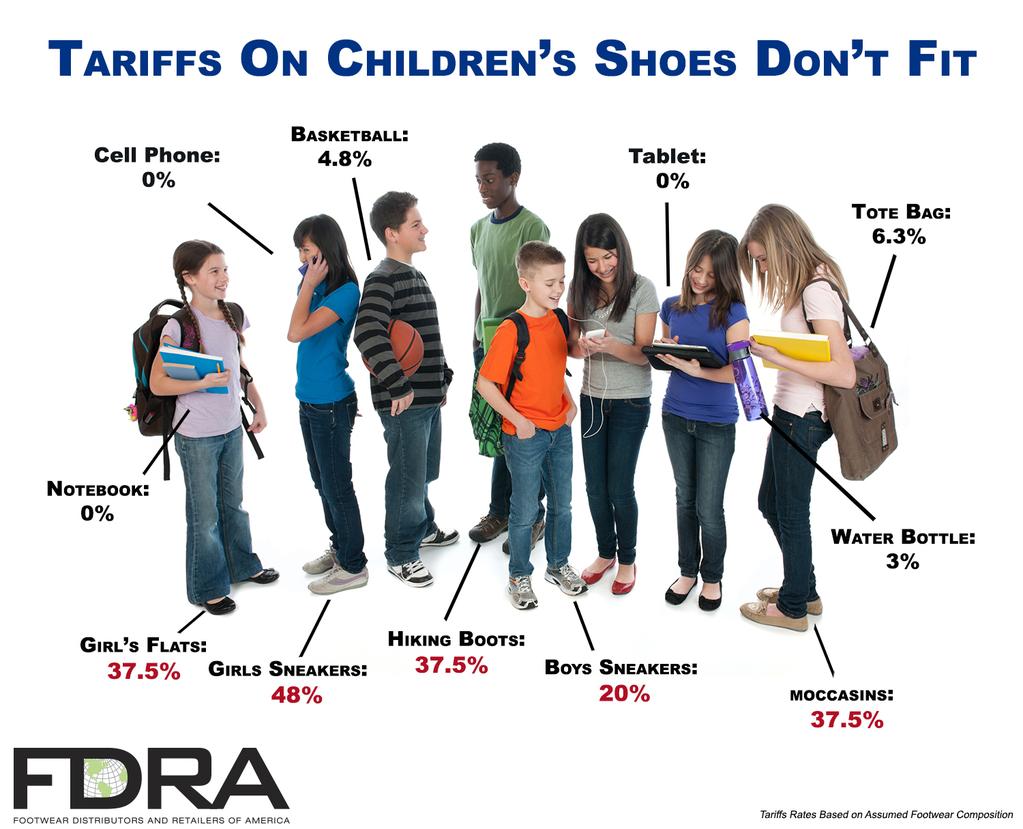
Tariff is a tax levied on imports only. Tariff will make imports more expensive in the market. For example, if the original price of a “Made in China” T-shirt is $5, with a 20% tariff, it becomes $5*(1+20%)=$6 when sold in the U.S. market.

Tariff has multiple impacts. On one hand, tariff may protect the domestic industry from foreign competition and help government of the importing country gain some tax revenues. On the other hand, consumers will have to pay more (or consume less) because of increased market price as result of tariff. Tariff also hurts exporters and those sectors operating on a global basis. For example, a high tariff rate on imported fabrics may raise the production cost of a clothing manufacturer which sells its finished products to the world market. According to the World Trade Organization, nearly 60 percent of world trade today are inputs and components. 

Questions for discussion:

  • How to explain the phenomenon that tariff rates are so different across different types of product in the picture? Should they be so different?
  • Should tariffs on flats, sneakers, boots and moccasins be lowered or eliminated in the U.S. or even world wide? What issues need to be considered?

Latest Trends in the US Apparel Industry (update: January 2015)

Latest statistics released by the American Apparel and Footwear Association (AAFA) indicate several trends in the U.S. apparel industry:

  • First, the retail market is gradually recovering. According to AAFA, on average, every American spent $907 on clothing (or purchased 64 garments) in 2013. Although this figure is still less than the one before the 2008 financial crisis, it is the highest level since 2012.
  • Second, “Made in USA” is growing but US consumers still rely on imports. Data from AAFA shows that US apparel production increased 6.2 percent from 2012 to 2013, accounting for 2.55% share of U.S. apparel market. However, nearly 98% of apparel consumed in the US were still imports in 2013.
  • Third, China remains the top apparel supplier to the United States. Despite the concerns about the rising production cost in China, latest data from OTEXA shows that, in 2014 (January to November) China still accounted for 42.5% of US apparel imports in terms of quantity and 39.1% in terms of value–almost the highest level in history. These two numbers were 41.7% and 39.9% a year earlier. On the other hand, Vietnam’s market share has reached 9.3% (by value) and 10.7% (by quantity) in 2014 (January to November), about ¼ of China’s exports to the United States.
  • Fourth, job market reflects continuous shift of the apparel industry. According to AAFA, among the total 2.8 million workers directly employed by the US apparel industry in 2013, only 5% were in the manufacturing sector, 5% were in the wholesaling sector and as many as 90% were working for retailers. However, within the apparel retail sector, total employment by the department stores is quickly shrinking—dropped 7.6 percent from 2012 to 2013 and cumulatively 21.3 percent from 1998 to 2013. At the same time, specialty clothing stores and sporting goods stores are hiring more people: 13.8% and 64.5% increase of employment from 1998 to 2013 respectively. The contrasting employment trend reflects the changing nature of the U.S. apparel retail market and the channels through which U.S. consumers purchase clothing.
  • Fifth, US consumers are paying higher taxes on imported clothing. Calculated by AAFA, while the overall U.S. imports were only charged by a 1.4% tariff rate, the effective duty rate on all apparel imports rose to 13.6% in 2013. The higher effective duty rate may be caused by the fact that less apparel were imported utilizing free trade agreement or trade preference programs.

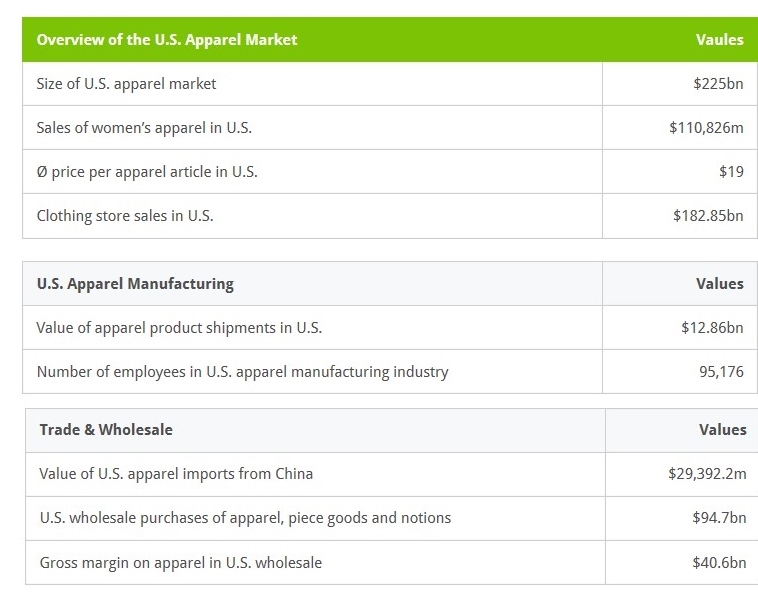
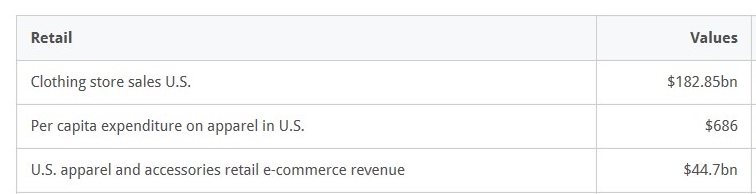
Appendix: Facts on the US Apparel Market in 2012

Slide1 Slide2

Data Source: http://www.statista.com/

Exclusive Interview with William L. “Bill” Jasper, Chairman & Chief Executive Officer, Unifi Inc.

Bill Jasper

William L. “Bill” Jasper has been Unifi’s Chairman of the Board since February 2011 and has served as Unifi’s Chief Executive Officer (CEO) and member of Unifi’s Board of Directors and the Company’s Executive Committee since September 2007. Prior to his role as Chairman of the Board, he served as President and CEO, Vice President of Sales and General Manager of Unifi’s polyester division. He joined the company with the purchase of Kinston polyester POY assets from INVISTA in September 2004. Prior to joining Unifi, Mr. Jasper was the Director of INVISTA’s DACRON® polyester filament business. Before working at INVISTA, he held various management positions in operations, technology, sales and business for DuPont since 1980.

Bill Jasper is also a University of Rhode Island alumni! He graduated in 1977 with a Master of Science in Mechanical Engineering.

Founded in 1971 and Headquartered in Greensboro, NC, Unifi, Inc. is a leading producer and processor of multi-filament polyester and nylon textured yarns. Unifi provides innovative, global textile solutions and unique branded yarns for customers at every level of the supply chain. Unifi’s core business consists of the manufacturing of POY (partially-oriented yarn), the texturing, air-jet texturing, twisting, and beaming of polyester and the texturing and covering of nylon filament yarns. Branded products of Unifi include aio® — all-in-one performance yarns, SORBTEK® A.M.Y.®, MYNX® UV, REPREVE®, REFLEXX®, INHIBIT® and SATURA®, which can be found in many products manufactured by the world’s leading brands and retailers.

Interview Part

Sheng Lu: How would you describe the current status of the U.S. textile industry? What’s your outlook for the industry in the next 5 years? What are the top challenges the U.S. textile industry is facing?

Bill Jasper: The industry has undergone a revival after years of decline, so the current status is strong and I believe we’ll see that environment continue for several more years in this region. The industry is expanding in practically every key economic indicator, including output, employment, exports and investment.

  • U.S. textile shipments topped $56 billion in 2013, up more than 5% from 2012
  • U.S. textile exports were $17.9 billion in 2013, up nearly 5%
    • The U.S. has also enjoyed an investment surge in new plants and equipment. Over the past year, 8 foreign companies have made public announcements regarding their intention to invest more than $700 million in new U.S. textile facilities and equipment. These investments are projected to provide approximately 1,900 new jobs in North Carolina, South Carolina, Georgia and Louisiana.
    • This $700 million does not include the ongoing re-investment activities that domestic textile companies have made.

The U.S. industry is also benefitting from several domestic advantages, including reliable and relatively inexpensive energy supplies, infrastructure, access to raw materials, and proximity to markets. We are gaining competitive advantages due to conditions outside the U.S., including rising costs in Asia, high shipping costs, and port capacity restraints. In addition, you’ve probably seen Wal-Mart’s advertising and P.R. blitz that it is committing to buy hundreds of billions of additional dollars in American-made products over the next decade to help support and spur U.S. manufacturing and innovation. With Wal-Mart leading the way, there is definitely a movement afoot to “reshore” some U.S. manufacturing, including textiles and apparel.

Finally, I believe a major driver of recent investments and one of the biggest contributors to the renaissance described above is also one of the biggest challenges the industry is facing. Virtually all of our free trade agreements to date have been based on a yarn forward rule of origin. This means that all processes, including the yarn extrusion, spinning, texturing, fabric formation, and the dyeing, finishing and assembly of the finished garment must take place in a free trade agreement member country to receive duty-free benefits. This rule has benefited the U.S. industry especially in NAFTA and DR-CAFTA, as U.S. yarn and fabric producers have dramatically increased our exports to the region under this regime.

As the U.S. negotiates the Transpacific Partnership Agreement (TPP), if this same rule of origin is undermined by single transformation rules or other loopholes, it could erode the entire supply chain in this hemisphere. In addition, careful attention must be paid to market access for potential TPP members like Vietnam, who is already the second largest exporter of textiles and apparel to the U.S. The domestic industry has requested reasonable duty phase-out periods in market access for our most sensitive products under the TPP so that our partnerships in this region have an adequate adjustment period. The TPP is considered to be the model for all future trade agreements with the U.S., thus it is critically important that our negotiators consider the profound consequences it can have on U.S. jobs and the U.S. textile industry.

Sheng Lu:  “Made in USA” is a very hot topic these days, yet we also live in a globalized world today. From the textile business perspective, what is the relationship between “Made in USA” and “going global” in the 21st century? Do US textile companies today still have to make a choice between the two?

Bill Jasper: Most apparel brands and retailers utilize a balanced sourcing strategy that incorporates production in this hemisphere, as well as Asia, Africa, or other global manufacturing and/or assembly. I do not feel that U.S. textile producers today must necessarily make a choice between the two, but must have a business plan that addresses the realities of the global market. In fact, nearly 98 percent of the clothing purchased in the U.S. is imported from abroad. Only two percent of clothing bought in this country is manufactured here in the U.S., and I doubt there is a business plan in any U.S. textile company that doesn’t reflect that reality.

Unifi, for example, works with downstream customers who want research and development, innovation, speed to market, sustainability, etc., from yarn and fabric production in this hemisphere. It is important that we provide flexibility and these same innovative products anywhere in the world our customers choose to do business. Thus, we export yarn to more than 30 countries from our domestic plants (not counting the exports of fabric from domestic weavers and knitters that use our inputs). Unifi also operates a wholly-owned subsidiary in Suzhou, China, where we focus on the development, sales and service of Unifi’s premium value-added yarns for the Asian market. Our expanding network of manufacturing facilities, sales and sourcing initiatives enables us to drive and capture growth in every major textile and apparel region in the world.

Sheng Lu: We know many products of Unifi are textile intermediaries like fibers and yarns. So how is Unifi’s brand promoted? How much can consumers recognize your product as “made in USA”?

Bill Jasper: As an upstream producer, making that connection with the ultimate consumer can be a challenge. Unifi has succeeded on several fronts. We have differentiated our product offering with premium value-added products, like REPREVE®, which we supply to our global customers wherever they are producing. Our downstream sales and marketing teams work extensively with brands and retailers to help them promote the unique properties of Unifi fibers and yarns. Some ways we do this includes, on product-labeling, hangtags, point of sale, cobranding, advertising and various consumer promotions. The “Made in the USA” message is and can be part of this effort, and I think we’ll see more demand for that as the brands and retailers move more of their sourcing from Asia back to this hemisphere over the next few years.

We recently began marketing directly to the consumer through the launch of our REPREVE #TurnItGreen campaign, which focuses on raising awareness around the importance of recycling and the products that can be created from plastic bottles when they are recycled. The initial launch took place at ESPN’s X Games Aspen in January 2014, where we literally and figuratively helped turn the event green using REPREVE-based product and color. At X Games Aspen, we recycled more than 100,000 plastic bottles to make X Games signage, lanyards and other merchandise. As we grow the REPREVE brand at retail and in the consumer space, we will continue these efforts with various partners, including current partners who have joined the REPREVE #TurnItGreen initiative, including NFL team, the Detriot Lions, where we will recycle more than 200,000 plastic bottles to help turn their stadium green on December 7th, 2014. We’re also driving recycling education by helping turn the live action event, Marvel Universe Live!, green through apparel for the cast and crew, merchandise items and banners, all made with REPREVE recycled fiber.

Sheng Lu: Unifi has opened factories in Brazil and Colombia. Why did Unifi decide to invest in South America? What is the connection between Unifi’s US-based operation and your operations in South America?

Bill Jasper: Both of these manufacturing plants were established in the mid to late 90s as wholly owned subsidiaries of Unifi, Inc. We purchased the small Colombia plant to give us more spandex covering capacity for our yarns that come back to the U.S. for use in pantyhose and socks. The Brazil operation was set up when we saw an opportunity to capture a share of the growing synthetic apparel market in that country. The majority of the textured polyester we make in Brazil stays in Brazil. Over the past several years we have introduced our premium value-added yarns in that market and hope to see strong growth in those product lines as the economy picks up down there.

Unifi also opened a 120,000 square foot polyester yarn texturing facility in El Salvador in 2010 to take advantage of the duty benefits in the DR-CAFTA trade pact and to better serve our growing customer base in the region.

Sheng Lu: What is the market potential of Asia and particularly China for Unifi and the US textile industry in general?

Bill Jasper: The expected growth in China and other Asian markets is enormous, and Unifi’s strategic plan reflects that. By 2020, China’s consumer market is expected to reach 22 percent of total global consumption, second only to the U.S. at 35 percent. Our wholly owned subsidiary (UTSC) is located at the center of one of China’s most important textile regions, Suzhou. UTSC customers will have quick access to new product introductions with the quality and technical service they have come to expect with Unifi. UTSC was established to provide the domestic Chinese market with a full complement of our specialty branded products, not only for their growing appetite for branded apparel, but for growth in their automotive and home furnishing markets.

The U.S. textile industry in general has invested heavily to take advantage of the growth in Asia by adding to their manufacturing facilities here or putting plants in Asia or China. Countries like Vietnam also offer strong manufacturing platforms due to lower wages than China and the prospect of duty-free exports to the European Union, the U.S. and Japan when announced trade agreements like TPP are completed. The growth of the Asian textile market certainly ups the ante in regard to whether there will be a yarn forward rule under TPP. Failure to include a strong yarn forward rule in this key agreement will likely cede key Asian markets to textile suppliers that are not a party to the TPP. To the contrary, inclusion of a yarn forward provision in that agreement will drive investment to partner countries and provides opportunities for U.S. fabrics and yarns to supply production meeting those guidelines.

Sheng Lu: How do you see “sustainability” as a game changer for the textile industry?  What has Unifi done in response to the growing awareness of sustainability among consumers?

Bill Jasper: Reducing our environmental footprint through the entire supply chain has been an important focus of the industry for several years, driven by industry leaders like Unifi and our suppliers and customers.

Unifi has an on-site environmental team constantly reviewing everything we do to see how we can reduce, reuse, recycle and conserve. All of our U.S.-based plants are currently landfill-free; we recycle our shipping pallets, we have installed energy-efficient lighting and increased efficiency around our compressed air usage, for example.

In 2010, Unifi opened our state-of-the-art REPREVE Recycling Center, where we use our own industrial yarn waste, recycled water bottles and even fabric waste to make REPREVE® recycled polyester fibers and yarns which go back into high end consumer apparel, like fleeces made by Patagonia, shoes and apparel by Nike, The North Face jackets, and eco-friendly Haggar pants. You can also find REPREVE® in Ford vehicles, including the 2015 Ford F150. In 2013, REPREVE® turned more than 740 million recycled bottles into fiber, and since 2009, we have recycled more than two billion plastic bottles to make REPREVE. Unifi’s recycled process offsets the need to use newly refined crude oil, uses less energy and water, and produces fewer greenhouse gas emissions compared to making virgin synthetic fibers.

Moreover, for Unifi at least, this is much more than a marketing concept. Our focus on environmental sustainability is now an engrained part of our culture. We believe that sustainability must be an unwavering core value of responsible manufacturing in the 21st century.

Sheng Lu: Given the changing nature of the US textile industry, what kind of talents will be most in needs by the US textile industry in the years ahead? Do you have any advice for textile and apparel majors in terms of improving their employability in the job market?

Bill Jasper: The U.S. textile industry is a diverse, technology driven, capital intensive, innovator of high quality products that is able and ready to compete effectively in the 21st century global marketplace, and a prepared workforce is critical in meeting the needs of this competitive industry. Not only do we look for skills in textile technology, we look for workers with high math and science aptitudes, technical and chemical engineering skills, process improvement, and industrial engineering capabilities. The ability to think strategically and globally is a big advantage in driving sales and creating marketing programs that meet the needs of our customers world-wide.

–The End–

2014 USFIA Benchmarking Study Released

UntitledKey Findings

  • China will remain the dominant supplier, though Vietnam and Asia as a whole are seen as having more growth potential.
  • Companies aren’t leaving Bangladesh, and are committed to compliance.
  • Companies continue to look for opportunities closer to home, including the United States, as they diversify their sourcing.
  • Companies are diversifying their sourcing and expect to continue to do so. However, current FTAs and preference programs remain under-utilized or don’t represent a major component of respondents’ sourcing.
  • Respondents welcome the passage or renewal of all future trade agreements that intend to remove trade barriers and facilitate international trade in the industry.

About the Benchmarking Study
The 2014 USFIA benchmarking study is conducted based on a survey of 29 executives at 29 leading U.S. fashion companies from March to April 2014. The study incorporates a balanced mix of respondents representing various business types in the U.S. fashion industry, including retailers, importers, wholesalers, and manufacturers. The survey asked respondents about the business outlook, sourcing practices, utilization of Free Trade Agreements and preference programs, and views on trade policy.

The full study can be downloaded from HERE.

Is Wal-Mart’s $250 billion “Made in the USA” Program Another “Crafted with Pride Campaign”? (I)

walmart

crafted-with-pride-hangtags

Earlier this year, Wal-Mart Store Inc. announced its commitment to buy $250 billion “Made in the USA” products (including textiles and apparel) over the next 10 years ($50 billion annually) with the hope to “help spark a revitalization of U.S.-based manufacturing” and “create jobs in America”. According to the Hoover’s, Wal-Mart’s cost of goods (i.e. sourcing cost for merchandise sold) totaled $358 billion in fiscal year 2013, suggesting $50 billion will account for around 10-14% of its total sourcing portfolio.               

Wal-Mart’s campaign has received positive feedback from the US textile and apparel industry. As reported by the WWD, the U.S. textile industry sees Wal-Mart’s movement an encouraging and “sincere commitment”. Bill Jasper, the outgoing chairman of the National Council of Textile Organizations (NCTO) and CEO of Unifi Inc believed that “manufacturing in general across the United States is in a more favorable position than we’ve seen for some time” and “this is an environment for growth in U.S. textile manufacturing”. As an example, Unifi Inc has spent millions of dollars upgrading its equipment and expanding the company’s US-based cloth mill. However, Bill also realizes the market risks involved in the investment decision, which may not happen without Wal-Mart’s “assurance” through the $250 billion program.

However, to fully take advantage of Wal-Mart’s program is not without obstacle. On top of them, Walmart requires qualified apparel for the program has to be “100 percent made in the United States”. However, the reality is there is more apparel being made in the Western Hemisphere by countries such as Mexico and those in the Caribbean Basin Regions than there is in the United States. As put by Bill, “We’re seeing more of a resurgence of ‘made in the region’ as opposed to Made in USA…If you at look the growth we see in apparel, much of that is in Central America and to a lesser extent Mexico. It does drive growth in yarn and fabrics here in the U.S., which are feed for those garments.”

It is also interesting to compare Wal-Mart’s $250 billion “Made in USA” program with its role in the “Crafted with Pride Campaign” launched in the 1980s (our case study 3). During that campaign, Wal-Mart initially pledged that “our entire management and merchandising staff is committed to Buy American program” and it did cut imports by 20% and purchased $197.3 million of merchandise from domestic suppliers in 1985 (Minchin, 2012). However, for the commercial reasons,  later on Wal-Mart more and more relied on imports to support its global expansion and “everyday low price” business model. The “betrayal” of Wal-Mart largely contributed to the eventual failure of the campaign.

What will be the destiny of the 21st century version of the “Crafted with Pride Campaign”? Is Wal-Mart really committed to “Made in USA” or rather the more price competitive “Made in USA” today attracts the attention of Wal-Mart? If implementation of new free trade agreements such as TPP and TTIP switches the cost balance of domestic sourcing versus global sourcing again, will War-Mart repeat its record in history? Maybe only time will tell…

Sheng Lu

Why Textile and Apparel Majors Need to Know about Trade Policy

Untitled

This past week, our class moved to the topic of trade policy, which as usual turned out to be one of the most challenging and “least exciting” chapters for our students. A common question in students’ mind is (and probably for some professors in the textile and apparel field as well): as a fashion major, why do I need to care about trade policy?

The answer is straightforward: textile market is shaped by rules—trade policy. Trade policy affects the availability of T&A products in the market in terms of quantity, price and speed. Trade policy also affects T&A companies’ access to the market, both domestic and foreign. Simply look at the clothing and shoes we wear daily: if they are imported, very likely the price we pay includes 10-30% additional tax (tariff). Even the clothing is “made in USA”, we should realize that the survival of US domestic apparel manufacturing could be the result of protection by the exact same trade policy which makes imported competing products 10—30% more expensive than otherwise in the US market.

Yet, trade policy does not happen naturally. Trade policies are deliberately made by policymakers and strongly influenced by industry players. Two things I hope our students can realize: first, the T&A industry cannot afford ignoring trade policy. Think about this case: if the US yarn manufacturers did not actively advocate “yarn-forward” rules of origin to be adopted in NAFTA and CAFTA, what will happen to their fate right now? Vice versa, how will the commercial interests of apparel retailers/importers be affected if they stop voicing themselves and simply leave the trade protectionism forces to influence trade policymakers? As the saying goes: if you are not at the table, you are on the menu. To certain extent, there is no good or bad trade policy, but winners and losers.

Second, understanding trade policy making is about understanding the real world. Trade policymaking is a painful balancing process like trying to “breathe and suck at the same time”.Not only different interests groups may have conflicting views on a specific trade policy, but also different policymakers may have their respective philosophies and priorities. As we mentioned in the class, agencies in the executive branch such as the US Trade Representative Office and the Commerce Department put national interests and international obligations of the United States at its heart whereas the Congress often times gives preferences to regional, sectoral and party interests.  A full understanding of T&A trade policy thus requires familiarity with what’s going on in this unique industry sector, knowledge about its key players as well as having a big picture vision in mind. For example, without recognizing the value of becoming a WTO member for China, it will be difficult to appreciate why it was willing to allow US to restrict its apparel exports from 2003 to 2008 on a discriminatory basis (T-shirt book, part III).

Our FASH students shall be encouraged to jump out of the narrowly-defined fashion world, because no industry operates as an island. Instead, the T&A industry is part of the world economy and shaped by the “rest” of the world economy.

 Sheng Lu

Berry Amendment may Extend to Athletic Shoes, Benefiting New Balance and Other US-based Shoemakers

9

According to the Wall Street Journal (WSJ), under the pressure from the domestic shoe industry and lawmakers, the US Department of Defense (DOD) is evaluating the possibility of procuring athletic (running) shoes 100% made in the USA. Under a provision of 1941 legislation known as the “Berry Amendment” , DOD must buy clothing, fabrics, fibers, yarns, other made-up textiles, boots and certain other items that are 100% US-made. The exception can be made, however, if US manufacturers do not have the capacity to meet the procurement needs. This exception has been applied to athletic shoes for boot camp.  

US-based shoemakers are excited about this opportunity and trying to convince DOD that they have enough capacity to make shoes in the USA. Shoemakers say the initiative will add jobs both at their plants and at suppliers.

Statistics from the American Apparel and Footwear Association (AAFA) show that in 2012 98.6% of shoes consumed in the US were imported. The WSJ report cited the Boston-based New Balance Athletic Shoe Inc as the only US maker of athletic shoes with large-scale production in the US, although New Balance also imported 75% of its branded shoes from overseas.

1

2On the other hand, the Berry Amendment itself is not without controversy and future challenges. Cited in a recent CRS report, some policymakers believe that the Berry Amendment contradicts free trade policies and produces negative effects such as reducing the business incentive to modernize, causing inefficiency due to a lack of competition and causing higher costs to DOD.  Negotiations of new trade agreements also create uncertainties for the future of the Berry Amendment. For example, under the Trans-Atlantic Trade and Investment Partnership (TTIP) negation, the European Union is seeking removal of “buy America” requirements such as the Berry Amendment to get more access to the US government procurement market.

Updates:

The DOD announced on April 25, 2014 that it will require new recruits to use their footwear allowance to purchase athletic footwear that is compliant with the Berry Amendment, which requires the use of domestically sourced apparel and textile products.

Wolverine, which for the past several years has urged the Pentagon to procure athletic footwear manufactured in the US rather than purchasing foreign-made products, believes the move will significantly help support the country’s supply chain for US-made shoes.

The policy change comes after campaigns last year to require the Department of Defense (DOD) to treat athletic footwear like every other uniform item, including boots, and ensure that such items are bought from American manufacturers.

Estimates suggest the DOD has spent around $180m to date on the athletic footwear cash allowance programme. Until now it has issued cash allowances to new recruits for training shoes which are not required to be Berry-compliant.

Additional reading: Berry Amendment and the U.S. Textile Industry

[comment for this post is closed]

Exclusive Interview with Kim Glas, Deputy Assistant Secretary for Textiles and Apparel, US Department of Commerce

kim-glas

(source of photo: WWD)

Kim  Glas is the Deputy Assistant Secretary for Textiles, Consumer Goods, and  Materials at the U.S. Department of Commerce. She oversees programs and strategies to improve the domestic and  international competitiveness of the broad product range of U.S. textiles,  apparel, consumer goods, metals and mining forest products, and chemicals and  plastics manufacturing sectors and industries.   Ms. Glas also serves as Chairman of the Committee for the Implementation  of Textile Agreements (CITA), which supervises the negotiation and  implementation of textile and apparel agreements.

Prior  to joining the Department of Commerce, Kim Glas served more than 10 years as a  professional staff member in the U.S. House of Representatives.  As Deputy Chief of Staff and Legislative  Director for Representative Michael Michaud of Maine for over seven years, Ms.  Glas managed the Congressman’s legislative agenda and was the key advisor on  international trade and labor issues.  In  addition, Ms. Glas worked for Representative John LaFalce of New York during  her tenure on Capitol Hill, advising on trade and labor issues.

Interview Part

Sheng Lu: Because almost all clothing consumed in the United States nowadays is imported, some people wonder if there is still a textile and apparel industry in this country.  What is the reality? What does the general public should know about the US textile and apparel industry today?

Kim Glas: While imports still dominate U.S. consumption of textiles and apparel, we can expect to see a new trend going forward.  Currently, the textiles and apparel industry in the country is experiencing a different manufacturing paradigm than 10 years ago.  In 2012, textiles and apparel exports were $22.7 billion, up 37% from just 3 years earlier. This is indicative of a reassessment by American companies about manufacturing in the United States. Cost, time benefits, and international economic challenges have closed the international manufacturing gap making it more attractive to source at home. More and more U.S. companies are considering and many have moved production or part of their production back to the U.S.  This return of manufacturing to the U.S. is expected to continue into the future. This means consumers can expect to find more quality and more affordable Made in USA textiles and apparel in the market in the years to come.

The United States has a strong and diverse textile industry, manufacturing a range of high quality products including fibers, yarn, fabric, and apparel.  It is the fourth largest single country exporter of yarns and fabrics, with $13.6 billion in exports in 2012.  The United States is also home to one of the largest providers of spun yarn in the world, Parkdale, Inc., with 29 manufacturing plants in the United States, Central America, Mexico, and South America.

Sheng Lu: From your view, what role does the OTEXA play in enhancing the competitiveness of the US textile and apparel industry in the 21st century global competition?

Kim Glas: OTEXA administers and enforces agreements and preference programs concerning the textile, apparel, footwear and travel goods industries and works to ensure fair trade and a level playing field for these industries to enhance their competitiveness in international markets.  The office has an active Export Promotion Program that assists small- and medium-sized U.S. textile and apparel firms to develop and expand their export markets helping job retention and creation in this and related sectors.

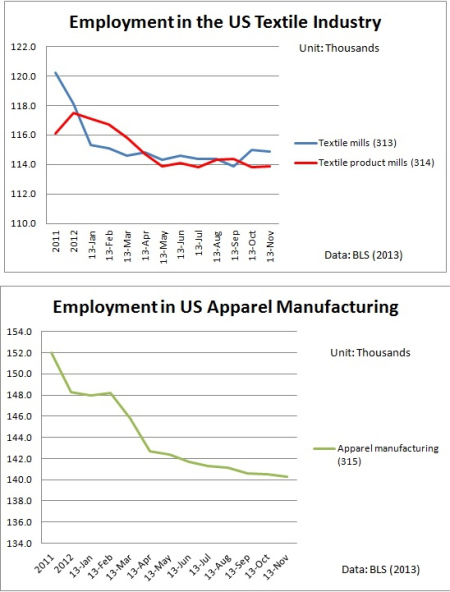
Sheng Lu: There have been many discussions recently about manufacturing coming back to the United States given the rising labor cost in China. Yet, statistics from the US Bureau of Labor statistics show a continuous decline of employment in the manufacturing aspect of the US textile and apparel sector (i.e. NAICS 313, NAICS 314 and NAICS 315). What is your view on the future of textile and apparel “made in USA” as well as related job opportunities?

Kim Glas: The U.S. textiles and apparel industry employs over 380,000 people nationwide.  Declining employment in this sector has been an ongoing trend for the past four decades, a development related mainly to productivity improvements and international competition.  The adoption of new technologies has boosted productivity in this sector.

Advances in technology and manufacturing capabilities by capital-intensive U.S. textile and apparel firms have contributed towards competitiveness and productivity, increasing output and lowering labor costs.

The apparel industry has retained more skilled and higher-paying jobs in such areas as computer-aided design and manufacturing, marketing, and product development.  Lower-skilled apparel production jobs have moved offshore, in support of our production-sharing operations in Mexico, Central America, and the Caribbean Basin, as well as to other countries with lower labor costs.

The continued upswing of re-shoring sentiments and companies moving textiles and apparel production back to the U.S., combined with increasing consumer demands for Made in USA products will help foster more U.S. production hence increasing high-skilled job opportunities in these sectors for the foreseeable future.

Sheng Lu: This year marks the 20th anniversary of the North American Free Trade Agreement (NAFTA), which has been both lauded and attacked in the United States. In your view, does the US textile and apparel industry a beneficiary of the agreement? What critical changes has the NAFTA brought to the US textile and apparel industry over the past 20 years, if any?

Kim Glas:The United States exported a total of $22.7 billion in textiles and apparel in 2012, including $5.3 billion to Mexico and $5.2 billion to Canada.  Together, our NAFTA partners account for 46% of total U.S. exports of textiles and apparel.

The United States imported more than $113 billion in textile and apparel products in 2012, including $2.2 billion from Canada and $5.7 billion from Mexico.  U.S. imports from our NAFTA partners have a high U.S. content and therefore help to preserve U.S. jobs and increase sales opportunities for U.S. producers.

U.S. textile and apparel firms have benefited from NAFTA provisions including the “yarn forward” rule of origin and Mexican production-sharing arrangements.  This has allowed them to optimize production and manufacturing.  U.S. investment in Canada and Mexico has increased by 57% since NAFTA was implemented, reaching $592 million in 2012. The United States remains the largest single-country supplier of textiles and apparel to Mexico.

Sheng Lu: Both the ongoing Trans-Pacific Partnership (TPP) and the Trans-Atlantic Partnership (TTIP) negotiations include a chapter specifically dealing with textile and apparel. What makes textile and apparel always a unique and sensitive sector in the free trade agreement negotiation? And what does the US textile and apparel industry can expect from the TPP and TTIP?

Kim Glas: The U.S. approach to free trade agreements (FTAs) has been to provide for specific rules that apply only to the textile and apparel sectors in several areas, including rules of origin and related matters, safeguards and anti-circumvention Customs cooperation commitments.  Treating textiles and apparel in a separate chapter of an FTA provides more clarity and transparency, and therefore makes it easier for industries and traders in our FTA partner countries to make maximum use of the opportunities of the agreement while improving compliance.

As the largest market for imported textiles and apparel, and as one of the world’s largest markets for imported textiles and apparel, trade negotiations for this sector require experts with specialized knowledge.  Textile issues have been addressed in a textile negotiating group in all of our major FTAs, past and pending, with full coordination with other relevant negotiating groups.

Sheng Lu: looking ahead in 2014, what are the key industry development trends and trade policy issues we shall watch?

Kim Glas: The turnaround in U.S. manufacturing of textiles and apparel is expected to continue to reshape the manufacturing landscape of this industry with improved industry strategies and planning.   U.S. companies will be increasingly active in their efforts to innovate and improve to keep and stay viable in today’s highly competitive global market place.  In addition to keeping up with innovations, we can expect to see improvements in companies’ sourcing, supply chain management, and development of niche product and improved quality. Moving forward, we can expect to see U.S. companies to be to be more lean, efficient and flexible with consumer and market demands.

The international aspect of the US economic policy: why and how we are all connected?


From 0:24′: Please enjoy an enlightening and inspiring dialogue with Penny Pritzker, US Secretary of Commerce and Michael Froman, US Trade Representative, on the international aspect of the US economic policy at the 2014 World Economic Forum in Davos.  The dialogue covers many interesting topics closely connected with our class lectures this & next week, for example:

  • Do we need more globalization? What is the impact of globalization on jobs and income inequality?
  • Why export matters to the US economy?
  • What will free trade agreements such as the Trans-Pacific Partnership (TPP) bring to the US?
  • Why foreign investment in the US is good for the US economy and job creation?
  • What is the connection between “global supply chain” and “made in USA”?

Despite growth of production, no sign of jobs recovery in the US textile and apparel manufacturing sector

According to the latest World Manufacturing Production Quarterly Report released by the United Nations Industrial Development Organization (UNIDO), for the first time over the past few years, production of wearing apparel enjoyed a positive growth of 3.9% in the third quarter of 2013 compared to the same period of 2012 in the United States. This statistics seem to support the argument that “made in USA” is making a coming back when “made in Asia” is losing cost advantages. A Just-style report quotes that “A growing number of US apparel manufacturers, government officials and industry leaders have been working on initiatives to increase domestic production. As an example, Wal-Mart has recently made a commitment to buy an additional $50 billion in U.S.-made products over the next ten years.”

However, statistics from the US Bureau of Labor Statistics show that the employment level in the US textile and apparel manufacturing sector continues declining in 2013 despite the positive growth of industry output. Specifically, total employment in the US textile mills (NAICS 313), US textile product mills (NAICS 314) and US apparel manufacturing (NAICS 315) sectors were 2.7%, 3.1% and 5.4% less in November 2013 respectively compared to the average level in 2012 after seasonal adjustment.

The mixed pattern imply the changing nature of textile and apparel manufacturing in the United States. Particularly, it is important to realize that the industry is NOT going back to the old days, but rather the resurgence of “made in USA” may be the result of a new round of capitalization in the industry, which is manifested by a growing number of modern-looking plants with “floors empty of people”.   

by Sheng Lu

2

Exclusive Interview with Julia K. Hughes, President of the United States Fashion Industry Association

Julia

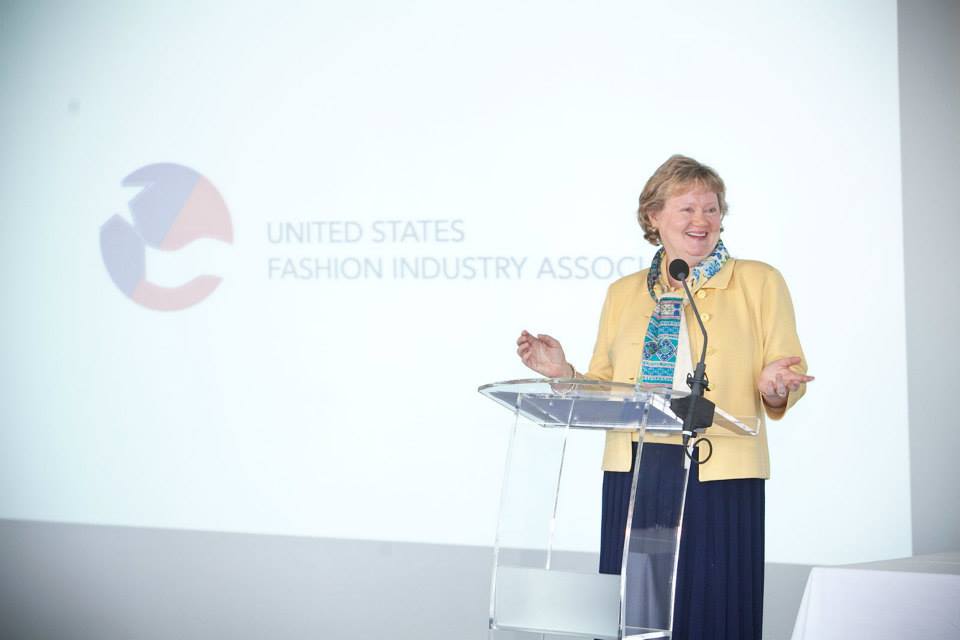
(Photo above: Julia Hughes presented at the 25th Annual Textile and Apparel Importer Conference. Courtesy of the United States Fashion Industry Association)

Julia K. Hughes is the President of the United States Fashion Industry Association (USFIA). USFIA represents all segments of the fashion industry, from apparel brands to retailers to service companies.  Ms. Hughes represents the interests of textile and apparel importers on trade policy issues to government officials, both in the United States and overseas. She has testified before Congress and the Executive Branch on textile trade issues. Ms. Hughes is also recognized as an expert in textile and apparel issues and is a frequent speaker at international conferences including the Apparel Sourcing Show, MAGIC, Foreign Service Institute, National Association of Manufacturers, Cotton Sourcing Summit, USIA’s Worldnet, the International Textiles and Clothing Bureau, Young Presidents’ Organization, World Trade Organization Beijing International Forum and others.

Julia Hughes is also well known to students enrolled in TMD433. She is featured in the book Travels of a T-shirt in the Global Economy, which highlights the global nature of the textile and apparel industry in the 21st century and those complicated economic, social and political factors associated with this important sector.

Interview Part

Sheng Lu: Would you please briefly introduce the current status of the U.S. fashion industry which your organization represents? For example, how large is the industry, how important is it to the US and the global economy, and what types of companies are involved as well as their business functions?

Julia Hughes: The phrase “the fashion industry” may call to mind images of Fashion Week and photo shoots. In this era of global trade, however, the high-fashion runways are just one part of the broader textile and apparel industry that ranges from high-end luxury brands to fast-fashion retailers—and the thousands of companies in between that produce and sell clothing, shoes, and other textile products.

United States Fashion Industry Association members and affiliates include companies across the value chain, which support our mission to remove barriers to textile and apparel trade. These companies include:

  • Brands, retailers, importers, and wholesalers of textiles and apparel.
  • Service providers, including consultants, customs brokers, freight forwarders, law firms, logistics providers, steamship lines, and testing and certification companies that help those brands, retailers, importers, and wholesalers.
  • Manufacturers and suppliers of finished products and inputs for finished products, as well as supplier associations, business councils, and promotional groups.
  • Agencies that promote the industry from a specific region, country, city, or other geographic entity.
  • Academic institutions.

This industry includes companies and professionals across the value chain, working in roles ranging from design and development, to sourcing and logistics, to trade policy and compliance, to retail and marketing. USFIA members include all of these types of companies and individuals…

Sheng Lu: The United States Association of Importers of Textiles & Apparel (USA-ITA) has been a big name in the industry for 25 years. What leads your organization to change the name and rebrand yourself? Particularly, how will the USFIA distinguish itself with the American Apparel and Footwear Association (AAFA), whose members also include many US-based apparel companies and retailers?

Julia Hughes: The United States Association of Importers of Textiles & Apparel (USA-ITA), founded in January 1989 by nine U.S. importers, was instrumental in eliminating the global apparel quota system. At that time, it seemed like an almost insurmountable task to change the political dynamic enough so that the special protection for textiles and apparel would finally end.

On January 1, 2005, the quotas were officially eliminated, and since then, the industry has increasingly globalized. As a result, new challenges arise every day for apparel brands, retailers, and importers, ranging from challenges with compliance at the factories to challenges with transportation at the ports of entry. Over the years, the association has evolved with our members to address these new challenges—but our brand, including our name, logo, and official mission statement, had not changed in over two decades.

Accordingly, our major project in 2013 was rebranding the association to more clearly communicate our purpose and our direction for the future. It’s important to note that this project was not about changing our purpose or direction, but about ensuring that our brand accurately reflects the reality of the industry and the work we had already been doing for our members. The new brand—the United States Fashion Industry Association—was developed over 10 months with input from members and our trusted network across the value chain who participated in comprehensive overviews.

Why did we choose this name? First, our members are no longer just “importers.” While importing will be a critical aspect of our members’ sourcing plans for the foreseeable future, many of our members are truly global brands—for instance, designing product in the United States, producing that product in Asia, and then selling that product in Europe or Australia. Additionally, many of our members are also making product in the United States from U.S. and/or imported inputs. As we told WWD, “We are very supportive of Made in USA, and we sponsored some of the very first programs about Made in USA at MAGIC. It is a very important element, but it is one part of sourcing decision making.” Considering these realities, the phrase “Importers of Textiles and Apparel” no longer accurately described the industry or our members, so we needed to update it. (It was also a mouthful!) We settled on this exact name because “the fashion industry” is the phrase that companies, government, and the media uses most commonly to describe the wide variety of companies and professionals across the value chain—it best describes our association in 2013 and moving forward.

We spoke to our members and some trusted partners in our network about who we are and what sets us apart. From those conversations, we developed five values that we keep in mind with every decision we make. They are:

1.      Integrity: Our members tell us that we listen to them, support them, and defend them—while our government partners tell us that we work with them to find creative solutions.

2.      Substance: We maintain and articulate a deep understanding of the industry and challenges most important to our members—the sourcing and compliance executives who make tough decisions every day on how to address these challenges.

3.      Focus: We keep a laser focus on our mission, which allows us to be agile and quickly seize upon opportunities to move the needle.

4.      Collaboration: Our members collaborate to share best practices and amplify the industry’s voice on the critical issues, putting aside marketplace competition to work together toward common goals.

5.      Foresight: We keep our members informed not only about the regulatory challenges today, but also the regulatory challenges of tomorrow—and as our industry globalizes, we likewise expand our reach.

Sheng Lu: As mentioned in your mission statement, the USFIA is dedicated to the removal of barriers that impede the free movement of textile and apparel products to the United States and international markets. What are the top trade policy and market access concerns for the USFIA right now?

Julia Hughes: For 25 years, the United States Fashion Industry Association (USFIA)–formerly the United States Association of Importers of Textiles & Apparel (USA-ITA)–worked to eliminate barriers that impede the free movement of textile and apparel products to the United States and international markets. We participate in advocacy activities on a number of issues related to our mission in order to eliminate the tariff and non-tariff barriers that impede the industry’s ability to trade freely and create economic opportunities in the United States and abroad. Our top issues include:

Sheng Lu: You are featured in the well-known book Travels of T-shirt in the Global Economy. Interestingly enough, your counterpart in the book—Mr. Auggie Tantillo, now taps to lead the National Council of Textile Organizations (NCTO) which represents the US textile industry.  In the T-shirt book, you two held very different views on whether the U.S. should restrict apparel imports from China. Now almost 8 years later, do you (and the USFIA) still debate often with Auggie (and the NCTO) on textile and apparel trade policy issues? If so, what are you mainly debating about?

Julia Hughes: Today, Auggie and I still disagree on some of the basic trade policy issues–especially the negotiations for new free trade agreements. NCTO is trying to hold onto the same textile rules of origin that were negotiated in the 1990s, the yarn-forward rule of origin. USFIA and our members continue to encourage the U.S. textile industry to take a fresh look at the global industry.  But, so far, we remain far apart.

Nonetheless, we also have some areas where we can work together. Both our organizations support efforts to promote Made in the USA activities, as well as manufacturing in the Western Hemisphere. And, just this week I asked Auggie to help us with information about U.S.-based fabric mills. We also have collaborated on some proposals with Customs and Border Protection that build on the “trusted trader” concept and would focus enforcement measures on the companies who are not already proven to be compliant. And if I had to make a prediction, I would predict that in the next few years, we will find other areas where we can worth together productively.

Sheng Lu: Most of our students in the Textiles, Fashion Merchandising and Design (TMD) department will become professionals working for the US fashion industry after graduation. Does the USFIA have any resources available to our college students or have any future plans to expand the collaboration with the textile and apparel educational programs/academic institutions?

Julia Hughes: Yes! We welcome participation from universities, educators, and students in the fashion industry.

First, our website is a wonderful resource for information about the industry and our key issues. In addition to our issue pages, you’ll also find resources including recaps of past seminars, recordings of past webinars, our member publications, and more. (Some of this information is locked to USFIA members, but in the spirit of helping to grow our industry and future members, we’re always happy to help you access specific information you need! Just ask us!) We continue to build on the website, and in 2014, we will be launching a Value Chain Directory, which will provide comprehensive information on service providers and sourcing opportunities around the world.

Additionally, we host a number of events throughout the year, including our annual conference. We’re happy to work with educators and students to make attendance affordable, and we even have opportunities for universities to exhibit and students to volunteer.

We also encourage current and former students to visit our Career Center, which contains job opportunities at USFIA member companies. Even if you’re not looking for a job at the moment, it may be helpful to see what types of candidates these companies are seeking.

We’re always happy to work with universities, educators, and students to ensure that we educate the next generation of fashion industry leaders and professionals—future USFIA members!

USAITA to USFIA

Is clothing “made in USA” more ethical? How “ethical” should be defined?

It has become a commonly held view that apparel workers in many developing countries are unfairly treated because they are much lower paid compared with their counterparts in the developed countries.  For example, American Apparel, a company that insists all of its products made in USA, claims itself to be sweatshop-free on the basis that it pays workers an hourly wage of $12.  However, does an hourly wage of $12 in the USA necessarily mean more “ethical” than an hourly wage of several cents in a poor developing country like Bangladesh?  

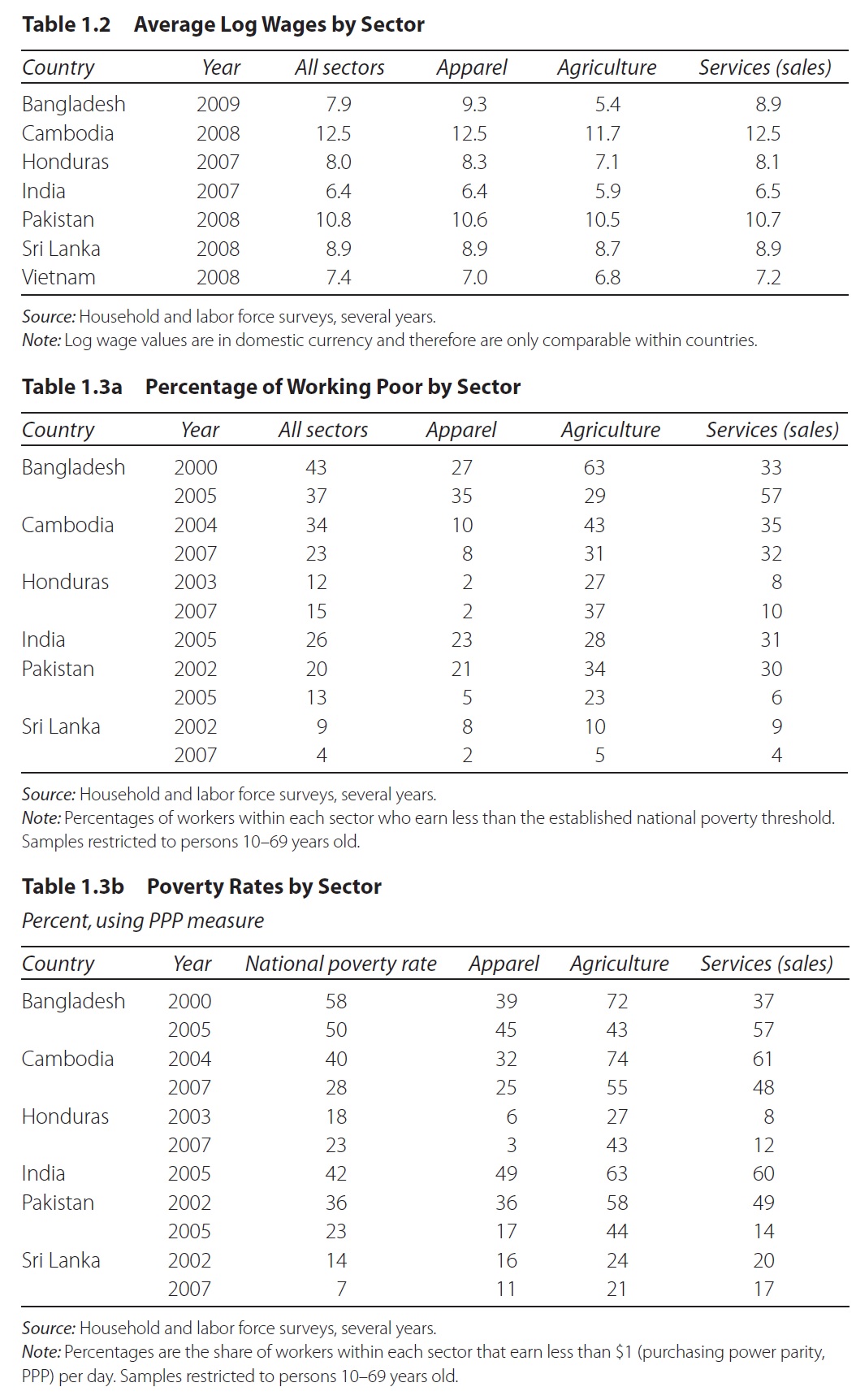
An often ignored fact is that in many developing countries, jobs in the apparel sector are better paid than positions in other sectors. For example, according to a recent study conducted by the World Bank, in Bangladesh, wage level in its apparel sector is 17.7% higher than the average level of all sectors, 72.2% higher than the wage level in the agriculture sector and 4.5% higher than the wage level in the service sector. This is not surprising, because in many developing countries, “moving from agriculture and low-end services into apparel jobs is a channel for social upgrading” (Lopez-Acevedo & Robertson, 2012).

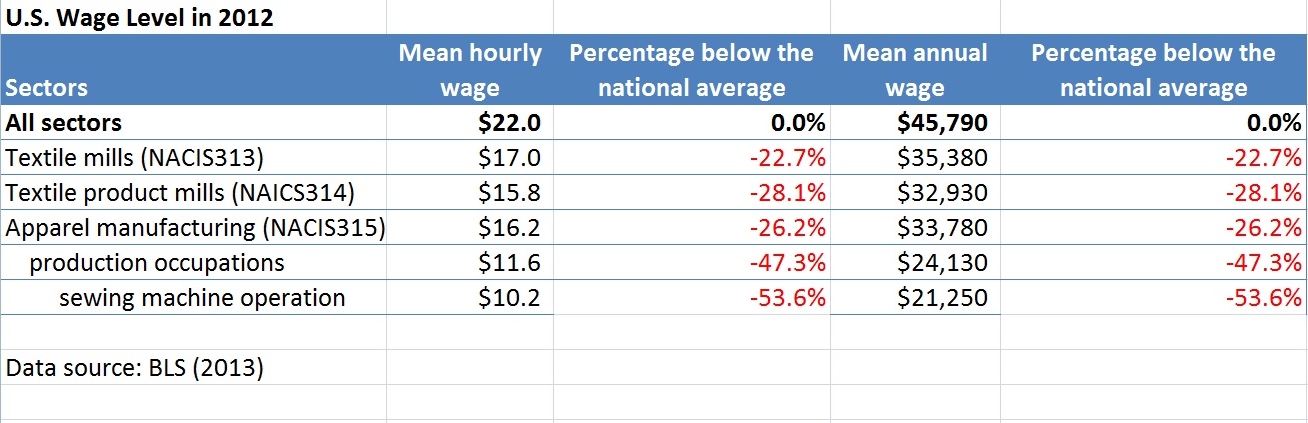
Then, what does an hourly wage of $12 mean in a developed country like the United States? Data from the Bureau of Labor Statistics show that, in 2012, average wage level in the U.S. apparel manufacturing sector (NAICS 315) is 26.2% below the average wage level of all sectors. More specifically, the average wage level for the production occupations is 47.3% below the national average level and 53.6% below the national average level for sewing machine operators, the exact type of job that the hourly wage of $12 refers to. 

The point to make here after the comparison is that it is misleading to define “ethical” or comment on “corporate social responsibility” without putting the matter in the context of the stage of development and the nature of the economy.  Wage level is not determined by good will, but by the principle of economics 101.

By Sheng Lu

apparel payment

Untitled

Outlook of the U.S. Textile Industry in 2013

The latest industry outlook proposed by the Textile World argues that in 2013 the U.S. textile industry will improve industry strategy and planning in the following areas:

  • increased management emphasis in such areas as sourcing, inventory control
  • use of more flexible and efficient machinery and equipment
  • new and upgraded consumer products,
  • more ecologically friendly offerings
  • more Made-in-USA labels

 Don’t misunderstand/misinterpret these terms. The proposed strategies actually tell us:

1. the U.S. textile industry will become even more capitalized in production (as the result of “using more flexible and efficient machinery and equipment”).

2. the success of the U.S. textile industry relies on import (that’s why “management of sourcing” is suggested to be emphasized), despite the intension to promote “made in USA” label which has more to do with the current “rules of origin” defining the nationality of the products.

3. the softgoods industry (textile, apparel and related retailing) is a highly buyer-driven industry. Even textile mills have realized the importance of understanding and directly reaching the consumers.

4. sustainability is a major factor driving technical reform and upgrading in the textile industry. Other than the environmental concerns, there is another strategy behind the efforts: when the U.S. textile industry is fully ready to “be able to produce in a sustainable way”, it will ask for legislation support to require “everybody”(including imported products) to meet the same environmental standards(professionally, we call it “technical barriers of trade”). Developing countries can compete on price, but definitely cannot compete on technology and capital which are the basis of achieving “sustainability”.  Bu then, you will see sustainability becomes a real game changer.     

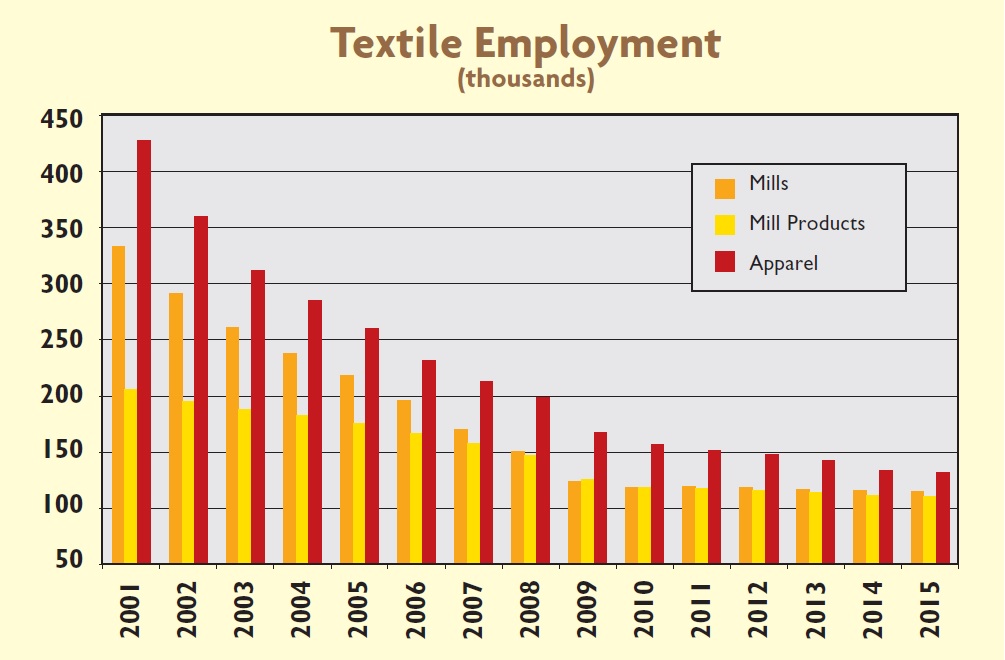
 Another relevant forecast made by the article “But holding these costs down through efficiency gains can also have a negative impact —namely, a smaller industry workforce. In the textile sector, for instance, squeezed by productivity gains, overall employment should drop from 232,000 in 2012 to near 209,000 by 2015.” As we menioned in the class, technology kills jobs too, although new types of jobs will be created at the same time–but with totally different skill requirements.