What Do You Take Away from FASH455? (Updated December 2025)

I encourage everyone to watch the two short videos above, which provide an excellent wrap-up for FASH455 and remind us of the meaning and significance of our course.

Firstly, I hope students can acquire essential knowledge about the textile and apparel trade and sourcing from FASH455. As you may recall from the videos, in FASH455:

Whether your dream job is to be a fashion designer, buyer, merchandiser, or marketing analyst, understanding how trade and sourcing work will be essential and beneficial to your future career, given the global nature of today’s fashion industry. And indeed, apparel trade, sourcing, compliance and trade policy offer exciting career opportunities for our college graduates, both in the public and private sectors.

Secondly, I hope FASH455 helps students shape a big-picture vision of the fashion apparel industry in the 21st-century world economy and provides students with a fresh new way of looking at the world. Throughout the semester, we’ve examined many critical, timely, and pressing global agendas that are highly relevant to the textile and apparel industry, from how to effectively expand near-shoring from the Western Hemisphere, and the debate on the textile and apparel provisions in U.S. free trade agreements, to the controversy of forced labor in the apparel supply chain. As the fashion industry moves toward sustainability and non-conventional factors like geopolitics play a more significant role in fashion companies’ sourcing decisions, we might see apparel sourcing and trade patterns continue to evolve substantially. Additionally, the emergence of AI tools could provide opportunities for fashion companies to optimize sourcing and logistics, identify and evaluate new suppliers, and improve supply chain efficiency.

Therefore, it is critical to remember that we wear more than clothes: We also wear the global economy, international business, public policy, and trade politics that make affordable, fashionable, and safe clothes possible and available for hardworking families.

Thirdly, I hope FASH455 can make students reflect on why “fashion and apparel” matters. A popular misconception is that “fashion and apparel” are just about “sewing,” “fashion magazines,” “shopping,” and “Project Runway.” In fact, as one of the largest and most economically influential sectors in the world today, the fashion industry plays a critical and unique role in creating jobs, promoting economic development, enhancing human development, and reducing poverty. For most developing countries, textiles and apparel typically account for 70%–90% of their total merchandise exports and provide one of the very few opportunities for these countries to participate in globalization. Likewise, maintaining a robust and competitive domestic textile and apparel manufacturing capacity in the US could also be strategically important—just consider the urgent demand for surgical masks and medical textiles during the pandemic.

Additionally, I hope that by taking FASH455,  students will take away meaningful questions that can inspire their future studies and even life’s pursuits. For example:

  • How can apparel sourcing and trade be made more sustainable and socially responsible? What are the roles and responsibilities of fashion companies, policymakers, and consumers?
  • What policies and regulations could be enacted at the national and international levels to incentivize sustainable apparel production and trade?
  • How will factors such as AI, digitalization, the sustainability movement, and geopolitics continue to shape the future landscape of apparel trade and sourcing? Who will emerge as the new winners and losers?
  • How can trade policy be utilized to address challenging global issues such as forced labor and climate change?
  • How could courses like FASH455 further challenge students’ perceptions, deepen their understanding of the global nature of the fashion apparel industry, and foster their global citizenship?

So, what do you take away from FASH455? Please feel free to share your thoughts and comments.

Dr. Sheng Lu

How EU Fashion Companies Navigate Trump’s Tariffs (Updated November 2025)

This study aims to examine the impacts of the Trump administration’s escalating tariffs on the apparel sourcing and business practices of EU-headquartered fashion companies. Based on data availability, transcripts of the latest earnings call from about 10 leading publicly traded EU fashion companies were collected. These earnings calls, held between August and November 2025, covered company performance in the second quarter of 2025 or later. A thematic analysis of the transcripts was conducted using MAXQDA.

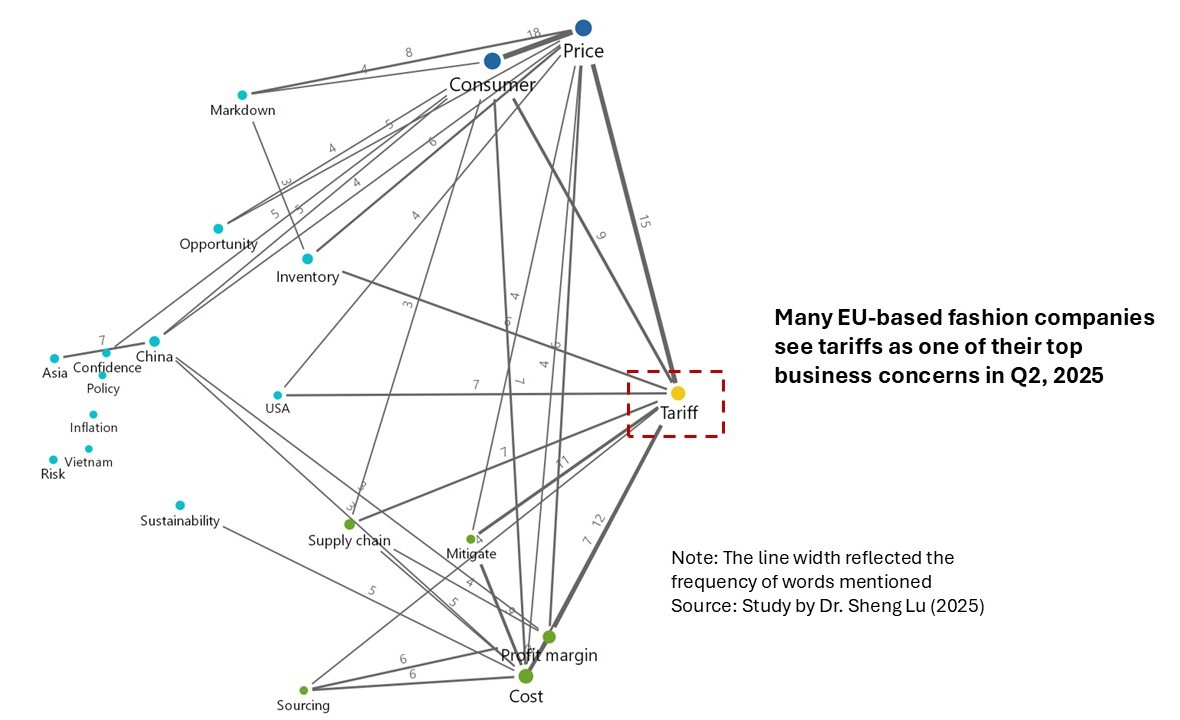
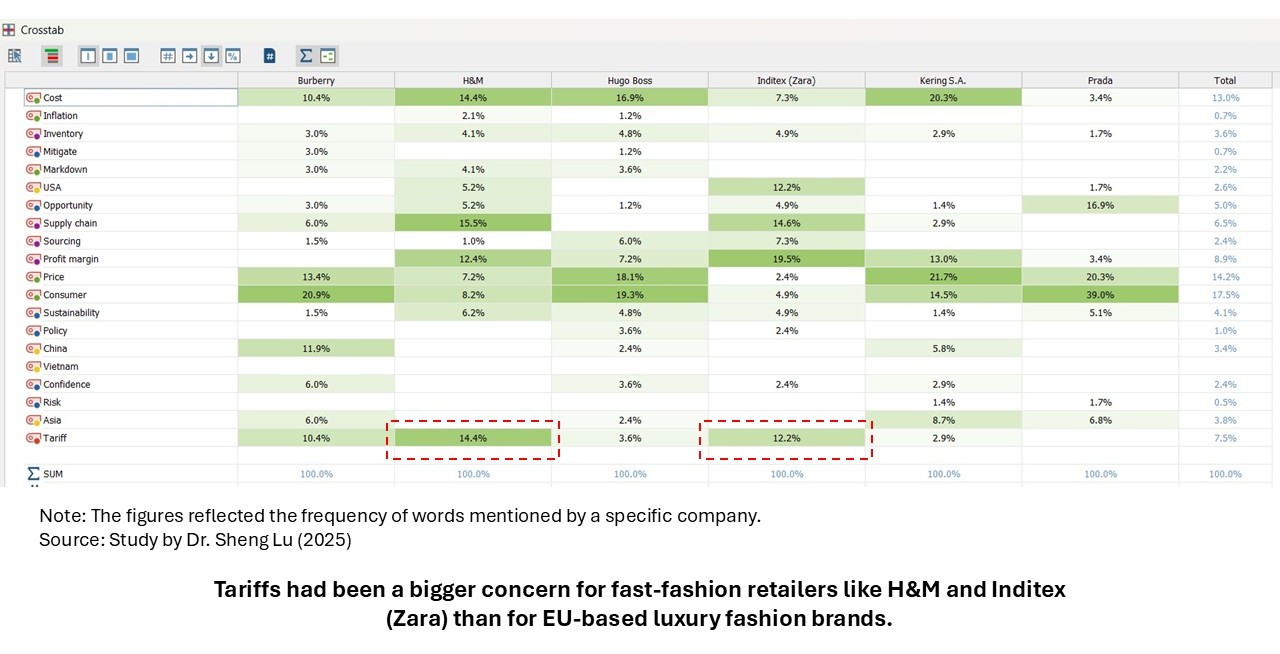
First, reflecting the global nature of today’s fashion apparel industry, many EU-based fashion companies also see tariffs as one of their top business concerns in the second quarter of 2025. However, overall, luxury fashion companies reported less significant tariff effects than fast-fashion retailers and sportswear brands. The result reflected luxury fashion companies’ distinct cost structure, supply chain strategies, and competitive factors, making them less sensitive toward tariff-driven sourcing cost increases.

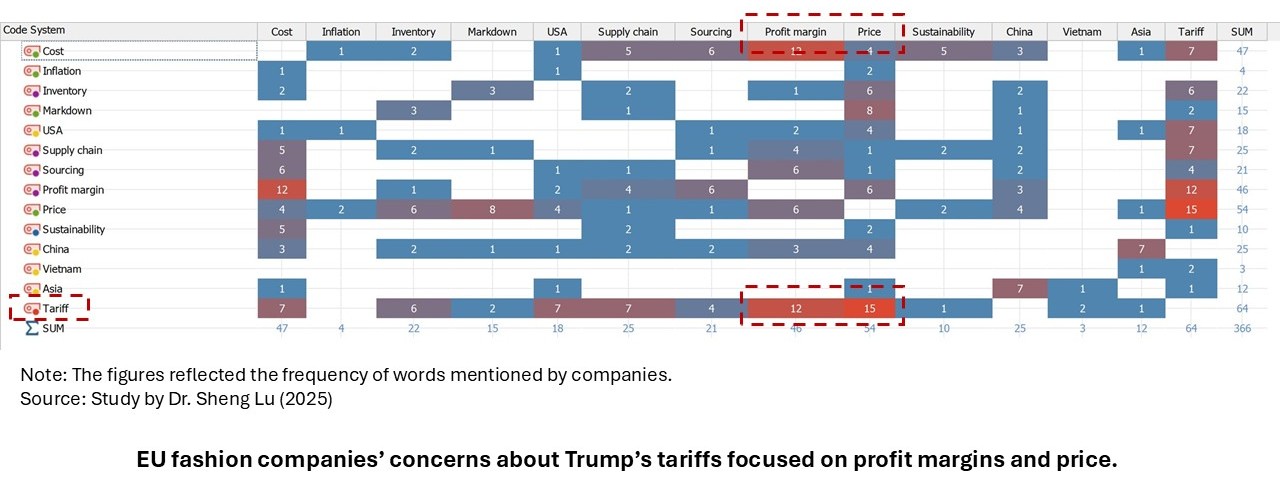
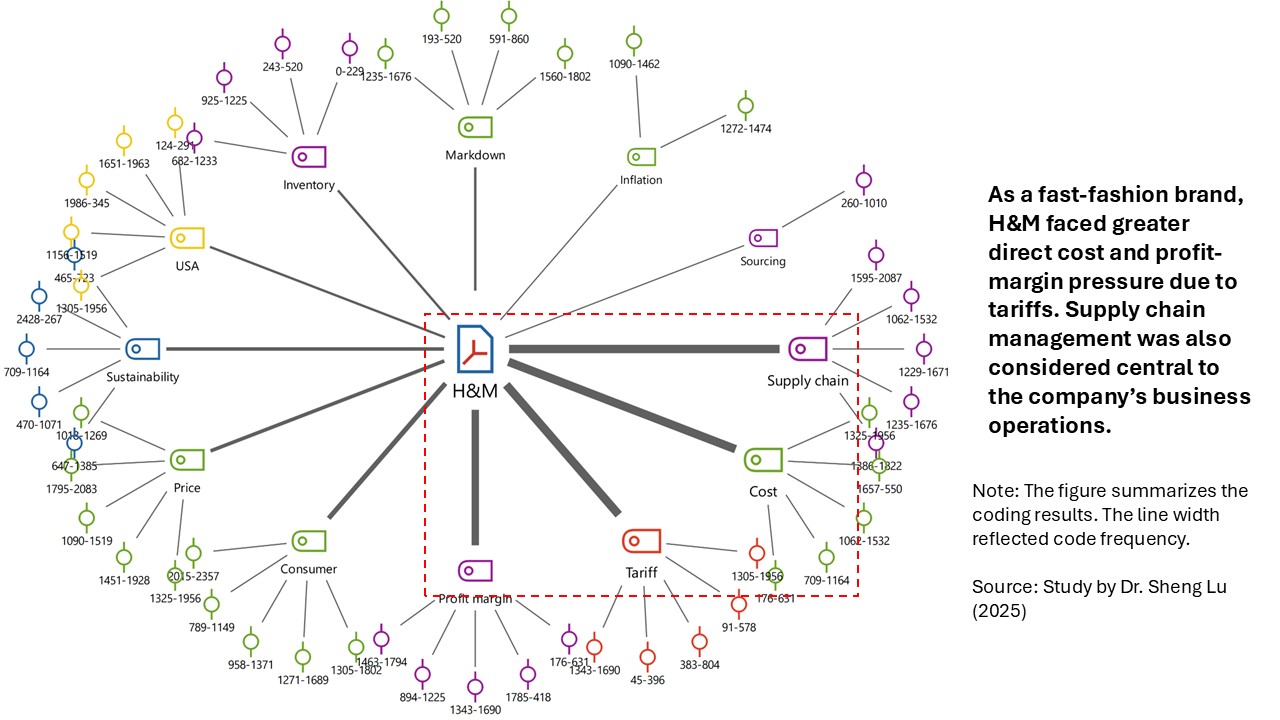
Second, EU-based fashion companies generally regarded the rising sourcing costs and the resulting pressure on profit margins as the most significant impacts of Trump’s tariffs. Companies also noted that the tariffs’ financial impacts would be more noticeable in the coming months as more newly launched products became subject to the higher import duties. For example:

  • Adidas: “We already had the double digit hit when it gets to cost of goods sold already in Q2 in the U. S…the impact of these duties, if they are the way we have calculated them here, an increase in cost of goods sold of about CHF 200,000,000 (about $250 million USD).
  • H&M: “Against that, we have the impact of the tariffs that will then, based on the tariffs we pay during Q3, a lot of those garments will be sold during Q4, and that’s when they affect our profit and loss.”

Third, EU-based fashion companies commonly adopted a sourcing diversification strategy to mitigate the tariff impact. Companies also increasingly look for vendors that can deliver speed, flexibility, and agility.  Furthermore, some EU companies have been strategically leveraging regional supply chains to meet the sourcing needs. For example:

  • Adidas: “We work with our suppliers who are mostly multi country…”
  • Hugo Boss: “Since our last update in early May, we have taken concrete steps to mitigate tariff-related impacts. Our well-diversified global sourcing footprint has a clear advantage in this regard. It enables us to swiftly adapt to changing conditions and optimize sourcing decisions.”
  • H&M: “We are working on how to increase the speed and reaction time in our supply chain. That’s a wide work that includes both, as we mentioned before, how we move production closer to the customer with what we call nearshoring or proximity sourcing, but it’s also working with a set of suppliers that can be much quicker and where they can support with a larger part of the product development process.”
  • C&A: “In the last quarter, we developed our logistics strategy to sustain C&A’s growth curve till 2030…This strategy was designed so as to bring greater speed and flexibility to our operational model through a more regionalized network, that is a network that is closer to the stores and major consumption centers, allowing us to have greater capacity to respond to the demands of each store.”

Fourth, like their U.S. counterparts, some EU fashion companies reduced their “China exposure” to lessen the impact of tariffs. Others establish a “China for China” supply chain due to perceived market opportunities there. For example:

  • Puma: “Our China exposure got reduced further for the Spring/Summer 2026 collection…The vast majority of our U. S. Imports originate from Asia, with Vietnam, Cambodia and Indonesia accounting for the majority…”
  • Adidas: “China is almost irrelevant for us because we have reduced the amount of China imports into the U. S. to only 2%…What we did is that we transferred the Chinese capacities to be mostly China for China…We have a more verticalized supply chain in China.”
  • Hugo Boss: “In particular, we have increased our inventory coverages in the U. S. And successfully rerouted product flows from China to other regions.”

Additionally, despite tariff-driven cost pressures, many EU-based fashion companies were cautious about raising prices, worried about losing customers in an overall weak market. Meanwhile, luxury fashion brands seem more comfortable raising prices than non-luxury brands. For example:

  • Adidas: “What kind of price increases could we take depending on the different duties, but there’s no decision on that…We are not the price leader, but we’d, of course, follow, a, what the market is doing, our competitor is doing and also, of course, look very closely what the consumer is accepting because in the end, it’s to keep the balance between all these factors.”
  • H&M: “That we do in the U.S., as we do in all other markets, and that leads to both price decreases and price increases to stay competitive. That’s an ongoing work. We are cautious about looking at the Q4 development in the U.S., given that we know we have already paid tariffs that will impact the gross margins as we look into the fourth quarter.”
  • Inditex (Zara): “With regards to the tariffs in the U.S. specifically, we have a stable pricing policy that we’re always talking about. Of course, all pricing activity, be it in the U.S. or any other geography, is primarily driven by commercial decisions, not financial ones. What we try to do in every market is maintain our relative position.
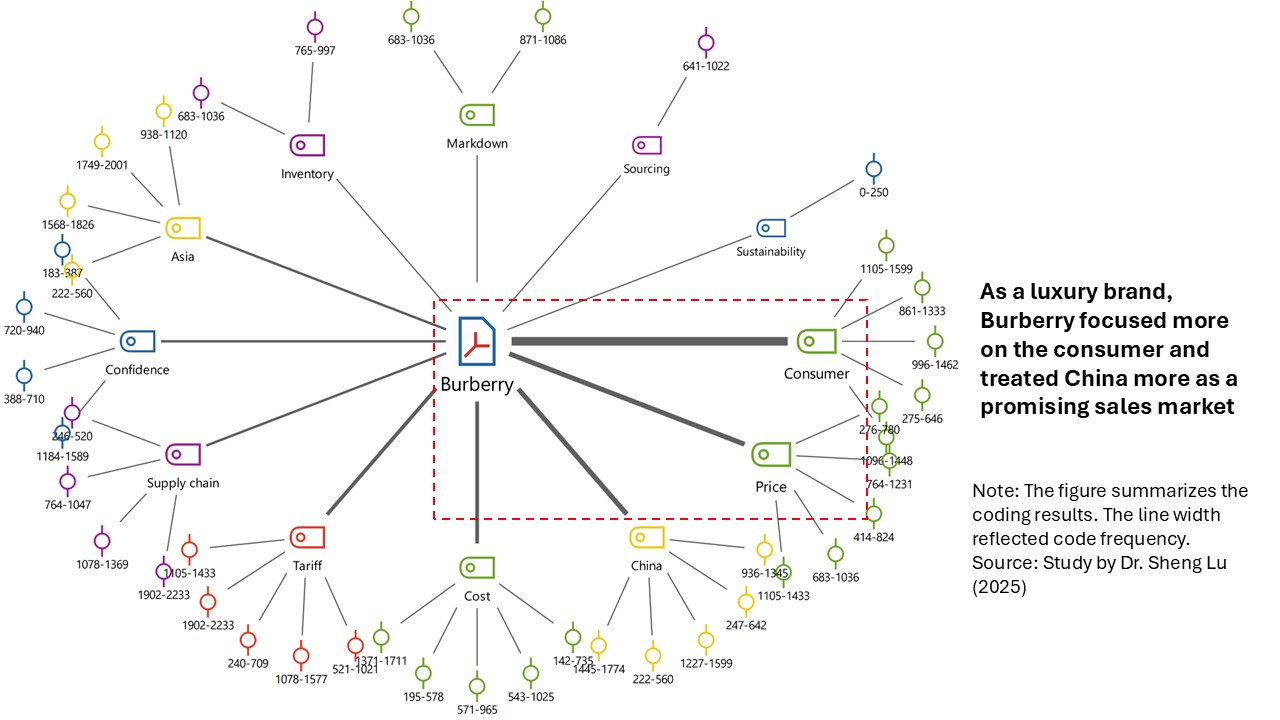
  • Burberry: “19% of our revenues are from the US…We spent much of last year looking at the supply chain, looking at price elasticity…We took quite a surgical approach to price increases in the US, and…we really definitely understood where we had price elasticity there.”
  • Hugo Boss: “we will introduce moderate price adjustments globally with the upcoming spring 2026 collections, which will begin delivery towards the 2025. These steps aim to safeguard our margin profile while remaining aligned with broader market dynamics.”

by Sheng Lu

FASH455 Exclusive Interview with Avedis Seferian, President & CEO of Worldwide Responsible Accredited Production (WRAP)

About the interview

Social responsibility is a critical topic in apparel sourcing and trade. Gen Z, both as consumers and future professionals in the fashion industry, care deeply about this issue. At the same time, the conversation around social responsibility has become more technical and complex, such as compliance with new regulations like the Uyghur Forced Labor Prevention Act (UFLPA).

In the interview, Avedis Seferian, President & CEO of Worldwide Responsible Accredited Production (WRAP), shared his insights and extensive practical experience about the current landscape and emerging trends in social responsibility related to apparel sourcing, including:

  • What does “social responsibility” truly mean in the context of today’s global apparel industry, and how has that meaning evolved over the past decade?
  • What are the key expectations for fashion companies if they need to achieve socially responsible sourcing?
  • Is social responsibility more of a legal issue or an ethical issue for fashion companies? Where does the line lie between what is required by law and what is expected ethically from apparel brands and factories?
  • How does a typical social compliance audit work on the ground, and why does it involve much more than simply “completing a checklist,” as some people may misunderstand?
  • Does greater supply chain transparency help promote social responsibility? How can fashion companies be encouraged to become more transparent, and what challenges remain?
  • What is the impact on garment factories and their workers when fashion companies suddenly cancel sourcing orders? As fashion companies increasingly expect suppliers to be “flexible,” such as accommodating last-minute changes to sourcing orders, could this expectation further complicate social responsibility efforts?
  • Can AI and technology have some potential applications in promoting social responsibility in the fashion industry?
  • Advice for students and young professionals entering the apparel industry who want to make a meaningful impact in social responsibility and ethical sourcing.

About Avedis Seferian

Avedis Seferian joined WRAP in 2004 and became its President and CEO in 2012. Avedis has extensive knowledge of social responsibility issues within the highly complex worldwide supply chains of the apparel, textile and footwear sectors. A recognized expert in the area of social compliance and responsible sourcing, Avedis was named by Assent Compliance as one of the top 100 corporate social responsibility influence leaders for 2020.

Additionally, Avedis speaks five languages, has lived in four countries and holds three degrees from three continents—a Bachelor’s in Economics from St. Stephen’s College, Delhi University in India; a Master of Business Administration from the American University of Armenia; and a Juris Doctor from the Georgetown University Law Center in the United States.

About Emilie Delaye (moderator)

Emilie Delaye is a master’s student & graduate instructor in Fashion and Apparel Studies at the University of Delaware, with a specific interest in supply chain, global sourcing, and sustainability. Emilie is also a member of the Fair Labor Association (FLA) 2025-2026 Student Committee and the University of Delaware President’s Student Advisory Council.  

Interview with Modaes (Spain) about the Shifting Global Apparel Trade and Sourcing Patterns (November 2025)

Full interview in English HERE ; Spanish version HERE

Below is the interview summary

Q1. Since the pandemic, has the global fashion supply chain changed?

Key point: The pandemic taught fashion companies the importance of flexibility and agility in sourcing. Heavy reliance on China caused major disruptions during lockdowns, prompting companies to diversify their sourcing base and develop stronger supplier relationships to reduce various sourcing risks.

Q2. Is supply security now more important than price in sourcing decisions?

Key point: Security and sourcing are becoming more closely linked. Leading fashion companies understand that sourcing now requires balancing cost with other important factors such as flexibility, regulatory compliance, and risk management. New regulations related to sustainability demand increasingly detailed supply-chain documentation and transparency. Meanwhile, geopolitical tension between the U.S. and China further adds complexity to fashion companies’ sourcing decisions.

Q3. Are companies continuing to reduce the number of suppliers, and why?

Key point: Recent studies show that many fashion companies are diversifying sourcing beyond China, importing more from emerging supplying countries like Vietnam, Bangladesh, Indonesia, Cambodia, Pakistan, Egypt, and more. However, there are two divergent strategies: some brands expand their supplier base to spread risk and enhance capabilities in sustainable fibers, while others consolidate suppliers to strengthen partnerships with large vendors operating across multiple countries, many of which are still based in China.

Q4. Can the value chain function without China?

Key point: Not realistically. While China’s share of finished garment exports is declining, it still dominates in textiles raw materials. Even when apparel is made in other countries (like Vietnam and Cambodia), much of its fabric, investment, or ownership is Chinese. The newly released OECD data also show that about 30% of Southeast Asian apparel exports include Chinese content.

Q5. Which countries could take advantage of China’s declining role?

Key point: China’s dominance comes not only from its low costs but also from its capacity to produce almost any product category at large scale. To replicate this, companies need to use multiple sourcing locations — a “many-country model” instead of relying on just one. Therefore, diversification, rather than substitution, is the most practical approach. Firms seek to avoid over-dependence on any single country, especially given the volatility of tariffs and supply-chain disruptions.

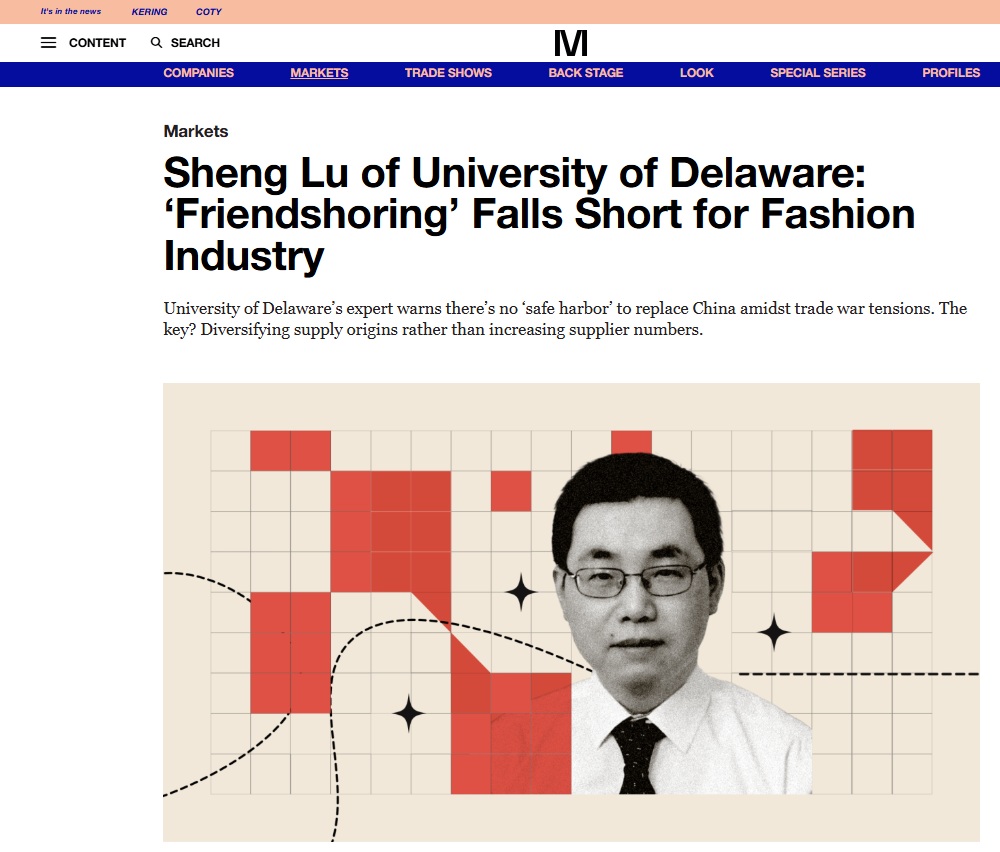
Q6. Does “friendshoring” apply to fashion?

Key point: Politically appealing but impractical for apparel sourcing. The idea of friendshoring — trading only with “like-minded” nations — doesn’t fit with fashion’s global manufacturing system. Europe and the U.S. share values, but Europe lacks large-scale apparel production. Over 70% of U.S. apparel imports still come from Asia, where most countries are not formal U.S. allies. Therefore, political alignment cannot guide sourcing strategy in fashion; cost, capacity, and speed are more important.

Q7. Will geopolitics and the trade war reshape fashion sourcing in Europe or the U.S.?

Key point: Nearshoring remains a popular concept. European companies explore Eastern Europe and the Mediterranean; U.S. firms consider the Western Hemisphere and limited domestic production. Sustainability has emerged as the new opportunity for near-shoring. Fashion companies now aim to use more sustainable fibers in their clothing products. EU sustainability rules could also attract new investment to expand production in the EU. However, in general, small-sized firms need more resources and support to meet these high environmental standards, both to comply with the law and sustain their businesses.

Q8. Is de-globalizing production possible?

Key point: True de-globalization is unlikely. Instead, globalization is shifting toward greater transparency and accountability. Companies now need to track and report where products are made and how workers are treated, including the sourcing of raw materials. This encourages brands to work closely with their suppliers and promote stronger and strategic collaboration.

Q9. Are there enough incentives for production automation in fashion?

Key point: Yes — Automation provides a way to increase efficiency in high-wage countries like the U.S. With labor costs high and factories shrinking, machines and AI are being adopted to boost productivity and customization. Automation can also help cut down on overproduction — one of fashion’s major waste issues — by supporting made-to-order or small-batch manufacturing.

Q10. Why don’t we see full automation yet?

Key point: Cutting, sewing, and material handling today still require human labor, although factories increasingly use automated tools to boost productivity. Asian suppliers are upgrading equipment to handle smaller, faster orders. Automation is bringing back niche manufacturing (e.g., sock production in the U.S.) and supporting recycling efforts, such as sorting used garments. It helps lower minimum order quantities, matching production to uncertain consumer demand.

Q11. How can Europe maintain relevance amid the U.S.–China trade war?

Key point: Europe continues to be a key player in both textile and apparel manufacturing and consumption. Nearly half of the apparel in the EU is produced locally, often in high-wage countries like Italy, Germany, and France. Asian countries are looking for more market access to the EU because of higher tariffs imposed by the US (e.g., trade diversion). Europe also leads in sustainability and regulatory standards. Complying with EU rules often means meeting the highest global standards. Luxury branding (“Made in Italy/France”) remains highly influential, and the EU’s proactive trade agreements might even enable it to export textiles for processing in Asia, expanding supply chain integration.

Q12. Why hasn’t Africa become a viable textile hub yet?

Key point: Africa’s potential greatly relies on trade preferences like the African Growth and Opportunity Act (AGOA), which recently expired. Without duty-free U.S. access, U.S. companies are less likely to source there. However, the EU could help bridge the gap by forging partnerships for recycled textile materials and sustainable production. Regional collaboration could unlock Africa’s place in circular fashion supply chains.

For students in FASH455: Feel free to share your thoughts on any of the interview questions above. You may also challenge and debate any points raised in the interview and present your arguments.

FASH455 Exclusive Interview with Mikayla DuBreuil about Technical Apparel Design and Sourcing

About Mikayla DuBreuil

Hello, my name is Mikayla DuBreuil, and my passion is to bring designers’ creative visions to life. I have a diverse background in apparel design, from intimates and compression wear to dresses and jeans, and everything in between! My resume consists of technical design positions at Under Armour, Marena, Anthropologie (URBN), Lee & Wrangler, and, most recently, SPIRIT HALLOWEEN.

Above all, my joy in apparel design lies in pattern-making. Designers are the artists, and pattern makers are the engineers who bring their designs to life. I love problem-solving to create fantastical designs and reduce physical sampling. Most of my work is in CAD 3D software, specifically CLO 3D. I am also a certified super user in the 3D CAD software, Vstitcher, and experienced in the 2D CAD patterning software, Accumark and Optitex.

Note: Mikayla Dubreuil graduated from the University of Delaware (UD) with a Master of Science in Fashion and Apparel Studies. She also graduated from UD with a Bachelor’s Science in Apparel Design in 2018. She received the International Textiles and Apparel (ITAA) Sara Douglas Fellowship for Professional Promise-Masters in 2019. Mikayla’s master’s thesis Traditional vs. big-data fashion trend forecasting: An examination using WGSN and EDITED was published in the International Journal of Fashion Design, Technology and Education and have been cited by more than 100 other scholarly papers.  

Sheng: What are your main responsibilities as a technical designer? Can you walk us through your typical day? Also, what makes you love your job?

Mikayla: A technical designer’s job is to ensure the proper execution of fit and construction of a garment to meet the designer’s & buyers’ expectations whilst keeping cost in mind.

This involves creating detailed tech packs with key measurements, i.e., specs like waist, front neck drop, across shoulder, sweep, and front length from high point shoulder, measuring garments, conducting fittings on a live fit model, and submitting fit comments. A common technical design goal is to approve a design with as few physical samples as possible.

Some technical designers’ responsibilities are more rooted in construction and creating tech packs, whilst others focus on fit.

However, in my opinion, the best technical designers have a strong pattern-making and construction background. By having a strong pattern-making and construction background, technical designers (TDs) can communicate to designers what silhouettes and constructions are feasible. In this manner, TDs can find creative solutions to execute the designer’s vision and improve fit.

As an Associate 3D Technical designer, my typical day consists of taking design set-ups/hand-offs, pattern making the designs in CLO 3D, and attending buyer review meetings.

I love my job at Spirit Halloween because I can build garments in 3D, both bringing the designer’s vision to life and improving sustainability by reducing sampling. I also have an incredible manager, which is very important.

Sheng: How does a technical designer collaborate with the sourcing department, and in what ways does your work influence sourcing decisions?

Mikayla: To preface, the sourcing department is responsible for deciding what fabrics and trims will go into the garment.

Technical designers collaborate with the sourcing department or buyers by recommending ideal fabrics to achieve the desired look of a garment. For example, for a bodysuit, technical design would recommend a stretch knit fabrication. TDs affect sourcing decisions by providing knowledge on how the garment will execute in the desired fabric.

Ultimately, it is often sourcing/design/buying’s decision—the call varies from company to company—to choose the fabric. Ultimately, technical design commonly doesn’t make the call on what fabric is used.

This impacts our work because technical designers will base their specs and patterns on the fabric and desired silhouette. For example, a stretch denim pant would have smaller specs than a non-stretch denim pant since the stretch denim has more ease.

Further, the sourcing department affects our TDs’ work because it determines which vendor is making the garment. As a result, this affects our decision on whether to make the pattern internally or externally, based on the vendor’s expertise & capabilities.

Sheng: Our students are particularly interested in fabric sourcing. From your experience, what factors do fashion companies weigh most heavily when selecting fabrics, and how do these influence design and production decisions?

Mikayla: Cost. Cost and fabric drape.

However, designers and technical designers can push back if a lower-cost option is executing poorly. Buyers can make the decision to increase the retail price to meet initial markup goals to accommodate higher fabric costs.

Alternatively, the team may choose to use the low-cost fabric option in a less high-profile area of the garment and spend more on a high-quality fabric in a statement area of the garment.

On a separate note, if there is liability fabric, i.e., extra fabric that is not being used, buyers often reallocate the fabric to a different or new silhouette.

Sustainability is also at the forefront of mind, especially at denim brands. There is a shift to move towards recycled cotton.

Sheng: Many fashion companies are incorporating “preferred sustainable fibers” such as recycled, organic, or regenerative materials. From your perspective, what are the opportunities and challenges in integrating these fibers into apparel?

Mikayla:Cost and fit are both challenges in integrating these fibers into apparel. For example, many consumers want stretch in denim jeans, but it can be difficult to achieve that effect when switching to certain “preferred sustainable fibers”.

Additionally, it’s difficult to source a “sustainable” faux fur for a teddy bear costume. The plush material is so specific, resulting in a lack of sustainable choices.

One opportunity is using fabrics that are composed of a single fiber. Fabrics with fiber blends are much more difficult to recycle. A lot of opportunities are available to the consumer! Buy fewer and higher-quality items. Wear clothes more than once before washing.

Sheng: Looking ahead, what industry trends will you be keeping a close eye on in the next 1-2 years, and why?

Mikayla: Tariffs!! Tariffs impact our ability to source and distribute our garments. Also, pop culture matters, since many want to dress up as the latest phenoms!

Sheng: Reflecting on your time at UD and in FASH, what experiences helped prepare you for your career? What advice would you give to current students as they plan their career paths?

Mikayla:Think about what you want and your goals. I am so glad that I attended the FASH Grad program, which gave me exposure to CLO 3D and ultimately led to my current role. While I was at UD, I was proactive by working with professors on projects that gave me industry visibility. For example, I worked on an Optitex project that allowed me to attend a training at the Under Armour HQ, which helped me earn a spot as a technical design intern and catapult my career.

–The End–

Hot Button Apparel Trade and Sourcing Issues: Gen Z’s Perspective (October 2025)

As the fashion industry faces an unprecedented business and trade policy environment, hearing directly from Gen Z fashion majors—the next generation of both consumers and young professionals—has never been more critical.

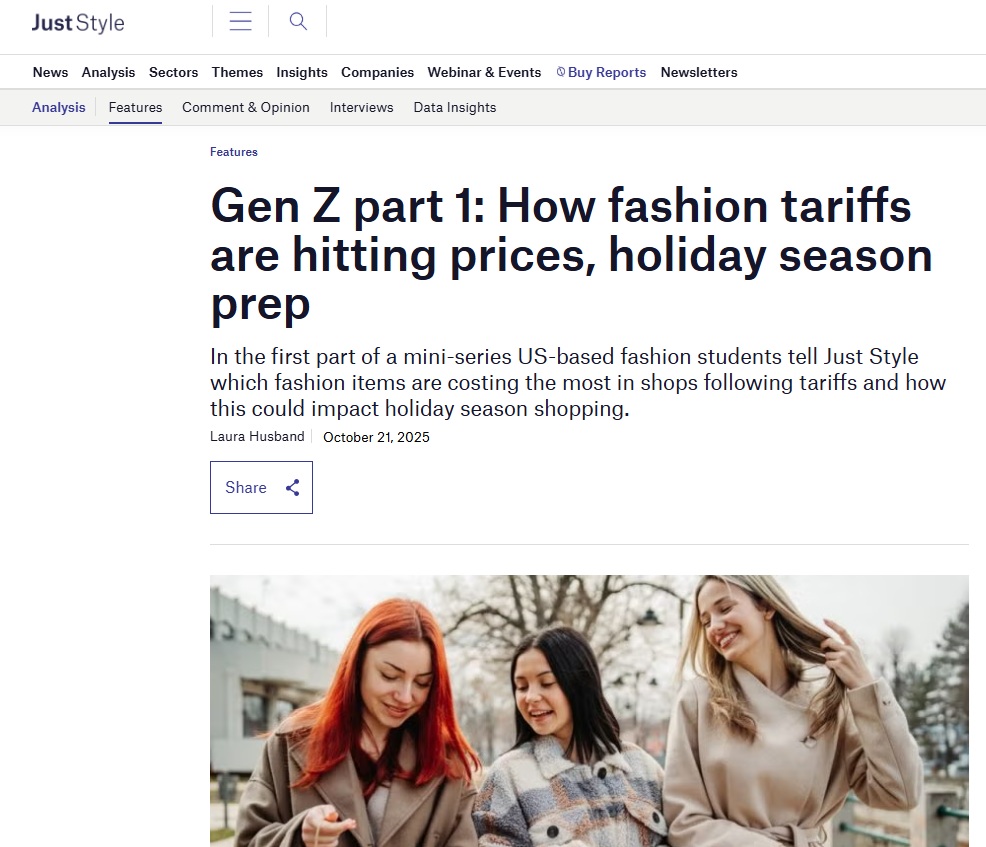
In a new Just-Style mini series, students from FASH455 and the FASH department at the University of Delaware shared their valuable Gen Z perspectives on several hot-button apparel trade and sourcing issues as well as their vision for the future of the fashion apparel industry. Several findings are noteworthy:

First, like other consumer groups, Gen Z has felt the increasingly noticeable retail price hike driven by higher tariffs, and they are responding by reducing clothing purchases.  Compared to a survey conducted in April, nearly all Gen Z consumers now see higher price tags across a broad range of products, including necessities, outerwear, and footwear in the U.S. retail market. Notably, Gen Z consumers feel most strongly about the price hikes at fast fashion retailers—including Shein. Due to the perceived low quality and use of inexpensive textile materials, it is even more challenging for fast fashion brands to justify price increases. Our students who frequently thrift clothing also noted a price increase in the secondhand clothing market. As a warning sign to fashion companies, many surveyed Gen Z students say they plan to spend less this holiday season, or keep shopping “to a minimum” because of price increases.  For example,

  • Gabriella Krug, Fashion Merchandising and Management senior: As a shopper, I’ve adjusted by buying fewer items overall, checking sales racks more often, and using platforms like Depop and Poshmark to sell and buy trendy pieces. For the holidays, I think these price increases will push me, and most shoppers like me, to focus more on quality rather than quantity. I’ll definitely be taking advantage of Black Friday and Cyber Monday deals this year. Ultimately, tariffs could cause people to make more intentional and selective purchases this holiday season.
  • Cheyenne Weiss, Fashion Design & Product Innovation senior: While the higher tariffs have widespread effects on the fashion industry, I have personally noticed raised prices for outerwear and footwear. I noticed these two categories specifically as they are what I was shopping for going back to school and it is telling of how directly trade policy impacts consumers. The effects of the tariffs are hitting close to home, and I would feel most frustrated to see loungewear and athleisure categories rise in price. While these areas seem to already be feeling the effects of raised tariffs, it would be hard as a consumer to continue purchasing these items if tariffs keep rising, considering these are the fashion categories I buy from the most often. As a shopper, the higher prices discourage me from going out and purchasing new clothing.
  • Skye Johnson, Fashion Merchandising and Management senior: I have noticed that prices are rising among all types of clothing. In particular, I have heard that Fast Fashion retailers like H&M or even Shein have increased their prices significantly. While I personally do not shop at fast fashion retailers like Shein, I’ve seen the impact through school research projects and conversations with friends. This is frustrating because these fast fashion items are made with very cheap materials like polyester and nylon.
  • Julia Brady, Graduate Student studying Fashion and Apparel with a focus on Sustainability: I mainly shop using online resale sites, such as Depop, and just enjoy browsing higher-end online consignment stores, like Vestaire and theRealReal, for secondhand designer deals. I have seen fewer deals on the site and more high-priced secondhand designer items… Even on Depop, international listings are higher than normal. The category I would be most frustrated to see prices rise in would be footwear… I also expect to buy holiday gifts from local artisans and local stores, due to higher quality and (hopefully) decreased tariff impact.
  • Nadia Grosso, Fashion Merchandising and Management senior: I’ve noticed myself becoming even more price-sensitive when shopping because of the rising prices, so I’m always looking to find the best deal to stretch my budget as much as I can. Overall, I think shoppers are trying to limit their spending as much as possible, and being more cognizant of prices when choosing what to purchase and who to purchase from. As a result, come holiday shopping time, I might be more inclined to shop at discount retailers or even decrease how much I purchase compared to previous years.

Second, Gen Z fashion majors view globalization and international trade as generally beneficial for the fashion industry. At the same time, they emphasize the need to enhance sustainability and social responsibility in the global apparel trade. For example, while most survey respondents supported leveraging apparel trade to promote economic development in developing countries, they also stressed that trade volume alone should not define success. Instead, many highlighted the importance of ensuring that garment workers in developing countries directly benefit from trade and Western fashion brands and retailers have a responsibility to help make this happen. For example,

  • Emilie Delaye, Master’s student in fashion and apparel studies: I believe that it is almost virtually impossible to move manufacturing fully back into the US. Nearshoring could really help sustainability (as fewer emissions would be released), but nearshoring would require investment and savvy trade deals to ensure that many different kinds of products can be produced there. I don’t really think it is that important that the US maintains a “strong” textile and apparel sector. As we know from the innovation or economic development timeline, the textile and apparel sector is an entry point for less developed economies. It could actually be perceived as a positive that we aren’t largely in this market. I think that there are other more critical sectors to focus on for the US. Plus, we simply do not have the skilled labor or machinery needed to do this. I support the leveraging of the clothing trade to support economic development in the countries that need it. I believe that if done sustainably and socially responsibly, the apparel sector could help millions of individuals in these countries.
  • Abigail Loth, Fashion Merchandising and Management senior: As a consistent consumer in the US fashion industry, I believe that globalization and international trade is vital for our success. Not only does it keep trends fresh, globalization and international trade encourage styles to remain diverse and costs to be cheap… Maintaining a strong domestic textiles and apparel sector in the US is also extremely important. This is because it provides an abundance of jobs/opportunities, innovation and sustainability practices. So, in order to leverage the clothing trade and support workers in developing countries as ethical sourcing and fair labor practices help ensure that globalization benefits more than just corporations.
  • Ekaterina Forakis, Fashion and apparel studies 4+1 graduate student: Globalization and international trade are crucial aspects of the U.S. fashion industry. It is these that keep the U.S. fashion industry running. Trade theory explains why globalization benefits countries like the U.S. and allows them to focus on textile manufacturing, one of the country’s strong suits. Higher tariffs and import restrictions are not necessary to maintain U.S. manufacturing because the U.S. is already a top textile exporting country and does not specialize in apparel production. The country’s capacity for automation is what makes it reliable in the textile sector. Automation allows for more standardized production of textiles which are necessary for developing countries to produce apparel.
  • Emma Lombardi, Fashion Design and Product Innovation senior: I view globalization and international trade as a double edged sword for the U.S. fashion industry, because on the one hand, while it doesn’t benefit the creation of jobs in rural areas that many covet, it also shifts the emphasis towards more sophisticated industries in technology development and innovation both in mechanical and textile sectors.
  • Julia Brady, Graduate Student studying Fashion and Apparel with a focus on Sustainability: I think tariffs and import restrictions are necessary, but not just to protect U.S. domestic manufacturing. Tariffs could help regulate the amount of toxic chemicals along the textile manufacturing value chain. An alternative route for the U.S. to take would be to scale up flax for fibers to be used in domestic textile manufacturing. Perhaps tariffs will force companies and the federal government to invest in agricultural advances in this field…I would never want to advocate taking away work in developing countries; however, for the sake of our environment, we may need to shift the way the fashion supply chain currently operates. It is important to me that the U.S. maintains a strong textiles and apparel sector because we are a big part of the problem. We must take control over the way we consume and dispose of textiles. There could be so many opportunities for economic growth if we shift toward domestic manufacturing, prioritizing the use of materials we already have.

Third, associated with the debate on the future of textiles and apparel “Made in the USA,” most Gen Z fashion majors show little interest in factory jobs. On the one hand, unlike most developing countries, today’s U.S. fashion industry provides Gen Z fashion majors with many exciting and promising non-manufacturing job opportunities, ranging from apparel design, product development, sourcing, trade compliance, and merchandising to marketing. By contrast, factory jobs are often perceived as “low paid,” “repetitive,” and “poor working conditions.”  Our Gen Z fashion majors particularly emphasized that their preferred employers should provide both financial and career progress opportunities, and they want to see keywords such as “innovation,” “sustainability,” “room to grow,” and “inclusiveness” associated with their future jobs. In other words, to attract more Gen Z workers to factory jobs, companies need to do more than just offer competitive pay. For example,

  • Gabriella Krug, Fashion Merchandising and Management senior: At this point in my career, I have not pursued an interest in textile or apparel manufacturing or factory-related jobs. My internships have exposed me to different sides of the industry…That said, I think my generation could see these roles as more appealing if companies focused on innovation, sustainability, and clear opportunities for growth. For example, if factories showcased their role in a circular fashion and created a more modern, flexible work environment, I think more Gen Z talent would be drawn in since we’re motivated by making a positive impact. Personally, I’m most interested in jobs that mix creativity with business—like sales, buying, or trend forecasting. When it comes to an employer, I value opportunities to learn and grow, strong mentorship, and a culture built on collaboration and inclusivity.
  • Cheyenne Weiss, Fashion Design & Product Innovation senior: I am not personally interested in pursuing a career in textile or apparel manufacturing as I see myself in a more creativity-based position. I feel as though my skills in fashion would be better suited for a role where I’m working directly with design and developing the fit and aesthetics of garments. Factory-related jobs in fashion could become more appealing to my generation if more rising fashion professionals knew about the opportunities that are available… When considering the qualities of an employer that I would want to work for, an important factor for me is a growth mindset. I value being able to learn and adapt as the industry evolves and I would want my employer to share my same persistence to always be learning and bettering the quality of work I can produce.
  • Skye Johnson, Fashion Merchandising and Management senior: I am not interested in pursuing careers in textile and apparel manufacturing or factory related jobs. However, I completely respect the importance of these roles in our fashion industry. I feel that my skills or career goals do not align with these jobs, but there could definitely be ways to make it more appealing to Gen Z. For example, offering safer working conditions, competitive pay, clear paths for professional growth, etc… When considering an employer, I value a workplace that aligns with my values, offers an inclusive environment, open communication, creative freedom, and room to grow in the company. I want to feel like I belong and am making an actual impact where I work.
  • Abigail Loth, Fashion Merchandising and Management senior: I personally do not have any interest in pursuing a career in textile or apparel manufacturing and factory-related jobs. These jobs consist of heavy hands on labor, limited creativity and repetitive daily tasks. The job is very cookie-cutter and has limitations for growth and opportunity. In order to make these types of factory jobs more appealing to our generation, the employers should provide safer working conditions, more money, and a sense of change/development in the everyday job. If factory jobs allowed more flexibility for creative thinking and alterations, they would appeal more to Gen Z.
  • Julia Brady, Graduate Student studying Fashion and Apparel with a focus on Sustainability: I am interested in pursuing a career related to textile and apparel manufacturing. Specifically, I would love to work towards a more socially responsible fashion industry. I could see myself working for a textile recycling plant in the U.S.; I expect more to be popping up over the next decade. If the factories were focused on green engineering and diverting textile waste, this might be another attractive core value of a potential future employer. I would be more inclined to work a factory job if the conditions in the factory were regulated and protective of the workers’ health. Additionally, if the employer was prioritizing the use of natural materials combined with textile recycling outputs, this would be very appealing to me as a prospective employee.

Fourth, Gen Z fashion majors show a high awareness of AI and are open to increasing its use in the fashion industry. Specifically, our Gen Z students believe that AI can be a powerful tool widely adopted by fashion companies, such as supporting apparel sourcing decisions, generating designs, and conducting data analysis and forecasting. Many also envision bold, creative applications of AI, such as optimizing secondhand clothing use or dynamically altering garments’ colors and textures based on weather conditions or consumers’ moods. These findings underscore the growing importance of deliberately integrating AI into fashion education and strengthening collaborations between industry and academia. For example,

  • Emilie Delaye, Master’s student in fashion and apparel studies: I think that AI could help understand and simplify the complex supply chains we have. Perhaps by incorporating AI into sourcing decisions, it could help determine the most efficient and eco-friendly path for the garment.
  • Gabriella Krug, Fashion Merchandising and Management senior: If there were no limits in terms of technology or resources, I would love to see AI used to create a truly circular fashion system. Garments would be designed with little to no waste from the very beginning with AI predicting the most sustainable production methods. Also, I think AI should account for each garment’s end-of-life by tracking how items can be reused, recycled, or repurposed.
  • Skye Johnson, Fashion Merchandising and Management senior: I still feel that AI will not be able to completely take over in the fashion industry, we still need that human touch. That human aspect is what makes the industry go round, especially when it comes to designers…If I could pick a bold AI-driven innovation to see in the fashion industry, I would love to see garments that change color or texture based on your mood or the weather. The AI technology could read your personal style and predict what looks best on you. That would definitely take years to make, but it would further blur the lines between fashion, technology and art.
  • Abigail Loth, Fashion Merchandising and Management senior: I would love to see AI-driven innovation that would be able to make custom designs depending on preferred colors, style, size, or shape and deliver it based on preferences of style and sustainability.
  • Nadia Grosso, Fashion Merchandising and Management senior: AI can be a helpful tool to analyze data and make recommendations on how to apply its findings to real-world situations. Especially with the uncertainty surrounding changing prices and geopolitics, AI could be implemented to help fashion companies navigate difficult sourcing decisions and manage their complex supply chains. I would also love to see AI be implemented more to drive sustainability initiatives such as reducing waste within production or even assisting with the discovery and development of more sustainable materials. However, I don’t think AI can fully replace human intelligence and creativity, so it’s important for it to be used as a tool and not as a replacement.

Additionally, the results show that Gen Z fashion majors overwhelmingly support the increased use of recycled textile materials in clothing and view it as an important opportunity to address the textile waste problem. However, as consumers, they still expect such products to remain financially affordable, match the quality of non-sustainable options, and look stylish. Additionally, with greater knowledge and awareness of sustainability, Gen Z consumers expect fashion companies to provide more transparency regarding their recycling practices and price structures (i.e., what they are actually paying for). This requires fashion companies to continue to improve their supply chain mapping and traceability in the era of textile recycling. For example,

  • Emilie Delaye, Master’s student in fashion and apparel studies: The (recycled) garments currently on the market are very expensive and do not appeal to my personal style…And it is very important for fashion companies to provide clear sustainability information. I think providing information on the cost breakdown would be valuable to see and ensure that the money is distributed more evenly.
  • Gabriella Krug, Fashion Merchandising and Management senior: Yes, I do care about clothing made from recycled textile materials because it feels like a step in the right direction and it makes me feel like I am making a more thoughtful choice as a consumer…What makes these products most appealing to me is the mix of style and transparency. Especially with Gen Z, the culture is shifting more and more toward eco-conscious consumers, now with the help of Depop, ThredUp, and Poshmark. These platforms give people an easy way to step into the world of sustainable fashion. For me, I want to know that the clothing looks and feels just as high-quality as non-sustainable options, but I also don’t want to feel like I’m overpaying just because it’s labeled as eco-friendly…I want brands to be upfront about what percentage of a garment is actually recycled and how it was made
  •  Skye Johnson, Fashion Merchandising and Management senior: For me, the appeal of recycled or sustainable fashion products comes from a combination of style, price, and brand transparency. I believe it is very important that fashion companies provide clear sustainability information and have the efforts and data to back it up… Obviously, no brand is perfect, but when I see a brand putting in the work to do better, I respect them a ton more.
  • Nadia Grosso, Fashion Merchandising and Management senior: Fashion brands need to do more to educate their consumers and highlight the importance of sustainability, while also incorporating it as a value into all of their business practices. I think that we can make sustainable and recycled products more appealing to consumers by being transparent and educating them on their importance. Fashion brands are becoming increasingly aware that providing clear sustainability and sourcing information to their consumers is necessary to gain their trust and loyalty, especially as a growing number of consumers are considering these practices as influencing factors to make purchases.

FASH students who contributed to the series include:

  • Gabriella Krug, Fashion Merchandising and Management senior
  • Emilie Delaye, Master’s student in fashion and apparel studies
  • Cheyenne Weiss, Fashion Design & Product Innovation senior & 4+1 graduate student
  • Skye Johnson, Fashion Merchandising and Management senior
  • Julia Brady, Master’s student in fashion and apparel studies
  • Abigail Loth, Fashion Merchandising and Management senior
  • Nadia Grosso, Fashion Merchandising and Management senior
  • Ekaterina Forakis, Fashion and apparel studies & 4+1 graduate student
  • Emma Lombardi, Fashion Design and Product Innovation senior

Explore more:

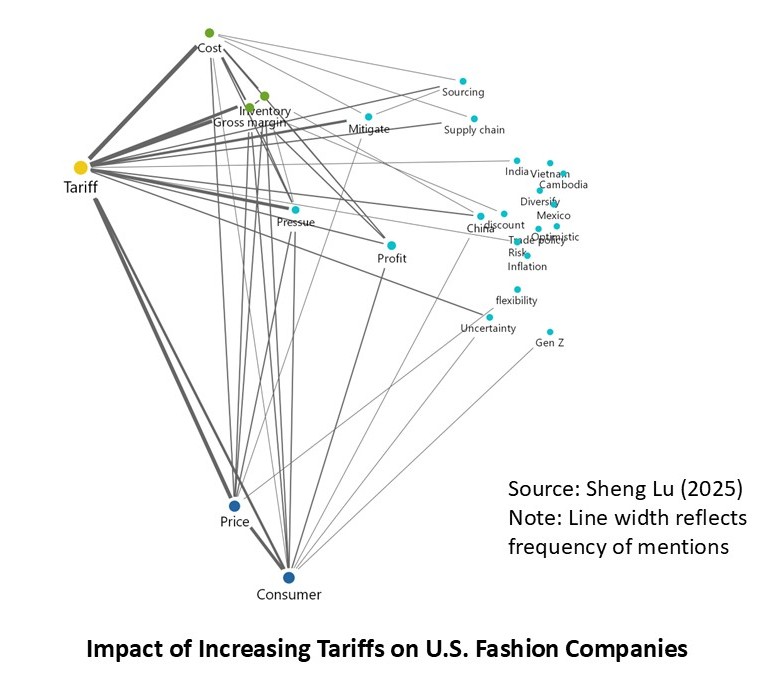
Updated Impact of Increasing Tariffs on U.S. Fashion Companies’ Sourcing and Businesses

This study aims to examine the impacts of the Trump administration’s escalating tariffs on U.S. fashion companies’ apparel sourcing practices. Based on data availability, transcripts of the latest earnings calls from about 30 leading publicly traded U.S. fashion companies were collected. These earnings calls, held between August and October 2025, covered company performance in the second quarter of 2025 or later. A thematic analysis of the transcripts was conducted using MAXQDA.

Key findings:

First, U.S. fashion companies reported a more significant impact of the increasing tariffs on their financial performance as the tariff increase expands from China to other countries. Many companies regarded tariffs as one of their top-most pressing external challenges to profitability in 2025, especially in the second half and beyond.  For example:

  • G-III Apparel: “We expect the total incremental cost of tariffs to be approximately $155 million, up from the $135 million original estimate, and this is based on the latest tariff increases implemented for Vietnam, India and Indonesia, among others.”
  • American Eagle: “On tariffs, yes, we are providing the guidance here for the third and fourth quarter. About $20 million of impact from Q3. $40 million to $50 million in Q4. So that will pressure gross margin a bit.”
  • Hanesbrands: “When you think about tariffs and the impact on our business, first of all, we won’t be really experiencing that cost until Q4 because of the inventory that we have and the way cost flows off of our balance sheet.”
  • Victoria’s Secret: “Our projected net tariff impact of $100 million in 2025 is up $50 million versus our assumption embedded in our previous guidance. With approximately $10 million of net tariff impact already recognized in the first half of the year, our guidance assumes approximately $20 million of net tariff pressure in the third quarter with $70 million impact in Q4.”
  • Tapestry: “We are facing greater than previously expected profit headwinds from tariffs and duties, with the earlier-than-expected ending of de minimis exemptions being a meaningful factor. In aggregate, the total expected impact on profitability this year from tariffs is $160 million, representing approximately 230 basis points of margin headwind.”
  • Carter’s: “We’ve assessed the higher incremental tariffs, which have already been implemented, an additional 10% duty for all countries and higher incremental duties for products from China, Vietnam and Indonesia. Relative to a few months ago, we’re preparing for a world with higher and more permanent tariffs above the over $100 million in duties, which we have paid historically. Our estimate of the additional baseline tariffs is that it would represent a gross additional tariff amount between $125 million and $150 million on an annualized basis.”

Second, despite the higher tariff burdens, most U.S. fashion companies still try to avoid across-the-board price hikes due to concerns about losing consumers. Instead, most companies opt for selective price increases, value-based pricing, and closely monitor consumers’ price sensitivity. However, price increases could be more noticeable down the road. For example:

  • Oxford industries: “We’ve not done sort of an across-the-board approach to pricing. We’ve really looked at it on an item-by-item basis and balanced the need to protect our margins and try to recover some of the tariff impact with not wanting to get too far ahead of ourselves because that tariff number…as we get into spring ’26… And on average, that’s led to sort of low to mid-single digit or low mid-single-digit price increases…we’re just being very cautious about increasing the price too much before we really know where things are settled out.”
  • URBN: “our pricing strategy…is really to look at some gentle price increases where we feel like there’s the value that contributes to that. So making sure that we’re protecting some of the opening price points that the customer counts on and some programs that we know drive a lot of volumeRecognizing the value equation is really important to all of our consumers.
  • TJX: “I think you’re gonna see a more of a little bit of a gradual increase in pricing as the tariffs come in…I don’t think you’ll see step all of a sudden Right. With the tariffs set,because I don’t wanna, I think, turn off customers immediately by seeing a dramatic price shift. So I think they might they might they might absorb it initially for a little bit, and eventually, they’ll get there.
  • Columbia Sports: “We expect higher prices for many consumer goods will negatively impact consumer demand…In fall ’25, we’re working with our retail partner to deliver value to consumers and keep inventory and dealer margins healthy. As a result, we’re not making any significant price changes to our fall ’25 product line and expect to absorb much of the incremental tariff costs this year…Our goal is to offset higher tariffs over time through a combination of actions, including price increases, vendor negotiations, SG&A expense efficiencies and other mitigation tactics.”
  • Ralph Lauren: “The big unknown sitting here today is the price sensitivity and how the consumer reacts to the broader pricing environment and how sensitive that consumer is. And that’s what we’re watching very closely as we head into the second half.”
  • Ross stores: “Some of the India tariffs, especially if the 25 goes to 50…I think that you’ll see this go into next year, and I think we would expect to see price increases. And — but over time…we think it will reach equilibrium, and it will be business as usual.”
  • Burlington stores: “we are seeing that competitors are taking up retail prices. So far, though, I would say that those price increases have been quite selective and quite restrained…Part of it may just be the time lag between imports arriving in the country and those goods showing up in stores. But also my sense is that wholesalers and retailers have been reluctant to make decisions on raising prices until they know what the final tariff rates are going to be. Now it does feel like there is more clarity on this now than there was a couple of months ago. So it wouldn’t be surprising if retail prices were to go up across the industry in the back half of the year. Now of course, we know that our customer is very, very price sensitive.
  • VF Corporation: “we have actions in place to mitigate the tariff impact through sourcing savings and pricing actions that will take effect later this year.”

Third, while U.S. fashion companies overall continue to reduce their apparel sourcing from China amid the current tariff and geopolitical tensions, some companies still regard China as a viable sourcing base given its many unique advantages, such as speed to market, production efficiency, and well-developed supply chain infrastructure. For example:

  • Carter’s Inc: “We’ve meaningfully reduced our exposure to China manufacturing over the last number of years. And now, as summarized here, our largest countries of origin are Vietnam, Cambodia, Bangladesh, and India.”
  • Abercrombie & Fitch: “Our approach and underlying principles for tariff mitigation remain unchanged, supported by a deep playbook and experience. We continue to expect China sourcing share in the U.S. will be in the low single digits for the year.”
  • Steve Madden: “Since the last call…We have moved certain production for fall back to China, where we felt it would be difficult to ensure on-time delivery, appropriate product quality and/or reasonable pricing in an alternative country. For fall 2025, we currently expect to source approximately 30% of our U.S. imports from China, down from 71% for the full year 2024..
  • Oxford industries: “With the recent tariff increases announced during the second quarter, including increased tariffs in countries like Vietnam and India that were included as part of our shift away from China, largely offset by the mitigation efforts we have undertaken, including accelerated inventory receipts and quickly shifting our sourcing network.”
  • American Eagle: “If you start with all the country of origin remixing…China where we know we were at a higher penetration coming into the year is mid-single digit now in a full year.”

Fourth, establishing a geographically diverse sourcing base continues to be a crucial strategy employed by U.S. fashion companies to mitigate tariff impacts and policy uncertainty. U.S. fashion companies are also intentionally adding speed, flexibility, and agility to their sourcing base and supply chain. However, given the complex sourcing factors fashion companies have to consider, plus the broad scope of “reciprocal tariffs, there is no clear winner. For example:

  • Kohl’s: “We have a diversified sourcing strategy from a country standpoint. We’re not heavily reliant on any one particular country, and we have the flexibility and agility to actually move production to other countries if necessary.
  • PVH: “We work closely with an established network of global sourcing partners across more than 30 countries, and we continue to leverage our deep long-standingrelationships to further optimize our sourcing and production costs.”
  • American Eagle: “If you start with all the country of origin remixing…India is small for us. Rebalancing some things out of Vietnam.”
  • Steve Madden: “we were focused on moving a lot of product to Brazil. We’re going to have to wait and see what happens. I think that really goes not just for Brazil, but for a lot of the countries that we work with. So we’ve tried to create a more diversified sourcing footprint. And — but there’s obviously a lot of uncertainty still about where the ultimate tariff rates will land by country. And so we’re going to have to wait and see what happens and then react accordingly. That’s all we can do.”
  • Hanesbrands: “when you think about tariffs and the impact on our business…not only do you have the Q4 impact, but you have to think about those other offsets about meaningful U.S. content that we have in our products that are exempt from reciprocal, the good East-West balance that we have in our supply chain…”
  • Land’s End: “With regard to sourcing…we have been intentionally repositioning our sourcing network to better serve the business we are building leading to a more balanced supply chain that enables us to bring new solutions to customers with more speed and frequency throughout the year. For example, our licens epartners are becoming part of our sourcing network…By tapping into the full breadth of our sourcing matrix, we are able to swiftly and strategically reposition fabric and manufacturing as tariff conditions evolve.”

Fifth, as part of their tariff cost mitigation strategy, many U.S. fashion companies have been strategically but cautiously building preemptive stock, adopting a data-driven approach to optimize inventory, and simplifying product assortment. For example:

  • Levi’s: “And for Q4, we declared a dividend of 14¢ per share, which is up8% to prior year. We ended the quarter with reported inventory dollars up 12%, driven by purposeful investment ahead of the holiday and higher product cost than a year ago due to tariffs. In unit terms, inventory was up 8% versus last year. As of today (October 9, 2025), we have 70% of the product in the US needed for holiday.”
  • Ralph Lauren: “So we feel good about our inventory levels as we head into the fall season. So we ended Q1 (2025), as you know, with inventories up 18% versus Q1 of last year (2024)…if you think about sort of our Q2 revenue guide of up high single digits, relates to the strategic acceleration of largely core inventory receipts into the U.S. in Q1 during the tariff pause period…So if you back out that tariff-related strategic pull up, our inventory growth is actually a little behind our double-digit top line growth for Q1 and right in line with our expected high single-digit top line growth for next quarter, Q2. And…for the year to go, we expect inventories to moderate as we move throughout the fiscal year, and we plan on ending fiscal ’26 with levels generally in line with demand.”
  • PVH: “Inventory at quarter end (Q2, 2025) was up13% compared to Q2 last year (2024), including a 1% increase due to tariffs, and reflects a planned improvement compared to up 19% in Q1.”
  • Hanesbrands: “we’re leveraging advanced analytics with the use of AI to drive operational improvement around the globe, including inventory and assortment management as well as demand planning and forecasting.”
  • Tapestry: “We’re bringing more innovation to the assortment while we streamline our offering, reducing handbag styles by over 30% by fall, allowing us to stand behind our big ideas with clarity and intention.

by Sheng Lu

FASH455 Video Discussion: Textiles, Trade & National Security: A Conversation with Parkdale Mills COO Davis Warlick

Discussion questions (for students in FASH455, please answer at least three questions from below)

  • #1 Use 1-2 examples from the video and explain how CAFTA-DR and USMCA help shape the Western Hemisphere textile and apparel supply chain.
  • #2 Based on the video, what do you see as the main opportunities for textile and apparel nearshoring or reshoring in the Western Hemisphere? Please also identify 1–2 key bottlenecks (e.g., cost, infrastructure, labor, sustainability, or trade policy) and explain your viewpoint.
  • #3 The speaker argues for a sectoral trade policy for textiles and apparel rather than broad “free trade.” What is your evaluation? Please make 1-2 specific points and use specific examples from the video to illustrate your viewpoint.
  • #4 How does the video help deepen your understanding of the complex economic and non-economic factors related to textile and apparel nearshoring and reshoring in the Western Hemisphere? Explain at least one insight that challenges your prior assumptions/views about sourcing and trade.

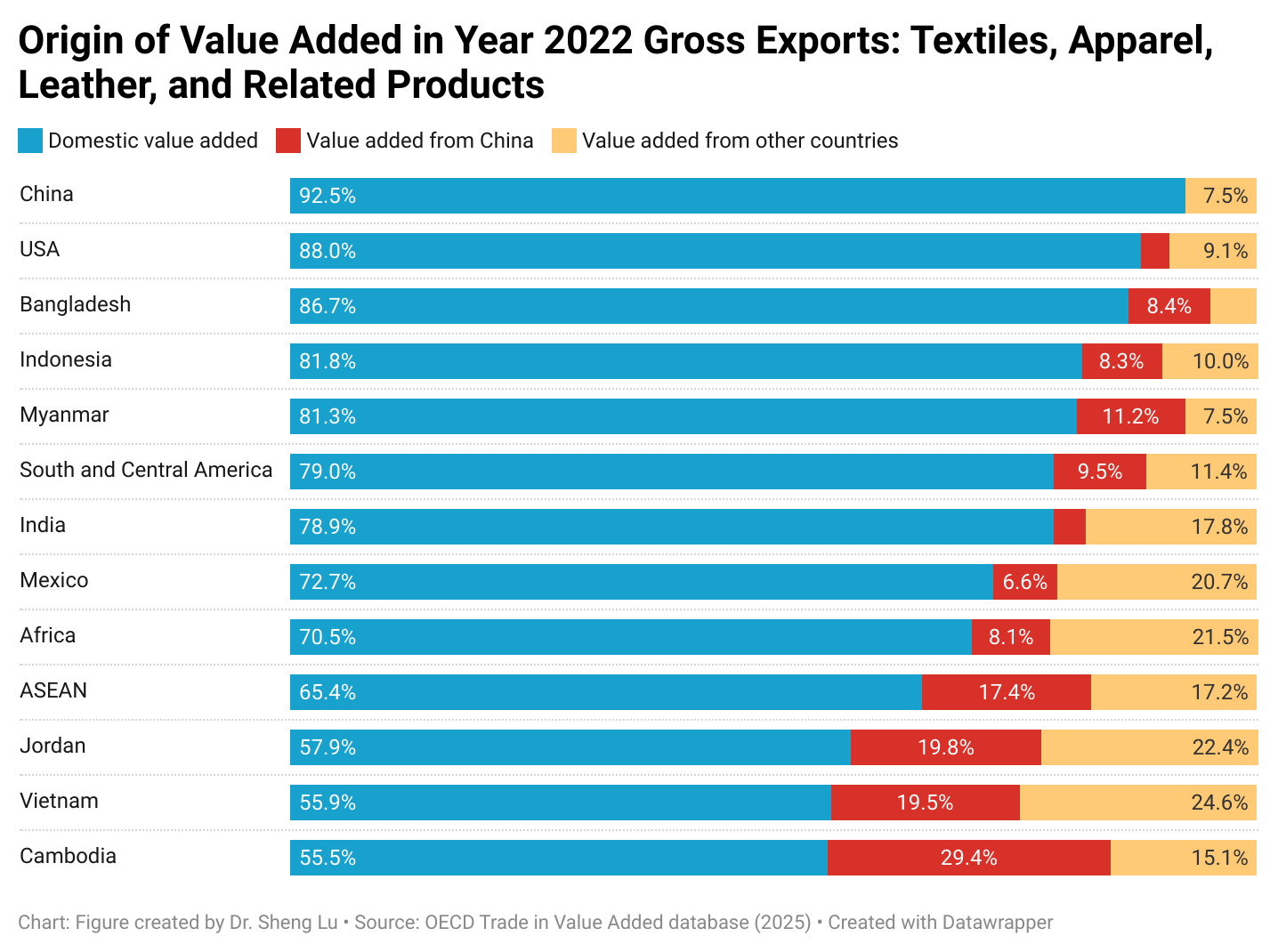
Patterns of Global Textile and Apparel Trade Measured by Origin of Value Added (updated October 2025)

Textiles and apparel today are produced through a global supply chain. For clothing labeled as “Made in Vietnam,” it is likely that the textile raw materials, such as yarns, fabrics, and trims, are sourced from elsewhere.

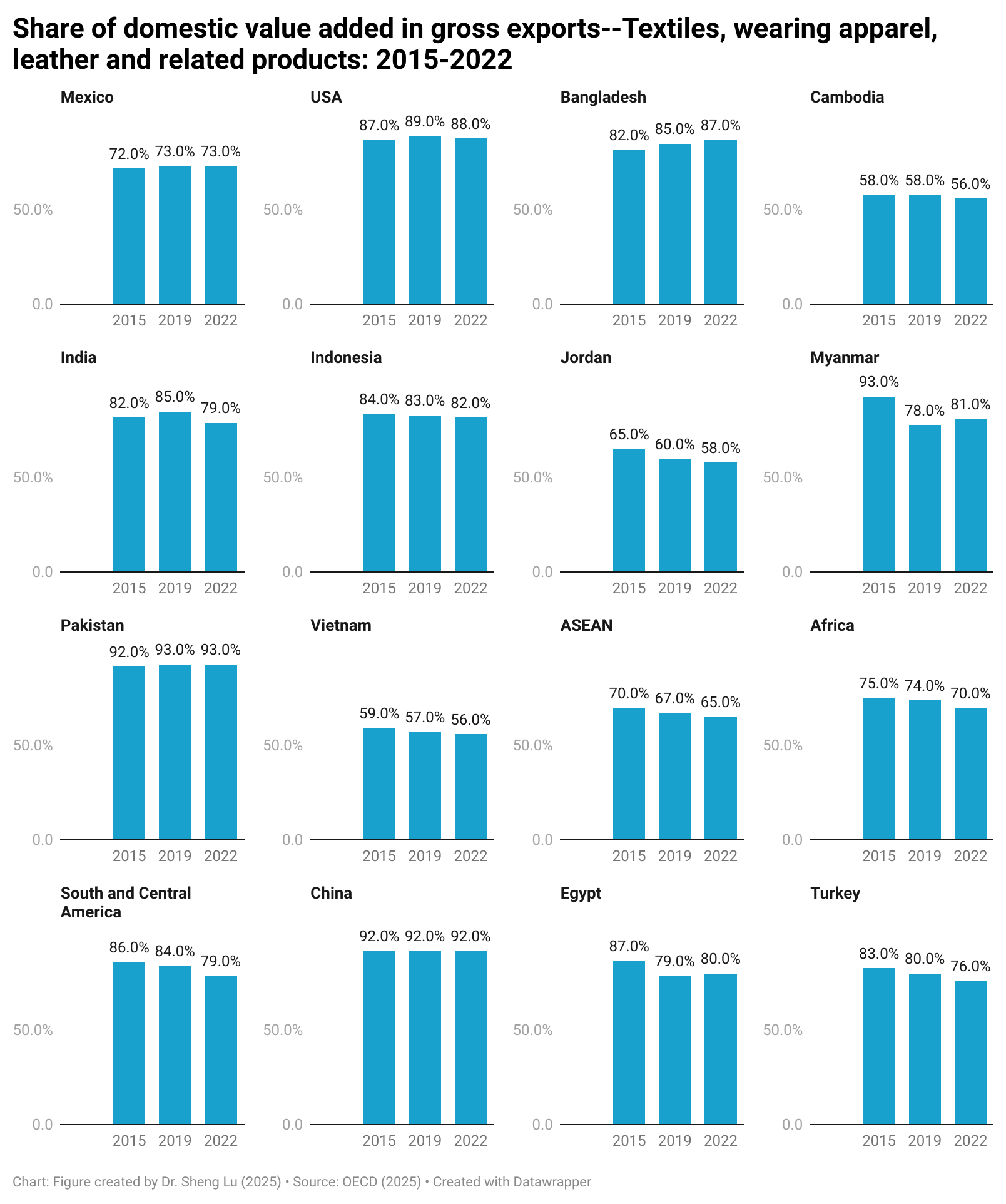
According to the newly released 2025 OECD trade in value added estimation, as of 2022, a country’s apparel exports commonly contain value added created in another country due to the use of imported textile materials and other inputs. This is the case for exports from leading apparel exporting countries in Asia, such as Vietnam (44% foreign value added), ASEAN members (35% foreign value added), Cambodia (45% foreign value added), India (21% foreign value added), and Jordan (42% foreign value added). Other emerging apparel sourcing destinations in North, South, and Central America, as well as the EU, also used substantial imported inputs for their apparel exports, such as Mexico (27.3% foreign value added), Türkiye (23.9% foreign value added), and Egypt (19.7% foreign value added). [See detailed data here]

Notably, among the sixteen countries and regions examined, they mostly increased the use of non-domestic value added in textile and apparel exports between 2015 and 2022 (note: paired T-test result was statistically significant at the 99% confidence level). This suggests that co-production through regional or global supply chains, rather than 100% domestic production, has become a more prominent phenomenon in the textiles and apparel industry. [See detailed data here]

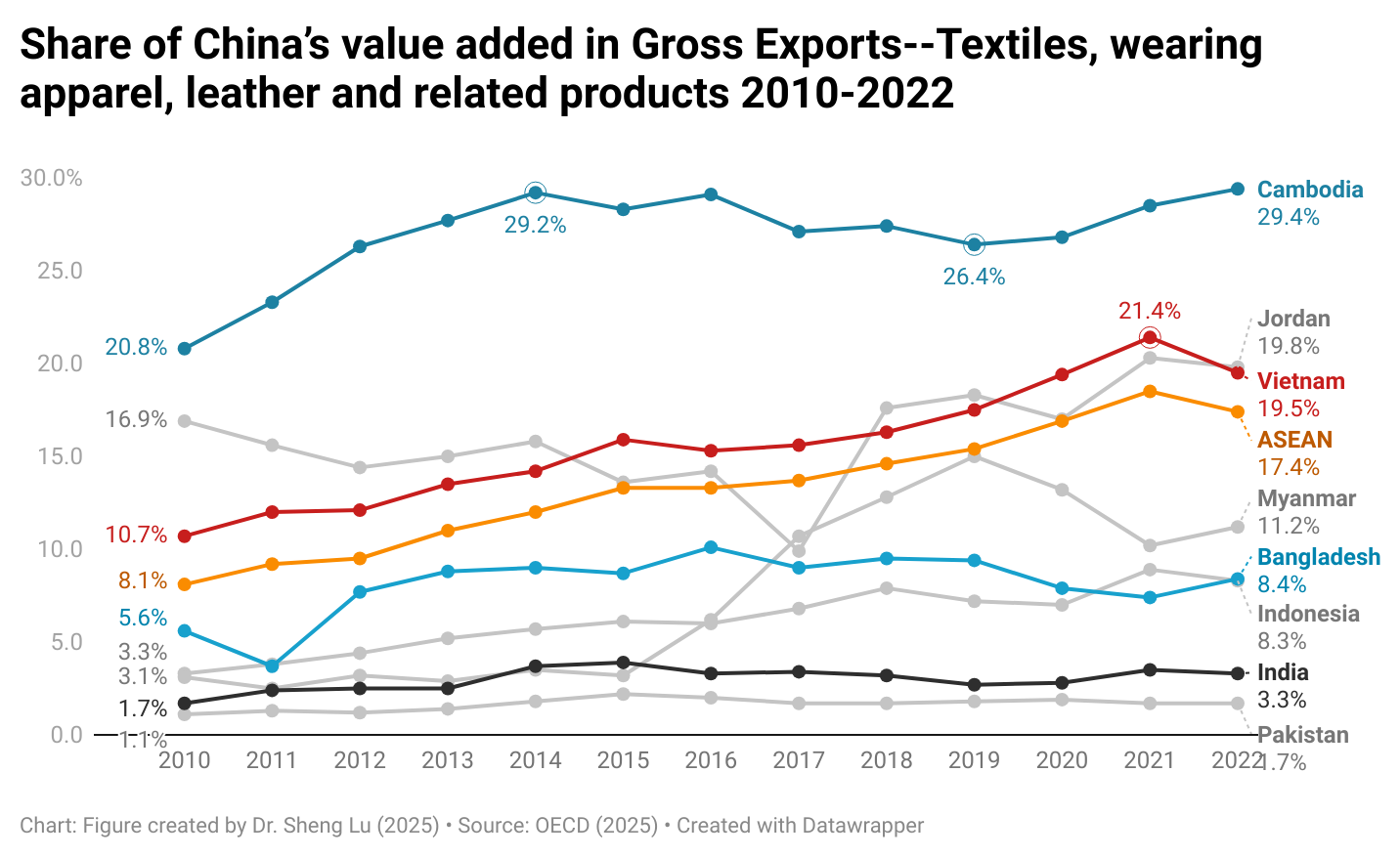
Furthermore, the value added from China appears to be increasing in the textile and apparel exports of many countries. Specifically, between 2015 and 2022, textile and apparel exports from several countries contained a higher percentage of value added from China, including not only Asian countries such as Vietnam (up 6 percentage points), ASEAN (up 4.1 percentage points) and Jordan (up 6.1 percentage points), but also those in other regions such as Egypt (up 3.3 percentage points), Mexico (up 1.7 percentage points), and South & Central America as a whole (up 4.7 percentage points). [See detailed data here] This result reflected China’s deliberate effort to expand its global economic presence through foreign direct investment, Belt and Road initiatives, and new trade agreements in recent years. 

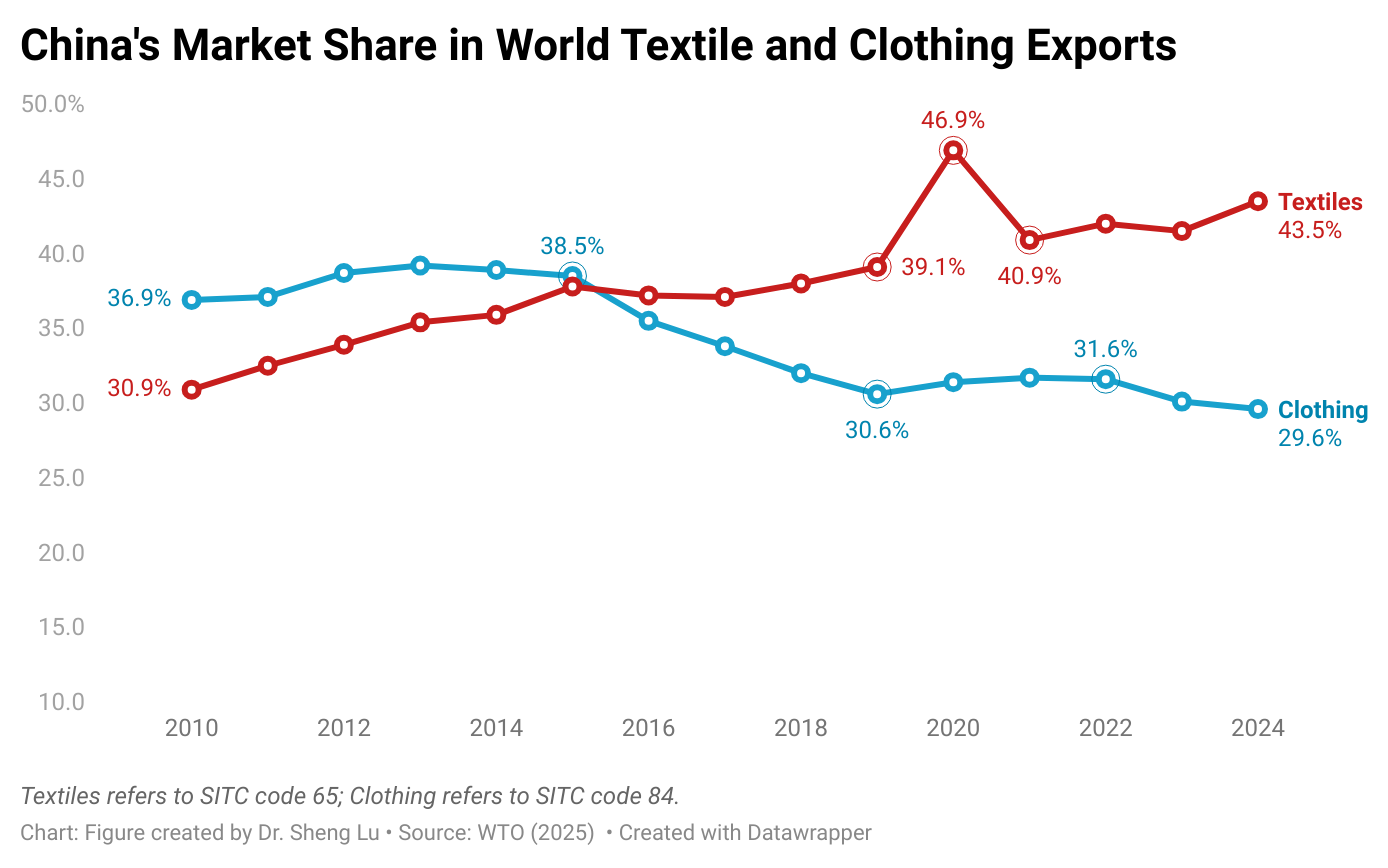
The latest data from the World Trade Organization (WTO) also shows that while China’s market share in the world clothing exports fell to 29.6% in 2024—the lowest level since 2010—China’s market share in textile exports increased to 43.3% in 2024, up from 41.5% a year earlier. In other words, consistent with the stage of development theory, China’s role as a major textile supplier to other apparel-exporting countries continues to grow, despite a decline in its finished garment exports. [See detailed data here]

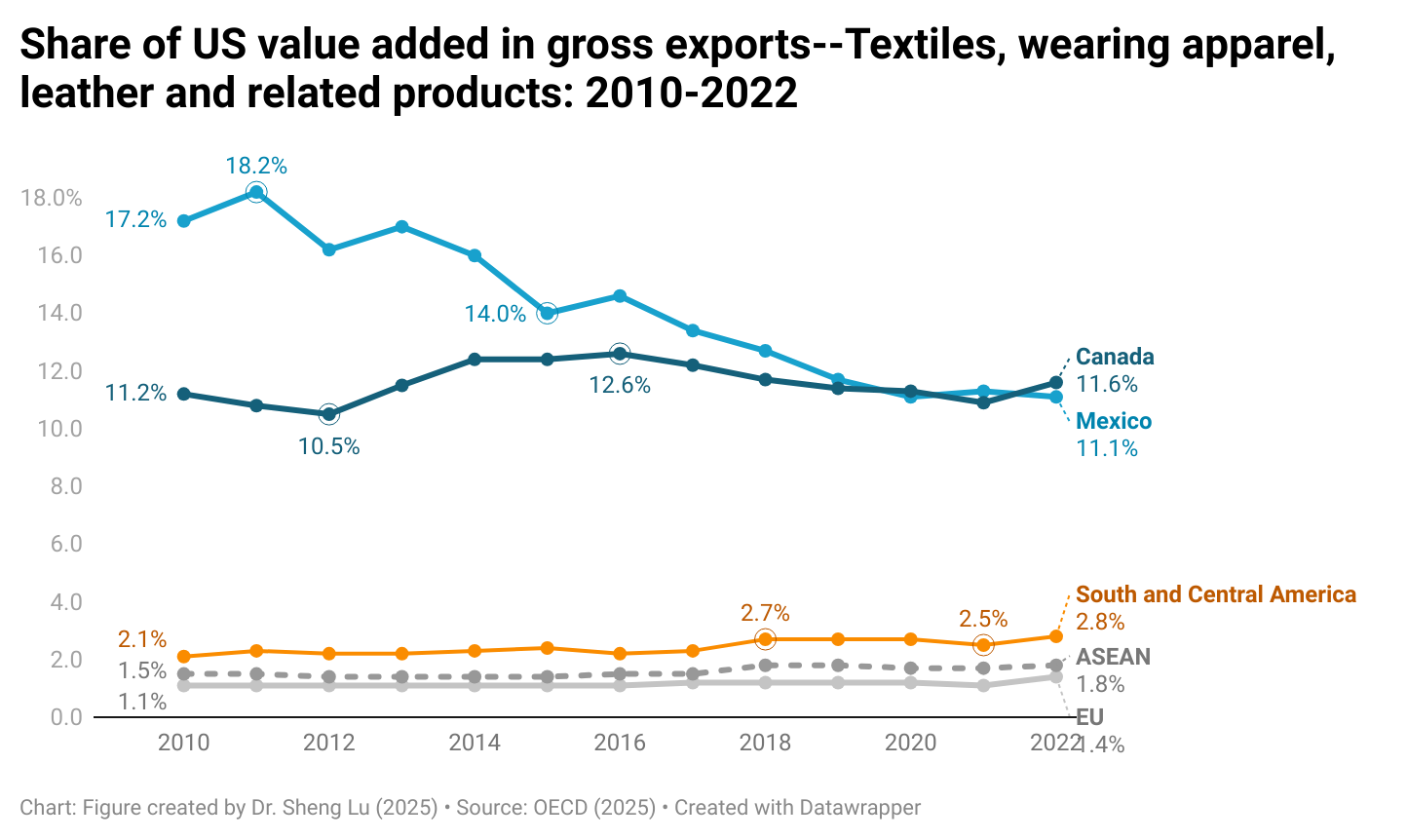
In comparison, while the United States remained an important contributor to the value added of textile and apparel exports from Mexico and Canada, its contribution slightly declined between 2015 and 2022 (i.e., from about 12%-14% to 11%). As the USMCA undergoes its mandated six-year review, it is critical to strengthen, rather than weaken, this North American co-production supply chain, which has a significant impact on the economic interests of the U.S. textile and apparel industry. This is particularly important given that supply chain collaboration between the U.S. and Asian or EU countries for textile and apparel production has been limited, with little indication of growth: According to OECD data, the U.S. value added in Asian and EU countries’ textile and apparel exports remained only around 1.5% [See detailed data here].

by Sheng Lu

(This post is not open for discussion due to its technical nature)

FASH455 Video Discussion: Vietnam Garment Factory Tour (updated: October 2025)

About the factory

  • The factory is a foreign direct investment (FDI) operation in central Vietnam specializing in ODM (Original Design Manufacturing) — producing ready-made designs that can be customized for private labels. Specific products include sportswear, casual wear, workwear, and uniforms.
  • The factory hires about 500 workers, and it aims to increase the size to 700-1000 workers, which was the pre-COVID level. The monthly pay averaged about $400.
  • The garment factory mainly exports to the U.S., Europe, and Brazil. The factory can do both full package sourcing (i.e., manages the entire production process, from procuring materials to manufacturing, quality control, and packaging—delivering finished goods ready for export) and CMT sourcing (i.e., cut make and trim–buyer provides the materials and designs, while the supplier only performs garment assembly, sewing, and finishing).
  • The factory mostly uses woven fabrics, and they are mainly sourced from China and Europe. Other sources include Taiwan, Thailand, and Malaysia. Some fabrics are Oeko-Tex certified, given the growing importance of using sustainable materials.
  • To meet the rules of origin requirements under free trade agreements (FTAs), such as the EU-Vietnam FTA, Vietnam is making efforts to enhance its local textile manufacturing capability.
  • To meet the clients’ needs, the factory has received several certifications related to social compliance and sustainability, including WRAP, BSCI, and ISO 9000.
  • Textile waste is partly sold or donated (e.g., blankets and jackets for local communities).

Discussion questions (for FASH455, please answer all of them):

  • How does the video help you understand the complexity of apparel sourcing?
  • Based on the video, what is your evaluation of the strengths of the factory as an apparel sourcing base for US fashion companies? Any specific area in which the factory can be improved?
  • If you have the chance to visit a garment factory, what would you focus on evaluating and why?

Additional reading: Vietnam overtakes China as US’s top apparel supplier (FDi intelligence, Financial Times, October 8, 2025)

FASH455 Exclusive Interview with Nicole Bivens Collinson, Managing Principal and Practice Leader of International Trade and Government Relations, Sandler, Travis & Rosenberg, P.A.

About the interview

When learning about apparel sourcing and trade, our students often notice how much they are affected by trade policies and regulations—from tariffs, and something called “de minimis” to UFLPA. These issues are not only critical for fashion companies but can also be quite technical.

We are fortunate to have Nicole Bivens Collinson, Managing Principal and Practice Leader of International Trade and Government Relations of Sandler, Travis & Rosenberg, P.A. (ST&R), a true expert in trade policy and the legal aspects of trade, join us. In the interview, Nicole clarified key U.S. trade rules and provided valuable insights into their apparel sourcing and trade implications, including:

  • What is a tariff, and why is it a big issue for US fashion brands and retailers?
  • Why have the so-called IEEPA “reciprocal tariffs” imposed by the Trump administration so far this year raised so many concerns?
  • What does the term “transshipment” mean in international trade? And why did this issue emerge in the context of higher tariffs this year?
  • What is the “20% US content” rule and its implications for fashion companies?
  • What is “tariff engineering”? Is it legal or illegal? How have fashion companies used it to mitigate the tariff impacts, potentially?
  • What is de minimis? Why was it created, and then became controversial? Since the “de minimis” rule was officially terminated recently, what impacts could we expect now? 
  • What is the Uyghur Forced Labor Prevention Act (UFLPA) and what does it aim to do? How has the implementation of the UFLPA affected U.S. fashion companies’ apparel sourcing?
  • For fashion students interested in working in trade compliance, trade policy, or the legal aspects of the fashion industry, what steps can they take to get started?

About Nicole Bivens Collinson

Nicole Bivens Collinson is the Managing Principal and Practice Leader of International Trade and Government Relations with Sandler, Travis & Rosenberg, P.A. (ST&R). Nicole is a commentator on trade matters on MSNBC, NPR, and BBC the producer of the Two Minutes in Trade podcast.

Nicole has nearly 40 years of experience in government and public affairs and lobbying. She prepares countries, companies, and associations for negotiations with the United States on free trade agreements, trade and investment agreements, labor disputes, and preferential trade programs.

Prior to joining ST&R, Nicole served as assistant chief negotiator for the Office of the U.S. Trade Representative, responsible for the negotiation of bilateral agreements with Latin America, Eastern Europe, Southeast Asia, the Sub-Continent, and Africa. She also served as a country specialist in the International Trade Administration at the Department of Commerce, where she was responsible for the preparation of negotiations on specific topics between the U.S. and Latin America, Eastern Europe, China, and Hong Kong as well as the administration of complex textile agreements.

Nicole holds a master’s degree in international relations from The George Washington University and a triple bachelor’s degree in political science, European studies, and French from Georgetown College. She also studied at the Université de Caen in France.

Nicole is past chair of the Women in International Trade Charitable Trust, past president of Women in International Trade, an advisory board member of America’s TradePolicy.com, treasurer and board member of the Washington International Trade Association, and a member of the Washington International Trade Association Foundation and Women in Government Relations. She serves on the board of trustees for Georgetown College and is the past executive director for the U.S. Hosiery Manufacturers Coalition, the U.S. Apparel Industry Coalition, and the U.S. Sock Distributors Coalition.

About Katie Yasik (moderator)

Katie Yasik is a master’s student & graduate instructor in Fashion and Apparel Studies (FASH) at the University of Delaware (UD). Katie graduated from UD & FASH with a B.S. in Fashion Design and Product Innovation & Sustainable Apparel minor. Driven by her strong passion for sustainability, she interned with the Worldwide Responsible Accredited Production (WRAP) in Spring 2024.

2025 World Trade Report: Making Trade and AI Work Together to the Benefit of All

The World Trade Organization (WTO) recently released its 2025 World Trade Report, which explored the complex and fast-evolving relationship between artificial intelligence (AI) and international trade.

Below are the findings most relevant to the textiles and fashion apparel sector:

First, AI has the potential to boost global trade. However, the impact on different sectors varies. According to the report, AI is expected to significantly boost global trade by 34-37% between 2025 and 2040, with larger increases in digitally deliverable services (around 40% growth), followed by other services (around 30%). In comparison, the AI-driven growth of global trade in the manufacturing sector (22-24%) and the primary input sector (9.5-9.9%) will be much smaller.

Second, AI is helping to reduce trade costs through multiple channels. For example, as the report noted, AI can help reduce trade costs through “optimizing trade logistics, streamlining regulatory compliance and contract enforcement, reducing language barriers, enhancing international communication, and improving search and matching processes between suppliers and buyers.” As another example, the report noted that, “in retail, AI-supported scenario planning has helped firms to diversify suppliers and adjust sourcing calendars to align with changing tariff regimes.” All of these AI applications could be used in apparel sourcing and trade.

In a March 2025 survey conducted by the WTO and the International Chamber of Commerce (ICC) among firms currently using AI, 90 percent reported tangible benefits in trade-related activities, and 56 percent reported that AI enhanced their ability to manage trade risks. The survey also found that “Larger firms primarily use AI for compliance with trade regulations, contract analysis, and trade finance. Smaller firms, in contrast, tend to focus on market intelligence and improving communication.”

Third, AI’s impact on jobs seems to be complicated.  For example, the report suggests that AI will have limited impacts on low-skilled apparel manufacturing jobs, but could replace middle-skilled and high-skilled jobs (such as those in apparel wholesaling and retailing). According to the report, “The task substitution from human labor to AI is more pronounced for medium-skilled and high-skilled occupations than for low-skilled ones.”

Meanwhile, the report categorized textiles and apparel manufacturing (ISIC code 13-15) as a “low” AI-intensity sector, and wholesale and retail (ISIC code 45-47) as “medium” AI-intensive. Nonetheless, the report estimates only a modest share of tasks to be replaced by AI—about 3% for low-skilled and 7–9% for medium- and high-skilled workers.

Fourth, the report calls for “deliberate efforts” by policymakers to broaden AI access and ensure the gains from AI will be evenly distributed globally. In other words, without targeted, proactive policymaking, AI could worsen global inequalities rather than reduce them.

For example, the report suggests that AI could act as an equalizer by increasing the productivity of medium- and low-skilled workers in developing economies. Combined with lower trade costs for cross-border services, these improvements could create more opportunities for companies and professionals in developing economies to engage more actively in global markets.

However, the report also warned thatAI may shift comparative advantages in ways that reinforce inequality.” Notably, “AI adoption is not uniform, as it tends to cluster in large, urban, digitally connected firms in high-income economies… AI technology favors capital- and data-intensive production, which could erode the competitiveness of economies that rely on low-skilled and low-cost labor.”

Additionally, the report noted that trade barriers remain an issue for international trade in the AI era. For example, AI-enabling goods are increasingly affected by technical barriers to trade (TBT). Also, AI-intensive services still face significant restrictions on trade as countries have only made modest commitments under the WTO’s General Agreement on Trade in Services (GATS). Furthermore, regulations on cross-border data flows are still largely fragmented. This explains why the WTO could still play a vital role in supporting AI development, from promoting open markets in AI-related goods and services, to supporting AI innovation and diffusion through intellectual property rights protection, and to encouraging greater regulatory consistency on trade-related aspects of AI.

Summary by Sheng Lu

FASH455 Video Discussion: The Lesotho Garment Industry in the Shadow of Trump’s Tariffs

Discussion questions: (for students in FASH455, please address at least two questions below in your response. There is no need to repeat the question, but please mention the question #)

  • #1 How do you see the importance of the garment industry to Lesotho—economically, socially, and politically?
  • #2 Why and how could the 15% additional tariff have a significant impact on Lesotho’s garment industry?
  • #3 What responsibilities do U.S. fashion brands and retailers have toward Lesotho in the situation described in the videos?
  • #4 If you were a U.S. garment worker, would you support more favorable trade terms for Lesotho? Why or why not?

Background

  • According to the World Trade Organization (WTO), textiles and apparel accounted for 56.6% of Lesotho’s manufactured goods exports in 2023.
  • UNComtrade data shows that between 2023 and 2024, about half of Lesotho’s apparel exports went to the United States, its largest export market. Other countries in Sub-Saharan Africa (SSA) made up an additional 44% of Lesotho’s apparel exports.
  • Industry sources further indicate that between January 2024 and July 2025, about 60% of apparel labeled “Made in Lesotho” for sale in the U.S. retail market were tops, including 41% of T-shirts. All of these clothes targeted the mass and value market segments, and they were typically priced even lower than those “Made in Bangladesh.”
  • The African Growth and Opportunity Act (AGOA), a trade preference program enacted in 2000, has played a critical role in supporting Lesotho’s apparel export to the U.S. market.
  • Data from the Office of Textiles and Apparel (OTEXA) under the U.S. Department of Commerce shows that U.S. apparel imports from Lesotho totaled $151 million, or 0.19% of total U.S. apparel imports, in 2024. Notably, all of these imports claimed the AGOA duty-free benefits, and 96.8% were entered under the “third-country fabric” provision, which allows least developed countries (LDCs) like Lesotho to use textile raw materials sourced from third countries.

[Discussion is closed for this post]

FASH455 Exclusive Interview with Karin De León, Investment and Promotion Director, Apparel and Textiles Association of Guatemala (VESTEX)

About Karin De León

Karin De León has been working in the textile and apparel sector in Guatemala for more than 25 years, promoting the development of the industrial cluster, participating in the creation of strategies, supporting the strengthening of the supply chain, and attracting investment.

As part of her role at the Apparel and Textile Association of Guatemala (VESTEX), for 10 years she held the position of Executive Director of CECATEC-RD (Central American and Dominican Council of Clothing and Textiles), the entity that integrates textile & apparel industry associations of Central America and the Dominican Republic and which is responsible for coordinating the inter-institutional relationship with public and private entities of the United States of America, Mexico and Colombia mainly.

From 2020 to the beginning of 2022, she served as Chief of Staff of the Ministry of Economy of Guatemala and later became General Coordinator of the National Competitiveness Program (PRONACOM), a government entity responsible for promoting the country and attracting investment.

Karin is currently VESTEX’s investment and promotion director, and representative of Guatemala in CECATEC-RD. She coordinates the inter-institutional relationship with government entities of the United States (such as the United States Trade Representative and the Department of Commerce) as well as private institutions mainly related to the United States, Mexico, and Colombia.

Sheng: Can you provide a brief introduction to VESTEX and a general overview of your member companies?

Karin: VESTEX is the Apparel and Textile Association of Guatemala, a private association representing the Guatemalan textile and apparel export sector. It focuses on promoting the industry’s exports through strategic alliances with public and private institutions at the national and international levels.  Its strategic axes are Sectoral Resilience, which seeks to position the industry as a generator of investment and formal employment in the country; Sectoral Sustainability, through the promotion of sustainability as a long-term strategy for industry continuity and compliance, providing companies in the sector with tools that facilitate compliance with the obligations established in the laws and regulations.

VESTEX partners comprise companies that integrate the entire supply chain of the apparel and textile sector, encompassing yarn and fabric manufacturers, apparel producers, as well as firms providing specialized services and accessories to the industry.

Sheng: Studies show that there is consistent interest among U.S. fashion companies in expanding nearshoring from the Western Hemisphere, including Guatemala. What is your observation? What makes Guatemala an attractive destination for apparel sourcing today? What are the unique advantages of sourcing from the country?

Karin:Guatemala has become an increasingly attractive destination for apparel sourcing due to its unique combination of industrial integration, geographic advantages, and strong compliance standards. The country offers a highly integrated apparel cluster that encompasses every stage of the supply chain—from spinning yarn and weaving fabrics to apparel manufacturing, printing, finishing, and packaging. This full-package model not only streamlines operations and enhances traceability but also allows for greater flexibility and product diversity, raising the added value of garments and positioning Guatemala as a competitive supplier for niche and complex products requiring skilled labor and high-quality materials.

Another key differentiator is Guatemala’s strategic location. With access to ports on both the Atlantic and Pacific coasts—separated by only 249 miles—the country can efficiently serve both the East and West coasts of the United States. Guatemala manages the second-largest maritime cargo operation in Central America (after Panama), which is critical for companies seeking to balance and mitigate geopolitical and logistical risks. In addition, proximity to the U.S. substantially reduces environmental impact: sourcing from Guatemala lowers CO₂ emissions from maritime transport by approximately 84% compared to sourcing from Asia. Transit times are also highly competitive, with shipments reaching Miami in as little as three days, enabling U.S. buyers to manage inventories more effectively and respond to market demands with agility.

Equally important, Guatemalan apparel companies operate under a strong framework of labor and environmental compliance. Companies demonstrate a full-spectrum commitment to input traceability, adherence to strict rules of origin, and continuous process improvement to reduce resource consumption. Investments in monitoring and ESG systems underscore their transparency and alignment with global sustainability standards.

Taken together, this integration of cluster capabilities, geographic proximity, and compliance with international norms positions Guatemala as a reliable, sustainable, and strategically advantageous sourcing partner for U.S. fashion companies.

Sheng: How important is the Dominican Republic-Central America Free Trade Agreement (CAFTA-DR) in supporting Guatemala’s apparel exports to the U.S. market? What impact do CAFTA-DR’s apparel-specific rules of origin have on garment exporters’ supply chains and export strategies in Guatemala?

Karin:CAFTA-DR has provided certainty by encouraging long-term investments in textile infrastructure and capabilities. CAFTA-DR has been the basis for the development of Guatemala’s apparel industry.  The yarn-forward rule established under the agreement has not only fostered integration with the U.S. supply chain but also promoted stronger collaboration among Central American countries. By allowing the accumulation of inputs and processes within the region, CAFTA-DR has significantly strengthened intraregional trade.

This integration has facilitated the specialization of each Central American country. In Guatemala’s case, it has enabled the use of specific yarns and fabrics produced in other countries and manufactured locally, fostering a greater diversification of production.

According to OTEXA figures, in the year ending June 2025, 89.17% of Guatemala’s total apparel exports to the U.S. entered under the Free Trade Agreement preferences. Of this total, 79.69% qualified under the yarn-forward rule—that is, garments made with yarn from the U.S. or yarn produced within one of the Central American countries. CAFTA-DR, and particularly its rules of origin, have been the basis of Guatemala’s strategy in recent years, not only to attract foreign direct investment but also to encourage significant reinvestments.

Sheng: Data shows that an increasing share of yarns and fabrics used by Guatemala garment factories are now locally made in Guatemala and other Central American countries. Could you discuss the recent trends in textile manufacturing capacity building in Guatemala, as well as the industry’s current priorities in building a more vertically integrated regional supply chain?

Karin:Guatemala offers a series of competitive advantages that are reinforcing its role as a regional hub for textile and apparel manufacturing. At the country level, it benefits from a stable macroeconomy, a solid exchange rate, competitive electricity prices within the region, and a reliable energy supply. At the industry level, Guatemala stands out for its robust apparel and textile cluster and highly skilled workforce.

Since the pandemic in 2020, when many global companies accelerated nearshoring strategies, Guatemala has successfully attracted new foreign investment and supported the expansion of companies already established in the country, particularly in the spinning industry. Installed capacity is primarily focused on cotton, although blends are also produced. By the end of 2024, apparel exported to the U.S. consisted of 62.8% cotton, 36.4% synthetics, and 0.8% wool, reflecting the central role of cotton in the country’s production while also showing diversification into other fibers.

Driven by shifting market demand, textile production in Guatemala has been expanding beyond knits, with a modest increase in woven fabrics as well. Investments in innovation and technology have enabled the industry to offer specialized processes, including antimicrobial treatments, absorption, UPF protection, enzymatic washing, softening, and plush finishing, among others. A particularly important advancement has been the investment in elastic knit fabrics, which has opened the door to the production of categories such as sportswear, intimate apparel (seamless), shapewear (technical lingerie and compression fabrics), and medical textiles.

We recognize, however, that there remain challenges and opportunities to broaden the regional textile offering—particularly in the production of yarns and fabrics made from fibers not yet manufactured locally. Expanding capacity in these areas would further strengthen vertical integration and supply chain resilience.

In this context, VESTEX has taken a leading role in supporting and guiding companies interested in exploring these opportunities. In coordination with Guatemala’s foreign direct investment promotion agency, efforts are underway to identify high-demand inputs that are currently unavailable in the region but represent strategic opportunities for local production.

Sheng: Since April 2025, U.S. apparel imports from CAFTA-DR countries, including Guatemala, are subject to a new 10% “reciprocal tariff.” How has this tariff increase and the Trump administration’s trade policy so far impacted Guatemala’s garment industry and exports? 

Karin:The main challenge for Guatemala’s apparel industry under the current U.S. trade policy has been the high degree of uncertainty. Markets and buyers demand stability, yet in recent months orders have slowed significantly as companies await clarity on the tariffs that will ultimately apply to each country. This hesitation has already resulted in lost opportunities: seasonal orders cannot be recovered once the selling window has passed.

Traditionally, Guatemala’s apparel sector grows between 3% and 5% annually; however, 2025 projections have been revised downward, and current expectations suggest growth closer to 1–2%. According to the Central Bank of Guatemala, as of June 2025, exports registered a modest 1.36% increase—well below what was anticipated under normal conditions.

Another major impact has been the need for companies to absorb additional costs to maintain contracts with international brands. This has reduced profit margins, limited reinvestment capacity, and increased pressure on already tight production cycles. Buyers face uncertainty as well: they do not know how much a garment ordered today will cost by the time it is delivered six to nine months later, since tariff rates are subject to abrupt changes. The volatility recalls past episodes in China, where tariffs under former President Trump rose as high as 145% before being reduced to 30%, creating unpredictable supply conditions.

That said, Guatemala continues to hold a relative tariff advantage compared with Asian competitors, where rates now reach 15%, 18%, 25%, or even higher. This gap may ultimately favor Guatemala if U.S. buyers reconfigure sourcing strategies to prioritize suppliers who are both geographically closer and more reliable. Indeed, global sourcing is shifting away from a purely low-cost model toward one that values resilience, speed to market, and compliance.

Sheng: The 2025 US Fashion Industry Association Benchmarking Study indicates that U.S. fashion companies are increasingly seeking sourcing destinations that can provide sustainable apparel products, including those made with preferred fibers such as organic, recycled, regenerative, and biodegradable materials. What strategies or recent initiatives has the Guatemalan textile and apparel industry undertaken to meet this demand for sustainability?

Karin: Guatemalan mills already source recycled polyester yarns, organic or regenerative cotton, and biodegradable materials. Brands are actively demanding these products. In fact, mills have obtained various certifications and adhere to practices focused on circular economy, science-based target initiatives, and other sustainability standards.

Traceability is key for the textile and apparel industry, and Guatemala has managed to implement measures such as data management and continuous improvement as a way to demonstrate this.

  • Adoption of Sustainable Certifications and Standards: Guatemalan manufacturers are obtaining certifications like GOTS (Global Organic Textile Standard), OEKO-TEX, Global Recycled Standard, Recycled Claim Standard, Blue Sign, Higg FEM, among others, ensuring their products meet international sustainability standards.
  • Investment in Technologies: Many mills are upgrading to water and energy-efficient machinery, as well as more sustainable dyeing and finishing processes.
  • Training and Capacity Building: Initiatives to train and certify workers and management on sustainable practices and standards are increasing, promoting a culture of sustainability throughout the industry.
  • Integration of Circular Economy Principles: Some mills are exploring design for recyclability techniques to align with circular economy goals.

These initiatives collectively position the Guatemalan textile and apparel sector as a viable sourcing destination for sustainable fashion, aligning with global market trends and buyer preferences for more sustainable products.

Sheng: In addition to the questions discussed earlier, what are the top business and policy issues facing Guatemala’s textile and apparel industry over the next 1–2 years?

Karin:Over the next 1–2 years, Guatemala’s textile and apparel industry will face several pressing business and policy issues that will shape its competitiveness.

1. Infrastructure and logistics.
A key issue remains the need to strengthen national infrastructure, particularly ports, customs processes, and internal transport routes.

2. Limited availability of regional inputs.
The industry continues to face constraints in the local production of certain yarns, fabrics, and specialized fibers. Inputs such as viscose, spandex, and rayon are not yet manufactured in the region at scale, which limits vertical integration and forces reliance on imports from outside the hemisphere. Expanding textile capacity in these areas is a central issue to ensure resilience and broaden the exportable supply.

3. Market visibility and buyer perception.
Despite its high level of integration, many international buyers remain unaware of Guatemala’s strengths in complex products, compliance, and sustainability. A persistent challenge is to raise global awareness of the country’s capabilities in order to capture greater sourcing opportunities.

4. Policy uncertainty and trade volatility.
The recent 10% reciprocal tariff applied to CAFTA-DR countries has introduced significant uncertainty. Buyers hesitate to place long-term orders when tariff levels are unclear, and this volatility affects sourcing decisions. Stability and predictability in trade policy remain critical issues for the sector.

5. Differentiation and specialization under nearshoring.
Another key challenge is sustaining competitiveness through higher-value products. Today, 54.11% of Guatemala’s apparel exports already include advanced finishing processes, and the industry is investing in spinning, woven fabrics, and technical textiles. However, scaling these capabilities requires reinvestment and foreign capital inflows—both of which are being constrained by global uncertainty. Given that Guatemala currently supplies only about 2% of U.S. apparel imports, a major issue ahead is how to convert this untapped potential into tangible growth.

In short, while the country is positioning itself strategically with competitive tariffs, geographic proximity, and an increasingly sophisticated textile base, the top issues over the next two years will be overcoming infrastructure and logistics bottlenecks, reducing dependence on imported inputs, strengthening promotion to buyers, and navigating trade policy volatility. Addressing these challenges will be crucial for Guatemala to capitalize on long-term opportunities in the ongoing global supply chain reconfiguration.

-The End-

2025 USFIA Fashion Industry Benchmarking Study Released

The full report is HERE.

Key findings of this year’s report:

#1 This year, the top business challenges facing U.S. fashion companies center on the Trump Administration’s escalating tariff policy and its wide-ranging impacts on companies’ sourcing and business operations.

  • 100 percent of respondents rated “Protectionist U.S. trade policies and related policy uncertainty, including the impact of the Trump tariffs” as one of their top business challenges in 2025. This included as much as 95 percent of respondents who ranked the issue among their top two concerns.
  • Respondents also expressed significant concerns about the wide-ranging effects of Trump’s tariff policy, including “Inflation and economic outlook in the U.S. economy” (80 percent), “Increasing production or sourcing cost” (nearly 50 percent), and “Protectionist trade policies and policy uncertainty in foreign countries, including retaliatory measures against the U.S.” (52 percent).
  • Over 70 percent of surveyed companies reported that the higher tariffs increased sourcing costs, squeezed profit margins, and led to higher consumer prices. Approximately half of the respondents reported a decline in sales, and 22 percent stated that they had to lay off employees due to increased tariffs.

#2 Maintaining a geographically diverse sourcing base has been one of the most popular strategies adopted by U.S. fashion companies to mitigate the impact of rising tariffs and policy uncertainty. 

  • This year, respondents reported sourcing apparel products from 46 countries, similar to the 48 countries reported in 2024 and an increase from 44 countries in 2023. At the firm level, approximately 60 percent of large companies with 1,000+ employees reported sourcing from ten or more countries in 2025, a notable increase from the 45–55 percent range reported in 2022 and 2023 surveys.
    • Amid escalating tariffs and rising policy uncertainty, Asia has become an ever more dominant apparel sourcing base for U.S. fashion companies in 2025. Respondents reported increased use of several Asia-based sourcing destinations other than China in 2025 compared to the previous year, including Vietnam (up from 90 percent to 100 percent), Cambodia (up from 75 percent to 94 percent), Bangladesh (up from 86 percent to 88 percent), Indonesia (up from 75 percent to 77 percent), and Sri Lanka (up from 39 percent to 53 percent).As part of their sourcing diversification strategy, U.S. fashion companies are also gradually increasing sourcing from emerging destinations in the Western Hemisphere and beyond, such as Jordan, Peru, and Colombia.
    • Most respondents intend to build a more geographically diverse sourcing base and broaden their vendor network over the next two years. Nearly 60 percent of respondents plan to source apparel from more countries, and another 40 percent plan to source from more suppliers or vendors. Reducing sourcing risk, especially to minimize the impact of rising tariffs and tariff uncertainty, is a key driver of companies’ sourcing diversification strategies

#3 U.S. fashion companies remain deeply concerned about the future of the U.S.-China relationship during Trump’s second term and intend to further “reduce China exposure” to mitigate sourcing risks.

  • While 100 percent of respondents reported sourcing from China this year, a record-high 60 percent of respondents reported sourcing fewer than 10% of their apparel products from China, up from 40 percent in 2024. Approximately 70 percent of respondents no longer used China as their top apparel supplier in 2025, representing a further increase from 60 percent in 2024 and significantly higher than the 25-30 percent range prior to the pandemic.
  • Despite the announcement of the reaching of a U.S.-China “trade deal” in May 2025, more than 80 percent of respondents plan to further reduce their apparel sourcing from China over the next two years through 2027, hitting a new record high. Many large-scale U.S. fashion companies are already limiting or plan to limit their apparel sourcing from China to a “low single-digit” percentage by 2026 or earlier, mainly due to concerns about the increasing geopolitical and trade policy risks associated with sourcing from the country.
  • Still, respondents rated China as highly economically competitive as an apparel sourcing base compared to many of its Asian competitors regarding vertical manufacturing capability, low minimum order quantity (MOQ) requirements, flexibility and agility, sourcing costs, and speed to market. However, non-economic factors, particularly the perceived extremely high risks of facing U.S. import restrictions, geopolitical tensions with the U.S., and concerns about forced labor, are driving U.S. fashion companies to continue their de-risking efforts.

#4 No evidence indicates that the Trump Administration’s tariff policy has successfully encouraged U.S. fashion companies to increase domestic sourcing of “Made in the USA” textile and apparel products or to expand sourcing from the Western Hemisphere.

  • Only about 44 percent of respondents explicitly say that they would expand sourcing from the Western Hemisphere, and even fewer respondents (17 percent) plan to source more textiles and apparel “Made in the USA” amid the tariff increase.
  • This year, fewer respondents reported sourcing apparel from Mexico and Canada (down from 60 percent in 2024 to 50 percent in 2025) and members of the Dominican Republic-Central America Free Trade Agreement, CAFTA-DR (down from 75 percent in 2024 to 64 percent in 2025).
  • About half of the respondents plan to expand apparel sourcing from Mexico and CAFTA-DR members over the next two years. Notably, nearly all of these companies also intend to increase sourcing from Asia, indicating that U.S. fashion companies view near-shoring from the Western Hemisphere as a complement, not a replacement, to their broader sourcing diversification strategy.
  • Respondents consider the most urgent capacity-building needs within CAFTA-DR lie in the production of textile raw materials (e.g., spandex) and accessories (e.g., zippers, threads, and buttons). Meanwhile, USMCA members are considered to have relatively stronger capacities in yarn and fabric production but face more pressing shortages in accessories.

#5 Respondents overall remain highly committed to sustainability, social responsibility, and compliance issues in the sourcing process.

  • This year, the top sustainability and compliance areas where respondents plan to allocate more resources include “Investing in technology to enhance supply chain traceability or isotopic testing” (53 percent), “Providing sustainability and social compliance training for internal employees” (50 percent) and “Providing sustainability and social compliance training for suppliers” (50 percent). 
  • As part of U.S. fashion companies’ sustainability efforts, all respondents (100 percent) report sourcing clothing made with “sustainable textile fibers” in 2025. Having 11–50% of apparel products containing various “sustainable textile fibers” is the most common (40 percent of respondents), followed by having 1–10% of the total sourcing value or volume(30 percent of respondents).
  • Moreover, most respondents (over 70 percent) plan to increase their use of various “sustainable fibers” in clothing over the next three years. This trend is especially strong for recycled materials, with 80 percent of respondents indicating they intend to increase their use.
  • The top three positions with the highest demand among respondents from 2025 through 2030 are “Environmental sustainability-related specialists or managers,” “Trade compliance specialists,” and “Data scientists”—more than 40 percent of respondents plan to increase hiring. There is also strong demand for “Textile raw material specialists” and “Sourcing specialists.”

#6 With the upcoming expiration of the trade preference program this September, respondents again underscore the importance of immediate renewal of the African Growth and Opportunity Act (AGOA) and extending the agreement for at least another ten years.

  • Due to the upcoming expiration of AGOA and uncertainty about its future, this year, respondents sourced from only six SSA and AGOA members (i.e., Kenya, Ethiopia, Ghana, Madagascar, Mauritius, and Tanzania), fewer than the seven countries in 2024.  And none of these countries were used by more than 20 percent of respondents.
  • Nearly 80 percent of respondents support “renewing AGOA for at least another ten years,” and no one opposes. This shows a consistent and wide base of support for AGOA among U.S. fashion companies.
  • More than 70 percent of respondents say that securing a long-term renewal of AGOA for at least ten years is essential for expanding apparel sourcing from the region. Similarly, another 60 percent of respondents believe that a long-term renewal of AGOA is necessary for U.S. fashion companies and their supply chain partners to commit to new investments in the region. 
  • Respondents warned that AGOA’s pending renewal has already begun to harm the region’s prospects as an apparel sourcing base. Approximately 30 percent of respondents explicitly stated that they had already reduced sourcing from AGOA members due to the uncertainty surrounding the agreement’s renewal.

About the study

Authored by Dr. Sheng Lu in collaboration with the United States Fashion Industry Association (USFIA), this year’s benchmarking study was based on a survey of executives from 25 leading U.S. fashion companies from April to June 2025. The study incorporated a balanced mix of respondents representing various businesses in the U.S. fashion industry. Approximately 85 percent of respondents were self-identified retailers, 60 percent were self-identified brands, and about 50 percent were importers/wholesalers.

The survey respondents included large U.S. fashion corporations and medium-sized companies. Around 90 percent of respondents reported having over 1,000 employees; the rest (10 percent) represented medium-sized companies with 100-999 employees.

Average Tariff Rates for U.S. Apparel Imports under Trump’s “Reciprocal Tariff” Policy (Updated July 2025)

The latest data from the U.S. International Trade Commission (USITC) indicates that Trump’s “Reciprocal Tariff” has led to higher import duties on U.S. apparel imports, although the impact on sourcing appears to be more nuanced than expected. Specifically:

As a result of the reciprocal tariff, the average tariff rate for U.S. apparel imports (HS Chapters 61 and 62) reached 23.8% in May 2025, increased further from 20.8% in April 2025 and much higher than 13.9% in May 2024 and 14.7% in January 2025, prior to Trump’s second term. This tariff rate also hit its highest level in decades. Similarly, while the value of U.S. apparel imports in May 2025 decreased by 7% from May 2024, the import duties skyrocketed by nearly 60% over the same period. [View detailed data HERE]

Due to numerous punitive tariffs beginning in February 2025, the average tariff rate for U.S. apparel imports from China reached an unprecedented 69.1% in May 2025, a further increase from 55.0% in April 2025, 37.0% in March 2025 and 22.1% in January 2025. In theory, U.S. apparel imports from China in May should be subject to a tariff rate of over 145%, as mandated by a series of executive orders. However, as “goods loaded onto a vessel at the port of loading and in transit on the final mode of transit before 12:01 a.m. eastern daylight time on April 5, 2025,“ were excluded from Trump’s reciprocal tariffs, it explains why the actual tariff rate in April and May 2025 appeared lower than the theoretical one.

Nonetheless, affected by the high tariffs, the value of US apparel imports from China in May 2025 was cut by more than half from a year ago (down 52%). China’s market share in US apparel imports in May 2025 also dropped to 9.9%, a new low in decades (note: was 19.9% in May 2024). [View detailed data HERE]

Additionally, the average tariff rate for U.S. apparel imports from countries other than China reached 18.9% in May 2025, up from 15.2% in April 2025. Although this rate was higher than approximately 12-13% before Trump’s second term in early 2025, the increase was still much more modest than the theoretical 10% universal reciprocal tariff rate announced by the Trump administration. The average tariff rates for U.S. apparel imports from leading Asian suppliers such as Vietnam, Bangladesh, and Cambodia followed similar patterns (i.e., higher tariff rates but well below a 10% increase). Similar to China’s case, it appears that U.S. apparel imports from other countries in April 2025 included a significant proportion of products that were exempt from reciprocal tariffs because they were “loaded onto a vessel” early enough. [View detailed data HERE]

It is interesting to note that the reciprocal tariff resulted in the most significant increase in tariff rates on U.S. apparel imports from CAFTA-DR members. While imports from these countries were supposed to be duty-free under the trade agreement, the average tariff rate reached 10% in May 2025, up from 6.7% in April 2025. In other words, the short shipping distance unintentionally “disadvantaged” near-shoring imports from being exempted from the reciprocal tariffs, as they could be mostly loaded after the deadline.

Overall, it remains uncertain how the U.S. apparel tariff rates will continue to evolve in response to Trump’s shifting tariff policy. It appears that the trade volume and timing of shipment will be highly sensitive to short-term tariff rate changes, whereas adjusting sourcing bases and product structures will be a consideration for U.S. fashion companies in the medium to long term.

By Sheng Lu

Additional reading: Apparel Tariffs Climbed to Historic Highs in April (Sourcing Journal, June 13, 2025)

Impacts of Trump’s Escalating Tariffs on Apparel Sourcing: U.S. Fashion Companies’ Perspective

Updated study available: Updated Impact of Increasing Tariffs on U.S. Fashion Companies’ Sourcing and Businesses (October 2025)

(Note: The figure above shows how frequently the term “tariff” was mentioned alongside other key issues in the earnings calls. A higher frequency indicates a more significant impact and a closer connection between tariffs and a specific theme.)

This study aims to examine the impacts of the Trump administration’s escalating tariffs on U.S. fashion companies’ apparel sourcing practices. Based on data availability, transcripts of the latest earnings calls from approximately 25 leading publicly traded U.S. fashion companies were collected. These earnings calls, held between mid-May and June 2025, covered company performance in the first quarter of 2025. A thematic analysis of the transcripts was conducted using MAXQDA.

Overall, the results indicate that the Trump administration’s escalating tariffs and policy uncertainties have financially hurt U.S. fashion companies and disrupted their apparel sourcing practices. To mitigate these impacts, most companies plan to further reduce their “China exposure,” maintain a geographically diversified sourcing base, and prioritize flexibility in sourcing and shipping. However, there is no clear evidence that the current policy environment has successfully incentivized U.S. companies to expand apparel sourcing from the Western Hemisphere, let alone commit to new long-term investments. Meanwhile, U.S. fashion companies have adopted a strategic pricing approach by not passing the entire cost increase to consumers through widespread retail price hikes.

A few key findings:

First, far from surprising, many leading U.S. fashion companies expressed concerns that the Trump administration’s escalating tariffs have resulted in higher sourcing costs and cut companies’ profit margins. For example:

  • Company G (specialty store): if current tariffs of 30% on most imports from China and 10% on most imports from other countries remain for the balance of the year, we estimate a gross incremental cost of approximately $250 million to $300 million.
  • Company O (a parent company of several leading apparel brands): We expect that gross margin will contract approximately 200 basis points for the year. This contraction includes $40 million in additional tariff costs.
  • Company V1 (underwear brand): gross tariff impact of approximately $120 million, which assumes 30% China tariffs and 10% non-China, with tariff mitigation of approximately $70 million for a net impact to fiscal year 2025 of approximately $50 million.

Second, with the hiking tariff rate on U.S. apparel imports from China and increasing strategic competition between the two countries, many leading U.S. fashion companies plan to reduce their apparel sourcing from China to a single-digit, if not move out of the country entirely. For example:

  • Company A1 (apparel brand): We’re on track to reduce our sourcing exposure to China to under 10% this year with fall and holiday season down to low single digits.
  • Company A2 (specialty store): For China specifically, we have worked for some time now to relocate the supply resources, and this year’s sourcing volume from China will be in the low single digits.
  • Company L (apparel brand): Less than 8% of our purchase order dollars last fiscal year were utilized on buys of China.
  • Company O (a parent company of several leading apparel brands): By the second half of 2026, we currently plan to be substantially out of China.
  • Company V2 (a parent company of several leading apparel brands): over the past several years we’ve strategically diversified our supply chain and proactively reduced our US finished goods sourced from China to less than 2%.
  • Company K2 (a parent company of several leading apparel brands): China for us is de minimis.

Third, maintaining a geographically diverse sourcing base remains a popular strategy for U.S. fashion companies to mitigate the impacts of increasing tariffs and ongoing policy uncertainties. Companies particularly intend to avoid “putting too many eggs in one basket” and limiting the reliance on any single supplying country. For example:

  • Company K1 (retailer): our talented and experienced global sourcing team has done an incredible job diversifying our countries of production to ensure that we are not overly reliant on any one country. Although tariffs remain a fluid and uncertain situation, the teams continue to work to reduce our exposure to high tariff countries by leveraging our diverse factory network to move production, adjusting orders based on pricing elasticity analysis.
  • Company G (specialty store): Most other countries represent less than 10%, Vietnam and Indonesia represented 27%, and 19% of our sourcing last year, respectively, and our goal is for no country to account for more than 25% by the end of 2026.
  • Company R (apparel brand): While tariffs will primarily impact our gross margins… we have a proven toolkit to manage cost inflation headwinds. This includes first, significant supply chain diversification…No single country accounts for more than 20% of our production volumes, with most countries representing a single-digit percentage.
  • Company U (retailer): The remaining third is strategically diversified across a number of other countries, each representing a low to mid-single-digit percentage. This deliberate diversification creates a well-balanced portfolio, reducing reliance on any single market and enhancing our ability to navigate geopolitical, costs and supply chain complexities from a position of strength.

Notably, while a limited few companies specifically mentioned the possibility of expanding sourcing from the Western Hemisphere amid the current business environment, most did not. For example:

  • Company L (apparel brand): We intentionally drove significant change in our supply chain as we accelerated production in the Western Hemisphere, giving us both speed and additional avenues to mitigate tariffs and provide resiliency.
  • Company G (specialty store): Diversification also means near-shoring as well as domestic investment.

Fourth, U.S. fashion companies have leveraged shipping timing, piled up inventory, and delayed or cancelled existing orders to mitigate the tariff impacts as much as possible. For example:

  • Company C (sportswear): For products that are impacted by the reciprocal tariffs, we are accelerating shipments to the extent possible in order to receive products during the 90-day tariff.
  • Company K1 (retailer): Inventory was up 1.7% compared to last year, driven by inventory strategies implemented to navigate the tariff pressure, including the pull forward of receipts and pack in holding seasonal inventory to be sold in the back half of the year.
  • Company B (off-price retailer): Our reserve inventory was 48% of our total inventory versus 40% of our inventory last year. In dollar terms, our reserve inventory was up 31% compared to last year, reflecting the great deals we were able to make to get ahead of tariffs.
  • Company M (retailer): With the recent announcement of these tariffs, we’ve renegotiated orders with suppliers, and we’ve canceled or delayed orders where the value proposition is just not where it needs to be.

It should be noted, however, that adjusting shipping and inventory could incur additional costs. For example:

  • Company V1 (underwear brand): More than half of the gross margin rate pressure in the quarter was due to a combination of elevated and expected airfreight rates, some tariff-related order adjustments

Fifth, despite higher sourcing costs and increasing financial pressures, many U.S. fashion companies have avoided widespread price hikes but have implemented selective increases in less price-sensitive apparel categories. For example:

  • Company V1 (underwear brand): [price increase driven by higher tariffs] And so we are going to sort of play in the middle where we see value. So and it won’t be across all categories. As we think about our business, it’s really that strategic case by case, category by category look that we’re taking.
  • Company U (retailer): gently and sparingly raising some prices. Please note that any price increases will be very strategic, protecting opening price points and only targeting areas where we believe we could raise prices without affecting the overall customer experience.
  • Company A2 (specialty store): we are not planning broad-based ticket increases. As we’ve done season after season, our goal is to deliver high-quality product and align inventory and promotions with our customers’ value perception.
  • Company P (a parent company of several leading apparel brands): We will evaluate strategic discounts to mitigate the potential tariff impact. While we are focused on delivering price value for the consumer, we are also ready to take calibrated targeted pricing actions where we have pricing power.

by Sheng Lu

Additional reading: Tariffs Upend Fashion Sourcing and Disrupt Cash Flow Amid Widening Trade Gap (Sourcing Journal, June 27, 2025)

FASH455 Exclusive Interview with Matthias Knappe, Head of Fibres, Textiles and Clothing Unit, International Trade Centre

About the interview

Textile and apparel trade matters. Even today in the 21st century, apparel could still account for 80—90% of a developing country’s total merchandise export and play a critical role in promoting economic growth, poverty reduction, and gender equality. The interview explored several key topics:

  • Why textile & apparel trade matters for development in the 21st century
  • How ITC provides capacity building support and enhances the export competitiveness of garment exporters in developing countries
  • Sustainability movement’s impact on apparel sourcing and export competitiveness of developing countries
  • The promise and complexity of circularity in tackling used clothing challenges
  • Empowering women entrepreneurs through SheTrades
  • Skills and education needed to thrive in the global fashion apparel trade

About Matthias Knappe (speaker)

Matthias Knappe is the Head of Fibres, Textiles and Clothing Unit at the International Trade Centre (ITC), which is co-run by the World Trade Organization (WTO) and the United Nations (UN). Matthias has over 30 years of diversified professional experience in international trade and development. He has worked at the enterprise, institutional, and governmental levels. Matthias is leading ITC’s textile and apparel and light manufacturing unit. Over the last 20 years, he has been working with the T&C sector around the world to increase its export competitiveness. He designed and currently manages ITC’s Global Textiles and Clothing (GTEX) programme and various other fibre, apparel and light manufacturing projects. The Unit’s present portfolio includes projects in 15 countries.

About Emilie Delaye (moderator)

Emilie Delaye is a master’s student in Fashion and Apparel Studies at the University of Delaware, with a specific interest in supply chain, global sourcing, and sustainability. With a background in Entrepreneurship and Fashion Management, Emilie’s passion lies in improving the fashion industry through innovative problem-solving and collaboration. She has worked on projects exploring sourcing destinations and emerging sourcing trends, as well as collaborated with Macy’s on an initiative centered around Extended Producer Responsibility (EPR) regulations. Emilie’s work is driven by a commitment to fostering innovation and ethical practices in fashion, positioning her as a future leader in driving the industry toward greater sustainability and responsibility.

USDA Released 2025 China Cotton Report

The U.S. Department of Agriculture (USDA) recently released its latest annual China cotton report. Below are the key findings most relevant to U.S. apparel sourcing from the country.

First, China’s retaliatory tariffs could severely impact US cotton exports. Faced with geopolitical tensions and rising competition from other suppliers like Brazil, U.S. cotton exports to China fell sharply by 73% in the first seven months of Marketing Year (MY) 24/25 (i.e., August 2024-February 2025), resulting in a decrease in the U.S. market share to 17.1%, down from 29.6% during the same period in MY 23/24. As noted in the report, “Beijing’s imposition of 140 percent tariffs on U.S. cotton will all but stop further imports from the United States.” Meanwhile, China’s overall demand for raw cotton could fall to a five-year low in MY 24/25, due to insufficient domestic demand and limited growth in textile and apparel exports.

Second, Xinjiang still dominated cotton production in China. Despite the Uyghur Forced Labor Prevention Act (UFLPA), Xinjiang accounted for approximately 92.3% of cotton production in China during MY 24/25 (note: was 90.9% in MY 23/24) and enjoyed an 11.4% year-on-year increase in total production. According to the USDA report, cotton production, yarn spinning, and textile manufacturing in Xinjiang received numerous subsidies from the government, such as support provided to farmers and cotton planting incentives.

The USDA report also noted that, in addition to raw cotton, textile production has experienced substantial growth in Xinjiang. For example, by the end of 2024, Xinjiang’s yarn spinning capacity reached 29.1 million spindles with 62,400 looms in operation, both marking the highest growth rates in history. “The spinning capacity is expected to rise further as the Xinjiang government plans to spin 45 to 50 percent of the Xinjiang cotton by 2028,” according to the USDA.

Third, China’s textile and apparel exports are facing growing headwinds. The USDA report predicted that “With ongoing market turbulences and uncertainties, China’s textile and apparel exports are expected to decrease in the remainder of MY 24/25” due to higher tariffs and the de minimis rule changes. While large-scale textile and apparel companies in China have been relocating some production to Southeast Asia, small-scale companies with limited resources may struggle to adapt. Additionally, according to the USDA, citing industry sources, the profit margin on China’s clothing exports to the US might be 10% or even lower and “the established textile manufacturers will face increased costs and administrative burdens for all import values, potentially disrupting their supply chains and reducing profit margins” due to the recent de minimis rule changes.

Further reading: U.S. and Xinjiang Cotton Are Locked in a Trade War of Their Own (Sourcing Journal)

Impacts of Tariffs: Gen Z’s Perspective

In a new Just-Style mini series, students from FASH455 and the FASH department at the University of Delaware shared their valuable Gen Z perspectives on the impact of the recent tariff increases.

Students’ responses reveal that the impacts of the tariff increase on ordinary U.S. consumers are real, direct, and significant. Like other consumer groups, our Gen Z students express deep concern about the adverse effects of tariffs on the U.S. economy, market uncertainties, and the fashion industry’s growth prospects this year. While shopping for clothing, many students have noticed price increases and reduced product availability due to tariff hikes and related disruptions.

On the other hand, as Gen Z consumers, students send a strong message to fashion brands and retailers—sustainability still matters. In fact, in this environment, students have become ever more conscious of sustainability, asking critical questions such as: Do I really need to buy more clothing? Where was the clothing made? Was the clothing produced ethically? In other words, we may see a growing shift toward “slow fashion” among Gen Z consumers, who expect apparel brands and retailers to make even stronger commitments toward sustainability and social responsibility, instead of compromising these values for “cost mitigation.”

Likewise, students expect higher-quality products or items that can last longer to justify the higher price they pay. Regularly shopping for secondhand clothing, driven by its affordability, environmental benefits, and unique styles, could also become increasingly popular. This leaves an interesting question about the future of cheap but low-quality fast fashion and its attractiveness among Gen Z consumers.

The mini series is available through Just-style. Below are selected comments from students:

Gen Z consumers care about tariffs in the news

Rachel Zemel (Fashion Merchandising and Management major): As a Fashion Merchandising and Management major, I’ve definitely been paying closer attention to how tariffs impact what we see on the sales floor. Learning about global sourcing and trade agreements in class has made me more curious about where products are coming from and how political or economic shifts can directly affect the retail industry. I’ve caught myself checking clothing labels more often to see where things are made and understand why certain brands are shifting their production away from countries like China. I think what used to feel like a distant conversation now feels very connected to the way I shop and think about product availability.

Annabelle Gensler (Fashion Merchandising & Management and Fashion Design & Product Innovation double majors): The tariff discussion has been far more impactful on my shopping habits than I would have imagined…I’d like to consider myself a thoughtful consumer in that I rarely make impulse purchases, and I do what I can to avoid feeling any sense of buyer’s remorse. This has become exceptionally true in today’s evolving state of trade policy and manifests itself in a few ways…As a fashion student, I have a good understanding of what constitutes a fair price for fashion and apparel goods. I try to use these strengths of mine by paying close attention to fiber content, care instructions, origin of materials, and manufacturing location. Overall, I’d say the tariff discussion makes me think twice, three times, ten times before making a purchase.

Alexandra Untu (Fashion Merchandising and Management and Philosophy double majors): As a fashion student and fashion lover, I closely follow tariff updates and actively try to educate myself to gain a more objective and informed perspective on the changes introduced by the current administration. Although I started shopping more consciously a while ago, I’m now more intentional than ever with my purchases…I pay attention to where clothes are made and take the time to research their country of origin and production practices. I’ve also been focusing on buying pieces made from high-quality materials, with timeless styles that are versatile enough to be worn in different outfits and settings.

Lola Kulis (Fashion merchandising and management major and 4+1 graduate student): As a Fashion Merchandising student, I’ve been especially invested in the ongoing discussion around tariffs and their impact on retail pricing. From an industry perspective, it’s scary; as someone preparing to enter the field, I feel uncertain about what the future holds. And as a consumer, I feel frustrated. We’re facing the direct impact of global trade decisions influencing the pricing and accessibility of apparel. The worst part is the uncertainty. The constant policy changes and back and forth are only putting more stress on business owners, consumers, the working class, etc.. The media coverage surrounding these trade policies has made me realize how interconnected global sourcing and retail pricing really are. I’ve started paying closer attention to where garments are manufactured and how those origins might impact cost, availability, and even quality. I’ve shifted my perspective, not only as a student but also as a consumer. 

Madison Toth (Fashion Merchandising and Management major): The tariff discussion in the media has definitely increased my interest in where exactly my clothing is being made. As I shop, I have started to check labels on where these apparel items are being manufactured. It is fascinating to me that the most popular and successful U.S retailers are globally sourcing apparel, yet the increase in tariffs is being thrown into policy. Admittedly, I struggle to keep up with the news, but I’m very intrigued by the current tariff discussion. I follow closely because it will affect my job in the future as I enter my career in the fashion industry, but also as a consumer.

Price hikes and reduced product availability due to tariffs concern Gen Z consumers

Rachel Zemel (Fashion Merchandising and Management major): Since April, I’ve definitely noticed price increases…I’ve also noticed a shift in product availability, especially when I shop online. Certain sizes and styles are gone faster than usual and don’t seem to get restocked. In stores, the selection feels limited too. It seems like brands are being more careful with how much they’re producing, maybe to avoid excess inventory or reduce risk. As someone who shops a lot and also studies this industry, it’s interesting to see how these challenges are playing out in real-time. It makes me think differently about what goes into every piece I buy.

Annabelle Gensler (Fashion Merchandising & Management and Fashion Design & Product Innovation double majors): The majority of the shopping I’ve done since April has occurred online, and the biggest difference I’ve noticed since the tariff discourse has started, is the stock of goods available. It’s rare that I stumble upon a product offering that has all sizes and colors in-stock. Now, when I filter my search for a graduation dress in the size and color I prefer, fewer and fewer items populate. In the past, retailers might have been able to bulk order goods to maintain stock domestically, or ship from international locations directly to the consumer; tariffs have halted these practices. Items I’m considering purchasing no longer feel safe in my cart because of how quickly stockouts are occurring. This, paired with an expectation of drastic increases in price, has created an internal sense of urgency when I have items in my cart. I know it’s unlikely that the item will be available at a certain price point, or at all, and so the conscious consumerism I try to practice is really being put to the test.

Alexandra Untu (Fashion Merchandising and Management and Philosophy double majors): Based on my own and my friends’ experience, the changes have been subtle so far, but noticeable. Prices have been going up gradually across all types of products, including clothing, but the availability of products hasn’t yet turned into a cause for concern. While the current situation is not dramatic as of now, there is undoubtedly a change that is happening, and we are expecting more striking changes in the near future that could affect our shopping behavior quite significantly.

Madeline Osbourn (Fashion Merchandising and Management major): The tariff increase has affected merchandise orders for my sorority. The tariffs have made the prices rise on orders that we planned on making. This creates an issue with prepaid and future orders, keeping in mind the members’ willingness to transition and conform to the higher-priced merchandise that is designed.

Lola Kulis (Fashion merchandising and management major and 4+1 graduate student): Because inflation has been on the rise for some time now, it’s hard to differentiate the cause of these price changes. Prices for basics, like denim, cotton tops, and even activewear, are outrageously high. Over the past year, I’ve observed a significant decline in promotional activity. Retailers are offering fewer discounts, and even Black Friday, once known for major deals, felt noticeably underwhelming. Considering the current global trade and policy changes, I only see this worsening. On the availability side, popular sizes and color options tend to sell out much more quickly, leading to a more competitive shopping experience.

Madison Toth (Fashion Merchandising and Management major): To be honest, I have been reluctant to shop with popular fashion retailers because of the current tariff discussions. I have strayed away from shopping online and in-store due to the uncertainty of the economic climate. While apparel prices are increasing, as well as other products, it is vital for me to take all of that into consideration. Tariffs affect more than apparel, and as a college student, some purchases take priority over clothing. Because of this, I am unable to comment on price and product availability since the tariff discussion began. I have simply decided that, for me personally, in the current economic climate, apparel shopping should be placed on the back burner.

Sustainability matters even more

Rachel Zemel (Fashion Merchandising and Management major): Sustainability matters even more to me now. When prices go up, it forces me to think about the long-term value of what I’m buying. I want to spend my money on items that are made with quality materials and with people and the planet in mind. It’s hard to justify spending more on something that was cheaply made or won’t last beyond a few wears. I think price increases actually help push the conversation toward more conscious consumption. Even with a student budget, I try to prioritize brands that are transparent about their production or at least make some effort toward ethical practices. It’s not always possible to buy 100% sustainably, but I try to balance things. thrifting, supporting small designers, and not overconsuming are just a couple of changes that can have a big impact. Sustainability isn’t just about buying the “right” thing, it’s about shifting the way we shop. That mindset doesn’t go away just because prices are rising.

Alexandra Untu (Fashion Merchandising and Management and Philosophy double majors): Sustainability has always been a core value for me, and that won’t change, even if prices rise. Sustainability isn’t just a trend; it goes far beyond money – it’s a life-or-death issue. It’s a moral responsibility we have to future generations, and we shouldn’t treat it lightly or abandon it. Shopping with sustainability in mind isn’t always the easiest or the cheapest route, but it’s the right one. Now, more than ever, we should be doing -or learning to do – the right thing. Every purchase sends a message about the change we want to see. Every purchase is a small step toward a better, more responsible future for us and for our children.

Lola Kulis (Fashion merchandising and management major and 4+1 graduate student): Sustainability matters even more to me in the face of rising prices. As clothing becomes more expensive, we become more hesitant in purchasing. I think more about what I’m investing in, starting with being intentional about supporting brands that are transparent, responsible, and committed to reducing their environmental impact. I’d rather buy less and choose more wisely than spend more on items that contribute to overproduction and waste. I’ve realized more than ever that sustainability is not a trend, it’s our future. As I prepare to enter the fashion industry, it’s important that I practice what I preach and support the long-term goals.

Madison Toth (Fashion Merchandising and Management major): Sustainability is something that I do genuinely care about. When shopping, I tend to lean more towards brands that practice ethical sourcing and are more transparent about where their items come from. From my time as a student, I have learned many of the horrible outcomes of the fashion industry related to sustainability. From seeing videos of workers begging for higher wages, seeing dyes dumped into bodies of water, and looking at the incredibly tall piles of textile waste, it sticks with me both as a student and a consumer…If a price increase meant that apparel manufacturers were getting paid fair wages, I would purchase those items. However, now, due to tariffs, I am more likely to dodge popular retailers. Sustainability is very important to my generation, and I value the efforts that brands have made to become more sustainable. But it raises the question, when is a price so high that sustainability no longer matters? To that, it’s hard to say. I think it depends on the economic status of each consumer. From sustainable companies with higher prices, there are purchases that I just cannot justify paying. I do care about sustainability, but there does come a point where it becomes financially unattainable.

Katie Yasik (Fashion Design and Product Innovation major): Yes, sustainability still matters to me, even with rising prices. It’s not always easy to prioritize, especially on a student budget, but I try to make more conscious choices like buying fewer, longer-lasting pieces or shopping secondhand. I think it’s important to consider the environmental and social impact of fast fashion, and if prices are going up anyway, I’d rather invest in something that aligns with my values.

Isabella DiGiulio (Fashion merchandising and management major and 4+1 graduate student): I think that the tariffs may bring a new wave of interest in sustainability, specifically for donation-based, second-hand clothing stores. These stores will likely be able to maintain their low pricing because they do not need to account for operational expenses in apparel production. Even if there is to be a price increase, their prices may still remain relatively lower and more affordable compared to first-hand clothing brands…Furthermore, sustainable shopping doesn’t solely refer to purchasing second-hand goods or buying from brands with biodegradable fabrics or ethical labor practices. Sustainable shopping can also refer to the abstinence from shopping. With influences such as social media and fast fashion, overconsumption has become an extremely normalized practice through which many people, especially Gen Z, feel compelled to consistently refresh their wardrobes to follow trends and keep up with the ever-changing standards of style and identity.

Explore more:

FASH455 Current Event Discussion: Ongoing Tariff War and Apparel Sourcing and Trade (Updated April 2025)

Video 1: Is U.S. Clothing Manufacturing at Risk? Tariffs and Competition Threaten Jobs (RT≠ Endorsement)
Video 2: Northern Virginia T-shirt brand faces challenges (RT≠ Endorsement)
Video 3: Tariffs could raise wedding dress prices for American brides (RT≠ Endorsement)
Video 4: Bangladeshi garment industry sweating on Trump tariffs (RT≠ Endorsement)
Video 5: Trump’s Tariff Twist: Can Pakistan’s Textiles Fill China’s Shoes? (RT≠ Endorsement)
Video 6: Tariffs: Europe’s textile sector holds its breath

Discussion questions (note: you may answer any of the following questions. However, you must watch all the videos above and use examples from the videos to support your viewpoints and arguments. For this learning activity, students are expected to form their own independent assessments of the topic.)

#1 Based on the videos, how do you expect the apparel sourcing strategy of US fashion companies to evolve in response to the tariff increase? For example, will companies continue to diversify sourcing, wait and see, or focus on expanding sourcing to countries or regions regarded as “safe havens”?

#2 Do you expect the higher tariffs on U.S. imports, including textiles and apparel, to benefit domestic “Made in the USA” production? Why or why not?

#3 As consumers, how do you perceive the impact of the tariffs on your shopping behavior and experiences? Have you noticed any changes, such as in price and product availability, while shopping for clothing recently? Feel free to share your observations.

#4 Are there any other notable impacts of the tariff increase on the global fashion apparel industry that we should be aware of? What additional questions do you have in mind about the tariff impacts?  

Patterns of U.S. Apparel Sourcing and Imports (updated April 2025)

The following analysis was based on the latest trade statistics from the Office of Textiles and Apparel (OTEXA) under the U.S. Department of Commerce.

First, the growth of U.S. apparel imports significantly slowed as fashion companies shifted from eagerly piling up stock to the wait-and-see mode. Specifically, in February 2025, U.S. apparel imports moderately went up 3.2% in value and 1.5% in quantity, much lower than the 18-19% increase seen in late 2024 and January 2025. The much-slowed growth confirmed that the earlier U.S. apparel import surge was largely driven by fashion companies’ worries about the upcoming tariff hikes rather than an actual increase in consumer demand.

Adding to the concern, U.S. consumer confidence fell sharply, which could lead to a steep drop in U.S. apparel imports ahead. For example, the Consumer Confidence Index dropped to a two-year low of 92.9 in March 2025, down from 100.1 the previous month (1985=100). Similarly, the Expectations Index—which measures consumers’ short-term outlook for income, business, and labor market conditions—plunged to 65.2, marking its lowest level in 12 years. With the announcement of reciprocal tariffs and the growing likelihood of an economic recession, U.S. consumer demand for clothing may decline significantly, potentially leading to the cancellation of many sourcing orders.

Second, apparel imports have become more expensive. Measured in dollars per square meters equivalent (SME), the unit price of U.S. apparel imports averaged $3.06/SME in the first two months of 2025, up from $3.03/SME a year ago (or a 1.3% increase). The unit price of U.S. apparel imports from many leading Asian countries rose at a notably higher rate, including China (up 2.9%), Vietnam (up 3.6%), and Bangladesh (up 2.6%), as well as those from Mexico (up 4.7%) and CAFTA-DR (up 0.6%). This result reflected the growing pressure of sourcing and production costs facing U.S. fashion companies and their suppliers, driven by rising labor costs and raw material prices among other factors. Indeed, if Trump’s reciprocal tariffs ultimately take effect, import prices could increase even more significantly.

Third, U.S. fashion companies’ sourcing diversification efforts appeared to slow amid rising uncertainty. In February 2025, Asian countries collectively accounted for 71.5% of the total value of U.S. apparel imports—unchanged from a year earlier. Similarly, in the first two months of 2025, the top five suppliers (China, Vietnam, Bangladesh, Cambodia, and India) made up 63.7% of total apparel imports by value, up from 59.7% during the same period in 2024. Even China’s market share remained largely stable at 18.4% in value and 32% in quantity, compared to a year ago.

These figures suggest that U.S. fashion companies somehow have become more hesitant to adjust their sourcing base in response to the universal tariffs imposed by the Trump administration, which target nearly all U.S. trading partners. As a result, U.S. fashion companies may find the sourcing diversification strategies no longer as effective as in the past in effectively mitigating their sourcing risks.

Meanwhile, data from the United Nations (UN Comtrade) show that Asian countries’ dependence on the U.S. market for apparel exports varied. In 2024, Vietnam, Sri Lanka, and ASEAN members exported about 40% of their apparel to the U.S., whereas the U.S. accounted for only about 20% of China’s and Bangladesh’s total apparel exports to the world. At the same time, the U.S. remained the single largest export market for Mexico and CAFTA-DR members, due to the integrated Western Hemisphere textile and apparel supply chain.

Fourth, no evidence shows that the current trading environment has benefited from near-shoring from the Western Hemisphere. On the contrary, measured in quantity, in February 2025, only 7.6% of U.S. apparel imports came from CAFTA-DR members, a notable drop from 9.6% a year ago. Similarly, Mexico accounted for 2.3% of U.S. apparel imports in February 2025, also lower than 2.4% a year earlier.

As a silver lining, the utilization rate of CAFTA-DR reached 81.1% in 2025 (January to February), much higher than 73.8% over the same period in 2024. About 75.3% of U.S. apparel imports from CAFTA-DR in 2025 (January to February) complied with the yarn-forward rules of origin compared to 67.4% a year ago. However, the use of “short-supply” remained low–only about 2.0% in 2025 so far.

by Dr. Sheng Lu

Related analysis: Lu, S. (2025). Patterns of U.S. Apparel Imports in 2024. Global Textile Academy, International Trade Centre, Geneva, Switzerland.

State of U.S. Textile and Apparel Manufacturing, Employment and Trade (updated April 2025)

Textile and apparel manufacturing in the U.S. has significantly decreased over the past decades due to factors such as automation, import competition, and the changing U.S. comparative advantages for related products. However, thanks to companies’ ongoing restructuring strategies and their strategic use of globalization, the U.S. textile and apparel manufacturing sector has stayed relatively stable in recent years. For example, the value of U.S. yarns and fabrics manufacturing (NAICS 313) totaled $24 billion in 2023 (the latest data available), up from $23.3 billion in 2018 (or up 2.8%). Over the same period, U.S. made-up textiles (NAICS 314) and apparel production (NAICS 315) moderately declined by only 1.8% and 1.6%.

More importantly, the U.S. textile and apparel manufacturing sector is evolving. Several important trends are worth watching:

First, “Made in the USA” increasingly focuses on textile products, particularly high-tech industrial textiles that are not intended for apparel manufacturing purposes.  Specifically, textile products (NAICS 313+314) accounted for over 83% of the total output of the U.S. textile and apparel industry as of 2023, much higher than only 56% in 1998 (U.S. Census, 2025). Textiles and apparel “Made in the USA” are growing particularly fast in some product categories that are high-tech driven, such as medical textiles, protective clothing, specialty and industrial fabrics, and non-woven. These products are also becoming the new growth engine of U.S. textile exports. Notably, between 2019 and 2022, the value of U.S. “nonwoven fabric” (NAICS 31323) production increased by 12.32%, much higher than the 1.15% average growth of the textile industry (NAICS 313). Similarly, while U.S. textile exports decreased by 13.75% between 2019 and 2024, “nonwoven fabric” exports surged by 10.48%--including nearly 40% that went to market outside the Western Hemisphere (U.S. International Trade Commission, 2025).

Second, U.S. apparel manufacturers today are primarily micro-factories, and they supplement but are not in a position to replace imports. As of 2021 (the latest data available), over 76% of U.S.-based apparel mills (NAICS 315) had fewer than 10 employees, while only 0.7% had more than 500 employees. In comparison, contracted garment factories of U.S. fashion companies in Asia, particularly in developing countries like Bangladesh, typically employ over 1,000 or even 5,000 workers.

Instead of making garments in large volumes, most U.S.-based apparel factories are used to produce samples or prototypes for brands and retailers.  In other words, replacing global sourcing with domestic production is not a realistic option for U.S. fashion brands and retailers in the 21st-century global economy. Nor are U.S. fashion companies showing interest in shifting their business strategies from focusing on “designing + managing supply chain+ marketing” back to manufacturing.

Meanwhile, due to mergers and acquisitions (M&A) and to leverage economies of scale, approximately 5% of U.S. textile mills (NAICS313) had more than 500 employees as of 2021–this is a significant number, considering that textile manufacturing is a highly capital-intensive process.

Third, employment in the U.S. textile and apparel manufacturing sector continued to decline, with improved productivity and technology being critical drivers.  As of 2024, employment in the U.S. textile and apparel manufacturing sector (NAICS 313, 314, and 315) totaled 270,700, a decrease of 18.4% from 33,190 in 2019. Notably, U.S. textile and apparel workers had become more productive overall—the labor productivity index of U.S. textile mills (NAICS 313) increased from 89.7 in 2019 to 94.4 in 2023, and the index of U.S. apparel mills (NAICS 315) increased from 105.8 to 110.78 over the same period.

On the other hand, clothing retailers (NAICS 4481) accounted for over 75.7% of employment in the U.S. textile and apparel sector in 2024.

Fourth, international trade, BOTH import and export, supports textiles and apparel “Made in the USA.” On the one hand, U.S. textile and apparel exports exceeded $12.5 billion in 2024, accounting for more than 30% of domestic production as of 2023 (NAICS 313, 314 and 315). Thanks to regional free trade agreements, particularly the U.S.-Mexico-Canada Agreement (USMCA) and the Dominican Republic-Central America Free Trade Agreement (CAFTA-DR), the Western Hemisphere stably accounted for over 70% of U.S. textile and apparel exports over the past decades. However, for specific products such as industrial textiles, markets in the rest of the world, especially Asia and Europe, also become increasingly important. Thus, lowering trade barriers for U.S. products in strategically significant export markets serves the interest of the U.S. textile and apparel industry.

On the other hand, imports support textiles and apparel “Made in the USA” as well. A 2023 study found that among the manufacturers in the “Made in the USA” database managed by the U.S. Department of Commerce Office of Textile and Apparel, nearly 20% of apparel and fabric mills explicitly say they utilized imported components. Partially, smaller U.S. textile and apparel manufacturers appear to be more likely to use imported components–whereas 20% of manufacturers with less than 50 employees used imported input, only 10.2% of those with 50-499 employees and 7.7% with 500 or more employees did so. The results indicate the necessity of supporting small and medium-sized (SME) U.S. textile and apparel manufacturers to more easily access their needed textile materials by lowering trade barriers like tariffs.

By Sheng Lu

Exploring the “Pink Tariff”

Begin at 36 minutes; Students are expected to form their own independent assessments of the topic.

Additional readings:

Discussion questions:

  • What do you think about the pink tariff? How does the pink tariff affect different stakeholders, including consumers and fashion companies?
  • How can fashion companies respond to or navigate pink tariffs in their global sourcing, particularly considering the tariff escalation in 2025?
  • What role can governments and international trade organizations play in addressing pink tariffs, and what policy changes could help eliminate the disparities? What are the challenges?

FASH455 Exclusive Interview with Ally Botwinick, Textile Assistant at The Kasper Group, about Textile Raw material Sourcing and Management

About Ally Botwinick

Hi! My name is Ally Botwinick, and I am a University of Delaware alum who studied Fashion Merchandising and completed the 4+1 master’s program in Fashion and Apparel Studies. I am currently working as a Textile Assistant at The Kasper Group in NYC. The Kasper Group is a portfolio of global fashion brands such as Nine West, Anne Klein, Kasper, Le Suit, and Jones New York. I work on fabric sourcing and production for the Jones New York brand as well as denim fabrics for all brands within the Kasper Group.

Note: During her studies in the FASH 4+1 program, Ally participated in several research and experiential learning projects. She co-authored Explore PVH Corporation’s Evolving Apparel Sourcing Strategies, published in Just-style, a leading industry publication focusing on apparel trade and sourcing. Her master’s thesis, which examined US retailers’ merchandising strategies for clothing made from recycled textile materials, was published in the International Journal of Fashion Design, Technology, and Education. Ally was also a UD summer scholar and a key member of the FASH students team that helped Macy’s develop a vision of its sustainable apparel sourcing strategy (see featured UDaily story and Yahoo).  Additionally,  Ally was a policy intern for the American Apparel and Footwear Association (AAFA) in Washington, D.C. in the summer of 2022.

Disclaimer: The views expressed in this interview are those of Ally Botwinick and do not reflect the views or positions of her employer or any affiliated organizations.

Sheng: What are your main responsibilities as a textile assistant? What does a typical day look like? What aspects of the job do you find particularly interesting or unexpected before taking on the role?

Ally: My main responsibility as a Textile Assistant is to help buy and keep track of all fabric orders for Jones New York as well as denim for multiple brands within the Kasper Group. Jones New York has both a mainline division, which is sold at retailers such as Macy’s and Dillard’s, as well as an off-price division called Jones New York Signature which is sold at off-price retailers such as TJ Maxx, Marshall’s, Burlington, Ross, etc..

During a typical day, I communicate with textile mills/factories overseas about fabric approvals or rejections based on fabric color, quality, and hand feel. For each fabric order that we place, we have the mills submit fabric references to our New York office for review. Each morning, I process these submissions and work with my team to release comments to the mills. The color must match the color standard we send them at the beginning of production. The fabric quality must match the fabric standard that we approved upon booking the fabric.

We keep track of all these approvals and rejections in what is called a fabric WIP (work in progress) chart, where we keep track of each order for each season and division. This WIP chart includes key fabric information, price, production timelines, and fabric submit status, among other order details. Creating and updating these fabric WIPs is something I do continuously throughout the day as I receive updates from mills and factories.

I frequently work with cross-functional partners, like members of the design, production, costing, and color teams, and touch base about any changes to design boards, production schedules, costing, or color issues that may arise.

One of the most interesting aspects of the job is the number of teams that collaborate on a daily basis, especially when there are updates made to the fashion collection, such as changes to color names, production units, production schedules, fabric details, and costs.

Sheng: In general, what factors should be considered when selecting textile raw materials, such as fabrics, in product development and sourcing?

Ally:Some important factors to consider when selecting fabrics are hand feel (whether the fabric feels soft, dry, smooth, rough, etc…) and price.  We want to ensure the fabric provides comfort to the consumer and that it will drape well according to the garment design. We work very closely with the design and costing teams when sourcing fabrics as we must ensure fabrics are functional, stylish, on-brand, and meet margin goals.

We highly consider the fiber content as well. Fiber costs can be influenced by a multitude of factors, even including the weather or occurrence of natural disasters which can affect supply and demand. We also closely monitor cotton traceability as there are forced labor concerns with cotton grown in parts of China. We require each mill supplying fabrics made with cotton to submit a cotton traceability certificate for us to track the cotton’s origins. This way, we can ensure no cotton is being produced in association with forced labor.

Sheng: What are the main processes involved in selecting and sourcing textile raw materials like fabrics?

Ally:At my company, the Fabric Research & Development team is more involved in finding new fabrics, whereas my team is more involved in fabric buying and production. The design and R&D team usually hand off the desired fabrics to us after sourcing, and we go ahead and buy the fabric. We buy fabric yardage according to the number of units (garments) in the collection, accounting for the different sizes and colorways.

However, we do occasionally get involved in the sourcing aspect as well. When we source fabrics, we consider the factors I mentioned such as cost, quality, and fiber content. We also think about how we may want to elevate and bring newness to the brand.

When adding certain washes or finishes to fabrics, the appearance can change, so this is something we consider as well. When purchasing a new novelty fabric such as a new jacquard, velour, or cross-dye, we expect the mill to tell us if there is a certain inherent characteristic we should know about prior to booking. For example, a mill might tell us the fabric is known to flare a bit, and this is hard to control, or it tends to shrink a little when washing. This way, we can decide whether the fabric is acceptable based on our needs. If we decide to purchase, we then collaborate with internal cross-functional partners about creating a level of tolerance accounting for these inherent characteristics.

Upon booking any fabric, we always require mills to fill out a fabric detail sheet with information such as cuttable width, weight, price, MOQ (minimum order quantity), lead time, etc… and we have them send us a fabric header which becomes our fabric standard. The design team will also request a sample garment to ensure the fabric is suitable for the garment. All these processes are essential for booking fabric.

Sheng: Where do textile raw materials typically come from, or which countries or regions mostly supply textile raw materials for US fashion companies today?

Ally:Some of the top countries supplying fabric for U.S. fashion companies include China, Vietnam, South Korea, and India. Also, from my observation, Asia plays a significant role as a leading textile raw material supplier for many leading U.S. apparel brands and retailers.

Sheng: From your observation, how has sustainability influenced the selection and sourcing of textile materials for fashion companies? What emerging trends are worth watching?

Ally:From my observation, sustainability is becoming more and more important to brands and consumers alike. Recycled polyester is on the rise as more consumers are paying attention to the materials in their clothing and trying to lessen their environmental impact. Recycled polyester seems easier to incorporate rather than, say, recycled cotton, which is harder to trace back to the source and has quality concerns. I see recycled materials on the rise in my company, and as someone who wrote my master’s thesis on this topic, it is very exciting and encouraging to see.

Sheng: Based on your experience, can you offer any advice to our students regarding preparing for a career in the fashion apparel industry? What could they do at UD?

Ally:Some advice I would give to students preparing for a career in the fashion industry is to think about what classes at UD most intrigued and inspired them. There are so many different career paths within the fashion industry, whether it be design, product development, sales, merchandise planning, costing, garment sourcing, fabric sourcing, merchandise buying, etc… Whatever you are most passionate about, go after it. Also, keep an open mind. You may find a great opportunity that you hadn’t previously considered, and you may end up loving it. There is so much to be learned in any given role, especially when starting out. Throughout my role, I have learned not only the ins and outs of the fabric production cycle, but also the entire garment life cycle. I can see how all the teams within my organization work together to achieve a common goal.

UD has so many amazing resources to utilize for planning your future career. First, take advantage of the career center by meeting with a career counselor and updating your resume and LinkedIn. Next, consider doing a research project with a professor on a topic you are passionate about. There are so many professors in the fashion department who would be happy to chat about research opportunities, and having this experience can really help you stand out during the job search and interview process. Internships and retail experience are also great ways to gain work experience while in school. Lastly, lean on your network. If an alum you know has a career that sounds interesting to you, reach out to them and ask them for a quick phone call to learn more about it. It is great to build your network and learn more about different potential career paths. Overall, my greatest advice is to truly enjoy your college years- they go by so fast. Make the most of your time at UD, pursue your passions, and remember that exciting opportunities lie ahead!
–The End–

Apparel Import Tariff Rates around the World (updated March 2025)

Apparel products are often subject to high tariffs for various reasons. In developed countries such as the United States, apparel has long been considered an “import-sensitive” sector, with relatively high tariff rates imposed primarily to “protect” specific domestic interest groups with political influences.

However, as importers, not exporters, pay the tariffs, heavy import duties have been a significant concern for US fashion companies for decades. According to data from the US International Trade Commission (USITC), in 2024, apparel (HS chapters 61 and 62) accounted for about 2.5 percent of total US imports but contributed approximately 15.6 percent of total tariff duties. Likewise, US fashion companies paid $11.9 billion in tariffs on apparel imports in 2024, an increase from $11.6 billion in 2023. The average applied tariff rate for apparel items reached 14.6% in 2024, a notable increase from 13.7% before the imposition of Section 301 tariffs on Chinese products. Additionally, due to retail markups, every $1 in tariffs could result in a $1.50 to $2 increase in the final retail price.

Meanwhile, developing countries, especially those least developed, also often impose high tariffs on apparel—either to protect their nascent domestic industries from import competition or to generate government revenues. For example, in Africa, the apparel import tariff rate commonly exceeds 35% as of 2023 (the latest data available).

In February 2025, President Trump announced the imposition of a so-called reciprocal tariff,” aiming to  “match” the tariff rates that other countries impose on US exports, thereby promoting “fairer trade practices.” However, the details of the “reciprocal tariff” idea remain highly uncertain.

In theory, if strict “tariff matching” is required on a product-by-product basis, US apparel imports from most leading sourcing destinations—particularly those in Asia without a free trade agreement with the US–would face a significant increase in tariffs. Similarly, beneficiary countries under the African Growth and Opportunity Act (AGOA) could face a similar issue, as AGOA is a trade preference program that does not provide duty-free market access for US products in Africa. If apparel exports from AGOA-member countries to the US were subjected to the same 35%+ tariff rates that US products currently face in their markets, it would be a devastating scenario.

By Sheng Lu

(note: this post is not open for comment/discussion)

Gap Inc.’s Evolving Apparel Sourcing Base: 2021-2024

Gap CEO talks tariff impacts (Feb 2025)

Established in 1969, Gap Inc. is a leading American clothing retailer that operates several prominent brands, including Old Navy, Gap, Banana Republic, and Athleta, catering to diverse consumer segments.

The following analysis is based on Gap Inc.’s publicly released factory list. Only factories identified as producing “apparel” products were included in the analysis.

First, like several other leading U.S. fashion companies, Gap Inc. maintained a geographically diverse global sourcing base but reduced the number of factories it sourced from between 2021 and 2024. Specifically, as of October 2024 (the latest data available), Gap Inc. sourced apparel from 24 countries, an increase from 21 countries as of March 2021. Gap Inc.’s apparel sourcing reached almost all continents, including Asia, the Americas, Europe, and Africa.

However, between March 2021 and October 2024, Gap Inc. decreased the number of apparel factories it contracts with from 548 to 502, a reduction of 46. Most of the cuts occurred in China (down 40 factories), Vietnam (down 32 factories), and Cambodia (down 8 factories).  This pattern aligned with the findings of other industry studies, which indicate that many U.S. fashion companies, particularly larger ones, are consolidating their vendor base to prioritize operational efficiency and strengthen the relationships with key vendors.

Second, Gap Inc. has significantly reduced its reliance on China and actively explored emerging sourcing destinations in the rest of Asia, Central America and beyond. According to Gap Inc.’s 2023 annual report (the latest available at the time of writing), its two largest vendors represented approximately 9 percent and 7 percent of the total dollar amount of the company’s purchases. In value terms, in 2023, approximately 29 percent of Gap Inc.’s products were sourced from Vietnam, followed by Indonesia (18 percent).

While China remained the largest source of U.S. apparel imports according to official trade statistics, China now plays a relatively minor role in supplying finished garments for Gap Inc. As of October 2024, the company sourced apparel from 36 factories in China, representing just 7.2 percent of its total apparel sourcing base, making China only the sixth-largest supplier after Vietnam, India, Indonesia, Bangladesh, and Sri Lanka. In an interview conducted in early 2025 (the video above), Gap Inc.’s CEO disclosed that less than 10 percent of the company’s products are sourced from China.

On the other hand, between March 2021 and October 2024, Gap Inc. expanded its sourcing network beyond the traditional top three (China, Vietnam, and Bangladesh), with significant growth in other parts of Asia and Central America, led by India (added 8 more factories) and Guatemala (added 9 more factories).  In 2022, Gap Inc. pledged to source around $150 million in apparel products each year from Central America by 2025.

Third, Gap Inc.’s apparel sourcing base varies by product category. For example, approximately 45% of the company’s contract factories producing denim and woven bottoms were located in Vietnam and Bangladesh, likely due to the availability of cotton and a relatively abundant low-cost labor force. In contrast, factories in Sri Lanka primarily manufactured intimates, performance wear, and swimwear (IPSS) for Gap Inc. Meanwhile, half of the company’s sweater factories were located in China, largely due to the complex manufacturing process and raw material requirements for these products. Additionally, India played a critical role as a sourcing base for Gap Inc.’s woven apparel.

Furthermore, Gap Inc.’s contract garment factories worldwide vary in size, reflecting the company’s diverse sourcing needs. Specifically, in Asia, garment factories in China are typically small or medium-sized, with fewer than 1,000 workers (94.3%). In contrast, nearly 80% of Gap Inc.’s contract garment factories in Bangladesh have more than 1,000 workers, with similar patterns observed in Vietnam (48.7%), India (50%), Indonesia (63.2%), and Pakistan (57.1%). This pattern aligns with other industry studies suggesting that U.S. fashion companies source apparel products from China primarily for orders with relatively small minimum order quantities (MOQs) and those requiring a great variety.

Meanwhile, most garment factories in Central American countries producing products for Gap Inc. have fewer than 1,000 workers, such as Guatemala (100%), Nicaragua (71%), Haiti (67%), and El Salvador (100%). A similar pattern is observed in other regions, such as Egypt (67%) and Turkey (82%). This result suggests that Gap Inc. may still need to rely on Asia to fulfill orders for large-volume items, as it takes time to expand production capacity in other regions.

by Sheng Lu

Used Clothing Trade Debate Continues in Kenya (updated March 2025)

A new study by the Changing Markets Foundation suggests severe negative environmental and social, economic impacts of used clothing exports to Kenya. However, the Textile Recycling Association, based in the UK, argues strongly in favor of the benefits of the used clothing trade.

Concerns about the used clothing exports to Kenya (viewpoints from the Changing Markets Foundation)

  • Data from the United Nations (UNComtrade) shows that Kenya’s used clothing imports surged by over 500% from 2005 ($27 million) to 2021 ($172 million).
  • An overwhelming volume of used clothing shipped to Kenya is waste synthetic clothing, a toxic influx creating devastating consequences for the environment and communities. It is estimated that over 300 million items of damaged or unsellable clothing made of synthetic or plastic fibers are exported to Kenya each year, where they end up dumped, landfilled, or burned, exacerbating the plastic pollution crisis.
  • Interviews with used clothing traders in Kenya show that 20–50% of the used clothing in bales they purchased was unsellable due to being damaged, too small, unfit for the climate or local styles, and sometimes even with clothing that is covered in vomit, stains or otherwise damaged beyond repair.
  • European sorting companies often skimmed off high-quality used clothing for resale in the local EU market. They exported the lower-quality and lower-graded ones to developing countries like Kenya.
  • It remains challenging to recycle synthetic clothing as it often contains harmful additives or other materials that make the recycling process difficult or impossible. Additionally, the quality of the recycled synthetic fibers is typically lower than that of the original fabric (i.e., using virgin fiber).

Defend the used clothing exports to Kenya (viewpoints from the Textile Recycling Association, TRA)

  • Sorting, trading and selling used clothing “directly employs two million people in Kenya alone , with tens of millions employed globally and supporting many more employment positions in ancillary sectors.”
  • “Used clothing and textiles collected in the UK, should go through a detailed sorting process and can be sorted typically into 130 plus re-use and recycling grades and sometimes this can be more than 200 grades. In the sorting process each garment is picked up and individually assessed by highly trained experts*.  The good quality re-useable products are segregated from the recycling grades.” [*According to Changing Markets Foundation’s report, about 36 million pieces of used clothing were exported from the UK to Kenya in 2021; All EU countries exported about 112 million pieces to Kenya]
  • “It is the buyers in these countries (note: countries like Kenya) that dictate the flows of (used clothing) textiles and which import the goods into their countries.”
  • “TRA members are required to ensure that only good quality re-usable clothing products are sold onto countries in Africa and other non-OECD countries.   Recycling grades and other non-textile/clothing items have to be removed… However, the majority of countries are not subject to the same tight restrictions on trading as the UK..  This is to the extent that some countries allow unsorted used textiles containing a complete mix of re-usable items, recycling grades, and waste to be sold into African countries as a product.” “The qualities of (used clothing) items originating from different countries is likely to vary significantly.”
  • “Kenyan’s buy more than 10 times as much used clothing from China than they do from the UK.”

Discussion questions proposed by FASH455 class:

  • #1 What is your stance on the used clothing trade? Should the government impose more export or import trade restrictions on used clothing?
  • #2 After considering both sides of the debate, what is your decision regarding donating used clothing? What factors influenced your choice?
  • #3 Any other thoughts or comments on the used clothing trade debate?
  • #4 As we learned in class, developing countries like Kenya are supposed to rely on making and exporting labor-intensive garments to develop their economies. Can importing used clothing lead to similar economic growth? Any evidence that can support the argument?
  • #5 What are the ethical issues involved in the used clothing trade? Should government policies play a role in regulating these ethical concerns?
  • #6 Could restricting the used clothing trade discourage fast fashion and reduce textile waste generation? Why or why not?
  • #7 Should developed countries like the U.S. voluntarily restrict used clothing exports to lessen the economic and environmental pressures on developing countries like Kenya? What are the potential benefits and drawbacks of such a policy?
  • #8 Based on the reading, what critical questions remain unanswered, and what further studies could be conducted to gather valuable information for informed decision-making on regulating the used clothing trade?

(Note: For students in FASH455, please answer at least two of the questions above. Be sure to mention the question number in your response, but there is no need to repeat the question.)

Additional reading:

VF Corporation’s Evolving Apparel Sourcing Base: 2023-2024

VF Corporation (VF) is one of the largest apparel companies in the US, with an estimated global sales revenue to exceed $10 billion in 2024. VF owns several well-known apparel and outdoor performance brands, including The North Face, Timberland, and Icebreaker. VF also has a global presence. According to its latest annual report, in Fiscal 2024, “VF derived 52% of its revenues from the Americas, 33% from Europe, and 15% from Asia-Pacific.”

The following analysis is based on VF’s publicly released supplier list. Only factories identified as producing “apparel” products and related textile raw materials are included in the analysis.

First, while VF maintained a geographically diverse global sourcing base, it reduced the number of factories it sourced from between 2023 and 2024. Specifically, as of Q3 2024 (the latest data available), VF sourced apparel from 36 countries, the same number as in Q1 2023. These countries spanned almost all continents, including Asia, the Americas, Europe, and Africa. Similarly, over the same period, VF sourced textile raw materials for apparel production—including factories producing polymers—from approximately 30 countries.

However, between Q1 2023 and Q3 2024, VF reduced the number of apparel factories it contracts with from 463 to 426. The number of textile mills VF contracts also declined, from 665 to 546. This pattern aligned with the findings of other industry studies, which indicate that many U.S. fashion companies, particularly larger ones, are consolidating their vendor base to reduce sourcing risks and enhance operational efficiency.

Additionally, VF’s annual reports indicate that no single supplier accounted for more than 6% of its total cost of goods sold during Fiscal Year 2024, the same as in 2023, but lower than 7% in Fiscal Year 2021.

Second, in line with macro trade data, Asia served as VF’s largest apparel sourcing base in Q3 2024, led by China (23.1 percent) and Vietnam (11.5 percent). Specifically, as of Q3 2024, approximately 55.3 percent of VF’s garment factories were located in Asia, an increase from 48.8 percent in Q1 2023. Meanwhile, VF is also adjusting its apparel sourcing strategy within the Asia region. For example, between 2023 and 2024, VF decreased the number of garment factories it worked with in China (down 5), Bangladesh (down 12), and India (down 17), while adding more contract factories in Vietnam (up 36), Cambodia (up 7), and Indonesia (up 4).  The pattern indicates that while VF may attempt to reduce its “China exposure,” it also actively seeks new sourcing opportunities within Asia. 

Conversely, in Q3 2024, around 21.2 percent of VF’s garment factories were based in the Western Hemisphere, a decrease from 27.0 percent in Q1 2023. In most situations, VF worked with about 10-20 garment factories in each Western Hemisphere country. Furthermore, from 2023 to 2024, VF cut the number of garment factories in Mexico (down 16) and the United States (down 10), indicating that expanding near-shoring and on-shoring was not the company’s preferred strategy in the current environment. 

Third, compared to garments, VF’s supply of textile raw materials relies even more heavily on Asia, especially China. Specifically, as of Q3 2024, approximately 83.5 percent of VF’s textile raw material suppliers were located in Asia, the same as in Q1 2023. Notably, China represented nearly half of VF’s textile material suppliers in Q3 2024, including 41.2 percent of textile yarn and fabric mills and 50.9 percent of trim mills. Although VF reduced the number of textile mills in China from Q1 2023 to Q3 2024, China’s share of VF’s total textile raw material supplier base remained the same. Overall, the pattern aligns with previous research suggesting that finding alternative sourcing bases for textile raw materials outside of China and Asia will be more difficult and time-consuming for US fashion companies, considering the capital-intensive nature of making textile products.

Fourth, VF’s contract garment factories worldwide varied in size, reflecting the company’s diverse sourcing needs. Specifically, in Asia, garment factories in China typically were small and medium-sized, with 11-100 workers (43.9 percent) or 101-500 workers (33.7 percent). In contrast, nearly 90 percent of VF’s contract garment factories in Bangladesh had more than 1,000 workers, with similar patterns observed in Vietnam (52.2 percent), Cambodia (50.0 percent), Indonesia (63.2 percent), and Pakistan (100 percent). These findings suggest that VF may use China as a sourcing base for relatively small, diverse orders while relying on other Asian countries with lower labor costs for high-volume production.

Meanwhile, in the Americas and Africa, VF’s contract garment factories in Haiti, Honduras, El Salvador, Kenya, and Jordan included more large-scale operations with over 1,000 workers. These locations could serve as emerging alternatives to sourcing from Asia, especially for specific categories. In contrast, VF’s contract garment factories in Mexico, the US, and Guatemala featured many medium and small operations, which are more likely to fulfill replenishment orders or produce specialized products.

by Sheng Lu

FASH455 Exclusive Interview with Hannah Laurits, Fabric Lab Textile Coordinator at Swim USA, about Fabrics and Apparel Sourcing

About Hannah Laurits

Hello! My name is Hannah Laurits, and I am currently working as a Textile Lab Fabric Coordinator at Swim USA. I graduated from the Master of Science program in Fashion and Apparel Studies at the University of Delaware in 2024. Through the program, I had the opportunity to work on various research projects, ranging from adaptive apparel to sustainable textiles. During my time at UD, I also had the privilege of teaching Fash133 Foundations for Fashion Innovation, which was an incredibly rewarding experience.

In addition to my master’s degree, I hold a Bachelor of Science in Apparel Design and Fashion Merchandising from the University of Delaware. Throughout my academic journey, I completed internships related to textiles and sourcing, which played a significant role in shaping my career and led me to my current position at Swim USA. I am passionate about the intersection of textile innovation, sustainability, and sourcing, and I’m excited to share insights from my experiences in the industry.

Disclaimer: The views expressed in this interview are those of Hannah Laurits and do not reflect the views or positions of her employer or any affiliated organizations.

Sheng: What are your main responsibilities as a fabric lab textile coordinator? What does a typical day look like? Which aspects of the job do you find particularly interesting or unexpected before taking on the role?

Hannah: As a Fabric Lab Textile Coordinator, I work to ensure that the fabrics that go into our products meet both our internal quality standards as well as the standards of our customers and the global textile industry. In the lab, we mainly focus on quality control, which includes ensuring that the fabrics we use in production meet specific quality standards.

In my role, a typical day may include visually and/or digitally reviewing colors to ensure that they align with our established standards. Additionally, each day consists of a variety of testing and analysis of results to ensure that they meet brand requirements. I also assist with raw materials development, particularly in the areas of color and fabric testing for various brands. One key aspect of my work is analyzing testing data to identify risks, areas for improvement, and potential delays in production. The best part of my role is the variety of tasks I’m involved in, the opportunity to work on multiple brands, and the extensive cross-functional collaboration I get to participate in. From color matching and testing to analyzing data and working directly with various teams, no two days are ever the same. The level of collaboration across departments has been extremely helpful, allowing me to learn from different areas of the business and broaden my skill set.

Sheng: In general, what factors should be considered when selecting fabrics in product development and apparel sourcing?

Hannah: When selecting fabrics for product development and sourcing, there are many factors to consider, including but not limited to cost, quality, durability, color and dyeing process, fiber content, intended use, sustainability, lead times, availability, and compliance with regulations. In my role, understanding the fabric composition, color, and dyeing process, as well as the intended final use is essential. Different fibers and dyestuffs have inherent properties that can affect the fabric’s appearance and colorfastness, so it’s crucial to understand how they will perform in the final product. This knowledge helps determine whether achieving a specific color while maintaining the desired quality is feasible. By carefully considering these factors, we ensure that the product meets both aesthetic and performance standards.

Sheng: Part of your job involves testing fabrics. What needs to be tested, and what are the main issues involved in the quality control of fabrics?

Hannah:A large part of my role involves testing fabrics to ensure they meet the required standards. There are a variety of tests that need to be completed, and they generally fall into two main categories: color fastness and physical properties. Color fastness testing is conducted to ensure that the fabric retains its color and/or does not run when exposed to various factors, such as washing, sunlight, or exposure to chlorine. Physical property testing helps ensure that the fabric will meet the required performance standards. This includes testing for qualities like weight, stretch, and dimensional stability. These tests are essential to make sure the final product fits well and performs as expected for the consumer.

Sheng: From your observation, how has sustainability impacted the selection and sourcing of textile materials for fashion companies? How is “sustainability” assessed for fabrics? What emerging trends are worth watching?

Hannah: Sustainability is a major focus in the textile and apparel industry, continuously evolving and shaping how fashion companies approach textile research, development, and sourcing. There is a noticeable shift towards prioritizing eco-friendly materials and minimizing environmental footprint. Sustainability can be assessed in many ways in fabrics throughout a fabric’s entire lifecycle – from raw material sourcing to end-of-life disposal. It is important to consider not only the environmental impact but also the social and ethical aspects of fiber cultivation and fabric production, ensuring that workers’ rights are also prioritized. From what I have observed in the market, the most accessible and widely adopted sustainable fabrics tend to be recycled, organic, or plant-based materials. However, there are many other emerging trends worth watching. These include waterless or low-water dyeing technologies, eco-friendly finishes and treatments, regenerative agriculture, and innovative fiber development

Sheng: Following up on the previous question, is it true or a myth that sustainable fabrics are typically more expensive and increase production costs? If so, how can companies balance sustainability with cost-effectiveness?

Hannah:While sustainable fabrics can sometimes be more expensive, it’s not always the case. Factors such as higher initial investments in sustainable technologies, costs of production, the smaller scale of production, and the costs associated with certifications can make sustainable fabrics more costly. However, it is still possible for companies to balance sustainability with cost-effectiveness. Sustainable practices often bring long-term benefits, such as risk reduction, improved durability, and increased brand value. Further, as more brands shift towards and invest in sustainable material innovation, we can expect these fabrics to become more affordable and available over time.

Sheng: Based on your experience, can you offer any advice to our students regarding preparing for a career in the fashion apparel industry? What could they do at UD? What is the benefit of getting a master’s degree in fashion and apparel?

Hannah: My advice to students is to get involved as much as possible. Internships are a great way to gain hands-on experience. If internships aren’t available, networking and learning from professionals in the industry are invaluable. At UD, there are numerous opportunities to take advantage of, like research projects, clubs, and career fairs to build connections and expand your knowledge. I have found that a master’s degree in Fashion and Apparel has provided me with a strong foundation which has helped me secure a career and be successful in the industry. I often find myself referring to course topics and key skills I learned in graduate school such as data analysis.

Additionally, if any students soon graduating are interested in Swim USA, below is information from our HR department on how they search for talent. “For entry-level roles, we typically use Handshake as a great way to reach upcoming graduates or recent alumni. I would advise them to register and look at opportunities there. If they haven’t already, they should also ensure their LinkedIn profile is up to date and has a nice professional picture. Start following companies that you might be interested in, like SWIM USA, to see new or open roles first. They are also welcome to follow our Swim USA careers page for more information.”

–The End–