TPP Textile Negotiation Updates (March 2015)

trans-pacific-trade-agreement_issuebanner

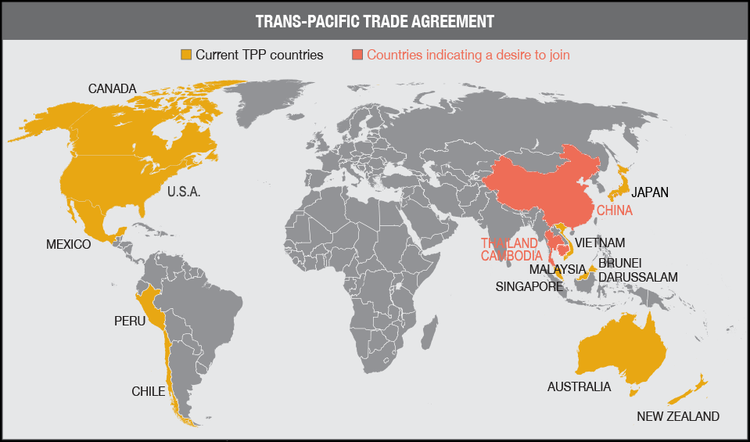
According to Inside US Trade, negotiators continued their work on the technical details of the textile chapter under the Trans-Pacific Partnership (TPP) during the latest round of negotiation in Hawaii. Although progress has been achieved, key issues remain unsolved.   Exceptions to Yarn-Forward Rule of Origin Since the 807A program under the Caribbean Basin Imitative (CBI) enacted in 1998, the so called “yarn-forward” rule of origin has been adopted in almost all free trade agreement (FTA) and trade preference program (TPA) reached between the United States and its trading partners. “Yarn forward” rule requires that each step of apparel production from spinning of the yarn must take place in one of the FTA countries. At the same time, FTA/TPA often adopt exceptions in addition to “yarn-forward” rule so as to provide flexibility to importers, especially in the case when certain textile and apparel products are not available in commercial quantities from the FTA/TPA region. It is almost certain at this point that TPP will continue to adopt the “yarn forward” rules of origin. However, what kind of exceptions to the yarn forward rule will be allowed in TPP remain unclear: 1) How long will be the “short supply” list in TPP? Short supply list is a mechanism which allows fibers, yarns, and fabrics determined not to be available in commercial quantities in a timely manner from within the FTA partner countries to be sourced from outside the countries for use in qualifying textile and apparel products. According to Inside US Trade, some TPP countries want to declare the short-supply list complete as soon as possible so that they can shift the discussion to other possible exceptions to the yarn-forward rule. However, others doubt that the U.S. would be willing to contemplate additional exceptions and therefore believe that the best approach is to keep the short-supply list open and try to add as many products as possible. 2) Whether there will be other exception mechanisms in TPP in addition to the “short supply” list? According to Inside US Trade, there were some discussions on creating a separate mechanism such as the tariff-preference levels (TPL) in TPP. TPL allows for a certain quantity of textile and apparel goods (usually yarns, fabrics and cut pieces) from a third-country (a country who is not a party to the agreement) to qualify for the FTA benefits. Additionally, it is more than just Vietnam that is seeking more exceptions to the “yarn forward” rule in TPP. For example, Australia and New Zealand are also doing so, which may be in large part for tactical reasons — essentially holding up the textile talks as leverage to secure acceptable outcomes in other areas that are more important to them, for instance, agricultural market access or intellectual property. Tariff Phrase-out Mechanism Inside US Trade says that U.S. is sticking to the framework that it laid out in its initial tariff offer, which put products into three categories subject to different phrase-out schedule:

  • X-basket, which covers the most sensitive products that would be subject to an initial cut upon entry into force, but then remain in place until they are eliminated in the tenth year for knit apparel and fifteenth year for woven apparel
  • B-basket, which consists of slightly more sensitive apparel items that would be subject to a linear tariff phase-out over five years
  • A-basket, which consists of least sensitive items whose tariff rate would go to zero immediately upon TPP entries into force

Key questions remain as to which items the United States will place into what basket. Other issues in the textile chapter The TPP textile chapter may also include languages on the following two issues: 1) a special safeguard mechanism under which the importing country can raise tariffs up to the most-favored nation (MFN) level in the case of an import surge; 2) customs language on the inspection mechanism.

Mexican New Import Rules on Textiles and Apparel Raise Concerns

mexicanclothes

In January 2015, Mexico announced a set of new measures aimed at combating “unfair” trade practices in T&A imports and enhancing the competitiveness of domestic T&A sector in the face of increasing foreign competition.

The proposed measures will particularly target those imports considered to be “undervalued” by the Mexican government. According to Inside US Trade and Sourcing Journal Online, one of these measures is to establish a minimum reference price for imported T&A products. If shipments enter at below that price, they would be subject to an investigation by the Mexican government that could lead to the imposition of additional duties and taxes. To be noted, the proposed new measures will be taken separately from traditional trade remedy measures such as anti-dumping, countervailing duty and safeguard.

Other proposed measures intend to strengthen custom enforcement, including:

  • Mexico will required a mandatory registry for T&A imports. A similar registry system has been required for footwear;
  • Mexico will postpone the import duty reduction that was expected to be implemented at the beginning of 2016 on 73 apparel items and seven textile made-ups. Originally slated to enter into force on January. 1, 2013, the duty reduction from 25 percent to 20 percent has been twice postponed for one-year periods and will now be delayed until 2018;
  • Importers will be required to provide advance notice of shipments to the Mexican Economy Secretariat in the future;
  • Mexico will break down the current eight-digit tariff lines for textile and apparel products into 10 digits, which an industry source said would allow tariff rates to be more specific in light of the fact that apparel products have evolved to be more specialized;

Moreover, Mexico will implement a new financing mechanism with total available credit of 450 million pesos (around $30 million USD) over the next 12 months to help the domestic T&A industry (especially small- and medium-sized enterprises) upgrade their machinery and equipment, pursue innovative strategies and develop new products. The Mexican Service Agency for the Commercialization and Development of Agricultural Markets (Aserca) will further support the purchase of cotton from domestic growers by textile manufacturers.

According to WWD, the US T&A industry has three major concerns about Mexican’s proposed measures: one is the potential delay in custom clearance and more complicated documentation requirements; second is the additional tariff rate and increased cost of exporting from the United States or anywhere else in the world to Mexico; third is the lack of policy transparency adding to the potent business risks.

Industry Background

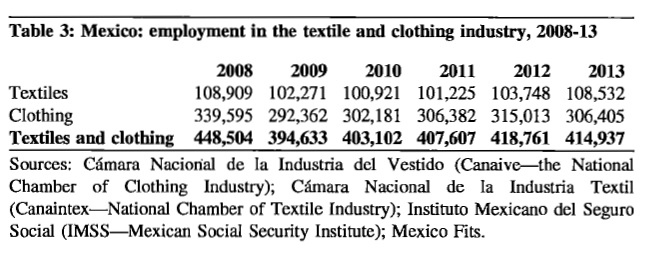
T&A industry accounted for 3.7 percent of Mexico’s GDP in 2013 (1.3 percent for textiles and 2.5 percent for apparel). About 415,000 workers directly employed in the sector in 2013, among which 74 percent worked for the apparel sector.

1

One important feature of Mexico’s T&A industry is the so called “Maquiladora” operation: simple sewing of garments made from imported fabrics and using cheap labor. The “Maquiladora” operation is largely coordinated by US-based apparel brands and retailers. Most of “Maquiladora” factories are located in the free trade zones, in which equipment and imported materials (such as fabrics) can be duty-free. Output of “Maquiladora” are exported, mostly to the United States.

3

Mexico imported $8.6 billion T&A in 2013, among which $2.4 billion were fabrics, followed by made-up textiles ($0.55 billion) and yarns ($0.39 billion). This pattern reveals Mexico’s heavy reliance on imported textiles due to limited domestic textile manufacturing capacity.

At the same time, Mexico’s apparel imports increased from $2.4 billion in 2008 to $2.9 billion in 2013. Particularly, Mexico’s apparel imports from China surged by 558.8 percent between 2008 and 2013. In 2013 alone, apparel imports from China went up by 42.1% to $0.97 billion. It is said that China is the main target of Mexico’s proposed new import measures.

4

 [Comment for the post is closed]

Pattern of U.S. Textile and Apparel Imports (Updated: February 2015)

12

4

Total U.S. textile and apparel imports enjoy steady growth from 2000 to 2014. From 2013 to 2014, value of apparel imports increased 2.5 percent and imports of fabric increased 5.4 percent. However, value of fiber imports declined 1.9 percent over the same period. Almost all fastest growing import categories from 2004 to 2014 are basic apparel.

3

Because the United States is no longer a major apparel manufacturer but one of the largest apparel consumption markets in the world, apparel products accounted for 76.1 percent of total U.S. textile and apparel imports in 2014. Fabrics and yarns accounted for 5.8 percent and 1.3 percent respectively.

75

8

While developing countries dominated apparel supply to the United States in 2014, developed countries remain important suppliers of textiles. For certain industrial textile products such as non-woven textiles, nearly 50 percent of imports still came from European Union (28), Canada and Japan. This pattern reflects different product nature of apparel (labor intensive) and textiles (capital intensive) as well as the respective comparative advantage of developing and developed economies.

6

Overall, pattern of apparel imports is in parallel with apparel retail sales in the U.S. market. This reflects the fact that demand for imports is largely shaped by macro-economic conditions. It should also be noted that despite the heated discussion on “reshoring” apparel manufacturing in the U.S., apparel imports is NOT declining.

9

11

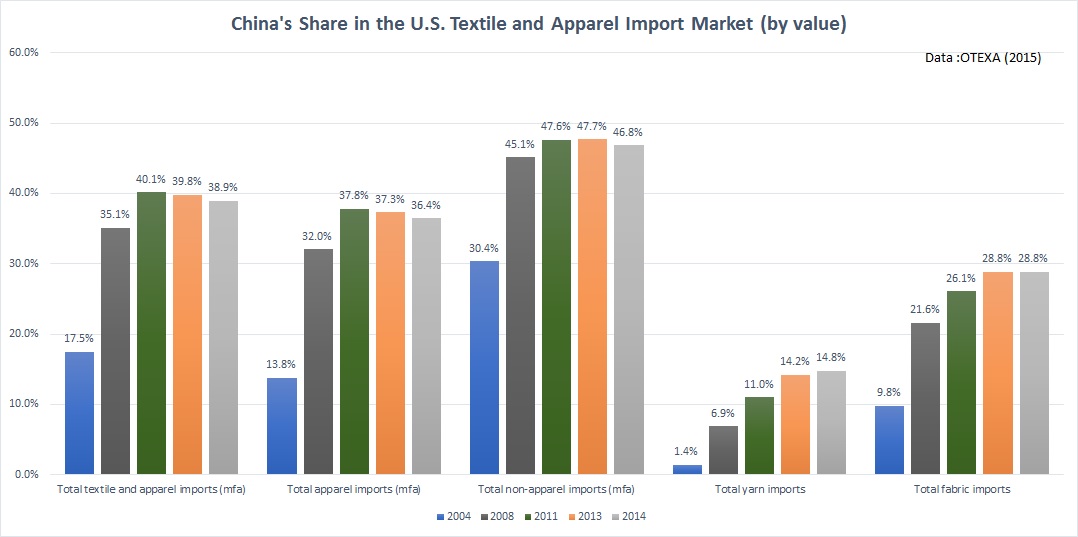
By value, China accounted for 38.9 percent of total U.S. textile and apparel imports in 2014, which was slightly lower than the level of 39.8 percent in 2013. It should be noted that China’s market shares significantly varies by category. Within the total 167 number of textile and apparel product categories complied by the Office of Textiles and Apparel (OTEXA), China enjoyed market share increase for 119 categories and suffered market share losses for 49 categories from 2004 to 2014 (many are sewing thread products).

Exclusive Interview with Erin Ennis, Vice President, US-China Business Council

erin ennis

Erin Ennis has been Vice President of the US-China Business Council (USCBC) since May 2005. In that position, she directs the Council’s government affairs and advocacy work for member companies and oversees the Council’s Business Advisory Services. She also leads a coalition of other trade associations on issues of interest to companies doing business with China. Founded in 1973, the US-China Business Council provides extensive China-focused information, advisory, and advocacy services, along with comprehensive events, to nearly 250 US corporations operating within the United States and throughout Asia.

Prior to joining the Council, Ms. Ennis worked at Kissinger McLarty Associates, the international consulting firm headed by former Secretary of State Henry Kissinger and former White House Chief of Staff Thomas “Mack” McLarty. At Kissinger McLarty, Ms. Ennis was responsible for implementing strategies for international business clients on proprietary trade matters, primarily in Vietnam and Japan.

Before entering the private sector, Ms. Ennis held several positions in the US Government. From 1992 to 1996, Ms. Ennis was a legislative aide to former U.S. Senator John Breaux, working on international trade and commerce. She also worked on health care issues during the Senate’s consideration of President Bill Clinton’s health care reform, an issue on which Senator Breaux actively worked to broker a compromise.

At the Office of the US Trade Representative from 1996 to 2000, Ms. Ennis first worked in Congressional Affairs on Asia issues, including annual approvals of China’s most favored nation status and the ill-fated 1997 push to renew presidential “fast track” negotiating authority. Beginning in 1998, she was assistant to Deputy US Trade Representative Richard Fisher, who led US trade negotiations and enforcement with Asia, the Americas, and on intellectual property rights.

Interview Part

Sheng Lu: Our students wonder whether increased trade with China is good or bad for the U.S. economy. Many of them consider the U.S. trade deficit with China to be a serious problem and they are worried about the loss of U.S. jobs to China. What’s your view and insights?

Erin Ennis: We should be realistic about what trade balance data shows and what it doesn’t. There is almost no correlation between a high US trade deficit and a strong US economy. In fact, we tend to have the lowest trade deficits when our economy is doing the worst – take a look at the data from the recent global recession between 2009 and 2010 for example versus what the trade deficit looked like in the 1990s when our economy was booming. We also don’t save much of our earnings, which also factors into the data.

Focusing on a single country as the source of our concerns leads to an inaccurate view that what other countries do has more of an effect on our economy than our own domestic policies. We should indeed be concerned about job creation in the US, but to do that, we should be implementing policies that ensure that we have as competitive an economy as possible. That will require a combination of education, energy, tax and other domestic policies. It also requires our economy to be as open as possible and pursuing market openings globally so that US goods and services have opportunities for sales overseas.

Sheng Lu: The USCBC 2014 China Business Environment Survey describes China as “an extremely difficult business environment along with a vital, growing market for foreign businesses”. We all know that China is an emerging market, but what are the top challenges faced by U.S. companies doing business in China?

Erin Ennis: Our survey goes into detail about the various challenges that companies experience in China. Competition with Chinese companies was the top issue in 2014, an issue that was not only cited independently, but also factors into several other issues that were cited such as foreign investment restrictions, uneven enforcement of laws, licensing disparities, and discrimination in the market. IPR enforcement is also a top concern for companies. Beyond those, there are also issues that both Chinese and foreign companies are grappling with in the market: a very tight labor market and significant increases in the cost of doing business.

Sheng Lu: Related to the previous question, two numbers in the USCBC survey seem to be very interesting: Although 90 percent of respondents consider rising costs in China a concern, only 14 percent of respondents say they actually reduced or stopped planned investment in China in the past year. How to explain this phenomenon?

Erin Ennis: The simple answer is that companies don’t make decisions on where to do business solely on cost. Most companies report that they are doing business in China to access Chinese customers. While costs may have increased, their opportunities for increased sales have increased too. China’s market grew at about 7% in 2014 – still a rapid rate of growth, even though it is slower than in previous years. Companies are likely to stay in the market, even as costs increase, to continue to access those opportunities.

Sheng Lu: While it is under heated discussion whether China should join the Trans-Pacific Partnership (TPP) or not, USCBC suggests that a successful conclusion of the Bilateral Investment Treaty (BIT) negotiations should be the top priority in the US-China economic relationship. What is BIT and why does it matter for U.S. companies?

Erin Ennis: The short answer is that a BIT matters because it will require China to provide the same treatment to foreign companies that it provides to domestic ones and it will require China to open many sectors of its economy to foreign investment that remain closed. More detailed explanations of what the BIT is and why it matters can be found on USCBC’s website here: https://www.uschina.org/advocacy/bilateral-investment-treaty.

Sheng Lu: December 2015 will mark the 15th anniversary of China’s accession to the World Trade Organization (WTO). In your view, what are the most important changes in US-China economic relations since China joins the WTO?

Erin Ennis: China’s WTO access required it to open significant parts of its economy to foreign companies. In general China has done a good job of implementing those commitments. As a consequence, China has grown to be the United States’ third largest trading partners after Canada and Mexico, with whom we have a free trade agreement. More needs to be done, however, to open China’s market. The US-China BIT negotiations will be a useful tool in achieving that goal.

Sheng Lu: China’s recent sweeping anti-graft campaign has attracted the world attention. How does the US business community look at this campaign? Will this campaign have any long-term impact on China’s business environment?

Erin Ennis: In general, the anticorruption campaign is viewed very positively by foreign companies because it is an additional way to ensure that all companies are treated equally in China – bribes and other illegal activities should never be tolerated. To date, the only impact that foreign companies have reported is that it takes longer to get some projects or licenses approved because Chinese officials are being overly cautious in ensuring that there is no appearance of impropriety. Those kinds of delays are ones that companies are willing to deal with.

Sheng Lu: Our students wonder if China presents as a career opportunity for them as well. What’s your observation and do you have any suggestions for our students interested in working/interning in China?

Erin Ennis: If you are serious about working in China, then learning Chinese should be at the top of your to do list – but the same could be said about going to work in any foreign country: learn their language. Beyond that, go to China and experience it. There are plenty of ways to do both of those, but language and on the ground experience will establish your credibility as someone who is serious about the specific opportunities in China, rather than someone who just wants a chance to live in a different country. Final suggestions: read as much as you can and question what you read. China is not a monolith and, as anywhere, there are always multiple sides to every story – that’s especially true in business and politics. Having an informed view of those dynamics will serve you well.

–The End–

Textile and Apparel in the 2015 US Trade Policy Agenda

Untitled

Two hearings were held on January 27 where US Trade Representative Michael Froman testified before the Senate Finance Committee and the House Ways & Means Committee on the 2015 US Trade Policy Agenda. During the Senate hearing, two questions were directly related to the textile and apparel (T&A) industry:

Senator Robert Menendez (D-NJ) expressed concerns that inclusion of several concessions requested by Vietnam regarding rule of origin and short supply list for T&A in the Trans-Pacific Partnership (TPP) will result in severe job losses and potentially hurt the T&A industry in the Western Hemisphere. In response, Froman said that:

“We worked in the textile area through the yarn forward rule, the short supply list, rules of origin and customer enforcement and corporation to take these things into consideration. We’ve worked very closely with textile manufacturers in the US who are part of this supply chain with Central America to get the best of our understanding of what are the sensitivities are and take that into account in our negotiations.”

John Isakson (R-GA) raised the question about China’s recent cotton reserve & subsidy policy and its negative impact on the world cotton price which “has declined from 83-85 cents/pound not a long ago to 55-57 cents/pound recently.” Isakson wondered if anything USTR would do to address the problem, such as bringing the case to the World Trade Organization (WTO) Dispute Settlement Body (DSB). In response, Froman said that:

“The whole pattern of agriculture subsidies has changed a lot over the last ten to fifteen years. When (WTO) Doha Round was first started, focus on the subsidy was really the United States and the European Union. But in both of those areas subsidies have come down, while subsidies from China and India in the agriculture area have been increased. By some measures, China is now the largest subsidizer of cotton. We are engaging with them. We have conversations in the last couple of days also about that, about taking a fresh look at where subsidies have been provided, how it distorted the market and how that should play into the global trading negotiations. It is important to update our views on where the subsidies come from and what impact it has. For poor farmers in Africa, it doesn’t matter whether the subsidies come from the US or from China. It matters that the subsidy exists and so we will be engaged with China on this and create some disciplines around us. We are looking at all options out there. We are not yet determined whether there will be a (WTO DSB) case brought in that area.”

Other hot topics covered by the hearing include passing Trade Promotion Authority (TPA) bill, creating jobs through trade, addressing agriculture, digital trade & data flow, State owned enterprises (SOE), currency manipulation, transparency and Intellectual property right (IPR) protection issues in TPP, strengthening trade enforcement, renewing African Growth and Opportunity Act (AGOA), and making further progress of Trade in Service Agreement (TiSA) and Information Technology Agreement (ITA) at WTO.

The followings are some personal comments on the overall atmosphere in the Senate hearing:

  • It doesn’t seem possible to be able to conclude TPP without TPA, for at least two reasons: 1) Congress doesn’t want to give up its authority on trade policy. If TPP negotiation were concluded before the passage of TPA, Congress would feel it had little influence on shaping TPP through the mechanism of TPA trade negotiating objectives. This will add to the difficulty of potentially passing the TPP implementing bill under expedited legislative procedures. 2) Other TPP members, such as Japan, are unlikely to put the final offer on the negotiation table, especially for politically sensitive issues, without having the assurance provided by TPA.
  • There is a growing call for “strong” labor and environmental provisions in TPP. This is not surprising given the fact that the general public is attaching greater importance to labor and environmental impact of international trade. NGOs, such as labor and environmental groups have become more critical players in trade politics nowadays as well. Practically, strong labor and environmental provisions are regarded as important means to create “a level playing field” for US products competing in the world marketplace. These provisions can also be used as leverages to push for better human right practices in some foreign countries. That being said, as noted by many trade experts, trade policy shall not be expected to solve environmental and labor problems.
  • Currency manipulation becomes a hot discussion topic again, but USTR doesn’t seem to be interested in including the currency provision in TPP. Many senators raised the currency issue during the hearing, however, it shall be noted that: 1) Free trade agreement (FTA) and even WTO is not an appropriate venue to deal with currency issues; 2) the business community actually does not see currency as a priority issue to address. They care more about things like market access, IPR protection, national treatment and dealing with SOEs. 3) Currency manipulation provision is not an effective way to solve currency concerns. For example, it would be impossible to determine what shall be the “right” exchange rate–ten economists may give twelve different answers. 4) It will be interesting to see what language the potential TPA bill will use to define currency issue as a  trade negotiating objective.
  • Benefit of trade is still largely misunderstood. During the hearing, almost all support for TPA & TPP came from the export side: “export is good for the US economy”, “export can create higher-paid middle class jobs”, “US runs trade surplus with all FTA partners and all trade deficits came from those non-FTA partners”…However, nobody in the hearing talked about the benefits of imports and the global nature of supply chain in the 21st Mercantilism is still a popular view in Congress.

Sheng Lu

2014 World Textile Industry Labor Cost Comparison

textileindustry_laborcost2014_bars-437br

According to the latest Werner International Labor Cost Comparison Report, labor cost gaps remained huge among textile industries worldwide in 2014. Within the 40 countries covered by the report, labor cost in Switzerland ($51.36/hour), the highest, was 82 times higher than in Bangladesh and Pakistan ($0.62/hour), the lowest, in 2014. Overall, labor cost in Western European countries (such as Italy, France and Germany)+Japan remained the highest in the world, followed by (from high to low):

  • the United States
  • advanced economies in East Asia (South Korea and Taiwan)
  • Eastern European countries (such as Poland)
  • South American countries (such as Brazil and Peru) 
  • developing countries in East and Southeast Asia (such as Bangladesh and Pakistan).

[Note: The report does not cover African countries].

change

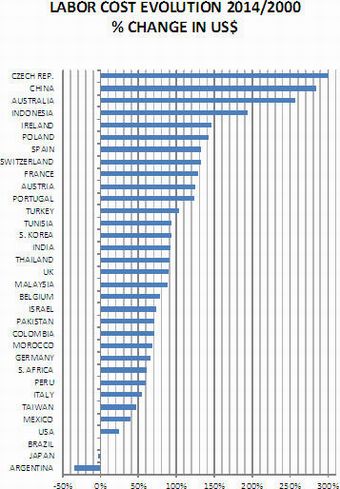
On the other hand, consistent with statistics from other sources, Werner’s report also suggests remarkable labor cost increase in China, which is rapidly approaching the $3 per operator hour (up from $2.1 in 2011 and up from only 0.69 US$ in the year 2000). From 2000 to 2014, labor cost in the U.S. textile industry went up about 25 percent. However, in terms of absolute difference, China’s labor cost was still only 15 percent of the level in the United States in 2014. As noted by the publisher, the labor cost comparison report covers all primary textile industry sectors, consisting of spinning, weaving and dyeing & finishing. Cut & sewing operations are not part of these comparisons. Labor cost in the clothing industry is not covered by the report however.

[Comment for this post is closed]

Tariff or Not

B711fJvCcAAELet

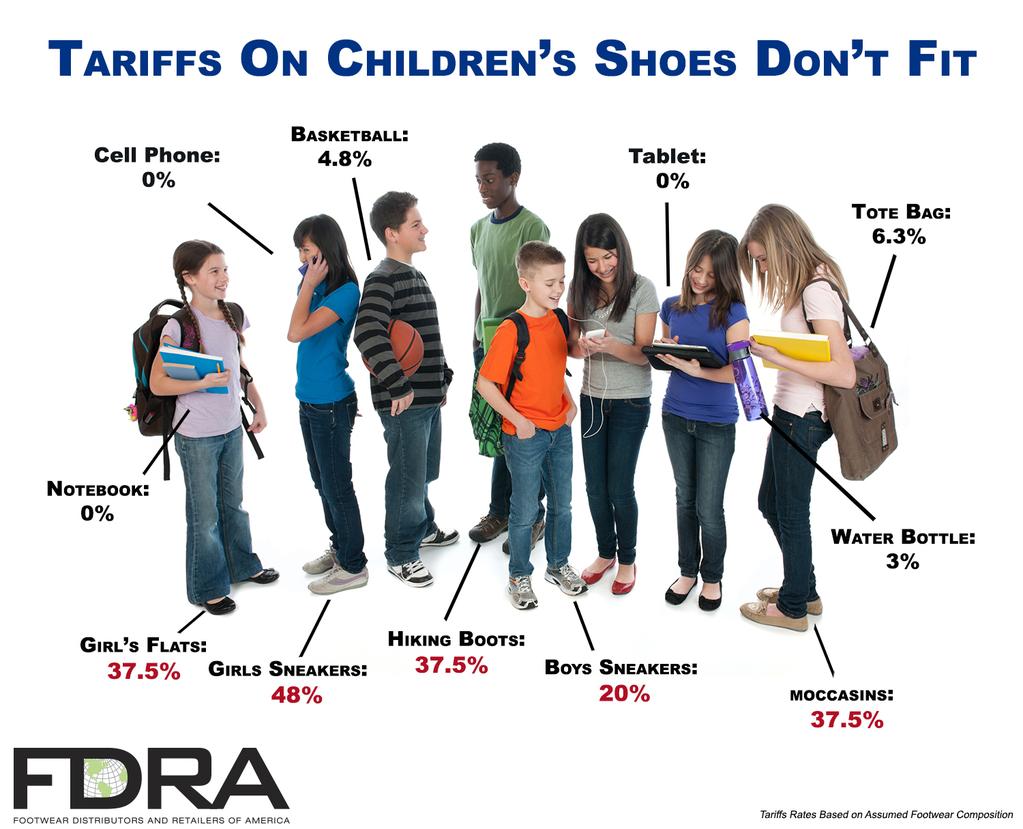
Tariff is a tax levied on imports only. Tariff will make imports more expensive in the market. For example, if the original price of a “Made in China” T-shirt is $5, with a 20% tariff, it becomes $5*(1+20%)=$6 when sold in the U.S. market.

Tariff has multiple impacts. On one hand, tariff may protect the domestic industry from foreign competition and help government of the importing country gain some tax revenues. On the other hand, consumers will have to pay more (or consume less) because of increased market price as result of tariff. Tariff also hurts exporters and those sectors operating on a global basis. For example, a high tariff rate on imported fabrics may raise the production cost of a clothing manufacturer which sells its finished products to the world market. According to the World Trade Organization, nearly 60 percent of world trade today are inputs and components. 

Questions for discussion:

  • How to explain the phenomenon that tariff rates are so different across different types of product in the picture? Should they be so different?
  • Should tariffs on flats, sneakers, boots and moccasins be lowered or eliminated in the U.S. or even world wide? What issues need to be considered?

Latest Trends in the US Apparel Industry (update: January 2015)

Latest statistics released by the American Apparel and Footwear Association (AAFA) indicate several trends in the U.S. apparel industry:

  • First, the retail market is gradually recovering. According to AAFA, on average, every American spent $907 on clothing (or purchased 64 garments) in 2013. Although this figure is still less than the one before the 2008 financial crisis, it is the highest level since 2012.
  • Second, “Made in USA” is growing but US consumers still rely on imports. Data from AAFA shows that US apparel production increased 6.2 percent from 2012 to 2013, accounting for 2.55% share of U.S. apparel market. However, nearly 98% of apparel consumed in the US were still imports in 2013.
  • Third, China remains the top apparel supplier to the United States. Despite the concerns about the rising production cost in China, latest data from OTEXA shows that, in 2014 (January to November) China still accounted for 42.5% of US apparel imports in terms of quantity and 39.1% in terms of value–almost the highest level in history. These two numbers were 41.7% and 39.9% a year earlier. On the other hand, Vietnam’s market share has reached 9.3% (by value) and 10.7% (by quantity) in 2014 (January to November), about ¼ of China’s exports to the United States.
  • Fourth, job market reflects continuous shift of the apparel industry. According to AAFA, among the total 2.8 million workers directly employed by the US apparel industry in 2013, only 5% were in the manufacturing sector, 5% were in the wholesaling sector and as many as 90% were working for retailers. However, within the apparel retail sector, total employment by the department stores is quickly shrinking—dropped 7.6 percent from 2012 to 2013 and cumulatively 21.3 percent from 1998 to 2013. At the same time, specialty clothing stores and sporting goods stores are hiring more people: 13.8% and 64.5% increase of employment from 1998 to 2013 respectively. The contrasting employment trend reflects the changing nature of the U.S. apparel retail market and the channels through which U.S. consumers purchase clothing.
  • Fifth, US consumers are paying higher taxes on imported clothing. Calculated by AAFA, while the overall U.S. imports were only charged by a 1.4% tariff rate, the effective duty rate on all apparel imports rose to 13.6% in 2013. The higher effective duty rate may be caused by the fact that less apparel were imported utilizing free trade agreement or trade preference programs.

Appendix: Facts on the US Apparel Market in 2012

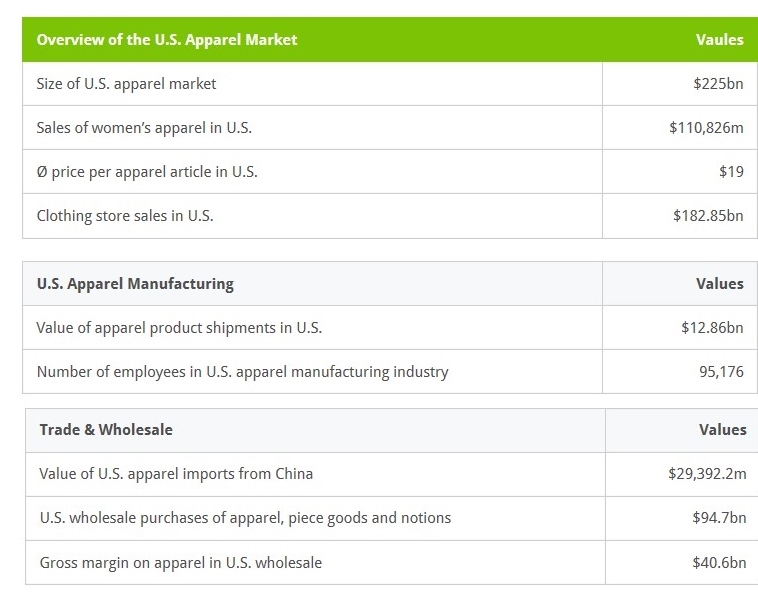
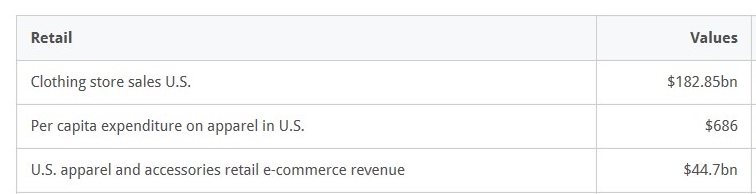
Slide1 Slide2

Data Source: http://www.statista.com/

US Department of Labor: 28 countries were Found Using Child or Forced Labor in Making Textiles and Apparel

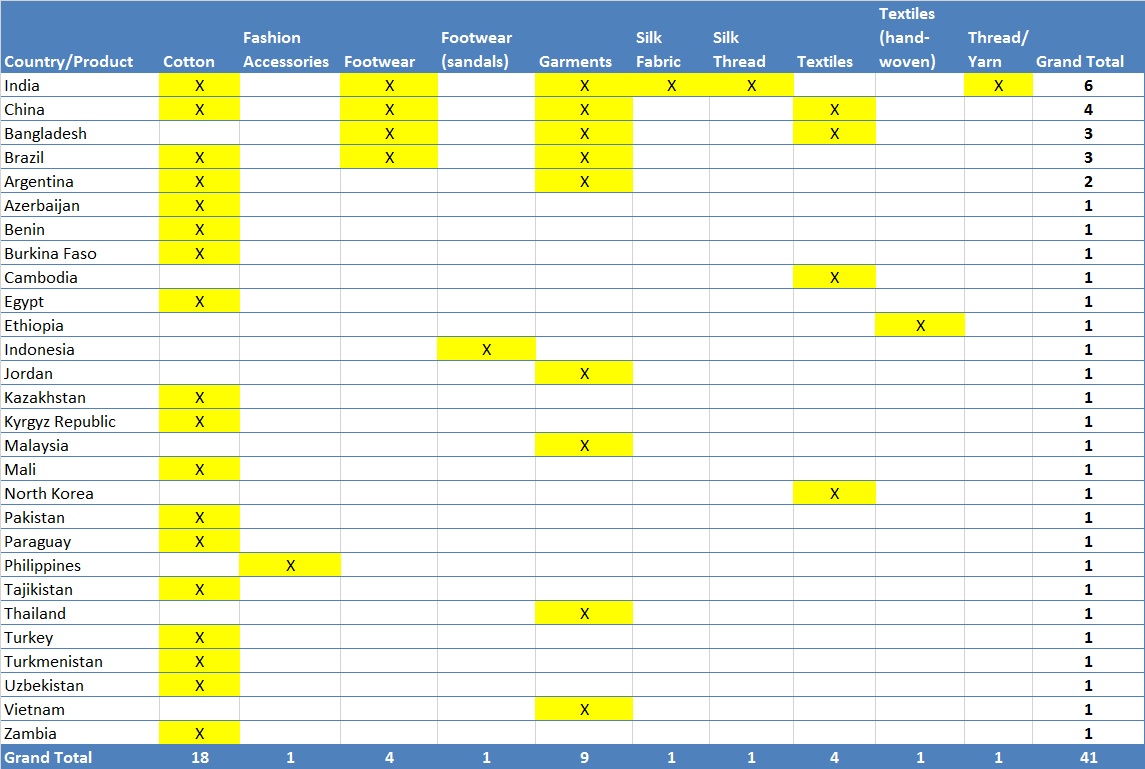
In its updated List of Goods Produced by Child Labor or Forced Labor (ILAB) released on December 1, 2014, the U.S. Department Labor said that at least 28 countries are found using child or forced labor in making textiles and apparel. All countries on the list appear to be developing countries. Particularly, the problem of using child labor or forced labor was found most serious in the cotton sector (18 countries), followed by garment manufacturing (9 countries).

Bangladesh, a focus of corporate social responsibilities practices these days, was found using child labor in making garment according to ILAB.

1

2(Data compiled by Sheng Lu)

Note: * ILAB maintains a list of goods and their source countries which it has reason to believe are produced by child labor or forced labor in violation of international standards. The List is intended to raise public awareness about child labor and forced labor around the world, and to promote and inform efforts to address them. A starting point for action, the List creates opportunities for ILAB to engage and assist foreign governments. It is also a valuable resource for researchers, advocacy organizations and companies wishing to carry out risk assessments and engage in due diligence on labor rights in their supply chains

Follow up:

After the release of the ILAB report, four House Democrats sent a letter to USTR Michael Forman on December 4th, 2014, asking him to provide details on labor provisions in the TPP. As noted by the lawmakers in the letter: “Vietnam, Mexico, Peru, and Malaysia, one-third of the nations included in the TPP, were all cited for labor abuses in the report…”. “We are following up with you because we believe it is important that you take action to ensure that real, meaningfully enforceable labor protections are in the TPP”.

U.S. Textile and Apparel Exports in 2013 (Updated in November 2014)

1

U.S. textile and apparel (T&A) exports increased by $543 million (3 percent) to $19.8 billion in 2013. However, because import increased by $3.2 billion (3 percent) to $97.5 billion, U.S. trade deficit in T&A increased rose to $97.5 billion in 2013. Imports supplied about 98 percent of U.S. consumer demand for T&A in 2013.

2

3

Textiles account for 83 percent of all U.S. T&A exports in 2013. Exports of these textiles products (particularly fabrics and yarns) are used primarily as intermediate inputs for finished products manufactured abroad, which are then imported back into the United States (USITC, 2014). In terms of value, specialty & industrial fabrics, spun yarns & thread, felts & other non-woven textiles and other made-up textile articles altogether account for nearly half of U.S. T&A exports in 2013. Statistics further show that U.S. apparel exports also grow fast in recent years. However, it shall be noted that a good proportion of them might be used clothing.

4

5

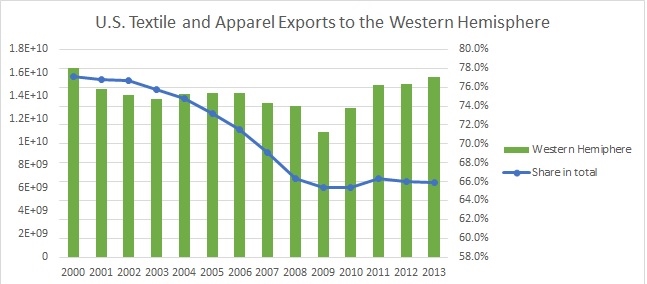
Mexico and Canada remain the top two largest export markets for U.S. T&A in 2013. 66 percent of U.S. T&A exports in 2013 went to the Western Hemisphere (i.e. North America, Central America, South America, and the Caribbean countries). However, this share has declined from 77.6 percent in 2000. Other leading export markets for U.S. T&A include Honduras, China and Japan.

6

Reference:

USITC (2014). Shifts in U.S. Merchandise Trade. http://www.usitc.gov/press_room/news_release/2014/er1112ll232.htm 

OTEXA (2014). U.S. Imports and Exports of Textiles and Apparel. http://otexa.trade.gov/msrpoint.htm

Think Big about International Trade

cropped-chess-globe-32

I hope you all enjoy the guest lecture given by Ambassador Friedrich Löhr on his global travel stories as a career diplomat over the past 37 years. Actually, topic of our class is closely connected with “international relations”. As observed by Michael Forman, US Trade Representative, “trade is what most of international relations are about and trade policy is national security policy”; “leaders have come to see the economic clout that trade produces as more than merely a purse for military prowess; they now understand prosperity to be a principal means by which countries measure and exercise power”.

Several readings/case studies/discussions in our class have touched the strategic aspects of international trade in the 21st century. For example, I hope at this point you not only understand the technical aspects of the Trans-Pacific Partnership (TPP) such as “yarn-forward” and “short supply list”, but also can see TPP as a strategic movement for the US to become more deeply embedded in the Asia-Pacific region. Similarly, the Trans-Atlantic Trade and Investment Partnership (T-TIP) is a free trade agreement, but a successful conclusion of T-TIP will also send “an unmistakable signal to the world about the strength of the US-EU bond—a timely reminder as the crisis in Ukraine has triggered deep unease across the continent.”

The strategic aspects of international trade can also be understood from the development perspective. There is a direct correlation between integration into the multilateral trading system and economic growth and between growth and poverty reduction. What then UN Secretary Kofi Annan said remains very true “The main losers in today’s very unequal world are not those who are too much exposed to globalization. They are those who have been left out”. No example can be more convincing than the case of textile and apparel (T&A) to illustrate this point. In many low-income countries in the world, T&A accounts for two-thirds of local employment and over 60 percentage of total merchandise exports. This is why trade preference programs such as AGOA, GSP and HOPE play a critical roles in providing greater market access opportunities to those most vulnerable countries.

To understand the strategic aspects of trade, you may further recall our case study 2 and the discussions on the necessity of maintaining a sound operation of the GATT system in the setting of 1970s. Without a rule-based multilateral trading system, international trade simply couldn’t happen. Yet the current multilateral trading system established shortly after World War II needs an update to better reflect the changing nature of world economy and format of trade. This is why so much attention has been given to mega-trade agreements such as TPP and TTIP. These free trade agreements will have a huge impact shaping the future rules of the game, no matter in terms of adding new agendas such as state-owned enterprises, digital trade and facilitating supply chain, or more effectively establishing a level playing field for issues such as environmental and labor standards.

So think strategically about international trade and think big about the impact of our T&A industry in the 21st century global economy.

Japan’s Textile Exports to Vietnam Keep Growing Fast

According to a recent report released by the Textile Outlook International, Japan’s textile and apparel (T&A) exports increased by 9.6% to a five-year high in 2013 (¥763,307 million or $8,571 million USD), added by a sharp depreciation in the value of the yen (Note: Yen or “¥” is Japan’s currency) against US dollar. Specifically, Japan’s textile exports increased by 9.8%, from ¥729,761 million in 2012 to ¥801,450 million in 2013. Japan’s apparel exports rose by 3.7%, from ¥33,546 million in 2012 to ¥34,792 million in 2013. Textiles account for a lion’s share of Japan’s total T&A exports– 95.8% in 2013 and 95.6% in 2012 in terms of value.

1

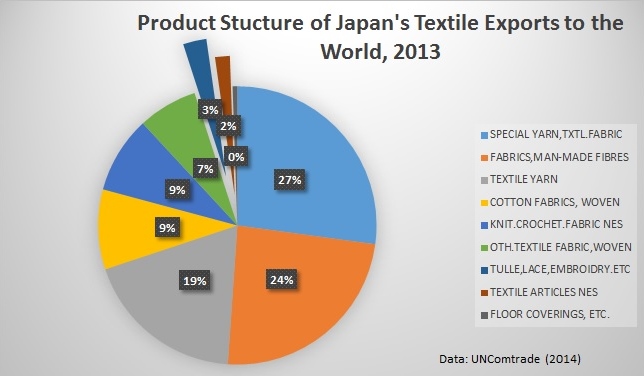
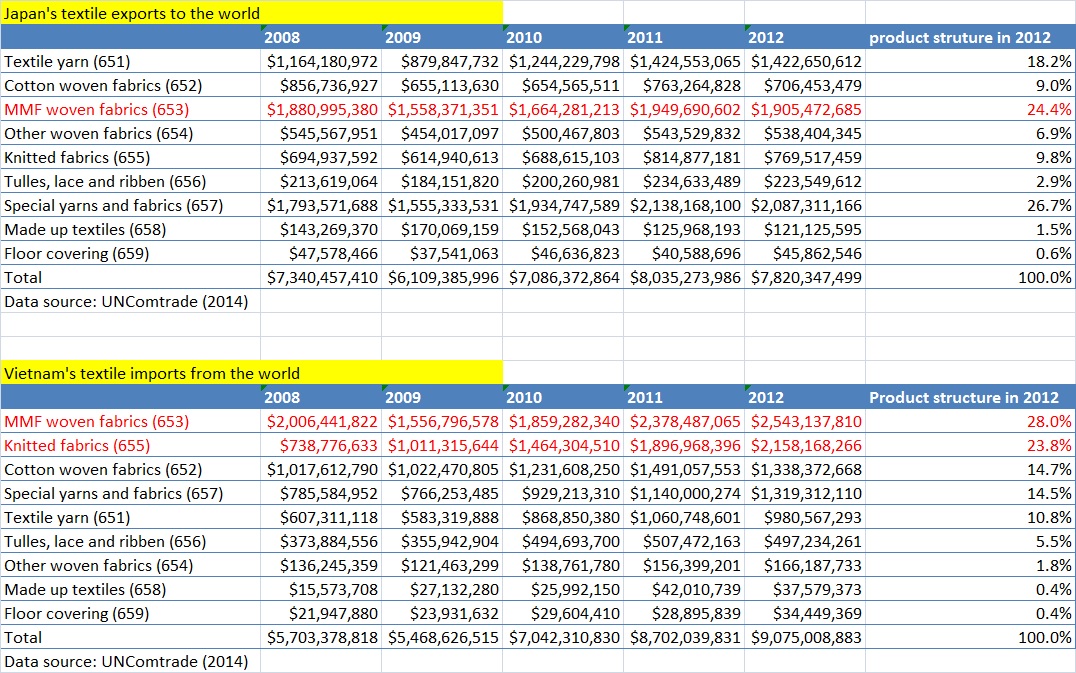
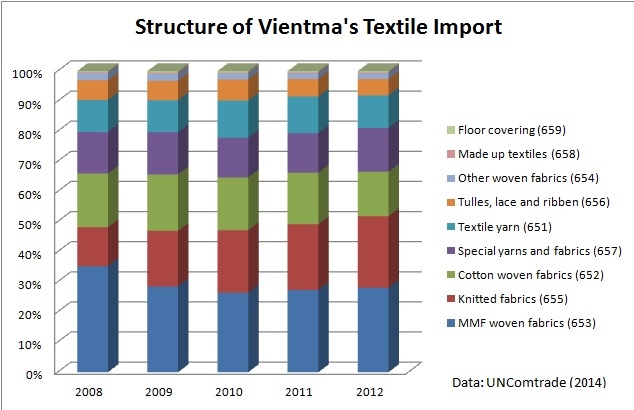
Statistics also show that Vietnam not only is Japan’s second largest T&A export market, but also is one of the fastest growing export markets for Japan. In 2013, 9.1% of Japan’s T&A exports went to Vietnam (mostly were textiles), increased from 8.5% in 2012. In terms of absolute value, Japans’ T&A exports to Vietnam has also kept growing fast in recent years: 17.1% increase in 2013, 9.7% in 2012 and 27.3% in 2011, much higher than the growth rate of Japan’s overall T&A exports over the same period. Additionally, about 26% of Japan’s textile exports to Vietnam in 2013 were man-made fiber fabrics (SITC 653), followed by special yarns and fabrics (SITC 657) which accounted for 21% in terms of value. This product structure well matches with Japan’s overall textile exports to the world.

2 3

On the other hand, Japans’ T&A exports to the US also grew by 8.1% in 2013, following a 3.2% rise in 2012. Fastest growing category of Japan’s T&A exports to the US in 2013 include blue denim fabric, non-textured filament yarn, wool knitted shirts and blouses and miscellaneous manufactured products made from man-made fibers.

However, the solid performance of Japan’s T&A exports in 2013 “failed to reinvigorate domestic production”. According to the report, Japan’s total T&A exports declined by 2.0% from 2012 to 2013, following a 2.3% fall a year earlier. However, production of miscellaneous textile products in Japan went up 0.6% in 2013.

Questions for discussion:

  • Will Japan further strengthen its ties with Vietnam in T&A production and trade because of TPP?
  • Should the US textile industry care about Japan in the TPP?

Welcome for any comments and suggestions.

Related reading
Lu, S. (2014). Does Japan’s accession to the Trans-Pacific Partnership an opportunity or a threat to the U.S. textile industry: A quantitative analysis. Journal of the Textile Institute. (ahead of print version) 

What does Vietnam’s Textile Factory Actually Look Like?

Vietnam attracts a lot of attention these days in the textile and apparel world. But what does Vietnam’s textile and apparel factory actually look like? 

This video features PPC (Phong Phu Corporation), one of the largest textile mills in Vietnam. It is said that PPC accounts for over 50% of Vietnam’s total textile exports.

  • Anything in the video interests you or surprises you?
  • How is PPC different from textile mills in the US?( You may think about the video we watched in class about the textile mills in NC. For example, are there any differences in working environment, the facility, what it is producing, required labor skills, efficiency and productivity?)
  • How should the US textile industry treat Vietnam? A competitor? A threat? A potential partner? or a great opportunity for investment?

Please feel free to share your thoughts.

[Please leave no more comment for this post unless you have NEW ideas to share]

Unleashing Fashion Growth City by City

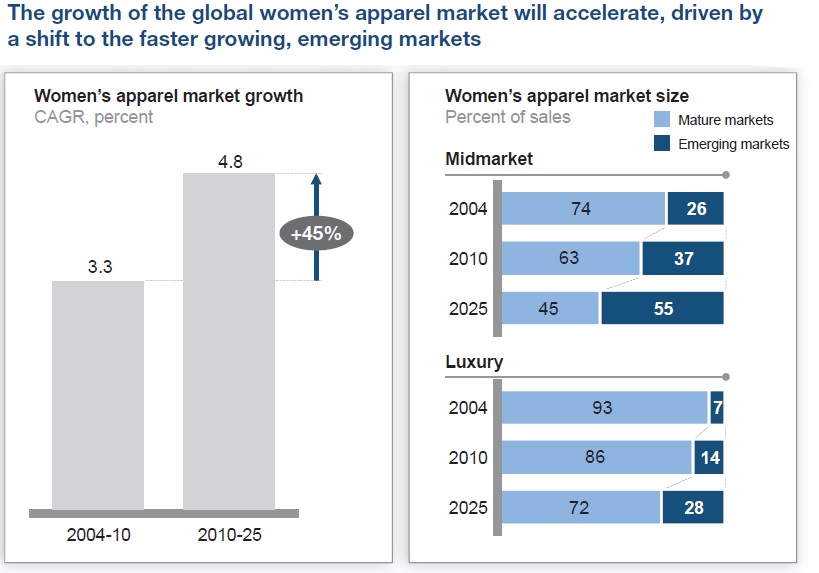
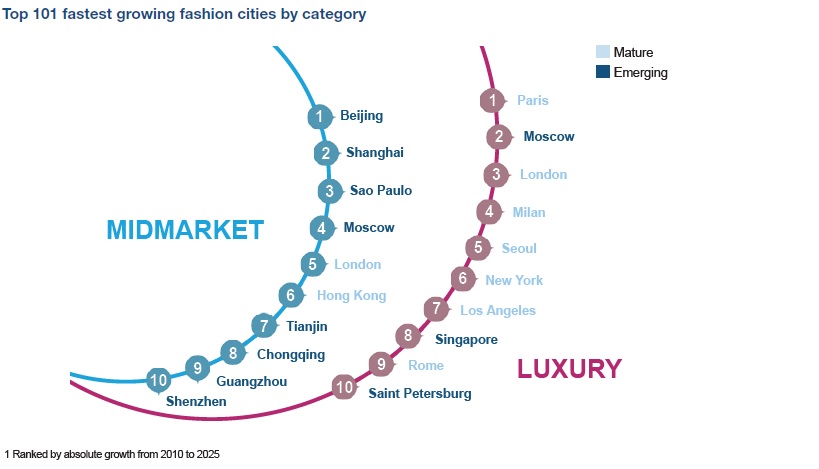
According to a recent study conducted by McKinsey, the global women’s apparel market growth rate is forecasted to increase by 50 percent over the next 12 years, largely driven by the increasing weight of emerging markets such as China and Russia. Historically, the global women’s apparel market has grown at just over 3 percent per year; However, by 2025 the growth rate is expected to approach 5 percent per year. By 2025, women’s apparel is expected to account for 55% of global apparel sales and 60% of sales growth.

1

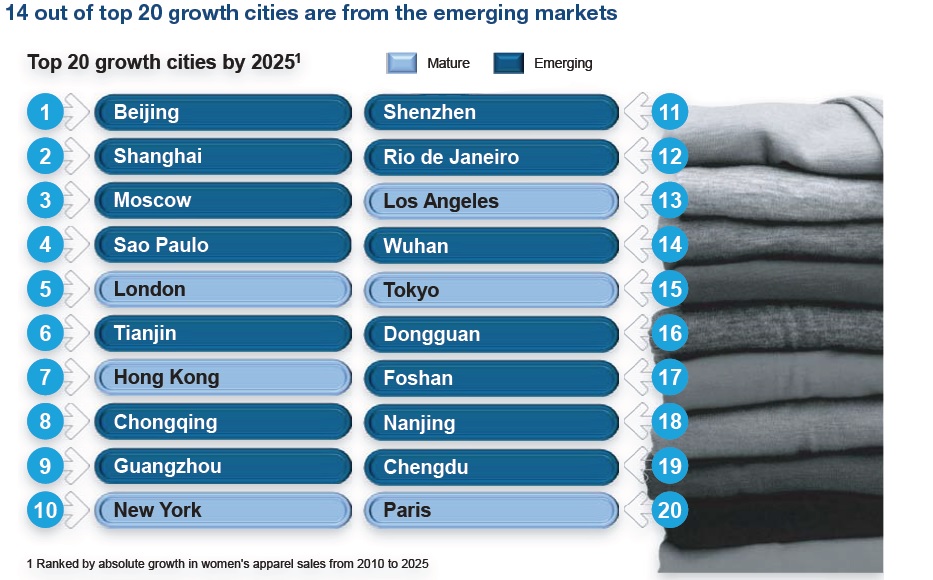
For fashion players, cities are mattering more than any other product category. Top 600 growth cities will account for 62% of women’s apparel market’s growth by 2025; and 16 out of top 20 growth cities are from the emerging markets, adding an additional $100 billion to the global women’s apparel market.

2

However, when looking at total size, mature-market cities will still have half the women’s apparel market worldwide, according to McKinsey. Particularly, growth in the luxury markets is still heavily dependent on the mature market, where 70 percent of top growth cities are located.

3

With the help of city level analysis, rather than discussing Europe or Asia as alternative destinations, or even the U.K. versus France, companies can now ask themselves, “in what 10 key cities should we next establish a strong presence?”

Five Key Trends in Luxury Goods

Five key trends in Luxury Goods

  • Luxury market remains optimistic with forecast sales set to reach $405 billion USD by 2019.
  • The United States remains the largest luxury goods market in the world, valued at $78 billion USD in 2014.
  • Designer apparel accounted for the most sales of all luxury categories in 2014.
  • Luxury jewelry and timepieces grew by 63% and 42% respectively in the last 5 years.
  • China dropped from 3rd to 4th place in the global rankings, due to the government clampdown on extravagant spending and slowing growth of the economy.

According to a featured story written by Just-Style on the Euromonitor report, global luxury goods sales in 2013 rose 3% year-on-year in value terms and most of this growth came from emerging markets such as China, India, Indonesia and Malaysia. Data shows that luxury spending in the BRIC countries experienced a massive increase of 104% over the last five years, compared to just 18% in developed markets. It is further suggested that BRIC countries will account for more than 35% of projected global sales of luxury goods from 2014-2018. Specifically, India is forecast to grow by a further 86% in constant value terms over the five years to 2018, followed by China at 72%, Brazil at 31% and Russia at 28%.

The outlook for the luxury goods industry over the short to medium term is positive. A rapidly expanding A and B class across sub-Saharan Africa, Latin America and emerging Asia, with incomes 150% to over 200% higher than the average gross incomes of individuals aged 15 and over, is fuelling a new culture of luxury aspiration, leading to an increase in luxury spend.

Source: Euromonitor International; Just-Style

US Fashion and Apparel Industry Releases Position Paper on the Transatlantic Trade and Investment Partnership (T-TIP)

p0111400002h

The American Apparel and Footwear Association (AAFA) and the US Fashion Industry Association (USFIA) , the two leading industry organizations representing the US fashion and apparel industry, jointly released a position paper this week on the Transatlantic Trade and Investment Partnership (T-TIP), which is currently under negotiation between the United States and the European Union.

The position paper spells out a few priorities deemed by the US fashion apparel industry for the T-TIP:

  • Full, immediate and reciprocal elimination of tariffs, meaning import duties on all apparel products shall be eliminated on day one without phrase-out periods.
  • Flexible rules of origin, meaning restrictive rules of origin such as “yarn-forward” which requires companies to use textile inputs from certain regions so as to enjoy the duty free market access shall be abandoned and replaced by simpler and more flexible ones.
  • Regulatory coherence, such as harmonization on labeling regulations, harmonization of product safety and test method regulations, and establishing of a harmonized list of prohibited substances.
  • Emphasis on facilitative customs provisions, meaning improving predictability, simplicity and uniformity in border procedures.  

The European Branded Clothing Alliance is also a party of the joint statement; however, the European Textile and Apparel Confederation (Euratex) is not involved.

On the other hand, in May 2014, the National Council of Textile Organizations (NCTO), which represents the interests of the US textile industry, announced its priorities for the T-TIP negation, including:

  • Adopt the “yarn-forward” rules of origin in T-TIP
  • Set phrase-out periods for sensitive textile and apparel products
  • Protect the Berry Amendment (which requires all US military uniforms have to be 100% made in USA)

Discussion: The People’s Republic of Capitalism

koppel_china_02_web08

  • What does the documentary impress you most or surprise you most?
  • How do you compare your life with any characters in the documentary? (the Missourian lady, her boss who moved factories to China, the Mexicans who worked on US cotton farms, the Chinese girl working on the production line, the Chinese high school student who comes from a poor rural area and her mother….)
  • How do you see the dilemma of globalization and international trade from the documentary?
  • What arguments in the video do you disagree or have different viewpoints?
  • Do you have any discussion questions to ask your classmates about the documentary?

Please feel free to share your thoughtful comments and I look forward to exciting discussions with you all.

[Discussion for this post has ended, please post no more comment]

Why People Think Differently about International Trade?

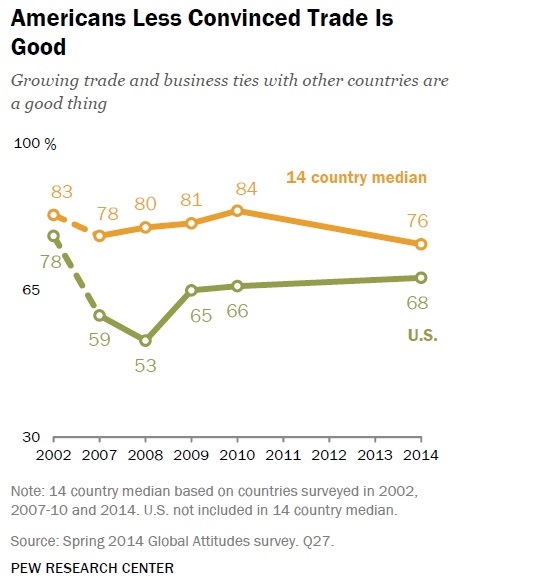
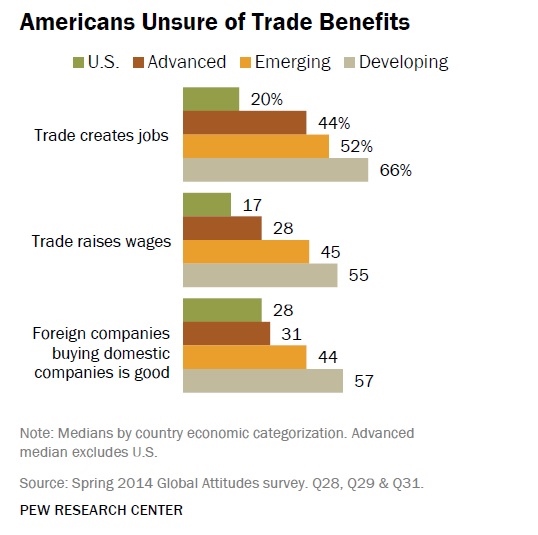
This week we looked at a critical activity closely associated with the textile and apparel industry in the 21st century: International Trade.  Among the fundamental questions we examined, whether trade is beneficial or not is a one that all of us care much about but also has raised many debates. 

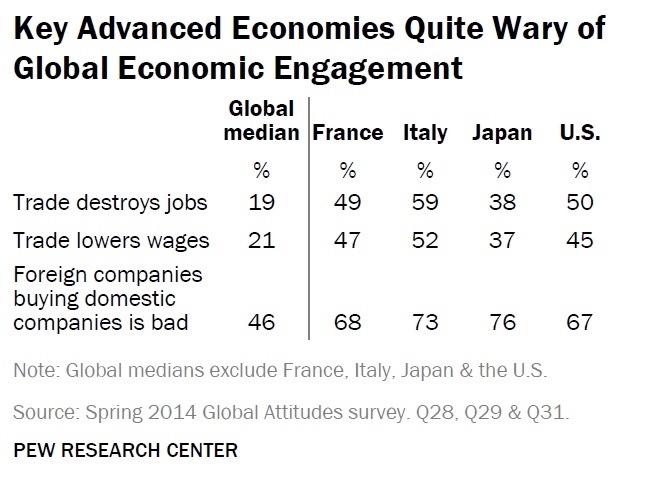
Just this week, the Pew Research Center released its latest survey findings about the public opinion on growing trade and business ties between countries and views about the impact of trade on jobs, wages and prices. The results show that not only Americans, but also people in other countries, including those developing ones, are divided about international trade. Anyhow, the highest level of public skepticism about trade and foreign investment is found in the United States.  

1

2

Job and wage are among the top concerns about trade among the general public. In Italy, nearly 59 percent survey respondents believed that trade destroy jobs and 52 percent believed trade lower wages. These two figures are 50 and 45 among US respondents.

 3

5

After our discussion on various trade theories, which school of thought do you agree more: mercantilism or comparative advantage theory? Are these theories proposed hundreds years ago still working today? Do you think deepened globalization will reduce the gap or even widen the gap of people’s divided view on international trade? How do you think international trade affects your daily life and your future career opportunities? Last but not least, is trade beneficial for the US textile and apparel industry in the 21st century? Please feel free to share your views!

World Textile and Apparel Trade (Update: August 2014)

The following analysis is conducted based on the statistics released by the World Trade Organization on August 5, 2014.

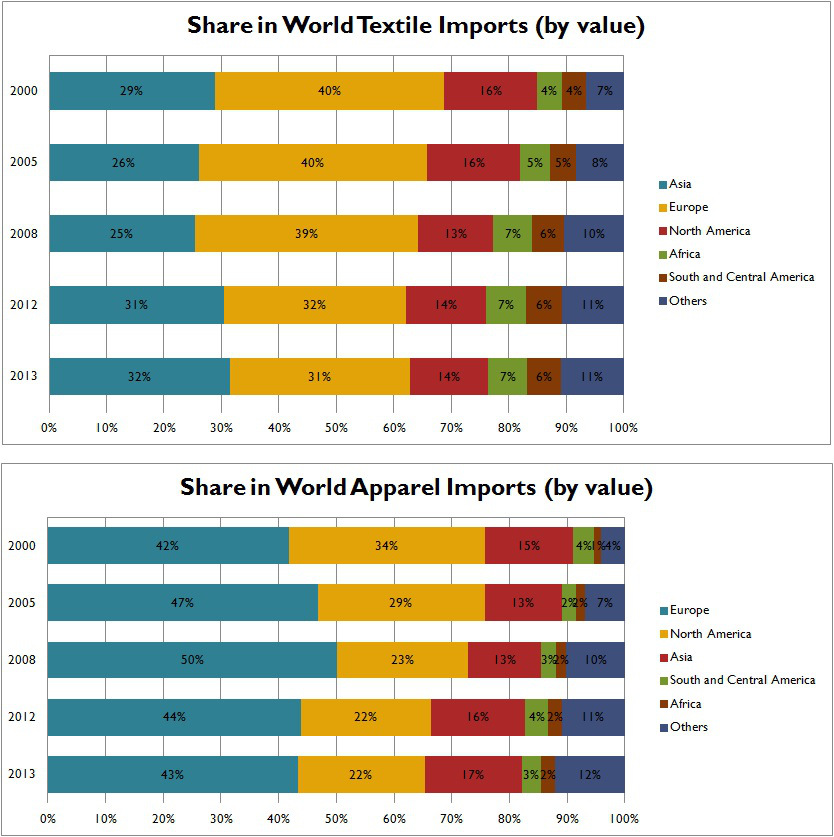
1. Asia continues to dominate the world textile and apparel exports from 2012 to 2013.

0

12

2. Despite concerns about its rising labor cost, China continues to gain more market shares in world textile and apparel exports from 2012 to 2013.

22

3. World market for textiles remains relatively stable from 2000 to 2013; world market for apparel is gradually shifting and diversifying. Although Europe and North America still account for lion’s shares in world apparel imports (due to their higher GDP per capita), Asia is the fast growing market.

32

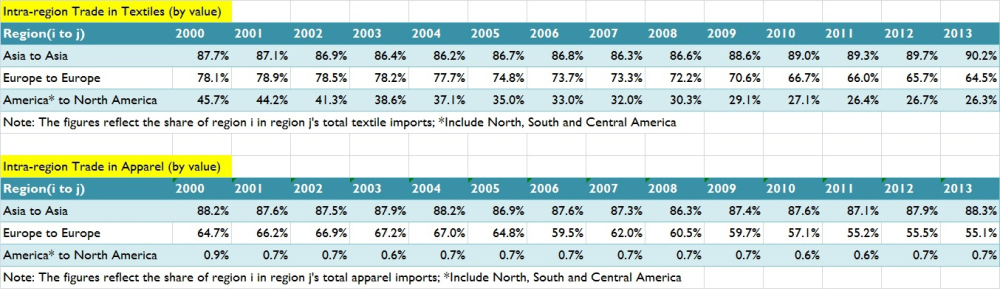
4. Intra-region trade remains a distinct pattern in world T&A trade, particularly in Asia, Europe and America. However, the pattern has become substantially weakened in Europe and America from 2000 to 2013, which could be the results of increasing number of FTAs in these regions.

41

5. US textile and apparel exports increased 3.3% and 4.4% respectively from 2012 to 2013. North America remains the single largest T&A export market for the United States.

51

by Sheng Lu

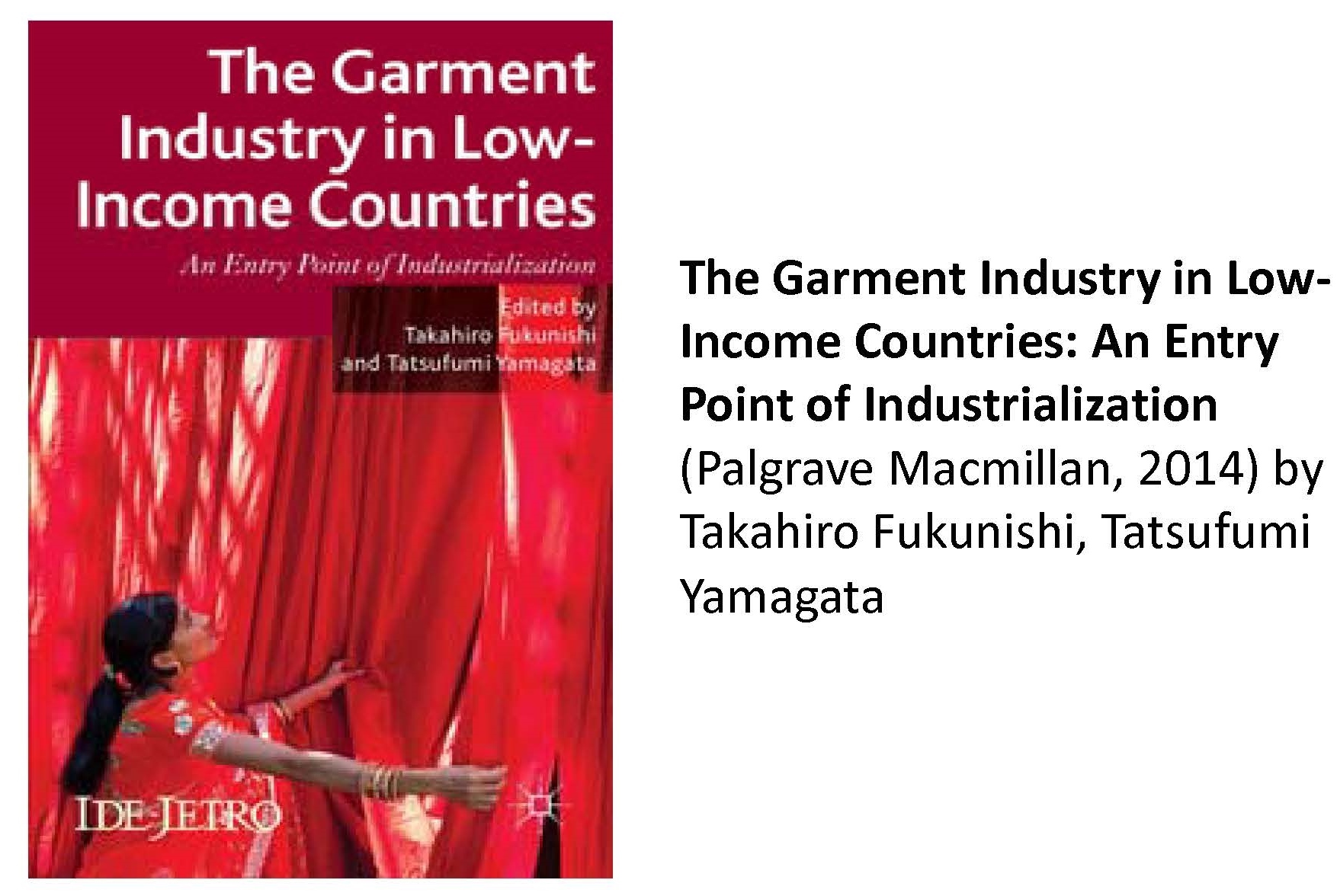
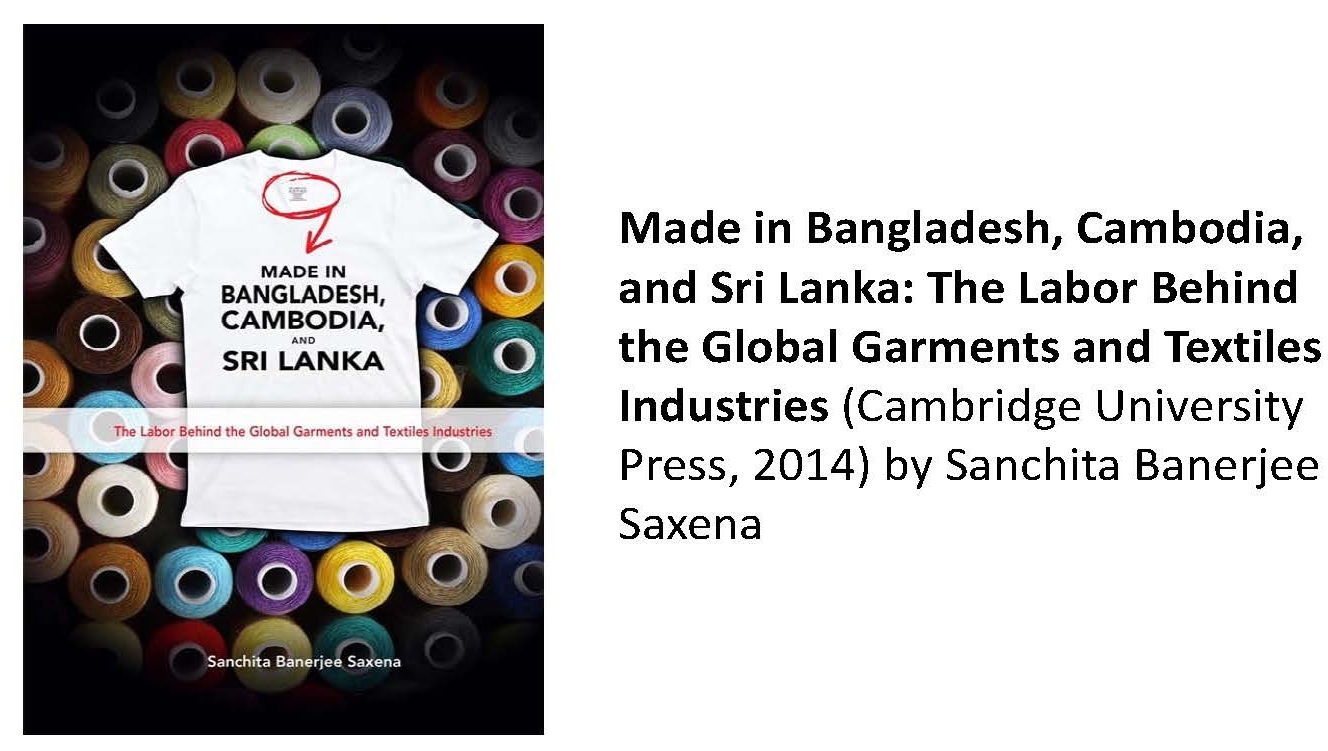
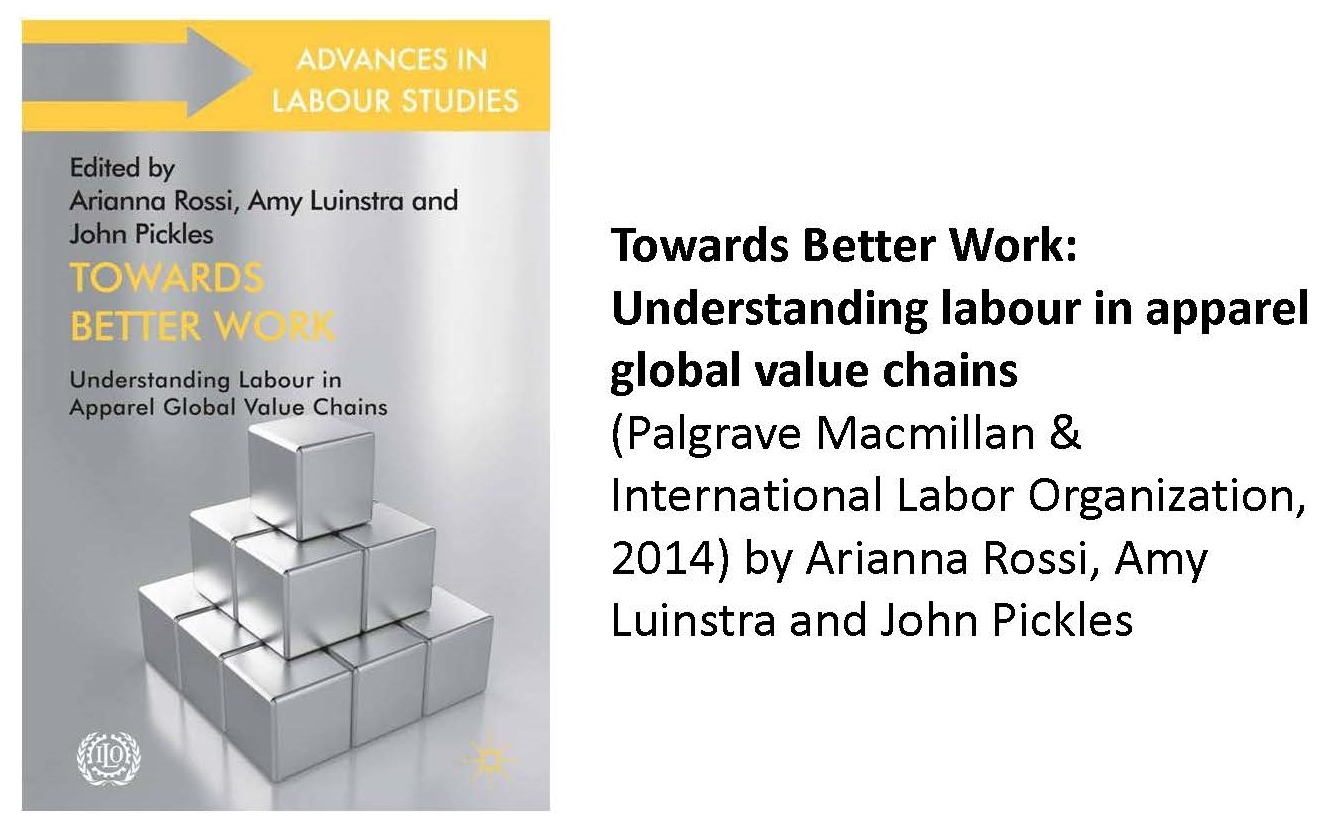
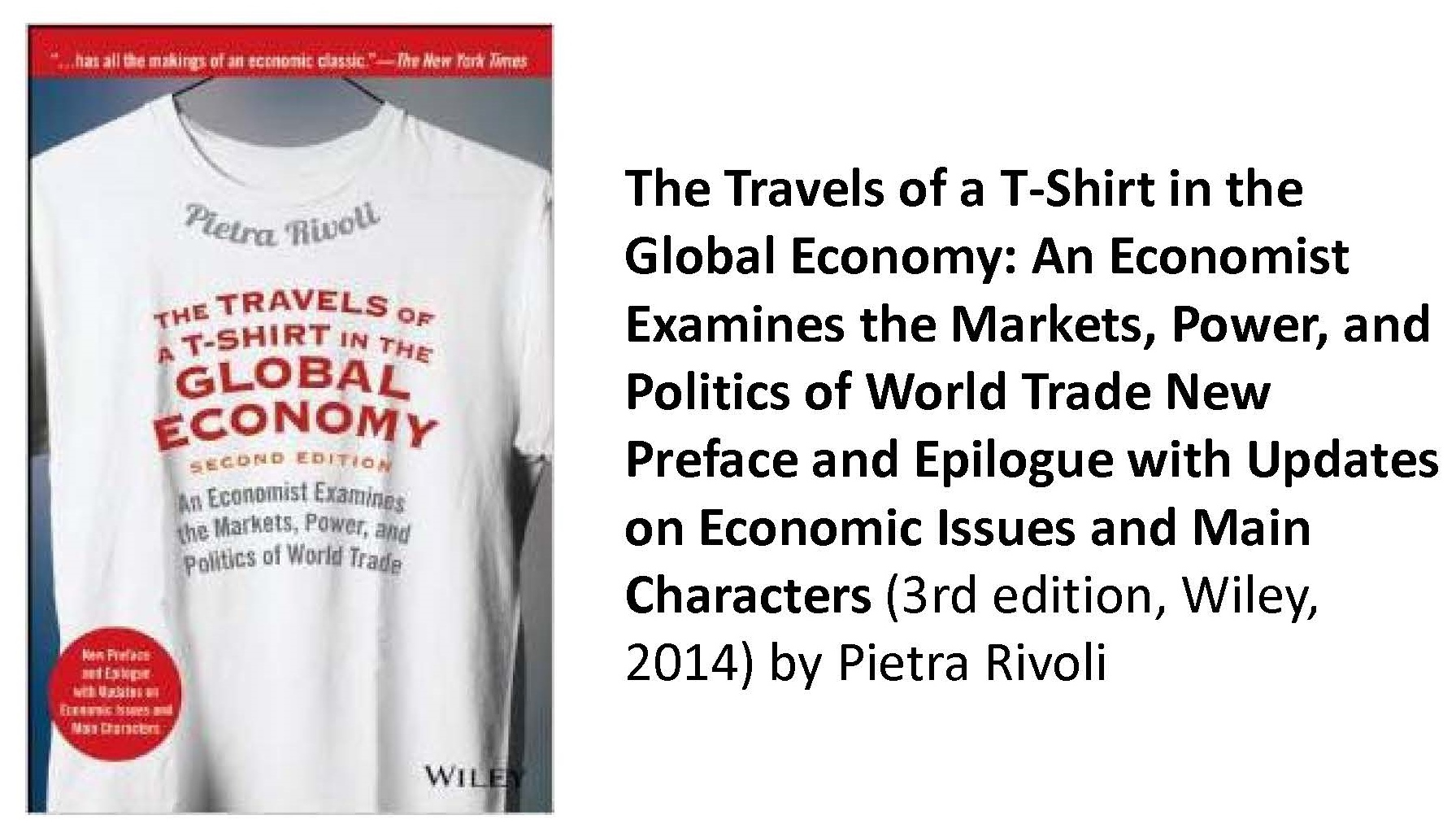
Recent Scholarly Books about the Global Textile and Apparel Industry (Update: Aug 2014)

4 3 2 1


Why does the US Textile Industry Want Yarn-forward Rule of Origin (RoO) in TPP?

textile

My personal understanding: the US textile industry insists yarn-forward RoO in TPP is not because they expect a substantial increase of textile exports to Vietnam as the case of NAFTA and CAFTA which help capture the export markets in Mexico and Central America. But rather it is because:

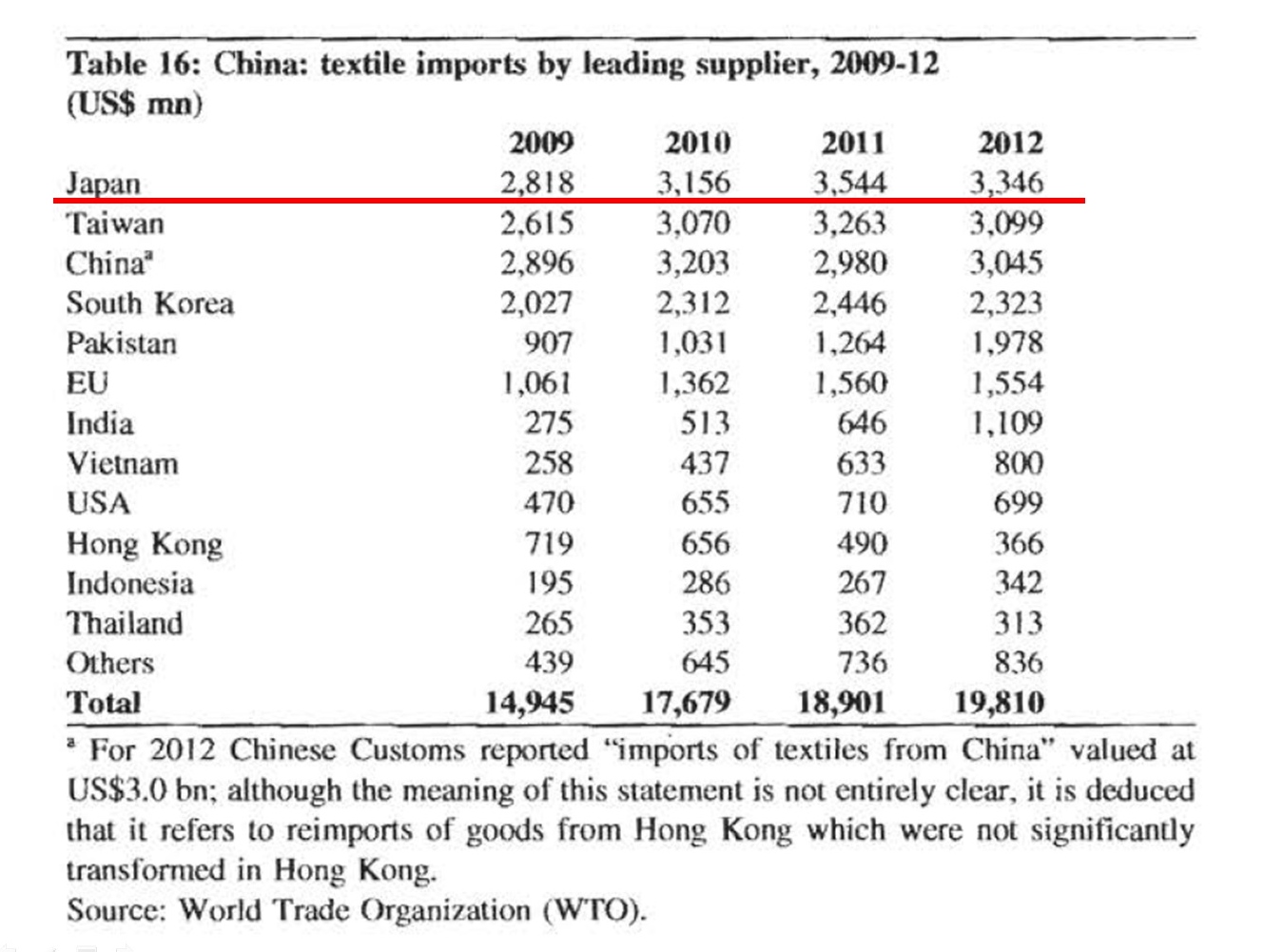
1) Without yarn-forward, situation will get even worse. Particularly, a less restrictive RoO will make Vietnam’s apparel exports which contain textiles made in China, Taiwan or South Korea qualified for duty free access to the US market. Definitely this will be a more imminent and bigger threat to the US textile industry than simply facing competition from Vietnam’s apparel which contains Japanese made textiles. And still many US textile companies don’t treat the Japanese textile industry very seriously, although I think they should. Remember, Japan currently is the fourth largest textile supplier to Vietnam and the NO.1 textile supplier to China.

1

2

2) With yarn-forward RoO in place, at least US textile companies can invest in Vietnam (remember, globalization is about movement of capital as well. Many apparel companies in Mexico and Central America actually are invested by US companies). Without yarn-forward RoO however, Vietnam can simply rely on imported textiles as the case mentioned in (1) and there will be no incentive for US textile companies to move factories to Vietnam (meaning, capital holders will lose).  

So overall yarn-forward RoO may win a few more years for the US textile industry. But in the long run, it is my view that the US textile production and its exports to the Western Hemisphere countries may still inevitably decline (especially those output to be used for apparel assembly purposes) after the implementation of TPP. In the 21st century, the nature of competition is supply chain v.s. supply chain. 

The future of the US textile industry is those high-end markets, particularly technical & industrial textiles.  

Sheng Lu 

Additional Reading: The potential impact of TPP on the US textile industry

Textile and Apparel Sector in the TPP Negotiation: An Update

TPP_map

USTR objectives
Officially, USTR has announced the following objectives in the TPP for textile and apparel:

  • Elimination of tariffs on textile and apparel exports to TPP countries;
  • A “yarn forward” rule of origin, which requires that textile and apparel products be made using U.S. or other TPP country yarns and fabrics to qualify for the benefits of the agreement, so as to ensure that non-qualifying textiles and apparel from non-TPP countries do not enjoy the benefits reserved for TPP countries;
  • A carefully crafted “short supply” list, which would allow fabrics, yarns, and fibers that are not commercially available in the United States or other TPP countries to be sourced from non-TPP countries and used in the production of apparel in the TPP region without losing duty preference;
  • Strict enforcement provisions and customs cooperation commitments that will provide for verification of claims of origin or preferential treatment, and denial of preferential treatment or entry for suspect goods if claims cannot be verified; and
  • A textile specific safeguard mechanism that will allow the United States and other TPP countries to re-impose tariffs on certain goods if a surge in imports causes or threatens to cause serious damage to domestic producers.

X-basket
According to the National Council of Textile Organizations, with regard to the market access offer to Vietnam, textile and apparel products are categories into different groups based on their “sensitivity” to the domestic industry producing the like products. Among the three major categories, the so called “X-basket” will include textile and apparel items that are deemed most sensitive to the United States. Specific items to be included in the X-basket however are unclear and details of the phrase-out formula are still under discussion. It is said that items in the “X-basket” may be subject to an initial tariff cut ranging from 35 to 50 percent.

Vietnam’s top apparel exports to the United States are basic apparel items like shirts, sweaters and pants.  Many of them are the same types of items that were subject to the U.S. safeguard measures against China back in 2005. The U.S. textile industry hopes that the longer phrase-out period for items in the “X-basket” would provide needed time for the industry to adjust. However, for the Vietnam side, if duties on most of its apparel exports to the United States stay in place after the implementation of the TPP, the value of participating in the agreement would substantially be compromised.

Short-supply list
The short-supply list is a roster of fabrics and other textile inputs that are determined to not be readily available in the TPP region in commercial quantities on a timely basis and can therefore be imported from third countries. Items on the short-supply list would be exempt from the general “yarn-forward” rule of origin that the U.S. has proposed in the textiles and apparel talks. USTR is pushing for a short-supply list that would have permanent items as well as temporary items that will be removed after three years. Previous U.S. free trade agreements, including CAFTA, have included a short supply process to add additional products to the list once the agreement enters into force. But the U.S. has rejected the notion that the short-supply list could be modified after the TPP enters into force.

Mexico has consistently sought to limit the scope of the short-supply list, arguing that it actually makes some of the products that the U.S. had originally proposed for inclusion in the short-supply list. Mexico was also pushing for roughly 70 items proposed for the short supply to be included only on a temporary basis, rather than a permanent one.

Other TPP members’ positions
According to the Inside US Trade, Malaysia’s textile and apparel industry is supporting U.S. calls for a “yarn-forward” rule of origin in TPP, but is also pushing for a range of exceptions such as cut-and-sew allowances and a short supply list that would be periodically reviewed. Among the items the Malaysian industry would like to see on the short supply list are shirting fabrics such as woven cotton fabric that weighs not more than 250 grams because this type of fabric is said not made in the U.S. nor Malaysia.

Related reading
Lu, S. (2014). Does Japan’s accession to the Trans-Pacific Partnership an opportunity or a threat to the U.S. textile industry: A quantitative analysis. Journal of the Textile Institute. (ahead of print version) 


EU Commission: Skills for Jobs in the EU Textile and Clothing Industry to Evolve

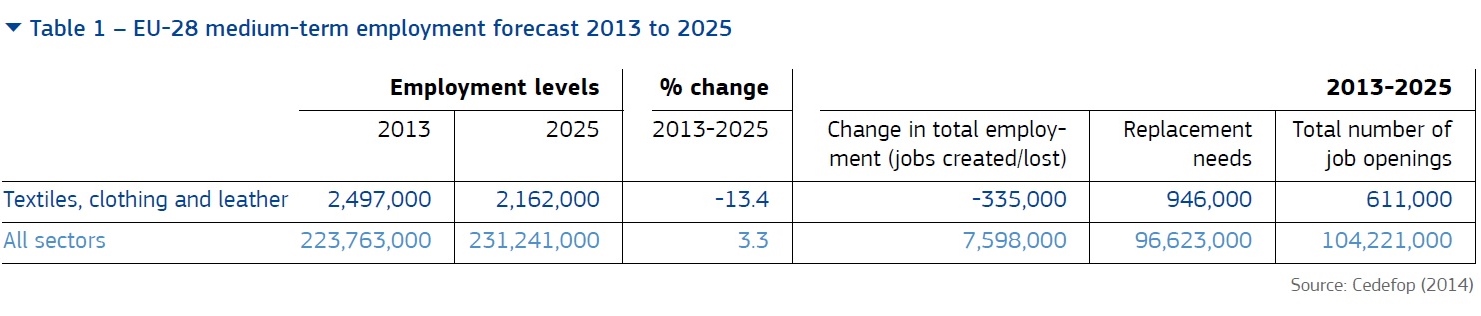
In a recent analysis report, the EU Commission foresees that skills needed by jobs in the EU textile and clothing industry will continue to evolve from 2013 to 2025. Specifically, the report argues that:

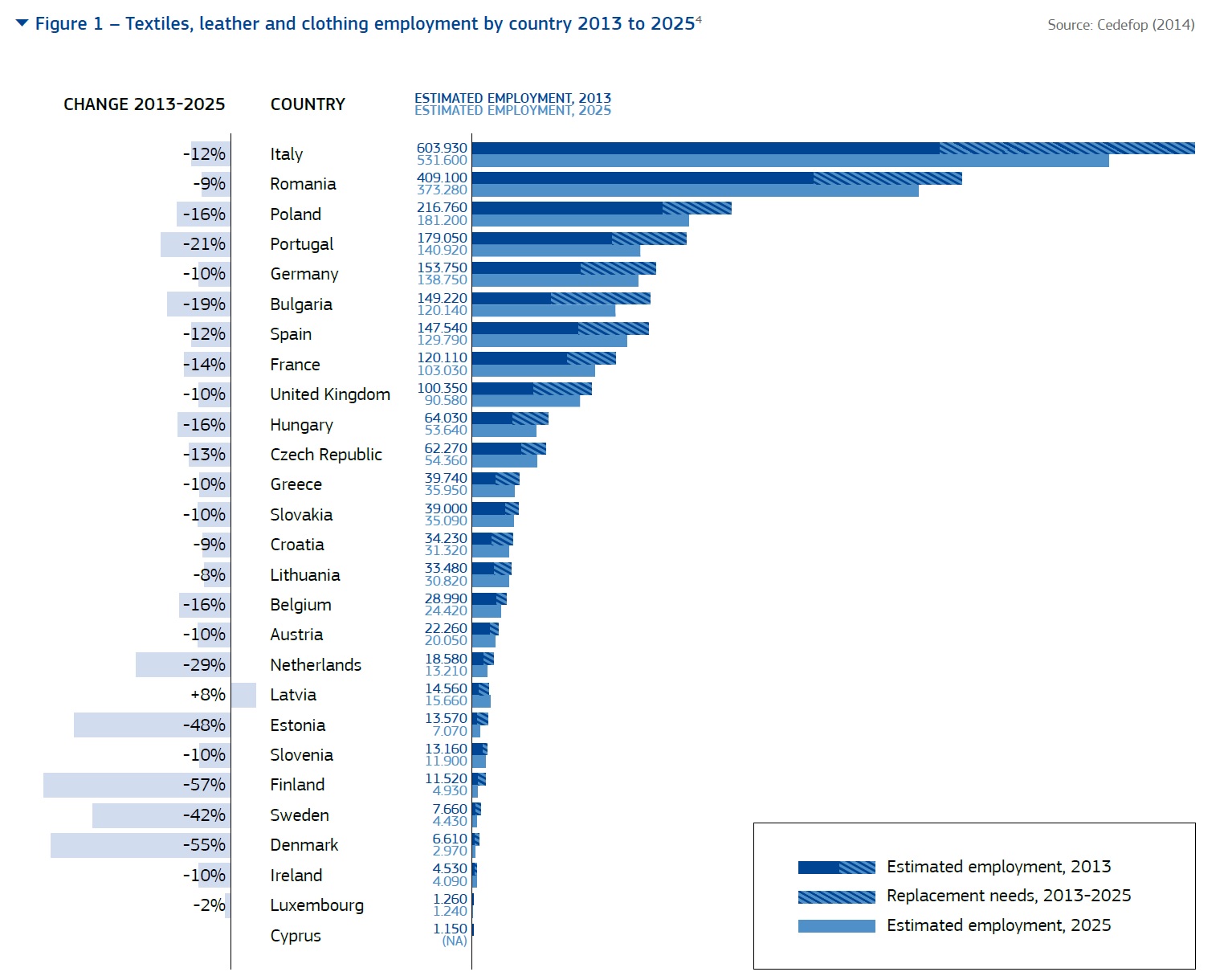
First, employment in the EU textile and clothing sector is forecast to decline by 13.4% from 2.5 million in 2013 to 2.1million in 2025. Even with shrinking employment levels, because of the need to replace nearly 1 million workers forecast to retire or leave the sector, about 611,000 job openings are anticipated from 2013 to 2025.

Second, employment in the EU textile and clothing sector is no just declined, but also evolved. From 2013 to 2025, demand for “crafted and related occupations” as well as “plant and machine operators and assemblers” will decline 34% and 13% respectively, whereas job openings for “technician and associated professional occupations” are estimated to grow at a modest rate. Among the estimated 611,000 job openings, 93% will require high or medium level qualifications.

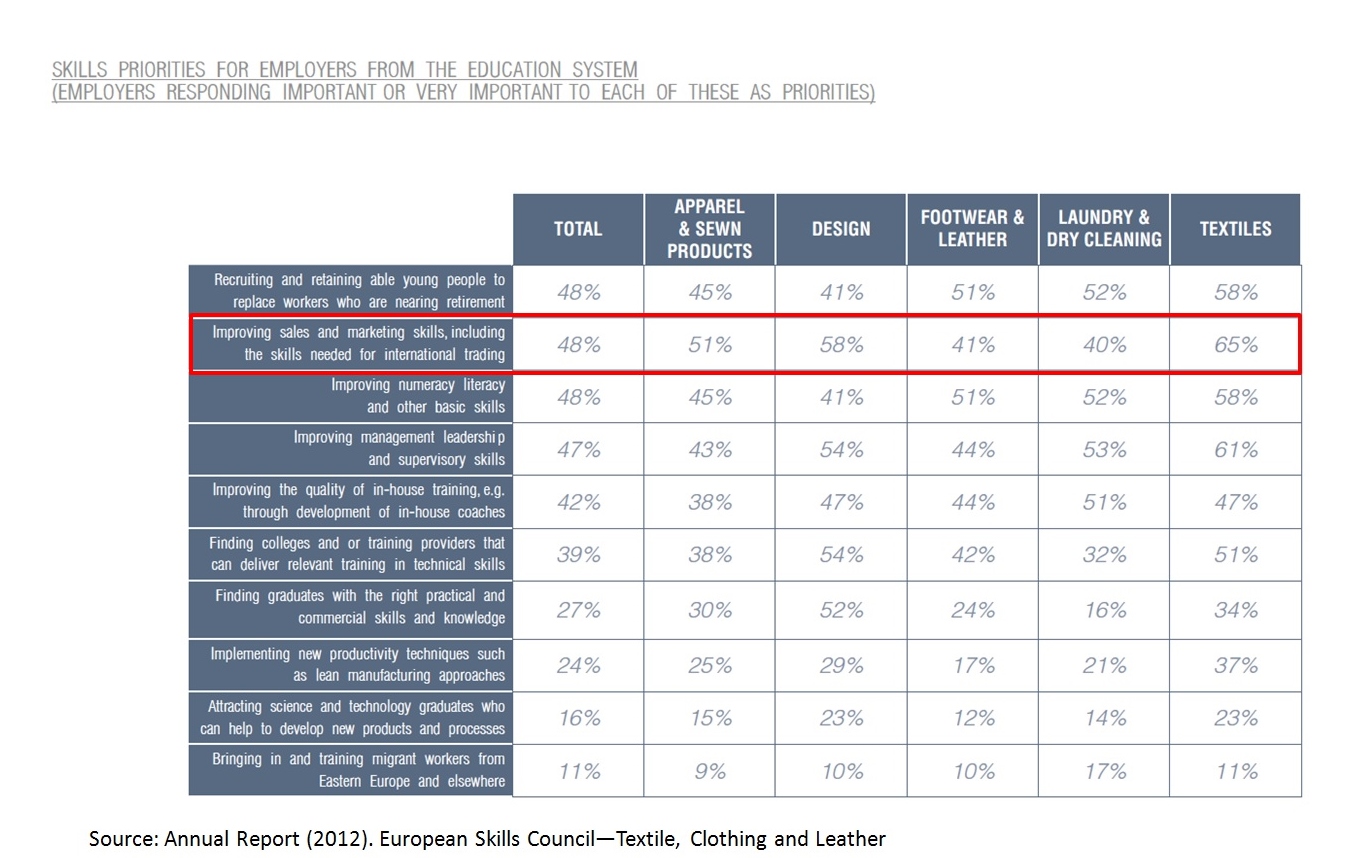
Third, in terms of specific skills needed by the EU textile and clothing sector based on where the sector might progress towards 2020:

1) Technical production competencies will remain central to recruitment with increased focus on the demand for versatile staffs that can operate across different workstations.

2) Supply chain management, business, sales and marketing skills (including the skills in international trade) are growing in importance. For many EU textile and clothing companies, “trade has taken place of production”.

3) The EU textile and clothing industry is further expecting skills on technology, innovation and sustainability. Leading technology-led areas include mass customization, 3D body measurement, advanced CAD and eCommerce technologies, internet infrastructures for custom-tailored clothing and business-to-consumer eCommerce among retailers.

2

3

1

UNCTAD: Sharp Rise of Greenfield FDI in the Textile and Apparel Industry Worldwide from 2012 to 2013

According to the 2014 World Investment Report released this week by the United Nation Conference on Trade and Development (UNCTAD), a sharp rise in greenfield foreign direct investment (FDI)* activity was observed in the textile and apparel (T&A) industry worldwide from 2012 to 2013, with the value of announced investment projects totaling more than $24 billion, more than doubled than the level a year earlier.

Although detailed country-level data is not available, the UNCTAD report shows that the developed countries as a whole attracted $13.7 billion inflows of greenfield FDI and invested $18.7 billion greenfield FDI overseas in the T&A industry from 2012 to 2013. The report further says that Cambodia and Myanmar, the two least developed countries in South-East Asia, have recently emerged as attractive locations for investment in textiles, garments and footwear.

FDI is another critical format of market access in addition to international trade.

*Note: Greenfield FDI means a foreign company opens a new physical facility from which to conduct business.

Untitled

Euratex Releases Key Indicators of the EU Textile and Apparel Industry in 2013

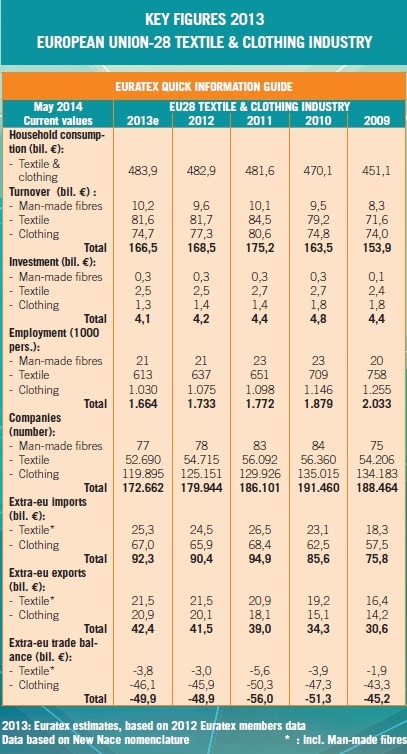
In its annual release, the European Apparel and Textile Federation (Euratex) provides a skeletal statistical profile of the EU textile and apparel (T&A) in 2013. Most statistics cited in the report comes from the Eurostat.

Production
In 2013, T&A production in EU overall remains stable. Output of Man-made fiber (MMF) enjoyed a 6.8 percent growth from a year earlier, although production of textile (yarns, fabrics and made-ups) and apparel respectively declined 0.1 percent and 4.2 percent.  Accumulatively, from 2010 to 2013, production of MMF, textile and apparel in EU has down 15.2 percent, 8.1 percent and 13.3 percent respectively.

Employment
Employment in the EU T&A industry continues to move downward in size, shrinking from 1.73 million in 2012 to 1.64 million in 2013. The most significant drop happened in the apparel subsector, which suffered a 4 percent job loss from 2012 to 2013. The number of employment in the textile and MMF subsectors goes down 3.7 percent and 1 percent respectively.

Consumption
Affected by the slow economic recovery in the region, EU consumers seem still hesitant in expending more money on T&A products in 2013. Value of T&A consumption in EU (28) stood at €483.9 billion in 2013, only a slight increase of 0.2 percent from 2012.

Trade
The two-way EU T&A trade enjoyed a modest growth from 2012 to 2013. Particularly, despite reported decline in production, value of EU apparel exports in 2013 increased 4 percent, reflecting the growing demand for “made in EU” apparel products in other parts of the world. In terms of import, consistent with the pattern of consumption, EU apparel imports slightly increased 1.7 percent from 2012 to 2013. It should be noted that China is gradually losing market share in the EU apparel import market. From 2012 to 2013, value of China’s apparel exports to the EU declined 4 percent, compared with 10 percent growth of Bangladesh.

EU1

EU2

EU Commission Releases Negotiating Positions for Textile and Apparel in T-TIP

EUUSbridgeShutte

The EU Commission released its negotiating positions for the textile and apparel sector in the Trans-Atlantic Trade and Investment Partnership (T-TIP) on May 14, 2014.  The position paper outlines a few areas that the EU Commission says it would include in the T-TIP negotiation with the United States:

  • Labeling requirements for textile & apparel and footwear products
  • convergence and/or harmonization of approaches to guarantee product safety and consumer protection
  • standards approximation

Earlier this year, USTR also released its negotiating objectives for the T-TIP. Specifically for the textile and apparel sector, USTR will “seek to obtain fully reciprocal access to the EU market for U.S. textile and apparel products, supported by effective and efficient customs cooperation and other rules to facilitate U.S.-EU trade in textiles and apparel.” USTR holds the positive view that “eliminating the remaining duties on our exports will create new opportunities for integration into European supply chains and to sell high-quality “made-in-USA” garments to European consumers.  Enhanced U.S.-EU customs cooperation will also help ensure that non-qualifying textiles and apparel from third countries are not being imported into the United States under T-TIP.

However, T-TIP negotiation somehow is under the shadow of the Trans-Pacific Partnership (TPP), another free trade agreement currently under negotiation among the United States and other eleven countries in the Asia Pacific region. As reported by the Inside US Trade, the National Council of Textile Organizations (NCTO) holds the view that TTP and T-TIP negotiation should be dealt with “sequentially”. NCTO would like to avoid a situation where the US makes a concession on textiles and apparel to the EU in T-TIP that goes beyond the US offer to Vietnam in TPP, causing Vietnam to demand the same concession in the TPP talks.

One of the most difficult issues on textiles and apparel in T-TIP will be the rule of origin, given that the U.S. and EU have taken vastly different approaches on this issue in their existing preferential trade agreements. The EU rule of origin for apparel essentially consists of two different rules — one that applies generally and one that can be used as an exception. Under the general rule, an apparel item qualifies as originating if it has undergone at least two “substantial processes” in the EU. In general, weaving the yarn into fabric and finishing the fabric are considered substantial operations. Under this scheme, EU manufacturers can use non-originating yarn to make qualifying apparel as long as that yarn is woven into fabric in the EU and also finished there. As a result, this part of the EU rule is sometimes referred to in the United States as the equivalent of a “fabric-forward” rule, since it usually requires all components of the item, starting with the fabric, to be made in the region.

The second part of the EU rule — which functions as an exception — essentially applies a more liberal rule for certain apparel and textile items. These items can qualify for tariff benefits even if only the printing or other downstream operations occur in the EU. Specifically, under this exception, a textile or apparel item that is made from non-originating fabric but for which the printing occurs in the EU can qualify for tariff benefits if the non-originating part of the item is no more than 47.5 percent of the value of the final product. EU manufacturers of printed bed sheets often take advantage of this printing exception (Inside US Trade).

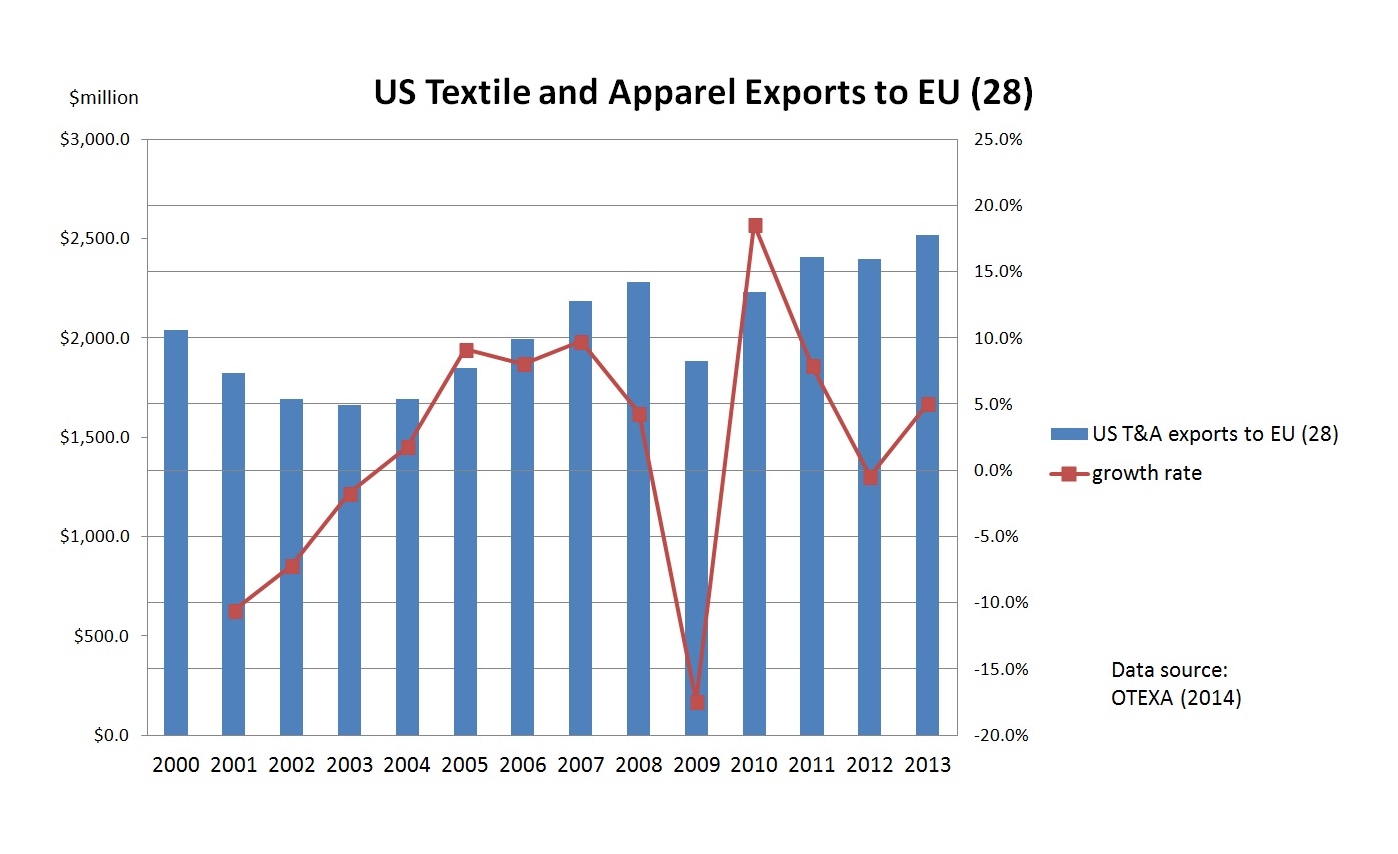
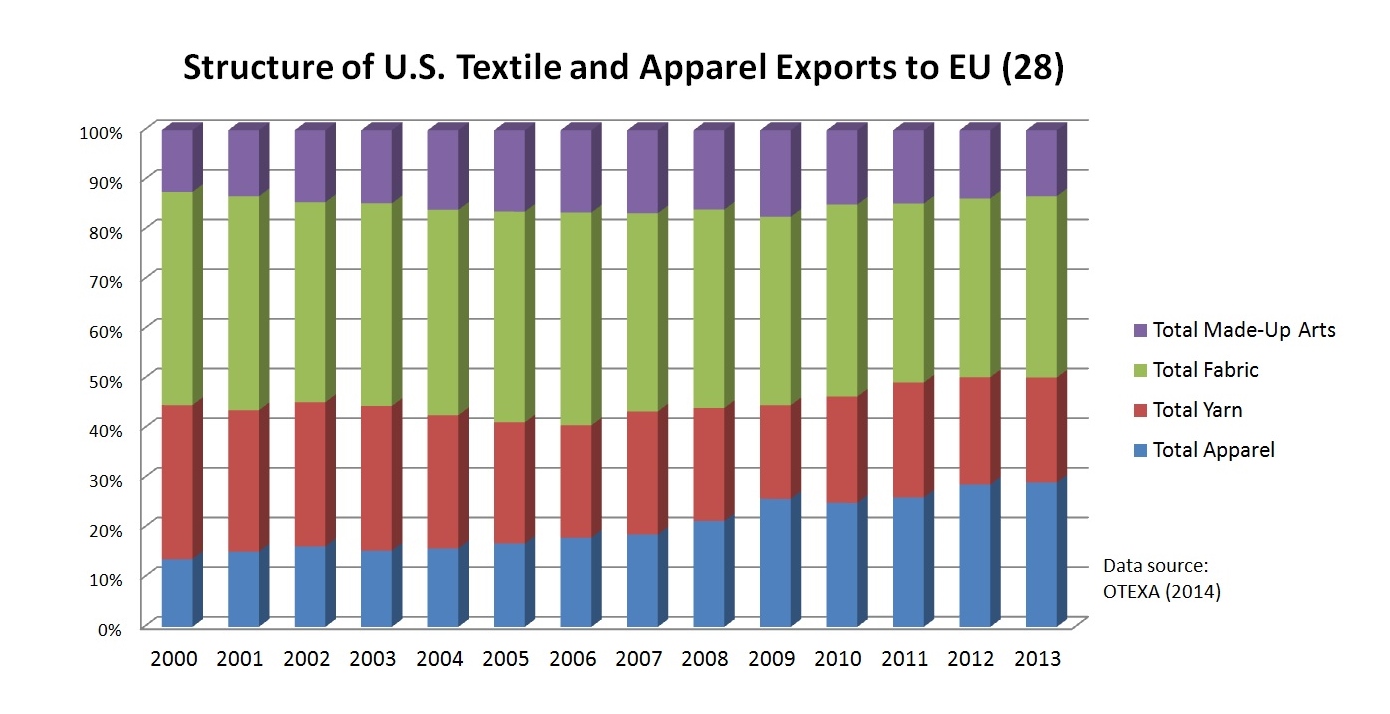
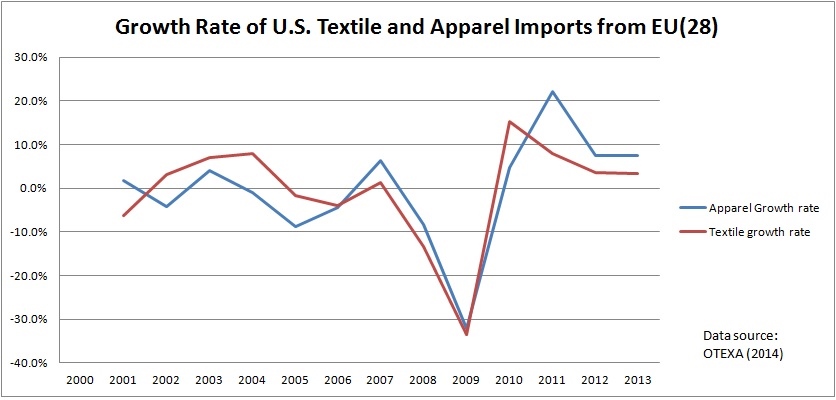
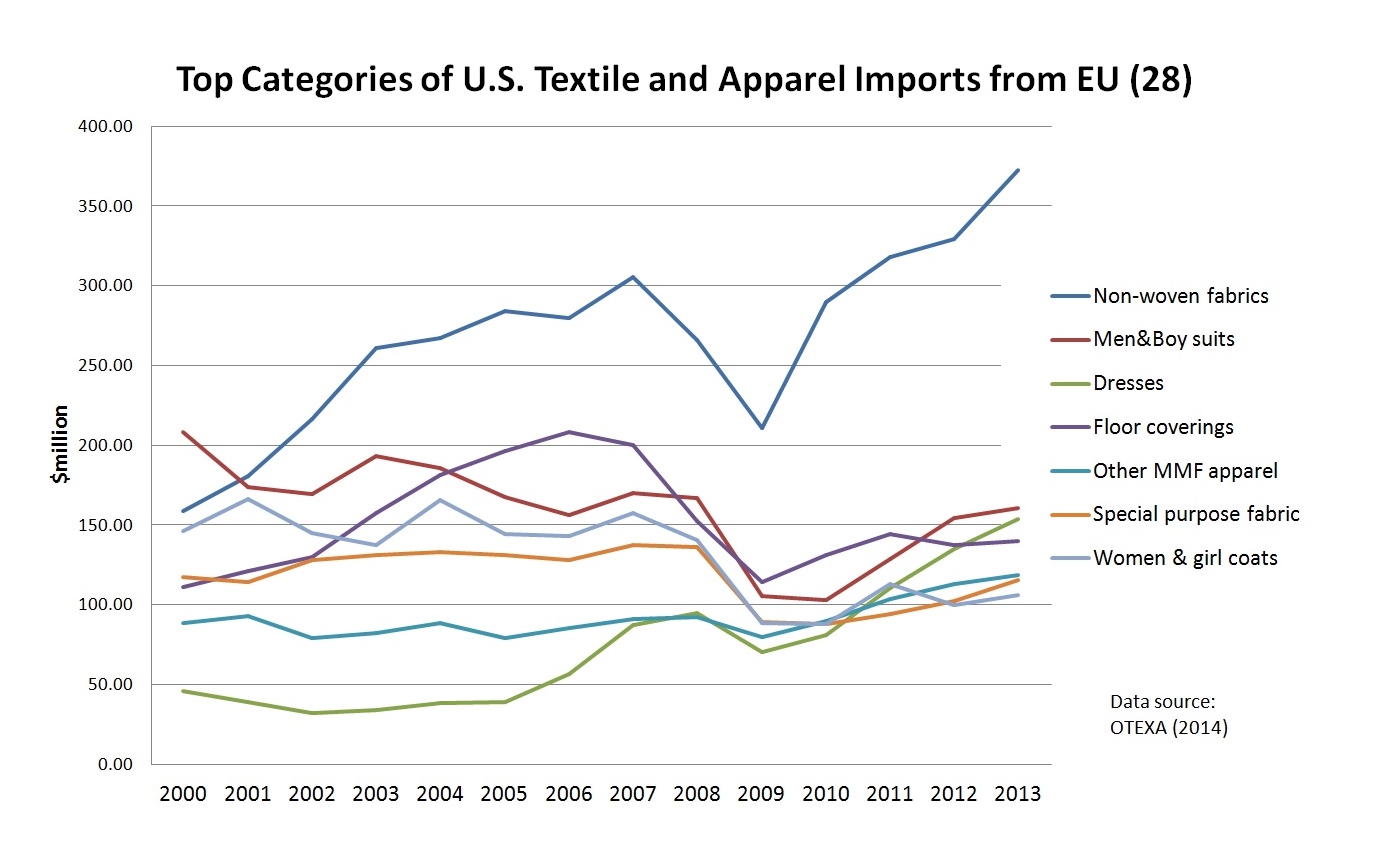
Latest data from OTEXA shows that in 2013, U.S. textile and apparel imports from EU(28) totaled $4 billion, among which 52% were apparel products and 48% were textiles. Top product categories of U.S. textile and apparel imports from EU include non-woven fabrics, men&boys’ suits, dresses, floor coverings, other man-made fiber apparel, special purpose fabrics and women & girls’ coats. In comparison, U.S. textile and apparel exports to EU(28) reached $2.5 billion in 2013, among which only 29% were apparel products and 71% were textiles. Top product categories of U.S. textile and apparel exports to EU include specialty & industrial fabrics, felts & other non-woven fabrics, filament yarns, other made-up textile articles, waste & tow staples, women & girls slacks, shorts and pants as well as spun yarns & thread.

1

2

3 4

 5

7

Vietnam Announces Ambitious Plan to Develop its Textile Industry

Reported by the Sourcing Journal, Vietnam’s Ministry of Industry and Trade recently approved its textile and garment sector development plan up to year 2030. Under the new plan, Vietnam sets an ambitious goal to achieve a 55% local content ratio for exported apparel by 2015 and will further increase the ratio to around 70% by 2030. As estimated, the plan will bring about an annual textile production growth rate of 12 to 13 percent between 2013 and 2030 in Vietnam.

Numerous studies have suggested that Vietnam could substantially expand its apparel exports to the world after the implementation of the Trans-Pacific Partnership (TPP), a free trade agreement under negotiation by twelve countries in the Asia-Pacific region, including the United States and Vietnam. However, restrained by its stage of development, about 70—80% of Vietnam’s demand for textile inputs currently is imported (Lopez-Acevedo & Robertson, 2012). Based on 23 interviews, Goto (2007) further finds that apparel suppliers in Vietnam on average produced 67% CMT and 33% FOB based on value and 95% CMT and 5% FOB based on quantity.

But with the help of foreign investment from South Korea, Taiwan and Japan, Vietnam is quickly building up its textile manufacturing capacity (note: this is very different from the case in Mexico). According to the General Statistics Office of Vietnam, the number of textile firms in Vietnam had quickly increased from 408 in 2000 to 1,577 in 2008. Lopez-Acevdeo & Robertson (2012) further suggest that Vietnam’s annual production of cotton fiber has reached 10,000 tons; 50,000 tons of man-made fiber; 260,000 tons of short-staple fiber and yarn; 15,000 tons of knitted fabric; and 680 million meters of woven fabric. Around 38% of Vietnam’s textile output came from foreign invested companies in 2009.

Vietnam’s ambition to expand its domestic textile manufacturing capacity will have huge implications for the US-based textile industry. Although Vietnam seldom uses US-made textile inputs, Vietnam’s apparel exports to the United States directly compete with those exported from Mexico and countries in the Caribbean Basin regions which is the largest export market for U.S. made textiles (Lu & Dickerson, 2012).  An expanded local textile manufacturing capacity will not only reduce Vietnam’s demand for imported textile inputs, but also will help improve the price competitiveness of Vietnam’s apparel exports in the global marketplace. If China increasingly moves its textile factories to Vietnam (unless the conflict between Vietnam and China over the South China Sea complicates the situation), Vietnam may further becomes a net textile exporter in the long run.

1

2


Untitled


3

4

Is Wal-Mart’s $250 billion “Made in the USA” Program Another “Crafted with Pride Campaign”? (I)

walmart

crafted-with-pride-hangtags

Earlier this year, Wal-Mart Store Inc. announced its commitment to buy $250 billion “Made in the USA” products (including textiles and apparel) over the next 10 years ($50 billion annually) with the hope to “help spark a revitalization of U.S.-based manufacturing” and “create jobs in America”. According to the Hoover’s, Wal-Mart’s cost of goods (i.e. sourcing cost for merchandise sold) totaled $358 billion in fiscal year 2013, suggesting $50 billion will account for around 10-14% of its total sourcing portfolio.               

Wal-Mart’s campaign has received positive feedback from the US textile and apparel industry. As reported by the WWD, the U.S. textile industry sees Wal-Mart’s movement an encouraging and “sincere commitment”. Bill Jasper, the outgoing chairman of the National Council of Textile Organizations (NCTO) and CEO of Unifi Inc believed that “manufacturing in general across the United States is in a more favorable position than we’ve seen for some time” and “this is an environment for growth in U.S. textile manufacturing”. As an example, Unifi Inc has spent millions of dollars upgrading its equipment and expanding the company’s US-based cloth mill. However, Bill also realizes the market risks involved in the investment decision, which may not happen without Wal-Mart’s “assurance” through the $250 billion program.

However, to fully take advantage of Wal-Mart’s program is not without obstacle. On top of them, Walmart requires qualified apparel for the program has to be “100 percent made in the United States”. However, the reality is there is more apparel being made in the Western Hemisphere by countries such as Mexico and those in the Caribbean Basin Regions than there is in the United States. As put by Bill, “We’re seeing more of a resurgence of ‘made in the region’ as opposed to Made in USA…If you at look the growth we see in apparel, much of that is in Central America and to a lesser extent Mexico. It does drive growth in yarn and fabrics here in the U.S., which are feed for those garments.”

It is also interesting to compare Wal-Mart’s $250 billion “Made in USA” program with its role in the “Crafted with Pride Campaign” launched in the 1980s (our case study 3). During that campaign, Wal-Mart initially pledged that “our entire management and merchandising staff is committed to Buy American program” and it did cut imports by 20% and purchased $197.3 million of merchandise from domestic suppliers in 1985 (Minchin, 2012). However, for the commercial reasons,  later on Wal-Mart more and more relied on imports to support its global expansion and “everyday low price” business model. The “betrayal” of Wal-Mart largely contributed to the eventual failure of the campaign.

What will be the destiny of the 21st century version of the “Crafted with Pride Campaign”? Is Wal-Mart really committed to “Made in USA” or rather the more price competitive “Made in USA” today attracts the attention of Wal-Mart? If implementation of new free trade agreements such as TPP and TTIP switches the cost balance of domestic sourcing versus global sourcing again, will War-Mart repeat its record in history? Maybe only time will tell…

Sheng Lu

The Ways and Means Hearing Shows Divided Views on US Trade Policy for Textiles and Apparel

ways&means

US Trade Representative Michael Froman testified on Obama’s 2014 trade policy agenda before the House Ways and Means Committee on April 3. Issues concerning the textile, apparel and the footwear industry were raised three times during the 3-hour hearing. However, it seems the Congress is much divided on how to deal with the T&A sector deemed as “sensitive” in the FTA talks.

(1h:42’)Mike Thompson (D-CA) asked Froman to reevaluate the value of including the “yarn-forward” rules of origin (RoO) in the TPP. Thompson suggested that this rule only affects a small proportion of the US apparel imports nowadays (Note: according to Froman, it was $13 billion annually or 17% of the total US apparel imports) and no longer meets the needs of the US outdoor apparel industry which demands more flexible RoO in supporting of their business model. In response, Forman said that “the USTR’s approach to T&A is always being to ensure to strike a balance that helps the domestic producers continue to produce while allowing importers to import products that serve customers…”

(2h:06’) Earl Blumenauer (D-OR) asked Froman to reduce the trade barriers (tariff and NTB) on footwear imports, arguing that less than 1% of the footwear consumed in the US nowadays is domestically produced. He said that the high tariff rates both retard the ability of the US footwear industry to concentrate on those parts of the value chain that it enjoys competitive advantages and hurt the interests of the US consumers. In response, Forman said that footwear has been a sensitive and key issue to the US and among other TPP members. According to Forman, USTR has been working both with the domestic producers and the importers to develop an approach hoping to achieve the right balance that the domestic producers can continue to compete and also the importers can bring in high quality products (from overseas) for the US consumers. Additionally, Forman referred to the footwear industry an “outstanding area” in the TPP negotiation and said that discussion among all partners will continue.

Last but not least, (2h:30’) Bill Pascrell(D-NJ), also the chair of the house textile caucus, reiterated the importance of the yarn-forward RoO to the US textile industry and asked Froman to ensure that the USTR will “seek the longest possible duty phrase out for the most sensitive textile items” in the TPP negotiation. In his reply to Pascrell, Forman said that his team will work with all stakeholders of the US T&A industry to fully understand what these “sensitive textile items” are and will use tools like the “phrase out period” and “short supply list” to strike a right balance. Pascrell also expressed the concerns of the US textile industry about Vietnam’s wanting of immediate access to the US apparel market after the implementation of the TPP. However, Forman declined to give any concrete promise, just saying the USTR commits to create the “maximum number of jobs in the US” through the trade talks[Note: textile industry jobs? Apparel retail jobs?].

In addition to the T&A, other issues mentioned in the hearing include TPA, GSP, TAA, IPR, SPS & TBT, TTIP, SOE, TiSA, ITA and WTO.

Full hearing can be viewed here

Sheng Lu

National Export Initiative Priority Markets

95% of the consumers live outside the US, implying huge market opportunities for the US textile and apparel industry. Among the leading emerging markets for U.S. companies are China, Vietnam, India, Indonesia, Taiwan and Thailand. From watching the short videos below (prepared by the US Commerce Department), how do you see the importance of these markets? And what are the unique local business environment and culture in your view?

China

Vietnam

Thailand

India

Indonesia

Taiwan