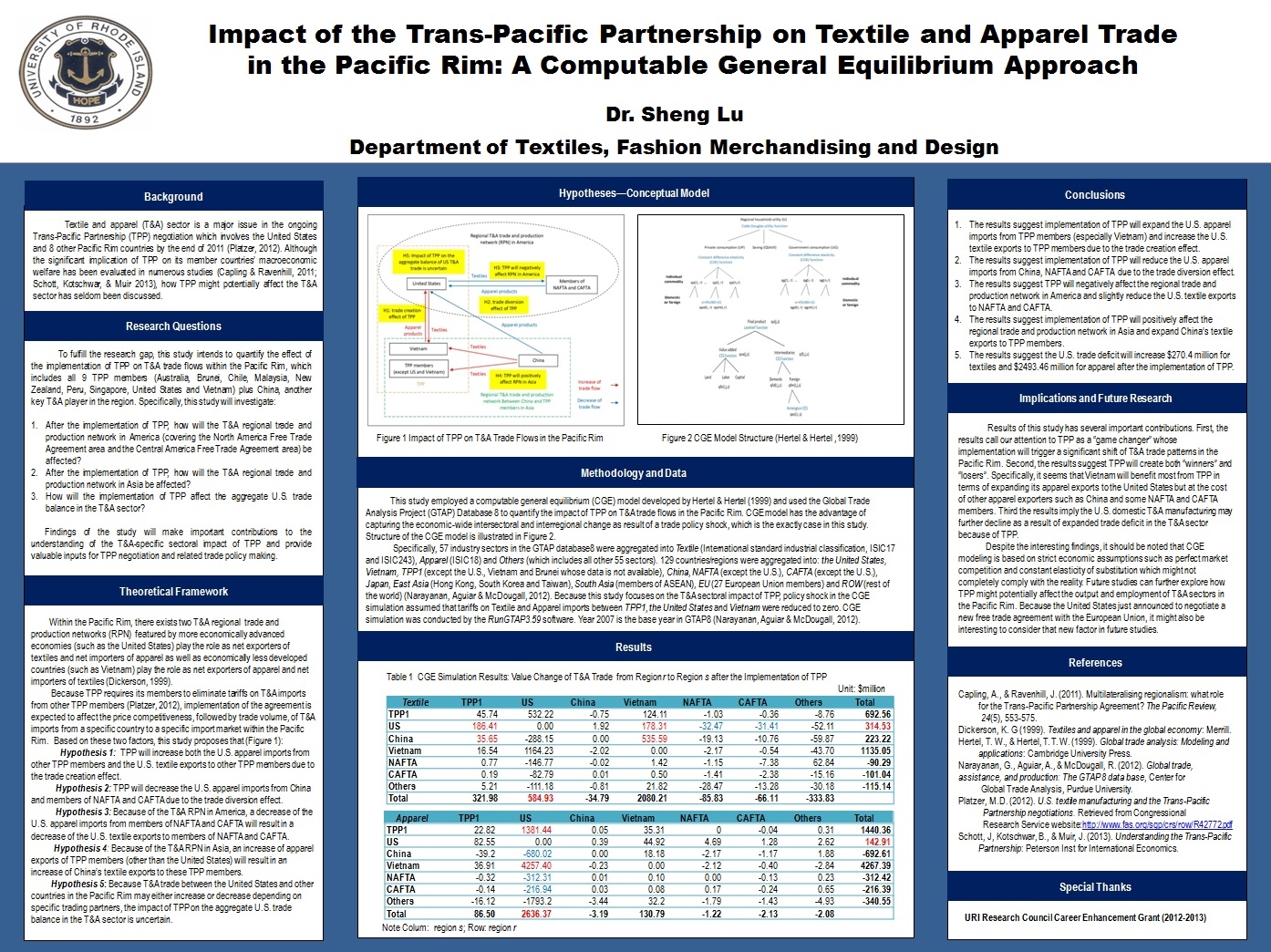
Citation: Lu, S. (2013). Impact of the Trans-Pacific Partnership on textile and apparel trade in the Pacific Rim. World Trade Organization Focus, 20(5), 67-77.
For questions, please contact the author: shenglu@mail.uri.edu
FASH455 Global Apparel & Textile Trade and Sourcing
Copyright© 2012-2026 Dr. Sheng Lu, Professor, Department of Fashion & Apparel Studies, University of Delaware

Citation: Lu, S. (2013). Impact of the Trans-Pacific Partnership on textile and apparel trade in the Pacific Rim. World Trade Organization Focus, 20(5), 67-77.
For questions, please contact the author: shenglu@mail.uri.edu
Yesterday in class, some of you asked why did the U.S. decide to join the TPP negotiation at the very beginning? The following report from the Financial Times (UK) may provide some insightful views. To put it simply, it is a big game involving national interests. You can also rethink about those points I mentioned in the class regarding the “strategic importance of Asia to the US”.
From Financial Times April 2, 2013
With the rise of China in its sights, the Obama administration has posted marines in Darwin, Australia, and increased the number of warships visiting Subic Bay in the Philippines. The “pivot” to Asia now has a new stopover: Brussels.
After years of discussing the idea, the US and the EU are finally starting to negotiate a free-trade agreement which would form an economic zone covering 40 per cent of the world’s gross domestic product.
At the same time, momentum is building on another important trade initiative, the Trans-Pacific Partnership, which brings together the US with several of the Asia-Pacific region’s most dynamic economies: Singapore, Australia, Vietnam and – since two weeks ago – Japan. It will come as a surprise to anyone who spent a lot of time on the campaign trail last year, but free-trade agreements have emerged as one of the biggest priorities of Barack Obama’s second term as US president.
The striking feature of this burst of free trading is who is absent. The agreements are one of the fresh ways Washington is developing to deal with China, the world’s biggest exporter of manufactured goods. After urging China to behave as “a responsible stakeholder” and after the brief flirtation with a G2 arrangement in Mr Obama’s first year, the latest trade approach might be characterised as ABC – Anyone But China.
Supporters of the US-EU trade pact complain that it is about more than China. They point to the boost to growth that could flow from a deal between two partners which already have a two-way annual trade in goods and services of $1tn.
However, much of the substance of the EU talks and of TPP points to China. The agenda includes state subsidies for business and protecting intellectual property – the sorts of issues that are huge bones of contention with Beijing.
If the US can get enough important countries to sign up, it hopes to establish global trading standards that China would feel obliged to respect.
On Capitol Hill, where free trade is not an easy sell in an era of unemployment of more than 7.5 per cent, the China angle helps to rally support.
“This is very much part of our China strategy,” an aide to a leading Republican senator puts it, talking of the discussions with the EU.
More broadly, the two negotiations reflect a different approach to global governance. Prolonged deadlock over the Doha trade round, with similar stalemates about climate change, small arms and other issues, has led to deep scepticism about the idea of achieving global agreements on important issues.
TPP and the US-EU trade talks represent an alternative strategy, an attempt to forge fresh rules by appealing to smaller groups of like-minded nations, in this case working around China rather than with Beijing. Supporters say this is not an abandonment of global institutions like the World Trade Organisation, but simply a realistic assessment of how to get things done.
The big question, of course, is how China will react. Ever since it joined the WTO more than a decade ago, China has had one foot inside the global trading system and one outside it.
On most of the occasions that China has lost legal challenges at the WTO, it has implemented the rulings and made its trade laws compliant. But Beijing has yet to open up government procurement, an important factor in an economy like China’s. At the same time, allegations of Chinese hacking of trade secrets from other countries are seen by many as an affront to the very idea of free trade.
Beijing has strong views about what is really going on.
“The US is trying to rewrite global trade rules behind our backs,” says a senior Chinese official.
The risk of the US approach is that it could encourage China to turn its back even further on the global trading system, diminishing the incentive to comply rather than intensifying it.
If that were to happen, the US-EU trade talks would not herald a new era of economic integration but rather another nail in the coffin of globalisation.

From Just Style, March 2013
Textile and clothing industry groups on both sides of the Atlantic have welcomed the news that the EU and the US are to commence talks on the biggest bilateral trade deal ever negotiated.
European Union (EU) clothing and textile industry association Euratex has hailed the launch of talks between the United States and the EU to forge what the European Commission calls the “biggest bilateral trade deal ever,” saying EU exporters will benefit.
A deal, once sealed, could eliminate American duties as high as 19%, says Euratex.
The EU’s textile and clothing industry already has a positive trade balance with the US. “Tariffs are still high in the US” for textile and clothing, Euratex president Alberto Paccanelli has stressed.
And it is worse when it comes to exporting products containing wool where the “duties are generally higher, sometimes above 19%,” Luisa Santos, head of international trade at Euratex, told just-style.
So “we expect to have duty-free access from the entry into force of the agreement and we are willing to give the same benefit to the US,” Ms Santos noted. With exports being highly price-sensitive, an elimination of the duties could “help substantially our competitiveness in the market.”
The EU’s textile and clothing exports to the US have been steadily increasing and are already substantial. In 2009, these exports stood at EUR2.8bn (US$3.7bn) and in 2010, they rose to EUR3.3bn, while they reached EUR3.7bn in 2011.
In negotiations, the EU would have a “forward looking approach” in terms of tariff and duty-free access from day one, according to Santos.
US sees opportunity
There was also optimism from American importers and retailers. Julie Hughes, president of the United States Association of Importers of Textiles & Apparel (USA-ITA), said a free trade agreement “presents a terrific opportunity” to remove duties and resolve regulatory issues that hold back trade between the US and the EU.
“We are especially enthusiastic about the launch of the US-EU trade negotiations,” Hughes told just-style adding: “Many people don’t realise that the EU is actually one of the top destinations for US exports of yarns, fabrics, and apparel” or that US brands import yarns and fabrics from the EU to manufacture ‘Made in the USA’ garments.
However some US groups are concerned because of different tax and regulatory regimes between the two regions.
“We are eagerly watching how the US government is going to engage with the EU,” said David Trumbull, vice president of the USA’s National Textile Association.
He is concerned about the fact that the US does not have the comprehensive sales tax systems in place in Europe, which do not apply for exports. Meanwhile, American producers can pay more through income tax or corporate tax: so US exporters could be placed at a comparative tax disadvantage, also having to pay VAT in Europe.
He said: “We do not want to get subjected to double taxation when exporting to the EU while EU producers get away with paying import duties to the US.”
Other issues to discuss
Meanwhile, back in Europe, the European Commission is compiling an impact study on “which sector benefits how”, said Helene Banner, EU trade spokesperson. The study will be released in two months.
An earlier report from the EU-US High-Level Working Group on Jobs and Growth (HLWG) had, noted Banner, recommended “eliminating all duties on bilateral trade, with a substantial elimination of tariffs upon entry into force, and a phasing out of all but the most sensitive tariffs in a short time frame.”
But there are host of other issues to discuss, notably, labelling, safety and consumer protection, during clothing and textile talks.
One issue is that “the information that has to be included on the label is more extensive in the US than in the EU,” Ms Santos stressed. For instance, the US has mandatory origin labelling – which is currently only a (recent) proposal in the EU.
And when it comes to safety and consumer protection, the US has its own legislation that varies from the EU. – for example requirements in terms of testing.
Santos said it is important to focus on “harmonisation to reduce costs for companies, especially small-and-medium enterprises in both sides of the Atlantic”.
Brussels and Washington aim to conclude the talks “ideally in about two years from now,” said EU trade Commissioner Karel De Gucht: “But more paramount than speed is achieving an ambitious deal.”
The European Commission will present draft negotiating directives to the EU Council of Ministers for approval in March and similar proposals are being sent to the US Congress. “Both sides aim to advance fast once negotiations are started,” added Banner.
By Sheng Lu


Although the graph above talks about the U.S. economy, the underlying principle applies to all countries in the world: raising minimum wage may reduce employment. The reason is fairly simple: just like how we purchase clothing given a cerain amount of budget, the higher the price, the less quantity we purchase. Similarily, when labor becomes more expensive, to reach the profit goal, companies also have to reduce hiring people if productivity remains unchanged.
Moreover, a higher minimum wage makes capital, another production input, relatively cheaper. This is why in many developed countries, more and more machines are being used in production in replace of labor. The choice of labor versus capital is based on their relative cost and abundance.
With that, it is easier to understand why many developing countries show grave concerns about paying more to their workers. The competition is so fierce in the textile & apparel industry and companies can hardly afford an increase of production cost. The only difference with the case of the U.S. economy is: because developing coutries have no money to capitalize production and apparel manufacturing is labor intensive in nature, therefore, a rising minimum wage will simply result in a shift of production to other places where cheaper labors are available.
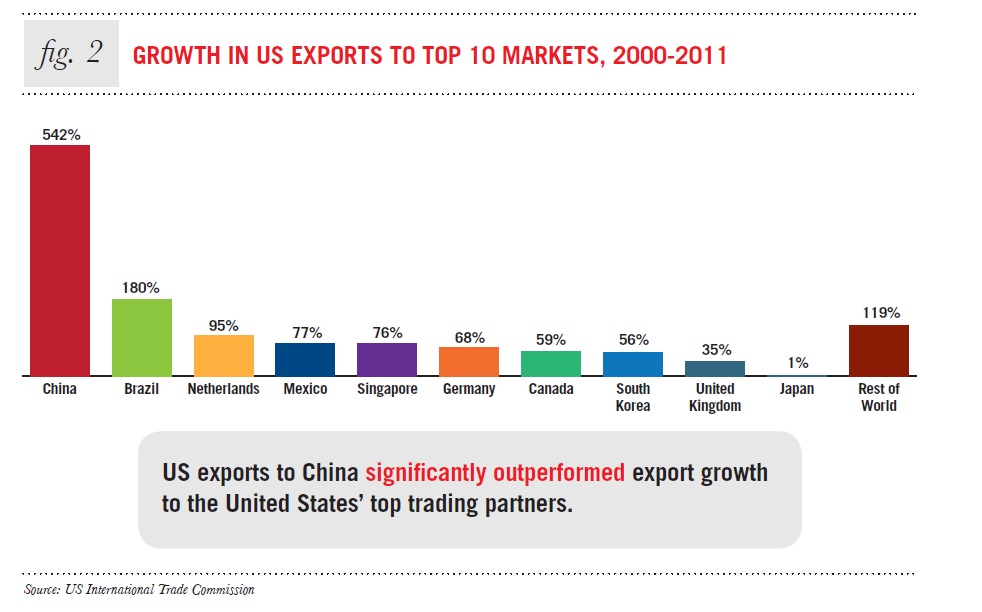
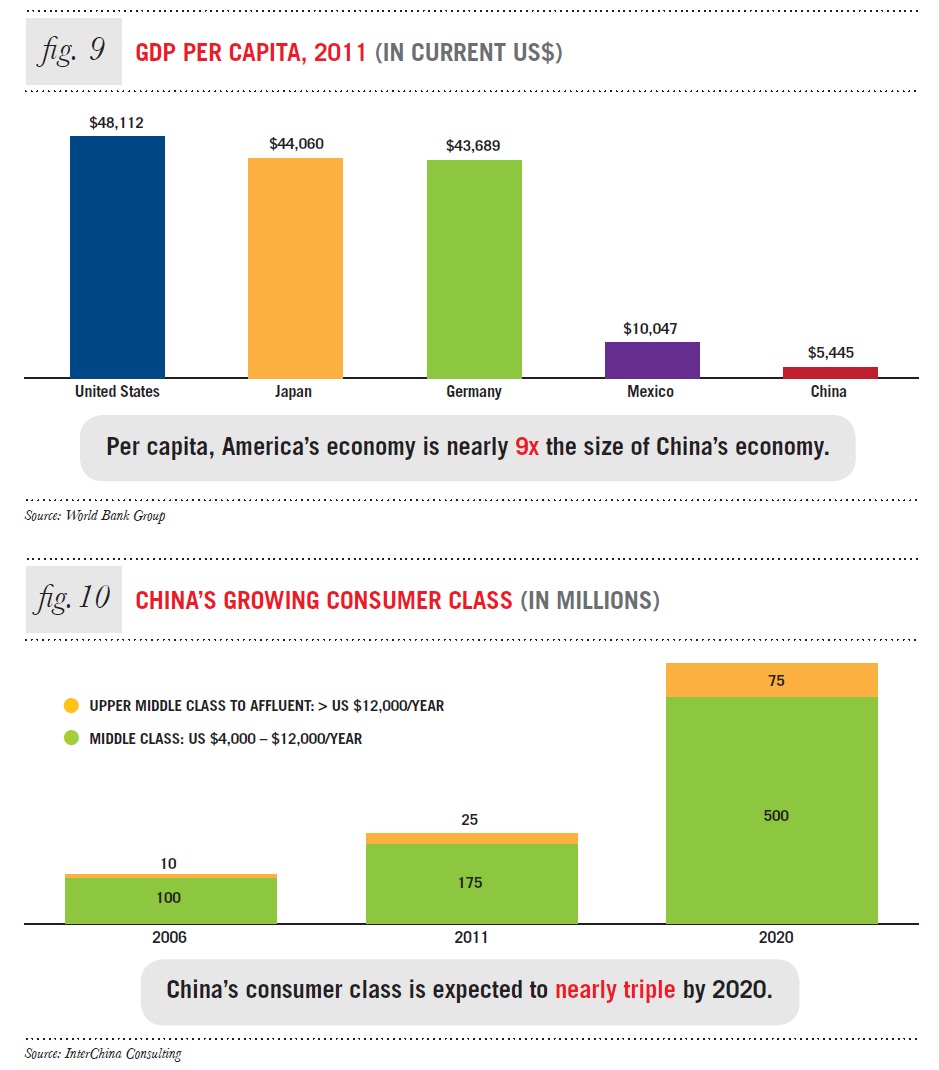
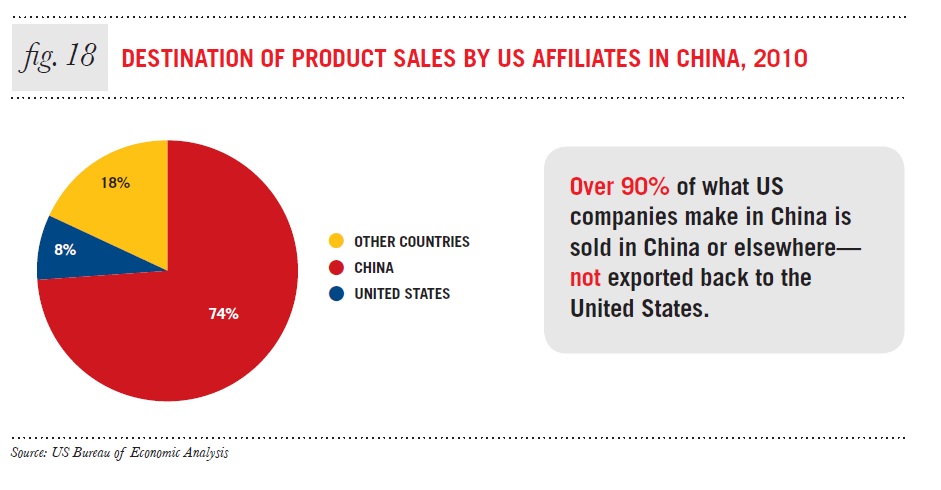
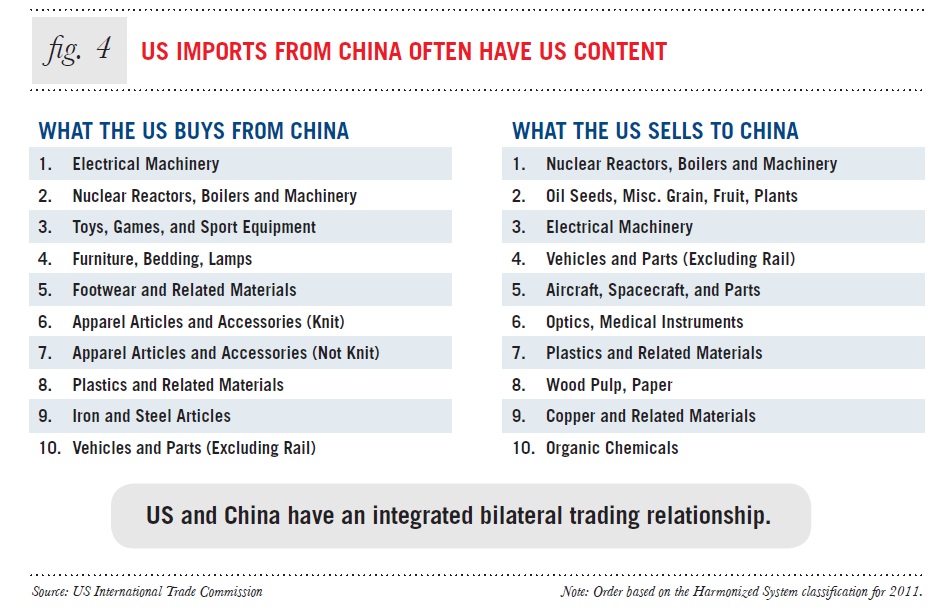
Last week in class, we discussed what globalization means and why international trade happens. This latest research report released by the U.S.-China Business Council (USCBC) on the U.S.-China commercial relationships provides latest evidence showing how the world two largest economies are interdependent with each other and mutually benefit from such a close trade partnership. The report also highlights several key facts about the U.S.-China trade relationship, which often time is misunderstood by the general public.
Full text of the report is available at:
https://www.uschina.org/info/trade-agenda/2013/uscbc-trade-agenda-report.pdf
Faced by rising labor cost, China has started thinking about “going globle” for its T&A sector: not product, but capital.
“According to William Gumede, a senior research fellow at the University of Witwatersrand’s school of public and development management in South Africa, Chinese domination of Africa’s textile markets and its industry has promoted significant job losses.
“For instance in South Africa, employment in the textile industry dropped from 300,000 workers in 1996 to 120,000 in 2010,” says Gumede when reached for comment by just-style.
And the situation is worse in Nigeria where the country has seen its once burgeoning US$1.3bn spinning industry in disarray, with Chinese cheap fabrics being highlighted as the culprit.
“Since 1995, over 175 textile manufacturing factories have shut down, leaving more than 250,000 workers jobless,” says Jaiyeola Olanrewaju, the director-general of the Nigerian Textiles Manufacturers Association.
And there is concern that some Chinese producers are not playing fair – being accused of mimicking African textile trade marks and unique designs.
“In order to compete favourably, African governments must stop [the] influx of counterfeit and smuggled textiles,” says Dr Walid Jibrin, the chairman of the Northern States Chapter of the Nigerian Textiles Manufacturers Association.
He identifies African prints, shirts, fine wax print textiles, unique Guinea brocades and lace embroideries as examples of African designs and textile trade marks being copied on cheap Asian fabrics and dumped in West Africa.
“The counterfeits have destroyed the handmade traditional textile industry in Nigeria, Ghana, Ivory Coast and Guinea,” says Dele Hunsu, the president of the National Union of Textile Garment and Tailoring Workers of Nigeria.
AGOA’s preferential access
But probably the most devastating effect of the Chinese textile industry on sub-Saharan Africa’s economic growth is its ability to piggy-back on the US’s year 2000 African Growth and Opportunity Act (AGOA).
Chinese firms have benefited from the region’s preferential access to the US by establishing Chinese-owned subsidiaries in the region. AGOA of course creates a trading advantage for sub-Saharan Africa’s textile industries to access the United States market.
According to Ms Ciliaka Millicent Gitau, a lecturer at the University of Nairobi’s School of Economics, its success was rapid but short-lived. By 2005, many Chinese companies had established subsidiaries in countries including Ghana, Kenya, Lesotho, Madagascar, Malawi, Mauritius, Namibia, Nigeria, Tanzania and South Africa.
“The issue is that AGOA did not have rules of origin that would have curbed transhipment of the Chinese textile commodities,” said Gitau who is an expert on the emerging Sino-Africa geo-politics and trade relations.
The result has been local African clothing and textile companies closing, unable to compete with Chinese firms’ aggressive export-oriented tradition, low production costs and technological superiority.
And while AGOA has been extended to 2015, Chinese clothing makers in sub-Saharan Africa will continue exporting more textiles to the US at the expense of African companies.
“In essence, in the last two decades, China has placed itself in a strategic position to reap benefits from sub-Saharan Africa, not only in the textile industry but in other sectors as well,” says Gitau.
New sales opportunities
And Chinese manufacturers are in no mood to pull back. With weakening demand in Europe and the US since the financial crisis, plus continuing disputes at the World Trade Organization (WTO) with key mature market trading partners, China’s clothing and textile industry wants to diversify its sales.
From January to August 2012, China Customs figures show textile and apparel exports to the European Union (EU) dropped 14.4% year-on-year to US$32.02bn, while they rose 12.2% to US$9.82bn to Africa.
“We have got lots of inquiries from clients in Africa recently. They are less demanding, and some of them are happy to accept our private brands,” says a director at a Shanghai clothing manufacturer who so far has been supplying the EU, US and Japanese markets.
“There are many economic communities in Africa, which allows us to enter other African countries easily once we are in one of the community countries. We would like to look into the African market,” she adds.
Other Chinese manufacturers are using Africa as a hassle-free, alternative way to access the US and EU markets.
“In Ethiopia, we rent a plant and hire local workers make clothing for clients in the US and EU,” says a business manager at a Shandong province-based textile firm, who stresses that the African Growth and Opportunity Act offers companies such as his legal opportunities to access the US market.
And Chinese companies continue to see Africa not only as a huge market for export, but also a possible place for massive investment.
For example, in August, China Garments, a Beijing-based former state-run manufacturer, announced it will invest about US$29.7m in Zimbabwe to form a joint venture with the Cotton Company of Zimbabwe. The JV is expected to be a major cotton supplier of China Garments.”
1. Is corporate social responsibility a problem ONLY in developing countries?
How ethical is clothing “made in UK” or “made in USA”? Suggested reading:
ANALYSIS – How ethical is UK manufacturing? (Textile Month International, 2012)
Sweatshops Are Fashion’s Dirty Little Secret. But They Don’t Exist in L.A. — Do They? (2012)
2. As a consumer, shall we be responsible for something too?
Isn’t that we always want better quality products at lower price and delivered at faster speed? Because clothing retail is such a highly competitive buyer-driven business, in order to meet our “demand”, isn’t companies have to find a way to increase product quality, shorten production time, frequently change design patterns but stick to the old delivery schedule and lower sourcing cost? Can we say the “race to the bottom” CRS practice in clothing factories has nothing to do with us as consumers?
3. Some people suggest: since there are so many ethical problems in developing countries, why not we just move apparel manufacturing back to the US or EU?
If you ask these garment workers in Bangladesh, they would tell you that despite the horrible working conditions, they still feel “happy” to work there. Before working for the garment factory, their life was even worse—because of poverty and limited opportunity available to them. For example, for many young females in the least developing countries, if they do not work for garment factories, the other place for them to go is prostitution. We need to think about this question: if the Bangladesh factory was forced to close (Western brands no longer give them the order), what would happen to its workers?
4. Why internationally we still have no official labor standard, despite we have international organizations such as ILO, WTO, World Bank and United Nations out there as well as many international rules in other areas?
The nature of the problem is very similar as the ongoing global climate change negotiation. Countries are at different stages of development and what seems “ethical” may not necessarily fit for another country’s national conditions.
But still, everyone has a role to play to improve the status quo and create a better world, no matter as a consumer, professional working in the T&A industry, scholar or policy maker.
Sheng Lu
Recently, WSJ wrote a story about apparel “made in USA”. Although apparel manufacturing will never disappear in the U.S. (as the case elsewhere in the world), neither is it likely that those lost labor-intensive manufacturing jobs in the apparel sector will come back in the future. Why? Just ask yourself: Am I willing to spend $1,300 for a blazer, $170 for a dress shirt, $80 for a tie and $390 for a pair of jeans? These are the price tags associated with “Made in USA” for apparel.
Apparel is not a single case. If you’d like to enjoy your iPhone “Made in USA”, please add two “00” to the current price tag. Like it or not?
Similar questions can also be raised to the Europeans, Chinese, Koreans and everyone else in the world. For example, what will happen if China does not import U.S. cotton but totally relies on its domestic supply? What will happen if each country tries to produce their own air plane instead of using Boeing’s aircraft? How about European retailers only accept credit card issued by an European financial service provider and reject Visa or America Express? And how long will it take to deliver a package to Asia if FedEx and UPS are not allowed to operate in these regions? Will these “changes” improve or worsen people’s daily life? The answer is obvious.
Globalization does not mean “Made in China”nor “Made in USA”. Rather, it means “Made in the World” based on each country’s comparative advantage, it means getting access to the world resources and using them more wisely and more efficiently. Why not everyone engages in doing something they are good at doing and then exchange? This is why we go grocery instead of growing vegetables nor raising cows by ourselves today.
Globalization also means a product now can reach the world market beyond the limited domestic market. But a country can only successfully export when another country is willing to import. This is why we need to support trade liberalization so that every country can export more of those products they are competitive in making. And definitely more jobs will be created domestically. I mean every country that engages in such global “exchange”.
We no longer live in the 15th century when the Mercantilism was born. In the 21st century, export is good and import is equally good for the economy. Embrace globalization and enjoy better life~
Sheng Lu

Data source: American Apparel and Footwear Association (2012)

Data source: U.S.-China Business Council
The Congressional Research Service just released its most recent study on the U.S. textile manufacturing industry and the Trans-Pacific Partnership (TPP) Negotiation. This is also one of the limited reference available so far that specifically addresses the sectoral impacts of TPP.
Overall, this report did a good job of compiling latest statistics showing the operation of the regional trade & production network between the United States and those developing countries in central and south America. It also discusses why the U.S. textile industry appears to be very nervous about Vietnam.
However, the study wasn’t able to quantify the impact of TPP, which leaves potential for future studies. On the other hand, although debates over TPP centers upon the rules of origin, we shall not forget about foreign investment–especially when geographically Vietnam is very close to China, Japan and South Korea. Even yarn-forward is adopted, why cannot Chinese factories move their factories to Vietnam? It shall be noted that China’s economy is undergoing structural change and it’s the time for some Chinese factories to “go offshore”.
Full text of the report can be found here.

The Office of Textiles and Apparel (OTEXA) recently released its 2012 Going Global Report, which identifies 15 top export markets for U.S. made textiles and apparel. The report also includes statistical profile of these 15 countries, including their GDP per capita, GDP growth and bilateral trade with the United States in recent years.
It is interesting to note that the top export markets for textile and for apparel are very different. Wonder why? Please think about the “stages of development theory” we discussed in class.
HS code refers to the “Harmonized tariff schedule” (HS), a classification system for commodities. Textile and apparel are covered by HS code chapter 50-63. Detailed list can be found at http://www.usitc.gov/tata/hts/bychapter/index.htm
The report can be downloaded from here
For your reference. Many issues are relevant to textile and apparel sectors (for example: global value chain, trade and job, trade facilitation, competition policy, intelletrual property right protection, green economy, pluralism/regionalism as well as trade and development).
This year’s WTO Public Forum will debate:
The session will cover the following sessions
This year’s Ideas Workshops will cover:
WTO’s first ever Youth Ambassadors, selected by separate video and essay contests, will discuss the topic “How can trade promote development?”

A row has flared up again over the yarn-forward rule of origin in US free trade agreements after The Hosiery Association (THA) called for a knit-to-shape, assembly-only exception for socks and hosiery in the Trans-Pacific Partnership (TPP).
Three textile trade associations have now written to US Trade Representative Ron Kirk expressing their “strong opposition” to the proposal.
The American Manufacturing Trade Action Coalition (AMTAC), National Council of Textile (NCTO) Organizations, and American Fiber Manufacturers Association (AFMA) say any such move “conflicts with the US textile industry’s longstanding support” of a yarn-forward rule of origin for textiles and apparel.
The yarn-forward rule requires all stages of production – from yarn spinning to fabric formation and final garment assembly – to be done either in the United States or in an FTA partner country to qualify for duty-free treatment.
US textile groups say the rule is “long-established” and “logical” because the value of a finished item comes from its components, rather than from its final assembly.
But American retailers, apparel brands, manufacturers and importers argue it is too restrictive, hinders new trade and investment in the sector, and renders most existing trade ineligible for preferential tariff treatment.
The Hosiery Association wants the TPP pact – currently being negotiated by the US, Vietnam, Brunei, Chile, New Zealand, Singapore, Australia, Malaysia and Peru – to allow hosiery producers to source yarns for man-made fibre socks and hosiery outside the TPP region in all instances except in the case of 100% cotton and polyester products.
But “this proposal would be a massive blow to US and other TPP producers who manufacture acrylic, nylon and various other types of man-made fibre yarns,” the textile groups say.
“In short, the THA proposal allows yarns currently made in large quantities in the United States to be sourced from third parties, notably China,” the letter says.
A latest comment made by the Economist on Peter Marsh’s book The New Industrial Revolution.
As metioned in our class, globalization does not mean “made in China” or “off-shore production”, but rather a much freeer movement of goods, services, capital and labor around the world, thanks to the economic growth, lowered trade & investment barriers and advancement of technologies.
In today’s global economy, “any firm, anywhere, can hook up to a global supply chain. A product may be designed in one country and assembled in another, using components from dozens more. Even a small local manufacturer can use the best suppliers the world has to offer.”
This concept is associated with the “new international division of labor” concept, which we will discuss this coming Tuesday.

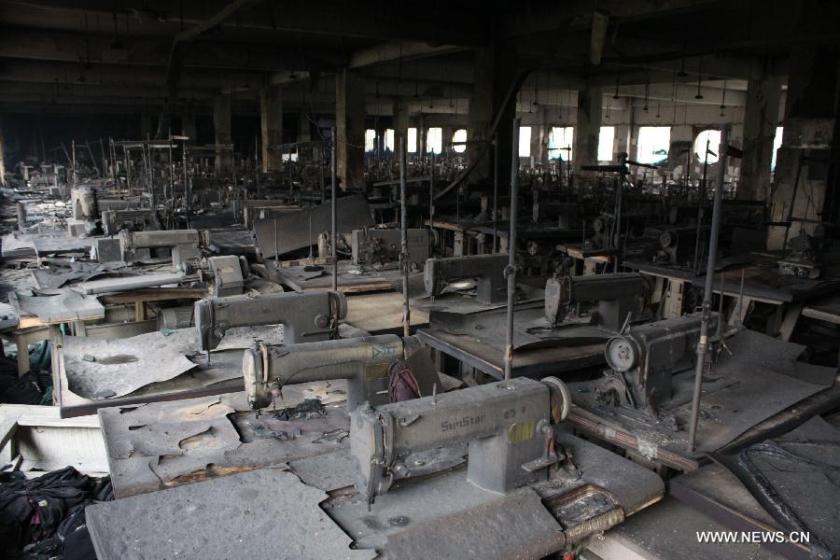
In the class, we just mentioned that the conditions under which our clothing were made significantly vary from country to country. Compared with the vidoes we watched yesterday, the story covered by the news is such a sharp contrast.
However, we may also want to think: despite the far-from pleasant working environment, why pepole in Pakistan are still willing to work there? As a consumer or professional in the US fashion apparel industry, what we can do to help improve the working conditions as shown in the picture? and what role can international trade play in helping developing countries like Pakistan to achieve economic development?
As reported by the New York Times article :
“Textiles are a major source of foreign currency for Pakistan, accounting for 7.4 percent of its gross domestic product in 2011 and employing 38 percent of the manufacturing work force. Pakistani cotton products are highly sought in neighboring India and form the backbone of a burgeoning fashion industry that caters to the elite. President Asif Ali Zardari’s government has often called on the United States to drop tariff barriers to Pakistani textile imports, which it says would be preferable to traditional aid.”
We will gradually touch these critical issues in the later part of the course. Stay tuned.
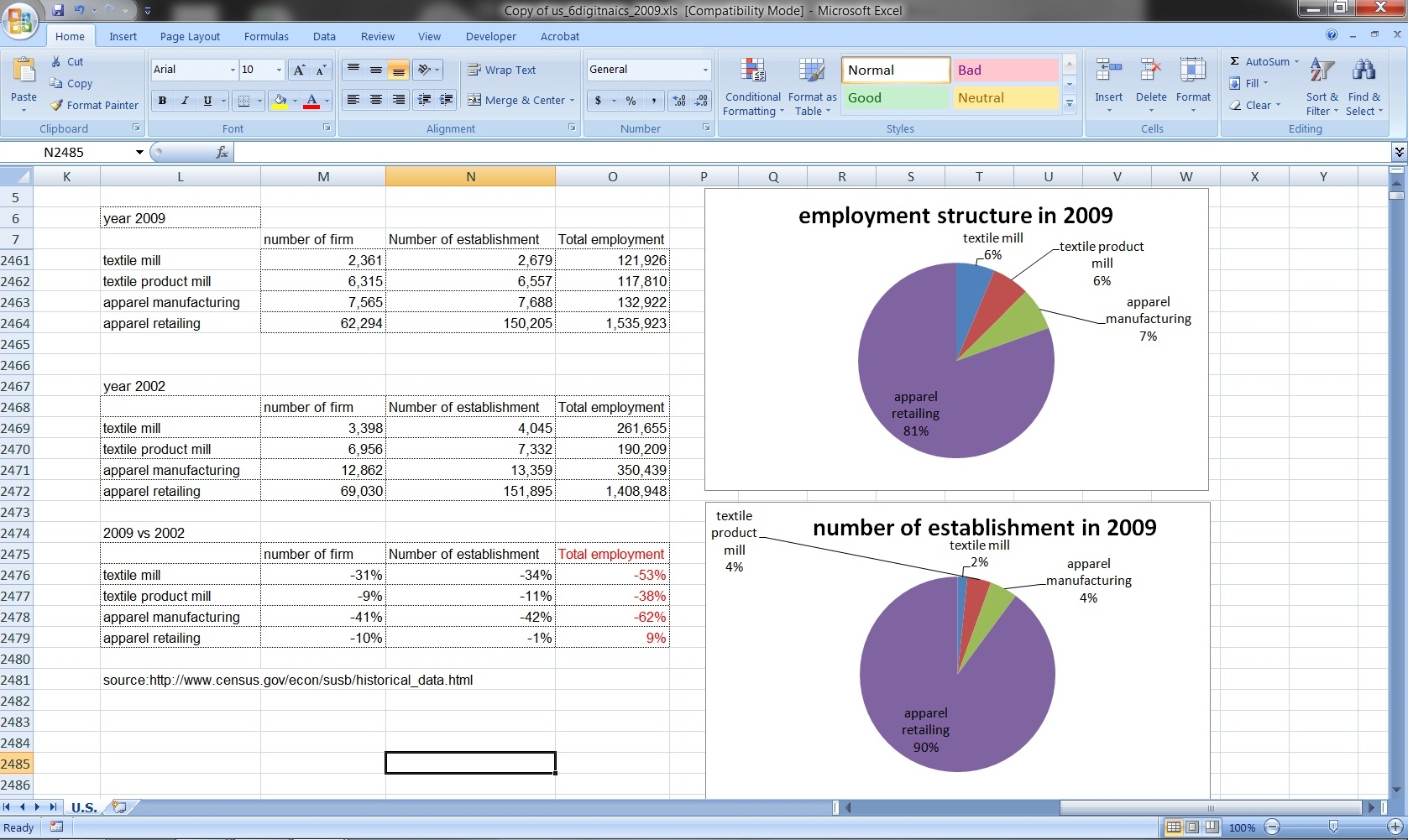
(click the picture to enlarge)
Key points:
“These four million U.S. workers – seen and unseen – help you get dressed every day. They design shoes and clothes, perform research and development, cut and sew, supervise production, handle customs and logistics, ensure product safety compliance, market and merchandise product, outfit our troops and work on the sales floor. In addition to these four million workers, there are countless U.S. transportation, distribution, warehousing, and logistics workers who depend on our industry for their jobs.”
“about 75 percent of the retail value of most clothing and footwear comes from non-manufacturing activities that happen entirely inside the United States.”
“Supply chain jobs and manufacturing jobs are equally valuable to the overall health of the U.S. economy. It is wrong to foster a public policy agenda that forces these two groups to compete against each other. ”
Written by Kevin Burke. president and chief executive officer of the American Apparel & Footwear Association.
Read more: http://www.politico.com/news/stories/0712/78779.html#ixzz21PNrJzHK

Below, on the right is a textile dyeing mill in Zhejiang Provience, China

A recent study of the United States International Trade Commission reaffirms the special roles played by free trade agreements in supporting the regional trade-production network (RTN) for textile and apparel products in America and promoting the export of U.S.-made textile to developing countries in the region in particular. However, also as mentioned in the report, the influence of such RTN has sustantially declined since the full elimination of quota system in 2005. The implementation of the new FTAs established between US and countries in Asia-Pacific pose new uncertanties to the RTN in America, given the trade diversion effect commonly seen in FTAs.

A great commentary article on a recent study on trade protectionist measures by Chad Bown, a former professor from Brandeis university and a guru on trade remedy measures. It is interesting to note that the using of trade protectionist measures is much less frequent today than in the past. I agree with the reasons proposed by the article, such as the establishment of the WTO as a monitoring body, global production and emerging markets instead of developed countries becoming leading importers. On the other hand, trade protectionist measures are taking more diversified forms today and the scope has gone far beyond the traditional AD, CVD and safeguard measures. In particuar, measures that intend to promote export potentially could raise new trade disputes among leading exporters.
The full report can be downloaded from here

Comment:
This article from the Economist echoes some recent arguments that with China’s rising wages, manufacturing jobs could move back to the developed countries. The article says that: “for some manufacturers low wage costs are becoming less important because labor represents only a small part of the overall cost of making and selling their products.”
However, such view is questionable. If labor cost only accounted for a minimum proportion of the total production cost, why would firms care about the rising labor cost? Also, more and more products made in China are sold locally today rather than shipped back to the US or other developed markets. Therefore, for many sectors (such as softgoods) despite the rising labor cost, leaving China is not always a workable option.

The report is prepared by Li & Fung and includes the following parts:
To read the full report, click here

Is “fast fashion” business model compatible with “sustainability” ? It seems fashion company never inspire consumers to lower their consumtion, post-purchase unsustainability practices is commonly see and we have flood of fashion brands claimed themselves as “eco-friendly” (Niessen, 2011).
One interesting article from the Observers about H&M’s green strategy.
To read the fulltext, click here

Can fast fashion go global? Does the business model which heavily rely on local supply fit for global operation? As mentioned in the article, 70% of Zara’s sale in 2001 came from the EU, although it has opened 179 new stores in Asia in 2011, 156 of them in China.
To do business in emerging markets may incur many unique barriers and challenges. For example, the article reported that China’s consumer watchdog attacked Zara for poor quality in 2011. Often time we see much heavier invovlement of government in economic activities. And many emerging markets are very segmented (due to regional economic development gap) than in the US/west. Europe.
To read the fulltext, click here
 Gereffi, G. & Frederick, S. (2010). The Global Apparel Value Chain, Trade and the Crisis: Challenges and Opportunities for Developing Countries. The World Bank.: Washington DC
One recent work of Dr. Gary Gereffi, a well-known expert on value chain studies, on the impacts of the financial crisis on the global apparel industry. It is suggested that the developing countries will gradually move up in the value chain and undertake more value-added functions such as design and product development. This is a two-edge sword to T&A industries in the developed countries. It could mean more resources to take advantage of and more intensified compeitition at the same time. Although Dr. Gary uses the concepts of OEM, ODM and OBM to describe evolution of the apparel chain, the major conlusions are compatable with the famous stages of development theory suggested by Toney (1986).
To read the fulltext, click here

