USITC Studies the Impact of Trade on Manufacturing Jobs in the U.S. Textile and Apparel Industry

job impact of trade

employment in the US T&A industry

In its newly released Economic Impact of Trade Agreement Implemented under Trade Authorities Procedures, 2016 Report, the U.S. International Trade Commission (USITC) provides a quantitative assessment on the impact of trade on manufacturing jobs in the U.S. textile and apparel industry. According to the report:

  • Manufacturing jobs in the U.S. textile and apparel industry have been declining steadily over the past two decades. Between 1998 and 2014, employment in the NAICS 313 (textile mills), NAICS314 (textile product mills) and NAICS 315 (apparel manufacturing) sectors on average decreased annually by 7.6 percent, 4.3 percent and 11.2 percent, respectively.
  • Rising import is found NOT a major factor leading to the decline in employment in the U.S. textile industry (NAICS 313)–as estimated, imports only contributed 0.4 percent of the total 7.6 percent annual employment decline in the U.S. textile industry. Instead, more job losses in the sector are found caused by improved productivity as a result of capitalization & automation (around 4.6 percent annually) and the shrinkage of domestic demand for U.S. made textiles (around 3.5 percent annually) between 1998 and 2014.
  • Rising imports is the top factor contributing to job losses in apparel manufacturing (NAICS 315), however. As estimated by USITC, of the total 11.2 percent annual employment decline in apparel manufacturing, almost all of them is affected by imports (10.8 percent). On the other hand, increased domestic demand for apparel (such as from U.S. consumers) is found positively adding manufacturing jobs by 2 percent annually in the United States from 1998 to 2014.
  • To be noted, USITC did not estimate the impact of trade on employment changes in the retail aspect of the industry. According to the U.S. Bureau of Labor Statistics, approximately 80 percent of jobs in the U.S. textile and apparel industry came from retailers in 2015. These retail-related jobs are typically “non-manufacturing” in nature, such as: fashion designers, merchandisers, buyers, sourcing specialists, supply chain management specialists and marketing analysts.

2016 U.S. Fashion Industry Benchmarking Study Released

The 2018 U.S. Fashion Industry Benchmarking Study is now available
usfia 2016 cover_Page_1

The report can be downloaded from HERE

Key Findings of the study:

I. Business environment and outlook in the U.S. Fashion Industry

  • Overall, respondents remain optimistic about the five-year outlook for the U.S. fashion industry. “Market competition in the United States” is ranked the top business challenge this year, which, for the first time since 2014, exceeds the concerns about “increasing production or sourcing cost.”

II. Sourcing practices in the U.S. fashion industry

  • U.S. fashion companies are more actively seeking alternatives to “Made in China” in 2016, but China’s position as the No.1 sourcing destination seems unlikely to change anytime soon. Meanwhile, sourcing from Vietnam and Bangladesh may continue to grow over the next two years, but at a slower pace.
  • U.S. fashion companies continue to expand their global reach and maintain truly global supply chains. Respondents’ sourcing bases continue to expand, and more countries are considered potential sourcing destinations. However, some companies plan to consolidate their sourcing bases in the next two years to strengthen key supplier relationships and improve efficiency.
  • Today, ethical sourcing and sustainability are given more weight in U.S. fashion companies’ sourcing decisions. Respondents also see unmet compliance (factory, social and/or environmental) standards as the top supply chain risk.

III. Trade policy and the U.S. fashion industry

  • Overall, U.S. fashion companies are very excited about the conclusion of the Trans-Pacific Partnership (TPP) negotiations and they look forward to exploring the benefits after TPP’s implementation.
  • Thanks to the 10-year extension of the African Growth and Opportunity Act (AGOA), U.S. fashion companies have shown more interest in sourcing from the region. In particular, most respondents see the “third-country fabric” provision a critical necessity for their company to source in the AGOA region.
  • Free trade agreements (FTAs) and trade preference programs remain underutilized in 2016 and several FTAs, including NAFTA and CAFTA-DR, are utilized even less than in previous years. U.S. fashion companies also call for further removal of trade barriers, including restrictive rules of origin and remaining high tariffs.

The benchmarking study was conducted between March 2016 and April 2016 based on a survey of 30 executives from leading U.S. fashion and apparel brands, retailers, importers, and wholesalers. In terms of business size, 92 percent of respondents report having more than 500 employees in their companies, while 84 percent of respondents report having more than 1,000 employees, suggesting that the findings well reflect the views of the most influential players in the U.S. fashion industry.

For the benchmarking studies in 2014 and 2015, please visit: https://www.usfashionindustry.com/resources/industry-benchmarking-study

Why NCTO and Euratex Disagree on the Textile and Apparel Rules of Origin in T-TIP?

eu-and-us-ta-rules-of-origin1

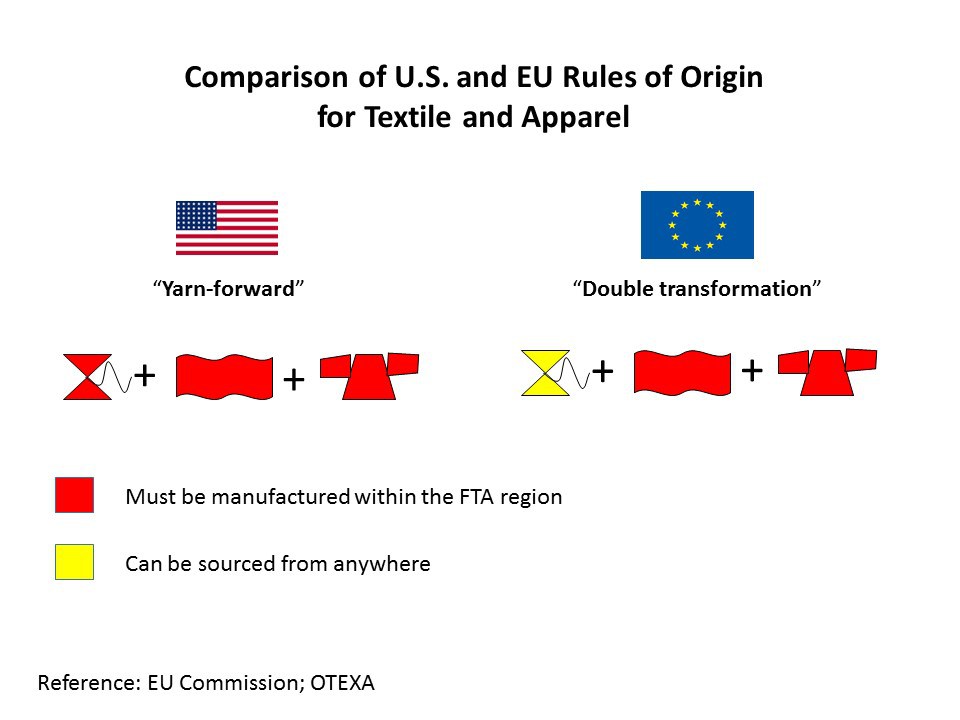
In an April 13 press briefing, the National Council of Textile Organizations (NCTO) which represents the U.S. textile industry, insists the Trans-Atlantic Trade and Investment Partnership (T-TIP) shall adopt the so called “yarn-forward” Rules of origin (RoO). Yarn-forward (or “triple transformation”) in T-TIP means, in order to receive preferential duty treatment provided under the trade agreement, yarns used in textile production in general need to be sourced either from the US or EU.  All 14 existing free trade agreements (FTA) in the United States adopt the yarn-forward RoO.

In comparison, in its position paper released in June 2015, the European Apparel and Textile Confederation (Euratex), which represents the EU textile and apparel industry, favors a so called “fabric forward” RoO in T-TIP instead of “yarn-forward”. Fabric-forward (or “double transformation”) in T-TIP means in order to receive preferential duty treatment provided under the trade agreement, fabrics used in apparel production in general need to be sourced either from the US or EU, but yarns used in textile production can be sourced from anywhere in the world.

US

Exploring data at the 4-digit NAICS code level can find that the United States remains a leading yarn producer. Value of U.S. yarn production (NAICS 3131) even exceeded fabric production (NAICS 3132) in 2014. This means: 1) U.S. has sufficient capacity of yarn production; 2) it will be in the financial interests of the U.S. textile industry to encourage more use of U.S.-made yarns in textile production in the T-TIP region (i.e. pushing the “yarn-forward” RoO).

eu textile production
EU yarn import

However, data at the 4-digit NACE R.2 code level suggests that EU(28) was short of €5,643 million local supply of yarns (NACE C1310) for its manufacturing of fabrics (NACE C1320) in 2013 (latest statistics available). This figure well matched with the value of €4,514 million yarns that EU (28) imported from outside the region that year. Among these yarn imports (SITC 651), over half came from China (22%), Turkey (19%) and India (13%), whereas only 5% came from the United States. Should the “yarn-forward” RoO is adopted in T-TIP, EU textile and apparel manufacturers may face a shortage of yarn supply or see an increase of their sourcing & production cost at least in the short run.

Sheng Lu

The Percent of U.S. Apparel Imports Entering under Free Trade Agreements Fell to a Record Low Level in 2015

FTA use 2015 1

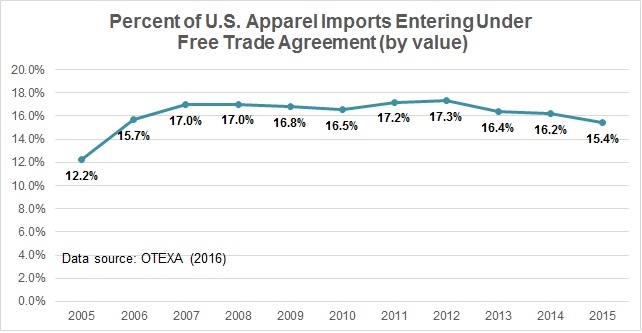
Latest statistics from the Office of Textiles and Apparel (OTEXA) show that the share of U.S. apparel imports entering under free trade agreements (FTAs) fell to a record low level of only 15.4 percent in 2015. This figure was not only lower than 16.2 percent in 2014, but also was THE lowest one since 2006, despite the implementation of a few new FTAs during that period.  

FTA use 2015 2

Among the major FTAs reached by the United States, the U.S.-Bahrain has the highest utilization rate of 99.7 percent in 2015 (note: utilization rate =value of imports entering under FTA from a particular country/value of imports from a particular country), whereas a couple of FTAs whose utilization rate is below 80 percent, such as CAFTA-DR (75.8 percent), U.S.-Korea FTA (75.2 percent), U.S.-Israel FTA (65.5 percent), U.S.-Australia FTA (53.7 percent) and U.S.-Morocco FTA (34.6 percent). A low utilization rate implies that U.S. companies did not claim the preferential duty benefits while importing apparel from these FTA regions.

FTA use 2015 3   

On the other hand, CAFTA-DR and NAFTA altogether account for around 76 percent of U.S. apparel imports entering under FTAs in 2015. This result is consistent with the findings in the 2015 U.S. Fashion Industry Benchmarking Study which also finds that CAFTA-DR and NAFTA were the two most frequently utilized FTAs reported by the survey respondents.

As a result of the lower share of apparel imports entering under FTAs, the American Apparel and Footwear Association Apparelstat 2015 released this week found that the effective average U.S. apparel import duty reached 13.54 percent in 2014, which is even higher than 11.97 percent in 2001. In comparison, over the same period, the average U.S. import duty on ALL products dropped from 1.64 percent in 2001 to 1.40 percent in 2014.

by Sheng Lu

Extra-EU Trade for Textile & Apparel Went Up in 2015

EU export (2015)

EU import (2015)

According to statistics released by the European Apparel and Textile Confederation (Euratex), extra-EU trade for textile and apparel (T&A) achieved record high in 2015, suggesting a positive economic state of the industry.

Specifically, extra-EU T&A exports went up by 3.6 percent in 2015. Among the key export markets: thanks to the appreciation of U.S. dollar against Euro last year, EU’s textile and apparel exports to the United States respectively increased by 16 percent and 21 percent. Despite China’s slowed economic growth, EU’s export to China was also robust: 6 percent growth for textile and 19 percent growth for apparel. However, EU’s T&A exports to Russia (down 27 percent for textile and down 29 percent for apparel) and Ukraine (down 26 percent for apparel) sharped dropped, reflecting the substantial impact of political instability on trade.  

In terms of the import side, extra-EU T&A imports rose 9.6% in 2015. China remained the top external T&A supplier to the EU, however, other Asian countries with lower-production cost are quickly catching up. This is particularly the case for apparel: while EU’s apparel imports from China went up 6 percent in 2015, imports from Bangladesh (up 24 percent), Cambodia (up 33 percent), Vietnam (up 26 percent), Pakistan (up 25 percent) and Myanmar (up 79 percent) grew much faster, suggesting a relative decline of China’s market share in the EU market.

Sourcing Strategy of Leading U.S. Apparel Companies

apparel 50

Changes in the Final Text of TPP Regarding Textile and Apparel Rules of Origin

tpp

The final text of the Trans-Pacific Partnership (TPP) released by the New Zealand Foreign Affairs & Trade in January 2016 has made a few changes to the textiles and apparel specific rules of origin compared with the USTR version released in November 2015:

  1. “5407.94” is replaced by “5403.49”
  2. “or heading 54.08″ is replaced by ” or heading 54.04 through 54.08″
  3. Minor wording changes are made regarding 55.03 and 55.06-55.11
  4. TPP originating input of “54.04 through 54.07” is now required for 54.08 (Woven fabrics of artificial filament yarn, including woven fabrics obtained from materials of heading 5405)
  5. Rules of origin for HS96.19 (Sanitary towels (pads) and tampons, diapers and diaper liners for babies and similar articles, of any material are newly added.

Details of the changes can be downloaded from HERE

State of China’s Textile and Apparel (T&A) Industry (Updated in January 2016)

Textile-factory-in-China-007

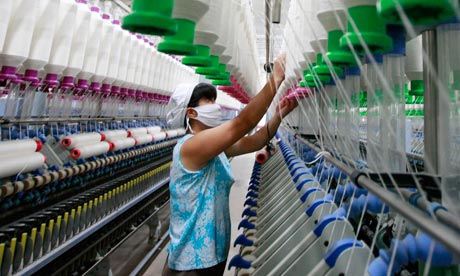
How to deal with China as a sourcing destination remains a tough and controversial issue facing U.S. apparel retailers and fashion brands in 2016. Although companies are of grave concerns about China’s continuous rising production cost (especially labor cost), few other lower-wage countries can beat China in terms of industry integration, supply chain efficiency, and reliability.This blog post intends to add to the discussion by taking a look at the supply side, i.e. what is happening in the China textile and apparel (T&A) industry.

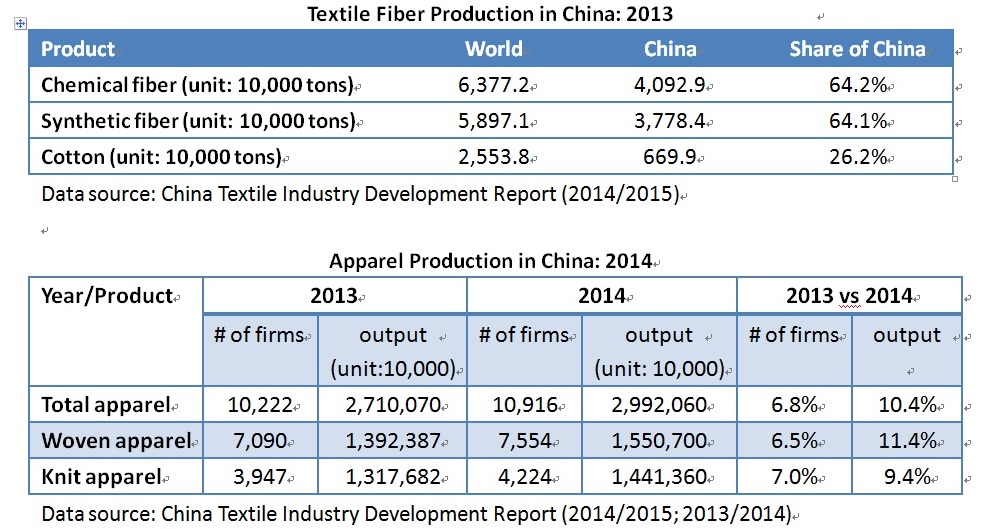
First, China’s production capacity remains unparalleled in the world. In 2014, the latest statistics available, textile fiber production in China exceeded 50 million tons, accounting for 54.36 percent of world share. By 2013, as much as 64.2 percent of the world’s chemical fibers, 64.1 percent of synthetic fibers and 26.2 percent of cotton were produced in China (see the table blew). On the other hand, apparel production in China reached 29.9 billion units in 2014, up 10.4 percent from 2013. Given China’s vast production capacity, very likely it will remain the top apparel sourcing destination for most EU and US fashion apparel companies for many years to come. For example, Vietnam’s apparel production in 2015 totaled 2.85 billion units, which was only around 10 percentage of China’s production scale in 2014.

1

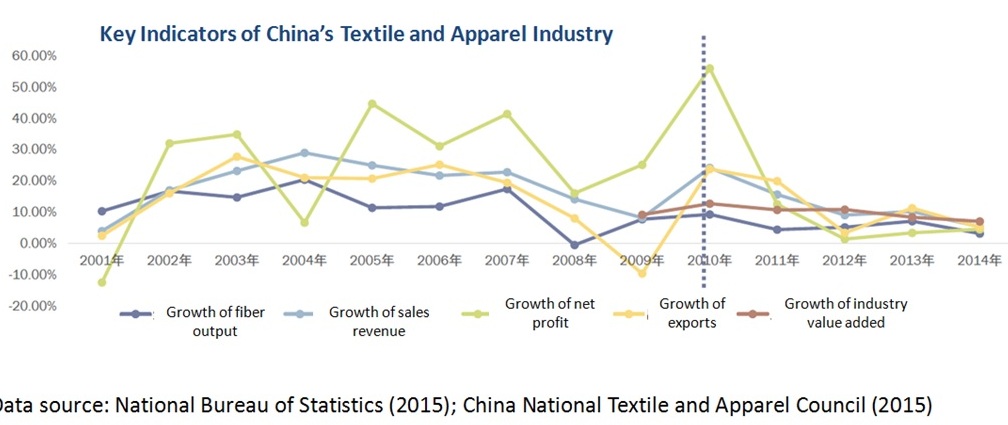
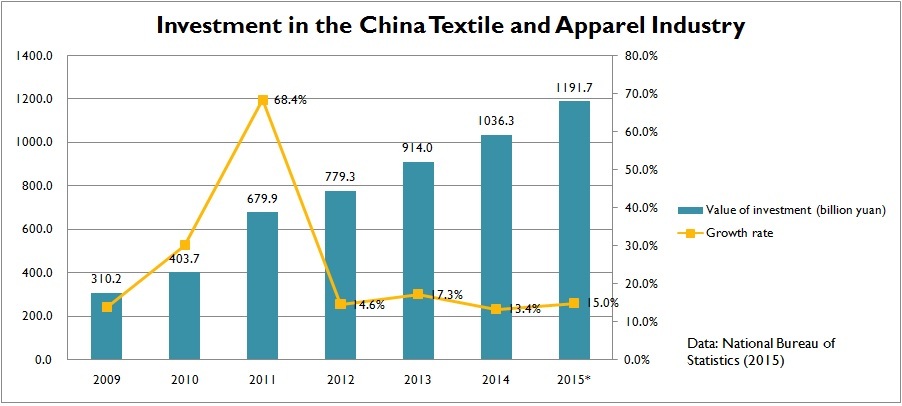
Second, China’s T&A industry is growing slower. Specifically, output of China’s T&A industry (measured by value added) grew only 7.0 percent between 2013-2014, a significant drop from 10.3 percent between 2009-2010. Other major economic indicators in the industry, from sales revenue, net profit to investment, followed a similar pattern (see the figure below). Additionally, for the first time since the 2008 financial crisis, China’s T&A exports suffered a 3.9 percent decline in 2015 (-1.3% for textiles and -5.4% for apparel). Given the downward pressure on China’s economy and uncertainties in the world marketplace, such a slow-growth pattern is likely to continue in the years ahead.

2

investment

Third, China’s T&A industry is undergoing important structural adjustment. Within the total industry output, the ratio of apparel, home textiles and industrial textiles has turned from 51:29:20 in 2010 to 46.8: 28.6: 24.6 in 2014, reflecting China’s efforts to move towards making more value-added and technology-intensive textile products. This ratio is expected to become 40:27:33 by the end of 2020 (i.e. the end of China’s 13th five-year plan). In order to overcome the pressure of rising labor and production cost, China’s T&A manufacturing base is gradually moving from the east coast to the western and central part of the country (accounting for 22.5 percent of China’s T&A production in 2014, up from 16.8 percent in 2010; this share may further increase to 28 percent by 2020). Additionally, T&A companies in China are encouraged to increase spending on research and development (R&D), which on average had accounted for 0.47 percent of T&A companies’ sales revenue in 2013, up from 0.43 percent in 2011.

Fourth, T&A companies in China are actively seeking business opportunities in the domestic retail market. Apparel retail sales in China reached 893.6 billion yuan in 2014 (around $137.5 billion), among which 30.77 percent were sold online (up from 14.54 percent in 2011). Apparel retail price on average rose 2.6 percent between 2013-2014, compared with 2.0 percent increase of China’s overall CPI over that period. However, it shall be noted that apparel retail sales in China’s tier 1 and tier 2 cities achieved almost zero growth in 2014, partially reflecting the negative impact of retail price increase on consumers’ demand. In comparison, apparel retail sales in China’s tier 3 & 4 cities as well as rural areas remain robust and strong. Additionally, financial performance of T&A companies in China is becoming more polarized. Companies that follow the traditional business model of manufacturing and exporting are facing their most difficult time since the 2008 financial crisis. However, there are also many success stories of apparel companies that focus on function upgrading, i.e. moving from simply “manufacturing” products to “serving” the market needs.

Sheng Lu

Recommended reading: China’s 13th five-year plan for its textile and apparel industry: Key numbers

Potential Impact of the Trans-Atlantic Trade and Investment Partnership (T-TIP) on Related Textile and Apparel Trade Flows

The presentation was delivered at the 2015 International Textile and Apparel Association (ITAA) Conference in Santa Fe, New Mexico on November 13, 2015. Welcome for any suggestions and feedback.

Tariff Remains a Critical Trade Barrier Worldwide for the Textile and Apparel Sector

1

tariff rate

According to data from the World Trade Organization:

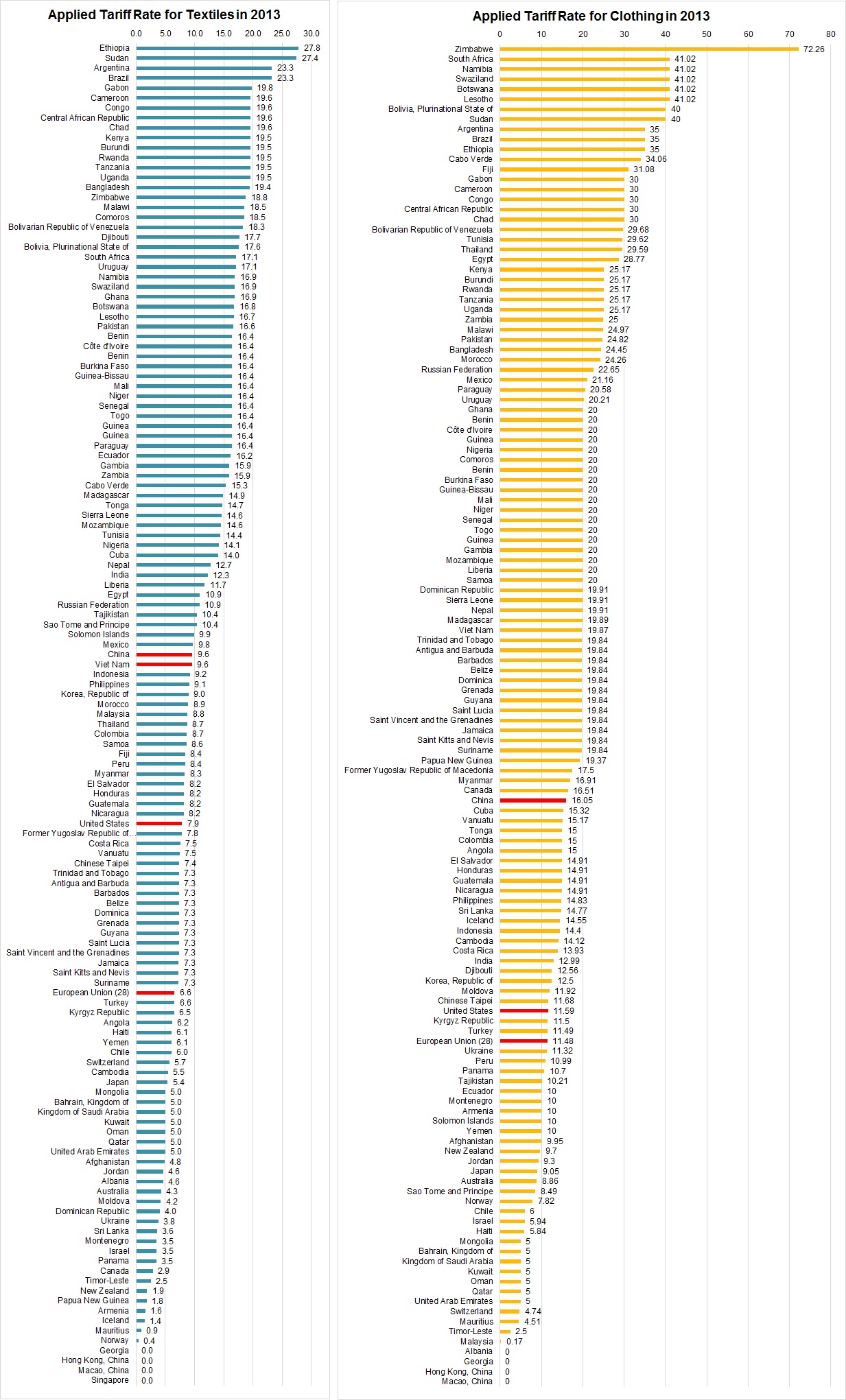
  1. In 2013, average applied tariff rate remained at 10.73% for textiles and 18.25% for apparel worldwide. Compared with the average tariff rate for all sectors, the rate for textiles on average is 1.4 percentage points higher and the rate for apparel is 8.9 percentage points higher. This implies that although tariff may not be a critical trade barrier for some sectors anymore, it still significantly matters for the textile and apparel sector.
  2. Least developed countries (LDC) overall set a higher tariff rate for textiles and apparel than the world average level. Ironically, many LDCs heavily rely on imports for textile supply. Should these LDCs lower their tariff rate for textiles, it may help apparel manufacturers there save sourcing cost for yarns and fabrics and improve the price competitiveness of finished apparel products.
  3. At the country level, countries with the highest tariff rate for textiles include Ethiopia (27.8%), Sudan (27.4%), Argentina (23.3%, Brazil (23.3%), Gabon (19.8%), Cameroon (19.6%), Chad (19.6%) and Congo (19.6%). And countries with the highest tariff rate for apparel include Zimbabwe (72.26%), South Africa (41.02%), Namibia (41.02%), Swaziland (41.02%), Botswana (41.02%), Lesotho (41.02%), Bolivia (40.0%), Sudan (40.0%), Argentina (35.0%), Ethiopia (35.0%) and Brazil (35.0%). Interesting enough, many of these countries are members of the African Growth and Opportunity Act (AGOA) which are eligible for the third country fabric provision.

Sheng Lu

Potential Impact of TPP on the Textile and Apparel Sector: A Summary of Recent Studies

Screenshot 2015-10-06 08.13.16

(Picture credit: Lu, S. (2015) Does Japan’s accession to the Trans-Pacific Partnership mean an opportunity or a threat to the U.S. textile industry? A quantitative evaluation, Journal of the Textile Institute, 106(5), 536-549.)

With the conclusion of the Trans-Pacific Partnership (TPP) negotiation on Oct 5, 2015, it is time to think about its potential impact. Specifically for the textile and apparel (T&A) industry, the followings studies may offer some hints (to read more, you can click each title):

Trade Statistics

Statistics show the 12 TPP partners altogether imported $65 billion worth of textiles and $154 billion worth of apparel in 2013, which accounted for a world import share of 20 percent and 32 percent, respectively (WTO, 2015). In 2014, around 55 percent of U.S. textile and apparel exports (or $13.3 billion) went to the other 11 TPP partners, and 17 percent of U.S. textile and apparel imports (or $17.8 billion) came from the TPP region (OTEXA, 2015).

Impact of TPP on U.S. Textile and Apparel Manufacturing: A Preliminary Estimation

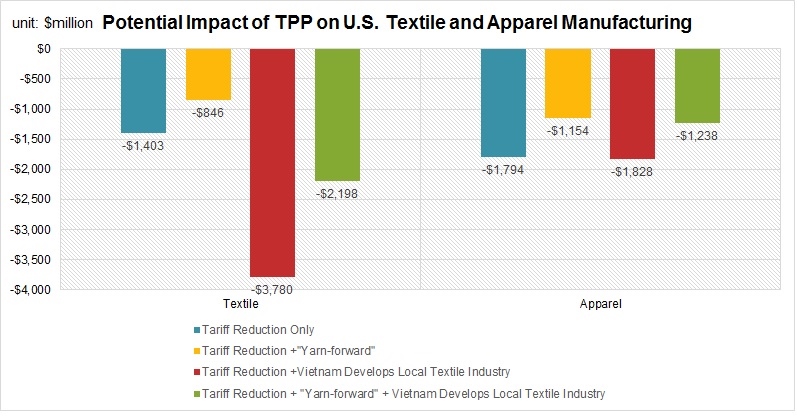
TPP overall will have a negative impact on U.S. domestic textile and apparel manufacturing. In all simulated scenarios, the annual manufacturing output in the United States will decline by $846 million–$3,780 million for textile and $1,154 million–$1,828 million for apparel than otherwise.

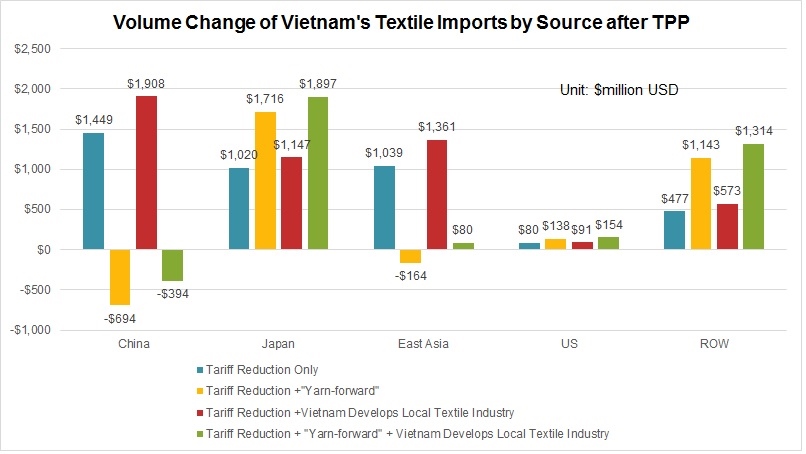
2.The “yarn-forward” rule may not substantially benefit U.S. domestic textile and apparel manufacturing as some people had suggested, for two reasons: 1) results show that Vietnam is more likely to use Japanese textiles than U.S. textiles when yarn-forward rule is in place. 2) U.S. apparel imports from Vietnam directly compete with those imported from NAFTA and CAFTA regions, the largest export market for U.S.-made yarns and fabrics. When NAFTA and CAFTA’s market share in the U.S. apparel import market is taken away by Vietnam, U.S. textile exports to NAFTA and CAFTA will decline anyway, regardless of whether Vietnam uses U.S.-made textiles.

3.Results suggest that compared with the “yarn-forward” rule, development of Vietnam’s local textile industry will have an even larger impact on the future of U.S. domestic textile and apparel manufacturing. Particularly, when Vietnam becomes more capable of making textile inputs by its own, not only Vietnam’s overall demand for imported textiles will decline, but also Vietnam’s apparel exports will become even more price-competitive in the U.S. as well as the world marketplace.

“Import Sensitive” Clothing and the TPP X-basket : What might include

1

Based on examining three recent trade programs, including: U.S. International Trade Commission (USITC) monitoring program on T&A imports from China based on the U.S.-China Textile Memorandum of Understanding (MOU) (2008—present), Office of Textiles and Apparel (OTEXA) monitoring program on U.S. T&A imports from Vietnam (2007-2008) and U.S. textile safeguard measures against China (2003-2005), it seems “import sensitive” T&A in the United States mostly refer to cotton and man-made fiber apparel and fabrics. OTEXA product Code 338, 339, 340, 345, 347, 348, 352, 447, 638, 639, 640, 645, 646, 647, 648 and 652 are most likely to be included in the TPP X-basket.

Because Vietnam’s T&A exports to the United States heavily concentrate on these “import sensitive” T&A categories, the X-basket has the potential to substantially affect the actual trade liberalization that can be enjoyed by the T&A sector under TPP:

  • By the most conservative estimation, i.e. the X-basket only covers Category A “import sensitive” apparel products, it will affect about 41.6 percent of U.S. apparel imports from Vietnam (or 38.7 percent of total U.S. T&A imports from Vietnam) if trade pattern remains the same as in 2014.
  • In the worst case, i.e. the X-basket covers all “import sensitive” T&A products identified by this study, it will affect about 70.0 percent of total U.S. T&A imports from Vietnam, if trade patterns remains the same as in 2014.

2015 US Fashion Industry Benchmarking Study

3

The survey results show that TPP matters for the U.S. fashion industry, with as many as 79 percent of respondents saying implementation of the agreement will impact their business practices. Specifically:

  • 72 percent expect to source more textiles and apparel from TPP partners, suggesting the imminent impact of TPP for the U.S. fashion industry could be trade creation.
  • Fewer than 10 percent expect to source less from non-TPP members after the implementation of the agreement, suggesting the trade diversion effect of TPP could be limited.
  • 48 percent expect to strategically adjust or redesign their supply chain based on TPP, implying TPP could be a game changer and has the potential to shape new patterns of textile and apparel trade in the Asia-Pacific region in the long term.
  • However, as few as 7 percent expect to export more products to TPP partners, while only 10 percent expect to invest more in TPP partners (building factories, operating retail stores and e-commerce operations) after implementation of the agreement. It seems the U.S. fashion industry hasn’t focused much on TPP’s potential to promote exports and achieve greater market access.
  • Additionally, 45 percent say the TPP Short-Supply List should be expanded, and comments indicate the proposed “yarn-forward” Rule of Origin is a major hurdle to the industry realizing real benefits from the agreement. In fact, as many as 83 percent support or strongly support abandoning the strict “yarn-forward” Rule of Origin and adopting a more flexible one in future FTAs (Figure 21). This suggests that the benefit of TPP for the U.S. fashion industry and the utilization of the agreement will largely depend on the Rule of Origin. In particular, there is a strong call among U.S. fashion companies to make the textile and apparel Rule of Origin less restrictive and more flexible in TPP.

Why does the US Textile Industry Want Yan-forward Rule of Origin (RoO) in TPP?

The US textile industry insists yarn-forward RoO in TPP is not because they expect a substantial increase of textile exports to Vietnam as the case of NAFTA and CAFTA which help capture the export markets in Mexico and Central America. But rather it is because:

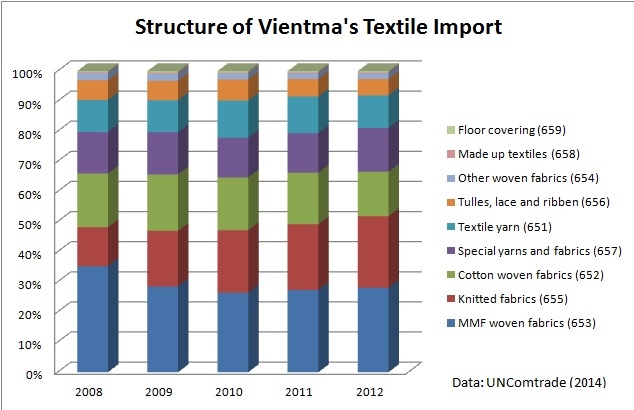
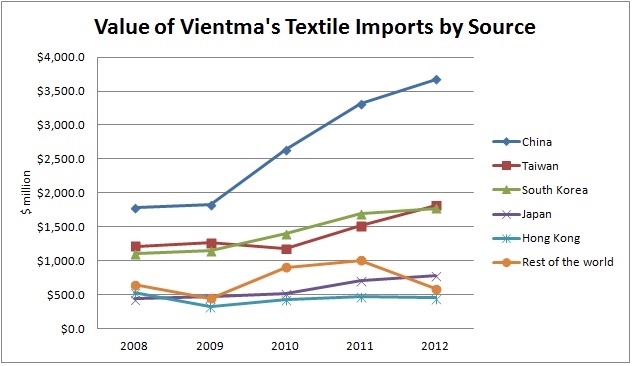
1) Without yarn-forward, situation will get even worse. Particularly, a less restrictive RoO will make Vietnam’s apparel exports which contain textiles made in China, Taiwan or South Korea qualified for duty free access to the US market. Definitely this will be a more imminent and bigger threat to the US textile industry than simply facing competition from Vietnam’s apparel which contains Japanese made textiles. And still many US textile companies don’t treat the Japanese textile industry very seriously, although I think they should. Remember, Japan currently is the fourth largest textile supplier to Vietnam and the NO.1 textile supplier to China.

2) With yarn-forward RoO in place, at least US textile companies can invest in Vietnam (remember, globalization is about movement of capital as well. Many apparel companies in Mexico and Central America actually are invested by US companies). Without yarn-forward RoO however, Vietnam can simply rely on imported textiles as the case mentioned in (1) and there will be no incentive for US textile companies to move factories to Vietnam (meaning, capital holders will lose).

So overall yarn-forward RoO may win a few more years for the US textile industry. But in the long run, it is my view that the US textile production and its exports to the Western Hemisphere countries may still inevitably decline (especially those output to be used for apparel assembly purposes) after the implementation of TPP. In the 21st century, the nature of competition is supply chain v.s. supply chain.

Regional Production-Trade Network Remains an Important Feature of Global Textile and Apparel Trade

Regional production-trade network (RPTN) refers to a vertical industry collaboration system between countries that are geographically close to each other. Within a RPTN, each country specialized in certain portions of supply chain activities based on its respective comparative advantages so as to maximize the efficiency of the whole supply chain.

There are three major textile and apparel (T&A) RPTNs in the world today:

  • Asia: more economically advanced countries/regions such as Japan, South Korea, Taiwan, Hong Kong and China supply textiles to the less economically developed countries such as Vietnam, Bangladesh and Sri Lanka for apparel manufacturing, where the wage level was much lower. On the other hand, Japan is a leading apparel importer and consumption market in Asia.
  • Europe: among EU members, textile inputs can be supplied by developed countries in Southern and Western Europe such as Italy and Germany. In terms of apparel manufacturing in the European Union, low and medium-priced products can be undertaken by developing countries in Southern and Eastern Europe such as Poland and Romania, whereas high-end luxury products can be produced by Southern and Western European countries such as Italy and France. Furthermore, finished apparel can be shipped to developed EU members such as UK, Germany, France and Italy.
  • America: within the region, the United States as a developed country supplies textile materials to developing countries in North, Central and South America (such as Mexico and countries in the Caribbean region), which assemble imported textiles into apparel by taking advantage of the local low labor cost. The finished apparel articles are eventually exported to the United States for consumption.

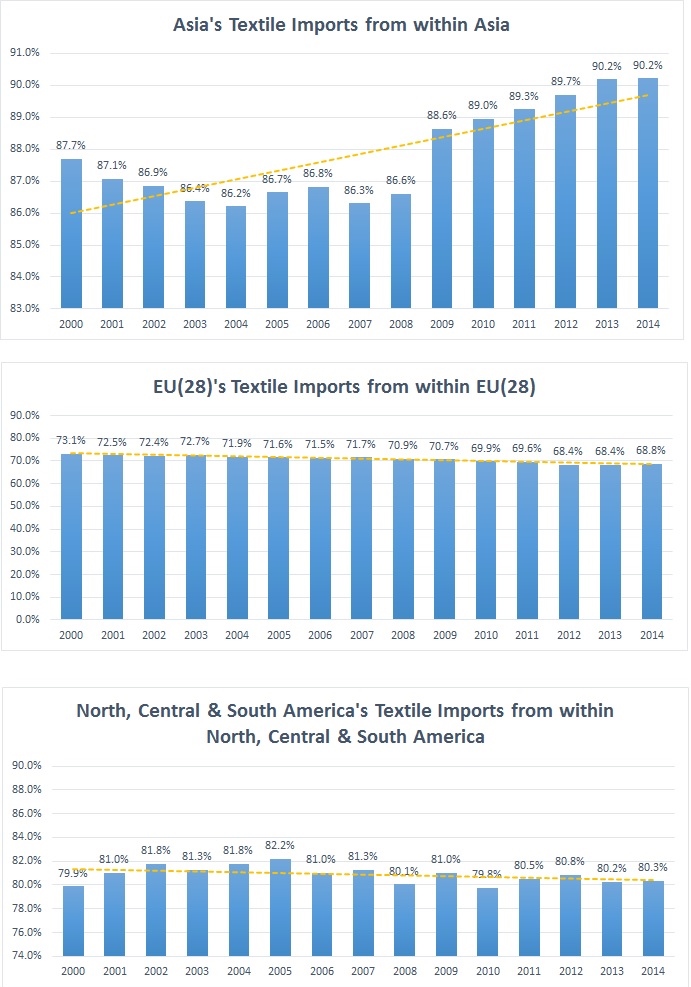
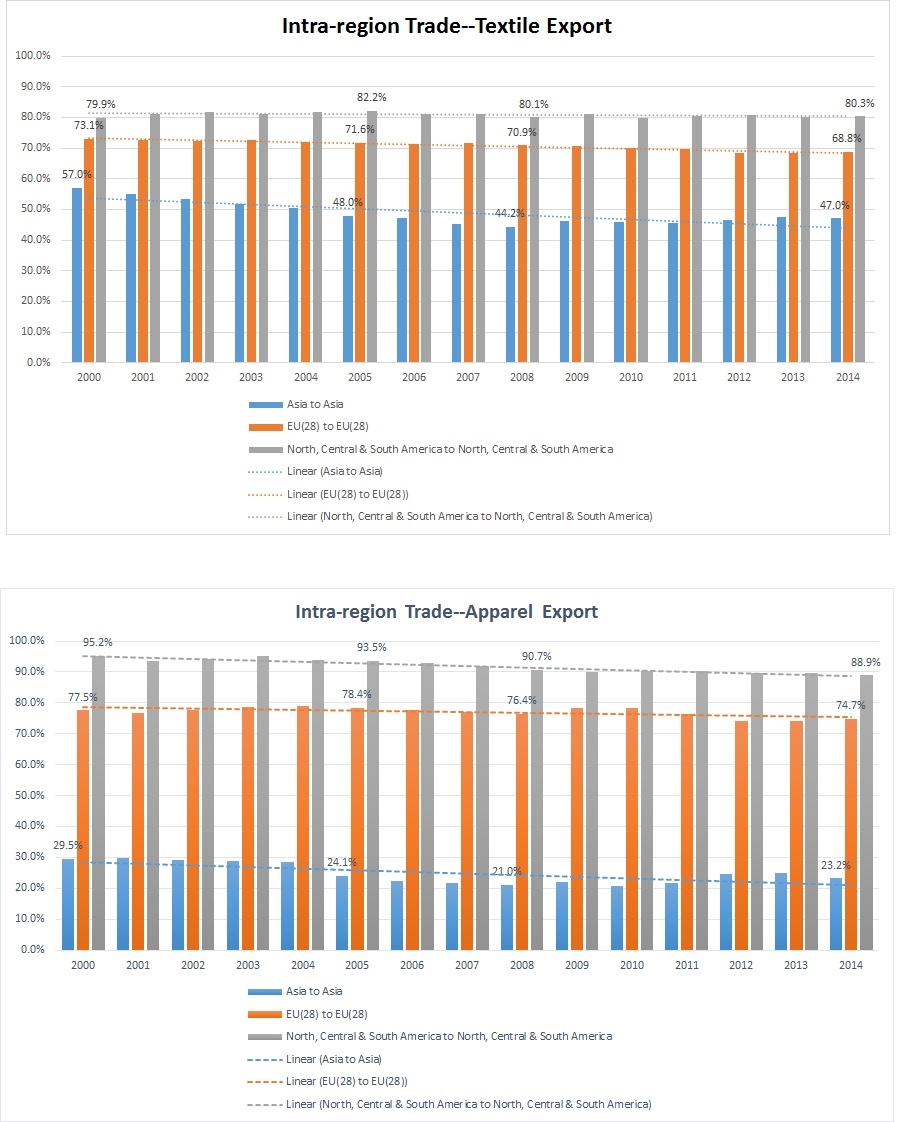
Latest data from the World Trade Organization (WTO) shows that RPTN in the above three regions remain an important feature of today’s global T&A trade as the graphs shown below:

123

4

(Note: Data comes from the World Trade Organization)

Particularly, three specific trade flows are worth watching:

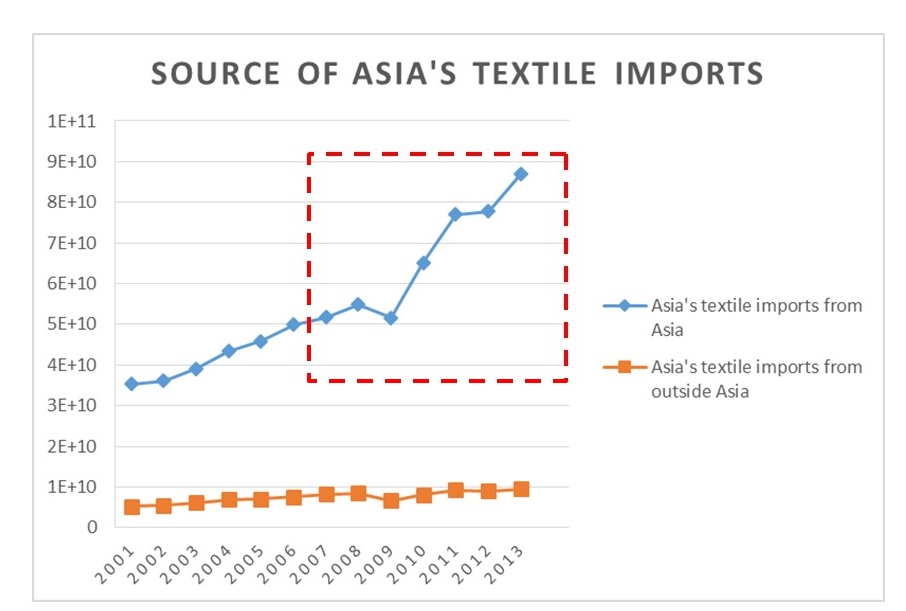
One is Asian countries’ growing dependence on textile supply from within the region, which rose to 90.2% in 2014 from 87.7% in 2000. This is a reflection of a growing integrated T&A supply-chain in Asia. As a result, apparel “Made in Asia” is becoming even more price-competitive in the world marketplace today and this has posted pressures on the operation of the T&A RPTNs in EU and America.

Second one is the stable intra-region trade pattern both for textile and apparel in EU. In 2014, 58.8% of EU’s (28 members) textile imports and 46.2% of apparel imports came from other EU members; at the same time, 68.8% of EU’s (28 members) textile exports and 74.7% of apparel exports also went to other EU members.

Additionally, developing countries in North, Central and South America still heavily rely on regional supply of textile inputs; at the same time, their finished apparel are also mostly consumed within the region. Data show that 80.3% of American countries’ textile imports still came from within the region in 2014; at the same time, 88.9% of American countries’ apparel exports were also shipped to the region, mostly the United States and Canada as the final consumption market.

Sheng Lu

Pattern of Production and Trade in the U.S. Textile and Apparel Industry from 2000 to 2013

Impact of TPP on U

Impact of TPP on U.S. Textile and Apparel Manufacturing: A Preliminary Estimation

Potential impact of the Trans-Pacific Partnership (TPP) remains a hot topic among the U.S. textile and apparel industry. A recent news report suggests that implementation of the agreement will negatively affect clothing manufacturers in LA, where most remaining U.S. apparel manufacturing capacity is located.

According to the news report, “small, independent apparel manufacturers (in LA) did not see big gains from TPP because they did not want to outsource their work, but it put them at a competitive disadvantage.” One local industry estimation quoted in the report claims that “Southern California’s apparel manufacturing will shrink an additional 20 percent if the TPP goes into effect.”

The report further says that “A key question for the apparel industry is whether the agreement includes a yarn-forward provision, which requires material to come from a TPP country in order to be duty-free.” However, the report does not explain why the “yarn-forward” rule could potentially benefit apparel manufacturing in the United States.

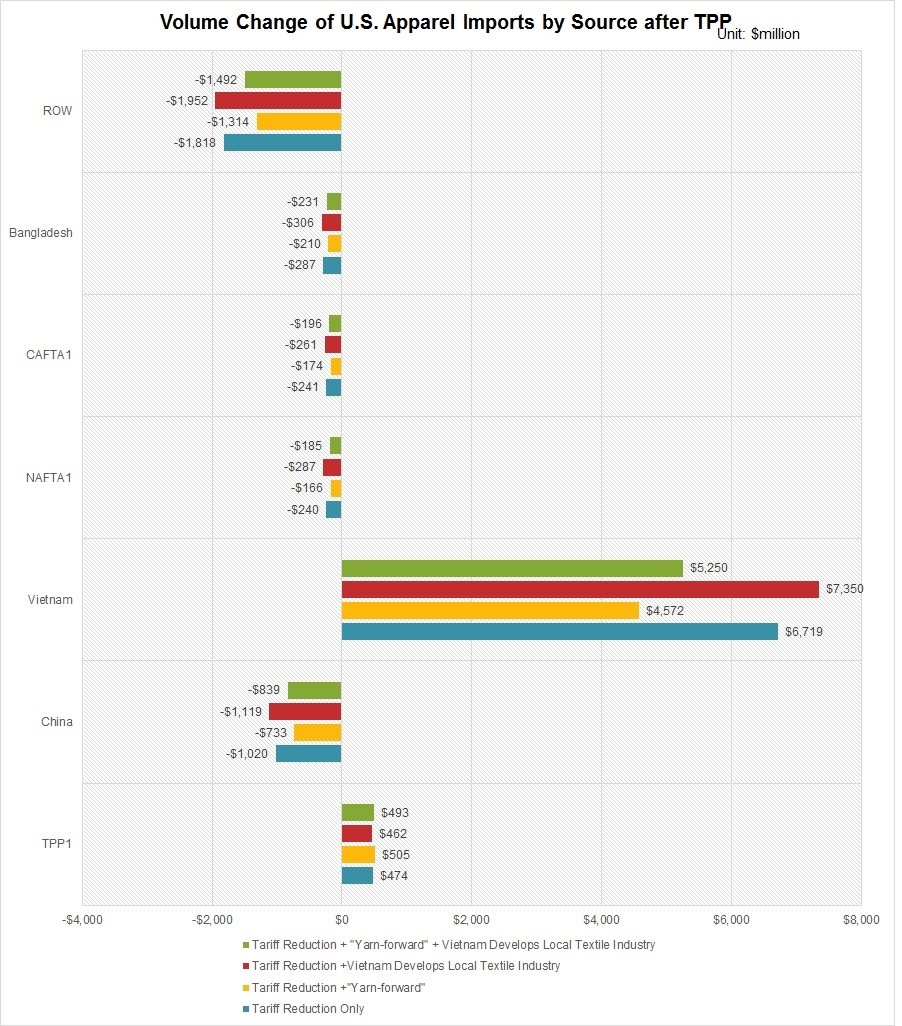
The followings are my personal preliminary estimation* of the potential impact of TPP on U.S. T&A manufacturing. Results show that, compared to the base year level in 2011:

  1. TPP overall will have a negative impact on U.S. domestic textile and apparel manufacturing. In all simulated scenarios, the annual manufacturing output in the United States will decline by $846 million–$3,780 million for textile and $1,154 million–$1,828 million for apparel than otherwise.
  2. The “yarn-forward” rule may not substantially benefit U.S. domestic textile and apparel manufacturing as some people had suggested, for two reasons: 1) results show that Vietnam is more likely to use Japanese textiles than U.S. textiles when yarn-forward rule is in place. 2) U.S. apparel imports from Vietnam directly compete with those imported from NAFTA and CAFTA regions, the largest export market for U.S.-made yarns and fabrics. When NAFTA and CAFTA’s market share in the U.S. apparel import market is taken away by Vietnam, U.S. textile exports to NAFTA and CAFTA will decline anyway, regardless of whether Vietnam uses U.S.-made textiles.
  3. Results suggest that compared with the “yarn-forward” rule, development of Vietnam’s local textile industry will have an even larger impact on the future of U.S. domestic textile and apparel manufacturing. Particularly, when Vietnam becomes more capable of making textile inputs by its own,  not only Vietnam’s overall demand for imported textiles will decline, but also Vietnam’s apparel exports will become even more price-competitive in the U.S. as well as the world marketplace.

 US T&A manfuacturing

US Textile exports

vietnam import source

vietnam import source

US apparel import source

*Note:1. The estimation is conducted based on the latest Global Trade Analysis Project (GTAP) 9.0 database which includes complete bilateral trade information, transport and protection linkages of 140 countries and 57 sectors. Four scenarios are estimated:

  • Scenario 1 (Tariff reduction only): assumes tariff rate for textile and apparel traded between the twelve TPP members are eliminated, whereas tariff rate for other textile and apparel trade flows remain unchanged.
  • Scenario 2 (Tariff reduction + yarn forward): assumes that in addition to tariff reduction among TPP members for T&A, Vietnam substantially increases tariff rate by 100 percent for textile imports from its leading suppliers that are non-TPP members (i.e. China, South Korea and Taiwan). This policy shock provides strong financial incentives for Vietnam to import less textile from non-TPP suppliers and instead import more from other TPP members—an equivalent effect as the yarn forward rule.
  • Scenario 3(Tariff reduction + Vietnam develops local textile industry): assumes that in addition to tariff reduction among TPP members for T&A, productivity of Vietnam’s textile industry increases by 10 percent whereas productivity of other sectors remain unchanged.
  • Scenario 4 (Tariff reduction + yarn forward + Vietnam develops local textile industry): this scenario combines all policy shocks mentioned in scenario 1-3, i.e. tariff rate for textile and apparel traded between the twelve TPP members are eliminated, Vietnam substantially increases its tariff rate by 100 percent for textile imports from its leading suppliers that are non-TPP members (i.e. China, South Korea and Taiwan) and productivity of Vietnam’s textile industry increases by 10 percent.

 2. TPP1 includes Australia, New Zealand, Malaysia, Singapore, Burnie, Chile and Peru; NAFTA1 includes Canada and Mexico; CAFTA1 includes all other CAFTA members except the United States.

Sheng Lu

What Does “Factory Asia” Mean for the U.S. Textile and Apparel Industry?

Slide37

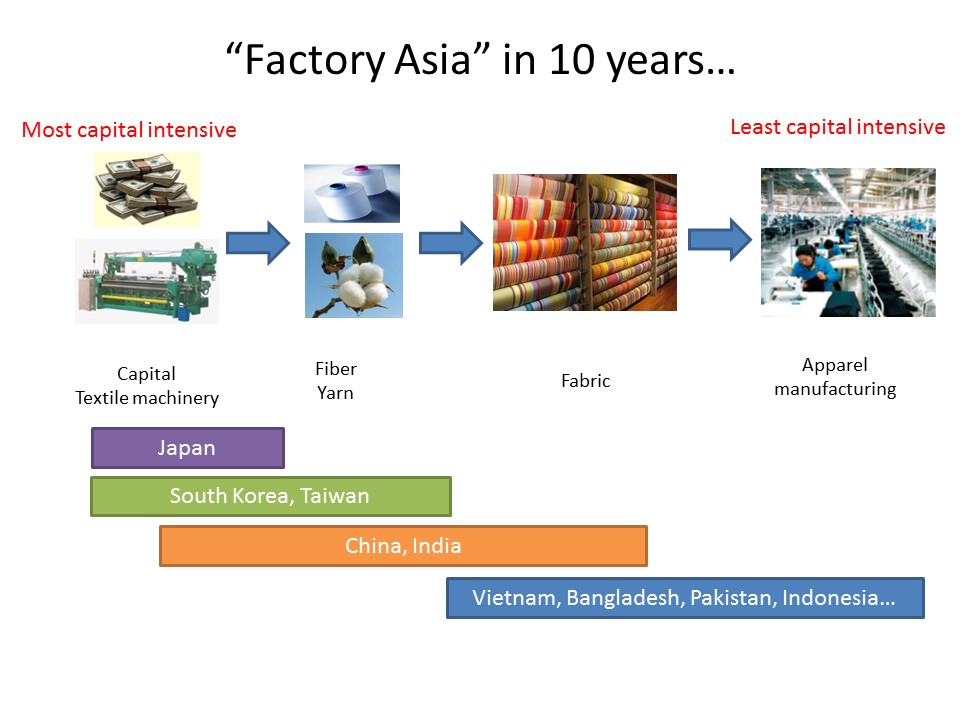
Slide38As we discussed in class, following the “flying geese pattern”, countries in Asia form a dynamic division of labor in textile and apparel (T&A) manufacturing. Although China may gradually lose its comparative advantage in labor-intensive apparel manufacturing, it will continue playing a critical role in “Factory Asia” (i.e. Asia-based T&A supply chain). As results, Asia will remain a giant player in T&A production and export in the years to come.

1 (1)

1 (2)

1 (3)

Slide35

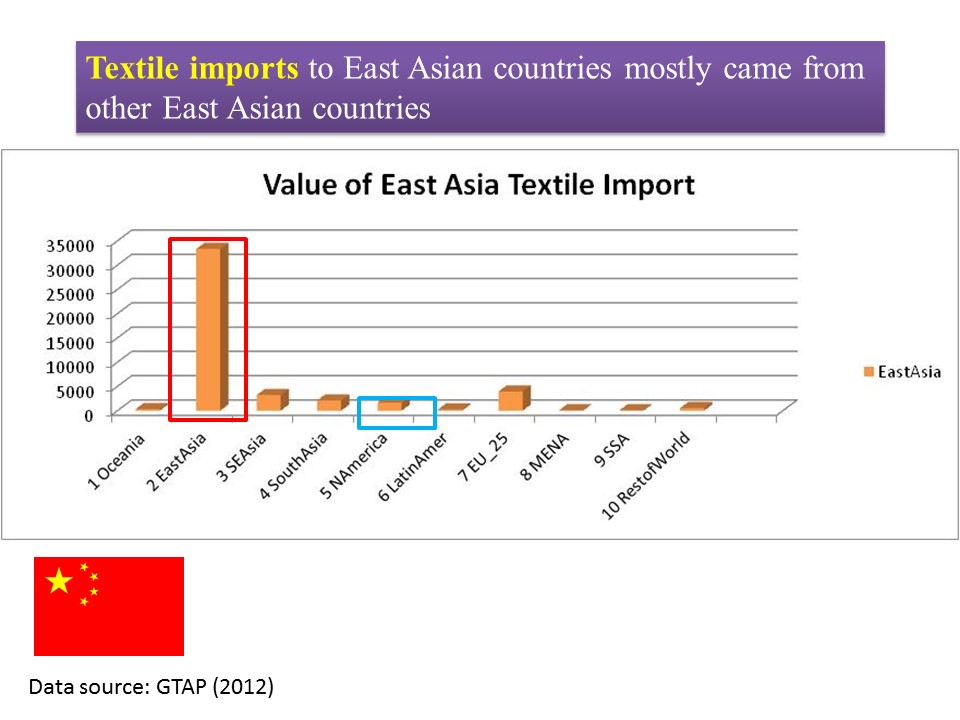
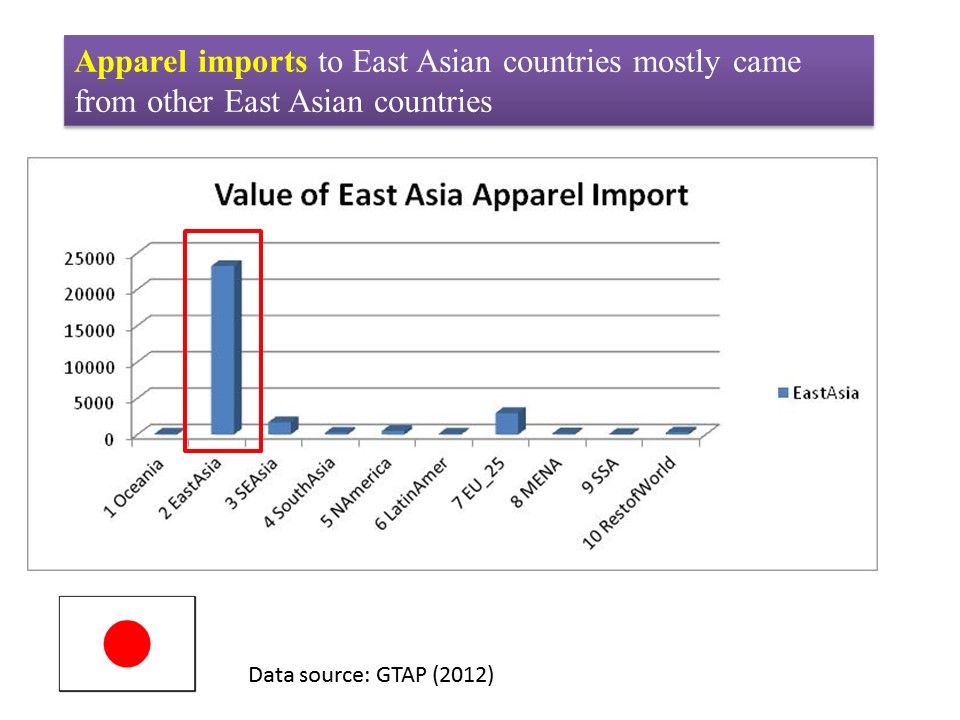
Another important feature of “Factory Asia” is regional integration–Asian countries tend to use more and more T&A inputs from within Asia rather than from outside the region. This may improve the internal efficiency of “Factory Asia”, but also may make it harder for T&A companies outside Asia to get access to the Asian market.

Slide54

So, what is your view on “Factory Asia”? What are the implications of “Factory Asia” for the U.S. T&A industry? Can the Trans-Pacific Partnership potentially shape new T&A supply chain in the Asia-Pacific region? What market opportunities does the Asia-Pacific region present to the US T&A industry? Please feel free to share your view and any other questions in your mind about the Asia-Pacific region. 

[Comment for this post is closed]

Pattern of U.S. Textile and Apparel Imports (Updated: February 2015)

12

4

Total U.S. textile and apparel imports enjoy steady growth from 2000 to 2014. From 2013 to 2014, value of apparel imports increased 2.5 percent and imports of fabric increased 5.4 percent. However, value of fiber imports declined 1.9 percent over the same period. Almost all fastest growing import categories from 2004 to 2014 are basic apparel.

3

Because the United States is no longer a major apparel manufacturer but one of the largest apparel consumption markets in the world, apparel products accounted for 76.1 percent of total U.S. textile and apparel imports in 2014. Fabrics and yarns accounted for 5.8 percent and 1.3 percent respectively.

75

8

While developing countries dominated apparel supply to the United States in 2014, developed countries remain important suppliers of textiles. For certain industrial textile products such as non-woven textiles, nearly 50 percent of imports still came from European Union (28), Canada and Japan. This pattern reflects different product nature of apparel (labor intensive) and textiles (capital intensive) as well as the respective comparative advantage of developing and developed economies.

6

Overall, pattern of apparel imports is in parallel with apparel retail sales in the U.S. market. This reflects the fact that demand for imports is largely shaped by macro-economic conditions. It should also be noted that despite the heated discussion on “reshoring” apparel manufacturing in the U.S., apparel imports is NOT declining.

9

11

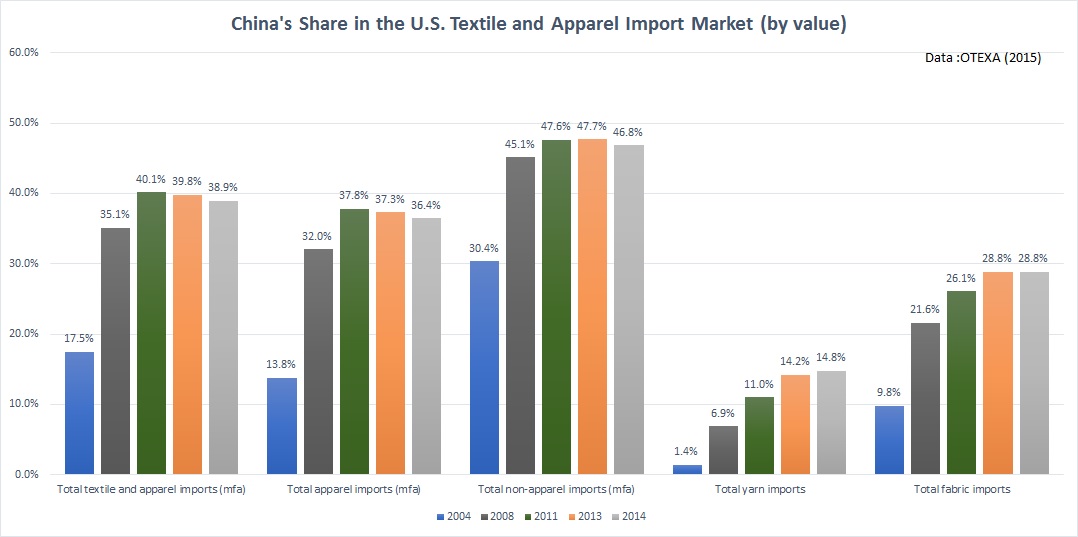
By value, China accounted for 38.9 percent of total U.S. textile and apparel imports in 2014, which was slightly lower than the level of 39.8 percent in 2013. It should be noted that China’s market shares significantly varies by category. Within the total 167 number of textile and apparel product categories complied by the Office of Textiles and Apparel (OTEXA), China enjoyed market share increase for 119 categories and suffered market share losses for 49 categories from 2004 to 2014 (many are sewing thread products).

Latest Trends in the US Apparel Industry (update: January 2015)

Latest statistics released by the American Apparel and Footwear Association (AAFA) indicate several trends in the U.S. apparel industry:

  • First, the retail market is gradually recovering. According to AAFA, on average, every American spent $907 on clothing (or purchased 64 garments) in 2013. Although this figure is still less than the one before the 2008 financial crisis, it is the highest level since 2012.
  • Second, “Made in USA” is growing but US consumers still rely on imports. Data from AAFA shows that US apparel production increased 6.2 percent from 2012 to 2013, accounting for 2.55% share of U.S. apparel market. However, nearly 98% of apparel consumed in the US were still imports in 2013.
  • Third, China remains the top apparel supplier to the United States. Despite the concerns about the rising production cost in China, latest data from OTEXA shows that, in 2014 (January to November) China still accounted for 42.5% of US apparel imports in terms of quantity and 39.1% in terms of value–almost the highest level in history. These two numbers were 41.7% and 39.9% a year earlier. On the other hand, Vietnam’s market share has reached 9.3% (by value) and 10.7% (by quantity) in 2014 (January to November), about ¼ of China’s exports to the United States.
  • Fourth, job market reflects continuous shift of the apparel industry. According to AAFA, among the total 2.8 million workers directly employed by the US apparel industry in 2013, only 5% were in the manufacturing sector, 5% were in the wholesaling sector and as many as 90% were working for retailers. However, within the apparel retail sector, total employment by the department stores is quickly shrinking—dropped 7.6 percent from 2012 to 2013 and cumulatively 21.3 percent from 1998 to 2013. At the same time, specialty clothing stores and sporting goods stores are hiring more people: 13.8% and 64.5% increase of employment from 1998 to 2013 respectively. The contrasting employment trend reflects the changing nature of the U.S. apparel retail market and the channels through which U.S. consumers purchase clothing.
  • Fifth, US consumers are paying higher taxes on imported clothing. Calculated by AAFA, while the overall U.S. imports were only charged by a 1.4% tariff rate, the effective duty rate on all apparel imports rose to 13.6% in 2013. The higher effective duty rate may be caused by the fact that less apparel were imported utilizing free trade agreement or trade preference programs.

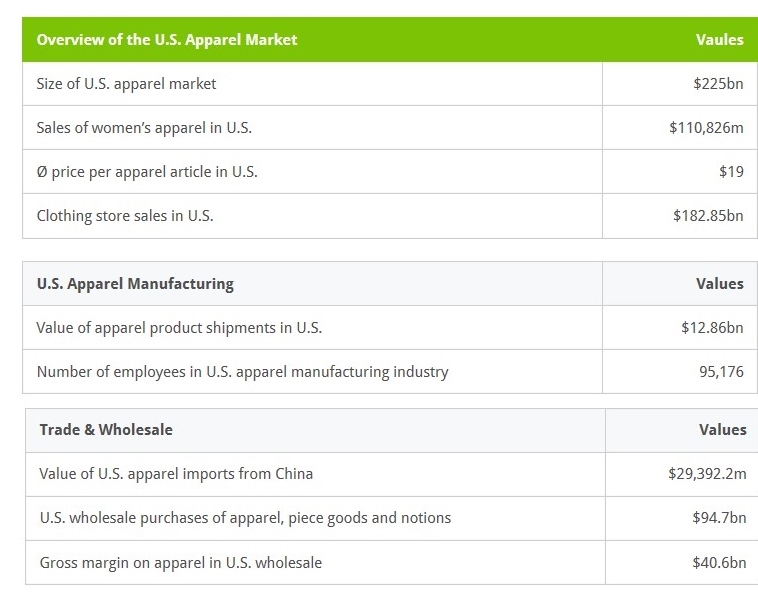
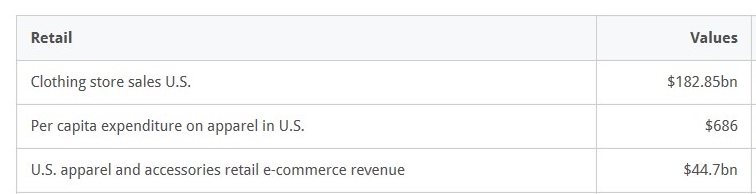
Appendix: Facts on the US Apparel Market in 2012

Slide1 Slide2

Data Source: http://www.statista.com/

China Apparel Retail Market (updated in December 2014)

According to Fung Group’s latest China apparel market report:

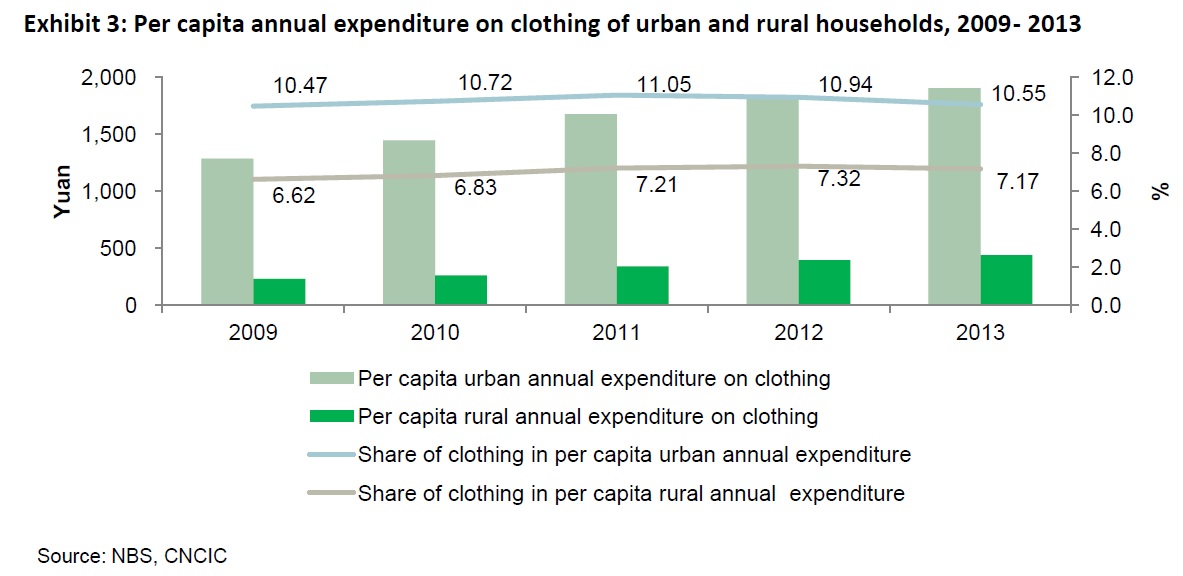
1. China’s apparel retail market remains strong despite slower growth. China’s apparel retail sales reached 1,141billion RMB (or $187 billion USD) in 2013, rose by 11.6 percent from 2012. On average, each urban household in China spent 1,902 RMB (or $306USD) on clothing in 2013, accounting for 10.6 percent of their total annual expenditure. [note: in the US, clothing accounts for around 3 percent of household annual expenditure]. It is estimated that China will replace the United States and become the world’s largest apparel retail market in 2017.

12


7

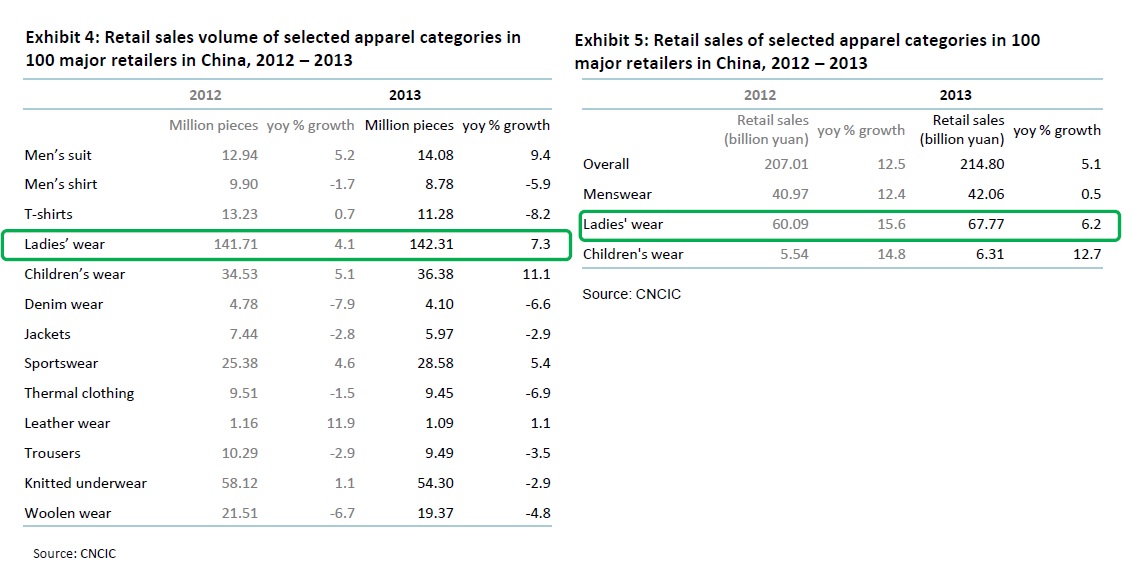
2. Women’s wear is the largest contributor to China’s total apparel sales. A survey of 100 major retailers in China shows that women’s wear accounted for 32.7 percent of their clothing sales from 2012 to 2013. However, women’s wear is a highly fragmented and competitive market in China. For example, the top ten brands altogether only accounted for 21.43 percent of market share in 2013.

4

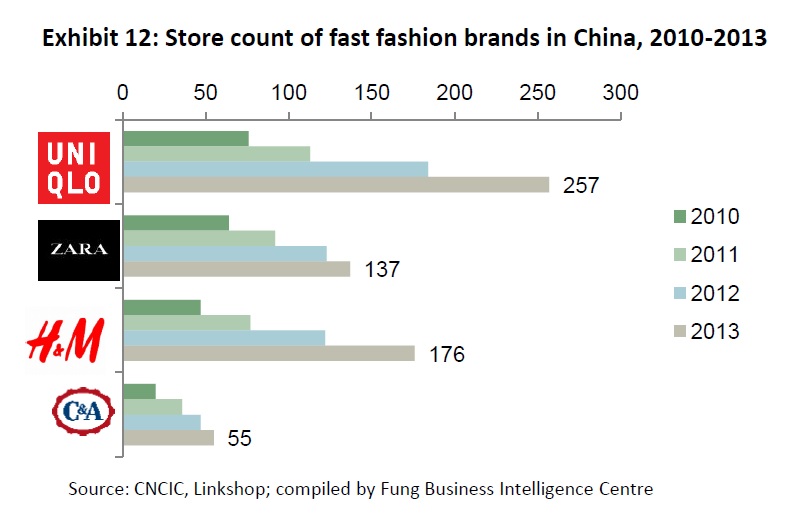
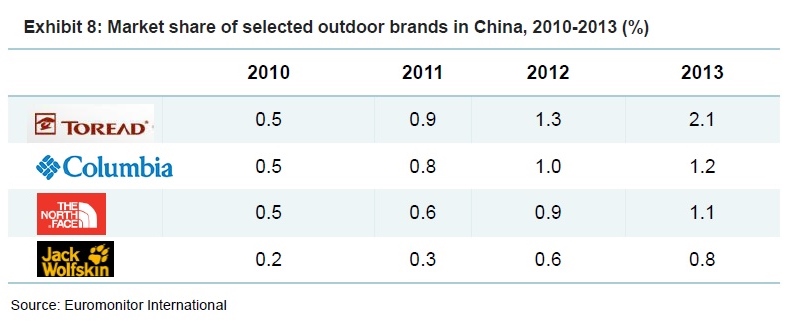
3. Children’s wear and sportswear are the two growing areas in China’s apparel market. Specifically, retail sales of children’s wear in China reached 6.3 billion RMB (or $1 billion USD) in 2013, registered growth of 12.7 percent. Because Chinese government has relaxed its “one-child policy”, China is estimated to add 1-2 million extra kids over the next few years, suggesting further market expansion possibility. Thanks to Chinese consumers’ increasing interest in sports and outdoor activities, sales of sportswear enjoyed 35 percent growth from 2012 to 2013. Functional products with fashionable designs are the key to win the market. While international brands (such as Nike and Adidas) are mainly concentrated in tier 1 and tier 2 cities, domestic brands are still dominating the lower-tier cities where more growth potential is involved.

5

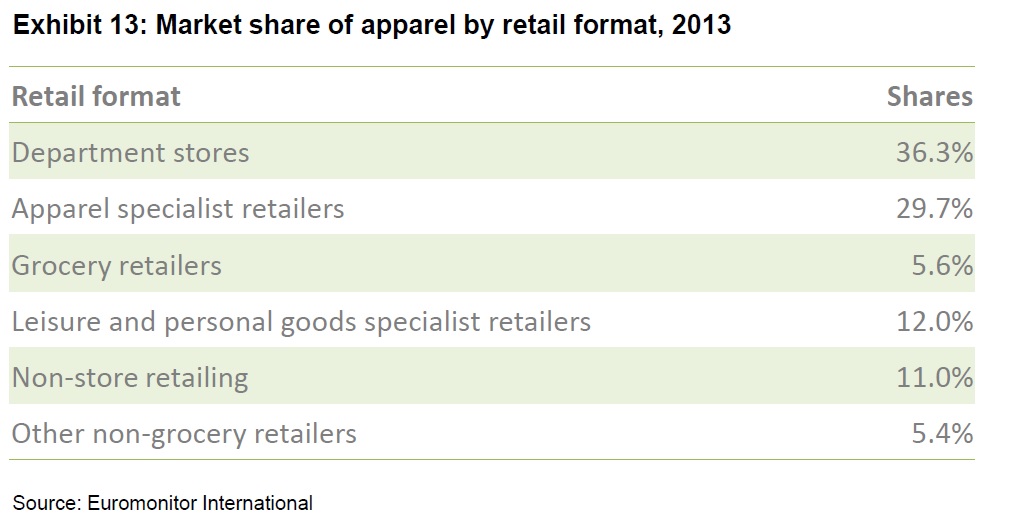
4. Department stores and specialty stores remained the main channels for apparel distribution in China, accounting for 36.3 percent and 29.7 percent of market share respectively in 2013. Specifically, department store remains the main channel for mid to high-end apparel sales in China, although specialty stores are increasingly preferred by apparel brand owners. As a common business practice in China, apparel brand owners manage their self-operated specialty stores in key cities while leaving other locations to franchisees as distributors. On the other hand, hypermarkets and supermarkets are popular retailing channels for lower-priced apparel, many of which are with poor brand recognition or unbranded.

3

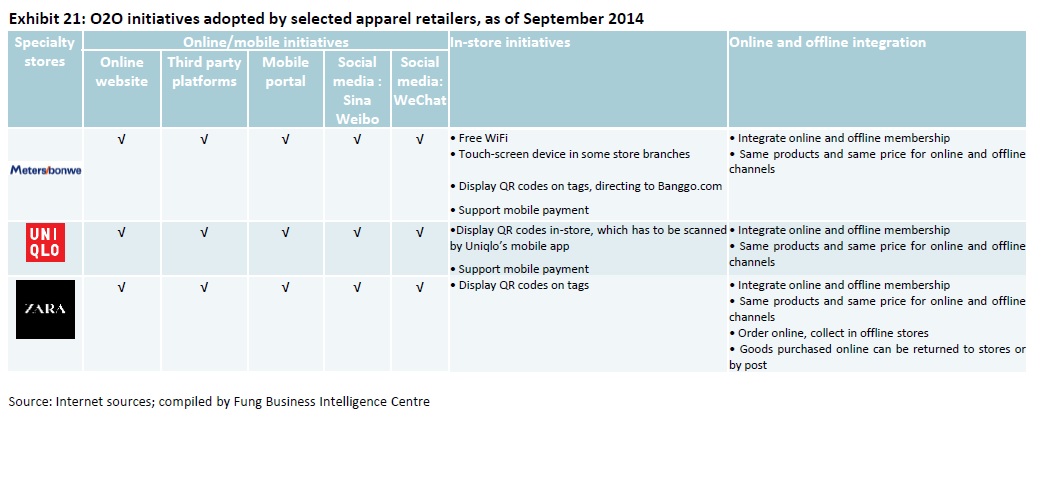
5. Online retailing is the fastest growing retail channel in China for apparel. According to one source, the total online apparel transaction value in China reached 434.9 billion RMB (or $36.2 billion USD) in 2013, increased by 42.6 percent from 2012. Similar as the emerging of “omni-channel retailing” in the US, apparel companies operating in China are making more efforts to explore“O2O” (online and offline integration). It shall be noted that more and more overseas apparel brands see e-commerce as a strategic means to reach Chinese consumers. For example, even luxury brands such as Burberry and Hugo Boss have opened online store through a B2C platform (like Tmall) in China.

9

6Some additional personal thoughts:

  1. Western apparel brands and retailers shall realize that China is a highly fragmented market with diverse market characteristics from region to region (for example, tier 1 v.s. tier 3 &4; urban v.s. rural; north v.s. south).
  2. Chinese consumers are getting more and more sophisticated, yet price is still a key factor to win this market.
  3. Given the size and sophistication of China’s apparel market, western apparel brands and retailers may consider building an independent China operation system (from design to distribution). Also, successful business models at home market may not work in China at all.

Apparel Industry is Not All about Labor Cost

While most discussions on improving corporate social responsibility practices in the apparel industry still focus on conventional solutions like higher labor standards and more effective monitoring programs, a recent Boston Consulting Group report suggests supply chain innovation also has its role to play.

One key argument of the report is: Although cost still matters in apparel sourcing, lower-cost can be achieved through means other than seeking cheap labor. For example:

1

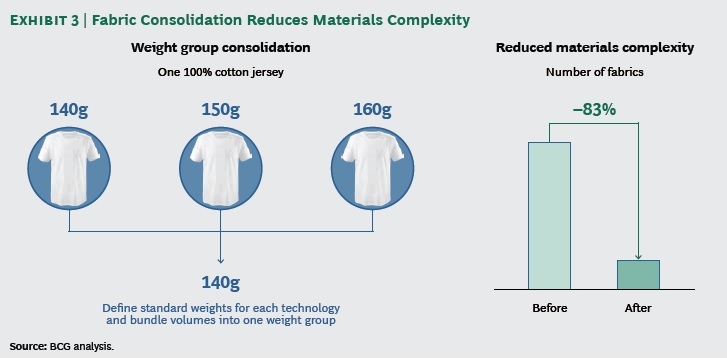
Engendering end-to-end supply chain efficiency through managing raw materials. Apparel companies may work with their suppliers further down the supply chain to optimize fabric selection, which usually account for as much as 60-70 percent of the total cost of a finished garment (v.s. 30-40 percent of labor cost). Some apparel companies have started to use fewer yarns and weight classes so as to reduce fabric count and lower down sourcing cost. Some other companies are realizing significant cost reduction by timing orders so as to level the load over the course of the year. [Note: looks like Uniqlo’s model]

2

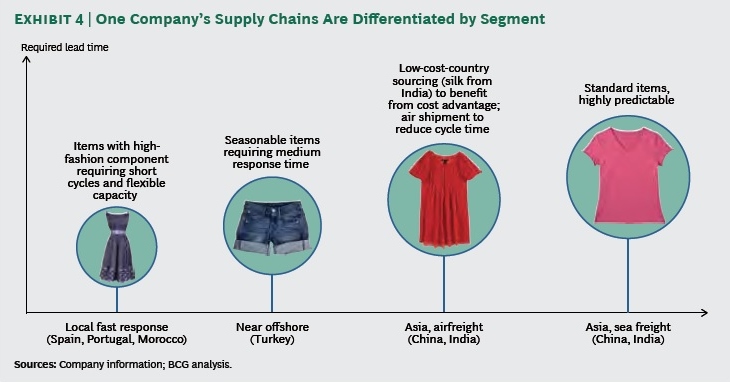
Building an integrated supply chain. As cited in the report, to balance sourcing cost and speed to market, one major apparel retailer builds 15 to 20 percent of the season’s styles and pre-positions about two-thirds of its raw material before the season (both in-house and from production partners). During the season, the company analyzes sales, staying in constant communication with its stores and with the design team. It resupplies items that are selling well through accelerated production and delivery, usually within three to four days. Designers then create new styles by adapting the best sellers using the pre-positioned material. [Note: looks like Zara’s model]

Innovating ways of production. The report suggests that bonding and gluing technologies (i.e. use bonded adhesive films and processes such as ultrasonic heating and high-frequency radiation to fuse together layers of fabric) can produce an entire small garment in 30 to 40 percent less time than conventional cut-and-sew. Digital technologies such as digital prototyping of textile designs can also significantly help apparel makers reduce waste and boost efficiency in pattern making. The potential application of 3D printing may further allow apparel makers to produce smaller batches, and possibly even allow for made-to-order production of individually designed and sized garments. This would not only allow companies to match the market’s growing need for speed, but also reduce the costs of retail inventory surpluses and associated price reductions.

Two additional thinking based on the report:

First, much attention has been given to the changing business environment of the apparel industry, such as rising labor cost in Asia, shifting market growth towards emerging economies and more sophisticated consumers’ demand in the era of omni-channel retailing. But what if the nature of the apparel industry is also changing: if one day labor cost is no longer a key factor in deciding where to produce and apparel production itself is no longer labor-intensive at all? Although automation of apparel production was not achieved in the 20st century, it may not be something totally impossible in the 21st century. We need to have bold thinking here.

Second, while the apparel industry is innovating its business model (i.e. the way to produce, the way to deliver products and the way to serve its customers), T&A educational programs also need to embrace innovative thinking. For example: are traditional course offerings sufficient enough (or still relevant) to prepare students’ job readiness in the 21st century? How to proactively respond to the changing nature of the apparel industry which has started to adopt more and more new technologies? What if we redefine the meaning of “T&A” majors and redesign the model of preparing the workforce for the apparel industry? (just like the question: for wearable technology, shall IT companies make apparel or apparel companies make IT products?)

U.S. Textile and Apparel Exports in 2013 (Updated in November 2014)

1

U.S. textile and apparel (T&A) exports increased by $543 million (3 percent) to $19.8 billion in 2013. However, because import increased by $3.2 billion (3 percent) to $97.5 billion, U.S. trade deficit in T&A increased rose to $97.5 billion in 2013. Imports supplied about 98 percent of U.S. consumer demand for T&A in 2013.

2

3

Textiles account for 83 percent of all U.S. T&A exports in 2013. Exports of these textiles products (particularly fabrics and yarns) are used primarily as intermediate inputs for finished products manufactured abroad, which are then imported back into the United States (USITC, 2014). In terms of value, specialty & industrial fabrics, spun yarns & thread, felts & other non-woven textiles and other made-up textile articles altogether account for nearly half of U.S. T&A exports in 2013. Statistics further show that U.S. apparel exports also grow fast in recent years. However, it shall be noted that a good proportion of them might be used clothing.

4

5

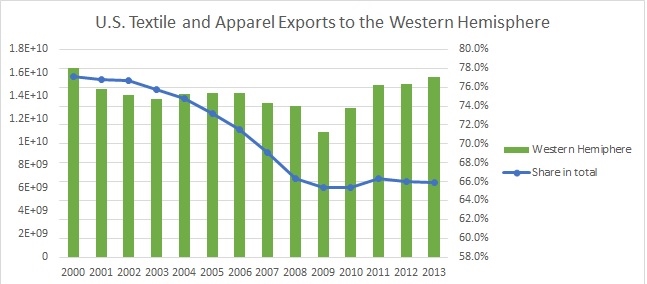
Mexico and Canada remain the top two largest export markets for U.S. T&A in 2013. 66 percent of U.S. T&A exports in 2013 went to the Western Hemisphere (i.e. North America, Central America, South America, and the Caribbean countries). However, this share has declined from 77.6 percent in 2000. Other leading export markets for U.S. T&A include Honduras, China and Japan.

6

Reference:

USITC (2014). Shifts in U.S. Merchandise Trade. http://www.usitc.gov/press_room/news_release/2014/er1112ll232.htm 

OTEXA (2014). U.S. Imports and Exports of Textiles and Apparel. http://otexa.trade.gov/msrpoint.htm

Study Suggests Positive Social Impact of the Garment Sector on the Lives of Bangladesh Women

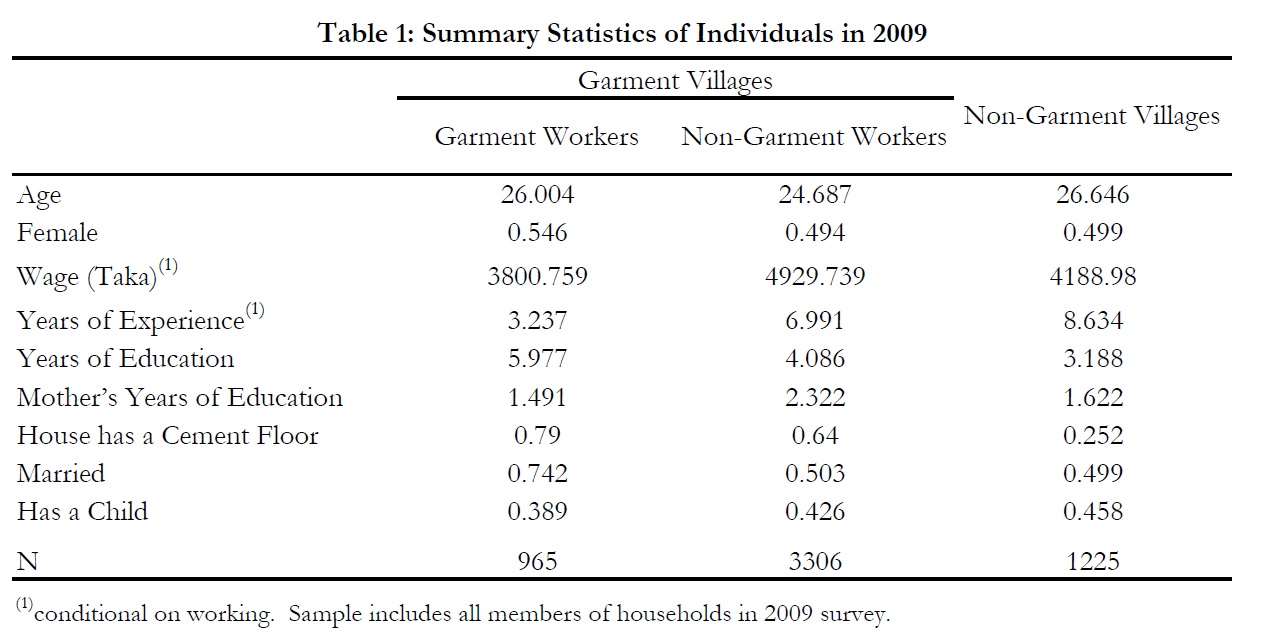
While our case study 1 focused on the problem of corporate social responsibility practices in the Bangladesh garment sector, a recent study based on examining 1,395 households in 60 Bangladeshi villages in 2009 suggests that the growth of the garment sector has resulted in positive impacts on the lives of Bangladeshi women.

Specifically, the study finds that:

1) Girls exposed to the garment sector delay early marriage and childbirth at early ages (12-18). Many studies have suggested the negative welfare implications of early marriage and childbirth.

2) Girls exposed to the garment sector gain extra years of education. According to the study, on average, one additional year of working in the garment sector statistically will lead to a 0.48 years of education for girls. The authors further suggest that increased demand for skills in garment factories was one of the main driving forces behind such a positive correlation.

As argued by the authors, in developing countries such as Bangladesh, social policies such as education are often tied to trade policy and industrial policy.

However, one another interesting finding is that the average wage level of respondents working in the garment sector was almost 22% lower than those working in the non-garment sector in Bangladesh.

So, based on our case study and the above research findings, do you have any new thoughts about improving the corporate social responsibility practices in the global apparel industry? Do you think Western retailers shall stop sourcing apparel from Bangladesh because of the reported problem of factory safety and workers’ working condition? Please feel free to share your views.

1

Why People Think Differently about International Trade?

This week we looked at a critical activity closely associated with the textile and apparel industry in the 21st century: International Trade.  Among the fundamental questions we examined, whether trade is beneficial or not is a one that all of us care much about but also has raised many debates. 

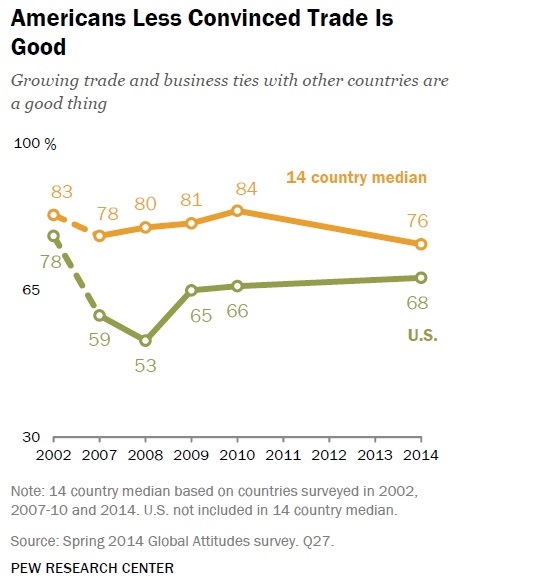
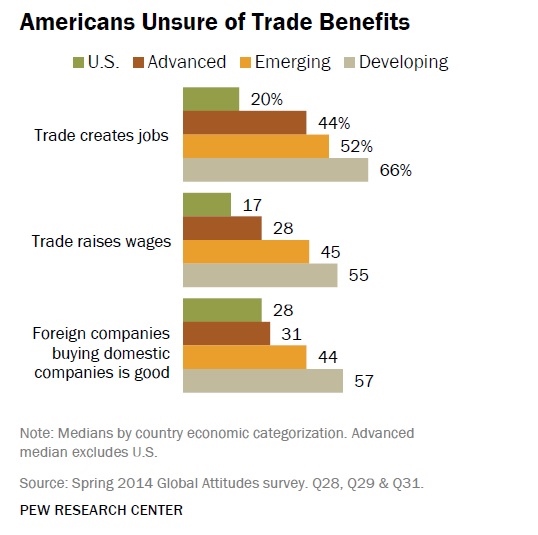
Just this week, the Pew Research Center released its latest survey findings about the public opinion on growing trade and business ties between countries and views about the impact of trade on jobs, wages and prices. The results show that not only Americans, but also people in other countries, including those developing ones, are divided about international trade. Anyhow, the highest level of public skepticism about trade and foreign investment is found in the United States.  

1

2

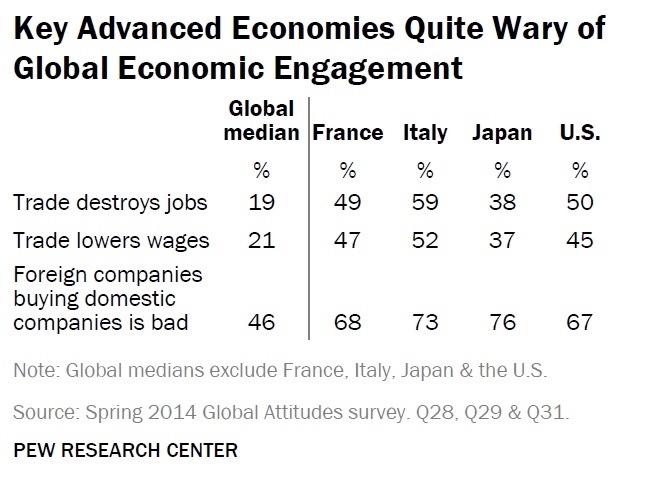
Job and wage are among the top concerns about trade among the general public. In Italy, nearly 59 percent survey respondents believed that trade destroy jobs and 52 percent believed trade lower wages. These two figures are 50 and 45 among US respondents.

 3

5

After our discussion on various trade theories, which school of thought do you agree more: mercantilism or comparative advantage theory? Are these theories proposed hundreds years ago still working today? Do you think deepened globalization will reduce the gap or even widen the gap of people’s divided view on international trade? How do you think international trade affects your daily life and your future career opportunities? Last but not least, is trade beneficial for the US textile and apparel industry in the 21st century? Please feel free to share your views!

World Textile and Apparel Trade (Update: August 2014)

The following analysis is conducted based on the statistics released by the World Trade Organization on August 5, 2014.

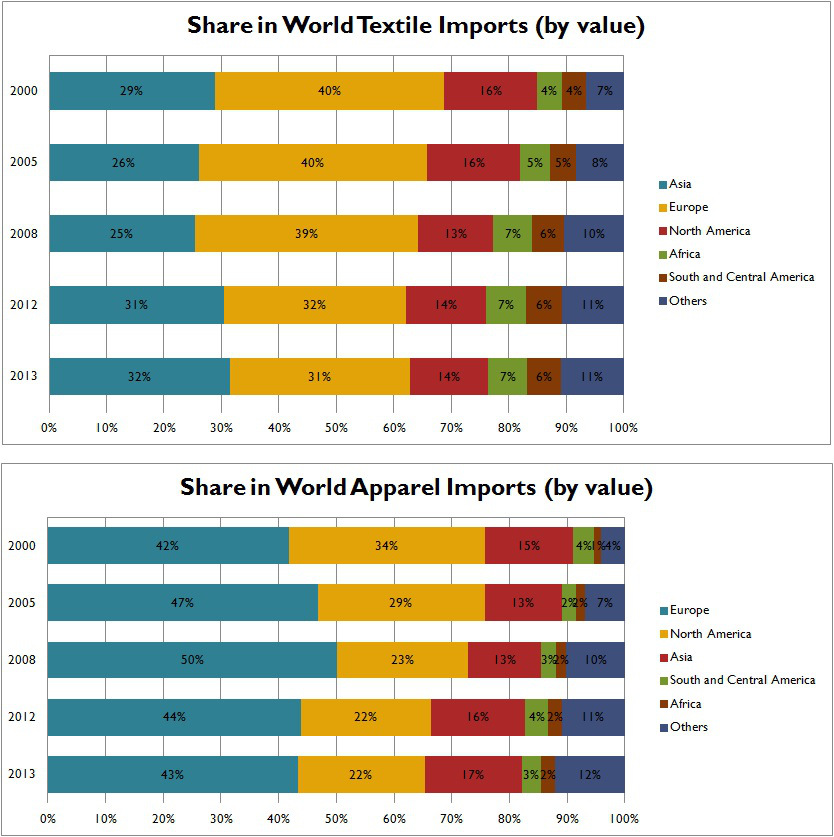
1. Asia continues to dominate the world textile and apparel exports from 2012 to 2013.

0

12

2. Despite concerns about its rising labor cost, China continues to gain more market shares in world textile and apparel exports from 2012 to 2013.

22

3. World market for textiles remains relatively stable from 2000 to 2013; world market for apparel is gradually shifting and diversifying. Although Europe and North America still account for lion’s shares in world apparel imports (due to their higher GDP per capita), Asia is the fast growing market.

32

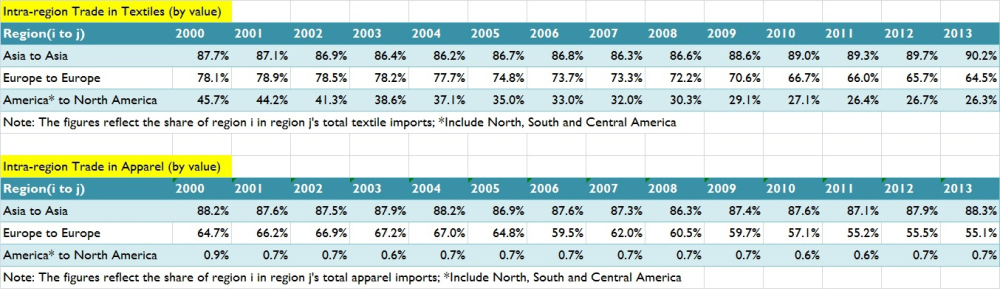
4. Intra-region trade remains a distinct pattern in world T&A trade, particularly in Asia, Europe and America. However, the pattern has become substantially weakened in Europe and America from 2000 to 2013, which could be the results of increasing number of FTAs in these regions.

41

5. US textile and apparel exports increased 3.3% and 4.4% respectively from 2012 to 2013. North America remains the single largest T&A export market for the United States.

51

by Sheng Lu

Recent Scholarly Books about the Global Textile and Apparel Industry (Update: Aug 2014)

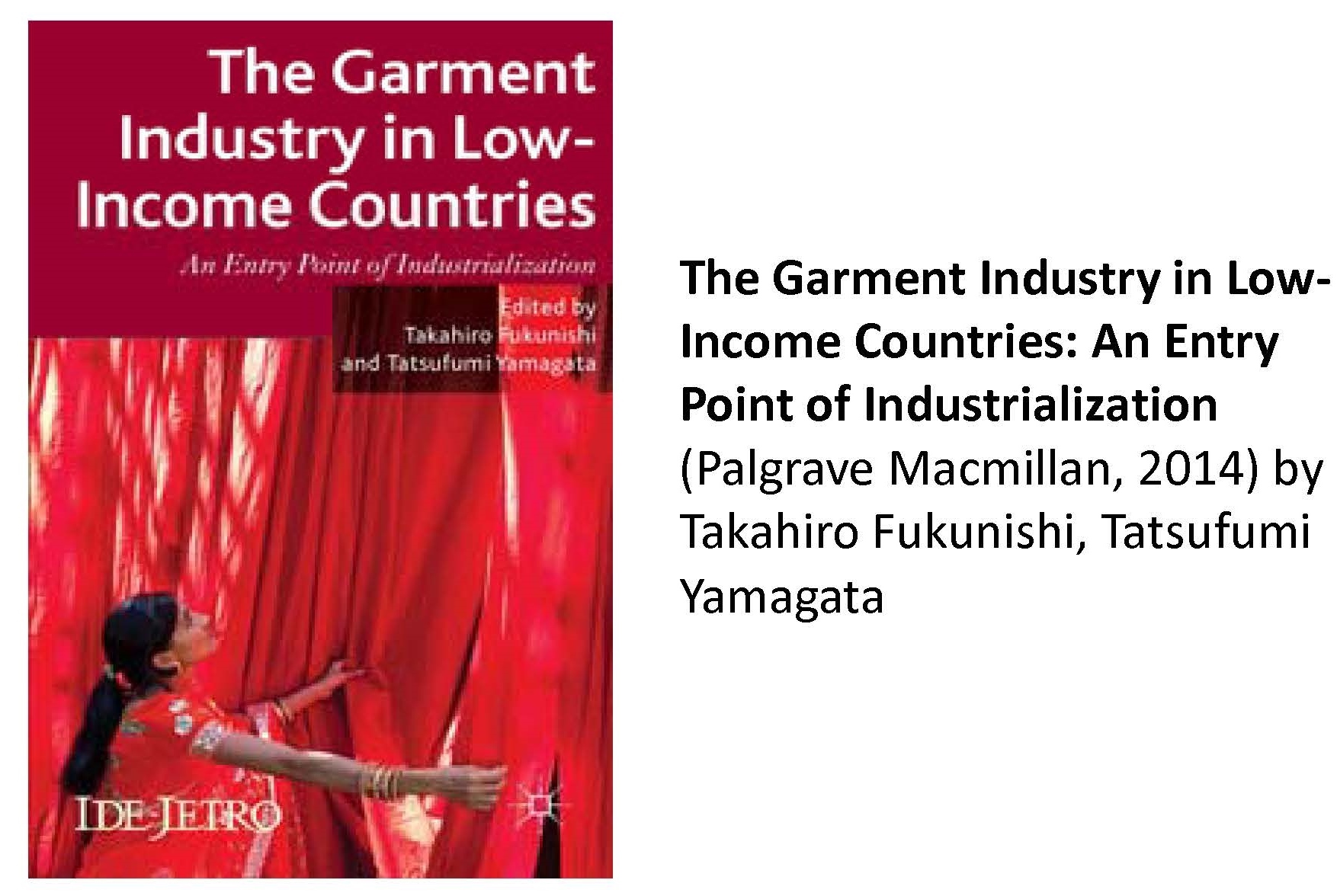
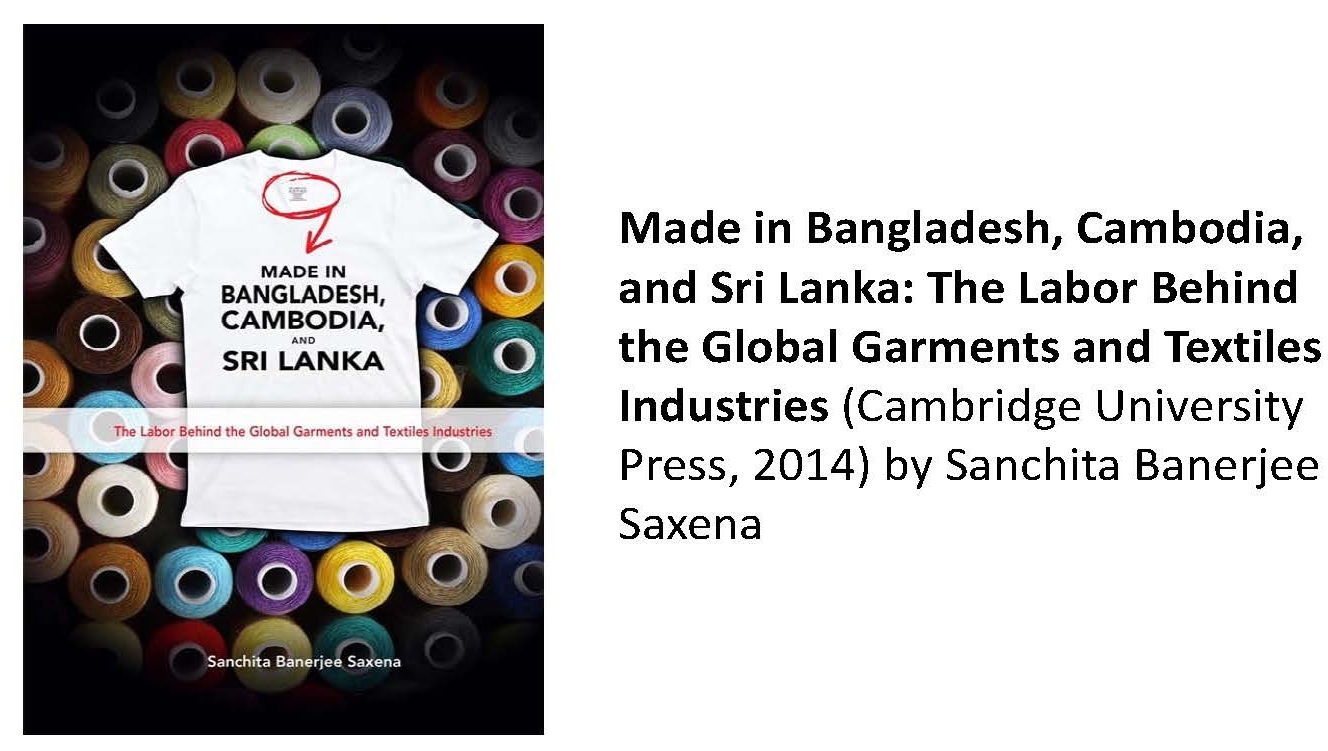
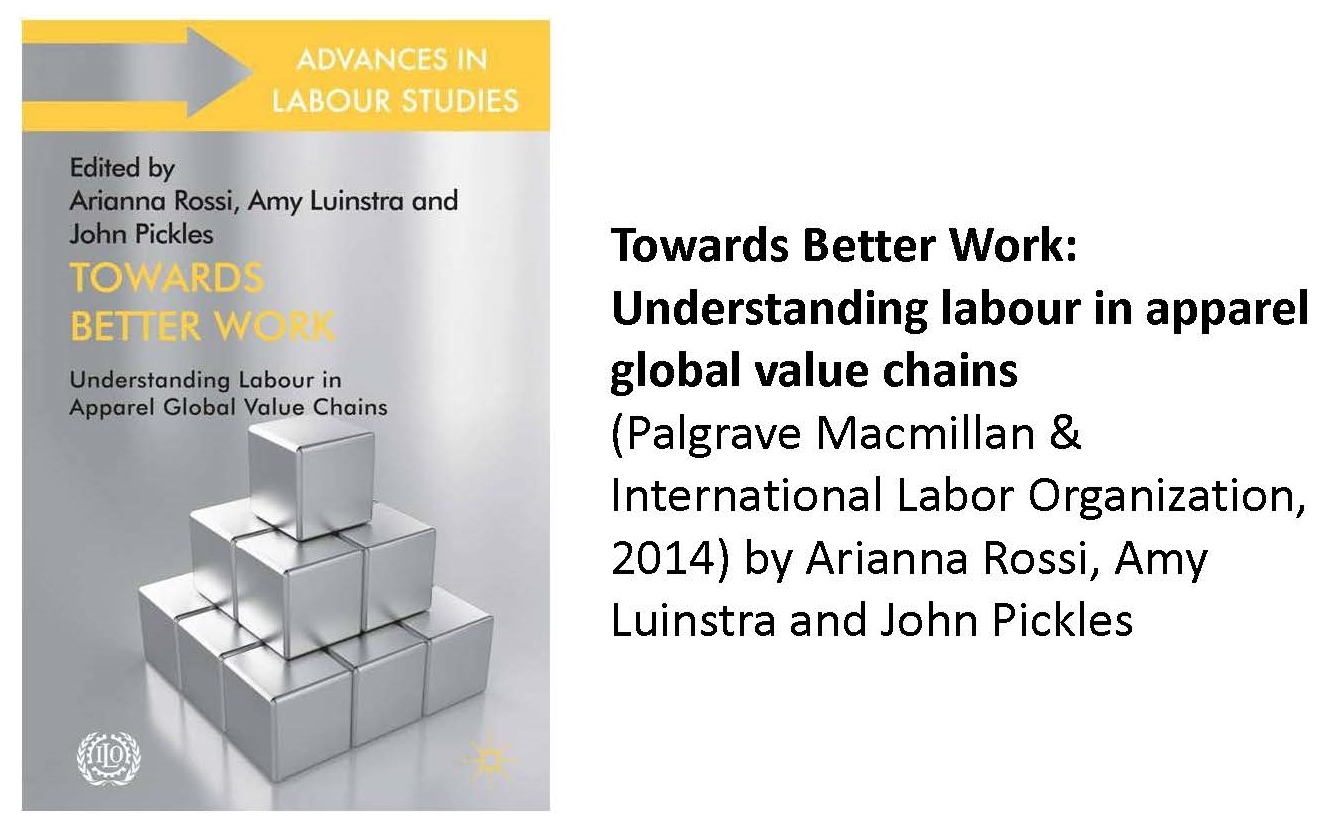
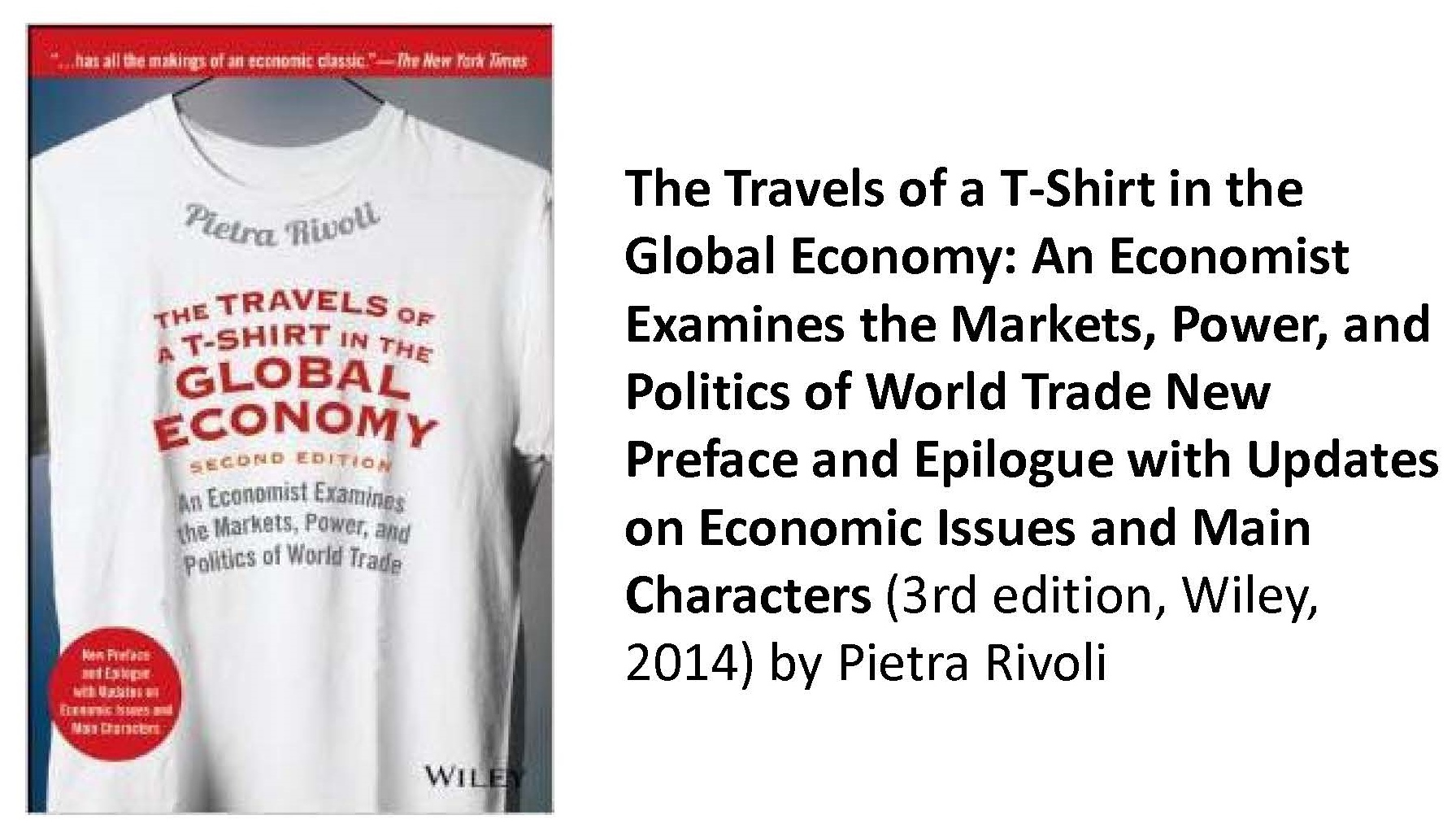
4 3 2 1


Why does the US Textile Industry Want Yarn-forward Rule of Origin (RoO) in TPP?

textile

My personal understanding: the US textile industry insists yarn-forward RoO in TPP is not because they expect a substantial increase of textile exports to Vietnam as the case of NAFTA and CAFTA which help capture the export markets in Mexico and Central America. But rather it is because:

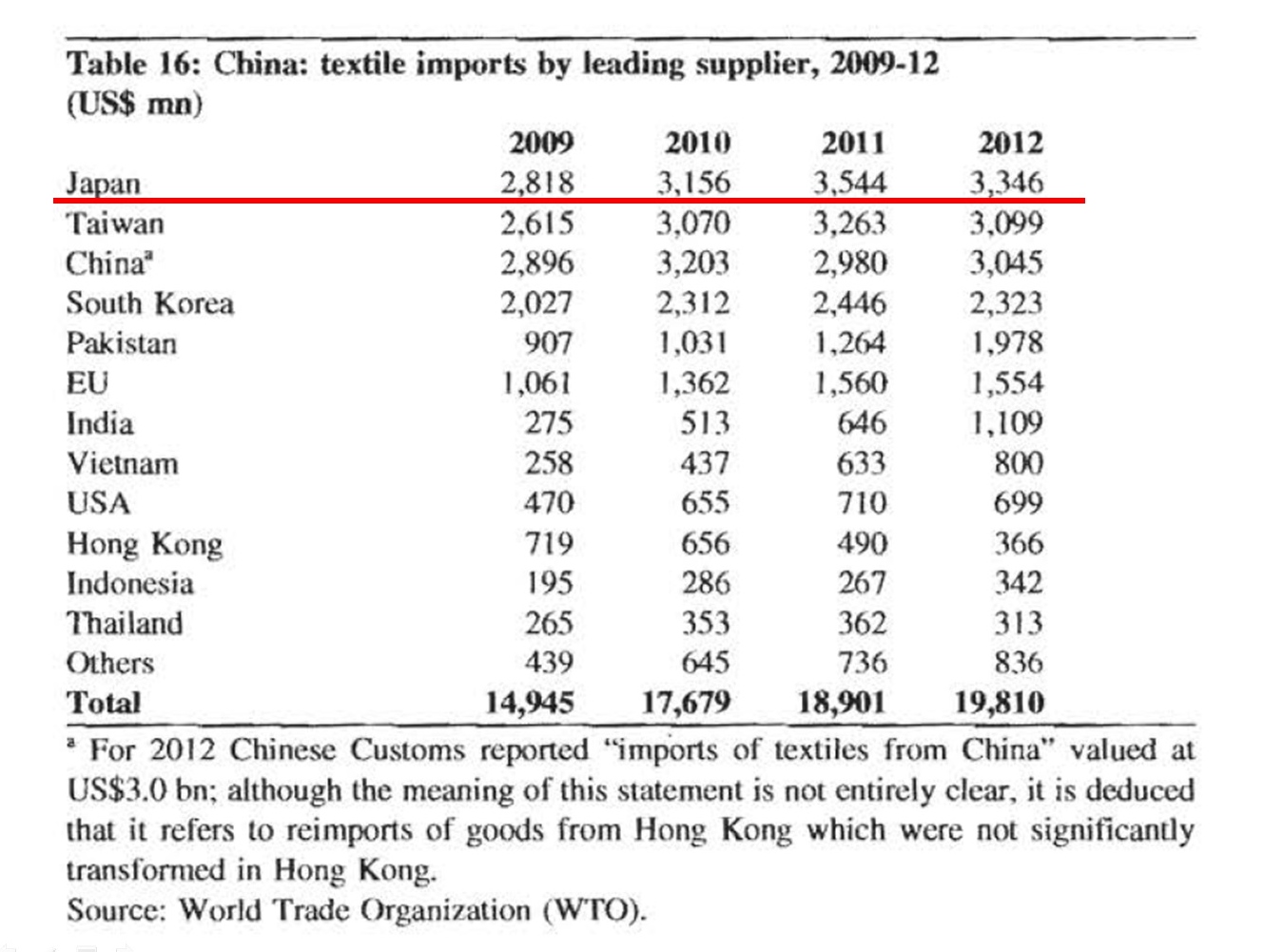
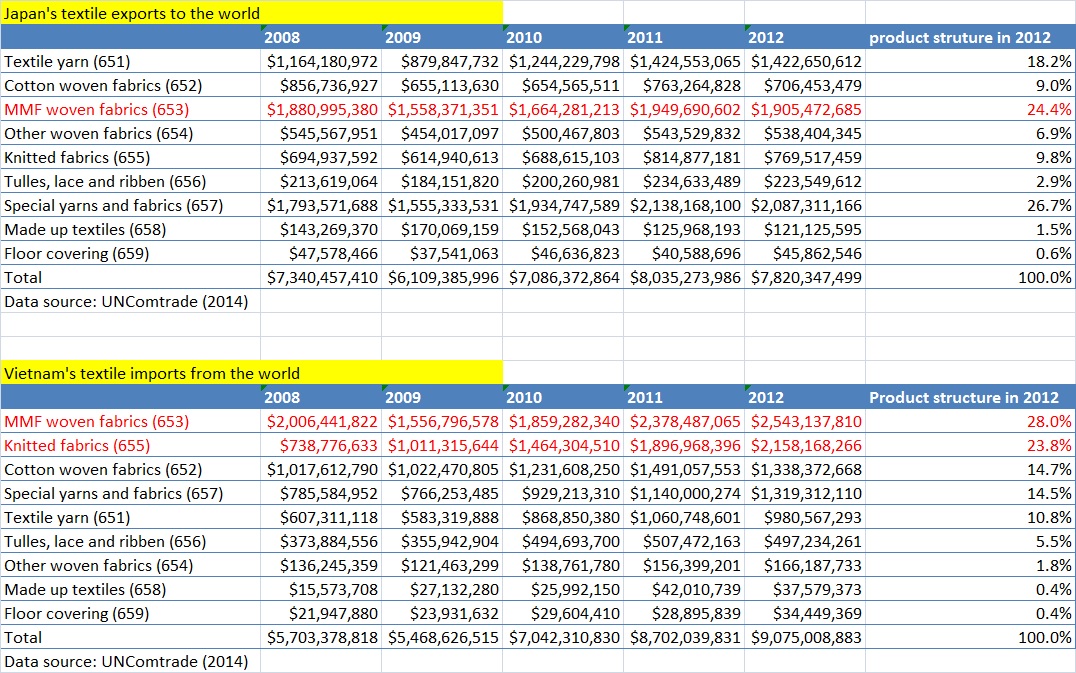
1) Without yarn-forward, situation will get even worse. Particularly, a less restrictive RoO will make Vietnam’s apparel exports which contain textiles made in China, Taiwan or South Korea qualified for duty free access to the US market. Definitely this will be a more imminent and bigger threat to the US textile industry than simply facing competition from Vietnam’s apparel which contains Japanese made textiles. And still many US textile companies don’t treat the Japanese textile industry very seriously, although I think they should. Remember, Japan currently is the fourth largest textile supplier to Vietnam and the NO.1 textile supplier to China.

1

2

2) With yarn-forward RoO in place, at least US textile companies can invest in Vietnam (remember, globalization is about movement of capital as well. Many apparel companies in Mexico and Central America actually are invested by US companies). Without yarn-forward RoO however, Vietnam can simply rely on imported textiles as the case mentioned in (1) and there will be no incentive for US textile companies to move factories to Vietnam (meaning, capital holders will lose).  

So overall yarn-forward RoO may win a few more years for the US textile industry. But in the long run, it is my view that the US textile production and its exports to the Western Hemisphere countries may still inevitably decline (especially those output to be used for apparel assembly purposes) after the implementation of TPP. In the 21st century, the nature of competition is supply chain v.s. supply chain. 
The future of the US textile industry is those high-end markets, particularly technical & industrial textiles.  

Sheng Lu 

Additional Reading: The potential impact of TPP on the US textile industry

EU Commission: Skills for Jobs in the EU Textile and Clothing Industry to Evolve

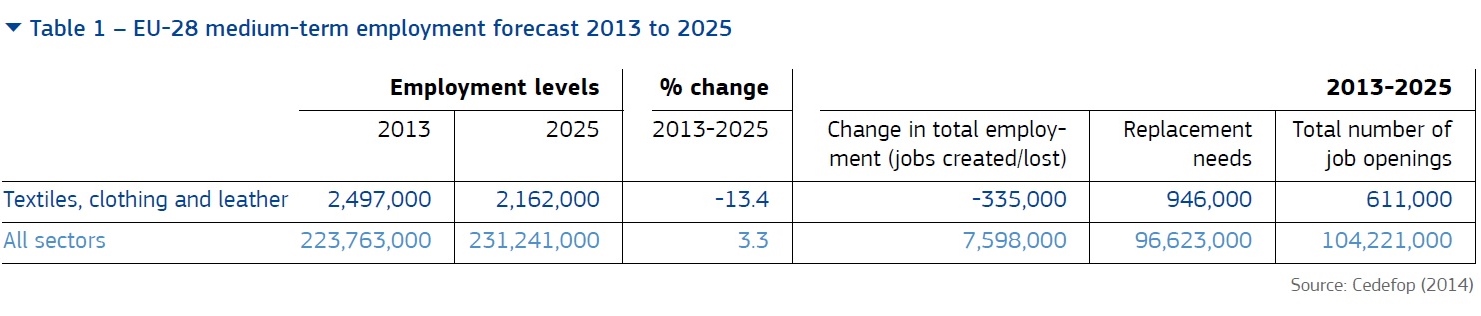
In a recent analysis report, the EU Commission foresees that skills needed by jobs in the EU textile and clothing industry will continue to evolve from 2013 to 2025. Specifically, the report argues that:

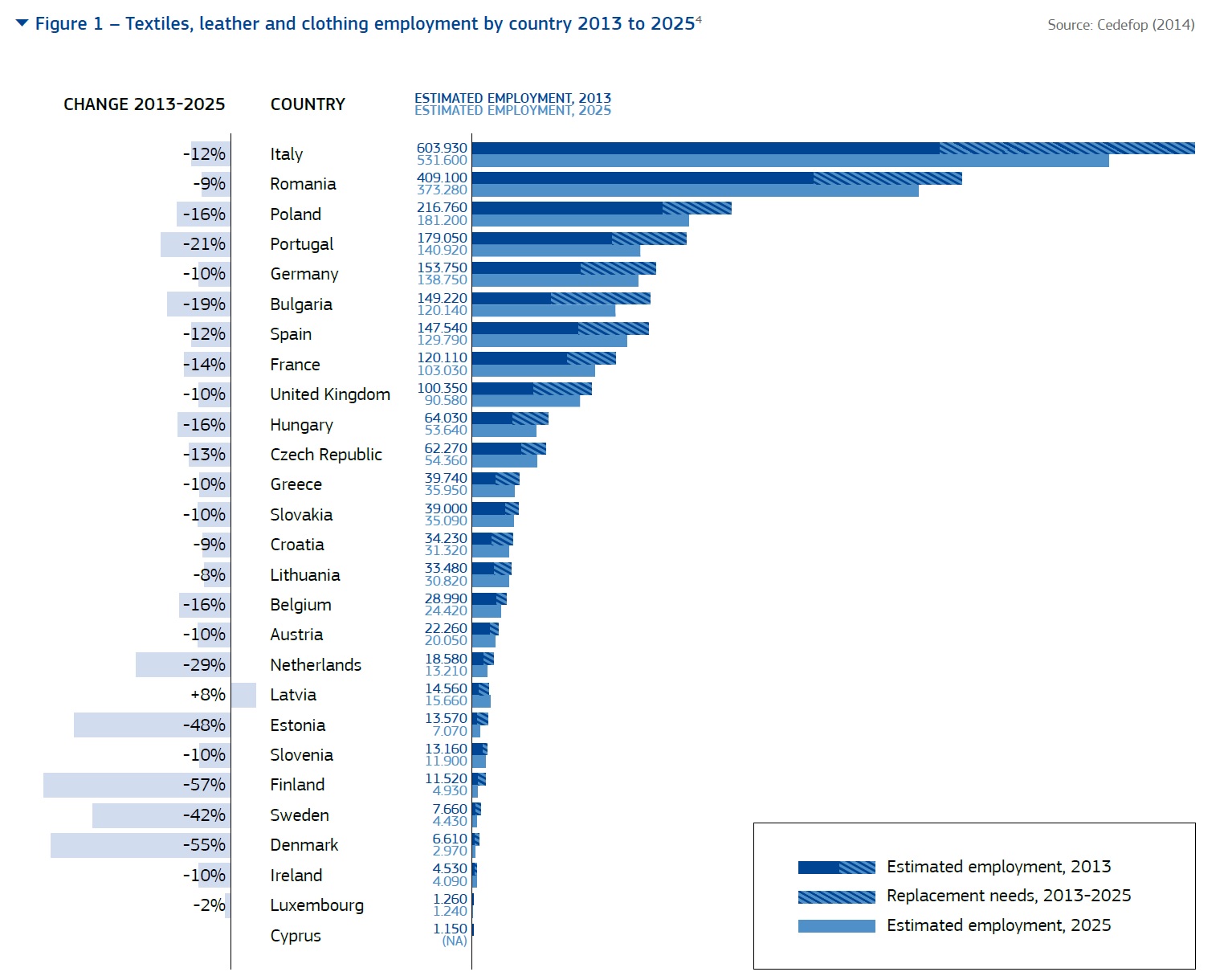
First, employment in the EU textile and clothing sector is forecast to decline by 13.4% from 2.5 million in 2013 to 2.1million in 2025. Even with shrinking employment levels, because of the need to replace nearly 1 million workers forecast to retire or leave the sector, about 611,000 job openings are anticipated from 2013 to 2025.

Second, employment in the EU textile and clothing sector is no just declined, but also evolved. From 2013 to 2025, demand for “crafted and related occupations” as well as “plant and machine operators and assemblers” will decline 34% and 13% respectively, whereas job openings for “technician and associated professional occupations” are estimated to grow at a modest rate. Among the estimated 611,000 job openings, 93% will require high or medium level qualifications.

Third, in terms of specific skills needed by the EU textile and clothing sector based on where the sector might progress towards 2020:

1) Technical production competencies will remain central to recruitment with increased focus on the demand for versatile staffs that can operate across different workstations.

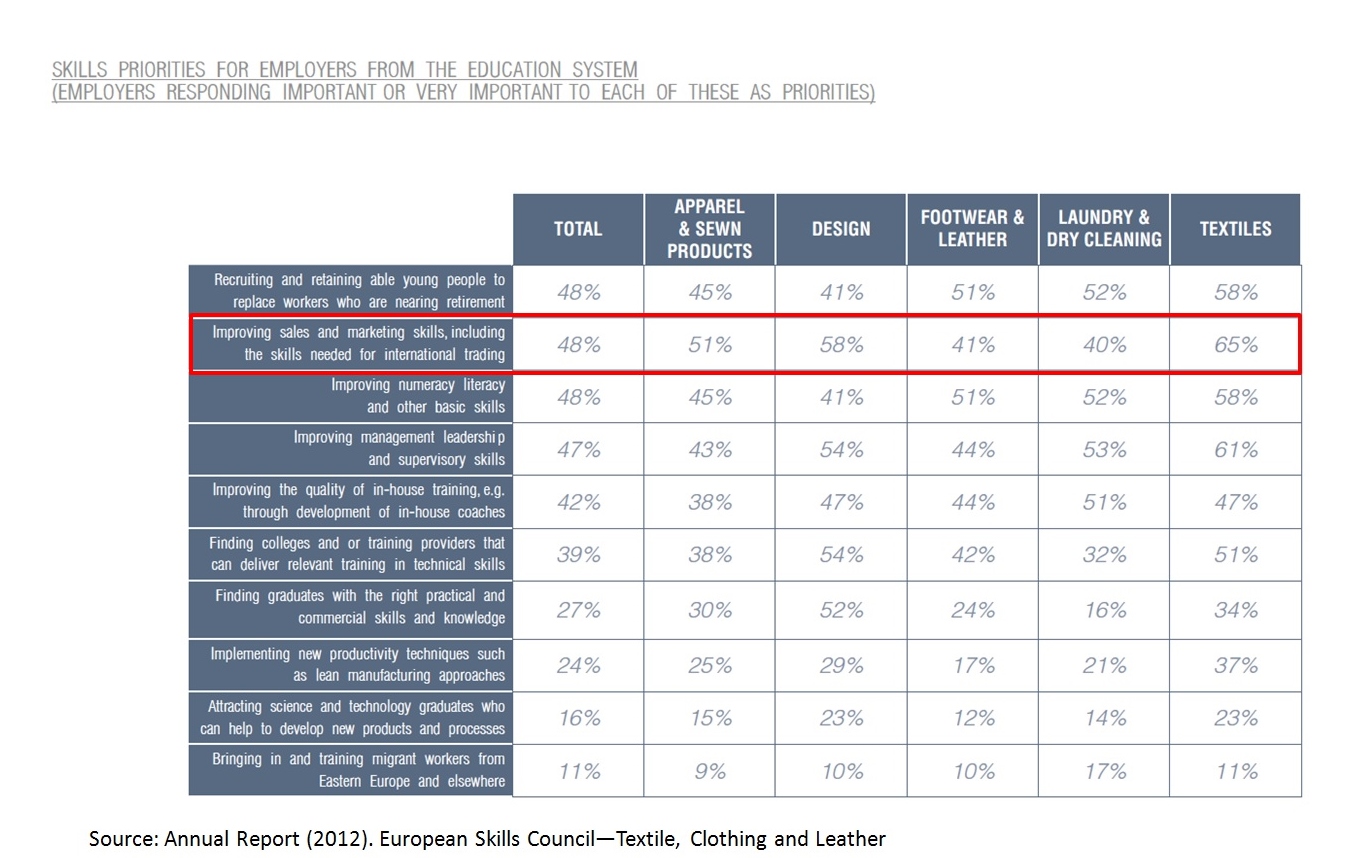
2) Supply chain management, business, sales and marketing skills (including the skills in international trade) are growing in importance. For many EU textile and clothing companies, “trade has taken place of production”.

3) The EU textile and clothing industry is further expecting skills on technology, innovation and sustainability. Leading technology-led areas include mass customization, 3D body measurement, advanced CAD and eCommerce technologies, internet infrastructures for custom-tailored clothing and business-to-consumer eCommerce among retailers.

2

3

1

2014 USFIA Benchmarking Study Released

UntitledKey Findings

  • China will remain the dominant supplier, though Vietnam and Asia as a whole are seen as having more growth potential.
  • Companies aren’t leaving Bangladesh, and are committed to compliance.
  • Companies continue to look for opportunities closer to home, including the United States, as they diversify their sourcing.
  • Companies are diversifying their sourcing and expect to continue to do so. However, current FTAs and preference programs remain under-utilized or don’t represent a major component of respondents’ sourcing.
  • Respondents welcome the passage or renewal of all future trade agreements that intend to remove trade barriers and facilitate international trade in the industry.

About the Benchmarking Study
The 2014 USFIA benchmarking study is conducted based on a survey of 29 executives at 29 leading U.S. fashion companies from March to April 2014. The study incorporates a balanced mix of respondents representing various business types in the U.S. fashion industry, including retailers, importers, wholesalers, and manufacturers. The survey asked respondents about the business outlook, sourcing practices, utilization of Free Trade Agreements and preference programs, and views on trade policy.

The full study can be downloaded from HERE.

EU Commission Releases Negotiating Positions for Textile and Apparel in T-TIP

EUUSbridgeShutte

The EU Commission released its negotiating positions for the textile and apparel sector in the Trans-Atlantic Trade and Investment Partnership (T-TIP) on May 14, 2014.  The position paper outlines a few areas that the EU Commission says it would include in the T-TIP negotiation with the United States:

  • Labeling requirements for textile & apparel and footwear products
  • convergence and/or harmonization of approaches to guarantee product safety and consumer protection
  • standards approximation

Earlier this year, USTR also released its negotiating objectives for the T-TIP. Specifically for the textile and apparel sector, USTR will “seek to obtain fully reciprocal access to the EU market for U.S. textile and apparel products, supported by effective and efficient customs cooperation and other rules to facilitate U.S.-EU trade in textiles and apparel.” USTR holds the positive view that “eliminating the remaining duties on our exports will create new opportunities for integration into European supply chains and to sell high-quality “made-in-USA” garments to European consumers.  Enhanced U.S.-EU customs cooperation will also help ensure that non-qualifying textiles and apparel from third countries are not being imported into the United States under T-TIP.

However, T-TIP negotiation somehow is under the shadow of the Trans-Pacific Partnership (TPP), another free trade agreement currently under negotiation among the United States and other eleven countries in the Asia Pacific region. As reported by the Inside US Trade, the National Council of Textile Organizations (NCTO) holds the view that TTP and T-TIP negotiation should be dealt with “sequentially”. NCTO would like to avoid a situation where the US makes a concession on textiles and apparel to the EU in T-TIP that goes beyond the US offer to Vietnam in TPP, causing Vietnam to demand the same concession in the TPP talks.
One of the most difficult issues on textiles and apparel in T-TIP will be the rule of origin, given that the U.S. and EU have taken vastly different approaches on this issue in their existing preferential trade agreements. The EU rule of origin for apparel essentially consists of two different rules — one that applies generally and one that can be used as an exception. Under the general rule, an apparel item qualifies as originating if it has undergone at least two “substantial processes” in the EU. In general, weaving the yarn into fabric and finishing the fabric are considered substantial operations. Under this scheme, EU manufacturers can use non-originating yarn to make qualifying apparel as long as that yarn is woven into fabric in the EU and also finished there. As a result, this part of the EU rule is sometimes referred to in the United States as the equivalent of a “fabric-forward” rule, since it usually requires all components of the item, starting with the fabric, to be made in the region.

The second part of the EU rule — which functions as an exception — essentially applies a more liberal rule for certain apparel and textile items. These items can qualify for tariff benefits even if only the printing or other downstream operations occur in the EU. Specifically, under this exception, a textile or apparel item that is made from non-originating fabric but for which the printing occurs in the EU can qualify for tariff benefits if the non-originating part of the item is no more than 47.5 percent of the value of the final product. EU manufacturers of printed bed sheets often take advantage of this printing exception (Inside US Trade).

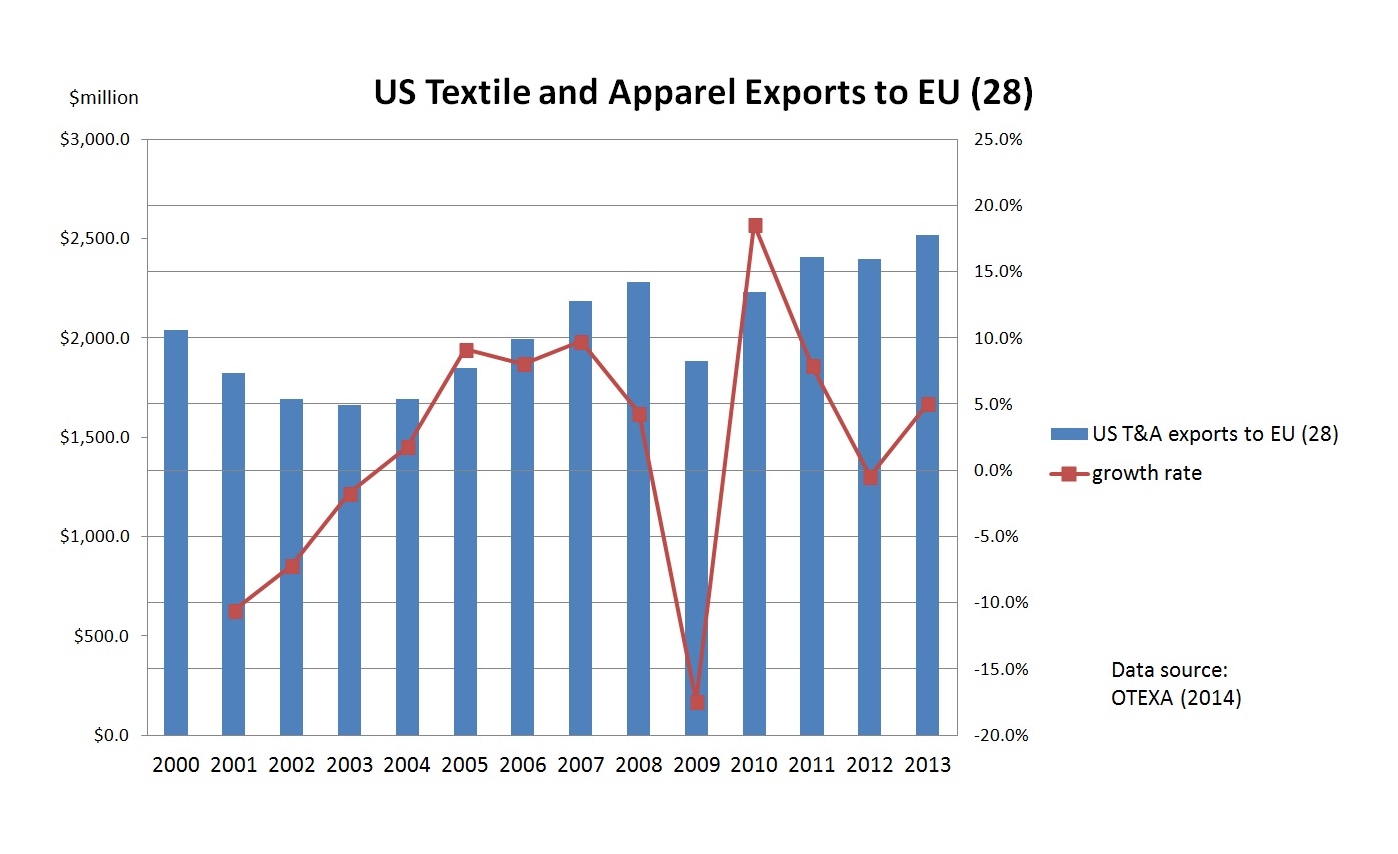
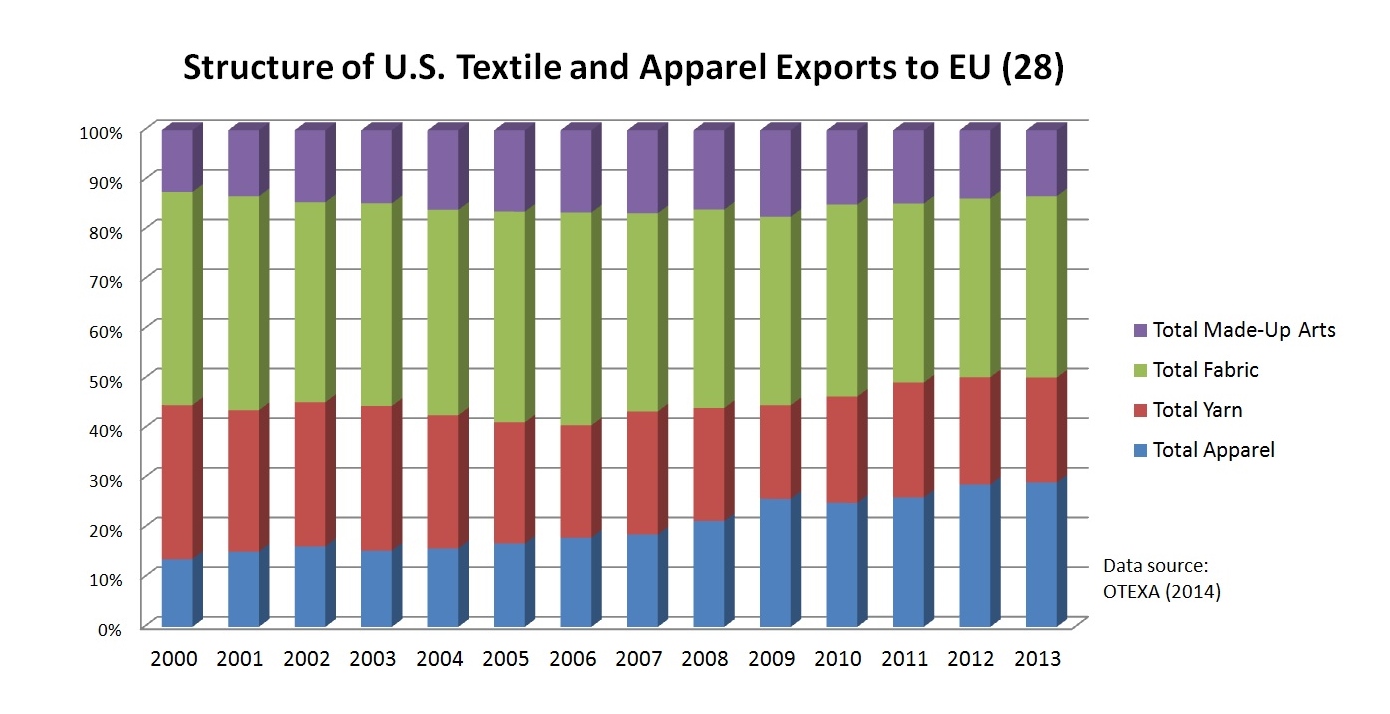
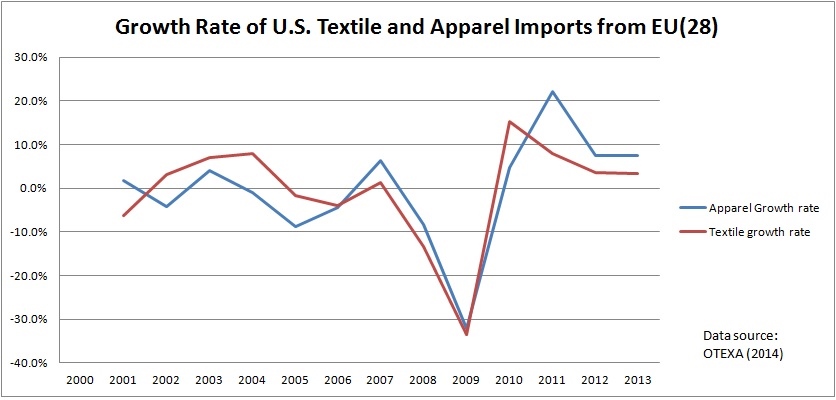
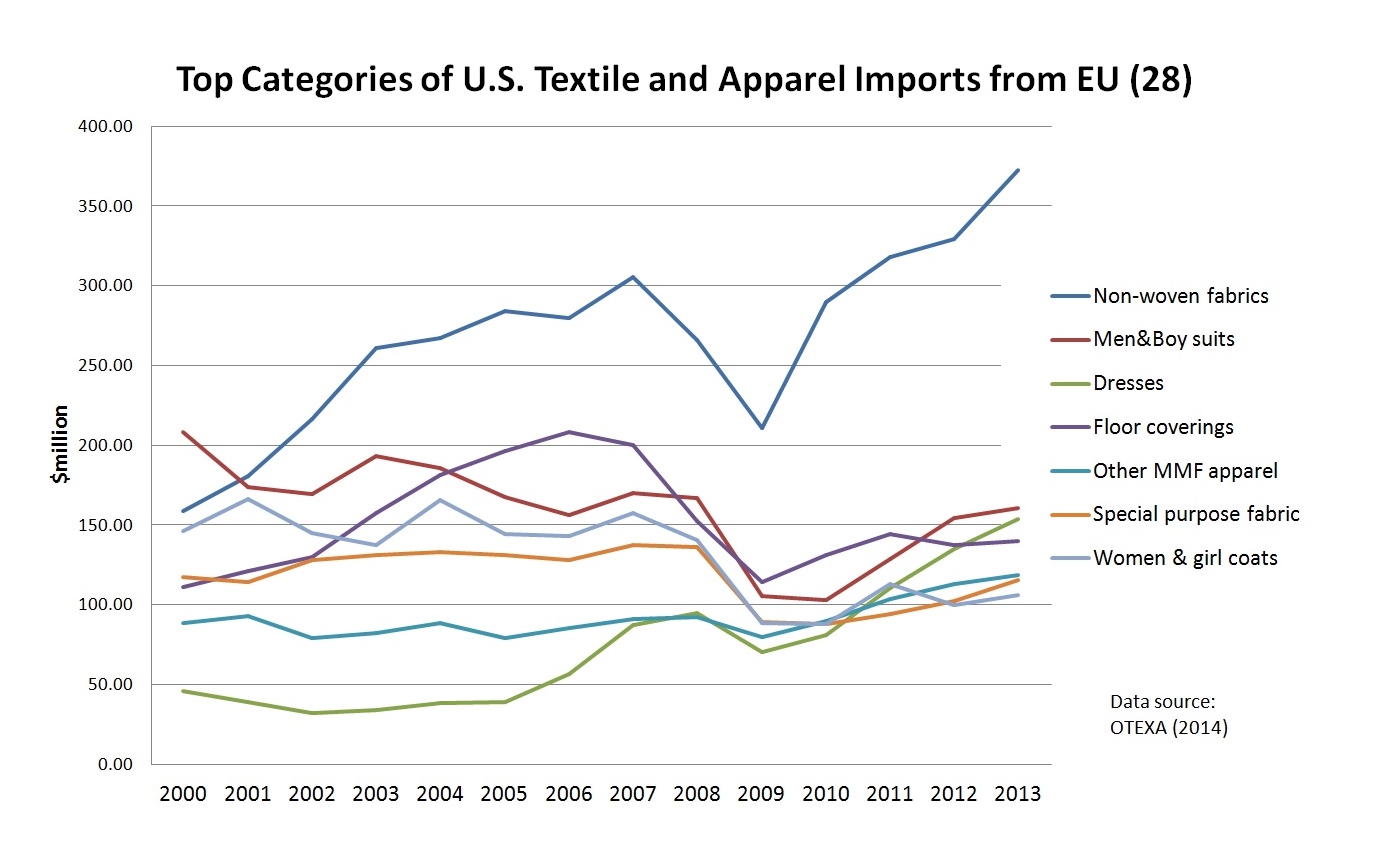
Latest data from OTEXA shows that in 2013, U.S. textile and apparel imports from EU(28) totaled $4 billion, among which 52% were apparel products and 48% were textiles. Top product categories of U.S. textile and apparel imports from EU include non-woven fabrics, men&boys’ suits, dresses, floor coverings, other man-made fiber apparel, special purpose fabrics and women & girls’ coats. In comparison, U.S. textile and apparel exports to EU(28) reached $2.5 billion in 2013, among which only 29% were apparel products and 71% were textiles. Top product categories of U.S. textile and apparel exports to EU include specialty & industrial fabrics, felts & other non-woven fabrics, filament yarns, other made-up textile articles, waste & tow staples, women & girls slacks, shorts and pants as well as spun yarns & thread.

1

2

3 4

 5

7

Vietnam Announces Ambitious Plan to Develop its Textile Industry

Reported by the Sourcing Journal, Vietnam’s Ministry of Industry and Trade recently approved its textile and garment sector development plan up to year 2030. Under the new plan, Vietnam sets an ambitious goal to achieve a 55% local content ratio for exported apparel by 2015 and will further increase the ratio to around 70% by 2030. As estimated, the plan will bring about an annual textile production growth rate of 12 to 13 percent between 2013 and 2030 in Vietnam.

Numerous studies have suggested that Vietnam could substantially expand its apparel exports to the world after the implementation of the Trans-Pacific Partnership (TPP), a free trade agreement under negotiation by twelve countries in the Asia-Pacific region, including the United States and Vietnam. However, restrained by its stage of development, about 70—80% of Vietnam’s demand for textile inputs currently is imported (Lopez-Acevedo & Robertson, 2012). Based on 23 interviews, Goto (2007) further finds that apparel suppliers in Vietnam on average produced 67% CMT and 33% FOB based on value and 95% CMT and 5% FOB based on quantity.

But with the help of foreign investment from South Korea, Taiwan and Japan, Vietnam is quickly building up its textile manufacturing capacity (note: this is very different from the case in Mexico). According to the General Statistics Office of Vietnam, the number of textile firms in Vietnam had quickly increased from 408 in 2000 to 1,577 in 2008. Lopez-Acevdeo & Robertson (2012) further suggest that Vietnam’s annual production of cotton fiber has reached 10,000 tons; 50,000 tons of man-made fiber; 260,000 tons of short-staple fiber and yarn; 15,000 tons of knitted fabric; and 680 million meters of woven fabric. Around 38% of Vietnam’s textile output came from foreign invested companies in 2009.

Vietnam’s ambition to expand its domestic textile manufacturing capacity will have huge implications for the US-based textile industry. Although Vietnam seldom uses US-made textile inputs, Vietnam’s apparel exports to the United States directly compete with those exported from Mexico and countries in the Caribbean Basin regions which is the largest export market for U.S. made textiles (Lu & Dickerson, 2012).  An expanded local textile manufacturing capacity will not only reduce Vietnam’s demand for imported textile inputs, but also will help improve the price competitiveness of Vietnam’s apparel exports in the global marketplace. If China increasingly moves its textile factories to Vietnam (unless the conflict between Vietnam and China over the South China Sea complicates the situation), Vietnam may further becomes a net textile exporter in the long run.

1

2


Untitled


3

4

OECD Service Trade Restrictiveness Index Shows Trade Obstacles in Emerging Economies Remain High

Untitled

According to the latest Service trade Restrictiveness Index (STRIs) released by the Organization for Economic Cooperation and Development (OECD), service trade barriers in many emerging economies remain much higher than their developed trading partners.

Specifically for the distribution service sector, which covers general wholesale and retail sales of consumer goods, the STRIs suggests the highest trade barriers are in place in Indonesia, China and India whereas Spain, Germany and Czech Republic are among the most open to foreign companies (see the figure above).  Because trade in distribution services has mainly taken place through commercial presence, and the STRI results highlight the importance of impediments on foreign ownership.

The STRIs indices take the value from 0 to 1, where 0 is completely open and 1 is completely closed. The indices are calculated based on the following five factors:

  • Restrictions on foreign ownership and other market entry conditions (30%)
  • Restrictions on the movement of people (10%)
  • Other discriminatory measures and international standards (17%)
  • Barriers to competition and public ownership (22%)
  • Regulatory transparency and administrative requirements (21%) 

Currently, the STRIs include 40 countries (34 OECD members as well as Brazil, China, India, Indonesia, Russia and South Africa) across 18 service sectors.