Global Trade of Used Clothing (Updated: October 2015)

Please also check the updated study: Why is the used clothing trade such a hot-button issue?

2

3

GlobalMapUSedClothing

United States

  • Generates 1.4 million tons of used clothing annually
  • Exports 800,000 tons of used clothing annually
  • 20% of used clothing sold domestically in thrift stores
  • Non-wearable material of used clothing is reprocessed into fibers for upholstery, insulation, soundproofing, carpet padding, building and other materials.

 Central and South America

  • Very large used clothing market in most countries
  • Imports of used clothing mostly come from the United States
  • Cotton wipers made from used clothing are exported back to the United States

Europe

  • Generates 1.5-2 million tons of used clothing annually
  • Large used clothing sorting centers located in Western and Eastern Europe
  • 10-12% used clothing (only those top quality) sold in local secondhand shops

Africa

  • One of the largest used clothing markets in the world
  • 80% of population wear secondhand clothes
  • Most used clothing imported from the United States, Europe, India and Pakistan

East Asia

  • Most used clothing is collected in Japan, South Korea and Taiwan
  • Countries in the region also import used clothing from the United States, Europe, India and Pakistan
  • Some large used clothing sorting centers are located in Malaysia and Philippines.

India and Pakistan

  • Residual used clothing are imported and sorted by grading companies
  • Wearable used clothing is extracted from “mixed rags” and sold locally or shipped to Africa
  • Recycled yarns are used to make new sweaters
  • Cotton wipers made from used clothing are exported to the United States

Australia

  • Used clothing is collected and sold through local shops and exported

Source: Planet Aid (http://www.planetaid.org); UNComtrade (2015)

USTR Adjusts Language of TPP Negotiation Objectives for Textile and Apparel

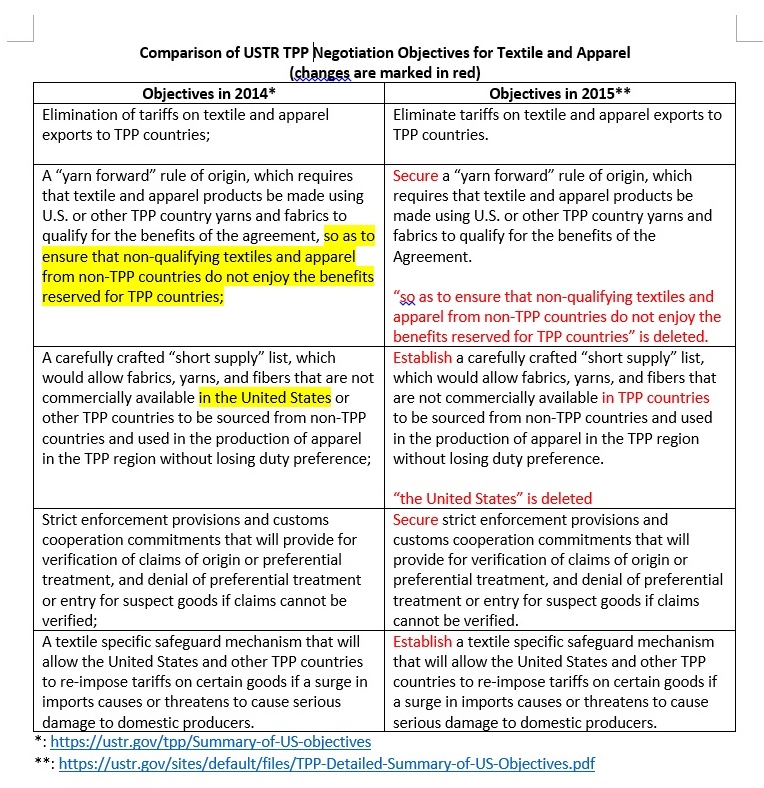
On September 22, the U.S. Trade Representative Office (USTR) releases a detailed summary of its latest TPP negotiation objectives. Specifically for the textile and apparel chapter, compared with the negotiation objectives released in 2014, some wording changes are made this time:

UntitledDoes the change imply that the U.S. side has agreed to allow more exceptions to the “yarn-forward” rules of origin in TPP, but in the format other than “short supply list”? For example, will it be “earned import allowance” or tariff preference level (TPL)?

On the other hand, does the change imply that the “short supply list” under TPP will be stricter than previously expected? (in the 2014 version of the negotiation objectives, it read like the “short supply list” may include those products that are not commercially available in the US but are commercially available in other TPP members. However, in the 2015 version, only those products that are absolutely not commercially available in the whole TPP region are eligible for the “short supply list”.)

Sheng Lu

Trade and Development

This video provides a great summary of what we discussed in class on trade and development. Please keep in mind that:

  • Textile and apparel industry (T&A) plays a critical role in generating economic growth, reducing poverty and promoting human development both in history and today. This is why T&A remains a critical sector in the 21st global economy, even though people may think clothing is such a “simple” product.
  • Apparel sourcing is far more than just about how to get the product at the lowest price. Throughout the supply chain, sourcing decisions and practices are closely connected with many people’s destiny in the world, especially those living in the developing countries. As future professionals working in the fashion apparel industry, please think about your impact and responsibilities.

Please feel free to share any comments and thoughts on the video

What Might Apparel Sourcing in the 3D-Printing Era Look Like?

3d (12)

3d (4)

3d (10)

3d (8)

(photo credit: WGSN)

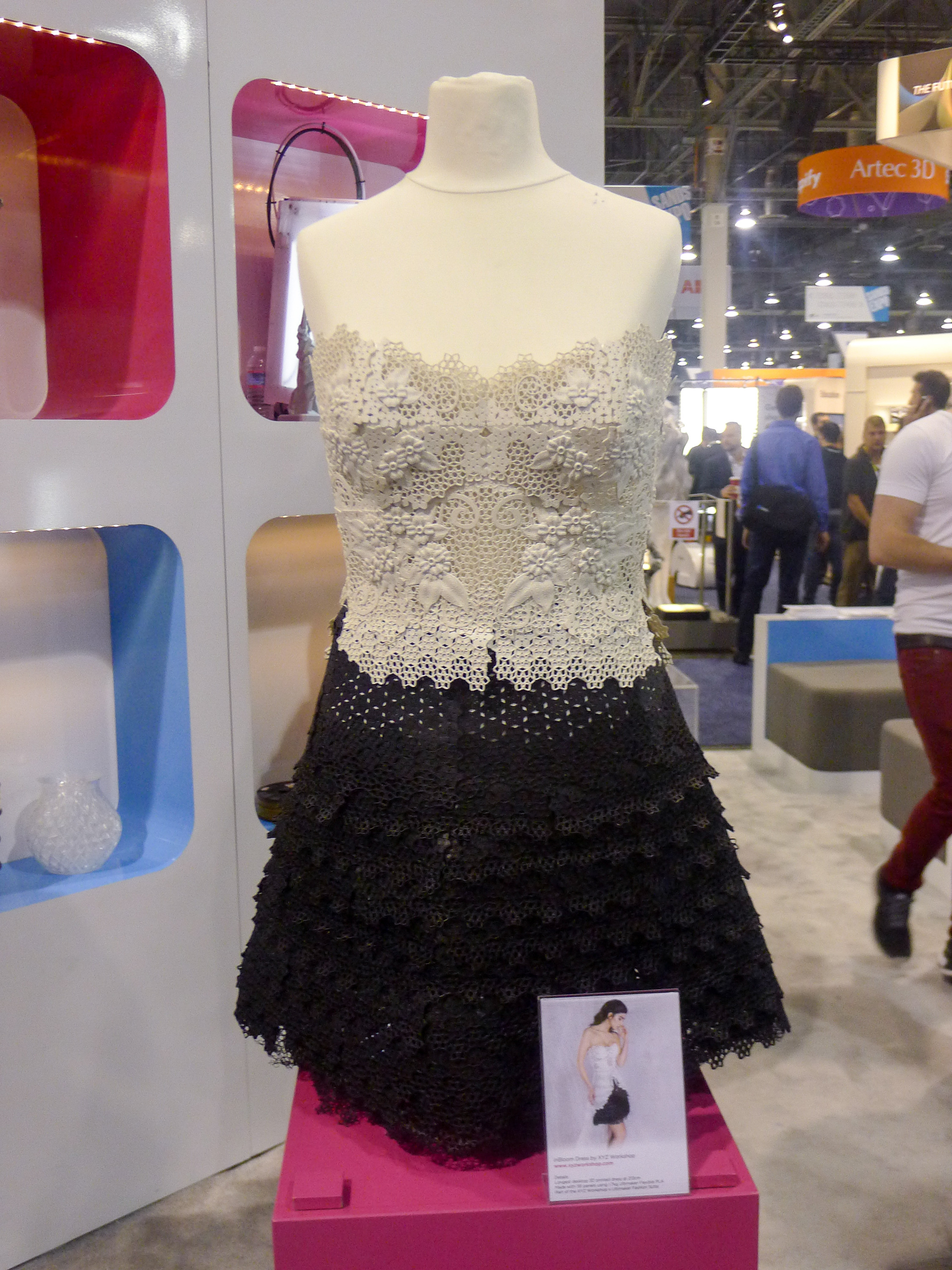
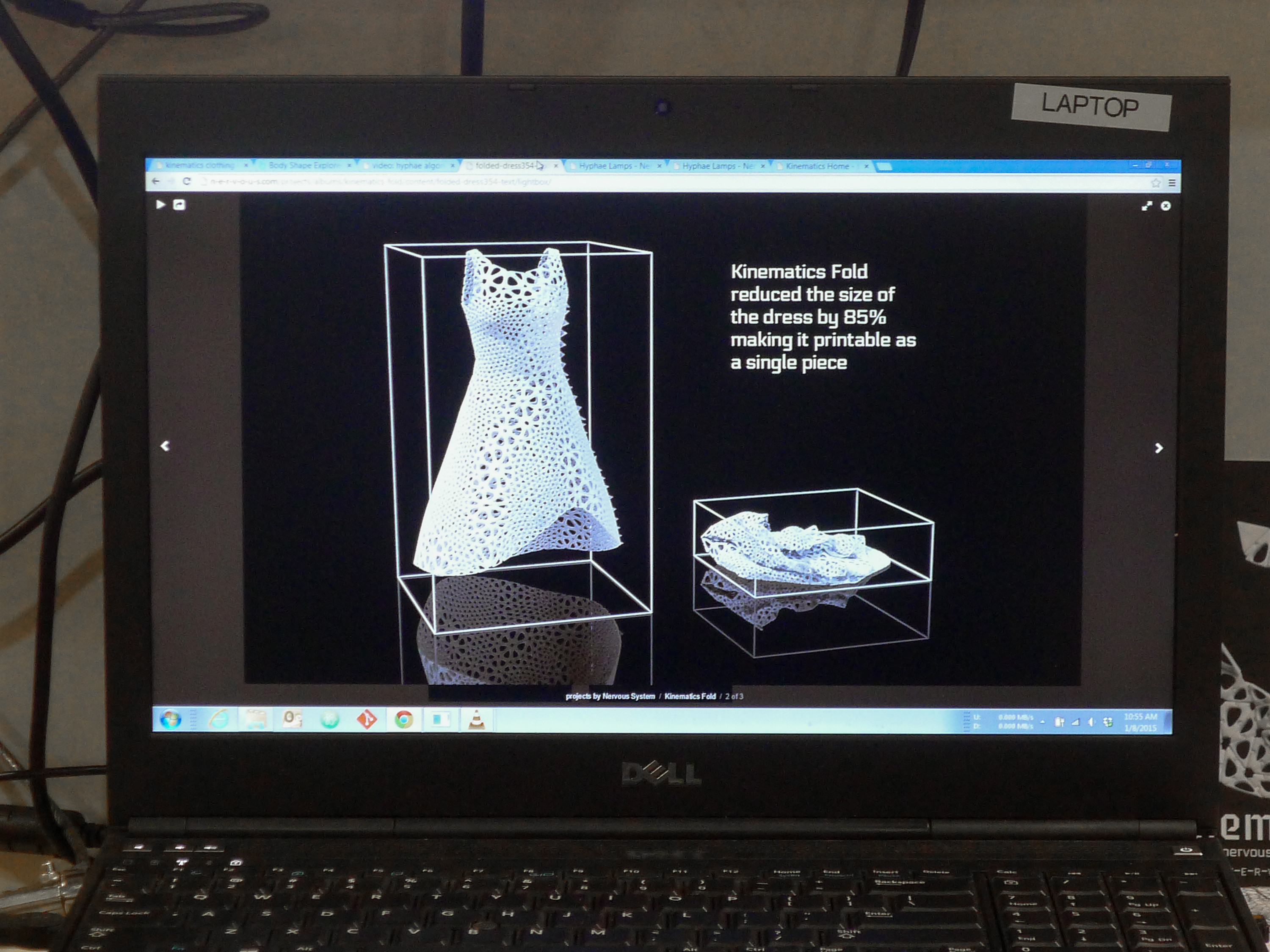
Wearing 3D-printed apparel is no longer a dream (see the pictures above)! But what is the implication of 3D-printing technology on apparel sourcing? Here is my personal vision:

First, 3D printing may create brand new T&A supply chains and business models. 1) Because 3D printing is highly technology and capital intensive with little input from low-skilled labor, it implies that developed countries rather than developing countries may enjoy the comparative advantage in manufacturing 3D-printed apparel. 2) Because apparel will be directly printed by machines, cross-the-border transportation can be largely reduced in the 3D printing era, generating potential cost-saving opportunities both for manufacturers and consumers. 3) 3D printing will empower consumers to more directly involve in the product development process. Yet given consumers’ limited technical knowledge and equipment, many new types of customer services ranging from design assistance to on-site apparel printing may emerge in the 3D printing era.

Second, 3D printing may result in a more sustainable T&A supply chain. 1) Because 3D printing is digital-based, it may help reduce waste during the product development process. 2) Because 3D printing is highly customized and can produce on-demand, it may result in less overproduction in the textile and apparel (T&A) industry. 3) 3D printing has the potential to be made by recycled material. 3D printed apparel itself may be recycled as well, resulting in almost zero carbon emission in the whole product life-cycle.

However, 3D printing my create new challenges for apparel sourcing. 1) When 3D printed apparel substitute traditionally-made apparel among ordinary consumers, demand for apparel sewing workers will be substantially reduced. Millions of unskilled or low-skilled workers currently employed in the T&A sector may have to find new jobs. 2) Workforce in the T&A industry may have to substantially update their knowledge structure in the 3D printing era. The T&A industry may even be short of talents for certain positions such as 3D printing designers and engineers. 3) The application of 3D printing will require an update of the current legal system to better address issues such as intellectual property right protection, consumer privacy protection and data security in a digital-based context.

What is your vision for the future of apparel sourcing in the 3D-printing era?

Sheng Lu

Apparel Sourcing Opportunities in Madagascar and Mauritius


Please feel free to share your thoughts on the following discussion questions:

  1. Why does the United States Agency for International Development (USAID) promote apparel sourcing from Africa?
  2. From the video, how do you see the social and economic impact of the textile and apparel industry on Madagascar and Mauritius?
  3. Do we need African Growth and Opportunity Act (AGOA)? Why or why not?
  4. With regard to the status of the textile and apparel industry in Madagascar and Mauritius, anything shown in the video interests or surprises you?

China to Become the World’s Largest Apparel Market in 2019

According to forecast made by the Euromonitor, China will exceed the United States and become the world’s largest apparel market by 2019. Specifically, annual apparel sales in China will reach $333,312 million in 2019, an increase of 25% from $267,246 million in 2014. In comparison, apparel sales in the United States is estimated to reach $267,360 million in 2019, which is only 3% higher than $260,050 million in 2014.

size of apparel market

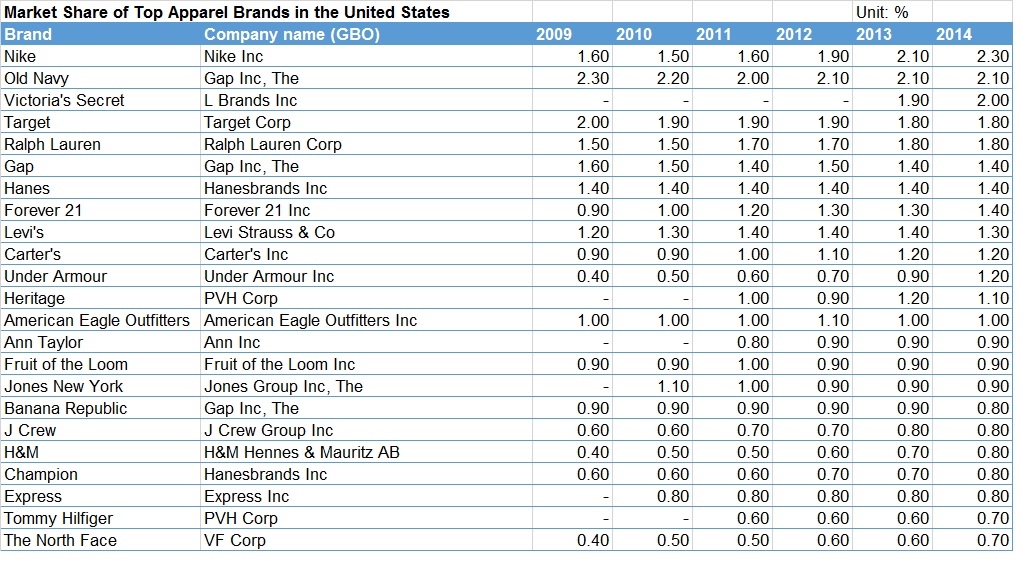
2However, it shall be noted that China seems to be an even more competitive apparel market than the United States. For example, no apparel brand was able to achieve a market share more than 1% in 2014 in China, whereas in the United States, market shares of several leading apparel brands exceeded 2%. Moreover, domestic brands overall outperform international brands in the Chinese apparel market.

34On the other hand, despite its overall market size, as a developing country, dollar spending on apparel per capita will remain much lower in China than many developed economies around the world. In 2014, each Chinese consumer on average spent $240 on apparel versus $815 in the United States, even though apparel spending accounted for a larger share in household income in China (around 10%) compared with the United States (less than 3%).

5

Several personal thoughts based on the data:

First, it is the time that U.S. apparel companies/fashion brands should start to seriously think about their sourcing strategy specifically for the Chinese market.

Second, for many Chinese apparel companies, serving the domestic market will help them more effectively achieve functional upgrading (i.e. shifting from low-value added manufacturing to higher-value added functions such as design, branding and distribution) than through exporting.

Third, controlling sourcing cost will be as important in China as in the United States. When China’s applied tariff rate is still as high as 9.63% for textiles and 16.05% for apparel (WTO, 2015), U.S. fashion companies/fashion brands may not have many options but to use “Made in China” to serve the Chinese consumers. In the long run, however, “Made in China” shall be gradually replaced by “Made in Asia”, especially when several free trade agreements (FTAs) involving China eventually take into effect (such as CEPA). However, China may strategically use rules of origin in these FTAs and encourage apparel manufacturers in the region to use Chinese made textile inputs (just like what U.S. did in NAFTA and CAFTA). Nevertheless, either for managing the apparel supply chain based on “Made in China” or “Made in Asia”, it doesn’t seem U.S. apparel companies/fashion brands will easily enjoy competitiveness over their Chinese competitors.

Data source: Euromonitor Passport(2015)

Is Wal-Mart’s $250 billion “Made in the USA” Program Another “Crafted with Pride Campaign”? (II)

walmart-is-committed-to-american-renewal-infographic-s-manufacting-infographic-400pxwide-01

In early 2014, Wal-Mart Store Inc. announced its commitment to buy $250 billion “Made in the USA” products (including textiles and apparel) over the next 10 years ($50 billion annually) with the hope to “help spark a revitalization of U.S.-based manufacturing” and “create jobs in America”.

So how is the program going so far, especially in the textile and apparel (T&A) area?

made-in-usa

21

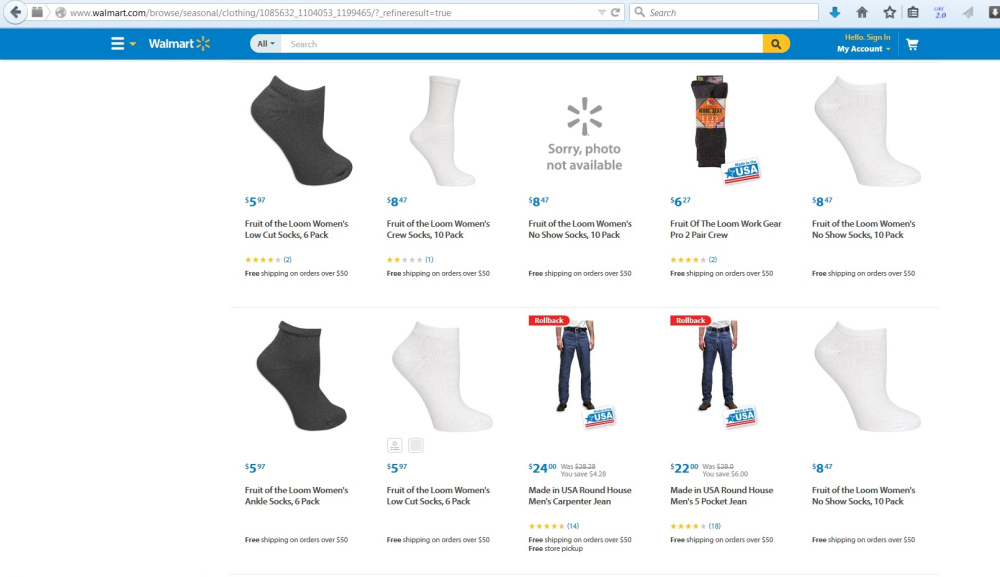
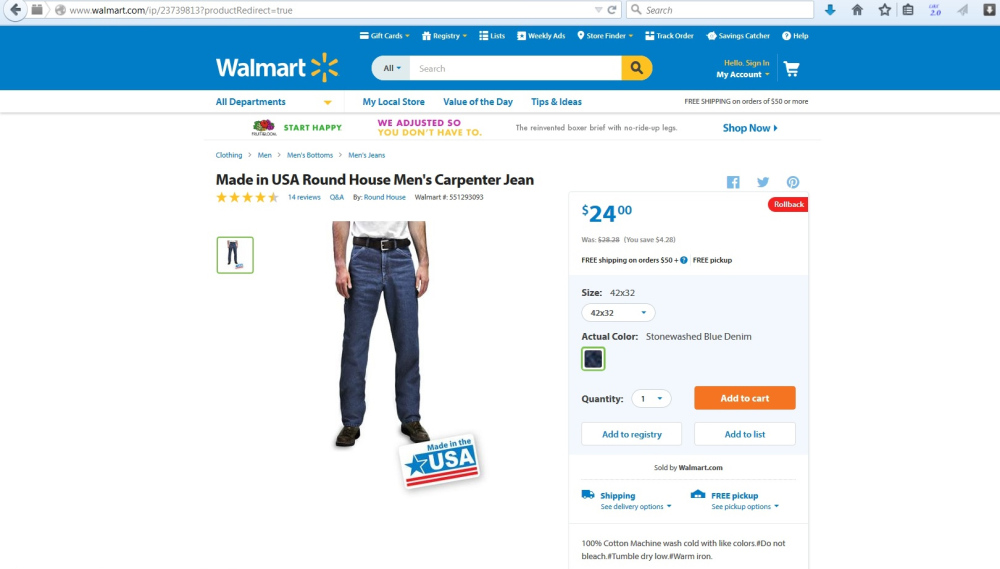
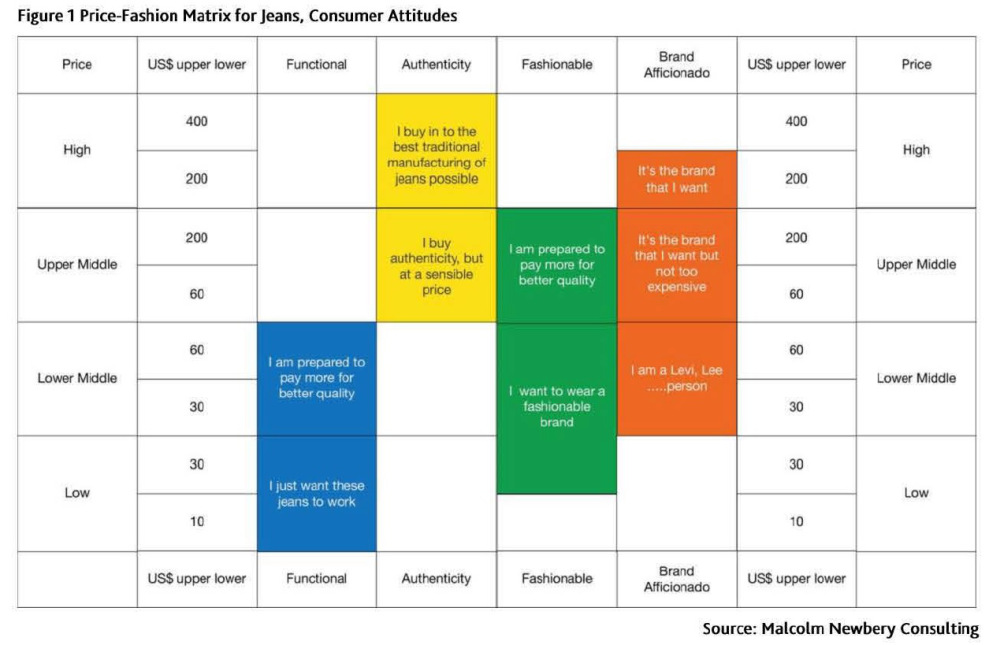
From exploring the company’s website, it is interesting to find that around 30 kinds of “Made in USA” T&A currently are being sold at Wal-Mart. However, majority of these T&A products are basic socks priced less than $10/unit. Wal-Mart also sells two types of men’s jeans, priced at $24/pair and $22/pair respectively. Although such a price level is higher than most jeans sold at Wal-Mart (which range from $8 to $20 per unit on average), it is still at the low-end of the market (see the chart below adopted from a Just Style report on the global jeans market).

41

On the other hand, as part of the “Made in USA” program, Wal-Mart sponsors a U.S. Manufacturing Innovation Fund with the purpose of “making it both easier and more competitive to make household goods in the U.S.”. T&A is one area this fund is willing to support as long as the research projects could “reduce the cost of producing textiles and apparel in the U.S., including weaving, fabric dyeing, cut & sew.

So what’s your view on Wal-Mart’s “Made in USA” initiative in the 21st century? How is it different from the “Crafted with Pride Campaign”? Will it bring back manufacturing jobs in the US as its objective stated? Will Wal-Mart repeat its record in history again? Please feel free to share your view.

[Please do not leave comment until after our case study 4]

Additional reading: Is Wal-Mart’s $250 billion “Made in the USA” Program Another “Crafted with Pride Campaign”? (I)


How to Save “Made in NYC”: Sewing Skill or New Technology?

The video is a recorded panel discussion hosted by the Texworld USA in July 2015 on the topic of apparel “Made in NYC”. Most panelists have years of experiences working in NYC as a fashion designer, including:

  • Eric Johnson, Director, Fashion & Arts Teams Center for Economic Transformation, NYC Economic Development Corporation
  • Erin Kent, Manager of Programs at The Council of Fashion Designers of America (CFDA)
  • Michelle Feinberg, NY Embroidery Studio
  • (The event was moderated by Arthur Friedman, Senior Editor, Textiles and Trade, WWD)

According to the panelists:

  • “Made in NYC” have a bright future in two niche markets: sample production for fashion designers and high-quality craftsmanship clothing. As one panelist put it “Designer needs to have tangible garment to show to the buyer”. However, there is no mention about “Made in NYC” serving the mass market in the discussion.
  • Two factors are regarded as critical to the survival of “Made in NYC”: training more professions with sewing skills and investing/upgrading equipment and technologies.
  • In support of the development of the local apparel manufacturing sector, several initiatives funded by the city government and private sources have been launched, including NYC Fashion Production Fund (provide financial support to young fashion designers), Fashion Manufacturing Initiative (support purchasing equipment and skill training) and Design Entrepreneurs NYC (equip fashion designers with the skills they need to successfully run a fashion label, including marketing, operations, and financial management).

However, the future of “Made in NYC” is not without major challenges:

  • One panelist lament that “fashion schools do not teach students much on how to make things”. However, another truth is college students today face a high opportunity cost of spending times on practicing sewing skills. This is particularly the case when most fashion jobs available for college graduates in the U.S. are business or merchandising focused. The constant upgrading of technology and manufacturing equipment in the fashion industry further raise the question as to whether learning traditional sewing skills is a worthwhile investment.
  • The brand image of “Made in NYC” overall is still less prestigious than “Made in Italy” and “Made in France” in the eyes of consumers.
  • Fashion designers in NCY heavily rely on imported fabrics (including those imported from Europe) today. Some questions can be asked: what is the meaning of clothing “Made in NYC” in the 21st century global economy? Should NCY promote the development of local textile manufacturing? If so, how to make it happen? Or should fashion designers in NCY support lower tariff rate and removal of trade barriers on imported fabrics?

Background (adapted from the New York City Economic Development Corporation)

New York City’s fashion industry employs 180,000 people, accounting for 6% of the city’s workforce and generating $10.9 billion in total wages, with tax revenues of $2 billion. An estimated 900 fashion companies are headquartered in the city, and in 2012, there were 13,800 fashion establishments here. Home to more than 75 major fashion trade shows plus thousands of showrooms, New York City attracts hundreds of thousands of visitors each year.

Pattern of Production and Trade in the U.S. Textile and Apparel Industry from 2000 to 2013

Impact of TPP on U

Impact of TPP on U.S. Textile and Apparel Manufacturing: A Preliminary Estimation

Potential impact of the Trans-Pacific Partnership (TPP) remains a hot topic among the U.S. textile and apparel industry. A recent news report suggests that implementation of the agreement will negatively affect clothing manufacturers in LA, where most remaining U.S. apparel manufacturing capacity is located.

According to the news report, “small, independent apparel manufacturers (in LA) did not see big gains from TPP because they did not want to outsource their work, but it put them at a competitive disadvantage.” One local industry estimation quoted in the report claims that “Southern California’s apparel manufacturing will shrink an additional 20 percent if the TPP goes into effect.”

The report further says that “A key question for the apparel industry is whether the agreement includes a yarn-forward provision, which requires material to come from a TPP country in order to be duty-free.” However, the report does not explain why the “yarn-forward” rule could potentially benefit apparel manufacturing in the United States.

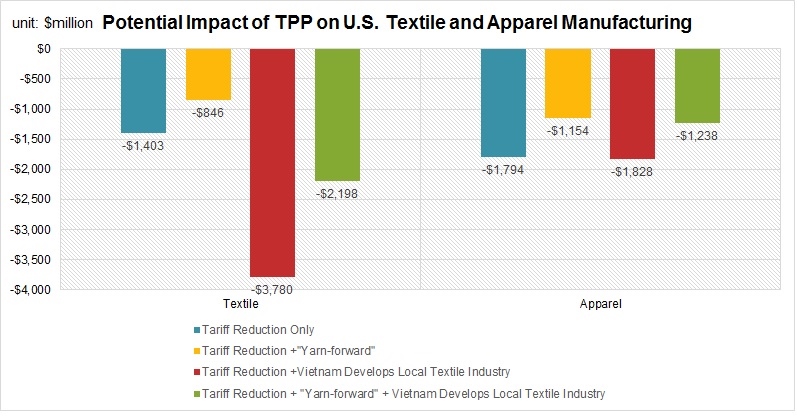
The followings are my personal preliminary estimation* of the potential impact of TPP on U.S. T&A manufacturing. Results show that, compared to the base year level in 2011:

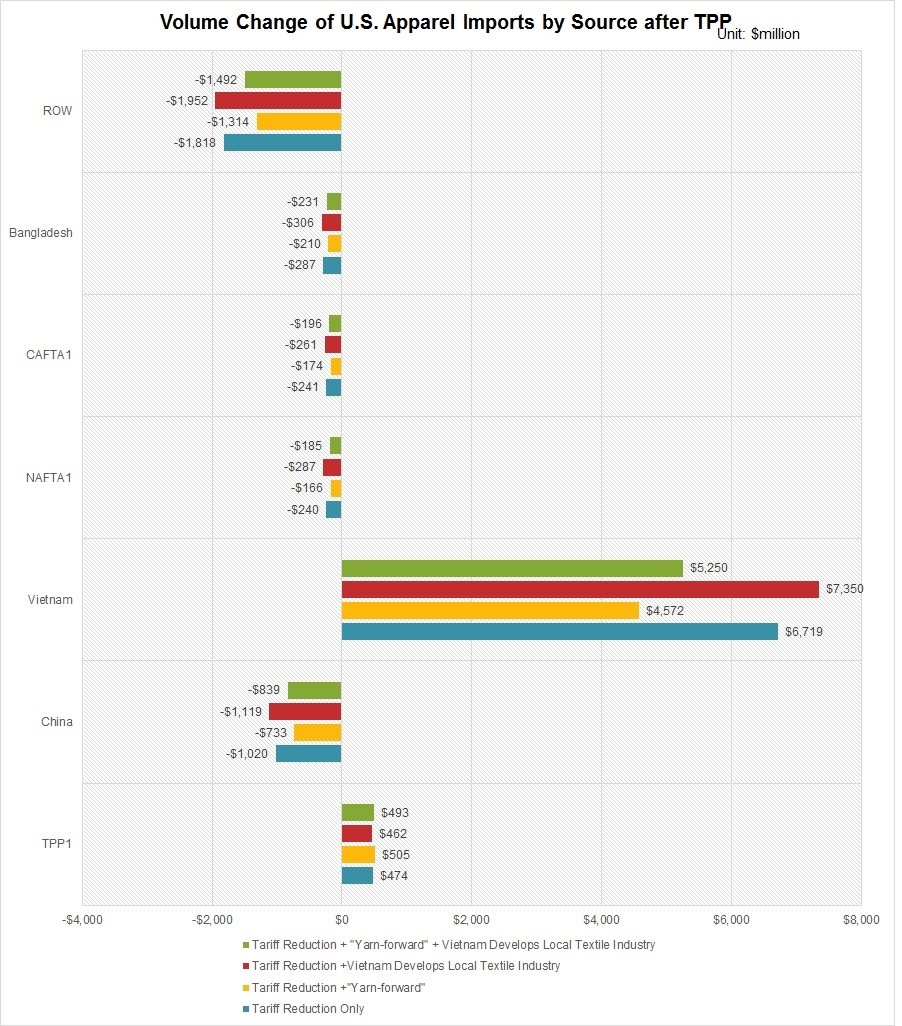
  1. TPP overall will have a negative impact on U.S. domestic textile and apparel manufacturing. In all simulated scenarios, the annual manufacturing output in the United States will decline by $846 million–$3,780 million for textile and $1,154 million–$1,828 million for apparel than otherwise.
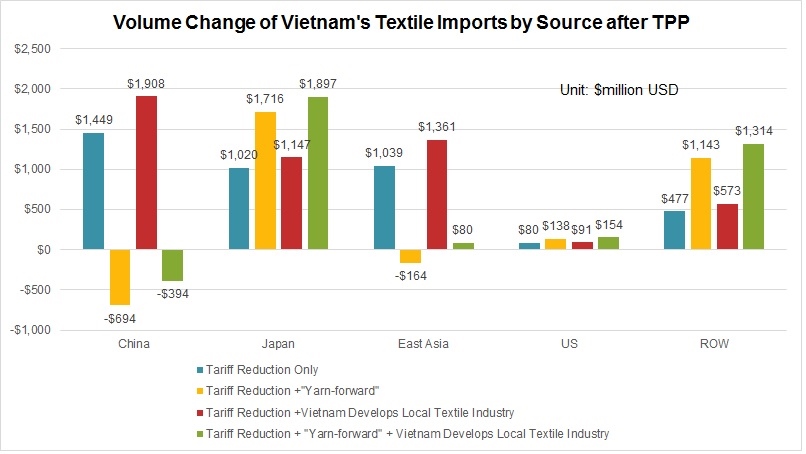
  2. The “yarn-forward” rule may not substantially benefit U.S. domestic textile and apparel manufacturing as some people had suggested, for two reasons: 1) results show that Vietnam is more likely to use Japanese textiles than U.S. textiles when yarn-forward rule is in place. 2) U.S. apparel imports from Vietnam directly compete with those imported from NAFTA and CAFTA regions, the largest export market for U.S.-made yarns and fabrics. When NAFTA and CAFTA’s market share in the U.S. apparel import market is taken away by Vietnam, U.S. textile exports to NAFTA and CAFTA will decline anyway, regardless of whether Vietnam uses U.S.-made textiles.
  3. Results suggest that compared with the “yarn-forward” rule, development of Vietnam’s local textile industry will have an even larger impact on the future of U.S. domestic textile and apparel manufacturing. Particularly, when Vietnam becomes more capable of making textile inputs by its own,  not only Vietnam’s overall demand for imported textiles will decline, but also Vietnam’s apparel exports will become even more price-competitive in the U.S. as well as the world marketplace.

 US T&A manfuacturing

US Textile exports

vietnam import source

vietnam import source

US apparel import source

*Note:1. The estimation is conducted based on the latest Global Trade Analysis Project (GTAP) 9.0 database which includes complete bilateral trade information, transport and protection linkages of 140 countries and 57 sectors. Four scenarios are estimated:

  • Scenario 1 (Tariff reduction only): assumes tariff rate for textile and apparel traded between the twelve TPP members are eliminated, whereas tariff rate for other textile and apparel trade flows remain unchanged.
  • Scenario 2 (Tariff reduction + yarn forward): assumes that in addition to tariff reduction among TPP members for T&A, Vietnam substantially increases tariff rate by 100 percent for textile imports from its leading suppliers that are non-TPP members (i.e. China, South Korea and Taiwan). This policy shock provides strong financial incentives for Vietnam to import less textile from non-TPP suppliers and instead import more from other TPP members—an equivalent effect as the yarn forward rule.
  • Scenario 3(Tariff reduction + Vietnam develops local textile industry): assumes that in addition to tariff reduction among TPP members for T&A, productivity of Vietnam’s textile industry increases by 10 percent whereas productivity of other sectors remain unchanged.
  • Scenario 4 (Tariff reduction + yarn forward + Vietnam develops local textile industry): this scenario combines all policy shocks mentioned in scenario 1-3, i.e. tariff rate for textile and apparel traded between the twelve TPP members are eliminated, Vietnam substantially increases its tariff rate by 100 percent for textile imports from its leading suppliers that are non-TPP members (i.e. China, South Korea and Taiwan) and productivity of Vietnam’s textile industry increases by 10 percent.

 2. TPP1 includes Australia, New Zealand, Malaysia, Singapore, Burnie, Chile and Peru; NAFTA1 includes Canada and Mexico; CAFTA1 includes all other CAFTA members except the United States.

Sheng Lu

2015 US Fashion Industry Benchmarking Study Released

[Note: The 2016 U.S. Fashion Industry Benchmarking Study has been released]

UntitledThe U.S. Fashion Industry Association (USFIA) released its 2015 benchmarking study today. The report examines the industry’s business environment and outlook, sourcing practices as well as U.S. fashion companies’ viewpoints on critical trade policy agendas. Among the key findings:

  • Overall, respondents remain optimistic about the five-year outlook for the U.S. fashion industry. Like last year, they are most concerned about increasing production or sourcing costs, but they expect increases to be more modest this year.
  • Consistent with our 2014 findings, U.S. fashion companies are NOT moving away from China, and Bangladesh remains a popular sourcing destination with high growth potential, though not quite as high as last year.
  • Companies continue to diversify their sourcing, though free trade agreements (FTAs) and preference programs remain underutilized.
  • The U.S. fashion industry is a critical Trans-Pacific Partnership (TPP) stakeholder, as close to 80 percent of respondents expect implementation will impact their business practices. However, the restrictive rules in the agreement limit the potential.
  • U.S. fashion companies continue to express interest in expanding sourcing in the United States in the next two years as they further diversify their sourcing. However, there is no evidence that companies are shifting their business models back to manufacturing.

This benchmarking study was based on a survey of 30 executives at the leading U.S. fashion companies from March 2015 to April 2015. The findings well reflect the views of the most influential players in the U.S. fashion industry, with 90 percent of respondents having more than 100 employees (including 60 percent with more than 1,000 employees).

The full report can be downloaded from HERE.

Euratex Releases Key Indicators of the EU Textile and Apparel Industry in 2014

In its annual release, the European Apparel and Textile Federation (Euratex) provides a skeletal statistical profile of the EU textile and apparel (T&A) in 2014. Most statistics cited in the report comes from the Eurostat.

Production

eu1

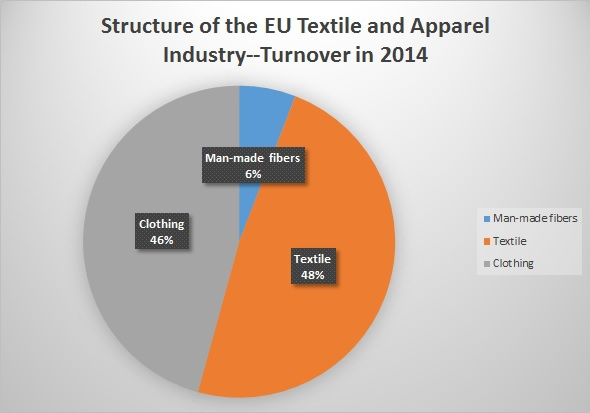
In 2014, T&A production in EU enjoyed a slight growth. Output of Man-made fiber (MMF), textile (yarns, fabrics and made-ups) and apparel went up by 2.8 percent, 2.8 percent and 1.9 percent respectively from a year earlier. In 2014, about 48 percent of T&A industry output was contributed by the textile sector, followed by the apparel sector (46 percent) and the MMF sector (6%).

Employment and productivity

eu2

eu3

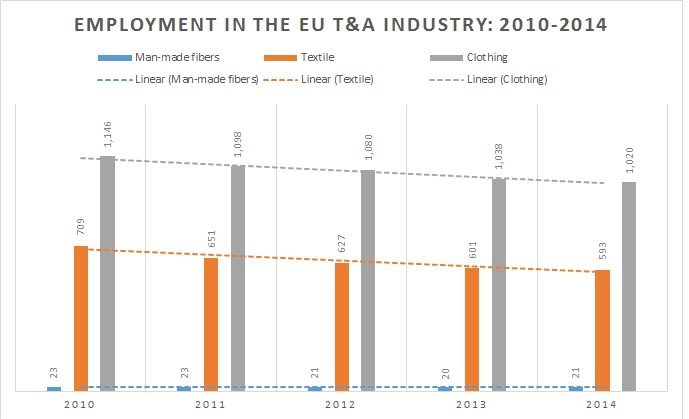
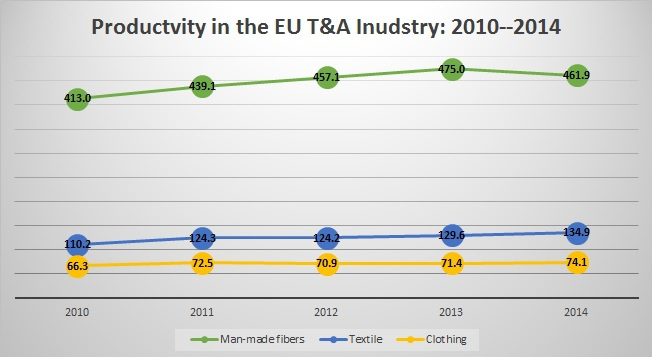
Employment in the EU T&A industry continues to move downward in size, shrinking from 1.66 million in 2013 to 1.63 million in 2014. The most significant drop happened in the apparel sector (-1.7%) and the textile sector (-1.3%), whereas employment in the MMF sector increased by 5 percent. As one important factor contributing to the job decline, productivity (measured by the value of output per person) in the EU T&A industry has constantly improved since 2010, especially in the textile sector (+22%).

Consumption
Consumption data in 2014 is not available yet. Value of T&A consumption in EU (28) stood at €483.9 billion in 2013, a slight increase of 0.2 percent from 2012.

Trade

eu 28 2014

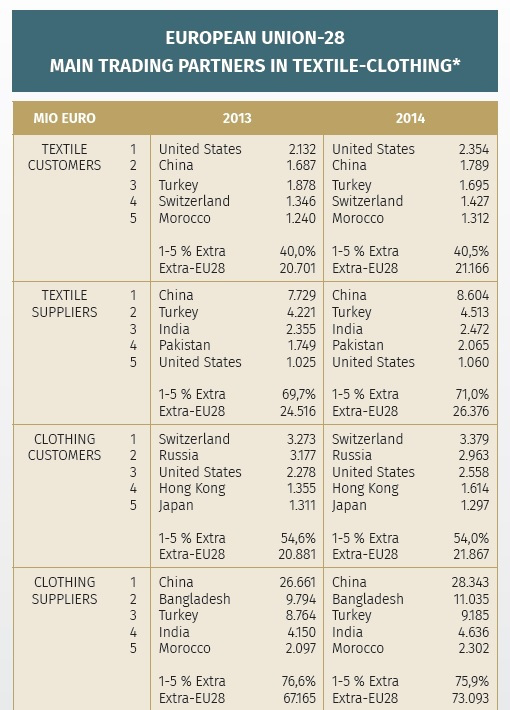
The two-way EU T&A trade enjoyed a robust growth from 2013 to 2014. Specifically, EU T&A exports increased by 3.5 percent (+2.2% for textile and +4.7% for apparel), which may attribute to the depreciation of euros against major currencies around the world. Interesting enough, EU’s T&A imports went up even faster in 2014—an overall 8.5 percent increase from 2013 (+7.6% for textile and +8.8% for apparel). With regard to EU’s key trading partners:

  • China remained THE dominant external T&A supplier for EU in 2014. However. China’s market share in the EU apparel import market declined from 39.7 percent in 2013 to 38.8 in 2014, whereas China’s share in the EU textile import market went up from 31.5 percent to 32.6 percent. It seems China is gradually shifting towards more textile exports and less for apparel along with its industry adjustment in recent years.
  • The United States remained the largest textile export market (11.1%) and the 5th largest apparel export market (11.7%) for EU in 2014. In the meanwhile, the United States is the 5th largest supplier of textiles to EU (however, U.S. market share declined from 4.0% in 2013 to 4.2% in 2014).
  • Bangladesh’s apparel exports to EU increased by 12.7 percent from 2013 to 2014, which helped Bangladesh gained 15.1% market share, up from 14.6% a year earlier.


Two Years after the Rana Plaza Tragedy: What Has Changed?

rana plaza

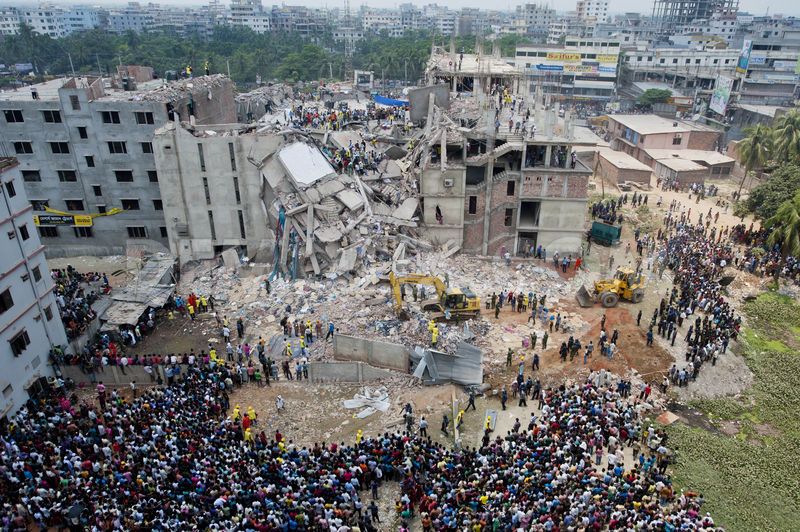
Note: the followings updates are compiled based on the 2015 Bangladesh Development Conference held from June 5th to 6th at the Harvard University. The conference attracted over 100 attendants and speakers from various aspects of the apparel industry, government agencies, international organizations, non-government organizations and academia.

1. Overall, the industry side argues that tremendous efforts have been made to improve work safety in the Bangladesh apparel industry and things are gradually improving. However, representatives from some labor unions say that changes are not happening fast enough as they should.

2. Indeed, as one of the most noticeable changes after the Rana Plaza tragedy, the Bangladesh apparel factories are now facing more frequent safety inspection and audit from various parties:

  • In addition to the regular inspection conducted by individual fashion brand or retailer, the Accord on Fire and Building Safety in Bangladesh (the Accord) and Alliance for Bangladesh Worker Safety (the Alliance) were established in 2013 respectively (mostly funded by western apparel brands sourcing from Bangladesh) to maintain minimum safety standards in the Bangladesh apparel industry.
  • The Accord has a total five-year budget of $50 million to be used on factory safety inspection and improvement. However, it is far from being clear what will happen after the Accord agreement expires in 2018 and whether the inspection achievements can be maintained afterwards.
  • The International Labor Organization and International Finance Corporation launched the “Better Work” program in collaboration with Bangladesh government, apparel factory owners, workers, fashion buyers and other relevant stakeholders. The program intends to provide assessments of factory compliance with national law and core international labor standards, paired with transparent public reporting on findings.
  • Nevertheless, some people argue that audit itself is not the answer to the problem, just like “a pig will not gain weight simply by weighting it; instead, we have to feed it.” Reflecting on the limitation of inspection and audit, they refer to compliance as just a piece of paper whereas ethics is something that keeps people awake in bed.

3. Some foreign governments also have responded to the Rana Plaza tragedy, although in different ways:

  • Stick: the U.S. government decided to suspend Bangladesh’s Generalized System of Preferences (GSP) status in 2013 as a response to the Rana Plaza tragedy. Because textile and apparel are excluded from GSP, this measure has no direct impact on Bangladesh’s apparel exports to the United States. But the movement is symbolic and significantly increases the publicity of corporate social responsibility (CRS) issue in the Bangladesh apparel industry.
  • Carrot: in comparison, the European Union chooses to continue providing Bangladesh its GSP benefits. As a GSP beneficiary, Bangladesh’s apparel exports to EU can enjoy duty free treatment when competing with other Asian suppliers such as China and India. According to EU, from 2008 to 2012 EU28 imports from Bangladesh increased from €5,464 million to €9,212 million (+69%), which is more than half of Bangladesh’s total exports. While granting Bangladesh the benefit, EU also launches the GSP Action Plan and the Sustainability Compact to encourage responsible businesses in Bangladesh.

4. Training has been provided for Bangladesh officials to help them better understand building safety requirements.

5. More apparel factories in Bangladesh now have their own labor unions. According to the local law, 30 percent of the labor force in a factory can form its own labor union, meaning theoretically one factory can have up to three different unions. There has been more open discussions on “worker/women empowerment”, “social dialogue” and “stakeholder engagement” in the Bangladeshi society as well.  

6. Some creative financial incentive mechanisms are suggested to improve the situation, such as offering factories with better compliance record with more attractive interest rate for bank loans; and adding building safety clauses in factory insurance contract.  

7. Academia is actively engaged in finding a solution for improving the CRS practices in the Bangladesh apparel industry as well:

  • Based on analyzing the factory inspection data, some scholars start to evaluate the effectiveness of the current inspection system (eg: does who pay for the inspection matter for the result? Does violation go down overtime in inspection? What is the role of on-going people to people relationship in inspection?).
  • Some projects intend to develop an estimate of the true size of the Bangladesh apparel industry, given the fact that the worst work condition may exist in those undocumented factories. As a matter of fact, even the Bangladesh government doesn’t know how many garment factories they have in the country.
  • Some scholars propose the idea of linking a company’s social compliance data with its business financial data to evaluate the business implication of CRS practices.
  • Some studies compare the labor practices between Bangladesh and other developing countries in South Asia such as Cambodia and Sri Lanka.
  • Some people suggest using case studies to develop hypotheses for a policy change.
  • More and more studies are now conducted based on field trip and interview in Bangladesh.

8. Criminal charges recently are filed against a dozen individuals and companies identified responsible for the Rana Plaza tragedy.

9. Response to the Rana Plaza tragedy has further led to a discussion on the broader economic, social and political reform in Bangladesh.

Sheng Lu

The Changing Business Model of Fashion Companies

From watching the video (the first 18 minutes):

  • What are the key challenges faced by fashion companies nowadays?
  • How has the business model of fashion companies evolved?
  • What’s your outlook for the U.S. fashion industry?

Foreign Direct Investment in the U.S. Textile and Apparel Industry (Updated in May 2015)

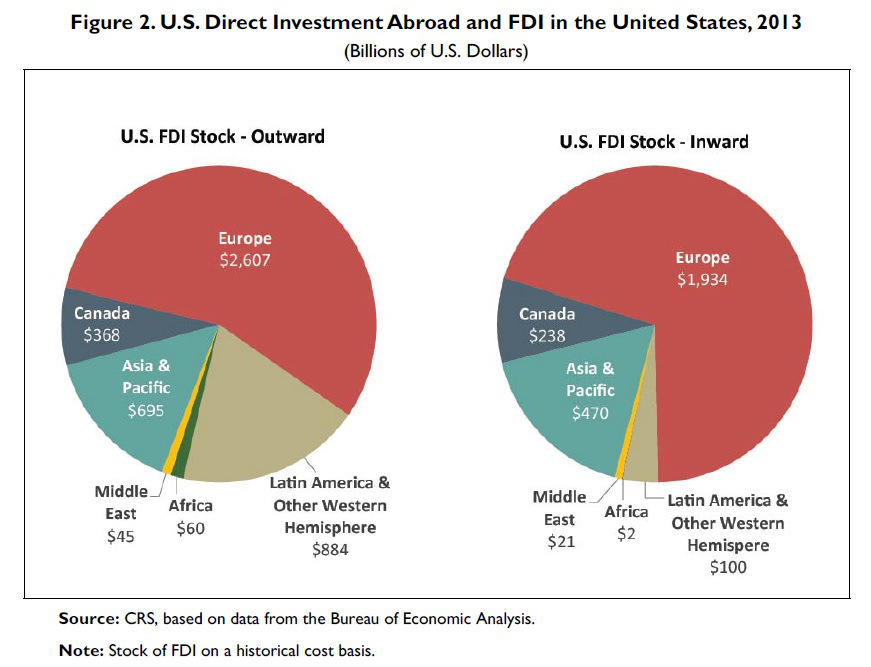
Foreign direct investment (FDI) is a major format of cross-border capital flow. It occurs when a company based in one country invests in physical productive assets in another country and obtains a controlling interest in the operation (Brookings, 2014).

0

Statistics show that in 2013 the total stock of global FDI exceeded $25 trillion, among which around 18.8% ($4.7 trillion) were made by U.S.-based companies. In the meanwhile, the United States is also a major FDI recipient, with the stock of FDI totaled $2.8 trillion by the end of 2013 (CRS, 2015). Europe is both the top destination of US FDI abroad (55.5%) and the largest source of FDI in the U.S. (70.1%).

Although historically developed countries have been the primary source of global FDI, in recent years, developing countries (especially emerging economies such as China) have played an increasing role in global investment. For example, according to a recent study released by the National Committee on US-China Relations, from 2000 to 2014, Chinese firms spent nearly $46 billion on new establishments and acquisitions in the U.S.. This includes Keer Group, a Chinese textile company, which invested $218 million in South Carolina to produce industrial cotton yarn products specifically for the China market.

It should be noted that in the 21st century FDI is considered to be a major driver of international trade. Particularly, a substantial share of international trade today is between parent firms and their foreign affiliates. For example, Statistics show that in 2012 the affiliates of foreign firms in the U.S. exported $334 billion or 21% of total U.S. exports and imported $671 billion or 29% of total U.S. imports. At the same time, U.S. parent companies (i.e. those companies made FDI overseas) exported $738 billion or 47% of total U.S. exports and imported $949 billion.

1

3

4

21

The U.S. textile and apparel industry (T&A) has been actively engaged in FDI as well. Data from the Bureau of Economic Analysis (BEA) show that in 2013 U.S. FDI abroad in the T&A industry reached $16.5 billion and FDI inflow reached $13.7 billion. The apparel retail sector (NAICS 448) in particular accounted for 85% of FDI inflow and 51% FDI outflow in the U.S. T&A industry. Interesting enough, data also show that FDI abroad made by the U.S. apparel manufacturers have substantially increased by 85.4% from 2009 to 2013, implying that U.S. apparel manufacturers may accelerate moving factories overseas rather than adding manufacturing capacity in the United States.

US Apparel Manufacturing Jobs Continue Declining in 2015

[Updated data is available: U.S. Continues to Lose Apparel Manufacturing Jobs in 2016]

11

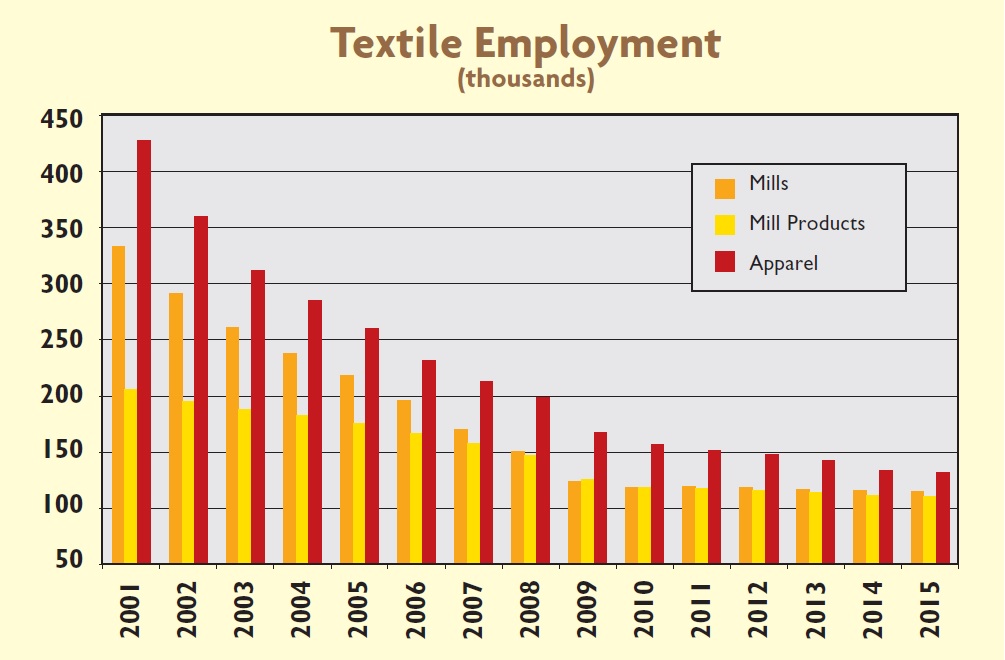
It may disappoint those who are hoping a return of apparel “Made in USA”, but according to the latest statistics from the Bureau of Labor Statistics, the U.S. apparel manufacturing sector (NAICS 315) lost another 4.2% jobs from April 2014 to April 2015. From January 2008 to April 2015, about 86,800 jobs (or 39%) in the U.S. apparel manufacturing sector had disappeared.

From the academic perspective, a sizable return of apparel manufacturing job in the United States seems to be extremely unlikely given the nature of the U.S. and global economy in the 21st century.

First, it is all about comparative advantage suggested by classic trade theories. The World Bank data show that from 1980 to 2010, the U.S. GDP increased by 424% (note: world GDP increased by 484% over the same period) whereas the total U.S. population was only 23% higher in 2010 than in 1980 (note: world population increased by 65.21% over the same period). This suggests that the United States actually is becoming more capital & technology abundant with less comparative advantage in manufacturing labor intensive apparel. A sizable return of apparel manufacturing in the United States might only happen in the following two occasions: 1) apparel manufacturing can be automated like textile manufacturing; 2) substantial amount of foreign workers were allowed to work in the United States. Unfortunately, neither of the two occasions seem likely to happen at least in the near future.

Second, it is about US apparel company’s business model in the 21st century. The suggested dominant types of apparel companies in the United States today are “branded manufacturers” and “marketers” whose business models heavily rely on global sourcing and non-manufacturing activities such as branding, marketing and design (Gereffi, 1999). If you carefully read US apparel companies’ annual reports, seldom you’ll see a company still regards “manufacturing” as a key competitive advantage or an area of strategic importance to invest in the future.

2

Additionally, according to data from the U.S. Bureau of Economic Analysis (BEA), the percentage of compensation of employees in the apparel industry’s total value added has been gradually declining since 2008. Similar trend is also observed in the U.S. economy and the U.S. manufacturing sector as a whole. Does the result imply that labor input is becoming less important to the output of the U.S. apparel industry? Or does the result suggest that U.S. apparel companies are more willing to invest on buying machines than hiring more people? Maybe it is the time that we shall pay more attention to the labor-capital substitution trend in the U.S. apparel industry.

What Does “Factory Asia” Mean for the U.S. Textile and Apparel Industry?

Slide37

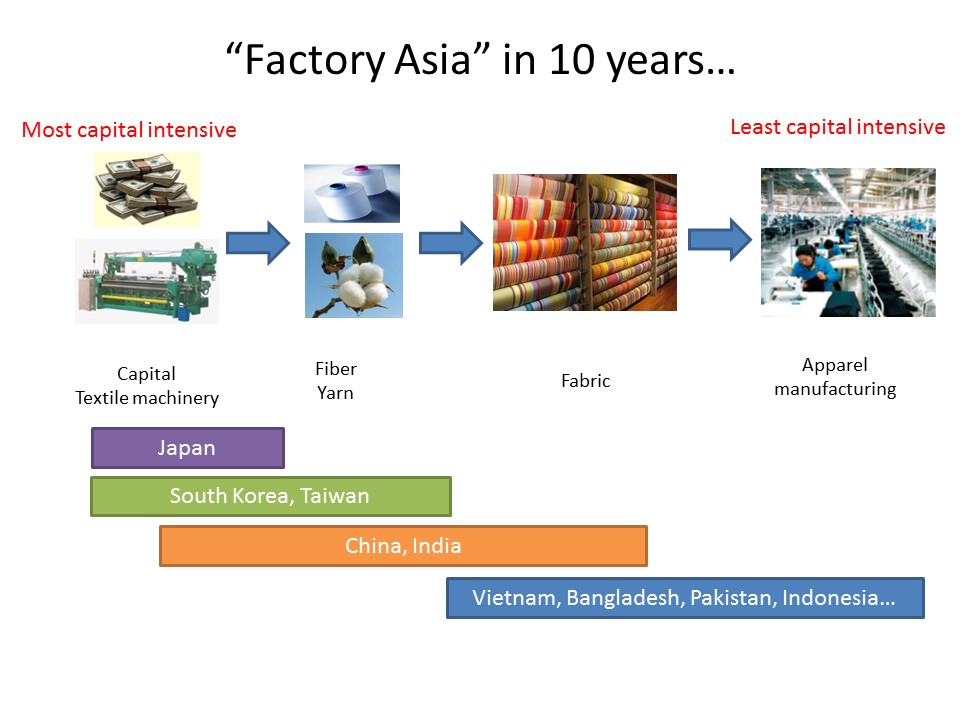
Slide38As we discussed in class, following the “flying geese pattern”, countries in Asia form a dynamic division of labor in textile and apparel (T&A) manufacturing. Although China may gradually lose its comparative advantage in labor-intensive apparel manufacturing, it will continue playing a critical role in “Factory Asia” (i.e. Asia-based T&A supply chain). As results, Asia will remain a giant player in T&A production and export in the years to come.

1 (1)

1 (2)

1 (3)

Slide35

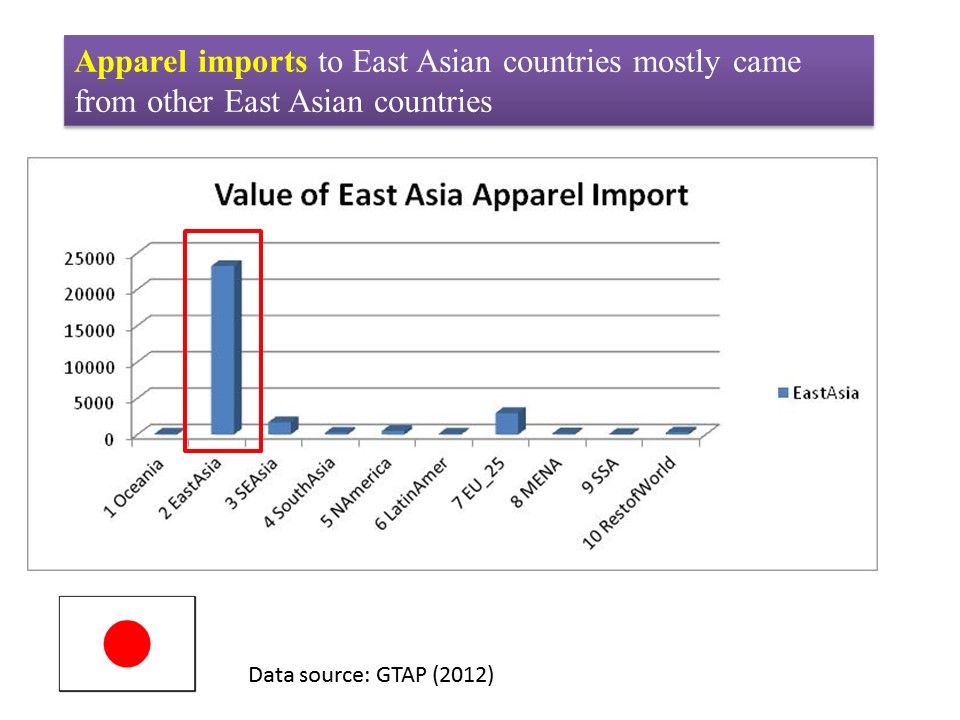
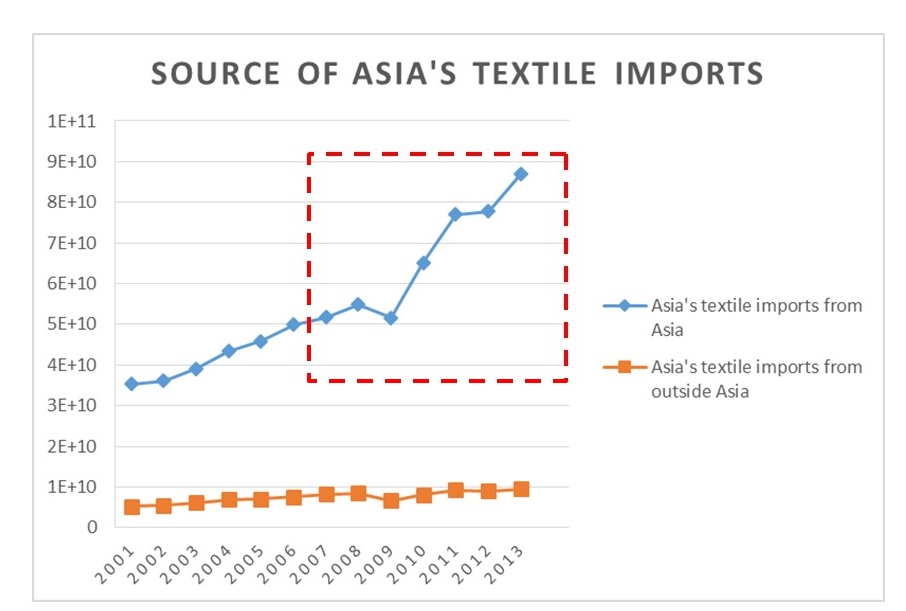
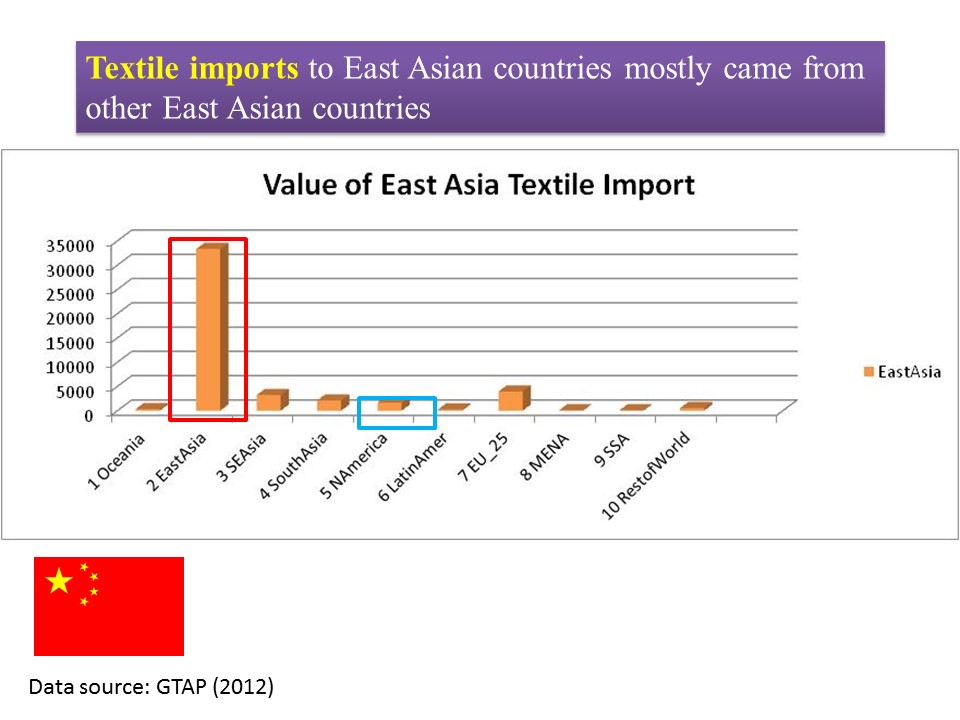
Another important feature of “Factory Asia” is regional integration–Asian countries tend to use more and more T&A inputs from within Asia rather than from outside the region. This may improve the internal efficiency of “Factory Asia”, but also may make it harder for T&A companies outside Asia to get access to the Asian market.

Slide54

So, what is your view on “Factory Asia”? What are the implications of “Factory Asia” for the U.S. T&A industry? Can the Trans-Pacific Partnership potentially shape new T&A supply chain in the Asia-Pacific region? What market opportunities does the Asia-Pacific region present to the US T&A industry? Please feel free to share your view and any other questions in your mind about the Asia-Pacific region. 

[Comment for this post is closed]

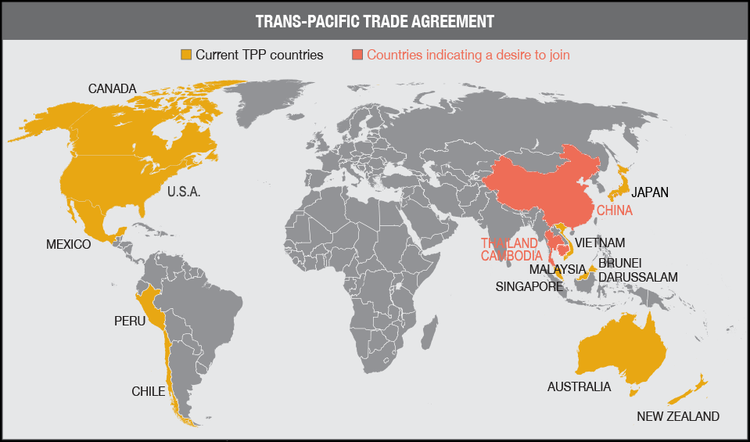
TPP Textile Negotiation Updates (March 2015)

trans-pacific-trade-agreement_issuebanner

According to Inside US Trade, negotiators continued their work on the technical details of the textile chapter under the Trans-Pacific Partnership (TPP) during the latest round of negotiation in Hawaii. Although progress has been achieved, key issues remain unsolved.   Exceptions to Yarn-Forward Rule of Origin Since the 807A program under the Caribbean Basin Imitative (CBI) enacted in 1998, the so called “yarn-forward” rule of origin has been adopted in almost all free trade agreement (FTA) and trade preference program (TPA) reached between the United States and its trading partners. “Yarn forward” rule requires that each step of apparel production from spinning of the yarn must take place in one of the FTA countries. At the same time, FTA/TPA often adopt exceptions in addition to “yarn-forward” rule so as to provide flexibility to importers, especially in the case when certain textile and apparel products are not available in commercial quantities from the FTA/TPA region. It is almost certain at this point that TPP will continue to adopt the “yarn forward” rules of origin. However, what kind of exceptions to the yarn forward rule will be allowed in TPP remain unclear: 1) How long will be the “short supply” list in TPP? Short supply list is a mechanism which allows fibers, yarns, and fabrics determined not to be available in commercial quantities in a timely manner from within the FTA partner countries to be sourced from outside the countries for use in qualifying textile and apparel products. According to Inside US Trade, some TPP countries want to declare the short-supply list complete as soon as possible so that they can shift the discussion to other possible exceptions to the yarn-forward rule. However, others doubt that the U.S. would be willing to contemplate additional exceptions and therefore believe that the best approach is to keep the short-supply list open and try to add as many products as possible. 2) Whether there will be other exception mechanisms in TPP in addition to the “short supply” list? According to Inside US Trade, there were some discussions on creating a separate mechanism such as the tariff-preference levels (TPL) in TPP. TPL allows for a certain quantity of textile and apparel goods (usually yarns, fabrics and cut pieces) from a third-country (a country who is not a party to the agreement) to qualify for the FTA benefits. Additionally, it is more than just Vietnam that is seeking more exceptions to the “yarn forward” rule in TPP. For example, Australia and New Zealand are also doing so, which may be in large part for tactical reasons — essentially holding up the textile talks as leverage to secure acceptable outcomes in other areas that are more important to them, for instance, agricultural market access or intellectual property. Tariff Phrase-out Mechanism Inside US Trade says that U.S. is sticking to the framework that it laid out in its initial tariff offer, which put products into three categories subject to different phrase-out schedule:

  • X-basket, which covers the most sensitive products that would be subject to an initial cut upon entry into force, but then remain in place until they are eliminated in the tenth year for knit apparel and fifteenth year for woven apparel
  • B-basket, which consists of slightly more sensitive apparel items that would be subject to a linear tariff phase-out over five years
  • A-basket, which consists of least sensitive items whose tariff rate would go to zero immediately upon TPP entries into force

Key questions remain as to which items the United States will place into what basket. Other issues in the textile chapter The TPP textile chapter may also include languages on the following two issues: 1) a special safeguard mechanism under which the importing country can raise tariffs up to the most-favored nation (MFN) level in the case of an import surge; 2) customs language on the inspection mechanism.

Mexican New Import Rules on Textiles and Apparel Raise Concerns

mexicanclothes

In January 2015, Mexico announced a set of new measures aimed at combating “unfair” trade practices in T&A imports and enhancing the competitiveness of domestic T&A sector in the face of increasing foreign competition.

The proposed measures will particularly target those imports considered to be “undervalued” by the Mexican government. According to Inside US Trade and Sourcing Journal Online, one of these measures is to establish a minimum reference price for imported T&A products. If shipments enter at below that price, they would be subject to an investigation by the Mexican government that could lead to the imposition of additional duties and taxes. To be noted, the proposed new measures will be taken separately from traditional trade remedy measures such as anti-dumping, countervailing duty and safeguard.

Other proposed measures intend to strengthen custom enforcement, including:

  • Mexico will required a mandatory registry for T&A imports. A similar registry system has been required for footwear;
  • Mexico will postpone the import duty reduction that was expected to be implemented at the beginning of 2016 on 73 apparel items and seven textile made-ups. Originally slated to enter into force on January. 1, 2013, the duty reduction from 25 percent to 20 percent has been twice postponed for one-year periods and will now be delayed until 2018;
  • Importers will be required to provide advance notice of shipments to the Mexican Economy Secretariat in the future;
  • Mexico will break down the current eight-digit tariff lines for textile and apparel products into 10 digits, which an industry source said would allow tariff rates to be more specific in light of the fact that apparel products have evolved to be more specialized;

Moreover, Mexico will implement a new financing mechanism with total available credit of 450 million pesos (around $30 million USD) over the next 12 months to help the domestic T&A industry (especially small- and medium-sized enterprises) upgrade their machinery and equipment, pursue innovative strategies and develop new products. The Mexican Service Agency for the Commercialization and Development of Agricultural Markets (Aserca) will further support the purchase of cotton from domestic growers by textile manufacturers.

According to WWD, the US T&A industry has three major concerns about Mexican’s proposed measures: one is the potential delay in custom clearance and more complicated documentation requirements; second is the additional tariff rate and increased cost of exporting from the United States or anywhere else in the world to Mexico; third is the lack of policy transparency adding to the potent business risks.

Industry Background

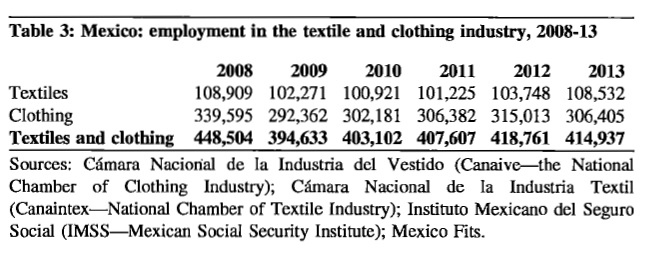
T&A industry accounted for 3.7 percent of Mexico’s GDP in 2013 (1.3 percent for textiles and 2.5 percent for apparel). About 415,000 workers directly employed in the sector in 2013, among which 74 percent worked for the apparel sector.

1

One important feature of Mexico’s T&A industry is the so called “Maquiladora” operation: simple sewing of garments made from imported fabrics and using cheap labor. The “Maquiladora” operation is largely coordinated by US-based apparel brands and retailers. Most of “Maquiladora” factories are located in the free trade zones, in which equipment and imported materials (such as fabrics) can be duty-free. Output of “Maquiladora” are exported, mostly to the United States.

3

Mexico imported $8.6 billion T&A in 2013, among which $2.4 billion were fabrics, followed by made-up textiles ($0.55 billion) and yarns ($0.39 billion). This pattern reveals Mexico’s heavy reliance on imported textiles due to limited domestic textile manufacturing capacity.

At the same time, Mexico’s apparel imports increased from $2.4 billion in 2008 to $2.9 billion in 2013. Particularly, Mexico’s apparel imports from China surged by 558.8 percent between 2008 and 2013. In 2013 alone, apparel imports from China went up by 42.1% to $0.97 billion. It is said that China is the main target of Mexico’s proposed new import measures.

4

 [Comment for the post is closed]

Pattern of U.S. Textile and Apparel Imports (Updated: February 2015)

12

4

Total U.S. textile and apparel imports enjoy steady growth from 2000 to 2014. From 2013 to 2014, value of apparel imports increased 2.5 percent and imports of fabric increased 5.4 percent. However, value of fiber imports declined 1.9 percent over the same period. Almost all fastest growing import categories from 2004 to 2014 are basic apparel.

3

Because the United States is no longer a major apparel manufacturer but one of the largest apparel consumption markets in the world, apparel products accounted for 76.1 percent of total U.S. textile and apparel imports in 2014. Fabrics and yarns accounted for 5.8 percent and 1.3 percent respectively.

75

8

While developing countries dominated apparel supply to the United States in 2014, developed countries remain important suppliers of textiles. For certain industrial textile products such as non-woven textiles, nearly 50 percent of imports still came from European Union (28), Canada and Japan. This pattern reflects different product nature of apparel (labor intensive) and textiles (capital intensive) as well as the respective comparative advantage of developing and developed economies.

6

Overall, pattern of apparel imports is in parallel with apparel retail sales in the U.S. market. This reflects the fact that demand for imports is largely shaped by macro-economic conditions. It should also be noted that despite the heated discussion on “reshoring” apparel manufacturing in the U.S., apparel imports is NOT declining.

9

11

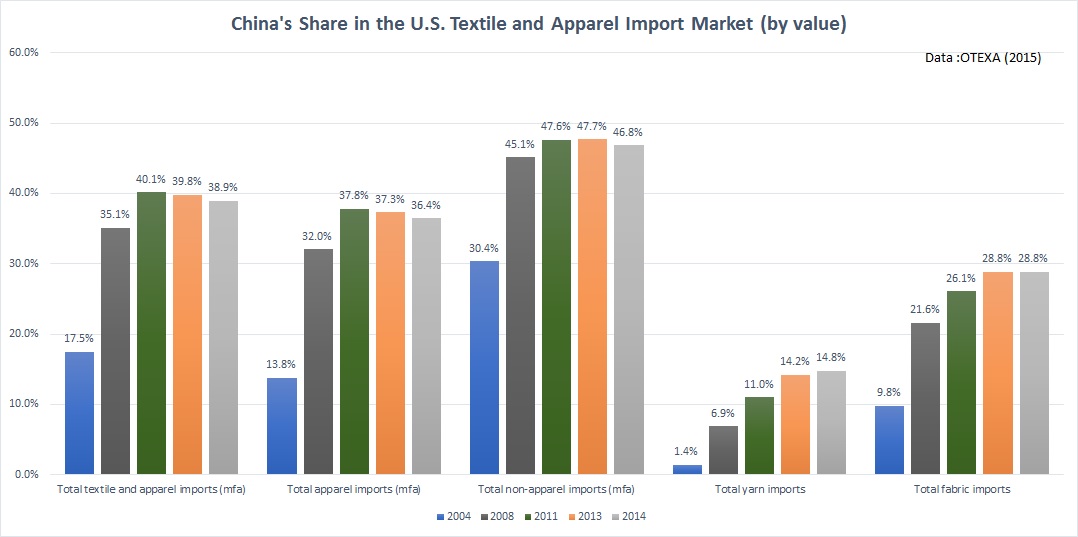
By value, China accounted for 38.9 percent of total U.S. textile and apparel imports in 2014, which was slightly lower than the level of 39.8 percent in 2013. It should be noted that China’s market shares significantly varies by category. Within the total 167 number of textile and apparel product categories complied by the Office of Textiles and Apparel (OTEXA), China enjoyed market share increase for 119 categories and suffered market share losses for 49 categories from 2004 to 2014 (many are sewing thread products).

Outlook for the U.S. Textile Industry in 2015

In its annual industry analysis report, the Textile World (TW) presents another optimistic outlook for the U.S. textile industry in year 2015.

First, the U.S. textile industry is predicted to be in a good shape economically this year. For example, according to TW, shipment of textile mills (NAICS 313 &314) is expected to increase 3-4 percent in 2015 from last year. Value of apparel manufacturing (NAICS 315) may also increase 5 percent. Additionally, market demand for basic mill products (fibers and fabrics), nonwoven fabrics and fabrics designed for activewear could be particularly strong this year.

Second, the U.S. textile industry will continue to bring back “made in USA” through capitalization. As observed by TW, new plant and equipment spending is widespread in the U.S. textile industry in recent years, covering activities ranging from fibers, spinning, nonwovens, composites, technical fibers to textile chemical. TW further estimates that some 2.2 percent of mill shipment dollars will be spent on new investment in 2015, a level much higher than a few years ago.

Third, trade deficit in the U.S. textile industry is gradually shrinking. On one hand, TW estimates that due to China’s decreasing market share, imports of T&A to the United States will down 1 percent in 2015. This trend may continue in the years ahead. On the other hand, TW estimates that the U.S. textile exports will continue to grow for the straight 5th year in 2015. However, TW doesn’t believe textile and apparel manufacturing will have any big near-term shift back to the U.S, nor the total employment in the industry (because increased production is to be made by machines).

Fourth, sustainability and supply chain management will attract even more attention by the industry in 2015. As mentioned by the TW report, consumers nowadays have become more aware of the environmental impact of textile and apparel manufacturing. This pushes companies to make more efforts to address issues such as toxins, waste and the amount of water used for production. On the other hand, supply chain management has started to play even more important roles in controlling cost and increasing profit. For example, quoted by TW, performance of supply chain management may result in 10 percentage point differences in profit margin in the textile industry nowadays.

Fifth, trade policy will continue to have a substantial impact on the the U.S. textile industry.  2015 could be a big year for trade policy in the United States. Things that are on the top watch list in 2015 include details of the Trans-Pacific Partnership negotiation and whether the Trade Promotion Authority (TPA) bill can be passed by Congress.

1

2

3

Latest Trends in the US Apparel Industry (update: January 2015)

Latest statistics released by the American Apparel and Footwear Association (AAFA) indicate several trends in the U.S. apparel industry:

  • First, the retail market is gradually recovering. According to AAFA, on average, every American spent $907 on clothing (or purchased 64 garments) in 2013. Although this figure is still less than the one before the 2008 financial crisis, it is the highest level since 2012.
  • Second, “Made in USA” is growing but US consumers still rely on imports. Data from AAFA shows that US apparel production increased 6.2 percent from 2012 to 2013, accounting for 2.55% share of U.S. apparel market. However, nearly 98% of apparel consumed in the US were still imports in 2013.
  • Third, China remains the top apparel supplier to the United States. Despite the concerns about the rising production cost in China, latest data from OTEXA shows that, in 2014 (January to November) China still accounted for 42.5% of US apparel imports in terms of quantity and 39.1% in terms of value–almost the highest level in history. These two numbers were 41.7% and 39.9% a year earlier. On the other hand, Vietnam’s market share has reached 9.3% (by value) and 10.7% (by quantity) in 2014 (January to November), about ¼ of China’s exports to the United States.
  • Fourth, job market reflects continuous shift of the apparel industry. According to AAFA, among the total 2.8 million workers directly employed by the US apparel industry in 2013, only 5% were in the manufacturing sector, 5% were in the wholesaling sector and as many as 90% were working for retailers. However, within the apparel retail sector, total employment by the department stores is quickly shrinking—dropped 7.6 percent from 2012 to 2013 and cumulatively 21.3 percent from 1998 to 2013. At the same time, specialty clothing stores and sporting goods stores are hiring more people: 13.8% and 64.5% increase of employment from 1998 to 2013 respectively. The contrasting employment trend reflects the changing nature of the U.S. apparel retail market and the channels through which U.S. consumers purchase clothing.
  • Fifth, US consumers are paying higher taxes on imported clothing. Calculated by AAFA, while the overall U.S. imports were only charged by a 1.4% tariff rate, the effective duty rate on all apparel imports rose to 13.6% in 2013. The higher effective duty rate may be caused by the fact that less apparel were imported utilizing free trade agreement or trade preference programs.

Appendix: Facts on the US Apparel Market in 2012

Slide1 Slide2

Data Source: http://www.statista.com/

China Apparel Retail Market (updated in December 2014)

According to Fung Group’s latest China apparel market report:

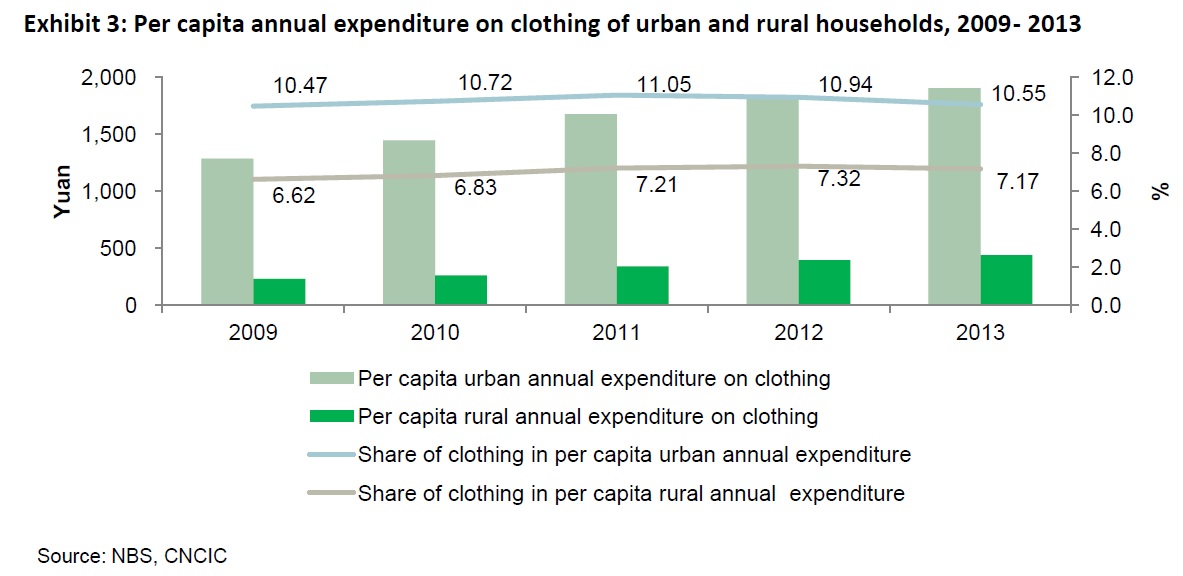
1. China’s apparel retail market remains strong despite slower growth. China’s apparel retail sales reached 1,141billion RMB (or $187 billion USD) in 2013, rose by 11.6 percent from 2012. On average, each urban household in China spent 1,902 RMB (or $306USD) on clothing in 2013, accounting for 10.6 percent of their total annual expenditure. [note: in the US, clothing accounts for around 3 percent of household annual expenditure]. It is estimated that China will replace the United States and become the world’s largest apparel retail market in 2017.

12


7

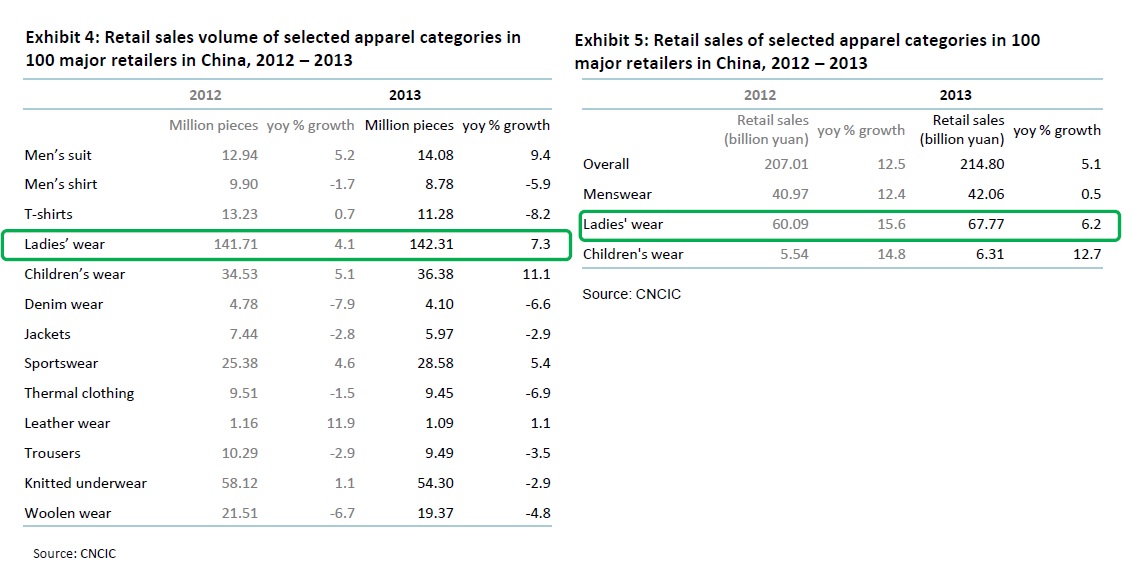
2. Women’s wear is the largest contributor to China’s total apparel sales. A survey of 100 major retailers in China shows that women’s wear accounted for 32.7 percent of their clothing sales from 2012 to 2013. However, women’s wear is a highly fragmented and competitive market in China. For example, the top ten brands altogether only accounted for 21.43 percent of market share in 2013.

4

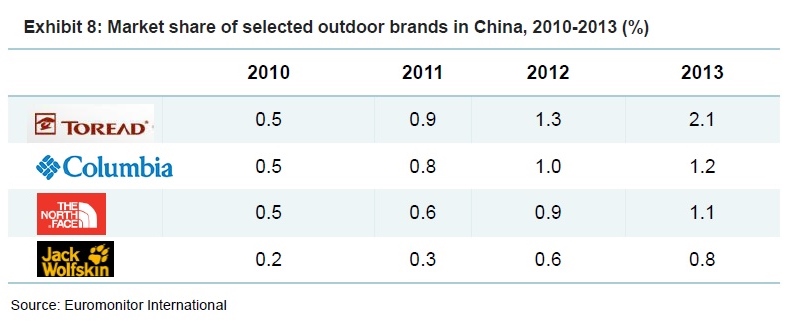
3. Children’s wear and sportswear are the two growing areas in China’s apparel market. Specifically, retail sales of children’s wear in China reached 6.3 billion RMB (or $1 billion USD) in 2013, registered growth of 12.7 percent. Because Chinese government has relaxed its “one-child policy”, China is estimated to add 1-2 million extra kids over the next few years, suggesting further market expansion possibility. Thanks to Chinese consumers’ increasing interest in sports and outdoor activities, sales of sportswear enjoyed 35 percent growth from 2012 to 2013. Functional products with fashionable designs are the key to win the market. While international brands (such as Nike and Adidas) are mainly concentrated in tier 1 and tier 2 cities, domestic brands are still dominating the lower-tier cities where more growth potential is involved.

5

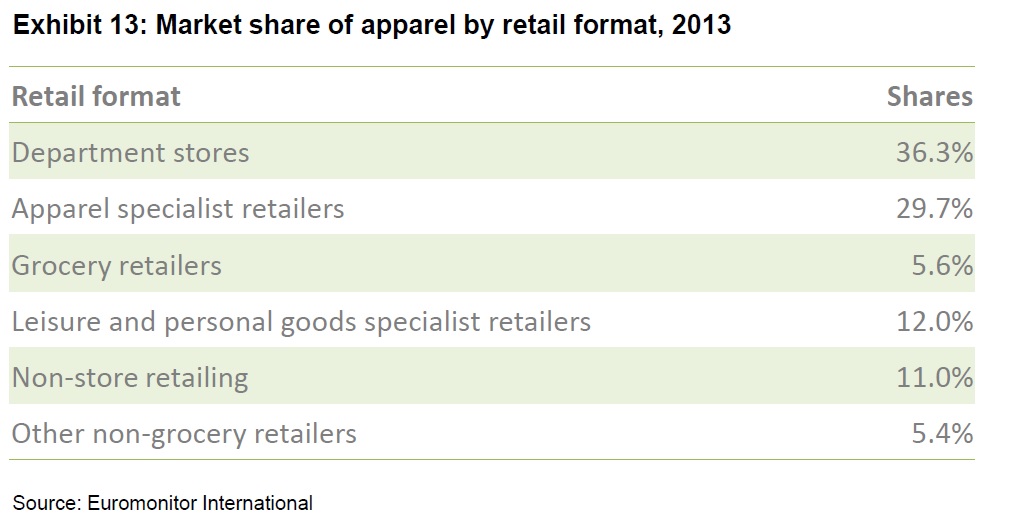
4. Department stores and specialty stores remained the main channels for apparel distribution in China, accounting for 36.3 percent and 29.7 percent of market share respectively in 2013. Specifically, department store remains the main channel for mid to high-end apparel sales in China, although specialty stores are increasingly preferred by apparel brand owners. As a common business practice in China, apparel brand owners manage their self-operated specialty stores in key cities while leaving other locations to franchisees as distributors. On the other hand, hypermarkets and supermarkets are popular retailing channels for lower-priced apparel, many of which are with poor brand recognition or unbranded.

3

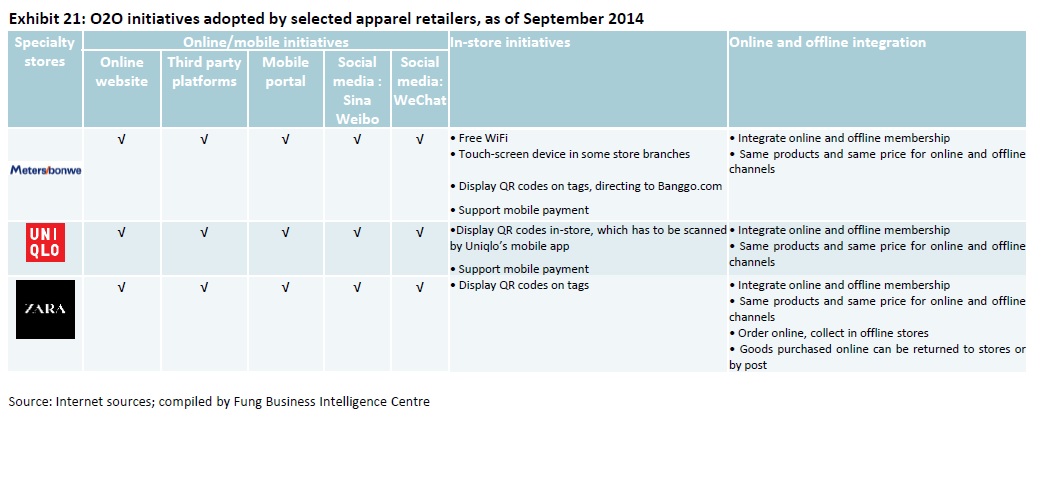
5. Online retailing is the fastest growing retail channel in China for apparel. According to one source, the total online apparel transaction value in China reached 434.9 billion RMB (or $36.2 billion USD) in 2013, increased by 42.6 percent from 2012. Similar as the emerging of “omni-channel retailing” in the US, apparel companies operating in China are making more efforts to explore“O2O” (online and offline integration). It shall be noted that more and more overseas apparel brands see e-commerce as a strategic means to reach Chinese consumers. For example, even luxury brands such as Burberry and Hugo Boss have opened online store through a B2C platform (like Tmall) in China.

9

6Some additional personal thoughts:

  1. Western apparel brands and retailers shall realize that China is a highly fragmented market with diverse market characteristics from region to region (for example, tier 1 v.s. tier 3 &4; urban v.s. rural; north v.s. south).
  2. Chinese consumers are getting more and more sophisticated, yet price is still a key factor to win this market.
  3. Given the size and sophistication of China’s apparel market, western apparel brands and retailers may consider building an independent China operation system (from design to distribution). Also, successful business models at home market may not work in China at all.

Apparel Industry is Not All about Labor Cost

While most discussions on improving corporate social responsibility practices in the apparel industry still focus on conventional solutions like higher labor standards and more effective monitoring programs, a recent Boston Consulting Group report suggests supply chain innovation also has its role to play.

One key argument of the report is: Although cost still matters in apparel sourcing, lower-cost can be achieved through means other than seeking cheap labor. For example:

1

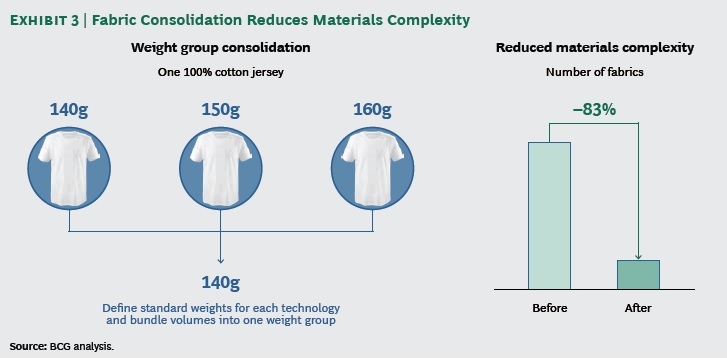
Engendering end-to-end supply chain efficiency through managing raw materials. Apparel companies may work with their suppliers further down the supply chain to optimize fabric selection, which usually account for as much as 60-70 percent of the total cost of a finished garment (v.s. 30-40 percent of labor cost). Some apparel companies have started to use fewer yarns and weight classes so as to reduce fabric count and lower down sourcing cost. Some other companies are realizing significant cost reduction by timing orders so as to level the load over the course of the year. [Note: looks like Uniqlo’s model]

2

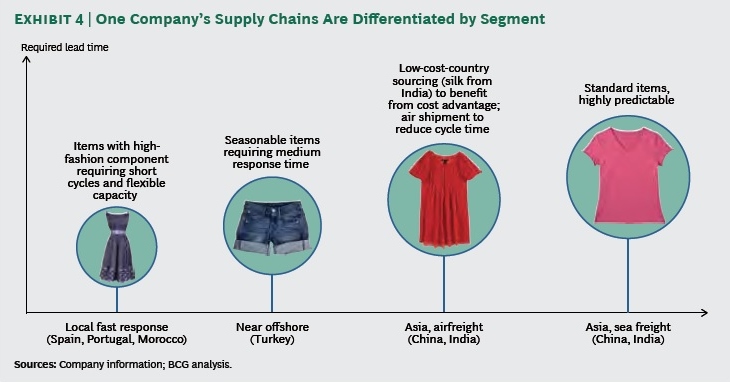
Building an integrated supply chain. As cited in the report, to balance sourcing cost and speed to market, one major apparel retailer builds 15 to 20 percent of the season’s styles and pre-positions about two-thirds of its raw material before the season (both in-house and from production partners). During the season, the company analyzes sales, staying in constant communication with its stores and with the design team. It resupplies items that are selling well through accelerated production and delivery, usually within three to four days. Designers then create new styles by adapting the best sellers using the pre-positioned material. [Note: looks like Zara’s model]

Innovating ways of production. The report suggests that bonding and gluing technologies (i.e. use bonded adhesive films and processes such as ultrasonic heating and high-frequency radiation to fuse together layers of fabric) can produce an entire small garment in 30 to 40 percent less time than conventional cut-and-sew. Digital technologies such as digital prototyping of textile designs can also significantly help apparel makers reduce waste and boost efficiency in pattern making. The potential application of 3D printing may further allow apparel makers to produce smaller batches, and possibly even allow for made-to-order production of individually designed and sized garments. This would not only allow companies to match the market’s growing need for speed, but also reduce the costs of retail inventory surpluses and associated price reductions.

Two additional thinking based on the report:

First, much attention has been given to the changing business environment of the apparel industry, such as rising labor cost in Asia, shifting market growth towards emerging economies and more sophisticated consumers’ demand in the era of omni-channel retailing. But what if the nature of the apparel industry is also changing: if one day labor cost is no longer a key factor in deciding where to produce and apparel production itself is no longer labor-intensive at all? Although automation of apparel production was not achieved in the 20st century, it may not be something totally impossible in the 21st century. We need to have bold thinking here.

Second, while the apparel industry is innovating its business model (i.e. the way to produce, the way to deliver products and the way to serve its customers), T&A educational programs also need to embrace innovative thinking. For example: are traditional course offerings sufficient enough (or still relevant) to prepare students’ job readiness in the 21st century? How to proactively respond to the changing nature of the apparel industry which has started to adopt more and more new technologies? What if we redefine the meaning of “T&A” majors and redesign the model of preparing the workforce for the apparel industry? (just like the question: for wearable technology, shall IT companies make apparel or apparel companies make IT products?)

US Department of Labor: 28 countries were Found Using Child or Forced Labor in Making Textiles and Apparel

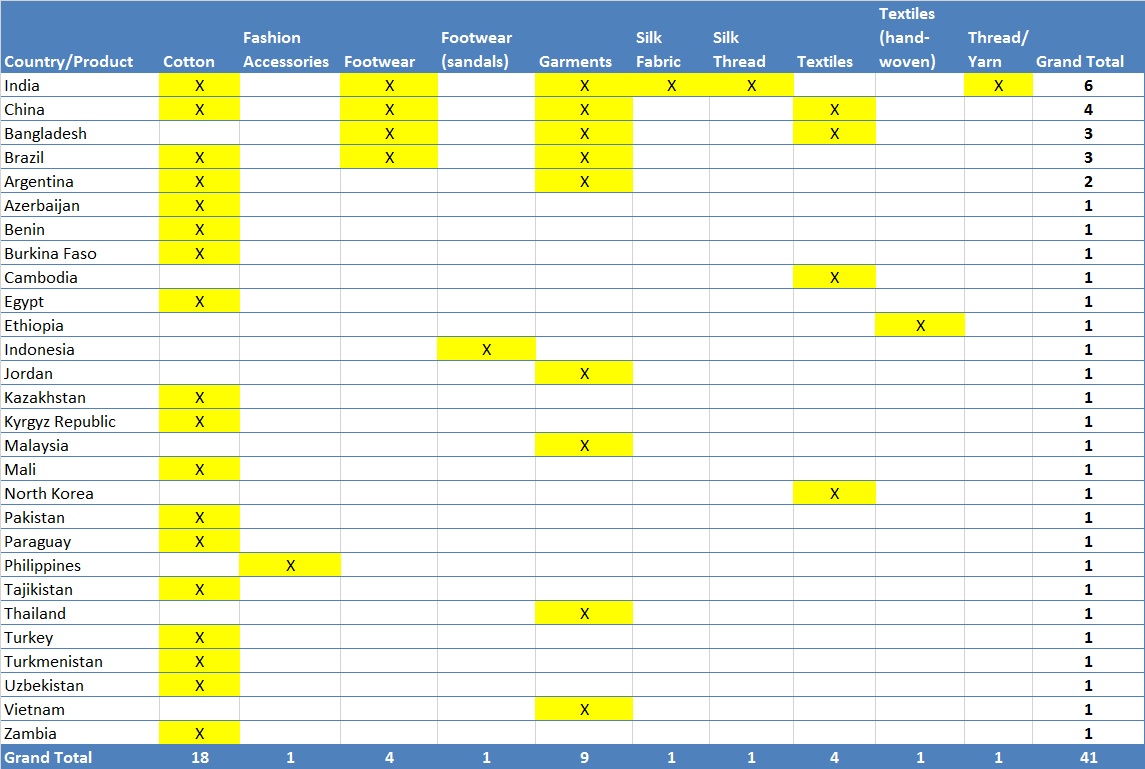
In its updated List of Goods Produced by Child Labor or Forced Labor (ILAB) released on December 1, 2014, the U.S. Department Labor said that at least 28 countries are found using child or forced labor in making textiles and apparel. All countries on the list appear to be developing countries. Particularly, the problem of using child labor or forced labor was found most serious in the cotton sector (18 countries), followed by garment manufacturing (9 countries).

Bangladesh, a focus of corporate social responsibilities practices these days, was found using child labor in making garment according to ILAB.

1

2(Data compiled by Sheng Lu)

Note: * ILAB maintains a list of goods and their source countries which it has reason to believe are produced by child labor or forced labor in violation of international standards. The List is intended to raise public awareness about child labor and forced labor around the world, and to promote and inform efforts to address them. A starting point for action, the List creates opportunities for ILAB to engage and assist foreign governments. It is also a valuable resource for researchers, advocacy organizations and companies wishing to carry out risk assessments and engage in due diligence on labor rights in their supply chains

Follow up:

After the release of the ILAB report, four House Democrats sent a letter to USTR Michael Forman on December 4th, 2014, asking him to provide details on labor provisions in the TPP. As noted by the lawmakers in the letter: “Vietnam, Mexico, Peru, and Malaysia, one-third of the nations included in the TPP, were all cited for labor abuses in the report…”. “We are following up with you because we believe it is important that you take action to ensure that real, meaningfully enforceable labor protections are in the TPP”.

U.S. Textile and Apparel Exports in 2013 (Updated in November 2014)

1

U.S. textile and apparel (T&A) exports increased by $543 million (3 percent) to $19.8 billion in 2013. However, because import increased by $3.2 billion (3 percent) to $97.5 billion, U.S. trade deficit in T&A increased rose to $97.5 billion in 2013. Imports supplied about 98 percent of U.S. consumer demand for T&A in 2013.

2

3

Textiles account for 83 percent of all U.S. T&A exports in 2013. Exports of these textiles products (particularly fabrics and yarns) are used primarily as intermediate inputs for finished products manufactured abroad, which are then imported back into the United States (USITC, 2014). In terms of value, specialty & industrial fabrics, spun yarns & thread, felts & other non-woven textiles and other made-up textile articles altogether account for nearly half of U.S. T&A exports in 2013. Statistics further show that U.S. apparel exports also grow fast in recent years. However, it shall be noted that a good proportion of them might be used clothing.

4

5

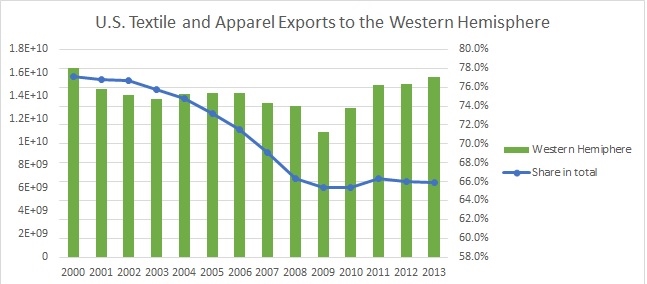
Mexico and Canada remain the top two largest export markets for U.S. T&A in 2013. 66 percent of U.S. T&A exports in 2013 went to the Western Hemisphere (i.e. North America, Central America, South America, and the Caribbean countries). However, this share has declined from 77.6 percent in 2000. Other leading export markets for U.S. T&A include Honduras, China and Japan.

6

Reference:

USITC (2014). Shifts in U.S. Merchandise Trade. http://www.usitc.gov/press_room/news_release/2014/er1112ll232.htm 

OTEXA (2014). U.S. Imports and Exports of Textiles and Apparel. http://otexa.trade.gov/msrpoint.htm

Think Big about International Trade

cropped-chess-globe-32

I hope you all enjoy the guest lecture given by Ambassador Friedrich Löhr on his global travel stories as a career diplomat over the past 37 years. Actually, topic of our class is closely connected with “international relations”. As observed by Michael Forman, US Trade Representative, “trade is what most of international relations are about and trade policy is national security policy”; “leaders have come to see the economic clout that trade produces as more than merely a purse for military prowess; they now understand prosperity to be a principal means by which countries measure and exercise power”.

Several readings/case studies/discussions in our class have touched the strategic aspects of international trade in the 21st century. For example, I hope at this point you not only understand the technical aspects of the Trans-Pacific Partnership (TPP) such as “yarn-forward” and “short supply list”, but also can see TPP as a strategic movement for the US to become more deeply embedded in the Asia-Pacific region. Similarly, the Trans-Atlantic Trade and Investment Partnership (T-TIP) is a free trade agreement, but a successful conclusion of T-TIP will also send “an unmistakable signal to the world about the strength of the US-EU bond—a timely reminder as the crisis in Ukraine has triggered deep unease across the continent.”

The strategic aspects of international trade can also be understood from the development perspective. There is a direct correlation between integration into the multilateral trading system and economic growth and between growth and poverty reduction. What then UN Secretary Kofi Annan said remains very true “The main losers in today’s very unequal world are not those who are too much exposed to globalization. They are those who have been left out”. No example can be more convincing than the case of textile and apparel (T&A) to illustrate this point. In many low-income countries in the world, T&A accounts for two-thirds of local employment and over 60 percentage of total merchandise exports. This is why trade preference programs such as AGOA, GSP and HOPE play a critical roles in providing greater market access opportunities to those most vulnerable countries.

To understand the strategic aspects of trade, you may further recall our case study 2 and the discussions on the necessity of maintaining a sound operation of the GATT system in the setting of 1970s. Without a rule-based multilateral trading system, international trade simply couldn’t happen. Yet the current multilateral trading system established shortly after World War II needs an update to better reflect the changing nature of world economy and format of trade. This is why so much attention has been given to mega-trade agreements such as TPP and TTIP. These free trade agreements will have a huge impact shaping the future rules of the game, no matter in terms of adding new agendas such as state-owned enterprises, digital trade and facilitating supply chain, or more effectively establishing a level playing field for issues such as environmental and labor standards.

So think strategically about international trade and think big about the impact of our T&A industry in the 21st century global economy.

Lectra Report: The Need for Transformation-An Analysis of the Fashion and Apparel Industry’s Evolution

Lectra

As the saying goes, change is the only constant in the fashion apparel industry. According to a newly released market report by Lectra*, “the pace of fashion has never been faster and neither has the pace of change”.

Lectra’s report highlights a few factors driving the changes in the fashion apparel industry:

1. Consumers

Consumers has much more control than in the past, implying the fashion industry can no longer define what to make and sell without taking consumers’ inputs into consideration. Some companies have alter their business models to be completely demand-driven, i.e. allowing integrating all their resources to meet the customized needs of all consumers.

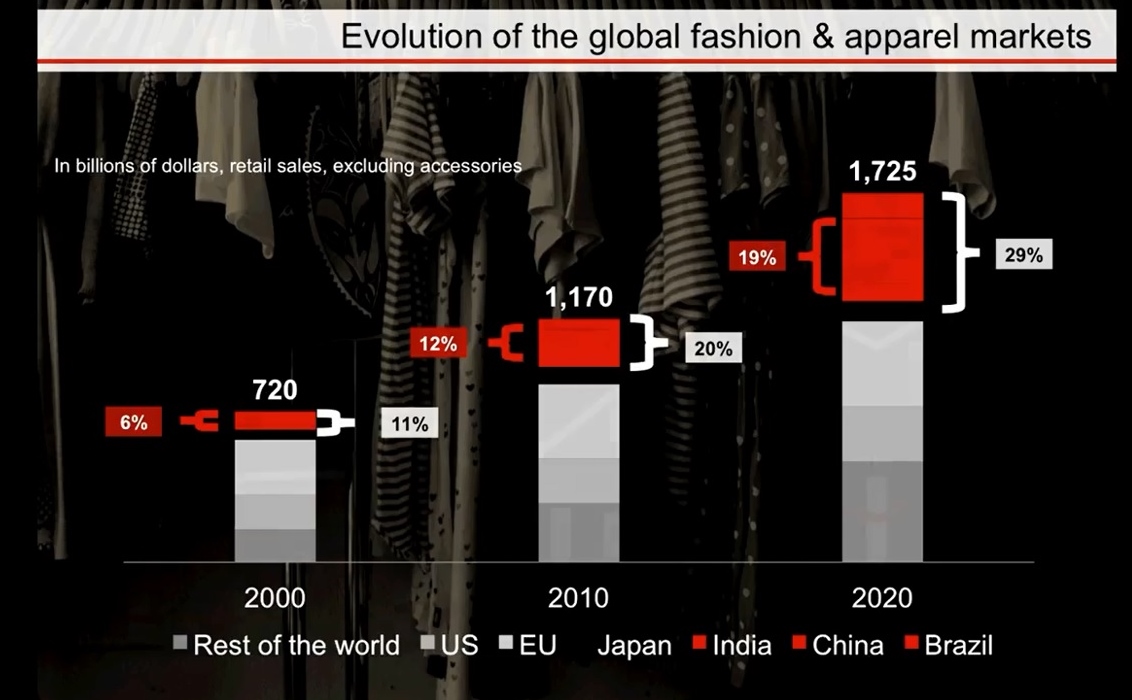
Social and economic changes like internet access and growing prosperity, have also spurred the growth of new fashion markets in emerging countries that had typically been only supplier region, creating new opportunities for western fashion brands and retailers to expand business.
1

2. Globalization

Historically, local brands dominate local market. However, because of the strategies of geographic expansion and international growth of many fashion brands, in more and more markets, local brands have to face competition from foreign brands. (for example: the Australian fashion industry is worried about the competition from H&M).

But globalization does not reduce diversity and localized consumer preferences. On the contrary, increased internationalization means that populations are more heterogeneous than in the past and retailers have to bring a localized response to individual markets.

3. Technology

New social media and mobile technologies have given consumers the power of instantaneous sharing and buying without restriction of time, place and in many cases, price. The availability of new technologies such as RFID, product life cycle management (PLM) and many other supply chain management tools have also enabled brands, retailers and manufacturers to reduce product development cycle, improve efficiency and better collaborate across the global process.

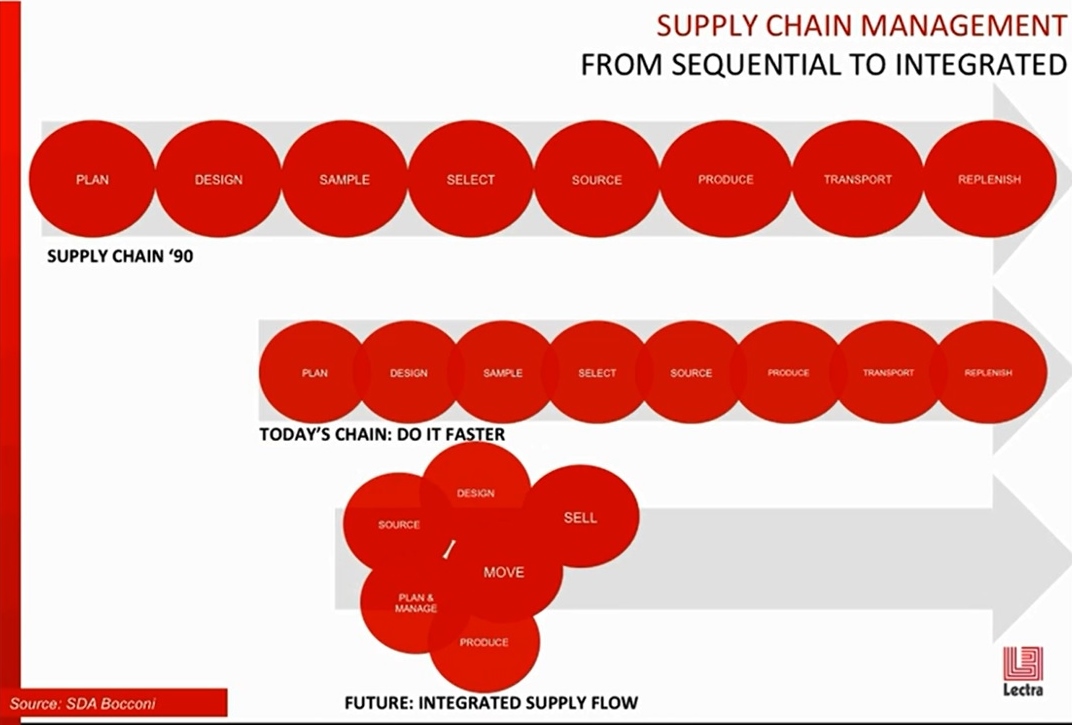
For example, digital prototyping gives companies the agility they need to adapt to changes in the market and test new products before they start to incur real production costs. PLM facilities the collaboration between design and development departments and breaks the silo mentality that has reigned for so long in the fashion and apparel industry, eliminating bottle- necks that resulted from outdated linear processes and increasing decision making power earlier on in product development.

4. Change of Business models**

In response to the application of new technologies and consumers’ updated demand, companies start to seriously reconsider their business models, especially the process of design, product development, production and distribution. As noted in the report, fashion brands, which have traditionally gone through retailers who sell on their behalf, have developed retail operations with the purpose of capturing a higher percentage of the final sale price and achieving complete control over the presentation, distribution and final price of their merchandise. Many retailers, however, also start to offer more and more private brands and exclusive products that can more effectively segment market and attract targeted consumers.

The traditional manufacturers are also looking for ways to cut costs and increase efficiency because of the pressure from retailers/brands. Manufacturers also have realized that selling directly to the end consumers is the most powerful way to protect revenue. As quoted by the report, roughly 60% of Chinese apparel manufacturers have launched their own brands. Armed with all that know-how, a growing number of Chinese manufacturers are now turning their efforts toward developing an offer for the domestic market and some are even setting their sights abroad. (recall the topic of “upgrading” in our lecture)
2

*: Lectra is a company which provides fashion-focused technology solutions such as the CAD system and the product life-cycle management (PLM) system.

Unleashing Fashion Growth City by City

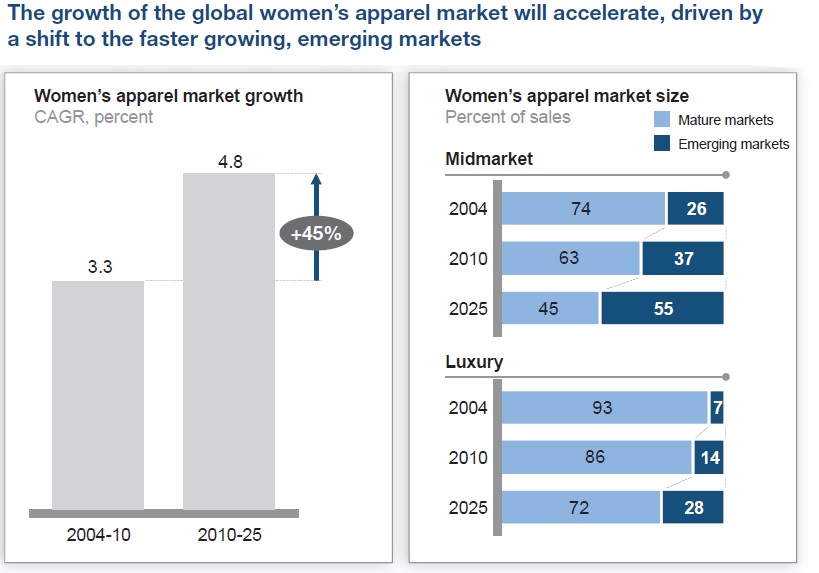
According to a recent study conducted by McKinsey, the global women’s apparel market growth rate is forecasted to increase by 50 percent over the next 12 years, largely driven by the increasing weight of emerging markets such as China and Russia. Historically, the global women’s apparel market has grown at just over 3 percent per year; However, by 2025 the growth rate is expected to approach 5 percent per year. By 2025, women’s apparel is expected to account for 55% of global apparel sales and 60% of sales growth.
1

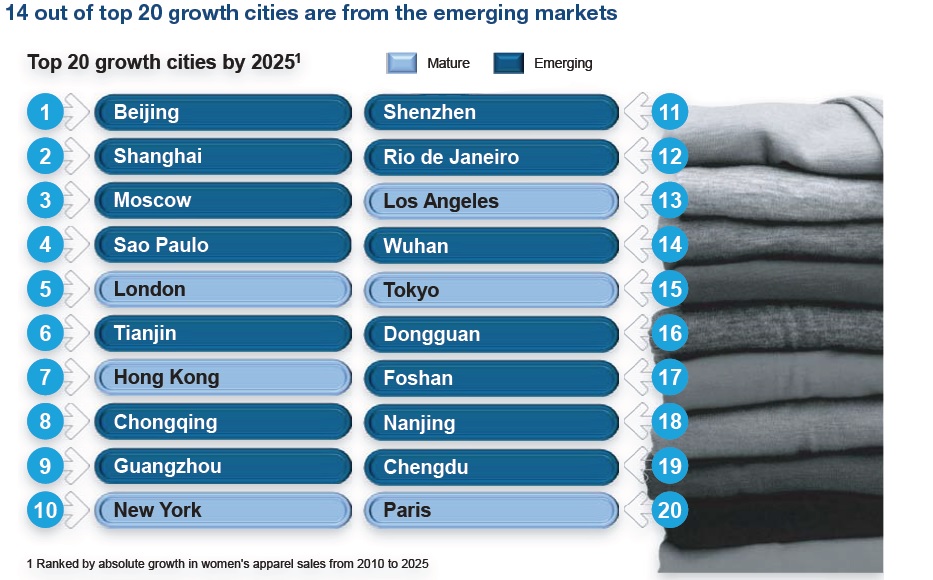
For fashion players, cities are mattering more than any other product category. Top 600 growth cities will account for 62% of women’s apparel market’s growth by 2025; and 16 out of top 20 growth cities are from the emerging markets, adding an additional $100 billion to the global women’s apparel market.

2

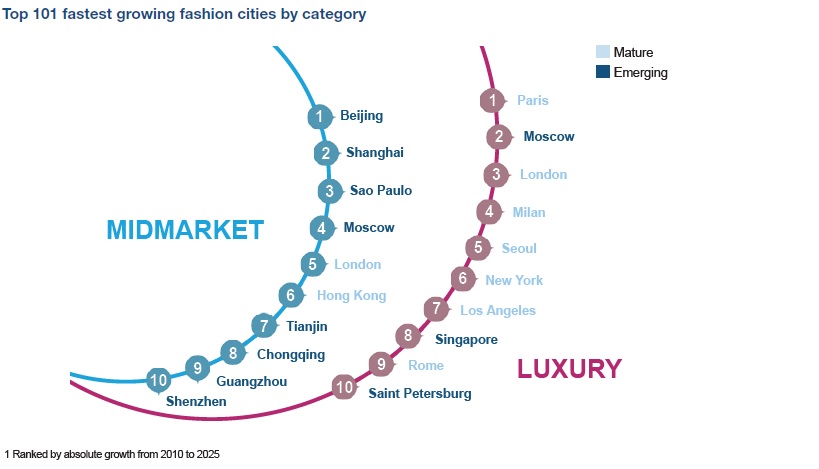
However, when looking at total size, mature-market cities will still have half the women’s apparel market worldwide, according to McKinsey. Particularly, growth in the luxury markets is still heavily dependent on the mature market, where 70 percent of top growth cities are located.

3

With the help of city level analysis, rather than discussing Europe or Asia as alternative destinations, or even the U.K. versus France, companies can now ask themselves, “in what 10 key cities should we next establish a strong presence?”

US Fashion and Apparel Industry Releases Position Paper on the Transatlantic Trade and Investment Partnership (T-TIP)

p0111400002h

The American Apparel and Footwear Association (AAFA) and the US Fashion Industry Association (USFIA) , the two leading industry organizations representing the US fashion and apparel industry, jointly released a position paper this week on the Transatlantic Trade and Investment Partnership (T-TIP), which is currently under negotiation between the United States and the European Union.

The position paper spells out a few priorities deemed by the US fashion apparel industry for the T-TIP:

  • Full, immediate and reciprocal elimination of tariffs, meaning import duties on all apparel products shall be eliminated on day one without phrase-out periods.
  • Flexible rules of origin, meaning restrictive rules of origin such as “yarn-forward” which requires companies to use textile inputs from certain regions so as to enjoy the duty free market access shall be abandoned and replaced by simpler and more flexible ones.
  • Regulatory coherence, such as harmonization on labeling regulations, harmonization of product safety and test method regulations, and establishing of a harmonized list of prohibited substances.
  • Emphasis on facilitative customs provisions, meaning improving predictability, simplicity and uniformity in border procedures.  

The European Branded Clothing Alliance is also a party of the joint statement; however, the European Textile and Apparel Confederation (Euratex) is not involved.

On the other hand, in May 2014, the National Council of Textile Organizations (NCTO), which represents the interests of the US textile industry, announced its priorities for the T-TIP negation, including:

  • Adopt the “yarn-forward” rules of origin in T-TIP
  • Set phrase-out periods for sensitive textile and apparel products
  • Protect the Berry Amendment (which requires all US military uniforms have to be 100% made in USA)