Current Event Discussion: How Shipping Containers Control Global Trade

FASH455 Learning activity: After watching the two video above, please explore the following topics with the assistance of ChatGPT or other generative AI tools:

  1. The significance and complexity of container shipping for U.S. fashion brands and retailers
  2. Current issues related to container shipping for U.S. fashion brands and retailers

In your response, please include the following elements:

  • Questions: list at least three questions you asked ChatGPT or other AI tools that helped generate the most information and insights.
  • Summary and reflections: summarize the key points from the answers you received from the AI tool and share your reflections (e.g., were there any surprising insights? the outlook for the issues discussed)
  • Further Reading: Suggest 1-2 additional articles from national or international press that offer deeper insights into the topics. The readings need to be published after 2024. Please share the article link and briefly explain why you recommend them.

New USITC Report: Apparel: Export Competitiveness of Certain Foreign Suppliers to the United States

The United States International Trade Commission (USITC) released its new fact-finding report examining the competitiveness of Bangladesh, Cambodia, India, Indonesia, and Pakistan as apparel suppliers to the United States. The study was conducted in 2024 based on input from secondary sources (e.g., trade statistics, public hearings, and desk studies) and fieldwork. Below are summaries of the key findings regarding apparel export competitiveness.

Factors that affect export competitiveness in the global apparel sector

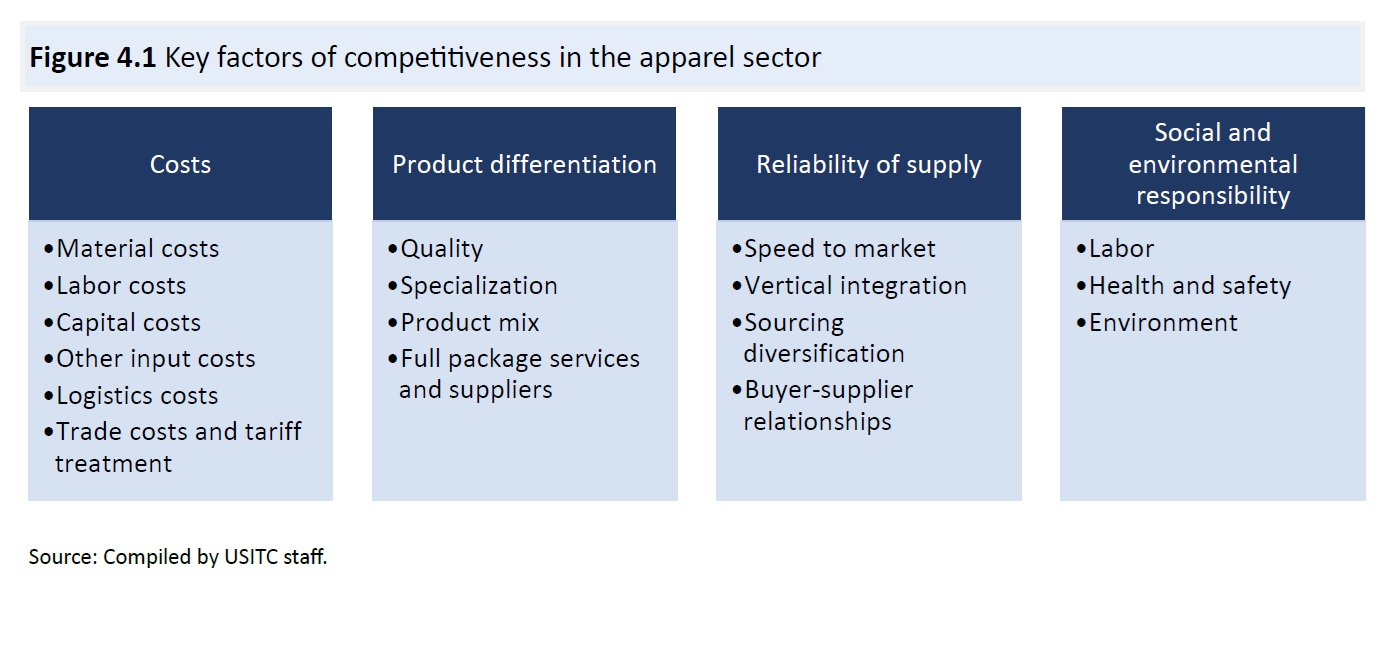
One key issue the study explored is what factors affect a country’s apparel export competitiveness and how to become a preferred apparel sourcing base for U.S. fashion companies.

The studies suggest that four types of factors are most important (see the figure above). However, consistent with existing literature, the USITC report could not determine which factor is decisive in fashion companies’ apparel sourcing decisions. For example, the report found that:

  • “cost—the price buyers pay their suppliers—plays a key role in sourcing decisions, although opinions vary regarding the importance of cost relative to other factors.”
  • “Depending on the product, target consumer, and identity of a brand or buyer, apparel buyers will place varying degrees of importance on product differentiation factors such as quality, specialization, product mix, and full package offerings, which include design services, finishing, packaging, and logistics.”
  • “The emphasis on reliability has particularly grown in response to various recent disruptions to global apparel supply chains such as a global pandemic, geopolitical conflicts, and trade policy.”
  • “Although emerging research suggests that compliance programs concerning wages, social inclusion, and climate change mitigation may increase competitiveness, buyers and brands remain divided on the topic…the relative importance, or “weight,” of such compliance in sourcing decisions remains a topic of active study and discussion within the industry.”

Cost and export competitiveness

The USITC report highlighted the complex and nuanced relationship between “costs” and a country’s apparel export competitiveness. Several patterns are noteworthy:

  • Apparel is a buyer-driven industry, meaning “the global apparel supply chain gives buyers the power to negotiate based on price, which can push down prices and transfer greater costs to the supplier.”
  • The ability to produce textile raw materials locally can provide cost advantages in garment production—“Material inputs are widely recognized as the largest component in the cost of a final apparel product, and these prices are largely determined by the presence of a domestic textile industry or costs of importing textiles.”
  • It is difficult to compare wages across countries to measure labor competitiveness. In particular, low labor costs “do not reflect the true cost of doing business (e.g., via wage suppression)” in a country and “they can harm a country’s reputation for social compliance and negatively affect labor productivity.”

Buyer-supplier relationships in apparel sourcing

The USITC report revealed some positive developments in the buyer-supplier relationships involving U.S. fashion companies.

  • Fashion companies increasingly recognize the value of building long-term relationships with their vendors. Buyers emphasize that maintaining these relationships is a key factor in sourcing decisions, largely due to the cost and time involved in finding and establishing relationships with new suppliers.
  • Fashion companies’ efforts to improve supply chain transparency and traceability also need  “suppliers who will act in line with their brand’s values.”
  • Suppliers benefit from the long-term relationship, too. As the USITC report noted, some fashion companies guarantee suppliers a particular profit margin to ensure their continued operation. Additionally, some buyers gain a deep understanding of their suppliers’ cost structures, enabling them to calculate the costs of compliance with various standards and assist suppliers in reducing costs where possible.
  • Subcontracting is still regarded as necessary for the garment industry. As noted in the USITC report, apparel orders fluctuate seasonally, making it impractical for suppliers to hire additional permanent workers or invest in machinery for peak demand. To meet buyer expectations during busy periods, manufacturers often subcontract parts of orders and increase overtime or rely on temporary contract workers. This practice is seen as essential for ensuring a reliable supply of apparel.

Social and environmental responsibility and apparel sourcing

The USITC report acknowledged the growing importance of social and environmental compliance to a country’s apparel export competitiveness. However, the relationship remains complex.

  • The extent to which voluntary social and environmental responsibility programs and their associated auditing practices have influenced outcomes, especially regarding worker rights, remains unclear.
  • Suppliers report that the increased frequency of flooding and high temperatures due to climate change negatively affect their ability to meet labor and environmental standards.
  • Increased compliance with social and environmental standards raises supplier costs, negatively impacting their cost competitiveness. Many stakeholders note that while brands and consumers demand greater responsibility, this often does not come with a “price premium” for suppliers, who ultimately absorb these increased costs.

Note: The USITC report also evaluated the export competitiveness of each apparel-exporting country it examined, including their respective competitive advantages and issues to address.

Merchandising and Sourcing: FASH455 Exclusive Interview with Natalie Kaucic, Global Merchant for Dockers at Levi Strauss & Co.

About Natalie Kaucic

Natalie Kaucic is a Merchandising professional currently in the role of Global Merchant for Dockers Men’s Tops at Levi Strauss & Co. She graduated from the University of Delaware in 2019 with a Fashion Merchandising Degree and Business Admin minor. During her studies, she was awarded the Fashion Scholarship Fund scholarship, studied at John Cabot in Rome, participated in the Disney College Program, and was a leader for the Delaware Diplomats. Natalie’s research on the global market for sustainable apparel was published in Just-style, a leading fashion industry trade publication. Post university, Natalie started as an assistant at Minted as a Merchandiser, where she worked in the Wedding category and faced the adverse challenges of the wedding industry during COVID-19. Levi’s was her next endeavor where she started as an assistant, and has since been promoted to run the Dockers Men’s Tops Category for the Globe.

Disclaimer: The comments and opinions expressed below are solely my own and do not reflect the views or opinions of any company.

Sheng: What are your primary job responsibilities as a global merchant? What does a typical day or week look like for you? Which part of the job do you find most exciting? Were there any aspects of the position that surprised you after you started?

Natalie: My primary responsibility is to create a brand-right and consumer-focused product assortment. Under the covers, this looks like a vast variety of tasks that I do on a seasonal basis. I regularly listen and work with regional merchandising to understand their regional specific needs, collaborate with design on new product ideas and fabrics, and meet with product development to work on new fabric innovations and product costing. Every week looks dramatically different for me in my work. Sometimes, I’m heads down in assortment strategy; other weeks, I work on creating templates and calendars for process improvement.

What I find most exciting is seeing the product in person. Most Dockers Tops are not sold domestically, so it’s really fun to see a product you worked on in the wild! I am also grateful to be able to manage an assistant. Seeing things click for her and watching her succeed is incredibly motivating.

What surprised me the most was the number of different teams I work with, including planning, regional merchants, product development, marketing, styling, design, garment/fit development, copy, IT, analytics, sales, business operations, and e-commerce. Learning what everyone does and who to go to was the most significant learning curve and the biggest shock coming into my role.

Sheng: Based on your observation and experience, how do the merchandising, product development, and sourcing teams collaborate in a fashion apparel company? Could you explain their respective responsibilities and how they support one another?

Natalie: In my role, I have more direct contact with our product development team than the sourcing team. I work very closely with product development as they are the team that helps produce our product. They manage fabric & garment development, costing negotiations, and innovation development/testing. They also work through some more micro-sourcing strategies, for example, moving the production from one factory to another to get better duty rates. As a hypothetical example, we sell a poplin shirt primarily in Europe. Pretend we produce the shirt in India at a cost of $10/each. However, shipping it to Europe incurs a 40% import duty, bringing the cost of goods sold (COGS) to $14. If we could produce the shirt in Mexico, where the duty rate to Europe is only 5%, even if the production cost is higher—say $12—the overall cost to Europe would still be lower. There are endless complexities to this that I’m sure you will learn more from FASH455—topics like free trade agreements, yarn forward rules of origin, etc.

Sheng: Fashion companies need to balance various factors such as cost, quality, speed to market, and compliance risks when deciding where to source their apparel products. Could you share your experiences and reflections on managing these challenges in the real world?

Natalie: Below is an example of natural fibers and the cost challenge with cotton-forward apparel products.

Currently, linen is in high demand, but there isn’t enough crop to meet industry needs—it’s a classic case of supply and demand. Not only does this drive up costs (COGS), but it also complicates the process of securing raw materials. It’s easy to overlook that the apparel industry is fundamentally tied to agriculture, making it vulnerable to factors like bad weather, natural disasters, and inaccurate demand forecasting. These challenges force us to make critical decisions. With rising garment costs, should the company absorb the expense to keep prices steady for consumers? Our product development team might ask if we need to pre-book fibers to lock in pricing—when is the right time to do that, and how much should we purchase?

This isn’t a new challenge. For example, cotton, our primary raw material for clothing, fluctuates in price like oil, making agility in sourcing essential!

Sheng: Studies show that consumers want to see more “sustainable apparel products” in stores. How are fashion companies responding to this demand? What opportunities and challenges does this trend present for fashion companies’ business operations, especially in merchandising, supply chain, and sourcing?

Natalie: This is such a complicated question. I think about this often as I am personally really passionate about this topic!

In my day-to-day work, I focus on sustainable fibers, as the fabric content of a garment is something I can directly influence. Working on a global scale, I collaborate with regions worldwide, each of which—along with their retailers—has different values regarding sustainable products. Europe, for instance, is relatively ahead of the US in sustainability and often requires a certain percentage of sustainable fibers (e.g., organic cotton, recycled cotton) in our products. In Europe, items using 100% organic cotton hold significant value and can command a higher price in stores such as Galeries Lafayette or Zalando. However, not all retailers and consumers globally share the same commitment to sustainability. In some cases, we may need to use synthetics for functional purposes, such as in activewear. In those instances, we prioritize using recycled polyester or nylon to meet our sustainability goals. Regardless of the consumer or price point, our goal is to integrate sustainability at every level and for every product.

One challenge I find particularly interesting is working with “recycled cotton.” As you may know, recycling cotton typically involves breaking down the fibers, which shortens and weakens them. Because of this, there’s usually a limit to how much recycled cotton can be used before fabric quality is affected. That’s why you often see recycled cotton blended with virgin cotton in the same garment. However, newer recycling methods that aim to preserve the staple length are emerging, offering hope for improvements as the technology becomes more mature and accessible.

Ultimately, heavy consumption, regardless of the fabric being recycled or organic, isn’t truly sustainable. The focus should be on choosing pieces you love and investing in items that are made to last.

Sheng: Are there any other major trends in the fashion industry that we should closely monitor in the next 1-3 years?

Natalie: In the next 1-3 years, I’m eager to see what AI-driven tools will be introduced to assist merchants in making smarter, data-backed decisions. In merchandising, we are constantly trying to predict the future. A lot of research and data analysis go into decision making,  but also a big handful of going with your gut. Will AI be able to help us find trends in the past that can better help us make decisions for the future?

It’s not exactly a trend, but I’m really curious about the future of fast fashion giants over the next decade. With growing interest in sustainability and new regulations emerging from Europe, will we eventually see a decline in these dominant players, or will demand for fast, cheap apparel always persist?

Sheng: Last but not least, is there anything you learned from FASH455 or other FASH courses that you find particularly relevant and helpful in your career? What advice would you offer current students preparing for a career in the fashion apparel industry?

Natalie: I felt really prepared coming out of the FASH program for my corporate job. I picked this degree, as I’m sure many have because it combined the necessary key concepts of a business degree with the skills and knowledge to build a career in apparel. I think the classes I reference the most in my day-to-day life are product development classes, textile classes, and apparel buying. As a merchant, I need to be able to talk about fabric types with designers, cost engineering with product developers, and financial metrics with planners. FASH455 was one of my favorite classes because sourcing, trade, geopolitics, and policy constantly pull the strings behind the scenes in the apparel sector. FASH455 gives you insight into how these factors create ripples in the apparel sector.

When it comes to advice, it’s tried and true: network! Talk to teachers, reach out to alumni, sign up for the UD Job Shadow Program, and talk to the career center. There are so many services to take advantage of while at UD. Other than networking, I would highly recommend steering the subjects of your papers to companies and topics you are interested in. I worked on a few reports about Levi Strauss & Co., which confirmed it as a target company for me and helped me succeed in the interview process.

Lastly, be flexible! You might come in, as I did, thinking you want to be a buyer, only to realize it’s not the best fit. Or, you could start with greeting cards and stationery merchandising and pivot to apparel. Or even move out of apparel entirely! Nothing is set in stone, and that’s both the most stressful yet reassuring lesson I’ve learned since graduating.

–The End–

New Study: PVH Corporation’s Evolving Apparel Sourcing Strategies (updated Septmeber 2024)

PVH Corporation (PVH), which owns well-known brands including Calvin Klein, Tommy Hilfiger, Van Heusen, Arrow, and Izod, is one of the largest US fashion companies with nearly $9.2 billion in sales revenues in 2022.

By leveraging PVH’s publically released factory lists, this article analyzes the company’s detailed sourcing strategies and changes from 2021 to 2022. Key findings:

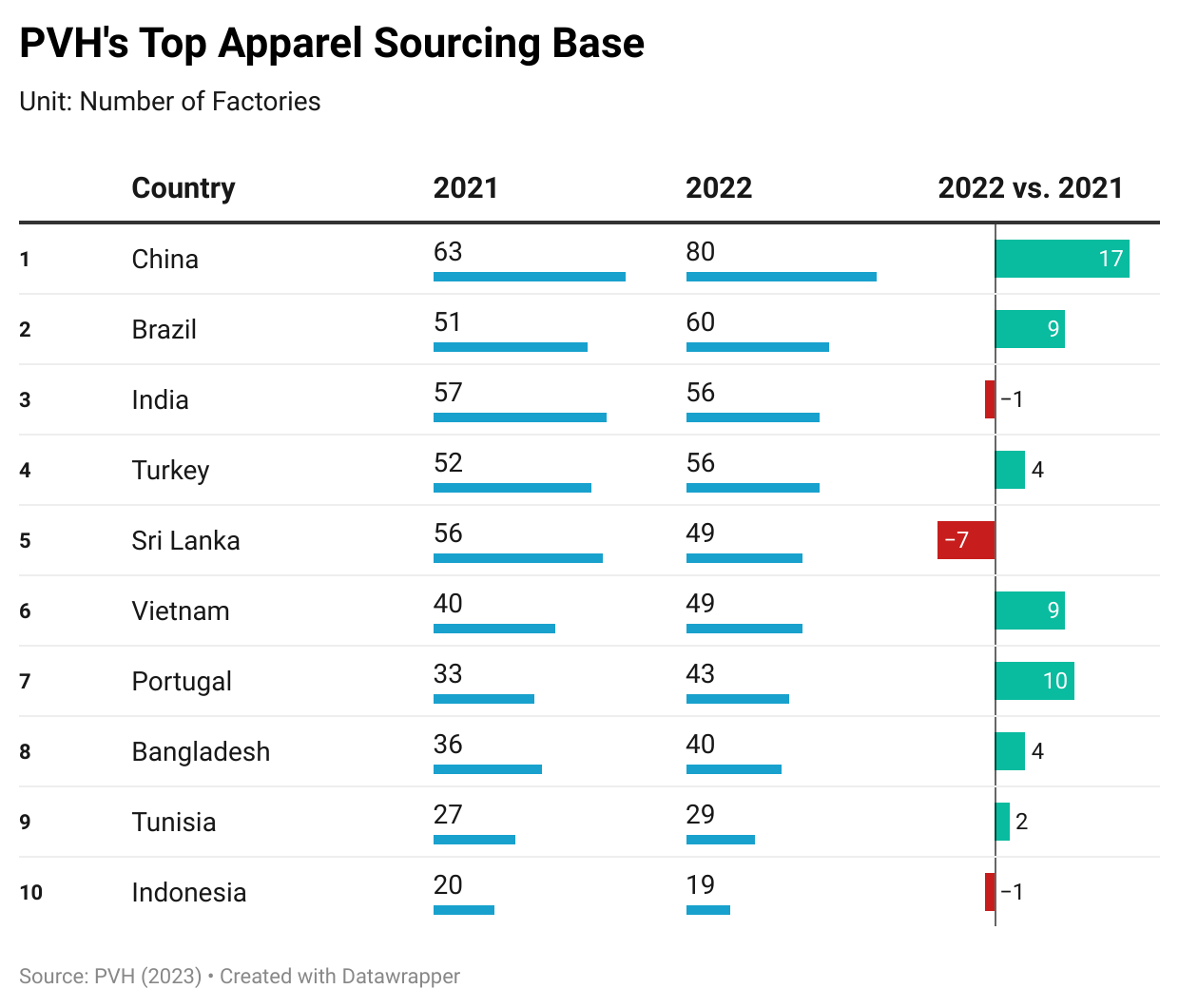
Trend 1: PVH adopts a diverse apparel sourcing base and continues to work with more vendors. Specifically, in 2022, PVH sourced apparel from as many as 37 countries in Asia, Europe, America, the Middle East, and Africa, the same as in 2021. Despite not expanding the number of countries it sources from, PVH increased its total number of vendors from 503 in 2021 to 553 in 2022, highlighting the company’s ongoing commitment to diversifying its sourcing base.

Trend 2: Asia is PVH’s dominant sourcing base for finished garments and textile raw materials.

Specifically, about 56.2% of PVH’s apparel suppliers were Asia-based in 2022, followed by the EU (20.3%). Compared with a year ago, PVH even added twenty new Asia-based factories to its supplier list in 2022, suggesting no intention of reducing sourcing from the region. Moreover, From 2021 to 2022, as many as 83% of PVH’s raw material suppliers were Asia-based, far exceeding any other regions.

Trend 3: PVH’s China sourcing strategies are evolving and more complicated than simply “reducing China exposure.”

  • First, PVH continued to work with MORE Chinese factories. Specifically, between 2021 and 2022, PVH added 17 Chinese factories to its apparel supplier list, more than other countries. However, the expansion could be because of PVH’s growing sales in China.
  • Second, PVH’s garment factories in China are smaller than their peers in other Asian countries. For example, in 2022, most PVH’s contracted garment factories in top Asian supplying countries, such as Bangladesh (87.5%), Vietnam (63.3%), and Sri Lanka (65.3%), had more than 1,000 workers. In comparison, only 11.3% of PVH’s Chinese vendors had 1,000 workers, and more than 62.5% had fewer than 500 workers. The result suggests that PVH treats China as an apparel sourcing base for flexibility and agility, particularly those orders that may include a greater variety of products in relatively smaller quantities.
  • Further, PVH often priced apparel “Made in China” higher than those sourced from the rest of Asia.

Trend 4: PVH actively used “emerging” sourcing destinations outside Asia. Other than those top Asian suppliers, PVH’s apparel sourcing base includes several countries in America, the EU, and Africa that deserve more attention, including Portugal, Brazil, Tunisia, and Turkey. Overall, PVH sourced from these countries for various reasons, from serving local consumers, seeking sourcing flexibility, accessing raw materials, and lowering sourcing costs.

by Sheng Lu and Ally Botwinick

Further reading: Lu, Sheng & Botwinick, Ally (2023). US fashion companies’ evolving sourcing strategies – a PVH case study. Just-Style. Retrieved from https://www.just-style.com/features/us-fashion-companies-evolving-sourcing-strategies-a-pvh-case-study/

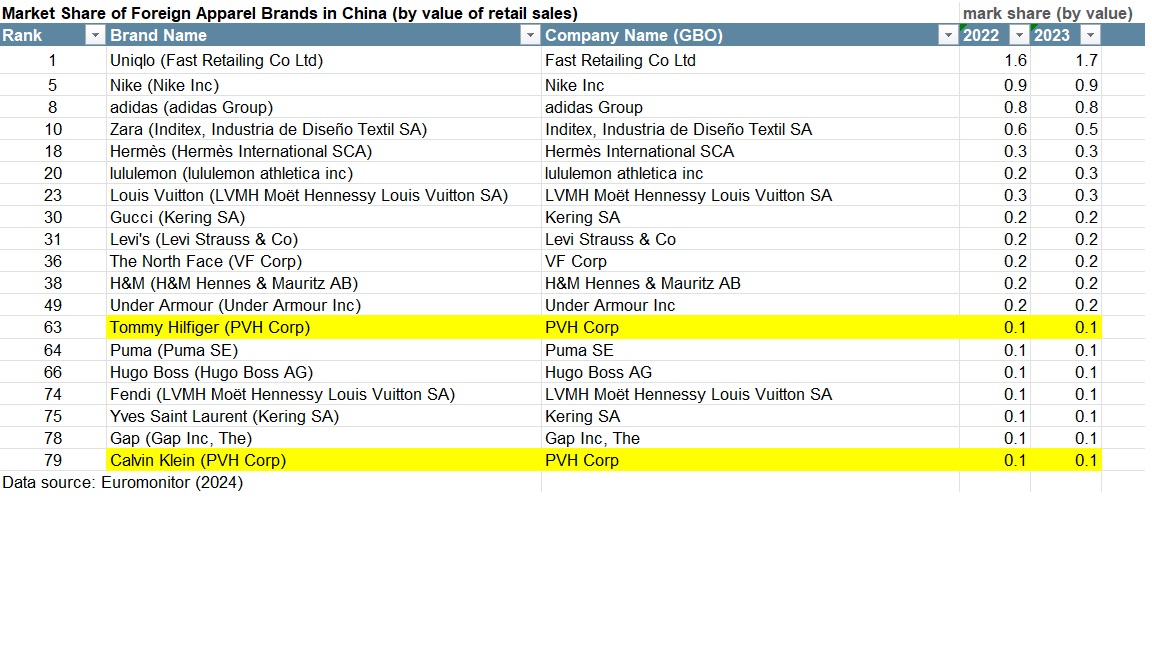
PVH’s market shares in the China apparel retail market

(discussion for this post is closed)

FASH455 Exclusive Interview with Michael Lambert, Executive Director of Global Trade and Compliance of Urban Outfitters, about Trade Compliance and Global Apparel Sourcing

About Michael Lambert

Michael Lambert is the Executive Director of Global Trade and Compliance at Urban Outfitters (URBN). He also serves as the Vice Chair of the Board of Directors of the United States Fashion Industry Association (USFIA).

Michael has spent over 30 years in the retail fashion business, primarily in the import/export and Customs compliance area. At URBN, Michael is responsible for Customs, Social, Vendor and Regulatory Compliance. Urban Outfitters has a global footprint, with stores in the U.S., Canada, Europe and the United Kingdom.  Urban Outfitters designs and develops products throughout the world, working with a core vendor base across more than thirty countries. Prior to Urban Outfitters, Michael spent nine years with Limited Brands as head of their Import Planning department.  He spent his last two years with Limited Brands in London, setting up Compliance activity for Limited Brands as they expanded overseas.

Michael has been a Licensed Customs Broker since 1998 and is a graduate of Pennsylvania State University, with a Bachelor of Arts in International Politics and Foreign Service.

About Emilie Delaye (Moderator)

Emilie Delaye is a 2024 UD entrepreneurship graduate and an incoming UD graduate student in fashion and apparel studies. Emilie is the recipient of the 2024 UD Alumni Association Alexander J. Taylor Sr. Awards for Outstanding Seniors.

China’s Textile and Clothing Export: Latest Patterns and Trends (updated August 2024)

The newly released World Trade Organization statistics and data from the United Nations (UNComtrade) suggest several patterns of China’s textile and clothing exports.

Firstly, while China remained the world’s largest clothing exporter in 2023, rising geopolitical tensions and Western fashion companies’ ongoing de-risking efforts pose increasing challenges to its export outlook.

To some extent, 2023 wasn’t too bad for clothing “Made in China.” In value, China’s clothing exports totaled $164 billion, accounting for 31.6% of the world—unchanged from 2022. While China’s clothing exports decreased by 9.7 percent in 2023 compared to the previous year due to weaker market demand, this performance was better than most other top ten suppliers, including Bangladesh (down 16 percent), Vietnam (down 12 percent), India (down 13 percent), and Indonesia (down 17 percent).

However, China’s clothing exporters face significant challenges ahead. Despite maintaining its overall market share, China is losing momentum in nearly all key Western clothing markets, including the United States, the European Union, the UK, and Canada. This trend is primarily driven by perceived heightened sourcing risks associated with China, ranging from concerns over forced labor in the Xinjiang region to escalating geopolitical tensions involving the country.

For example, according to the 2024 Fashion Industry Benchmarking Study released by the US Fashion Industry Association (USFIA) in July, a record 43 percent of surveyed leading US fashion companies reported sourcing less than 10 percent of their apparel products from China in 2024, compared to only 18 percent in 2018. Likewise, nearly 60 percent of respondents no longer use China as their top apparel supplier in 2024, much higher than the 25-30 percent range before the pandemic. Additionally, nearly 80 percent of respondents plan to further reduce their apparel sourcing from China over the next two years through 2026, citing perceived high sourcing risks as the primary concern.

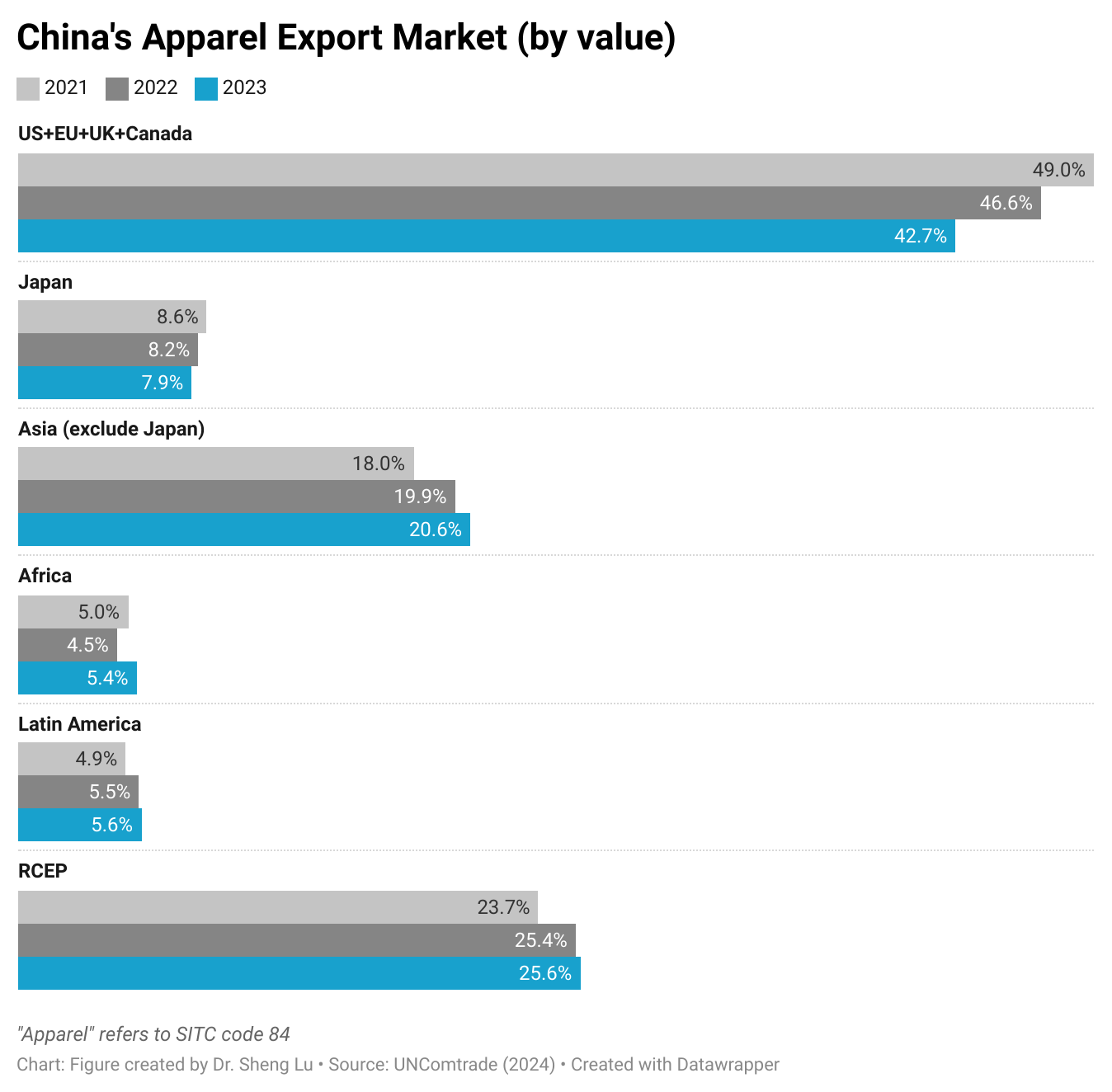
Secondly, China has been diversifying its clothing exports beyond traditional Western markets in response to the “de-risking” movement. For example, the US, EU, UK, and Canada combined accounted for 43-45 percent of China’s clothing exports in 2023, lower than over 50 percent in the past. In comparison, these four Western markets typically accounted for 70 to 90 percent of an Asian country’s clothing exports. Meanwhile, since 2021, Asian economies, especially members of the Regional Comprehensive Economic Partnership (RCEP) and Africa, have become more important export markets for China. Nevertheless, since RCEP members and those in Africa primarily consist of developing economies with ambitions to expand their own clothing production and exports, the long-term growth prospects for their demand for “Made in China” clothing remain uncertain.

Thirdly, China’s weakened economy could lead to an increased supply of low-cost Chinese clothing in the global market.

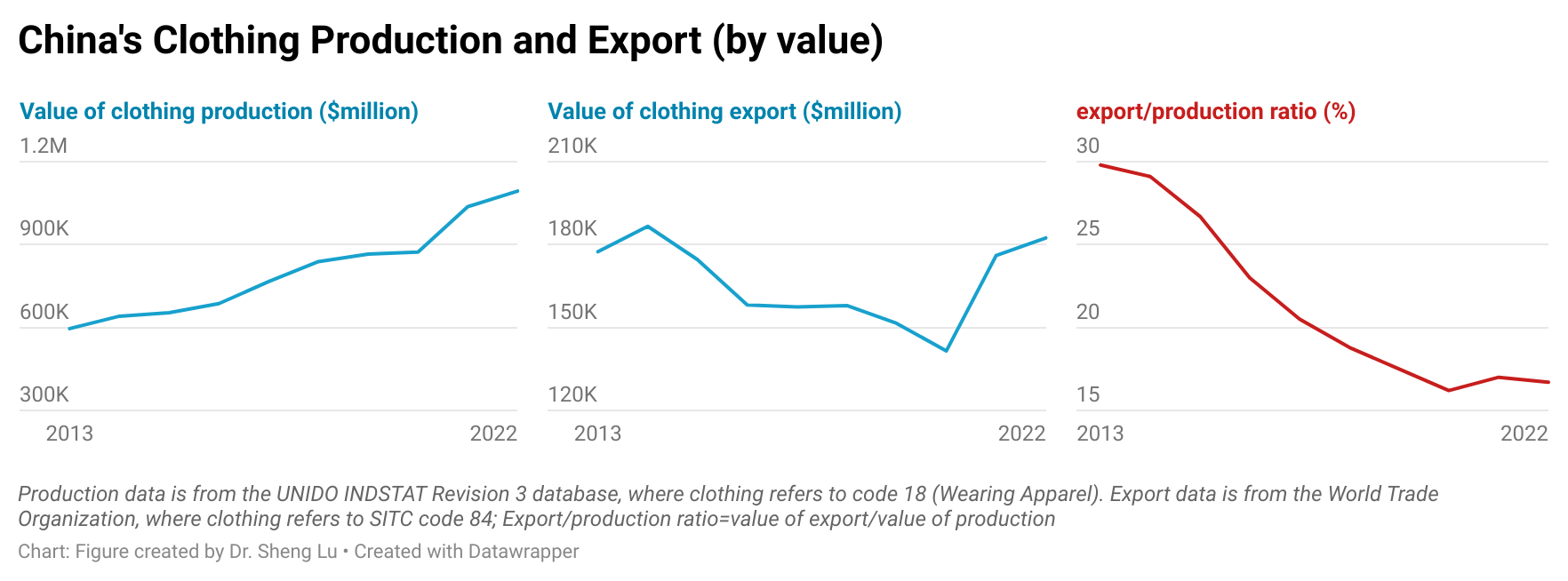
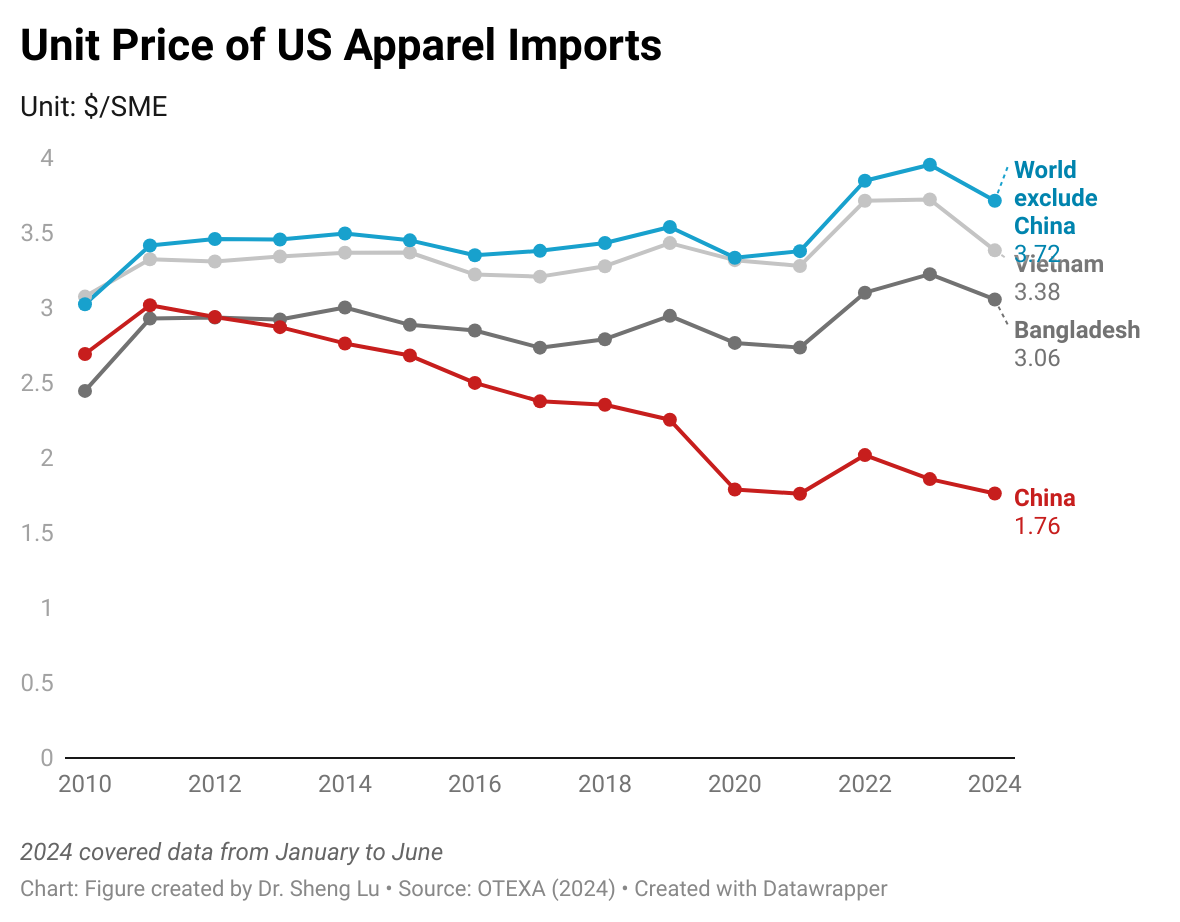
Despite being known as the world’s largest clothing exporter, between 2013 and 2022 (the latest available data), over 70%–80% of clothing produced in China was consumed domestically, with only about 20%–30% being exported. However, as China’s economic growth has slowed and consumer spending on clothing has stalled, more clothing made in China could enter the international market and intensify the price competition. Notably, between June 2023 and June 2024, the average unit price of US apparel imports from China decreased unusually by 7.6 percent, signaling that an increased supply of Chinese clothing began to suppress market prices. Likewise, it doesn’t seem reasonable that the unit price of U.S. apparel imports from China was 40% lower than that of imports from Bangladesh in the first half of 2024. Thus, the growing influx of cheap Chinese products raises the risk of market disruptions, potentially leading to additional trade tensions and restrictive measures against Chinese products.

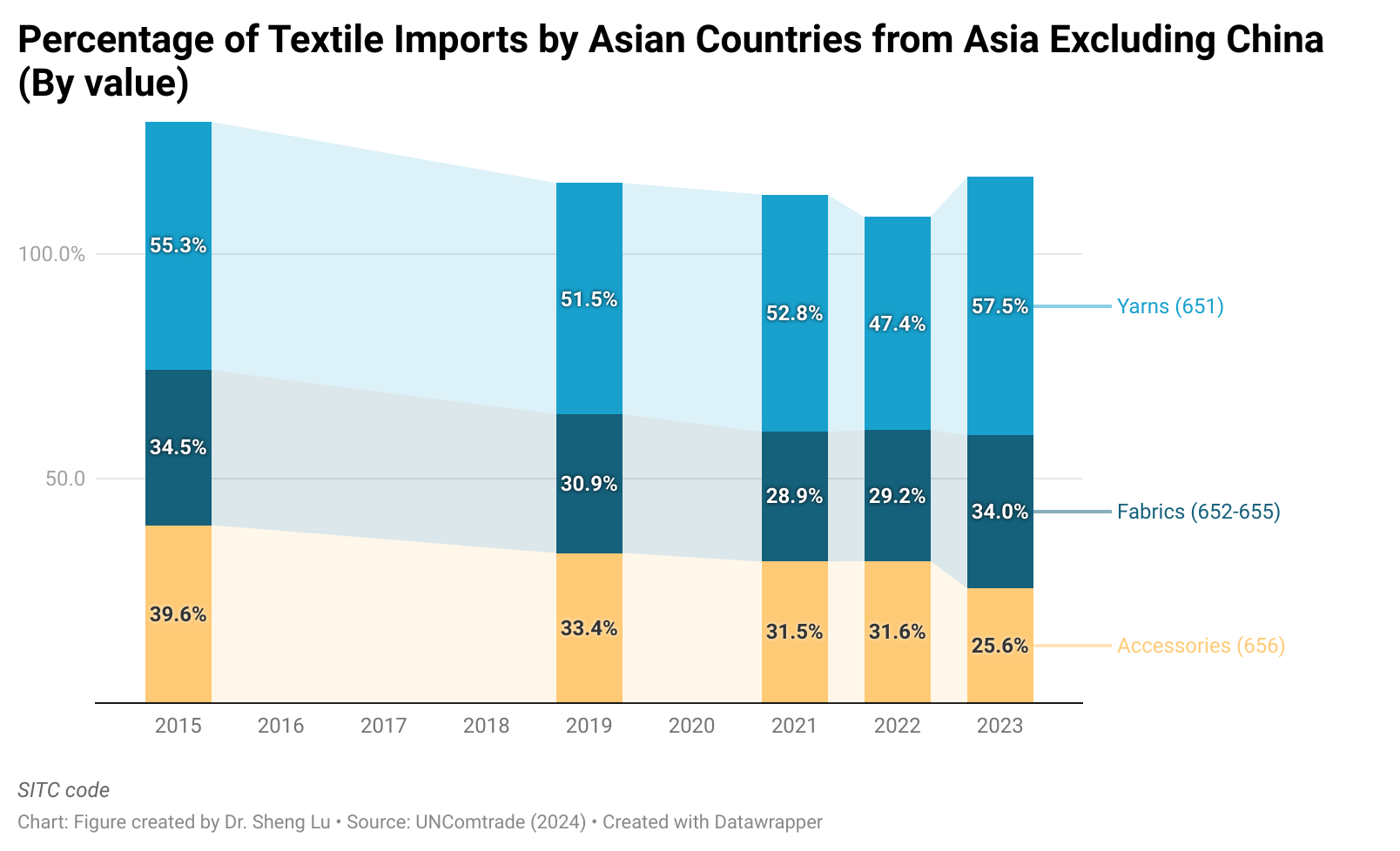
Fourthly, there is an early sign that Asian countries have become more cautious about using Chinese yarns and fabrics. China remained a key supplier of textile raw materials to leading apparel-exporting countries in Asia. However, Asian countries appeared to be sourcing fewer yarns and fabrics from China in 2023, possibly due to the enforcement of anti-forced labor laws, such as the Uyghur Forced Labor Prevention Act (UFLPA), and the perceived risks associated with sourcing Chinese cotton. Instead, more Asian countries’ yarns and fabrics now came from regional suppliers other than China.

by Sheng Lu

Additional reading: China has turned inward to sell Xinjiang cotton after a trade ban. Will it be enough? (South China Morning Post, August 11, 2024).

2024 USFIA Fashion Industry Benchmarking Study Released

The full report is HERE

Key findings of this year’s report:

#1 Respondents reported growing sourcing risks of various kinds in 2024, from navigating an uncertain U.S. economy, managing forced labor risks, and responding to shipping and supply chain disruptions to facing rising geopolitical tensions and trade protectionism.

  • Over half of the respondents ranked “Inflation and economic outlook in the U.S.” and “Managing the forced labor risks in the supply chain” as their top business challenges in 2024.
  • The issues of “Shipping delays and supply chain disruptions” and “Managing geopolitics and other political instability related to sourcing” have newly emerged among respondents’ top five concerns in 2024.
  • About 45 percent of respondents rated “Protectionist trade policy agenda in the United States” as a top five business challenge this year, a jump from only 15 percent in 2023.

#2 U.S. fashion companies leverage sourcing diversification to respond to the growing sourcing risks and market uncertainty in 2024.

  • Nearly 70 percent of large-sized companies with 1,000+ employees reported sourcing from ten or more countries, significantly higher than the 45-55 percent range in the past few years. It also has become more common for medium to small-sized companies with fewer than 1,000 employees to source apparel from six or more countries in 2024 than in the past.
  • Nearly 80 percent of respondents plan to source from the same number of countries or even more countries through 2026, aiming to mitigate sourcing risks more effectively. However, their approaches differ at the firm level—some U.S. fashion companies plan to work with fewer vendors, while others intend to source from more.

#3 Managing the risk of forced labor in the supply chain continues to be a top priority for U.S. fashion companies in 2024.

  • U.S. fashion companies have adopted a comprehensive approach to comply with UFLPA and mitigate forced labor risks. On average, each surveyed company has implemented approximately six distinct practices across various aspects of their business operations this year, up from an average of five in 2023.
  • More than 90 percent of respondents say they are “Making more efforts to map and understand our supply chain, including the sources of fibers and yarns contained in finished products.” Notably, nearly 90 percent of respondents report mapping their entire apparel supply chains from Tier 1 to Tier 3 in 2024, a significant increase from about 40 percent in the past few years.
  • More than 80 percent of respondents say they “intentionally reduce sourcing from high-risk countries” in response to the UFLPA’s implementation. Another 75 percent of respondents explicitly state that their company has “banned the use of Chinese cotton in the apparel products” they carry.
  • About 45 percent of respondents have been actively “exploring sourcing destinations beyond Asia to mitigate forced labor risks.” However, this year, fewer respondents (i.e., under 10 percent) plan to cut apparel sourcing from Asian countries other than China directly, implying a more targeted and balanced approach to mitigating risks and meeting sourcing needs.
  • Based on field experience, respondents call for greater transparency in U.S. Customs and Border Protection (CBP)’s UFLPA enforcement, specifically in shipment detention and release decisions and in targeted entities and commodities information. Respondents also suggested that CBP reduce repeated detentions, focus on “bad actors” only, clarify enforcement on recycled cotton, and continue to partner with U.S. fashion companies on UFLPA enforcement.

#4 U.S. fashion companies remain deeply concerned about the deteriorating U.S.-China bilateral relationship and plan to further “reduce China exposure” to mitigate risks.

  • A record 43 percent of respondents sourced less than 10 percent of their apparel products from China this year, compared to only 18 percent in 2018. Likewise, nearly 60 percent of respondents no longer use China as their top apparel supplier in 2024, much higher than the 25-30 percent range before the pandemic.
  • Respondents rated China as economically competitive as an apparel sourcing base compared to many of its Asian competitors regarding vertical manufacturing capability, relatively low minimum order quantity (MOQ) requirements, flexibility and agility, sourcing costs, and speed to market. However, non-economic factors, particularly the perceived high risks of forced labor and geopolitical tensions, are driving U.S. fashion companies to move sourcing out of China. This trend applies to surveyed U.S. fashion companies selling products in China.
  • Nearly 80 percent of respondents plan to reduce their apparel sourcing from China further over the next two years through 2026. Consistent with last year’s results, large-size U.S. fashion companies with 1,000+ employees currently sourcing more than 10 percent of their apparel products from China are among the most eager to “de-risk.”

#5 U.S. fashion companies are actively exploring new sourcing opportunities, with a particular focus on emerging destinations in Asia and the Western Hemisphere.

  • This year, more respondents reported sourcing from India (89 percent utilization rate) than from Bangladesh (86 percent utilization rate) for the first time since we began the survey. Also, nearly 60 percent of respondents plan to expand apparel sourcing from India over the next two years, exceeding the planned expansion from any other Asian country.
  • For the second year in a row, three non-Asian countries made it to the top ten most utilized apparel sourcing destination list in 2024, including Guatemala (ranked 7th), Mexico (ranked 7th), and Egypt (ranked 10th). All three countries also witnessed an improved utilization rate in 2024 compared to last year’s survey results.
  • This year, a new record 52 percent of respondents plan to expand apparel sourcing from members of the Dominican Republic-Central American Free Trade Agreement (CAFTA-DR), over the next two years, up from 40 percent in 2023. However, most U.S. fashion companies consider expanding near-shoring from the Western Hemisphere as part of their overall sourcing diversification strategy. For example, nearly ALL companies that plan to increase sourcing from CAFTA-DR over the next two years also plan to increase sourcing from Asia.
  • 75 percent of respondents identified the “lack of sufficient access to textile raw materials” as the main bottleneck preventing them from sourcing more apparel from CAFTA-DR members. Respondents say the local manufacturing capability for yarns and fabrics using fiber types other than cotton and polyester, such as spandex, nylon, viscose, rayon, and wool, was modest or low in the CAFTA-DR region, even when including the United States.
  • The U.S.-Mexico-Canada Trade Agreement (USMCA) entered into force on July 1, 2020, replacing the North American Free Trade Agreement (NAFTA). Within the context of expanding nearing-shoring from the Western Hemisphere, in 2024, about 65 percent of respondents reported sourcing from Mexico and Canada (or USMCA members), a noticeable increase from about 40 percent in 2019-2020. About 36 percent of respondents say their companies “expanded apparel sourcing from USMCA members because of the agreement.”

#6 Respondents underscore the importance of immediate renewal of AGOA before its expiration in September 2025 and extending the agreement for at least another ten years.

  • This year, respondents reported sourcing from seven AGOA members or countries in Sub-Saharan Africa (SSA), including Lesotho, Ethiopia (note: lost AGOA eligibility in 2022), Kenya, Madagascar, Mauritius, Tanzania, and Ghana, an increase from four countries in 2023, and six countries in 2022. Most respondents sourcing from AGOA in 2024 are typically large-scale U.S. fashion brands or retailers with 1,000+ employees. Generally, these companies treat AGOA as part of their extensive global sourcing network.
  • Over 86 percent of respondents support renewing AGOA for at least another ten years, and none object to the proposal. This reveals U.S. fashion companies’ strong support for the trade preference program and the non-controversial nature of continuing this agreement.
  • Over 70 percent of respondents say another 10-year renewal of AGOA is essential for their company to expand sourcing from the region.
  • About 30 percent of respondents reported that they had already held back sourcing from AGOA members due to the pending renewal of the agreement and associated policy uncertainty. This figure could increase to half of the respondents if AGOA is not renewed by the end of 2024.
  • Another 30 percent of respondents indicate that keeping the flexible rules of origin in AGOA, such as the “third country fabric provision” for least-developed members, is essential for their company to source from the region.

Other topics the report covered include:

  • 5-year outlook for the U.S. fashion industry, including companies’ hiring plan by key positions
  • The competitiveness of major apparel sourcing destinations in 2024 regarding sourcing cost, speed to market, flexibility & agility, minimum order quantity (MOQ), vertical integration and local textile manufacturing capability, social and environmental compliance risks and geopolitical risks (assessed by respondents)
  • Respondents’ detailed sourcing portfolio in 2024 for garments and textile materials (i.e., yarns, fabrics and accessories)
  • Respondents’ latest strategies to mitigate forced labor risks in the supply chain and fashion companies’ suggestions for CBP’s UFLPA enforcement based on field experience
  • U.S. fashion companies’ latest social responsibility and sustainability practices related to sourcing
  • U.S. fashion companies’ trade policy priorities in 2024

About the study

This year’s benchmarking study was based on a survey of executives from 30 leading U.S. fashion companies from April to June 2024. The study incorporated a balanced mix of respondents representing various businesses in the U.S. fashion industry. Approximately 80 percent of respondents were self-identified retailers, 60 percent were self-identified brands, 41 percent were importers/wholesalers, and 3 percent were manufacturers.

The survey respondents included large U.S. fashion corporations and medium-sized companies. Around 80 percent of respondents reported having over 1,000 employees; the rest (20 percent) represented medium-sized companies with 100-999 employees.

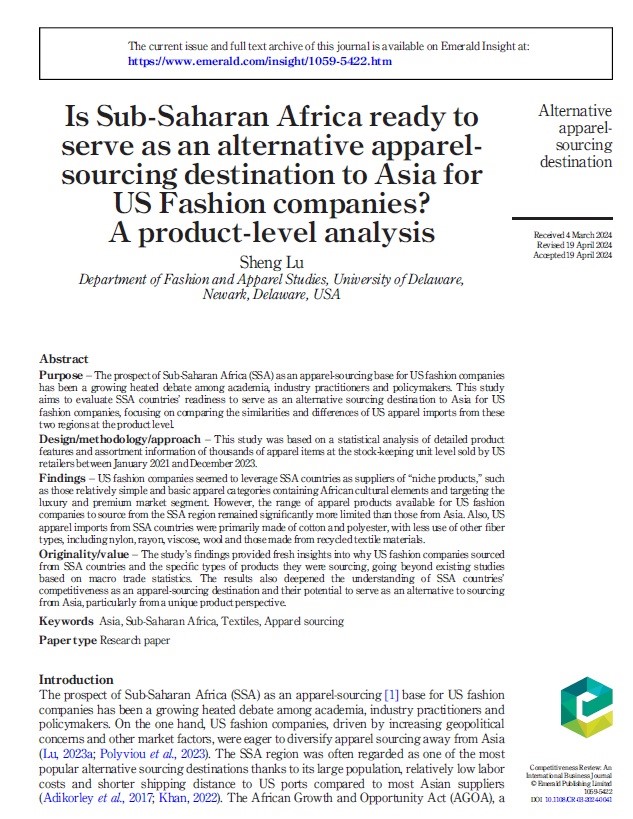
New Study: Is Sub-Saharan Africa Ready to Serve as an Alternative Apparel Sourcing Destination to Asia for U.S. Fashion Companies? A Product-Level Analysis

Full paper: Lu, S. (2024), “Is Sub-Saharan Africa ready to serve as an alternative apparel-sourcing destination to Asia for US Fashion companies? A product-level analysis“, Competitiveness Review, Vol. ahead-of-print No. ahead-of-print. https://doi.org/10.1108/CR-03-2024-0041

Summary:

The prospect of Sub-Saharan Africa (SSA) as an apparel-sourcing base for U.S. fashion companies has been a growing heated debate. On the one hand, U.S. fashion companies, driven by increasing geopolitical concerns and other market factors, were eager to diversify apparel sourcing away from Asia. The SSA region was often regarded as one of the most popular alternative sourcing destinations thanks to its large population, relatively low labor costs, and shorter shipping distance to U.S. ports compared to most Asian. The African Growth and Opportunity Act (AGOA), a trade preference program enacted in 2000, in particular, allowed eligible apparel exports from SSA countries to enter the United States import duty-free, creating substantial financial incentives for U.S. fashion companies to source from the SSA region.

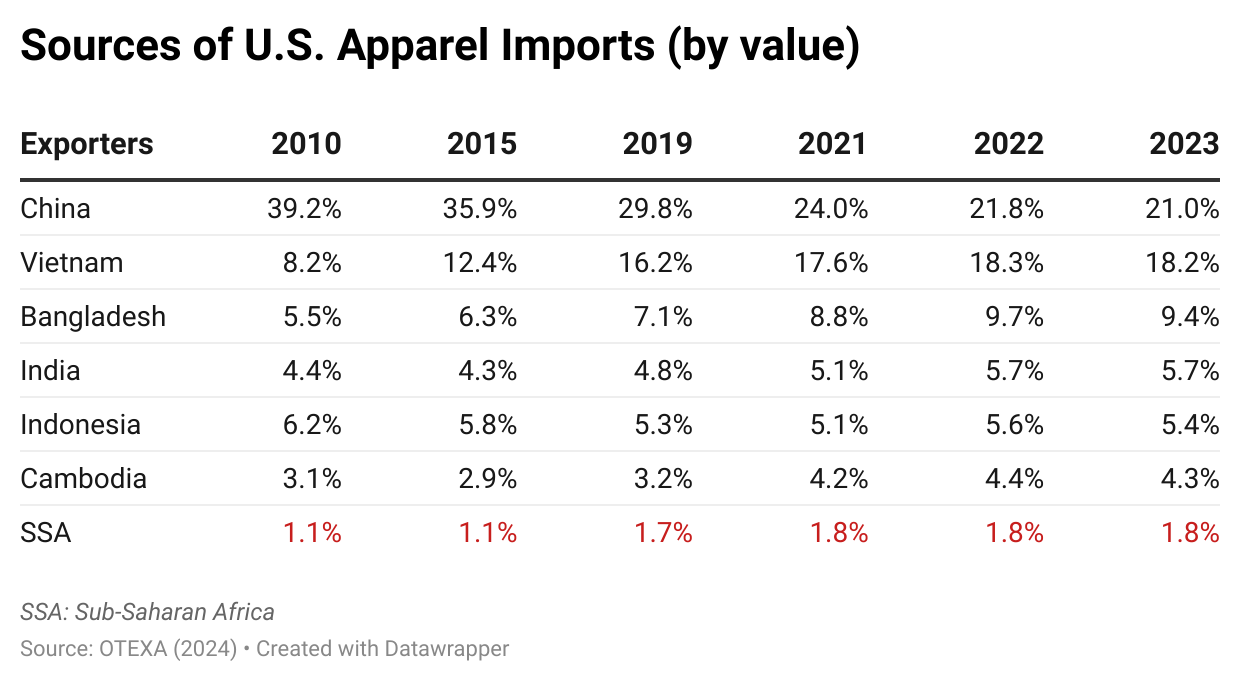
However, empirical trade data shows that U.S. apparel imports from SSA members have stagnated over the past decades without evident growth. Notably, with little change from 2010, SSA countries collectively accounted for only 1.8% of U.S. apparel imports in 2023, with no single SSA member achieving a market share of more than 1%. In contrast, over the same period, despite China’s declining market shares, the following five largest Asian suppliers—Vietnam, Bangladesh, India, Indonesia, and Cambodia—jointly accounted for 43.0% of U.S. apparel imports in 2023, a notable increase from 27.4% in 2010.

This study aims to evaluate SSA countries’ capacity to serve as an alternative apparel sourcing destination to Asian suppliers for US fashion companies. Specifically, the study examined the detailed product information of a total of 10,000 stock keeping units (SKUs) of clothing items sold in the U.S. retail market from January 2021 to December 2023. Half of these items were sourced from the six largest apparel-exporting countries in SSA: Lesotho, Kenya, Mauritius, Ethiopia, Madagascar, and Tanzania. Together, these countries accounted for over 96% of the value of U.S. apparel imports from the SSA region between 2021 and 2023. The remaining half came from China, Vietnam, Bangladesh, Cambodia, India, and Indonesia, the six largest Asian apparel exporters, which stably accounted for approximately 90% of U.S. apparel imports from Asia over the past decade.

Key findings:

First, the results revealed that U.S. fashion companies’ sourcing strategies for SSA countries appeared more subtle and complicated than simply treating the region as another low-cost sourcing destination, as suggested by previous studies. Instead, according to the results, U.S. fashion companies seemed to leverage SSA countries as suppliers of “niche products,” such as those relatively simple and basic apparel categories containing African cultural elements and targeting the luxury and premium market segment. Meanwhile, the demand for such products could be much smaller than regular apparel items sold in the value and mass market. This allows SSA countries to fulfill these smaller orders despite their limited production capacity, often family-owned or involving handmade processes.

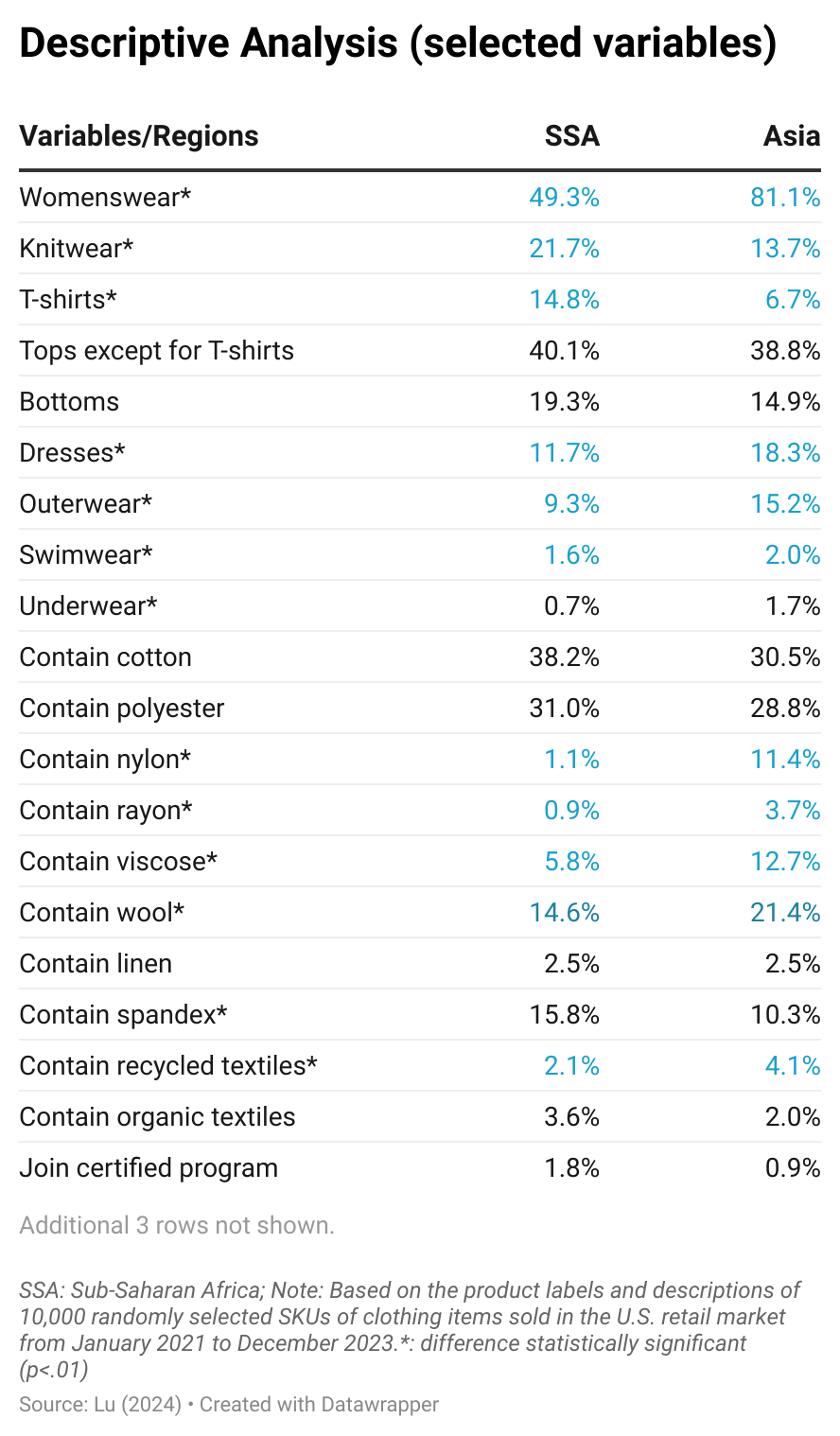
Second, the study’s findings identified significant challenges for SSA countries serving as immediate alternatives to sourcing from Asia for U.S. fashion companies. While SSA countries could offer relatively low sourcing costs, the range of apparel products available for U.S. fashion companies to source from the SSA region remained significantly more limited than those from Asia. For example, results show that U.S. fashion companies preferred sourcing relatively basic and technologically simple categories like knitwear, T-shirts, and bottoms from SSA countries. However, imports from SSA countries offered more limited sizing and color choices and were less likely to include womenswear and relatively more sophisticated or specialized product categories such as outerwear and swimwear. As another example, U.S. apparel imports from SSA countries were primarily made of cotton and polyester, with less use of other fiber types, including nylon, rayon, viscose, wool, and those made from recycled textile materials (see table below).

Third, building on the previous point, the results call for new thinking on strengthening SSA countries’ genuine competitiveness as an apparel-sourcing destination. Over the past decades, trade preference programs such as AGOA have mainly focused on improving the price competitiveness of SSA countries’ apparel exports. However, as this study’s findings illustrate, AGOA and other trade preference programs seemed inadequate in assisting SSA countries in developing capacity beyond basic apparel categories and securing a sufficient variety of textile materials. As U.S. fashion companies have placed greater emphasis on factors beyond price in their sourcing decisions, such as flexibility, agility, sustainability, and vendors’ capability to make a wide variety of products, this could put SSA countries at even more significant disadvantages down the road to being considered alternatives to Asia for apparel sourcing.

The results also reminded us that AGOA’s liberal rules of origin, which allowed least-developed SSA countries to use textile materials from anywhere worldwide, cannot replace the crucial need to develop the local textile manufacturing capacity within the SSA region. Without a robust local textile manufacturing sector, SSA countries would encounter significant challenges in diversifying their product offerings to include more complex and versatile clothing categories, such as outerwear and women’s dresses. These categories typically require a wide variety of raw textile materials and accessories, making it highly impractical and inefficient to rely solely on imports for their supply.

On the other hand, the findings reveal the necessity of creating a stable and foreseeable business environment, such as the long-term renewal of AGOA, to attract more long-term investments in SSA. For example, investing in and strengthening SSA countries’ local supply of sustainable textile materials, such as recycled or organic fibers, could strategically enhance SSA countries’ competitiveness in meeting the increasing demand from U.S. fashion companies for sustainable apparel products.

Additional reading:

Explore Egypt, Morocco, and Tunisia as a Sourcing Base for Clothing Made from Recycled Cotton

The full article is available HERE and below is the summary:

With consumers’ growing demand for sustainable apparel products, fashion companies increasingly carry clothing made from recycled textile materials and seek additional supply bases. Recycled cotton has great potential for use in garments because of the wide availability of cotton-made secondhand clothing and the perceived positive environmental impacts of effectively recycling post-consumption cotton waste.

This study explores Egypt, Morocco, and Tunisia’s potential as sourcing bases for clothing made from recycled cotton. North African countries, including Egypt, Morocco, and Tunisia, have a long history of making and exporting cotton and cotton-made finished garments. The “developing country” status and membership in trade agreements or trade preference programs, such as the African Growth and Opportunity Act (AGOA) and the EU-Mediterranean Association Agreement, allow apparel products from these three countries to enjoy preferential duty benefits in the world’s top import markets. Therefore, there is great potential to capitalize on recycled cotton apparel and “green exports” to further promote economic development in the region.

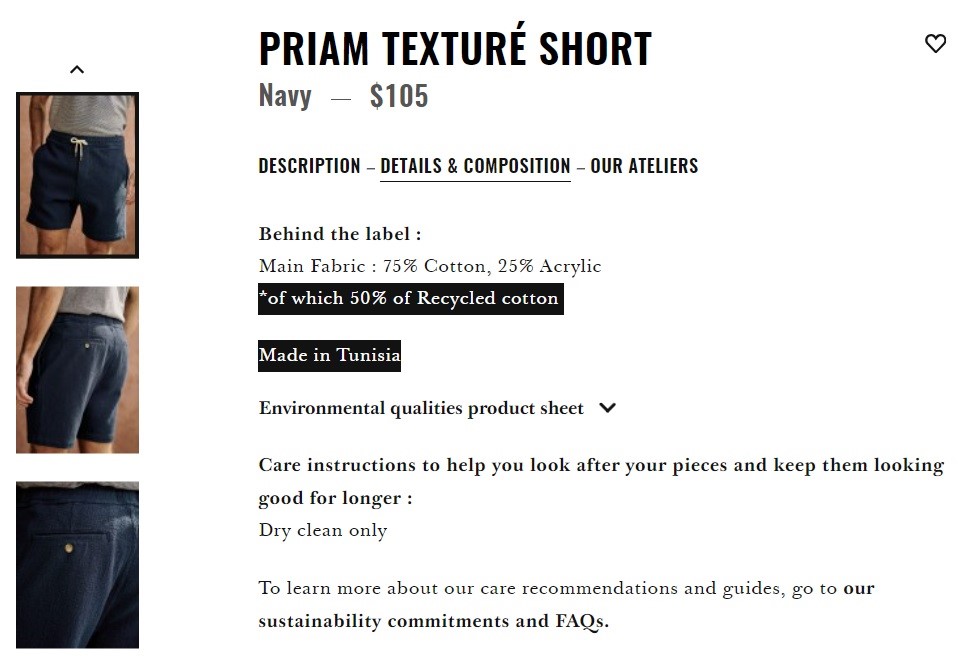
About 13,000 Stock Keeping Units (SKUs) of clothing items made by these three countries newly launched to the world retail market between January 2022 and April 2024 were randomly captured from fashion brands and retailers’ websites. About half of the items were made of regular cotton, and the other half explicitly mentioned using “recycled cotton” in the product label or description. The results show that:

#1: Egypt, Morocco, and Tunisia have gradually expanded their clothing exports made from recycled cotton since 2022. For example, as estimated, about 1,300 SKUs of clothing using recycled cotton from these three countries were newly launched to the US and EU retail markets in 2023, a substantial increase from only 150 SKUs back in 2022 (or a sevenfold increase). Similarly, in the first four months of 2024, clothing using recycled cotton accounted for 10.2% of total cotton apparel from the three countries in the US and EU markets, a substantial increase from only 1.1% in 2022.

#2: Of the collected samples, apparel using recycled cotton from Egypt, Morocco, and Tunisia was destined for as many as 49 countries, reflecting the global demand for such products. However, possibly restrained by the limited supply, the export market for clothing using recycled cotton remained less diverse than that for clothing made of regular cotton, which spanned 72 countries.

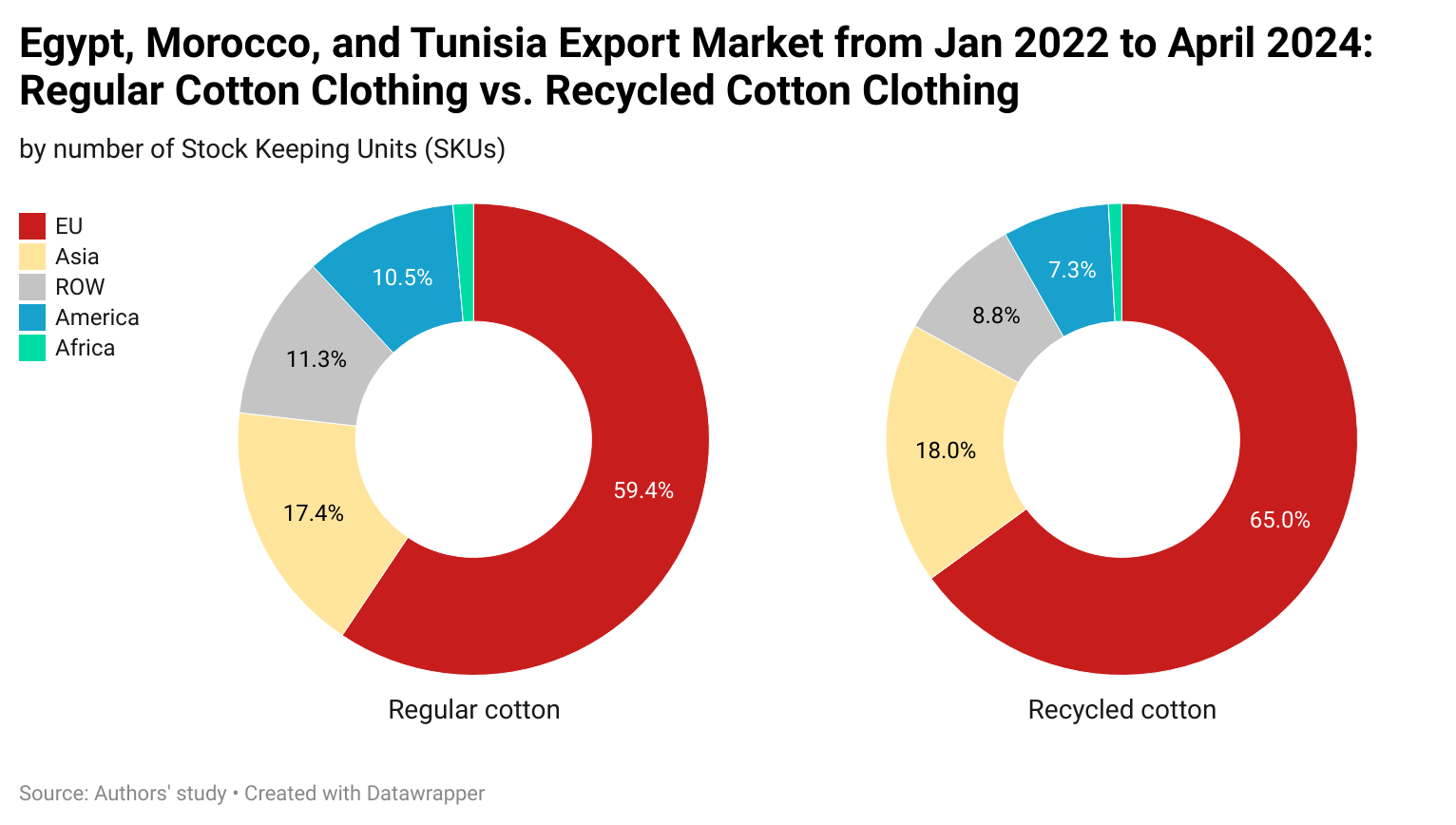
#3: Geographically, the European Union (EU) was the top clothing export market for Egypt, Morocco, and Tunisia, accounting for over 75% of these countries’ export value in 2022, according to UN trade statistics (UNComtrade). This was also the case for recycled cotton products. Specifically, the EU accounted for 65% of these three countries’ total recycled cotton clothing exports measured in SKUs in the collected samples, higher than 59.4% of regular cotton clothing products.

#4: Egypt, Morocco, and Tunisia focused on different product categories for clothing using recycled cotton than those made from regular cotton. Specifically, of the sampled items, clothing using recycled cotton had a notable concentration on bottoms (52.9%), followed by tops other than T-shirts (23.8%). Recycled cotton clothing also was more commonly used for outerwear (7.5%) than those using regular cotton (3.8%). In comparison, only about 7.9% of clothing using recycled cotton were T-shirts, much fewer than nearly 30% of those using regular cotton. Similarly, specific product categories, such as underwear and hosiery, rarely use recycled cotton. Likely, the concerns for quality and durability and the difficulty of absorbing higher production costs make using recycled cotton for these relatively simple categories more challenging.

#5: Even though cotton apparel made in Egypt, Morocco, and Tunisia already commonly mentioned their sustainability attributes (86%), phrases such as “sustainability” and “sustainable” appeared even more frequently in clothing using recycled cotton (94.6%). For example, some producers highlighted that they “worked with suppliers, workers, unions and international organizations” to ensure their recycled cotton clothing contributed to “the United Nations Sustainable Development Goals.” Likewise, some labels intentionally remind consumers about the positive environmental impact of using recycled cotton, “The use of recycled cotton helps to limit the consumption of raw materials.” Another added, “The production of recycled cotton recovered cotton, mainly from the production of other garments, thus reducing the production of virgin spring and water consumption, energy and natural resources.”  

Meanwhile, compared to clothing using regular cotton, those made with recycled cotton in Egypt, Morocco, and Tunisia reported much higher participation in certification programs, such as the Recycled Claim Standard (RCS), which verifies the recycled content and tracks it from source to final product.

#6: Reflecting the technical limitations of the fiber property, it remains rare to have clothing that is 100% made from recycled cotton. According to industry experts, longer cotton fibers generally indicate higher quality. Since the recycling process shortens cotton fibers, regular virgin cotton or other fibers like polyester are typically used alongside recycled cotton to make fabrics smoother, stronger, and more durable. For example, common labels include descriptions such as “80% virgin cotton, 20% RCS certified recycled cotton” and “55% RCS certified recycled polyester, 45% RCS certified recycled cotton.”

#7: Except for T-shirts, in most cases, clothing made from recycled cotton in Egypt, Morocco, and Tunisia was priced lower than their equivalent using virgin fiber in the market. This is particularly the case for the premium and luxury market segments, where clothing using recycled fiber typically was 20-30% lower priced than regular clothing. The results echo the findings of numerous studies indicating that consumers are generally unwilling to pay higher prices for recycled fiber clothing as they perceive such products as lower quality and less “valuable.” Also, more needs to be done to create more financial incentives for producers in Egypt, Morocco, and Tunisia to expand the production scale and increase the use of recycled cotton in their products.

By Emilie Delaye and Sheng Lu
New Report: Reimagining the Apparel Value Chain amid Volatility

The new study released by Mckinsey & Co. was based on a survey of chief procurement officers (CPOs) from “apparel companies that collectively spend about $110 billion annually on sourcing” and follow-up in-depth interviews with 25 CPOs conducted in late 2023. Key findings:

#1 Fashion companies face increasingly challenging sourcing scenarios complicated by “ongoing supply disruptions caused by shifting demand, material price volatility, geopolitics, global trade issues, rising competition, and regulatory changes.” Compared to many other sectors, the apparel supply chain is particularly volatile, and disruptions can have amplified ripple effects throughout the supply chain. For example, an 11% decline in yarn exports could lead to a 30% drop in the production utilization rate of fabric mills.

#2 Fashion companies further prioritized “end-to-end” process efficiency in response to the shifting sourcing environment. For example, nearly 70 percent of respondents expect to “improve sourcing cost in the near term,” they plan to “improve efficiency across all facets of sourcing, including lower product costs, reduced sourcing expenses, and accelerated go-to-market processes.” Other practices to control sourcing costs include “using analytics to examine product cost breakdowns and identifying opportunities to improve fabric unit costs and material consumption,” “using digital platforms and data-driven insights to inform sourcing decisions and collaborating with suppliers to pinpoint cost savings opportunities.”

#3 Strengthening relationships with key suppliers remains critical. About 71 percent of surveyed brands consider “consolidating the supplier base” a medium to high priority for their strategy in the next five years. Surveyed fashion companies also indicate that deeper relationships, including “long-term volume commitments, shared strategic three- to five-year plans, and collaboration partnerships,” accounted for 43 percent of their total apparel supplier base in 2023, up from 26 percent in 2019. In comparison, suppliers based on “transactional relationships” only accounted for 3% of the total in 2023, a substantial decrease from 22% in 2019.

As the report noted, building strategic partnerships with core suppliers and “innovative niche suppliers” based on trust and transparency “resulted in a more robust, resilient, and agile supplier base” for fashion companies. More importantly, deeper importer-supplier partnerships extend beyond cost-saving measures but increasingly emphasize “sustained value creation.”

#4 Fashion companies continue to diversify their sourcing base geographically and pursue nearshoring to “improve speed, cost, and agility.” Specifically, between 2019 and 2023, respondents reduced their sourcing value from China (down from 30% to 22%) and sourced more from South Asia (up from 23% to 34%). At the country level, more than 40 percent of respondents plan to further increase sourcing from Bangladesh, India, and Vietnam. That being said, the report found that nearshoring remains “flat” in sourcing value in the US (about 17%) and in the EU (about 25%) from 2019 to 2023.

#5 To expand apparel nearshoring, several bottlenecks remain to be solved: 1) lower labor productivity in the region resulting in higher “total landed costs,” 2) challenges with yarn and fabric availability, and 3) the supplier bases in nearshoring countries can manufacture a more limited array of products.

The report also noted that “both local suppliers and Asian companies with a presence in Central America and Mexico have invested in improving their productivity and building local capacity for making yarns and fabrics,” which is helpful in addressing the challenges.

#6 Sustainability will continue to affect fashion companies’ sourcing decisions. For example, 80 percent of respondents said that “environmental, social, and governance certifications; transparency and traceability; and sustainable material usage have become prerequisites in supplier selection.” Fashion companies commonly used scorecards (92 percent) and third-party audits (78 percent) to ensure suppliers’ compliance with sustainability requirements. There is also an increasing need for data transparency on sustainability. However, “data is important, but organizations must understand how to use it to create value.”

Further, 86 percent and 70 percent of respondents said they would use recycled polyester and recycled cotton in their apparel products over the next five years.

#7 Digital innovation will deepen further in the sourcing and product development area. Popular tools include 3D modeling and digital sampling, Fabric libraries, and Product Lifecycle Management (PLM) system. However, prioritizing process redesign, data quality enhancement, and the integration of systems are essential to enable efficient operations. For example, one company developed a single material ID library with more than 30,000 materials from approximately 300 suppliers, allowing the company to aggregate more than 6,000 cost sheets in less than a minute.

The Puzzling US Apparel Import Data…

The latest US apparel import data raises several puzzles that deserve to be investigated further.

Question 1: Why did imports suddenly surge, and is this surge sustainable?

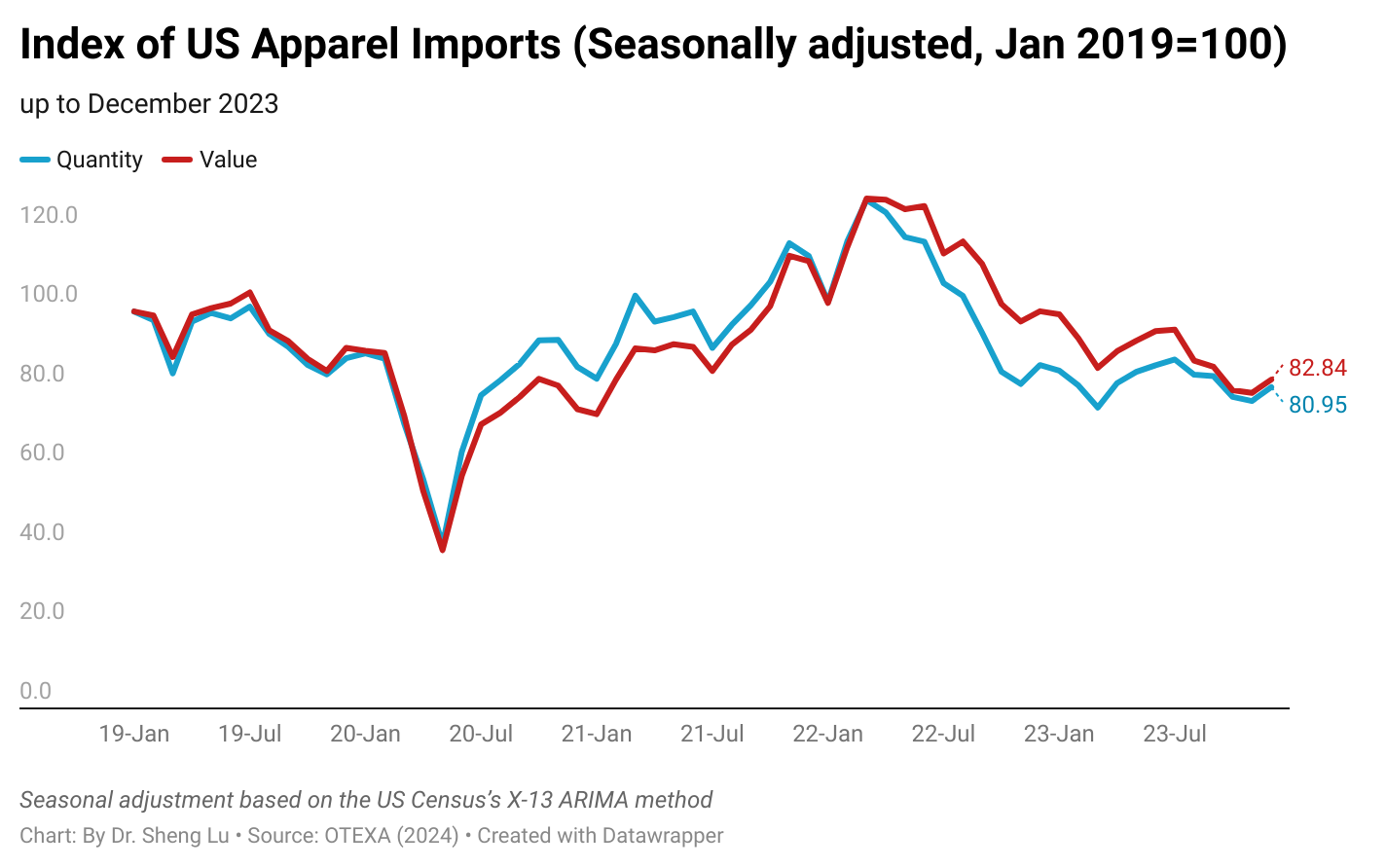
Unexpectedly, US apparel imports experienced a significant surge in February 2024. This surge was marked by a 12.9% increase in quantity and a 2.9% increase in value compared to the previous year. Seasonally adjusted US apparel imports in February 2024 were also nearly 10% higher than in January 2024. The import surge was particularly surprising given that the value of US clothing sales in February 2024 was only 1.3% higher than a year ago and even 0.5% lower than in January 2024 (seasonally adjusted).

That being said, US total merchandise imports also enjoyed a 2.2% increase year over year in February 2024, the best performance since last fall. Meanwhile, the World Trade Organization (WTO)’s latest April 2024 forecast predicted the world merchandise trade volume to grow by 2.6% in 2024 as opposed to a 1.2% decline in 2023.

Therefore, it will be important to watch whether the US apparel trade has indeed reached a turning point and will continue growing in the coming months and throughout the year.

Question 2: Could the volume of US apparel imports in 2023 have been underreported?

With over 98% of clothing sold in the US retail market being imported today, there exists a strong correlation between US apparel retail sales (NAICS code 4481) and the volume of apparel imports. Between 2015 and 2022, the US clothing sales to clothing import ratio remained consistently around 3.0-3.2 (seasonally adjusted). In other words, the value of retail sales was approximately three times the value of apparel imports. However, in 2023, this ratio increased to 4.0-4.5.

One suspicion is that as more apparel imports came into the US through the de minimis, the official US apparel import data in 2023 was somewhat underreported. Notably, according to Euromonitor, about 40% of US apparel retail sales were achieved through e-commerce in 2023, a substantial increase from 9.4% in 2010. Likewise, with US customs tightening controls on “small package shipments” and enhancing UFLPA enforcement, more imports likely began entering through the standard procedure in recent months, which explains why the US apparel sales to import rato fell back to 3.8 in February 2024.

On the other hand, some say the lowered US apparel import volume in 2023 was due to retailers’ efforts to control inventory levels. Data shows that US clothing stores’ stock-to-sales ratio in the last quarter of 2023 averaged 2.34, slightly lower than 2.43 from 2015 to 2019, but was higher than 2.19 back in 2021. In other words, while there was some effort by retailers to control inventory (as seen by the ratio being lower than pre-pandemic levels), it wasn’t a significant enough change to have a large impact on import demand. Also, considering that apparel is a seasonal product, it doesn’t seem too likely that retailers would risk losing sales opportunities during the most critical selling season of the year (i.e., 4th quarter) by promoting outdated items instead of stocking new ones on the shelf.

Question 3: Why did Asian countries export more apparel to Mexico?

As a developing country, Mexico is not traditionally a leading apparel import market due to consumers’ limited purchasing power and the sufficient local apparel supply. Take China, Vietnam, Bangladesh, and Cambodia, the four top Asian apparel exporting countries (Asia4), for instance. Between 2018 and 2020, Mexico typically accounted for 0.4%-0.7% of Asia4’s total apparel exports. However, since 2022, Asia4 has almost doubled its apparel exports to Mexico (i.e., increased to 1.5%-2.0%). Moreover, during the same period, the percentage of Asia4’s apparel exports to the United States declined from 27% to below 20%, especially in the last quarter of 2023.   

What’s behind the increase in Asian countries’ apparel exports to Mexico needs to be investigated further. As noted earlier, Mexico itself is a leading apparel-producing country. Also, according to Euromonitor, the clothing market in Mexico stayed relatively stable at around 7.6%-7.9% of the size of the US from 2017 to 2023 (in quantity). In other words, Mexico’s increased import demand for Asian clothing doesn’t make much sense.

Others suspect some Asian apparel exports to Mexico eventually entered the US market either by taking advantage of the de minimis rule or the US-Mexico-Canda (USMCA) trade agreement. However, the exact size of this particular trade flow calls for further investigation.

By Sheng Lu

Current Event Discussion: U.S. Customs and Border Protection (CBP) and Textile Enforcement

#1: On April 5, 2024, the US Department of Homeland Security (DHS) released its new enhanced strategy to combat illicit trade and level the playing field for the American textile industry and the estimated over 500,000 US textile jobs*. *note: according to the Bureau of Labor Statistics, as of December 2023, the US textile and apparel manufacturing sector employed about 272,400 workers (seasonally adjusted), including 89.3K in NACIS313 textile mills, 95.6K in NAICS314 textile product mills and 87.5K in NAICS315 apparel manufacturing. As of December 2023, NAICS 4482 apparel retail stores employed about 850,000 workers (seasonally adjusted).

According to DHS, the new enforcement plan will focus on the following areas:

  • Cracking down on small package shipments to prohibit illicit goods from U.S. markets by improving screening of packages claiming the Section 321 de minimis exemption for textile, Uyghur Forced Labor Prevention Act (UFLPA), and other violations, including expanded targeting, laboratory and isotopic testing, and focused enforcement operations.
  • Conducting joint Customs and Border Protection (CBP)-Homeland Security Investigation (HIS) HSI trade special operations to ensure cargo compliance. This includes physical inspections; country-of-origin, isotopic, and composition testing; and in-depth reviews of documentation. CBP will issue civil penalties for violations of U.S. laws and coordinate with HSI to develop and conduct criminal investigations when warranted.
  • Better assessing risk by expanding customs audits and increasing foreign verifications. DHS personnel will conduct comprehensive audits and textile production verification team visits to high-risk foreign facilities to ensure that textiles qualify under the U.S.-Mexico-Canada Agreement (USMCA) or the Central America-Dominican Republic Free Trade Agreement (CAFTA-DR). (note: As CBP noted, most US free trade agreements and trade preference programs have complex textiles and apparel-specific rules of origin requirements. CBP is “responsible for ensuring that the trade community complies with all statutory, regulatory, policy, and procedural requirements that pertain to importations under free trade agreements and other trade preference programs.”)
  • Building stakeholder awareness by engaging in an education campaign to ensure that importers and suppliers in the CAFTA-DR and USMCA region understand compliance requirements and are aware of CBP’s enforcement efforts.
  • Leveraging U.S. and Central American industry partnerships to improve facilitation for legitimate trade. (note: The Biden Administration aims to leverage textile and apparel trade as part of the solution to address “root causes of migration in Central America. According to the White House Fact Sheet released in March 2024, the Office of the U.S. Trade Representative and Central American Trade Agencies and textiles and apparel industry stakeholders will work together to build a directory with detailed profiles of manufacturing and sourcing companies in the region, including information on business practices and production capabilities, to facilitate transparent sourcing, and bolster the region’s supply chain.)
  • Expanding the Uyghur Forced Labor Prevention Act (UFLPA) Entity List to identify malign suppliers for the trade community through review of additional entities in the high-priority textile sector for inclusion in the UFLPA Entity List. (note: Once an entity is on this list, in general, it is prohibited from exporting its goods to the United States. Importers are required to ensure the supply chains of their imported products are free from entities on the Entity List).

#2: Several US textile and apparel industry stakeholders have publicly responded to DHS’s new strategy.:

 The National Council of Textile Organizations (NCTO), representing the US textile manufacturing sector, made several points in its statement:

“We strongly commend DHS for the release of a robust textile and apparel enforcement plan today. We also greatly appreciate Secretary Mayorkas’ personal engagement in this urgent effort and believe it’s a strong step forward to addressing pervasive customs fraud that is harming the U.S. textile industry.”

“The essential and vital domestic textile supply chain has lost 14 plants in recent months. The industry is facing severe economic harm due to a combination of factors, exacerbated by customs fraud and predatory trade practices by China and other countries, which has resulted in these devastating layoffs and plant closures. DHS immediately understood the economic harms facing the industry and deployed the development of a critical action plan.”

“The industry requests include

  • Ramped up textile and apparel enforcement with regard to Western Hemisphere trade partner countries, including onsite visits and other targeted verification measures to enforce rules of origin as well as to address any backdoor Uyghur Forced Labor Prevention Act (UFLPA) violations.
  • Increased UFLPA enforcement to prevent textile and apparel goods made with forced labor from entering our market, including in the de minimis environment.
  • Immediate expansion of the UFLPA Entity List, isotopic testing, and other targeting tools. Intensified scrutiny of Section 321 de minimis imports and a review of all existing Executive Branch authorities under current law to institute basic reforms to this outdated tariff waiver mechanism. “

Joint Association Statement on New DHS Textile Trade Enforcement from the American Apparel & Footwear Association, the National Retail Federation, the Retail Industry Leaders Association, and the United States Fashion Industry Association:

“We appreciate the Department of Homeland Security (DHS)’s announcement today outlining enhanced enforcement activities to prevent illicit trade in textiles. Our members support 55 million (more than one in four) American jobs and invest considerable time and resources in their customs compliance programs. Many of our members are Tier 3 participants in Customs-Trade Partnership Against Terrorism (C-TPAT). They are trusted traders and meet the high standards required to receive that designation by U.S. Customs and Border Protection and DHS. Our members are on the front lines for ensuring that they have safe and secure supply chains.

 “While DHS launches this enforcement plan, we urge it to partner with our associations and our associations’ members. A successful enforcement plan must include input from all stakeholders, clear communication with the trade, and coordinated activities with importers, especially if DHS finds illicit activity happening in the supply chain. The results of any illicit activities must be shared so that our members and other importers can act quickly to address the issue. As our members look to diversify their supply chains, especially back to the Western Hemisphere, we must make sure efforts are included to incentivize and not deter new investments.”

#3 Comments: Overall, the new DHS textile enforcement plan suggests several key US textile and apparel trade policy directions: 1) revisit the current de minimis rules that are used by many e-commerce businesses; 2) further strengthen the UFLPA and forced labor enforcement; 3) expand the Western hemisphere textile and apparel supply chain and encourage more US apparel sourcing from CAFTA-DR members; 4) scrutinize US apparel imports from China and imports from other Asian countries that heavily use textile raw material from China.

Discussion questions for FASH455 (please answer them all):

  1. How do the perspectives of the US textile industry and US fashion brands and retailers diverge concerning CBP’s new strategy? What are the areas in which they share common ground?
  2. Building on the previous question, how can the difference between the US textile industry and US fashion brands and retailers be explained regarding their response to DHS’s new enforcement strategy?
  3. As a sourcing manager for a major US apparel brand with global operations, how do you plan to adjust your company’s sourcing practices in light of DHS’s new strategy? You can list 1-2 detailed action plans and provide your analysis.

Background

The U.S. Customs and Border Protection (CBP) is an agency within the Department of Homeland Security (DHS), responsible for “regulating and facilitating international trade, collecting import duties, enforcing U.S. trade laws, and protecting the nation’s borders.”  

Homeland Security Investigations (HSI) is also a division within the Department of Homeland Security (DHS), responsible for “investigating transnational crime and threats, specifically those criminal organizations that exploit the global infrastructure through which international trade, travel and finance move.”

Product Development and Apparel Sourcing: FASH455 Exclusive Interview with Abby Edge, Product Development Associate at Eileen Fisher

About Abby Edge

Abby Edge is the Product Development associate at Eileen Fisher, where she supports key initiatives in sourcing and sustainability. She graduated from the University of Delaware (UD) in 2020 with a degree in Fashion Merchandising. During her time at UD, she developed a passion for sustainable sourcing and social responsibility, which led her to pursue a career with a company that aligns with these values. Abby also served as a teaching assistant for FASH455 in Spring 2020 and was the co-author of How will EU Trade Curb Affect Cambodia’s Apparel Industry published in Just-Style.

Disclaimer: The views expressed in this interview are those of Abby Edge and do not reflect the views or positions of her employer or any affiliated organizations.

Sheng: What does a Product Development Associate do? Can you walk us through your typical day at Eileen Fisher? Also, what makes you love your job?

Abby: Product development can mean different things at different companies, but at Eileen Fisher (EF) it means costing and development prior to product development (PO). All samples, fabrics, and costs need to be approved during the Product Development period before the business teams place their buys. Every day, I communicate with our vendors to cost styles and create time & action plans so that delivery will be met. We work with our vendors and fabric mills to align and finalize pricing to achieve our margin goals. We also must think strategically about material and vendor allocation to improve lead times and mitigate carbon footprint.

I work hybrid, and our beautiful office is on the Hudson River in Irvington, New York. I enjoy going into the office to spend time with my team and review the product in person. I love my job because I am exposed to so many new and exciting sustainability initiatives every day. I admire everything that EF stands for and that we can promote a “less is more” wardrobe.

Sheng: What are the key steps involved in product development, and how do you collaborate with your sourcing team throughout this process?

Abby: At Eileen Fisher, there are two main stages of the product development process before “commitment”: “development” and “dupe.” At the development stage, we focus on any new materials that are being added to the line. We make sure the costing, testing, and lead times are workable. Then, at the dupe stage, we cost and sample the entire product line so that the merchandising and buying teams have all the information they need to place their buys. After commitment, we pass the baton to the Production team to finalize quantities, issue purchase orders, and track orders. Together, the Product Development

Sheng: Sustainability is a key focus in the fashion apparel industry today. From the product development perspective, what notable improvements have been made in recent years, and where do opportunities lie for further progress?

Abby: Eileen Fisher is leading the way in sustainability within the fashion industry, and it has been incredibly rewarding to be a part of a team where this principle is integrated into every aspect. For example, materials are at the core of EF. We focus on natural, organic, and regenerative materials and steer away from synthetics. Regenerative organic cotton is a new material that I’m really excited about. It all starts with the health of the farm and the people growing our cotton. The regenerative organic certification means that the cotton is grown holistically and healthily, contributing to the soil’s health and mitigating the impacts of climate change.

Additionally, the certification has strict social responsibility guidelines, requiring a living wage and safe working conditions for all farmers. This is just one example of innovative improvements that are being made in the material sector. Others include Lenzing Tencel lyocell, regenerative responsible wool, and organic linen.

Another key initiative at Eileen Fisher is our take-back program called “Renew,” where customers bring back their old EF garments in exchange for a $5 store credit. Since the program started in 2009, 2 million garments have been collected. Of the 2 million, 660,885 have been re-sold in stores, and the rest have been donated, repurposed, or downcycled. Some of my favorite EF pieces have actually been purchased from the store’s renewal section! It is also great to see other brands following suit and creating take-back and recycling programs. Clothing waste is an industry-wide problem; we need all hands on deck to make a difference.

Sheng: From your observation, how has the adoption of digital technologies transformed the practices of product development and apparel sourcing?

Abby: Our Product lifecycle management (PLM) system— Centric— has helped streamline the design and product development process tremendously. All teams have access to the PLM system, which allows everyone to be on the same page and easily access any information they might need. For example, designers use the system to set up styles and tech packs, whereas the merchandising team uses the system to line plan and set retails. In my role, I use PLM to enter and land costs and analyze margins. It is dynamic and provides everyone the key tools to succeed while working on multiple seasons at once.

Sheng: Are there any other major trends in the fashion industry that we should closely monitor in the next 1-2 years, particularly in product development and sourcing?

Abby: Traceability and transparency have become increasingly important in the industry. Technology platforms are emerging that can ensure transparency throughout all supply chain tiers using a digital “fiber coin.” The specific platform we use— Textile Genesis—maps the supply chain from fiber to retail to verify any sustainable fibers so that all claims we make are valid. In other words, they ensure the “transactions” between each supply chain step (fiber to yarn to fabric to garment) are authentic. It has been very exciting to see this project come to life, and I feel that platforms like this will become increasingly more prominent in the coming years.

Sheng: What reflections can you share from your experiences at UD and FASH? what advice would you offer to current students preparing for a career in product development and apparel sourcing?

Abby: I am so grateful for my time at UD in the FASH program. I made so many connections with my peers, professors, and alums that have helped me get to where I am now. My advice to current students is to get involved as much as possible, whether through study abroad programs, internships, or clubs. Don’t limit yourself or close yourself off to areas of the industry and embrace any opportunity you get, as you never know where it could lead. My internship with Under Armour in Hong Kong through the FASH study abroad program really helped me grow personally and professionally and I would not be where I am without that experience.

–End–

US Fashion Companies’ Evolving Sourcing Strategies and the Future of the US Textile and Apparel Industry: Discussion Questions from FASH455

Students in FASH455 have proposed the following discussion questions based on the readings about the US textile and apparel industry and fashion companies’ sourcing strategies. Everyone is welcome to join the online discussion. For FASH455 students, please address at least two questions and mention the question number (#) in your reply.

#1 As a developed country, should the US prioritize further strengthening highly capital-intensive yarn manufacturing, or should we rebuild a vertically integrated textiles and apparel supply chain (e.g., yarns, fabrics, and garments) at home? What is your recommendation, and why?

#2 In FASH455, we discussed how the US textile industry has experienced a decline in employment despite increasing production volumes, largely due to advancements in technology. However, why is import competition often cited in the media as the single largest threat to the US textile industry?

#3 While studies show that US fashion companies are reducing “China exposure,” measured in quantity, China still accounted for 36.1% of US apparel imports in 2023, even higher than 34.7% in 2022. How can we explain this phenomenon? What factors have made US fashion companies hesitant to move away from China?

#4 How will US fashion companies’ growing interest in carrying more sustainable textiles and apparel affect their sourcing destinations and supply chains? Will developing countries with cheap labor and/or developed countries with the right capital and technology be the winners in the sustainability movement? Please provide your thoughts.

#5 Will the growing demand for supply chain transparency and traceability reduce the incentives or add additional burdens for fashion companies to diversify their supply chain further? What are the benefits of pursuing sourcing diversification other than mitigating the potential sourcing risks?

#6 What is your vision for the use of AI in apparel sourcing? What key sourcing and supply chain problems facing fashion brands and retailers can AI potentially solve?

Sourcing Sustainable Fashion Products (II): FASH455 Exclusive Interview with Megan Dawson-Elli, Product Sustainability Manager at Tapestry (UD & FASH BS16)

About Megan Dawson-Elli

Megan Dawson-Elli graduated from the University of Delaware (UD) in 2016 with a degree in Fashion Merchandising. During her time at UD, she was the winner of the Fashion Scholarship Fund case study, a highly competitive national competition. Early in her academic career, she identified her interest in environmental sustainability within the fashion industry. This inspired Megan to study abroad in Hong Kong in 2014, where she was a Sourcing & Sustainability intern for Under Armour. After graduation, Megan worked in merchandising and sourcing before starting her career in environmental sustainability at PVH in 2018. Presently, Megan holds the position of Product Sustainability Manager at Tapestry, where she leads their work on product impact, environmentally preferred materials, and circularity.

In her free time, Megan enjoys reading, running, and traveling. She lives in NYC with her fiancé, also a UD graduate, and likes spending her weekends in Central Park.

Disclaimer: The views expressed in this interview are those of Megan Dawson-Elli and do not reflect the views or positions of her employer or any affiliated organizations.

Sheng: What does a Product Sustainability Manager do? Can you walk us through your typical day at Tapestry? Also, what makes you love your job?

Megan: As a Product Sustainability Manager, I work as an internal consultant to our brands to support their progress towards our Environmental, Social and Governance (ESG) goals and their desire to market and evaluate the environmentally preferred attributes of our products. Many initiatives fall under Product Sustainability, but I would bucket most of the work into several categories: marketing claims substantiation, environmentally preferred materials, product impact, circularity, and packaging. Every day can look different in this role, which keeps it exciting! One day I will be working with teams to craft a marketing claim about a product and the next I will be collecting data from suppliers for a life cycle assessment. My work is very dynamic, with some projects lasting days versus months. I love my job because I get to work with teams across the company that are passionate about sustainability, and even though I no longer work to create products, it’s still the focus of my work.

Sheng: Consumers today, especially our Gen Z students, want to see more “sustainable” fashion products in the market. What does “sustainable product” mean in practice? Can “sustainability” be objectively measured?

Megan: The term “sustainable” has become difficult to define as many initiatives can fit under it, like environmentally preferred materials, responsible sourcing, circularity, etc. It can also be seen as a yes/no question, while sustainability is a journey where progress should grow as new innovations become available. At a product level, the most visible sustainability initiatives that can be seen are environmentally preferred materials or social impact claims being made about the item. There are plenty of initiatives that companies are doing across their supply chain and their operations. Checking out a company’s annual Corporate Responsibility report will show a greater picture of its efforts, commitments, and progress.

Sheng: How can sourcing contribute to a fashion company’s sustainability efforts and make more sustainable products available to consumers?

Megan: At Tapestry, we follow an internal framework known as “Style, Performance and Impact.” This ensures all products meet our high standards of craftsmanship. The framework also guides our decision-making around environmentally preferred materials and material innovation investments.

  • Style: Does it meet design needs or the intended design function of the product?
  • Performance: Does it meet expectations of quality and cost?
  • Impact: Does the material or decision have a measurable reduction in environmental impact?

Additionally, suppliers play a critical role in helping companies realize their environmental and social ambitions. We consistently partner with stakeholders across our value chain to work toward more responsible practices that their businesses can incorporate, especially through increased implementation of environmentally preferred manufacturing practices and using preferred materials.

Sheng: Related to sustainability are the buzzwords “supply chain transparency” and “traceability.” What progress has been made, and what are the key steps for fashion companies in achieving greater transparency and traceability in their supply chains and sourcing?

Megan: To ensure a more responsible and transparent supply chain, it is critical to map supply chains and the relationships between suppliers. At Tapestry, we have begun the process of onboarding suppliers to join TrusTrace, a cloud-based web platform for sustainability, where we intend to conduct more upstream supply chain mapping and the collection of documentation to establish material and product traceability. We envision the platform will help us meet enterprise-wide sustainability commitments and goals, and help us align with upcoming regulatory requirements and industry best practices.

We have also improved downstream traceability by launching a digital product passport program, most notably through Coachtopia products. Customers can hold their smartphones against the cloud emblem on their Coachtopia product until the pop-up appears and then learn the total environmental impact of the product, along with all the potential avenues to extend its useful life under the sub-brand’s circular principles.

Sheng: As legislation related to fashion companies’ sustainability practices continues to be newly implemented or is on the horizon, are there any specific regulations you would recommend our students closely monitor?

Megan: There are many emerging ESG regulations, especially in Europe. Below are some that would be interesting to review.

Europe:

USA:

Sheng: Any reflections on your experiences at UD and FASH? What advice would you offer to current students preparing for a career in fashion sustainability after graduation?

Megan: My “lightbulb moment” for wanting to pursue a career in sustainability happened while I was at UD, specifically from taking the ethics and sustainability in the fashion industry class. After identifying environmental sustainability as my focus and passion, I found ways to include it in every project, case study, and internship during school. The great thing about sustainability is that every department in a company can be part of the collective efforts, so even if you aren’t on an ESG (Environmental, Social, Governance) team, you can make an impact. If you are specifically interested in pursuing a role on an ESG team, I recommend networking with people in the industry that have those roles to learn more about what the job looks like and staying up to date on the latest news, innovations and regulations in the space. Also, there are plenty of college courses and industry certifications in sustainability that can be a great learning resource.

–END–

Sourcing Sustainable Fashion Products (I): FASH455 Exclusive Interview with Julianna Alfieri, Senior Global Sourcing Specialist at Amscan (UD & FASH BS22)

About Julianna Alfieri

Julianna Alfieri is the Senior Global Sourcing Specialist for Amscan, which serves over 40,000 retail outlets across the globe and owns Party City Holdings Inc. Born and raised in Long Island, Julianna has always had a passion for all things fashion. This passion led her to pursue a Bachelor’s degree in Fashion Merchandising and Management, with a minor in Sustainable Apparel & Textile Innovation, from the University of Delaware. Julianna furthered her expertise with a Graduate Degree from Parsons School of Design in Fashion Sustainability. Her diverse background includes experience in fashion styling, retail, marketing, and indexing, all of which have shaped her approach to global sourcing. With these educational and professional experiences, Julianna has built a solid foundation and acquired the necessary tools to excel in the industry.

Disclaimer: The views expressed in this interview are those of Julianna Alfieri and do not reflect the views or positions of her employer or any affiliated organizations.

Sheng: What does a Senior Global Sourcing Specialist do? What does your typical day look like? Also, what makes you love your job, or what is the most exciting part of it?

Julianna: As a Senior Global Sourcing Specialist, my role revolves around fostering cross-functional collaboration and maintaining strong relationships with vendors and suppliers. I oversee specific categories of the company’s business, ensuring effective communication and negotiation to maximize the quality of goods while meeting financial objectives. This involves working closely with my sourcing team, global offices, and utilizing various systems to streamline sourcing processes.

On a typical day, I work closely with my sourcing team and global partners to analyze costs, manage vendor relationships, and collaborate on major projects within my designated categories. Additionally, I assist in updating data in relevant systems and ensuring smooth transitions for new suppliers while also contributing to major projects aimed at enhancing redundancy categories and diversifying our supplier base.

The dynamic nature of the role keeps me engaged and continuously learning, allowing me to apply my education to real-world scenarios and witness the tangible outcomes of our efforts, such as seeing products I’ve contributed to in stores. What I find most exciting is the opportunity for constant growth and the collaborative aspect of working with our global partners!

Sheng: Can you walk us through the sourcing process—for example, the main procedures, who will be involved, and the general timeline?

Julianna: The overall sourcing process is an extremely collaborative effort involving multiple teams and stakeholders. It begins with identifying the need for specific products, which could stem from various reasons such as new product development, transitioning from existing suppliers, or finding vendors offering better cost or quality.

Once the product to be sourced is determined, we engage with suppliers from our matrix. Communication is managed internally for domestic vendors, while for international vendors, our global partners are involved. We evaluate potential suppliers based on their capability to produce the desired product and then proceed to cost negotiations.

Sample gathering is a crucial step where we collect samples from all potential vendors to assess quality and cost-effectiveness. This decision often involves input from both sourcing and product development teams. Using Product Lifecycle Management (PLM) systems, we then generate artwork for the product, collaborating closely with the art team.

Once artwork is finalized, it is shared with the chosen vendor to facilitate production specifications. Lead times for sample creation and production are negotiated with the vendor. Once we receive a pre-production sample, either our global partners or product development teams evaluate its quality and suitability.

Upon pre-production sample approval, the sourcing team updates our systems to indicate the selected vendor for the product. Throughout this process, sourcing manages communication between cross-functional teams and partners.

The timeline for this process typically spans 3 to 6 months, varying on factors such as the country of sourcing, vendor payment terms, lead times, and sample production quality.

Sheng: We know retailers today need to “balance” many sourcing factors today, from costs and speed to market to compliance risks. In practice, how do these factors actually affect companies’ sourcing decisions? For example, are there any specific factors that hold particular importance or are given significant weight in the decision-making process?

Julianna: Sourcing decisions within companies are deeply influenced by a number of factors. Among these factors, cost stands out as a primary consideration, directly impacting the financial health and competitiveness of the company. Balancing cost-effectiveness with other factors is essential to ensure optimal value for the organization.

Quality is another factor that holds significant weight in sourcing decisions. Maintaining specific standards of quality is essential to uphold the brand reputation, customer satisfaction, and overall product integrity. Innovation also drives sourcing decisions, as companies look for suppliers with advanced products, technologies, or processes to stay competitive and meet changing consumer needs.

Other critical factors include supplier reliability and supplier diversity. Dependable suppliers ensure consistent delivery schedules, minimize disruptions, and foster trust, while diversification enhances resilience and flexibility. Building strong relationships with suppliers encourages working together, coming up with new ideas, and achieving long-term success!

Finally, sustainability is now a crucial factor in sourcing decisions, driven by increasing consumer and regulatory demands for environmentally and socially responsible practices. Companies favor suppliers committed to sustainability, such as reducing waste and upholding fair labor standards. Embracing sustainability not only reflects a company’s corporate values, but also ensures long-term business success and resilience in a market that values conscious practices.

Sheng: From your observation, what are the critical sourcing trends and key issues to watch in 2024?

Julianna: In today’s climate, it is evident that there are several critical sourcing trends and key issues to keep a close eye on in 2024. Among these, prioritizing resilience, sustainability, and diversification stands out as essential for companies aiming to navigate the evolving sourcing landscape successfully!

The COVID-19 pandemic has led to a renewed emphasis on strengthening supply chain resilience. Companies are actively diversifying their suppliers and improving risk management to ensure operational continuity. Based on my personal experience in this industry, I’ve recognized the essential role adaptability plays in keeping operations running smoothly without interruption.

Additionally, there is growing attention on sustainability and ethical sourcing. Companies are under pressure to be transparent and accountable due to increased consumer awareness about environmental and social issues. In our organization, we maintain standards through the use of supplier audits to ensure sustainability compliance. Initiatives such as sustainable packaging and collaborations with suppliers certified by reputable organizations like the Forest Stewardship Council (FSC) reflect our efforts to advance sustainability goals.

One of the key challenges I’ve encountered in my sourcing career is the reliance on a limited supplier base. This became evident during our paper bag project when antidumping duties significantly impacted our sourcing strategy. The imposition of antidumping duties on paper bags from certain regions prompted us to explore alternative suppliers globally. This highlighted the importance of diversifying our supplier matrix to reduce dependence on specific regions and mitigate risks associated with geopolitical tensions or trade regulations.

Lastly, uncertain economic climates have significantly influenced what warrants close attention. Our company’s experience with Chapter 11 bankruptcy served as a pivotal moment, illuminating the crucial paths forward. As repeatedly emphasized, maintaining a diverse and resilient supplier base is essential for mitigating risks linked to potential disruptions in the supply chain. Additionally, closely monitoring costs and implementing cost-saving measures becomes imperative for navigating through uncertain economic times. Lastly, fostering robust supplier relationships and enhancing communication and collaboration with suppliers emerge as essential strategies for navigating challenges and ensuring continuity in the sourcing process, especially amidst economic uncertainty.

Sheng: Many retailers have adopted PLM (product life cycle management) and other digital tools to manage sourcing and the supply chain. From your observations, what changes have these tools brought to sourcing?

Julianna: Digital tools are vital for global sourcing as they streamline processes, enhance communication, and provide real-time insights, enabling companies to make informed decisions. Some important tools I work with closely include PLM (Product Lifecycle Management), BPCS (Business Planning and Control System), and Datamyne, as they help to optimize efficiency and mitigate risks in the complex global marketplace.

PLM helps to centralize information and documents, which ensures that all stakeholders have access to real-time data, updates, and feedback, leading to improved alignment. This helps for history purposes and checking previous decision making done by other team members. PLM also assists with processes such as supplier onboarding, product specifications management, and artwork/sample tracking.

BPCS provides a wide range of tools for managing inventory, procurement, and production planning. It helps ensure that inventory levels are optimized, procurement processes are efficient, and production activities are scheduled according to demand forecasts and inventory data. This visibility into inventory levels also allows sourcing partners to access crucial information, such as the amount of inventory on hand, helping us prioritize sourcing efforts based on urgency.

Lastly, Datamyne provides valuable insights into global trade data, including import and export information, tariffs, and compliance requirements. Datamyne also allows users to search for potential suppliers, thus mitigating risks associated with geopolitical factors and trade regulations. In response to the antidumping tariffs affecting our paper bags (previously mentioned), I utilized Datamyne to identify alternative vendors exempt from these tariffs. I thoroughly researched and explored these potential vendors to determine if they could serve as viable alternatives for sourcing paper bags, thereby circumventing the tariffs.

Sheng: Any reflections on your experiences at UD and FASH? What advice would you offer current students preparing for a career in sourcing after graduation?

Julianna: Reflecting on my experiences through the UD fashion program, I am grateful for the comprehensive education and real-world projects that have shaped my understanding of the fashion industry and the global sourcing world. UD provided me with valuable insights into various aspects of the industry and encouraged me to explore my interests deeply. Through specialized courses for my focus on sustainable apparel and textile innovation, I gained practical knowledge that is directly applicable to the sourcing realm. The exposure to relevant case studies and global issues was instrumental in honing my skills and preparing me for my career in global sourcing, and UD has paved the way for the inevitable challenges and opportunities ahead.

For current students preparing for a career in sourcing after graduation, my first piece of advice would be to prioritize networking and building relationships with peers and faculty members. Business is personal, and these connections can open doors to opportunities in the industry! Additionally, dedicating oneself to school projects and seeking any type of industry experience can provide clarity on career paths and offer invaluable insights into different work environments, and help in understanding one’s preferences within the industry.

Developing strong presentation skills and the confidence to speak up in team settings are essential for standing out as a leader and effectively communicating with vendors, global partners, and cross-functional teams.

Finally, staying informed about current events, especially in the sourcing landscape, is crucial for making informed decisions and staying ahead in the industry.

Feel free to reach out anytime if you’d like to connect, chat, or discuss industry insights – I am always here and eager to engage!

–The END–

Patterns of US Apparel Imports in 2023 and Critical Sourcing Trends to Watch in 2024

The latest data from the Office of Textiles and Apparel (OTEXA) and the United States International Trade Commission (USITC) suggested several key patterns of US apparel imports in 2023.

First, affected by the macro economy, US apparel import volume in 2023 suffered the most significant decline since the pandemic. Specifically, US apparel imports decreased by 22% in quantity and value in 2023 compared to 2022, with none of the top ten suppliers experiencing positive growth.

Nevertheless, after several months of straight decline, US apparel imports finally bounced back in December 2023. Thanks to the holiday season and a gradual improvement of the US economy, seasonally adjusted US apparel imports in December 2023 were about 4.5% higher in quantity and 4.2% higher in value than the previous month. Highly consistent with trends, the US Consumer Confidence Index (CCI) increased from 67.2 in November to 76.4 in December (January 2019=100), suggesting US households turned more confident about their financial outlook and willing to spend. That being said, the latest January 2024 International Monetary Fund (IMF) forecasts still predicted the US GDP growth would slow down from 2.5% in 2023 to 2.1% in 2024. Thus, whether the US apparel import volume could continue to maintain growth after the holiday season remains a big question mark.

Second, while the pace of sourcing cost increases has slowed, the costs and financial pressure facing US fashion companies are far from over. Specifically, as of December 2023, the price index of US apparel imports stood at 106 (January 2019=100), almost no change from January 2023. However, two emerging trends are worth watching. One is the declining US apparel retail price index since August 2023, which means US fashion companies may have to sacrifice their profits to attract consumers to the store. The second trend is the surging shipping costs as a result of the recent Red Sea shipping crisis, which were not reflected in the December price data. According to J.P. Morgan, during the week of January 25, 2024, the container shipping rates from China to the US West Coast and East Coast saw a significant spike of around 140% and 120% from November 2023, respectively. Even worse, there is no sign that the Red Sea crisis will soon be solved. Therefore, 2024 could pose another year of financial challenges for many US fashion companies.

Third, diversification remained a pivotal trend in US fashion companies’ sourcing strategy in 2023. For example, the Herfindahl–Hirschman index (HHI), a commonly used measurement of market concentration, went down from 0.105 in 2022 to 0.101 in 2022, suggesting that US apparel imports came from even more diverse sources.

Notably, measured in value, only 71.6% of US apparel imports came from Asia in 2023, the lowest in five years. Highly consistent with the US Fashion Industry Association’s Benchmarking Survey results, OTEXA’s data reflected companies’ intention to diversify their sourcing away from Asia due to increasing geopolitical concerns, particularly the rising US-China strategic competition.

However, it should be noted that Asia’s reduced market share did not benefit “near-shoring” from the Western hemisphere much. For example, in 2023, approximately 14.6% of US apparel imports originated from USMCA and CAFTA-DR members, nearly the same as the 14.3% recorded in 2022. Instead, US apparel imports outside Asia and the Western Hemisphere jumped to 11.4% in 2023 from 9.8% a year ago. Some emerging EU and African suppliers, such as Turkey, Romania, Morocco, and Tunisia, performed relatively well in the US market in 2023, although their market shares remained small. We could highly expect the sourcing diversification strategy to continue in 2024 as many companies regard the strategy as the most effective to mitigate various market uncertainties and sourcing risks.

Fourth, US fashion companies continued reducing their China exposure as much as possible, but China will remain a key player in the game. On the one hand, about 20.0% of US apparel imports in value and 25.9% in quantity came from China in 2023, both hit a new low in the past decade. Recent studies also show that it became increasingly common for China to no longer be the largest source of apparel imports for many US fashion companies.

However, China remains highly competitive in terms of the variety of products it offers. For example, the export product diversification index, calculated based on trade data at the 6-digit HTS code level (Chapters 61 and 62), shows that few other countries can match China’s product variety. Likewise, product level data collected from industry sources indicates that China offered far more clothing styles (measured in Stock Keeping Units, SKUs) than its competitors in 2023. According to the results, rather than identifying 1-2 specific “next China,” US fashion companies appeared to leverage “category killers”—for example, utilizing Vietnam as a sourcing base for outerwear, underwear, and swimwear; India for dresses, and Bangladesh for large-volume basic knitwear items.

Related to this, another recent study found that the top five largest Asian suppliers next to China, including Vietnam, Bangladesh, Indonesia, India, and Cambodia, collectively can offer diverse product categories almost comparable to those from China in the US market.

Fifth, trade data reveals early signs that US fashion companies are gradually reducing sourcing cotton apparel products from Asia because of the implementation of the Uyghur Forced Labor Prevention Act (UFLPA). Notably, when concerns about cotton made by Xinjiang forced labor initially emerged in 2018, US fashion companies quickly shifted sourcing orders for cotton apparel (OTEXA code 31) from China to other Asian countries. However, UFLPA’s enforcement increasingly targets imports from Asian countries other than China due to the highly integrated regional textile and apparel supply chain and Asian countries’ heavy reliance on textile inputs from China. Consequently, Asia (excluding China) accounted for a declining share in the total imports of US cotton apparel in 2023.

Meanwhile, affected by UFLPA’s enforcement, only 11.8% of US cotton apparel imports came from China in 2023, marking a further decline from 13% in 2022 and reaching a new low for the past decade. China also deliberately decreased the percentage of cotton apparel in its total apparel exports to the US market, dropping from nearly 40% in 2017 to only 25% in 2023. In comparison, cotton apparel consistently represented about 45% of total US apparel imports during the same period.

Additionally, while there was no substantial increase in the volume of US apparel imports from CAFTA-DR members, as a silver lining, the utilization of the trade agreement improved. In 2023, about 19.2% of US apparel imports claimed duty-free benefits under US free trade agreements and trade preference programs, a notable increase from 17.7% in 2022. Most such imports came under CAFTA-DR (45.4%) and USMCA (19.7%).

Meanwhile, in the first 12 months of 2023 (latest OTEXA data), about 70.2% of US apparel imports came from CAFTA-DR members claimed the duty-free benefit, up from 66.6% the same period a year ago. Particularly, 65.4% of US apparel imports under CAFTA-DR complied with the yarn-forward rules of origin in 2023, a notable increase from 61.3% in 2022. Another 2.6% of imports utilized the agreement’s short supply mechanism, which also went up from 2.3% in 2022. The results could reflect an ever more integrated regional textile and apparel supply chain among CAFTA-DR members due to increasing investments made in the region in recent years. However, there is still much that needs to be done to effectively increase the volume of US apparel imports from the region.

by Sheng Lu

FASH455 Video Discussion: The Outlook of China as an Apparel Sourcing Destination

Video 1: I Visited a Chinese Factory
Video 2: Comments from Kim Glas, President of the National Council of Textile Organizations (2023)

Additional background reading: China’s U.S. Exports See Biggest Drop in 30 Years (Source: Sourcing Journal| January 19, 2024)

Discussion questions:

#1 What makes China a controversial apparel-sourcing destination with heated debate? What are the benefits of sourcing from China, and what are the concerns?

#2 As noted in the background reading, China accounted for about 21% of US apparel imports 2023, which marked a new record low in the past decade. What are the key drivers behind this shift, and do you anticipate this trend to continue in the next 3-5 years? Why or why not?

#3 Should US fashion companies decouple or derisk with China and to what extent? Please provide reasoning for your recommendation.

#4 Why do you think the US textile industry cares about apparel imports from China? What factual data/statistics supports or challenges the comments in the second video?

#5 Feel free to share any other reflections on the two videos (e.g., anything you find interesting, surprising or thought-provoking).

New Study: Importing Clothing Made from Recycled Textile Materials? A Study of Retailers’ Sourcing Strategies in Five European Countries

Full paper: Leah Marsh and Sheng Lu (2024). Importing clothing made from recycled textile materials? A study of retailers’ sourcing strategies in five European countries. Sustainability, 16(2), 825.
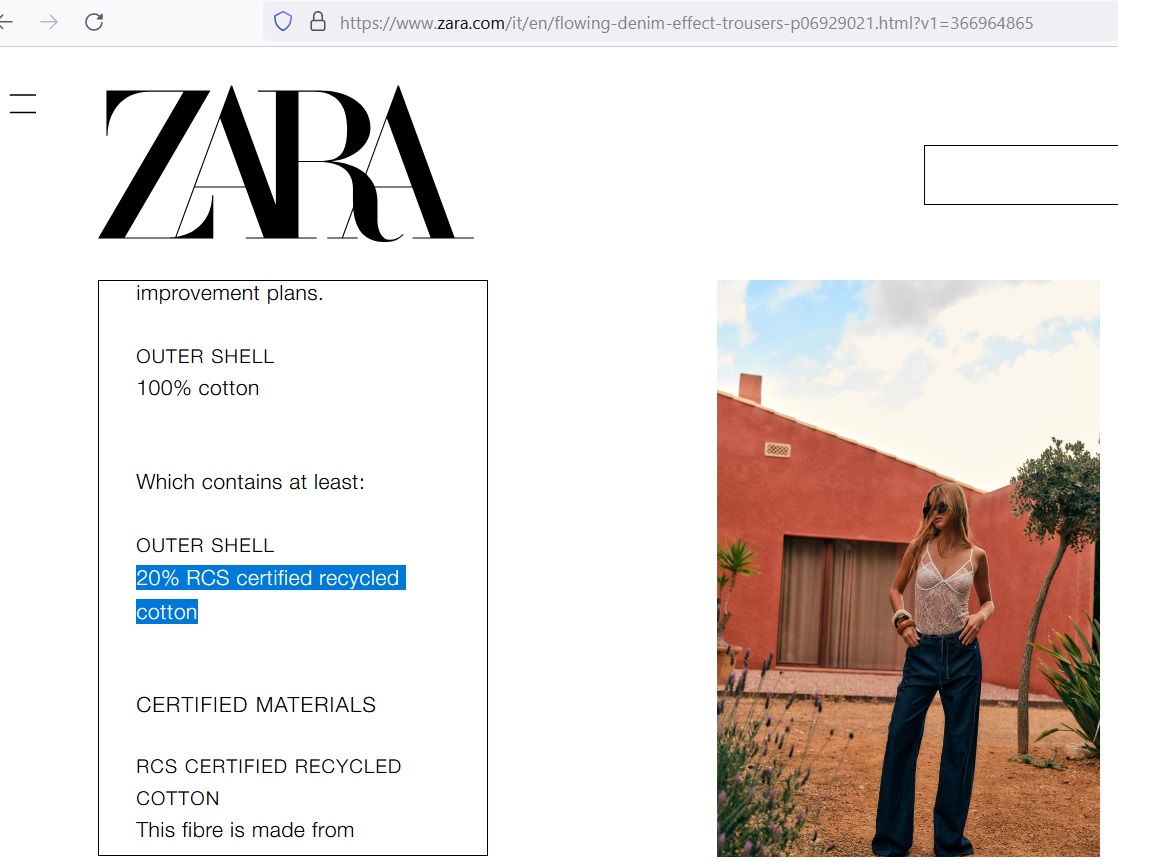
Summary & Key Findings:

With consumers’ growing awareness of the environmental impacts of clothing production and consumption, retailers in Europe (EU) have expressed a heightened interest in selling clothing using recycled textile materials (referred to as “recycled clothing” in this study). For example, fast fashion giants like H&M and Zara and luxury brands such as Hugo Boss have started carrying recycled clothing, aiming to integrate circularity into their product designs and business models.

In the study, we examined retailers’ sourcing strategies for clothing made from recycled textile materials in five European countries, including the United Kingdom (UK), Italy, France, Germany, and Spain. These five countries represent the EU’s largest clothing retail markets, consistently accounting for over 60% of the region’s total apparel sales.

Through an industry source using web crawling techniques and manual verification, 5,000 Stock Keeping Units (SKUs) of clothing items made from recycled textile materials were randomly selected and analyzed. These items were sold by retailers in the UK, Germany, Italy, France, and Spain between January 2021 and May 2023.

The results show that Firist, EU retailers sourced clothing using recycled textile materials from diverse sources, including over 40 developing and developed countries across Asia, America, Europe, and Africa. Second, other than assortment diversity (i.e., the number of color or sizing options for a clothing item), no statistical evidence shows that developing countries had advantages over developed ones regarding product sophistication, replenishment frequency, and pricing for recycled clothing in the five EU markets. Third, a supplying country’s geographic location statistically affects the type of recycled clothing EU retailers import. For example, retailers in the five EU countries typically adopt the following sourcing portfolio by region:

  • Asia: relatively sophisticated clothing items (e.g., dresses and outerwear) targeting the mass and value market.
  • America (North, South, and Central): relatively simple clothing categories (e.g., T-shirts and socks) targeting the mass and value market.
  • Europe: sophisticated clothing categories primarily for the luxury or premium market
  • Africa: relatively simple clothing categories targeting the premium market

The findings offered new insights into the business aspects of recycled clothing, particularly regarding its intricate supply chains and leading suppliers. The study’s results have several additional important implications.

First, while existing studies often suggest “local for local” textile recycling, the study’s findings revealed promising global sourcing opportunities for clothing using recycled textile materials. Particularly, leveraging a diverse sourcing base would allow EU retailers to take advantage of each supplying country’s unique production strength regarding product categories and assortment features and more efficiently balance various sourcing factors ranging from costs and flexibility to speed to market. Meanwhile, the study’s findings indicate that many countries worldwide have begun producing and exporting clothing using recycled textile materials, and the sourcing options and capacities will hopefully continue to grow.

Second, according to the study’s findings, unlike the patterns of making regular garments using virgin fiber, low-wage developing countries demonstrated no noticeable competitive edges over developed economies regarding producing and exporting clothing using recycled textile materials. Instead, developed economies, including many high-wage Western EU countries, emerged as top suppliers and leading sourcing destinations for recycled clothing. Thus, expanding clothing production using recycled textile materials presents an exciting economic opportunity with a promising future in developed countries, where many have plans to revitalize the domestic manufacturing sector and establish a sustainable circular economy.

Third, building on the previous point, the sustained commitment of fashion brands and retailers to carry more clothing made from recycled textile materials in their product assortment could hold significant implications for the future landscape of global apparel trade and sourcing patterns. For example, whereas apparel products are predominantly exported from developing to developed countries today, more trade flows could occur between developed economies in the future, attributed to their increasing production capacity and growing demand for clothing using recycled textile materials. Similarly, major apparel exporters in Asia, such as China and Bangladesh, might assume a less dominant role as a sourcing base for recycled clothing due to their insufficient infrastructure for efficiently sorting used clothing and generating high-quality recycled textile materials.

By Leah Marsh and Sheng Lu

Discussion questions proposed by FASH455:

#1 How might EU fashion companies’ sourcing strategies change as they increase carrying clothing made from recycled textile materials?

#2 Could the US emerge as a leading sourcing destination for clothing made from recycled textile materials? What are the potential advantages and disadvantages?

#3 Is expanding clothing made from recycled textile materials the right approach to achieve fashion sustainability? What is your thought?

Outlook 2024–Key Issues to Shape Apparel Sourcing and Trade

In December 2023, Just-Style consulted a panel of industry experts and scholars in its Outlook 2024–what’s next for apparel sourcing briefing. Below is my contribution to the report. Welcome any comments and suggestions!

What’s next for apparel sourcing?

Apparel sourcing is never about abrupt changes. However, fashion companies’ sourcing practices, from their crucial sourcing factors and sourcing destinations to operational priorities, will gradually shift in 2024 in response to the evolving business environment.

First, besides conventional sourcing factors like costs, speed to market, and compliance, fashion companies will increasingly emphasize flexibility and agility in vendor selection. One driving factor is economic uncertainty. For example, according to leading international organizations such as the World Bank and the International Monetary Fund (IMF), the world economy will likely grow relatively slowly at around 2.6%-3% in 2024. However, it is not uncommon that the economy and consumers’ demand for clothing could perform much better than expected. This means companies need to be ready for all occasions. Likewise, geopolitical tensions, from the Russia-Ukraine war and the US-China decoupling to the military conflict in the Middle East, could cause severe supply chain disruptions anytime and anywhere. Thus, fashion companies need to rely on a more flexible and agile supply chain to address market uncertainties and mitigate unpredictable sourcing risks.

Secondly, it will be interesting to watch in 2024 to what extent fashion companies will further reduce their exposure to China. On the one hand, it is no surprise that fashion companies are reducing finished garments sourcing from China as much as possible. However, fashion brands and retailers also admit that it is difficult to find practical alternatives to China in the short to medium terms regarding raw textile materials and orders that require small runs and great variety. Meanwhile, investments from China are flowing into regions considered alternative sourcing destinations, such as the rest of Asia and Central America. These new investments could complicate the efforts to limit exposure to China and potentially strengthen, not weaken, China’s position in the apparel supply chains. And stakeholders’ viewpoints on “investments from China” appear even more subtle and complicated.

Third, regulations “behind the borders” could more significantly affect fashion companies’ sourcing practices in 2024, particularly in sustainability-related areas. While sustainability is already a buzzword, fashion companies must deal with increasingly complex legal requirements to achieve sustainability. Take textile recycling, for example. The enforcement of the Uyghur Forced Labor Prevention Act (UFLPA) on recycled cotton, the US Federal Trade Commission’s expanded Green Guides, the EU’s extended producer responsibility (EPR) program and its strategy for sustainable textiles, and many state-level legislations on textile waste (e.g., California Textile Recycling Legislation) may all affect companies’ production and sourcing practices for such products. Fashion companies’ sourcing, legal, and sustainability teams will need to work ever more closely to ensure “sustainable apparel” can be available to customers.

Apparel industry challenges and opportunities

In 2024, a slow-growing or stagnant world economy will persist as a significant challenge for fashion companies. Without sourcing orders from fashion brands and retailers, many small and medium-sized manufacturers in the developing world may struggle to survive, leaving garment workers in a precarious financial situation. China’s economic slowdown could worsen the situation as many developing countries increasingly treat China as an emerging export market. With shrinking domestic demand, more “Made in China” apparel could enter the international market and intensify the price competition. 

Another challenge is the rising geopolitical tensions and political instability in major apparel-producing countries. For example, while a broad base supports the early renewal of the African Growth and Opportunity Act (AGOA), which will expire in 2025, the reported human rights violations in some essential apparel exporting countries in the region could complicate the renewal process in US Congress. Likewise, even though the Biden administration is keen to encourage fashion companies to expand sourcing from Central America, political instability there, from Nicaragua to Haiti, makes fashion companies hesitant to make long-term sourcing commitments and investments. Furthermore, 2024 is the election year for many countries, from the US to Taiwan. We cannot rule out the possibility that unexpected incidents could trigger additional instability or even new conflict.

On the positive side, it is encouraging to see fashion companies continue to invest in new technologies to improve their operational efficiency in apparel sourcing. Digital product passports, 3D product design, PLM, blockchain, Generative AI, and various supply chain traceability tools are among the many technologies fashion companies actively explore. Fashion companies hope to leverage these tools to improve their supply chain transparency, strengthen relationships with key vendors, reduce textile waste, accelerate product development, and achieve financial returns.

It is also a critical time to rethink and reform fashion education. In addition to traditional curricula like apparel design and merchandising, we need more partnerships between the apparel industry and educational institutions to expose students to the real world. More direct engagement with Gen Z will also benefit fashion companies tremendously, allowing them to understand their future core customers and prepare qualified next-generation talents. 

by Sheng Lu

Exploring US Apparel Brands and Retailers’ Evolving Sourcing Strategies (December 2023)

The full article is here (Just-Style access required). Below are the key findings:

Based on a content analysis of the annual reports of about 30 largest US fashion brands and retailers from 2018 to 2023, this study aims to identify these companies’ most critical evolving sourcing practices, including their sourcing destination adjustment, primary sourcing factors, and emerging sourcing-related “hot topics.” The findings provide critical market intelligence, informing US fashion companies about their peers’ emerging sourcing trends and popular practices. The results show that:

First, maintaining a relatively diverse sourcing base remains common among US fashion companies. Results show that large-size companies today typically source from more than 20 countries. One critical factor behind fashion companies’ sourcing diversification strategies is that no single supplying country is “perfect,” given the increasingly complex sourcing factors. Sourcing diversification allows fashion companies to balance various sourcing factors. For example, according to company #19, “the (sourcing diversification) approach provides us with the greatest flexibility in identifying the appropriate manufacturers while considering quality, cost, timing of product delivery and other criteria.” On the other hand, sourcing diversification enables companies to adapt quickly to market uncertainties and enjoy supply chain flexibility and resilience.

Second, while US fashion companies are not necessarily leaving any particular countries they source from, many have substantially reduced the number of vendors they work with over the past few years. Specifically, out of the 30 fashion companies the study examined, over 60% explicitly mentioned they consolidated their sourcing base at the vendor level from 2017/2018 to 2022/2023, although the degree varied. For example:

  • Company #4, a leading sportswear brand, cut its contracted factories from 363 to 291 (or down 19.8%)
  • Company #6, which owns several jeans and sportswear brands, reduced its contracted factories from 1,000 to around 340 (or down 66%)
  • Company #9, a well-known specialty clothing store, cut its vendors from 800 to 250 (or down 68.8%)
  • Company #26, a specialty clothing store targeting the youth, cut its vendors from 150 to around 119 (or down 20.7%)
  • Company #28, a discount department store, cut its vendors from 3,100 to around 2,800 (or down 9.7%)

Associated with the trend of “country diversification and vendor consolidation,” US fashion companies are increasingly interested in working with “super vendors,” e.g., those with multiple country presence or vertical manufacturing capability. The use of “super vendor” can also be observed in fashion companies’ willingness to give more sourcing orders to their top suppliers. For example, Company #18, a casual and outdoor wear retailer, reduced its vendors from 200 in 2017/2018 to 110 in 2022/2023, but increased the cap of sourcing orders for its top 10 vendors from 40% to 47% over the same period.

Third, regarding the sourcing base, many US fashion companies have intentionally reduced their apparel sourcing from China, given the US-China tariff war, deteriorating bilateral relations, and the forced labor concerns with China’s Xinjiang region (XUAR). Specifically, more than one-third of the examined companies explicitly mentioned their strategy to reduce finished garments sourcing from China. Furthermore, several US fashion companies indicated their “reducing China exposure” strategy would continue, implying China’s market share in the US apparel import market could decrease further.

Nevertheless, even though fewer finished garments are coming from China, US fashion companies admit that China will continue to play a critical role as a textile raw material supplier as no immediate practical alternative is available. For example, Company #20, a specialty clothing chain focusing on trendy and fashionable items, says, “During fiscal 2022, we sourced most of our finished products with partners and suppliers outside the US and we continued to design and purchase fabrics globally, with most coming from China.”

Fourth, in line with trade statistics, US fashion companies consider other Asian suppliers, such as Vietnam, Bangladesh, Cambodia, and Indonesia, as their top choices as China’s alternatives. In comparison, few fashion companies explicitly mentioned moving their sourcing orders from China to Western Hemisphere countries or other regions.

Additionally, regarding emerging “hot topics” related to sourcing:

  • Geopolitics: the deteriorating US-China relations, escalated trade tensions expanded from tariffs to forced labor, and the potential trade disruptions have concerned US fashion companies significantly. Notably, US fashion companies regard sourcing from China as increasingly risky, with the implementation of the Uyghur Forced Labor Prevention Act (UFLPA) in June 2022. For example, according to Company 2, “The Uyghur Forced Labor Prevention Act and other similar legislation may lead to greater supply chain compliance costs and delays to us and to our vendors.”
  • Near-shoring: due to the decoupling and de-risking from the China movement, US fashion companies have begun actively exploring near-shoring sourcing opportunities in the Western Hemisphere, particularly from members of the Dominican Republic-Central America Free Trade Agreement (CAFTA-DR). For example, Company #1, the North American manufacturer, disclosed that “(our) Company relies on a number of preferential trade programs (…) including the Dominican Republic – Central America – United States Free Trade Agreement (CAFTA-DR (…) Collectively, these agreements strengthen US economic relations and expand trade with Central America, the Dominican Republic, and Haiti.”
  • Sustainability and social responsibility: It is noteworthy that aside from climate change and forced labor, which are typically addressed as risk factors, US fashion companies generally hold an optimistic and forward-looking perspective for sustainability, such as new technologies and endeavors toward more sustainable production and sourcing. Terms such as using preferred or recycled materials, supply chain transparency and traceability, and emerging sustainability technologies have been more frequently mentioned in companies’ annual or ESG reports. For example, Company #17 says, “Increase the usage of environmentally preferred materials to comprise 32.6% of the brand’s global materials footprint.” Company #2 adds, “Our goal is to use preferred materials in 100 percent of our products by 2030.” Company #9 states, “We collaborate with suppliers to increase the supply of preferred raw materials.”
  • Supply chain transparency: US fashion companies attach great importance to improving supply chain transparency and traceability. Compared to the past, fashion companies are more willing to invest in new technologies and digital tools, allowing them to map supply chains and achieve sustainability goals more effectively. Related to this, US fashion companies have actively engaged with industry associations and other industry communities outside the company to stay informed about sustainability trends and learn best practices.

By Emily Delaye and Sheng Lu

Note: Welcome to the webinar hosted by the US Fashion Industry Association (USFIA) on Friday, December 15, 2023 at 2:00pm EST, to hear Emily Delaye discuss the study in detail.

FASH455 Exclusive Interview with Jennifer Pisula, Fabric Sourcing Manager at QVC, about Why Fabric Sourcing Matters

About Jennifer Pisula

Jennifer Pisula is a Fabric Sourcing Manager at QVC. Jennifer is also a member of the Cotton Board, appointed by the U.S. Secretary of Agriculture.

Jennifer has over ten years of experience in the corporate retail industry, where she first started her career as a Buyer at Qurate for QVC, buying for brands such as Isaac Mizrahi, Liz Claiborne, and C. Wonder. Given her love for Product Development and Production, Jennifer shifted her career to Sourcing at QVC where she traveled to China, Hong Kong, and Vietnam for factory and mill visits. Jennifer left QVC to be the Sourcing lead for URBN’s Anthropologie Plus line and the lead for Free People Movement Pre-Production and Production. In 2020, Jennifer returned to Qurate to lead the Fabric Sourcing team for QVC, where she manages sourcing & R&D for over 20 brands, working on both celebrity and core private label brands. Jennifer also works part-time as an Adjunct Professor at Immaculata University, where she teaches Textiles and Fashion Portfolio Development. In addition to her professional positions,

Jennifer Pisula graduated from the Textiles, Fashion Merchandising and Design M.S. program from the University of Rhode Island & earned a B.S. in Fashion Merchandising from Mercyhurst University.

The interview was conducted by Leah Marsh, a graduate student in the Department of Fashion and Apparel Studies at the University of Delaware. Leah’s research focused on​​ exploring EU retailers’ sourcing strategies for clothing made from recycled textile materials and fashion companies’ supply chain and sourcing strategies.

The interview is part of the 2023 Cotton in the Curriculum program, supported by Cotton Incorporated, to develop open educational resources (OER) for global apparel sourcing classes.

Understand the Evolving Production and Trade Patterns of Textiles and Apparel “Made in Asia”: Discussion Questions from Students in FASH455

Students in FASH455 have proposed the following discussion questions based on the videos about the state of textile and apparel in Asia. Everyone is welcome to join the online discussion. For FASH455 students, please address at least two questions and mention the question number (#) in your reply.

#1 We have seen all the improvements and “upgrading” Vietnam has made toward the fashion industry. What can the garment industry in other countries take away from Vietnam’s experiences?

#2 Is Asia’s highly integrated apparel supply chain unique to the region? Can the Western Hemisphere “copy” Asia’s model?

#3 How can Asia’s textile and apparel industry balance the growing demand for sustainability and the need to remain cost-competitive? What innovative strategies can be adopted to achieve this balance?

#4 As Asian textiles and apparel factories continue to improve their efficiency and expand product offers, will it be beneficial for the US to reach a trade agreement with Asian countries? Or do you believe such an agreement might contradict the goals we try to achieve from CAFTA-DR?

#5 Will Vietnam eventually become the next China, or could its labor shortages be a significant barrier preventing its textile and apparel industry from advancing to the next level?

#6 Should textile and garment factories in Asia make more efforts to appeal to the younger generation (e.g., Gen Z)? Or is automation the solution?

#7 To what extent do you think Asian apparel exporting countries (e.g., Bangladesh, Vietnam and Cambodia) will reduce their dependence on textile raw materials supply from China due to the Uyghur Forced Labor Prevention Act (UFLPA)? Or, instead, do you think Asian apparel-exporting countries other than China benefit from UFLPA?

#8 The video shows that Asian countries have begun to invest heavily in new production capacities for textile recycling. Do you believe the region will continue to dominate textile and apparel production in the era of fashion circularity? Or will the emergence of textile recycling shift the world textile and apparel trade patterns in the long run?

FASH455 Exclusive Interview with Beth Hughes, Vice President of the American Apparel and Footwear Association (AAFA), about US apparel sourcing from Central America

About Beth Hughes

Beth Hughes serves as the Vice President of the American Apparel and Footwear Association (AAFA), responsible for supporting the association’s efforts on international trade and customs issues. Beth oversees AAFA’s Trade Policy Committee, as well as AAFA’s Customs Group. Beth is also the spokesperson of the Coalition for Economic Partnership in the Americas (CEPA), a group of prominent American companies, and manufacturers committed to advancing regional trade and employment opportunities in the Western Hemisphere.

Before joining AAFA, Beth served for six years as senior director of international affairs at the International Dairy Foods Association. Beth earned a Bachelor of Arts degree in political science at George Washington University and received a Master of Arts in international affairs from Florida State University.

The interview was conducted by Leah Marsh, a graduate student in the Department of Fashion and Apparel Studies at the University of Delaware. Leah’s research focused on​​ exploring EU retailers’ sourcing strategies for clothing made from recycled textile materials and fashion companies’ supply chain and sourcing strategies.

The interview is part of the 2023 Cotton in the Curriculum program, supported by Cotton Incorporated, to develop open educational resources (OER) for global apparel sourcing classes.

FASH455 Exclusive Interview with Julia Hughes, President of the United States Fashion Industry Association about the Latest US Apparel Sourcing Trends

About Julia K. Hughes

Julia K. Hughes is President of the United States Fashion Industry Association (USFIA), which represents brands, retailers, importers, and wholesalers based in the United States and doing business globally. She represents the industry in front of the U.S. government as well as international governments and stakeholders, explaining how fashion companies create high quality jobs in the United States and economic opportunities around the world.

An expert on textile and apparel trade issues, Julie has testified before Congress and the Executive Branch. She frequently speaks at international conferences including the China & Asia Textile Forum, Fashion Institute of Technology (FIT), Harvard University’s Bangladesh Development Conference, MAGIC, Prime Source Forum, Vietnam Textile Summit, and others.

Julie served as the first President and is one of the founders of the Washington Chapter of Women in International Trade (WIIT) and is one of the founders of the WIIT Charitable Trust. She also was the first President of the Organization of Women in International Trade (OWIT).  In 1992, she received the Outstanding Woman in International Trade award and in 2008, the WIIT Lifetime Achievement Award. She also is a member of the International Women’s Forum.

Julia has an M.A. in International Studies from the Johns Hopkins School of Advanced International Studies and a B.S. in Foreign Service from Georgetown University.

The interview was conducted by Leah Marsh, a graduate student in the Department of Fashion and Apparel Studies at the University of Delaware. Leah’s research focused on​​ exploring EU retailers’ sourcing strategies for clothing made from recycled textile materials and fashion companies’ supply chain and sourcing strategies.

The interview is part of the 2023 Cotton in the Curriculum program, supported by Cotton Incorporated, to develop open educational resources (OER) for global apparel sourcing classes.

Technical Design and Apparel Sourcing: FASH455 Exclusive Interview with Emma Zuckerman (UD & FASH BS16), Technical Designer at Nike

About Emma Zuckerman

Emma Zuckerman, a New Jersey native, graduated from the University of Delaware in 2016 with a degree in Apparel Design. During her time at UD, she actively participated in the FASH program and engaged in extracurricular activities related to her major. Emma conducted research on functional fashion with Dr. Martha Hall and held positions on the executive board, eventually becoming the President of Synergy Fashion Group in her senior year. She also founded a club dedicated to creating adaptive garments for children with disabilities. After graduation, Emma commenced her career in technical design with Under Armour (UA), accumulating six years of experience across various apparel categories and fabrications. She began in youth basketball, then transitioned through a range of products, from underwear to seamless leggings, woven jackets, and pants. In her later years at Under Armour, she played a significant role in the launch of Curry Brand and the introduction of UA’s first inline women’s basketball apparel line (non-uniform). Presently, Emma holds the position of Senior Technical Designer at Nike, where she contributes to the development of ACG and Nike SB product lines.

In her free time, Emma loves working on personal sewing, patterning, and draping projects. She also loves hiking, skateboarding, baking, swimming, and painting!

Disclaimer: The views expressed in this interview are those of Emma Zuckerman and do not reflect the views or positions of her employer or any affiliated organizations.

Sheng: What does a technical designer do? Can you walk us through your typical day as a technical designer? Also, what makes you love your job?

Emma: Technical designers work on developing clothing – we work with factory partners to take a style from a conceptual sketch to bulk production. For each style, we start by working with our design partners to understand their vision. We create detailed construction sketches, measurement charts, and sometimes original patterns, then compile those into a tech pack along with our designer’s garment sketch and a Bill of Materials outlining all garment components. A factory partner uses the information in that tech pack to make a sample to send back to us. We fit that sample with our team, cutting and pinning until we achieve the desired fit and aesthetic. The factory uses our feedback to create a second sample, and this process repeats until the style is finalized and approved for production. Throughout the process, we keep the tech pack up-to-date and ensure it accurately reflects the style we’re developing.

There are so many things I love about my job! The subjects of fitting and patterning are fascinating to me, and there will always be so much to learn about them. I love that throughout my career, there will be no limit to how much I can learn and how much my skills can grow. I exercise my creativity while also exercising the mathematical side of my brain, so my job is constantly challenging me in really interesting ways. I get to work with people around the world, learn about other cultures, backgrounds, and communication styles, and collaborate with amazingly talented teammates.

Sheng: How does a technical designer get involved in a fashion company’s sourcing process?

Emma: A technical designer’s level of involvement in the sourcing process varies from company to company, but it is always extremely helpful to work closely with our sourcing team. Since both technical designers and the sourcing team communicate with factories, we often check in with each other to make sure the information we’re sending is consistent. We (technical designers) can help provide feedback on factory capabilities and sample quality. Understanding the sourcing process helps us gain insight into why our sourcing partners allocate certain styles to specific factories (for example, a factory might have expertise with woven fabrics, outerwear, or embroidery; a style might qualify for a lower duty rate if sourced from a specific region; some factories may reach their maximum capacity for new styles more quickly than others).

Technical designers work most closely with our sourcing partners during costing conversations. Factories send cost sheets for every style at several key points during development. These cost sheets break down every element that contributes to the final cost of making the garment, from materials to trims, to time spent.  One major role of a sourcing partner (or, at some companies, a product developer) is to process these cost sheets and advise the rest of the team on how much cost needs to be saved, and/or what steps can be taken to save cost, to ensure the style is profitable. Technical designers can use our garment construction and patterning expertise to effectively contribute to these conversations (which leads nicely into the next question)!

Sheng: We know production cost is a critical sourcing factor for fashion brands and retailers. From a technical designer’s perspective, what factors affect garment production and its sourcing costs? What strategies can be employed to manage these costs, beyond labor wages?

Emma: So many factors affect production cost – at the top of my mind are material cost (for fabric yardage and individual trims like zippers) and cut/make time (which includes labor cost and factory overhead). Material usage and cut/make time are both factors that technical designers can heavily influence during costing conversations with our design and sourcing teams. 

Material usage: Marker efficiency refers to the amount of fabric used per garment compared to the amount wasted. The more closely pattern pieces can fit together, the less space for fabric scraps between them and the more efficient a marker will be. A technical designer can use their patterning experience to advise pattern shapes that will contribute to marker efficiency. For example, adding or removing a seam may allow pattern pieces to fit more closely together. Choosing where and when to engineer print placements – for example, matching stripes across a seam – will also impact the way pattern pieces can be arranged and, therefore, how efficient a marker can be. An efficient marker will both save cost and minimize fabric waste.

More on material usage, and cut/make time: Each construction choice contributes to the final cost of making the garment. For example, when it comes to finishing seam allowances, binding a seam allowance will take longer and use more material than an overlock stitch. For that reason, binding a seam allowance will also be more expensive. As garment construction experts, we lead conversations about style details, the time it will take to construct them, and other options that could potentially save time and material. This helps our team make informed choices that consider both cost and aesthetics.

Sheng: What are your thoughts on the trend of fashion companies using more sustainable materials like recycled cotton in their products?

Emma: I support fashion companies making an effort toward more sustainable & ethical production, and using recycled materials is an important step. Fabric with recycled fiber content can be more expensive and more difficult to source than traditional fabric, which may discourage some companies from moving in that direction. I’m hopeful that this trend will continue and that as it gains popularity, fabric with recycled fiber content will become easier to source over time.

Speaking of ethical production, I also would like to see fashion industry brands take additional steps toward a more earth-positive and people-positive existence, including:

  • Considering local labor laws, worker wages, and working conditions when selecting factories
  • Implementing garment repair programs to extend the lifecycle of their styles
  • Improving accuracy of demand planning to reduce excess inventory and/or considering donation or upcycling of excess inventory
  • Expanding size ranges and accurately grading sizes to fit well on plus-sized consumers
  • Moving away from gendering clothing as “men’s” or “women’s;” during sample development, checking that samples fit well on lots of body types (including individuals who have had gender-affirming care, individuals who haven’t, individuals who may be wearing gender affirming garments like binders)
  • Diversifying the company workforce at every level, from entry-level to leadership to c-suite
  • Expanding representation in advertising campaigns to reflect the diversity of global consumers
  • Supporting nonprofit agencies whose work aligns with company values

Some companies are doing a great job of fulfilling some, most, or all of the items on my above wish list, but we know that the fashion industry has a long way to go when it comes to impacting our earth and our societies positively. I think it’s our job as newer fashion industry professionals to speak up about all of this and start to push our industry in a better direction.

Sheng: What other key industry trends will you closely monitor in 2023?

Emma: I am so interested in the increased use of 2D and 3D patterning software. Programs such as Gerber, Optitex, Clo, and Browzwear are already changing the design and development process in fascinating ways. Experience in any of these programs has already become a very valuable asset for job applicants. I’m curious whether garments will ever be sold to consumers based only on 3D renderings, and if body scanning will become a more mainstream part of the shopping process.

I’m also curious how the increased use of 2D and 3D patterning software will impact more traditional design processes, like paper patterns and draping. Will these arts be preserved? Are there types of apparel that will always need to be draped or patterned physically? Will students 20 years from now still learn to pattern and drape the way we did, or will these skills be fully computer-based?

Sheng: Any reflections on your experiences at UD and FASH? what advice would you offer current students preparing for a career in fashion after graduation?

Emma: I feel so lucky to have had the experience that I did at UD and within the FASH program. I learned so much in my patterning, draping, collections, textiles, and sourcing classes (big shoutout to Dr. Lu!) that has stayed with me and helped me find success in my current job.

I have so much advice! If you’re looking for a career in technical design, practice any patterning software you can access as much as you can. As you begin applying to jobs, try to reach out to contacts at the companies you’re applying to (even if it means sending a random LinkedIn message to a fellow UD grad, or asking a professor/another student to help connect you with someone). Start your career with curiosity and an open mind – you will learn so much on the job that isn’t covered in school. Try to find a mentor, or several mentors, who’ve had work experiences similar to yours. A mentor who you can trust and rely on for advice makes a huge difference when work gets challenging. Speaking of which – work does get challenging, and that’s okay! Work on learning to identify situations that you can work through and learn from (which are hugely beneficial to your personal growth and career development), compared to work environments that are more consistently unhealthy or not providing what you need (which are an indication that it’s time to make a change). If you have coworkers you trust, sharing salary information openly is a great way to make sure everyone’s skills and contributions are being valued appropriately.

Enjoy your time in college and in the FASH program. I miss it!

–The END–

Patterns of US Apparel Imports (Updated September 2023)

First, while US apparel imports gradually recovered, the import demand remained weak overall. For example, US apparel imports in July 2023 increased by 0.9% in value and 2% in quantity from June (seasonally adjusted). However, the trade volume still experienced a decrease of approximately 17-18% compared to the previous year. Meanwhile, the US consumer confidence index fell again in August 2023, suggesting the economic uncertainties are far from over. Notably, so far in 2023 (January to July), US apparel imports decreased by 22.3% in value and 28% in quantity from the previous year, the worst performance since the pandemic.

As a silver lining, the price of US apparel imports has stabilized, although inflation remains an issue for the US economy.  

Secondly, because of the seasonal pattern, Asian countries were able to capture relatively higher market shares since June. For example, measured in value, China, ASEAN, and Bangladesh accounted for over 64% of total US apparel imports in July 2023, a notable increase from 61% in June and 58% in May 2023.

Nevertheless, US fashion companies continue diversifying their sourcing base to mitigate various supply chain risks and rising geopolitical tensions. For example, the HHI Index for US apparel imports dropped to 0.097 in the first seven months of 2023, which is lower than the 0.106 recorded in the same period the previous year (January to July 2022), indicating a greater diversity in the sources of imports.

Third, despite an apparent rebound in exports to the US, China continued to experience a further decline in its market share. For instance, in July 2023, China’s market share was more than 3 percentage points lower in value (27.2% in July 2022 vs. 24.1% in July 2023) and 2.5 percentage points lower in quantity (43.1% in July 2022 vs. 40.6% in July 2023). This marked the worst performance since April 2023. In other words, consistent with recent industry surveys, US fashion companies continue to reduce their China exposure given the adverse business environment.

Fourth, the latest data suggests that US apparel imports from CAFTA-DR members remain stagnant, and some critical problems, such as the underutilization of the agreement, even worsened. For example, about 9.5% of US apparel imports in value and 8.5% in quantity came from CAFTA-DR members in July 2023, lower than 10.2% and 9.0% in the previous year (i.e., July 2022). In absolute terms, US apparel imports from CAFTA-DR in 2023 were about 20% lower than in 2022.

Additionally, CAFTA-DR’s utilization rate (i.e., the value of imports claiming the duty-free benefits under CAFTA-DR divided by the total value of imports from CAFTA-DR) fell from 70.2% in 2022 (Jan to July) to a new low of 69.2% in 2023 (Jan to July). Likewise, the value of imports utilizing CAFTA-DR’s short supply decreased by more than 20%. Thus, how to leverage CAFTA-DR to meaningfully encourage more US apparel imports from the region, particularly in light of US fashion companies’ eagerness to reduce their exposure to China, calls for sustained efforts and probably new strategies.

by Sheng Lu
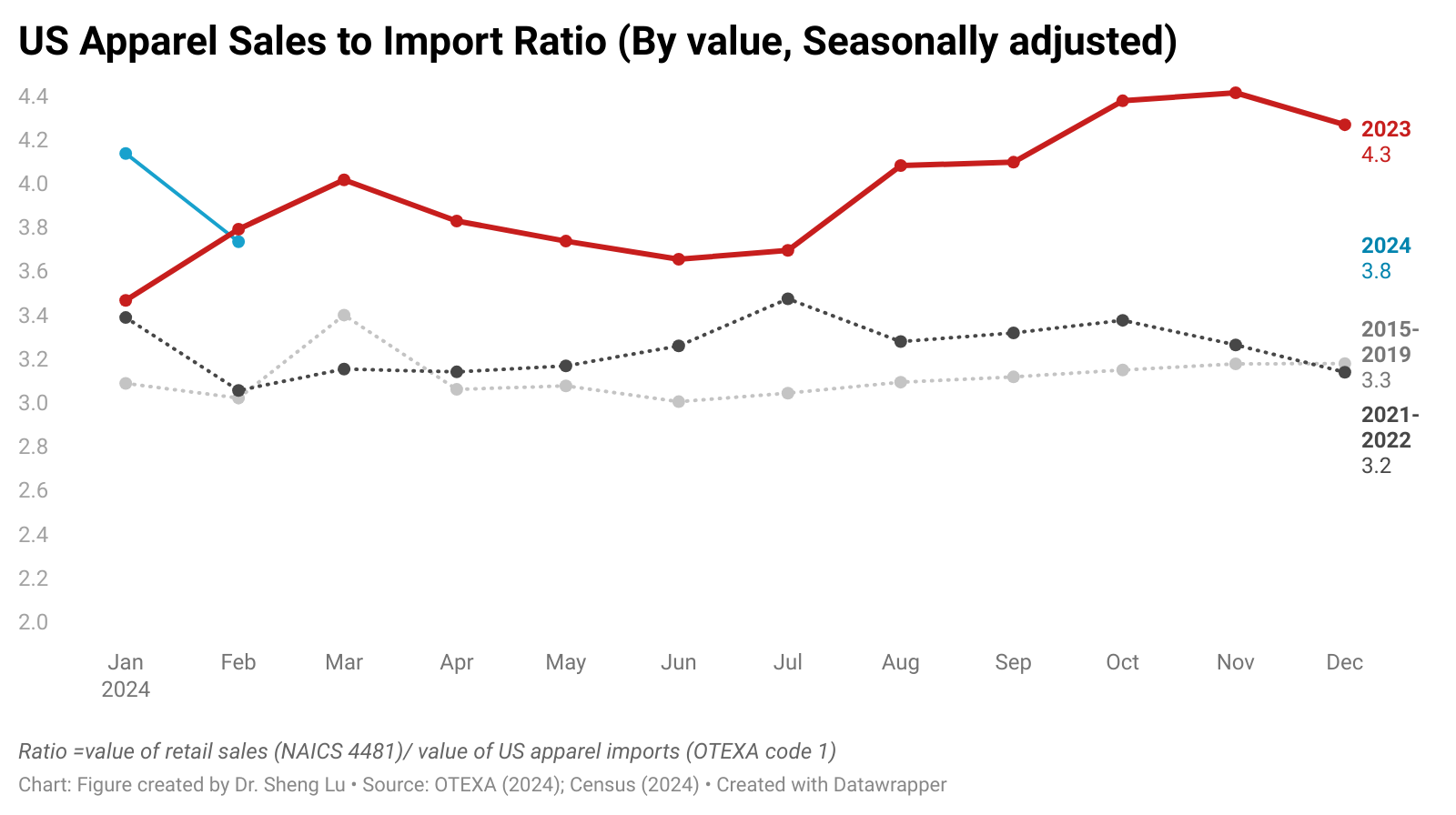
Primark’s Global Sourcing for Apparel (Updated September 2023)

Primark’s sourcing strategies

According to Primark, it does not own any factories but sources all apparel products from contracted factories. Any contracted factory that manufactures products for Primark must meet internationally recognized standards before receiving the first sourcing order.

As of October 2022, Primark sourced from 883 contracted factories in 26 countries (note: it was a slight decline from 928 contracted factories in 28 countries as of May 2021). Of these factories, 85.5 percent were Asia-based because of the region’s massive production capacity and a balanced offer of various sourcing factors, from cost, speed to market, and flexibility to compliance risks.

Like many other EU-based fashion companies, near-shoring from within the EU was another critical feature of Primark’s sourcing strategies. About 14 percent of Primark’s contracted garment factories were EU-based (including Turkey).

Measured by the number of workers, Primark’s Asian factories were larger than their counterparts in other parts of the world. For example, while Primark’s factories in Pakistan and Bangladesh typically have more than 2,500+ workers, its factories in Western EU countries like the UK, Germany, Italy, and France, on average, only have 64-200 workers. This pattern suggests that Primark mainly uses Asian factories to fulfill volume sourcing orders, and its EU factories mainly produce replenishment or more time-sensitive fashionable items.

Meanwhile, similar to the case of other retailers like PVH, Primark’s contracted garment factories in China were smaller than their peers in the rest of Asia. For instance, while over 90% of Primark’s garment factories in Bangladesh employ more than 1,000 workers, around 43% of their contracted factories in China have fewer than 100 workers. This pattern suggests Primark could use China as an apparel sourcing base primarily for orders requiring greater flexibility and agility and those involving a wider variety of products but in smaller quantities.

Further, reflecting the unique role of the garment industry in creating economic opportunities for women, females account for more than half of the workforce in most garment factories that make apparel for Primark. The percentage was exceptionally high in developing countries like Tunisia (94%), Morocco (91%), Pakistan (69%), Sri Lanka (69%), Myanmar (64%), India (62%), and Vietnam (59%).

According to Primark (as of September 2023), its Ethical Trade and Environmental Sustainability team comprises over 120 specialists based in key sourcing countries. The team conducts around 3,000 supplier audits a year to monitor compliance (i.e., fair pay, safety, and healthy working conditions.) Additionally, Primark says its factories were in line with the company’s environmental code of conduct, and the company “donated any unsold merchandise to the Newlife Foundation in Europe and KIDS/Fashion Delivers in the US.

by Sheng Lu
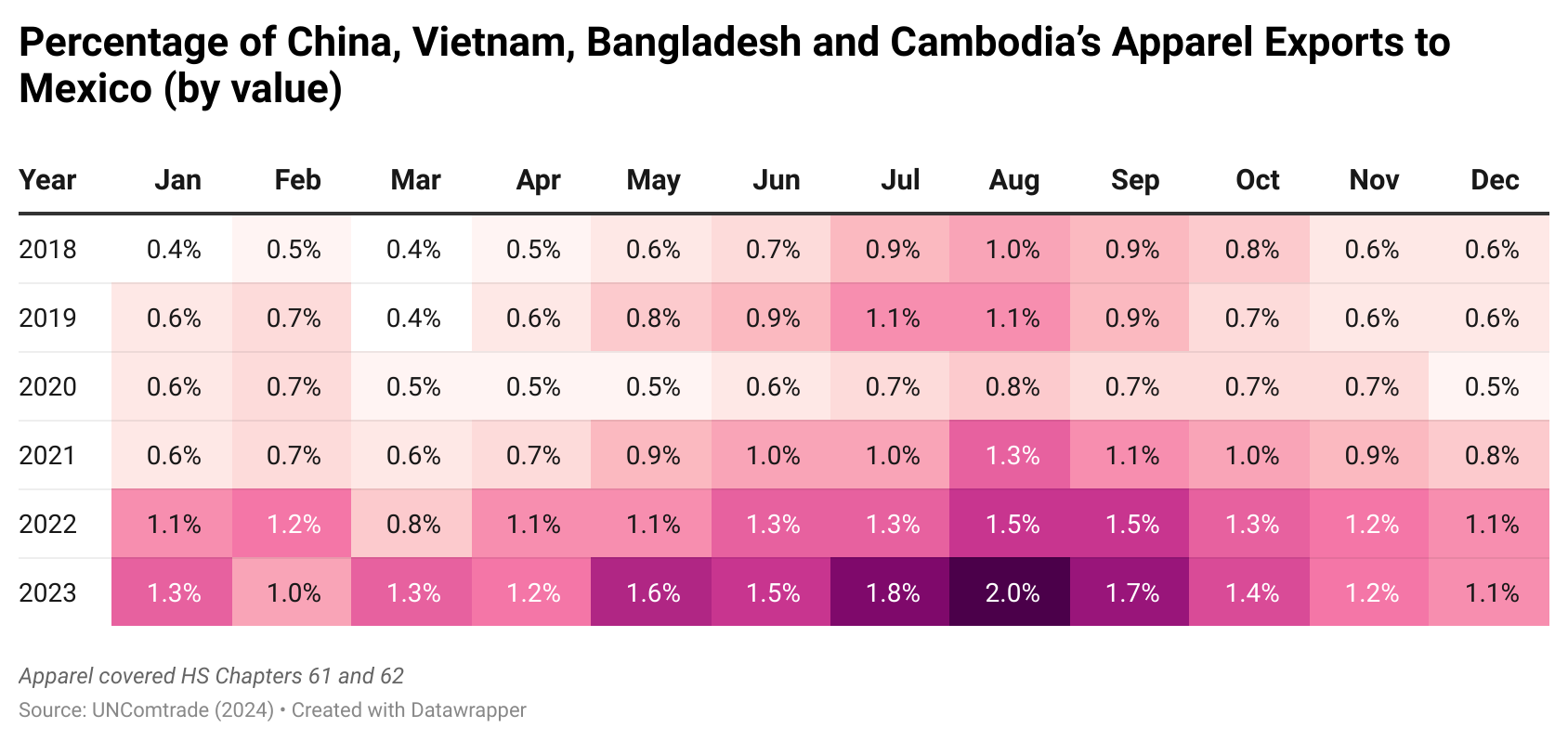
Discussion questions:

What are the unique aspects of Primark’s apparel sourcing strategies? What role does sourcing play in supporting Primark’s business success? Any questions or suggestions for Primark regarding its sourcing practices?

Video Discussion: Why China’s Banned Cotton Keeps Sneaking Into U.S. Supply Chains (WSJ)

Discussion questions: What factors contribute to the complexity of eliminating banned Xinjiang cotton from the apparel supply chain? How can the current efforts be enhanced to better address the situation and by whom? Feel free to share any other reflections on the video and the graphs.

Further reading:

FASH455 Industry/Internship Stories—Hannah Laurits, Haddad Brands

Hannah Laurits (second from the right) worked as a sourcing intern for Haddad Brands in New York City in the summer of 2023. In the picture, Hannah was visiting the company’s world class distribution center in New Jersey.

About Hannah Laurits

Hannah Laurits is a master’s student in the Department of Fashion and Apparel Studies (FASH) at the University of Delaware (UD). She also received her B.S. from UD & FASH with a double major in apparel design and fashion merchandising and management.

Hannah is passionate about adaptive clothing and making the fashion industry more inclusive and sustainable. She has participated in several related research projects, including working at UD’s Health and Innovation Lab and designing adaptive clothing for children with Down syndrome. Hannah’s master’s thesis explores U.S. retailers’ merchandising and business strategies for adaptive clothing. As a graduate instructor, Hannah teaches FASH133 (Foundations for Fashion Innovation), an important foundational course for FASH freshmen. Hannah is the recipient of the 2023 International Textiles and Apparel Association (ITAA) Sara Douglas Fellowship in recognition of her academic excellence and accomplishments.

During the summer of 2023, Hannah had the exceptional opportunity to work as a sourcing intern for Haddad Brands in New York City. Below, she shared her reflections on this incredible internship experience.

Question: What does a typical day look like during your sourcing internship with Haddad?

Hannah: Each day, I would enter Haddad’s beautiful Manhattan office and make my way up to my desk on the 10th floor, which was home to the design and sourcing departments. I had the opportunity to sit next to my mentor and assist her in her day-to-day tasks as a Fabric and Trim Research &Development (R&D) Manager. This often consisted of maintaining fabric/trim development digital and physical libraries, creating new fabric swatch headers, entering fabric/trim data in PLM, partnering with Product Development to establish fabric and trim codes for PLM, and analyzing new fabric developments. I also assisted in collaborating and developing fabrications, finishes, and trims with our supply chain by communicating feedback via internal emails.

One thing that  I really enjoyed was that each day consisted of working cross-functionally with the different teams. I helped prepare for and sit in on weekly fabric/trim development status meetings with the various Design teams where fabric/trim developments for the upcoming seasons were discussed and designers would make new fabric requests for their added styles. I also sat in on bi-weekly fabric/trim development status meetings with the Product Approval team to ensure the fabric samples from mills were up to standard for development. Here, I was able to help weigh in on fabrics and compare them to our standards to determine if they met our requirements or if they needed to be changed and how. Additionally, some days included meetings with various suppliers to discuss innovations in fiber, fabric, finish, and trim.

Being part of an internship that enabled me to perform meaningful work from day one, provided countless opportunities for personal growth, and exposed me to working with some of the most iconic global brands (e.g., Levi’s) was a truly fulfilling experience.

Question: Any major projects did you work on during your internship? What did you learn from the experiences?

Hannah:Each Haddad Legacy Intern was assigned and worked on a project for their department based upon a real business need. Based on my educational background and my passion for sustainability, my team outlined a project that would best fit. This involved researching innovative sustainable solutions and sourcing practices to further their sustainability efforts.

My research was not only conducted from outside sources but from internal ones as well. I felt an immense amount of support from all of the individuals who helped me accomplish this project and was excited to learn that they also are just as excited about sustainable practices as I am. At the end of the internship, each intern had the chance to present to senior management our individual projects. This experience taught me how to create a visually compelling presentation and relay large amounts of data concisely and effectively.

Question: What insights did you learn about the fashion apparel industry from the internship? For example, the key issues the industry cares about or the challenges it faces.

Hannah:From my internship experience, I was able to see firsthand key topics important to the fashion/apparel industry; specifically, two areas caught my attention.

First, sustainability and social responsibility. Consumers and investors are seeking more sustainable products and better practices from the brands they love. Considering this, sustainability-forward brands are focused on maintaining their high values regarding these areas and keeping their practices aligned with them.

Second, the fashion industry is constantly seeking innovative technology solutions, including in the sourcing and supply chain areas. Technology is evolving faster than ever, helping create efficient solutions to drive the fashion industry forward. Technologies such as 3D printing, AI, laser cutting, and more are being used to improve the industry in various ways such as trend forecasting, supply chain, and consumer experience, just to name a few. Even regarding sustainability, many fashion brands are investing in or actively exploring new technology solutions to help them develop a more sustainable and ethical supply chain and improve sourcing transparency, traceability, and accountability.

Question: How do your learning experiences at FASH help with your internship? Any specific knowledge or skill sets do you find most critical?

Hannah:FASH had a great influence on my decision to pursue a sourcing internship with Haddad Brands. It was through the UD & FASH department’s Fashion Career Meetup that I was able to connect with the amazing HR team at Haddad Brands and learn more about the company.

Specifically, it was FASH455 (Global Apparel Trade and Sourcing) that piqued my interest in the world of sourcing and provided foundational knowledge for my internship. Working in fabric research and development, on a daily basis, I referred back to key concepts from FASH215 (Fundamentals of Textiles I) and FASH220 (Fundamentals of Textiles II) on fiber, yarn, fabric, structures, color, and finish. Additionally, the FASH Social Responsibility and Sustainability certificate courses played a unique role in my experience, helping me bring a sustainability forward perspective into my internship and providing a solid background to further build upon for my internship project.

Furthermore, the FASH department at UD excels at providing students with extensive foundational fashion industry knowledge. Not only is the course curriculum excellent, but so is the faculty who goes above and beyond to help foster student’s education and build critical professional skills.

Question: What’s your plan after graduation?

Hannah:I am currently working on wrapping up my master’s program and am on track to graduate in May 2024. I am seeking a full-time role that allows me to have a hand in developing products that have a positive impact on people and the planet. Potential roles include sustainability, social compliance, sourcing, product development, and product line management related to fashion apparel products. While I am originally from Delaware, I am hoping to relocate to a city on the East Coast such as NYC, Philadelphia, or Baltimore. However, I am open to considering job opportunities and locations beyond this scope. As my graduation approaches, I am eager to begin my career in the fashion apparel industry.

Meanwhile, I am actively seeking winter and spring internship opportunities in the greater Philadelphia area or remote positions to enhance my professional development.

–END—